

![6 AthenaHQ Alternatives That Skip the Credit Math [2026]](/_next/image?url=https%3A%2F%2Fwww.datocms-assets.com%2F164164%2F1778742681-blobid0.png&w=3840&q=75)

Summarize this blog post with:


AthenaHQ built the early case for treating answer engines like a measurable channel. It gives you a clean dashboard for share of voice across ChatGPT, Gemini, Claude, Perplexity, and Copilot. The reason teams shop around isn’t usually the data quality. It’s the math.
The $295/month Self-Serve plan looks fixed but is metered by credits. The ACE Citation Engine, API access, multi-region tracking, and BI integrations live behind the Enterprise wall. And every time you widen your tracked prompt set or pull in another AI engine, you burn through the 3,600 credit allowance faster. Once usage scales, predictability stops.
In this article, you’ll see six AthenaHQ alternatives priced and built differently, what each one is good for, and where Analyze AI fits when you need AI search visibility plus the content production and agent automation that turn insights into shipped pages..
Table of Contents
Why teams start looking past AthenaHQ
Three patterns show up in every “we’re shopping AthenaHQ alternatives” conversation.
The credit ceiling. AthenaHQ’s pricing runs on a consumption model. Tracked prompts, Ask Athena queries, and fan-out analyses all draw from the same 3,600-credit pool. Daily checks across 8 engines empty that pool fast, which means your “$295/month tool” can quietly turn into a $600+ bill.
The locked feature wall. Self-Serve covers one country, no API, no BI, and no ACE Citation Engine. The features people get excited about during the demo usually sit on the Enterprise tier (custom pricing, often quoted at $2,000+/month).
The action gap. AthenaHQ’s Action Center recommends fixes, but you still leave the platform to write, optimize, and ship the page. If your team is two people and a Notion board, you don’t need another dashboard. You need the dashboard, the writer, and the publisher in the same place.
The six tools below address one or more of these problems.
Analyze AI: AI search visibility, content production, and agent automation in one platform
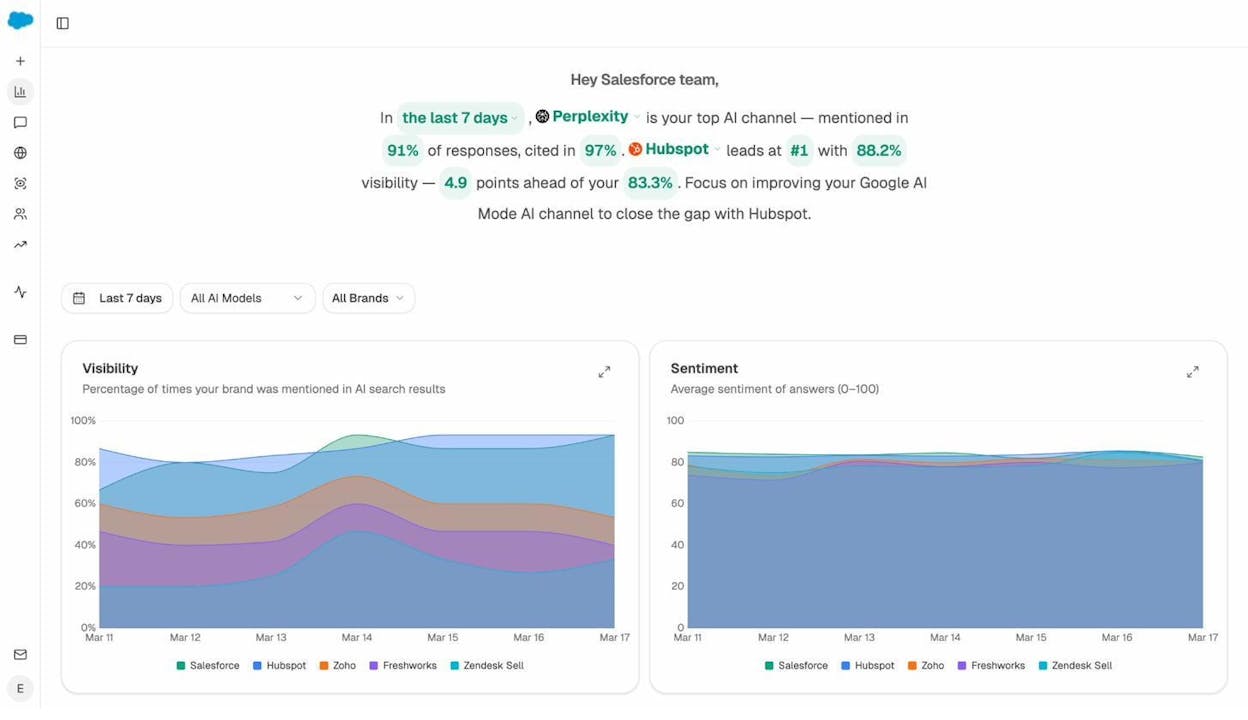
Analyze AI is positioned as an agentic SEO and content platform. The AI search visibility layer is the front door, but it’s not the whole product. Underneath sits a content production pipeline (research, outline, draft, optimize) and an agent builder with 180+ nodes that can pull from GA4, GSC, Semrush, DataForSEO, HubSpot, Notion, WordPress, and your own AI search data.
If AthenaHQ is a measurement dashboard, Analyze AI is the operations layer. You measure, you write, you optimize, and you automate the parts that should run themselves, all in one place.
What you actually get
AI search visibility, without the credit math. Prompt Tracking monitors how your brand shows up across ChatGPT, Claude, Gemini, Perplexity, Copilot, and Google AI Mode. You see visibility percentage, sentiment score, average position, and the competitors mentioned alongside you. The plan ships with a clear prompt allowance instead of a credit pool, so adding a new engine or new prompt doesn’t quietly drain a wallet.
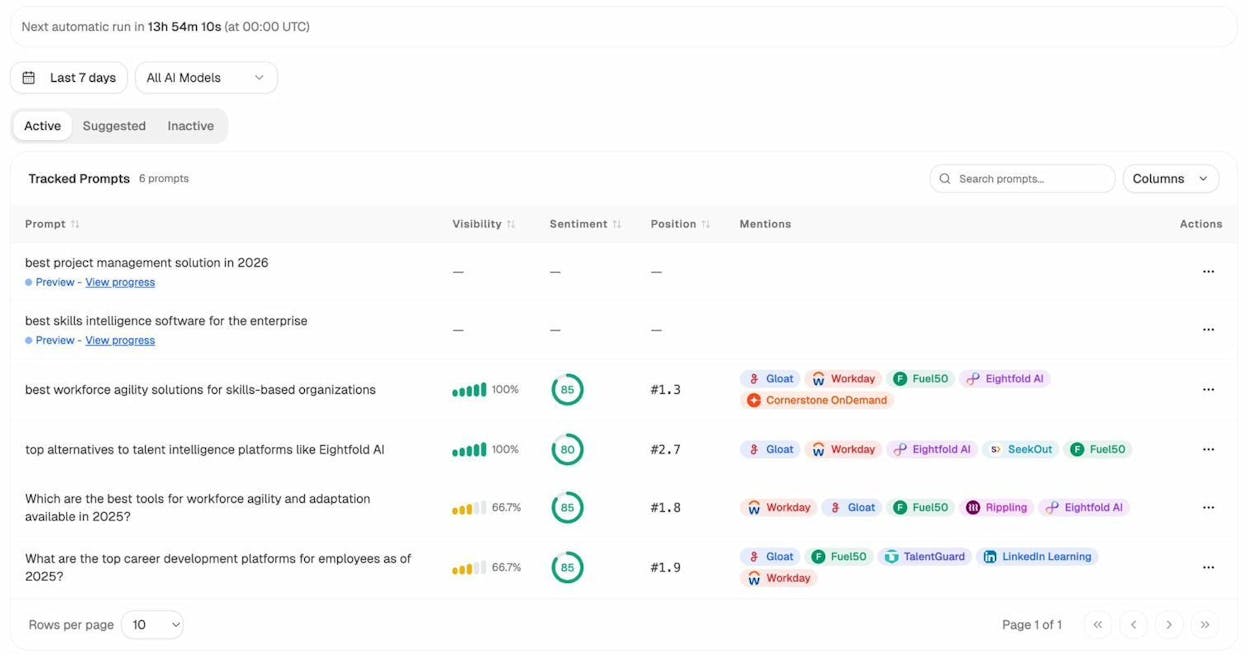
Three ways to research prompts. Tracked Prompts run on a daily schedule. Suggested Prompts surface high-value questions where competitors appear and your brand doesn’t, which is what Prompt Discovery is built for. Ad Hoc searches let you stress-test any new prompt on the spot before deciding whether to track it. Three workflows, one place.
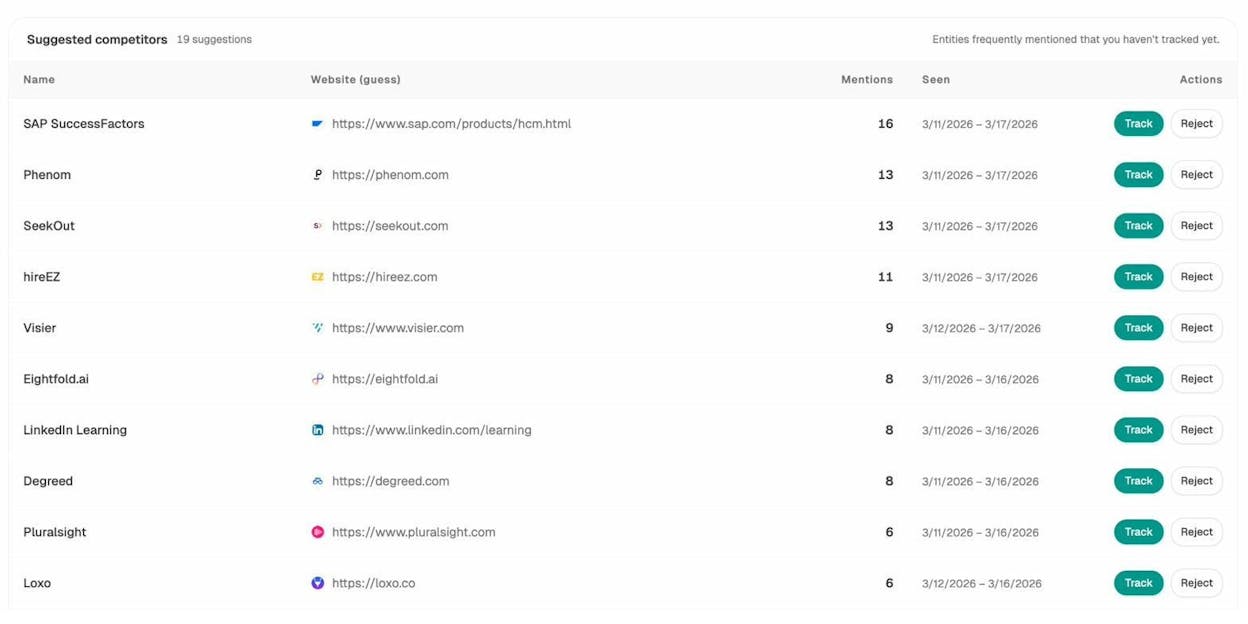
Competitor intelligence that names names. The Competitors dashboard shows share of voice, the prompts where competitors out-cite you, the sources feeding their answers, and the narrative drift over time. AthenaHQ tracks competitors. Analyze AI tells you which page on which competitor domain to write against.
Citation analytics and a Perception Map. Citation Analytics shows which domains AI models pull from when they answer prompts about your category. The Perception Map plots every tracked brand on a presence-versus-narrative-strength quadrant, so you see at a glance who’s winning, who’s drifting, and where there’s room.
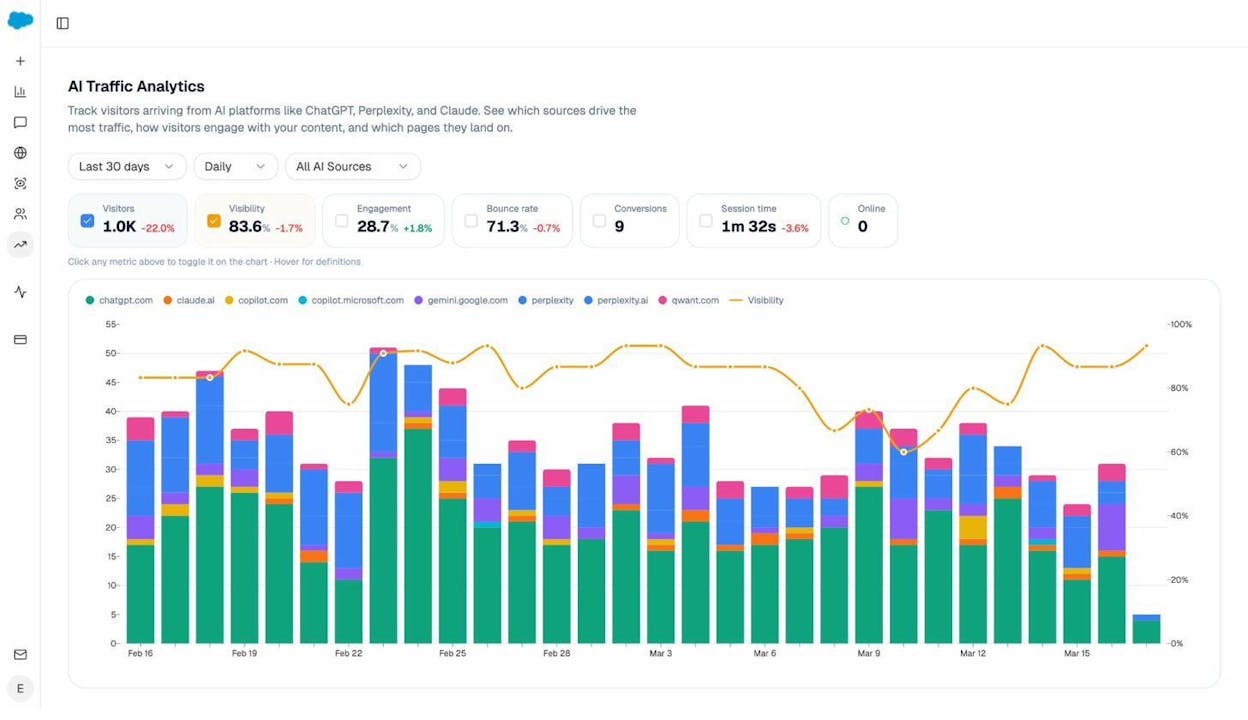
AI Traffic Analytics tied to GA4. This is the layer AthenaHQ leaves to its Shopify integration. Analyze AI connects to GA4 and shows you visitors from ChatGPT, Claude, Perplexity, Copilot, and Gemini, the pages they land on, and how they engage. The Landing Pages report is where this gets useful, since it tells you which pages are already winning AI traffic so you can double down on the patterns that work.
Content Writer and Content Optimizer. This is where the comparison with AthenaHQ stops being close. Content Writer runs a four-step pipeline (idea, structured research, outline, draft). Each step is editable and inherits your brand vault, so the draft sounds like you wrote it. Content Optimizer detects declining pages, identifies gaps against the top-ranked AI citations, and produces a rewrite. Both ship as part of the platform, not an add-on.
Agent Builder. This is the part teams undersell when they describe the platform, so be specific about it.
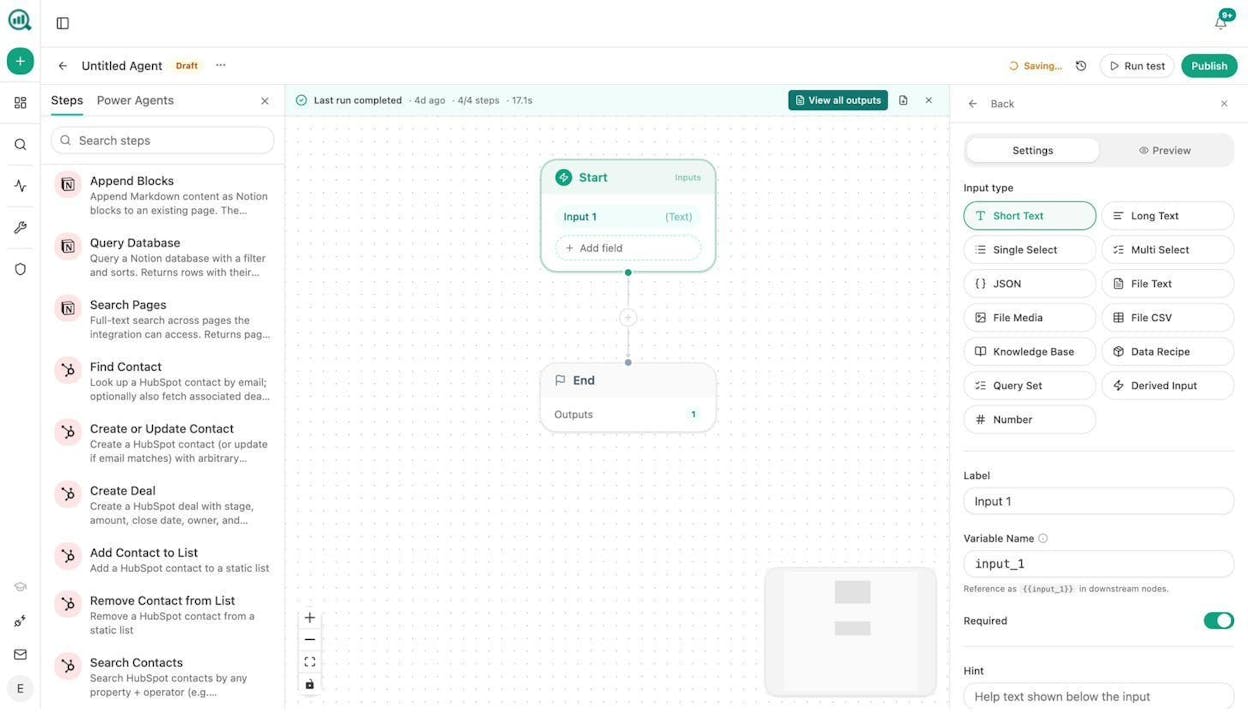
The agent builder is a programmable substrate. You get 180+ nodes, 34 pre-built data recipes, 13 input primitives, and 3 trigger modes (manual, scheduled cron, HMAC-signed webhook). The nodes cover GA4, GSC, Semrush, DataForSEO, HubSpot, Notion, WordPress, Sanity, Contentful, Mailchimp, Hunter, Tomba, YouTube, Exa, and every Analyze AI native (visibility, citations, prompts, brand vault, content writer, content optimizer). Anything you’d otherwise build in Zapier, Make, n8n, or Retool, you can build here, with your AI search and SEO data already in the room.
A few concrete scenarios:
-
Monday board prep. Scheduled agent runs at 7am, pulls the exec one-pager recipe, share-of-voice, GA4 AI traffic, new HubSpot deals, and emails a DOCX summary to your leadership distro. Replaces the four-hour analyst pull every Monday.
-
Content refresh fleet. Weekly schedule, scans GA4 for declining pages, fetches each one, rewrites it with brand-vault injection, runs an AEO scorecard, and pushes the updated post to WordPress only if it passes the threshold.
-
Crisis early-warning. Every 15 minutes, scans brand mentions and news for sentiment drops, and Slacks the PR team with a draft response. You hear about negative coverage before your CEO does.
-
Inbound lead enrichment. Webhook from Typeform fires the agent, runs domain overview + Lighthouse + recent news on the prospect’s site, drops the enriched record into HubSpot, and notifies the AE in Slack.
AthenaHQ has agents for content optimization. Analyze AI’s agent builder operates the marketing function. That’s not the same product category.
Pricing
Analyze AI starts at $99/month with predictable prompt and search allowances instead of a credit pool. The plan tracks the major AI engines on day one. No tier gates the API or BI. Pricing scales with prompt volume and seats, not with how many queries you happened to run last week.
Key features
-
AI Visibility Tracking across ChatGPT, Claude, Gemini, Perplexity, Copilot, and Google AI Mode
-
Prompt Tracking (tracked, suggested, and ad-hoc)
-
Citation Analytics and Engine Breakdown
-
Competitor Intelligence and AI Battlecards
-
Perception Map and AI Sentiment Monitoring
-
AI Traffic Analytics with GA4 integration and Landing Pages report
-
Content Writer (research, outline, draft) and Content Optimizer
-
Agent Builder with 180+ nodes, scheduled and webhook triggers
-
Free tools suite (keyword generator, SERP checker, website authority checker, LLM.txt generator, AI visibility audit)
Pros
-
One platform covers AI search visibility, content writing, content optimization, and end-to-end automation
-
Predictable, prompt-based pricing instead of credit consumption
-
Agent Builder reaches well beyond AI search into the full marketing operations stack
-
Direct GA4 attribution shows which AI engines actually drive sessions and conversions
-
Brand vault keeps every generated piece on voice
Cons
-
The depth of the platform takes a couple of sessions to learn end-to-end
-
Native Slack notifications are still rolling out (webhook routing works today)
Profound: enterprise-grade AI visibility for Fortune 500 teams
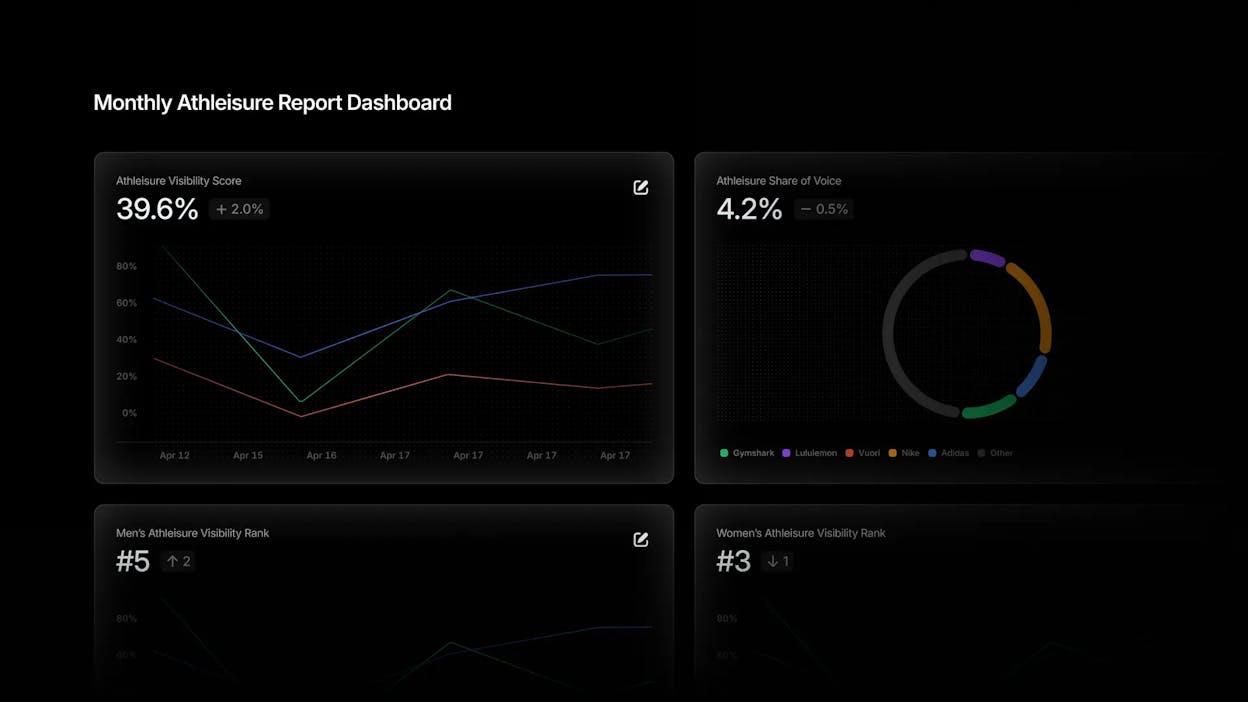
Profound is the well-funded incumbent on enterprise budgets, with $155M raised and Fortune 500 case studies. It’s the platform that buyers stack against AthenaHQ in procurement conversations.
The standout feature is the Conversation Explorer, which shows the actual back-and-forth between users and AI models, broken down by topic. It’s closer to market research than a visibility dashboard, which is exactly what brand teams at large companies need to defend the investment internally.
The catch is access. Profound’s Starter plan is $99/month but only covers ChatGPT. To unlock Perplexity and Google AI Overviews, you move to Growth at $399 or $499/month, depending on quote. The full 10+ engine coverage (Claude, Gemini, Copilot, Meta AI, and the rest) is Enterprise-only, with custom pricing typically in the four-figure-per-month range.
Pros
-
10+ engines on Enterprise plans
-
SOC 2 compliance and procurement-ready security posture
-
Strong analyst story for board-level reporting
Cons
-
Starter plan is effectively a single-engine demo
-
No content writing or optimization workflows in-platform
-
Pricing curve is steep once you need real coverage
Peec AI: clean mid-market analytics at fair pricing
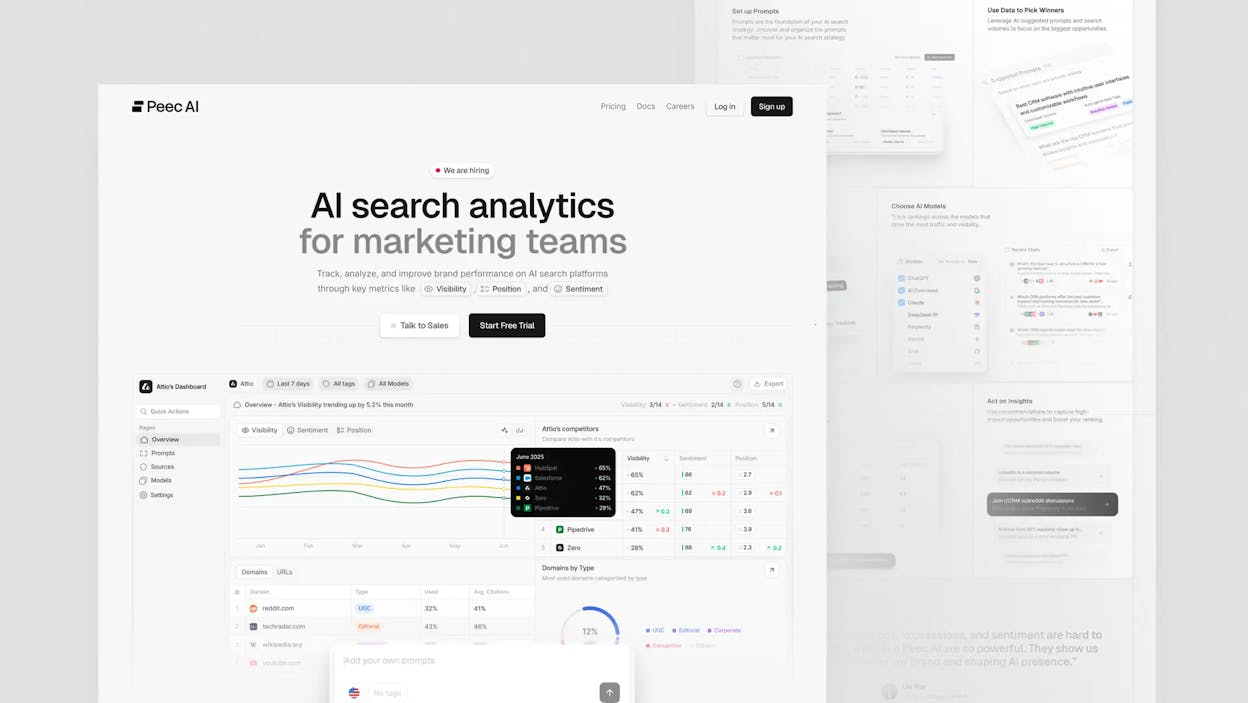
Peec AI is the Berlin-based challenger that crossed $4M ARR in ten months and raised $29M+. The product is built around clean, fast analytics for mid-market B2B teams who want to monitor AI search visibility without the enterprise overhead.
Starter is €89/month and the plan ships with unlimited seats, which is unusual in this category. Many competitors charge per seat or cap teams at three to five. Peec AI’s Actions feature surfaces prioritized optimization opportunities directly in the workflow, which is a step beyond pure monitoring.
The base plan covers three engines (ChatGPT, Perplexity, Gemini). Adding the full stack pushes you toward €169-209/month, but that’s still well below AthenaHQ’s effective spend once credits are factored in.
Pros
-
Predictable flat pricing with unlimited seats
-
115+ language support for global tracking
-
Direct Slack support, fast product cycle
Cons
-
Three-engine base coverage means you’ll likely move tiers
-
No native content generation or optimization
-
Lacks a built-in automation layer
Otterly.AI: the budget-friendly entry point
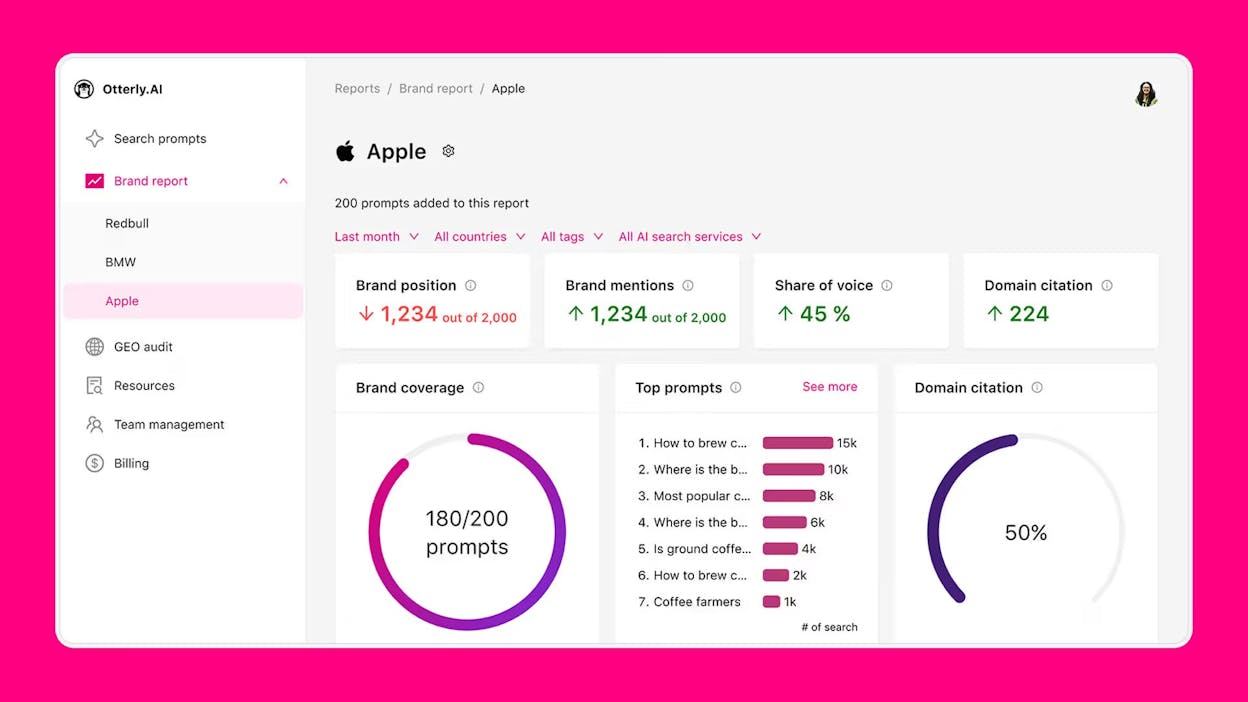
Otterly.AI is where small teams and agencies start when they want to put AI search visibility on a $29/month line item. The Lite plan tracks a small set of prompts across the major engines and produces clean weekly reports.
It’s a low-risk way to validate whether AI search matters for your category before committing to a $300-500/month tool. For an agency, it’s also a defensible add-on for small clients who don’t yet have the appetite for a heavier platform.
The tradeoffs are clear. Prompt limits are tight, depth of competitive analysis is shallow, and there’s no content creation. Otterly tracks at the API level, which means the responses you see can drift from what real users get inside the ChatGPT or Perplexity app.
Pros
-
$29/month entry price, well below the rest of the list
-
14-day trial, simple onboarding
-
Agency-friendly reporting templates
Cons
-
API-level tracking can yield different results than in-app responses
-
No content writer, optimizer, or automation
-
Outgrown quickly once tracking needs scale
SurferSEO: on-page optimization with a GEO layer bolted on
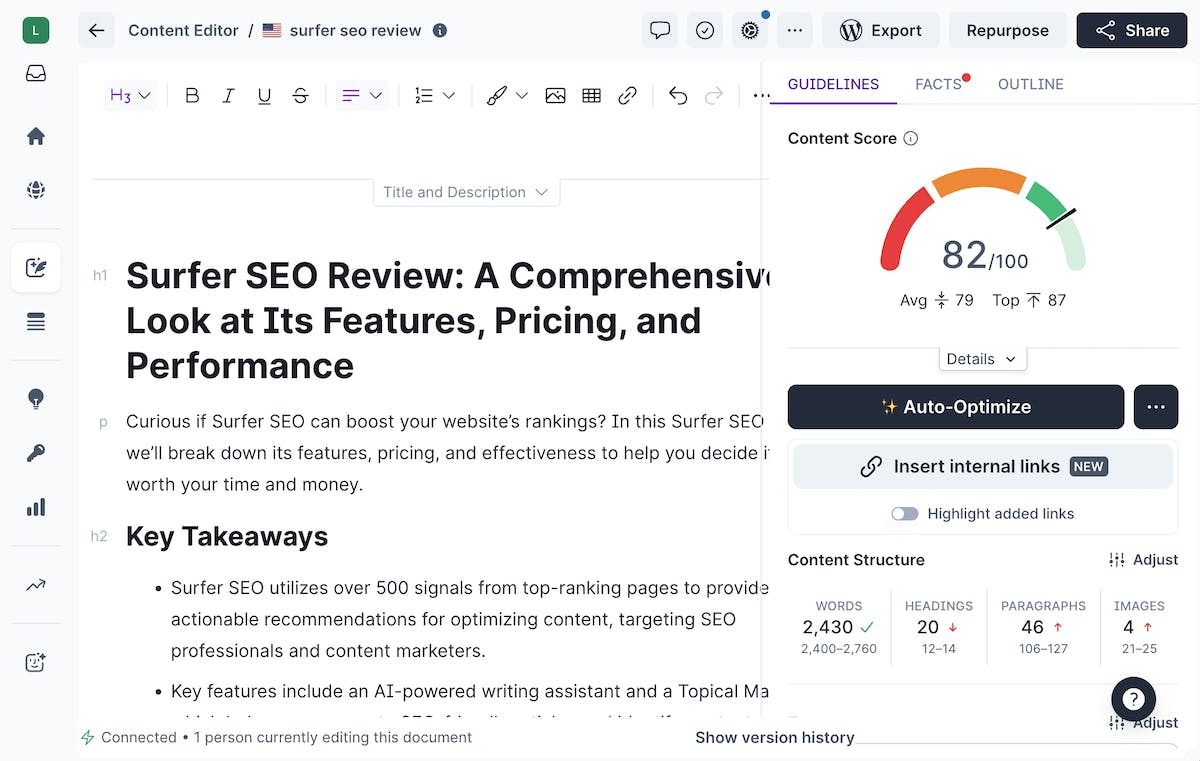
SurferSEO is the traditional pick when the brief is “help our writers ship better-ranking articles this week.” The Content Editor scores drafts in real time on structure, keyword coverage, and word count, and the SERP Analyzer benchmarks competitors on hundreds of on-page factors.
Surfer added GEO tracking to its product over the past year, which makes it a partial AthenaHQ alternative for teams who already use Surfer for traditional SEO. The integration with Google Docs, Jasper, and WordPress keeps it inside existing writing workflows.
The limit is depth. Surfer’s AI search visibility is a layer on top of its SEO product, not the foundation. If your job is “rank in Google AND get cited in ChatGPT,” Surfer’s content scoring is strong for the first half and a starting point for the second. If your job is to run a full AI search visibility program, you’ll need to pair it with something else.
Pros
-
Live content scoring inside the editor saves writer revision cycles
-
Strong SERP competitive analysis on traditional Google rankings
-
Mature integrations with WordPress, Google Docs, Jasper
Cons
-
GEO module is shallower than purpose-built AI visibility tools
-
Aggressive scoring can push writers toward keyword stuffing
-
Pricing on the team plan adds up fast
Writesonic GEO: unified SEO and GEO with content automation
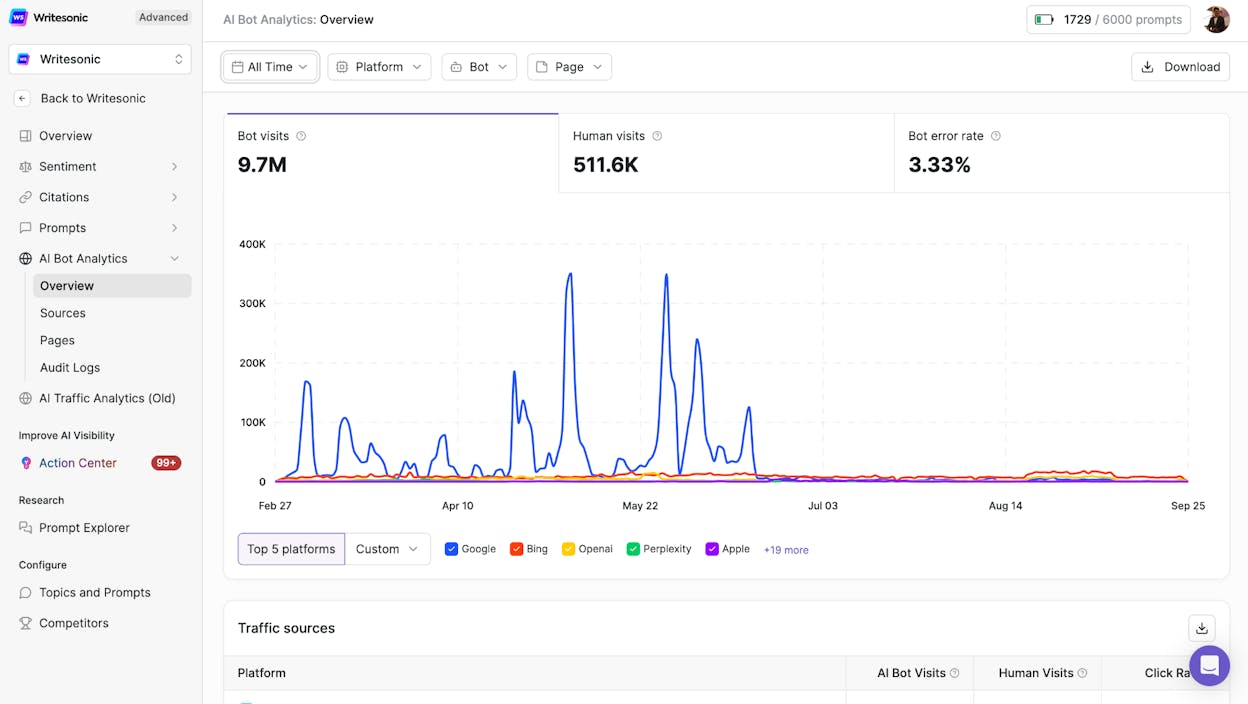
Writesonic GEO takes a different angle by combining traditional SEO, generative engine optimization, and AI-powered drafting in one platform. The AI Article Writer produces long-form pieces optimized for both search and engagement, and the GEO tracker shows visibility across major AI engines.
The pitch is execution. You publish, you track, you adjust, all in the same tool. For teams that want to ship at volume without juggling a writer, a visibility tool, and a tracker, the consolidation is real.
The downside is that breadth often comes at the cost of depth in any one area. Writesonic’s visibility tracking is functional but doesn’t match purpose-built tools, the content scoring is generic, and the high-output drafts still benefit from heavy editorial cleanup before publishing. Pricing scales quickly on higher tiers once you need real word allowances.
Pros
-
One platform for SEO tracking, GEO tracking, and content production
-
Built-in automation for rewrites and technical SEO fixes
-
Strong fit for high-volume content programs
Cons
-
Broad coverage, shallow depth in any single area
-
AI drafts need human refinement to avoid generic prose
-
Higher tiers can exceed AthenaHQ pricing without matching depth
Side-by-side comparison
|
Platform |
Starting price |
AI engines (entry tier) |
Content writer |
Content optimizer |
Agent / automation builder |
Pricing model |
|---|---|---|---|---|---|---|
|
Analyze AI |
$99/month |
All major engines (ChatGPT, Claude, Gemini, Perplexity, Copilot, Google AI Mode) |
Yes |
Yes |
Yes (180+ nodes, scheduled + webhook) |
Prompt-based, predictable |
|
AthenaHQ |
$295/month |
8+ engines |
Limited (Action Center) |
Limited |
Limited |
Credit-based, metered |
|
Profound |
$99/month |
1 (ChatGPT) |
No |
No |
No |
Tiered by engine |
|
Peec AI |
€89/month |
3 (ChatGPT, Perplexity, Gemini) |
No |
No |
No (Actions feature only) |
Flat, unlimited seats |
|
Otterly.AI |
$29/month |
Major engines, limited prompts |
No |
No |
No |
Flat |
|
SurferSEO |
$99/month |
GEO layer added |
Editor only |
Audit only |
No |
Flat |
|
Writesonic GEO |
Varies by tier |
Major engines |
Yes |
Yes |
No |
Word-allowance based |
Choosing the right AthenaHQ alternative
The honest answer depends on the job you need the tool to do.
If you want a low-budget way to validate whether AI search is worth tracking, start with Otterly.AI. If you’re a mid-market B2B team and the priority is clean monitoring at fair pricing, Peec AI is the right call. If you’re Fortune 500 with a procurement process that demands SOC 2 and Conversation Explorer-level depth, Profound is built for you. If your writers live inside a content editor and you want GEO bolted onto an SEO workflow they already know, SurferSEO fits. If you want SEO, GEO, and drafting in one tool and you’re optimizing for output volume, Writesonic GEO is reasonable.
If the job is bigger than visibility, Analyze AI is the alternative that does the rest of the work. You get the AI search visibility AthenaHQ ships, the Content Writer and Content Optimizer it doesn’t, and the agent builder that turns recurring marketing operations into background processes. AI search visibility is the front door. The actual product is the operations layer underneath.
This is what the Analyze AI manifesto says out loud. SEO isn’t dead, AI search is a new organic channel layered on top, and the brands that compound results are the ones that measure clearly, write well, and automate the busywork. The right tool isn’t the one stacked with dashboards. It’s the one that gets the next thing shipped.

Ernest

Ibrahim


![50 GEO Statistics From Tracking 83,670 AI Citations [2026 Data]](/_next/image?url=https%3A%2F%2Fwww.datocms-assets.com%2F164164%2F1779314907-blobid0.png&w=3840&q=75)

