



Summarize this blog post with:


In this article, you’ll learn what AI visibility is, why it matters alongside traditional SEO, how to check yours for free, how to track it at scale, and the specific optimization principles that get your brand mentioned and cited across ChatGPT, Perplexity, Gemini, Claude, and Google AI Overviews. You’ll also learn how to measure the actual traffic and conversions AI search sends to your site — so you can prove impact, not just track mentions.
Table of Contents
What Is AI Visibility (and Why It Matters Now)
AI visibility is how often your brand gets mentioned, recommended, or cited when people ask questions on AI platforms like ChatGPT, Claude, Google AI Overviews, Google AI Mode, Perplexity, and Copilot.
Here’s an example. When someone asks ChatGPT “best CRM for small businesses,” it doesn’t return a list of ten blue links. It gives a direct answer — recommending specific products, explaining trade-offs, and sometimes linking to sources. If your brand appears in that answer, you have AI visibility. If it doesn’t, you’re invisible to a growing share of your potential customers.
This shift is creating three important changes in how people discover brands:
Fewer visitors, but higher intent. AI answers most basic questions directly, which filters out people who were only browsing for information. The people who actually click through to your site have moved past the research phase. They’re closer to making a decision. Ahrefs’ research found that AI-referred visitors stayed longer on-site and converted at higher rates than traditional search traffic.
Personalized recommendations at scale. Traditional search shows the same ten results to everyone. AI tailors its recommendations based on budget, industry, use case, and follow-up questions. This opens up opportunities for niche products that would never rank on page one of Google. But the trade-off is stark: AI may only present one or two recommendations without showing the alternatives it considered. If you’re not in that shortlist, you don’t exist.
Attribution is harder than ever. AI often drives awareness without leaving the usual digital footprints. Someone hears about your product through a ChatGPT conversation, then Googles your brand name directly. That shows up as branded search traffic, not AI referral. The real influence of AI search is larger than what any analytics tool can currently track — which is why you need dedicated AI traffic analytics (more on that below).
This has sparked conversations about Generative Engine Optimization (GEO) — the practice of optimizing your content so AI assistants mention and recommend your brand. But here’s what’s critical to understand: GEO is not a replacement for SEO. It’s an additional organic channel. The brands that win will be the ones that compound both.
That’s the position we hold at Analyze AI: SEO is not dead. The way buyers find you is changing, but the reason they choose you is not. Quality content still wins. The difference is that your content now has to work for AI models too — not just Google.
How AI Search Changes Customer Behavior
Traditional search gives you a list of links. AI search gives you direct answers.
![[Screenshot: Side-by-side comparison of a Google search results page showing ten blue links versus a ChatGPT response giving a direct, structured answer with recommendations for the same query]](https://www.datocms-assets.com/164164/1776985709-blobid1.png?auto=format,compress&w=1248&fit=max)
This changes how people interact with search. Instead of typing short keyword phrases, people ask conversational questions with full context: “I have a budget of around $200 and I’m looking for the best email tool — can you compare some options and recommend which one gives the best value?” They ask follow-ups. They refine.
But the behavioral shift isn’t as dramatic as the headlines suggest. Research from Kevin Indig’s Growth Memo shows that people use AI answers as shortcuts for simple facts — a quick definition, a measurement conversion. It saves them a click. But for anything important — a purchase, a big decision, a health question — they still scroll past the AI summary to find a trusted source. They see the AI answer as a starting point, not the final word.
This is good news. It means if you show up in the AI answer and rank well in traditional search, you get a double endorsement. The AI mention builds awareness. The organic listing provides the trust signal that closes the deal.
Major AI Platforms You Need to Know
Not all AI platforms matter equally for your business. Here’s what’s sending traffic today:
ChatGPT is the dominant player. It drives the largest share of AI-referred traffic across most industries and has the broadest user base. With each model update, it relies more heavily on real-time web search, which means your SEO work increasingly feeds directly into ChatGPT’s answers.
Perplexity is smaller but growing fast. It’s citation-heavy by design — every answer includes linked sources — which makes it particularly valuable for content publishers and SaaS companies. If Perplexity cites your page, users are more likely to click through than on any other AI platform.
Google AI Overviews (AIOs) appear directly inside Google Search results. As of mid-2025, AIOs show for roughly 10–16% of desktop keywords depending on the market, and that number keeps climbing. AIOs pull 76% of their citations from pages that already rank in the top 10, which reinforces the point: strong SEO is the foundation of AI visibility, not a separate effort.
Claude, Gemini, and Copilot round out the landscape. Each has different strengths — Claude is popular among developers and researchers, Gemini is tightly integrated with Google’s ecosystem, and Copilot captures Microsoft’s enterprise user base. You should test your visibility across all of them because the answers can vary wildly between platforms.
![[Screenshot: Side-by-side comparison of two different AI platforms answering the same query and returning different brand recommendations, showing platform variability]](https://www.datocms-assets.com/164164/1776985721-blobid2.png?auto=format,compress&w=1248&fit=max)
Training Data vs. Real-Time Search
AI platforms use two information sources, sometimes combining both:
Training data is the foundational knowledge an AI learned during initial training, which typically includes web content up to a specific cutoff date (often 6–12 months ago). Established brands with strong historical presence have advantages here because they were well-represented in the training data.
Real-time search is what AI uses for current information — recent events, updated pricing, new product launches. This levels the playing field for newer companies with good SEO and content strategies.
The trend is clear: future models will rely more on real-time search. GPT-5 and subsequent models are expected to make real-time retrieval a core capability, not an add-on. That makes your SEO work more important for AI visibility, not less. Every piece of content you optimize for search engines is now also a candidate for AI citation.
How to Manually Check Your AI Visibility for Free
Before investing in any tools, start with a simple manual audit. Open free accounts on ChatGPT, Claude, and Perplexity (Google AI Overviews appear automatically in some Google searches), and ask the same questions your customers ask.
Step 1: Build Your Prompt List
Start with the obvious: “What’s the best [your product category]?” and “How do I choose [your product type]?” Then get specific based on what you actually sell. If you sell email marketing software, try prompts like “affordable email marketing for small businesses” and “email marketing vs newsletters.”
Don’t know what to test? Here are four ways to build your prompt list:
Check what you already rank for. Open Google Search Console and look at your top queries. These are the searches people already associate with your brand. You can also use Analyze AI’s Keyword Rank Checker to see where you stand.
![[Screenshot: Analyze AI’s Keyword Rank Checker performance report showing top queries with clicks and impressions]](https://www.datocms-assets.com/164164/1776985724-blobid3.png?auto=format,compress&w=1248&fit=max)
Use a keyword tool. Tools like Analyze AI’s free Keyword Generator or AlsoAsked show you what questions people actually type. Focus on the question-based queries — these are the ones most likely to trigger AI answers.
![[Screenshot: Analyze AI’s Keyword Generator showing keyword suggestions with search volume and difficulty]](https://www.datocms-assets.com/164164/1776985739-blobid4.png?auto=format,compress&w=1248&fit=max)
Think about sales conversations. The questions your sales team answers every week are the same questions people ask AI. “What’s the difference between X and Y?” “Is [your product] good for [specific use case]?” These high-intent queries are exactly where AI visibility matters most.
Check Google Autocomplete. Start typing your main keywords into Google and note the suggested completions. These reflect real user behavior and translate directly into AI prompts.
![[Screenshot: Google search autocomplete showing suggested completions for a product-category keyword]](https://www.datocms-assets.com/164164/1776985739-blobid5.png?auto=format,compress&w=1248&fit=max)
Step 2: Test Across Multiple Platforms
Ask each prompt on ChatGPT, Claude, Perplexity, and check for AI Overviews in Google. You’ll be surprised how different the answers are. One platform might mention your brand prominently while another ignores you completely.
Also, ask the same question multiple times. AI responses vary even for identical prompts. Run each prompt 2–3 times on each platform over a few weeks. Yes, this is tedious. That’s exactly why most of your competitors aren’t doing it — which makes it a genuine first-mover advantage.
Step 3: Document What You Find
For each prompt, record: Did your brand appear? In what position? Was the mention positive, neutral, or negative? What competitors appeared? What sources were cited? This baseline will tell you where you stand and where the gaps are.
How to Do This in AI Search With Analyze AI
Manual testing gives you a snapshot, but it doesn’t scale. Analyze AI’s Ad Hoc Prompt Searches let you run one-off queries across ChatGPT, Perplexity, and Google AI simultaneously — without toggling between browser tabs.
Type any prompt, select a region, and hit Track. You’ll see exactly who shows up, in what position, and with what sentiment — across all major AI engines in one view.
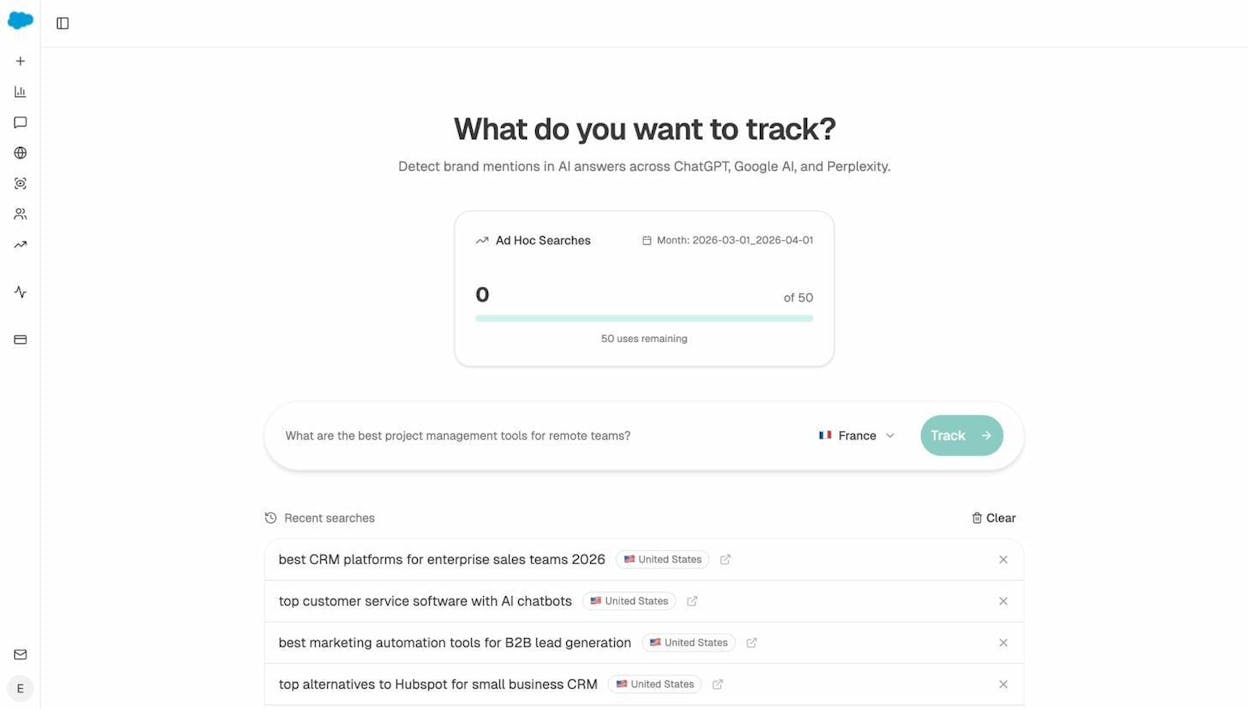
This is especially useful for validating ideas before committing to a full tracking campaign. Before you write a comparison article or launch a product page, run the prompt and see who currently owns that answer. It takes 30 seconds and can save you weeks of wasted effort.
How to Track AI Visibility at Scale
Manual checking breaks down fast. You’re dealing with multiple platforms, hundreds of query variations, and responses that change daily. For competitive analysis, you need consistent tracking over time — and that’s nearly impossible to do by hand.
But the bigger limitation is discovery vs. tracking. When you manually test “best email marketing tools,” you’re only checking queries you already thought of. You’re not discovering the conversations where your competitors get mentioned but you had no idea those conversations were happening.
Automated Prompt Tracking
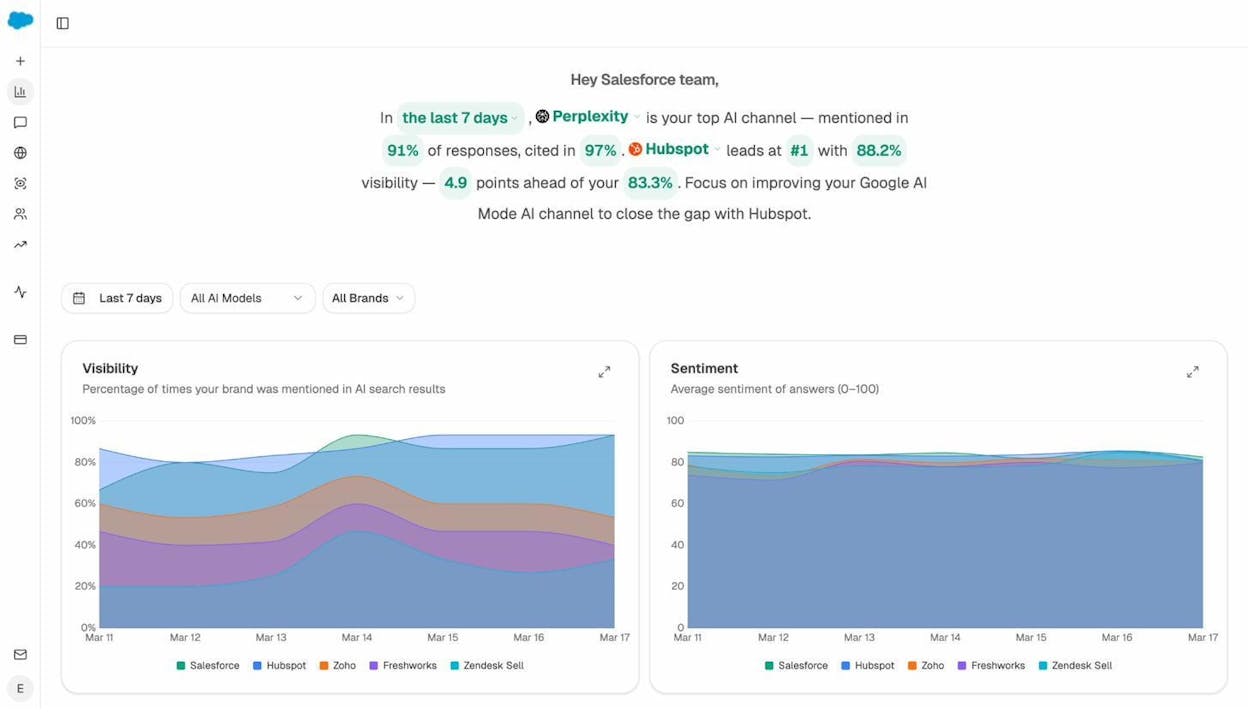
Dedicated AI visibility platforms solve this by monitoring thousands of prompts across multiple AI engines automatically. The key metrics you should track:
Visibility — the percentage of AI responses that mention your brand for your tracked prompts. This is your top-line number. If it’s going up, your optimization efforts are working.
Position — where your brand appears in the AI’s recommendation list. Being mentioned is good. Being recommended first is better.
Sentiment — whether the AI’s portrayal of your brand is positive, neutral, or critical. You might be visible but described negatively, which is worse than being invisible.
AI Share of Voice — your brand’s visibility compared to competitors for the same prompts. This is the competitive metric that tells you whether you’re winning or losing.
In Analyze AI, the Overview dashboard shows all of these metrics at a glance. Here’s what it looks like for a brand tracking its visibility against five competitors:
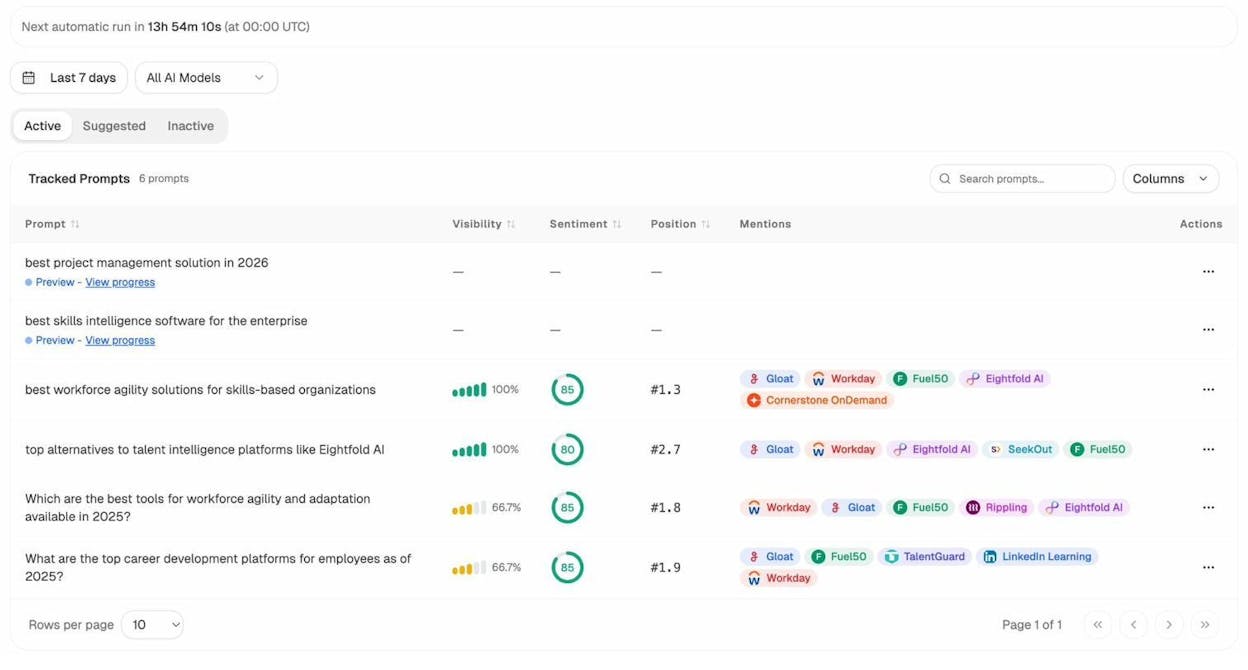
The Prompts dashboard goes a level deeper. It shows every tracked prompt with its visibility percentage, sentiment score, average position, and — critically — which competitor brands appear alongside you in each answer.
Prompt Discovery: Finding What You Don’t Know to Track
The most valuable feature of any AI visibility tool isn’t tracking the prompts you already know about. It’s discovering the ones you don’t.
Analyze AI’s Suggested Prompts feature uses your existing prompt data and competitor mentions to surface new prompts you should be tracking — queries where your competitors are getting mentioned but you haven’t been monitoring.
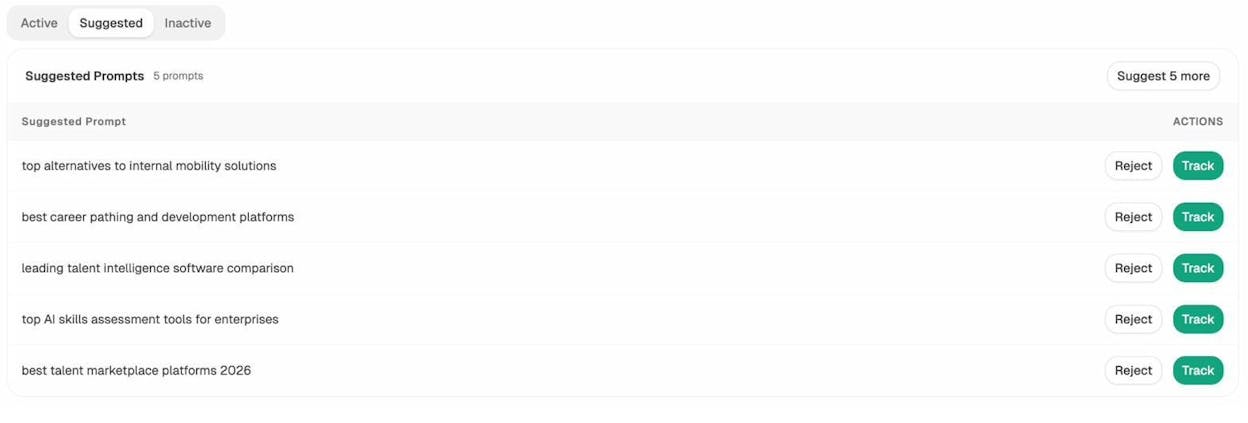
This closes the discovery gap that makes manual tracking so limited. Instead of guessing what customers might ask, you let the data show you.
Competitor Intelligence
You can’t optimize in a vacuum. You need to know who you’re losing to and on which prompts.
In Analyze AI, the Competitors view shows two things. First, your tracked competitors — the brands you’ve already chosen to monitor — with their total mentions and last-seen dates:
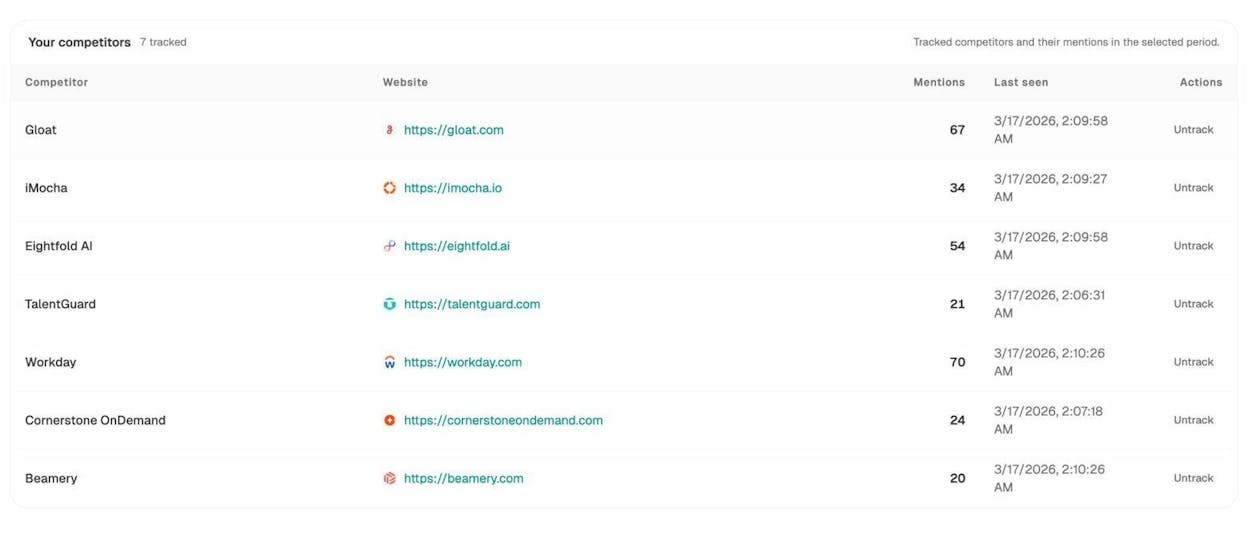
Second, Suggested Competitors — entities that frequently appear in AI answers alongside your brand that you haven’t started tracking yet. These are brands the AI associates with your space, whether you consider them competitors or not:
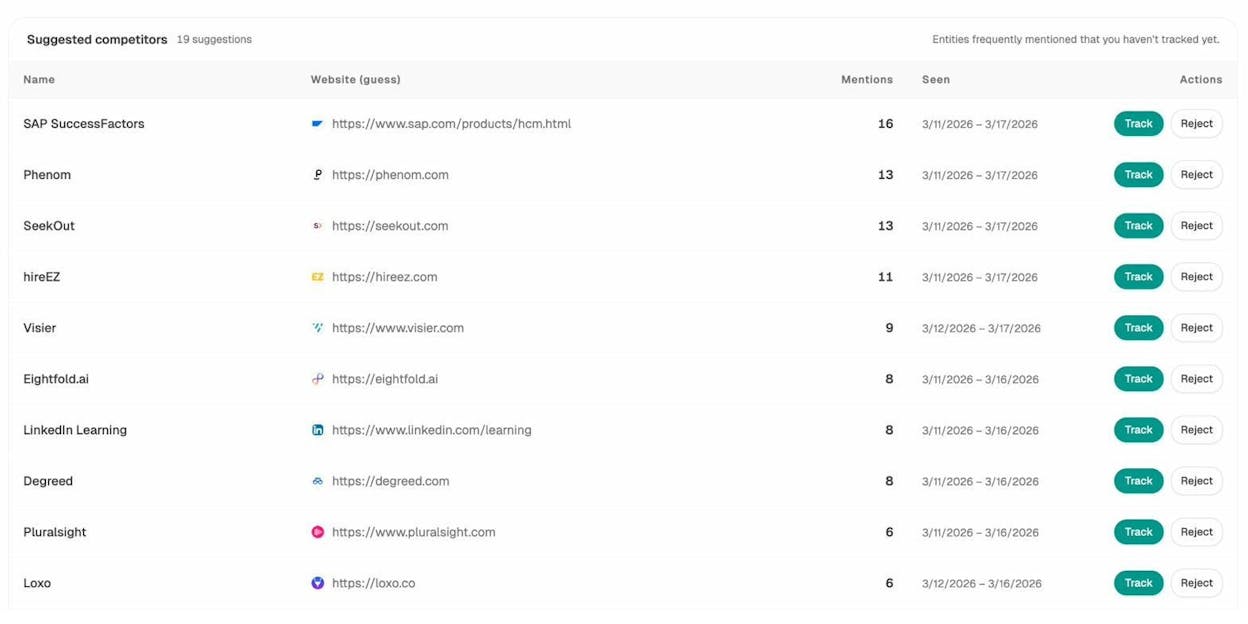
This is how you discover competitive threats you didn’t know existed. A company you’ve never heard of might be getting mentioned in 40% of the AI answers in your space. Without this data, you’d have no idea.
AI Traffic Attribution: Proving Impact With Real Numbers
Mentions and citations are useful, but they don’t close deals. The question your CMO will ask is: “How much traffic is AI search actually sending us, and is it converting?”
This is where most AI visibility tools stop. They track mentions but can’t connect them to actual business outcomes.
Analyze AI connects to your GA4 account and attributes AI-referred sessions to specific engines, landing pages, and conversion events. Here’s what the AI Traffic Analytics dashboard looks like:
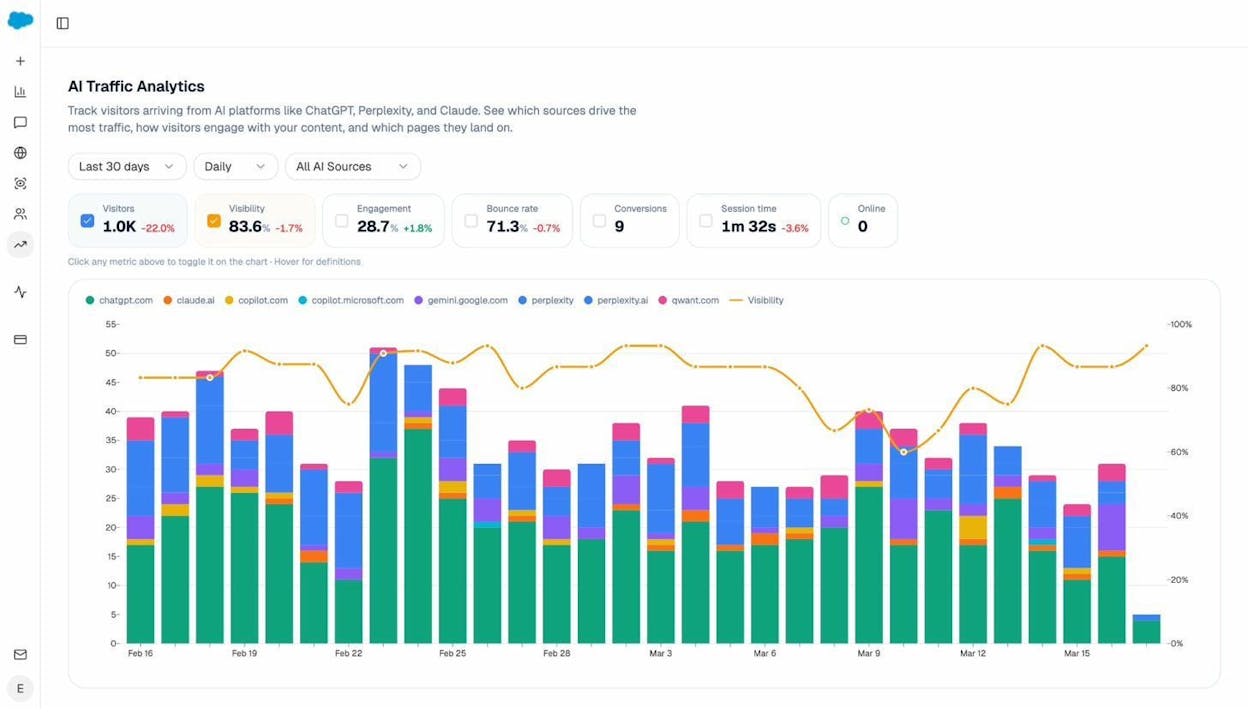
Notice the stacked bar chart breaking down traffic by AI source — chatgpt.com, claude.ai, copilot.microsoft.com, gemini.google.com, perplexity.ai, and others. The orange line overlays your visibility score so you can see the correlation between visibility improvements and actual traffic increases.
The Landing Pages report below it answers the next question: which pages are actually receiving this AI traffic, and how do visitors behave on them?
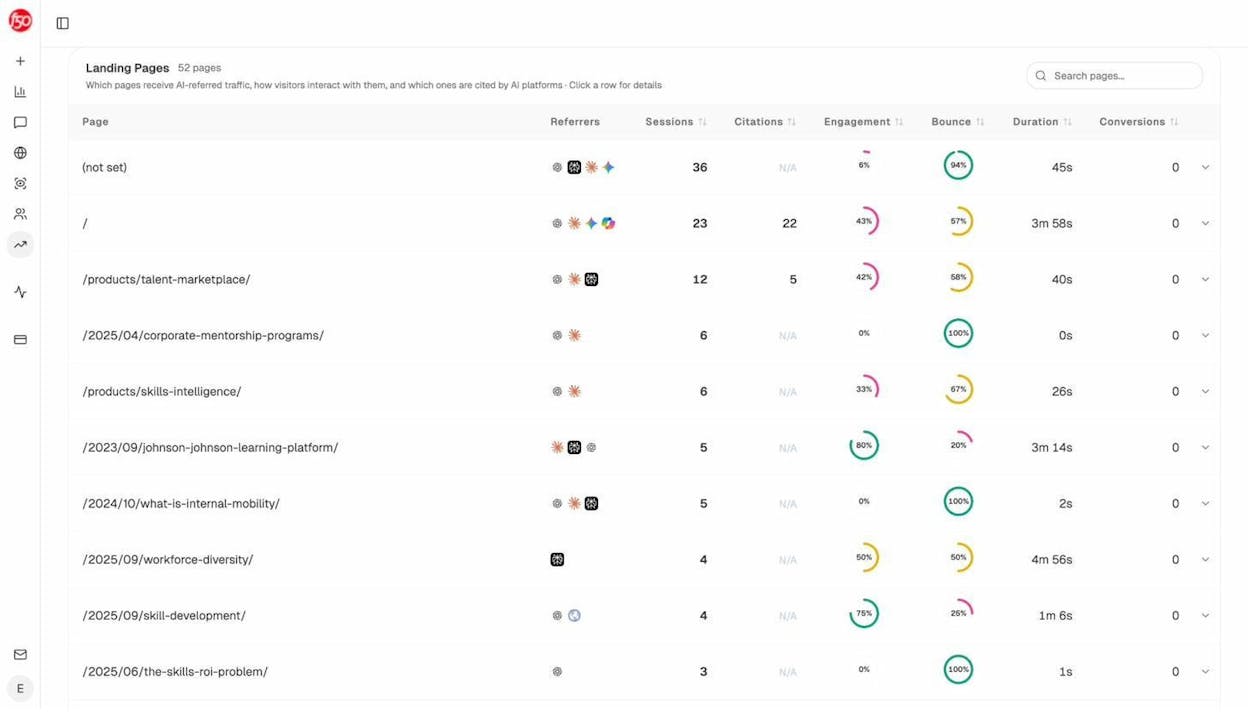
This data is critical for prioritization. If your product page gets 23 sessions from AI with a 57% bounce rate and 3m 58s average session duration, that’s high-quality traffic. If a blog post gets 6 sessions with a 100% bounce rate and 0s duration, the traffic exists but isn’t engaging. You double down on what works and fix or deprioritize what doesn’t.
Citation and Source Analysis
Understanding which sources AI platforms cite in your space is one of the most actionable insights you can get. It tells you where to focus your PR, content, and link-building efforts.
Analyze AI’s Sources dashboard shows the content types AI references (websites, blogs, reviews, product pages, social) and the specific domains it cites most often:
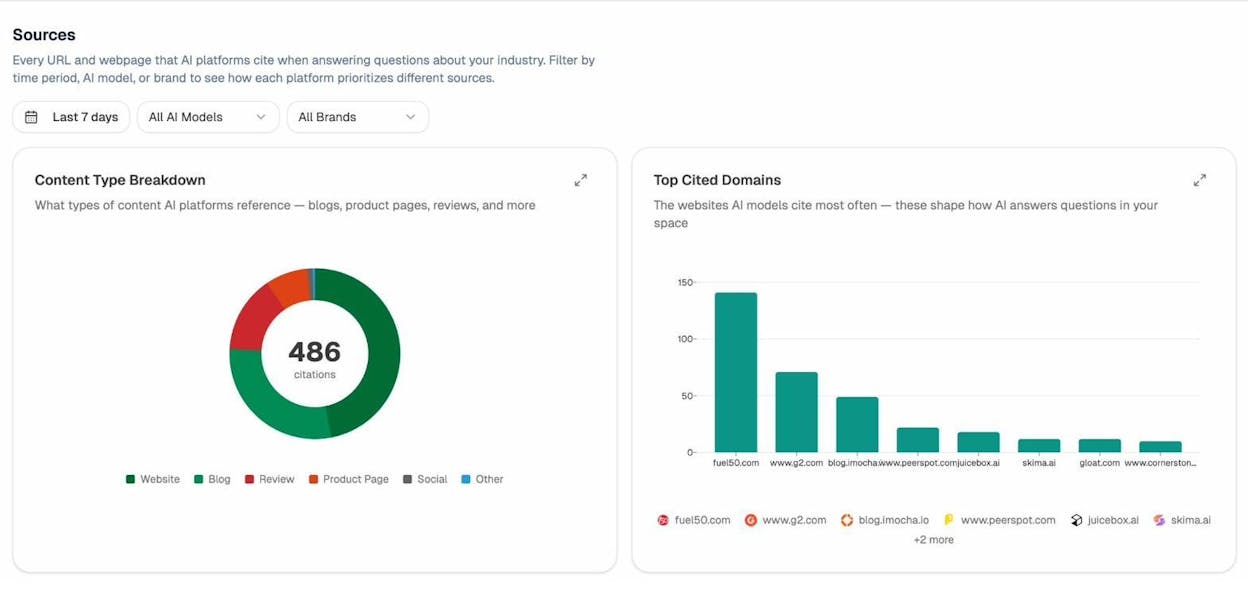
If G2 reviews drive the most citations in your space, you need a strong G2 presence. If competitor blogs dominate, you need content that outperforms them. If review sites are heavily cited, you need more customer reviews on those platforms.
This turns a vague strategy like “get more third-party mentions” into a specific action plan: target these five domains, in this order, with this type of content.
Perception Mapping: How AI Frames Your Brand
Being visible is necessary but not sufficient. How AI describes your brand matters just as much as whether it mentions you.
Analyze AI’s Perception Map plots your brand and competitors across two dimensions: visibility (how often you appear) and narrative strength (how compelling the AI’s description is). This reveals four quadrants:
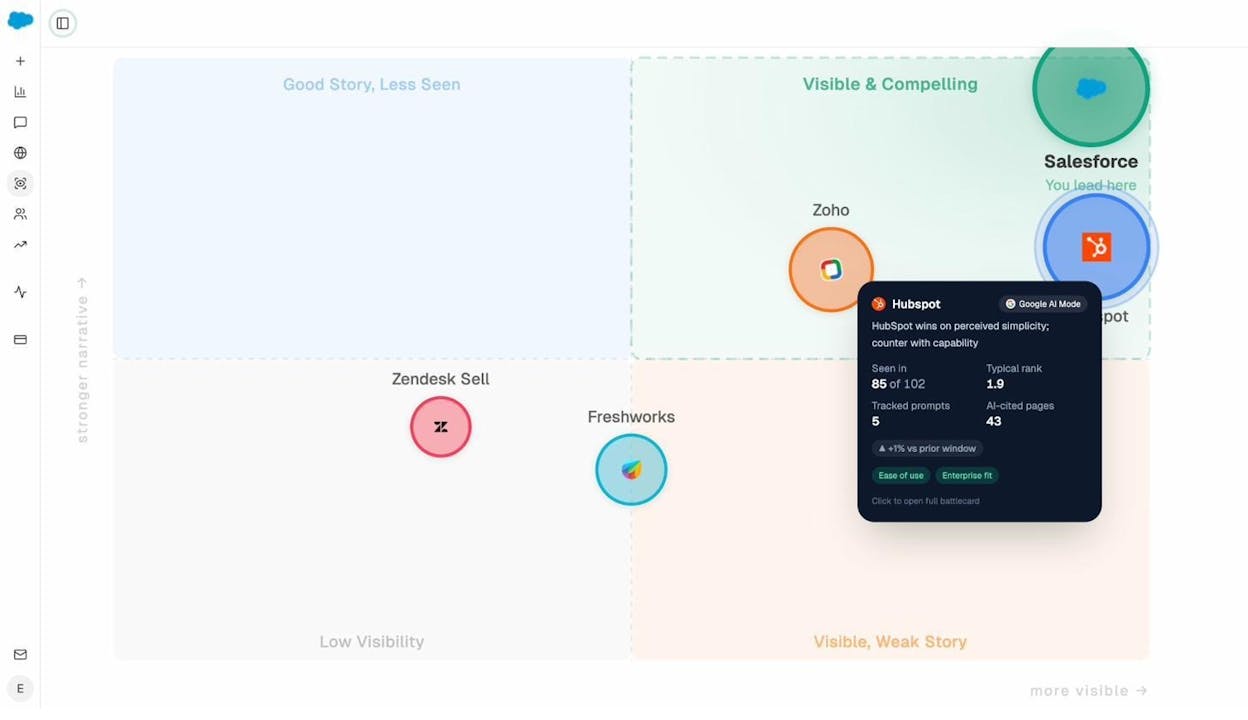
The ideal position is the top-right quadrant: Visible & Compelling. If you’re in “Good Story, Less Seen,” your content is strong but not discoverable enough. If you’re in “Visible, Weak Story,” you’re showing up but the AI’s narrative isn’t favorable — you need to improve the underlying content and third-party references that shape how AI talks about you.
Hovering over any competitor opens a battlecard with their typical rank, number of AI-cited pages, tracked prompts, and the narrative themes AI associates with them. This is competitive intelligence you can act on immediately.
Weekly Email Digests: Stay Informed Without Logging In
Tracking AI visibility shouldn’t require checking a dashboard every day. Analyze AI sends a weekly email digest with everything you need to know: visibility changes, rank movements, sentiment shifts, pages gaining or losing citations, and specific competitor alerts.
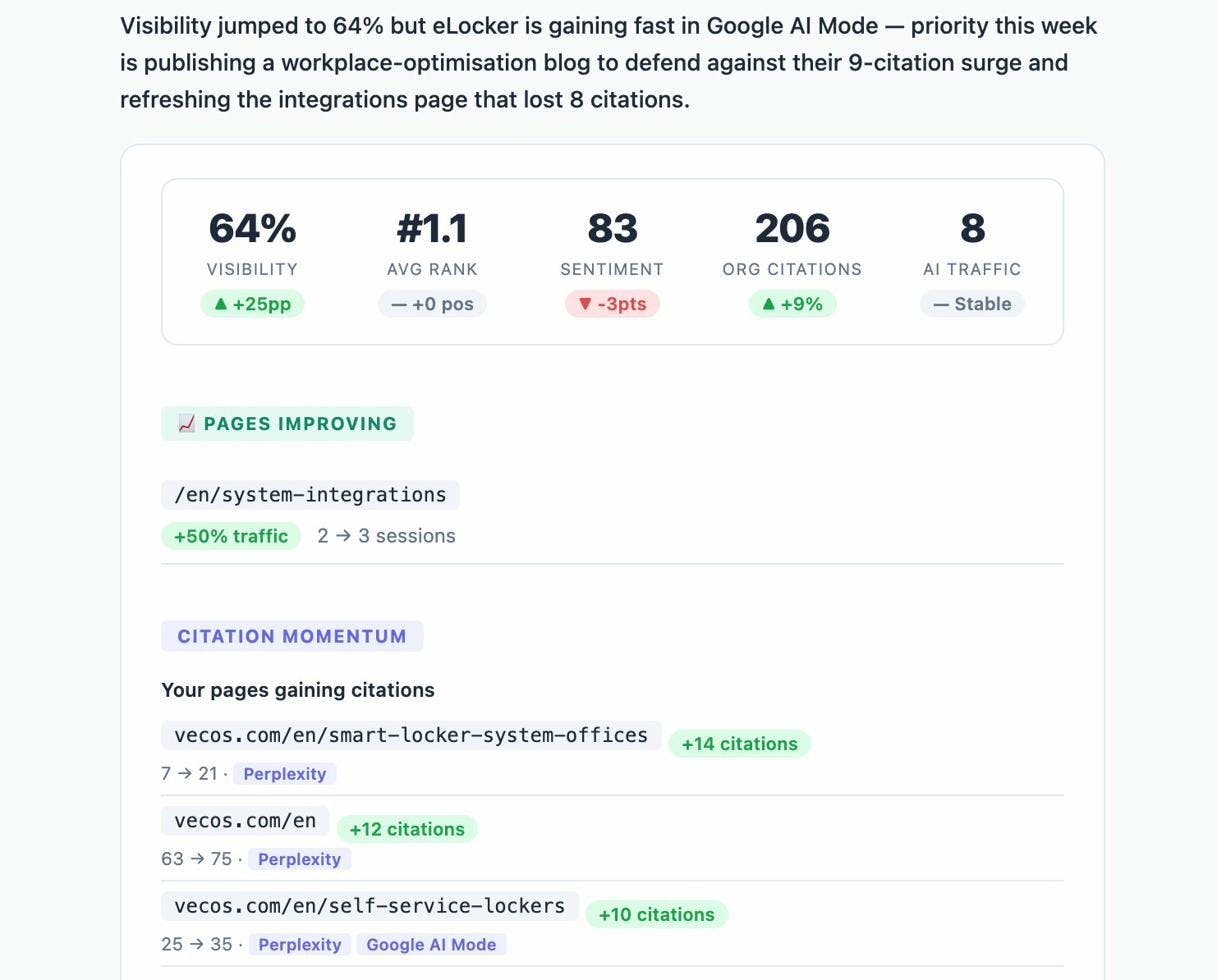
This is designed for the marketing leader who needs to stay informed without doing the work of pulling reports. When leadership asks “how are we doing in AI search?” — you already know.
A Note on AI Tracking Limitations
No AI visibility tool is perfect. The data has real constraints you should understand:
No real demand data exists. No company has access to actual search volume data for ChatGPT or Perplexity prompts. All tools, including Analyze AI, use synthetic prompts based on keyword databases and real-world search behavior.
AI responses vary. Even identical prompts produce different answers due to personalization, model updates, and inherent randomness. That’s why tracking over time matters more than any single snapshot.
Attribution has gaps. Not all AI-influenced visits can be tracked. Someone may discover your brand through AI, then navigate directly to your site — which shows up as direct traffic, not AI referral.
The tools aren’t perfect, but they’re your best option for systematic tracking. The alternative — manual spot-checking — is worse in every way.
Key AI Visibility Optimization Principles
Now that you can measure AI visibility, here’s how to improve it. These principles are grounded in what we know about how AI platforms select sources and construct answers.
Build Third-Party Authority
Most AI brand mentions come from third-party sites, not your own domain. AI platforms trust external validation over self-promotion. When an industry publication or review site recommends you, AI treats that as a stronger signal than your own marketing copy.
Focus your efforts on three areas:
Industry rankings and “best of” lists from authoritative publications. If TechCrunch, G2, Capterra, or your industry’s equivalent publication runs a “best tools” roundup, being included in that list directly feeds AI answers. Use Analyze AI’s Sources dashboard to identify which publications AI already cites in your space — then prioritize outreach to those specific outlets.
PR and media coverage in relevant trade publications. A feature story in a respected industry outlet doesn’t just drive referral traffic — it shapes how AI models understand and describe your brand. If the AI’s narrative about your brand is weak (check your Perception Map), targeted PR is often the fastest fix.
Customer reviews and case studies on third-party platforms. AI platforms reference G2, Capterra, TrustRadius, and similar review sites extensively. A steady stream of authentic customer reviews builds the kind of third-party consensus that AI models weigh heavily.
Focus on Content Formats AI Loves to Cite
Certain content types get cited by AI more frequently than others. According to research on AI citation patterns:
|
Content Format |
Why AI Cites It |
Your Action |
|---|---|---|
|
“Best of” and “Top X” lists |
AI needs structured comparisons to make recommendations |
Create definitive roundups in your space — and keep them updated |
|
“Vs” comparisons |
AI answers head-to-head evaluation questions |
Write detailed comparison pages for your product vs. each competitor |
|
How-to guides |
AI pulls step-by-step instructions for process questions |
Make your guides the most thorough and actionable in your niche |
|
Data studies and original research |
AI values proprietary data it can’t find elsewhere |
Publish original data, benchmarks, or surveys regularly |
|
Product and service pages |
AI cites factual descriptions when explaining what companies offer |
Write clear, jargon-free product descriptions with specific capabilities |
|
FAQ content |
AI answers basic definitional questions from these |
Create comprehensive FAQ pages that cover every common question |
One more critical detail: AI assistants tend to favor fresher content over older content. If you published a “best tools” roundup two years ago and haven’t touched it since, it’s losing ground to competitors who update quarterly. Put content freshness on your editorial calendar.
Perfect Your Primary Touchpoints
Research consistently shows that the majority of AI-referred traffic goes to homepages, product pages, and core tools — not blog posts. This means the pages you might think of as “already done” are actually your most important AI visibility assets.
Make these pages AI-friendly:
Lead with your value proposition. The first paragraph should state exactly what your product does and who it’s for. No clever taglines, no animated hero sections that say nothing. AI can’t parse vibes — it needs clear, factual statements.
Write descriptions AI can cite. Avoid marketing fluff like “revolutionary” and “world-class.” Instead, use specific, factual language: “Tracks brand visibility across 6 AI engines including ChatGPT, Perplexity, and Gemini” is citable. “The ultimate AI solution for modern marketers” is not.
Use structured formatting. Hierarchical headings (H1, H2, H3), short paragraphs, and clear sections make your content easier for AI to parse and quote accurately.
Include key business details. Pricing tiers, feature lists, integration capabilities, supported platforms — the factual details AI needs to make informed recommendations.
Format Your Content for AI Readability
Beyond your primary pages, every piece of content you publish should follow these formatting principles:
Use hierarchical headings and bullet points. Structure your content with H1 → H2 → H3 hierarchy. This isn’t just good for SEO — it’s how AI models understand the relationship between concepts in your content.
Write in simple, direct language. Answer questions explicitly rather than making readers (or AI) infer answers. If someone asks “how much does it cost?” — your content should contain a sentence that starts with “Pricing starts at…”
Include specific facts and figures. AI quotes numbers with confidence. Vague claims like “significant improvement” get ignored. Specific claims like “reduced bounce rate by 23% over 90 days” get cited.
Add schema markup. FAQ schema, product schema, and how-to schema give AI platforms structured data they can parse and cite with higher confidence.
Don’t block AI bots. Check your robots.txt file. If you’re blocking GPTBot, ClaudeBot, or PerplexityBot, you’re invisible to those platforms. Unless you have a specific reason to block them, let them crawl your site.
You can use Analyze AI’s free AI Website Audit Tool to check whether your site is properly accessible to AI crawlers and identify technical issues that might be hurting your AI visibility.
Post on High-Authority User-Generated Content Platforms
AI platforms heavily favor certain websites when pulling citations. YouTube is one of the most cited domains across AI answers — and Reddit shows up in a significant percentage of product review searches.
The takeaway: go where your audience already spends time and where AI looks for answers.
For Reddit: Find the subreddits where your target customers ask questions. Contribute genuinely useful answers (not promotional content — Reddit users and moderators will destroy you for that). The goal is to be the helpful expert who also happens to work in the space.
For YouTube: Create content that answers the specific questions AI gets asked. “How to set up [your product type]” and “[Product A] vs. [Product B]” comparison videos are particularly effective because they align with the query formats AI platforms receive most often.
For industry forums and communities: Quora, Stack Overflow (for technical products), and niche industry forums all appear in AI citations. Consistent, helpful participation builds the kind of distributed authority that AI models aggregate into brand trust.
Find Your AI Mention and Citation Gaps
The highest-leverage optimization work isn’t creating new content from scratch — it’s closing the gaps where competitors are visible and you’re not.
Mention gaps are AI responses where competitors get mentioned but you don’t. These represent conversations happening about your market where you’re invisible.
Citation gaps are AI responses where competitors’ content gets cited as a source but yours doesn’t. When AI cites your competitor’s research or quotes their expert opinion, it positions them as the thought leader — and your brand stays invisible.
In Analyze AI, you can identify both gaps using the Competitors dashboard. Look at the prompts where you show 0% visibility but competitors show 66–100%. Those are your highest-priority optimization targets.
Then look at the Sources dashboard to see which third-party domains are being cited for those prompts. These are your PR and outreach targets — the publications and review sites that AI already trusts in your space.
The workflow is: find the gap → identify the cited sources → create or improve content that targets those specific prompts → get mentioned on the third-party sources AI trusts → monitor whether your visibility improves.
Create Content Designed for AI Citations With the Right Tools
Finding gaps is step one. Closing them requires content that AI platforms actually want to cite. This is where Analyze AI’s Content Writer and Content Optimizer come in.
The Content Writer takes you from idea to published draft with AI visibility built into every step. It starts with SERP and LLM research — showing you what currently ranks on Google and what AI engines cite — then generates an outline with editorial comments highlighting where to add originality, where competitors are weak, and where citation opportunities exist.
![[Screenshot: Analyze AI Content Writer showing the research phase with SERP analysis and AI visibility gaps identified]](https://www.datocms-assets.com/164164/1776985799-blobid17.png?auto=format,compress&w=1248&fit=max)
The Content Optimizer works on existing pages. Paste a URL, and it scores your content against AI citation factors: structure, entity coverage, argument completeness, and source density. It then gives line-by-line suggestions for improvement — not generic “add more keywords” advice, but specific recommendations like “add a pricing comparison table to improve citation likelihood.”
![[Screenshot: Analyze AI Content Optimizer showing content score, identified gaps, and specific improvement suggestions]](https://www.datocms-assets.com/164164/1776985808-blobid18.png?auto=format,compress&w=1248&fit=max)
Both tools are designed around a simple principle: the most helpful, thorough, well-structured content wins in both SEO and AI search. There’s no trick. There’s no hack. You just need to be demonstrably better than what’s already out there.
How to Build an AI Visibility Strategy (Without Starting From Scratch)
AI search isn’t a completely separate marketing channel you need to add to an already-packed strategy. It’s how your existing efforts — content creation, PR, SEO, brand building — now have additional impact you weren’t measuring before.
The content you’re already creating can get cited by AI platforms. The PR coverage you’re already pursuing can lead to AI mentions. The customer reviews you’re already earning can result in AI recommendations.
Here’s a practical starting framework:
Week 1: Baseline. Run manual checks on 10–20 high-intent prompts across ChatGPT, Claude, and Perplexity. Document your current visibility. Set up an AI visibility tool like Analyze AI and connect GA4 to start tracking AI traffic attribution.
Week 2–3: Gap analysis. Use your Competitors and Sources dashboards to identify where competitors are visible and you’re not. Prioritize by business impact — focus on the prompts that represent actual purchase intent, not just informational queries.
Week 4+: Execution. Start closing gaps. Update your highest-traffic pages for AI readability. Reach out to the publications AI cites most in your space. Create or improve content targeting the specific prompts where you’re invisible. Use your weekly email digests to track progress without constant dashboard-checking.
Ongoing: Compound. AI visibility compounds like SEO does. The brands that start measuring and optimizing now will have a significant advantage over those who wait. Every piece of content you improve, every third-party mention you earn, every citation you gain builds on the last.
This isn’t about panicking or dropping everything to chase AI search. It’s about recognizing a timing opportunity and acting while the barrier to entry is still low. The fundamentals haven’t changed — great content, strong authority, clear structure. You’re just expanding the definition of success beyond clicks to include AI citations, mentions, and the traffic they drive.
Start with what you already have. Measure what’s working. Double down on it.
Ready to see how AI search represents your brand? Start tracking your AI visibility with Analyze AI — or use our free tools to check your keywords, SERP rankings, and website authority today.

Ernest

Ibrahim


