Analyze AI - AI Search Analytics Platform

2026 SEO Content Strategy: 10-Step Breakdown

Written by

Ernest Bogore

Ernest Bogore

CEO

Reviewed by

Ibrahim Litinine

Ibrahim Litinine

Content Marketing Expert

2026 SEO Content Strategy: 10-Step Breakdown

In this article, you'll learn how to build an SEO content strategy that drives traffic from both traditional search engines and AI answer engines. You'll discover how to find topics worth writing about, prioritize keywords based on business impact, structure content that satisfies search intent, and measure performance across Google and AI platforms like ChatGPT, Claude, and Perplexity.

What you will learn:

  • How to identify topics with real business potential

  • Why prioritizing low-difficulty keywords accelerates early wins

  • The role of long-form content in satisfying search intent

  • How to write for target personas without generic filler

  • Building brand authority that protects against algorithm shifts

  • Covering multiple search intents across the buyer journey

  • On-page optimization techniques that move rankings

  • Measuring results and adapting based on data

  • Demonstrating your product naturally within content

  • Link building strategies that compound over time

  • How to track your brand's visibility across AI answer engines

Table of Contents

1. Identify Topics That Matter to Your Business

Every piece of content you create should connect to something your business actually does. This sounds obvious, but the temptation to chase high-volume keywords unrelated to your product creates a predictable problem: traffic that never converts.

Start by listing the core problems your product solves. If you sell project management software, your topics might include task prioritization methods, team collaboration challenges, deadline tracking, and resource allocation. Each of these connects directly to what your product does.

[Screenshot: Spreadsheet showing topic ideas mapped to product features with business potential scores]

Avoid topics that only tangentially relate to your business. A project management tool probably shouldn't publish content about "how to write a resignation letter" even if the keyword has volume. That traffic will bounce without engaging further.

A useful exercise is scoring each topic idea on a 1-10 scale for business relevance. Remove anything below 6 from your list. This filter prevents the scattered content libraries that dilute topical authority.

Finding Topic Clusters

The most efficient approach groups related topics into clusters. Instead of writing random one-off articles, you build interconnected content that signals depth to search engines.

To generate these clusters manually:

  1. Start with your main topic (e.g., "email marketing")

  2. List every subtopic that falls under it (automation, deliverability, list building, segmentation)

  3. For each subtopic, identify specific questions your audience asks

  4. Group these questions by theme

[Screenshot: Topic cluster visualization showing main topic connected to subtopics with individual article ideas branching off]

Tools like Ahrefs, Semrush, or Surfer can accelerate this process by analyzing what top-ranking sites cover. Enter your main topic, and they'll show related keywords grouped by subject.

Extending Topic Research to AI Search

Traditional keyword tools show what people type into Google. But the questions people ask AI assistants often differ—they're longer, more conversational, and sometimes entirely different from what shows up in keyword databases.

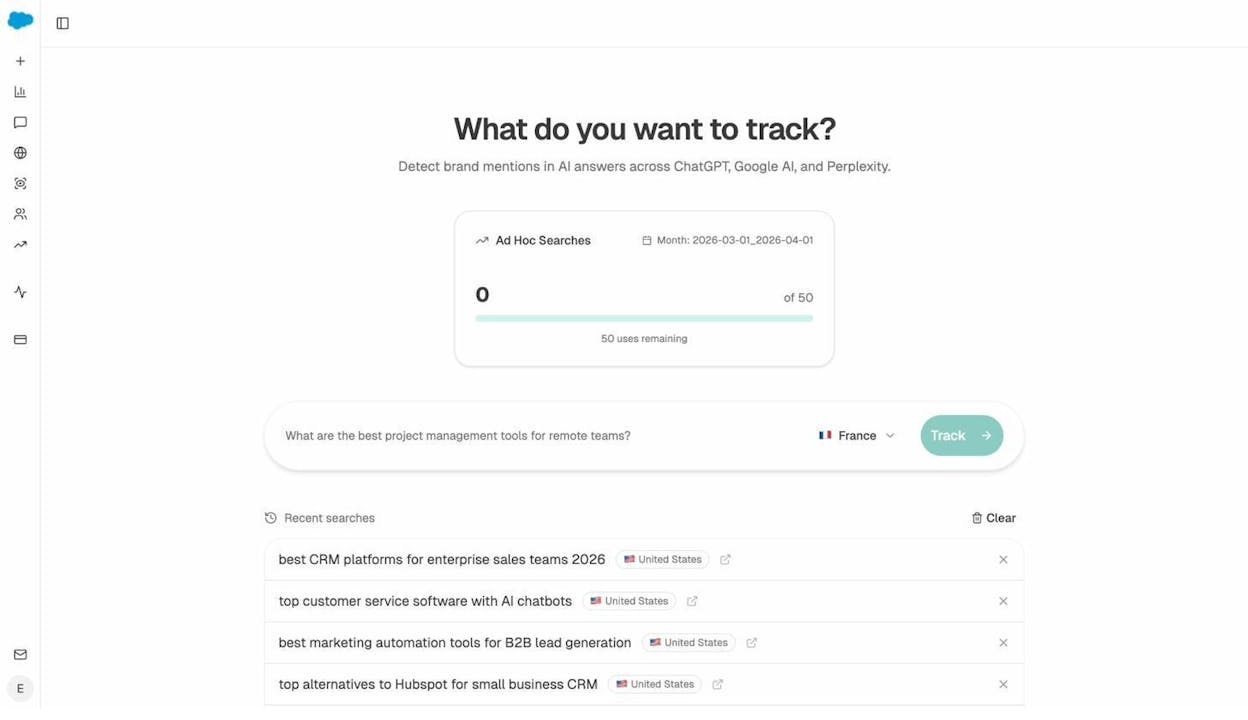
Analyze AI's prompt suggestion feature helps uncover these AI-specific queries. The tool identifies prompts relevant to your industry that are generating AI responses—showing you not just what people search on Google, but what they're asking ChatGPT, Claude, and Perplexity.

[Screenshot: Prompt_Suggestion.png - showing the Suggested tab with prompts like "Best email marketing tools for increasing engagement in 2026?" with Track/Reject options]

This matters because the prompts where your competitors appear (and you don't) represent immediate opportunities. A keyword might have low Google volume but significant AI query activity—and those AI mentions can drive referral traffic and shape how potential customers perceive your brand before they ever visit your site.

When building your topic list, pull from both sources:

  • Traditional keyword research tools for Google-focused topics

  • Analyze AI's prompt suggestions for AI-specific opportunities

  • Customer conversations and support tickets for language patterns real people use

The overlap between these sources reveals your highest-value topics: ones that rank in Google AND get cited in AI responses.

2. Prioritize Low-Hanging Keywords

Not all keywords require the same effort to rank. Some need months of link building and content investment. Others can reach page one within weeks, even for newer sites.

Low-hanging keywords are terms you can rank for without significant domain authority. They typically share these characteristics:

  • Lower keyword difficulty scores (under 30 in most tools)

  • Less competition from established sites

  • Sufficient search volume to justify the effort

  • Strong alignment with your business

Sorting your keyword list by difficulty reveals which terms to target first. Early wins build momentum—both for your traffic numbers and your team's confidence that the strategy works.

[Screenshot: Keyword research tool showing keywords sorted by difficulty score, with low-KD terms highlighted]

The Compound Strategy

A common mistake is assuming low-difficulty keywords aren't worth pursuing because of lower individual volume. But content strategy compounds. An article targeting a keyword with 50 monthly searches can rank for dozens of related long-tail variations, multiplying its actual traffic potential.

The math works like this:

  • Main keyword: 50 monthly searches

  • Related long-tail keywords captured: 15-30 variations

  • Combined monthly traffic potential: 200-500 visits

Target 20 low-difficulty keywords over three months, and you're looking at 4,000-10,000 monthly organic visits—all from terms your competitors ignored because the individual volumes looked small.

Manual Keyword Research Process

If you prefer finding keywords without paid tools, follow this process:

  1. Google your main topic

  2. Look at the "People also ask" section

  3. Scroll to "Related searches" at the bottom

  4. Check Google Autocomplete by typing your topic + various letters (a, b, c...)

  5. Visit top-ranking pages and note what subtopics they cover

  6. Use Google's free Keyword Planner for volume estimates

[Screenshot: Google search results showing "People also ask" section expanded with related questions]

This manual approach takes longer but costs nothing and often surfaces questions that paid tools miss.

[Screenshot: Google Autocomplete suggestions appearing as you type a partial query]

Low-Hanging Fruit in AI Search

The same prioritization logic applies to AI visibility. Some prompts are dominated by well-known brands with extensive content libraries. Others represent gaps where no clear winner has emerged.

Analyze AI's Opportunities feature identifies these gaps automatically. It shows prompts where competitors appear but your brand doesn't—essentially highlighting the low-hanging fruit in AI search.

[Screenshot: Opportunities.png - showing the Opportunities dashboard with prompts, number of Unmentioned results, and Competitors columns]

For each opportunity, you can see:

  • The specific prompt where you're absent

  • Which competitors currently appear

  • How many times you've been unmentioned versus competitors

Prioritize opportunities where:

  • Multiple competitors already appear (validates the prompt matters)

  • Your brand has relevant content that could be cited

  • The topic directly connects to your product's value proposition

This approach focuses your AI optimization efforts on winnable prompts rather than trying to appear everywhere at once.

3. Publish Long-Form, Helpful Content

Google's guidelines emphasize "helpful, reliable, people-first content." In practice, this usually means long-form articles that thoroughly address the reader's question.

Long-form content gives you space to:

  • Explain concepts completely rather than superficially

  • Address related questions the reader might have next

  • Demonstrate expertise through depth

  • Include examples that make abstract ideas concrete

  • Naturally incorporate relevant keywords without stuffing

The ideal length varies by topic. Some questions require 1,500 words to answer properly. Complex technical topics might need 4,000+. The right length is whatever fully addresses the search intent—no padding, no missing pieces.

Structuring Long-Form Content

Length alone doesn't make content helpful. Structure determines whether readers actually engage with it. These formatting practices improve readability:

Break content into sections. Each major point deserves its own heading. This creates visual breaks and lets readers scan to find specific information.

Use headers as signposts. Your H2s and H3s should tell a story even if someone only reads those. A reader scanning your headers should understand what the article covers.

Keep paragraphs short. Online readers process information differently than book readers. Three to four sentences per paragraph is usually ideal.

Add visual breaks. Screenshots, tables, charts, and images interrupt walls of text. They also help explain complex points faster than words alone.

Use simple language. Over half of American adults read below a sixth-grade level. Write clearly, avoid jargon, and explain technical terms when you must use them.

[Screenshot: Example blog post showing proper formatting with headers, short paragraphs, and visual elements breaking up text]

Why Long-Form Matters for AI Citations

AI models trained on web content develop preferences for certain content characteristics. Our analysis of 83,670 citations across ChatGPT, Claude, and Perplexity revealed that AI engines heavily favor certain content types—and the preferences differ by platform.

Claude favors blog content at 43.8% of citations, nearly four times higher than ChatGPT's 16.7%. ChatGPT and Perplexity lean toward product pages and official documentation.

What this means for your content strategy:

  • Comprehensive blog content that explains concepts thoroughly gets cited more frequently by some AI engines

  • Documentation-style content with clear specifications performs better with others

  • The depth that helps you rank in Google also provides the context AI models need to cite you accurately

Long-form content naturally provides more citable material. A 3,000-word guide covering a topic thoroughly gives AI models multiple reference points. A 500-word overview gives them almost nothing to work with.

4. Write for Your Target Personas

Generic content addresses everyone and resonates with no one. Target personas force specificity in your writing, which produces content that actually connects with readers.

A persona is a detailed profile of your ideal reader. It goes beyond demographics to include:

  • Their job role and responsibilities

  • Specific challenges they face

  • Their level of expertise with your topic

  • What they've likely already tried

  • What outcomes they're seeking

Building Useful Personas

Most persona exercises produce documents that gather dust. The profiles are too vague to inform actual content decisions. Fix this by making personas specific and actionable.

Bad persona: "Marketing managers at mid-size companies who want to improve their marketing."

Useful persona: "Director of Marketing at a B2B SaaS company with 50-200 employees. Reports to a VP who wants measurable results. Has tried content marketing but struggled to prove ROI. Currently relies on paid ads and worries about rising CPCs. Reads industry blogs during commute, prefers tactical content over thought leadership. Needs to show results within 6 months to secure next year's budget."

The useful persona tells you exactly what to write. You know their pain points (proving ROI, rising ad costs), their constraints (6-month timeline), and their content preferences (tactical, not theoretical).

[Screenshot: Persona template filled out with specific details about job role, challenges, expertise level, and content preferences]

Applying Personas to Content

Once you have personas, use them as filters for every content decision:

Topic selection: Would this persona actually search for this? Does it address a real problem they face?

Angle: What perspective would resonate most? Beginner guide or advanced tactics? Strategic overview or step-by-step implementation?

Depth: How much do they already know? Can you skip basics or do you need to establish foundation?

Examples: What references would they recognize? Industry examples, tools they likely use, metrics they care about?

Tone: Are they looking for formal analysis or conversational guidance?

A single topic can produce very different articles depending on the persona. "Email marketing automation" for a solo entrepreneur looks completely different than the same topic for an enterprise marketing director.

How AI Engines Perceive Your Brand

Personas shape how humans perceive your content. But AI engines also form perceptions of your brand based on what sources they cite and what context those sources provide.

Analyze AI's sentiment tracking shows how AI engines characterize your brand across different prompts. A sentiment score of 85 means AI responses frame your brand positively. A score of 40 suggests neutral or mixed characterizations.

[Screenshot: Sentiment_Analysis.png - showing sentiment scores over time for multiple brands with trend lines]

This matters because AI engines can rate the same brand very differently. Our research found brands rated up to 79 points apart depending on which AI engine responds. This happens because each engine pulls from different sources and weights information differently.

If your sentiment score is low for certain prompts, examine the sources AI engines cite for those responses. The third-party content they reference shapes how they characterize your brand. Improving your sentiment often means improving those external sources—through better PR, customer reviews, or getting cited in publications that AI models trust.

5. Build Brand Authority

Brand authority is your insurance policy against algorithm changes. When Google or AI engines update their systems, sites with established authority typically survive better than those without.

Brand authority means people search specifically for your brand. They recognize your name, trust your expertise, and seek you out rather than finding you through generic searches.

Why Brand Authority Protects You

Recent algorithm updates penalized sites without strong brands more severely. Here's why:

  • Branded searches signal that real humans want to find you specifically

  • Brand mentions across the web (even without links) establish your presence

  • Content from known brands receives more trust signals

  • Users engage differently with content from recognized sources

If your site lost all rankings tomorrow, would people still find you? If the answer is no, brand authority needs attention.

Building Brand Authority

Authority compounds over time through consistent effort across multiple channels:

Publish consistently. Regular content signals an active, invested presence. Sporadic publishing makes your site look abandoned.

Develop original research. Data that others cite builds authority faster than republishing existing information. Surveys, analyses, and case studies create citable material.

Establish thought leaders. Named authors with visible expertise attract more engagement than anonymous "Admin" posts. Build profiles for your content creators.

Expand beyond your site. Contribute to industry publications, podcasts, and events. Each appearance extends your brand reach.

Repurpose content. Turn blog posts into LinkedIn posts, email newsletters, videos, and social threads. Meet your audience where they already spend time.

[Screenshot: LinkedIn carousel post created by repurposing blog content, showing multiple slides with key points]

Brand Authority in AI Search

AI engines form their own sense of brand authority based on what they were trained on and what they retrieve during responses. This is separate from Google's authority signals.

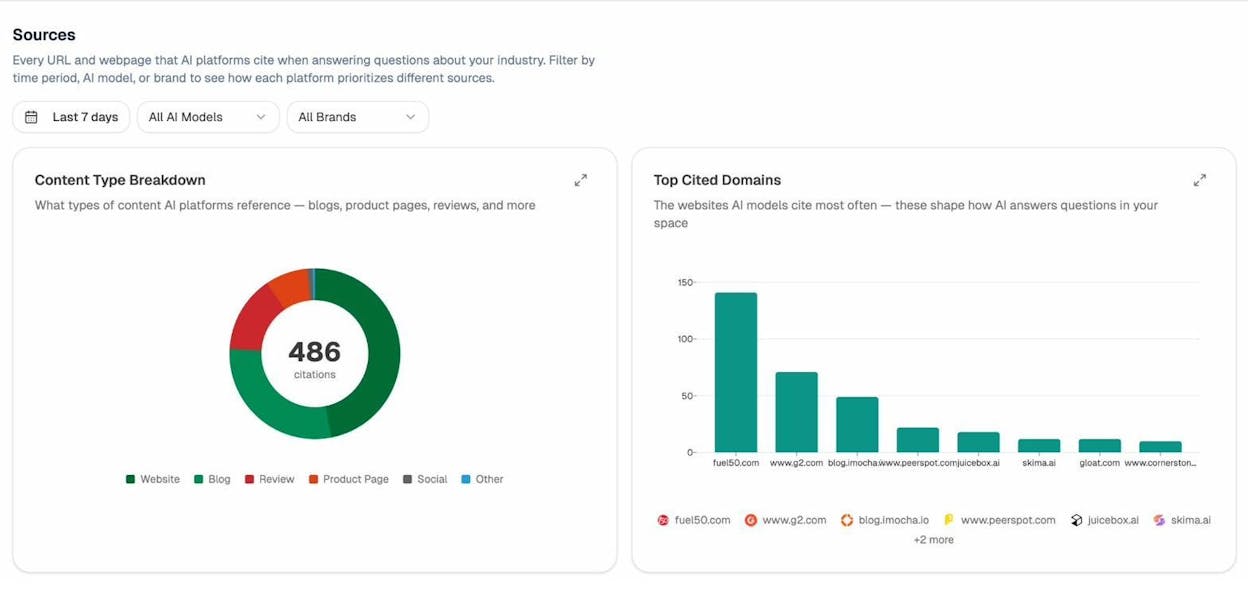
About 83% of AI citations come from third-party sources, not brand websites directly. This means your AI visibility depends heavily on how external sources discuss your brand.

Analyze AI's Top Sources report shows which external domains drive the most citations for your tracked prompts.

[Screenshot: Top_Sources.png - showing domains ranked by Total Citations with Used % of chats and Type columns]

Use this data to:

  • Identify which publications AI engines trust for your industry

  • Prioritize PR and guest content efforts toward high-citation sources

  • Monitor when competitor content on external sites gains traction

  • Track whether your brand gets mentioned by the sources AI engines cite most

Building AI brand authority means getting positive coverage on the external sources that AI models cite—not just optimizing your own site.

6. Cover Different Search Intents

Search intent is the reason behind a query. Someone searching "what is email marketing" wants different content than someone searching "best email marketing software." Matching your content to intent determines whether searchers find what they need.

The four main intent types:

Informational: The searcher wants to learn. They're researching, not buying. Content: guides, explanations, how-tos.

Navigational: The searcher wants a specific destination. They know where they want to go. Content: homepage, login pages, specific product pages.

Commercial: The searcher is considering a purchase but needs more information. They're comparing options. Content: comparison posts, reviews, "best of" lists.

Transactional: The searcher is ready to buy or take action. Content: product pages, pricing pages, signup flows.

Matching Content to Intent

Before writing any content, search your target keyword and examine the results. Google has already tested what content type satisfies that intent—the ranking pages show you the answer.

If all top results for "email marketing software" are listicle comparisons, Google has determined that commercial comparison content matches the intent. Publishing a single-product review will struggle to rank because it doesn't match what searchers want.

[Screenshot: Google search results for a commercial intent keyword showing listicle-style comparison posts dominating rankings]

Check for:

  • Content format (listicle, guide, product page, definition)

  • Content length (quick answers vs. comprehensive guides)

  • Specific elements included (pricing tables, feature comparisons, how-to steps)

Match these patterns in your content. You can still differentiate through better information, but the fundamental format should align with intent.

Covering the Full Buyer Journey

A complete content strategy addresses all stages of the buyer journey:

Awareness: The buyer recognizes they have a problem. Content educates about the problem space. Example: "Why email open rates matter for business growth."

Consideration: The buyer explores solutions. Content compares options and explains approaches. Example: "How to choose an email marketing platform."

Decision: The buyer evaluates specific options. Content differentiates your solution. Example: "Mailchimp vs. Klaviyo: Which is right for your ecommerce store?"

Map your content to these stages and ensure coverage across all three. Many content strategies over-index on awareness content (easier to produce) while neglecting consideration and decision content (where conversions happen).

[Screenshot: Spreadsheet showing content mapped across buyer journey stages with assigned keywords and intent types]

Intent in AI Search Responses

AI engines also respond differently based on query intent. Informational prompts generate explanatory responses. Commercial prompts trigger comparison-style answers with multiple options listed.

Analyze AI tracks your brand's position across prompts—showing not just whether you appear, but where you rank in AI responses.

[Screenshot: Prompt_Level_Analytics.png - showing visibility %, sentiment, position, and brand mentions for specific prompts]

For commercial-intent prompts like "best CRM platforms for small businesses," position matters significantly. Appearing first versus fifth in an AI response affects how many users consider your brand.

Track your position for high-value commercial prompts. If you consistently appear in positions 3-5 while competitors hold position 1, investigate what content they have that you're missing—then create better versions.

7. Optimize for On-Page SEO

On-page SEO is the final polish that helps search engines understand and rank your content. It's not the most glamorous part of content strategy, but ignoring it leaves opportunity on the table.

URL Structure

Keep URLs short, descriptive, and keyword-rich:

  • Good: /email-marketing-guide/

  • Bad: /blog/2026/01/15/the-complete-guide-to-email-marketing-in-2026-for-beginners/

Avoid dates in URLs. When you update content, the URL shouldn't reference an old year.

Heading Tags

Heading tags (H1, H2, H3) create hierarchy for both readers and search engines.

  • H1: Page title. One per page. Include your primary keyword.

  • H2: Major sections. Each main point in your outline.

  • H3: Subsections within H2s. Supporting points under each major section.

Include relevant keywords in headings where natural. Don't force keywords into every heading—readability trumps optimization.

[Screenshot: Article structure showing H1, H2, and H3 heading hierarchy in a content management system]

Keyword Placement

Include your primary keyword in:

  • Page title (H1)

  • Meta title

  • First 100 words of content

  • At least one H2

  • Meta description

  • Image alt text (where relevant)

Beyond your primary keyword, include related terms naturally throughout. These semantic keywords signal topical relevance. For an email marketing article, terms like "open rates," "deliverability," "segmentation," and "automation" would appear naturally in comprehensive coverage.

Internal Linking

Internal links connect your content and distribute authority across your site. For each new article:

  1. Link to 3-5 relevant existing articles from the new content

  2. Update 3-5 existing articles to link to the new content

  3. Use descriptive anchor text (not "click here")

A quick way to find internal linking opportunities: search your site using Google. For example: site:yoursite.com "email marketing" shows all pages mentioning email marketing that could link to your new article on that topic.

[Screenshot: Google site search showing internal pages that mention a specific keyword]

Meta Title and Description

The meta title and description appear in search results. They don't directly impact rankings, but they influence click-through rates—which indirectly affects rankings.

Meta title: 50-60 characters. Include primary keyword. Make it compelling enough to click.

Meta description: 150-160 characters. Summarize the content's value. Include a reason to click.

[Screenshot: Google search result showing meta title and description with character limits highlighted]

On-Page Optimization and AI Citations

The same structural clarity that helps Google understand your content helps AI models parse and cite it accurately. AI engines process page structure to determine what information to extract.

Specifically, clear H2/H3 headers help AI models identify distinct sections they can reference. Well-structured content with clear topic sentences makes it easier for AI to accurately summarize and cite specific points.

There's no separate "AI on-page optimization" checklist—the standard best practices serve both channels.

8. Monitor Results and Adapt

A content strategy is only as good as its results. Regular monitoring shows what's working, what's failing, and where to adjust.

Core Metrics to Track

Organic traffic: Total visits from search engines. Track overall trends and per-page performance.

Keyword rankings: Where you rank for target keywords. More important than traffic for new content that hasn't had time to accumulate visits.

Click-through rate (CTR): Percentage of people who see your result and click. Low CTR suggests meta title/description improvements.

Engagement: Time on page, pages per session, bounce rate. These indicate whether content satisfies visitor intent.

Conversions: Leads, signups, purchases—whatever action matters to your business. Traffic without conversions is vanity metrics.

Setting Up Tracking

Google Search Console shows impressions, clicks, CTR, and ranking positions for your pages. It's free and essential.

Set up a weekly review:

  1. Check overall clicks trend—is traffic growing?

  2. Review top pages—any unexpected drops?

  3. Examine new content performance—are new articles gaining traction?

  4. Identify rising keywords—opportunities to double down

[Screenshot: Google Search Console performance report showing clicks, impressions, and average position over time]

Google Analytics tracks what visitors do after arriving. Connect it to see:

  • Which pages drive conversions

  • User paths through your site

  • Engagement metrics by content type

  • Traffic sources beyond organic

When and How to Update Content

Not every piece of content succeeds. The standard approach:

Months 1-3: Let new content index and accumulate data. Don't make changes yet.

Month 3-6: Review performance. Content ranking 11-30 often needs small improvements to break into page one. Content ranking 50+ may need fundamental rework or should be cut.

Ongoing: Update content annually at minimum. Refresh statistics, add new sections, remove outdated information. Content updates often trigger ranking improvements.

For underperforming content, diagnose the problem before changing anything:

  • Ranking poorly for target keyword? Check if content matches search intent.

  • Ranking but low CTR? Improve meta title and description.

  • High traffic but no engagement? Content may attract wrong audience or fail to deliver on promise.

Tracking AI Search Performance

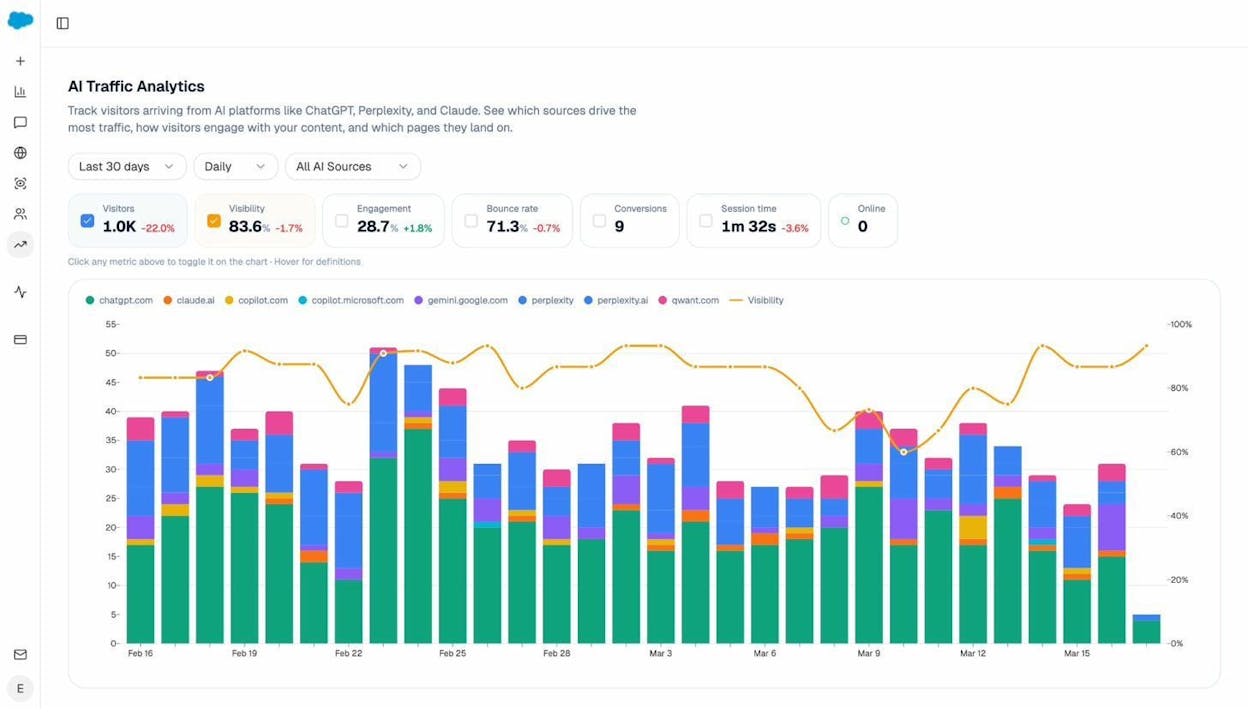
Traditional analytics tools don't show AI search referral traffic by default. AI visits appear as direct traffic or get misattributed.

Analyze AI connects with your Google Analytics to properly attribute AI referral traffic, showing:

  • Total sessions from AI search engines

  • Which AI engines send the most traffic

  • Which pages receive AI referrals

  • Trends over time

[Screenshot: AI_Referral_Traffic.png - showing Total AI Referrals (691 sessions), AI Traffic Contribution (1.6%), and AI Referral Trend chart]

This data answers critical questions:

  • Is AI search actually sending meaningful traffic?

  • Which AI engines should you prioritize?

  • What content types receive the most AI referrals?

Beyond traffic, track your brand visibility across AI responses. Analyze AI monitors how often your brand appears in AI responses to specific prompts, with historical tracking to spot trends.

[Screenshot: Prompt_Level_Analytics.png - showing visibility, sentiment, and position metrics for tracked prompts with mentions and status columns]

If your visibility for a key prompt drops from 80% to 40% over two weeks, investigate what changed. New competitor content? Source changes? Algorithm updates? Early detection prevents prolonged invisibility.

9. Demonstrate Your Products

Your content shouldn't just attract traffic—it should show how your product solves real problems. This isn't aggressive selling. It's using your own tools as examples throughout your content.

Show, Don't Just Tell

When explaining a concept, use your product as the demonstration:

Weak approach: "Use a project management tool to track tasks." (Generic advice that could apply to any tool.)

Strong approach: "In our task dashboard, create a new task, assign it to a team member, and set a due date. The assignee gets notified automatically, and you can track progress from your weekly review screen." (Specific demonstration using your actual product.)

The strong approach accomplishes two things: it gives concrete guidance the reader can apply, and it shows them exactly how your product works.

[Screenshot: Blog post section showing product UI integrated naturally into tutorial content]

Where Product Demonstration Works

  • Process explanations: Walk through how to accomplish something using your product

  • Feature context: When introducing a concept, show how your product implements it

  • Before/after comparisons: Show the problem, then show your product solving it

  • Data and results: Use your own data as examples when discussing metrics

Where Product Demonstration Fails

  • Forced inclusion: Shoehorning product mentions into unrelated content

  • Every section: Readers notice when every answer is "use our product"

  • Before establishing value: Show the concept matters before showing how your product handles it

The test: Would this example make sense even if the reader never buys your product? If yes, the demonstration is adding value. If the example only makes sense as a sales pitch, rework it.

Demonstrating AI Search Visibility

When creating content about AI search strategy, Analyze AI serves as the natural demonstration tool. Rather than generic advice about "monitoring AI visibility," you can show specific dashboards and workflows.

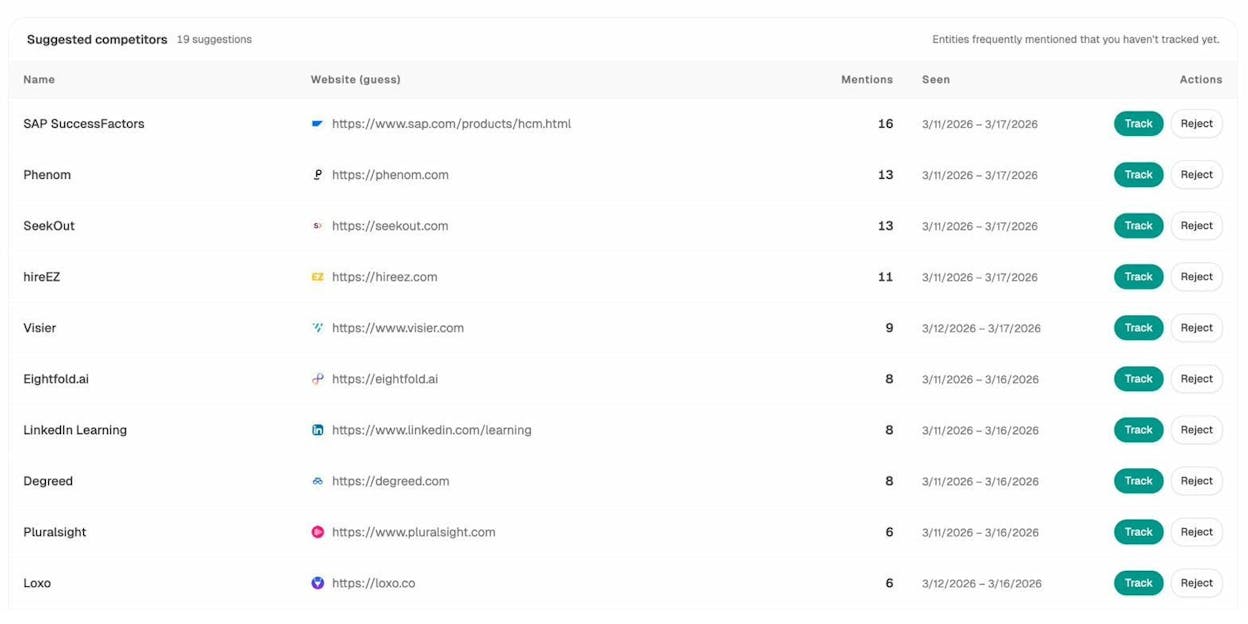
For example, explaining how to identify competitors in AI search becomes concrete with a screenshot showing your competitor tracking dashboard:

[Screenshot: Competitor_Overview.png - showing tracked competitors with websites, mention counts, and last seen dates plus suggested competitors section]

This approach transforms abstract concepts into actionable steps the reader can replicate—and naturally demonstrates the product's value without aggressive selling.

Backlinks remain a significant ranking factor. They signal to search engines that other sites find your content valuable enough to reference.

Why Links Matter

Links pass authority. When a respected site links to your content, some of that site's trust transfers to you. Enough quality links establish your site as authoritative in your space.

The emphasis on "quality" matters. One link from an authoritative, relevant site outweighs dozens of links from low-quality directories or unrelated sites. Prioritize links from:

  • Industry publications

  • News sites covering your space

  • Educational resources (.edu domains)

  • Government resources (.gov domains)

  • Well-established blogs in your niche

Link Building Strategies

Create linkable assets. Original research, comprehensive guides, and useful tools naturally attract links. Our analysis of AI citations mentioned earlier exemplifies this—unique data that others want to reference.

Guest contributions. Write for industry publications in exchange for author bio links. The content you provide should be genuinely valuable, not thinly veiled promotions.

Expert commentary. Reporters constantly need quotes from industry experts. Services like Help a B2B Writer or Qwoted connect writers with sources. Respond to relevant queries with useful insights, and your quotes (with links) appear in published articles.

Broken link building. Find broken links on relevant sites pointing to dead resources. Create better content on that topic and suggest it as a replacement. The site owner fixes their broken link, and you gain a backlink.

Build relationships. The best links often come from genuine relationships with others in your industry. Connect without an immediate ask, provide value, and link opportunities emerge naturally.

Links and AI Citations

AI engines also function as citation engines—they reference sources in their responses. The URLs AI models cite aren't traditional backlinks, but they serve similar purposes: establishing authority and driving traffic.

About 83% of AI citations point to third-party sources. Getting cited by those third parties—the sites that AI engines already trust—is an indirect path to AI visibility.

Analyze AI's citation analytics reveal which sources appear in AI responses for your tracked prompts:

[Screenshot: Citation_Analytics.png - showing citation URLs, mention status, brand mentions, Used Total, and Avg Citations columns]

This data helps prioritize link building efforts:

  • Target links from sites that AI engines frequently cite

  • Monitor which of your URLs already receive AI citations

  • Identify competitor content being cited that you could create better versions of

When an authoritative site links to you AND that site gets cited by AI engines, you gain both traditional SEO value and potential AI visibility through association.

How AI Search Fits Into Your Content Strategy

Throughout this guide, AI search has appeared alongside traditional SEO practices. This reflects how the two channels should work together—not as separate strategies, but as complementary layers of the same foundation.

The content that ranks well in Google often gets cited well by AI engines. Depth, originality, clear structure, and genuine usefulness drive success in both channels. You don't need to create separate content for AI—you need to create excellent content and ensure it reaches AI engines effectively.

Tracking AI Visibility

Analyze AI provides the measurement layer for AI search performance. The platform tracks:

Prompt monitoring: Which queries your brand appears in, with visibility percentages and position tracking.

[Screenshot: Prompts.png - showing list of tracked prompts with visibility, sentiment, position, mentions, status, and dates]

Competitor comparison: How your AI visibility compares to competitors across the same prompts.

[Screenshot: Competitor_Overview.png - showing competitors tracked with mention counts and suggested competitors]

Citation sources: Which external URLs get cited when AI engines answer prompts about your industry.

[Screenshot: Prompt_Level_Citations.png - showing URLs cited for specific prompts with usage count and which AI models cite them]

Traffic attribution: Actual visits to your site from AI search engines, broken down by source and landing page.

[Screenshot: AI_Traffic_By_Page.png - showing landing pages receiving AI traffic with source/medium and session counts]

Engine comparison: Performance differences across ChatGPT, Claude, Perplexity, Copilot, and Gemini.

[Screenshot: Analytics_By_Engine.png - showing monthly session breakdown by AI referrer]

This measurement infrastructure doesn't replace Google Search Console or traditional SEO tools—it complements them by covering the AI channel that existing tools miss.

The Combined Approach

The most effective 2026 content strategy addresses both channels simultaneously:

  1. Research topics using keyword tools AND AI prompt data

  2. Create content that satisfies Google's search intent AND provides citable material for AI

  3. Build authority through links AND through appearing in sources AI engines trust

  4. Measure results through organic traffic AND AI referrals

  5. Optimize based on data from both channels

AI search isn't replacing traditional SEO—it's adding another organic channel that rewards the same fundamentals. The brands that will win are those building for both.

Key Takeaways

  • Choose topics with direct business relevance; chase traffic only when it connects to what you sell

  • Prioritize low-difficulty keywords for early wins that compound over time

  • Create long-form content that thoroughly answers the search query—length serves completeness, not padding

  • Write for specific personas to create content that resonates rather than generic content that bounces

  • Build brand authority as insurance against algorithm changes across Google and AI

  • Match content format and depth to search intent by examining what already ranks

  • Apply standard on-page SEO practices—they serve both traditional and AI search

  • Monitor performance with appropriate tools and adapt based on what the data shows

  • Demonstrate your product naturally within content rather than forcing promotional mentions

  • Build quality links from relevant, authoritative sources that AI engines also trust

  • Track AI visibility alongside traditional SEO metrics to capture the full picture of organic search performance

The fundamentals haven't changed: create genuinely useful content, structure it clearly, promote it effectively, and measure what matters. What's new is where that content now needs to perform—in AI responses alongside traditional search results.

Tie AI visibility toqualified demand.

Measure the prompts and engines that drive real traffic, conversions, and revenue.

Covers ChatGPT, Perplexity, Claude, Copilot, Gemini

Similar Content You Might Want To Read

Discover more insights and perspectives on related topics

© 2026 Analyze AI. All rights reserved.