



Summarize this blog post with:


In this article, you’ll learn what answer engine optimization (AEO) is, how it complements traditional SEO, and how to earn citations in AI-generated answers from ChatGPT, Perplexity, Google AI Mode, and others. You’ll get a step-by-step process for finding the prompts where competitors appear and you don’t, structuring content so AI engines can extract and cite it, and tracking whether any of this actually drives traffic and revenue.
Table of Contents
What Is Answer Engine Optimization?
Answer engine optimization (AEO) is the practice of getting your brand mentioned and cited inside AI-generated answers. These answers come from platforms like ChatGPT, Google AI Mode, Perplexity, Microsoft Copilot, Claude, and Gemini.
Traditional SEO focuses on ranking your pages in a list of search results. AEO focuses on making your brand the one that AI engines reference when they generate a direct answer to a user’s question.
The shift matters because millions of users now get their answers without clicking a single link. If your brand is not in that response, you are invisible to those users.
But here is what most AEO guides get wrong. They treat it as an entirely new discipline that requires throwing out your existing SEO playbook. It doesn’t. The brands that show up in AI answers are the ones with clear, original, and well-structured content. The difference is that your content now needs to work for AI models too, not just Google’s ranking algorithm.
AEO vs. SEO: How They Compare
AEO and SEO share the same foundation but differ in where and how your content surfaces.
|
SEO |
AEO |
|
|---|---|---|
|
Primary goal |
Rank web pages in search engine results |
Get your brand cited inside AI-generated answers |
|
Search environment |
A ranked list of links |
Dynamic, AI-generated responses with selective citations |
|
Optimization focus |
Keywords, backlinks, technical SEO |
Brand mentions, question targeting, content structure for extraction |
|
Primary platforms |
Google Search, Bing Search |
ChatGPT, Google AI Mode, Perplexity, Copilot, Claude, Gemini |
|
Success metrics |
Rankings, click-through rate, organic traffic |
AI citations, brand mentions, AI referral traffic, sentiment |
|
User journey |
User clicks through to your website |
User may never click, but sees your brand named as a trusted source |
The key takeaway from this comparison: AEO is not a replacement for SEO. It is an extension of it. You still need crawlable, well-structured, authoritative content. But once those basics are covered, the focus shifts from ranking a page to packaging information in a way AI engines can trust, extract, and cite.
This is why GEO is not a replacement for SEO. Search is expanding from ten blue links to AI-generated answers. Quality still governs visibility. Authority still comes from depth, originality, and usefulness. What changes is where that quality needs to be legible.
Why AEO Matters Right Now
AI Overviews are reducing clicks on organic results. When AI Overviews appear, click-through rates on the top organic result drop significantly. Users get the answer they need directly in the SERP.
AI search traffic converts at higher rates. Visitors arriving from AI platforms convert at rates several times higher than traditional organic visitors. The volume is smaller, but users who click through from an AI citation arrive pre-qualified.
User behavior is shifting structurally. Over 400 million people use OpenAI products weekly. Perplexity processes over 100 million monthly searches. Google AI Mode is rolling out broadly. These are default search behaviors for a growing segment of your audience.
Most of your AI mentions come from third-party sites. When ChatGPT answers a question about your industry, the mention of your brand often comes from a review site, a comparison article, or a community discussion, not from your own website. AEO requires a strategy that extends beyond your own content.
The bottom line: zero-click searches are becoming the norm. The brands that adapt will maintain visibility in a landscape where traffic alone is no longer the full picture.
How to Do Answer Engine Optimization (Step by Step)
Here is a practical process you can follow to build and sustain AI visibility. Each step builds on the previous one.
Step 1: Audit What AI Engines Currently Say About You
Before you optimize anything, you need a baseline. Open ChatGPT, Perplexity, Claude, Gemini, and Copilot. Ask questions your potential customers would ask about your category.
Try prompts like “What are the best [your category] tools?” and “How does [your brand] compare to [competitor]?” Note which platforms mention you, how they describe you, what competitors appear alongside you, and which sources are cited.
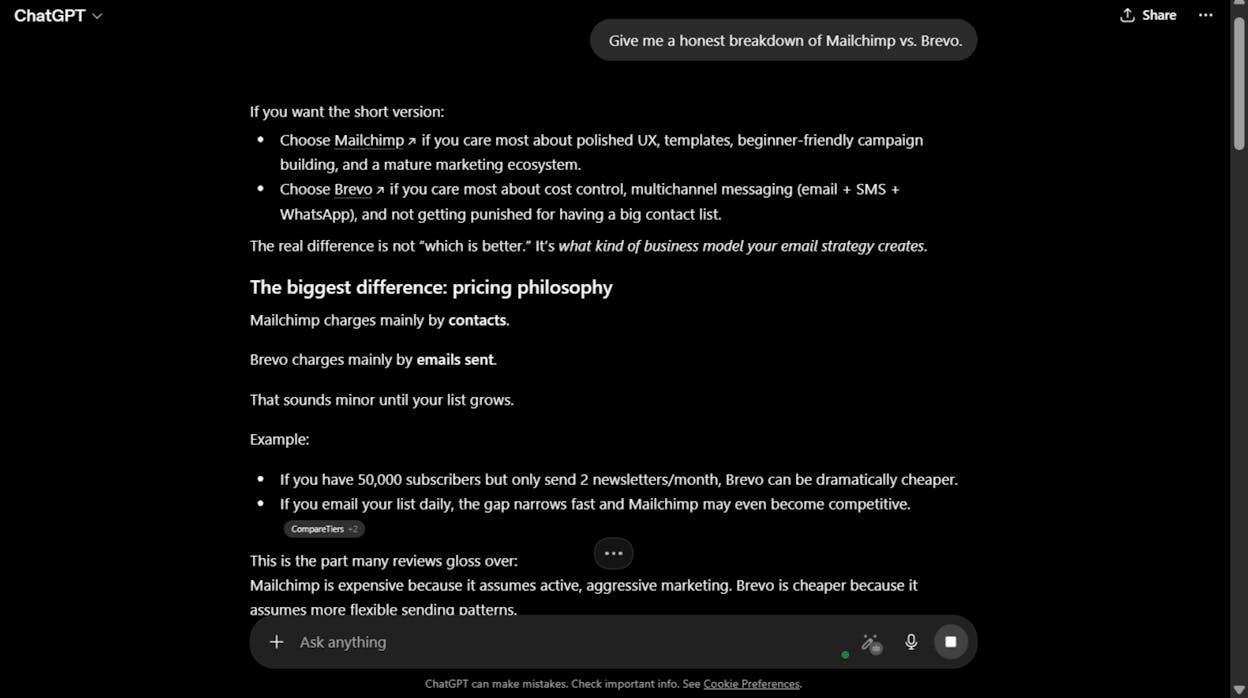
This manual audit gives you a qualitative sense of your AI presence. But for ongoing tracking, you need something automated.
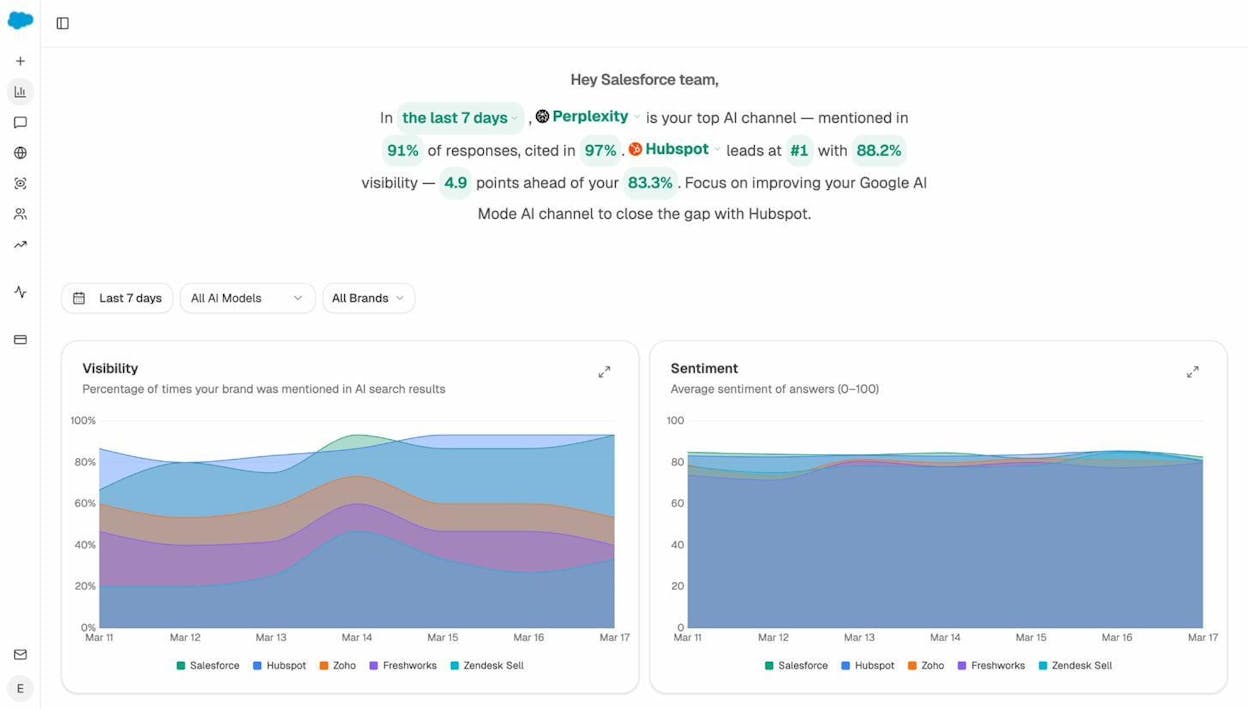
In Analyze AI, the Overview dashboard shows your brand’s visibility, sentiment, and competitive position across all major AI engines at a glance. You can filter by time period, AI model, and brand to see exactly how your visibility is trending.
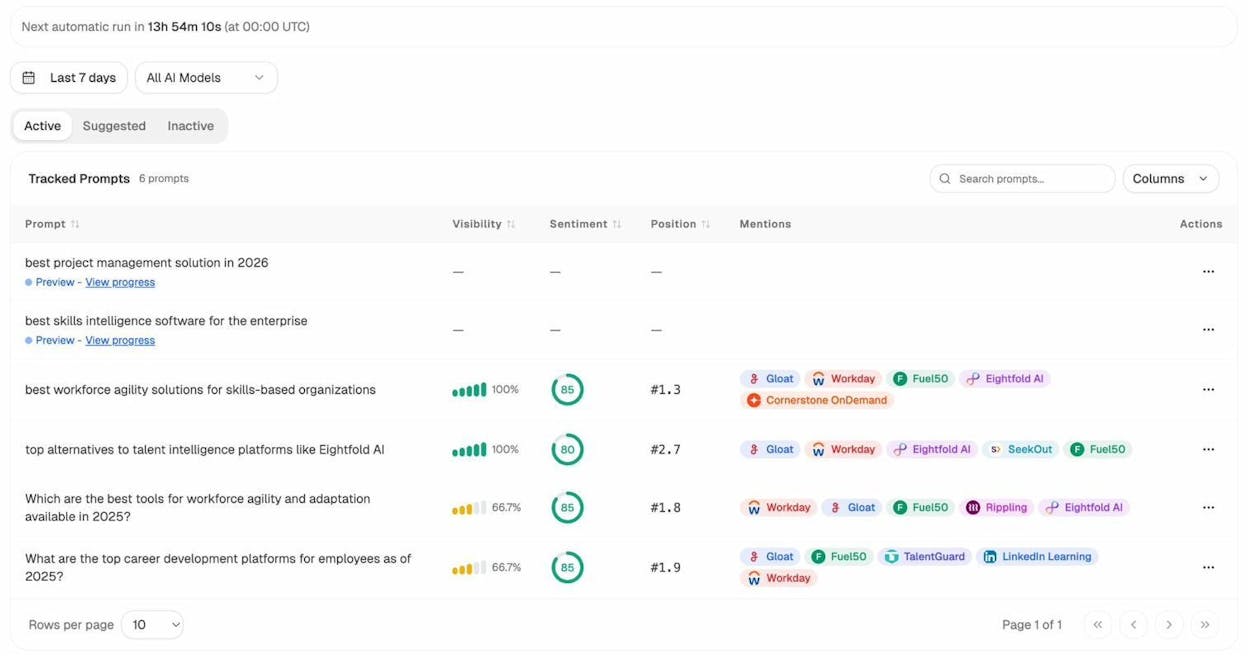
The Prompt Tracking view goes deeper. It shows every tracked prompt with your visibility percentage, sentiment score, average position, and which competitors appear in the same response.
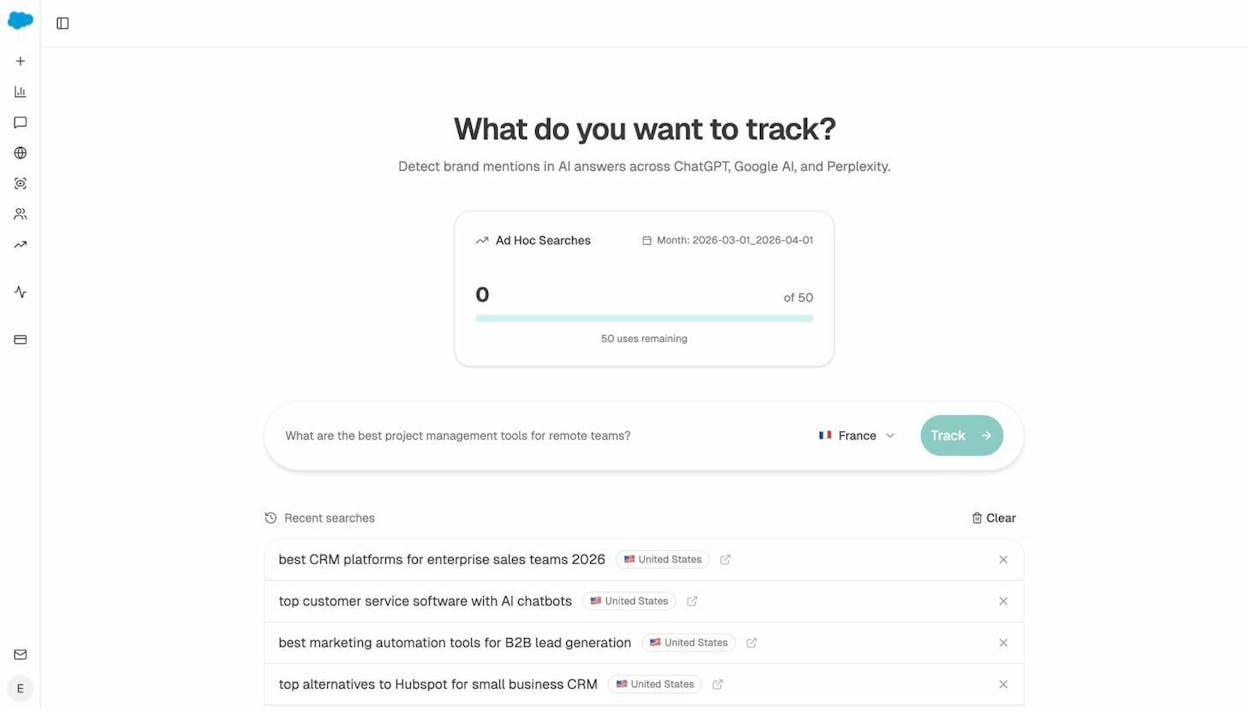
For one-off checks, the AI Search Explorer lets you run ad hoc queries across AI platforms instantly, without leaving your dashboard.
Document your findings. This baseline drives every step that follows.
Step 2: Find the Prompts Where Competitors Win and You Don’t
The fastest way to identify AEO opportunities is to find the queries where competitors get cited and you don’t. These gaps represent the topics where AI engines have already decided someone else is the authority.
In Analyze AI, the Competitor Intelligence view shows you every brand that AI engines mention alongside yours. You can track competitors manually or use the Suggested Competitors feature, which automatically identifies brands that appear frequently in your industry’s AI responses.
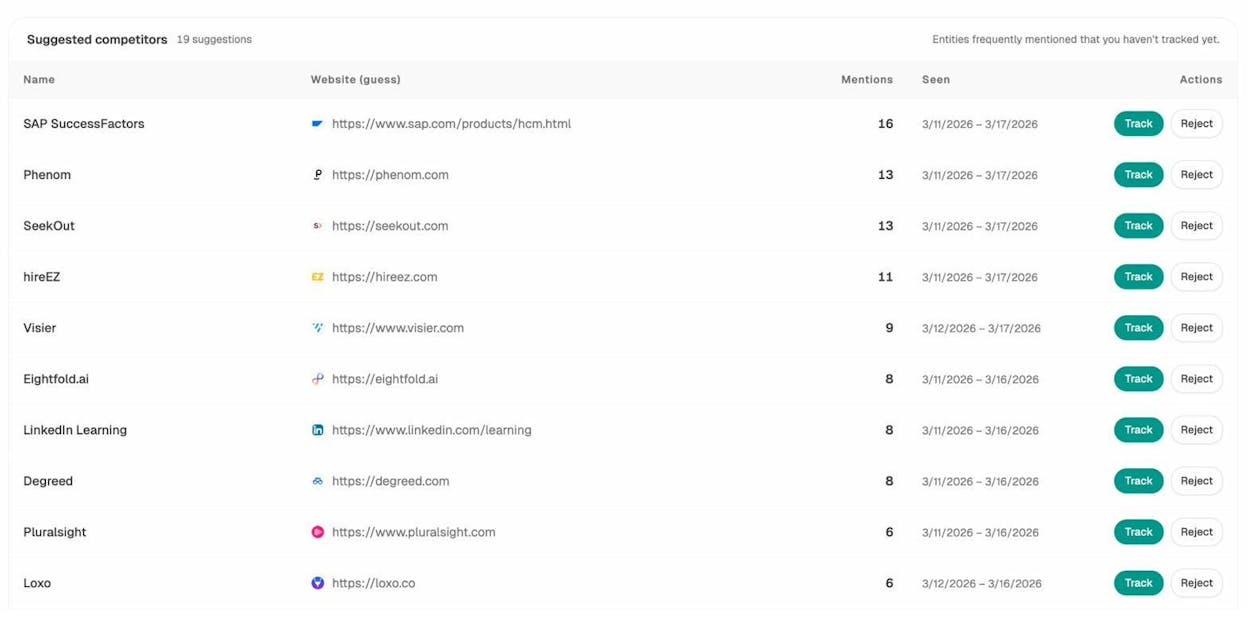
Once you are tracking competitors, you can compare visibility on a prompt-by-prompt basis. If a competitor has 100% visibility on a prompt where you have 0%, that prompt is your highest-priority content gap.
Beyond direct competitor gaps, the Sources dashboard reveals which domains and content types AI engines cite most frequently in your space.
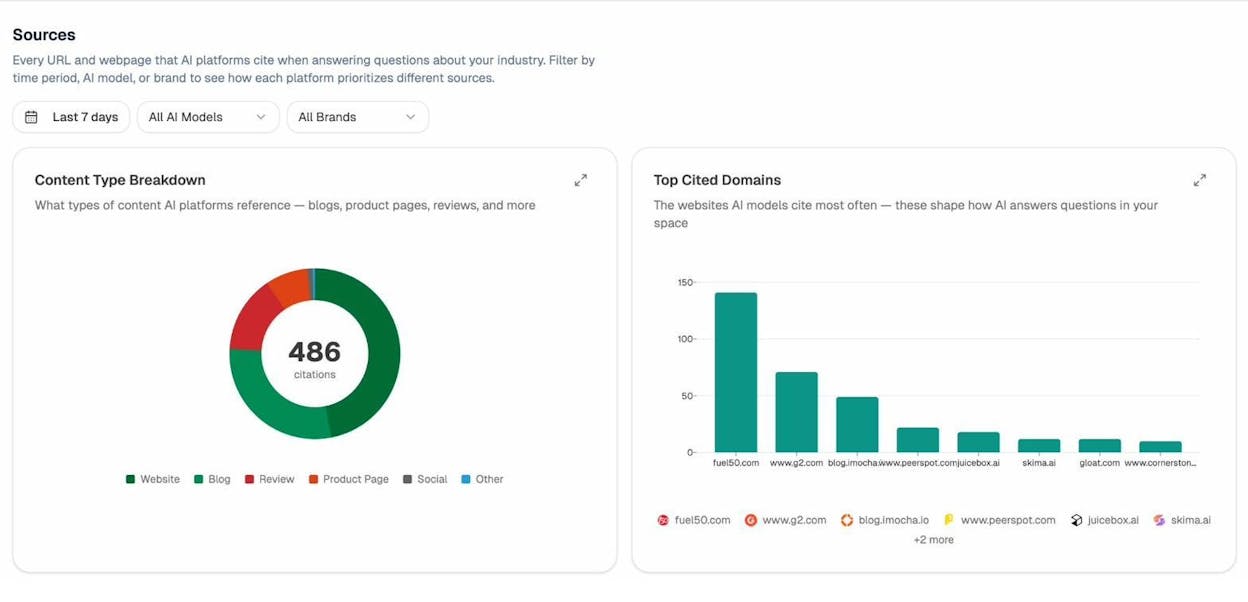
This report tells you two things. First, which types of content AI engines prefer (blogs, product pages, review sites, or something else). Second, which specific domains carry the most weight in AI answers for your industry. Both insights shape your content and outreach strategy.
Step 3: Answer Questions AI Engines Are Already Asking
Once you know where the gaps are, you need to create content that fills them. The goal is to answer real questions in a way that AI engines can easily extract and cite.
Find the right questions to answer. Use the People Also Ask section on Google, the Keyword Generator, and your keyword research process to identify question-based queries in your niche. Then cross-reference those questions with what AI engines are actually answering. Use Analyze AI’s Suggested Prompts feature to discover the prompts users are asking AI platforms in your category.
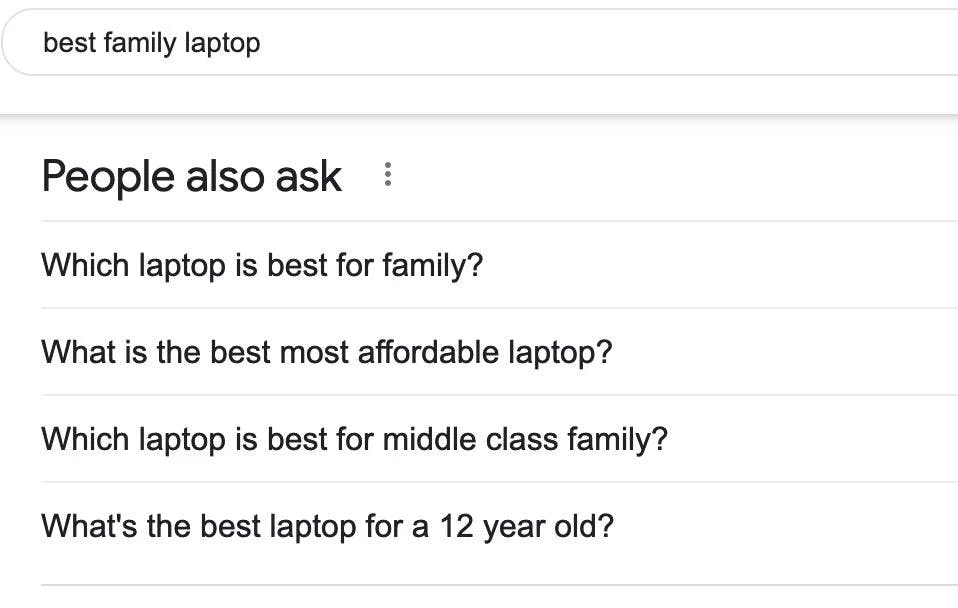
Check the SERP for each target keyword. If the SERP includes an AI Overview, that keyword has both SEO and AEO potential. Optimize for both.
Structure your answers for extraction. AI engines don’t read your content the way humans do. They scan for clear, extractable answers. Here is what helps:
|
Content element |
Why it matters for AEO |
|---|---|
|
H2/H3 headings that match user queries |
AI engines match headings to prompts when deciding what to extract |
|
First sentence of each section answers the heading |
AI often pulls the first 1-2 sentences after a heading |
|
Tables for comparisons and structured data |
AI engines extract tabular data more accurately than prose |
|
Specific numbers, dates, and names |
Specificity signals authority and makes content more citable |
|
Short paragraphs (2-4 sentences) |
Easier for AI to segment and extract cleanly |
|
Internal links to related content |
Helps AI engines understand your topical authority |
Lead with the answer, then expand. State your key point in the first sentence of each section, then provide supporting context, examples, and evidence. This way, AI can cite your summary while readers still get depth. Use the Keyword Difficulty Checker to evaluate whether the topics you discover through prompt research are also worth targeting in traditional search.
Step 4: Prioritize Information Gain Over Generic Coverage
This is the single most important content principle for AEO. AI engines have access to thousands of pages that all say the same generic thing. The pages that earn citations are the ones that add something new.
Information gain means providing original data, specific examples, unique frameworks, or expert insights that make your content more valuable than anything else available. Here is what that looks like in practice:
Include first-person insights. Statements like “We tested this across 100 accounts and found…” signal real-world expertise. AI engines seem to favor content that reflects genuine experience, aligning with Google’s E-E-A-T principles.
Share original research. Proprietary data, surveys, and case studies give AI engines something they can’t find anywhere else. If you publish a study and it gets cited by news outlets, linked on Reddit, and referenced in newsletters, AI engines begin treating it as a canonical source. The compounding effect on AI visibility is significant.
Use specific numbers instead of vague claims. “Our process reduced churn by 14%” is more citable than “our process reduces churn.” AI engines gravitate toward specificity because it is harder to fabricate and easier to verify.
Run the “So what?” test on every section. If a reader could find the same information on the first three Google results for your keyword, your content has no information gain. Rewrite it until it does.
Step 5: Build Authority Beyond Your Own Website
AI engines don’t just evaluate your website. They evaluate how the wider web perceives your brand.
Earn backlinks and mentions on sites AI trusts. Use the Website Authority Checker to evaluate potential link targets, and use Analyze AI’s Sources dashboard to identify which domains AI engines cite most frequently in your space. A backlink from a domain that AI engines frequently cite is worth more for AEO than one from a domain they ignore.
Be consistent across platforms. Make sure your brand name, description, and positioning are identical on your website, G2, Capterra, LinkedIn, and every directory where you appear. Conflicting messaging confuses AI engines.
Pursue co-mentions with established entities. If your brand consistently appears alongside recognized industry leaders (in comparison articles, expert roundups, and review sites), AI engines begin to associate your brand with that level of authority.
Invest in digital PR. Getting featured in industry publications and news articles builds the off-site signal layer that AI engines rely on. Many AI citations trace back not to your own content, but to what respected third parties say about you.
Step 6: Implement Technical Foundations for AI Crawlers
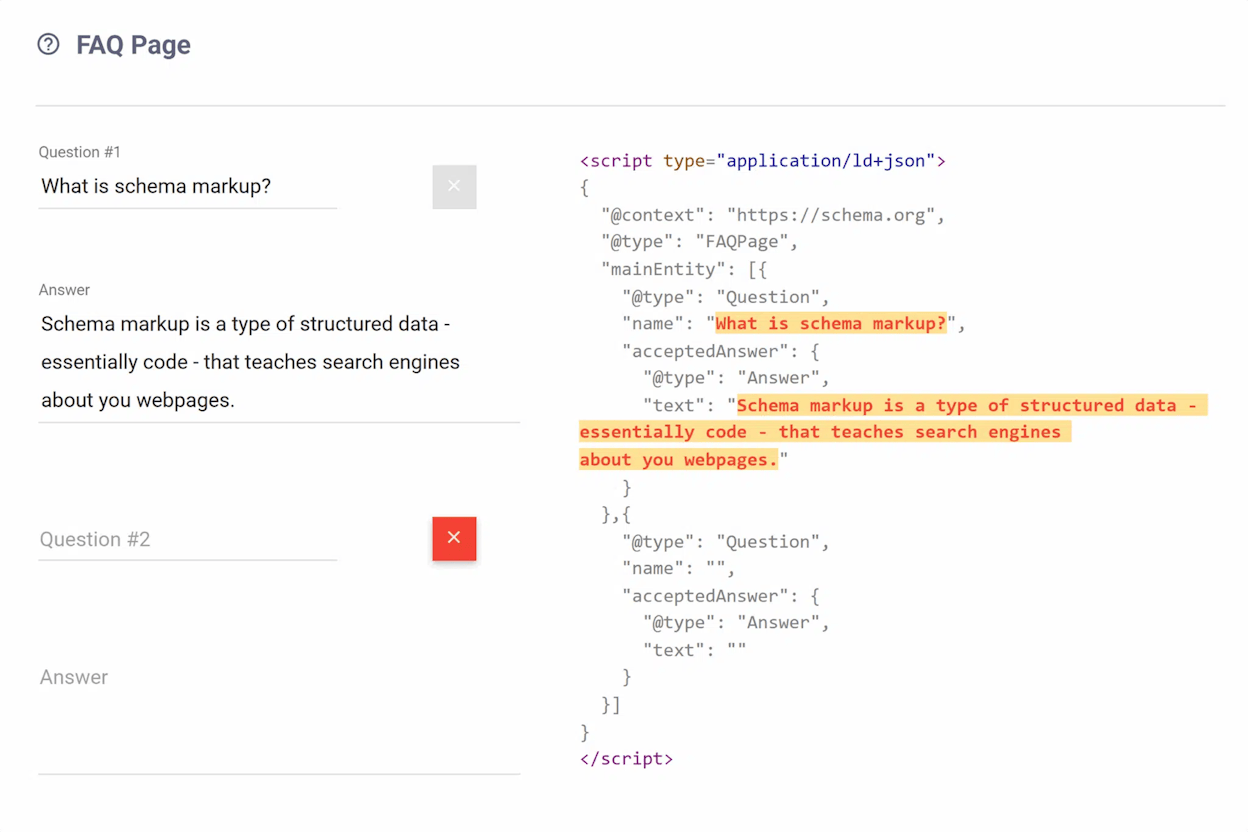
Schema markup. Implementing schema types like Article, FAQPage, HowTo, and Speakable helps machines recognize the most important pieces of information on your page. The Speakable schema is particularly relevant because it tells AI systems which parts of your page are most suitable for direct citation.
AI crawler access. Check your robots.txt file. Some AI platforms use specific user agents (GPTBot for OpenAI, PerplexityBot for Perplexity, ClaudeBot for Anthropic). If your robots.txt blocks these, your content will not appear in their answers. Ensure your content loads without heavy JavaScript reliance. Server-side rendering or static HTML is safer.
Content freshness. AI engines weigh recency when deciding what to include. Research shows the vast majority of ChatGPT citations come from content published or updated within the last 10 months. Add timestamps (“Updated June 2026”) and use datePublished and dateModified structured data to signal recency.
Site speed and clean architecture. Fast-loading sites are easier for AI engines to crawl at scale. Run a broken link check to catch issues that could block AI crawlers. A strong internal linking structure helps AI engines understand relationships between your content and assess your topical depth.
Step 7: Track Whether AEO Actually Drives Traffic and Revenue
Most AEO advice stops at “get mentioned in AI answers.” But mentions don’t pay the bills. You need to know whether AI visibility drives traffic, engagement, and conversions.
In Analyze AI, the AI Traffic Analytics dashboard connects to your GA4 account and shows exactly how many visitors arrive from each AI platform, how they engage, and which pages they land on.
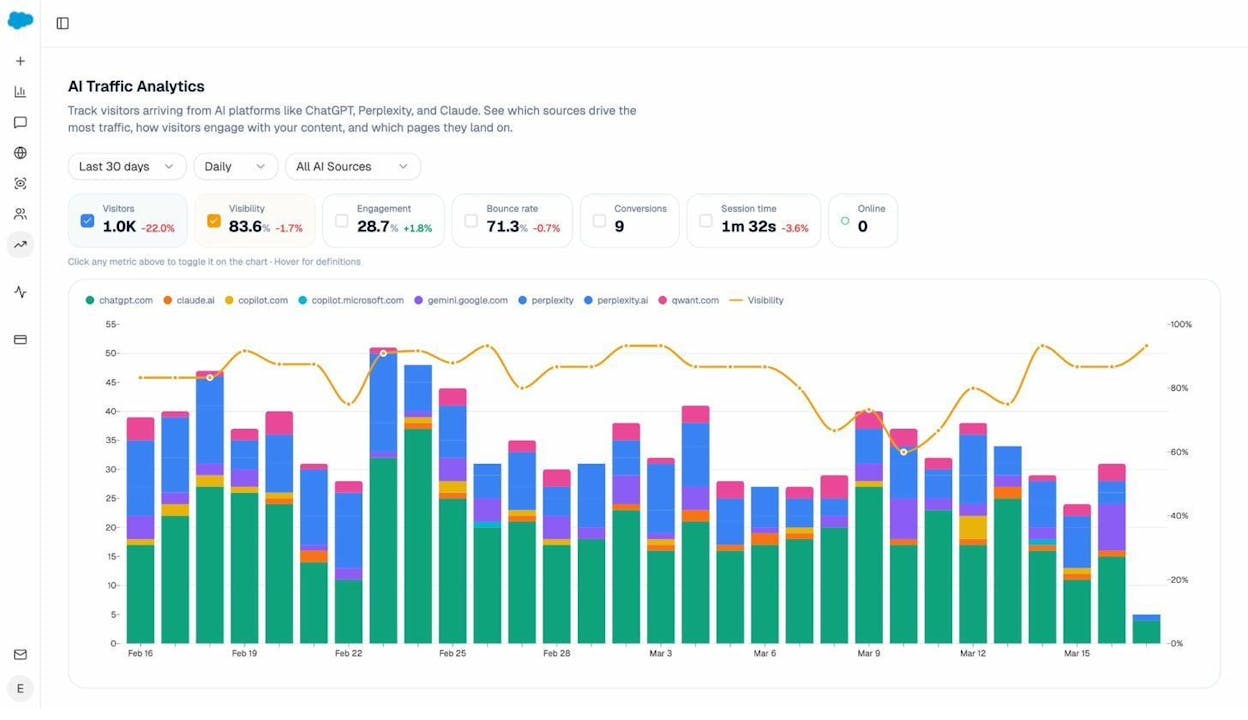
You’ll see total visitors broken down by platform, engagement rates, conversions attributed to AI referrals, and session duration. The Landing Pages report shows which pages receive AI-referred traffic, how many times each was cited, and what the conversion rate looks like.
Use this data to double down on what works. If a blog post drives high engagement from AI traffic, create more content in that format. If a product page gets cited frequently but has low conversions, optimize the page experience. This is what separates AEO as a measurable channel from AEO as a vanity metric.
How to Add AI Search to Your Existing SEO Workflow
The most common mistake with AEO is treating it as a separate channel that requires a separate strategy. It doesn’t.
When you do keyword research, add prompt research. Traditional keyword research tells you what people search on Google. Prompt research tells you what people ask AI engines. The overlap is significant but not complete. Many high-value prompts are longer and more conversational than traditional keywords. When you research keywords, also research the prompts that matter in your space using Analyze AI’s Prompt Discovery feature.
When you publish content, structure it for both channels. Every piece of content should serve both SEO and AEO. Include a clear, concise answer near the top of each major section (for AI extraction), followed by depth, examples, and evidence (for SEO ranking signals and reader value). Use the Content Optimizer to score your content against AEO readiness criteria before publishing.
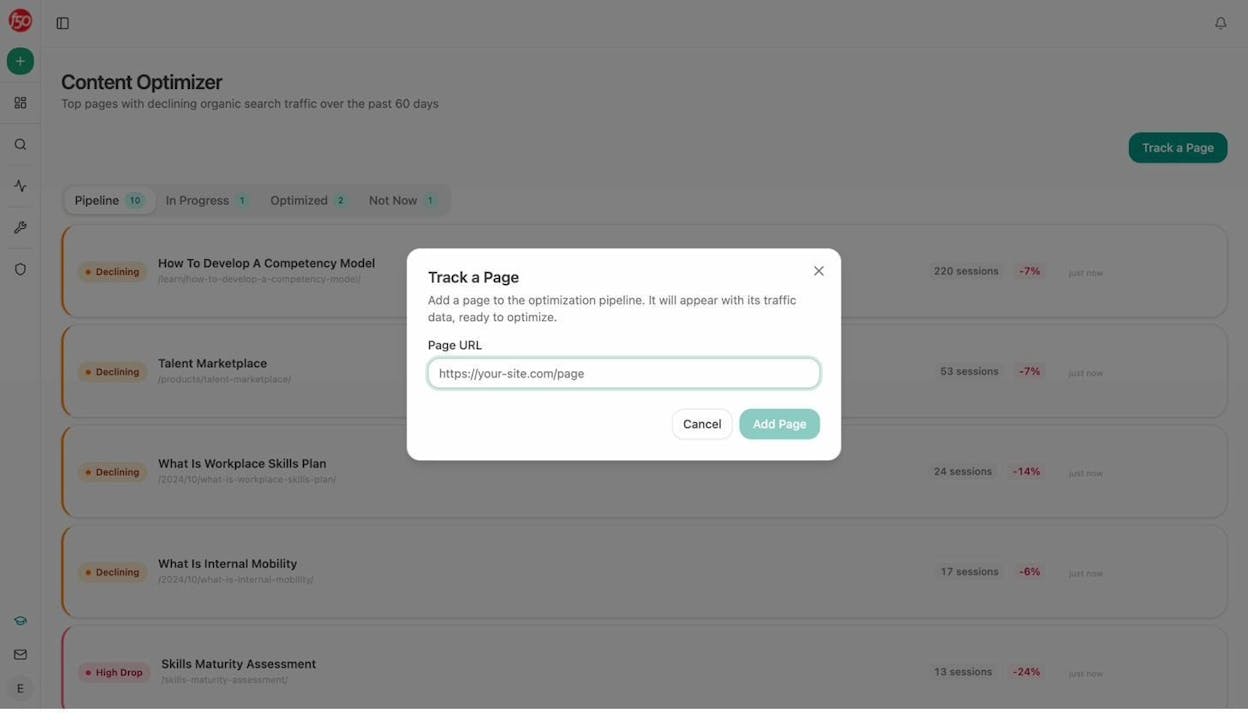
When you audit content, include AI visibility data. During your next content audit, add AI metrics alongside traditional SEO metrics. For each page, check whether it gets cited in AI answers, whether it receives AI referral traffic, and whether gaps exist in either channel. This combined view helps you prioritize updates that improve both SEO and AEO simultaneously.
When you build links, prioritize AI-cited domains. Not all backlinks are equal for AEO. A link from a domain that AI engines frequently cite is more valuable than a link from a domain they ignore. Use the Sources dashboard to identify the most-cited domains in your space and prioritize your link building efforts toward those domains.
Automate the repetitive parts. Analyze AI’s Agent Builder goes far beyond content creation. With 180+ nodes, 34 pre-built data recipes, and integrations with GA4, Google Search Console, HubSpot, DataForSEO, and more, you can build automated workflows for nearly any marketing operation. Schedule a daily visibility regression alert. Set up a weekly competitor briefing that lands in Slack every Monday. Build a content refresh pipeline that identifies pages losing AI citations and drafts updated versions automatically. Create a brief-to-publish workflow that gates every piece on AEO quality scores before it goes live.
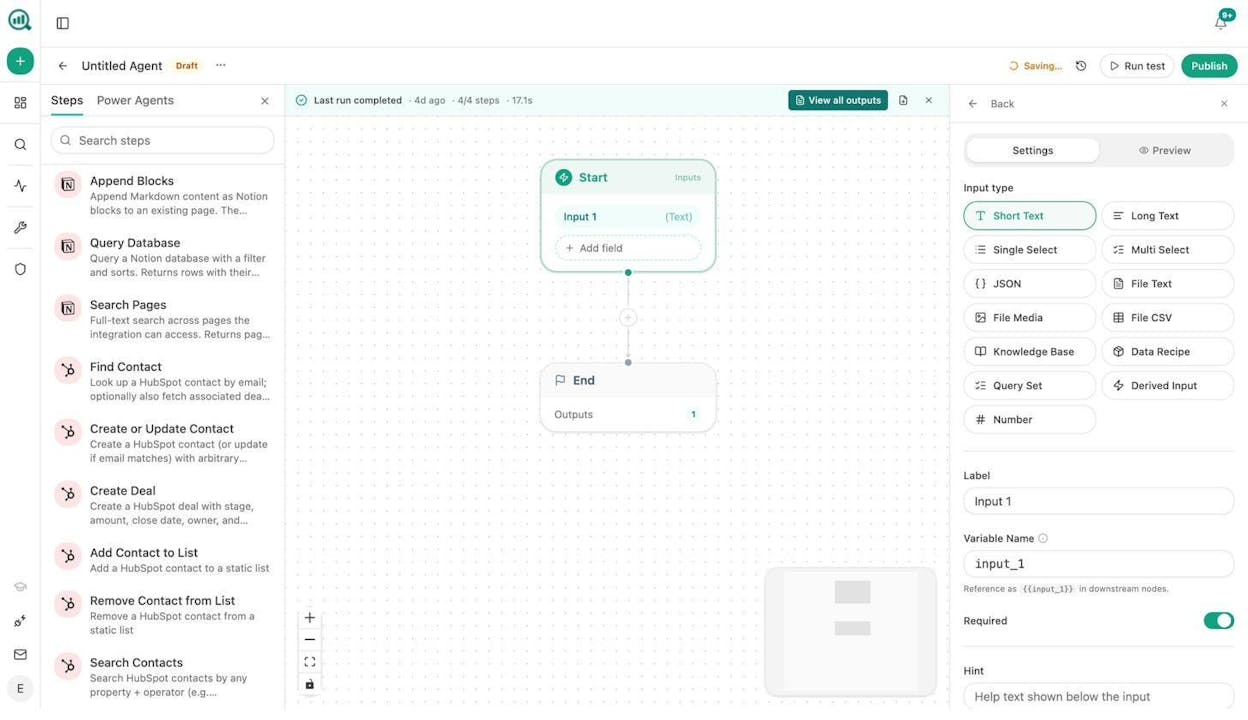
The agent builder runs on three trigger modes: manual (on-demand), scheduled (cron-based, like “every Monday at 7am”), and webhook (event-driven, fires when something changes in HubSpot, Stripe, or any connected system). For agencies, one workflow runs per client. Reporting day, brief day, and crisis response all become background processes. For content teams, the agent builder manages editorial calendars, multilingual rollout, and newsletter compilation. For sales teams, inbound leads get automatically enriched with AI visibility data and competitive context before an AE ever sees them.
Monitor, Measure, and Refine
AEO is not a one-time project. AI platforms change quickly. New models launch. Competitors publish new content.
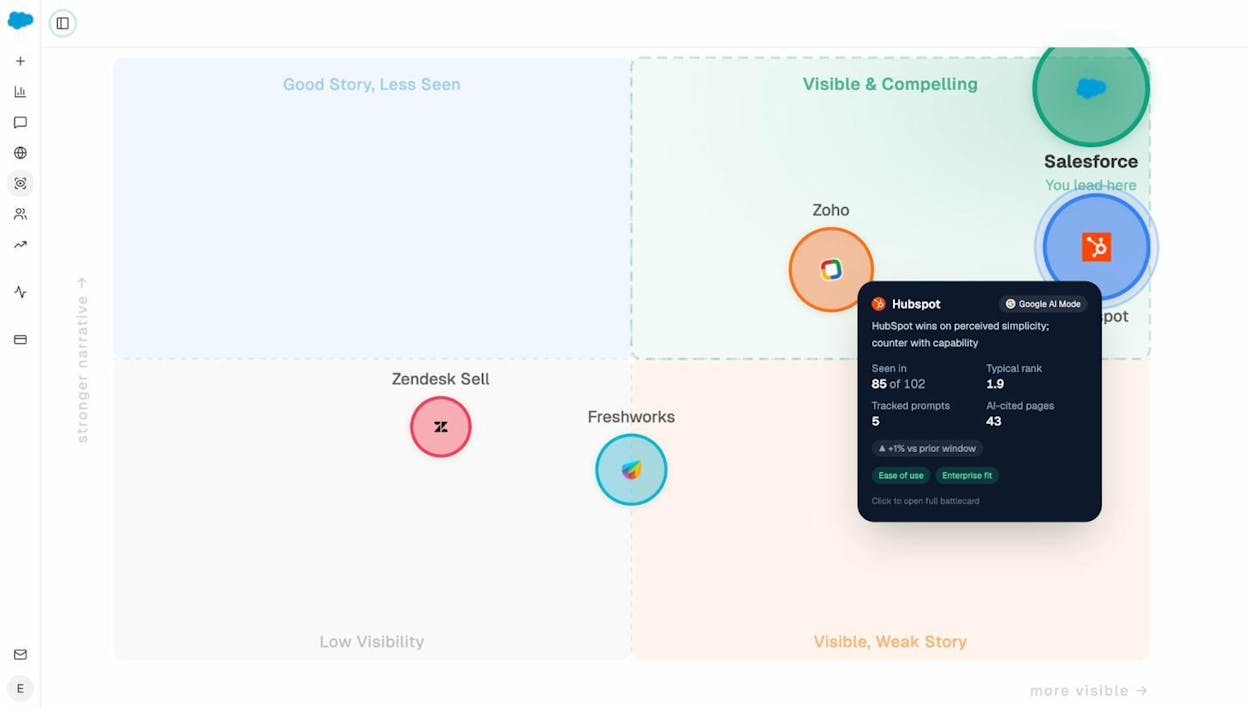
Use the Perception Map in Analyze AI to track your strategic position over time. It plots your brand and competitors on two axes: visibility (how often you appear) and narrative strength (how positively AI portrays you).
Set up Weekly Email Digests to get prioritized actions, citation changes, and competitor shifts delivered to your inbox every Monday. Connect AEO metrics to broader marketing KPIs. Track how AI traffic contributes to your overall traffic mix. Monitor conversion rates of AI-referred visitors compared to organic and paid. The goal is to make AEO a measurable, accountable channel, not a side project with unclear ROI.
Common AEO Mistakes to Avoid
Treating AEO as separate from SEO. AEO builds on SEO fundamentals. Without solid on-page optimization, crawlability, and domain authority, you will struggle with AI visibility too. Fix the SEO basics first, then layer on AEO-specific tactics.
Optimizing for a single AI platform. ChatGPT is the most visible, but Perplexity, Claude, Gemini, Copilot, and Google AI Mode each have different citation behaviors. Our guides on how to rank on ChatGPT and how to rank on Perplexity cover platform-specific details.
Chasing mentions without tracking traffic. Getting mentioned feels good. But it is not valuable unless it drives business outcomes. Always tie AI visibility to actual traffic, engagement, and conversions using AI Traffic Analytics.
Publishing generic content and expecting citations. AI engines have access to millions of pages. If your content says the same thing as everyone else, it will not get cited. Prioritize information gain in everything you publish.
Ignoring third-party mentions. Most of your AI citations will come from what other websites say about you, not what you say about yourself. Invest in digital PR, brand mention monitoring, review management, and strategic outreach alongside your content strategy.
Not monitoring regularly. AI answers change frequently. A query that cited your brand last week may cite a competitor this week. Without ongoing AI search monitoring, you will not know until it is too late.
Start Building Your AEO Strategy Today
Search is evolving from links to answers. The brands that adapt will maintain visibility, authority, and customer trust as this shift accelerates.
Start by auditing what AI engines say about your brand today. Fix inaccuracies. Close the topic gaps where competitors win. Structure your content for both human readers and AI extraction. Build authority through off-site signals. And track whether it all drives real traffic and revenue.
The brands that treat answer engine optimization as an ongoing, measurable process will compound their visibility as AI search grows. The ones that wait will spend the next year wondering why competitors keep getting cited.
For deeper dives, explore our guides on what is generative engine optimization, LLM visibility, the AEO and SEO trends shaping 2026, and the SEO and AI visibility checklist with 90+ action items you can put to work today.

Ernest

Ibrahim


