Analyze AI - AI Search Analytics Platform

16 Best Competitor Monitoring Tools & How to Use Them

Written by

Ernest Bogore

Ernest Bogore

CEO

Reviewed by

Ibrahim Litinine

Ibrahim Litinine

Content Marketing Expert

16 Best Competitor Monitoring Tools & How to Use Them

Competitor problems rarely show up as one big event — they build quietly through small shifts you only recognize once the impact hits.

  • A rival gains momentum, but none of your dashboards explain where it comes from.

  • Deals start slipping away even though nothing in your narrative changed.

  • Competitor moves reach you late, long after their launch or pricing change has shaped the market.

We analyzed the leading competitor-monitoring tools to understand which ones surface real signals instead of noise. Our focus stayed on tools that expose concrete shifts — traffic surges, product updates, messaging changes, AI-answer visibility, ad tests, pricing adjustments, and funnel activity — because those signals determine whether you react early or fall behind.

This guide breaks down the 16 best tools, the type of intelligence each one uncovers, and how to use them to build a monitoring workflow that actually improves outcomes. By the end, you’ll know which tools match your needs and how to track competitor moves with clarity instead of guesswork.

Table of Contents

TL;DR

Tool

Best for

Main Focus / Signals

Key Strengths

Key Watch-outs

Indicative Pricing*

Analyze AI

AI-search visibility & real business impact

AI engine visibility, prompts, citations, traffic, conversions, revenue

Connects ChatGPT/Claude/Perplexity visibility to real GA4 traffic & revenue

New category; requires teams to adopt AI-search tracking

$99/mo (flat, all features)

Semrush

Search + traffic visibility

SEO, PPC, traffic analytics, channel mix

Unified view of rankings, traffic, ads & market trends

Expensive add-ons; complex suite

$139.95 → $499.95/mo + add-ons

Ahrefs

Backlink + search intelligence

Backlinks, keywords, content, authority

Massive backlink index; deep search visibility

SEO-only; costs scale with usage

$129 → $449/mo

Similarweb

Traffic & channel benchmarking

Modeled traffic, engagement, channels, AI signals

Clear channel-mix insight; strong benchmarking

Modeled (not GA) data; higher tiers needed for depth

$125 / $335 / $540 per mo (annual)

Panoramata

Creative & marketing asset monitoring

Emails, SMS, ads, landing pages, site changes

Excellent for ecommerce/DTC campaign tracking

No SEO/pricing/product intel

$99 / $179 / $399/mo

SpyFu

Keyword + ad history

PPC history, keywords, SERPs

Long-term ad/keyword history at low cost

Less polished; narrower than Ahrefs/Semrush

$39 / $59 / ~$249/mo

Crayon

Full-funnel CI + sales enablement

Web changes, pricing, messaging, reviews, deal intel

Deep battlecards + AI summaries + GTM workflows

Requires a CI owner; enterprise-leaning

Custom (~$649+/mo historically)

Kompyte

Real-time digital-footprint tracking

Websites, ads, social, reviews, job posts

Always-on monitoring + AI filtering

Signal volume can overwhelm

Essentials / Pro / Unlimited (quote)

Klue

Competitive enablement + win/loss

Signals + win/loss + CRM-embedded battlecards

Revenue-focused CI tied to deal cycles

Requires mature enablement processes

Custom only

AlphaSense

Market & document-level intelligence

Filings, calls, research, news, expert calls

Extremely deep strategic & financial insight

Enterprise pricing; less value for private-only markets

~$17.5k–$40k+/yr

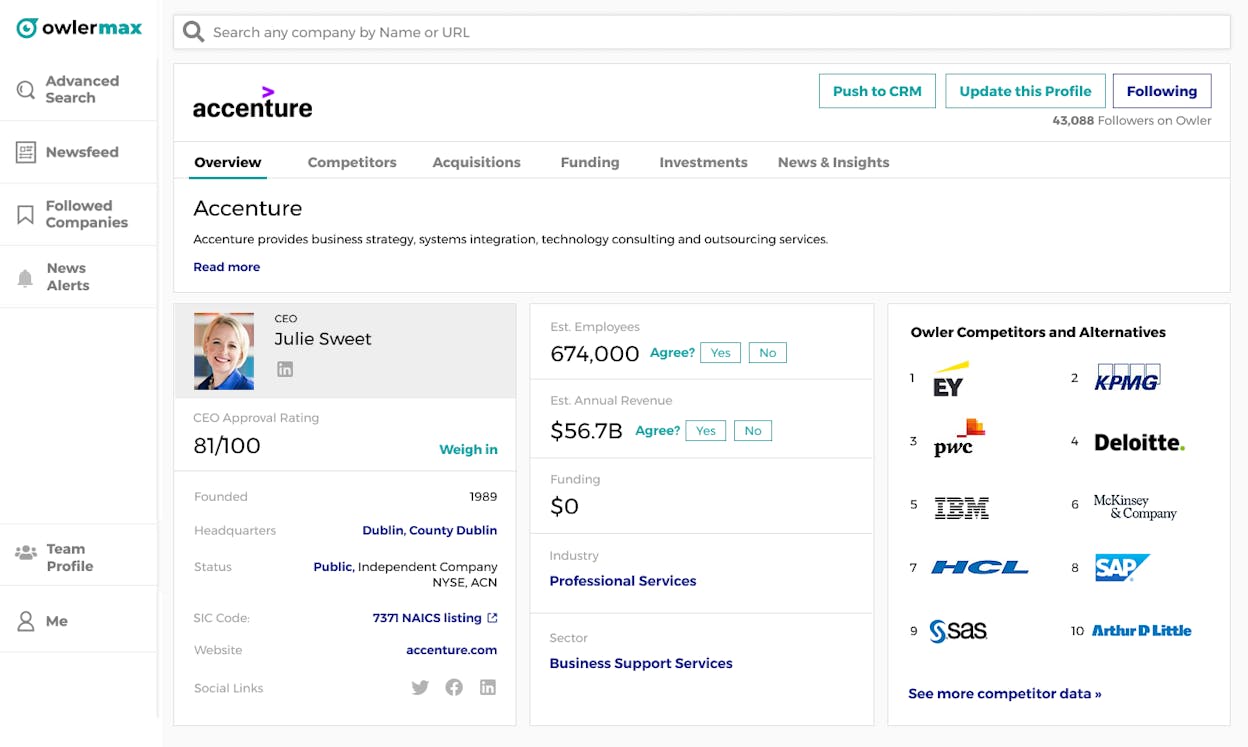
Owler

Lightweight company & news monitoring

Funding, leadership changes, acquisitions, news

Simple SMB-friendly alerts; free tier

Crowdsourced data quality varies

Free; Pro ~$39/mo; Enterprise

Brandwatch

Enterprise social listening

Social + news + forums + sentiment

Deep narrative & sentiment tracking

Expensive; enterprise-complexity

$800–$3,000/mo (~$50k/yr typical)

Talkwalker

Global media + visual intelligence

Social + media + visual logo detection

Massive global coverage; visual listening

Complex; enterprise pricing

$9.6k/yr+; custom

Sprout Social

Social competitor benchmarking

Social analytics + engagement + publishing

Very usable dashboards; marketer-friendly

Social-only; per-seat pricing gets expensive

$199 / $299 / $399 per user/mo

Meltwater

Social + news + broadcast monitoring

Social, news, blogs, TV, radio, podcasts

Large multi-media coverage; great for PR

Dated UX; opaque enterprise pricing

$15k–$45k/yr

Priceva

Dynamic pricing + ecommerce price intel

Price tracking, MAP, repricing

Real-time pricing visibility; strong automation

Limited analytics vs full ecommerce suites

Free; $99 / $199/mo; Enterprise

Analyze AI: best competitor monitoring tool for AI-search visibility and real business impact

competitor analysis tools

Key Analyze AI standout features

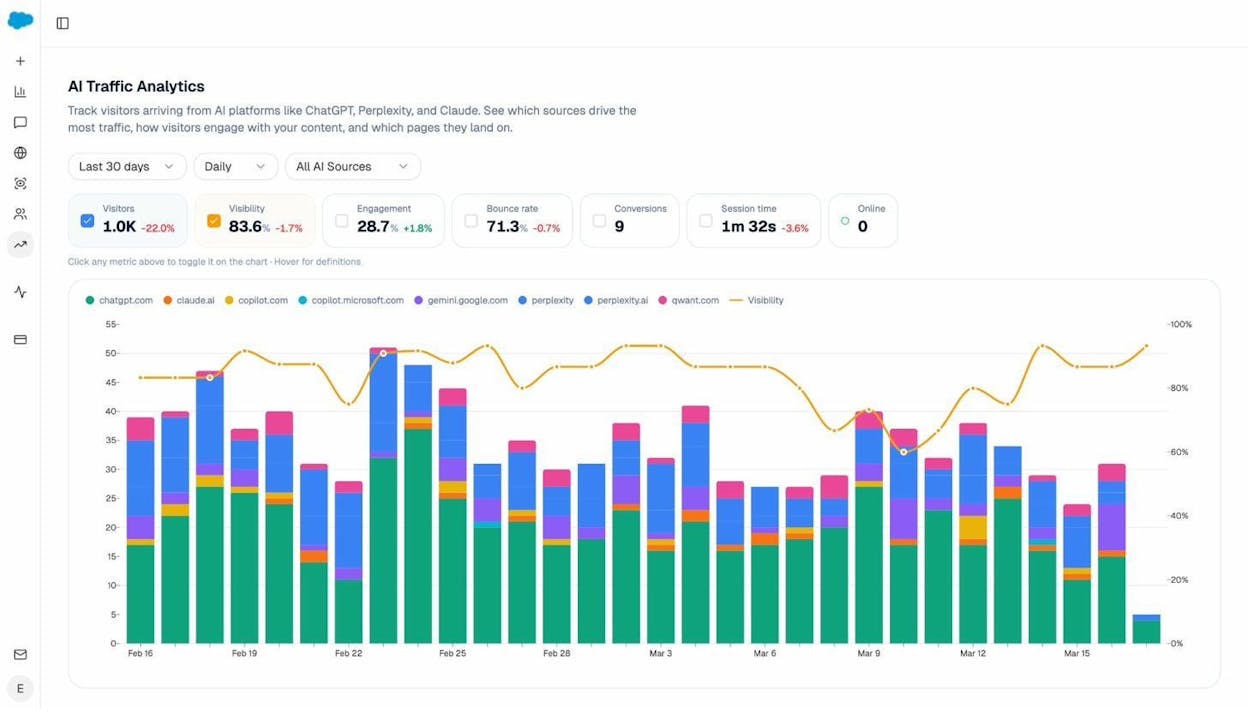
  • AI-engine referral tracking that shows which LLMs send traffic (ChatGPT, Claude, Perplexity) and how that traffic behaves.

  • Landing page and conversion visibility connecting every AI referral to sessions, actions and revenue.

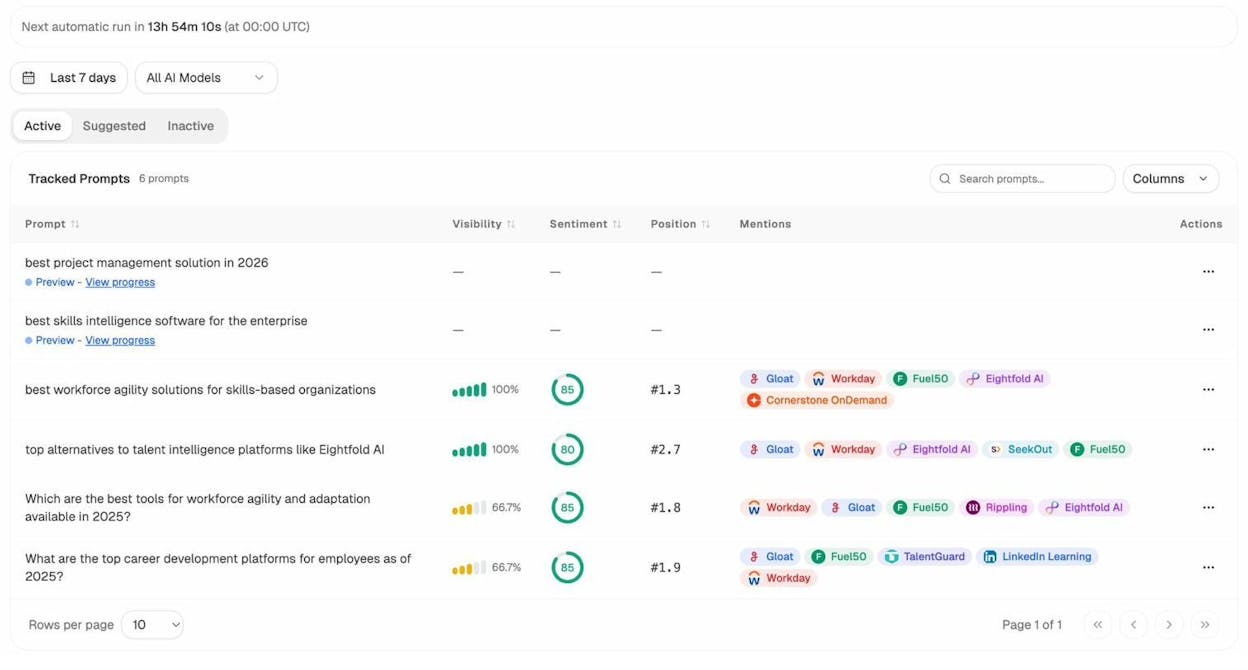
  • Prompt-level tracking across major LLMs to see where you win or lose vs competitors.

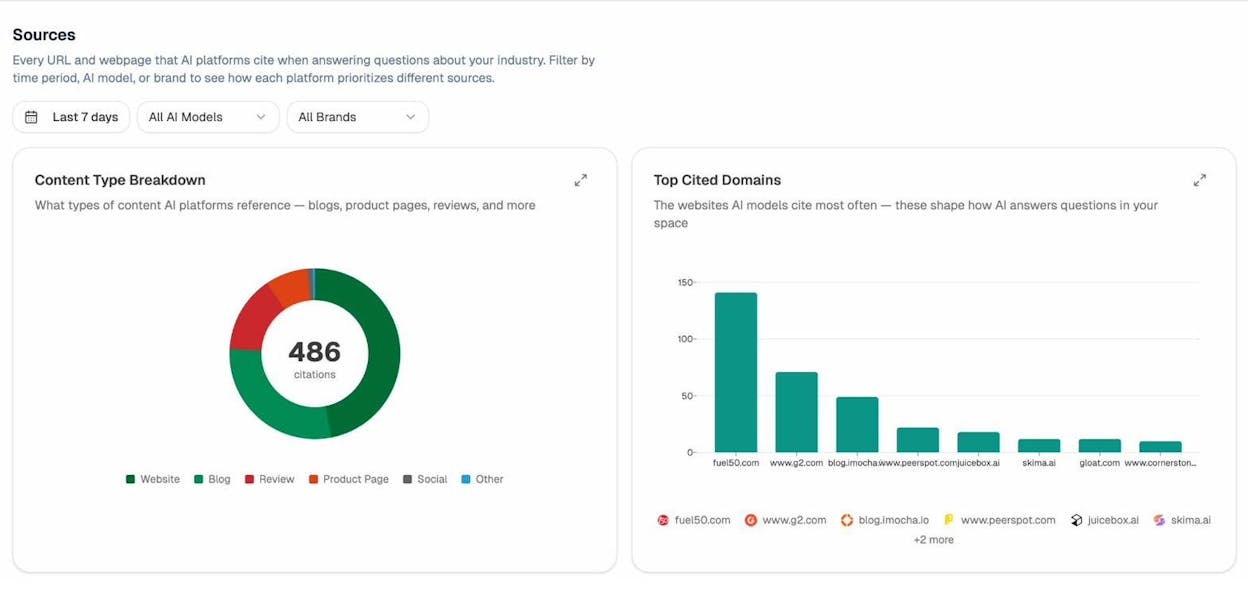
  • Citation and source auditing showing which domains models rely on when shaping answers.

  • Opportunity scoring and competitive-gap identification to prioritize actions based on potential business impact.

competitive intelligence software

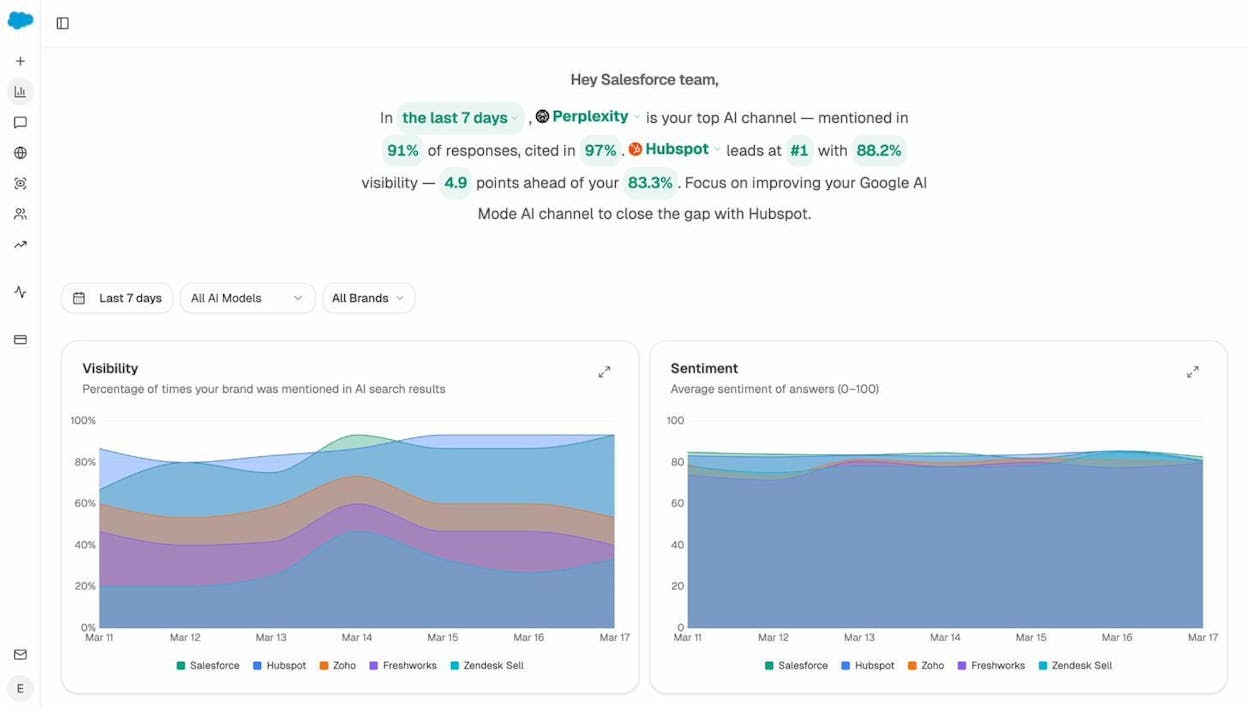
Analyze AI helps when you need more than “your brand appeared in an AI answer.” Most GEO tools capture mentions without proving whether those mentions drive traffic, conversions, or revenue. That gap forces teams to celebrate visibility that sends nothing or underestimate engines that quietly drive high-intent visitors. Analyze AI solves this by attributing each AI-engine session to its model, its prompt and the landing page it influenced. You see which queries matter, which pages convert and which engines actually drive pipeline.

competitor tracking tools

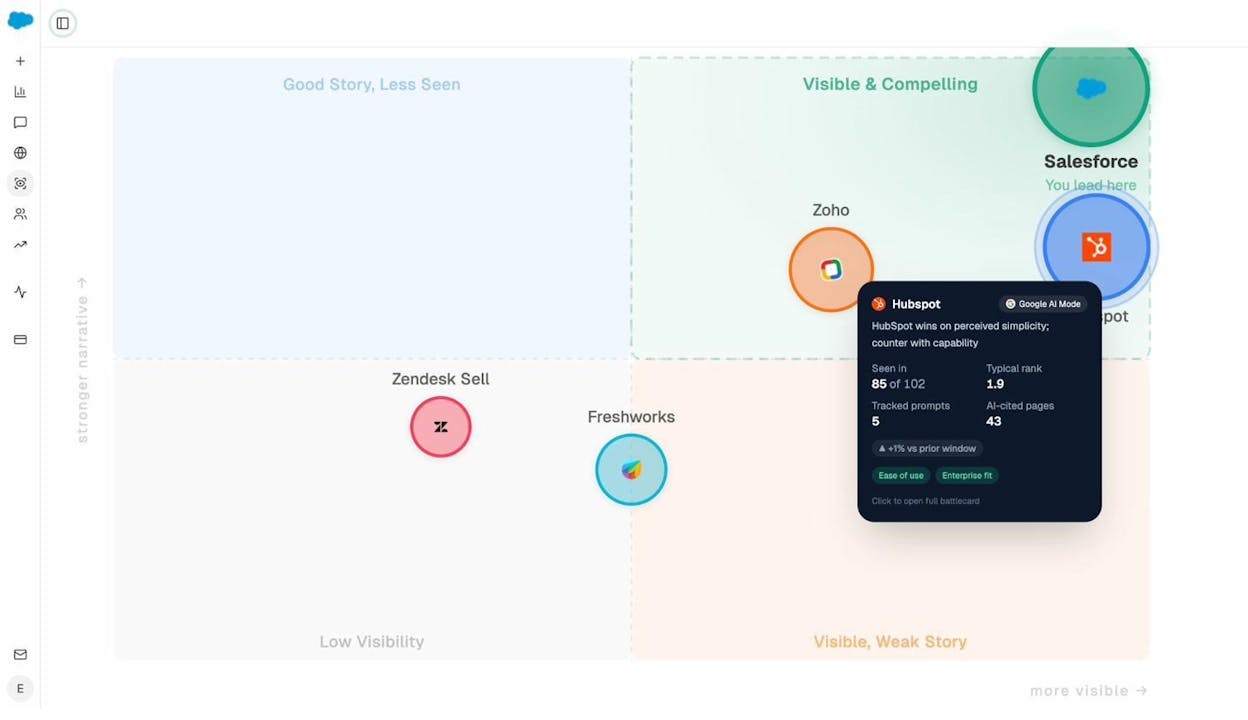
Its strength is attribution. Analyze AI maps the full chain—from prompt, to LLM, to answer, to landing page, to conversion—so you understand not just where you show up but whether that visibility performs. You see how competitors rank on critical prompts, how sentiment shifts over time and which citation sources give competitors their advantage. This enables targeted, outcome-focused action instead of chasing vanity visibility. The limitation is category maturity: AI-search tracking is still new, so teams often adopt Analyze AI as the foundation for building a structured visibility strategy.

market intelligence tools

Pricing plan for Analyze AI

Analyze AI offers a single, transparent plan at $99/month, which includes all core capabilities—three answer engines (ChatGPT, Claude, Perplexity), daily prompt tracking, ad-hoc searches, unlimited competitor tracking, GA4-powered AI traffic analytics, unlimited seats, onboarding and priority support—without additional tiers or add-on fees.

Analyze AI at a glance for competitor monitoring

Dimension

How Analyze AI performs

Why it matters for competitor monitoring

Engine coverage

Tracks ChatGPT, Claude and Perplexity referrals and answer visibility

Shows where competitors gain or lose visibility inside AI answers

Depth of brand/competitor insight

Detailed prompt-level ranks, sentiment trends and competitor positions

Reveals exactly why competitors outrank you and where gaps exist

Citation/source insight

Audits which domains LLMs trust and cite

Identifies the authority sources shaping competitor visibility

Attribution abilities

Links AI-engine traffic to landing pages, conversions and revenue

Converts AI visibility from vanity metrics into measurable performance

Actionability/workflow strength

Opportunity scoring with ordered recommendations

Helps teams shift focus to moves with the highest impact

competitor research tools

Best-fit use cases

  • You want AI visibility tracking that connects mentions to traffic, conversions and revenue.

  • You need daily competitive monitoring across ChatGPT, Claude and Perplexity.

  • You want to understand which sources LLMs use when ranking competitors.

  • You need a lightweight, outcome-focused workflow for improving AI visibility.

  • You want unlimited seats so SEO, PMM, content and leadership can work from one system.

Takeaway

Analyze AI is the best fit if you want AI-search visibility tracking that turns LLM mentions into measurable traffic, conversions and revenue — not guesses.

Semrush: best competitor monitoring tool for search and traffic visibility

competitive monitoring software

Key Semrush standout features

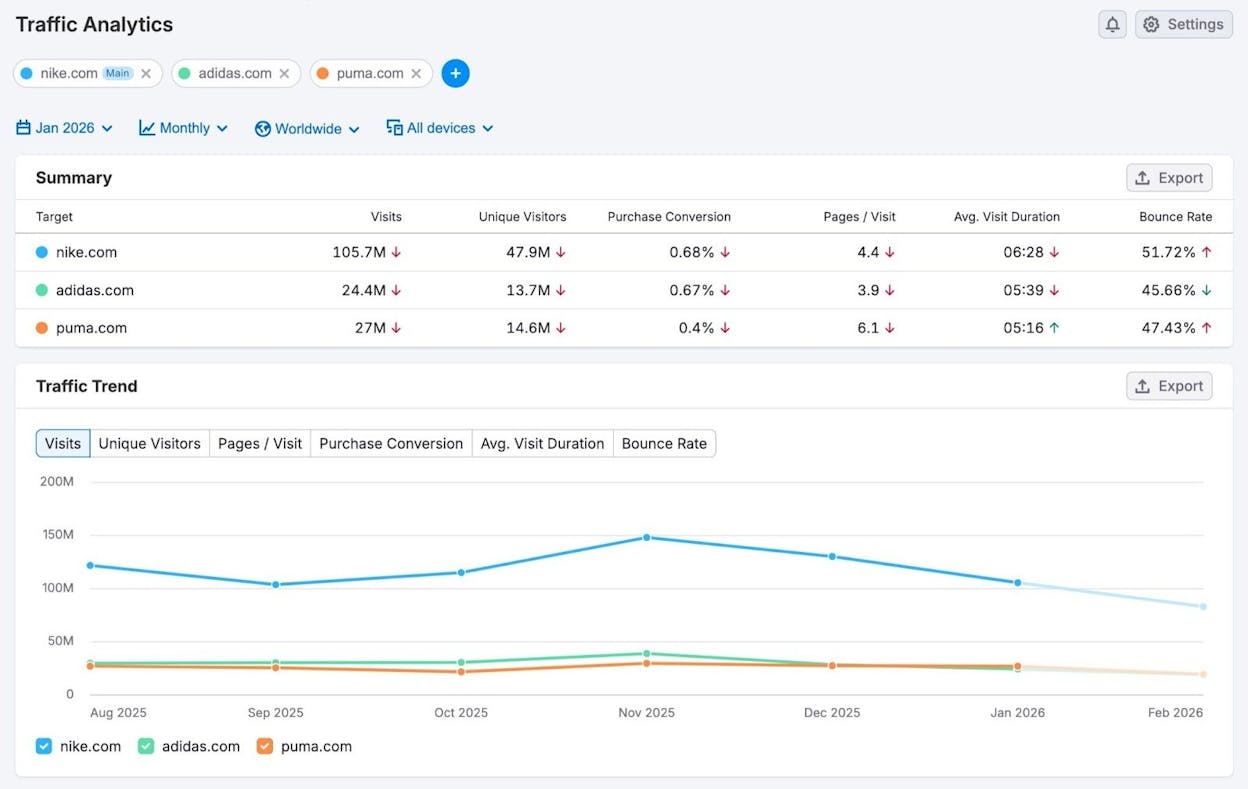
  • Traffic Analytics shows competitor traffic volumes, channel mix, and engagement trends.

  • Market Explorer maps category players and highlights who is gaining or losing share.

  • Position Tracking compares daily ranking and visibility shifts across competing domains.

  • Advertising Research reveals paid keywords, budgets, and message tests competitors run.

  • Brand Monitoring surfaces brand and competitor mentions across major web sources.

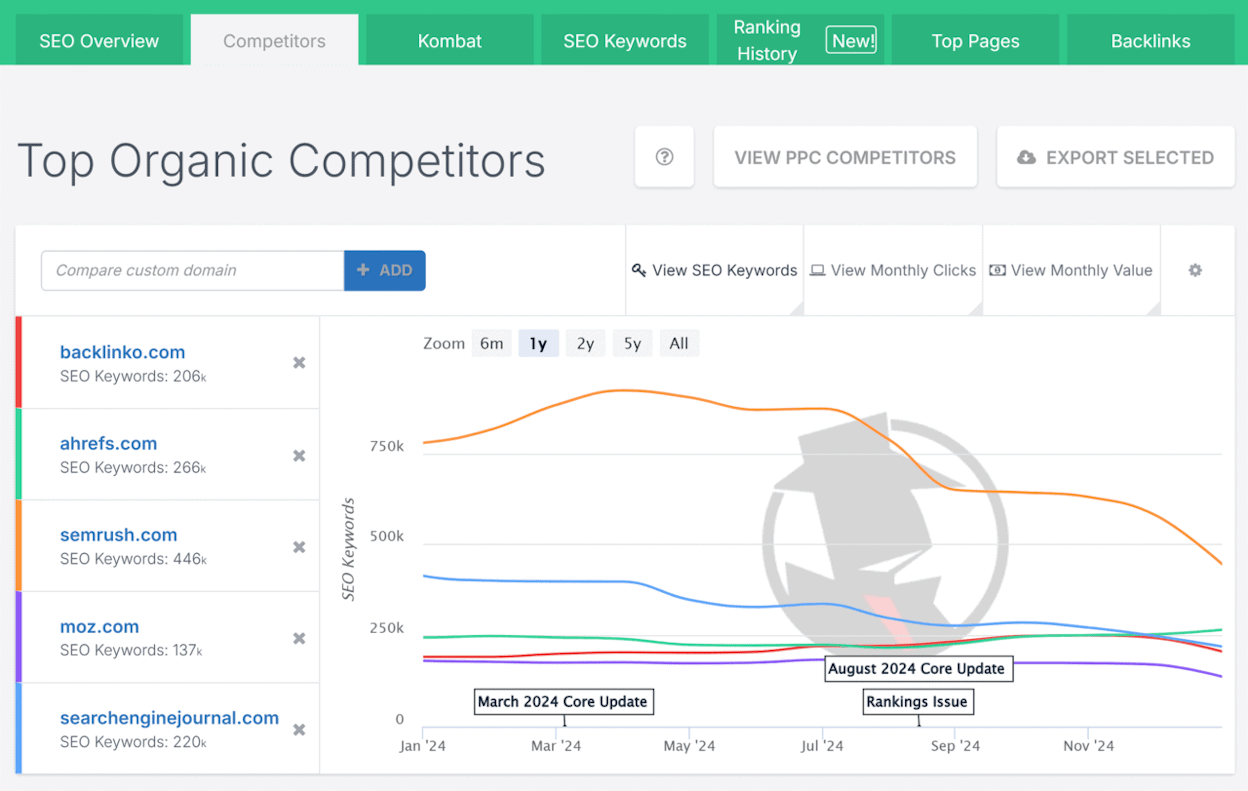
Semrush helps when you struggle to understand why competitors gain visibility while your own performance plateaus. Traffic Analytics and Market Explorer show where that momentum originates, whether from organic search, paid campaigns, new referrals, or emerging geographies. These signals replace intuition with quantifiable evidence, which makes competitive changes easier to interpret and faster to act on. Position Tracking then exposes daily keyword movements that indicate when a rival ships new pages or refreshes existing content, which reveals the underlying actions that push their rankings upward.

competitor benchmarking tools

Its strength lies in unifying these insights in one environment, because it links market-level trends to specific pages, keywords, and campaigns without forcing you to assemble data from multiple tools. You can move from “a competitor is growing” to “here is the page and the channel responsible” in a few steps, which reduces blind spots when rivals accelerate. The limitation is the platform’s breadth. Semrush carries the weight of a full marketing suite, and this scope introduces complexity when you need only focused competitor monitoring. Costs climb with each project, keyword set, user seat, and intelligence add-on, which means teams must commit to active use to justify the investment.

Pricing plan for Semrush

Semrush uses tiered pricing that starts with the Pro plan at $139.95/month, moves to the Guru plan at $249.95/month, and reaches the Business plan at $499.95/month, while key competitive intelligence modules like Traffic Analytics and Market Explorer sit behind separate add-ons that raise total cost as you track more domains, larger keyword sets, or deeper market insight layers.

Semrush at a glance for competitor monitoring

Dimension

How Semrush performs

Why it matters for competitor monitoring

Engine coverage

Strong for Google search, paid search, and web traffic signals.

Reveals where competitors generate measurable visibility and demand.

Depth of brand/competitor insight

Deep on traffic, rankings, ads, and audience behavior.

Shows which rivals grow, why they grow, and where they gain ground.

Citation/source insight

Strong on backlinks and traffic sources, not article-level citations.

Identifies the domains and channels that accelerate competitor authority.

Attribution abilities

Connects keyword and traffic changes to landing pages and campaigns.

Helps you estimate the impact of competitor actions on discovery and engagement.

Actionability/workflow strength

Dashboards and alerts support ongoing monitoring.

Enables a predictable weekly CI workflow with minimal manual digging.

Best-fit use cases

  • You need clarity on how competitors gain search visibility and traffic share.

  • You want daily insight into keyword battles and ranking volatility.

  • You track competitor ad tests, budget movements, and new paid campaigns.

  • You analyze AI category-wide shifts and want evidence behind market growth patterns.

Takeaway

Semrush is the best fit if you need a unified view that explains how competitors gain search and traffic momentum before those changes affect your results.

competitor insights tools

Key Ahrefs standout features

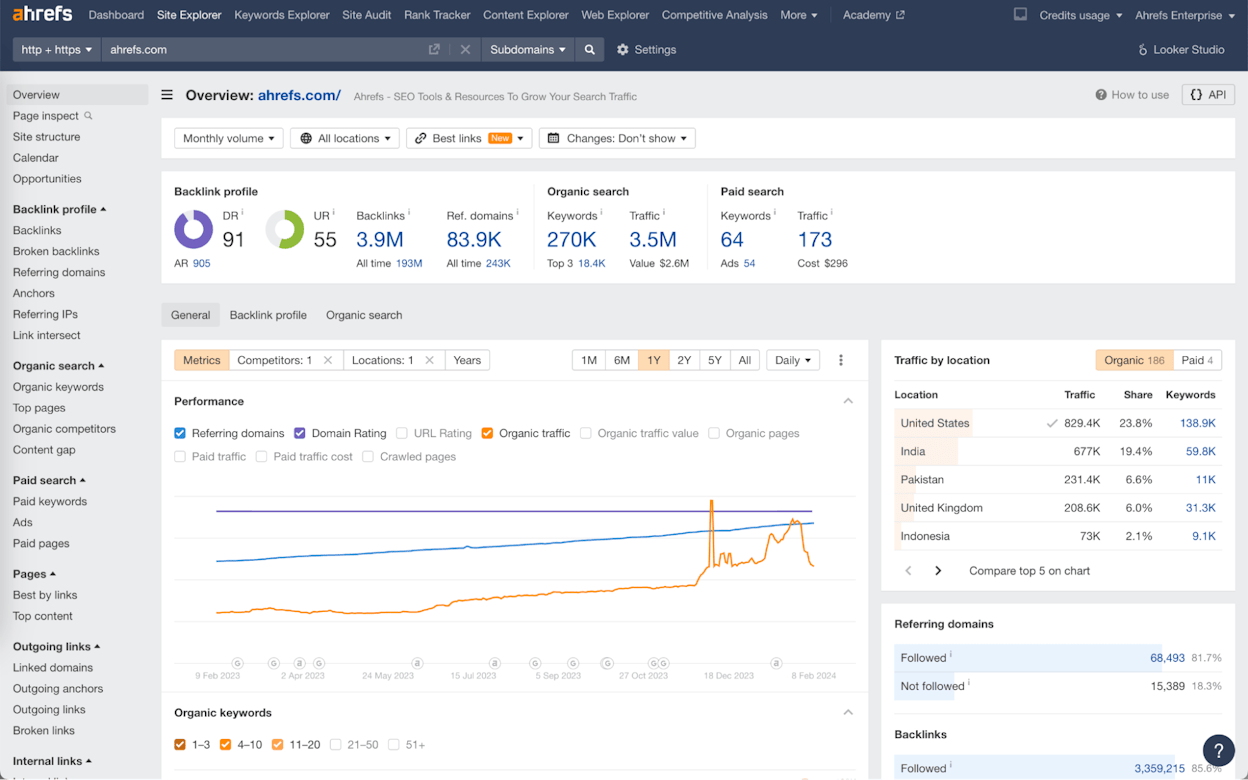
  • Site Explorer reveals competitor traffic patterns, backlinks, paid activity, and keyword performance.

  • Rank Tracker compares your rankings against competitors and highlights movements over time.

  • Backlink intelligence exposes historic link growth so you can see how rivals built authority.

  • Content and Keyword Explorer uncovers topic gaps and emerging queries competitors target.

  • AI visibility tools track brand presence and search signals across AI-driven surfaces.

Ahrefs helps when you cannot explain why certain competitors outrank you or why their authority grows faster than yours. Site Explorer shows how their traffic flows, where their links come from, and which pages pull the most weight, which removes the guesswork that usually surrounds search performance. Rank Tracker adds daily clarity by revealing when a competitor climbs on priority keywords, which often signals a new page, a content refresh, or a successful link push. You see movements early enough to respond with your own content or technical adjustments instead of reacting once their lead becomes entrenched.

competitive analysis software

Its advantage is depth. Ahrefs holds one of the largest backlink indexes available, which allows you to trace how competitors built trust over months or years and correlate those changes with traffic gains. You can open the exact links that shifted authority, identify their highest-impact pages, and understand why certain content accelerates their search momentum. The limitation is scope. The platform is engineered for SEO, not full GTM or cross-channel competitive intelligence, which means you will not track pricing shifts, product launches, or broader market moves without supplementing it. Costs also rise as you expand keyword tracking and user access, which can challenge small teams with limited scope.

Pricing plan for Ahrefs

Ahrefs uses a tiered structure where the Lite plan starts at $129/month, the Standard plan increases to about $249/month, and the Advanced plan reaches roughly $449/month, while enterprise-level monitoring requires custom pricing, and the total cost often climbs as you add projects, users, keyword sets, or competitor domains.

Ahrefs at a glance for competitor monitoring

Dimension

How Ahrefs performs

Why it matters for competitor monitoring

Engine coverage

Strong for Google search and backlink ecosystems.

Shows how competitors gain visibility and authority where discovery happens.

Depth of brand/competitor insight

Deep on backlinks, keywords, and content performance.

Reveals the levers competitors use to grow search share.

Citation/source insight

Excellent backlink and referring-domain intelligence.

Identifies which sources amplify competitor authority.

Attribution abilities

Links ranking and traffic gains to specific pages and link events.

Helps explain when competitor moves trigger performance changes.

Actionability/workflow strength

Clear reports and historical data support ongoing monitoring.

Enables a consistent routine for tracking competitor authority shifts.

Best-fit use cases

  • You need to understand why competitors outrank you across core keywords.

  • You investigate backlink strategies and authority gaps in your category.

  • You want early signals when a competitor launches new content or link pushes.

  • You rely heavily on SEO traffic and must monitor rivals with precision.

Takeaway

Ahrefs is the best fit if you need deep visibility into how competitors gain authority, backlinks, and search momentum across your category.

Similarweb: best competitor monitoring tool for traffic and channel benchmarking

competitor price monitoring

Key Similarweb standout features

  • Traffic and engagement analysis estimates competitor visits, audience size, and on-site behavior.

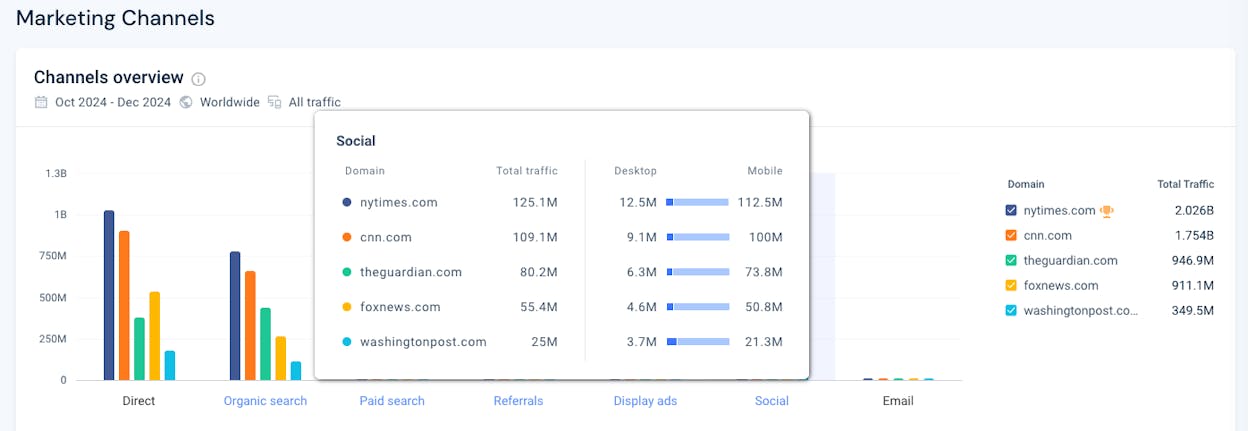
  • Channel breakdowns reveal how rivals acquire traffic across direct, search, social, referrals, and display.

  • AI visibility and chatbot signals show referral patterns and brand presence across AI-driven surfaces.

  • Benchmarking and market share insights compare your performance against competitor domains across growth, geography, and category position.

  • Advanced intelligence modules extend analysis into mobile apps, ad spend, campaigns, and global market dynamics.

Similarweb helps when competitor traffic surges without a clear explanation and you cannot tell whether their momentum comes from search, social, paid, or new referral partnerships. Traffic and engagement analysis gives you directional volume, trend lines, and quality metrics, which helps you separate real audience growth from short-lived spikes. Channel breakdowns expose the underlying acquisition levers, so you can see when a rival increases paid budgets, gains referral placements, or shifts focus toward social, and you can match those patterns with your own performance. This visibility reduces the guesswork that usually comes from comparing your internal analytics with their external footprint.

competitor SEO analysis tools

Its strength is its ability to turn market-level movement into channel-level explanations inside one interface. You can show executives how traffic share shifts, how competitors distribute their acquisition mix, and how these changes evolve across geographies or segments, which helps strategic planning. The limitation is the nature of its data. Similarweb relies on modeled datasets rather than first-party analytics, so numbers rarely match internal tools like GA. The platform also ties deeper exports, historical windows, and advanced intelligence layers to higher-tier plans, which can constrain teams that need broad visibility on a tight budget.

Pricing plan for Similarweb

Similarweb’s Entrepreneur plans start with Competitive Intelligence at $125/month billed annually (or $199 monthly), followed by Competitive Intel & SEO at $335/month billed annually (or $399 monthly), and the Competitive Intel, SEO & Ads tier at $540/month billed annually (or $649 monthly), with each tier increasing historical data availability, feature depth, and intelligence modules, which means total cost scales with the complexity of the competitor signals your team needs to monitor.

Similarweb at a glance for competitor monitoring

Dimension

How Similarweb performs

Why it matters for competitor monitoring

Engine coverage

Tracks web traffic sources, marketing channels, and AI-driven referral activity.

Shows how competitors acquire attention across both traditional and emerging discovery surfaces.

Depth of brand/competitor insight

Strong on share, traffic composition, and market-level trends.

Helps you understand which rivals grow, why they grow, and how their acquisition mix changes.

Citation/source insight

Channel-level signals rather than granular citation paths.

Gives directional clarity about which channels amplify competitor reach.

Attribution abilities

Links traffic shifts to channels, geographies, and acquisition patterns.

Helps estimate which competitor actions influence demand within the category.

Actionability/workflow strength

Visual dashboards and comparative reports support strategic review cycles.

Enables consistent market monitoring with executive-ready insights.

Best-fit use cases

  • You need clarity on where competitor traffic originates and how their channel mix evolves.

  • You benchmark category players and want evidence behind share-of-traffic changes.

  • You monitor market trends and require top-level channel insight for planning.

  • You track early AI-driven referral patterns across new discovery surfaces.

Takeaway

Similarweb is the best fit if you need a clear view of how competitors gain traffic, shift channels, and expand their presence across both established and AI-driven acquisition paths.

Panoramata: best competitor monitoring tool for marketing assets and funnel visibility

competitor content analysis

Key Panoramata standout features

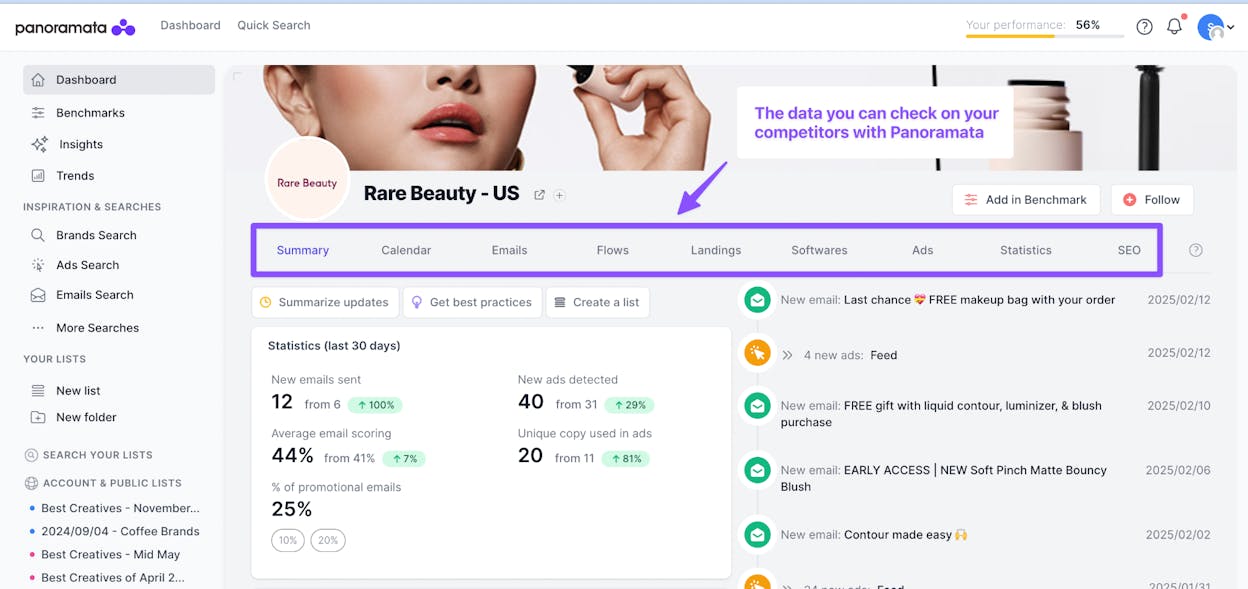
  • Unified tracking for competitor emails, SMS flows, ads, landing pages, and site changes.

  • Marketing calendar benchmarking to compare campaign timing and tactical patterns across brands.

  • Large DTC and ecommerce brand directory so you can start monitoring without manual setup.

  • Creative and asset search to browse competitor emails, ads, and landing pages at scale.

  • Real-time monitoring with automated alerts when competitors launch new creative or update key pages.

Panoramata helps when you cannot keep up with the volume of competitor campaigns, launches, and creative tests happening across your market. The platform centralizes every email, SMS flow, ad, and landing-page update into a single feed, which eliminates the scattered manual process of subscribing to competitor newsletters, collecting screenshots, and hunting for new ads. This visibility gives you a clearer sense of how rivals sequence campaigns, how often they test new assets, and how their funnel evolves over time. It becomes easier to identify patterns—like seasonal pushes, discount cycles, or creative themes—without drowning in disconnected files and inbox clutter.

competitor social media monitoring

Its strength is its focus. Panoramata tracks marketing assets rather than traffic or keyword data, which makes it especially useful for ecommerce and DTC teams where creative execution drives performance. You can see the full journey from email to landing page to offer structure, and you can compare these sequences across competitors with minimal manual effort. The limitation is that the tool does not try to cover SEO, pricing intelligence, or product-level shifts. It works best as the creative and lifecycle component of your competitive stack, and teams outside of DTC may find coverage less deep depending on their vertical.

Pricing plan for Panoramata

Panoramata offers clear monthly plans: Startup at $99/month with six months of history, Professional at $179/month with up to three years of history and ten users, Advanced at $399/month with unlimited brand tracking and twenty users, and Enterprise for tailored datasets and custom needs, which requires a direct quote.

Panoramata at a glance for competitor monitoring

Dimension

How Panoramata performs

Why it matters for competitor monitoring

Engine coverage

Focused on email, SMS, ads, and landing-page assets.

Reveals how competitors communicate, promote, and convert across their funnel.

Depth of brand/competitor insight

Strong for creative, lifecycle flows, and campaign timing.

Shows what rivals launch, how often they test, and which tactics they prioritize.

Citation/source insight

Tracks source assets rather than backlinks or search citations.

Helps you see the exact creative inputs driving competitor campaigns.

Attribution abilities

Links marketing assets to funnel sequences and campaign patterns.

Helps diagnose why competitor pushes work and how they structure offers.

Actionability/workflow strength

Automated feeds and searchable libraries speed creative analysis.

Enables quick benchmarking without manual tracking or inbox clutter.

Best-fit use cases

  • You monitor DTC or ecommerce competitors with heavy creative and lifecycle activity.

  • You want fast visibility into competitor emails, ads, offers, and landing pages.

  • You need structured insight into how competitors plan campaigns and sequence their funnels.

  • You want a scalable alternative to manual screenshotting and newsletter monitoring.

Takeaway

Panoramata is the best fit if you need fast, automated visibility into competitor emails, ads, funnels, and creative patterns without manual tracking.

SpyFu: best competitor monitoring tool for keyword and ad-history intelligence

competitor website monitoring

Key SpyFu standout features

  • Competitor keyword research shows which keywords rivals rank for and which terms they buy on Google Ads.

  • Ad-history tracking reveals long-term ad copy tests, bidding shifts, and campaign changes.

  • SERP and rank tracking highlights movements across priority keywords and surfaces domains “sneaking up” in your niche.

  • Backlink intelligence uncovers referring domains and link-growth trends even if it is lighter than dedicated link tools.

  • Keyword gap analysis compares shared and missing keywords to expose areas where competitors outrank or outbid you.

SpyFu helps when you cannot see how competitors structure their paid search strategy or why they consistently outrank you across critical keywords. Competitor keyword research shows the exact terms they win, the ads they buy, and the overlap between their organic and paid footprint, which gives you a clearer sense of their priorities. Ad-history tracking adds context by revealing how long they have pushed a message, when they shifted bidding behavior, and where they expanded their keyword sets. These insights help you understand the patterns behind their search presence rather than reacting to isolated ranking changes.

competitor ad tracking tools

Its strength is precision. SpyFu focuses on keyword behavior and PPC history rather than broad market intelligence, which makes it especially useful when search competition dictates performance. You can reverse engineer keyword strategies, examine years of ad tests, and uncover which pages consistently attract search visibility. The limitation is breadth. SpyFu lacks the technical depth of larger SEO suites and does not extend into multi-channel competitive intelligence, so you will need additional tools if you track pricing changes, product launches, or non-search GTM shifts. Some users also note that data freshness and interface polish lag behind top-tier platforms, which matters if you monitor fast-moving categories.

Pricing plan for SpyFu

SpyFu uses a simple tiered structure with the Basic plan at $39/month (or $29/month when billed annually), the Professional plan at $59/month with expanded limits, and a Team plan around $249/month (or $187/month annually) for heavier monitoring needs, with all plans providing long-term historical ad and keyword data that varies in depth based on tier.

SpyFu at a glance for competitor monitoring

Dimension

How SpyFu performs

Why it matters for competitor monitoring

Engine coverage

Strong for Google organic and paid search intelligence.

Shows how competitors win attention through search and ads.

Depth of brand/competitor insight

Deep on keyword behavior and ad history; lighter on broader GTM signals.

Helps you trace the exact terms and tests driving competitor visibility.

Citation/source insight

Moderate backlink intelligence focused on referring domains.

Supports basic authority comparisons without replacing specialized tools.

Attribution abilities

Links keyword or ad shifts to ranking changes and SERP outcomes.

Helps diagnose when competitor actions cause traffic or visibility swings.

Actionability/workflow strength

Clear keyword and ad-history reports with long-term timelines.

Enables fast auditing of competitor search strategy without manual digging.

Best-fit use cases

  • You monitor keyword battles and need visibility into competitor paid and organic search activity.

  • You want a clear record of competitor ad tests, bidding shifts, and long-term PPC patterns.

  • You work in a competitive search market and need a budget-friendly intelligence tool.

  • You want to identify keyword gaps where competitors capture demand you miss.

Takeaway

SpyFu is the best fit if you need affordable, high-signal visibility into competitor keywords, ad history, and long-term search strategy.

Crayon: best competitor monitoring tool for full-funnel intelligence and sales enablement

competitive landscape analysis

Key Crayon standout features

  • Comprehensive digital-footprint monitoring tracks websites, pricing shifts, news, reviews, and support-doc changes.

  • Aggregated intel blends public signals with deal notes, internal insights, and vendor interactions.

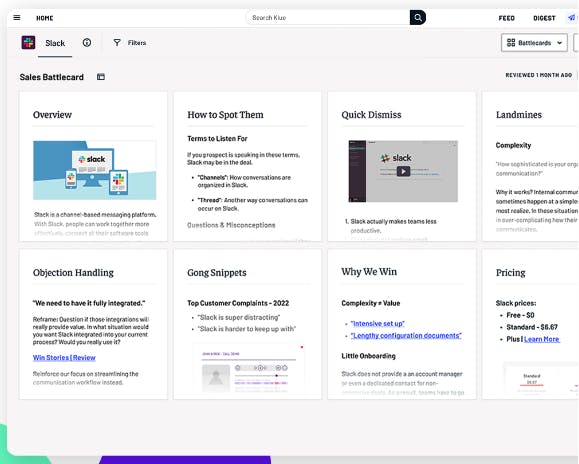
  • Battlecards and enablement workflows turn raw intel into sales-ready narratives.

  • AI-assisted summaries condense competitor updates into concise, actionable briefs.

  • Deep integrations push insights directly into Salesforce, Slack, Teams, and other GTM systems.

Crayon helps when competitor activity moves too fast for manual tracking and your revenue teams feel blind during deals. Its monitoring engine captures changes across websites, pricing pages, product messaging, documentation, and public narratives, which gives you a detailed view of how competitors evolve. You see “before/after” shifts that reveal strategic moves rather than surface-level updates, which helps your team understand intent, timing, and impact. These signals feed into structured battlecards so sales can counter positioning, handle objections, and frame value during competitive cycles.

competitor performance tracking

Its strength is its end-to-end workflow. Crayon does more than track competitor changes—it organizes, interprets, and routes that intelligence into the tools your teams already use. AI summaries reduce the noise that usually overwhelms CI programs, while standardized battlecards help align sales, PMM, and product teams. The limitation is the operational footprint required. Crayon works best when someone owns CI internally, curates insights, and maintains alignment. The platform is also positioned for enterprise needs, which makes both pricing and implementation more demanding than lighter competitor-tracking tools.

Pricing plan for Crayon

Crayon does not publish fixed pricing tiers and instead uses custom-quoted plans based on intelligence depth, user seats, integrations, and data volume, with one third-party source noting a past starting point around $649/month for a single-user “Growth” plan, though actual pricing varies significantly for modern deployments.

Crayon at a glance for competitor monitoring

Dimension

How Crayon performs

Why it matters for competitor monitoring

Engine coverage

Tracks changes across sites, pricing, messaging, documentation, and news.

Captures strategic shifts competitors make across the entire funnel.

Depth of brand/competitor insight

Very deep, blending public signals with internal deal intelligence.

Builds a holistic view of competitor behavior that sales and PMM can act on.

Citation/source insight

Highlights before/after changes with clear source evidence.

Makes competitor pivots easy to validate and communicate internally.

Attribution abilities

Links intel to battlecards, objection handling, and GTM positioning.

Helps sales connect competitor moves to deal outcomes.

Actionability/workflow strength

Strong integrations and AI summaries reduce manual overhead.

Enables a repeatable, scalable CI workflow across GTM teams.

Best-fit use cases

  • You run B2B SaaS or enterprise GTM motions where competitive pressure shapes deals.

  • You need structured battlecards and automated CI workflows, not isolated alerts.

  • Your team wants before/after evidence of competitor pricing, messaging, or product shifts.

  • You require deep integrations and intelligence that reaches sales in real time.

Takeaway

Crayon is the best fit if you need full-funnel competitive intelligence that turns raw signals into sales-ready insights and battlecards.

Kompyte: best competitor monitoring tool for real-time digital footprint tracking

competitor trend analysis

Key Kompyte standout features

  • Automatic tracking of websites, reviews, social content, ads, and job postings across competitor domains.

  • AI noise-filtering and daily summaries that surface only meaningful updates.

  • Integrated battlecards and workflows that route intelligence into Slack, Teams, and Salesforce.

  • Unlimited reports and listening alerts on higher tiers for broad monitoring.

  • Deep CRM and collaboration integrations across HubSpot, Salesforce, Slack, and Teams.

Kompyte helps when competitors make frequent changes across digital channels and your team feels behind on messaging shifts, campaign launches, or product adjustments. Its monitoring engine captures updates across websites, ads, social posts, and job boards, which gives you a real-time view of competitor momentum. AI filtering reduces the noise that usually overwhelms CI teams, so you can focus on the handful of changes that deserve attention. These signals flow into structured battlecards and alerts, which allows sales, product, and marketing teams to act rather than sift through raw data.

competitive research platforms

Its strength lies in its always-on nature. Kompyte does not wait for weekly crawls or manual checks; it surfaces competitor movements as they happen and pushes them directly into your workflows. This makes it especially useful for fast-moving categories where positioning changes quickly. The limitation is that Kompyte generates a large volume of signals by design, and the value depends on how well your team curates and operationalizes them. If you already run Semrush for search monitoring, some overlap may appear, and without a clear internal process the stream of insights can feel heavy.

Pricing plan for Kompyte

Kompyte structures its pricing around three tiers: Essentials, which tracks up to 10 companies and includes 25 user licenses; Professional, which expands tracking to 20 companies and 100 users with unlimited battlecards and alerts; and Unlimited, which offers unlimited tracked companies, unlimited users, and advanced features like SSO, though exact pricing for all tiers is available only through a custom quote.

Kompyte at a glance for competitor monitoring

Dimension

How Kompyte performs

Why it matters for competitor monitoring

Engine coverage

Tracks websites, social, ads, reviews, and job postings.

Reveals competitor activity across the full digital footprint.

Depth of brand/competitor insight

Strong for messaging, campaigns, hiring signals, and content changes.

Highlights strategic shifts competitors make across channels.

Citation/source insight

Captures before/after snapshots across monitored pages.

Makes competitor moves easy to verify and contextualize.

Attribution abilities

Feeds insights into battlecards and GTM workflows.

Helps sales and PMM tie competitive updates to deal outcomes.

Actionability/workflow strength

Deep integrations with CRM and collaboration tools.

Enables fast internal distribution of high-value intelligence.

Best-fit use cases

  • You monitor competitors making rapid updates across web, social, and ad channels.

  • You want automated alerts instead of manual tracking or periodic reviews.

  • You need structured battlecards and GTM workflows that route intel into sales tools.

  • You work in a fast-moving market where messaging and positioning change frequently.

Takeaway

Kompyte is the best fit if you need real-time competitor monitoring that pushes filtered, actionable insights directly into your sales and GTM workflows.

Klue: best competitor monitoring tool for competitive enablement and win-loss intelligence

competitor data tools

Key Klue standout features

  • Unified signal collection from websites, internal notes, calls, deal feedback, and win-loss interviews.

  • Deal-based insights and battlecards embedded directly into Salesforce, Slack, Teams, and other sales tools.

  • Win-loss analysis module that explains why deals are won or lost against each competitor.

  • Automated alerts that surface strategic shifts in pricing, messaging, product, or positioning.

  • Centralized CI repository that organizes updates, assets, and insights for PMM and sales teams.

Klue helps when competitor intelligence lives in scattered places and your sales team struggles to access it during active deals. Its signal engine captures changes in competitor messaging, pricing, product launches, and public narratives, then pairs those signals with feedback from real opportunities. This blend of external and internal intel gives revenue teams a clearer picture of how competitors actually behave in the market. Battlecards embedded in CRM and collaboration tools help sellers handle objections, frame differentiation, and react to competitor moves with confidence.

competitor marketing analysis

Its strength is its focus on revenue impact. Klue goes beyond web monitoring and ties competitive signals to the deal cycle, which helps leadership understand how competitor strategies show up in win/loss patterns. This makes it particularly valuable for B2B SaaS and enterprise GTM teams that depend on structured enablement. The limitation is the process required. Klue works best when organizations have the discipline to run win/loss programs, maintain CI workflows, and encourage sales participation. Smaller teams without these rhythms may find the platform heavier than their needs.

Pricing plan for Klue

Klue does not publish fixed tiers and instead provides custom-quoted pricing based on the number of competitors tracked, user seats, integrations, and intelligence depth, with third-party sources noting that actual pricing varies widely depending on enterprise requirements.

Klue at a glance for competitor monitoring

Dimension

How Klue performs

Why it matters for competitor monitoring

Engine coverage

Tracks web updates, pricing shifts, messaging changes, and sales-deal insights.

Reveals competitor impact across both public signals and real deal outcomes.

Depth of brand/competitor insight

Deep analysis strengthened by win/loss data and internal inputs.

Helps teams understand how competitor moves influence revenue.

Citation/source insight

Collects and labels sources from calls, web updates, and deal notes.

Makes intelligence verifiable and easy to route across GTM teams.

Attribution abilities

Connects competitor signals to win/loss patterns and sales objections.

Helps leadership quantify how competition affects pipeline and conversion.

Actionability/workflow strength

Strong CRM and collaboration integrations for real-time enablement.

Ensures intel reaches sellers at the exact moment they need it.

Best-fit use cases

  • You operate in B2B SaaS or enterprise markets where competitive pressure shapes deals.

  • You want battlecards and deal-based insights embedded directly into your CRM workflows.

  • You run or plan to run structured win/loss programs.

  • You need intelligence that helps sales, PMM, and leadership align around real competitor impact.

Takeaway

Klue is the best fit if you need a competitive-enablement system that connects competitor signals to deals, win/loss outcomes, and revenue team execution.

AlphaSense: best competitor monitoring tool for market and document-level intelligence

competitor traffic analysis

Key AlphaSense standout features

  • Aggregated document intelligence spanning SEC filings, earnings transcripts, broker reports, news, and internal records.

  • Semantic search and AI filtering to extract insights from millions of documents.

  • Alerts on competitor mentions and strategic themes across filings, calls, and news cycles.

  • Expert-call and premium content access for deeper qualitative context.
    Watchlists and monitoring workflows for tracking specific competitors, markets, or trends.

AlphaSense helps when you need to understand competitors through what they disclose to investors, analysts, regulators, or financial markets — not just through their websites or marketing channels. Its document universe covers filings, earnings calls, and research reports, which gives you a clear picture of how late-stage or public competitors position their strategy, strengths, risks, and future plans. Semantic search cuts through the noise and lets you pinpoint narrative shifts, repeated themes, and signals that often foreshadow product changes or market moves. This depth makes it easier for strategy and finance teams to ground decisions in verifiable documents rather than second-hand summaries.

competitor keyword tracking

Its strength lies in its depth and credibility. AlphaSense combines premium documents, expert interviews, and broker research into a single environment, which gives you insight into how competitors speak to sophisticated audiences like investors and analysts. This is particularly valuable when your category includes public or late-stage companies whose filings influence perception and capital allocation. The limitation is accessibility. Enterprise-oriented pricing and content licensing make AlphaSense difficult for early-stage teams to adopt, and if your competitive set is mostly private companies, you may not gain as much value from filings and transcripts relative to more GTM-centric tools.

Pricing plan for AlphaSense

AlphaSense uses annual, custom-quoted subscriptions that vary by team size, document access, and content licensing, with third-party sources indicating typical deals around $17,500 per year, sometimes exceeding $40,000+ for broader enterprise deployments.

AlphaSense at a glance for competitor monitoring

Dimension

How AlphaSense performs

Why it matters for competitor monitoring

Engine coverage

Tracks filings, transcripts, research, news, and expert calls.

Captures signals from the sources competitors use to communicate strategy.

Depth of brand/competitor insight

Extremely deep on financial, strategic, and narrative disclosures.

Helps you understand competitor intent, positioning, and forward guidance.

Citation/source insight

Strong document-level traceability with direct citations.

Supports defensible insights for board, finance, and strategy discussions.

Attribution abilities

Links narrative shifts to competitor events and market reactions.

Helps teams interpret how strategic moves influence perception and valuation.

Actionability/workflow strength

Watchlists, alerts, semantic search, and premium content.

Enables continuous monitoring without manual document review.

Best-fit use cases

  • You monitor public or late-stage competitors where filings and earnings calls reveal strategy.

  • You run strategy, finance, IR, or corporate-intelligence functions.

  • You need authoritative insights sourced from regulated or analyst-reviewed documents.

  • You track macro trends that shape category direction and investor expectations.

Takeaway

AlphaSense is the best fit if you need deep, document-driven intelligence that reveals what competitors tell investors, analysts, and the market.

Owler: best competitor monitoring tool for lightweight company and news tracking

competitor backlink analysis

Key Owler standout features

  • Event-based monitoring for funding rounds, acquisitions, leadership shifts, and major news.

  • Community-sourced data model where users contribute and validate company information.

  • Competitive graph mapping millions of relationships between companies and rivals.

  • Custom newsfeeds and Daily Snapshot alerts tailored to your watched companies.

  • Simple tracking system for competitors, prospects, and key accounts.

Owler helps when you need quick awareness of major competitor events without the overhead of a full competitive-intelligence system. Its event-driven model surfaces funding announcements, leadership changes, acquisitions, and significant news updates, which gives you a timely view of material shifts in your competitive landscape. The crowdsourced structure helps maintain broad coverage, especially across SMBs and long-tail companies that traditional CI platforms overlook. This makes it easier to follow a wide set of competitors without managing complex alert rules or multiple research tools.

competitive intelligence platforms

Its strength is accessibility. Owler provides a lightweight, low-friction way to monitor company-level signals and stay informed about big moves that matter for strategy or sales. The free tier and low-cost paid plans fit smaller teams that cannot justify enterprise CI budgets. The limitation is depth. Because the dataset is crowdsourced, accuracy varies by company, and Owler does not provide structured insight into product launches, technical changes, marketing creative, or detailed financials. It works best as an early-warning layer rather than a full competitor-intelligence stack.

Pricing plan for Owler

Owler offers a free Community plan for tracking up to five companies, a Pro plan starting at $39/month (billed annually) for richer alerts and expanded tracking, and Max/Enterprise plans with custom pricing that include integrations and team features, with some sources indicating that effective costs for expanded usage can reach about $114/month depending on add-ons and configuration.

Owler at a glance for competitor monitoring

Dimension

How Owler performs

Why it matters for competitor monitoring

Engine coverage

Tracks news, funding, leadership changes, and major company events.

Surfaces early signals of meaningful competitor shifts.

Depth of brand/competitor insight

Moderate; strong for company events, weaker for product or marketing intel.

Helps you stay informed, but not replace deeper research.

Citation/source insight

Pulls from public news, press releases, and crowdsourced updates.

Makes it easy to verify events from recognizable sources.

Attribution abilities

Limited—focused on event detection, not strategic linkage.

Works best as an early-warning complement to richer CI tools.

Actionability/workflow strength

Simple alerts, email digests, and newsfeeds.

Keeps teams informed without requiring dedicated CI process.

Best-fit use cases

  • You want lightweight competitor monitoring without enterprise tools.

  • You need alerts about funding, leadership changes, or acquisitions.

  • You follow many SMB or long-tail competitors with limited public data.

  • You need an “early warning system” to pair with more advanced CI platforms.

Takeaway

Owler is the best fit if you need a simple, affordable way to stay aware of major competitor events without investing in heavy CI infrastructure.

Brandwatch: best competitor monitoring tool for enterprise social listening and narrative analysis

competitor monitoring software comparison

Key Brandwatch standout features

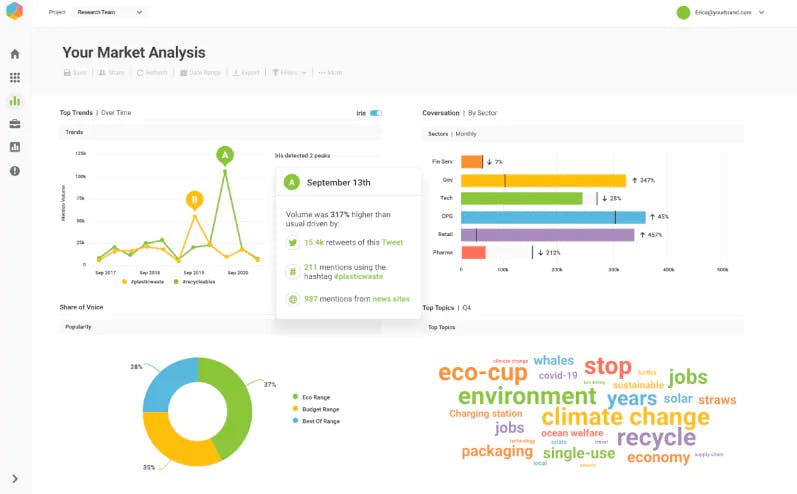
  • Multichannel monitoring across social networks, blogs, forums, news sites, and online communities.

  • Advanced AI for sentiment, trends, and topic discovery, including image recognition.

  • Custom dashboards and visualizations for share-of-voice, campaign tracking, and competitive benchmarks.

  • Multilingual listening coverage for global brands.

  • Structured query and filtering tools for deep audience and narrative analysis.

Brandwatch helps when you need to understand how competitors show up across social conversations, news cycles, and online communities—not just isolated posts or mentions. Its listening engine surfaces signals across platforms and languages, which gives you a broad view of where competitor narratives strengthen or weaken. Sentiment analysis and topic discovery highlight themes that drive engagement, while share-of-voice dashboards reveal when a rival gains or loses visibility during campaigns or product launches. This depth makes it easier to interpret market perception in real time rather than relying on anecdotal snapshots.

competitor analytics tools

Its strength lies in scale and precision. Brandwatch ingests millions of posts, discussions, and articles each day, then applies AI to classify sentiment, detect emerging trends, and segment conversations by audience. Global brands depend on this breadth because their competitors operate across many markets and languages. The limitation is the enterprise footprint. Pricing, onboarding, and configuration are geared toward large organizations, and the platform can feel overwhelming if you only need lightweight social monitoring or simple competitor alerts.

Pricing plan for Brandwatch

Brandwatch uses custom-quoted pricing with reported ranges of $800–$3,000 per month depending on volume, modules, and data limits, with additional guidance showing median annual contracts around $50,000 and total spend rising with add-ons such as image recognition, live dashboards, and expanded channel access.

Brandwatch at a glance for competitor monitoring

Dimension

How Brandwatch performs

Why it matters for competitor monitoring

Engine coverage

Tracks social networks, forums, blogs, and news across languages.

Reveals how competitors appear across global online conversations.

Depth of brand/competitor insight

Very deep on sentiment, topics, and narrative shifts.

Shows how competitor stories evolve and resonate.

Citation/source insight

Uses post-level data from social and news channels.

Provides direct evidence of how audiences talk about competitors.

Attribution abilities

Connects conversation spikes to campaigns, events, or product launches.

Helps identify what triggers competitor visibility shifts.

Actionability/workflow strength

Custom dashboards and reporting built for large teams.

Supports cross-functional insight sharing at enterprise scale.

Best-fit use cases

  • You manage a global brand and need multilingual, multichannel competitive monitoring.

  • You track how competitor narratives change across social and news ecosystems.

  • You require deep sentiment, trend detection, and share-of-voice analytics.

  • You operate at enterprise scale with complex social-listening needs.

Takeaway

Brandwatch is the best fit if you need enterprise-level social listening that reveals how competitors perform across global conversations, narratives, and sentiment.

Talkwalker: best competitor monitoring tool for global media and visual intelligence

competitor growth tracking

Key Talkwalker standout features

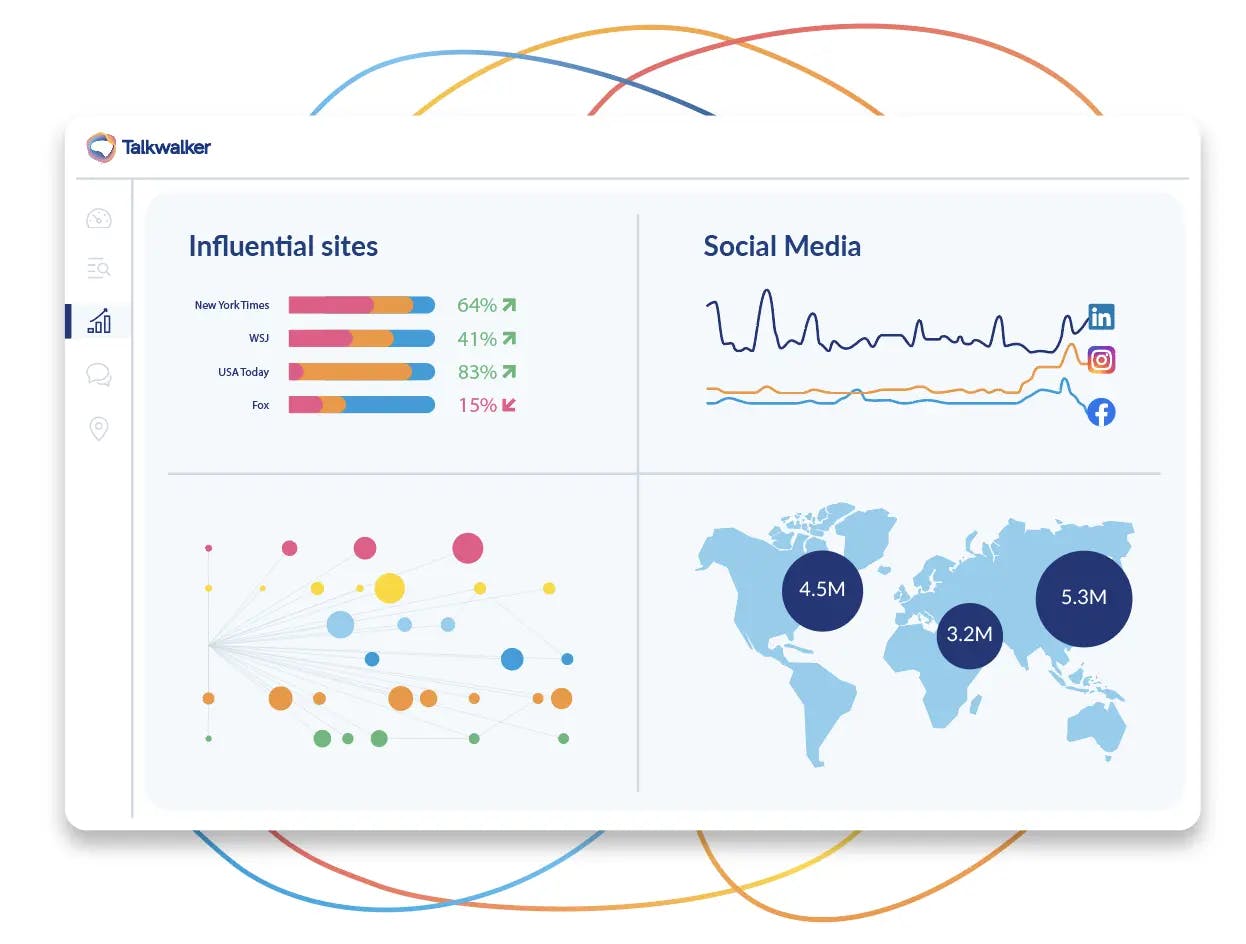
  • Global media and social monitoring across 150M+ sources, 187+ languages, and nearly every country.

  • Image and video recognition that detects competitor logos, products, and brand appearances even when untagged.

  • Share-of-voice and competitive benchmarking dashboards for social and media performance.

  • AI-driven trend detection and sentiment analysis to surface emerging narratives.

  • Custom alerts and dashboards to tailor monitoring to markets, brands, or product lines.

Talkwalker helps when you need a comprehensive view of how competitors appear in conversations, media cycles and visual content across global regions. It captures text-based and visual mentions, which means you can detect competitor activity even when users don’t tag or reference the brand directly. This matters in categories where visual exposure drives awareness—like CPG, fashion, automotive, retail, or sports—because many competitive signals show up in images rather than written posts. Its global scale gives multinational brands clarity across markets and languages without stitching together separate tools.

competitor product monitoring

Its strength is coverage. Talkwalker ingests content from social networks, newsrooms, blogs, forums, and open web sources, and pairs that with a visual-recognition engine that helps identify untagged competitor visibility. This helps teams understand where competitor narratives gain traction and where brand presence appears organically. The limitation is complexity. The platform requires careful configuration to avoid noisy dashboards, and pricing aligns with enterprise needs rather than small teams. If you only need lightweight social monitoring, Talkwalker’s breadth may exceed your requirements.

Pricing plan for Talkwalker

Talkwalker uses custom-quoted pricing, with external sources indicating ranges from $1,200 to $9,600 per year, “Basic” packages around $9,600/year, and broader enterprise deployments costing $500–$2,200+ per month depending on volume and modules.

Talkwalker at a glance for competitor monitoring

Dimension

How Talkwalker performs

Why it matters for competitor monitoring

Engine coverage

Massive global coverage across social, news, forums, blogs, and web.

Captures competitor signals across markets and languages.

Depth of brand/competitor insight

Strong on sentiment, trends, and visual detection.

Reveals both narrative shifts and visual presence competitors gain.

Citation/source insight

Pulls from diverse media and social sources with post-level traceability.

Helps verify specific mentions and understand context of conversations.

Attribution abilities

Links spikes in mentions or visuals to specific campaigns or events.

Shows how competitor actions influence visibility across channels.

Actionability/workflow strength

Dashboards, alerts, visual-recognition insights, and cross-market views.

Supports coordinated monitoring for global teams.

Best-fit use cases

  • You operate across multiple countries and need multilingual monitoring.

  • You track competitors in visual-heavy categories like retail, CPG, fashion, automotive or sports.

  • You need visibility across both text and visual mentions to understand brand presence holistically.

  • You run an enterprise social-listening or comms function with complex monitoring needs.

Takeaway

Talkwalker is the best fit if you need global, multilingual, and visual-first competitor monitoring that captures both narrative and untagged brand exposure.

Sprout Social: best competitor monitoring tool for social benchmarking and marketer-friendly insights

competitor market share analysis

Key Sprout Social standout features

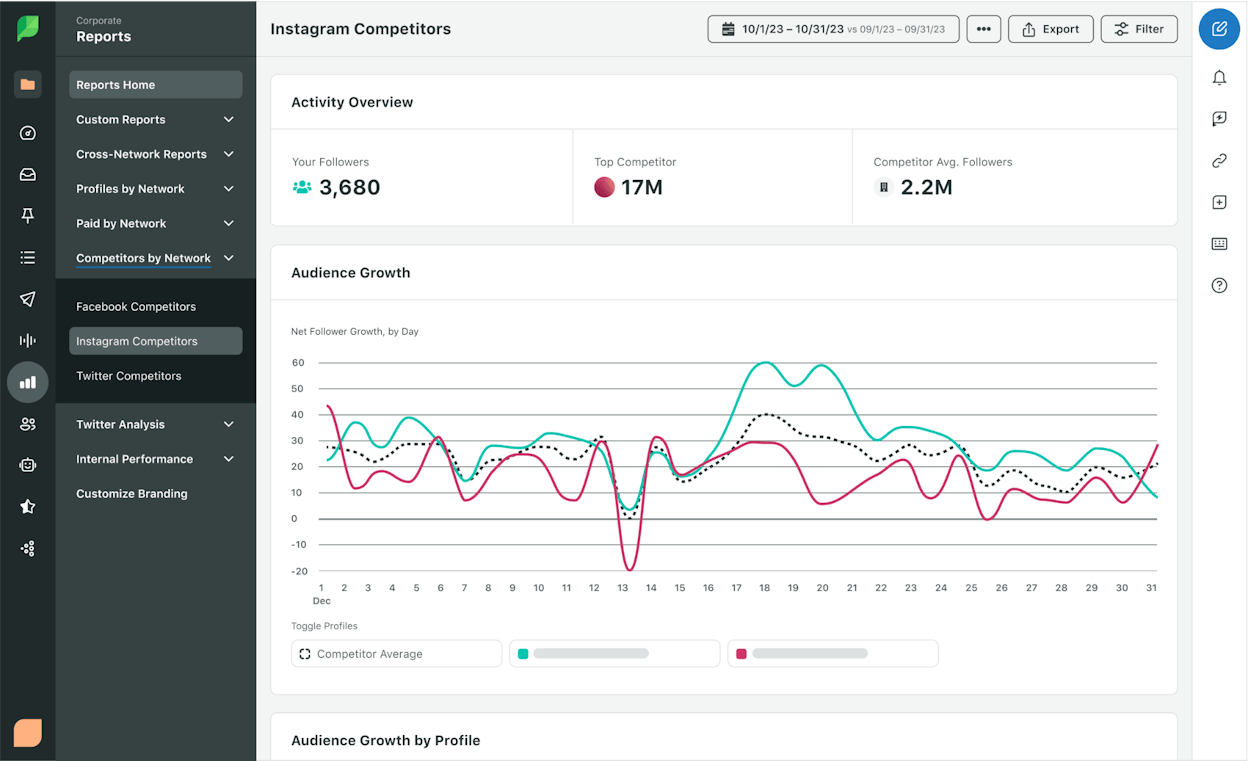
  • Competitor performance reports comparing engagement, posting frequency, impressions and audience growth against rivals.

  • Listening templates for competitive analysis to track share-of-voice and sentiment without heavy setup.

  • Unified social publishing and engagement tools so you can act on insights immediately.

  • Cross-network analytics that consolidate performance across major social platforms.

  • Clear, visual dashboards designed for non-analysts and marketing teams.

Sprout Social helps when you want clean, practical competitor benchmarks across social channels without managing a complex listening suite. Its competitor reports show how your engagement, posting cadence and audience growth compare with rival brands, which makes it easier to pinpoint where your social presence lags or leads. The listening templates extend this by tracking sentiment and share-of-voice, turning social monitoring into a structured process rather than ad-hoc checks. Because publishing, engagement and analytics live in the same tool, you can shift from insight to action without switching platforms.

competitive positioning tools

Its strength is usability. Sprout Social presents competitive insights in dashboards that marketing teams can interpret quickly, which is helpful when you need to communicate performance differences to stakeholders who don’t live inside analytics tools. The limitation is scope. Sprout covers social only, so you still need separate tooling for SEO, pricing moves, or broader GTM intelligence. Pricing also scales per user, which can feel steep for smaller teams that mainly want competitor reports rather than full social-management capabilities.

Pricing plan for Sprout Social

Sprout Social uses a per-user pricing model, with the Standard plan starting around $199 per user/month (annual), Professional around $299 per user/month, Advanced at $399 per user/month, and Enterprise plans available via custom quote, with monthly billing priced higher across tiers.

Sprout Social at a glance for competitor monitoring

Dimension

How Sprout Social performs

Why it matters for competitor monitoring

Engine coverage

Tracks major social platforms through publishing, engagement and analytics tools.

Shows how your social visibility compares with direct rivals.

Depth of brand/competitor insight

Strong for social engagement, posting behavior, sentiment and SOV.

Highlights where competitors win attention or momentum.

Citation/source insight

Pulls from platform-level social data with post-level details.

Helps teams understand the context behind competitor engagement.

Attribution abilities

Connects performance trends to posting activity and audience shifts.

Reveals which competitor behaviors drive visibility changes.

Actionability/workflow strength

Fully integrated with publishing and engagement.

Enables immediate execution based on competitor insight.

Best-fit use cases

  • You need simple, clear competitor benchmarks for social performance.

  • You want competitor monitoring integrated with your day-to-day publishing and engagement workflow.

  • Your team prefers visual dashboards rather than complex analytics tools.

  • You operate primarily through social channels and don’t need broader CI coverage.

Takeaway

Sprout Social is the best fit if you need marketer-friendly social benchmarking that connects competitive insights directly to your publishing and engagement workflow.

Meltwater: best competitor monitoring tool for broad social + media coverage at enterprise scale

competitor strategy analysis

Key Meltwater standout features

  • Monitoring across social networks, forums, blogs, news, broadcast media, and podcasts from a global dataset.

  • Competitive benchmarking and share-of-voice reporting for mentions, reach, and visibility.

  • Integrations with Owler to surface company-level alerts like funding, acquisitions, and leadership changes.

  • Visual and multimedia coverage across TV, print, and podcasts.

  • Global, multilingual tracking built for PR and comms teams.

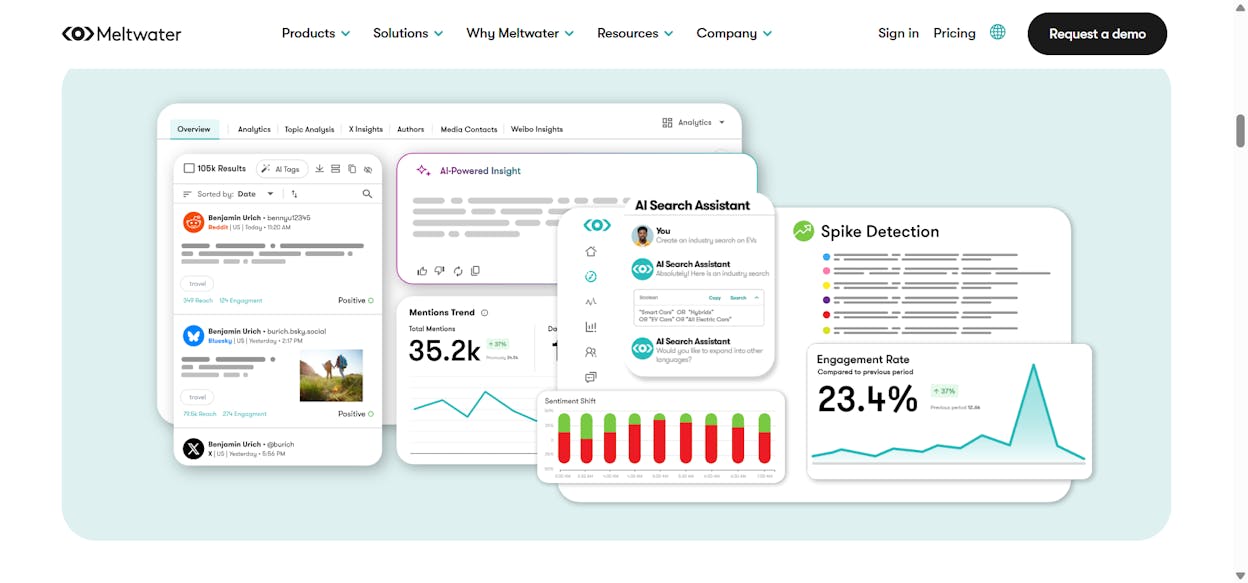
Meltwater helps when your competitor monitoring needs extend far beyond social channels and into newsrooms, broadcast outlets, forums, and podcasts. Its strength is volume and breadth: the platform ingests signals from hundreds of thousands of sources, which gives teams visibility into narratives that emerge in traditional media alongside social discussions. The share-of-voice dashboards show how your brand compares with competitors across these channels, while Owler integration adds company-event alerts that give you context on material changes at competitor organizations. For PR-heavy teams, the ability to track visibility across social posts, news articles and broadcast segments in one place removes the need for manual monitoring across disconnected tools.

competitor alerts software

Its strength is channel diversity. Meltwater gives you coverage across media types that most social-first platforms cannot reach, which matters when competitors invest heavily in PR, broadcast campaigns, or earned media. The limitation is usability. The interface is often viewed as dated and harder to navigate compared with newer platforms, and the platform’s depth can overwhelm teams without a clear monitoring workflow. Pricing can also be opaque and enterprise-oriented, which makes it harder for smaller teams to justify if they only need lightweight monitoring.

Pricing plan for Meltwater

Meltwater uses custom-quoted, enterprise-oriented pricing, with third-party sources indicating typical annual contracts of $15,000–$20,000/year, scaling to $30,000–$45,000+ for larger deployments depending on regions, modules, and media coverage.

Meltwater at a glance for competitor monitoring

Dimension

How Meltwater performs

Why it matters for competitor monitoring

Engine coverage

Tracks social, news, blogs, broadcast, podcasts, and forums.

Captures competitor visibility across media types, not just social.

Depth of brand/competitor insight

Strong for PR, narrative, and reach-based competitive tracking.

Helps teams understand how competitors gain earned media or press momentum.

Citation/source insight

Pulls from public newsrooms, broadcast outlets, and social feeds with source-level data.

Supports validation of where competitor narratives originate.

Attribution abilities

Connects spikes in press or social mentions to campaigns, events, or product announcements.

Reveals the drivers behind competitor visibility jumps.

Actionability/workflow strength

Dashboards and alerts suited for PR and comms operations.

Helps teams respond quickly to competitive press cycles.

Best-fit use cases

  • You need to track competitors across social, news, broadcast, podcasts, and forums.

  • You run a PR or communications function where multi-channel media monitoring is essential.

  • You want competitor share-of-voice metrics that combine social and traditional media.

  • You monitor big competitors with active earned-media or PR-driven strategies.

Takeaway

Meltwater is the best fit if you need enterprise-level monitoring that covers social, news, and broadcast media in one place, giving you a wide-angle view of competitor visibility.

Priceva: best competitor monitoring tool for dynamic pricing and ecommerce price intelligence

competitor sales intelligence

Key Priceva standout features

  • Real-time competitor price tracking across multiple stores and marketplaces, with price-change alerts and availability monitoring.

  • MAP monitoring and violation alerts to enforce pricing agreements and detect undercutting.

  • Dynamic pricing engine that automatically adjusts your prices based on competitor data, stock levels, and predefined rules.

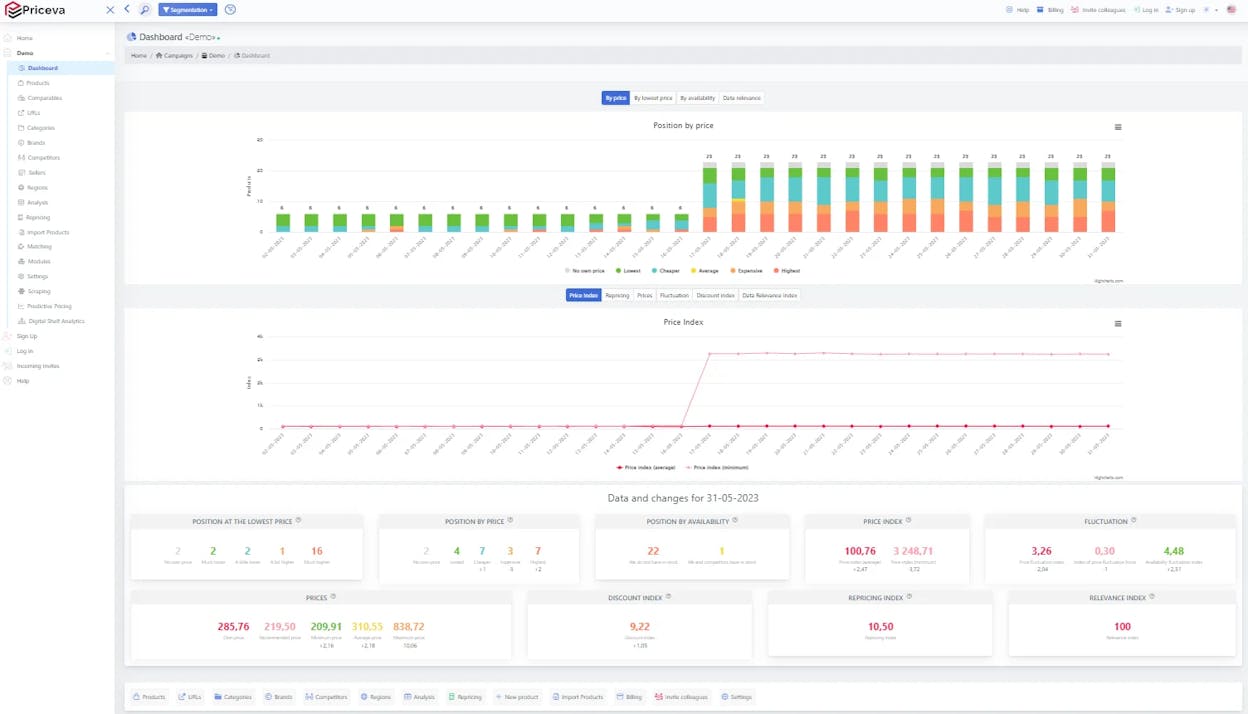
Priceva helps when price moves frequently across your category and you need to stay competitive without manual tracking. Its real-time tracking surfaces price drops, stock changes or competitor repricing quickly, which allows you to respond or adjust before you lose margin or sales. MAP monitoring adds protection against undercutting and preserves pricing integrity when you carry restricted or brand-sensitive items. The dynamic pricing engine further streamlines operations by updating your prices algorithmically, turning competitor data into actionable pricing moves without manual effort.

competitor pricing intelligence

Its strength is precision and automation. Priceva focuses solely on price — not on SEO, marketing, or customer behaviour — which makes it highly effective in categories where margins and price competitiveness are critical (electronics, marketplaces, retail). The dynamic pricing feature helps maintain competitiveness while preserving margins, which can make the difference in fast-moving, price-sensitive markets. The limitation is scope and sophistication: its analytics and integrations are simpler compared with full-fledged ecommerce suites, and advanced features like auto-matching or high-volume product sets may increase complexity and cost, which might be challenging for lean teams or very large catalogs.

Pricing plan for Priceva

Priceva offers a transparent tiered subscription model: a Starter plan (free) for basic monitoring (up to 20 sites/competitors and 20 products), a Business plan at $99/month (up to 30 sites/competitors and 35,000 monthly price checks), a Pro plan at $199/month (up to 40 sites/competitors and about 100,000 monthly price checks), and an Enterprise plan with custom pricing for broader capabilities and higher volume monitoring.

Priceva at a glance for competitor monitoring

Dimension

How Priceva performs

Why it matters for competitor monitoring

Engine coverage

Tracks multiple stores and marketplaces globally (price + availability)

Lets you monitor a broad competitive set, especially in marketplaces.

Depth of insight

Provides price history, change alerts, and MAP-violation detection

Helps you react quickly to competitor repricing and protect margins.

Citation/source insight

Pulls data directly from competitor listings, shows historical price data

Gives clear evidence when competitor prices change, allowing you to compare transparently.

Attribution abilities

Links competitor moves to price shifts or stock changes on your products

Helps you understand when competitor actions impact your sales or pricing strategy.

Actionability/workflow strength

Built-in dynamic pricing automation and alerting

Enables fast, automated response to competitor price actions.

Best-fit use cases

  • You sell in price-sensitive categories (electronics, commodities, marketplaces) where price changes often.

  • You manage a catalog across multiple retailers or marketplaces and need proactive price monitoring and repricing.

  • You want to enforce MAP agreements or monitor competitor discounting across channels.

  • You prefer automation over manual repricing and want to react to competitor moves at scale.

Takeaway

Priceva is the best fit if you need real-time competitor price tracking and automated pricing adjustments to stay competitive in fast-moving, price-sensitive markets.

Tie AI visibility toqualified demand.

Measure the prompts and engines that drive real traffic, conversions, and revenue.

Covers ChatGPT, Perplexity, Claude, Copilot, Gemini

Similar Content You Might Want To Read

Discover more insights and perspectives on related topics

© 2026 Analyze AI. All rights reserved.