8 Best Answer Engine Optimization (AEO) Tools
Written by
Ernest Bogore
CEO
Reviewed by
Ibrahim Litinine
Content Marketing Expert

We evaluated 8 best Answer Engine Optimization (AEO) tools built to solve this exact pain. We compared their data models, tested whether they track prompt-level shifts, validated if they measure traffic or conversions from AI engines, and checked which ones support meaningful optimization instead of vanity reporting.
Table of Contents
TL;DR
|
Tool |
Best for |
Primary focus |
Standout strength |
Key limitation / trade-off |
Ideal team size / type |
|
Analyze AI |
Proving AI visibility drives real business outcomes |
Multi-engine AI traffic attribution, conversions, revenue, prompt + citation data |
Connects AI answers to sessions, conversions, and revenue so AEO becomes a performance channel |
It’s more tailored to SMBs |
Product-led teams, growth teams, agencies |
|
Writesonic |
Turning AI visibility data into content actions |
AI visibility tracking, prompt explorer, citations, sentiment, content workflows |
Strong bridge between AI visibility data and day-to-day content creation |
Best value when you also use its content suite; lighter if you only want monitoring |
Content and SEO teams shipping often |
|
Profound |
Deep citation analysis and competitive clarity |
URL-level citation tracking, prompt trends, research and dashboards |
Very detailed view of which pages and domains AI engines trust and when that changes |
Heavy on analysis, light on execution; enterprise pricing can be a barrier |
Enterprise brands with SEO and data maturity |
|
AthenaHQ |
Structuring content so AI engines understand and trust it |
GEO/AEO content optimization, schema and entity guidance, predictive shifts |
Strong focus on structured content, entities, and question-based optimization |
Less about full workflows or analytics depth; works best alongside existing content tools |
Mid-size teams improving content structure |
|
Semrush |
Adding AI visibility inside an existing SEO stack |
AI visibility toolkit on top of classic SEO (keywords, audits, backlinks) |
One familiar workspace for SEO + AEO metrics |
AEO depth lags specialist tools; you pay for full SEO suite even if you only need AEO |
Teams already using Semrush at scale |
|
Peec AI |
Simple visibility tracking and quick competitor insights |
Multi-engine mentions, share-of-voice, regional visibility, basic recs |
Easy, lightweight way to see AI visibility and compare against rivals |
Recommendations are early-stage; limited depth and credits can cap tracking |
Growing brands and marketers new to AEO |
|
Scrunch |
Brand reputation, sentiment, and co-mentions in AI |
Brand radar, sentiment tracking, co-mentions across multiple AI engines |
Strong brand and sentiment view with clear multi-engine coverage |
Focused on monitoring; little guidance on how to change content or structure |
Brand, PR, and marketing teams at mid–large orgs |
|
Conductor |
Full-funnel enterprise SEO + AEO in one platform |
End-to-end SEO/AEO suite: AI visibility, content creation, monitoring, analytics |
Deep, unified workflow from visibility to content and technical health |
Enterprise cost and complexity; overkill for small or early-stage teams |
Large organizations with complex SEO operations |
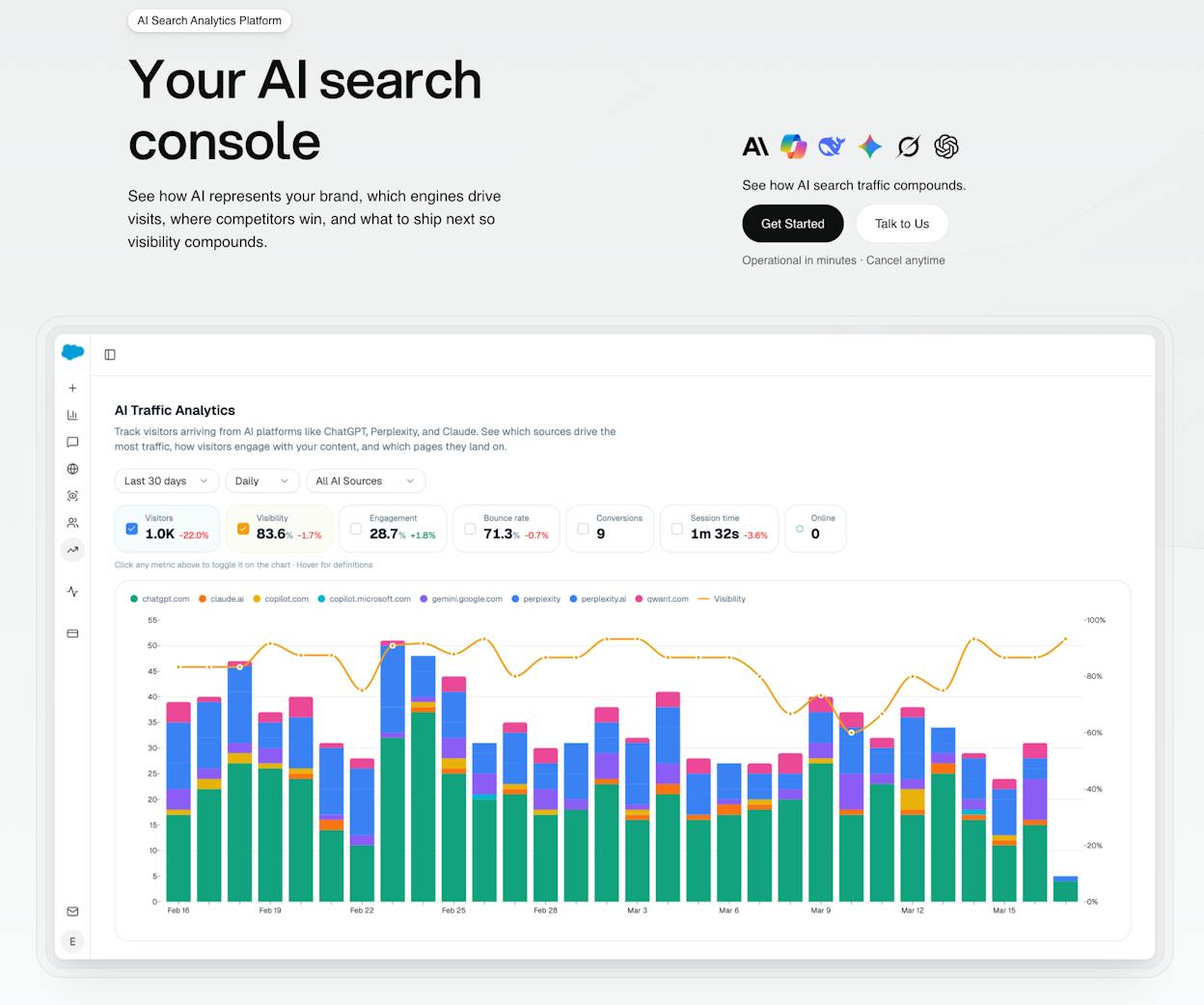
Analyze AI: best answer engine optimization tool for connecting AI visibility to real traffic, conversions, and revenue
|
Area |
What Analyze AI does |
Why it matters for AEO |
|
Multi-engine attribution |
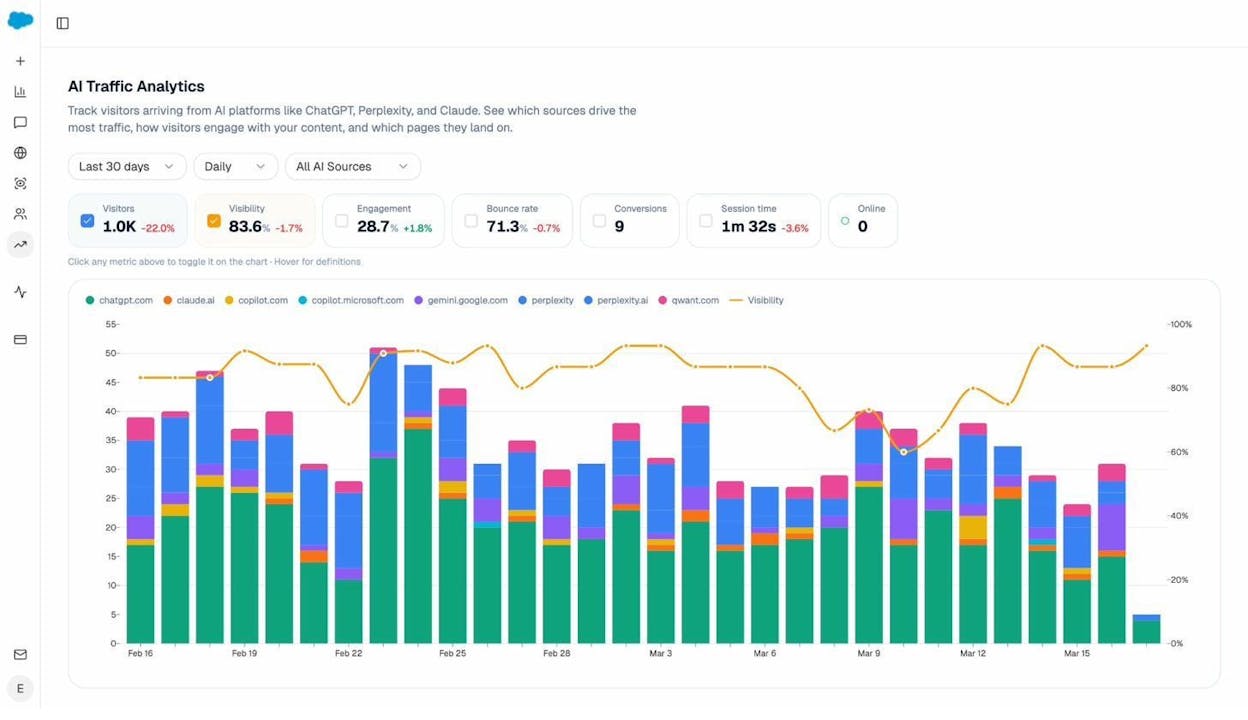
Shows traffic and conversions from ChatGPT, Perplexity, Claude, Copilot, and Gemini |
Helps teams focus on engines that drive real results |
|
Landing page insights |
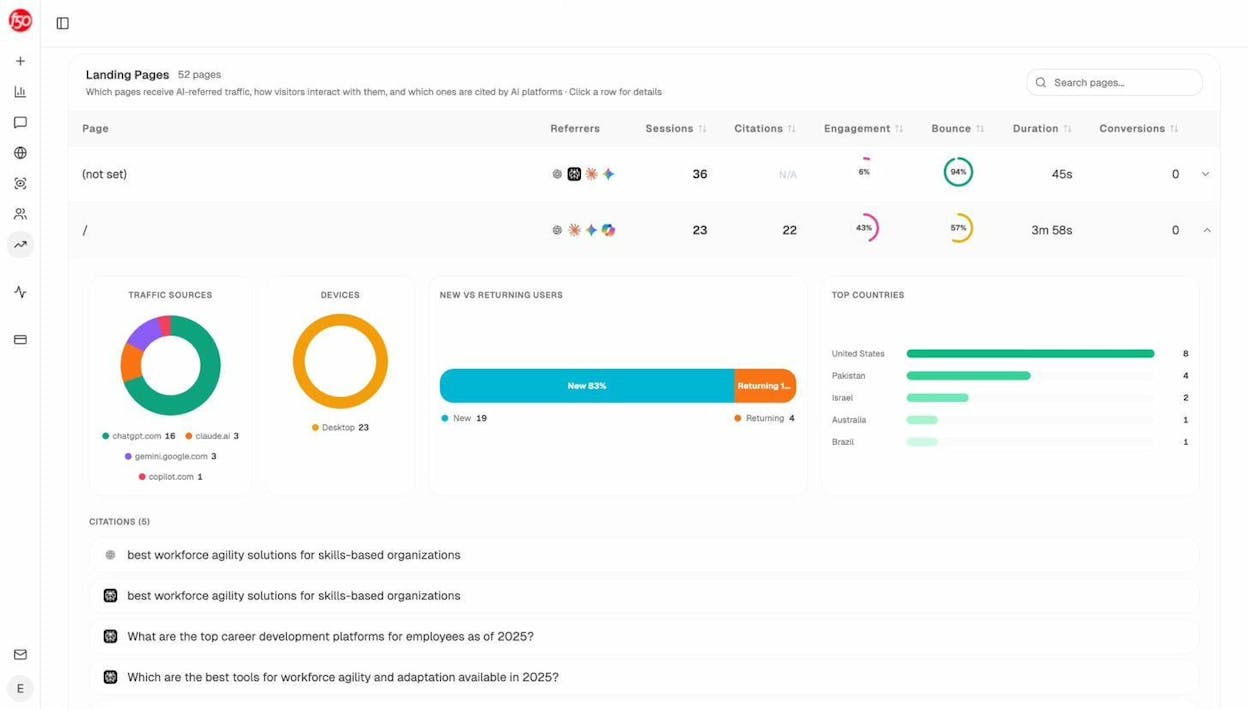
Reveals which pages receive AI referrals and how they convert |
Guides optimization toward pages that generate revenue |
|
Prompt-level tracking |
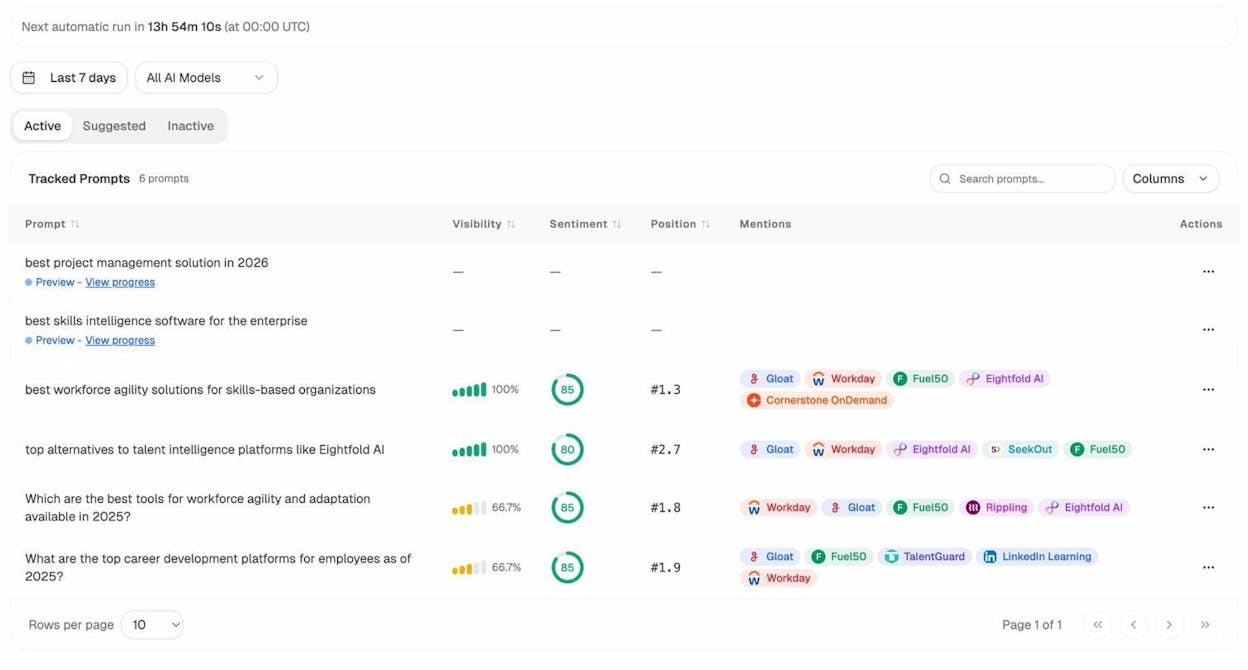
Surfaces wins and losses across high-intent prompts |
Lets teams prioritize topics that drive sessions and conversions |
|
Citation audits |
Tracks domains LLMs trust and reference |
Helps brands strengthen authority where models pull their sources |
|
Opportunity mapping |
Highlights gaps, rising prompts, and high-impact actions |
Supports teams in planning weekly or monthly AEO improvements |
Best-fit use cases
-
Companies wanting to tie AI visibility to traffic, conversions, and revenue
-
Teams needing prompt-level insights across all major LLMs
-
Brands that want to understand which pages win AI-driven traffic
-
Organizations wanting to track which domains models cite and why
-
Agencies needing actionable AEO reporting for clients
Here are in more details how Analyze AI works:
See actual traffic from AI engines, not just mentions

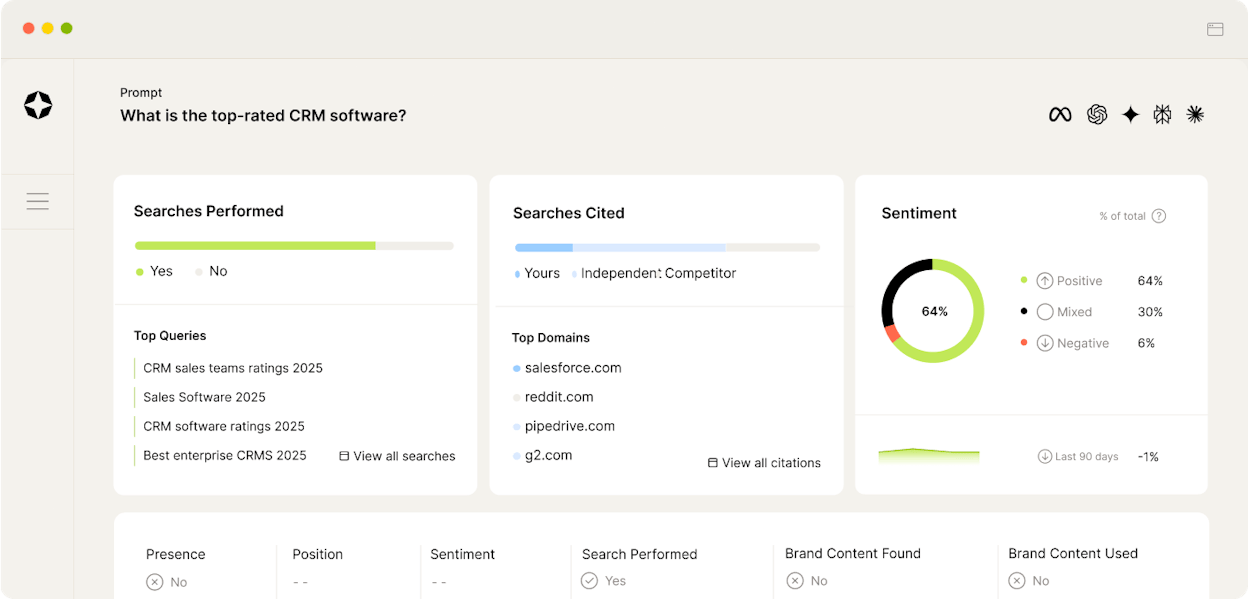
Analyze AI attributes every session from answer engines to its specific source—Perplexity, Claude, ChatGPT, Copilot, or Gemini. You see session volume by engine, trends over six months, and what percentage of your total traffic comes from AI referrers. When ChatGPT sends 248 sessions but Perplexity sends 142, you know exactly where to focus optimization work.

Know which pages convert AI traffic and optimize where revenue moves

Most tools stop at "your brand was mentioned." Analyze AI shows you the complete journey from AI answer to landing page to conversion, so you optimize pages that drive revenue instead of chasing visibility that goes nowhere.
The platform shows which landing pages receive AI referrals, which engine sent each session, and what conversion events those visits trigger.
For instance, when your product comparison page gets 50 sessions from Perplexity and converts 12% to trials, while an old blog post gets 40 sessions from ChatGPT with zero conversions, you know exactly what to strengthen and what to deprioritize.
Track the exact prompts buyers use and see where you're winning or losing

Analyze AI monitors specific prompts across all major LLMs—"best Salesforce alternatives for medium businesses," "top customer service software for mid-sized companies in 2026," "marketing automation tools for e-commerce sites."

For each prompt, you see your brand's visibility percentage, position relative to competitors, and sentiment score.
You can also see which competitors appear alongside you, how your position changes daily, and whether sentiment is improving or declining.

Don’t know which prompts to track? No worries. Analyze AI has a prompt suggestion feature that suggests the actual bottom of the funnel prompts you should keep your eyes on.
Audit which sources models trust and build authority where it matters

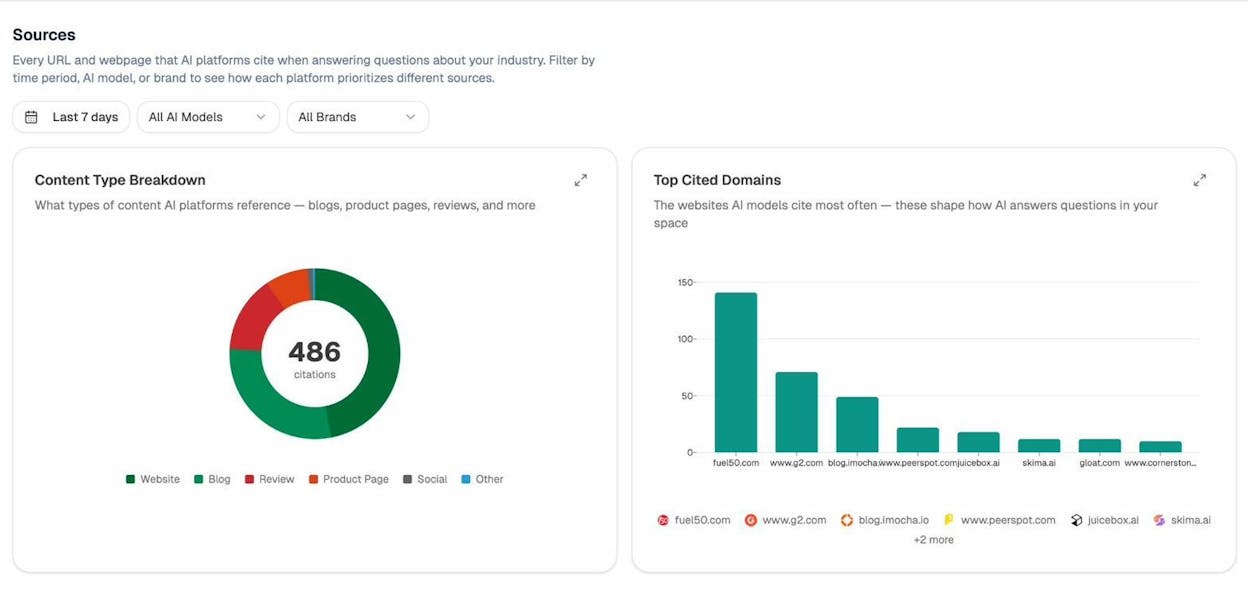
Analyze AI reveals exactly which domains and URLs models cite when answering questions in your category.
You can see, for instance, that Creatio gets mentioned because Salesforce.com's comparison pages rank consistently, or that IssueTrack appears because three specific review sites cite them repeatedly.

Analyze AI shows usage count per source, which models reference each domain, and when those citations first appeared.

Citation visibility matters because it shows you where to invest. Instead of generic link building, you target the specific sources that shape AI answers in your category. You strengthen relationships with domains that models already trust, create content that fills gaps in their coverage, and track whether your citation frequency increases after each initiative.
Prioritize opportunities and close competitive gaps

Analyze AI surfaces opportunities based on omissions, weak coverage, rising prompts, and unfavorable sentiment, then pairs each with recommended actions that reflect likely impact and required effort.
For instance, you can run a weekly triage that selects a small set of moves—reinforce a page that nearly wins an important prompt, publish a focused explainer to address a negative narrative, or execute a targeted citation plan for a stubborn head term.
Writesonic: best Answer Engine Optimization (AEO) tool for AI visibility and citations

Key Writesonic standout features
-
Multi-platform tracking across ChatGPT, Gemini, Perplexity, Claude, and AI Overviews
-
Prompt explorer that shows the exact questions where your brand appears or is missing
-
Citation and source tracking that links AI answers back to real URLs and pages
-
Sentiment and competitor benchmarking for how engines talk about you versus others
-
Actionable optimization workflows tied directly to content briefs and writing tools
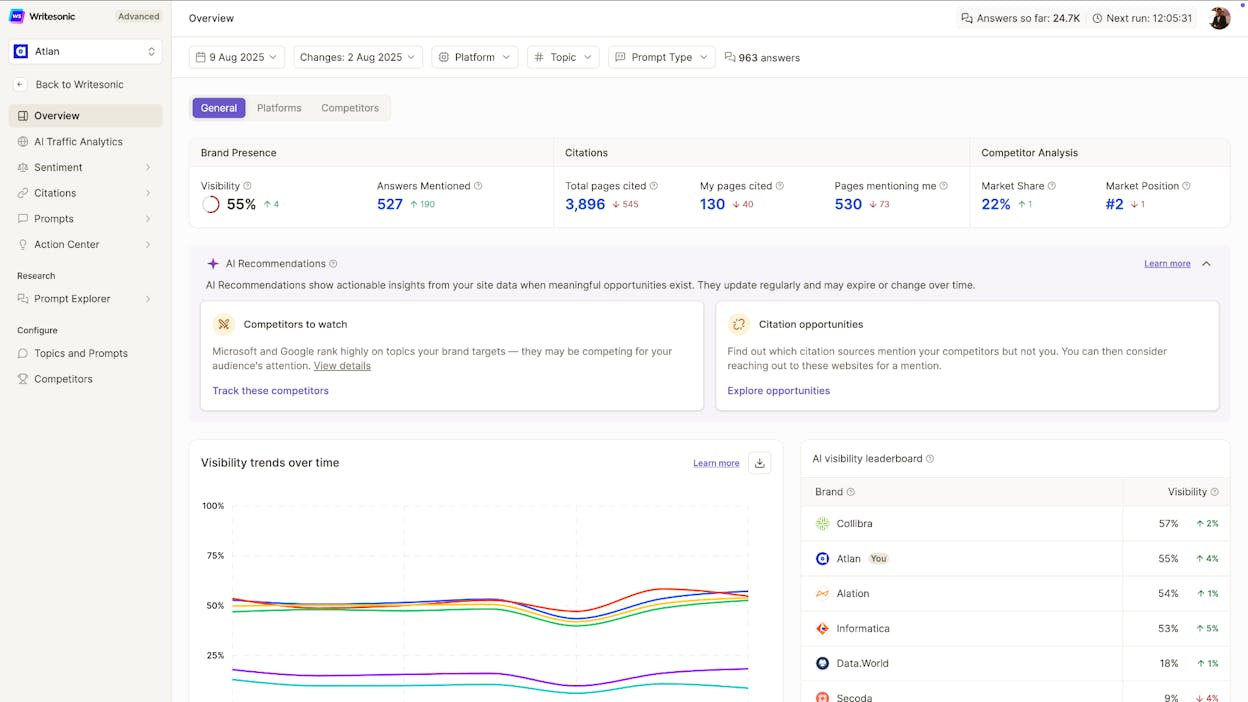
Writesonic works like an AI search radar that never sleeps and never forgets. It shows how often AI engines mention your brand, which pages they trust, and which prompts you win or lose, so your team sees the real shape of your presence across answer engines instead of guessing from a few manual tests. The prompt explorer makes this very clear, because you see the exact questions people ask, the answers they get, and where your brand stands in those answers, which turns vague “AI visibility” into clear lists of wins, gaps, and risks.
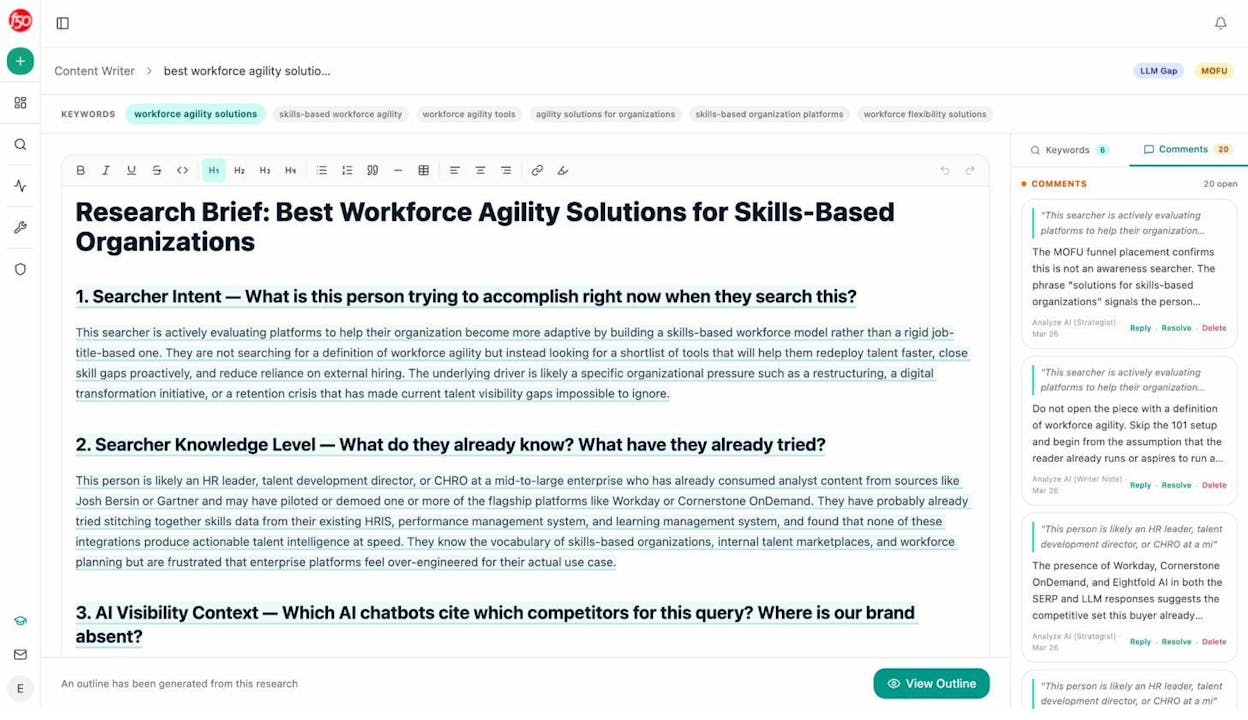
The second big strength is how Writesonic ties these insights back into the way teams already create content. Instead of handing you static reports, it lets you feed citation and prompt data into content briefs, outlines, and writing flows, so writers can adjust headings, entities, and examples with a clear target in mind. This approach helps content and SEO teams move from “we know where we show up” toward “we know what to change this week,” which is the real job of any AEO tool that claims to help with growth rather than only reporting.

After you use it for a while, some limits start to show, and they matter when you plan budget and process. Writesonic does a strong job tracking mentions and suggesting next steps, yet it still depends on humans to decide which changes to ship, in which order, and on which pages, so it works best for teams that already follow a steady content and SEO rhythm. The workflows help you see which pages to improve, which schema issues to fix, and which prompts to target, however they do not yet feel like a full “hands off” automation layer that can run complex experiments without close guidance.
Pricing can also feel heavy for very small teams that only want a light tracker instead of a full content and AEO suite. The most useful dashboards, competitor views, and deeper insights often sit behind higher tiers, which means solo operators or tiny brands may only scratch the surface before they hit a paywall. Writesonic is also not a pure specialist tracker, because its strengths shine when you use both the visibility layer and the writing tools together, so teams that only want a lean monitoring panel might prefer a narrower tool that focuses only on alerts and mentions.
How Writesonic supports Answer Engine Optimization
|
Area |
What Writesonic does |
Why it matters for AEO |
|
AI visibility tracking |
Shows where your brand appears across major AI engines |
You see true reach inside AI answers, not just web search results |
|
Prompt-level insights |
Lists exact questions that trigger or ignore your brand |
You learn how real people ask and where you fail to show |
|
Citation and source mapping |
Connects answers to specific URLs and domains |
You know which pages engines trust and where to focus improvements |
|
Sentiment and competitors |
Measures tone and compares mentions against rival brands |
You track reputation inside AI answers, not only social or web |
|
Optimization workflows |
Suggests actions and feeds data into briefs and content tools |
Teams move from insights toward edits, tests, and new assets |
|
Content creation integration |
Lets writers use AI visibility data while drafting and improving |
Each new piece launches with AEO reality built into its structure |
Best-fit use cases
-
Brands that want to compare visibility against key rivals across AI engines
-
Teams that update or ship content every month and need clear AEO targets
-
Companies that must see which pages AI engines trust and why
-
Writers who want prompts, citations, and schema signals inside their briefs
-
Marketing leaders who want early warning signs when engines change answers
Writesonic shows where your brand stands inside major AI engines and gives clear steps to improve those answers. It works best when your team wants both visibility insights and a practical way to act on them.
Profound: best Answer Engine Optimization (AEO) tool for deep citation insights and competitive clarity

Key Profound standout features
-
Multi-platform tracking across ChatGPT, Perplexity, Google AI Overviews, Claude, and Gemini
-
URL-level citation tracking that reveals which pages AI engines trust most
-
Competitor replacement alerts that show when rivals take over your citations
-
Prompt and conversation insights to surface questions that shape AI answers
-
Integration with partner dashboards like G2’s AI Visibility tools for deeper reporting
Profound works like a visibility map built for teams that want to understand not only when they appear in AI answers but also which specific URLs and sources power those mentions. It focuses on citation clarity, showing the exact pages that influence AI engines, the strength of those citations, and the places where a brand loses ground to a rival. Rather than offering a surface view of “mentions,” Profound breaks down the mechanics behind those mentions so teams see what content is working and what must be rebuilt. This gives marketers a steady sense of where their authority stands inside AI systems and which content assets carry the most weight across answer engines.
Another important part of the tool is how it captures trends in prompts, questions, and conversational patterns. Profound publishes ongoing research across platforms like ChatGPT, Perplexity, and AI Overviews, and it brings those insights into the product. Users can learn how AI engines change citations over time, which questions gain traction, and how sentiment shifts during updates. This lets teams shape new content that reflects real AI demand instead of trying to guess what drives exposure. Since Profound supports multi-engine tracking with enterprise-grade depth, it works well for brands that operate in many regions or need high-resolution insight into how engines pick sources.

Where Profound may feel less complete is in the hands-on execution layer. It provides strong analysis but expects teams to use separate tools for writing, editing, and publishing changes. You get deep insight and clear patterns, yet the platform does not guide you through content revisions or push structured workflows like some integrated suites. This makes sense for larger teams with established processes, but smaller teams may want something with lighter onboarding and built-in writing assistance. The pricing structure reinforces this, because many advanced features sit behind custom or enterprise plans, which can be harder for small companies to adopt.
The platform is also more specialized than broad marketing suites. It focuses tightly on the factors that move AI citations—URL strength, domain trust, prompt behavior, and competitor shifts—without adding unrelated SEO or content modules. This focus is a strength for enterprise users but creates a narrower experience than tools that combine monitoring with creation or optimization features. Still, for brands that care deeply about AI citation depth and competitive clarity, Profound offers insight that most general SEO tools do not match.
How Profound supports Answer Engine Optimization
|
Area |
What Profound does |
Why it matters for AEO |
|
Multi-engine visibility |
Tracks mentions across ChatGPT, Perplexity, AI Overviews, Claude, Gemini |
Brands see a reliable view of presence across major AI platforms |
|
Citation tracking |
Reveals which URLs and domains fuel AI explanations |
Teams know which content deserves updates or expansion |
|
Competitor comparison |
Alerts when rivals replace your citations |
Helps brands spot shifts before they impact revenue or visibility |
|
Prompt trend insights |
Surfaces the questions and conversations shaping exposure |
Lets marketers target real AI demand instead of guessing |
|
Dashboard integrations |
Syncs with partner tools like the G2 AI Visibility dashboard |
Supports larger teams that centralize analytics across channels |
Best-fit use cases
-
Brands that want detailed insight into which pages and domains AI engines cite
-
Teams that need prompt and conversation trends to guide content choices
-
Companies with competitors that frequently shift the citation landscape
-
Marketing leaders who want to track brand authority inside AI answers
-
Enterprise teams operating in many markets or languages
Profound offers deep, URL-level clarity on why AI engines cite certain sites and ignore others. It is ideal for teams that value precise visibility data and competitive insight more than built-in content tools.
AthenaHQ: best Answer Engine Optimization (AEO) tool for structured content and AI-ready optimization

Key AthenaHQ standout features
-
Multi-engine tracking across ChatGPT, Gemini, Perplexity, Claude, Copilot, and AI Overviews
-
Structured-content optimization with schema guidance and entity-level suggestions
-
Question-based optimization that aligns pages with how LLMs interpret user intent
-
Predictive dashboards that show expected shifts in AI visibility
-
Benchmarking tools that compare brand mentions against competitors across engines
AthenaHQ is built for teams that want their content to match the way AI engines parse, structure, and reuse information. It focuses heavily on preparing pages in formats that large language models prefer, with clear schema, structured layouts, and question-driven content blocks. Instead of only tracking which answers mention your brand, the platform teaches you why those answers form the way they do and how you can shape your content so engines trust it more. This makes AthenaHQ well-suited for marketers who want visibility rooted in clear, structured content rather than improvisation or guesswork.
The platform goes deeper by providing learning resources and ongoing guidance about the shifts happening inside answer engines. AthenaHQ publishes steady research on AEO and GEO best practices, breaking down how content structure, entity clarity, and question-level alignment change visibility. The tool includes dashboards that help teams predict shifts in AI behavior and adjust pages ahead of time, which supports brands that want to stay ahead of engines rather than react after answers change. Because it frames visibility through the lens of content structure and model semantics, AthenaHQ fits well with teams that treat AEO as part of their ongoing editorial and optimization cycles.

AthenaHQ does not try to be a broad enterprise suite, and that shows when you compare its analytics and reporting depth to larger platforms. It offers strong insights for mid-size teams, yet it may not deliver the same range of integrations or advanced analysis demanded by global organizations. Most of the value sits in shaping and improving content formats for AI engines rather than managing complex workflows across many stakeholders. This keeps the tool focused and easy to adopt, although it leaves some gaps for companies that expect heavier analytics or in-depth operational support.
Teams looking for full content production capabilities may also find AthenaHQ slightly limited, since its strength lies in optimization guidance rather than writing or publishing content. It works best when paired with an existing content or SEO stack, supplying clear direction about structure, entities, and questions but not replacing editorial tools. That said, for teams that already write regularly and simply need sharper AI-visibility guidance, AthenaHQ offers clarity without forcing new processes or long onboarding cycles.
How AthenaHQ supports Answer Engine Optimization
|
Area |
What AthenaHQ does |
Why it matters for AEO |
|
Multi-engine tracking |
Monitors visibility across ChatGPT, Gemini, Perplexity, Claude, Copilot, and AI Overviews |
Brands gain a clear picture of how AI engines treat their content |
|
Structured content guidance |
Helps shape schema, entities, and structured blocks |
Strong structure increases trust and boosts citation likelihood |
|
Question-based optimization |
Aligns content with the questions LLMs use to understand topics |
Improves relevance and clarity inside AI-generated answers |
|
Predictive dashboards |
Shows likely shifts in visibility and behavior |
Teams can adjust content before engines rewrite answers |
|
Competitor benchmarking |
Tracks brand mentions against rivals across AI engines |
Helps companies understand their standing in the AI landscape |
Best-fit use cases
-
Teams improving content structure for AI-ready semantics and schema clarity
-
Brands wanting early signals on AI visibility shifts or ranking volatility
-
Companies using question-driven content strategies across many pages
-
Marketers who want guidance without heavy enterprise complexity
-
Growth teams needing multi-engine visibility across key AI platforms
AthenaHQ helps teams shape content the way AI engines understand it, with clear structure and strong entity signals. It is ideal for companies that want practical optimization guidance without the weight of a large enterprise suite.
Semrush: best Answer Engine Optimization (AEO) tool for teams that want AI visibility built into their SEO stack

Key Semrush standout features
-
AI Visibility Toolkit that shows where your brand appears across ChatGPT, Google AI, and other engines
-
Prompt Tracking inside Position Tracking to monitor AI queries and traditional SEO metrics together
-
Multi-engine AI citation tracking to compare your presence against competitors
-
Free AI search visibility tools that help teams spot missed prompts and topics
-
Full SEO suite integration including audits, keyword research, and content tools
Semrush gives teams a way to see how AI engines treat their brand while keeping all of that data inside the same place they already manage their SEO. It adds AI visibility layers on top of keyword tracking, site audits, and competitive tools, so brands do not need an entirely new workflow to understand where they appear in AI answers. The AI Visibility Toolkit shows when content is cited by large language models, how often those mentions appear, and what prompts trigger them, which gives teams a simple bridge between SEO and AEO without extra complexity. This makes Semrush helpful for companies that want to adapt to AI search without switching platforms.
The platform also supports this transition with guides, tutorials, and tools that explain how to align pages with AI-driven search behavior. Semrush publishes steady educational content about AEO, breaking down how to improve visibility in answer engines and how to update pages so they match LLM expectations. For teams already comfortable inside Semrush, these AI-focused features feel natural because they sit inside the same dashboards used for keywords, audits, and backlinks. This setup reduces friction and helps marketers bring AI visibility into their day-to-day SEO cycles.

Where Semrush may fall short is in the depth of its AI-specific tracking compared to tools built purely for AEO or GEO. Its dashboards do not always update as quickly as niche AEO tools, and some AI engines appear in limited detail depending on the plan. Reviewers note that Semrush behaves more like an SEO suite with added AI visibility instead of a purpose-built AEO solution, so teams needing advanced citation data or URL-level clarity may find gaps. Because Semrush spreads its attention across many features, its AEO additions are strong for discovery but not always as deep as specialized platforms.
Another point to consider is that Semrush’s AEO features work best for teams already using its broader ecosystem. The integration is helpful because all data lives in one place, yet it also means the tool does not stand alone as a dedicated AEO product. Smaller brands who only want AI tracking may find themselves paying for a full SEO suite they do not fully use. For companies already invested in Semrush, this creates efficiency; for those seeking only AI visibility, it may add unnecessary weight.
How Semrush supports Answer Engine Optimization
|
Area |
What Semrush does |
Why it matters for AEO |
|
AI Visibility Toolkit |
Tracks your appearance across ChatGPT, Google AI, and similar engines |
Teams spot where answers cite them or ignore them |
|
Prompt Tracking |
Adds AI prompt visibility inside Position Tracking |
Helps connect AI behavior with classic SEO signals |
|
AI citation monitoring |
Shows how content is reused by large language models |
Lets brands measure authority inside AI answers |
|
SEO + AEO integration |
Blends AI visibility with keyword tracking and site audits |
Teams use one system instead of jumping across tools |
|
Free AI visibility tools |
Helps users find prompts and topics where they should appear |
Gives fast insights without heavy setup |
Best-fit use cases
-
Teams that already rely on Semrush for SEO and want AI visibility in the same workspace
-
Brands needing a blended view of traditional rankings and AI answer presence
-
Companies wanting prompt-level insights without learning a new tool
-
Marketers who prefer simple AI visibility rather than complex dashboards
-
Teams exploring AEO for the first time and needing a light learning curve
Semrush adds AI visibility on top of a full SEO platform, giving teams a familiar place to watch how AI engines use their content. It suits companies that want AEO insights built into their existing workflow rather than a separate tool.
Peec AI: best Answer Engine Optimization (AEO) tool for simple visibility tracking and fast competitor insights

Key Peec AI standout features
-
Multi-engine tracking across ChatGPT, Perplexity, Claude, and Gemini
-
Competitor benchmarking with share-of-voice comparisons across AI platforms
-
Regional and multi-language tracking for brands active in global markets
-
Visibility gap detection with recommendations tied to missing prompts
-
Lightweight interface built for fast onboarding and easy daily use
Peec AI focuses on helping teams see how often AI engines mention their brand and how that visibility compares to close competitors. It shows which AI assistants surface the brand in their answers, what topics or prompts trigger those mentions, and where gaps exist that competitors fill instead. Rather than offering deep research or complex dashboards, the platform keeps the visibility layer simple so teams can quickly understand where they stand across AI engines. This makes Peec AI helpful for brands that want clarity without the complexity of enterprise-level tools.
The tool also works well for companies with regional audiences because it supports multi-language and multi-market tracking. It highlights how AI answers shift in different locations and languages, which gives teams a sense of how their visibility changes beyond one region. Peec AI also identifies visibility gaps and competitive opportunities by showing where rival brands dominate, helping teams choose areas to focus on. Its quick learning curve and light interface make it accessible for marketers new to AEO or teams that simply want high-level insights without heavy setup.

Peec AI’s limits appear when teams seek deeper optimization guidance. Its recommendations are described as basic or early-stage, and they often require external content or SEO tools to turn those insights into real changes. Plans may also include credit-based limits, which can restrict tracking unless companies upgrade to higher tiers. Since Peec AI does not include full content workflows, schema tools, or detailed citation metadata, some brands may find themselves wanting more precision once they begin optimizing.
The platform’s tracking depth can also be lighter than what large companies need. Historical data, long-term trend detail, and advanced reporting options may not match enterprise expectations. For brands with mature content programs or teams needing high-resolution analysis, these limits could become noticeable. Still, for many growing companies, the simple dashboard and competitor-friendly insights create enough value to justify the lower barrier to entry.
How Peec AI supports Answer Engine Optimization
|
Area |
What Peec AI does |
Why it matters for AEO |
|
Multi-engine tracking |
Monitors brand mentions across ChatGPT, Claude, Perplexity, Gemini |
Shows where AI engines feature or skip your brand |
|
Visibility gap detection |
Flags areas where competitors appear but you do not |
Helps teams prioritize topics to improve |
|
Competitor benchmarking |
Compares share of voice across AI platforms |
Reveals rival strengths and shifts in AI answers |
|
Multi-language insights |
Tracks visibility across regions and languages |
Supports global brands with local search patterns |
|
Lightweight recommendations |
Offers basic suggestions for improving AI visibility |
Gives teams a starting point without complex workflows |
Best-fit use cases
-
Brands that need a simple way to compare visibility with competitors
-
Teams that want quick insights across several AI platforms
-
Companies working in many regions or languages
-
Marketers who prefer a clear, easy interface instead of advanced dashboards
-
Brands with some existing visibility that want to understand how AI engines discover them
Peec AI gives teams a simple view of how often AI engines mention their brand and where competitors win. It fits companies that want fast clarity and easy benchmarking without the complexity of deeper AEO platforms.
Scrunch: best Answer Engine Optimization (AEO) tool for brand visibility, sentiment, and multi-engine monitoring

Key Scrunch standout features
-
Multi-engine tracking across ChatGPT, Perplexity, Google AI Overviews, Bing AI, and more
-
Brand radar dashboards showing mentions, co-mentions, trends, and sentiment shifts
-
Prompt-level tracking to highlight when and where brands appear in AI answers
-
Competitor co-mention reporting to understand brand positioning inside AI responses
-
Sentiment analysis tools that measure tone across multiple AI platforms
Scrunch focuses on helping teams understand how AI engines talk about their brand, how often they show up in answers, and which competitors appear beside them. It gives a wide-angle view of visibility across major AI engines, showing where a brand is present and where it is missing. The tool makes it clear how AI assistants describe the brand, whether the tone is positive or negative, and how often other brands enter the same answers. This makes Scrunch especially useful for teams that care about reputation and visibility inside AI-driven customer journeys.
The platform is also built for teams that want to monitor sentiment at scale. Scrunch tracks tone across many engines and surfaces shifts whenever AI-generated answers change, which helps brands react quickly. Its focus on co-mentions and prompt-level discovery gives teams insight into how often they appear beside direct competitors, which can highlight risks or opportunities. Scrunch’s design suits marketers and brand teams who want clarity without the need for deep technical dashboards, making it a strong fit for companies that need quick and reliable brand signals.

The pricing model is also built for teams with broader visibility needs. Plans start at $250 per month with limits on prompts, personas, and audits, and the higher tiers reach $417 per month for teams that want more tracking and more user seats. This means smaller brands may feel the cost early, while mid-size and enterprise teams will see more value as they use the added capacity. Scrunch works best for companies that already manage steady brand demand and want a clear view across many AI engines, though early-stage teams may find the depth of coverage more than what they need.
How Scrunch supports Answer Engine Optimization
|
Area |
What Scrunch does |
Why it matters for AEO |
|
Multi-engine tracking |
Monitors mentions across ChatGPT, Bing AI, Perplexity, Google AI |
Shows where the brand appears and where it drops out |
|
Brand radar dashboards |
Tracks sentiment, tone, and co-mentions |
Helps teams understand how AI engines talk about the brand |
|
Prompt-level insights |
Surfaces questions where brands appear or vanish |
Reveals opportunities to improve topics or answers |
|
Competitor co-mentions |
Shows which brands appear in the same answers |
Helps companies understand visibility gaps and competitive pressure |
|
Sentiment tracking |
Measures tone across multiple AI systems |
Supports brand and PR teams reacting to shifts in perception |
Best-fit use cases
-
Brands wanting AI-driven sentiment and reputation insights across multiple engines
-
Teams monitoring co-mentions to understand competitive positioning
-
Companies with agency-level or enterprise-scale visibility needs
-
Marketers who want reliable brand tracking without deep technical workflows
-
Teams focused on how AI engines describe their company at scale
Scrunch gives brand and marketing teams a clear view of how AI engines mention, compare, and describe them. It is ideal for companies that care about sentiment and visibility but do not need advanced optimization features.
Conductor: best enterprise Answer Engine Optimization (AEO) platform for large teams needing full workflow coverage

Key Conductor standout features
-
Unified platform combining AI visibility, SEO analytics, competitor monitoring, and content workflows
-
Real-time tracking of mentions, citations, sentiment, and competitive shifts across major AI engines
-
Built-in content creation tools through Conductor Creator for briefs, outlines, and AI-supported writing
-
Site health and crawlability monitoring through Conductor Monitoring
-
Enterprise-grade data engine with more than a decade of indexed performance data
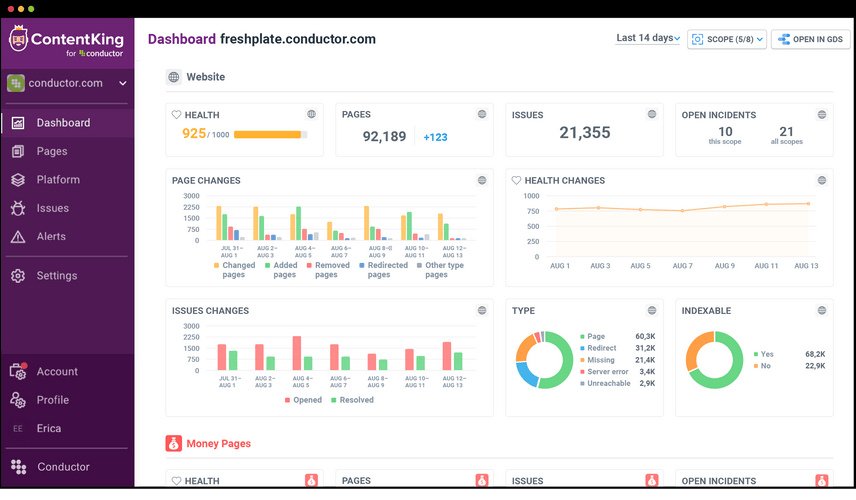
Conductor is built for companies that need every part of their SEO and AEO workflow connected inside one system. It blends AI visibility with keyword research, content planning, and site monitoring, giving large teams one place to manage how search engines and AI engines treat their brand. The platform ties insights directly to execution, so teams can track AI mentions, build new content, audit pages, and measure ROI without switching tools. This setup works well for organizations with many stakeholders who need a single source of truth for visibility and performance.
Its position in the market reflects this scale. Conductor appears at the top of enterprise AEO and GEO rankings and is described as the only fully end-to-end platform built for visibility, creation, and monitoring in one product. It supports brands with millions of pages, multi-domain setups, and global content teams that require precise insights. The platform’s APIs and real-time dashboards give these teams fast access to large datasets, helping them understand how AI engines interpret their content across many markets and environments.

Conductor’s enterprise reach also brings a level of complexity that smaller teams may not need. The platform uses custom pricing and deeper onboarding cycles, which works well for companies that already have content and SEO processes but can feel too heavy for startups or small businesses. Its broad feature set can also overwhelm teams that want simple AI visibility tracking without the larger ecosystem. Analysts often point out that Conductor offers more capability than most small teams will use, making it a better match for organizations with mature workflows.
Another factor to consider is cost. Because Conductor focuses on large organizations, pricing sits in the enterprise range, and plans are custom rather than self-serve. This positions the platform well for companies that need advanced workflows and huge data sets, yet early-stage teams may find more value in lighter tools. Conductor’s strength comes from its depth and scale, so teams without complex operational needs might not take advantage of everything it offers.
How Conductor supports Answer Engine Optimization
|
Area |
What Conductor does |
Why it matters for AEO |
|
AI visibility tracking |
Monitors mentions, citations, sentiment, and competitors across major AI engines |
Gives teams a complete view of brand presence inside AI answers |
|
Integrated content creation |
Creates briefs, outlines, and drafts through Conductor Creator |
Helps teams act on insights without moving to another platform |
|
Technical monitoring |
Tracks site health, crawlability, and indexing |
Ensures content is accessible to search engines and AI engines |
|
SEO & AEO blending |
Combines keyword research, AI visibility, and performance analytics |
Supports enterprise teams using one workflow for both search layers |
|
Enterprise data engine |
Uses 10+ years of indexed performance and visibility data |
Helps large teams predict trends and plan long-term strategies |
Best-fit use cases
-
Enterprise brands with multi-domain or global content programs
-
Teams needing complete visibility across keywords, content, site health, and AI mentions
-
Organizations managing large editorial workflows with many stakeholders
-
Companies requiring deep data integrations and long-term visibility tracking
-
Brands needing a unified system for SEO and AEO performance
Conductor gives large teams one platform to manage AI visibility, SEO strategy, content creation, and site monitoring. It suits enterprise organizations that need scale and depth, though smaller teams may find it beyond what they require.
Tie AI visibility toqualified demand.
Measure the prompts and engines that drive real traffic, conversions, and revenue.
Similar Content You Might Want To Read
Discover more insights and perspectives on related topics

Goodie AI Alternatives in 2026: Top AI Visibility Tools Comparison

8 Brand Tracking Software Tools You Can’t Afford to Ignore

The 9 Best LLM Monitoring Tools for Brand Visibility in 2026

Use These 10 AI Tools to Scale Your Startup in 2026

22 Best Blogging Tools for Growth