



Summarize this blog post with:


In this article, you’ll learn how to run a complete brand mention audit that covers both traditional search and AI search. You’ll get a step-by-step process for benchmarking your current mentions, spotting misinformation before it spreads, finding gaps against competitors, recovering lost visibility, and building a repeatable system that keeps your brand narrative accurate across Google, ChatGPT, Perplexity, Gemini, and every other place where buyers now look for answers.
Table of Contents
What are brand mentions (and why they matter more than ever)
A brand mention is any reference to your company, product, or team members online. It could be your company name in a SaaS comparison post, your CEO quoted in an industry roundup, or your product discussed in a Reddit thread. The mention might include a link. It might not. Either way, it counts.
For years, SEOs treated unlinked mentions as a nice-to-have. The real currency was backlinks. That is still partly true. Links remain a core ranking factor in traditional search.
But the landscape has shifted. AI search engines like ChatGPT, Perplexity, and Gemini do not rank pages the way Google does. They synthesize answers by pulling from the dominant language patterns they find across the web. They analyze the context of your mentions, the frequency, and the sentiment. Then they decide whether to recommend you, ignore you, or describe you in ways you never intended.
This makes brand mentions a dual-signal asset. They influence both traditional rankings and AI-generated responses. An Ahrefs study of 75,000 brands found that web mentions were the single most correlated factor with brand inclusion in AI Overviews, beating out backlinks by a 3:1 ratio.
Auditing your brand mentions is how you uncover what narratives exist about you, where misinformation might be feeding AI systems, and which topics and entities are most strongly connected to your brand. Think of it as backlink auditing for the AI era.
Here is how to do it, step by step.
1. Benchmark your existing brand mentions and web visibility
Before you can improve anything, you need a baseline. How often is your brand mentioned? On what types of sites? With what sentiment? Without this data, every future effort is a guess.
Start by picking a brand monitoring tool. Google Alerts is free but limited. It catches some mentions but misses many, especially on forums, niche blogs, and social platforms. For a more complete picture, use a dedicated tool.
Set up your brand monitoring:
-
Enter your exact brand name as the primary search term
-
Add common misspellings, abbreviations, and product names as secondary terms (for example, if your brand is “Acme Analytics,” also track “AcmeAnalytics,” “Acme,” and any product names like “Acme Insights”)
-
Exclude your own domain so you only see external mentions
-
Set the time range to the last 90 days to start
![[Screenshot: Google Alerts setup page showing a brand name entered with email notification settings configured]](https://www.datocms-assets.com/164164/1777313860-blobid1.png?auto=format,compress&w=1248&fit=max)
Record these baseline metrics:
|
Metric |
What it tells you |
Where to find it |
|---|---|---|
|
Total unique pages mentioning you |
The breadth of your brand footprint |
Brand monitoring tool |
|
Estimated organic traffic to those pages |
Whether mentions live on pages people actually visit |
Ahrefs, Semrush, or similar SEO tool |
|
Referring domains linking to those pages |
The authority of the sites mentioning you |
Backlink analysis tool |
|
Mention velocity (new mentions per month) |
Whether your brand presence is growing or declining |
Manual tracking via monthly exports |
|
Sentiment breakdown |
How the web talks about you (positive, neutral, negative) |
Manual review or sentiment analysis tool |
From there, compare month-by-month data. Track your mention acquisition rate the same way you would track link velocity in a backlink audit. Correlate spikes in mentions with marketing campaigns, product launches, or PR events. If you ran a webinar in March and saw a 40% jump in mentions that month, that tells you something about what drives awareness for your brand.
A strong benchmark gives you a clear picture of where you stand today. It also makes it possible to measure whether future efforts are actually working.
How to benchmark your brand’s AI search visibility
Traditional web mentions are only half the picture. You also need to know how AI search engines currently talk about your brand.
This is a different kind of visibility. A brand can have thousands of web mentions and still be invisible in ChatGPT. Or it might show up in Perplexity but get described inaccurately. Each AI engine pulls from different sources, weights them differently, and builds its own narrative.
In Analyze AI, the Overview dashboard gives you a real-time snapshot of your AI visibility across multiple engines. You can see your visibility percentage (how often AI mentions you when asked about your space), your average position, your sentiment score, and how all of this compares to competitors.
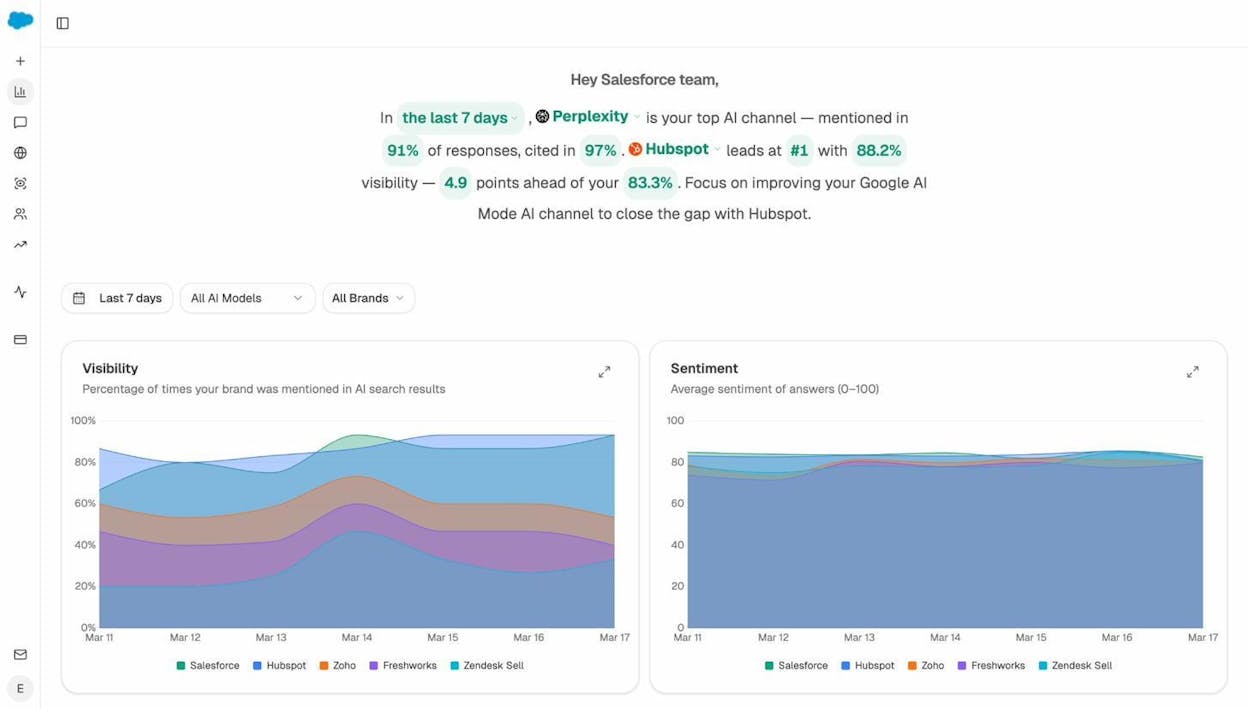
The key metrics to record for your AI search baseline are your visibility percentage across each engine (ChatGPT, Perplexity, Gemini, Copilot), your average rank when you do appear, the overall sentiment score, and how many of your pages are being cited as sources.
This baseline matters because AI search is growing fast. Tracking it now means you can measure progress over time and catch problems early, before they become entrenched in model responses.
2. Understand how web mentions shape AI responses
AI search is probabilistic. It reflects the dominant language patterns found across its training data and the web pages it retrieves in real time. The way your brand is described online directly influences how AI systems describe you in their answers.
This is worth thinking about carefully. If the majority of pages mentioning your brand focus on one product feature but ignore others, AI engines will do the same. If review sites frequently pair your brand with words like “expensive” or “difficult to set up,” those associations will show up in AI-generated answers.
When reviewing your brand mentions, ask yourself these questions:
What is the predominant sentiment? Read through a sample of 20 to 30 mentions. Are they mostly positive, negative, or neutral? A tool-driven sentiment score is useful, but nothing replaces actually reading what people write about you.
Which brand elements get the most attention? Your main brand name might get mentioned less often than a specific product, a founder, or a signature framework. This tells you where your real brand equity lives.
What types of publications mention you? News sites carry different weight than Reddit threads. Industry blogs build different associations than comparison sites. Map your mentions by publication type to see where you are strong and where you are missing.
Which topics are you most often paired with? If you sell project management software but your mentions mostly come from articles about “remote work tools,” that pairing will influence what AI engines associate with you. This can be a strength or a blind spot, depending on your positioning.
Do mention spikes correlate with visibility changes? If you launched a campaign in February that generated 50 new mentions, check whether your AI visibility improved in March. This cause-and-effect mapping helps you understand what actually moves the needle.
How to see your brand’s AI narrative directly
Instead of guessing what AI engines say about you, you can look directly.
In Analyze AI, the Perception Map plots your brand and competitors on a two-axis grid. The vertical axis shows narrative strength (how compelling and detailed the story AI tells about you). The horizontal axis shows visibility (how often you appear). The goal is the upper-right quadrant: visible and compelling.
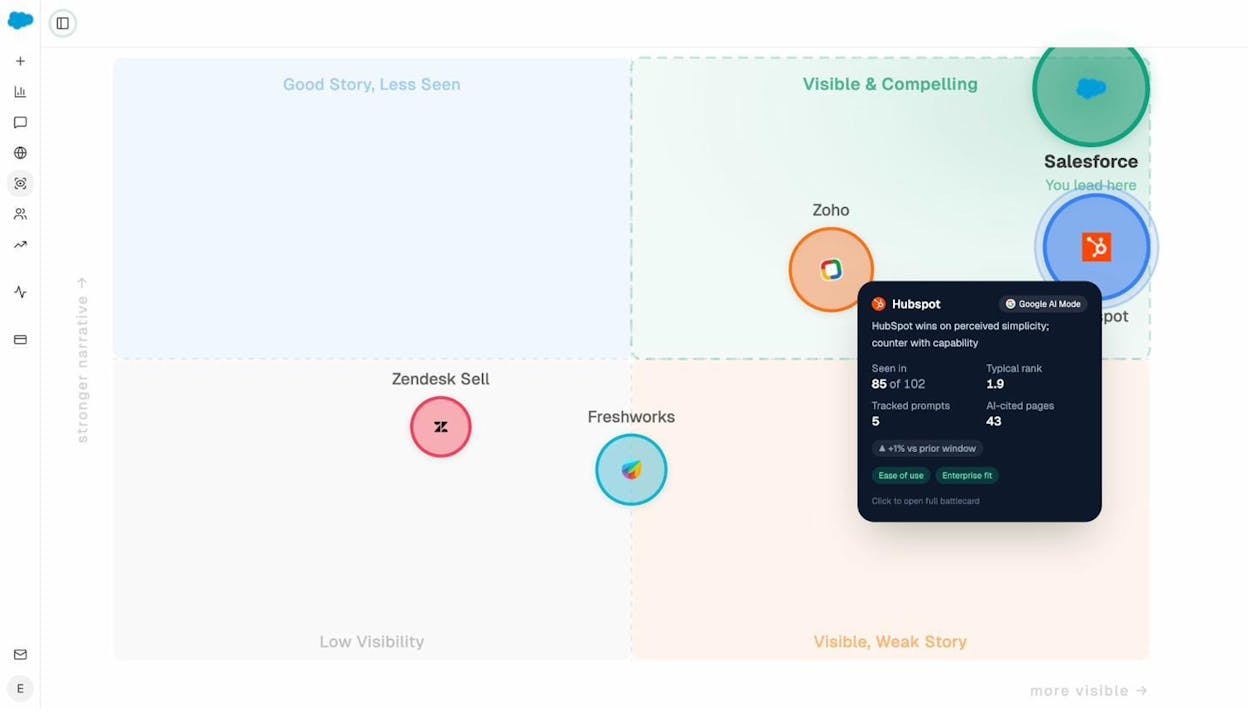
Click on any competitor bubble to see their typical rank, the number of tracked prompts they appear in, their AI-cited pages, and the key themes AI associates with them. This is the kind of competitive intelligence that used to be invisible. Now you can see exactly how AI engines frame your competitors and use that information to shape your own narrative.
For deeper sentiment analysis, the AI Sentiment Monitoring feature breaks down what AI says about each brand by engine, by theme, and by sentiment. You can see whether Perplexity focuses on your pricing while ChatGPT emphasizes your ease of use.
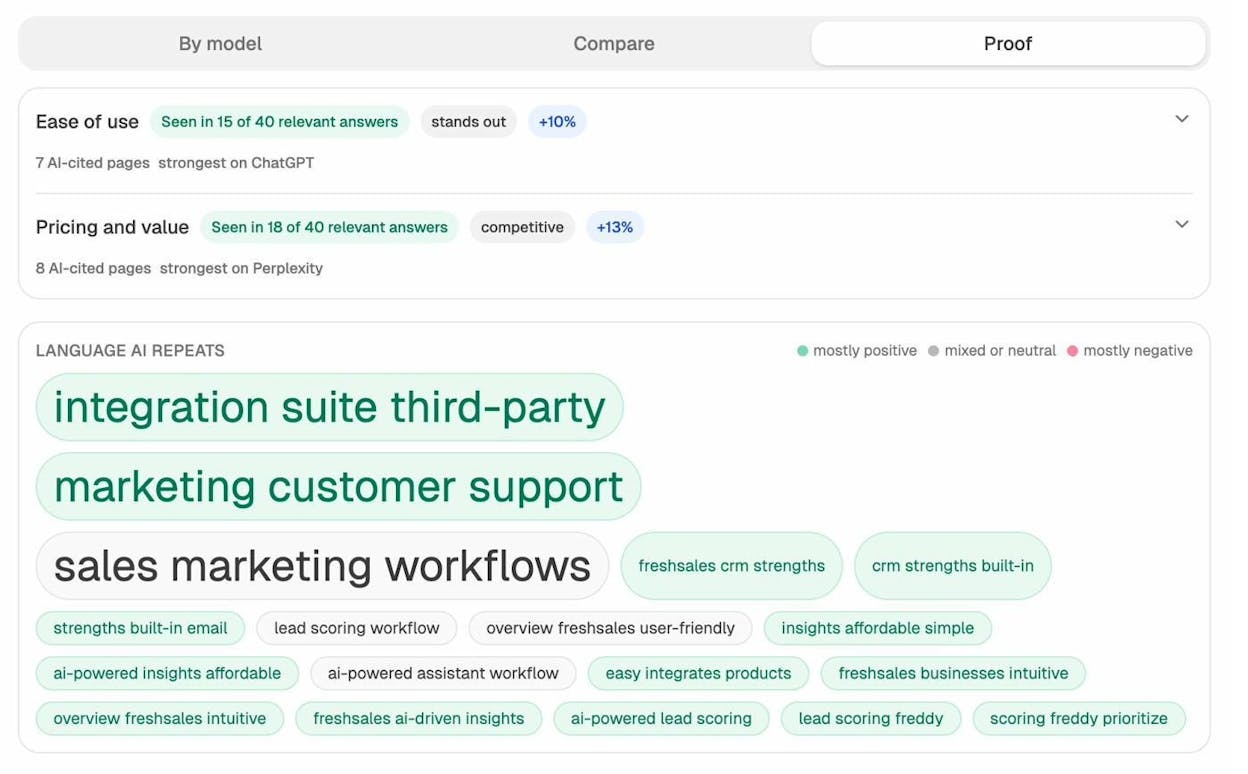
This per-engine breakdown matters because the same brand can receive wildly different treatment across engines. Our analysis of 83,670 AI citations found that sentiment scores for the same brand can vary by up to 79 points depending on which engine you ask.
3. Discover lost mentions that may be dropping your visibility
Mentions are not permanent. They disappear when publishers update their content, redesign their sites, or prune old posts. Sometimes your brand gets quietly replaced by a competitor in a roundup article that used to feature you.
This matters for the same reason losing backlinks matters. Both search engines and AI systems rely on a steady stream of references to gauge authority and relevance. If valuable mentions disappear, your visibility erodes over time, often without you noticing.
How to track lost mentions:
Step 1. Set up quarterly exports of your brand mentions. Most monitoring tools let you filter by date range and export to CSV.
![[Screenshot: Brand monitoring tool showing the publication date filter being used to narrow mentions to a specific quarter]](https://www.datocms-assets.com/164164/1777313907-blobid5.png?auto=format,compress&w=1248&fit=max)
Step 2. Build a simple tracking spreadsheet. Create columns for the date of export, total mentions, unique domains, estimated traffic to mentioning pages, and the breakdown by sentiment. Each quarter, add a new row.
Step 3. After a few quarters, look for patterns. If a site that was mentioning you in Q1 stops mentioning you by Q3, dig into why. Did they update the article? Did a competitor replace you?
Step 4. Verify what changed. Use the Wayback Machine to compare the old version of the page with the current one. Look specifically for whether your brand was removed, whether the context changed, or whether the entire page was deleted.
Step 5. Prioritize recovery. Focus on lost mentions from high-traffic, authoritative pages first. A mention on a page that gets 10,000 monthly visitors is worth more than one on a page with 50 visitors. Reach out to the publisher and ask whether they would consider restoring the mention or linking back to an updated resource.
How to track mention and citation changes in AI search
Lost web mentions can also lead to lost AI citations. If the sources AI engines relied on to mention your brand disappear, you might drop out of AI responses entirely.
Analyze AI’s weekly email digests track this automatically. Every Monday, you get a summary showing visibility changes, citation momentum (which of your pages are gaining or losing citations), pages improving, and competitor shifts.
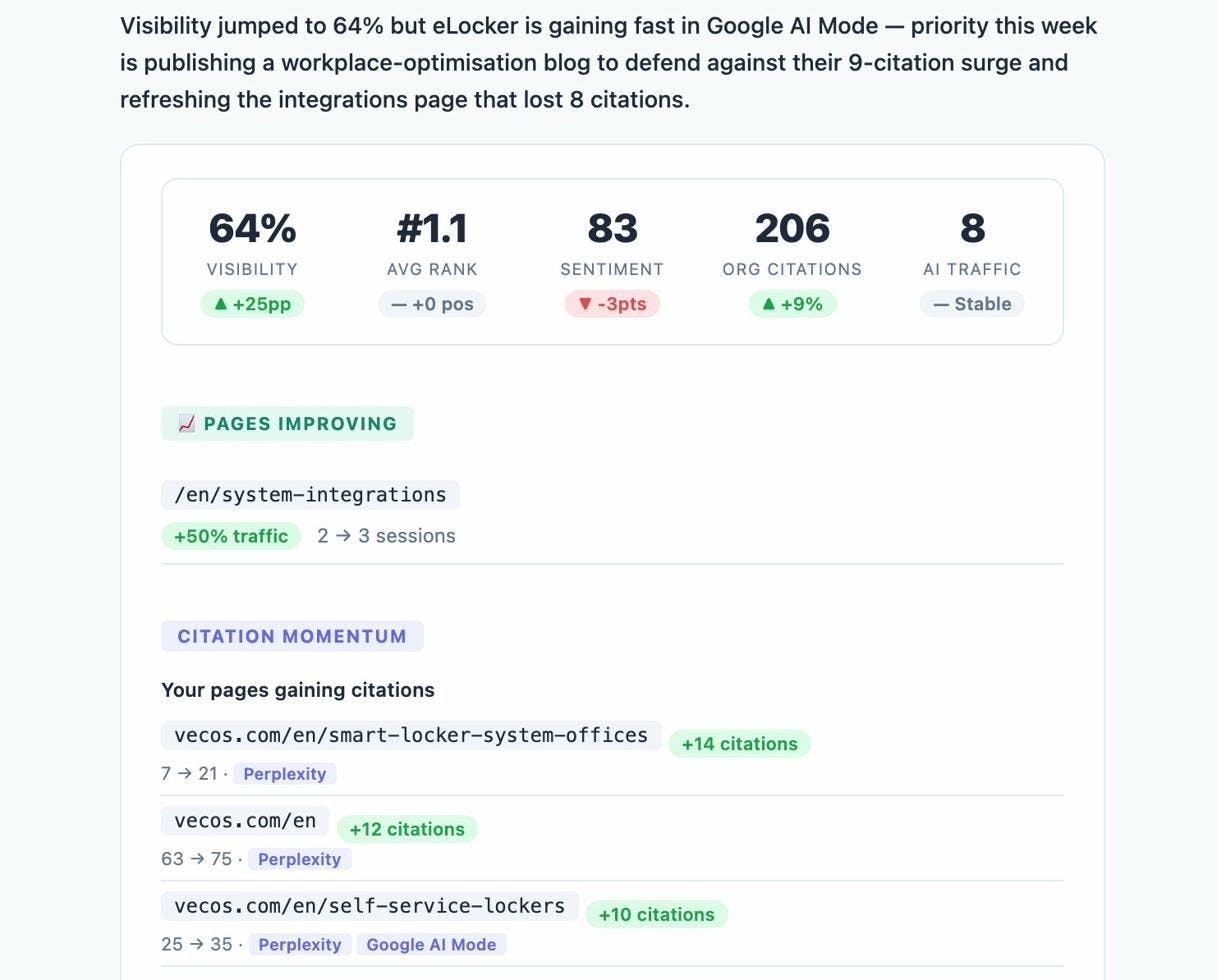
The citation momentum section is especially useful for spotting lost mentions. If one of your pages drops from 25 to 17 citations in a week, you can investigate immediately rather than discovering the problem months later.
For more granular tracking, the Citation Analytics dashboard shows every URL that AI engines cite in your space. You can filter by engine, by brand, and by time period to see exactly which of your pages are being cited and which ones have stopped appearing.
4. Identify opportunities to strengthen weak mentions
Not all mentions are equally useful. Some are too shallow, generic, or poorly placed to move the needle on your brand authority. These weak mentions represent low-hanging fruit. With a targeted outreach effort, you can upgrade them into stronger brand signals.
Types of weak mentions to look for:
-
Generic anchor text. A link that says “click here” or “this tool” instead of using your brand name. The link helps with SEO, but it does nothing to build brand entity recognition. AI engines rely heavily on the words surrounding your brand name to understand what you do.
-
Unlinked mentions. Your brand is named in an article, but there is no link back to your site. These are the classic “low-hanging link-building fruit” because the publisher already knows and trusts your brand enough to mention it.
-
Mentions buried in low-visibility sections. A passing reference in a footnote or sidebar carries less weight than a mention in the main body of an article. AI models pay attention to where in the content your brand appears.
-
Mentions on zero-traffic pages. A mention on a page that nobody visits still contributes to your overall web footprint, but a healthy mention profile should include references on pages that real people actually read.
-
Mentions with negative sentiment. Not every negative mention needs to be “fixed.” But if an outdated complaint is still ranking and feeding AI responses, it is worth addressing.
How to act on weak mentions:
For each weak mention worth improving, add it to a prospect list. Track the URL, the current mention context, what you want changed, the contact person at the publication, and the status of your outreach.
Then, tailor your outreach to the situation:
-
For unlinked mentions, ask the publisher to add a link. Frame it as adding value for their readers, not as a favor to you.
-
For generic anchor text, suggest a specific branded anchor that would improve clarity for the reader.
-
For mentions with outdated information, offer to provide updated stats, product details, or a quote from your team.
Do not send template emails. Publishers can spot a mass outreach campaign from a mile away. Reference the specific article, explain why the change benefits their readers, and keep it short.
5. Fix misinformation before it spreads through AI
AI systems often rely on patterns from across the web. If the data is wrong, the answers will be wrong too. And unlike a bad Google result that a user can scroll past, a wrong AI answer feels authoritative. Users tend to trust it without checking.
Common types of brand misinformation include:
-
Inaccurate product descriptions. Review sites or comparison articles may describe features your product does not have, or fail to mention features it does have. These descriptions feed AI training data.
-
Outdated pricing or plan details. If your pricing changed last year but a dozen comparison articles still list the old numbers, AI engines will confidently repeat the wrong price.
-
Hallucinated URLs. AI engines sometimes generate URLs to pages on your site that do not exist. If users click them and get a 404, that damages trust. Research shows this happens more often than most brands realize.
-
Inaccurate claims from UGC sites. A single wrong answer on Reddit or Quora, repeated enough times, can become “fact” in AI responses.
-
Misattributed quotes or stats. Your brand might be credited with claims it never made, or genuine quotes might be stripped of context in ways that change their meaning.
How to fix it:
Start with what you control. Update your own website, help docs, and business listings with clear, current information. If your product pages use ambiguous language that could be misread by an AI model, rewrite them to be explicit. Define your products, pricing, and capabilities in plain language.
Move to what you can influence. Reach out to publishers who have inaccurate information. Provide corrected details and make it easy for them to update. If the article is a comparison or listicle, offer updated screenshots, stats, or a brief product summary they can paste in.
Escalate when necessary. For deliberate misinformation or negative SEO campaigns, consult legal counsel. For persistent inaccuracies on major platforms (Wikipedia, Crunchbase, G2), follow each platform’s correction process.
Monitor the results. After correcting misinformation, check whether AI engines update their responses. This can take weeks or months, since AI models update their knowledge on different schedules. But the web mentions feeding those models should show improvement faster.
How to check what AI is actually saying about you
Before you can fix misinformation in AI responses, you need to know it exists.
In Analyze AI, you can run ad hoc prompt searches to see how AI engines respond to questions about your brand in real time. Type in a prompt like “What are the best alternatives to [your brand]?” or “Is [your brand] good for enterprise?” and see the actual AI-generated answers across ChatGPT, Perplexity, and Google AI.
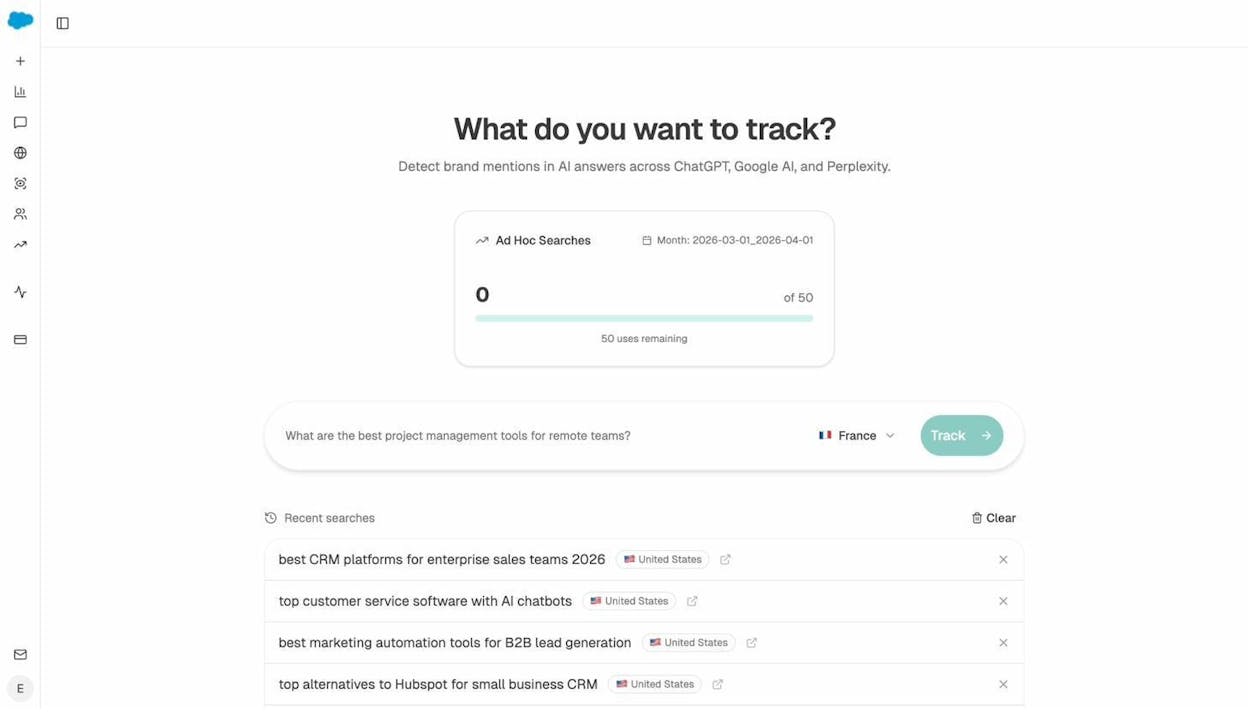
This is valuable for spot-checking specific claims. If you suspect AI is getting something wrong about your pricing or your product capabilities, run the query and see for yourself. You can also use this to validate that your corrections are working over time.
6. Find competitive gaps and learn from your rivals’ best mentions
Auditing your own mentions only gives you half the picture. To understand where you are falling behind, you need to compare against competitors.
Step 1. Identify your real competitors.
Your competitors in AI search might be different from your competitors in traditional search. A brand you never considered a rival might show up more often than you in AI-generated answers because they have a stronger web mention footprint in your topic area.
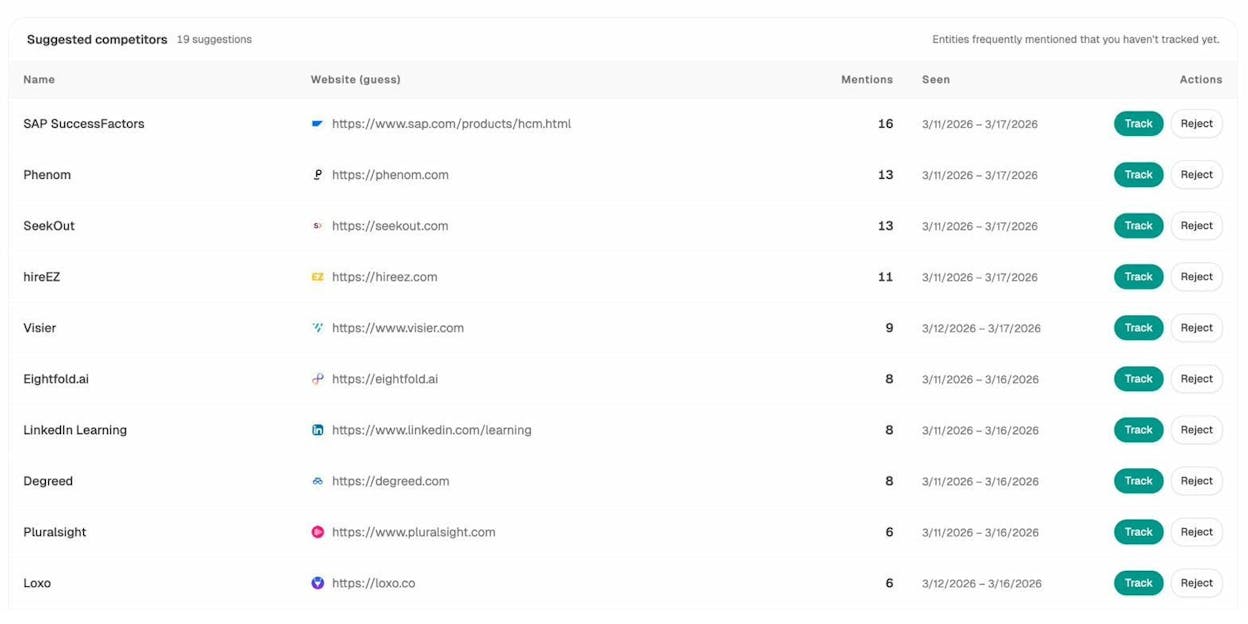
In Analyze AI, the Competitor Intelligence feature suggests competitors based on which brands AI engines frequently mention alongside yours. These are entities that appear in the same AI responses, meaning they compete directly for the same attention.
Step 2. Benchmark competitor mentions.
For each competitor, track the same metrics you recorded for yourself in Step 1: total unique pages, estimated traffic to mentioning pages, referring domains, and mention velocity. A simple side-by-side comparison reveals where you are ahead and where you are behind.
|
Metric |
Your brand |
Competitor A |
Competitor B |
|---|---|---|---|
|
Unique mentioning pages |
340 |
520 |
280 |
|
Avg traffic to mentioning pages |
1,200 |
3,400 |
900 |
|
New mentions/month |
15 |
28 |
12 |
|
Sentiment (positive %) |
72% |
81% |
65% |
Step 3. Find the gaps.
The most actionable gaps are pages that mention one or more competitors but do not mention you. These are articles where the author is already writing about your space and has chosen not to include you. Each one is a potential outreach target.
To find these gaps, export mentions for each competitor, then cross-reference the lists. Look for pages that appear in a competitor’s list but not in yours. Start with pages that mention multiple competitors, since these are typically comparison articles or roundup posts where adding your brand is a natural fit.
Step 4. Reverse-engineer what works.
For each competitor who is outperforming you in mentions, dig into how they are earning visibility:
-
Content formats. Are their mentions tied to original research, case studies, or product comparisons? If a competitor publishes an annual industry report that generates 50 mentions, that tells you something about what earns attention in your space.
-
Publication relationships. Do certain authors or sites reference them repeatedly? Building relationships with the same outlets could work for you.
-
Campaign triggers. Did a product launch, thought leadership piece, or viral idea drive a wave of mentions? Understanding the trigger helps you replicate the approach.
-
Distribution channels. Guest posts, podcast appearances, co-authored reports, or community participation can all generate mentions. Figure out which channels your competitors are using and whether you are present in those same places.
How to find competitor gaps in AI search specifically
Web mention gaps and AI search gaps are related but not identical. A competitor might have fewer web mentions than you overall but still dominate in AI answers because their mentions are on the specific sources that AI engines trust.
In Analyze AI, the Prompt Tracking dashboard shows you exactly which prompts your competitors appear in and which ones you are missing from. Each tracked prompt displays your visibility percentage, sentiment score, average position, and the list of brands that appear.
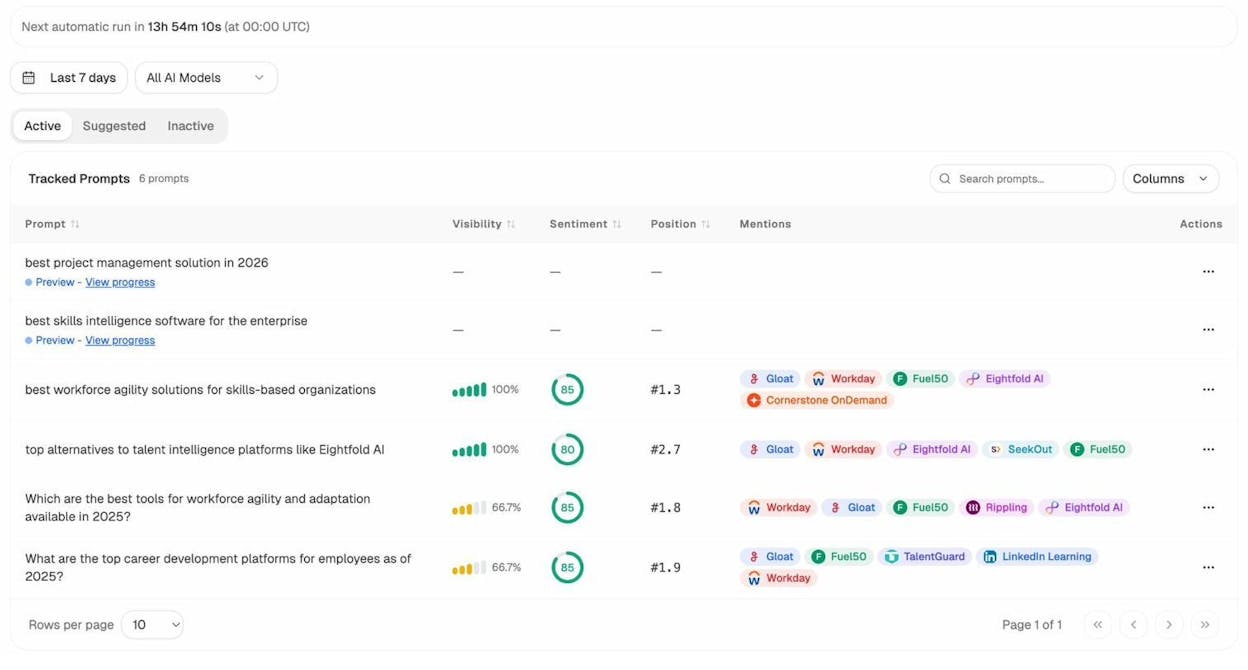
If a competitor appears in 100% of responses for a key prompt while you appear in 0%, that is a gap you need to close. The path to closing it usually involves improving the web mentions and content that feed those AI responses, which brings you back to the web-based audit steps above.
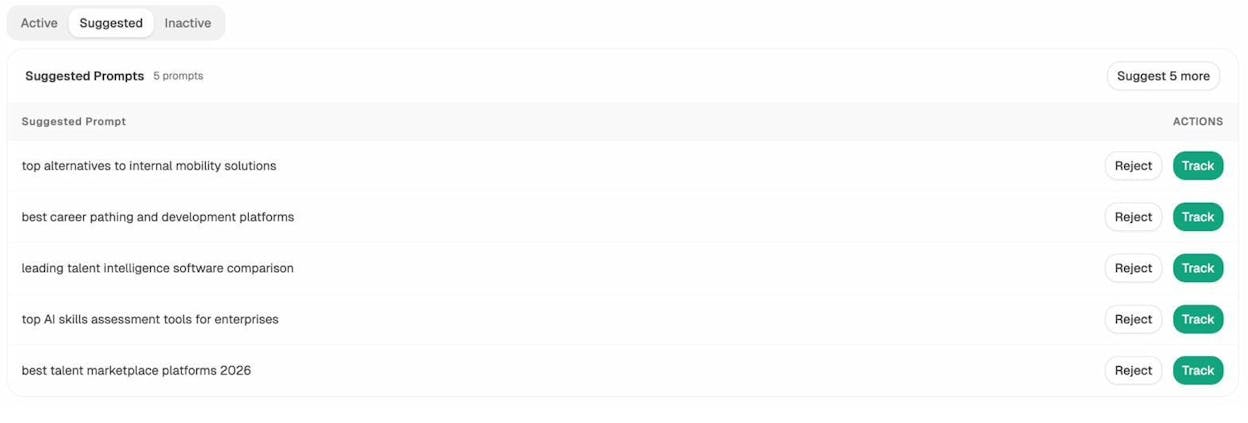
The Suggested Prompts tab is also valuable. Analyze AI suggests prompts based on your industry that you might not have thought to track. These are queries real users are asking AI engines, and they represent opportunities to expand your visibility.
7. Leverage untapped opportunities no competitor has found
Competitor analysis shows you what is already working. But the biggest gains often come from finding opportunities that nobody has claimed yet.
These are the neutral, high-authority pages that discuss your topic area but do not mention any brand by name. If you can get your brand included on these pages, you gain visibility that competitors have not.
How to find untapped opportunities:
Step 1. Search for your core topics (not your brand name) in a content research tool. Look for pages with high traffic that discuss your product category, your use cases, or your target customer’s problems.
Step 2. Filter out pages that already mention your brand or any known competitors. What remains is a list of neutral, authoritative content in your space.
Step 3. Evaluate each page. Is the content relevant enough that your brand would be a natural fit? Is the page on an authoritative domain? Does the author have a history of updating their content? Add qualified pages to your outreach list.
Step 4. Reach out with a specific pitch. Do not ask for a generic mention. Instead, offer something the article is missing: a stat, a quote, a tool recommendation, or a counterpoint that would make the piece more complete. The publisher is more likely to add your brand if doing so improves their content.
Even a small number of these neutral, high-visibility placements can shift AI responses in your favor. AI engines weight fresh, authoritative sources heavily. If a well-cited industry report starts mentioning your brand, that signal propagates into AI answers quickly.
How to find the sources AI engines already trust
Instead of guessing which publications carry weight with AI engines, you can look at the data directly.
In Analyze AI, the Sources dashboard shows every URL and domain that AI engines cite when answering questions in your space. You can see the content type breakdown (blogs, product pages, reviews, social) and the top cited domains.
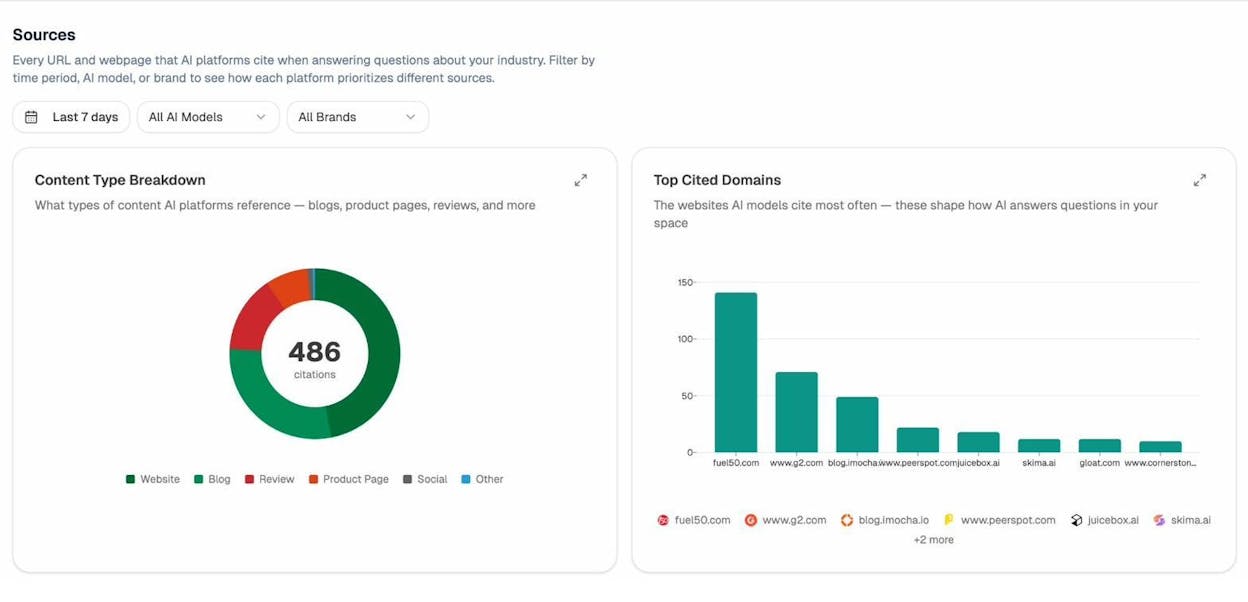
This data reveals which publications actually influence AI answers. If G2 is the most-cited domain in your space, getting a stronger presence on G2 should be a priority. If a specific blog consistently appears in citations, a guest post or partnership with that blog could directly improve your AI visibility.
The Sources dashboard also shows you which content types AI engines prefer to cite. If blogs make up 42% of citations in your space, that validates investing in blog content. If product pages are underrepresented, it might mean AI engines do not trust product pages as authoritative sources, which changes how you think about your content strategy.
8. Audit and improve the content feeding your mentions
Mentions point to your brand, but the content those mentions reference also matters. If your most-mentioned page is outdated, poorly structured, or thin on substance, even a high volume of mentions will not help you.
This is where brand mention audits connect with content strategy. The pages that earn the most mentions and citations need to be your best work.
What to check on your most-mentioned pages:
-
Accuracy. Are product descriptions, pricing, and feature lists current? Outdated pages that get mentioned frequently are actively spreading old information.
-
Depth. Does the page answer the question thoroughly, or does it skim the surface? AI engines prefer citing comprehensive sources.
-
Structure. Is the content organized with clear headings, logical flow, and easy-to-extract information? AI models parse structured content more effectively.
-
Entity clarity. Does the page clearly define what your brand is, what it does, and who it serves? Ambiguous language leads to ambiguous AI responses.
-
Citation-worthiness. Would a journalist or researcher cite this page as a credible source? If not, what would need to change?
How to improve your content for AI citations:
Analyze AI’s Content Optimizer fetches any existing page and scores it on Argument (how well the content makes its case) and Flow and Clarity (how readable and well-structured it is). It then generates AI editorial comments with specific suggestions for improvement.
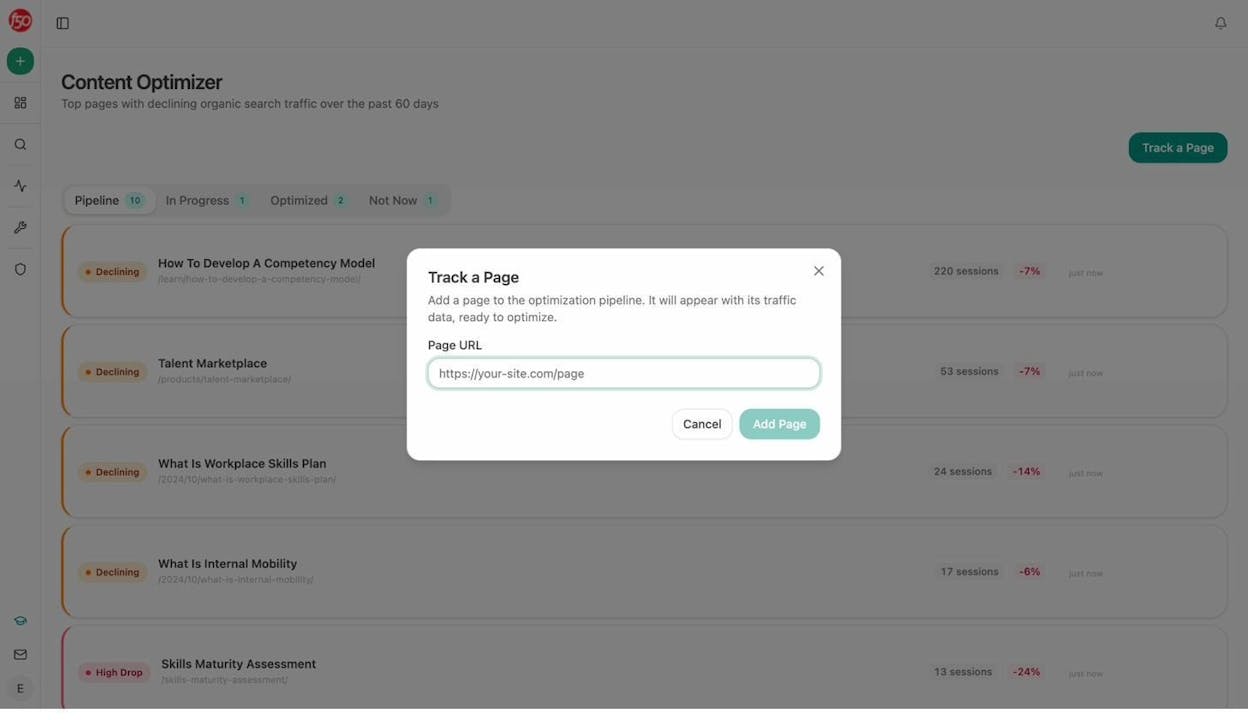
The optimization suggestions are grounded in what actually gets cited in AI responses. They might point out missing entity references, suggest adding a comparison table, or flag sections that lack the specificity AI engines look for when choosing sources to cite.
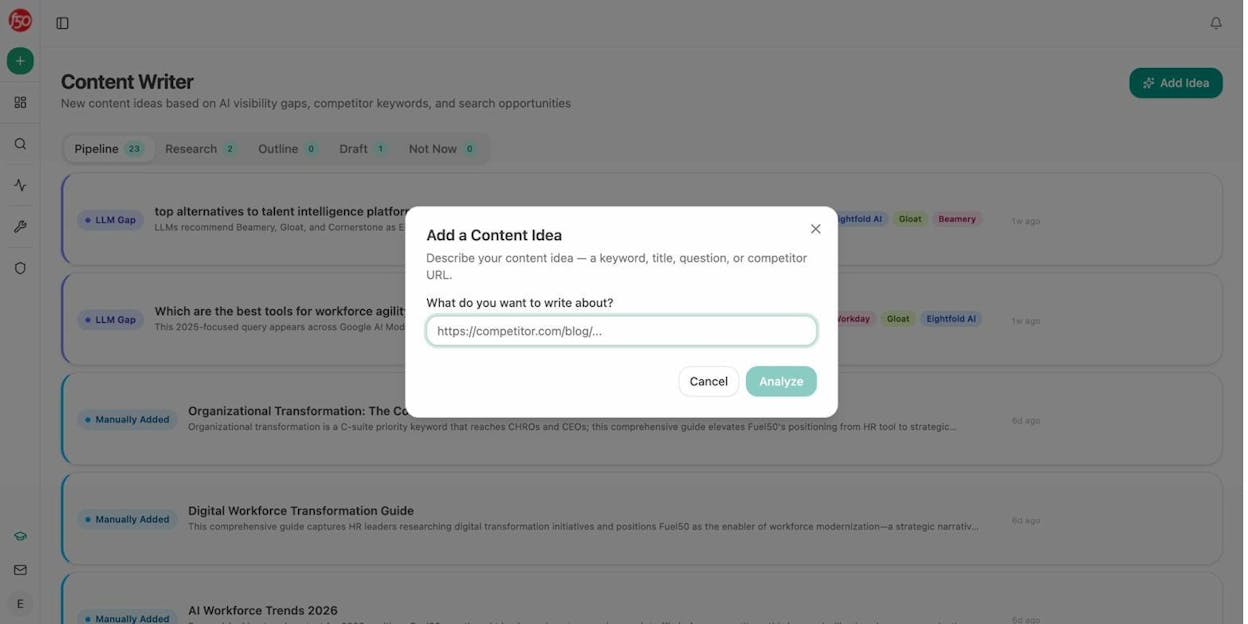
For creating new content from scratch, the Content Writer takes you from idea to research to outline to draft. It pulls in competitor keywords, SERP data, and LLM gap tags (showing where AI engines mention competitors but not you) so you can create content specifically designed to close visibility gaps.
9. Monitor new mentions over time and report to stakeholders
A brand mention audit is not a one-time project. Mentions fluctuate as campaigns launch, websites change, and competitors gain traction. You need a system for ongoing monitoring and regular reporting.
Monthly monitoring cadence:
-
Review new mentions. Check each one for accuracy, sentiment, and whether action is needed (outreach for a link, a correction request, or an upgrade opportunity).
-
Track mention velocity. Are you earning mentions faster or slower than last month? Sudden drops often signal a problem. Sudden spikes are worth understanding so you can replicate what worked.
-
Check AI response changes. Run your core prompts through AI engines to see if your positioning has shifted. Did a competitor overtake you on a key query? Did a correction you requested actually change the AI response?
Quarterly reporting cadence:
-
Benchmark against competitors. Update your competitive comparison table from Step 6. Spot new tactics competitors are using or emerging players gaining buzz.
-
Identify new opportunities. Discover emerging publications or topics you should be present on.
-
Summarize insights for leadership. Executives care about trends, not raw data. Report on visibility trajectory, sentiment changes, competitive positioning, and the business impact of your outreach efforts.
What a brand mention report should include:
|
Section |
Contents |
|---|---|
|
Executive summary |
One-paragraph overview of visibility trend and key actions taken |
|
Mention metrics |
Total mentions, velocity, sentiment breakdown, month-over-month change |
|
AI visibility metrics |
Visibility % by engine, average position, citation count, sentiment score |
|
Competitive comparison |
Side-by-side positioning against top 3 to 5 competitors |
|
Actions taken |
Outreach results, corrections made, content published |
|
Recommended next steps |
Prioritized list of opportunities for next quarter |
How to automate AI search reporting
Manual tracking across multiple AI engines is time-consuming. Analyze AI’s weekly email digests automate the monitoring side by delivering a prioritized summary every Monday. You get visibility changes, citation momentum, competitor shifts, and recommended actions without logging into any dashboard.
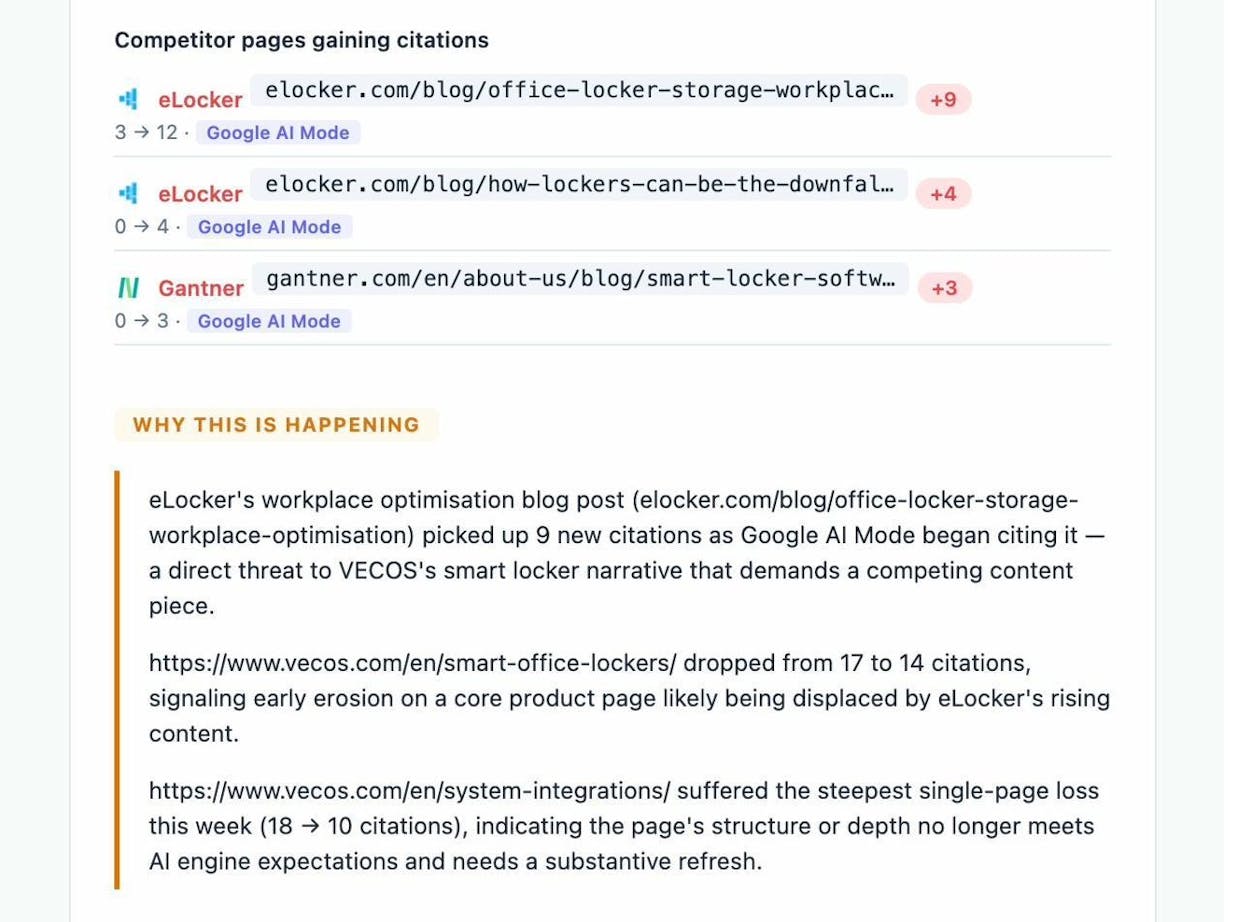
For stakeholder reporting, the AI Traffic Analytics dashboard ties your AI visibility to actual business metrics. You can show leadership how many visitors came from AI search engines, which pages they landed on, their engagement rates, and conversions. This closes the loop from “we improved our mentions” to “here is the traffic and pipeline impact.”
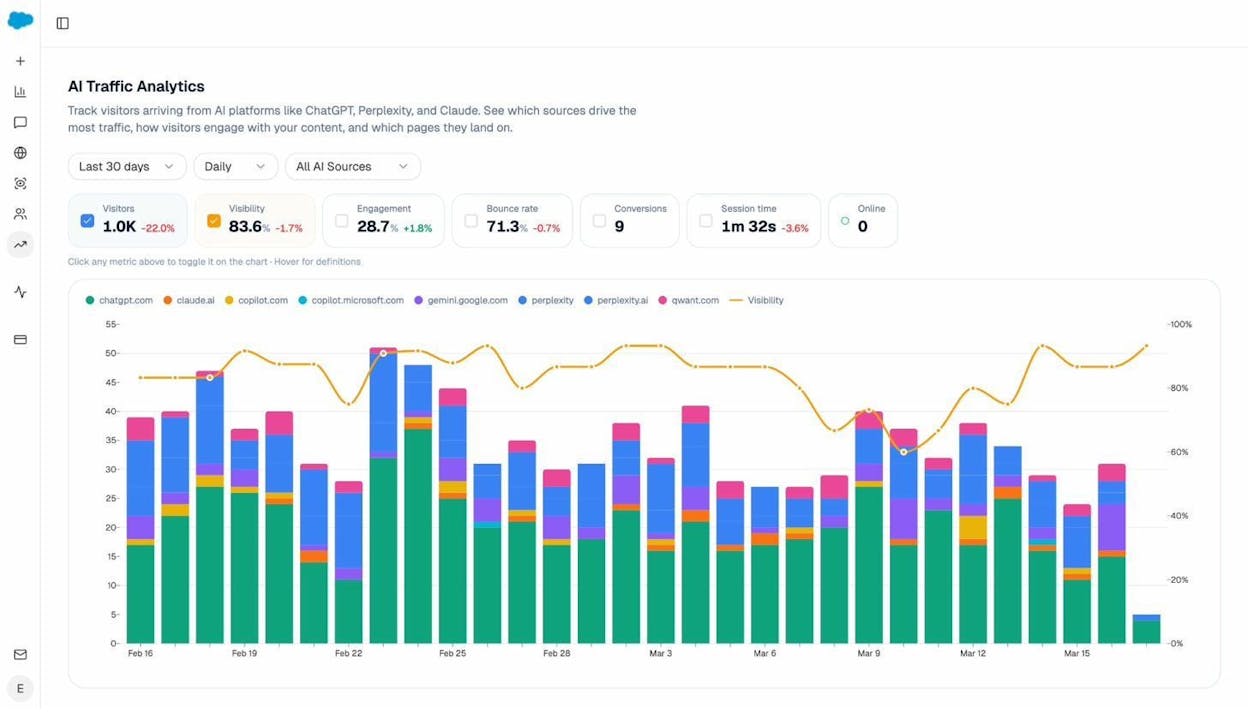
When your CMO asks “how are we doing in AI search?” you want to have a clear, data-backed answer. That answer should include both the visibility side (where and how often you appear) and the business side (how that visibility translates to traffic and revenue).
10. Build a repeatable brand mention audit system
One-off audits produce insights. Repeatable systems produce results. The difference between brands that build strong mention profiles and brands that drift is whether the audit becomes a regular operating rhythm.
Here is a framework for building that rhythm:
Weekly (15 minutes):
-
Review new mention alerts
-
Flag any mentions that need immediate action (misinformation, negative press, competitor mentions of your brand)
Monthly (1 to 2 hours):
-
Export and log mention data
-
Review AI visibility dashboards for shifts
-
Complete outreach for any open opportunities from your prospect list
-
Update your tracking spreadsheet
Quarterly (half day):
-
Full competitive benchmark update
-
Content audit of your most-mentioned pages
-
AI search narrative review (run key prompts and document how engines describe you)
-
Stakeholder report and planning for next quarter
Annually (full day):
-
Strategic review of your mention profile against business goals
-
Reassess competitor set (new entrants, changing market dynamics)
-
Update your brand monitoring setup (new terms, new platforms, new AI engines)
-
Set targets for mention velocity, AI visibility, and sentiment for the next year
The brands that win in modern search are the ones that treat mentions with the same rigor they give to their backlink profile, their content calendar, and their paid media spend. Mentions are no longer a passive byproduct of doing good work. They are an asset you can actively build, protect, and optimize.
Final thoughts
Backlink audits defined the last era of SEO. Brand mention audits define this one.
Every reference to your brand online, whether linked or not, contributes to how both search engines and AI systems perceive your authority and relevance. These mentions shape the narratives that AI engines repeat to millions of users. They influence whether buyers hear about you at all, and if they do, whether they hear the right things.
The process is straightforward. Benchmark where you stand. Identify what is wrong. Find the gaps. Fix them. Then build a system that keeps the work going.
The brands that treat mentions as a core part of their SEO and AI search strategy will compound their visibility over time. The ones that ignore mentions will watch competitors fill the gaps.
Start your audit today. The data is waiting.

Ernest

Ibrahim


