Analyze AI - AI Search Analytics Platform

4 Main Pillars of an Effective SEO Strategy (And How to Extend Them to AI Search)

Written by

Ernest Bogore

Ernest Bogore

CEO

Reviewed by

Ibrahim Litinine

Ibrahim Litinine

Content Marketing Expert

4 Main Pillars of an Effective SEO Strategy (And How to Extend Them to AI Search)

In this article, you'll learn the four foundational pillars of SEO: technical SEO, on-page SEO, content, and off-page SEO. You'll discover how to implement each pillar with specific, actionable steps that improve your rankings in traditional search. And you'll understand how to extend these same strategies to AI search engines like ChatGPT, Perplexity, and Claude—because the same principles that drive Google rankings now influence whether AI engines mention, cite, and recommend your brand.

Table of Contents

What Are the Pillars of SEO?

The pillars of SEO represent the fundamental strategies that determine whether search engines can find, understand, and rank your content. These four pillars work together—weakness in one undermines the others.

On-page SEO focuses on optimizing individual pages through URLs, headings, meta tags, and keyword placement. When done right, search engines understand exactly what each page covers.

SEO Content addresses the substance of your pages. Quality content satisfies user intent, incorporates relevant keywords naturally, and demonstrates expertise that keeps visitors engaged.

Off-page SEO builds authority through external signals. Backlinks from reputable sites tell search engines that others trust and reference your content.

Technical SEO ensures search engines can crawl and index your site efficiently. Page speed, mobile responsiveness, and proper site architecture all fall under this pillar.

Here's what most SEO guides miss: these same pillars now extend to AI search. AI engines like ChatGPT, Perplexity, and Claude cite sources, recommend brands, and answer questions using content they've crawled and indexed. The sites that perform well in traditional search often perform well in AI search—but not always.

Understanding both channels lets you optimize once and benefit twice.

1. On-Page SEO

On-page SEO involves optimizing elements within your control on each page. These elements signal relevance to search engines and influence click-through rates from search results.

URLs

URL structure affects both search engine understanding and user trust. Clean URLs that describe the page content perform better than generic strings of numbers or parameters.

What works:

  • Short URLs (under 60 characters when possible)

  • Primary keyword included naturally

  • Hyphens to separate words

  • Lowercase letters only

What to avoid:

  • Random strings like /page?id=12847

  • Keyword stuffing (/best-seo-tips-seo-guide-seo-strategy)

  • Dates that will make content look outdated (/2024/03/15/seo-tips)

  • Unnecessary folder depth (/blog/category/subcategory/post/seo-tips)

Example transformation:

www.example.com/blog/p/12847?ref=homepage

www.example.com/blog/seo-pillars

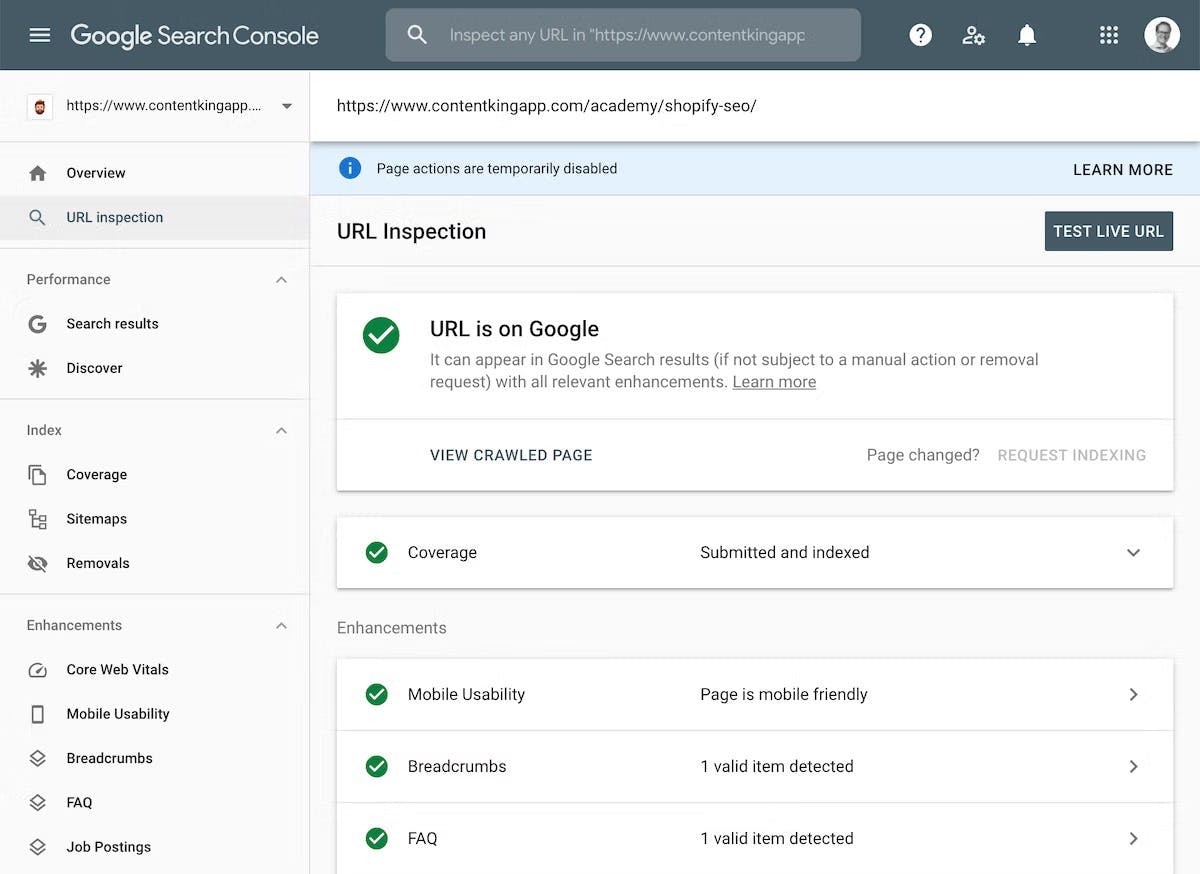
[Screenshot: Google Search Console URL Inspection tool showing a clean URL structure with "URL is on Google" status]

The second URL tells both users and search engines exactly what the page covers before anyone clicks.

Page H1

The H1 tag serves as the primary heading and signals the core topic of your page. Search engines weight this element heavily when determining relevance.

H1 optimization guidelines:

  1. Include your primary keyword naturally—forced placement reads awkwardly and may hurt rankings

  2. Match the H1 to user intent—if someone searches "how to do keyword research," your H1 should address that directly

  3. Keep it under 70 characters to ensure it displays fully in most interfaces

  4. Use only one H1 per page—multiple H1s dilute the primary topic signal

  5. Align H1 with meta title—mismatches confuse both users and search engines

A common mistake: writing clickbait H1s that don't match the content. If your H1 promises "The Complete Guide to Technical SEO" but your content only covers page speed, users bounce. High bounce rates signal low relevance to search engines.

Keywords

Keywords connect your content to user queries. The goal isn't to stuff keywords everywhere—it's to use them strategically in high-impact locations.

Primary keyword placement (in order of importance):

  1. H1 tag

  2. First 100 words of body content

  3. Meta title

  4. At least one H2 subheading

  5. URL slug

  6. Meta description

  7. Image alt text

Secondary and semantic keywords support your primary keyword by covering related concepts. If your primary keyword is "SEO pillars," semantic keywords might include "technical optimization," "backlink building," "content strategy," and "on-page factors."

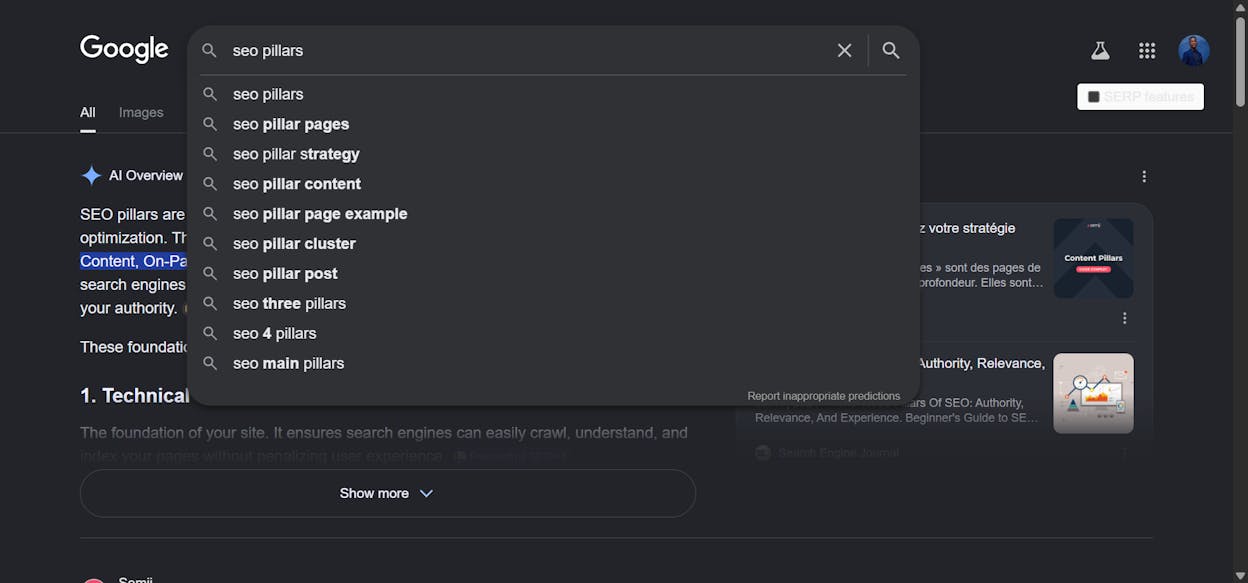
[Screenshot: Ahrefs or Semrush keyword overview showing search volume, keyword difficulty, and related keywords for "SEO pillars"]

Search engines have grown sophisticated enough to understand topic coverage. A page about "SEO pillars" that never mentions "technical SEO" or "backlinks" appears incomplete compared to competitors that cover the full topic.

Header Tags

H2 and H3 tags organize your content into scannable sections. They serve two purposes: helping readers navigate quickly and signaling content structure to search engines.

Effective header structure:

  • H2s for major sections (the main topics within your page)

  • H3s for subsections (specific aspects within each major section)

  • H4s sparingly, only when H3s need subdivision

  • Descriptive text that previews section content

  • Secondary keywords incorporated where natural

Poor structure: Generic headers like "Introduction," "Main Points," "Conclusion" waste opportunities to signal relevance.

Strong structure: Headers that describe what each section covers, like "Technical SEO Fundamentals," "How to Audit Your Site Speed," "Common Crawling Errors and Fixes."

Meta Titles and Descriptions

Meta titles and descriptions appear in search results. They don't directly affect rankings as heavily as on-page content, but they dramatically influence click-through rates.

Meta title best practices:

  • 50-60 characters (longer titles get truncated)

  • Primary keyword near the beginning

  • Brand name at the end if space permits

  • Unique for every page on your site

Meta description best practices:

  • 150-160 characters

  • Include a clear value proposition

  • Incorporate the primary keyword naturally

  • Add a soft call-to-action when appropriate ("Learn how to..." or "Discover the...")

  • Match the actual content—misleading descriptions increase bounce rates

[Screenshot: Google search results showing a well-optimized meta title and description with the search term highlighted]

Structured Data Markup

Structured data helps search engines understand your content in ways that plain HTML cannot. When implemented correctly, it can trigger rich snippets—enhanced search results that stand out visually.

Common structured data types:

  • Article: Signals news, blog posts, and editorial content

  • FAQ: Displays questions and answers directly in results

  • HowTo: Shows step-by-step instructions with images

  • Product: Displays price, availability, and reviews

  • LocalBusiness: Shows address, hours, and contact information

  • Review: Displays star ratings in search results

[Screenshot: Google search results showing a recipe rich snippet with star ratings, cook time, and calorie count]

Structured data doesn't guarantee rich snippets, but it makes them possible. Without it, your content competes without the visual advantages that attract clicks.

Implementation approach: Use JSON-LD format (Google's preferred method) placed in the <head> section of your page. Test with Google's Rich Results Test before publishing.

On-Page SEO for AI Search

AI search engines process your content differently than traditional crawlers, but on-page optimization still matters. Here's how to extend your on-page SEO for AI visibility.

Clear entity identification: AI models work with entities—people, companies, products, concepts. Make your brand name, product names, and key differentiators explicit and consistent throughout your content. If ChatGPT can't identify what entity you represent, it can't recommend you.

Direct answers in content: AI engines often pull direct answers from pages that state information clearly. Compare these two approaches:

❌ "Many factors contribute to SEO success, and understanding them requires careful consideration of various elements..."

✅ "The four pillars of SEO are: technical SEO, on-page SEO, content, and off-page SEO."

The second version answers the question directly. AI models can extract and cite this information. The first version buries the answer in vague language.

Structured information: Lists, tables, and clear hierarchies help AI models parse your content. When Perplexity answers "What are the best CRM platforms for small businesses?" it looks for content that presents options clearly—not buried in paragraphs.

Our analysis of 83,670 AI citations found that Claude cites blog content 43.8% of the time, while ChatGPT favors product pages at 60.1%. This means your on-page optimization strategy should account for which AI engines matter most to your audience.

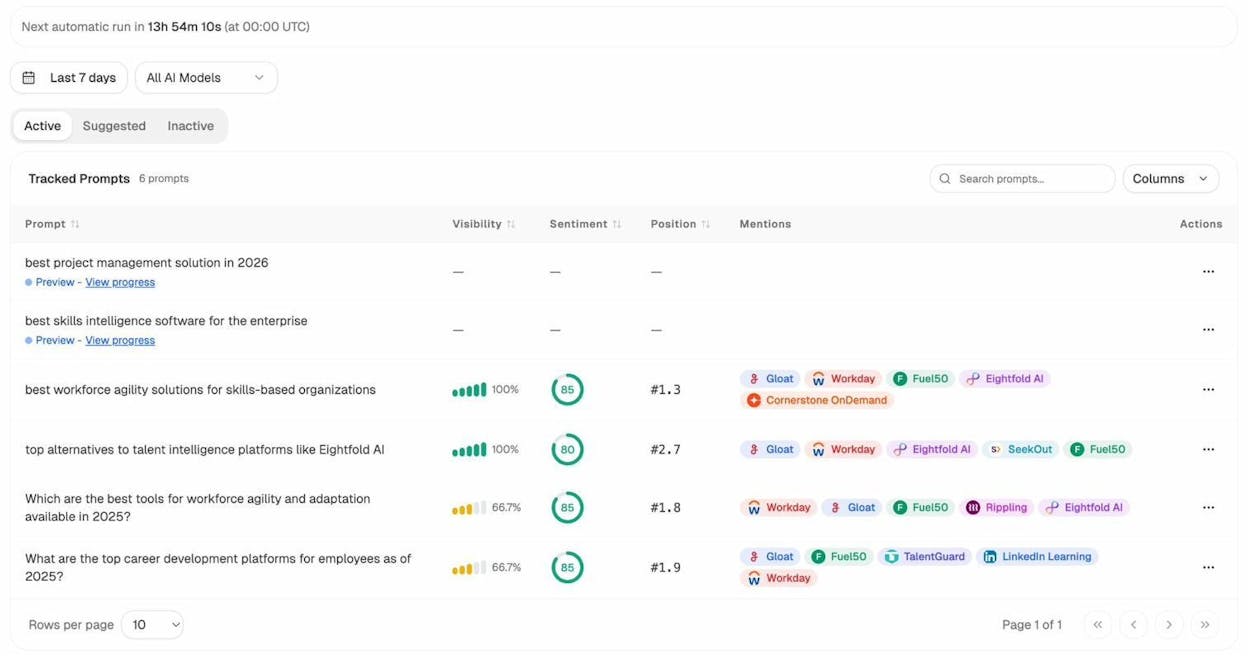
[Screenshot: Analyze AI Prompt Level Analytics showing visibility, sentiment, and position metrics for tracked prompts]

To see how AI engines currently respond to queries relevant to your brand, track specific prompts and monitor which pages get cited. This reveals whether your on-page optimization translates into AI visibility.

2. SEO-Friendly Content

Content determines whether visitors find value on your site. Search engines evaluate quality signals like time on page, scroll depth, and return visits. AI engines evaluate whether your content provides clear, accurate, and comprehensive answers.

Keyword Research

Keyword research identifies what your audience searches for and how to prioritize your content efforts. Without it, you create content nobody looks for—or content that can never rank because competition is too intense.

Effective keyword research process:

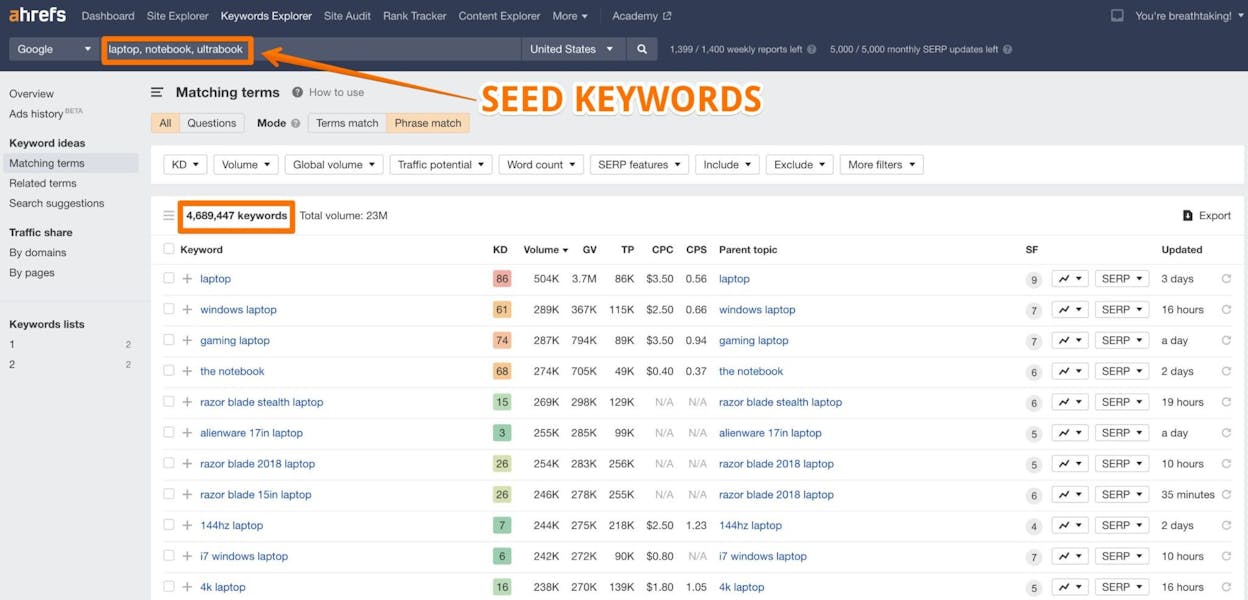
Step 1: Generate seed keywords

Start with 5-10 broad terms related to your business. A CRM company might start with: "CRM software," "customer relationship management," "sales pipeline," "contact management," "lead tracking."

Step 2: Expand using keyword tools

Input seed keywords into Ahrefs, Semrush, or Google Keyword Planner. Look for:

  • Search volume (how many people search this term monthly)

  • Keyword difficulty (how hard it will be to rank)

  • Related keywords and questions

  • Parent topics (broader terms that include your keyword)

[Screenshot: Ahrefs Keywords Explorer showing search volume, keyword difficulty, and related keywords for a seed term]

Step 3: Assess intent

Not every high-volume keyword fits your goals. A keyword with 10,000 monthly searches means nothing if the intent doesn't match what you offer. Check the current SERP to understand intent:

  • Informational: "What is CRM software" → blog posts, guides

  • Commercial: "Best CRM for small business" → comparison pages, reviews

  • Transactional: "HubSpot pricing" → product pages, pricing pages

  • Navigational: "Salesforce login" → brand-specific pages

[Screenshot: Google search results page showing the types of content ranking for a commercial intent keyword]

Step 4: Prioritize strategically

Target keywords where you can realistically compete. A new site targeting "CRM software" (keyword difficulty 90+) will struggle against HubSpot, Salesforce, and Zoho. Instead, target longer variations like "CRM for real estate agents" or "CRM with email marketing built in."

Step 5: Cluster keywords by topic

Group related keywords together. One comprehensive page about "email marketing CRM" can target the primary keyword plus variations like "CRM email automation," "email campaigns in CRM," and "email marketing integration CRM."

Optimized Content

Creating optimized content means writing for both search engines and readers. The two aren't opposed—content that ranks well typically satisfies users well.

Content optimization checklist:

Match search intent precisely. If someone searches "how to audit technical SEO," they want a step-by-step process—not a theoretical overview of why technical SEO matters. Check what currently ranks and deliver the format users expect.

Cover the topic comprehensively. Analyze competing pages. Note which subtopics they cover. Include everything relevant—and add sections they missed. Incomplete coverage gives users a reason to return to search results.

Provide unique value. What can you offer that competitors don't? Original research, specific examples, proprietary data, expert interviews, or practical templates all differentiate your content.

Structure for scanning. Most readers skim before committing to read fully. Use descriptive headings, short paragraphs (3-4 sentences maximum), bullet points for lists, and bold text for key concepts.

Update regularly. Outdated content loses rankings over time. Set a review schedule for high-value pages—quarterly for fast-changing topics, annually for evergreen content.

[Screenshot: Content optimization tool interface showing keyword suggestions, content length recommendations, and competitor analysis]

Topical Authority

Topical authority measures how comprehensively you cover a subject area. Search engines reward sites that demonstrate expertise through depth of coverage rather than scattered, unrelated posts.

Building topical authority:

Create topic clusters. Choose a pillar topic (like "CRM software") and create supporting content that covers every angle: selection guides, feature comparisons, implementation tutorials, industry-specific recommendations, and integration guides.

Interlink strategically. Connect related pages with internal links. Your pillar page should link to all supporting content, and supporting content should link back to the pillar and to related supporting pages.

Demonstrate expertise. Include author bios with relevant credentials. Cite authoritative sources. Reference your own experience implementing what you teach.

Publish consistently within your niche. A site with 50 deep articles about CRM software appears more authoritative than a site with 200 shallow posts across 30 unrelated topics.

[Screenshot: Site architecture diagram showing a pillar page connected to supporting content pages with internal links]

Alt Tags

Alt tags describe images for search engines and screen readers. Since search engines can't "see" images the way humans do, alt text provides necessary context.

Writing effective alt tags:

  • Describe the image content accurately

  • Include your target keyword when it fits naturally

  • Keep under 125 characters

  • Don't start with "Image of..." or "Picture of..."—it's redundant

Examples:

alt="image"

alt="SEO, SEO tips, SEO strategy, search engine optimization"

alt="Google Search Console dashboard showing crawl errors report"

Alt tags provide a small ranking signal for image search and contribute to overall page relevance. They also ensure accessibility compliance.

Content Strategy for AI Search

AI search engines evaluate content differently than traditional search. They synthesize information from multiple sources to generate answers. Getting cited requires understanding what makes content "AI-friendly."

What AI engines look for in content:

Direct, quotable statements. AI models pull specific claims from content. Compare:

❌ "Content marketing can be beneficial for various business outcomes when implemented correctly."

✅ "Companies that publish consistent blog content generate 67% more leads than those that don't."

The second statement gives AI something specific to cite. The first statement says nothing quotable.

Comprehensive coverage of the topic. When Claude answers a question about "SEO pillars," it synthesizes information from multiple sources. Pages that cover all four pillars thoroughly get cited more often than pages that cover one or two.

Structured data that AI can parse. Tables, numbered lists, and clear hierarchies help AI models extract information. A comparison table of CRM features is easier for AI to process than the same information buried in paragraphs.

Factual accuracy with sources. AI engines increasingly evaluate the accuracy of information. Cite reputable sources for statistics and claims. Incorrect information may be filtered out or deprioritized.

Our research found that 83% of AI citations come from third-party sources rather than brand websites. This means content about your industry—not just about your product—drives AI visibility.

[Screenshot: Analyze AI Citation Analytics showing which URLs get cited, by which AI engines, and how often]

Identifying What AI Engines Already Surface

You can't optimize for AI search without knowing where you stand. Track the prompts relevant to your brand and see how AI engines respond.

Prompt tracking approach:

  1. List the questions your target customers ask when evaluating solutions

  2. Note the variations—"best CRM for startups" differs from "top CRM platforms for enterprise"

  3. Track how ChatGPT, Claude, and Perplexity answer these prompts

  4. Identify which brands get mentioned and which sources get cited

  5. Spot gaps where competitors appear and you don't

[Screenshot: Analyze AI Prompts dashboard showing tracked prompts with visibility percentage, sentiment score, and brand mentions]

This research reveals opportunities. If competitors consistently appear for "best project management software for agencies" but you don't, you've found a content gap to address.

3. Off-Page SEO

Off-page SEO builds authority through external signals. The most important signal remains backlinks—links from other websites to yours. These links function as endorsements, telling search engines that others find your content valuable enough to reference.

Backlinks

Not all backlinks carry equal weight. A link from a high-authority site in your industry outweighs dozens of links from low-quality directories.

Backlink quality factors:

  • Domain authority of the linking site

  • Relevance of the linking site to your topic

  • Placement of the link (editorial links within content > footer links)

  • Anchor text used (natural variation beats keyword-stuffed)

  • Follow vs. nofollow (follow links pass authority; nofollow links provide traffic but less SEO value)

Link building strategies that work:

Create linkable assets. Original research, comprehensive guides, free tools, and templates naturally attract links. Our analysis of 83,670 AI citations generated links from sites covering AI and SEO because it provided data nobody else had.

Guest posting on relevant sites. Write quality content for publications your audience reads. Include a contextual link back to relevant content on your site—not just your homepage.

Broken link building. Find pages in your niche with broken outbound links. Create content that could replace the dead resource. Reach out and suggest your replacement.

Digital PR. Create newsworthy content—studies, surveys, contrarian takes—and pitch to journalists and bloggers who cover your industry.

Resource page link building. Many sites maintain resource pages linking to helpful content. Find pages relevant to your topic and suggest your content as an addition.

[Screenshot: Ahrefs backlink profile showing referring domains, domain rating, and anchor text distribution]

What to avoid:

  • Buying links (violates Google guidelines and risks penalties)

  • Private blog networks (artificial link schemes that Google detects)

  • Irrelevant directory submissions (low value, potential spam signals)

  • Excessive link exchanges (reciprocal linking at scale looks manipulative)

NAP Consistency

NAP stands for Name, Address, Phone number. For businesses with physical locations, consistent NAP information across the web affects local search rankings.

NAP optimization:

  • Use identical formatting everywhere (if you write "Street" on your website, don't write "St." on Google Business Profile)

  • Claim and update all business directory listings

  • Add NAP to your website footer for easy access

  • Include structured data markup for local business information

Inconsistent NAP confuses search engines about whether listings represent the same business. This fragmentation weakens your local authority.

Local SEO

Local SEO matters for businesses that serve specific geographic areas. Even online businesses may have local relevance—a SaaS company headquartered in Austin might target "Austin tech companies" for recruitment content.

Local SEO fundamentals:

Google Business Profile optimization:

  • Complete every field with accurate information

  • Add photos of your business, products, and team

  • Post updates regularly (weekly or more)

  • Respond to all reviews—positive and negative

  • Enable messaging and Q&A features

Local content creation:

  • Create pages for each location you serve

  • Write content addressing local audiences ("How Denver Restaurants Can Improve Online Ordering")

  • Cover local events, news, and trends relevant to your business

Local link building:

  • Sponsor local events and organizations

  • Join local business associations and chambers of commerce

  • Partner with complementary local businesses

[Screenshot: Google Business Profile dashboard showing profile completeness score and recent reviews]

Reviews management:

Reviews directly impact local rankings and influence whether customers choose your business. Develop a systematic approach:

  • Ask satisfied customers to leave reviews (email follow-ups work well)

  • Respond to every review within 24-48 hours

  • Address negative reviews professionally—acknowledge the issue and offer to resolve it

  • Never fake reviews or incentivize them with discounts (violates guidelines)

Off-Page Signals for AI Search

AI engines don't follow links the way traditional crawlers do, but off-page signals still influence AI visibility. Here's why: AI engines learn from the content they crawl. When multiple authoritative sources mention and link to your brand, that reinforces your relevance for related queries.

Third-party mentions matter more than owned content.

Our analysis found that 83% of AI citations come from third-party sources. When ChatGPT recommends CRM platforms, it often cites G2 reviews, industry analyst reports, and comparison sites—not the brands' own websites.

This means off-page SEO directly affects AI visibility. Getting mentioned on authoritative third-party sites increases the likelihood that AI engines will encounter and reference your brand.

Building AI-influencing mentions:

Pursue product review coverage. Get listed and reviewed on sites like G2, Capterra, TrustRadius, and industry-specific review platforms. These sites appear frequently in AI citations.

Contribute expert quotes. Respond to journalist queries through HARO, Terkel, or direct outreach. Your quotes get published on authoritative sites, associated with your brand.

Publish original research. Data-backed studies get cited by other publications, creating a web of mentions that AI engines encounter.

Participate in expert roundups. Industry publications often compile expert opinions. Being included associates your brand with your area of expertise.

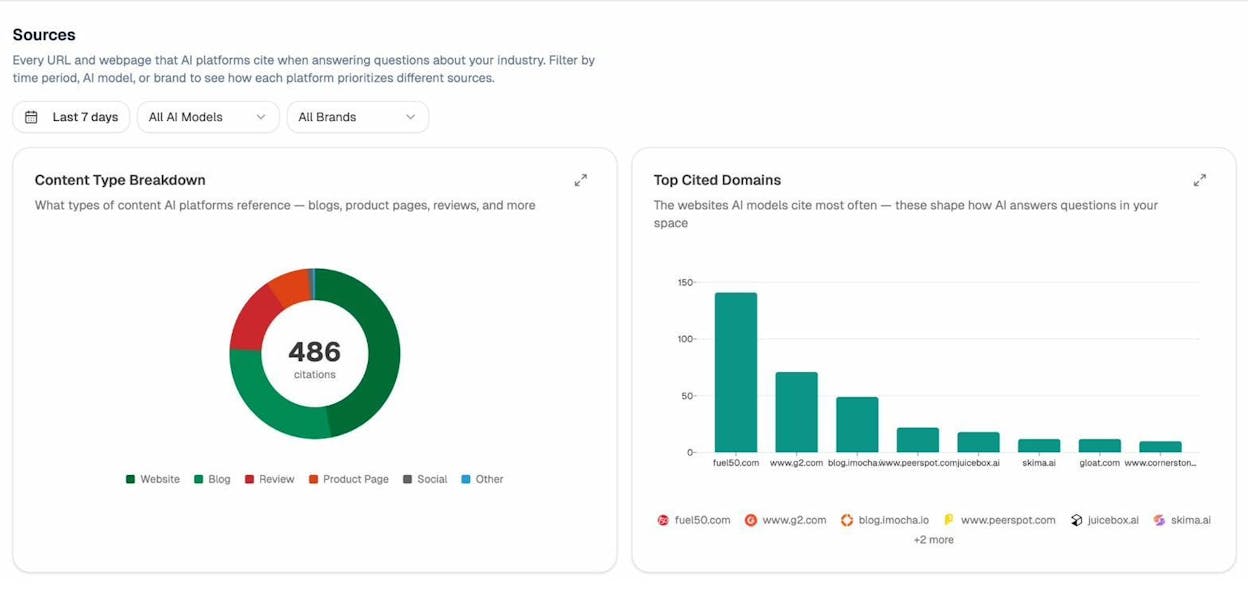
[Screenshot: Analyze AI Top Sources showing which third-party domains drive the most AI citations for tracked prompts]

Tracking which sources AI engines cite most for your target prompts reveals where to focus off-page efforts. If TechCrunch and G2 drive most citations for "project management software" queries, getting coverage on those sites should be a priority.

Monitoring Competitor Visibility

Off-page SEO becomes strategic when you know where competitors succeed. Track which brands AI engines mention for prompts relevant to your business, and identify the sources that drive their citations.

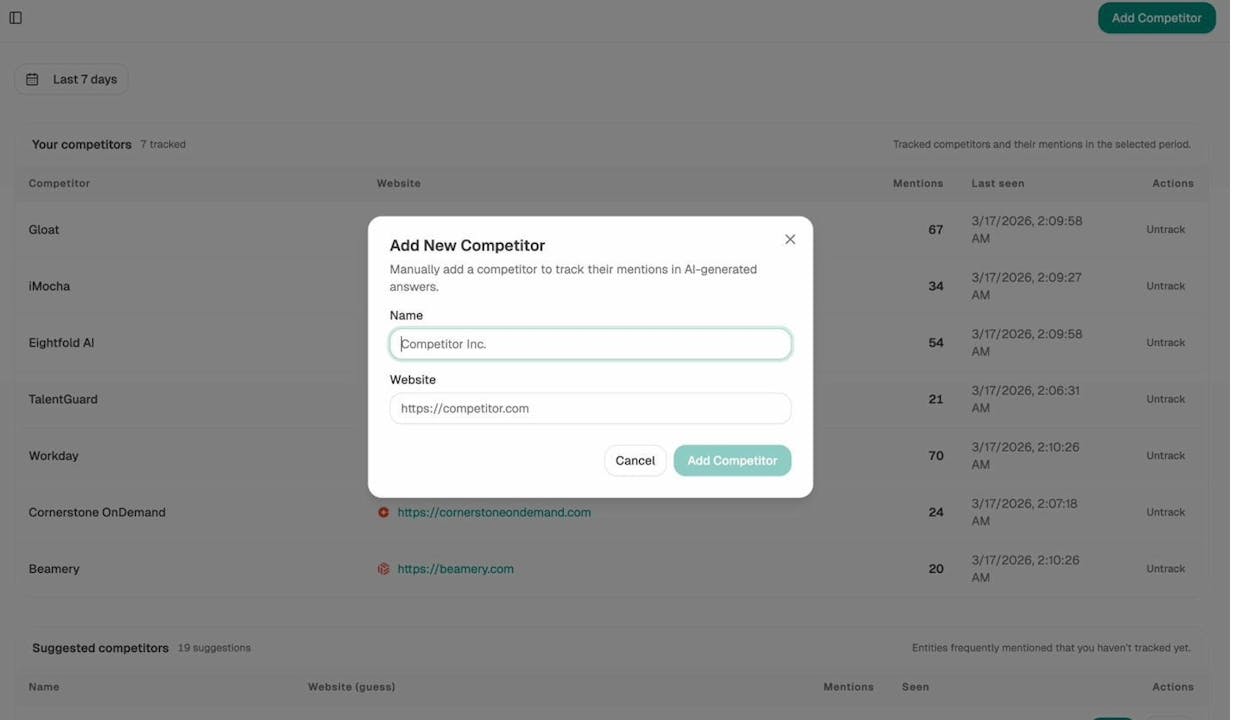
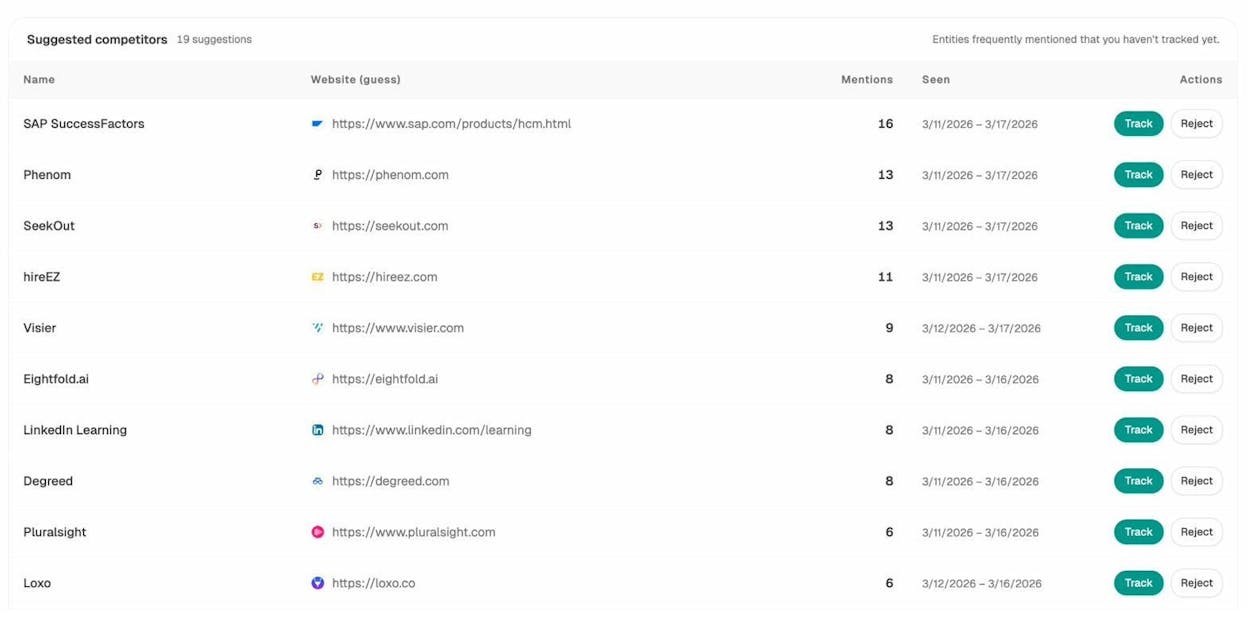
[Screenshot: Analyze AI Competitor Overview showing tracked competitors, their mention counts, and last seen dates]

If a competitor consistently appears for "best email marketing platforms" but you don't, investigate why:

  • What third-party sources cite them?

  • What content do they have that you lack?

  • Where do they have coverage that you don't?

[Screenshot: Analyze AI Opportunities dashboard showing prompts where competitors appear and your brand doesn't]

This competitive intelligence directs both your traditional link building and your AI visibility strategy.

4. Technical SEO

Technical SEO ensures search engines can access, crawl, understand, and index your content. The best content and strongest backlinks mean nothing if search engines can't find your pages.

Page Speed

Page speed affects both rankings and user experience. Google has confirmed that page speed is a ranking factor, and users abandon slow-loading pages.

Measuring page speed:

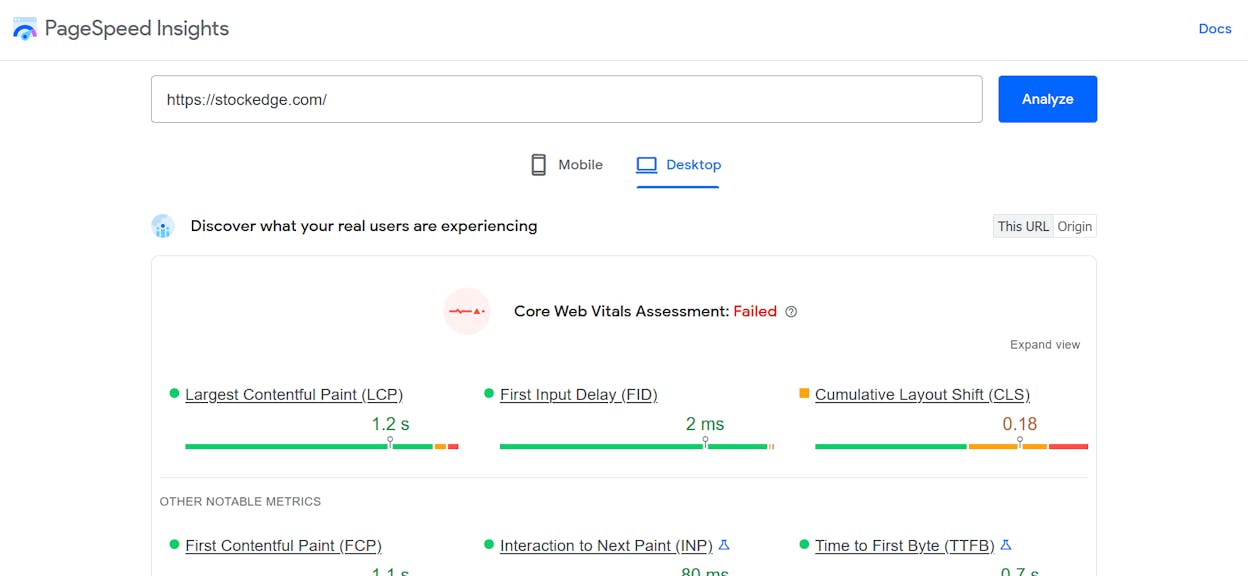
Use Google's PageSpeed Insights, Lighthouse, or GTmetrix to evaluate your site. Focus on Core Web Vitals:

  • Largest Contentful Paint (LCP): How long until the main content loads. Target under 2.5 seconds.

  • First Input Delay (FID): How long until the page becomes interactive. Target under 100 milliseconds.

  • Cumulative Layout Shift (CLS): How much the page layout shifts while loading. Target under 0.1.

[Screenshot: Google PageSpeed Insights showing Core Web Vitals scores with pass/fail indicators]

Common speed improvements:

Optimize images: Compress images without visible quality loss. Use modern formats like WebP. Implement lazy loading so below-the-fold images load only when needed.

Minimize code: Reduce CSS and JavaScript file sizes through minification. Remove unused code. Defer non-critical JavaScript loading.

Leverage browser caching: Set appropriate cache headers so returning visitors don't re-download unchanged resources.

Use a CDN: Content delivery networks serve files from servers geographically close to users, reducing latency.

Upgrade hosting: Cheap shared hosting often throttles resources. A quality host can dramatically improve response times.

Crawling

Search engine bots must crawl your site to discover and index content. Crawl issues prevent pages from appearing in search results at all.

Ensuring crawlability:

robots.txt configuration: This file tells crawlers which parts of your site to access and which to skip. Verify it doesn't accidentally block important content.

XML sitemap: A sitemap lists all pages you want indexed. Submit it to Google Search Console and Bing Webmaster Tools. Update it automatically when you publish new content.

Internal linking: Crawlers follow links to discover pages. Pages without internal links pointing to them (orphan pages) may never get crawled.

Crawl budget management: Large sites need to prioritize which pages get crawled. Block low-value pages (admin pages, search results, filtered URLs) to ensure important pages get crawled more frequently.

[Screenshot: Google Search Console Coverage report showing indexed pages, crawl errors, and excluded pages]

Fixing crawl errors:

Regularly check Google Search Console for crawl issues:

  • 404 errors: Missing pages. Either restore them, redirect to relevant content, or remove internal links pointing to them.

  • Server errors (5xx): Hosting issues preventing access. Investigate server logs and contact hosting support.

  • Redirect errors: Redirect chains or loops that confuse crawlers. Simplify to direct redirects.

  • Blocked by robots.txt: Pages you've accidentally blocked from crawling.

Proper Indexing

Crawling and indexing are different. Crawling means discovering pages; indexing means adding them to the search engine's database. Pages can be crawled but not indexed.

Indexing best practices:

Unique, valuable content: Pages with thin or duplicate content may be crawled but not indexed. Ensure every page provides unique value.

Canonical tags: When similar content exists across multiple URLs, canonical tags tell search engines which version to index. This prevents duplicate content issues.

Index/noindex directives: Use noindex tags on pages that shouldn't appear in search results: thank you pages, admin areas, staging environments.

Sitemap inclusion: Ensure all important pages appear in your sitemap, and verify the sitemap is submitted to search engines.

[Screenshot: Google Search Console URL Inspection tool showing indexing status for a specific page]

Diagnosing indexing issues:

If important pages aren't indexed:

  1. Check for noindex tags in the HTML

  2. Verify the canonical tag points to the correct URL

  3. Ensure the page is included in your sitemap

  4. Check whether robots.txt blocks the page

  5. Evaluate content quality—thin pages may not be indexed

  6. Request indexing through Google Search Console

Information Hierarchy

Site architecture affects how easily users and search engines navigate your content. A logical hierarchy distributes authority across your site and helps crawlers understand relationships between pages.

Effective site structure:

Flat architecture: Most pages should be reachable within 3-4 clicks from the homepage. Deep pages get crawled less frequently and inherit less authority.

Logical categorization: Group related content under intuitive categories. An e-commerce site might structure as: Homepage > Category > Subcategory > Product.

Breadcrumb navigation: Breadcrumbs show users their location within your site structure. They also provide internal links and help search engines understand hierarchy.

Internal linking strategy: Link from high-authority pages to pages you want to rank. Link related content together. Use descriptive anchor text that signals what the linked page covers.

[Screenshot: Site architecture visualization showing homepage connected to categories, subcategories, and individual pages]

Mobile Responsiveness

Google uses mobile-first indexing, meaning it primarily uses your mobile site for ranking and indexing. If your mobile experience is poor, your rankings suffer.

Mobile optimization requirements:

  • Responsive design: Pages adapt to any screen size automatically

  • Touch-friendly elements: Buttons and links large enough to tap accurately

  • No horizontal scrolling: Content fits within the viewport

  • Readable text: Font sizes that don't require zooming

  • Fast mobile loading: Often slower than desktop—optimize accordingly

Test your site with Google's Mobile-Friendly Test and in Chrome's device emulator.

HTTPS Security

HTTPS encrypts data between users and your site. Google has confirmed HTTPS as a ranking factor, and browsers now display security warnings for HTTP sites.

HTTPS implementation:

  1. Obtain an SSL certificate (free through Let's Encrypt or included with most hosting)

  2. Install the certificate on your server

  3. Update internal links to HTTPS

  4. Set up 301 redirects from HTTP to HTTPS

  5. Update your sitemap and Google Search Console settings

  6. Verify all resources (images, scripts, stylesheets) load over HTTPS

Technical SEO for AI Visibility

Technical SEO affects AI search differently than traditional search. AI engines have their own crawlers and indexing systems, and some technical factors matter more than others.

Crawlability for AI engines:

Different AI engines crawl the web differently. Some use their own crawlers; others rely on search engine indexes or real-time web access. Ensure your robots.txt doesn't block AI crawlers you want to access your content.

Common AI crawlers:

  • GPTBot (OpenAI)

  • Anthropic's crawler

  • PerplexityBot

Structured content for AI parsing:

AI models process structured information more effectively than unstructured prose. Tables, lists, and clear section headings make your content easier for AI to understand and cite.

[Screenshot: Example of well-structured content with clear headings, tables, and lists that AI can parse]

Schema markup for entity recognition:

Structured data helps AI engines understand what entities your content discusses. Organization schema, Product schema, and FAQ schema all provide context that aids AI comprehension.

Clean, accessible HTML:

AI engines process the raw HTML of your pages. Clean markup without excessive JavaScript rendering requirements ensures AI crawlers can access your content. If your content only loads after JavaScript execution, some AI crawlers may miss it.

Measuring AI Search Traffic

Unlike traditional SEO where Google Search Console shows your ranking data, AI search traffic requires specific attribution setup.

Setting up AI traffic attribution:

AI engines that send users to your site show up in analytics as referral traffic. The referrer data reveals which AI engine sent the visit.

Common AI referrer patterns:

  • chatgpt.com, chat.openai.com (ChatGPT)

  • perplexity.ai (Perplexity)

  • claude.ai (Claude)

  • copilot.microsoft.com (Microsoft Copilot)

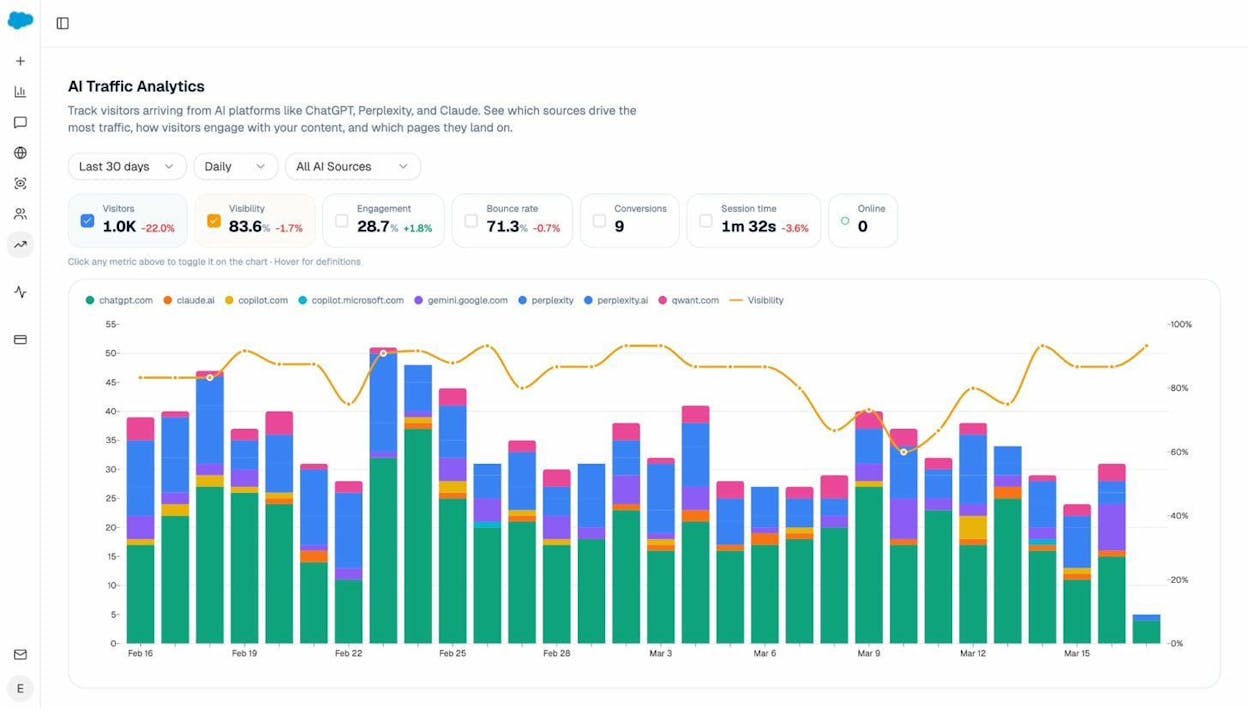
[Screenshot: Analyze AI Traffic Analytics showing total AI referrals, referral trend over time, and AI traffic contribution percentage]

Track this traffic separately from traditional organic search to understand how AI search contributes to your overall acquisition.

Page-level AI traffic analysis:

Which of your pages receive AI referral traffic? This reveals what content AI engines cite and recommend.

[Screenshot: Analyze AI Traffic By Page showing landing pages, AI referrer source, and session counts]

Pages receiving consistent AI traffic are succeeding in AI search. Analyze what makes them successful:

  • What topics do they cover?

  • How is the content structured?

  • What format do they use?

  • How comprehensive is the coverage?

Apply these patterns to other content to expand your AI visibility.

Engine-specific performance:

Different AI engines may favor different content from your site. Understanding which engines drive traffic helps you optimize for the engines that matter most to your audience.

[Screenshot: Analyze AI Analytics By Engine showing traffic breakdown by ChatGPT, Perplexity, Claude, and other AI engines over time]

If ChatGPT drives 60% of your AI traffic, prioritize understanding how ChatGPT selects and cites content. If Perplexity drives most conversions, focus optimization efforts there.

Measuring Your SEO and AI Search Performance

Optimization without measurement is guesswork. Track performance across both traditional and AI search to understand what's working and where to focus.

Traditional SEO Metrics

Track in Google Search Console:

  • Total clicks and impressions

  • Average position by keyword

  • Click-through rate by page

  • Indexing status and errors

Track in Google Analytics:

  • Organic traffic trends

  • Engagement metrics (time on page, bounce rate)

  • Conversion rates from organic traffic

  • Landing page performance

Track in rank tracking tools:

  • Daily ranking positions for target keywords

  • Competitor ranking comparisons

  • SERP feature appearances

AI Search Metrics

Track AI visibility:

  • Which prompts mention your brand

  • Your position in AI responses (first mentioned, third mentioned, etc.)

  • Sentiment of AI responses about your brand

  • Which sources AI engines cite for relevant queries

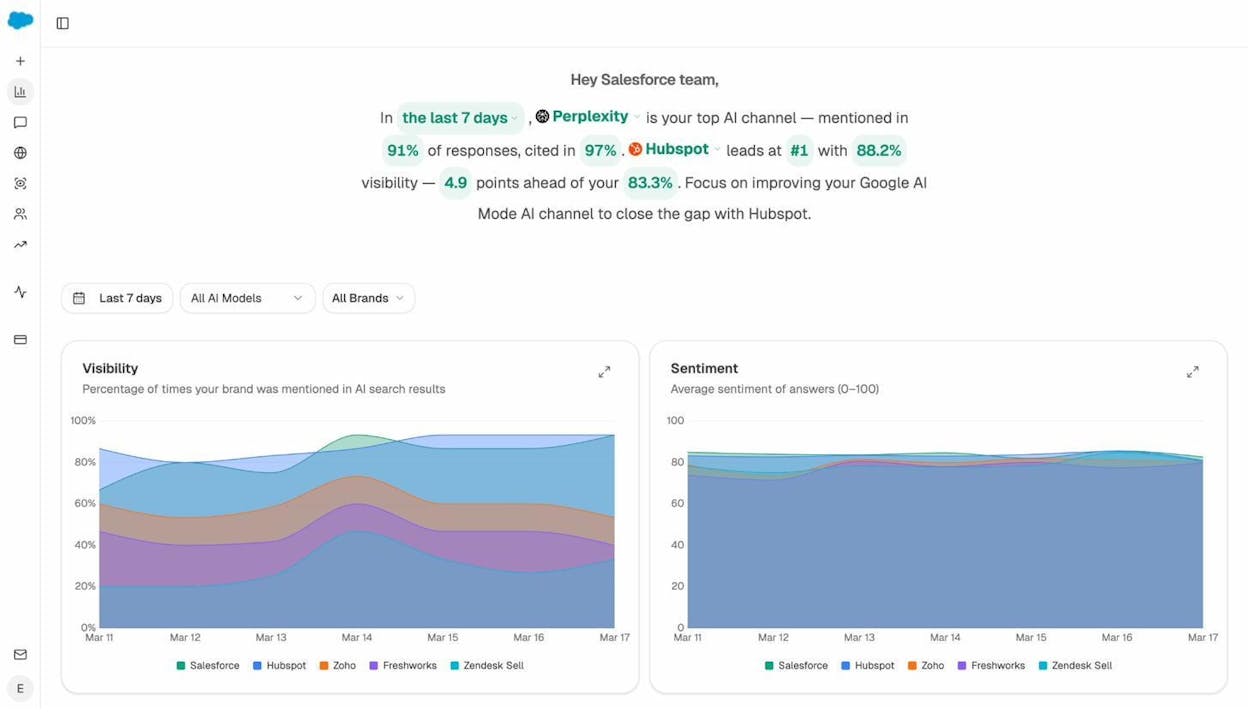
[Screenshot: Analyze AI Prompt Level Analytics showing prompt visibility, sentiment score, position, and response timeline]

Track AI referral traffic:

  • Total sessions from AI engines

  • Which engines drive traffic

  • Which pages receive AI traffic

  • Conversion rates from AI traffic

Track competitive position:

  • Which brands appear alongside you in AI responses

  • Prompts where competitors appear and you don't

  • Share of voice across tracked prompts

[Screenshot: Analyze AI Sentiment Analysis showing sentiment trends over time for tracked brands]

Connecting Metrics to Action

Metrics only matter if they drive decisions. Use your measurement data to identify specific actions:

If organic rankings dropped: Check for technical issues, content quality problems, or algorithm updates. Audit the affected pages and compare against competitors who now outrank you.

If AI visibility is low: Review which sources AI engines cite. Create content that matches what AI engines reference. Pursue coverage on third-party sites that appear in AI citations.

If traffic is high but conversions are low: The content attracts visitors but doesn't convert them. Improve calls-to-action, landing page experience, or targeting.

If competitors dominate specific queries: Analyze their content and backlink profiles. Identify gaps in your coverage and authority.

Integrating SEO and AI Search Optimization

The four pillars of SEO don't change because of AI search—they extend to it. Quality content, strong authority, proper technical foundation, and on-page optimization all influence both traditional and AI search results.

What this means in practice:

Single optimization strategy, dual benefit. When you create comprehensive content that satisfies user intent, it can rank in Google AND get cited by ChatGPT. When you build authority through backlinks and mentions, it strengthens your position in both channels.

AI search adds new visibility opportunities. Prompts that AI engines answer represent new ways for potential customers to discover your brand. Even if you don't rank #1 in Google for a query, you might appear in AI responses—or vice versa.

Measurement requires both channels. Track traditional rankings AND AI visibility. Track organic traffic AND AI referral traffic. A complete picture shows where your SEO strategy succeeds and where gaps exist.

Third-party content matters more. AI engines heavily cite external sources. Your off-page SEO efforts—getting coverage, reviews, and mentions—directly influence AI visibility.

The goal isn't to choose between SEO and AI search optimization. It's to build a comprehensive organic strategy that compounds across all the channels where potential customers search for information.

Key Takeaways

  • On-page SEO optimizes individual pages through URLs, headings, meta tags, and keyword placement—and extends to AI search through clear entity identification and direct, quotable statements

  • SEO content satisfies user intent with comprehensive, high-quality information—and performs in AI search when structured for easy parsing and fact extraction

  • Off-page SEO builds authority through backlinks and third-party mentions—and drives AI visibility since 83% of AI citations come from external sources

  • Technical SEO ensures crawlability and proper indexing—and affects AI search through crawler accessibility and structured content that AI can process

  • Measurement across both channels reveals where your optimization succeeds and where to focus improvement efforts

  • GEO is not a replacement for SEO—it's an evolution that adds new visibility opportunities while reinforcing the fundamentals that have always driven organic success

Tie AI visibility toqualified demand.

Measure the prompts and engines that drive real traffic, conversions, and revenue.

Covers ChatGPT, Perplexity, Claude, Copilot, Gemini

Similar Content You Might Want To Read

Discover more insights and perspectives on related topics

© 2026 Analyze AI. All rights reserved.