



Summarize this blog post with:


In this article, you’ll learn which brand mention tools actually deliver in 2026, what each one is best at, how much they cost, and how to pick the right one for your team. You’ll also learn how to track brand mentions in AI search engines like ChatGPT, Perplexity, and Gemini, not just social media.
Table of Contents
Why Brand Mentions Matter More in 2026
Brand mentions have always mattered for SEO. Unlinked mentions signal authority to Google. Linked mentions drive referral traffic. Negative mentions in reviews tank conversions.
But something bigger is happening now. AI search engines like ChatGPT, Perplexity, and Gemini are pulling answers from across the web and recommending brands by name. When someone asks ChatGPT for the best CRM or the best project management tool, the answer is shaped by what third-party sources say about you, not what you say about yourself.
We analyzed 83,670 AI citations across ChatGPT, Claude, and Perplexity and found that only 17% of citations come from a brand’s own website. The other 83% come from earned media, reviews, and third-party content.
That means your brand reputation now directly influences whether AI recommends you or your competitor. And if you are not tracking how your brand shows up in these AI answers, you are flying blind.
This is why the best brand mention tools in 2026 need to cover two surfaces. Social media, where conversations happen in real time. And AI search engines, where buying decisions are increasingly made.
What Is a Brand Mention Tool?
A brand mention tool is software that tracks what people and platforms say about your brand online. The best tools cover social media platforms like X, LinkedIn, and Reddit. They also cover AI search engines like ChatGPT, Perplexity, and Google AI Overviews.
Most brand mention tools let you track competitor mentions, analyze sentiment, set up real-time alerts, and generate share of voice reports. The key difference between tools is whether they focus on social listening, AI search monitoring, or both.
8 Best Brand Mention Tools in 2026
-
Analyze AI
-
Alertmouse
-
Brand Radar (by Ahrefs)
-
Sprout Social
-
Hootsuite
-
Peec AI
-
Brandwatch
-
Google Trends
1. Analyze AI
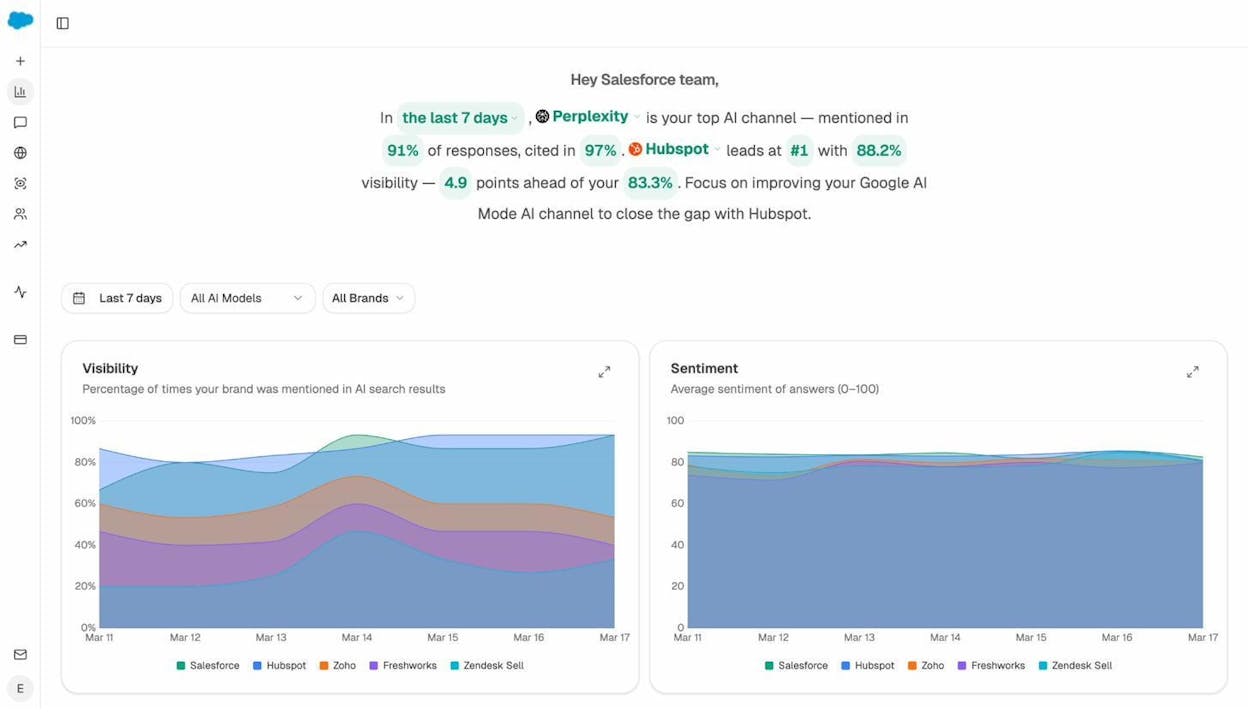
Best for: Tracking brand mentions across AI search engines and building custom monitoring workflows with agents
Pricing: Free trial available. Paid plans offer transparent, flat-rate pricing.
What stands out: Analyze AI is the only platform on this list that combines AI search brand monitoring with a full Agent Builder capable of billions of workflow combinations across 180+ nodes. You do not just get dashboards. You get the ability to build any brand monitoring, content, or SEO workflow your team needs.
Here is what makes it different from the other tools on this list.
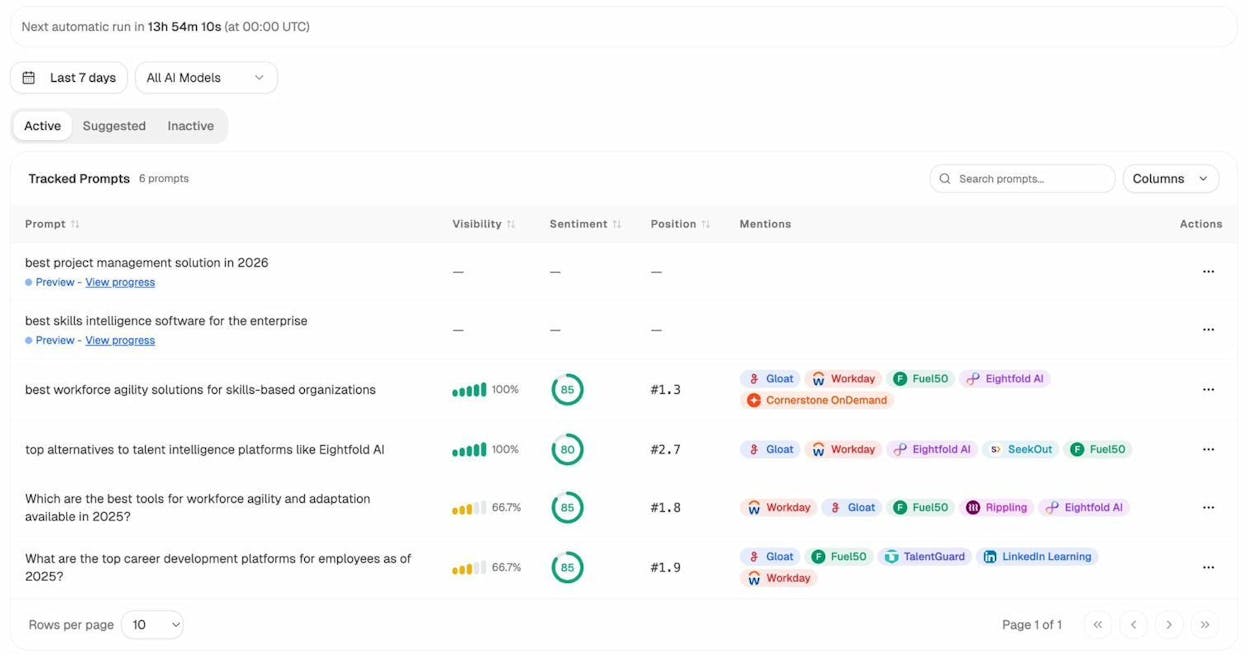
AI search brand tracking built in. The Prompt Tracking feature lets you track exactly how your brand shows up in ChatGPT, Perplexity, Gemini, Claude, and Google AI Overviews. You see your visibility score, sentiment, position, and which competitors appear alongside you, all updated automatically.
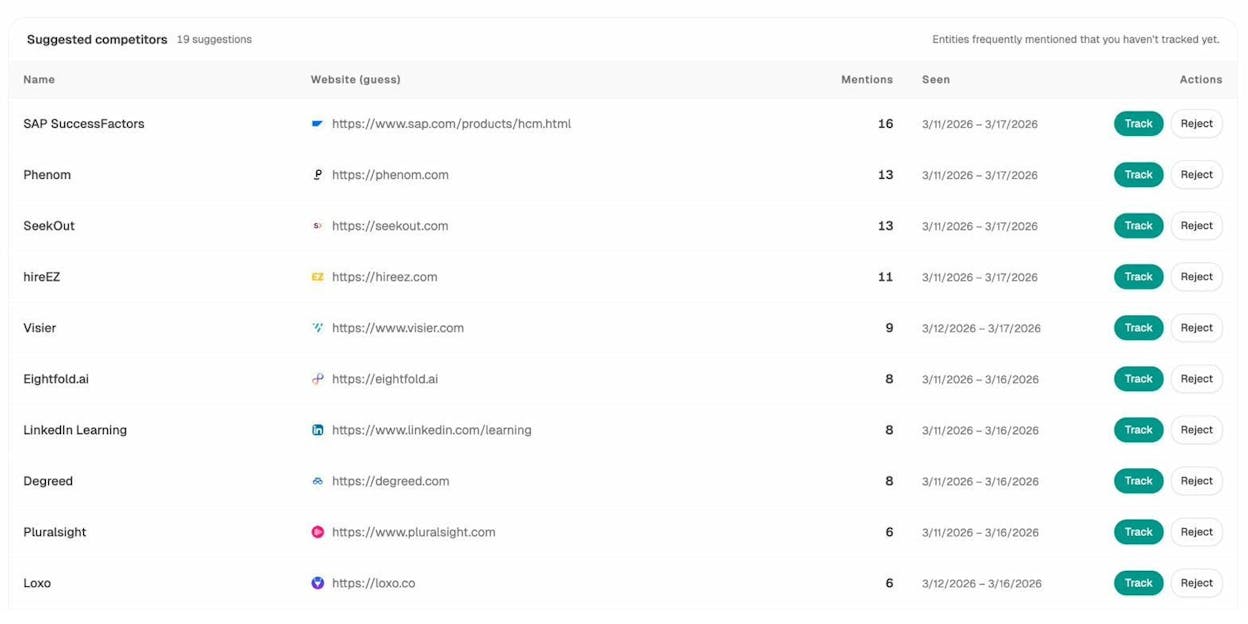
Competitor intelligence that goes deep. The Competitors dashboard automatically surfaces brands that appear in AI answers alongside yours. You can track them, see their visibility trends over time, and find prompts where they rank and you do not.
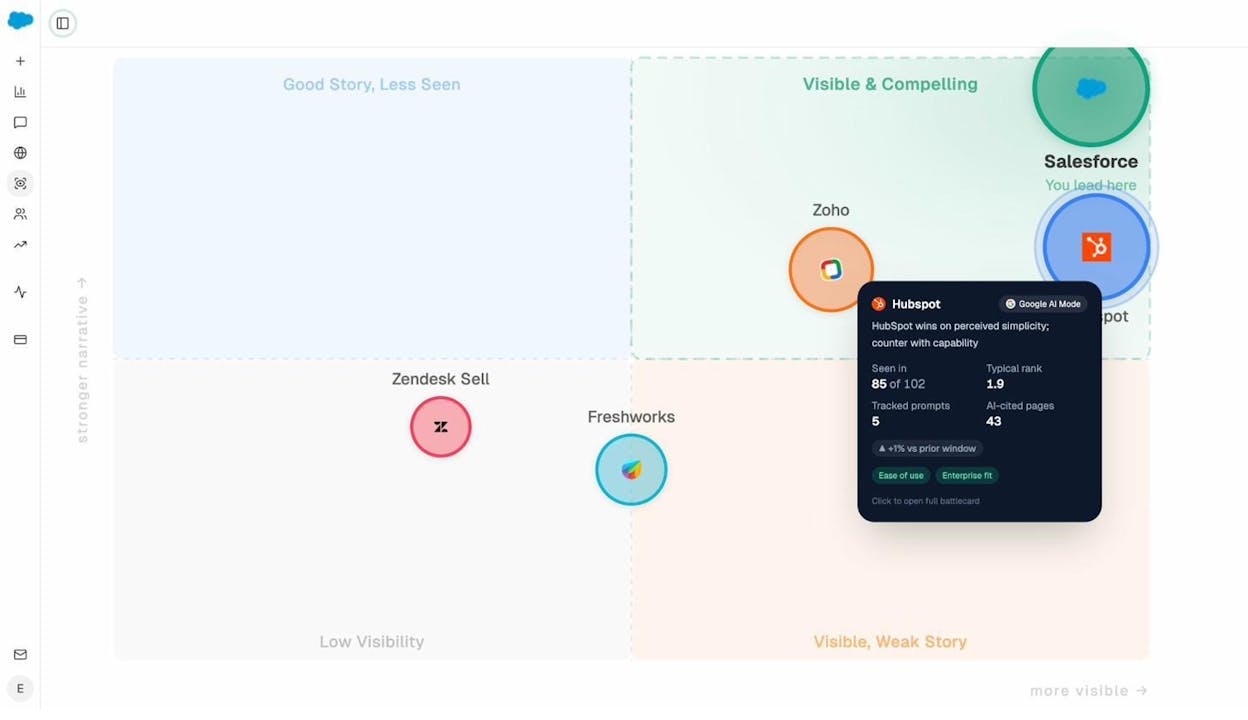
Perception Map. This is a feature no other tool on this list offers. The Perception Map plots your brand and competitors on a quadrant based on visibility and narrative strength. You instantly see who is “Visible and Compelling” versus who is “Visible but has a Weak Story.” Click on any competitor and get an AI Battlecard with their positioning, cited pages, and themes.
Sources dashboard. The Sources dashboard shows you every URL and website that AI platforms cite when answering questions in your industry. You see which domains get cited most, what content types get referenced (blogs, reviews, product pages), and how each AI model prioritizes different sources.
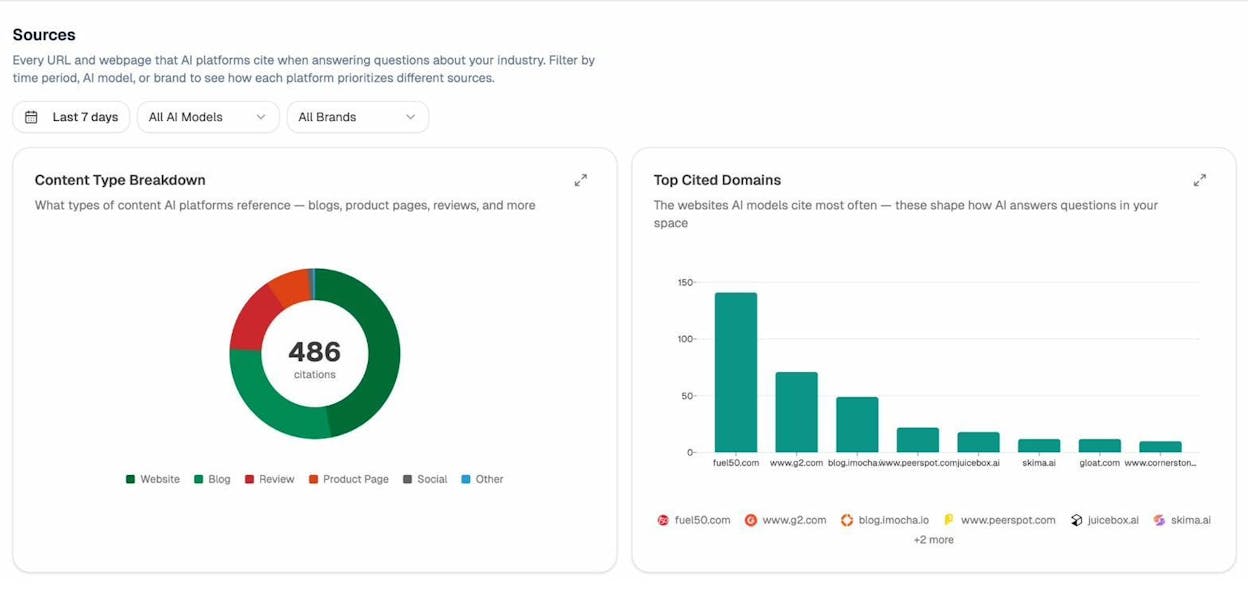
This is powerful for digital PR and link building. If you see that G2 reviews or a specific industry blog drive most AI citations in your space, you know exactly where to focus your earned media efforts.
Agent Builder for custom brand monitoring at scale. This is the biggest differentiator. The Agent Builder gives you access to 180+ nodes and 34 pre-built data recipes. It integrates with GA4, Google Search Console, Semrush, DataForSEO, HubSpot, WordPress, Notion, Slack, and dozens more.
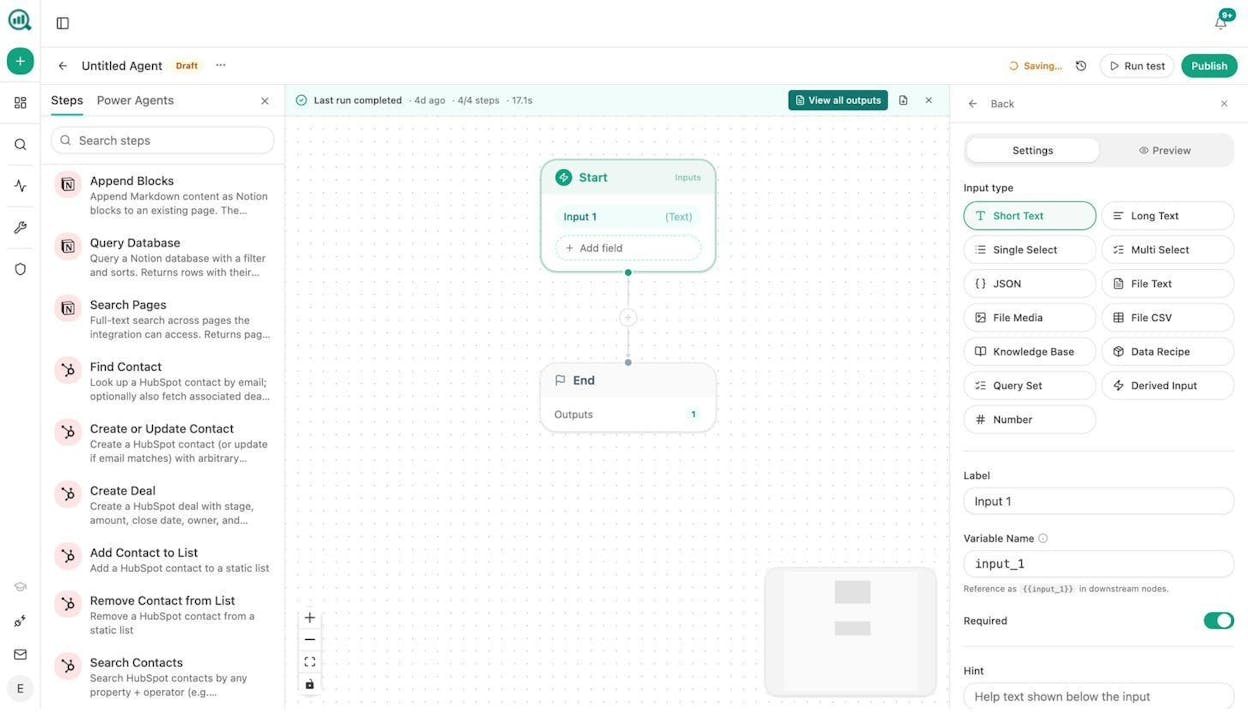
Here are a few examples of what you can build:
Brand mention monitoring agent. Create an agent that pulls your Visibility Score and Sentiment Score across all AI models, checks for competitor-gaps (prompts where competitors appear but you do not), runs sentiment-alerts for any prompt where AI sentiment about your brand drops below a threshold, and sends a summary to Slack or email every Monday. This uses the share-of-voice, competitor-gaps, and sentiment-alerts data recipes, a Conditional node, and a Slack or Email node.
Content response agent. Build a workflow that monitors declining-pages from GA4, cross-references them with citation-decay-alert to find pages losing both traffic and AI citations, then feeds those URLs into the Content Optimizer to generate refresh recommendations. Connect a HubSpot node to create a task for your content team. That is five nodes. Done.
Competitor narrative tracker. Set up an agent that runs the competitor-message-shift recipe weekly, compares it against your brand’s narrative-themes, and generates an executive summary using a Prompt LLM node. Send the output to Notion or Google Docs.
The Agent Builder also includes nodes for image creation (social media images, infographics, blog featured images), web scraping, keyword research, and B2B enrichment. If you can describe the workflow, you can probably build it.
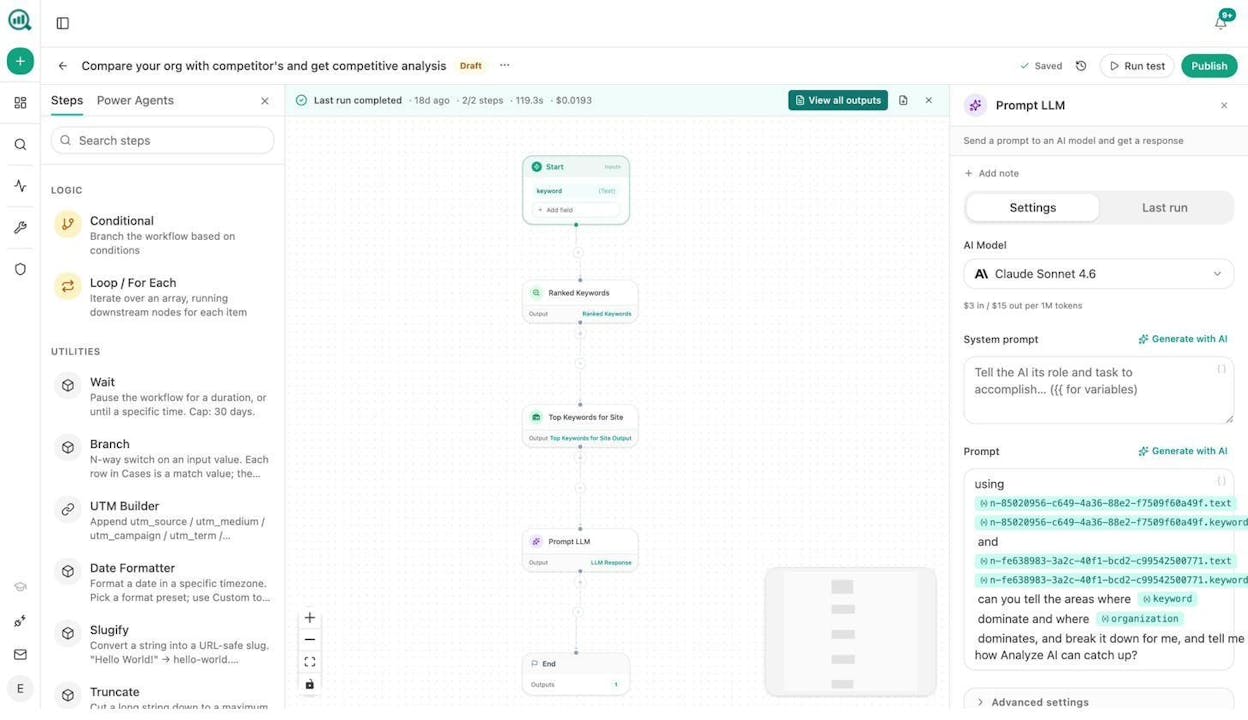
On top of that, Analyze AI includes a Content Writer and Content Optimizer that use a multi-step research, outline, and draft process. And Weekly Email Digests that automatically send your team a summary of visibility changes, so you stay on top of brand mentions without logging in.
Analyze AI reviews: Analyze AI is growing fast in the AI visibility tracking space and offers a free trial so you can test everything before committing.
2. Alertmouse
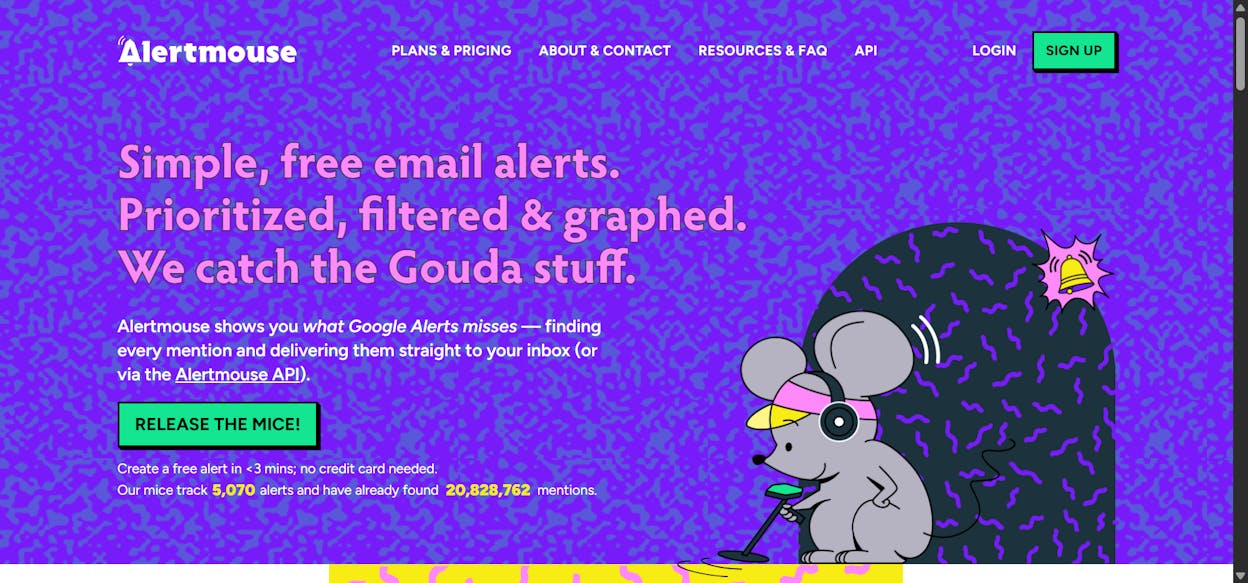
Best for: Simple, affordable email alerts for web brand mentions
Pricing: Free plan available. Paid plans start at $10/month.
What stands out: Alertmouse was created by Rand Fishkin, co-founder of Moz and SparkToro. It does one thing well. You enter a brand name or phrase, set keyword inclusion and exclusion rules, and get email alerts whenever that phrase is mentioned on the web.
It covers Google results, Reddit, social media, news articles, and blogs. The filtering is better than Google Alerts, which is known for missing relevant mentions and surfacing irrelevant ones.
The tool is ideal for founders, PR professionals, and solo marketers who need a simple way to know when their brand is being talked about. It does not track AI search engines, and it does not offer sentiment analysis or competitive dashboards. But for basic web monitoring at $10/month, it gets the job done.
Alertmouse pricing:
|
Plan |
Price |
Alerts |
Users |
Mention History |
|---|---|---|---|---|
|
Nibble (Free) |
$0 |
1 |
1 |
60 days |
|
Slice |
$10/mo |
5 |
3 |
1 year |
|
Wedge |
$50/mo |
50 |
10 |
2 years |
|
Wheel |
$100/mo |
200 |
100 |
2 years |
Alertmouse reviews: The tool is still new, so third-party review data is limited. Jon Henshaw at Coywolf published a detailed review worth reading.
3. Brand Radar (by Ahrefs)
Best for: Tracking brand mentions in AI search engines with a large query database
Pricing: Starts at $199/month as an add-on to Ahrefs plans (which start at $129/month)
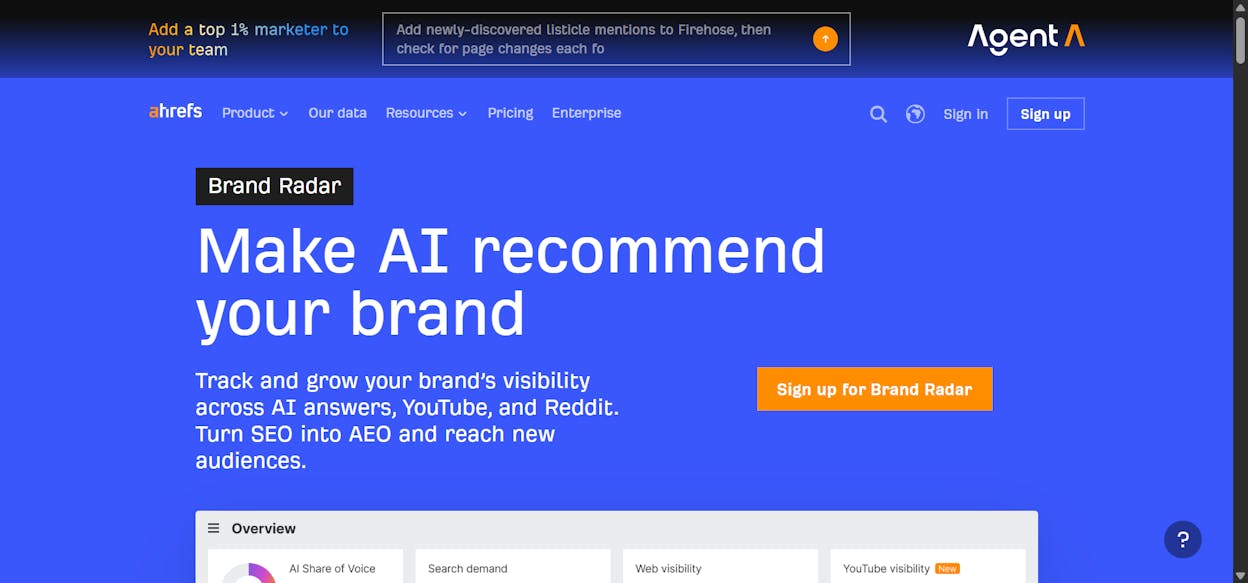
What stands out: Brand Radar tracks how your brand appears in ChatGPT, Perplexity, Gemini, and AI Overviews. It draws from a database of over 150 million queries, which gives it broad coverage.
You get visibility data, citation tracking, and share of voice metrics. It sits inside the Ahrefs product suite, so if your team already uses Ahrefs for keyword research and backlink analysis, adding Brand Radar keeps everything in one place.
The downside is cost. You need an active Ahrefs subscription (starting at $129/month for Lite) plus the $199/month Brand Radar add-on. That is a minimum of $328/month before you add extra users or features. For enterprise teams already invested in Ahrefs, the cost may be justified. For smaller teams, it is steep compared to alternatives.
Brand Radar also does not include a Content Writer, Content Optimizer, or any kind of agent or automation builder. It is a monitoring tool only.
Ahrefs reviews: G2 rating of 4.5/5 (600+ reviews). Capterra rating of 4.7/5 (570+ reviews).
4. Sprout Social
Best for: All-in-one social media management with built-in brand monitoring
Pricing: Starts at $199/month per seat (for the Standard plan that includes listening features)
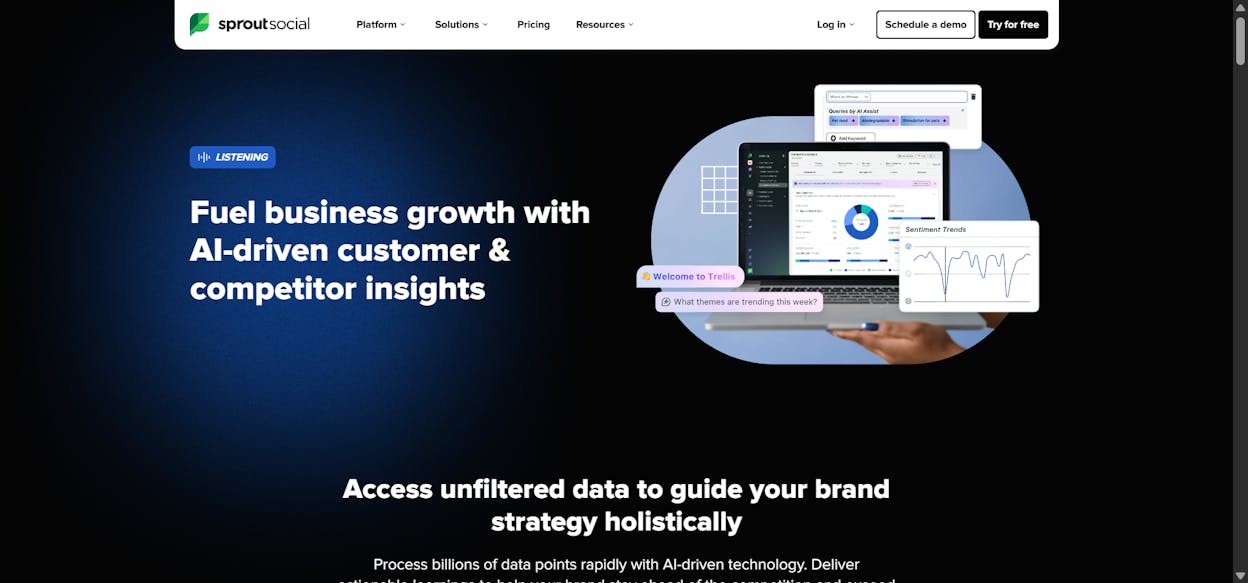
What stands out: Sprout Social is a full social media management platform. You can plan campaigns, schedule posts, engage with your audience, and track analytics. The Listening tool uses AI to track brand mentions and sentiment across social platforms.
It offers templates for brand health, competitor analysis, campaign monitoring, and industry insights. For social media teams that need one platform for everything, Sprout Social covers a lot of ground.
The limitation is that Sprout Social focuses entirely on social media. It does not track brand mentions in AI search engines. And pricing adds up quickly because it charges per seat. A team of five on the Standard plan costs $995/month.
Sprout Social reviews: G2 rating of 4.4/5 (5,500+ reviews). Capterra rating of 4.4/5 (600+ reviews).
5. Hootsuite
Best for: Brand reputation management across social platforms with damage control alerts
Pricing: Starts at $149/month per user
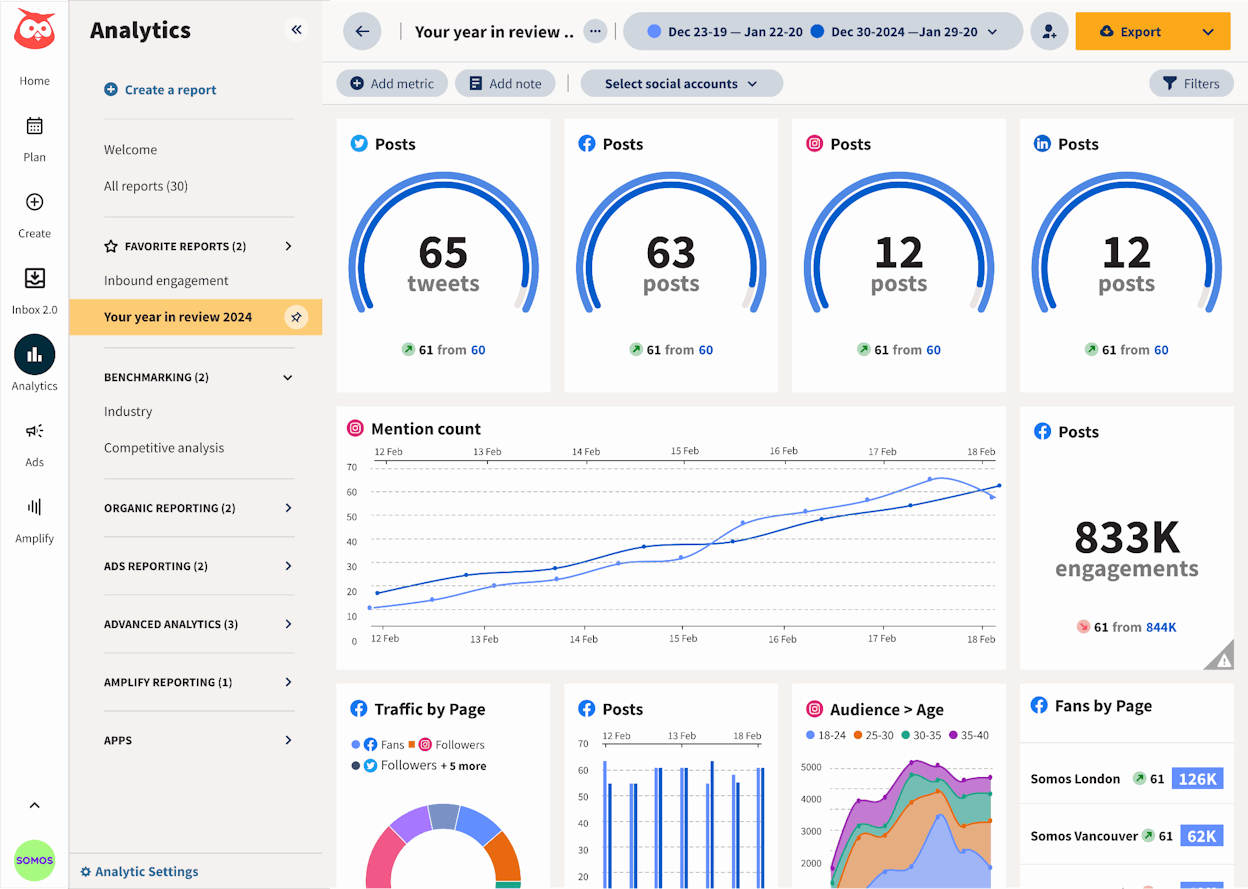
What stands out: Hootsuite has been around longer than most social media tools. It offers scheduling, analytics, and social listening in a single platform. The standout feature is real-time damage control alerts that notify your team when negative mentions spike.
The Standard plan lets you search the past 7 days for brand mentions and benchmark against 5 competitors. The Advanced plan ($399/month per user) extends that to 30 days and 20 competitors. Like Sprout Social, Hootsuite is social-only with no AI search tracking.
Hootsuite reviews: G2 rating of 4.3/5 (6,600+ reviews). Capterra rating of 4.4/5 (3,700+ reviews).
6. Peec AI
Best for: Affordable AI search engine brand monitoring
Pricing: Starts at approximately $95/month
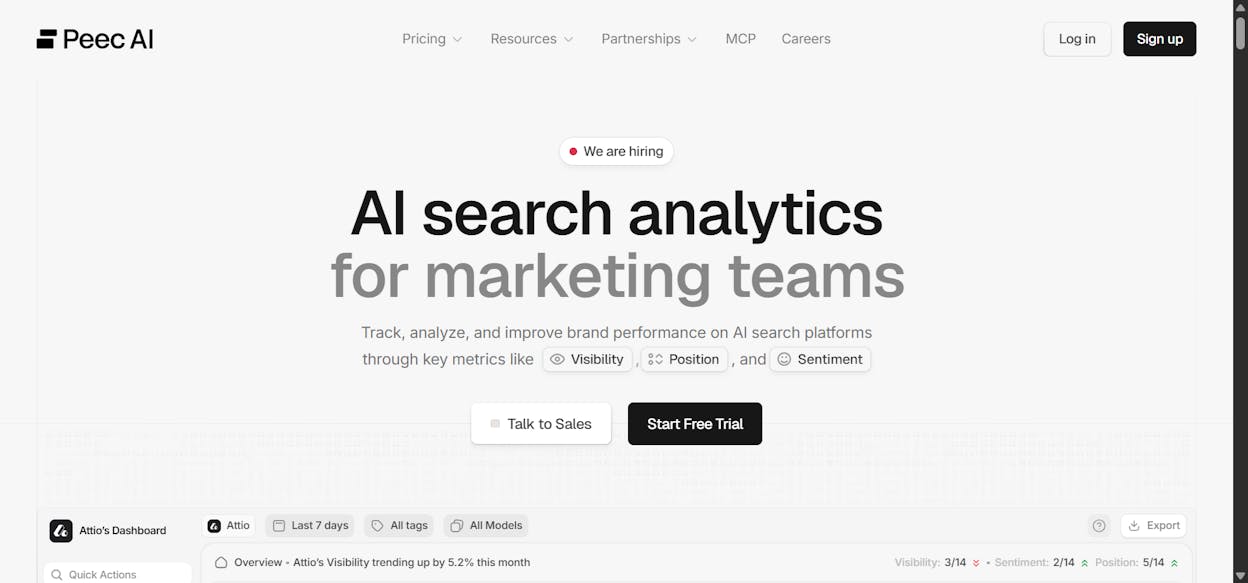
What stands out: Peec AI tracks how your brand shows up in ChatGPT, Perplexity, and AI Overviews. It is significantly cheaper than Brand Radar and has a clean, simple interface. You can track specific prompts, see competitor appearances, and get a chat interface for querying your data.
The trade-off is database size. Peec AI does not have the 150 million query database that Ahrefs has. It tracks the prompts you configure rather than scanning a massive pre-built query bank. For teams that know exactly which prompts matter to their business, this focused approach can work well.
Peec AI does not include content creation tools, optimization features, or any kind of workflow automation. It is purely a monitoring tool.
Peec AI pricing:
|
Plan |
Price |
Prompts |
AI Answers/Month |
|---|---|---|---|
|
Starter |
$95/mo |
25 |
2,250 |
|
Pro |
$214/mo |
100 |
9,000 |
|
Enterprise |
$535+/mo |
300+ |
27,000+ |
Peec AI reviews: G2 rating of 5/5 (1 review). Still new with limited third-party review data.
7. Brandwatch
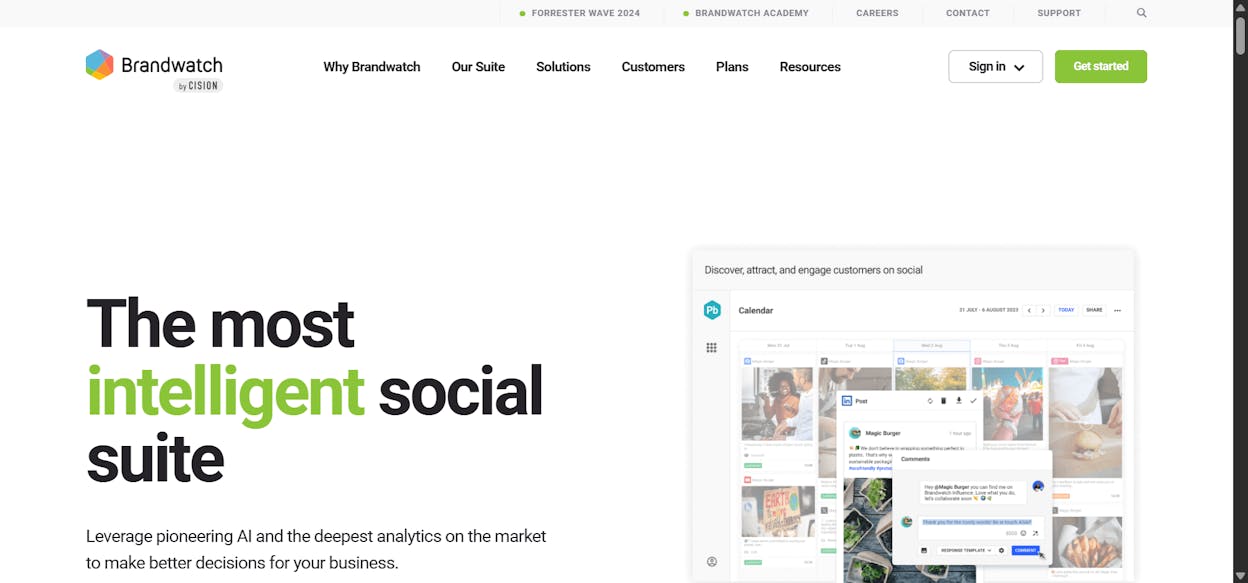
Best for: Enterprise-level social media management and brand monitoring
Pricing: Custom pricing (contact sales)
What stands out: Brandwatch is built for large consumer brands like Nestlé and Toyota. It combines social media management, influencer marketing (30 million+ creator database), and brand monitoring with crisis management features. It covers Facebook, Instagram, LinkedIn, X, Reddit, WhatsApp, YouTube, and more.
The downside is that Brandwatch does not publish pricing. You have to contact sales, which typically means an enterprise-level commitment.
Brandwatch reviews: G2 rating of 4.4/5 (700+ reviews). Capterra rating of 4.2/5 (230+ reviews).
8. Google Trends
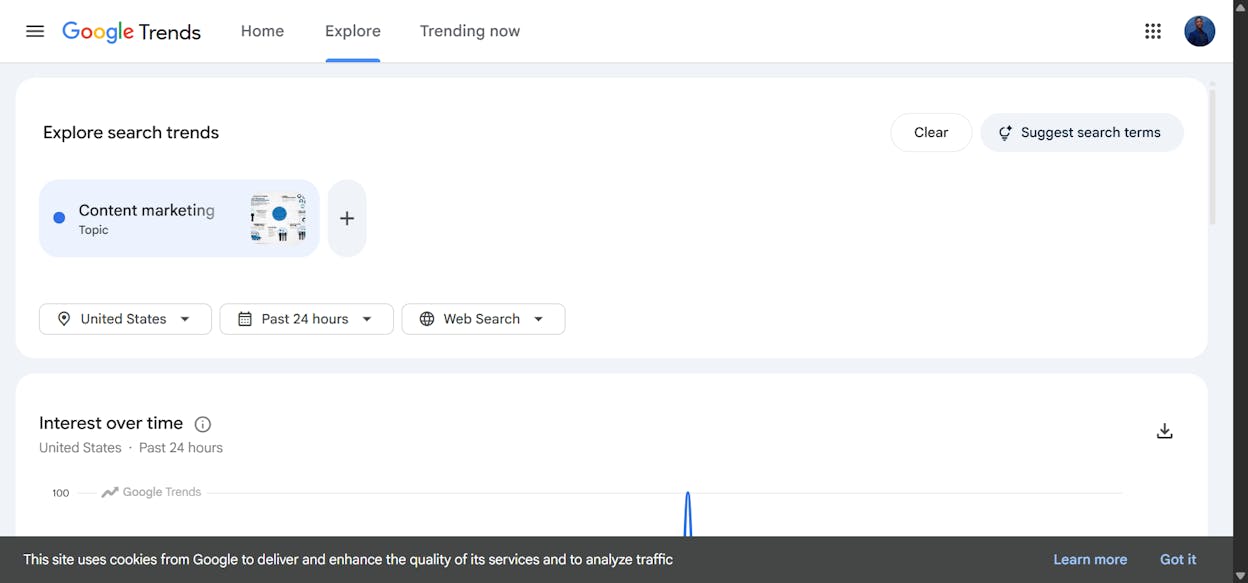
Best for: Free, quick brand interest comparisons over time
Pricing: Completely free
What stands out: Google Trends lets you compare search interest for your brand versus competitors over time. Filter by region, time range, and category to get a rough pulse check on whether brand awareness is growing or declining.
The limitation is that Google Trends shows relative search volume, not actual numbers. It only covers Google Search, not social media or AI search engines. But for a free tool that takes 30 seconds, it is a useful starting point.
How to Track Brand Mentions in AI Search (Step by Step)
Most of the tools above cover social media well. But tracking how your brand shows up in AI search engines is a newer problem that fewer tools solve. Here is how to do it with Analyze AI.
Step 1: Set up prompt tracking. Go to the Prompt Tracking dashboard and add the prompts that matter to your brand. Think about the questions your buyers ask ChatGPT or Perplexity before making a purchase decision. For example, “best CRM for small businesses” or “top project management tools 2026.”
Step 2: Add your competitors. Analyze AI will automatically suggest competitors that appear alongside your brand in AI answers. You can track or reject each suggestion. Once tracked, you will see side-by-side visibility, sentiment, and citation comparisons.
Step 3: Check the Perception Map. Open the Perception Map to see where you sit relative to competitors on visibility and narrative strength. If you are in the “Low Visibility” quadrant, you need more mentions. If you are “Visible but Weak Story,” you need better positioning in the sources AI models reference.
Step 4: Dig into Sources. The Sources dashboard shows which websites AI models cite most in your industry. If a competitor’s G2 page or a specific blog drives most of their AI citations, that tells you where to invest in earned media.
Step 5: Set up automated monitoring. Use the Agent Builder to create a weekly monitoring agent. Combine the share-of-voice data recipe with a Conditional node (flag if visibility drops below your threshold) and a Slack or Email node. You will get an alert any time your AI visibility changes significantly. You can also add competitor-gaps and sentiment-alerts recipes to the same agent to keep your competitive intelligence on autopilot.
Step 6: Act on insights. When you find prompts where competitors appear and you do not, use the Content Writer to create content that fills those gaps. When existing pages lose AI citations, run them through the Content Optimizer for refresh recommendations. Connect everything to your content marketing workflow so insights turn into action, not just reports.
How to Pick the Right Brand Mention Tool
The right tool depends on what you need to track and what you plan to do with the data.
If you only need social media monitoring, Alertmouse ($10/month) covers the basics. For full social media management with built-in listening, look at Sprout Social or Hootsuite.
If you need AI search monitoring, Analyze AI and Brand Radar both track brand mentions across ChatGPT, Perplexity, Gemini, and AI Overviews. Analyze AI includes an Agent Builder, Content Writer, and Content Optimizer on top of monitoring. Brand Radar is monitoring-only and requires an existing Ahrefs subscription.
If you need both social and AI coverage, you will likely need two tools. Pair Alertmouse or Sprout Social for social with Analyze AI for AI search. Or use the Analyze AI Agent Builder to create custom web scraping and monitoring agents that cover both surfaces.
If you are an enterprise team, Brandwatch is built for large-scale social media operations. For AI search at enterprise scale, Analyze AI offers the deepest feature set, and the Agent Builder scales with your team because agents can be published, scheduled, and shared across your organization.
Start Tracking Your Brand Mentions Today
Brand mentions are no longer just a PR metric. They directly influence whether AI search engines recommend your product or your competitor’s. They shape buyer decisions before your sales team even gets a chance to make a pitch.
The tools on this list range from free (Google Trends) to enterprise (Brandwatch). The right choice depends on where your audience discovers brands and what actions you plan to take when you find insights.
If you want to go beyond monitoring and actually improve how your brand shows up in AI search, start a free trial of Analyze AI and see your visibility, sentiment, and competitive position across every major AI engine.

Ernest

Ibrahim


