



Summarize this blog post with:


In this article, you’ll learn how to generate content ideas that earn traffic, citations in AI engines, and pipeline. You’ll get a simple framework for finding ideas on demand, eight specific tactics with examples, and the exact tools (free and paid) to execute each one. By the end, your content calendar should be the easiest part of your week.
Most content ideation advice is a list of where to look. The hard part is not finding ideas. It’s finding ideas that turn into traffic, leads, and citations once published. This guide is built around that distinction.
Table of Contents
What is content ideation?
Content ideation is the process of generating article, video, podcast, or social post ideas that match what your audience searches for, asks AI engines about, and buys based on. Good ideation is repeatable, not lucky. It plugs into a feedback loop so each new idea is informed by the last one’s performance.
That feedback loop has three parts.
![[Screenshot description: A simple three-stage loop diagram. Stage 1 “Inputs” with icons for customer calls, search data, AI prompts, forums. Stage 2 “Output” with a content calendar. Stage 3 “Feedback” with traffic, AI citations, and pipeline metrics flowing back into Inputs.]](https://www.datocms-assets.com/164164/1777674843-blobid1.png?auto=format,compress&w=1248&fit=max)
Inputs. Customer calls, sales objections, support tickets, competitor moves, search queries, AI prompts, industry shifts, your own experiments. Anything from the outside world that gives you signal about what people care about.
Output. A short list of validated ideas with a clear angle, target keyword or prompt, and intended reader.
Feedback. What got read, ranked, cited in ChatGPT or Perplexity, and converted. This becomes input for the next round.
The mistake most teams make is skipping the feedback step. They publish, watch traffic, and never ask why some pieces won. That’s how you end up with a calendar full of fresh ideas and zero compounding learning.
Set up the system before you run the tactics
Before any of the eight tactics below pay off, three lightweight habits need to be in place.
Read and listen widely. If every input you take in is a content marketing blog post, every idea you produce will look like a content marketing blog post. Subscribe to industry newsletters outside your niche. Follow operators, not pundits.
Capture every idea in one place. A Google Doc, a Notion database, a notes app. The format does not matter. What matters is that every idea, even the half-formed ones, lands in the same inbox. Most ideas die because nobody wrote them down.
Track what works in both search and AI engines. Traditional analytics tells you which posts get organic clicks. That’s half the picture. The other half is which posts get cited by ChatGPT, Perplexity, Gemini, Claude, and Google AI Mode. A page can drive almost no Google clicks and still drive pipeline if it’s the page AI engines cite when buyers ask about your category. You can see that in your AI traffic analytics and citation analytics.
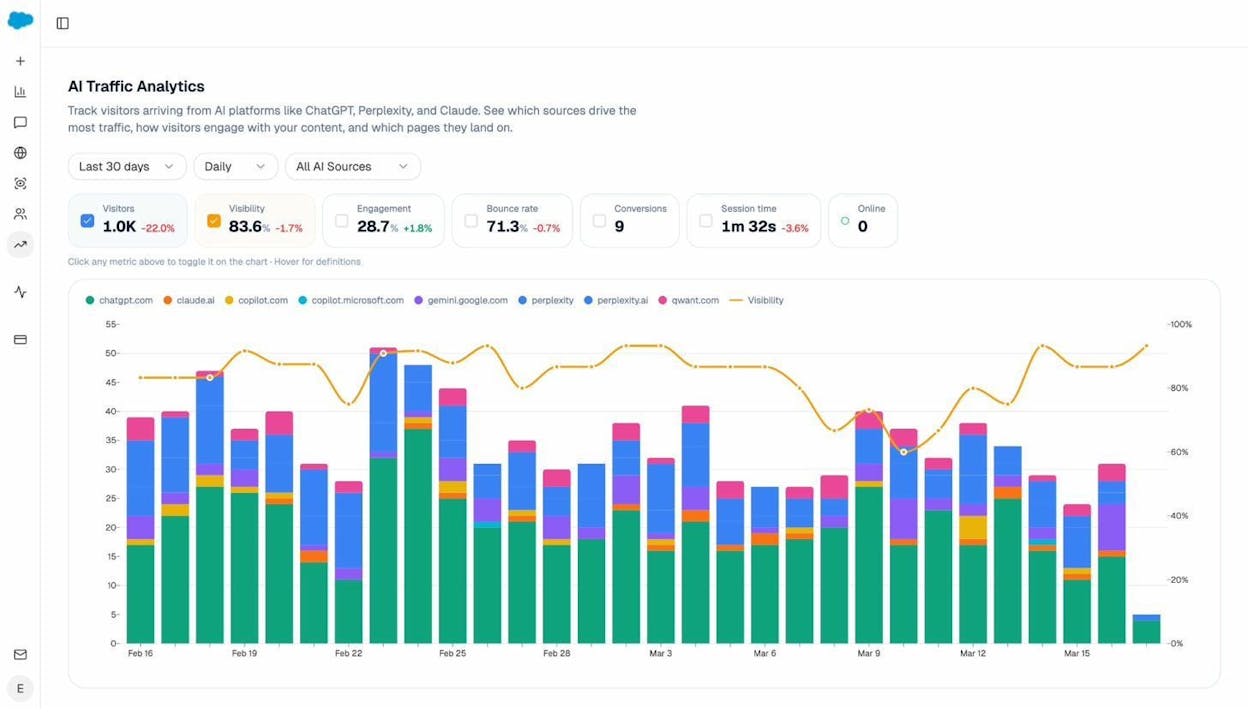
The pages already winning AI traffic for you are the cleanest signal you have for the next five articles. If a comparison post is being cited across five different prompts, write three more comparisons. The pattern that earned the win is the brief for the next piece.
8 content ideation methods that actually work
1. Answer the questions your buyers are already asking
The simplest source of ideas is also the highest-converting one. Find the questions your buyers ask before, during, and after they consider your product. Then answer them better than anyone else.
There are four places to look.
Reddit, Quora, and industry forums. People ask questions on Reddit they would never type into Google. The threads with the most comments reveal real objections, real workflows, and real language. Search Reddit for "your category" site:reddit.com and read the top results.
![[Screenshot description: A Reddit search for “how to build backlinks site:reddit.com” showing a thread with 200+ comments, with the top question and answer highlighted.]](https://www.datocms-assets.com/164164/1777674852-blobid3.png?auto=format,compress&w=1248&fit=max)
Search queries phrased as questions. Open any keyword tool, enter a seed term, and filter for questions. In Ahrefs Keywords Explorer, this is the “Questions” report under Matching terms. The free Keyword Generator tool from Analyze AI does the same thing without a paid subscription.
![[Screenshot description: Ahrefs Keywords Explorer showing the “Matching terms” report filtered to “Questions” with a list of question keywords like “how to get rid of carpet beetles” alongside their search volumes.]](https://www.datocms-assets.com/164164/1777674856-blobid4.png?auto=format,compress&w=1248&fit=max)
Google Autocomplete and “People Also Ask”. Type your seed keyword into Google and screenshot the autocomplete suggestions. Then scroll down to “People Also Ask” and click each question to expand the next set. You’ll get 30 to 50 real questions in five minutes.
![[Screenshot description: Google search results page for “content ideation” showing the “People Also Ask” box expanded with four nested questions visible, plus the autocomplete suggestions from the search bar.]](https://www.datocms-assets.com/164164/1777674857-blobid5.png?auto=format,compress&w=1248&fit=max)
The prompts buyers ask AI engines. This is the new input most teams miss. When someone asks ChatGPT “what is the best AI search analytics tool for B2B SaaS,” that’s a buying signal. When they ask “how does Profound compare to Otterly,” that’s even further down the funnel. These prompts don’t show up in traditional keyword tools because they’re not searched on Google. You have to mine the AI engines directly. The Discover module in Analyze AI surfaces the prompts your customers ask across ChatGPT, Perplexity, Gemini, Copilot, and Claude, ranked by buying intent.
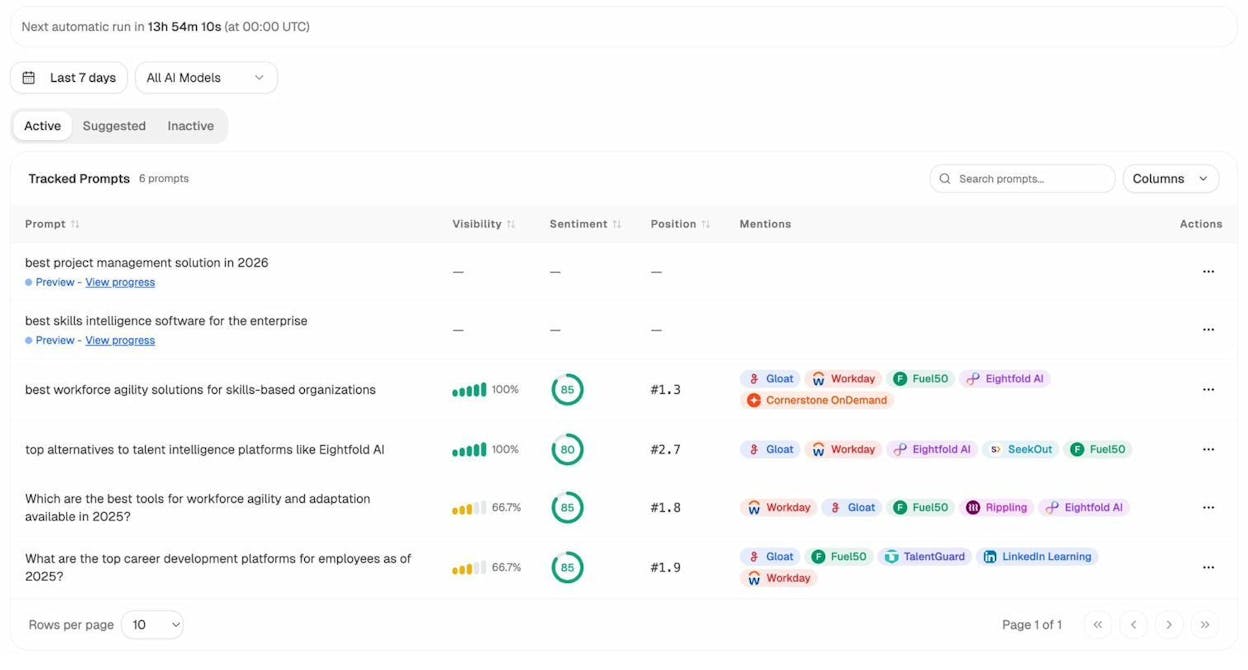
The article you write for “best AI search analytics tools” should rank on Google. The same article, optimized correctly, should also be the one ChatGPT cites when a buyer asks the equivalent question. Both can be true at once.
For more on tracking the questions buyers ask in AI engines, see our guide on People Also Ask in AI search.
2. Turn sales objections into content
Every objection your sales team hears is a content brief in disguise. The same hesitation that costs you a deal is killing fifty other pipelines on competitor websites right now. Write the answer once and let it work on autopilot.
Three formats work.
Comparison pages. “Your product vs. Competitor X.” Buyers search this exact phrase when they’re days away from buying. Be honest, be specific, and be confident. A fair comparison page that admits where the competitor is stronger earns more trust than a hit piece. Podia’s “Podia vs. Kajabi” is a clean example.
Feature philosophy posts. Explain why your product works the way it does. Basecamp wrote “Why You Need a Kanban Board for Project Management” to defend a product decision. The post both ranks and pre-handles the objection.
Direct rebuttals. When customers raise a real concern about pricing, positioning, or a missing feature, write a public response. Ahrefs did this with their pricing change announcement. The transparency built more goodwill than silence ever could have.
To find sales objections at scale, ask three questions in your team’s next pipeline review.
|
Question |
What it surfaces |
|---|---|
|
What’s the most common reason a deal stalls? |
Top-of-funnel positioning gap |
|
What competitor do we lose to most often? |
Comparison content priority |
|
What feature do prospects ask for that we already have? |
Education content priority |
If you don’t have a sales team, the same questions work in customer support tickets and onboarding survey responses.
3. Capture your customer wins
Case studies are the most underrated content type in B2B. They convert better than blog posts, get shared internally by champions, and serve as proof in sales calls. The catch is that a case study only works if it’s genuinely useful to a reader who isn’t yet your customer.
The structure that works.
-
Open with the customer’s specific problem in their words, not your category language.
-
Walk through what they tried before, including things that didn’t work.
-
Show the exact playbook they ran with your product, with numbers.
-
Quantify the outcome with metrics the reader cares about.
-
End with a takeaway the reader can apply even if they don’t buy your product.
The Ahrefs “link building case study” does this well. It’s a case study, but it also works as a tutorial. Anyone could follow the playbook even without using Ahrefs.
![[Screenshot description: A B2B case study landing page showing the customer logo, a headline with a specific metric like “3x organic traffic in 90 days,” and a quote pulled from the customer.]](https://www.datocms-assets.com/164164/1777674863-blobid7.png?auto=format,compress&w=1248&fit=max)
A note for AI search. Case studies with concrete metrics, specific quotes, and a clear before-and-after narrative get cited more often by AI engines than generic feature pages. When ChatGPT answers “is X tool worth it,” it pulls from case studies, not from landing pages. Treat every case study as a citation candidate.
4. Reverse-engineer your competitors’ winners
Your competitors have already done the hard work of finding which topics earn traffic and links. You can see what’s winning for them and decide whether to write a better version, a different version, or an opposing one.
There are two surfaces to mine. The traditional search surface, and the AI search surface. They overlap, but not completely. A page can drive massive Google traffic and almost zero AI citations. The reverse is also true.
On the traditional search surface. Open a competitor’s blog URL in Ahrefs Site Explorer or Semrush, navigate to “Top pages,” and sort by estimated organic traffic. The top ten pages usually account for most of their blog’s value.
![[Screenshot description: Ahrefs Site Explorer “Top pages” report for a competitor blog, sorted by traffic, with the top three rows highlighted to show they account for ~20% of total blog traffic.]](https://www.datocms-assets.com/164164/1777674867-blobid8.jpg?auto=format,compress&w=1248&fit=max)
If you don’t have a paid tool, the free Website Traffic Checker and SERP Checker from Analyze AI cover most of what you need for the URLs and keywords you most care about.
For each top page, ask three questions.
-
Could I write a more specific, more useful version of this for the same keyword?
-
Could I write a contrarian version that argues the opposite?
-
Could I write a version that covers a sharper sub-topic the competitor missed?
If the answer to any of those is yes, that’s your next article.
On the AI search surface. This is the surface most ideation guides ignore. A competitor can dominate AI engine answers for a prompt where you’re invisible. Those prompts are ideation gold because they show topics where buyers are actively asking and your competitor is the default answer.
The Competitor Intelligence feature in Analyze AI shows exactly this. You enter your competitors, and it surfaces the prompts where they get cited and you don’t, across ChatGPT, Perplexity, Gemini, Copilot, and Claude.
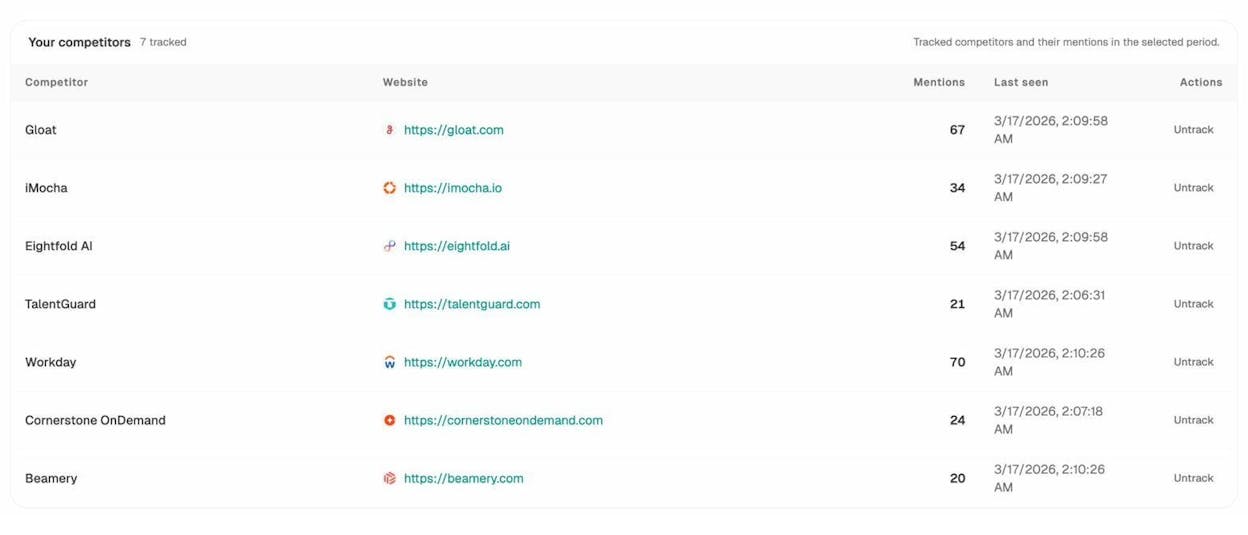
Each row is a prompt where your competitor is winning. Each is also a content brief. Write the article that earns the citation, optimize it for AI engine retrieval, and you reclaim the share of voice. For a deeper walkthrough, see our 6-step SEO competitor analysis guide.
A practical rule. Pick the prompts where the competitor is cited but the citation is weak (a short mention, a thin source). Those are the easiest to displace. Save the prompts where the competitor has a deep, authoritative source for later.
5. Analyze your industry
If you can help your audience understand the world they operate in, you build trust faster than any feature page can. The format is simple. Take something that’s changing, explain why it’s changing, and tell readers what to do about it.
Three angles work consistently.
Trend explainers. “What ChatGPT means for SEO.” “Why CACs are rising in B2B.” “The shift from keywords to prompts.” Pick a trend your audience is already worried about, take a clear position, and give them three concrete actions.
Strategy teardowns. Pick a company that’s winning and reverse-engineer how. Ahrefs’s “6 Things I Love About Zapier’s SEO Strategy” is the textbook example. Pick a public-facing playbook, document what they did, and explain why it worked.
Acquisition and funding analyses. When something major happens in your industry, write the explainer your audience wants but didn’t have time to research. Foundation’s HubSpot acquires The Hustle post is a clean example.
![[Screenshot description: An industry teardown blog post landing page with a hero image of a company logo and a headline like “6 Things I Love About Zapier’s SEO Strategy.”]](https://www.datocms-assets.com/164164/1777674872-blobid10.png?auto=format,compress&w=1248&fit=max)
A craft note. Industry analysis is where it’s easiest to lapse into corporate filler. The good ones have a real point of view. If your draft doesn’t commit to a position, it isn’t finished.
6. Challenge industry truisms
Every industry has best practices that everyone repeats and almost nobody questions. “You need to publish twice a week.” “Long-form always wins.” “GEO is replacing SEO.” When you actually look at the data, many of these are wrong.
If your experience disagrees with conventional wisdom, write the disagreement. Show your work. Explain why the truism is wrong, what people should do instead, and what evidence backs up your view.
Two examples worth studying.
Why Wireframes Are Bad for Creativity by Basecamp argues against a near-universal practice in product design. It earned links and started a real debate.
Should You Raise Your Rates and Only Take Paid Speaking Gigs? Not So Fast… by SparkToro pushes back against advice given out at every creator conference.
For Analyze AI, our manifesto is the same kind of post. Most of the AI search industry tells you SEO is dead. We argue the opposite. AI search is an additional organic channel to optimize alongside traditional SEO, not a replacement for it. That position has earned more inbound conversations than any feature post we’ve written.
A warning. Contrarian posts work only when the contrarian view is genuinely held and well-supported. Manufactured contrarianism is worse than no take.
7. Share useful personal experiences
You and your team have done things most of your readers haven’t. Built systems that worked, run experiments that failed, made decisions you can defend. Those experiences, written up clearly, are some of the most valuable content you can produce.
Three formats.
Process documentation. “How we make decisions at Coinbase.” “The exact onboarding email sequence that got us to $1M ARR.” Show the workflow, not just the principle.
Failure stories. “I Blogged Every Night for a Week. It Went Terribly.” Failure stories work because everyone else publishes curated wins. The contrast earns attention.
Experiments with results. Run something you don’t know the answer to, log every step, publish the data. Ahrefs’s “I Deleted the Content From Two Posts To See if They’d Still Rank” is a good template.
![[Screenshot description: A blog post titled “How We Make Decisions at Coinbase” with a visible decision-making framework diagram in the body of the post.]](https://www.datocms-assets.com/164164/1777674874-blobid11.png?auto=format,compress&w=1248&fit=max)
The test for whether to write up a personal experience is simple. Would a reader who’s not in your company find this useful within two minutes of reading? If yes, write it. If no, save it for an internal doc.
8. Document your vision
Customers buy features. The customers who stay, refer, and expand buy a vision. Posts that explain what you believe and why are the easiest way to compound that loyalty.
Three angles.
Why you exist. Tell the founding story honestly. The version where you nearly quit is more persuasive than the version where everything went smoothly.
How the industry is changing and what you’ll do about it. This is where most “manifesto” posts live. The good ones make a clear prediction and stake out a position. The bad ones hedge.
Why you made an unusual business decision. Ahrefs wrote “How Ahrefs Saved US$400M in 3 Years by NOT Going to the Cloud”. It earned more enterprise inbound interest than any feature post.
Vision posts are also the content type AI engines disproportionately quote when describing your company. ChatGPT won’t paste your homepage tagline back to a buyer. It will paraphrase the manifesto post you wrote two years ago. Make sure that post says what you want said.
From idea to draft
A simple validation rule turns the inbox into a calendar. For every idea, score three things. Search demand or AI prompt frequency. Fit with your product. Your team’s unique angle. If two of three are weak, kill it. Then read the top 5 Google results and ask the same question to ChatGPT and Perplexity. If you can’t beat what’s already there on at least one dimension, change the angle.
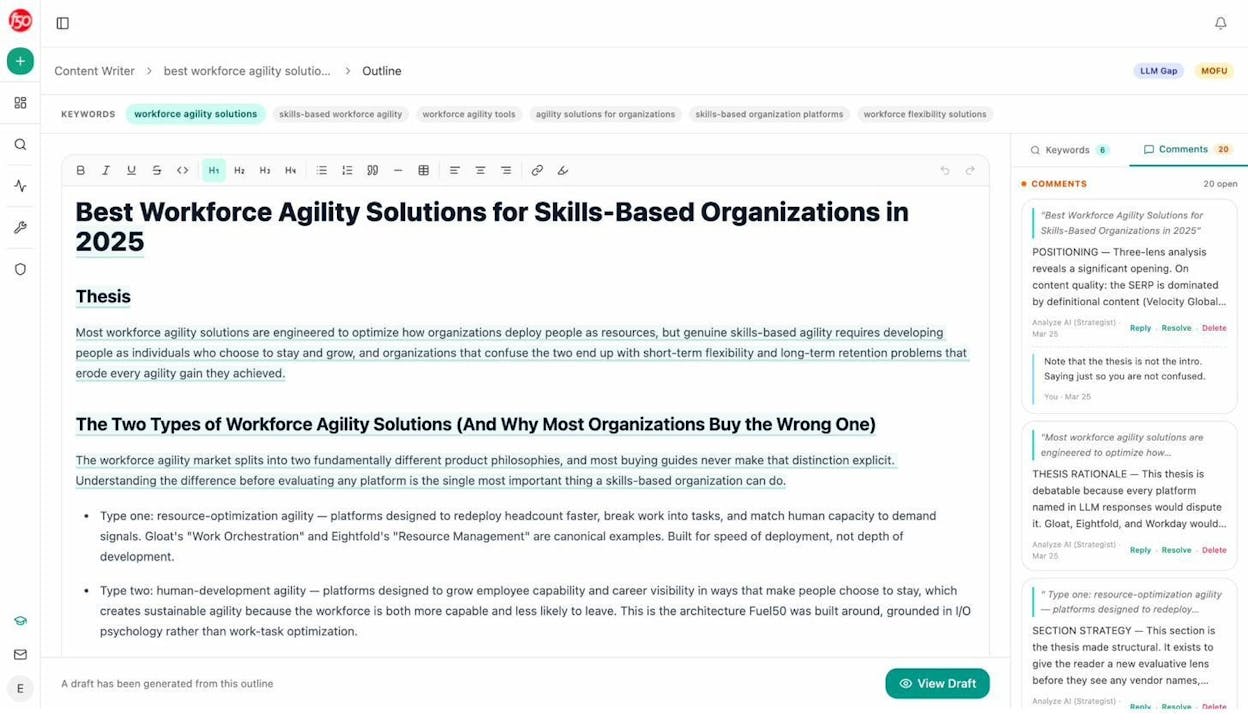
The Content Writer in Analyze AI compresses this loop. It pulls competitor pages and AI engine citations for the target keyword, finds the gaps, builds an outline, and drafts the article with citations preserved. The Content Optimizer does the same for posts you already have but want to update.
Final thoughts
The teams who win at content ideation aren’t the most creative. They’re the most systematic. They have a steady stream of inputs, a place to capture every thought, a clear scoring rule, and a feedback ritual that makes each idea better than the last.
The new layer in 2026 is AI search. The same prompts and citations that drive ChatGPT, Perplexity, and Gemini answers are now part of the input set, the output set, and the feedback set. Treat AI search as another organic channel running alongside traditional SEO and your ideation system stays robust as both surfaces evolve.
If you want the AI search side of your loop in one place, start a free Analyze AI account and connect your domain. The prompts your buyers ask, the competitors winning those prompts, and the pages on your own site already driving AI traffic will all be in front of you within minutes. From there, the next 50 articles practically write themselves.

Ernest

Ibrahim


