



Summarize this blog post with:


In this article, you’ll learn why 96.55% of pages on the web pull in zero organic traffic from Google, and the practical steps that put yours in the 3.45% that actually gets visitors.
You’ll also learn how to extend the same playbook to AI search engines like ChatGPT, Perplexity, Claude, Gemini, and Copilot, which now act as a second organic channel sitting alongside Google.
We’ll keep this tactical. By the end, you’ll have a clear process for five things.
-
Validating that real demand exists for your topic on both Google and AI engines
-
Earning the backlinks and citations that move pages from page two to page one
-
Matching the actual intent behind a query (or a prompt) instead of guessing
-
Adding the kind of original details that pull a page out of the copycat pile
-
Building pages that are easy for both Google and AI engines to extract and recommend
Let’s start with where the 96.55% number comes from.
Table of Contents
What the data actually says
In late 2023, Ahrefs studied around 14 billion pages from their Content Explorer index and found that 96.55% of them get zero organic traffic from Google. Another 1.94% pick up between one and ten visits a month.
That leaves a tiny minority of pages doing all the work.
![[Description of the screenshot to use: Ahrefs’ bar chart from the original study showing the distribution of organic traffic across 14 billion pages, with 96.55% of pages in the “0 visits” column]](https://www.datocms-assets.com/164164/1777645347-blobid1.png?auto=format,compress&w=1248&fit=max)
The bottom line on the chart is harsh, but it lines up with what most SEO teams already feel. Most content you publish will land like a tree falling in an empty forest.
A few things have changed since 2023 that make this number even more important to internalise.
In 2025, Chartbeat data showed Google referral traffic to over 2,500 publisher websites was down by a third year-over-year globally, and 38% in the US. Similarweb reported around 69% of Google searches now end without a click to any external site, rising to 83% when AI Overviews appear and 93% in Google’s AI Mode.
So Google clicks are getting scarcer, and AI engines are starting to absorb a growing share of buyer research.
Here’s the part most “GEO is the new SEO” pieces miss. AI search is an additional organic channel that runs alongside Google. The brands showing up in both are the ones with the compounding effect, because the same fundamentals make a page win in either place.
That’s also our position at Analyze AI. Quality content still wins. The difference now is your content has to work for AI models too, not just Google.
So if 96.55% of pages get nothing from Google, what’s behind it? And how do you avoid joining them?
There are five reasons that explain almost every page in that 96.55%. We’ll work through each one with the specific steps to fix it.
Reason 1. The topic has no search demand
If nobody is searching for your topic, you can rank #1 and still get nothing. That’s true on Google, and it’s true on ChatGPT.
Take a query like “pull sitemap into google sheets.” The top-ranking page solves the problem instantly, but it gets effectively zero monthly visits because nobody else is typing those exact words into Google. The page is excellent. The topic is empty.
![[Description of the screenshot to use: Ahrefs Site Explorer showing a top-ranking page with zero estimated organic traffic for the query “pull sitemap into google sheets”]](https://www.datocms-assets.com/164164/1777645354-blobid2.png?auto=format,compress&w=1248&fit=max)
Most failed content has a version of this problem. Either nobody is searching for the exact angle the writer chose, or the keyword has volume but the writer never checked first.
The fix is keyword research, with one important upgrade. You now need to validate demand on two channels.
How to find topics with real Google demand
The classic process still works. Open a keyword research tool and look for keywords that pass three filters at once.
![[Description of the screenshot to use: keyword research tool view (Ahrefs Keywords Explorer or similar) showing volume, keyword difficulty, and traffic potential columns side by side]](https://www.datocms-assets.com/164164/1777645354-blobid3.png?auto=format,compress&w=1248&fit=max)
The three filters are search volume, keyword difficulty, and what Ahrefs calls Traffic Potential. Volume tells you how many people search the keyword each month. Difficulty tells you how hard the top 10 will be to crack. Traffic Potential estimates how much traffic the top page actually pulls in across all the related queries it ranks for.
Volume by itself is misleading. A keyword with 200 searches a month can drive thousands of visits if the top page also ranks for hundreds of related queries. A keyword with 10,000 searches a month can drive a fraction of that if the top page covers only the head term.
You can run this validation for free using the Analyze AI Keyword Difficulty Checker, the Keyword Generator, and the SERP Checker. For a deeper walkthrough, our team put together a step-by-step guide on how to find SEO keywords.
Once you have a shortlist, group them into clusters. One cluster equals one piece of content. Our keyword clustering guide walks through how to do this without overcomplicating it.
A useful sanity check at this stage is Google Autocomplete. Start typing your keyword into the search bar and screenshot the suggestions. These are the most-searched extensions of your seed term, straight from Google.
![[Description of the screenshot to use: Google search bar showing the autocomplete dropdown for a seed keyword, with several long-tail suggestions visible]](https://www.datocms-assets.com/164164/1777645360-blobid4.png?auto=format,compress&w=1248&fit=max)
If autocomplete shows variations you hadn’t planned to cover, add them to the cluster. They’re free demand signals.
How to find prompts buyers are actually using on AI engines
Here is where most teams stop. They validate Google demand, then assume the same keyword will work on ChatGPT. It rarely does. Buyers ask AI engines longer, more specific questions, and the language is different.
A Google searcher might type “best CRM for startups.” A ChatGPT user is more likely to type “What’s the best CRM for a 5-person SaaS startup that integrates with HubSpot and has a free tier?” The intent overlaps, but the surface form does not, and the citations that appear on these prompts come from very different pages.
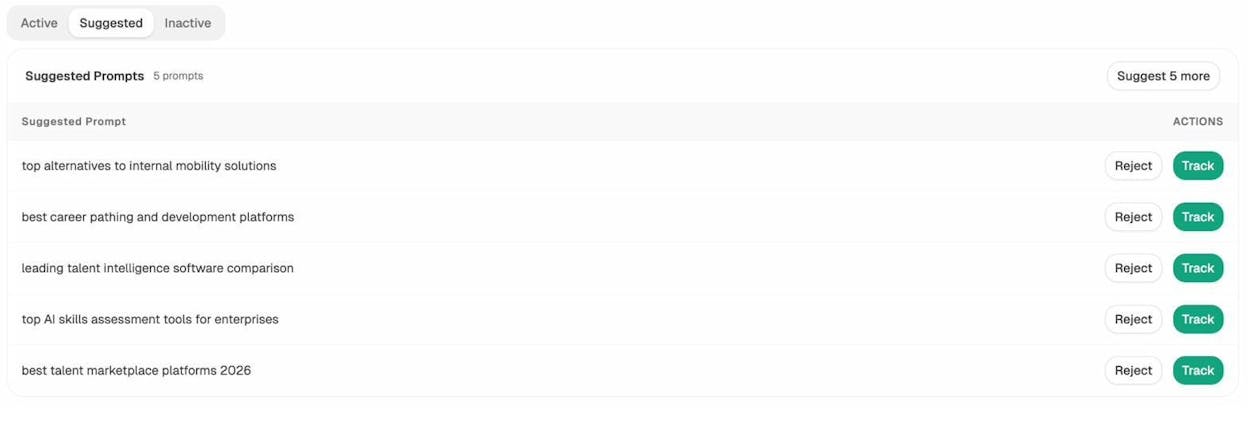
Inside Analyze AI, the Prompt Discovery feature generates a list of suggested prompts that real users are likely to ask in your space, based on your domain, your competitors, and the topics you sell into. You can move them straight into tracking with one click.
You can also test a single prompt on the spot before committing to long-term tracking. The AI Search Explorer runs an ad-hoc search across ChatGPT, Perplexity, Gemini, and Copilot and shows you who gets cited, what the answer looks like, and where the gaps are.
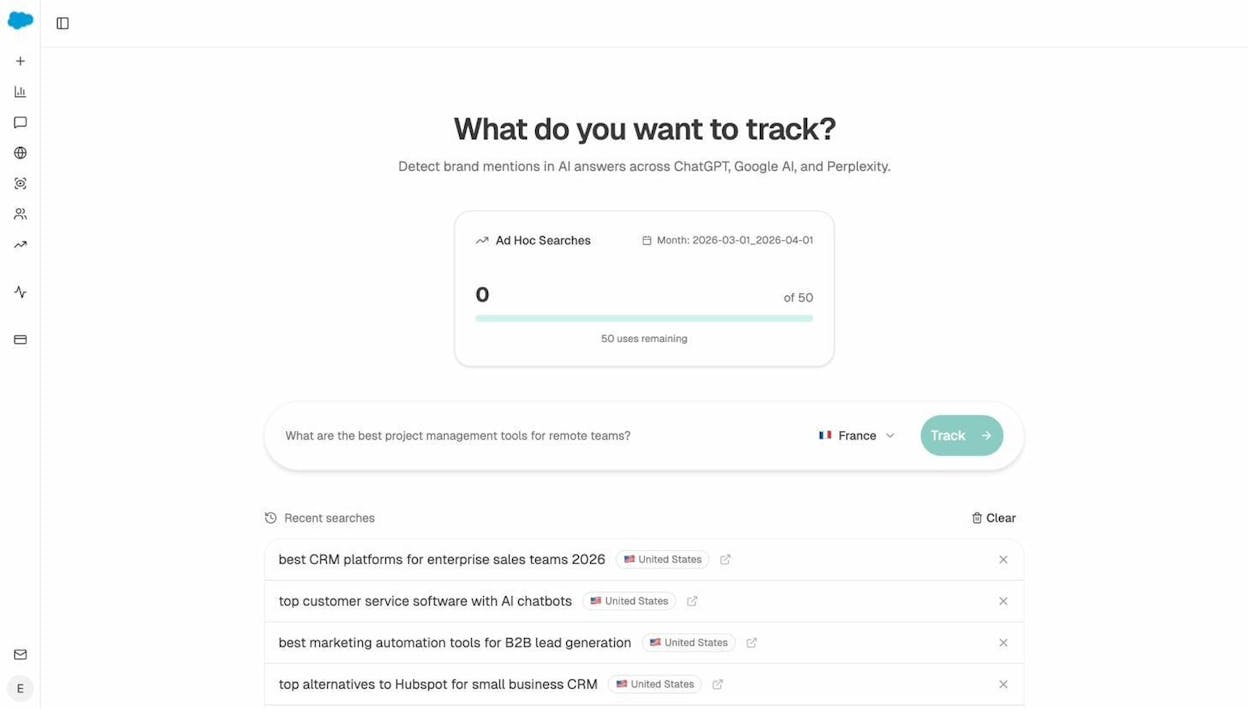
This is the AI search equivalent of a SERP analysis. You’re checking demand and competitive shape in one move.
If a prompt has no answers in your space, that’s a sign the topic has no real AI demand yet. Either skip it or get there early before competitors do. If a prompt has clear answers and you’re not in them, you have a target.
For a deeper read on prompt-level keyword work, see our guide on AI keyword research using free chatbot tools and our breakdown of the 22 keyword types to know for SEO and AI search.
Validating demand on both channels takes more time than only checking Google, but it doubles the surface area where your content can win.
Reason 2. The page has no backlinks (and no citations)
Backlinks are still one of Google’s top three ranking factors. The correlation is well-documented. Pages with more linking domains rank for more keywords and pull more traffic, with one exception we’ll get to.
![[Description of the screenshot to use: line chart from the Ahrefs study showing the relationship between number of referring domains and organic traffic, with traffic increasing as referring domains increase]](https://www.datocms-assets.com/164164/1777645366-blobid7.png?auto=format,compress&w=1248&fit=max)
The exception is low-competition topics. If a keyword has a Keyword Difficulty score in the single digits, you can rank for it on a fresh page with zero backlinks, especially if the rest of your domain has authority that flows through internal links.
Most pages that get traffic without backlinks are doing one of two things. They’re either ranking for very long-tail, low-competition queries, or they’re sitting on a strong domain that’s lifting them through internal PageRank.
So the practical rule is simple. You have two paths.
Path A. Target uncompetitive topics you can win without links
Open a keyword research tool. Filter for keyword difficulty below 20.
Then filter for at least one site with a Domain Rating equal to or lower than yours ranking in the top 5. Make sure the Traffic Potential column shows real volume, not just one isolated keyword.
![[Description of the screenshot to use: keyword research tool with filters set to KD ≤ 20 and “Lowest DR” equal to the user’s domain rating, showing a filtered list of qualified keywords with Traffic Potential values]](https://www.datocms-assets.com/164164/1777645371-blobid8.png?auto=format,compress&w=1248&fit=max)
That filtered list is your starting point. Pick keywords where the SERP is dominated by thin pages, broken pages, or pages that obviously don’t match intent. Those are gaps you can take with strong content alone.
You can run a quick version of this analysis using the Analyze AI Keyword Difficulty Checker and the Website Authority Checker, both free.
Path B. Build the links you need to rank competitive topics
If the keywords that matter to your business are competitive, you’ll need links. There’s no shortcut here, but there is a process. We’ve broken it down in our off-page SEO guide and our list of the best link-building tools.
The shortest version. Build pages that genuinely add something to the conversation, then promote them to the people most likely to link. Generic content gets ignored. Original data, original opinion, and original frameworks get linked.
A small operational detail matters here too. Audit your existing pages for broken outbound links once a quarter. Broken links lower the perceived quality of the page in Google’s eyes and frustrate readers. The free Analyze AI Broken Link Checker handles this in a few seconds per URL.
How “links” work on AI engines (citations and source authority)
AI engines do not rank pages the way Google does, but they have their own version of the link graph. They rely on citations, the URLs they pull from to build an answer, and on entity-level signals that tell them which brands matter in a given space.
A few patterns from recent research. Semrush found that nearly 90% of ChatGPT citations come from URLs that rank outside the top 20 in Google. Previsible’s analysis of 1.96 million LLM sessions found that brand search volume was the strongest predictor of AI citations, ahead of backlinks.
Translation. AI engines pull from a wider, weirder set of sources than Google does, and brand recognition matters more than Domain Rating. So while you should keep building links for Google, you also need to map out which sources AI engines trust in your category.
The Citation Analytics feature inside Analyze AI shows you exactly which URLs and domains AI engines cite when answering questions in your space. You see the full source list ChatGPT, Claude, Perplexity, Gemini, and Copilot pull from on a query, ranked by how often each source appears, and broken down by content type.
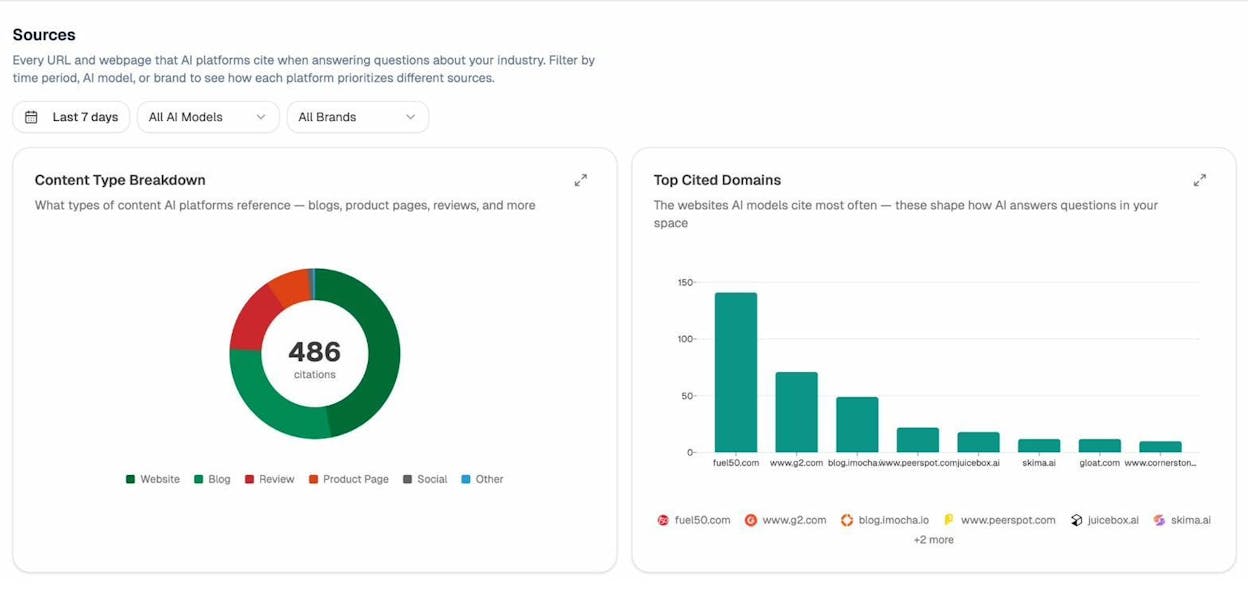
This gives you three concrete moves.
First, audit the top sources in your space and figure out why they’re cited. Often it’s because they have structured information AI can lift cleanly, like a comparison table, a clear definition, or a numbered list of options.
Second, target the sources you can earn placement on. If G2, Capterra, or a Reddit thread keeps showing up as a top citation for buying queries, get listed there. Make sure your profile is current and rich.
Third, identify the URLs you already have that look citation-ready and double down on them. The same kinds of pages get cited again and again.
For a much deeper read on this, see our analyses of how to rank on Perplexity AI and how to rank on ChatGPT, both based on 65,000 prompt citations.
Reason 3. The page doesn’t match search intent (or prompt intent)
You can rank a page on a high-volume keyword with strong backlinks and still get no traffic. It happens when the page doesn’t match what the searcher actually wants.
Take “best yoga mats.” The top results are blog posts that compare options. A product page selling a single yoga mat, even with backlinks from six times more sites than any of the top results, won’t rank, because Google knows the searcher is in research mode.
![[Description of the screenshot to use: SERP for “best yoga mats” showing a list of comparison-style blog posts at the top, with a sidebar showing a competing product page that has many more backlinks but doesn’t appear in the top 10]](https://www.datocms-assets.com/164164/1777645377-blobid10.png?auto=format,compress&w=1248&fit=max)
This is where most “we have great content but no rankings” problems come from. The team built the wrong format.
How to read search intent before you write
Open a Google search for your target keyword. Look at the top 5 results and ask three questions.
What format are they? Listicle, tutorial, definition, tool, comparison, product page. Whatever dominates the top 5 is the format Google has decided fits the query. Build that format.
What angle are they? “Best for small teams,” “free options only,” “with case studies.” Look at the angles the top pages chose. Your angle should fit the same neighbourhood, then add something the others don’t.
What sub-topics do they cover? Skim the headings of the top 3. The overlap is the bare minimum your content needs to address. The gaps in their coverage are your opportunity to add information.
This is the work most “SEO content” skips. Our full guide on how to write an article covers it in more depth, and our SEO competitor analysis breakdown goes further on the SERP-level read.
How to read prompt intent on AI engines
The equivalent move for AI search is to read the prompt, not just the keyword. Prompts carry more intent because they include the constraints buyers don’t bother to type into Google.
“Best CRM” is a keyword. “Best CRM for a 10-person agency that wants to track outbound campaigns and sync to Slack” is a prompt. The second one tells you exactly what kind of content gets cited, which features matter, and how to structure your page.
Inside Analyze AI, the Competitor Intelligence view shows you which competitors AI engines recommend for a given prompt, and which prompts they win on that you don’t.
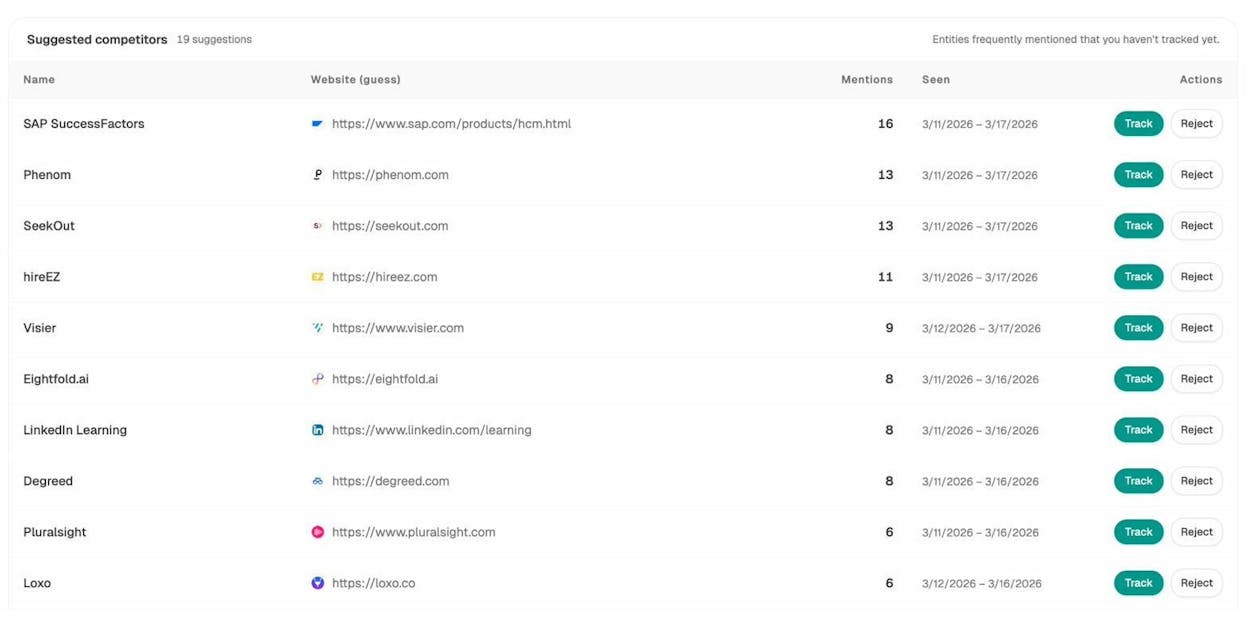
If competitor X keeps appearing for “best CRM for agencies” but not for “best CRM for ecommerce,” you have a clear pattern. Their content matches the agency intent better than yours.
Read their pages. Spot what they emphasise. Match the intent on yours, then push past it.
Re-optimising for intent is one of the highest-leverage SEO moves there is. Ahrefs’ free backlink checker is a famous case.
The page used to be a generic landing page explaining the product. Once they realised searchers wanted a free tool, they replaced the page under the same URL with an actual tool. Rankings went from nowhere to #1, and traffic went from around 14k a month to nearly 200k.
The same logic applies to AI search. If your page targets a prompt that wants a comparison and your content reads like a sales page, you won’t get cited. Re-optimising for prompt intent looks like adding the comparison table, naming the alternatives directly, and including the use cases buyers actually mention.
Reason 4. The content has no information gain
Search demand, backlinks, and intent matching are necessary, but they’re not enough on their own anymore. You can hit all three and still get no traffic, because the bar for “good enough” has moved.
The reason is information gain. If your page repeats what the top 5 results already say, Google has no reason to rank it, and AI engines have no reason to cite it. Every model in the modern web rewards content that adds something the rest don’t.
Animalz wrote a strong piece on this that’s worth reading in full. Their core argument from the Information Gain breakdown is that AI engines synthesise an answer from an average of five sources. The page that gets cited is the one that contributes something new. The rest get absorbed into the synthesis without attribution.
There are five practical sources of information gain you can pull from.
|
Source |
What it looks like in practice |
|---|---|
|
Original data |
A study you ran, a survey you fielded, a dataset you analysed |
|
Original opinion |
A clear point of view that disagrees with the conventional answer |
|
Original frameworks |
A model or process you’ve built and tested with real cases |
|
Direct experience |
First-person tests, screenshots from real workflows, before-and-after numbers |
|
Customer interviews |
Quotes, case studies, and pain points from people who actually bought your product |
Pages that lean on at least one of these consistently outperform pages that summarise. The Grow and Convert team has written about a similar idea they call “originality nuggets,” arguing that even one specific, hard-won insight in a piece can change its competitive trajectory.
How to find information gaps before you write
The fastest way is a side-by-side audit. Open the top 5 pages for your keyword. Read them with one question in mind. What is every single one of them missing?
Your information gain is whatever the gap turns out to be. A pricing breakdown nobody included. A failure mode nobody mentioned.
A workflow nobody documented step by step. A cohort of customers nobody segmented for.
This is also where the Analyze AI Content Optimizer earns its keep. You give it a URL. It fetches the page, scores the content on argument quality, flow, clarity, and polish, and surfaces the specific gaps based on what AI engines and search engines reward.
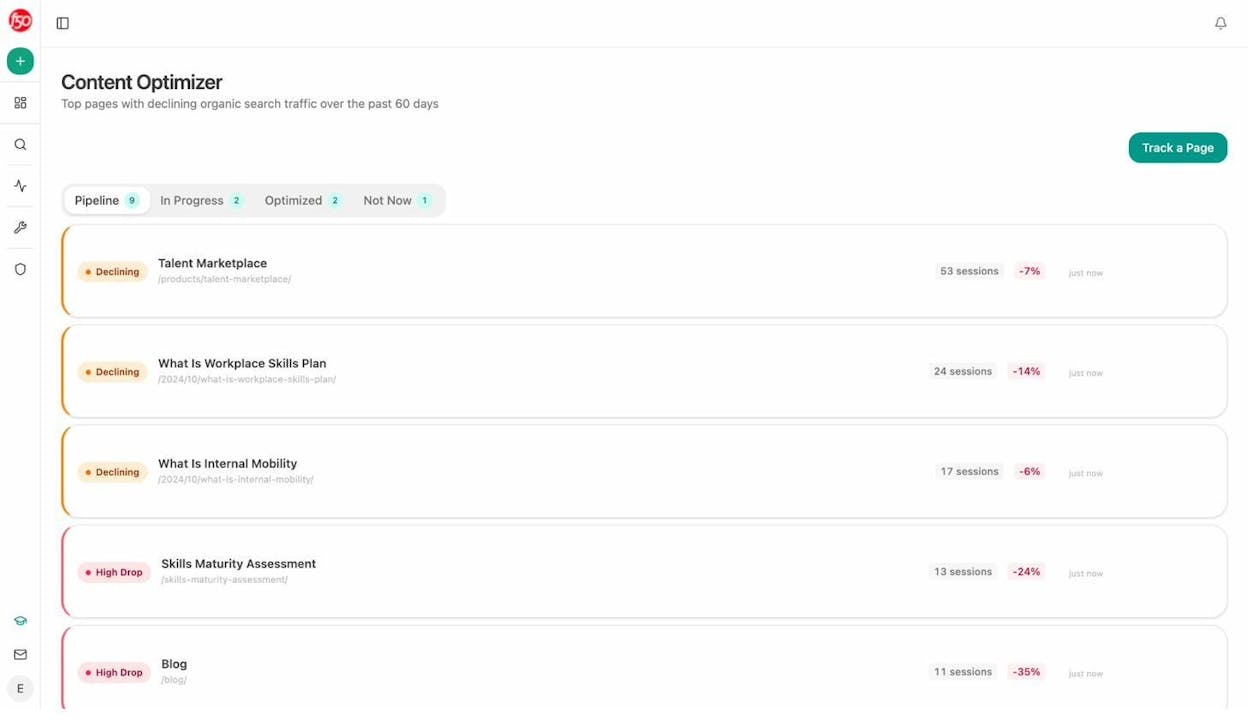
It also drafts an editorial pass with line-level comments, so you can see exactly where the argument is thin and where original details would land hardest.
Why information gain matters even more in AI search
AI engines summarise. When a model summarises five pages that say roughly the same thing, only one of them gets cited, because the others add nothing. The page that gets cited is usually the one with the distinctive detail, the original number, the contrarian take, the specific example.
Generic content was always weak SEO. In an AI-search world, generic content is invisible.
If you want to go deeper on the workflow side, our content marketing tools roundup covers the research aids that help find gaps faster, and our breakdown of AI SEO content optimization tools compares the dedicated platforms.
Reason 5. The page lacks E-E-A-T signals and isn’t built to be quoted
The last reason is the most underrated. You can have demand, links, intent, and information gain, and still lose, if Google and AI engines can’t trust the page or pull a clean answer out of it.
Google’s December 2025 Core Update increased the weight of E-E-A-T (Experience, Expertise, Authoritativeness, Trust) across all content types, not just YMYL topics. Sites with thin author bios, no original testing, and no external authority signals lost ground at scale.
AI engines apply a similar filter, just less explicitly. They prefer content that looks like it was written by someone who knows the topic. They reward pages that present claims clearly enough to lift into an answer.
There are two things to fix here.
Fix 1. Strengthen the credibility signals on every page
Three details move the needle most.
First, give the article a real author with a real bio. Link the bio page to the author’s external profiles like LinkedIn, X, Substack, podcast appearances, and conference talks. The point is to show that this person exists and has spent real time in the topic.
Second, show experience. Add screenshots of your own workflow, numbers from a project you ran, quotes from customers you interviewed. Generic stock images don’t count.
The phrase Google uses internally for this is “first-hand experience.” If the page reads like the author has done the thing, both Google and AI engines weight it more.
Third, link out to authoritative sources, and earn inbound links from them. The reverse is true too. If your sources are weak (random Medium posts, AI-generated content farms, low-quality directories) the page inherits that weakness.
For a deeper breakdown, see Ahrefs’ work on E-E-A-T markers, which lists 220 specific signals that map to experience, expertise, authority, and trust.
Fix 2. Structure the page so the answer is easy to extract
This matters more for AI search than for Google, but it helps both.
A few rules that consistently improve extractability.
Lead the section with a clear, one-sentence answer. AI engines often pull the first sentence under a heading as the canonical answer. Don’t bury the lead under context.
Use H2s and H3s that match the question shape. “What is X” works better than “Understanding X.” “How to do X” works better than “X in your business.” If the heading mirrors the prompt, the section is easier to lift.
Put structured information into actual structure. Comparison data goes in a table. Steps go in a numbered list.
Definitions sit on their own line. The model can’t extract a clean answer from a wall of text, no matter how good the wall is.
Add summary lines at the top of each section. One or two sentences that compress the section’s argument. These tend to get cited verbatim.
Add a clear FAQ block at the bottom for the closely related sub-questions. They often get cited as standalone answers.
![[Description of the screenshot to use: example article structure with clearly question-shaped H2 headings, a one-line summary under each, a table inside one section, and an FAQ block at the bottom, annotated to show which elements AI engines tend to lift]](https://www.datocms-assets.com/164164/1777645383-blobid13.png?auto=format,compress&w=1248&fit=max)
For more on this side of the work, our breakdown of answer engine optimization (AEO) and our definition of generative engine optimization (GEO) cover the structural patterns in detail.
How to know if AI engines are actually quoting you
This is where most teams are flying blind. You publish, you wait, and you have no idea whether ChatGPT or Perplexity is sending traffic to the page or citing it in answers.
Inside Analyze AI, the AI Traffic Analytics view shows you the ChatGPT, Claude, Perplexity, Gemini, and Copilot referrals hitting your site, the engagement, the conversion data, and the specific landing pages getting the visits.
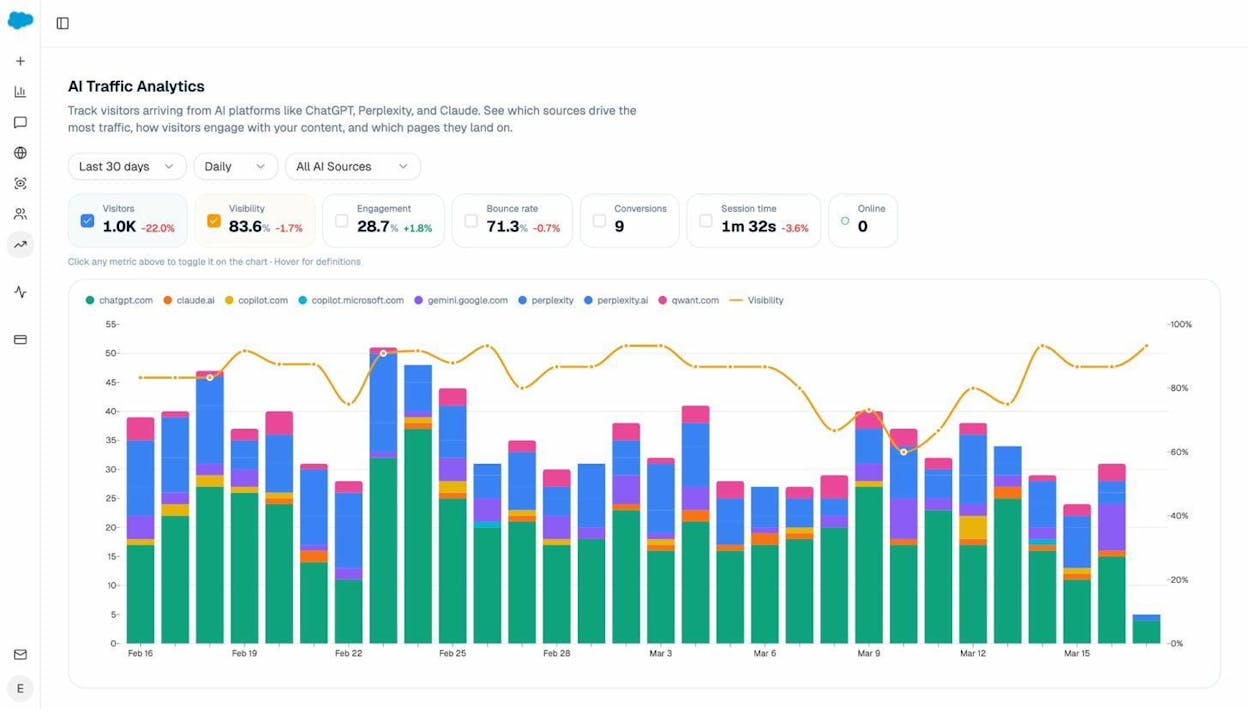
You can sort by landing page and see the exact pages that are pulling AI search traffic. That list is gold, because it tells you which formats and topics already work in AI search for your domain. Double down on the patterns that show up.
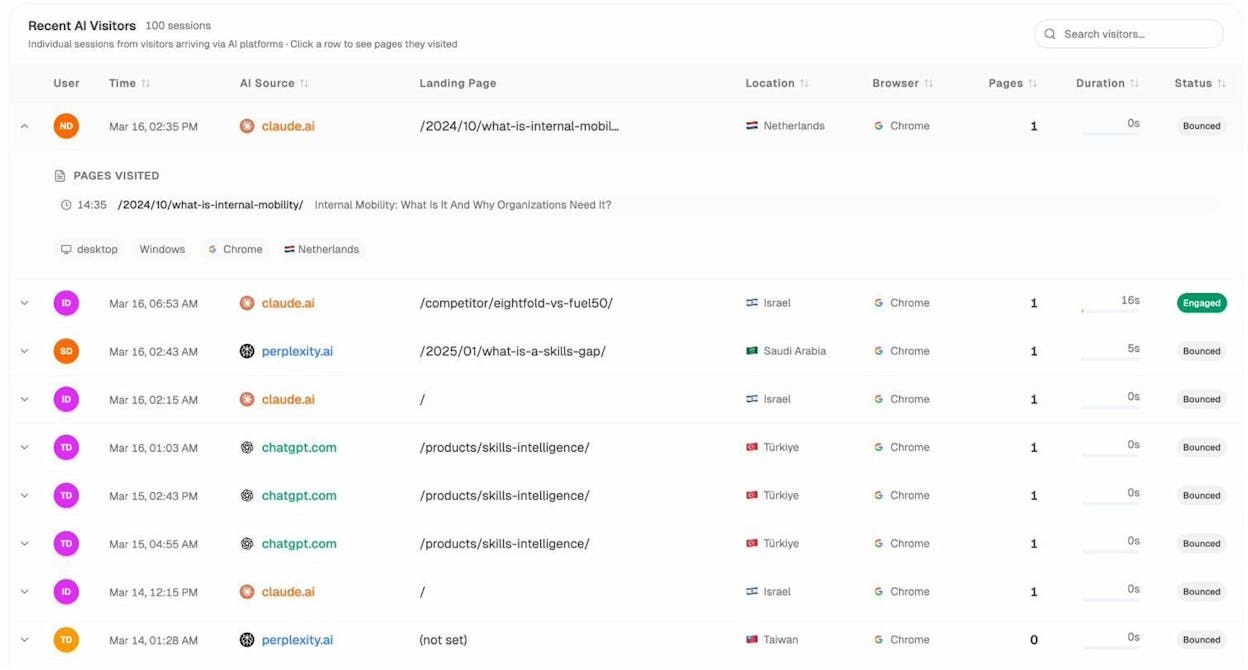
If a how-to article is pulling traffic from Claude, the playbook is to write more how-tos. If a comparison page is pulling traffic from Perplexity, write more comparisons. AI search traffic, like Google traffic, compounds when you spot the pattern early.
You can also pair this with our breakdown of types of SEO and 40+ techniques to rank higher and our 2026 SEO content strategy guide to fold the AI signals into your wider plan.
A practical playbook for the next 30 days
Here’s what to do with all of this. Pick one underperforming page on your site. Either one that ranks page two or three on Google, or one you’ve published in the last six months that’s still not getting traffic. Run it through this checklist.
|
Step |
What to do |
Tool or guide |
|---|---|---|
|
1 |
Check the keyword has real Traffic Potential and the prompt has real demand on AI engines |
|
|
2 |
Confirm the page is indexed and has at least a handful of internal links from related pages |
|
|
3 |
Audit the top 5 SERP results and the top citations on AI engines for the same query, then match the format |
|
|
4 |
List the gaps. Add at least one piece of original data, opinion, framework, or experience the top results don’t have |
|
|
5 |
Strengthen the byline, the sources, and the structure. Lead each H2 with a clean one-sentence answer |
|
|
6 |
Track what changes. Watch Google rankings, AI citations, and AI referral traffic together |
If you do this for one page a week, you’ll have ten upgraded pages in two and a half months. That’s usually more impact than publishing ten new ones on autopilot.
For more on the broader strategy, see our 2026 SEO content strategy guide, our breakdown of the four pillars of an SEO strategy for AI search, and our 16 best competitor monitoring tools for keeping an eye on shifts in your space.
TL;DR
96.55% of pages get no organic traffic from Google. The most common reasons are no real demand, no backlinks or authority, mismatched intent, no information gain, and weak credibility or structure.
The same five reasons explain why most pages also fail in AI search. Demand exists at the prompt level too. Authority looks like citations from sources AI engines trust.
Intent has to match the prompt, not just the keyword. Information gain matters more, because AI summarises. And extractability decides whether you get quoted.
SEO is alive. AI search adds to it. The brands showing up in both are the ones that get the compounding effect.
If you want to see how your brand currently appears across ChatGPT, Perplexity, Claude, Gemini, and Copilot, Analyze AI gives you the baseline in minutes.

Ernest

Ibrahim


