



Summarize this blog post with:


The headline number you’ve probably seen quoted is Ahrefs’ April 2025 study showing AI Overviews correlated with a 34.5% lower CTR for top-ranking pages. That number is now outdated. As of December 2025, Ahrefs’ updated study put the figure at 58%, and several other research teams have measured even larger drops in specific contexts.
In this article, you’ll see how much AI Overviews have eroded organic click-through rates across 12 independent studies, why the impact is much larger than what Google admits, which industries and query types are taking the worst hit, where the missing clicks are actually going, and how to measure your own exposure step by step. You’ll finish with a clear playbook for adapting without abandoning the SEO foundation that still drives most of your pipeline.
Table of Contents
How much have AI Overviews really cut click-through rates?
Twelve studies released between mid-2025 and early 2026 all reach the same conclusion. AI Overviews are siphoning a meaningful share of clicks away from the top of the page. They disagree on the exact percentage, but the direction is unambiguous.
Here is the picture across the most rigorous research:
|
Source |
Method |
CTR Impact When AIO Appears |
|---|---|---|
|
300,000 keywords, GSC data |
-58% at position 1 |
|
|
68,000 real queries, 900 users |
-47% (8% vs 15% baseline) |
|
|
3,119 queries, 25.1M impressions |
-49% to -65% organic |
|
|
Authoritas (2025) |
Top organic link analysis |
~-79% on AIO SERPs |
|
SISTRIX (Germany) |
Position 1 analysis |
-59% |
|
Amsive Digital |
700,000 keywords, 5 industries |
-15.5% (averaged across positions) |
|
DMG Media (Daily Mail) |
First-party publisher data |
-89% (25.2% to 2.8%) |
The Ahrefs data is the most cited because it covers the largest keyword set and uses Google Search Console data directly. But the most behaviorally accurate study comes from Pew Research, which tracked actual browsing behavior of 900 U.S. adults and found people clicked through on just 8% of searches when an AI Overview was present, compared to 15% without one.
Only 1% of users click a link inside the AI Overview itself, according to that same Pew study.
That last number deserves attention. Sundar Pichai has publicly claimed that “links included in AI Overviews get more clicks than if the page had appeared as a traditional web listing.” The independent data does not support this. When a brand is cited inside an AI Overview, it gets a small bump in brand awareness, but very rarely a click.
Position 1 is no longer worth what it used to be
The CTR damage is concentrated at the top of the page, where it hurts the most. Ahrefs’ position-by-position analysis shows the impact decays as you move down the SERP, but no ranking position escapes unscathed.
|
Ranking Position |
CTR Impact When AIO Appears |
|---|---|
|
1 |
-58.0% |
|
2 |
-50.8% |
|
3 |
-46.4% |
|
4 |
-38.8% |
|
5 |
-32.6% |
|
6 to 10 |
-19% to -30% |
Source: Ahrefs, December 2025
This pattern reverses the historical economics of SEO. Position one used to deliver roughly ten times the traffic of position ten. With AI Overviews present, the gap narrows considerably because position one absorbs most of the click loss.
For long-form content teams, this means the marginal value of pushing a page from position 3 to position 1 has fallen sharply on AIO-affected queries. Effort that used to produce a 3x traffic gain might now produce a 1.5x gain.
The verticals taking the biggest hit
Not every industry is bleeding clicks at the same rate. AI Overviews appear most often on informational, question-led, comparison, and how-to queries. They appear far less often on transactional, local, and shopping queries.
Ahrefs’ research shows AI Overviews appear in 99.9% of informational keywords (most of them long-tail, 7+ words), while transactional and shopping queries see them less than 5% of the time.
Industry breakdown of AIO presence:
|
Vertical |
AI Overview Presence |
|---|---|
|
Science |
43.6% |
|
Health |
43.0% |
|
Pets and Animals |
36.8% |
|
People and Society |
35.3% |
|
News |
15.1% |
|
Sports |
14.8% |
|
Real Estate |
5.8% |
|
Shopping |
3.2% |
Source: Ahrefs, November 2025
If you publish health content, science content, or B2B explainers, your most exposed pages are almost certainly the long-form informational pieces that historically drove top-of-funnel traffic. If you sell ecommerce or local services, your direct-purchase queries remain mostly intact, but your educational blog content is still vulnerable.
A surprising counterpoint comes from Amsive’s analysis of 700,000 keywords. Branded queries with AIOs actually saw a CTR increase. When a user searches for your brand by name and an AI Overview appears, the AIO often reinforces brand authority and pushes the click rate up. This is the only context where AIOs reliably help you.
Why is this happening?
AI Overviews are the latest in a long line of SERP features designed to keep users on Google. Featured Snippets started this trend over a decade ago. People Also Ask boxes, knowledge panels, local packs, video carousels, and zero-click search all worked in the same direction.
Roughly two-thirds of all Google searches now end without a click on any organic result. AI Overviews simply accelerated a curve that was already steep.
Three mechanics drive the click loss:
The query gets resolved on the page. Most informational searches have a definable answer. When the AI Overview provides that answer in two short paragraphs, there is no remaining reason to visit a website.
The user trusts the synthesis. AI Overviews summarize across multiple sources, which feels more authoritative than any single result. Users stop comparing because the comparison feels already done.
The session ends. Pew found that 26% of users abandoned their browsing session entirely after seeing an AI summary, versus 16% without one. The query is closed and the user moves on.
This is not a temporary drop while users get used to a new feature. It is a structural change in how search behavior resolves.
So where did the clicks actually go?
Some of the clicks vanished. The user got their answer and left, full stop. But a meaningful portion of the queries themselves migrated entirely.
People who used to type “best CRM for small business” into Google are now typing it into ChatGPT, Claude, Perplexity, or Gemini. ChatGPT alone served an estimated 18 billion search queries per month by late 2025, according to several industry reports.
We analyzed 83,670 AI citations across ChatGPT, Claude, and Perplexity over a 54-day period and confirmed what most teams suspect. The same buyers who used to evaluate vendors through 10 blue links are now evaluating them through three to seven names that an AI engine surfaces in a single answer.
The implication is uncomfortable. If your brand is not cited by those engines, you are not in the consideration set. Your position 1 ranking on Google is still earning a CTR, but it is earning it on a smaller pool of queries than it did 18 months ago.
This is the part that requires honesty. SEO is not dead, and AI search is not replacing it. We have laid out our full position on this in the Analyze AI manifesto. Buyers still use search engines for most of their research. Most AI engines still pull from search results to ground their answers. The two channels are tied together.
But the click economy has split. Some buyers complete their journey inside Google with no click. Some complete it inside an AI engine. Some still click through and convert the way they always did. The right response is to track all three channels and optimize for each.
How to measure your own AIO exposure and click loss
Before adapting, you need to know what you’re losing. Ahrefs’ 58% number is an industry average. Your number is what matters. Here is how to find it.
Step 1: Identify which of your keywords trigger an AI Overview
Most major SEO platforms now flag AI Overview presence as a SERP feature. In Ahrefs, you go to Site Explorer, open the Organic keywords report, and apply the AI Overview filter under SERP features.
![[Screenshot description: Ahrefs Site Explorer Organic keywords report with the AI Overview SERP feature filter enabled, showing a list of ranking keywords that trigger an AIO]](https://www.datocms-assets.com/164164/1777646530-blobid1.jpg?auto=format,compress&w=1248&fit=max)
In Semrush, the same filter is available under Position Tracking. In Google Search Console, you cannot directly filter for AI Overview presence, but you can look for queries where impressions are flat or rising while clicks are declining. That divergence is a strong AIO signal.
For one-off checks, you can use a free tool like the Analyze AI SERP Checker to see exactly what the live SERP looks like for any keyword.
Step 2: Quantify the click loss
Pull the last 12 to 16 months of Search Console data, segmented by query. For each query that triggers an AIO, compare the average CTR for the 6 months before the AIO appeared and the 6 months after. The delta is your real click loss for that query.
![[Screenshot description: Google Search Console Performance report filtered to a single query, showing the impressions line steady or rising while the clicks line drops after a marked date when AIOs began appearing]](https://www.datocms-assets.com/164164/1777646536-blobid2.png?auto=format,compress&w=1248&fit=max)
For most B2B and informational sites we have seen, the per-query loss lands somewhere between 25% and 55%. If yours is much higher, your content is probably summary-friendly. If it is much lower, you are either cited inside the AIO often, or your queries skew transactional.
Step 3: Find out where those queries went in AI search
This is the step most teams skip, and it is the one that closes the loop. The lost clicks did not vanish into nothing. A portion of them are happening as conversations inside AI engines. You need to track that.
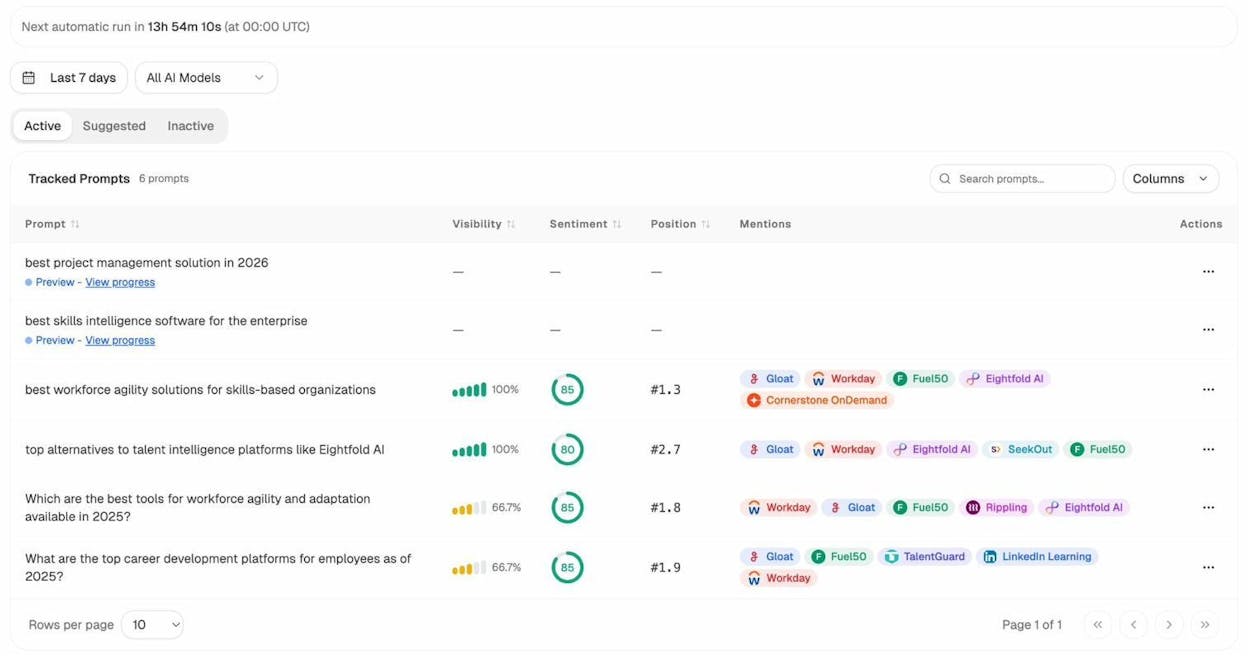
Inside Analyze AI, the Prompt Discovery feature lets you input your domain, and it will return the prompts buyers are actually asking AI engines about your category, along with which competitors are getting cited.
Once you know the prompts, you can move them into Prompt Tracking to monitor your visibility on each one across ChatGPT, Claude, Perplexity, Gemini, and Copilot.
Step 4: Tie AI visibility to the traffic it produces
Most AI engines now pass referrer data to the destination site. Inside AI Traffic Analytics, you can see which of your pages are receiving sessions from chatgpt.com, perplexity.ai, claude.ai, copilot.microsoft.com, gemini.google.com, and the others, plus how those sessions engage and convert.
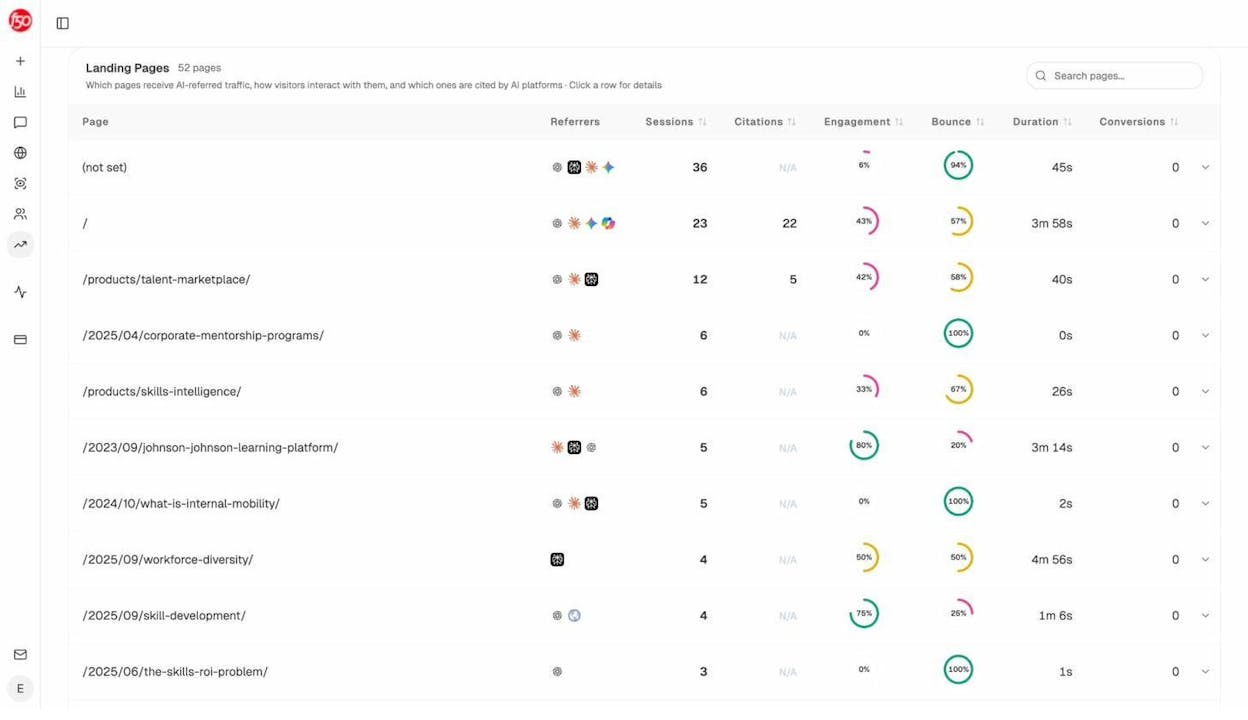
The patterns here are usually instructive. Most teams find that 60 to 80% of their AI search traffic lands on a small set of pages, often product pages, comparison content, and high-authority blog posts. That tells you which content the AI engines have decided is canonical for your category, and which content they have not.
How to adapt without abandoning what works
Once you have the measurement in place, the response is straightforward. You stop optimizing only for clicks and start optimizing for two outcomes at once. Clicks still happen on AIO-light queries. Citations still happen across both AIOs and AI engines. Both feed pipeline.
Cover the queries AIOs leave alone
The most resilient pages are the ones AI Overviews rarely trigger on. That maps to:
-
Bottom-of-funnel commercial keywords (best, top, alternatives, vs, comparisons)
-
Branded queries
-
Local intent queries
-
Transactional and shopping queries
-
Highly opinionated, original content where summarization fails
Animalz wrote a strong guide on systematically covering BOFU keywords, and the principle holds. Audit your content for gaps in “best [category],” “[competitor] alternatives,” and “[your category] vs [other category]” queries. These pages still earn clicks at full rates.
Earn citations, not just rankings
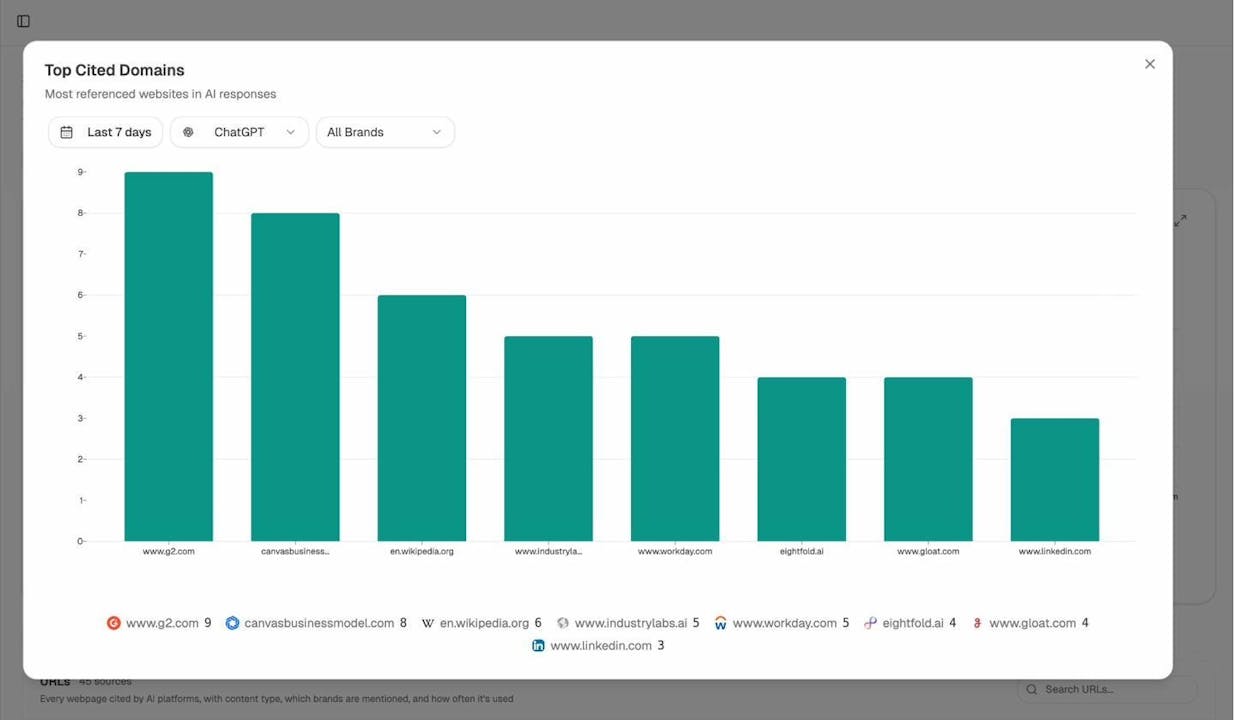
Across our 83,670-citation dataset, 82.9% of AI citations came from third-party sources, not the brand’s own website. ChatGPT cites brand websites for only 13.5% of mentions. Claude is highest at 22.2%, but still relies primarily on external sources.
This means your link-building strategy now does double duty. Backlinks were always a ranking factor. Now they are also a citation factor. The mentions you earn on G2, Reddit, industry publications, podcasts, and analyst reports often matter more for AI visibility than the content on your own domain.
Diversify across AI engines
Each engine cites differently. ChatGPT pulls Wikipedia for 12.1% of citations. Claude pulls it for 0.1%. Perplexity does not cite it at all. ChatGPT loves LinkedIn (4.1% of citations). Claude and Perplexity ignore it. Claude prefers blog content (43.8%). ChatGPT and Perplexity prefer product and feature pages (60% and 54% respectively).
Building visibility on a single engine is fragile. We cover the engine-specific tactics in our breakdowns of how to rank on ChatGPT and how to rank on Perplexity.
Refresh content to add information gain
AI Overviews summarize across the existing top results. Content that simply restates what is already on page one becomes invisible. Content that adds an original angle, a new dataset, or a counter-intuitive finding tends to get cited because it is the only place the model can find that idea.
For pages that have lost clicks, refresh them with one of three things. Original research or first-party data. A specific case study with named companies and numbers. A counter-position to the conventional wisdom. Then track whether the page starts earning citations using the Citation Analytics view.
Watch competitors, especially the ones beating you in AI search
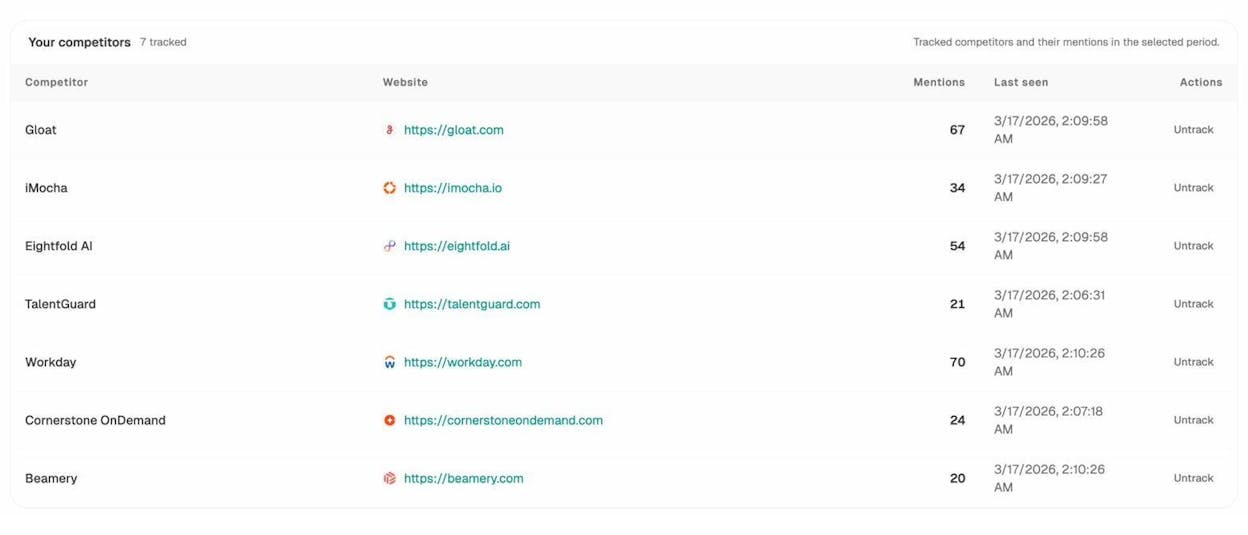
Your competitor analysis used to involve checking their backlinks and their ranking keywords. It now also has to cover which prompts they show up on, which sources cite them, and how their sentiment compares to yours.
Competitor Intelligence inside Analyze AI shows mentions per competitor across all engines, with timestamps and source URLs. The insight worth chasing is the one where a competitor consistently wins prompts you do not, because that points directly to the citation source you need to earn next.
Realign your KPIs
Organic traffic is no longer a complete success metric. Search impressions, AI mentions, AI citations, branded search volume, and assisted conversions all matter now. Realign internally before performance reviews land in Q2 or you will be defending a chart that no longer reflects your actual contribution.
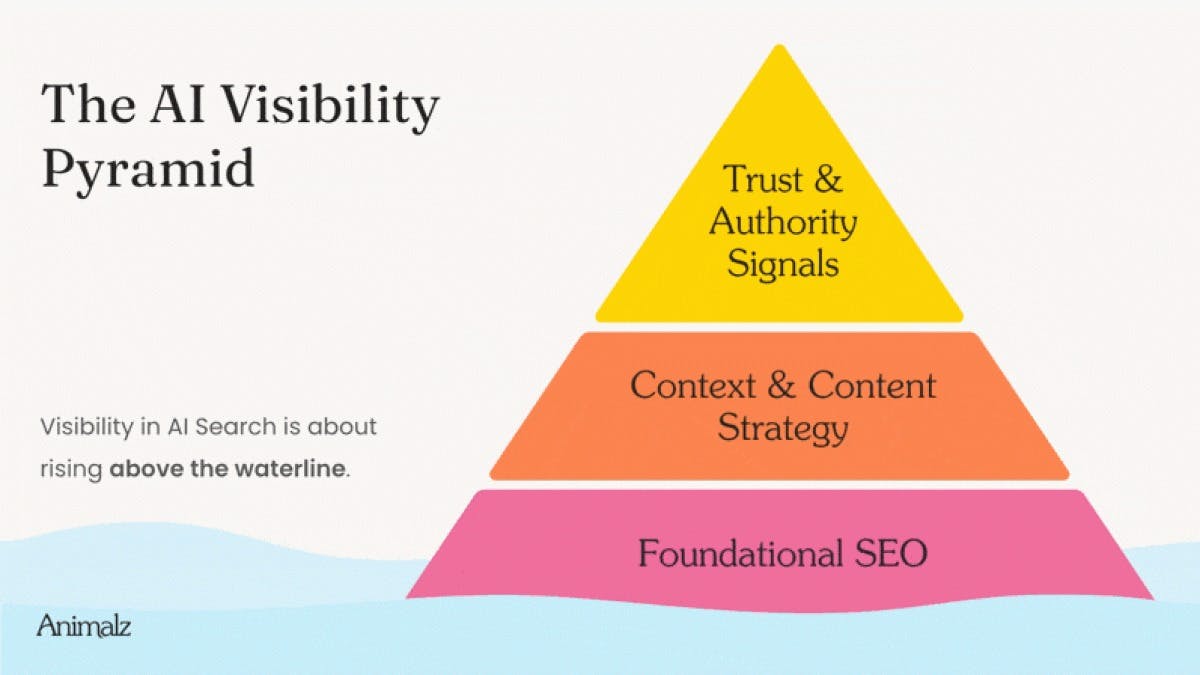
Animalz’ Ajdin Perco has a useful framing on this. Treat AI search visibility as a leading indicator of brand health, traffic as a lagging indicator of search demand, and conversions as the only number that ultimately matters. Most teams that adopt this mental model stop panicking about AIO CTR loss within a quarter.
Final thoughts
AI Overviews have permanently changed the click economics of search. The most credible studies put position-one CTR loss between 47% and 79% on affected queries. That is not a number that walks back, and the trend has been worsening with every quarterly update.
But the conclusion most consultants jump to is wrong. SEO is not dead. The brands winning right now are the ones still ranking on Google, still earning citations across AI engines, and still treating high-quality content as the asset that powers both. The work has gotten harder. It has also gotten more concentrated, because most teams have not yet adjusted.
If you want to start measuring your AI search visibility alongside your SEO, Analyze AI tracks both. You can book a demo or start free. Either way, the first step is honest measurement. The second step is adapting the playbook to a search market that now has two open lanes instead of one.
Further reading

Ernest

Ibrahim


