



Summarize this blog post with:


In this article, you’ll learn how to plan, run, and measure an SEO campaign that also wins traffic from AI search engines like ChatGPT, Perplexity, Gemini, and Google’s AI Overviews.
The framework has three steps. Pick a goal. Figure out the gap between where you are and where you want to be. Take action.
We will walk through each step with examples, and at every stage we will show you how to do the same work for AI search. We do not believe AI search replaces SEO. We treat it as another organic channel that runs alongside Google. The brands winning right now optimize for both at the same time.
Table of Contents
What is an SEO campaign?
An SEO campaign is a focused effort to hit a specific search-related goal inside a fixed window of time. You pick the goal, identify what is keeping you from hitting it, and run the work that closes the gap.
A campaign is not the same as your overall SEO strategy. Your strategy is the long-term picture. A campaign is a sprint inside that picture. It has a target page or set of pages, a target keyword or set of keywords, a defined goal, and a deadline.
The campaigns that compound today cover both organic channels at once. Google still drives the bulk of qualified traffic for B2B and consumer brands, and the ranking signals that matter for Google (relevance, authority, freshness) also influence whether your brand gets cited in ChatGPT and Perplexity. So the same campaign can move both needles when you plan it that way.
If you want a deeper picture of how the two channels connect, read our breakdown of the 4 pillars of an effective SEO strategy for AI search.
Here is the three-step process.
Step 1. Set a campaign goal
The first job is to define what success looks like in clear, measurable terms. A goal that says “improve SEO” gives you nothing to plan against. A goal that says “move our ‘enterprise CRM’ page from position 7 to position 3 in 60 days” gives you a target you can act on.
Common SEO campaign goals
Most campaigns target one of the following outcomes.
|
Goal type |
Example |
How to measure |
|---|---|---|
|
Higher ranking for a keyword |
Move from position 8 to top 3 for “seo campaign” |
Average position in Google Search Console |
|
More organic traffic to a page |
Grow blog post traffic from 500 to 2,000 visits per month |
Sessions in GA4 |
|
Build backlinks to a page |
Get 25 new referring domains in 90 days |
Referring domains via a backlink tool |
|
Win the featured snippet |
Capture the snippet for a target query |
SERP check or rank tracker |
|
Index and rank for new keywords |
Publish 10 pages targeting commercial keywords |
Indexed URLs and ranking keywords |
Pick one. A campaign with three goals at the same time becomes three separate projects, and each one gets less attention than it deserves.
Add an AI search goal to the same campaign
Most teams stop at the goals above. The brands that are pulling ahead in 2026 also set a target for AI search visibility on the same campaign.
Common AI search goals we see teams pick.
-
Get cited by ChatGPT or Perplexity for a specific prompt or set of prompts
-
Reach a defined share of voice (the percentage of relevant prompts where your brand is mentioned)
-
Improve sentiment in AI answers from neutral to positive
-
Grow the number of landing pages receiving AI-referred traffic
You set these goals the same way you set traditional SEO goals. Pick one prompt cluster or one outcome, name a number, name a deadline. For example, “Get mentioned in 60 percent of ChatGPT answers for ‘best CRM for small business’ and related prompts within 90 days.”
If you are still mapping the gap between SEO and AI search outcomes, our explainer on GEO vs SEO walks through what each one actually measures.
Set a real baseline before you commit
Whichever goal you pick, write down the current state before you start. You cannot prove a campaign worked if you do not know the starting point.
For SEO baselines, pull the current ranking, traffic, and backlink data on your target page. The free keyword rank checker and website authority checker get you both numbers in a few minutes.
For AI search baselines, you need a tool that can show you which prompts your brand is currently appearing in, which competitors are taking the cites, and how often. In Analyze AI, the Overview dashboard does this in a single view. You see your AI visibility score, the percentage of tracked prompts where you appear, and how that has shifted over time. This is the number you will be trying to move.
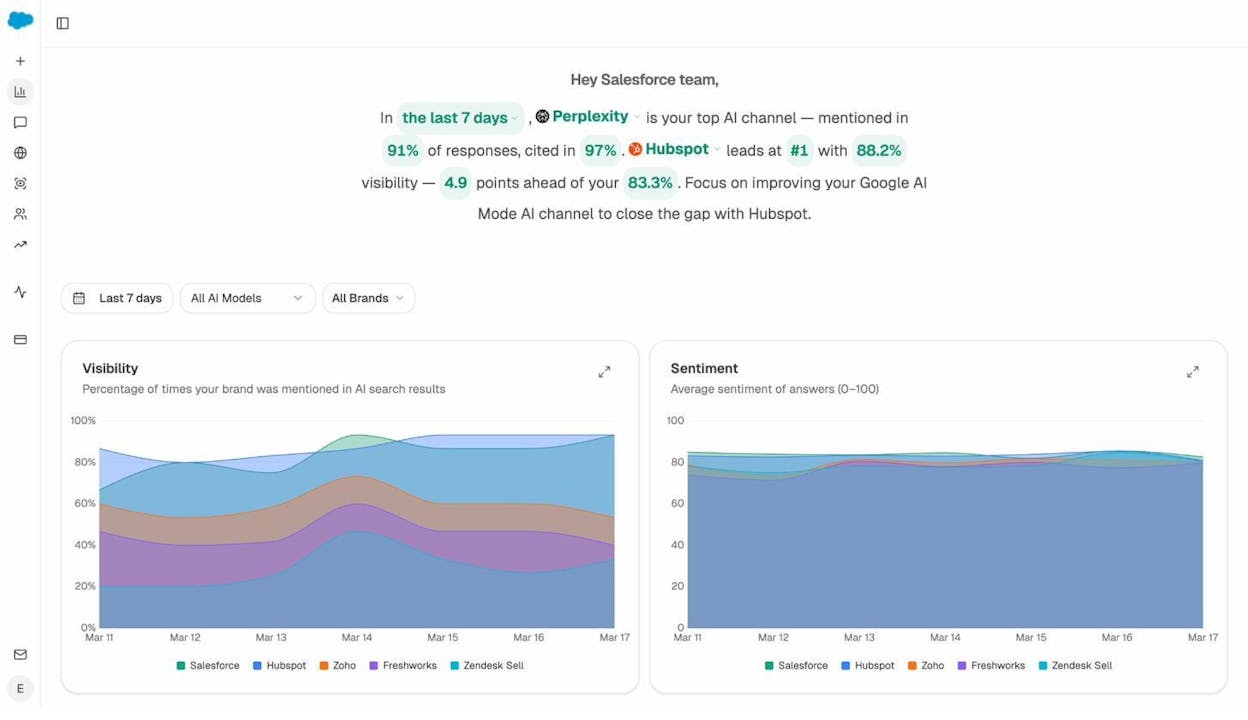
Analyze AI Overview dashboard showing AI visibility score and tracked prompts
Step 2. Figure out how to achieve the goal
You have a target. Now you need to understand why you are not already at that target. This is the audit phase, and it is where most of the actual thinking happens in a campaign.
We will cover the SEO audit first, then the AI search audit. Both run in parallel because the same content asset usually needs to perform on both.
Audit your page for SEO gaps
There are five things that commonly hold a page back from ranking. Work through them in order.
1. The page cannot be crawled or indexed
If Google cannot crawl your page or has not indexed it, nothing else matters. Open Google Search Console, paste in the URL, and run a URL inspection.
![[Screenshot of the Google Search Console URL Inspection tool showing an indexed page]](https://www.datocms-assets.com/164164/1778269157-blobid2.png?auto=format,compress&w=1248&fit=max)
If the page is not indexed, fix the underlying issue first. The common causes are a noindex tag, a robots.txt block, or a canonical pointing somewhere else.
2. The page targets a keyword with no traffic potential
You can rank first for a keyword nobody searches for and still get nothing. Before you invest more work in a page, confirm there is real demand.
A simple way to do this is to use a free SERP checker. Plug in your target keyword and look at the search volume and the traffic that the top three results actually receive.
![[Screenshot of the Analyze AI free SERP Checker tool showing search volume and top results]](https://www.datocms-assets.com/164164/1778269162-blobid3.png?auto=format,compress&w=1248&fit=max)
You can run this in Analyze AI’s free SERP checker, or use the keyword difficulty checker if you want to know how competitive the keyword is before you invest.
If the keyword has no volume and the top results are not getting any traffic either, the campaign goal needs to change. There is no point ranking first for a keyword nobody types.
3. You do not have enough backlinks
Backlinks remain one of the strongest signals Google uses for competitive keywords. If the pages outranking you have far more referring domains, you have your answer.
Compare your site’s authority against the top three using a website authority checker. If you are five domains behind, you can probably rank with content alone. If you are 500 behind, link building is part of this campaign whether you wanted it to be or not.
For a deeper walkthrough of which tools to use for outreach, broken-link replacement, and digital PR, see our roundup of the 9 best backlink building tools.
4. The page does not match search intent
Search intent is the reason behind the search. If your content does not match it, no amount of optimization will help.
Open an incognito tab, search your target keyword, and look at the type of pages ranking. Are they listicles, how-to guides, product pages, comparison pages, calculators? That format is what Google has decided searchers want.
![[Screenshot of a Google SERP showing the dominant content format for a sample target keyword]](https://www.datocms-assets.com/164164/1778269162-blobid4.png?auto=format,compress&w=1248&fit=max)
If your page is a how-to guide and the SERP is full of comparison posts, you need to rewrite the page to match. This is the highest-leverage fix in the entire audit.
5. The page is not comprehensive enough
Even when intent matches, your page might be missing the subtopics that searchers expect. The simplest way to find these gaps is to look at what the top-ranking pages cover that yours does not.
Take the top three results, list out their H2 and H3 headings, and compare them against your own outline. The subtopics that show up in two or more of the top results, but not on your page, are the ones you need to add.
You can also pull related questions from the People Also Ask box. We covered the workflow in detail in our guide to optimizing and tracking People Also Ask.
Audit your AI search visibility for the same target
This is where most teams have a blind spot. You can win every SEO audit point above and still be invisible in ChatGPT, Perplexity, Gemini, and Copilot. AI engines pull from a different mix of signals, and the audit needs to account for that.
Here is the four-question audit we run.
1. What prompts should you appear in?
You cannot improve visibility for prompts you have not identified. The first job is to map the prompts your buyers are actually using when they ask AI engines about your category.
In Analyze AI, the Prompts dashboard shows the prompts you have chosen to track and how often your brand appears in the answer for each one.
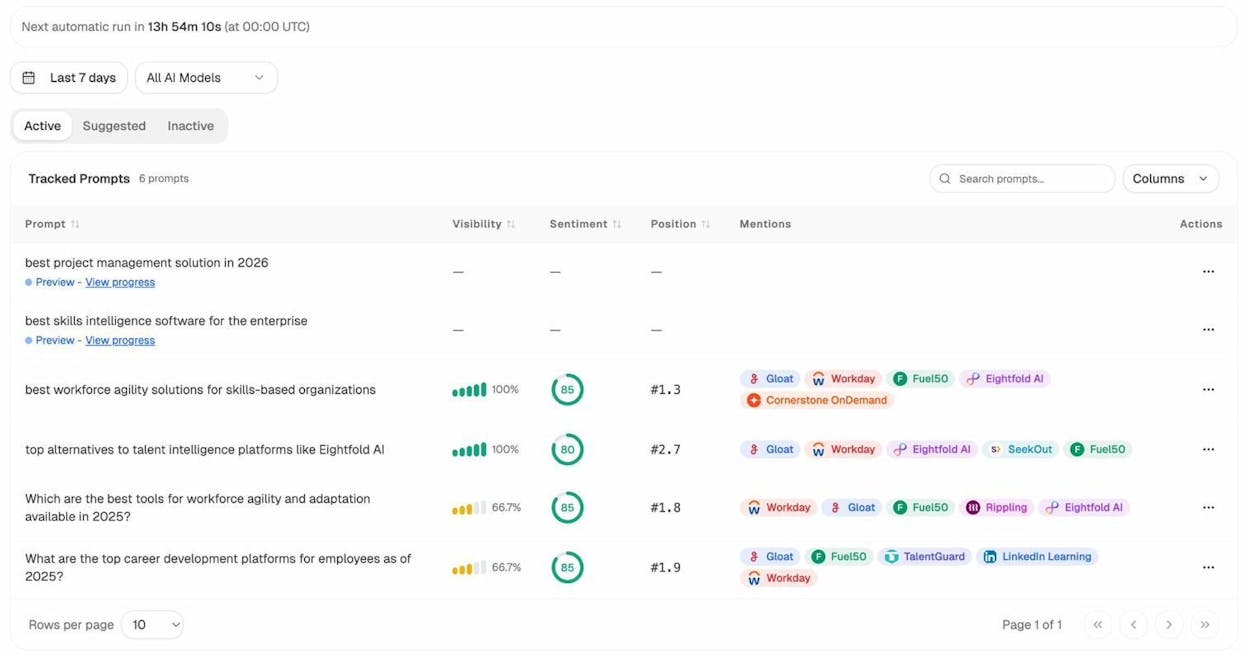
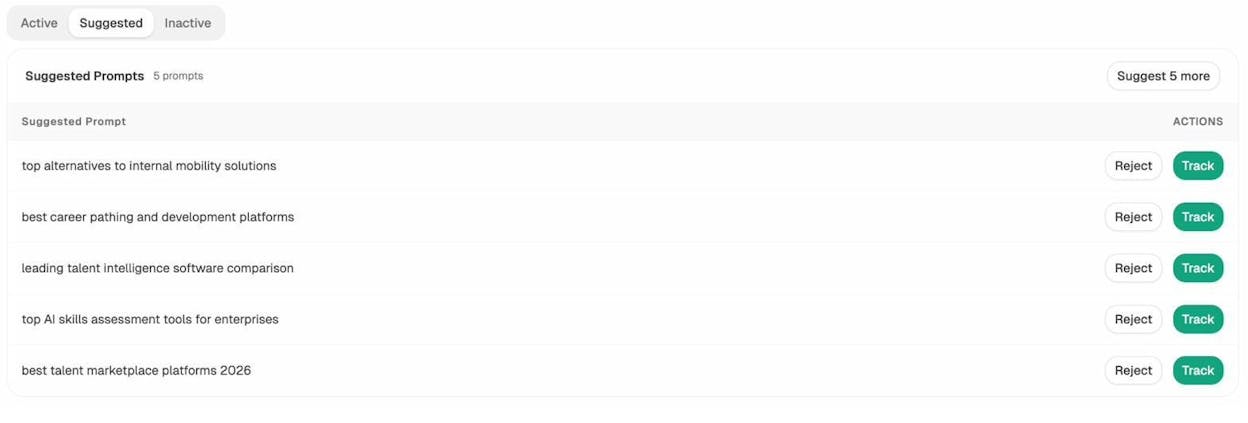
If you are starting from scratch, the Prompt Discovery feature suggests prompts your competitors already win on, so you can prioritize the ones with the highest traffic potential.
2. Where are competitors winning that you are not?
Competitive gaps are a quick path to impact. If a competitor is mentioned in 8 out of 10 relevant ChatGPT answers and you are mentioned in 1, that gap is the campaign.
Open the Competitors dashboard. It shows which competitors AI engines mention more often than you, broken down by prompt cluster.
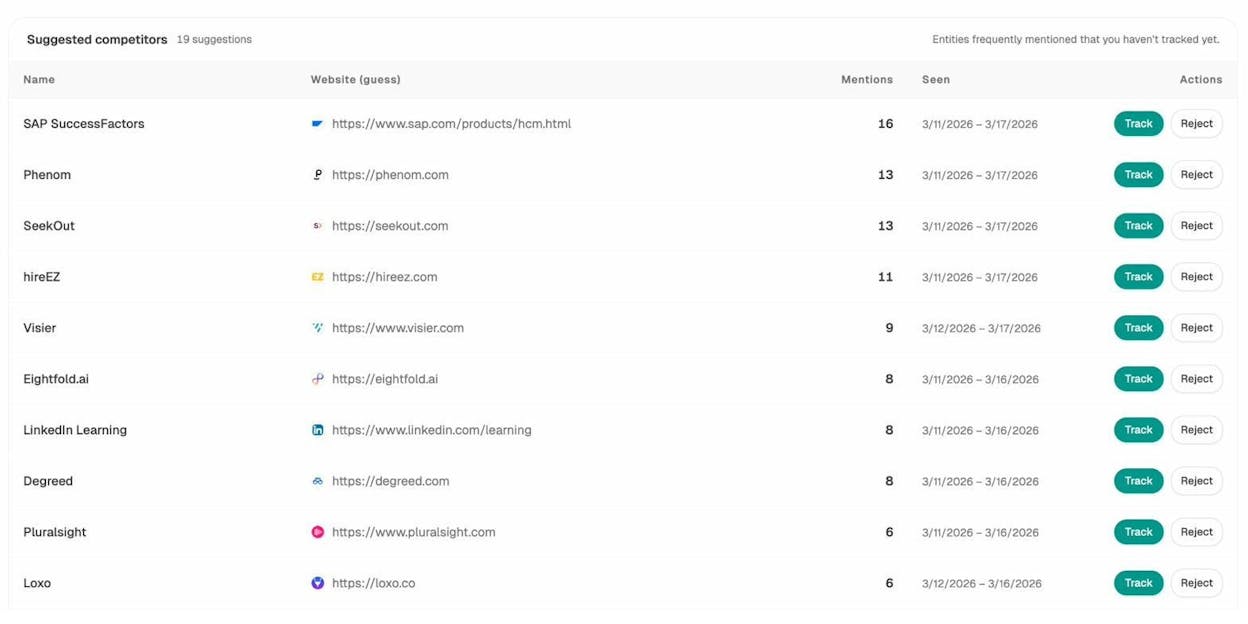
For each high-priority gap, the next question is why. Is the competitor cited because they have a stronger third-party presence on G2 and Reddit? Is their own content more declarative and easier for an LLM to quote? Is their brand name mentioned more times across the open web? Each cause has a different fix.
3. What sources are AI engines pulling from?
AI engines lean heavily on third-party sources. Reddit, Wikipedia, G2, YouTube, and industry blogs show up disproportionately in citations across ChatGPT and Perplexity. Our analysis of 83,670 AI citations showed that roughly 83 percent of citations come from external sources, not brand websites.
The Sources dashboard in Analyze AI shows which domains are being cited in AI answers about your category, and whether your own pages are among them.
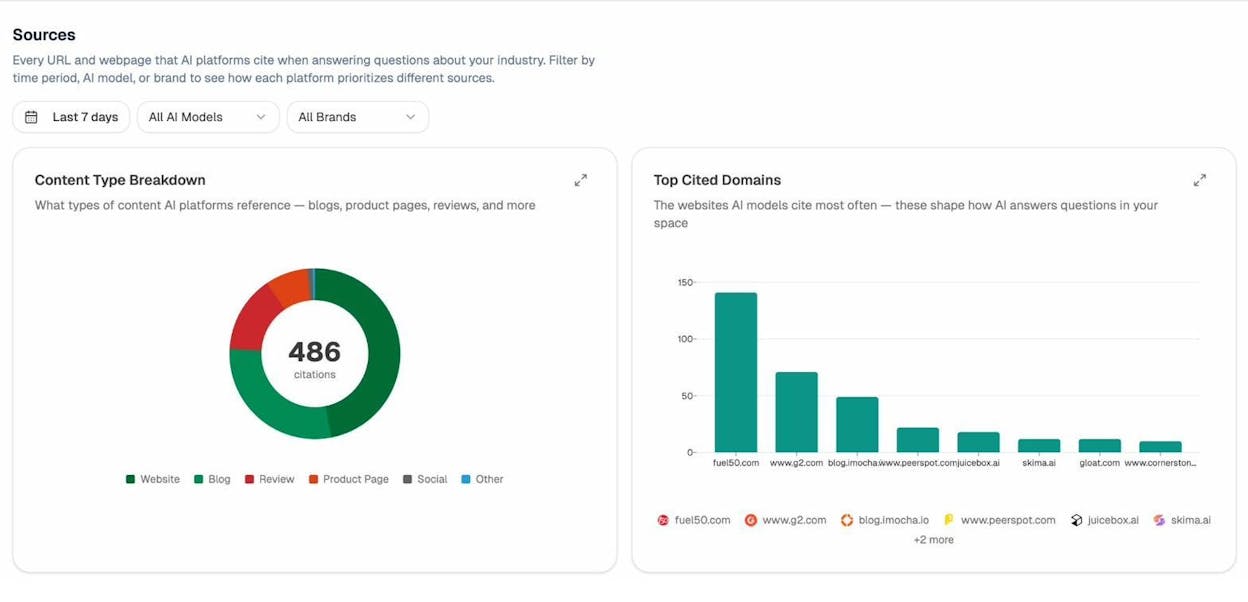
If the same five third-party domains keep appearing and your brand is not mentioned on any of them, that is a clear input for your campaign action plan. Get mentioned there.
4. How is your brand being talked about?
Sentiment matters because being mentioned negatively is sometimes worse than not being mentioned at all. The Perception Map shows how AI engines characterize your brand against competitors across the attributes buyers care about (ease of use, pricing, support, integrations, and so on).
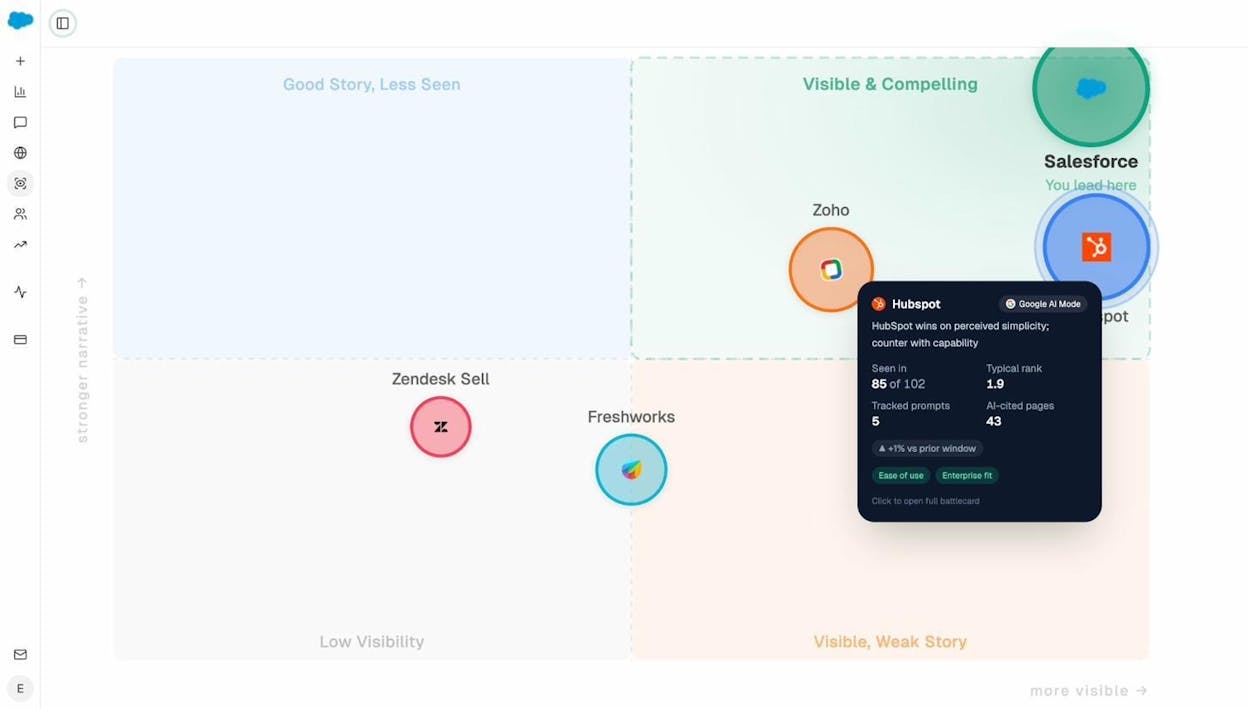
If your brand consistently gets described as “expensive” or “complicated” in AI answers, that is fixable. It usually traces back to outdated reviews, comparison posts that no longer reflect your product, or thin documentation. Each of those is a tactic you can add to the campaign.
Step 3. Take action
You have a goal. You have an audit. Now execute.
Group the work from your audit into three buckets. This keeps the campaign manageable and stops it from sprawling into endless small tasks.
Bucket 1. Fix the content
Most campaigns start here because content is the lever you can pull yourself without external dependencies.
If the page is misaligned with search intent, rewrite it from the outline up. Do not patch a how-to guide into a listicle. Start fresh with the format Google is rewarding.
If the page is missing subtopics, add them. Use the gap analysis from the audit to write the missing sections, and lead with the highest-priority gaps first.
If the page reads in a way that makes it hard for an LLM to quote, tighten it. The patterns that work for AI citation overlap with the patterns that work for the featured snippet. Lead with the answer (the “Bottom Line Up Front” approach), use declarative sentences, define key terms early, and structure the page with clear H2s and H3s that a model can lift directly.
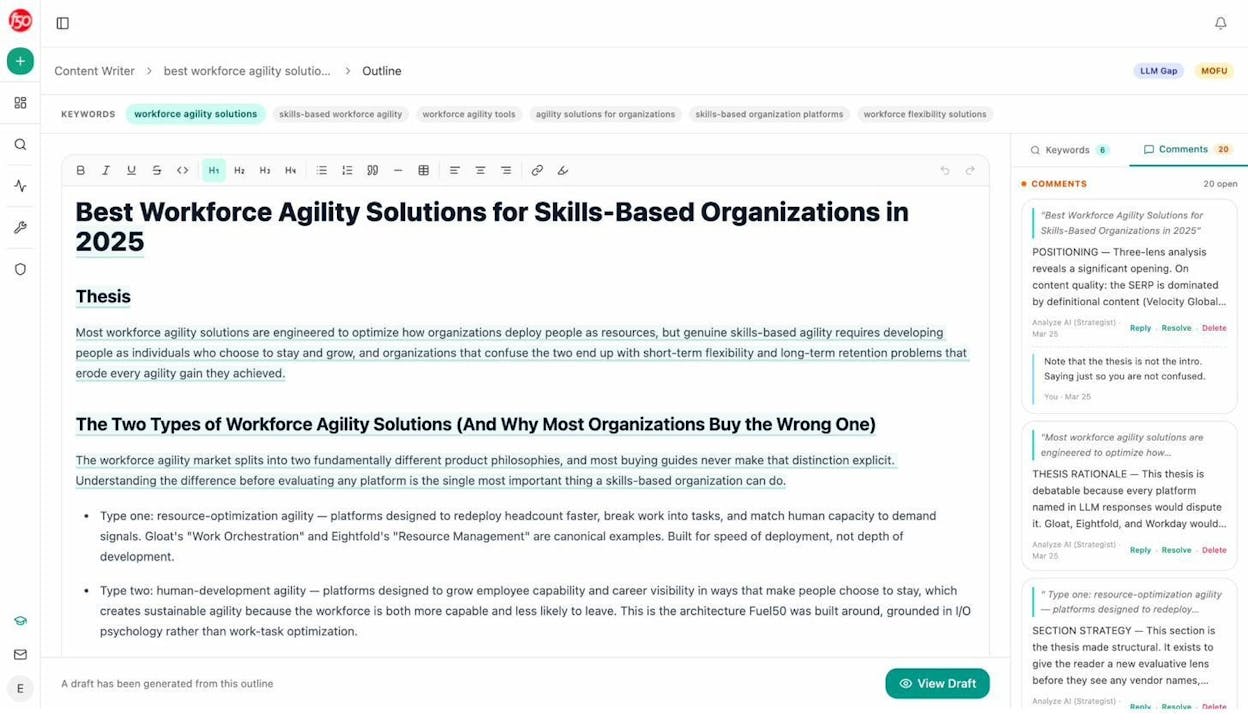
The Analyze AI Content Optimizer pulls in your existing page, compares it against the prompts you want to win, and shows you what to add or rewrite.
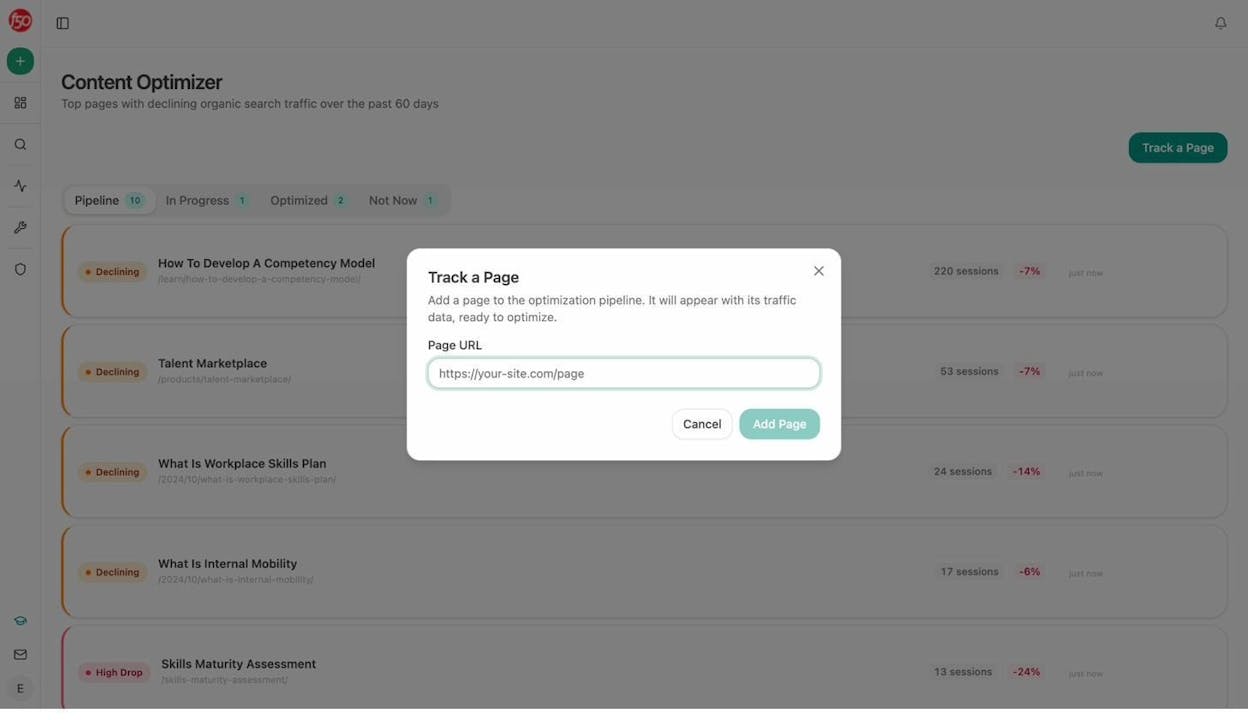
The optimizer surfaces concrete gaps so you can ship the rewrite the same day.
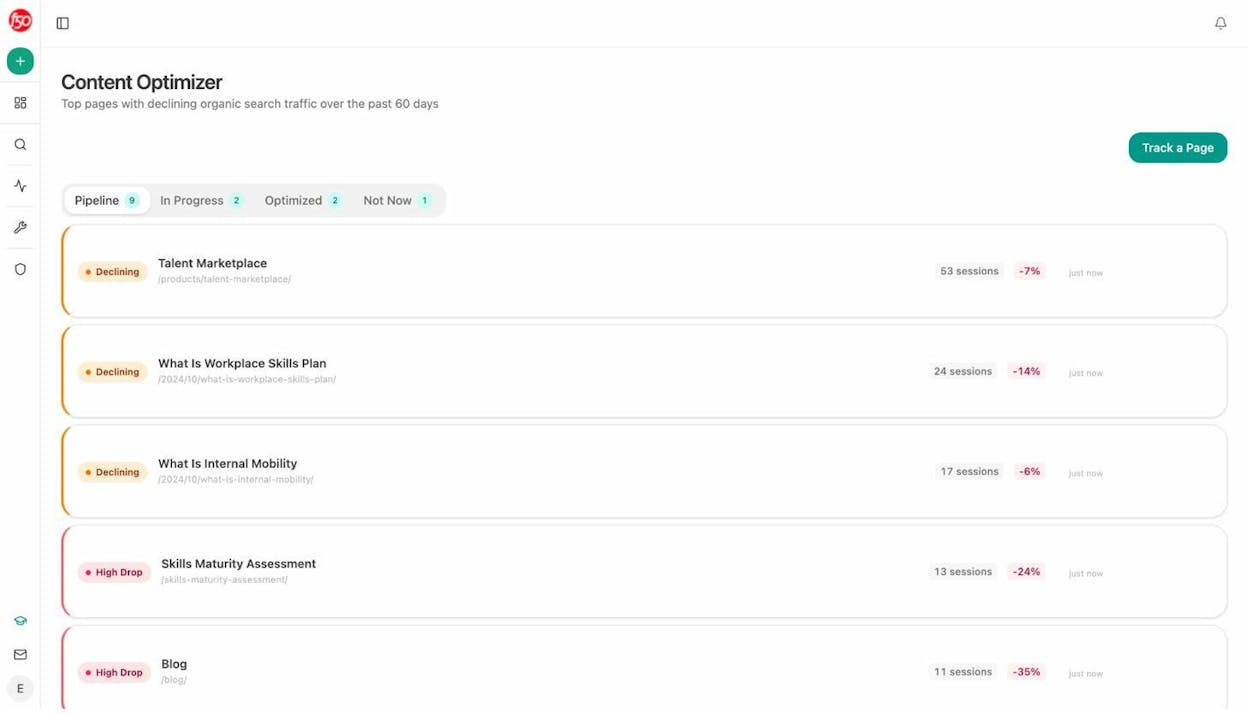
For pages built from scratch, the Content Writer goes one step further and produces a brief and outline based on real AI visibility data instead of generic SERP analysis.
Bucket 2. Build the off-page signals
If your audit pointed at a backlinks gap or a third-party citation gap, this is the bucket.
For Google, the work is link building. Pick five to ten target outreach types (guest posts, unlinked mentions, broken link replacements, digital PR) and run them in parallel. Our link building tools roundup covers the tools we use for each tactic.
For AI search, the work is mention building. Get your brand into the third-party domains that AI engines actually cite. Four moves we see work consistently.
-
Get listed on review sites like G2 and Capterra with current, relevant comparison pages
-
Be mentioned in roundup posts on industry blogs that already get cited by ChatGPT and Perplexity
-
Build a presence on Reddit and Quora for questions in your category
-
Publish original data and research that other writers will reference
If a third-party site is already getting cited for prompts you want to win, getting your brand mentioned there is often the quickest way to enter the answer.
Bucket 3. Fix the technical and indexability layer
If the audit found indexability or technical issues, fix them before the next two buckets ship. There is no point publishing a well-optimized page Google cannot crawl.
For broken internal links specifically, run our free broken link checker on the target page and the pages linking into it.
How to measure the campaign
The campaign is not done when the work ships. It is done when you can prove the work moved the metric you set in Step 1.
For SEO results, three checks at minimum.
-
Average position for the target keyword in Google Search Console, week over week
-
Organic traffic to the target page in GA4
-
Referring domains pointing to the target page
For AI search results, you need a different lens. Traditional analytics tools cannot tell you that ChatGPT mentioned your brand in an answer (because the user often does not click through). The metric you actually want is share of voice across the prompts you targeted.
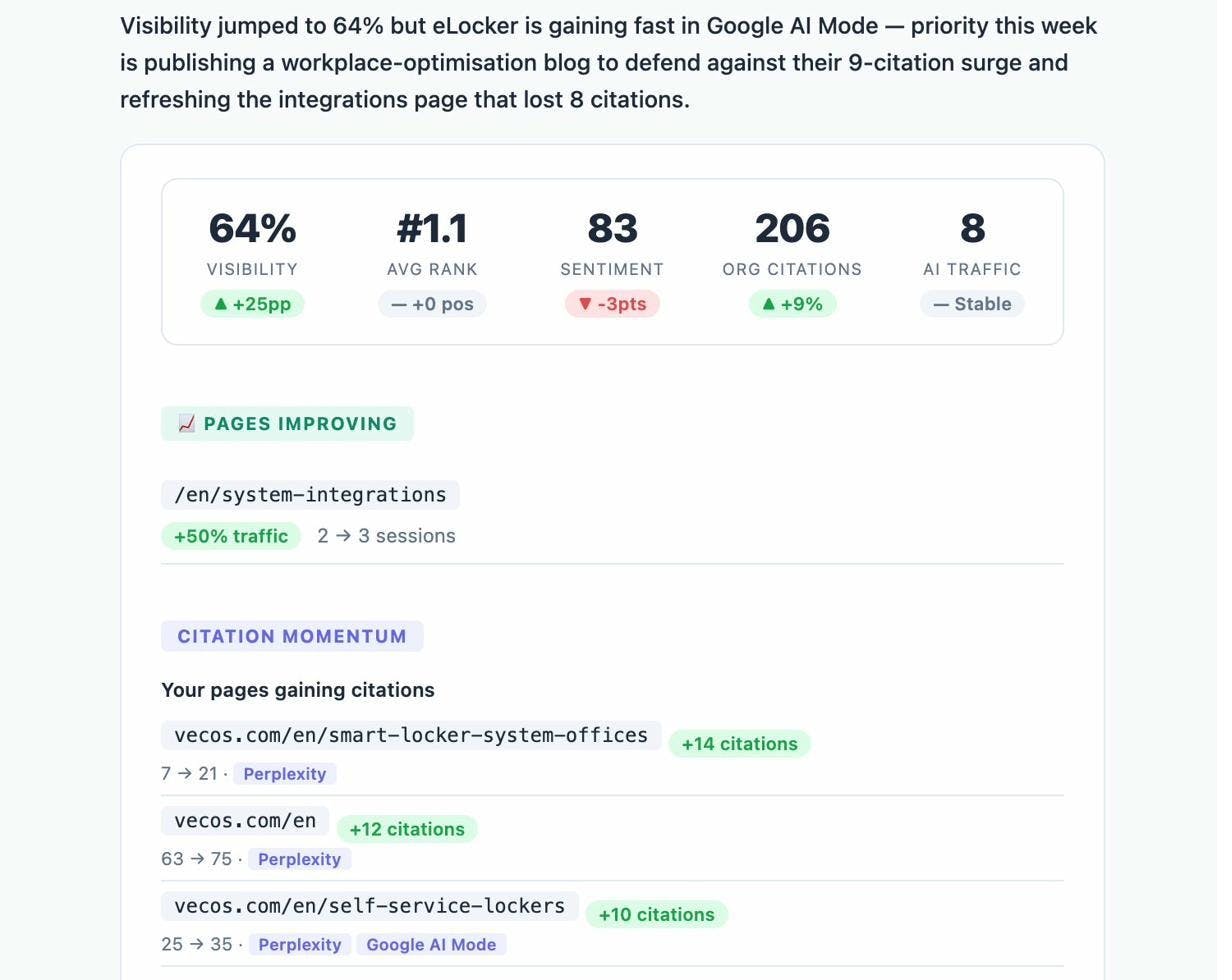
Analyze AI’s Weekly Email Digests deliver this without you having to log in. Each week you get a summary of how your visibility moved across the prompts you track, which competitors gained or lost share, and which new prompts started showing up.
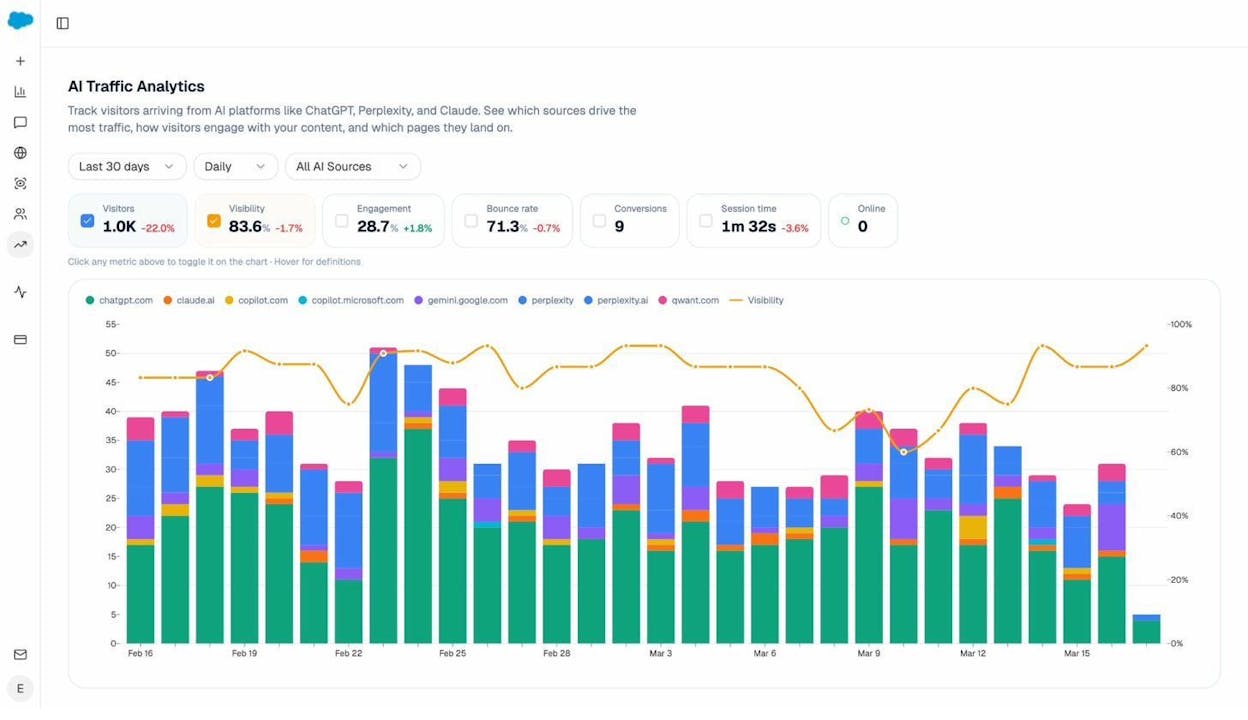
For deeper analysis on which pages are pulling AI-referred traffic and converting, the AI Traffic Analytics dashboard shows you sessions, citations, engagement, and conversions per page.
This is the same loop teams have used for SEO for years. Set a goal, run the audit, ship the work, measure the result, and start again on the next opportunity.
Final thoughts
Most SEO campaigns fail in one of two ways. Either the goal was too vague to plan against, or the audit was skipped and the team jumped straight to action without knowing what gap they were closing.
The three-step framework (Goal, Assess, Action) protects you from both failure modes. Pick one specific outcome. Identify the actual gap. Ship the work that closes it. Then measure.
The thing that has changed in 2026 is the channel mix. Running a campaign that only optimizes for Google leaves real demand on the table, because a growing share of buyers are asking ChatGPT, Perplexity, and Gemini before they ever type a query into Google. Running a campaign that abandons SEO for AI search makes the opposite mistake, because Google still sends most of the traffic and AI engines still rely on Google’s index to decide who to cite.
Run both at once. The audit and action steps overlap more than they diverge. The same well-structured, well-researched, well-cited piece of content that wins position one in Google has a strong chance of being quoted in ChatGPT.
If you want a single tool that handles the AI search side of this campaign (prompts, competitors, sources, sentiment, traffic, weekly tracking), Analyze AI covers it.

Ernest

Ibrahim


