



Summarize this blog post with:


Homepages tend to be the highest-authority page on a domain. That authority can be channelled into ranking for category keywords, and it can be passed to other pages on your site through internal links. Squarespace ranks its homepage for thousands of non-branded keywords like “website builder” and “build a website.”
![[Screenshot of Squarespace’s organic keyword report showing non-branded rankings for the homepage URL]](https://www.datocms-assets.com/164164/1778179646-blobid1.png?auto=format,compress&w=1248&fit=max)
The same shift is happening in AI search. When buyers ask ChatGPT “good customer messaging tools” or Perplexity “alternatives to Intercom,” the engine picks which sources to cite. Homepages with sharp category positioning, real trust signals, and consistent third-party mentions get pulled into the answer.
In this article, you’ll learn how to rank your homepage for non-branded keywords on Google, earn citations in AI engines like ChatGPT and Perplexity, and do both without breaking the page’s primary job of selling your product.
Table of Contents
How to optimize a homepage for search engines and AI search in six steps
The flow looks similar to optimizing any other page. Pick a keyword, write the page, build authority, fix technical issues, and track results. The differences come from what a homepage is for. A blog post can chase any keyword that fits your niche. A homepage has to describe your business first and rank second.
Step 1. Pick a target keyword that defines your business
Your homepage should make it clear what you sell so Google and AI engines know when to surface it.
Start with a list of five to ten keywords that describe your offering. Look at how your direct competitors describe themselves on their homepages, and how reviewers describe the category on G2, Reddit, and YouTube.
Say you compete with Intercom in customer messaging. Your candidate list might look like this.
-
Customer messaging platform
-
Customer communications platform
-
Conversational marketing platform
-
Customer service software
-
Live chat software
-
CRM
Now plug each candidate into a keyword tool. You’re looking for two things, traffic potential and search intent. Use Analyze AI’s free keyword generator for volume and difficulty, and the SERP checker to see who currently ranks for each one.
![[Screenshot of the Analyze AI Keyword Generator showing volume and difficulty for the candidate list]](https://www.datocms-assets.com/164164/1778179655-blobid2.png?auto=format,compress&w=1248&fit=max)
Then check search intent. Open the top 10 Google results for each candidate and look at what types of pages rank.
-
If you mostly see homepages and product pages, that keyword wants a homepage. Good.
-
If you mostly see “best of” listicles or “what is” guides, that keyword wants a blog post or comparison page. Skip it.
You’ll usually end up in one of three places.
-
One keyword fits. Use it as your target.
-
Several keywords fit. Pick the one with the highest global volume, since that signals the language your audience uses most.
-
None fit because the SERP is full of listicles. Don’t force it. Use the keyword that best describes your business and chase the listicle-friendly variants with separate landing pages or comparison posts. Our SEO content strategy guide walks through that trade-off. Keep the runner-up keywords for body copy and secondary keyword placement.
Pick the AI prompts your homepage should win
The same exercise applies to AI search, with one twist. AI users rarely type two-word category terms. They type questions. “Customer messaging platform for B2B SaaS.” “Intercom alternatives for startups.” “Tools that combine live chat and email automation.”
Your homepage’s target keyword is the seed for those prompts. Drop it into Analyze AI and let the Prompts feature suggest the category prompts your buyers run across ChatGPT, Perplexity, Gemini, and Copilot.
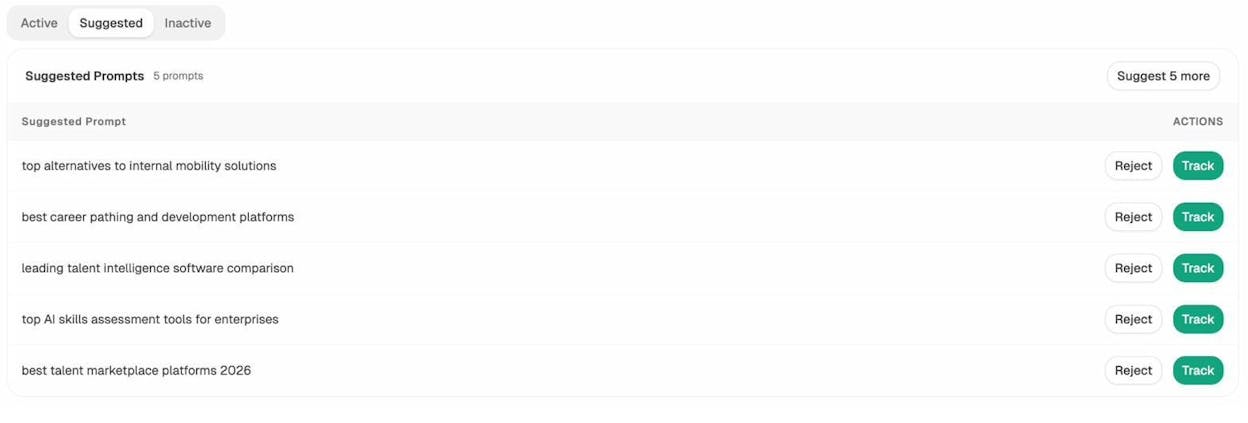
The Prompts view tells you which queries mention your category and which competitors show up most often. Pull up the Competitors panel next to see which brands AI is already citing in your space. Any brand that appears here and is not on your radar is a competitor your homepage needs to be positioned against.
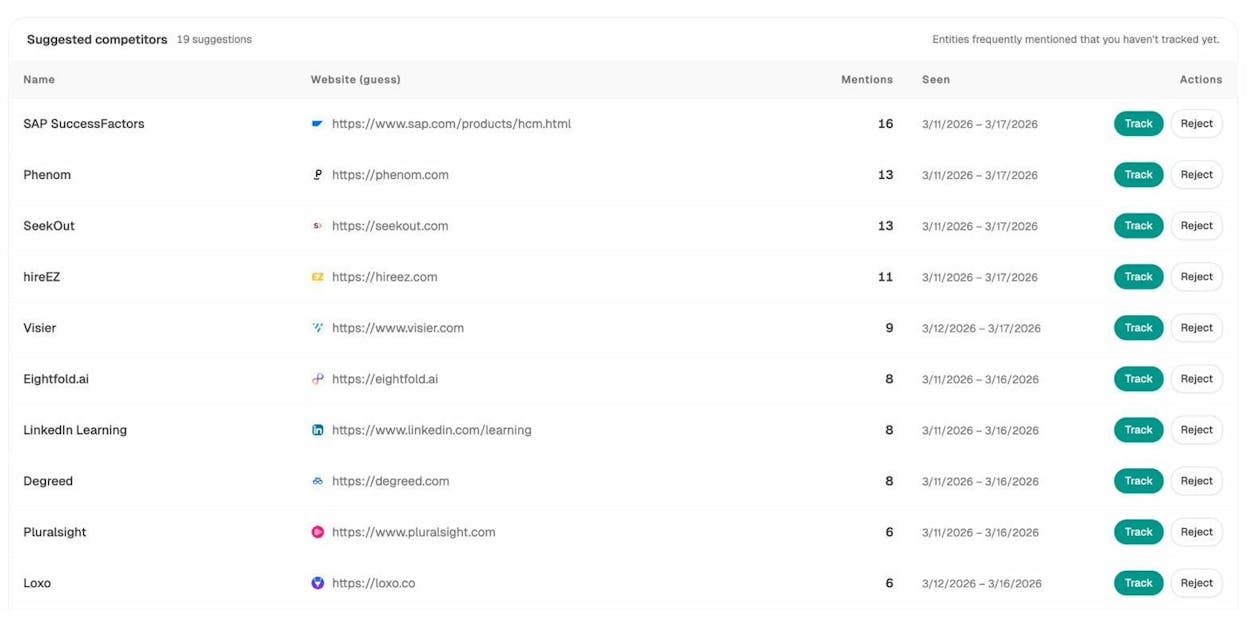
The prompts that mention every competitor except you are the gap your copy needs to close.
Step 2. Write the homepage copy
Your homepage copy has four jobs from an SEO and AI search standpoint. Tell Google and AI engines what the page is about, match search intent, communicate trust, and sell your product. Most of that work happens in five elements.
Title tag
The title is a small ranking signal for Google, and it is what makes people click. Three rules.
-
Include the target keyword and your brand name. Keep both natural.
-
Stay under 60 characters so Google does not truncate or rewrite the title.
-
Make a claim, not a description. “Customer messaging platform for B2B SaaS | Intercom” beats “Intercom Inc. - Home.”
Meta description
Meta descriptions are not a ranking factor and Google rewrites them often. They still matter for click-through rate, so write them like ad copy. Stay under 160 characters, treat the description as a continuation of the title rather than a repeat, and skip the clickbait. If the homepage does not deliver on the promise, the bounce will hurt more than the click helps.
H1 and main content
Your H1 should contain the target keyword and a clear value proposition. Don’t write the H1 around what you do. Write it around what the customer gets.
For the main content, look at the top 10 ranking pages for your target keyword and find the topics they all cover. For “CRM,” those topics include what a CRM is, why companies need one, the core features, and a few use cases. Google promotes pages that educate searchers on the topic, so your homepage needs to give visitors a quick answer to those questions, even if most of the page is product positioning.
You can speed up this analysis with the “Also rank for” and “Also talk about” reports inside any keyword research tool, including Analyze AI’s. Both surface the related terms that the top-ranking pages also include, which gives you a ready-made list of subtopics to weave into the body.
Schema markup
Schema markup is structured data that helps Google understand your page. It will not push you up the rankings on its own, but it can earn you rich results in the SERP, which improves click-through rate.
For a homepage, the schema types worth adding are.
|
Schema type |
What it does |
|---|---|
|
Organization |
Tells Google your page represents a company, which can earn you a Knowledge Panel |
|
Sitelinks search box |
Lets users search your site directly from the SERP |
|
Review or AggregateRating |
Pulls star ratings and review counts into the SERP |
|
FAQPage |
Surfaces FAQs as expandable rich results |
|
BreadcrumbList |
Replaces the URL path with a cleaner trail |
Use a generator and paste the JSON-LD output into the head of your homepage. Validate the result with Google’s Rich Results Test before publishing.
![[Screenshot of the Google Rich Results Test showing a passed schema check on the homepage]](https://www.datocms-assets.com/164164/1778179661-blobid5.png?auto=format,compress&w=1248&fit=max)
Demonstrate trustworthiness
Trustworthiness is the visible part of E-E-A-T, Google’s Quality Rater framework. AI engines use the same signals when picking sources to cite. Make the page feel like it belongs to a real, accountable business.
A few practical moves.
-
Show real customer testimonials with names, photos, and company logos.
-
Link to a real contact page with a phone number, an email, and a physical address if you have one.
-
Link to your terms of service, privacy policy, and security page.
-
Display recognitions like G2 badges, ISO certifications, or SOC 2 reports if you have them.
-
Cite the sources of any data you display.
Ask someone who has never seen your homepage whether they would trust your business with a credit card. If the answer is no, you have a trust problem before you have a ranking problem.
A note on writing for AI search
AI engines do not just read your homepage. They quote it. That changes how you write.
Crisp factual claims with concrete numbers, customer names, and dates are easier for AI engines to extract than marketing prose. “Used by 4,200 B2B SaaS companies, including Notion, Linear, and Loom” lifts cleanly into a citation. “The leading platform for modern teams” does not. Write at least one short, claim-dense block on the homepage, and put it above the fold. Our GEO vs SEO guide goes deeper on this difference.
Step 3. Earn high-quality backlinks and the AI citations that come with them
A homepage, just like any other page, needs backlinks to compete for non-branded keywords. The more good-quality backlinks you have, the higher the chance of ranking.
Not all backlinks are equal. The traits that matter are.
-
Relevance. Links from sites in your industry pass more weight than links from unrelated sites.
-
Authority. Links from established sites pass more weight than links from new ones.
-
Placement. Links inside body copy pass more weight than links inside footers or sidebars.
-
Anchor text. Anchors that describe the page’s topic give Google extra context.
-
Followed. Nofollow links pass little to no ranking signal.
Audit your existing link profile with the free website authority checker and broken link checker, then go after new links from these four sources.
-
Reviews and “best of” listicles. Pitch your product to writers who already cover your category. To find them, study your competitors’ backlinks and filter for words like “best,” “vs,” “alternative,” and “review.” The same publications will likely cover you.
-
Digital PR. Answer reporter questions on platforms like Qwoted and Connectively, or pitch a data-driven study to outlets in your niche. Press links carry weight because they are earned and because the domains have authority.
-
Guest posts. One well-placed guest post earns one strong backlink to your homepage. Pick publications that already cover your category and write something only you could write.
-
Directories and listings. Industry directories and trusted listings are easy wins, particularly for single-page websites.
![[Screenshot of a competitor backlink report filtered for review-style anchors]](https://www.datocms-assets.com/164164/1778179666-blobid6.png?auto=format,compress&w=1248&fit=max)
Here’s the angle most SEO articles miss. The same outreach earns AI citations.
A 2026 analysis of 83,670 AI citations across ChatGPT, Claude, and Perplexity found that 82.9% of AI citations come from third-party sources like review sites, news articles, and industry blogs. Only 17.1% come from a brand’s own website. AI engines weight third-party mentions heavily because they are harder to fake than self-published claims.
Inside Analyze AI, the Sources view shows which third-party domains AI engines cite most often when answering questions about your category. That list is your shortlist. Every domain in that view is a place where a single mention can show up in AI answers for months.
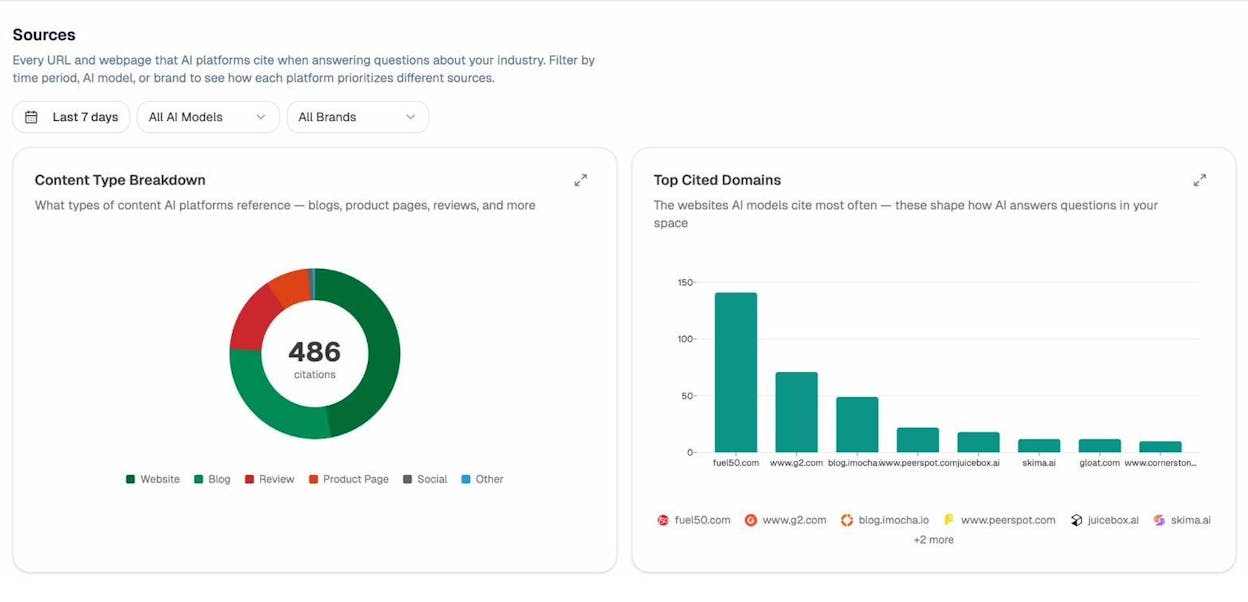
A backlink campaign that targets those domains buys you Google rankings and AI citations from the same outreach effort. Our deeper guide on how to get mentioned in AI search covers the full process.
Step 4. Add internal links
Internal links do three jobs at once. They help Google discover new pages, they pass authority between pages, and they tell Google what each page is about. Your homepage holds the highest external authority on most sites, which makes it a powerful internal linker.
Two directions matter.
Link from your homepage to your priority content. Pick the four to six pages you want to rank, like a flagship blog post, a landing page, or a free tool, and link to them in the body of the homepage rather than the footer. Body links pass more authority. Salesforce uses this trick to push its “What is CRM?” page to the top of Google by linking to it from the Salesforce homepage, and it has held position for years.
Link from blog posts and resource pages back to your homepage. Most sites already do this through the logo and the navigation, but those links carry less weight than in-body links. Mention your brand inside relevant blog content and turn the brand mention into a homepage link, once per post. Our guide on internal linking for SEO has more on link placement.
Step 5. Fix technical SEO
Technical SEO is what lets Google find, crawl, understand, and index your homepage. If something is broken at this layer, none of the other steps matter.
|
Run a site audit with one of the tools in our roundup of SEO audit tools and focus on the seven issues that hurt homepages most. |
Issue |
|---|---|
|
Indexability errors |
A stray noindex tag or robots.txt block keeps the homepage out of search results |
|
Broken pages |
A homepage returning a 4xx or 5xx error gets removed from the index |
|
Few or no internal links |
Poorly linked homepages get less crawl activity and pass less authority |
|
Mobile experience |
Google indexes the mobile version of your site first |
|
HTTPS issues |
Missing or misconfigured TLS hurts rankings and creates duplicate content |
|
Poor Core Web Vitals |
Loading and responsiveness scores are part of Google’s Page Experience signal |
|
Missing schema markup |
No schema means no rich results |
There’s an AI search angle here too. AI crawlers do not render JavaScript, which means any homepage content loaded client-side is invisible to them. If your hero copy, customer logos, or value proposition only appears after a JavaScript call, AI engines will not see it. Move the critical homepage copy into the server-rendered HTML.
![[Screenshot of Google Search Console’s Page Indexing report showing the homepage is indexed]](https://www.datocms-assets.com/164164/1778179672-blobid8.png?auto=format,compress&w=1248&fit=max)
Step 6. Track performance for both Google and AI search
With the foundations in place, the last step is monitoring. Track health, rankings, and AI citations on a recurring schedule. Otherwise you will lose ground without knowing why.
For Google, watch four metrics on the homepage.
-
Keyword rankings for the target keyword and the related terms you placed in the copy.
-
Share of voice across your tracked keywords, so you can compare yourself to competitors over time.
-
Organic traffic to the homepage URL only, not the whole domain.
-
Referring domains. A drop here often shows up in rankings two to three months later.
For AI search, the metrics differ but track the same things in spirit. Visibility, sentiment, and competitive position.
Inside Analyze AI, the AI Traffic Analytics view shows which pages on your site are getting actual visits from AI engines, broken down by ChatGPT, Claude, Perplexity, and Gemini. The homepage is almost always one of the top-cited pages on a domain, which makes this view the fastest way to confirm your homepage SEO work is paying off in AI search too.
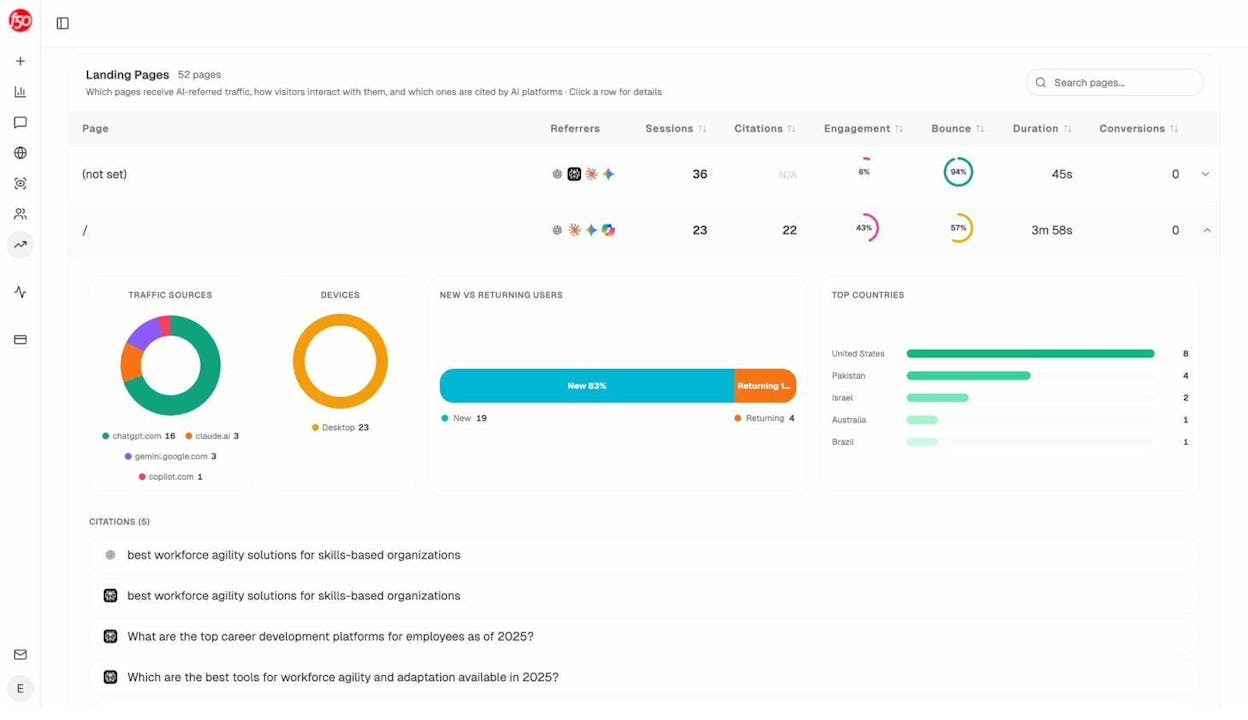
Pair that with the Perception view to see how your brand sits against competitors on the visibility-versus-narrative axis. A homepage that is “Visible & Compelling” wins the prompts where buyers compare options. A homepage that is “Visible, Weak Story” gets cited but loses the comparison.
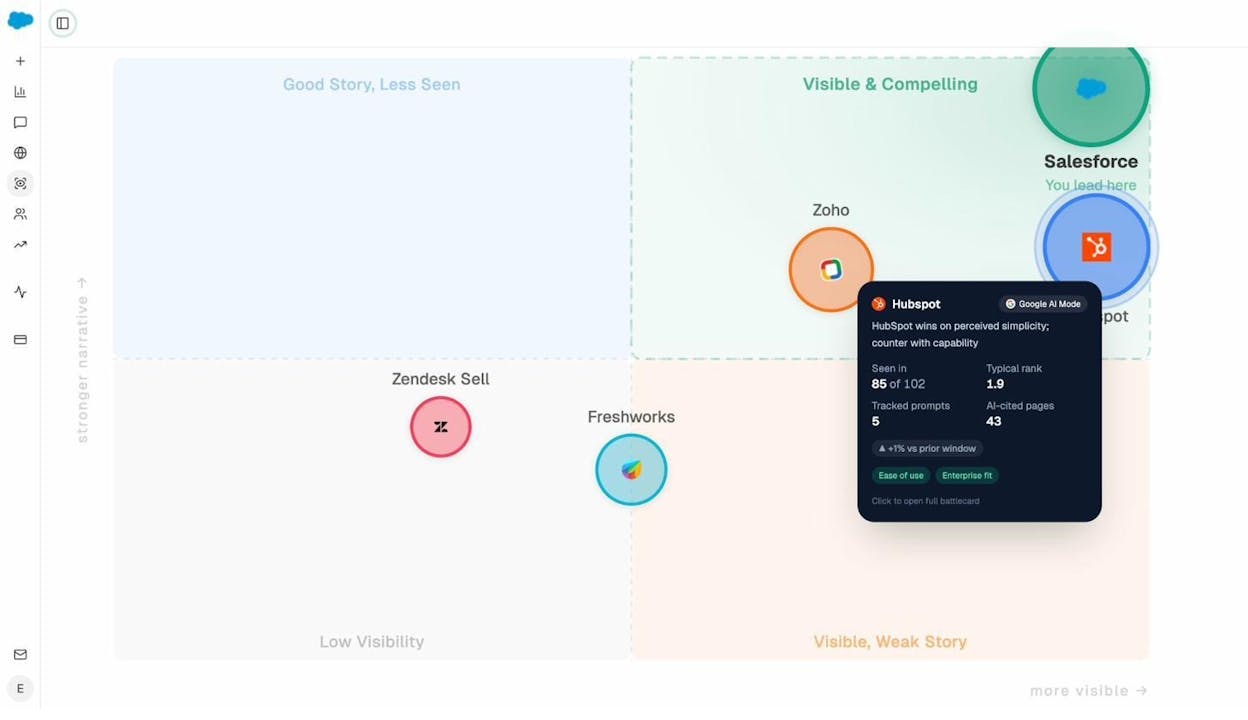
To automate the review, the weekly email digests summarize visibility shifts, new prompts to track, and competitor moves so you do not have to log in to spot a problem.
FAQ
Is the homepage the most important page for SEO?
It usually has the most backlinks, the most branded traffic, and the most internal authority, which makes it a high-leverage page. That does not mean every keyword belongs on it. Pages with informational intent should still be blog posts.
How long does it take Google to display changes on the homepage?
Google says crawling can take a few days to a few weeks. The change has to be crawled, indexed, then re-evaluated against the SERP. Expect three to six weeks for ranking shifts to show.
How much text should there be on a homepage?
There’s no fixed answer. Match the depth of the top-ranking pages for your target keyword. If they all run 1,500 words because the keyword has educational intent, you’ll need a homepage that explains the topic, not just a hero section.
Will AI search reward the same homepage that Google rewards?
Mostly yes. Both reward search intent match, clear claims, and third-party validation. AI engines lean a little harder on third-party citations and are stricter about JavaScript-rendered content.
Final thoughts
Homepages get neglected in SEO strategies. They shouldn’t. They can rank for non-branded category terms, lift the rankings of every other page through internal links, and earn AI citations that compound over time.
Two cautions. First, do not force a keyword onto a homepage that wants a different intent. If the SERP for your target keyword shows nothing but listicles, your homepage will not break in. Build a separate page for that intent and keep your homepage focused on what you sell.
Second, search intent still rules. The “speed test” SERP is the cleanest reminder. Every page that ranks for that keyword serves a working speed test on the homepage. No copywriting trick beats giving the searcher what they came for.
The homepage is just a page. The same SEO rules apply, and the same AI search rules apply. Match intent, write with clarity, earn third-party trust, and keep the technical layer clean.

Ernest

Ibrahim


