



Summarize this blog post with:


In this article, you’ll learn what SEO copywriting is, why it matters for both search engines and AI answer engines, and how to do it step by step. You’ll walk away with a repeatable process for creating content that ranks on Google, gets cited by AI models like ChatGPT and Perplexity, and actually converts readers into customers.
Table of Contents
What Is SEO Copywriting?
SEO copywriting is the process of creating content that ranks high on search engines and persuades readers to take action—whether that’s signing up, buying, or sharing.
It’s different from regular copywriting because it blends search engine optimization fundamentals (keyword targeting, search intent, on-page SEO) with persuasive writing techniques (hooks, storytelling, calls to action). And it’s different from plain SEO writing because the end goal isn’t just traffic. It’s revenue.
Here’s a simple way to think about it:
|
Regular Copywriting |
SEO Writing |
SEO Copywriting |
|
|---|---|---|---|
|
Goal |
Persuade and convert |
Rank and get traffic |
Rank, get traffic, and convert |
|
Focus |
Reader psychology |
Search engine algorithms |
Both |
|
Keyword strategy |
None |
Primary focus |
Integrated naturally |
|
Measures of success |
Conversions, engagement |
Rankings, organic traffic |
All of the above |
The sweet spot is where organic visibility meets persuasion. That’s SEO copywriting.
Why Is SEO Copywriting Important?
Content that ranks on Google but reads like a keyword-stuffed mess won’t convert anyone. And brilliant copy that nobody finds is a tree falling in an empty forest.
SEO copywriting solves both problems at once. Here’s why it matters now more than ever:
-
Organic search is still the largest traffic channel for most websites. Despite the rise of social media and paid ads, organic search drives more than 50% of all trackable web traffic. If your content doesn’t rank, you’re leaving the biggest traffic source on the table.
-
AI search engines are creating a second organic channel. ChatGPT, Perplexity, Claude, and Google AI Overviews now answer user questions directly—and they cite sources when they do. Analyze AI’s research across 83,670 citations found that the content AI models cite most often shares the same qualities as strong SEO copy: it’s well-structured, authoritative, specific, and genuinely useful.
This means the skills that make your content rank on Google—clear structure, topical depth, E-E-A-T signals—also make it more likely to get cited in AI-generated answers. SEO copywriting isn’t just about Google anymore. It’s about being visible wherever your audience searches.
-
Good SEO copy compounds over time. Unlike paid ads that stop the moment you cut the budget, a well-written, well-optimized article can drive traffic and leads for months or years. One piece of content, working around the clock.
How to Do SEO Copywriting
There are three stages to SEO copywriting: research, drafting, and editing. Each stage has specific steps that, when followed in order, produce content that ranks and converts.
Let’s walk through them.
Stage 1: Research
This is where most of the strategic work happens. Skip this stage and you’ll end up writing content that either targets the wrong topics, misses search intent, or sounds like everything else already on page one.
1. Find Topics with Keyword Research
If you want organic traffic, you need to write about topics people actually search for. That means starting with keyword research before you write a single word.
Here’s a straightforward process:
Start with seed keywords. Think about what your target customer would type into Google. If you sell project management software, your seed keywords might be “project management,” “task management,” “team collaboration,” or “Gantt chart.”
Use a keyword research tool to expand those seeds. Tools like Ahrefs, Semrush, or Analyze AI’s Keyword Generator will show you hundreds of related keywords, along with their search volume, difficulty, and more.
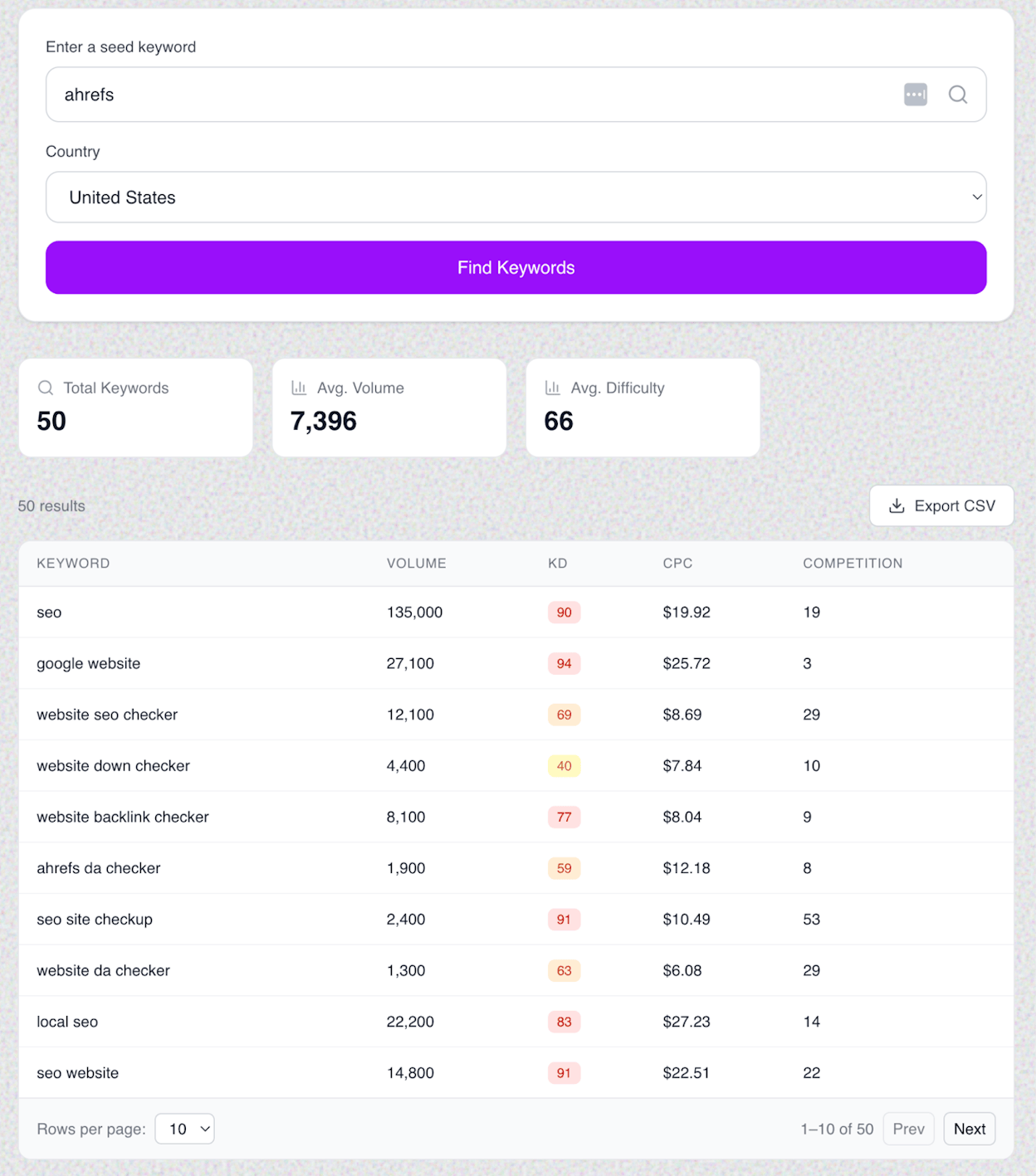
Filter for keywords with business value. Not all keywords are worth targeting. A keyword like “what is project management” has high volume but very low purchase intent. A keyword like “best project management software for remote teams” has lower volume but the person searching it is much closer to buying.
Prioritize keywords where you can naturally mention your product or service as part of the answer. This is what Grow and Convert calls Pain Point SEO—targeting keywords where your product solves the searcher’s problem.
Check keyword difficulty. Targeting “SEO” as a new blog is like trying to outrun a Ferrari on a bicycle. Use the keyword difficulty score to find terms you can realistically rank for given your site’s authority. You can check this with Analyze AI’s free Keyword Difficulty Checker.

Look at long-tail keywords too. These are longer, more specific phrases (usually 3+ words). They tend to have lower search volume but higher intent and less competition. A keyword like “how to write SEO product descriptions for ecommerce” is much easier to rank for—and convert on—than “SEO copywriting.”
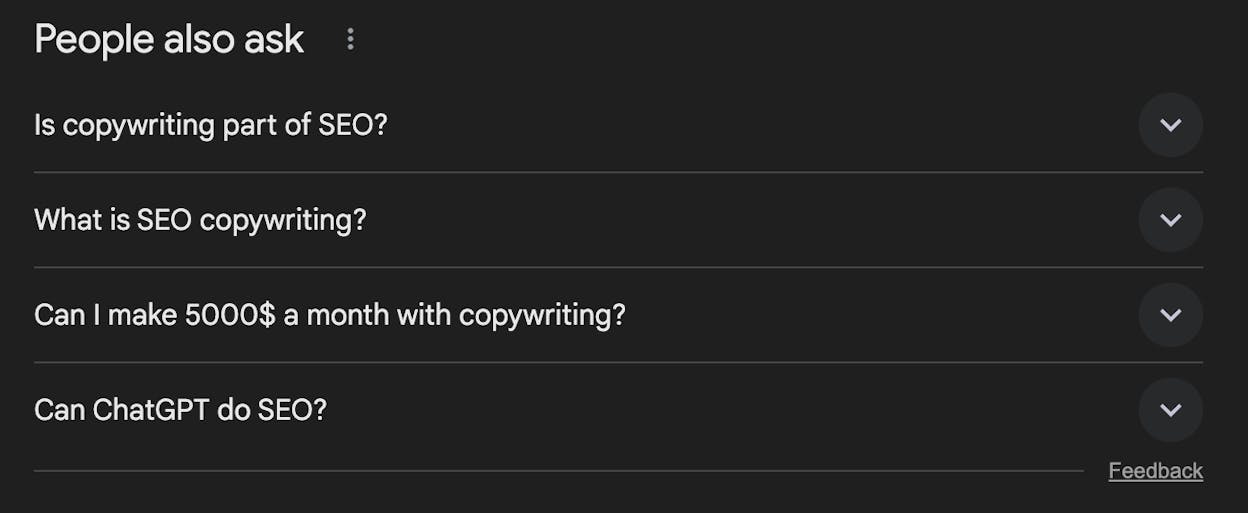
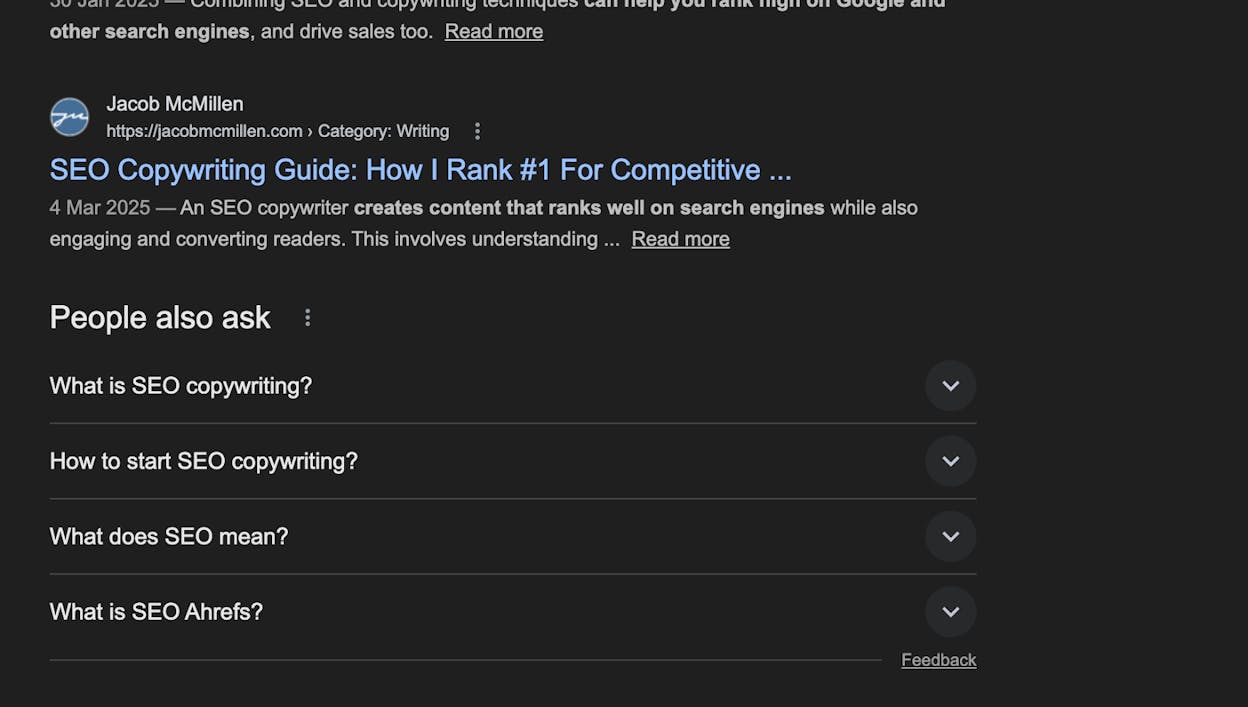
You can find long-tail variations in the “Questions” filter of most keyword tools, or by checking Google’s “People Also Ask” boxes.
Find What People Ask AI Search Engines
Here’s where most SEO copywriting guides stop. But search behavior is expanding beyond Google.
People now ask ChatGPT, Perplexity, and Claude the same types of questions they used to search on Google—and these AI models cite specific sources in their answers. If your content gets cited, you get referral traffic from a channel most of your competitors aren’t even tracking yet.
To find what people ask AI engines about your topic, you can use Analyze AI’s prompt suggestion feature. It analyzes your topic clusters and suggests the specific prompts real users are asking across AI platforms. You can then track which prompts mention your brand—and which ones don’t.
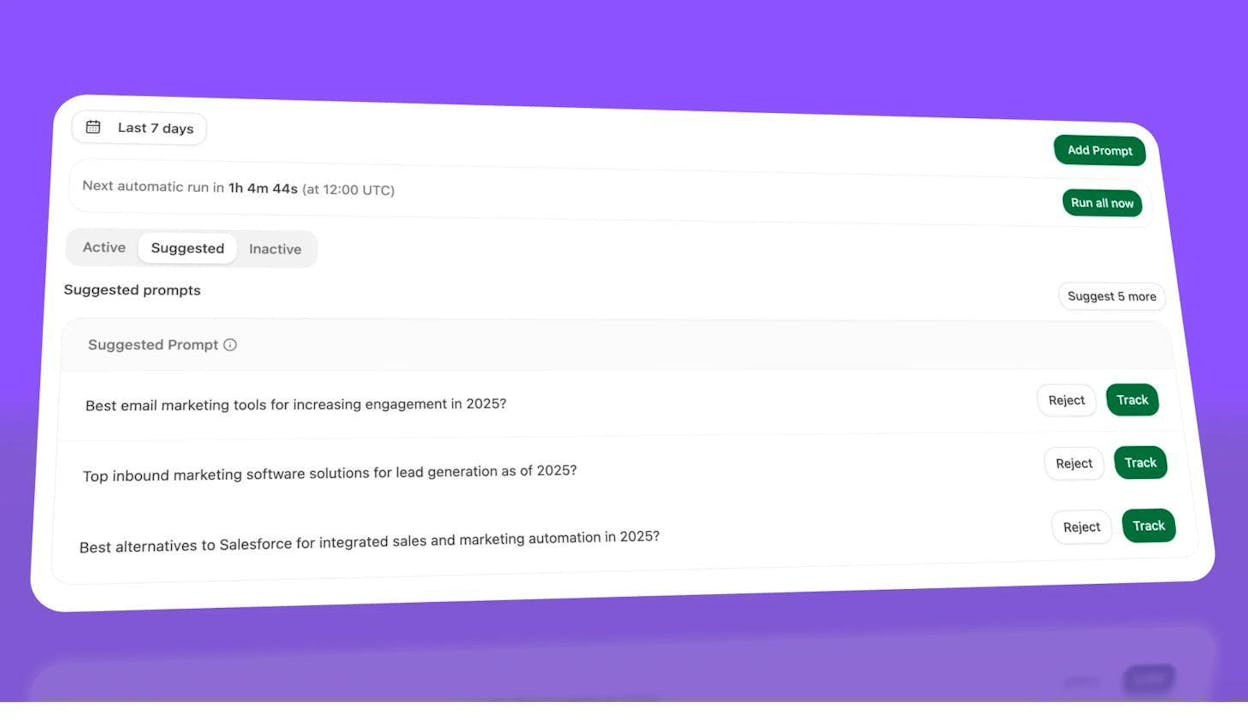
This gives you a second layer of keyword research: not just what people search on Google, but what they ask AI engines. Content that answers both will have twice the organic reach.
2. Match Search Intent
Google ranks content that matches what the searcher actually wants. If someone searches “SEO copywriting,” they’re looking for an informational guide—not a product page. If someone searches “hire SEO copywriter,” they want a service page or a list of agencies.
You need to figure out the search intent before you write. Here’s how:
Google your target keyword and study the top 10 results. Look at three things:
-
Content type: Are the results blog posts, product pages, videos, or tools?
-
Content format: Are they how-to guides, listicles, comparisons, or definitions?
-
Content angle: What’s the dominant perspective? (Beginner-friendly? Data-driven? Step-by-step?)
For example, searching “SEO copywriting” shows mostly long-form guides and how-to articles. That tells you Google’s users want educational content, not a sales page.
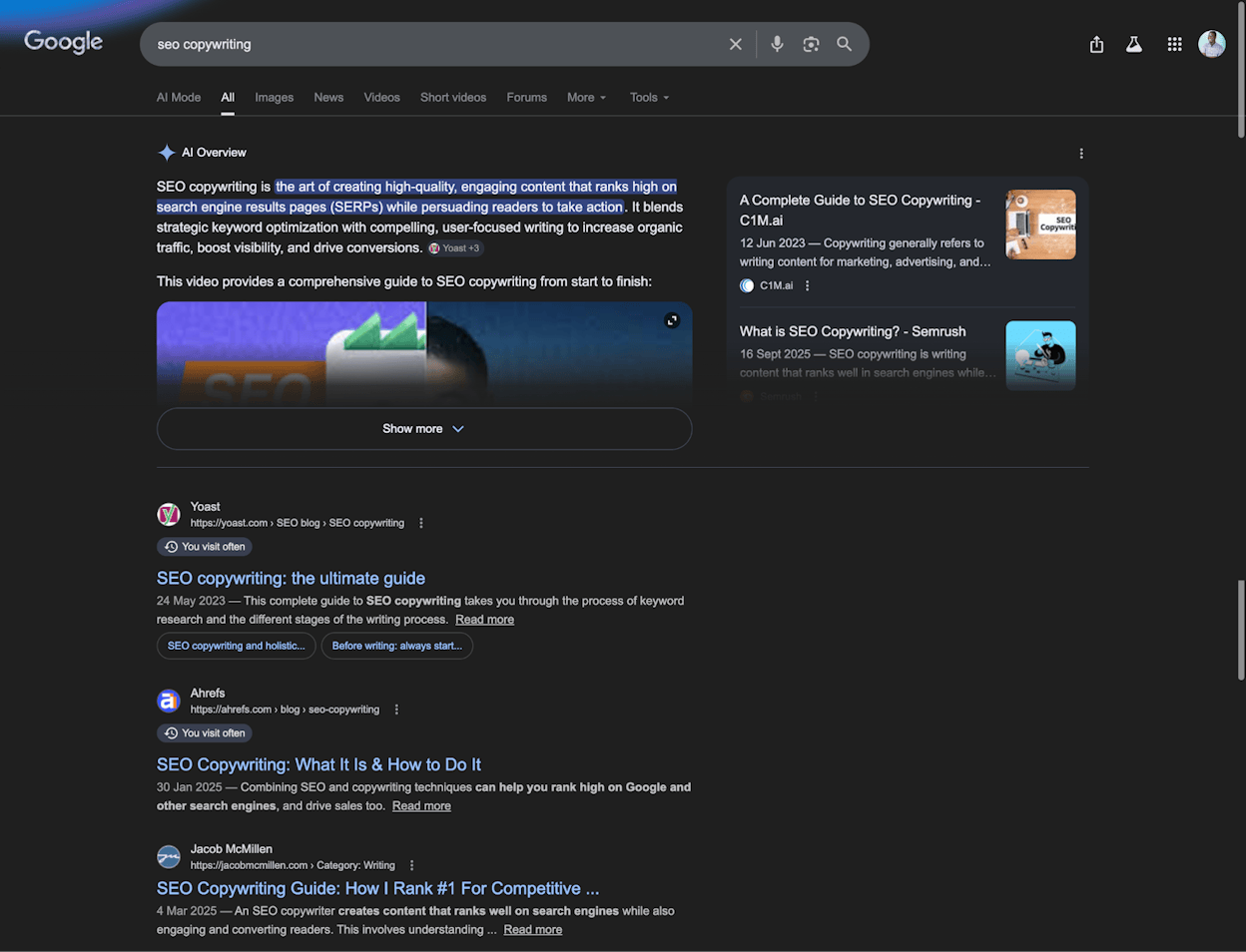
Match your content to what’s already working. If every top result is a step-by-step guide, don’t write a listicle. If the top results are all beginner-friendly, don’t write an advanced technical deep-dive (unless you have a specific reason to challenge the format).
This isn’t about copying what exists. It’s about understanding what searchers expect—and then exceeding those expectations.
3. Build a Data-Driven Outline
Most writers skip the outline or throw together a few bullet points. That’s a mistake. A good outline is the skeleton of a high-ranking article. It determines which subtopics you cover, which keywords you naturally include, and how your content flows.
Here’s how to build one that’s informed by what’s already ranking:
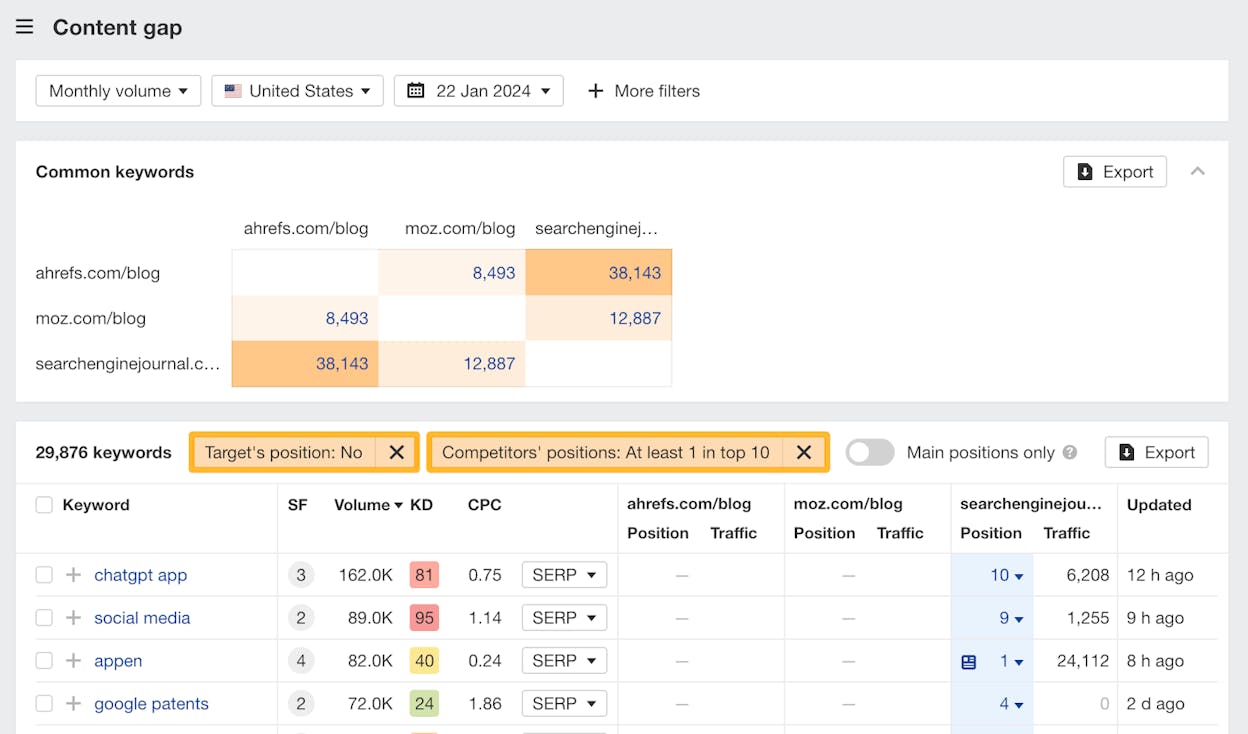
Identify the subtopics top-ranking pages cover. You can do this manually by reading the top 5–10 results and noting their H2s and H3s. Or you can use Ahrefs’ Content Gap tool: paste a few top-ranking URLs, and it’ll show you the common keywords they all rank for. These often map directly to subtopics you should cover.
Check “People Also Ask” for additional subtopics. Google’s PAA box shows questions searchers commonly ask. These make excellent H2s or FAQ entries. You can also track PAA topics using tools like Analyze AI’s PAA optimization feature.
Organize your outline by reader logic, not keyword logic. Don’t just list subtopics randomly. Arrange them in the order a reader would naturally want to learn about them. For an SEO copywriting guide, it makes sense to start with “what is it,” move to “why it matters,” then teach “how to do it” in stages.
Decide where your product fits in naturally. If you’re writing SEO copy for a business blog, identify the sections where your product or service solves a specific problem. Don’t force it into every section—weave it in where it genuinely adds value.
4. Give Your Content a Unique Angle
Here’s the problem with most SEO content: it’s the same article rewritten 50 different ways. The same tips, the same examples, the same structure. Google calls this the information gain problem—content that adds nothing new to what’s already out there.
To rank and earn links, your content needs a unique spin. Here are ways to add one:
Write from personal experience. Google’s E-E-A-T framework explicitly rewards content that demonstrates first-hand experience. If you’re writing about SEO copywriting, share your own results—traffic numbers, conversion rates, specific examples from your work. Readers can tell the difference between someone who’s done the thing versus someone who just researched it.
Include original data or research. Nothing earns links and citations faster than unique data. Run a survey, analyze a dataset, or share internal metrics. For example, Analyze AI’s research analyzing 83,670 AI citations is the kind of original data that gets cited repeatedly—both by other writers and by AI models.
Introduce a framework or formula. If you can name a concept or create a memorable framework, you give people a reason to link to your article specifically. Ahrefs coined the “ASMR formula” for readability. Grow and Convert coined “Pain Point SEO.” These frameworks become associated with the brand.
Challenge conventional wisdom. If you have evidence that a common practice doesn’t work—or that there’s a better way—say so. Opinionated content stands out in a sea of “me too” articles. Just make sure you back up your claims with specifics.
5. Use the Inverted Pyramid to Get to the Point
Readers are impatient. They want the answer immediately. If they have to scroll through four paragraphs of fluff before getting to the substance, they’ll hit the back button—and Google will notice.
The inverted pyramid is a journalism concept: put the most important information first, then provide supporting details, then background context.
For SEO copywriting, this means:
-
Answer the core question in the first 100 words. If someone searches “what is SEO copywriting,” define it immediately.
-
Front-load each section. Start each H2 or H3 with the key takeaway, then explain and elaborate.
-
Save the backstory for later. Context and background are important, but they should come after you’ve delivered the value.
This approach reduces pogo-sticking (when users click a result, don’t find what they need, and return to the SERP) and increases dwell time—both signals that help your rankings.
6. Build Credibility and Proof
Google’s E-E-A-T guidelines (Experience, Expertise, Authoritativeness, Trustworthiness) emphasize that content should demonstrate the author’s qualifications. Readers want proof that you know what you’re talking about before they trust your advice.
Here’s how to build credibility into your SEO copywriting:
Include an author bio with relevant credentials. If your SEO copywriting guide is written by someone who’s actually ranked content for clients, say so. Include specific results where possible.
Show evidence for claims. Don’t just say “keyword research is important.” Show the traffic results you got from following the process. Include screenshots, data tables, or links to case studies.
Interview experts when you lack first-hand experience. If you’re writing about a topic outside your expertise, bring in someone who has the credentials. Quote them with attribution. This is a common practice at top publications—and it strengthens both your content and your E-E-A-T signals.
Link to authoritative sources. Citing respected industry sources (research papers, official documentation, trusted publications) reinforces your credibility and gives readers confidence in your information.
Stage 2: Drafting
With your research done and outline ready, it’s time to write. This is where SEO fundamentals meet copywriting craft. The goal: create content that keeps readers scrolling, builds trust, and moves them toward action.
7. Hook Readers with a Strong Introduction
Your introduction has one job: convince the reader to keep reading. If it fails, nothing else in your article matters.
One effective approach is the PAS formula: Problem → Agitate → Solution.
-
Problem. State the reader’s pain point clearly. (“You’ve published 50 blog posts and none of them rank. Worse, the ones that do rank don’t generate a single lead.”)
-
Agitate. Make the problem feel urgent. (“Every month that passes is traffic, leads, and revenue you’re leaving on the table. Your competitors are capturing those searches right now.”)
-
Solution. Introduce what you’ll teach them. (“In this article, you’ll learn the exact SEO copywriting process that blends search optimization with persuasive writing—so your content ranks and converts.”)
Some other approaches that work well:
-
Start with a specific result. (“This process helped us grow organic traffic from 5,000 to 300,000 monthly visits. Here’s how.”)
-
Start with a counterintuitive statement. (“Most SEO copywriting advice tells you to write for Google first. That’s backwards.”)
-
Start with ‘In this article, you’ll…’ and directly state the value the reader will get. No fluff, no preamble.
The worst thing you can do is start with a vague, generic opener like “In today’s digital landscape…” or “When it comes to SEO copywriting…” These tell the reader nothing and signal that the article has nothing original to offer.
8. Keep Readers Engaged with Transitions
Long-form content risks losing readers in the middle. Transitions—sometimes called “bucket brigades”—are phrases that create micro-curiosity and pull readers from one sentence to the next.
Examples:
-
“Here’s the thing:”
-
“But that’s only half the story.”
-
“It gets better.”
-
“Here’s what most guides won’t tell you:”
-
“Let me explain.”
-
“The result?”
Use these at the start of paragraphs or sections where you feel the momentum might dip. They work because they create an open loop—a promise of information that the reader has to keep reading to close.
But don’t overuse them. If every paragraph starts with a bucket brigade, the writing feels manipulative. Use them strategically: at transition points between sections, after dense explanations, or before a payoff.
9. Write for Scanners First, Readers Second
Most people don’t read web content word by word. They scan headlines, skim bolded text, glance at images, and only read deeply when something catches their eye.
Your SEO copy needs to work for both scanners and deep readers. Here’s how:
Use descriptive subheadings. Don’t write vague H2s like “The Basics” or “Getting Started.” Write H2s that tell the scanner exactly what they’ll learn: “Find Topics with Keyword Research” or “Hook Readers with a Strong Introduction.”
Bold key takeaways within paragraphs. When a paragraph contains an important insight, bold the key sentence. This gives scanners the highlight reel while deep readers get the full context.
Use short paragraphs. On the web, walls of text are intimidating. Keep paragraphs to 1–3 sentences when possible. Each paragraph should contain one idea.
Include images, screenshots, and examples. Visual elements break up text, illustrate concepts, and give scanners anchor points. For a tutorial-style article, screenshots of each step are essential.
10. Naturally Weave In Your Product
If your article never mentions your product, you’re leaving conversions on the table. But if every other sentence is a sales pitch, readers will tune out.
The key is what Grow and Convert calls Customer-Content Fit: only mention your product in sections where it genuinely solves the problem being discussed. If you’re explaining how to do keyword research and your tool helps with that, show it. If the section is about writing introductions, your keyword tool doesn’t belong there.
When you do mention your product, show it in action. Don’t just say “Our tool does X.” Show a screenshot, walk through the steps, and demonstrate the value.
11. Add an FAQ Section to Capture Long-Tail Traffic
People researching a topic inevitably have follow-up questions that don’t fit neatly into your main sections. An FAQ section at the end of your article catches these.
Here’s why this matters for SEO:
-
Long-tail keyword rankings. Each FAQ answer is an opportunity to rank for a specific question-based keyword. Google often pulls FAQ answers into featured snippets and “People Also Ask” boxes.
-
AI citation opportunities. AI models frequently pull answers from well-structured FAQ sections. A clear, concise answer to a specific question is exactly the format that ChatGPT, Perplexity, and Claude prefer to cite.
-
Reader experience. Instead of cluttering your main content with every tangential question, you give readers a clean way to find specific answers.
To find the right questions for your FAQ:
-
Search your target keyword and check the “People Also Ask” box on Google.
-
Use a keyword tool’s “Questions” filter to find question-based variations.
-
Check Analyze AI’s prompt tracking to see what questions people ask AI engines about your topic.
Stage 3: Editing
Writing is rewriting. The editing stage is where you transform a decent draft into a polished piece that reads well, ranks well, and looks professional.
12. Simplify Your Language
Complex language doesn’t make you sound smart. It makes your content harder to read—and harder-to-read content gets abandoned.
Here are practical ways to simplify:
Cut jargon unless your audience expects it. If you’re writing for SEO beginners, don’t use terms like “canonical tags” or “crawl budget” without explaining them. If you’re writing for advanced practitioners, skip the basic definitions.
Use short words over long ones. “Use” instead of “utilize.” “Help” instead of “facilitate.” “Start” instead of “commence.” Your eighth-grade English teacher might have rewarded big vocabulary, but web readers reward clarity.
Read your draft out loud. If a sentence sounds awkward when spoken, it’ll read awkwardly too. This simple test catches most readability issues.
Use readability tools. Paste your draft into Hemingway or Analyze AI’s Grammar Checker to catch overly complex sentences, passive voice, and readability issues. Aim for a Grade 6–8 reading level for most web content.
13. Optimize for Featured Snippets
Featured snippets are the answer boxes that appear at the top of Google’s search results, above the #1 organic result. Winning a featured snippet can dramatically increase your click-through rate—even if you’re not the #1 ranked page.
Here’s how to optimize for them:
Check if a featured snippet exists for your keyword. Search your target keyword on Google and look for a snippet at the top. Note its format: is it a paragraph definition, a numbered list, a bulleted list, or a table?
Match the snippet format. If Google shows a definition snippet, include a clear, concise definition (40–60 words) near the top of the relevant section. If it shows a list, use a numbered or bulleted list. If it shows a table, create one.
Place your snippet-optimized content immediately after the relevant H2. Google typically pulls snippet content from content that directly follows a subheading that matches the query.
For example, if the featured snippet for “what is SEO copywriting” shows a definition, make sure your article has a clear H2 like “What Is SEO Copywriting?” followed immediately by a concise, complete definition.
14. Make Your Content Comfortable to Read
Reading long content is a transaction. Readers trade their time for your information. If the reading experience is painful, they’ll quit.
Follow this framework to make your content readable:
Add annotations. Sidenotes, callout boxes, blockquotes, and embedded media (tweets, videos) break up walls of text and add visual variety. They give the reader’s eye places to rest.
Use short sentences and paragraphs. Vary sentence length for rhythm, but default to short. If a sentence has more than two commas, consider breaking it into two sentences.
Include multimedia. Images, screenshots, diagrams, and videos illustrate points more efficiently than paragraphs of explanation. For every major concept or step, ask: “Would a visual make this clearer?”
Read your content out loud. This is the single best editing technique. If you stumble over a phrase, your readers will stumble too. Rewrite anything that doesn’t flow naturally.
15. Strengthen Your On-Page SEO
On-page SEO is the technical foundation that helps search engines understand and rank your content. After your draft is written and edited, do a final optimization pass:
Include your target keyword in key positions: - Title tag (H1) - URL slug - First 100 words - At least one H2 - Meta description
Add internal links to related content on your site. Internal links help search engines discover and understand the relationship between your pages. They also keep readers on your site longer. Link to relevant articles using descriptive anchor text—not “click here.”
Optimize your images. Use descriptive file names (not “IMG_4523.jpg”) and write helpful alt text that describes the image content. Compress images to keep page load times fast.
Write a compelling meta description. The meta description is the snippet that appears below your title in search results. While it doesn’t directly affect rankings, it heavily influences click-through rate. Write 150–160 characters that summarize the value of your content and include your target keyword.
You can generate optimized meta descriptions using Analyze AI’s free Meta Description Generator.
How to Write SEO Copy That AI Search Engines Cite
Everything we’ve covered so far applies to both Google and AI search engines. But there are additional steps you can take to maximize your visibility in AI-generated answers.
AI models like ChatGPT, Perplexity, and Claude work differently from Google. They don’t rank pages—they synthesize answers from multiple sources and cite the ones they pull from. Analyze AI’s analysis of 65,000 prompt citations found several patterns in the content that gets cited most:
Structured, clear content gets cited more. AI models parse your content to extract specific answers. Clear H2/H3 hierarchies, concise paragraphs, and well-organized information make it easier for models to identify and cite your content.
Specificity wins over generality. Vague content like “keyword research is important” won’t get cited. Specific content like “use a keyword tool to filter for terms with a KD score under 30 and monthly volume above 500” gives AI models something concrete to reference.
Original data and research earn disproportionate citations. If you’re the original source of a statistic, framework, or finding, AI models are more likely to cite you directly rather than a site that simply references your work.
Authoritative domains get more citations. Domain authority matters in AI search too. Building topical authority through consistent, high-quality content on related topics improves your chances of getting cited.
Track Your AI Search Visibility
The biggest mistake most content teams make with AI search is not measuring it at all. You can’t optimize what you can’t measure.
Analyze AI lets you track exactly where your brand appears—and doesn’t appear—across ChatGPT, Perplexity, Claude, Copilot, and Gemini. Here’s how to use it for SEO copywriting:
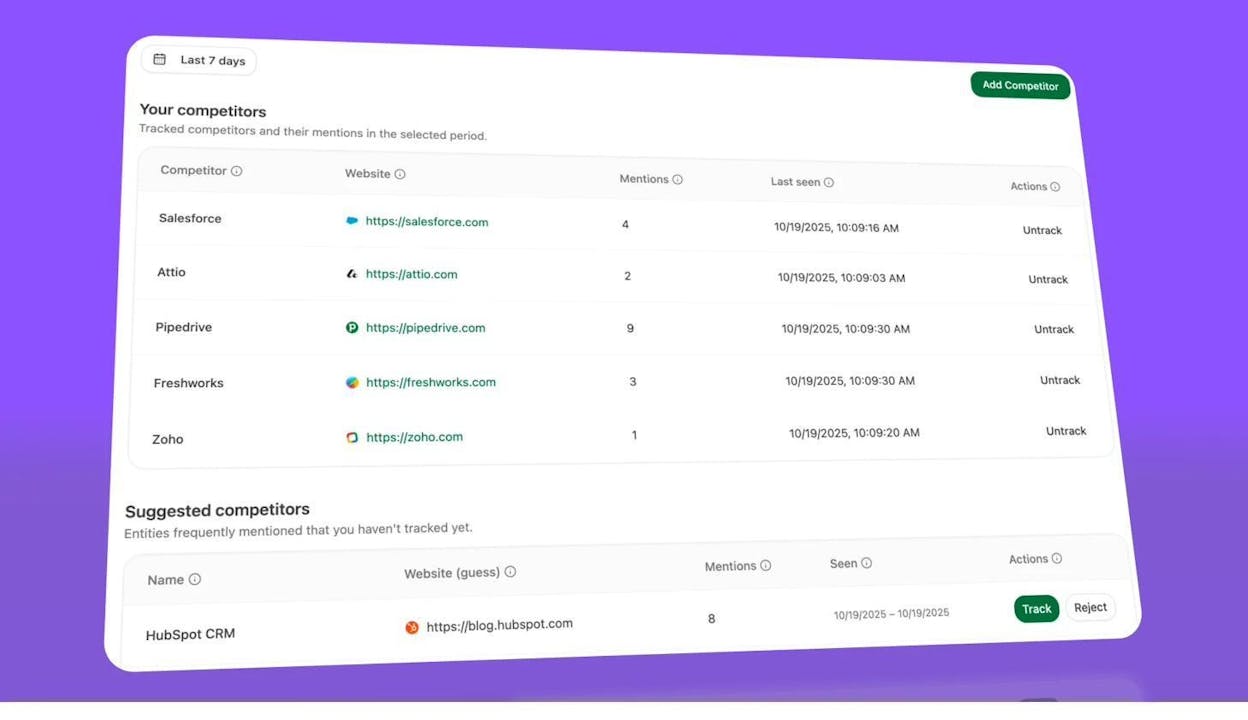
See which prompts mention your brand. Analyze AI tracks prompts across AI engines and shows you where your brand is being cited, which competitors appear alongside you, and where you’re absent.
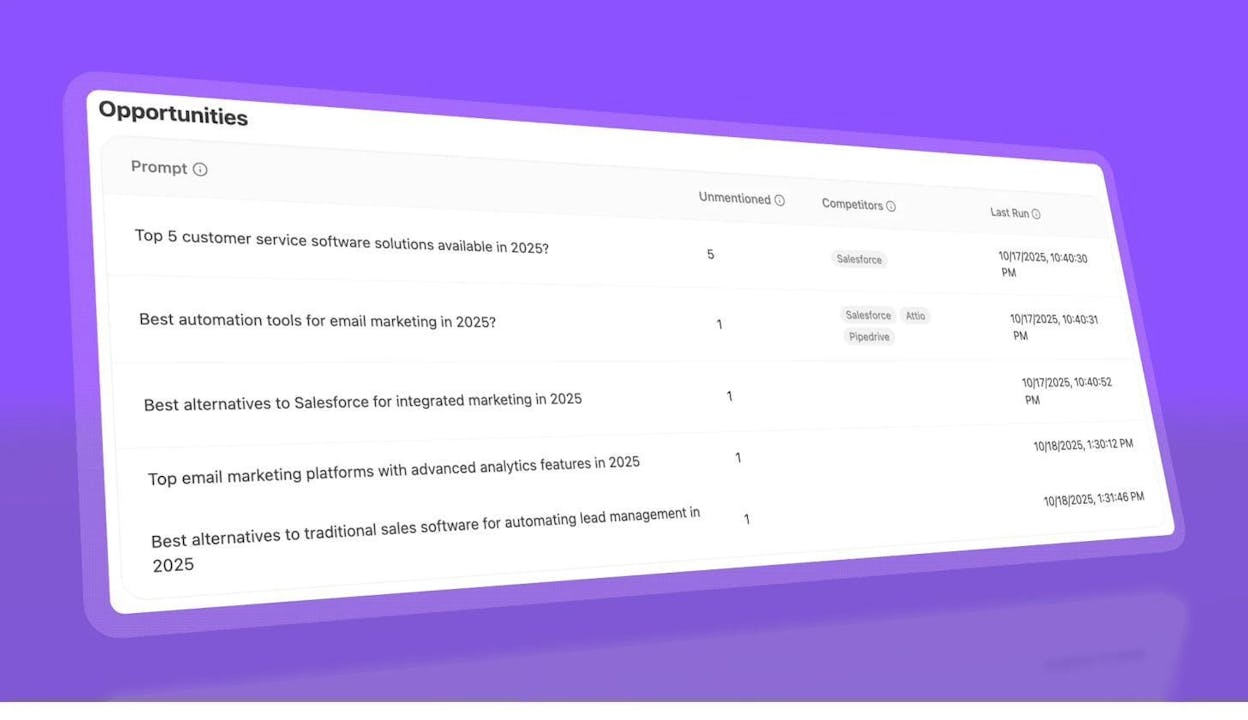
Find content gaps with the Opportunities feature. The Opportunities dashboard shows specific prompts where your competitors are mentioned but you’re not. These are the exact content gaps your next article should fill.
Track which pages receive AI referral traffic. Connect your GA4 to Analyze AI and you’ll see exactly which landing pages get traffic from AI search engines, which AI engine sent the traffic, and how many sessions each page generates.
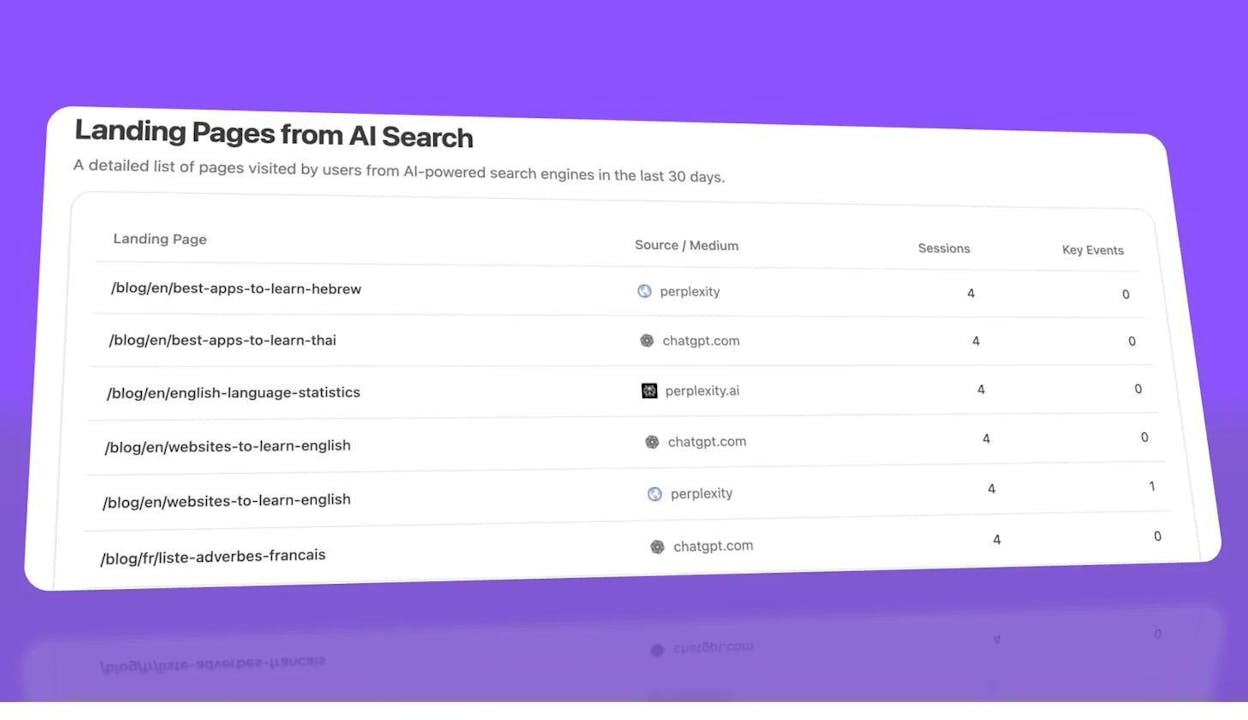
This data tells you which content formats and topics AI engines prefer to send traffic to. Double down on what works.
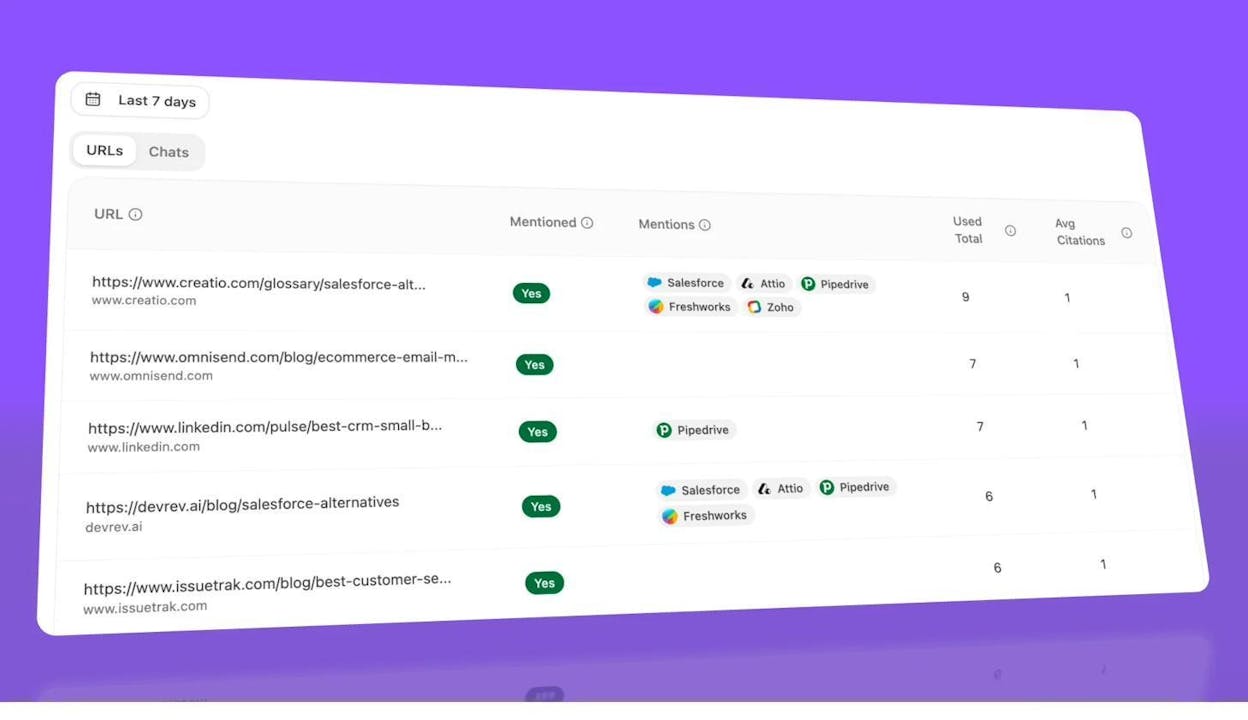
Monitor citation sources. Analyze AI’s citation analytics show which of your URLs get cited by AI models, how often, and in which engines. If a specific blog post is getting cited heavily by Perplexity but not ChatGPT, you can investigate why and optimize accordingly.
Bonus SEO Copywriting Tips
These additional techniques can elevate your SEO copy from good to exceptional.
16. Add a Table of Contents for Long Content
For articles over 1,500 words, a table of contents (ToC) serves two purposes:
-
Reader experience. It lets readers see your full scope upfront and jump to the section they need. Once they start reading, they often get pulled into more of the article.
-
SEO benefit. Google sometimes converts ToC links into sitelinks in search results, giving your listing more real estate and more click opportunities.
Most CMS platforms (WordPress, Webflow, etc.) have plugins or built-in features to auto-generate a ToC from your headings.
17. Write Title Tags That Earn Clicks
Your title tag is the headline that appears in search results. It’s the single biggest factor in whether someone clicks your result—or scrolls past it.
Here’s what makes a title tag click-worthy:
-
Include the target keyword (preferably near the beginning).
-
Communicate clear value. “SEO Copywriting: What It Is & How to Do It” tells the searcher exactly what they’ll get.
-
Add a differentiator when possible. Numbers (“14 Tips”), brackets (“[With Examples]”), or freshness signals (“2026 Guide”) can boost click-through rates.
-
Keep it under 60 characters so Google doesn’t truncate it.
You can generate and test title tags with Analyze AI’s free SEO Title Generator.
18. Use Schema Markup to Enhance Your SERP Listing
While not strictly a “copywriting” tip, adding structured data to your page can improve how your content appears in search results. FAQ schema, How-To schema, and Article schema can generate rich results that take up more space on the SERP and attract more clicks.
If your content includes an FAQ section, implementing FAQ schema is especially worthwhile—it can display your questions and answers directly in search results.
SEO Copywriting Tools
The right tools make SEO copywriting faster and more effective. Here are the ones worth using:
|
Tool |
What It Does |
Best For |
|---|---|---|
|
Keyword research, content gap analysis, rank tracking, backlink analysis |
Comprehensive SEO research |
|
|
AI search visibility tracking, prompt monitoring, citation analytics, AI traffic attribution |
Understanding and improving how your content performs in AI search |
|
|
Organic performance data, indexing status, click-through rates |
Monitoring your Google search performance |
|
|
Readability scoring, sentence simplification |
Making your writing clear and accessible |
|
|
Grammar, spelling, tone, and clarity checks |
Polishing your draft |
|
|
Meta descriptions, title tags, outlines, content ideas, paraphrasing |
Quick content generation and optimization |
|
|
Keyword ideas from seed terms |
Finding new keyword opportunities |
|
|
Check current SERP results for any keyword |
Analyzing search intent and competition |
FAQ
What is the difference between SEO writing and SEO copywriting?
They’re often used interchangeably, but there’s a subtle difference. SEO writing focuses primarily on creating content that ranks well in search engines. SEO copywriting adds a persuasion layer—the content is written not just to rank, but to convince readers to take a specific action (sign up, buy, share). In practice, the best content does both.
Is SEO copywriting still relevant with AI search?
Absolutely. The fundamentals of SEO copywriting—clear structure, keyword targeting, search intent matching, and persuasive writing—are exactly what makes content rank on Google and get cited by AI search engines. AI models prefer well-structured, authoritative, specific content. That’s good SEO copywriting. The only change is that you now have an additional channel to optimize for, which means tracking your AI search visibility alongside your traditional SEO metrics.
How long should SEO copy be?
There’s no universal answer. The right length depends on the topic and what’s already ranking. For some keywords, a 500-word page is sufficient. For others, you need 3,000+ words to cover the topic thoroughly. The rule of thumb: be as long as necessary to fully answer the searcher’s question, and not a word longer. Check the word count of the top-ranking pages for your keyword to get a benchmark.
How do I know if my SEO copywriting is working?
Track these metrics:
-
Organic traffic (via Google Search Console or Google Analytics)
-
Keyword rankings for your target terms (via Keyword Rank Checker or Ahrefs)
-
AI search citations and traffic (via Analyze AI)
-
Conversions from organic and AI traffic (via Google Analytics goals or events)
If your content ranks, drives traffic, and converts, your SEO copywriting is working.
Can AI write SEO copy for me?
AI writing tools (ChatGPT, Claude, Jasper) can help with drafts, outlines, and ideation. But they can’t replace human judgment on strategy, originality, or product knowledge. The most effective approach is to use AI as an assistant for speed, then add your own expertise, experience, and editorial judgment to create something genuinely valuable. Content that’s purely AI-generated tends to lack the specificity and originality that ranks well and earns citations. Read more about this in our guide on AI copywriting.
What’s the best way to learn SEO copywriting?
Practice. Study the top-ranking content for any keyword you care about. Analyze what they do well and where they fall short. Then write your own version that’s better. Track your results, iterate, and repeat. Reading guides like this one helps with the fundamentals, but the real learning happens when you publish, measure, and improve.
Final Thoughts
SEO copywriting is a skill that sits at the intersection of search optimization, persuasive writing, and content strategy. Master it and you have a repeatable way to generate organic traffic that converts.
The process is straightforward: research your keywords and intent, draft content that hooks and engages, edit for clarity and optimization, and track your results across both traditional and AI search channels.
The brands winning in organic search today aren’t choosing between SEO and AI visibility. They’re treating them as two sides of the same coin—because the same qualities that make content rank on Google (depth, structure, authority, specificity) also make it get cited by ChatGPT, Perplexity, and Claude.
If you’re not tracking your content’s performance in AI search yet, start with Analyze AI. You’ll see exactly where your content shows up, where it doesn’t, and what to do about it.

Ernest

Ibrahim


![The Only SEO Checklist You Need in 2026 [With Template]](/_next/image?url=https%3A%2F%2Fwww.datocms-assets.com%2F164164%2F1774288228-image7.png&w=3840&q=75)


