



Summarize this blog post with:


In this article, you’ll learn how much traffic AI search engines actually send to websites in 2026, why that number is misleading on its own, and what you can do today to capture both the visits and the upstream brand exposure that AI search creates. We pulled benchmarks from Conductor, Adobe, Chartbeat, and our own 83,670-citation dataset to give you a complete picture, then walked through the exact tracking and content moves that turn AI visibility into pipeline.
If you’re trying to decide how much energy to spend on AI search versus traditional SEO, this is the data and the playbook.
Table of Contents
AI sends roughly 1% of website traffic. That’s a 10x jump in a year.
For most of 2025, the working assumption was that AI referral traffic sat around 0.1% of total web visits. That number came from an Ahrefs study of about 35,000 sites in early 2025 and was repeated everywhere.
It’s now out of date.
Conductor’s 2026 AEO/GEO Benchmarks Report analyzed 13,770 enterprise domains across 10 industries and aggregated 3.3 billion sessions between May and September 2025. The headline finding: AI referral traffic now accounts for 1.08% of all website traffic on average and is growing roughly 1% month over month.
That’s a 10x jump from the prior year and the highest credible benchmark we’ve seen so far.
It’s also still small. Across the same dataset, organic search continues to drive over 33% of website visits in industries like Industrials. The rest comes from direct, paid, social, and other referral sources. AI hasn’t replaced anything. It has shown up as a new, fast-growing channel sitting next to email, social, and paid.
A few other 2026 reference points worth pinning down:
-
Chartbeat found AI chatbots still account for less than 1% of publisher page view referrals, even after ChatGPT referrals grew over 200% across 2025.
-
Adobe data shows AI platforms generated 1.13 billion referral visits in June 2025, a 357% increase from June 2024.
The right way to read these numbers is not “1% is small, ignore it.” It’s that AI traffic is small in volume, large in growth rate, and starting to behave differently from any other channel in your analytics.
For a deeper look at the citation patterns behind that traffic, our team analyzed 83,670 AI citations across ChatGPT, Claude, and Perplexity and found that the engines disagree on almost everything, including which sources to cite and which brands to mention.
ChatGPT now drives almost 9 out of every 10 AI clicks
Inside that 1% of AI traffic, the distribution is wildly uneven.
Conductor found that 87.4% of all AI referral traffic comes from ChatGPT. The remainder is split between Perplexity, Gemini, Copilot, and Claude in single-digit shares.
|
AI engine |
Share of AI referral traffic |
|---|---|
|
ChatGPT |
87.4% |
|
Perplexity |
~6% |
|
Gemini |
~3% |
|
Copilot |
~2% |
|
Claude |
<1% |
Source: Conductor 2026 AEO/GEO Benchmarks Report
This concentration matters because the engines do not behave alike. ChatGPT has a citation rate of around 0.7%, while Perplexity sits at 13.8% and Google AI Mode at 9.5%. In plain English, ChatGPT sends the most clicks but rarely shows the source link, while Perplexity sends fewer clicks but cites sources far more often.
That asymmetry has a strategic consequence. If your only goal is direct traffic, ChatGPT is the priority. If your goal is brand citations and authority signals, Perplexity and Google AI Mode pay back faster per visibility moment.
We saw the same split in our own 83,670-citation analysis. Perplexity averaged 1.26 citations per brand mention, Claude 1.05, and ChatGPT 0.98. The closer an engine sits to “live search,” the more often it links out.
The conversion paradox: tiny traffic, oversized impact
Here’s where the story flips.
The same Conductor and Adobe data sets show that the visitors who do click through from AI engines convert at rates that are hard to ignore.
-
AI search traffic converts at 14.2% versus Google’s 2.8% in one large-sample analysis.
-
Microsoft Clarity’s 2025 study of more than 1,200 publishers found AI traffic converts at roughly 3x the rate of traditional channels for sign-ups and subscriptions.
-
Adobe found that visitors from AI search stay on sites 41% longer, view 12% more pages, and bounce 23% less than non-AI traffic.
The pattern is consistent across studies. Smaller volume, much higher intent.
The behavioral explanation is simple. By the time someone clicks through from an AI answer, the assistant has already done the early-stage research, narrowed the options, and explained the basics. The user arrives further down the funnel than a typical Google visitor.
For B2B teams, this often shows up as a small number of high-quality demo requests that look minor in GA4 but disproportionately well in the CRM. The implication for measurement is clear. Tracking AI traffic in isolation undersells it. You need to tie AI sessions to downstream actions, not just landings.
Where AI traffic is actually concentrated
The 1.08% average hides a 10x range across industries.
In Conductor’s data, IT leads at 2.80% of total traffic, followed by Consumer Staples at 1.91% and Financials at 1.52%. Utilities (0.35%) and Communication Services (0.25%) sit at the bottom.
|
Industry |
AI referral traffic share |
|---|---|
|
Information Technology |
2.80% |
|
Consumer Staples |
1.91% |
|
Financials |
1.52% |
|
Industrials |
1.25% |
|
Health Care |
~1.0% |
|
Utilities |
0.35% |
|
Communication Services |
0.25% |
If you sell to engineers, IT buyers, or finance professionals, you should already be tracking AI search seriously. If you serve municipalities or telecoms, AI is on the watch list, not the priority list.
Geography matters too. SE Ranking found ChatGPT’s global share at roughly 78%, but in the US Perplexity climbs to nearly 20% of AI referrals. The US is where AI traffic is most diversified across engines, which is one more reason US-targeted brands need to track all four major AI sources, not just ChatGPT.
Best-of, comparison, and product pages capture the most AI clicks
When we look at which page types pick up AI traffic, the pattern is consistent across our data and earlier Ahrefs studies. The pages that win are listicles and “best X” roundups, versus and alternative pages, product and feature pages (especially on ChatGPT, where over 60% of cited sources are product documentation), in-depth how-to guides (which Claude favors at 43.8% blog share), and pricing pages.
The pattern is clear. AI engines pull from the same bottom-of-funnel content that already converts well in traditional search. If you’ve been investing in SEO content strategy for buyer-intent keywords, you’ve already done most of the AI groundwork.
The catch is that the prompts AI engines answer are often longer and more specific than the keywords those pages were originally built around. We’ll come back to this in the playbook below.
Most of AI’s value sits upstream of the click
Here’s the part most click-counting analyses get wrong.
When someone uses ChatGPT to compare three project management tools, they may never click any link. But they walked away with three brand names in their head and a sense of which one fits their team. That mental shortlist is the value, even when the analytics tab shows zero.
We saw this clearly in our 83,670-citation study. The top 10 brands in any category capture roughly 30% of all AI mentions. Salesforce alone showed up in 6.3% of responses. Most of those mentions never produced a click, but they shaped buyer perception in ways no GA4 dashboard will measure.
A few patterns worth internalizing:
-
About 83% of AI citations come from third-party sources like review sites, news articles, and analyst content. Only 17% come from the brand’s own domain.
-
The same brand can score 79 sentiment points apart across ChatGPT, Claude, and Perplexity, depending on which sources each engine pulls from.
-
Brand mentions in AI answers correlate with downstream branded search volume, which still gets attributed to “Google organic” in your analytics.
Measuring AI value purely through “AI / Referral” sessions in GA4 will always understate it. The real impact shows up in branded search lift, direct traffic increases, and “How did you hear about us?” responses that mention ChatGPT. This is also why we don’t believe SEO is dead. Strong content earns Google rankings, those rankings get cited by AI engines, those citations build brand recall, and that recall drives both AI clicks and direct visits. We laid out the full thesis in GEO vs SEO.
How to actually track and grow your AI traffic
Now the practical part. Here’s the workflow we use ourselves and recommend to teams getting serious about AI search.
1. Set up AI referral tracking in GA4
Out of the box, GA4 lumps most AI traffic into “Direct” or “Referral” without distinguishing the source. You need to fix that first.
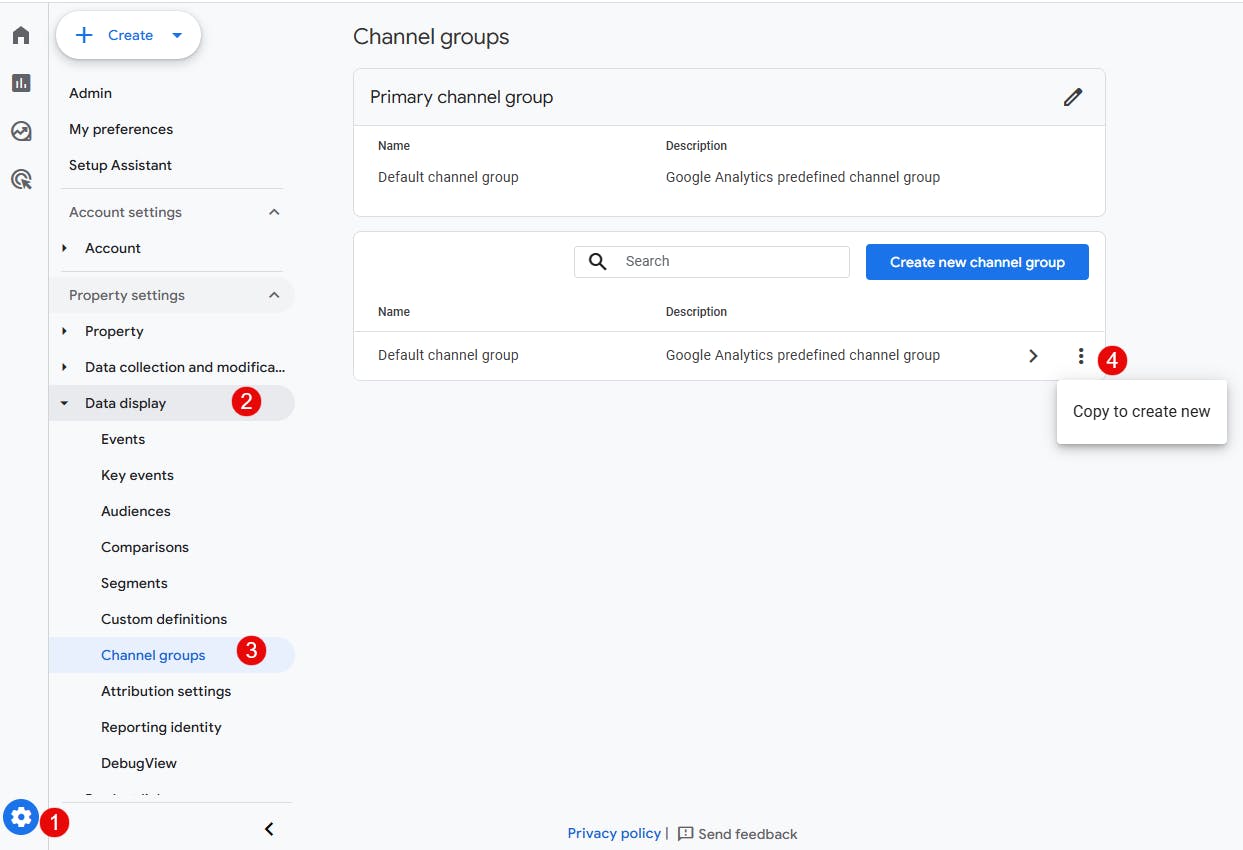
Create custom channel groupings in GA4 by going to Admin > Data display > Channel groups > Create new channel group. Add a new “AI Search” channel with conditions matching source containing chatgpt.com, chat.openai.com, perplexity.ai, gemini.google.com, copilot.microsoft.com, and claude.ai.
Also set up a custom report under Reports > Library > Create new report with Source/Medium as the dimension, filtered to those AI domains, with metrics for sessions, conversions, and engagement rate.
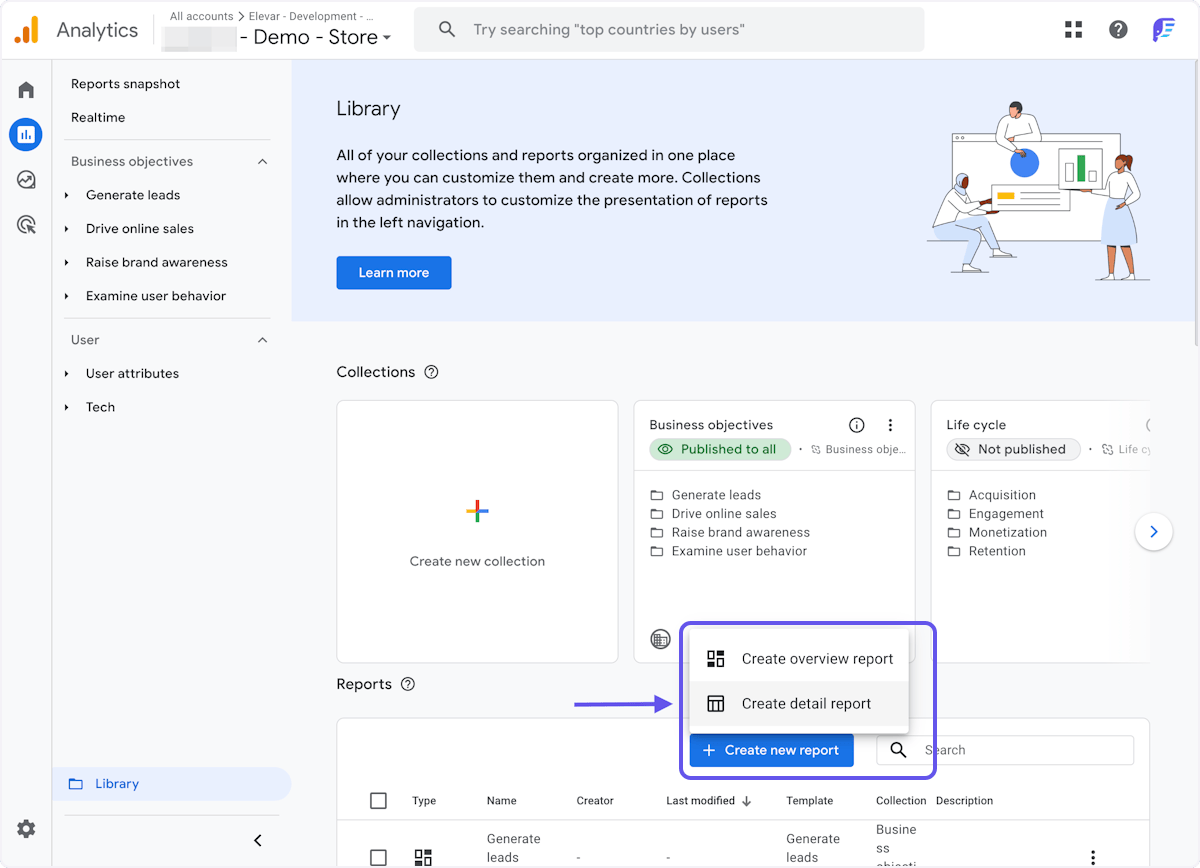
Once you have a few weeks of data, you’ll see exactly which AI engine sends traffic, which pages they land on, and how those visitors behave compared to your other channels.
2. Track AI visits at the session level, not just the channel
Channel-level data tells you how much AI traffic you got. Session-level data tells you what those visitors did.
In Analyze AI, the AI Traffic Analytics view rolls all of that together in one place. You get visitors per AI source, visibility, engagement rate, bounce rate, conversions, and average session time.
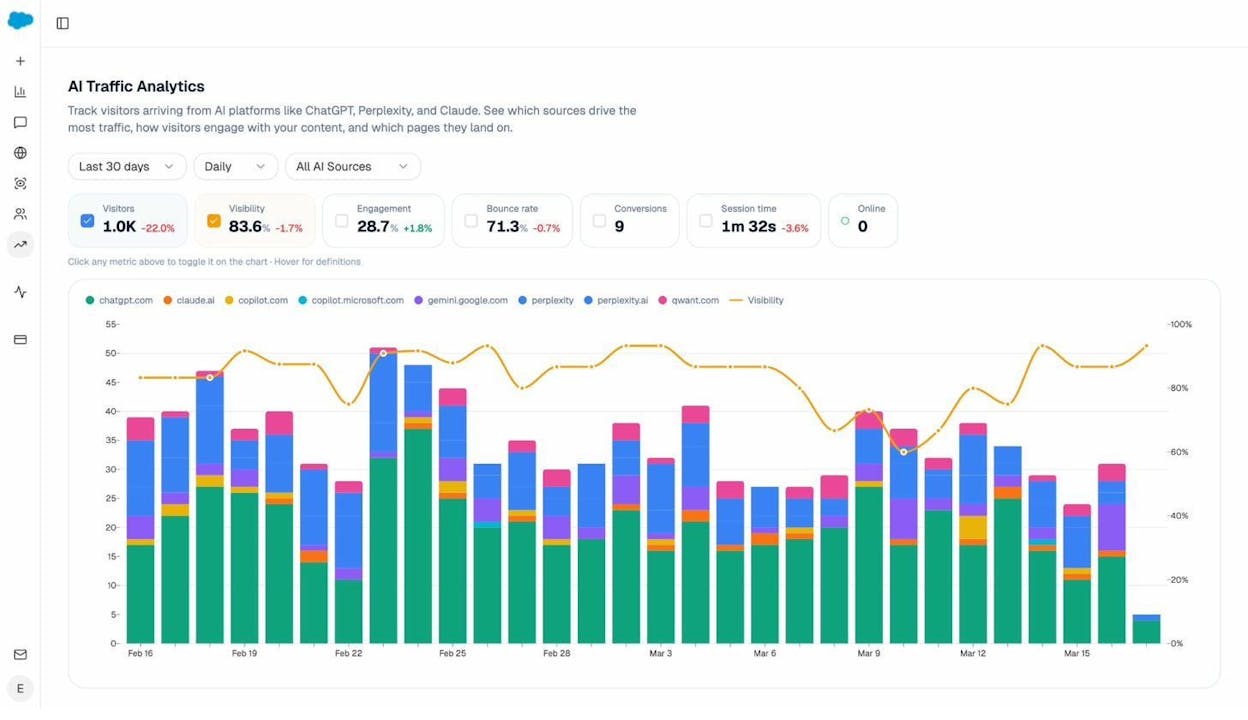
The chart above is from a real account. ChatGPT (in green) drives roughly half the AI visits, with Perplexity and Gemini splitting most of the rest. Visibility (the orange line) hovers around 80%, meaning the brand shows up in 4 out of every 5 tracked AI responses. That ratio is what you want to track week over week, not the raw visitor count, because visitor counts will always be small in absolute terms while visibility share moves earlier and predicts traffic growth.
You can also drill into individual sessions to see which AI engine sent which visitor to which page.
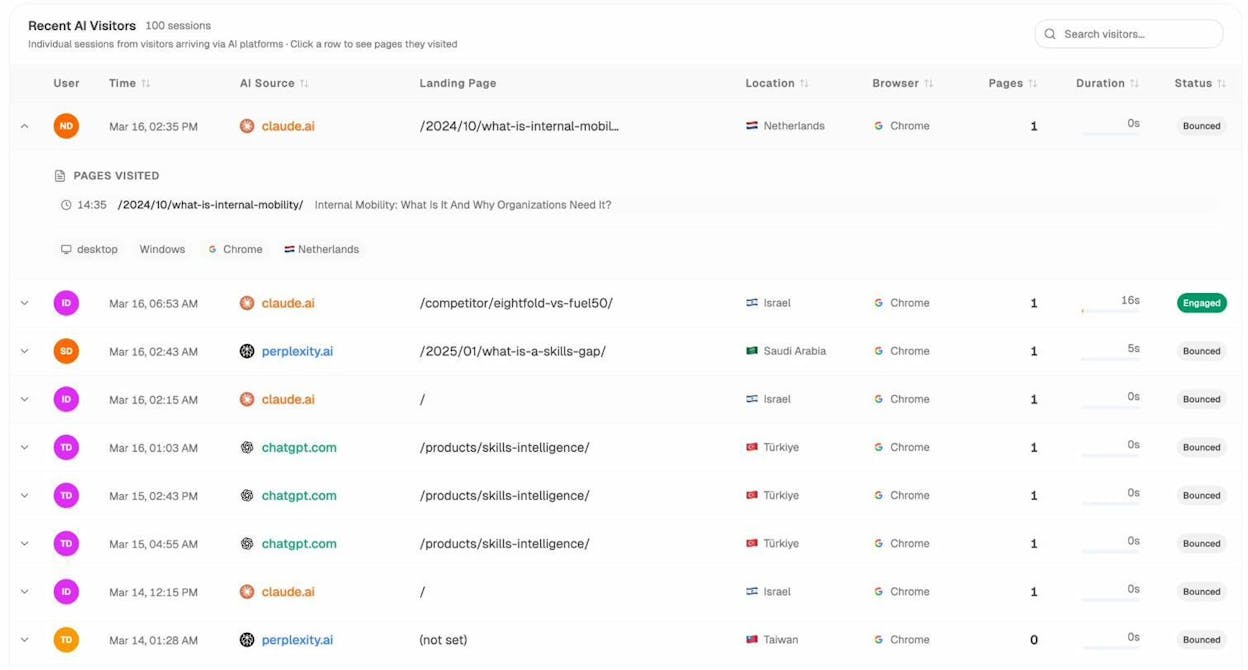
This is the equivalent of “user explorer” in GA4 but specifically for AI traffic. It’s what you use when a session converts and you want to know exactly what path led to it.
3. Find the prompts your buyers are actually typing
Tracking traffic tells you what already happened. Tracking prompts tells you what’s about to happen.
In Analyze AI’s Prompt Discovery view, the platform suggests the prompts your category buyers are running across ChatGPT, Perplexity, Claude, and Google AI Mode based on your domain and competitors.
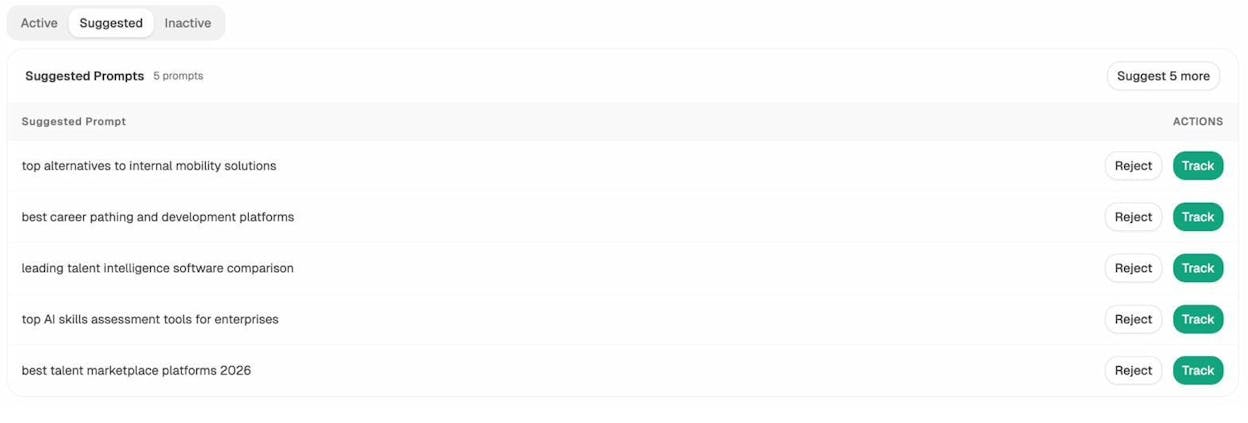
Hit “Track” on the prompts that match your buyer’s questions. From that point on, Analyze AI runs those prompts daily across every major AI engine and reports back on whether your brand was mentioned, where you ranked, what sentiment came through, and which competitors showed up alongside you.
For each tracked prompt, you can see exactly how visibility is trending versus competitors over time.
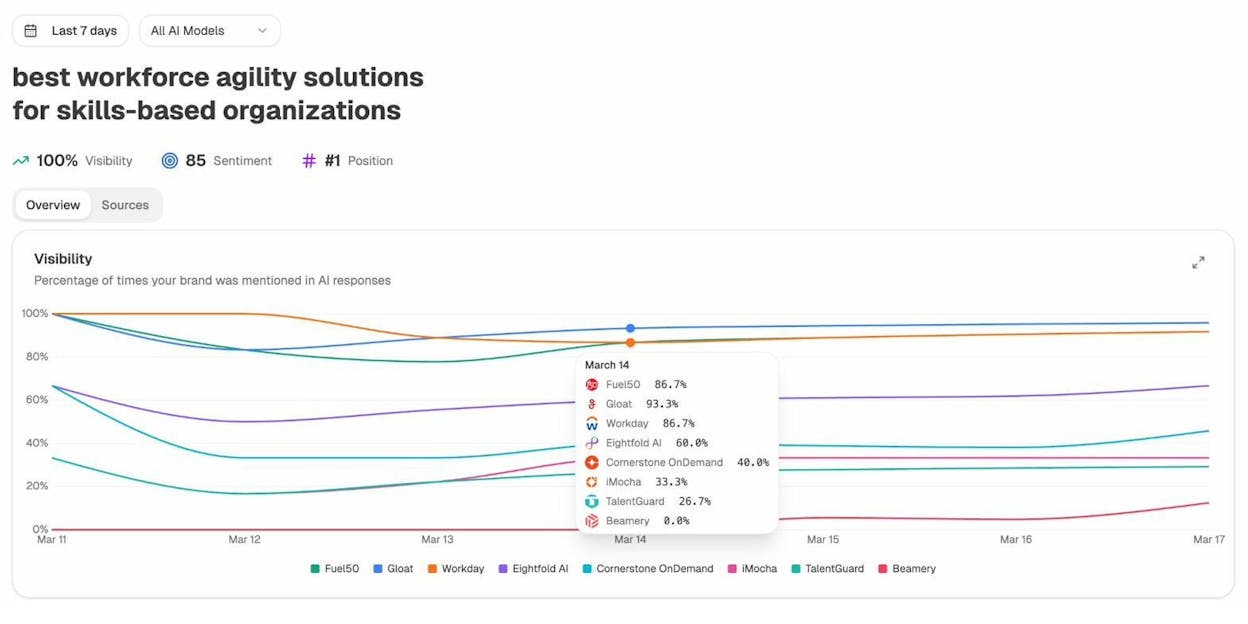
This is the upstream version of keyword tracking. Instead of tracking your rank for a keyword, you track your share of voice for the natural-language prompts buyers actually use.
4. Identify which pages AI is already citing and double down
If you only know the channel-level number, you’re flying blind on what’s working. The key question is which specific pages of yours AI engines are citing, and which competitor pages are getting cited instead.
Inside Analyze AI’s Citation Analytics and Sources view, every URL that AI platforms reference for prompts in your industry is broken down by content type and domain.
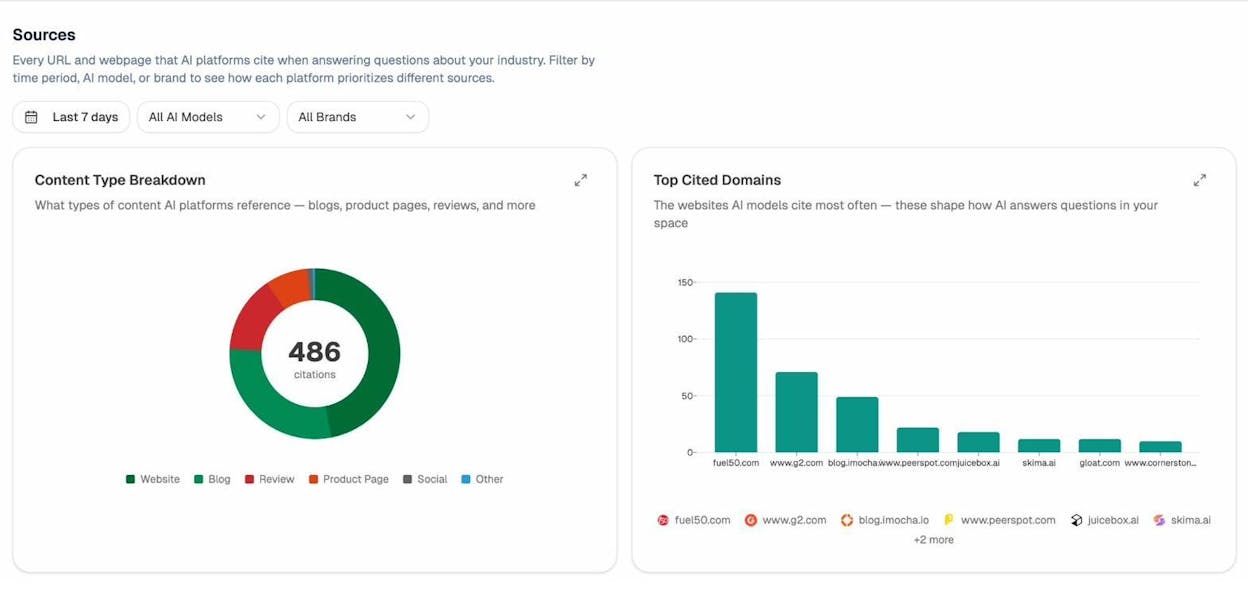
This is where you find your AI content gold. Pages that already get cited deserve more internal linking, more updates, and more variations. Pages that don’t get cited but should are your priority backlog.
The simple workflow is to filter to “Last 30 days,” sort top cited domains, identify which of your URLs are getting traction, and refresh them with the structured comparison data, specific stats, and FAQ content that AI engines extract well. We cover this in our guide on how to rank on ChatGPT.
5. Watch where competitors win in AI and you don’t
The fastest content roadmap usually comes from looking at where competitors get mentioned and you don’t.
The Competitor Intelligence view tracks how often each of your tracked competitors gets mentioned across AI answers in your category.
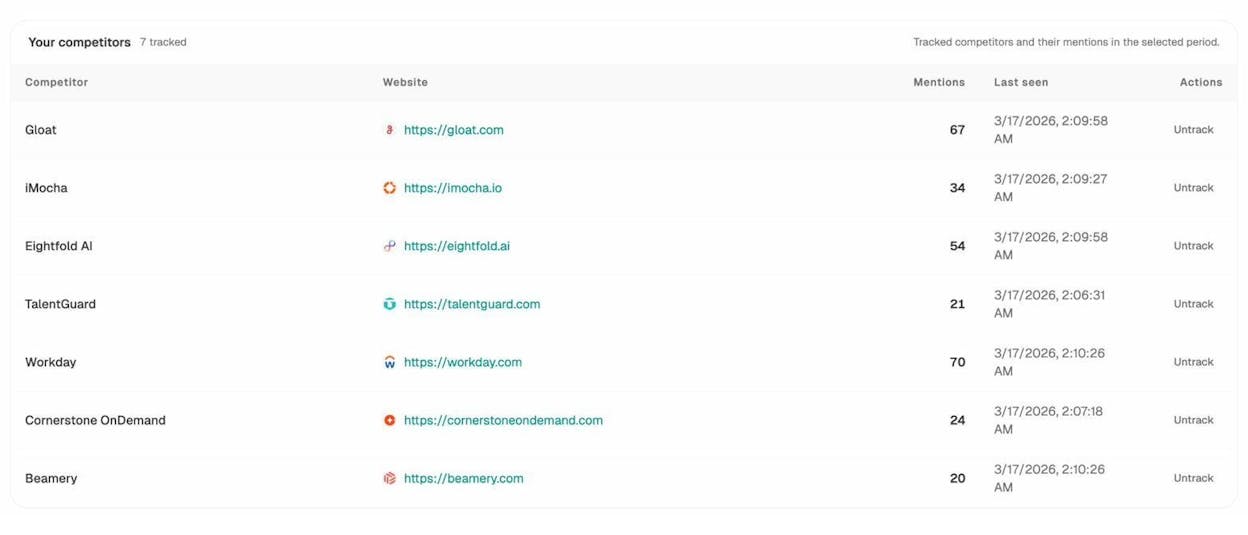
If a competitor is getting mentioned 70 times a week and you’re getting mentioned 20, you don’t need to guess where to invest. You drill in, find the prompts where they win and you don’t, and either build a new asset or refresh an existing one targeting that prompt.
For more on this approach, read how to outrank competitors in AI search.
6. Map perception, not just visibility
Showing up isn’t the same as being recommended. The Perception Map plots every brand in your category on two axes: visibility (how often AI engines mention them) and narrative strength (how positively they describe them).
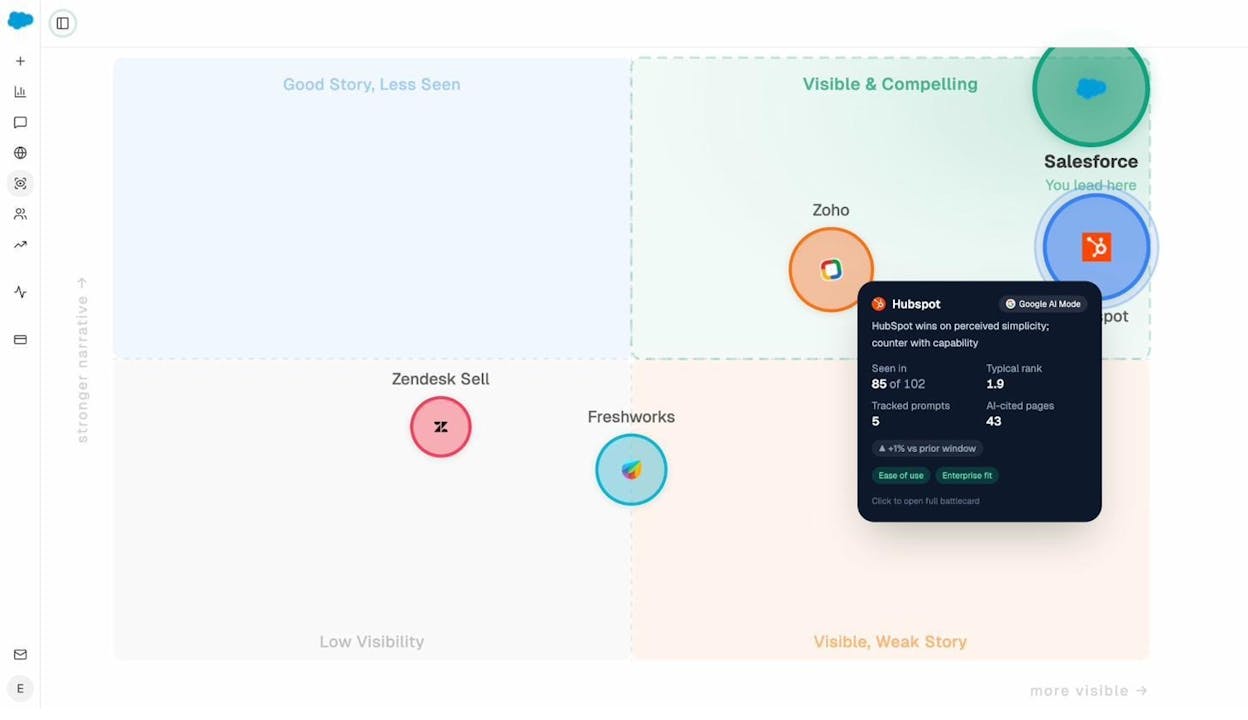
The “Visible & Compelling” quadrant is where you want to be. The “Visible, Weak Story” quadrant is the dangerous one. AI is talking about you, but not in ways that win deals. The fix there is usually content, messaging, and review-site work, not more publishing volume.
7. Run a weekly digest and refresh declining pages
The reason most teams give up on AI search tracking is that the data feels noisy week to week. A weekly digest fixes that.
Set up a weekly email digest that summarizes the four numbers you actually need to act on: visibility change, sentiment change, citation momentum, and traffic from AI sources.
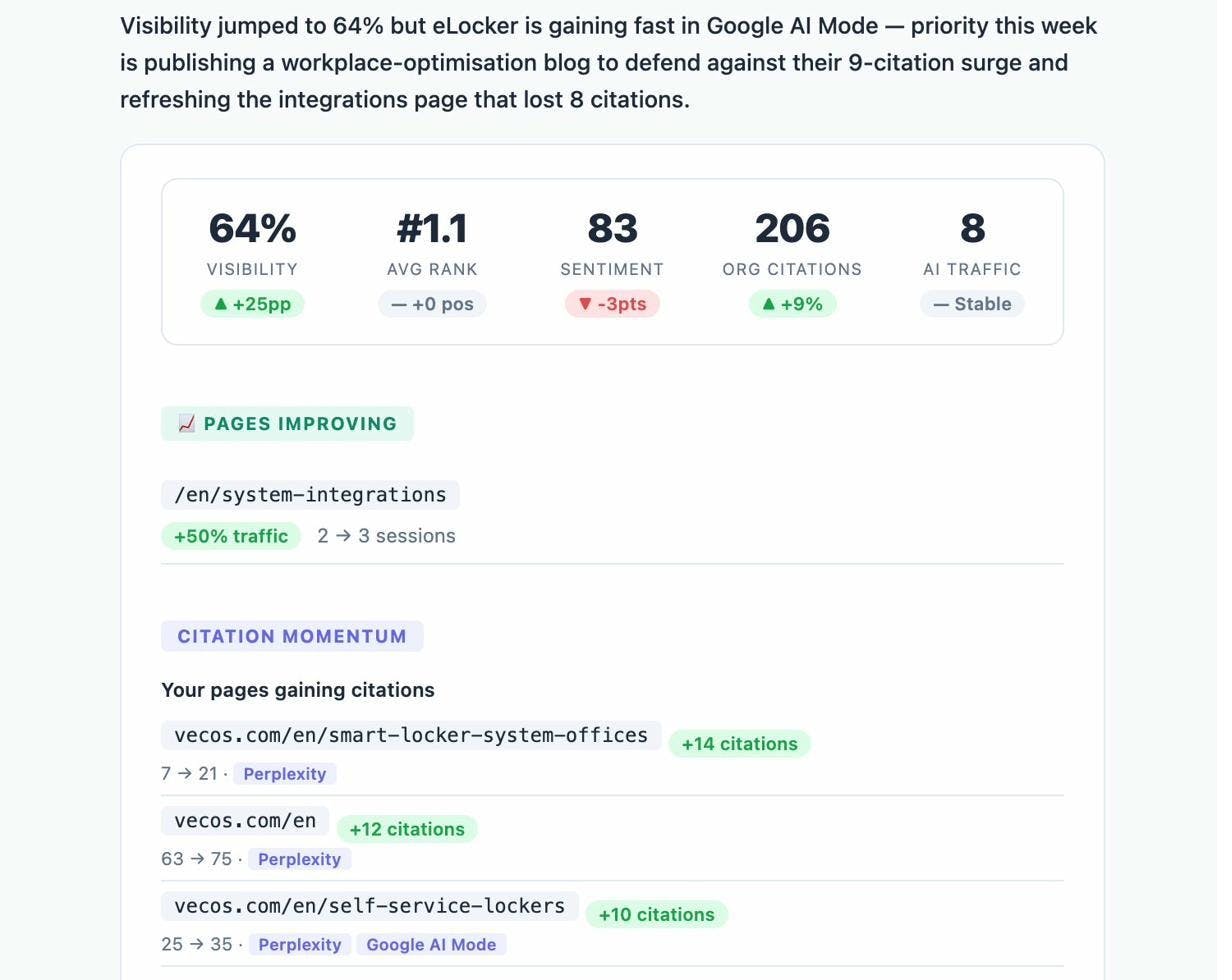
The digest tells you which pages are gaining citations, which ones are losing them, and what to publish next.
The other half of the weekly routine is refreshing pages that used to drive AI traffic and are now declining. The AI Content Optimizer surfaces those pages automatically with a triage view.
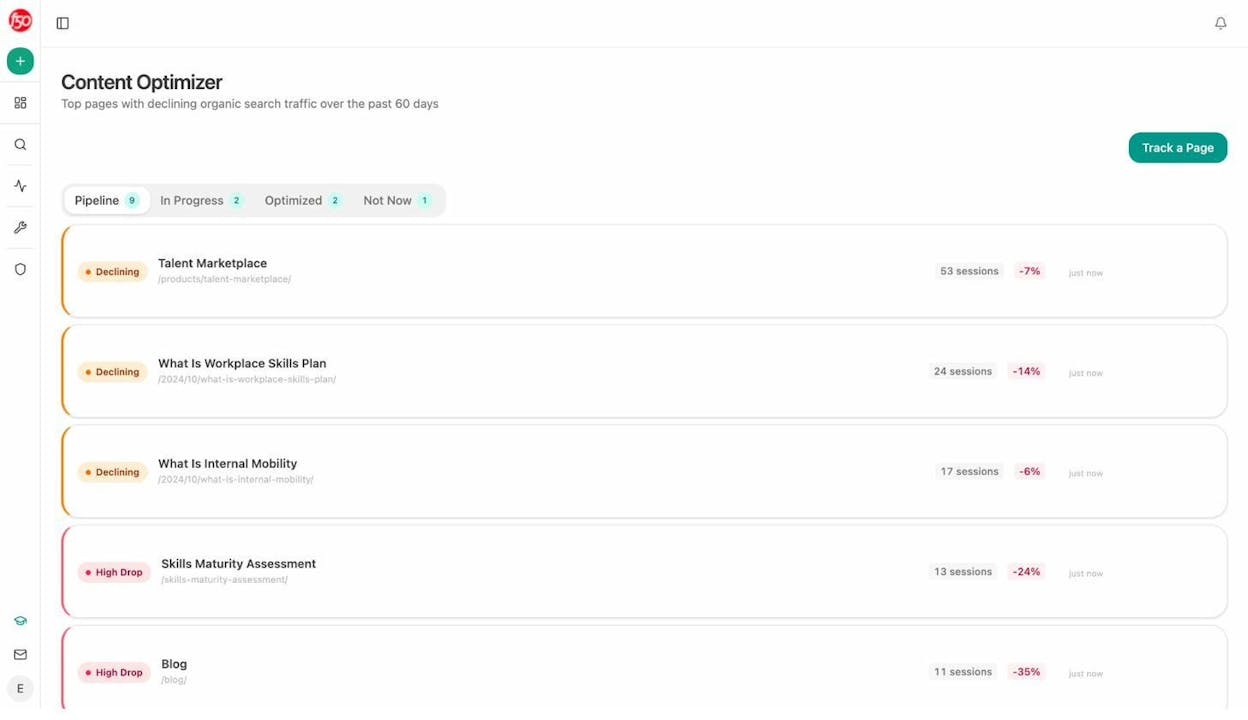
Pick the top declining page each week, run it through the Optimizer, and ship the recommended changes.
SEO isn’t dead. AI search is an additional channel, not a replacement.
Every headline this year has tried to convince you that GEO is the new SEO and that your old playbook is finished. The data doesn’t back that up.
Organic search still drives 33% to 42% of total traffic across most industries. Branded search, which is heavily influenced by AI mentions, gets attributed to Google organic in your analytics. The pages that win in AI engines are the same buyer-intent pages that win in Google, optimized slightly differently for prompt-style queries.
The mental model that works is this. SEO is your foundation. AI search is a new layer that rewards the same investment in clear, original, useful content with an additional distribution surface. Brands that abandon SEO to chase AI lose both. The short version is to keep doing SEO, add AI search tracking, and treat them as one program. For the longer argument, see our take on generative engine optimization.
Wrapping up
AI traffic is around 1% of the web in 2026. That number will keep growing, and the engines will keep diversifying, but the underlying pattern is unlikely to change soon. AI is going to remain a small-volume, high-intent channel that punches above its weight on conversions and shapes far more brand awareness than the click counts suggest.
The teams that win in this environment do five things:
-
Track AI traffic, mentions, and citations as separate KPIs from organic search
-
Treat ChatGPT visibility as the primary traffic lever and Perplexity and Google AI Mode as the citation levers
-
Refresh existing top-performing content for AI extractability before publishing more
-
Watch competitor mentions weekly and respond with targeted content
-
Tie AI sessions to downstream pipeline rather than judging the channel by raw visits
Start with the GA4 setup this week. Add prompt and citation tracking next. Then build the weekly digest into your routine. Six months in, you’ll have a defensible AI search program built on the same SEO foundation that’s been working all along.
If you want to skip the manual tracking and see all of this in one dashboard, start tracking your AI visibility with Analyze AI. The free trial pulls your prompts, citations, and AI traffic into one view in under five minutes.

Ernest

Ibrahim


