

![7 seoClarity Alternatives That Won’t Lock You Into $2,500/mo Enterprise Contracts [2026]](/_next/image?url=https%3A%2F%2Fwww.datocms-assets.com%2F164164%2F1779457139-blobid0.png&w=3840&q=75)

Summarize this blog post with:


seoClarity is a capable enterprise SEO platform. Its ArcAI module tracks AI visibility across ChatGPT, Perplexity, and Google AI Overviews, and its broader suite covers rank tracking, site audits, and content optimization.
But the pricing makes the decision for most teams before they even get a demo.
The Research & Content tier starts at $2,500/month. Technical SEO starts at $3,200/month. The full Enterprise package starts at $4,500/month. Every plan requires a sales conversation, and most contracts lock you in for 12 to 24 months.
If you’re a mid-market brand, a growing agency, or a content team that needs AI visibility tracking without the enterprise overhead, that pricing is a non-starter. And if you only need ArcAI’s AI search features, paying for the full SEO suite to access them feels like buying a truck to carry groceries.
In this article, you’ll get a hands-on breakdown of seven seoClarity alternatives that offer better value, simpler pricing, and features that seoClarity’s ArcAI module either hides behind enterprise contracts or doesn’t offer at all. You’ll learn what each tool does best, where it falls short, and which one fits your team’s budget, workflow, and growth stage.
Table of Contents
1. Analyze AI: the agentic platform for SEO, AEO, content, and GTM ops
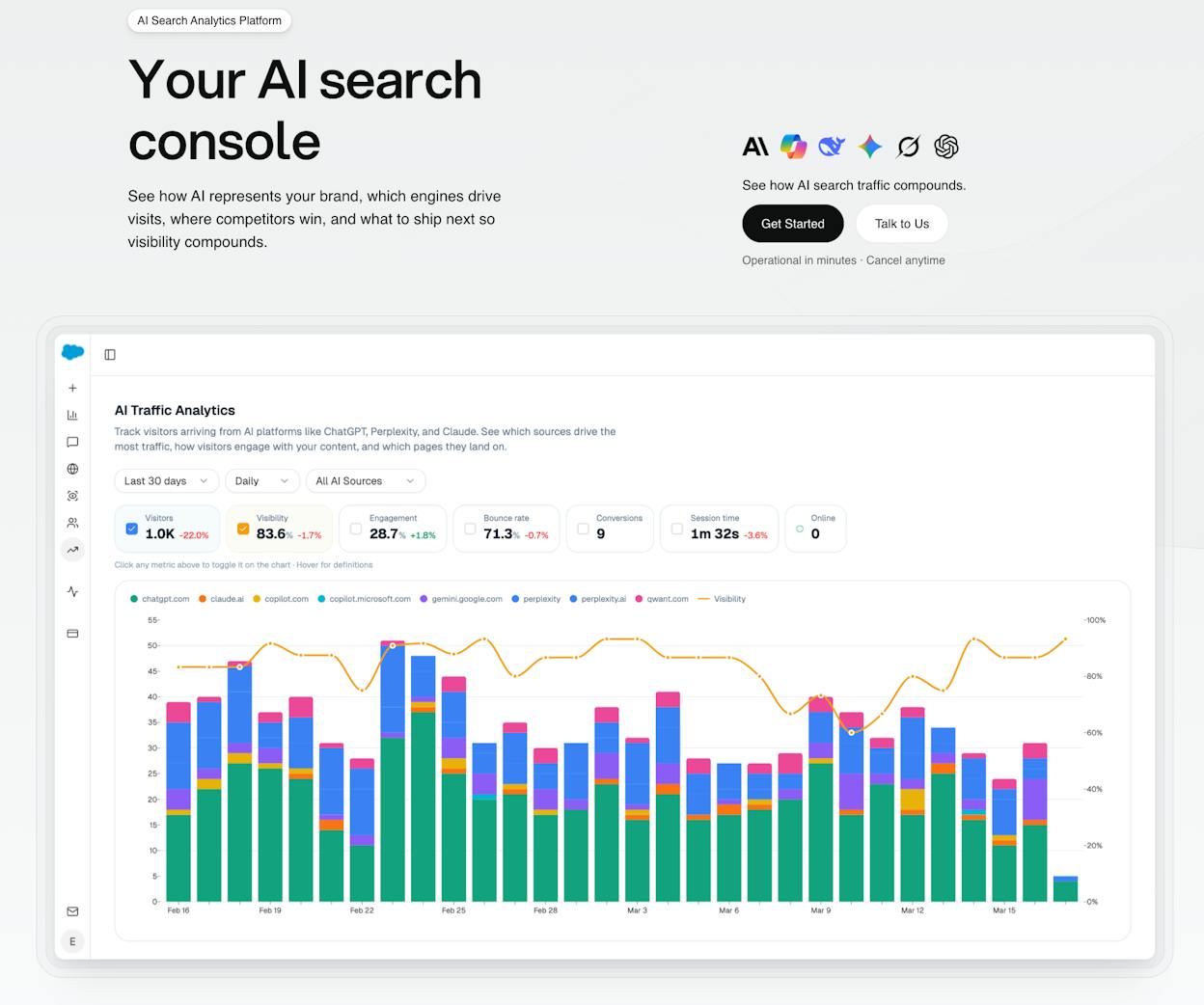
Most AI visibility tools tell you that your brand appeared in a ChatGPT response. Then they stop. You get a visibility score, maybe a sentiment label, but no connection to what happened next. Did anyone click? Did they convert? Was the mention worth anything?
Analyze AI closes that loop. The platform tracks which AI engines send real sessions to your site, which pages those visitors land on, what conversion events they trigger, and how much revenue they influence. You see prompt-level performance across ChatGPT, Perplexity, Claude, Copilot, and Gemini. But unlike visibility-only tools, you also see the business outcomes.
That alone makes it different from seoClarity’s ArcAI. But the real gap is what happens after you get the data.
See where AI traffic actually goes (and what converts)
Analyze AI attributes every session from AI engines to its source. Perplexity sent 142 sessions last month. ChatGPT sent 248. Claude sent 37. You see which engine is growing, which is flat, and what percentage of your total traffic comes from AI referrers.
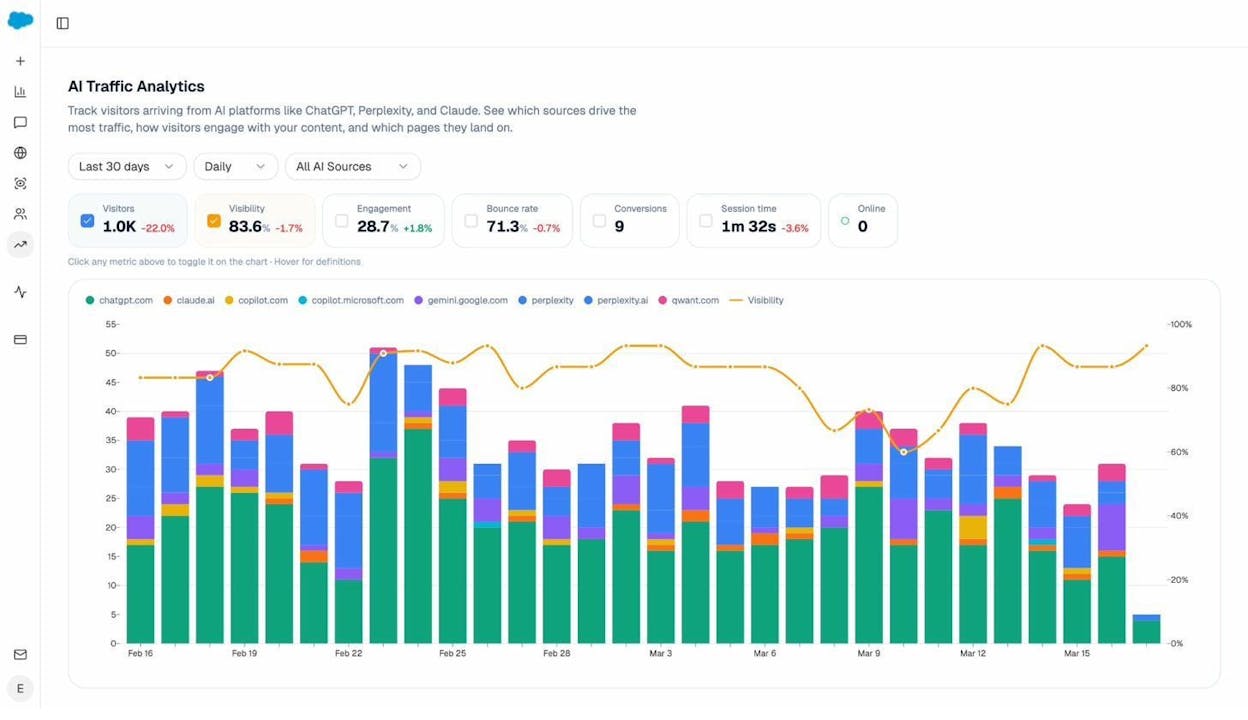
Then you go one level deeper. The Landing Pages report shows which pages receive AI referrals, which engine sent each session, and what conversion events those visits triggered. When your product comparison page gets 50 sessions from Perplexity and converts at 12%, while an old blog post gets 40 sessions from ChatGPT with zero conversions, you know exactly what to strengthen and what to deprioritize.
seoClarity’s ArcAI shows mentions and share-of-voice. It does not connect those mentions to traffic, pages, or revenue.
Track the prompts your buyers use
Analyze AI monitors specific prompts across all major LLMs. For each prompt, you see your brand’s visibility percentage, position relative to competitors, and sentiment score. You can also see which competitors appear alongside you, how your position changes daily, and whether sentiment is improving or declining.
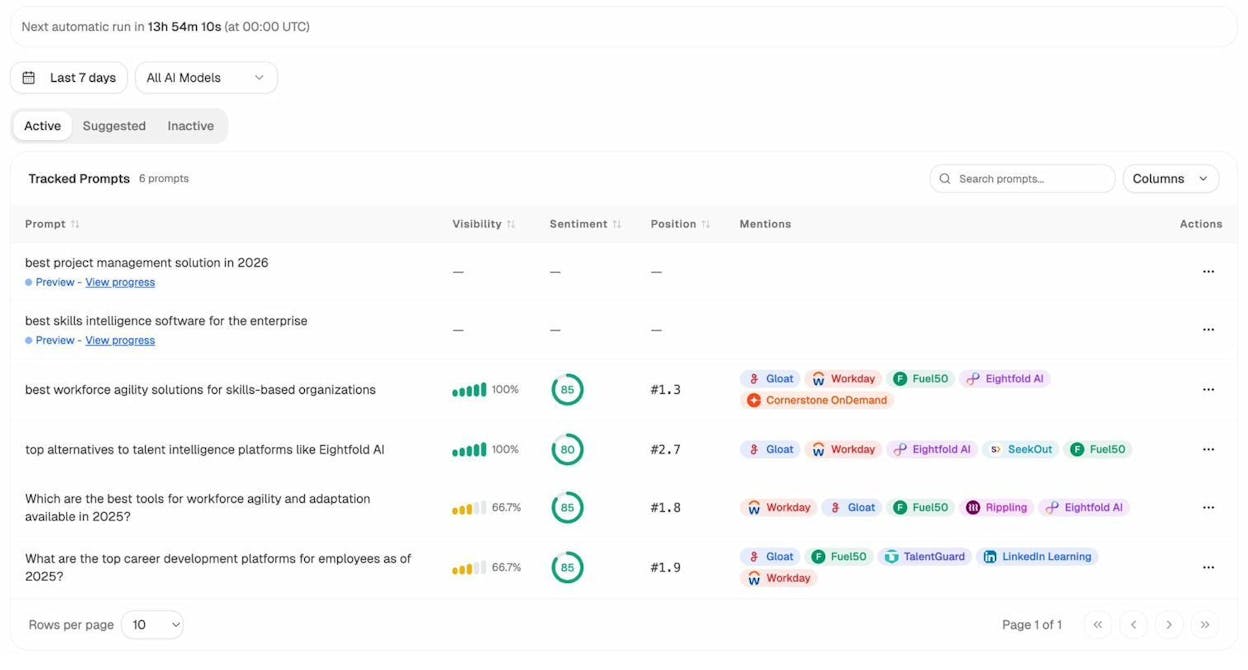
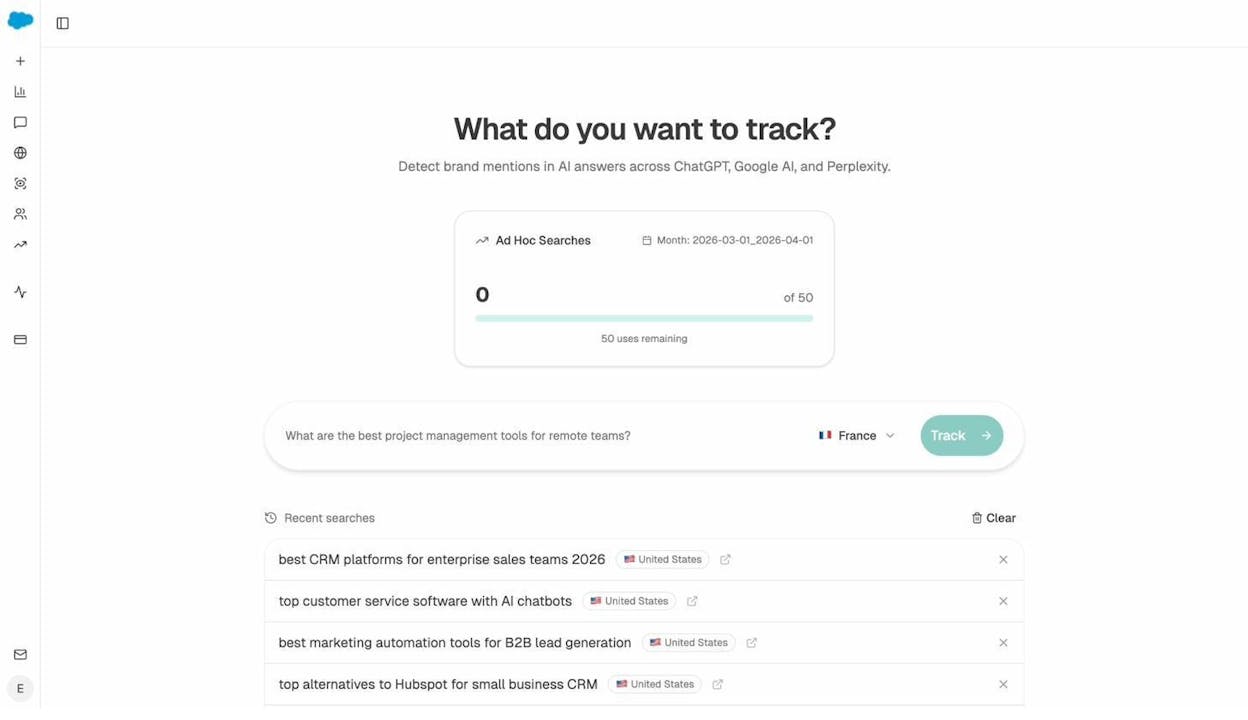
Don’t know which prompts to track? The Prompt Suggestion feature recommends the bottom-of-funnel prompts you should keep your eyes on. You can also run ad hoc prompt searches across ChatGPT, Perplexity, and Gemini to validate ideas before committing to full tracking.
Know which sources AI engines trust in your category
Analyze AI reveals exactly which domains and URLs models cite when answering questions in your space. You see usage count per source, which models reference each domain, and when those citations first appeared.
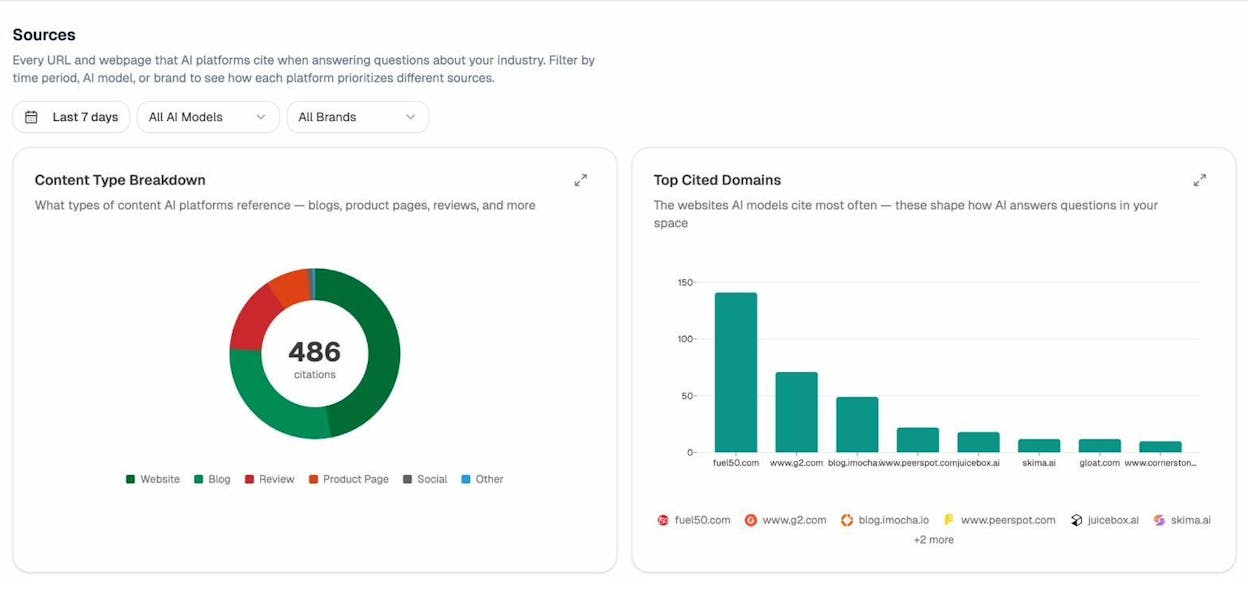
This matters because it tells you where to invest. Instead of generic link building, you target the specific sources that shape AI answers in your category. You strengthen relationships with domains that models already trust, create content that fills gaps in their coverage, and track whether your citation frequency increases after each initiative.
Audit competitors across every AI engine
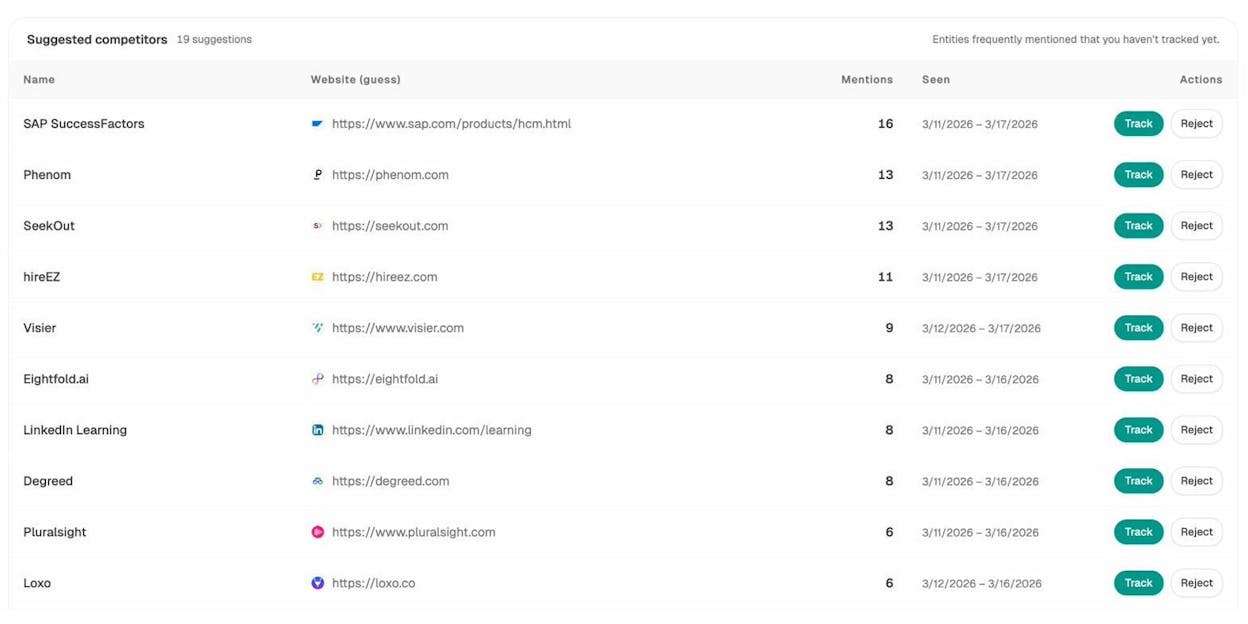
The Competitor Intelligence module lets you stack your brand against rivals and see share-of-voice by engine, topic, and time. You see exactly where competitors outrank you, on which prompts, and which sources feed their visibility.
Write and optimize content that gets cited
This is where Analyze AI pulls furthest ahead of seoClarity and every other tool on this list.
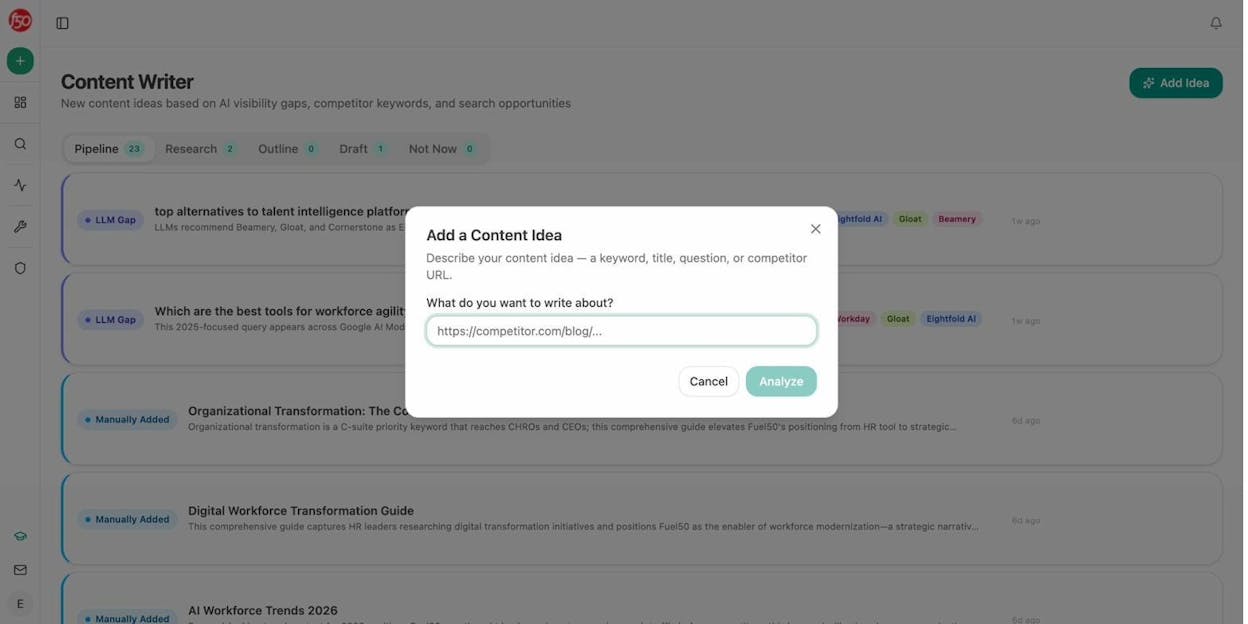
The AI Content Writer takes you from idea to research to outline to draft with AI visibility gaps, competitor analysis, and editorial comments built into every step. It does not just generate words. It researches what AI engines cite in your space, identifies the gaps in existing content, and builds drafts that address those gaps with the right entities, sources, and structure.
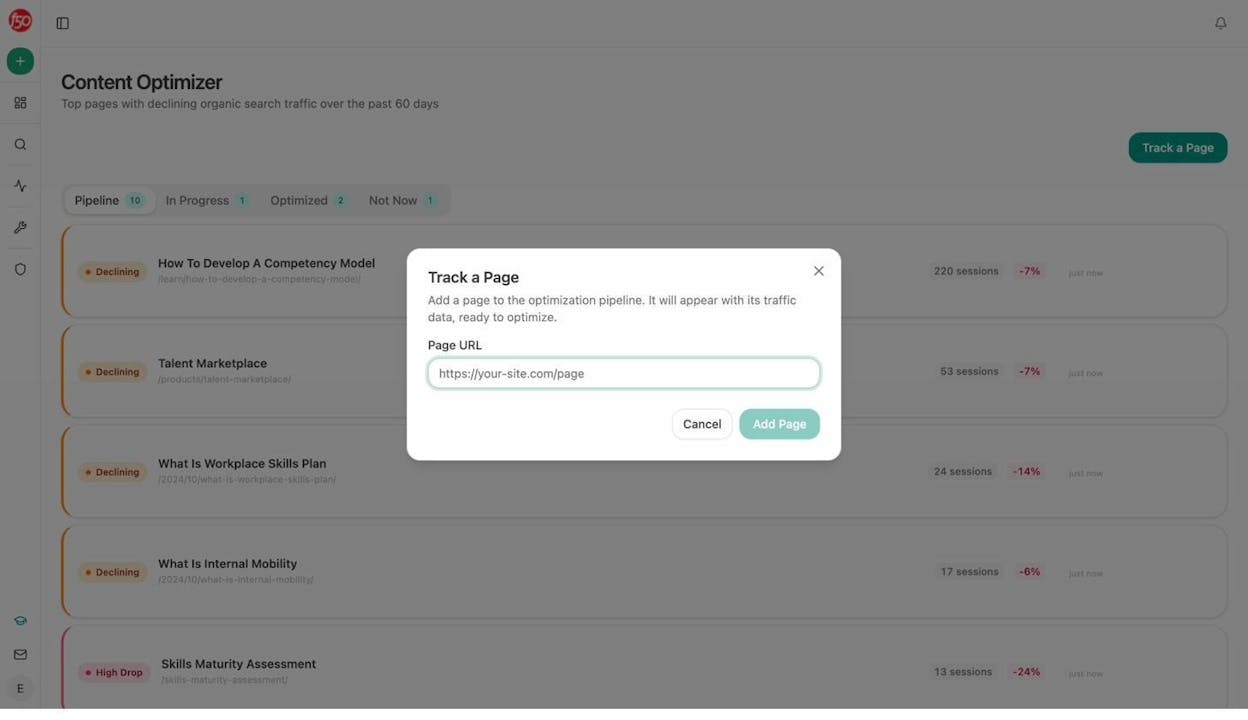
The AI Content Optimizer audits existing pages for both SEO and AI search performance. Paste a URL and get a content score, argument gaps, and line-by-line suggestions. It tells you exactly what to add, what to restructure, and what entities to include so AI models are more likely to cite your page.
seoClarity has content tools, but they are SEO-focused. They do not analyze what AI engines cite, they do not surface AI-specific content gaps, and they do not score pages for AI citability.
Automate entire workflows with the Agent Builder
Here is the part that most teams miss when they first evaluate Analyze AI.
The Agent Builder is a programmable automation layer with 180+ nodes, 34 pre-built data recipes, 13 input primitives, and three trigger modes (manual, scheduled, and webhook). It connects directly to GA4, Google Search Console, DataForSEO, Semrush, HubSpot, Notion, WordPress, Slack, and every major LLM.
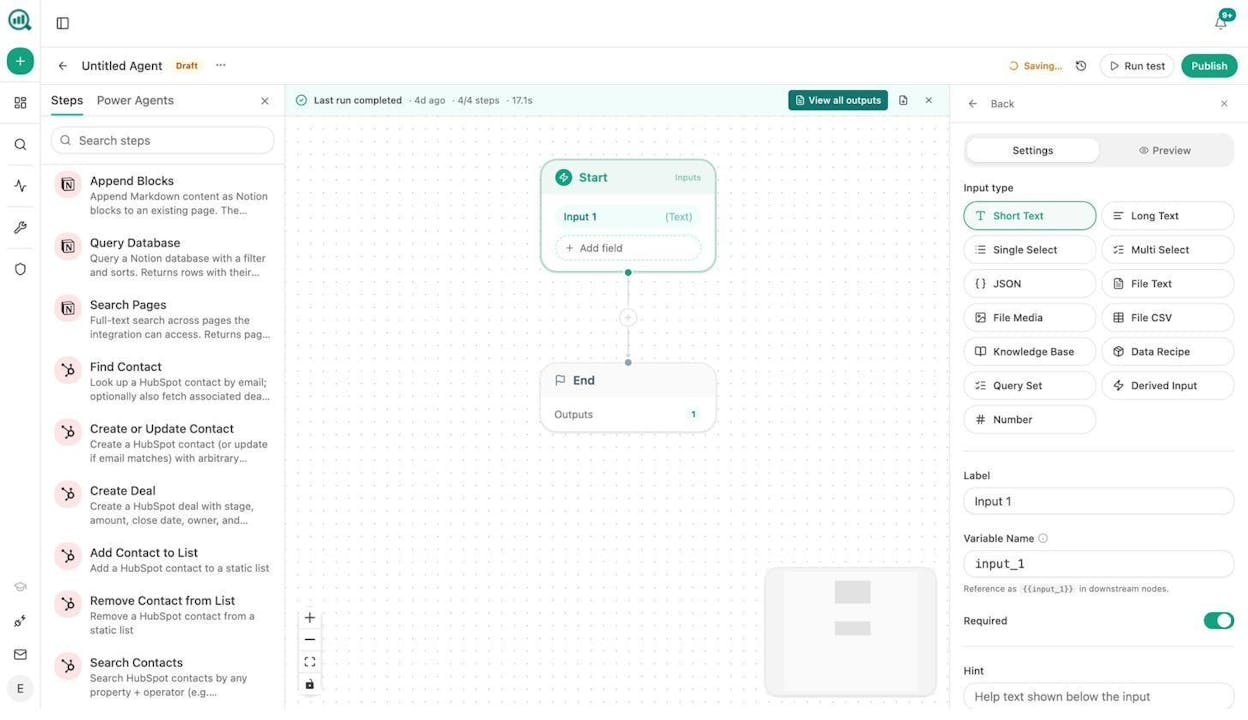
This is not a simple “run an AI prompt” feature. It is an operations substrate that replaces entire workflows.
A few examples of what teams build:
-
Monday client briefing (agencies): A scheduled agent pulls your exec one-pager, GSC top pages, AI visibility changes, and competitor movement, then assembles a DOCX with your letterhead and emails it to the account team. Every client, every Monday, zero manual work.
-
Brief-to-publish pipeline (content teams): A webhook fires when a brief moves to “approved” in Notion. The agent generates research, writes an outline, produces a full draft with brand voice injected, runs an AEO content scorecard, and publishes to WordPress if the score passes the quality gate. If it doesn’t, the writer gets a Slack message with the gaps.
-
Crisis early-warning (PR teams): A scheduled agent runs every 15 minutes, pulling brand mentions and news. If sentiment drops below a threshold and reach exceeds another, it fires a Slack alert and drafts three response options before anyone on your team even knows there is a problem.
-
Lead enrichment (sales): A webhook fires when a form is submitted. The agent verifies the email, researches the company, pulls domain data, and creates an enriched contact in HubSpot with a full research brief attached. The AE sees the lead fully prepped.
seoClarity has ClarityAutomate, but it focuses on deploying SEO changes to your site. Analyze AI’s Agent Builder operates across your entire marketing stack.
Monitor brand perception and sentiment drift
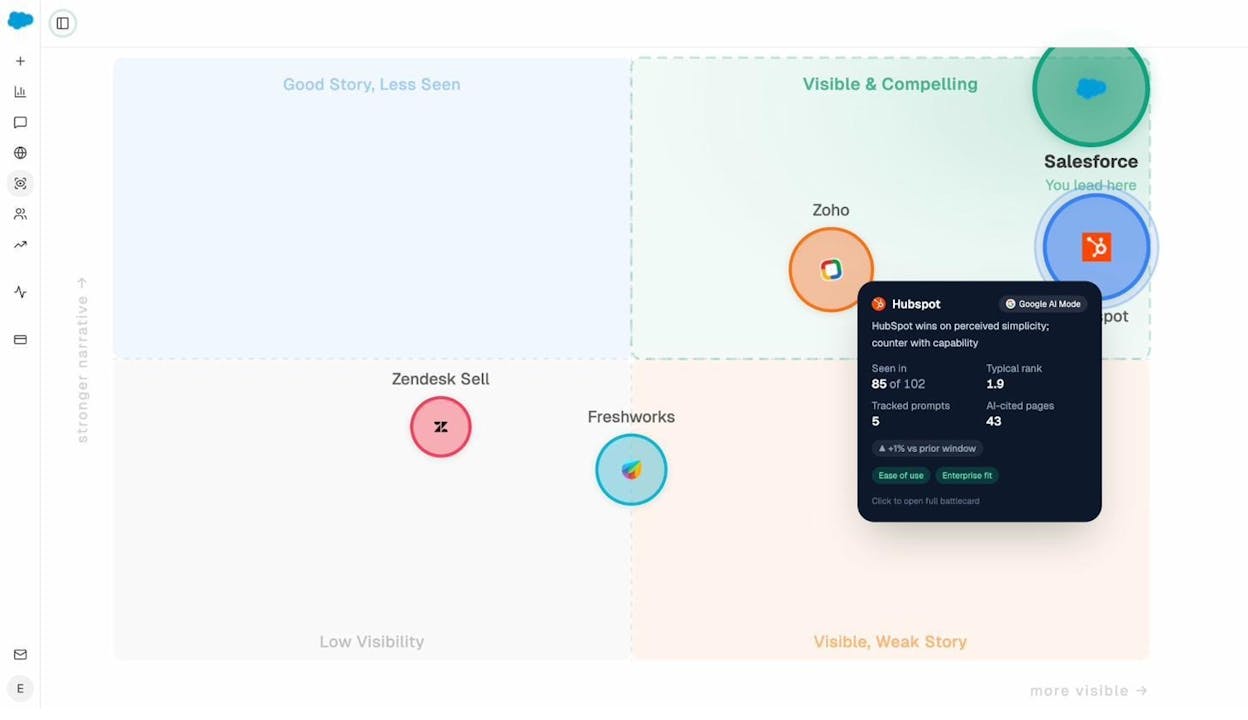
The Perception Map and AI Sentiment Monitoring show how AI models frame your brand over time. You see positive, neutral, and negative sentiment trends, risk terms, and narrative drift. The AI Battlecards give your team counter-strategies with the proof behind every claim AI makes about you and your competitors.
Get a prioritized action plan every Monday
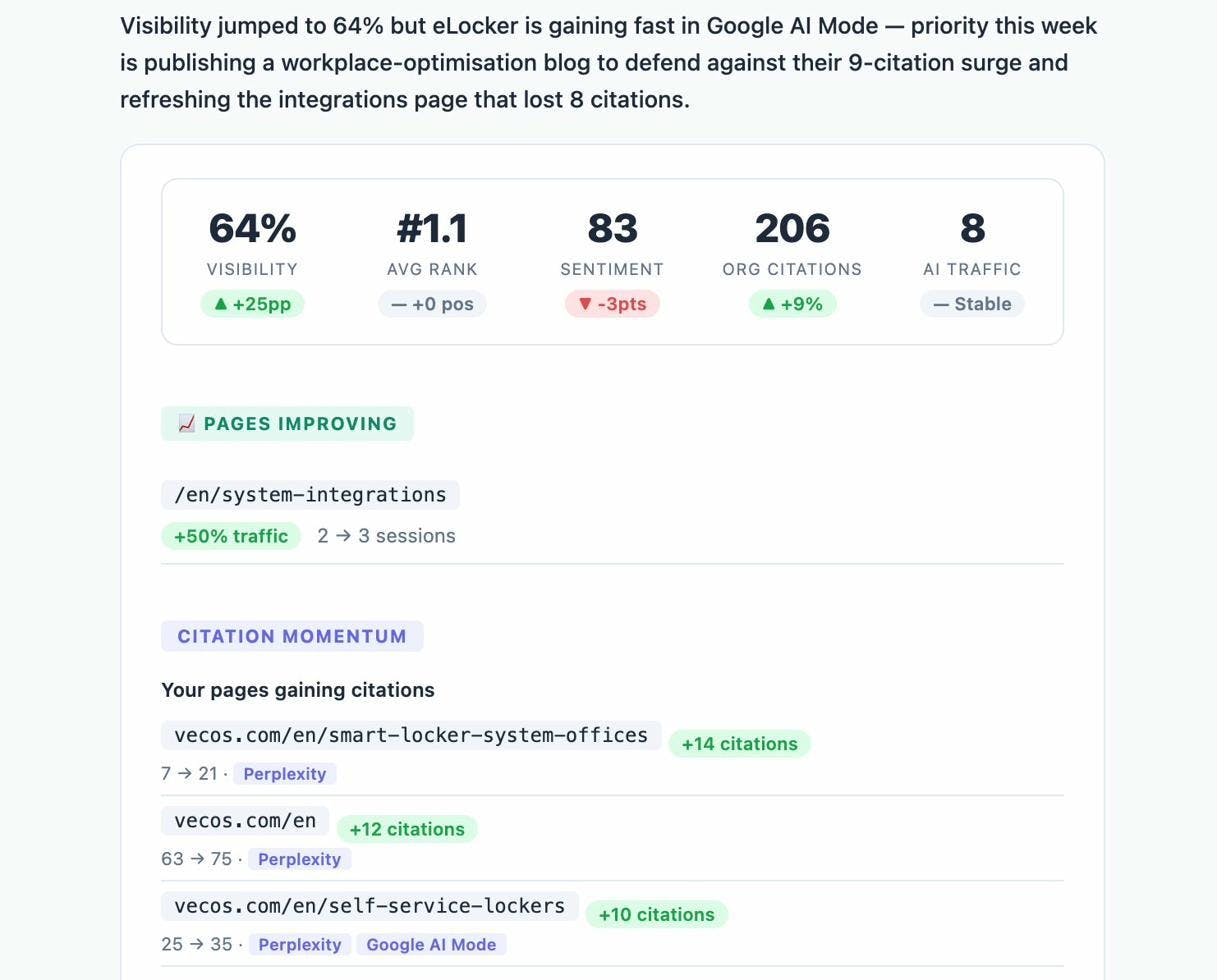
Weekly Email Digests deliver citation changes, competitor shifts, and prioritized actions to your inbox without logging in. When leadership asks “how are we doing in AI search,” you already have the answer.
Analyze AI vs. seoClarity ArcAI at a glance
|
Capability |
Analyze AI |
seoClarity ArcAI |
|---|---|---|
|
AI traffic attribution (sessions, pages, conversions) |
Yes, with GA4 integration |
No |
|
Engine coverage |
ChatGPT, Perplexity, Claude, Copilot, Gemini |
ChatGPT, Perplexity, AI Overviews |
|
AI Content Writer with citation-gap research |
Yes |
No |
|
AI Content Optimizer (AI + SEO scoring) |
Yes |
SEO-only content tools |
|
Agent Builder (180+ nodes, 34 data recipes) |
Yes |
ClarityAutomate (SEO deployment only) |
|
Prompt suggestions |
Yes |
Limited |
|
Perception Map and AI Battlecards |
Yes |
Share-of-voice only |
|
Weekly email digests |
Yes |
Custom alerts |
|
Starting price |
Transparent tiers |
$2,500/mo+ |
|
Contract requirement |
Cancel anytime |
12-24 month contracts typical |
When to pick Analyze AI: You want a single platform that tracks AI visibility, attributes it to revenue, writes and optimizes content for AI citability, and automates your entire marketing ops layer.
When to pick seoClarity: You are a Fortune 500 brand that needs enterprise-grade traditional SEO modules (unlimited crawls, log file analysis, global rank tracking) and AI visibility as an add-on.
2. Peec AI: focused visibility tracking with clean dashboards
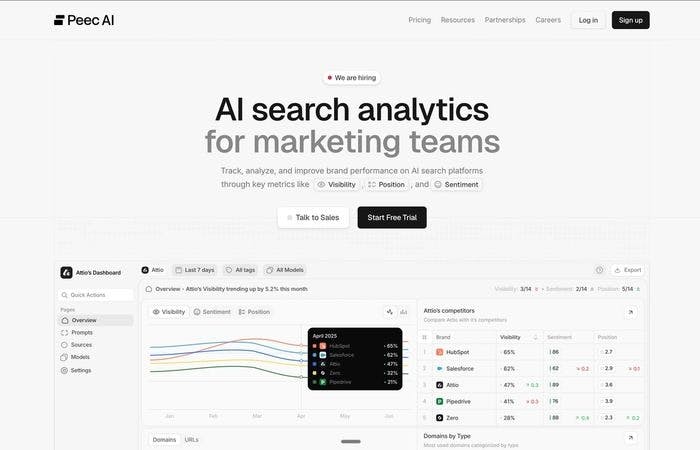
Peec AI solves one problem well. It pulls AI search results into one clean view and stores the exact answer for every prompt you test. You see where your brand appears, which words triggered the mention, and which source fed the answer.
Peec’s strength is competitive clarity. You can stack your brand next to rivals and see share-of-voice by engine, topic, and time. Agencies use this during pitches because it shows wins and gaps without extra slides.
The trade-offs are real. Peec does not write content, does not optimize pages, does not tie mentions to traffic or revenue, and charges extra for AI engines beyond the default three (ChatGPT, Perplexity, AI Overviews). The Starter plan begins at about $95/month for 50 prompts. Adding Claude, Gemini, or Grok costs $20 to $30 each per month.
Best for: Marketing teams and agencies that want centralized, auditable AI visibility without full-suite overhead.
Read our full Peec AI review | Compare Analyze AI vs. Peec AI
3. Rankability AI Analyzer: SEO and AI visibility in one workspace
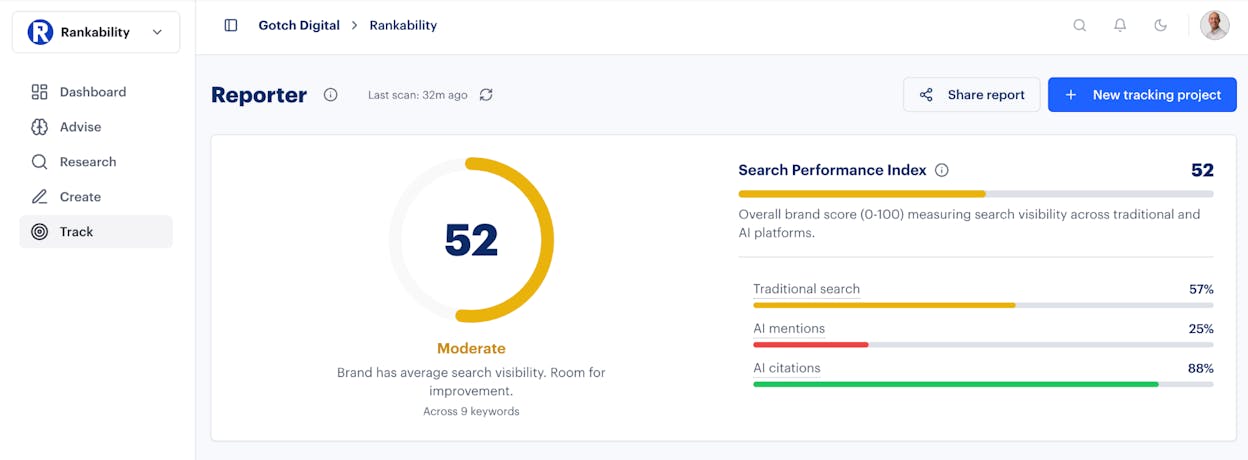
Rankability extends its SEO platform into AI-driven discovery. It brings together content briefs, topic scoring, and keyword analysis with AI visibility data from ChatGPT, Gemini, and Perplexity.
What makes it different is the “insight-to-action” loop. You don’t just see AI visibility data. You get optimization recommendations to improve your citations over time. For teams already using Rankability for SEO, the transition into AI visibility tracking feels natural.
The downsides are real. The AI Analyzer is still a young feature. Coverage across AI engines is still expanding, regional support may vary, and some modules remain in “coming soon” status. It also lacks deep technical SEO features like crawls and backlink management.
Best for: Teams already using Rankability for SEO who want AI visibility plus optimization guidance in one workflow.
Read our Rankability comparison
4. SE Ranking AI Overviews Tracker: for teams already in SE Ranking
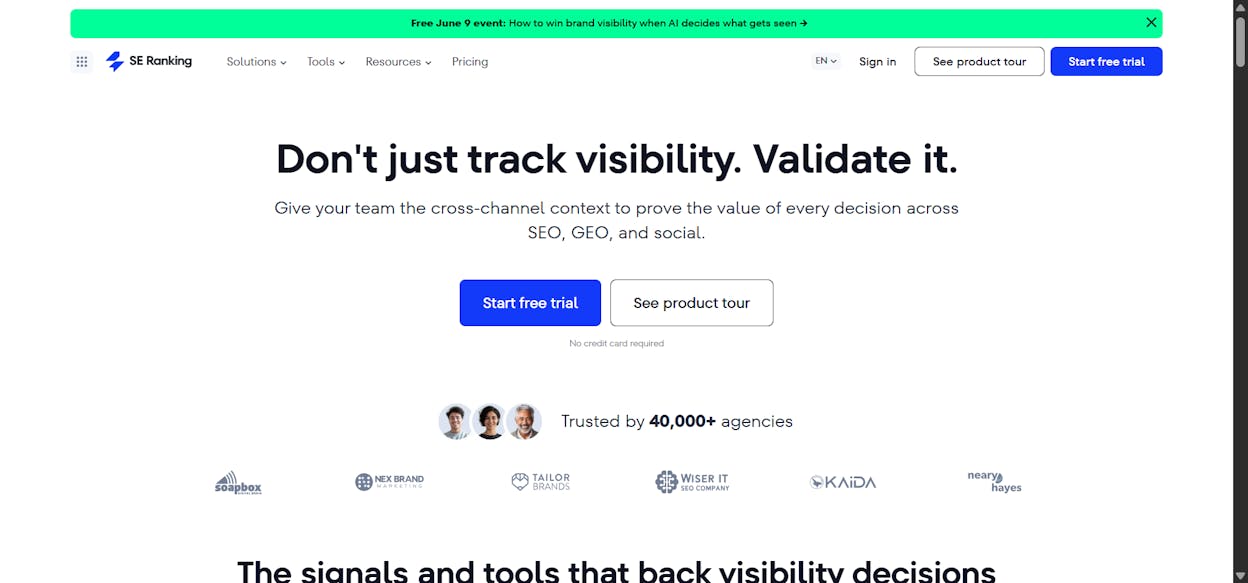
SE Ranking’s AI Overviews Tracker works as a native module inside the SE Ranking platform. It shows which of your keywords trigger AI-generated answers in Google’s search results and whether your domain is cited.
The integration is the value. Because SE Ranking already stores your keyword, volume, and ranking data, adding AI visibility makes it easy to find patterns. High-ranking pages that never appear in AI Overviews. Low-ranking keywords that consistently generate citations.
The limitation is scope. The tracker covers only Google AI Overviews. No ChatGPT, no Perplexity, no Gemini. It is available only to Pro ($69/mo) and Business ($149/mo) users, with keyword caps of 200 and 500 respectively.
Best for: SE Ranking users who want easy AI Overview visibility without adopting a new platform.
Read our full SE Ranking review
5. ZipTie: lightweight AI Overview monitoring
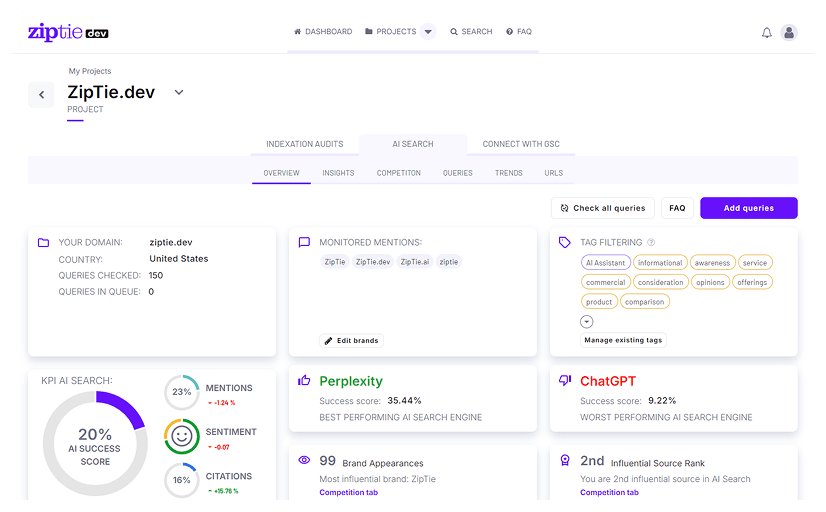
ZipTie is built for marketers who want clarity without complexity. You list the queries you care about, and the platform checks which ones trigger AI Overviews and where your brand appears. Each result shows whether your site was cited, mentioned, or ignored.
ZipTie distills visibility into a single AI Success Score that combines mentions, sentiment, and citations. Daily checks run automatically. The dashboard shows share-of-voice trends clearly, and cached snapshots let you see what AI summaries looked like last week or last month.
The trade-off is depth. ZipTie monitors but does not optimize. It won’t recommend how to improve pages, won’t write content, and won’t connect mentions to traffic. Engine coverage is narrower than platforms like Analyze AI or Peec, emphasizing Google AI Overviews with limited multi-engine tracking.
Best for: Small teams or solo marketers who want fast, visual AI Overview tracking without managing a heavy platform.
6. Profound: enterprise AI visibility with compliance
Profound is built for large organizations that need precision, security, and audit trails. It is SOC 2 Type II certified, supports SSO, and includes SLA-backed support.
Its “Answer Engine Insights” module tracks mentions, citations, and share-of-voice across ChatGPT, Gemini, Perplexity, and Google AI Overviews. The “Agent Analytics” feature monitors how AI crawlers interact with your site. The “Prompt Volumes” module reveals what real users are asking across AI systems.
The cost reflects the positioning. Profound is expensive and complex to onboard. Setup requires time and technical resources. For organizations without dedicated analytics staff, the platform can feel overwhelming. As a newer player (founded in 2024), its coverage and regional support are still evolving.
Best for: Enterprise brands in regulated industries (finance, healthcare, SaaS) that need SLA-backed data and compliance.
Read our full Profound review | Compare Analyze AI vs. Profound
7. AthenaHQ: GEO strategy across regions and engines
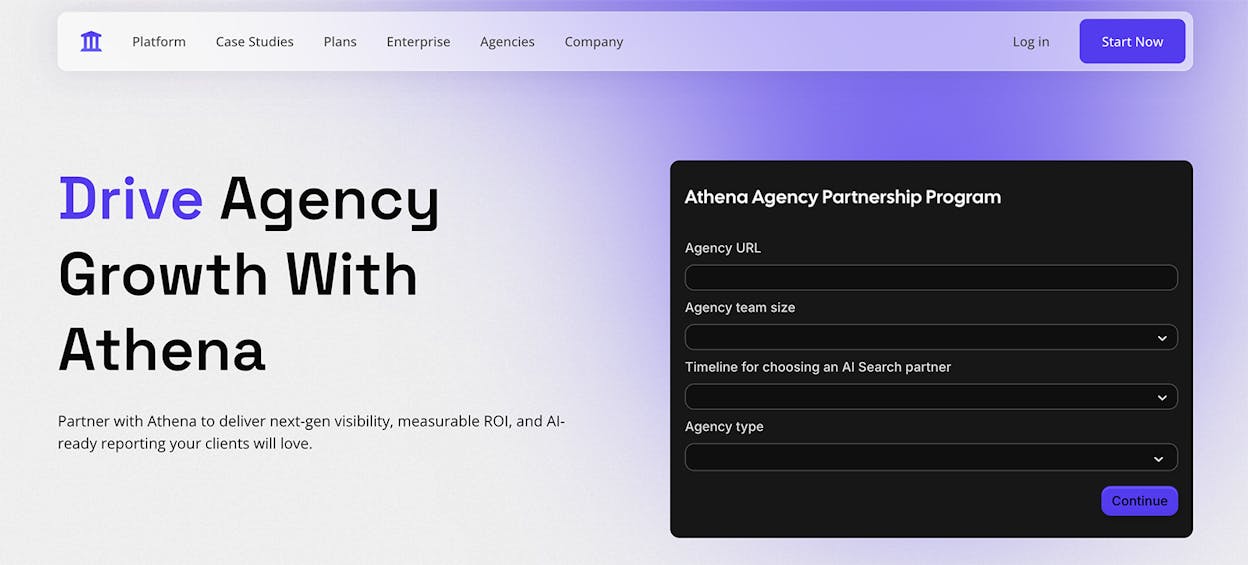
AthenaHQ positions itself as a GEO (Generative Engine Optimization) platform. It maps how generative engines interpret, cite, and present your content across ChatGPT, Perplexity, Gemini, and Claude.
What makes it distinct is its focus on visibility by geography, model, and topic. Through its Conversation Explorer and Prompt Volumes modules, the platform shows which questions are trending across regions and how different engines respond. It goes beyond reporting by offering optimization insights to improve inclusion in generative answers.
AthenaHQ’s newness introduces growing pains. Integrations, documentation around APIs, and CMS support are still thin. Pricing skews toward the premium segment, and data consistency can fluctuate as AI models change.
Best for: Mid-size and enterprise teams building GEO strategies across multiple regions and engines.
Read our full AthenaHQ review | Compare Analyze AI vs. AthenaHQ
How to choose the right seoClarity alternative
The right tool depends on what you need most.
If you need full-funnel AI visibility with traffic attribution, content creation, and workflow automation, Analyze AI is the most complete option. It is the only platform on this list that ties AI mentions to sessions, pages, and revenue, writes content optimized for AI citability, and automates marketing operations through a programmable agent builder.
If you need focused visibility tracking without a full suite, Peec AI offers clean dashboards and strong competitive benchmarking.
If you’re already invested in SE Ranking or Rankability, their native AI modules add visibility without switching platforms.
If you need enterprise compliance with SOC 2, SSO, and SLAs, Profound is the best fit.
And if you just want a quick, visual check on AI Overview presence, ZipTie gets you there fastest.
Whatever you choose, the goal is the same. SEO is not dead. AI search is an additional organic channel alongside traditional search, not a replacement. The brands that invest in both will compound their visibility while everyone else scrambles to pick sides.
Start by understanding where you stand. Analyze AI’s free AI Visibility Checker shows you how AI engines currently see your brand, with no signup required.

Ernest

Ibrahim


![7 LLMrefs Alternatives That Do More Than Track Mentions [2026]](/_next/image?url=https%3A%2F%2Fwww.datocms-assets.com%2F164164%2F1779313840-blobid0.png&w=3840&q=75)


