



Summarize this blog post with:


In this article, you’ll see seven examples of branded content that earned attention without selling, learn what separates campaigns that build brand equity from the ones that flop, and walk away with a measurement system that tracks branded content performance across both Google search and AI search engines like ChatGPT, Perplexity, and Gemini.
Table of Contents
What is branded content?
Branded content is media or entertainment that a brand sponsors, commissions, or creates to build emotional connection rather than drive an immediate sale. The product takes a back seat. The story takes the front seat.
Think Netflix-style documentaries from a payments company, a podcast drama from a compliance vendor, or a children’s book from an SEO software company. The audience consumes it because it entertains or moves them. The brand benefits because audiences who feel something are far more likely to remember and trust it.
A useful way to understand branded content is to compare it against the marketing formats it gets confused with.
|
Format |
Goal |
Where the product sits |
|---|---|---|
|
Advertising |
Persuade you to buy now |
Front and center |
|
Content marketing |
Educate to build long-term demand |
Mentioned naturally as a solution |
|
Product placement |
Subtly remind you the brand exists |
Embedded in someone else’s content |
|
Branded content |
Entertain or move you, building affinity |
Optional cameo, often invisible |
When you dial down the persuasion and dial up the entertainment, audiences forget they’re consuming marketing.
That forgetting is the point.
Why branded content matters more in the AI search era
Branded content has always built brand equity. What’s changed is that brand equity now compounds across two organic channels instead of one.
Google search rewards distinctive content with backlinks, mentions, and higher rankings. AI search engines reward distinctive content by repeating it. Models like ChatGPT and Perplexity learn what to say about your brand from the language the open web uses to describe you. The more original and widely-discussed your branded content is, the more raw material AI has to associate with you.
Here are four reasons branded content earns its budget right now.
1. You stand out in a sea of pick-me brands
Most B2B and SaaS content sounds the same because it follows the same playbook. Branded content sidesteps that playbook entirely. While competitors publish their forty-seventh “ultimate guide,” you publish a podcast drama, a short film, or a board game. You become the brand people remember without trying.
2. You build positive associations that ads can’t buy
According to Nielsen research, viewers are 62% more likely to react positively to branded content than to a 30-second TV ad. When you give your audience something fun, beautiful, or useful, they form an association with you that paid ads cannot replicate at any spend level.
3. You reach new audiences through new formats
New formats unlock new channels, and new channels unlock new audiences.
|
Format |
Channel |
New audience reached |
|---|---|---|
|
Podcast drama |
Spotify, Apple Podcasts |
Commuters, true crime fans |
|
Short film |
YouTube, festivals |
Cinephiles, design audiences |
|
Documentary series |
Owned site, YouTube |
Founders, industry insiders |
|
Board game |
Retail, events |
Hobbyist communities |
Branded content also improves brand recall by 81%, which means those new audiences are more likely to remember you weeks later when they’re ready to buy.
4. You give AI engines something distinctive to repeat about you
AI search engines don’t list ten blue links. They generate a single answer that synthesizes what the web says about a topic. When AI describes your brand, it draws from the language used in articles, podcasts, social posts, and reviews about you.
If everything written about your brand sounds generic, AI will describe you in generic terms. If your branded content has earned distinctive language (“the company that made the SEO board game,” “the payments brand with the Netflix-style studio”), AI engines will repeat that language back to anyone who asks.
Branded content seeds the vocabulary AI uses about you. That’s a moat traditional content marketing rarely builds.
What separates branded content that works from branded content that flops
Branded content is high-stakes. The same emotional charge that makes great campaigns memorable makes failed ones unforgettable for the wrong reasons. Three things consistently separate the two.
Authenticity. Audiences spot a brand wearing values that don’t fit it. The work has to align with what your brand genuinely believes and does, not what your marketing team wishes it believed.
Clarity of message. Apple released an ad in 2024 showing creative tools being crushed by an industrial press to reveal an iPad. The intended message was “all of this in one device.” The received message was “Apple is destroying creativity.” Even the world’s most valuable brand can lose the audience by leaving the interpretation ambiguous.
Audience-first thinking. If the answer to “why are we making this?” is anything other than “because our audience would love it,” go back to the brief.
How to measure the success of branded content
Branded content goals are softer than performance marketing goals. You’re tracking brand awareness, recall, sentiment, and share of voice rather than MQLs and pipeline. That makes measurement tricky but not impossible. Here’s how to track it across both Google search and AI search.
Track mentions across the web
Every time your branded content gets covered in the press, embedded in a roundup, or referenced on a podcast, that’s a measurable mention.
You can use any backlink and mention monitoring tool to do this. Search your brand name plus the campaign name, filter to news or recent results, and track the volume of pages discussing your work.
![[Screenshot: A backlink monitoring tool showing search results for a branded content campaign name, with the news filter applied and total page count visible.]](https://www.datocms-assets.com/164164/1777769440-blobid1.png?auto=format,compress&w=1248&fit=max)
The metric to watch is co-mentions. If your brand is mentioned 10,000 times this quarter and 1,500 of those mentions also reference your campaign theme, you have a 15% topical association rate. Watch that number trend over time.
Track citations in AI answers
This is where most marketers stop short, because the tools they use for SEO measurement weren’t built to monitor AI engines.
When ChatGPT or Perplexity generates an answer about your category, it cites specific URLs. Those citations are the AI equivalent of a top-three Google ranking. If your branded content campaign starts getting cited, you know it’s working.
Inside Analyze AI, the Citation Analytics view shows every URL AI engines reference when answering questions about your industry, broken down by content type and source domain.
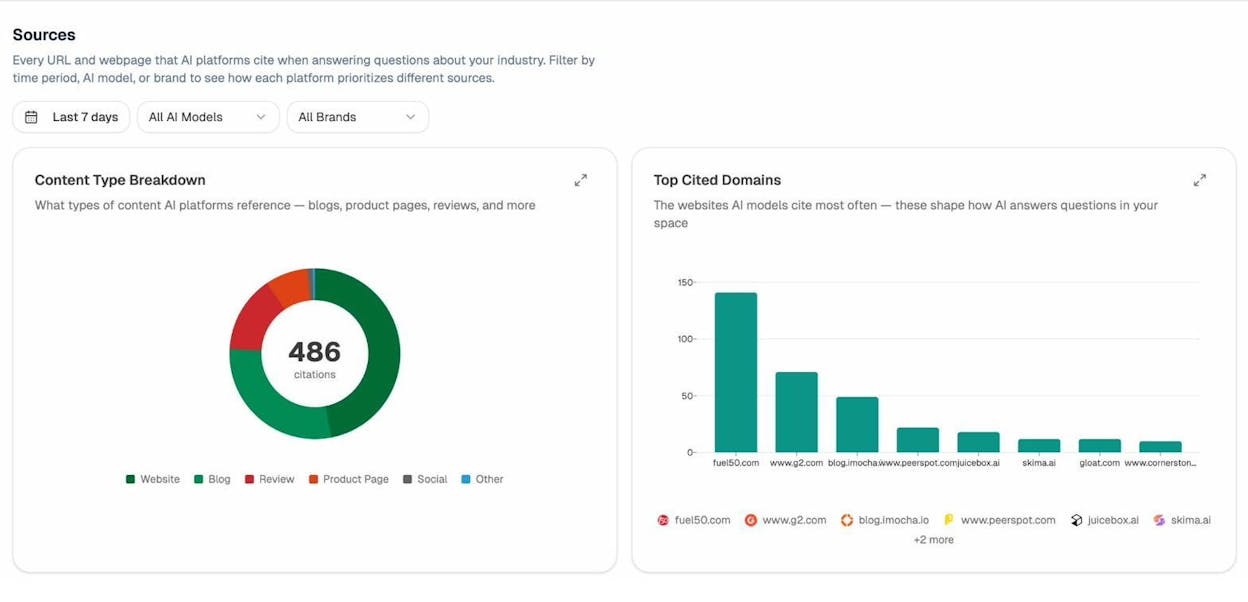
You can see which content formats AI rewards in your space. If reviews dominate the citations, your branded content needs to drive more third-party reviews. If blogs dominate, your editorial content is doing the heavy lifting. You can also see exactly which competitor content is being cited, which is a content gap analysis you couldn’t have done two years ago.
Track brand sentiment and perception in AI answers
A campaign that lifts sentiment is doing its job. A campaign that doesn’t move it needs reworking.
Traditional sentiment tools scrape social posts and reviews. AI sentiment monitoring goes further by tracking how AI engines themselves describe your brand. Since AI is increasingly the layer between your audience and the answer, what AI says about you is what your audience hears.
The Perception Map plots your brand and competitors across two axes, narrative strength and visibility, so you can see whether your branded content is moving your position over time.
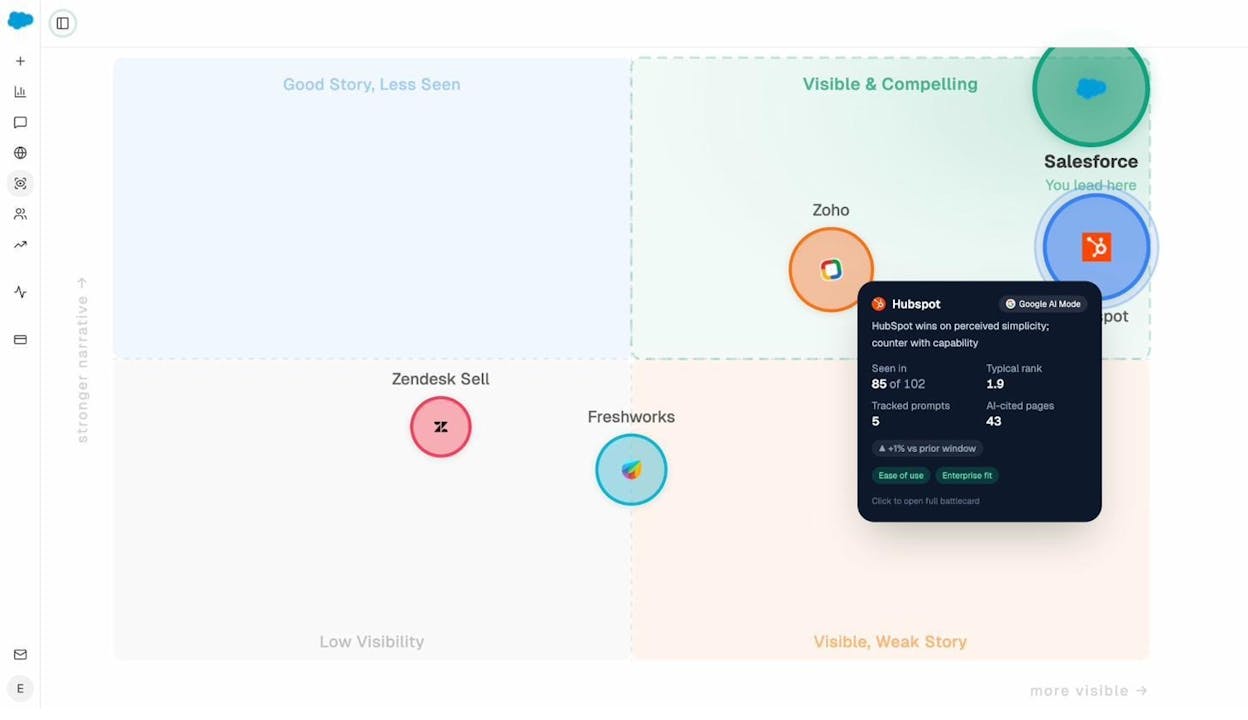
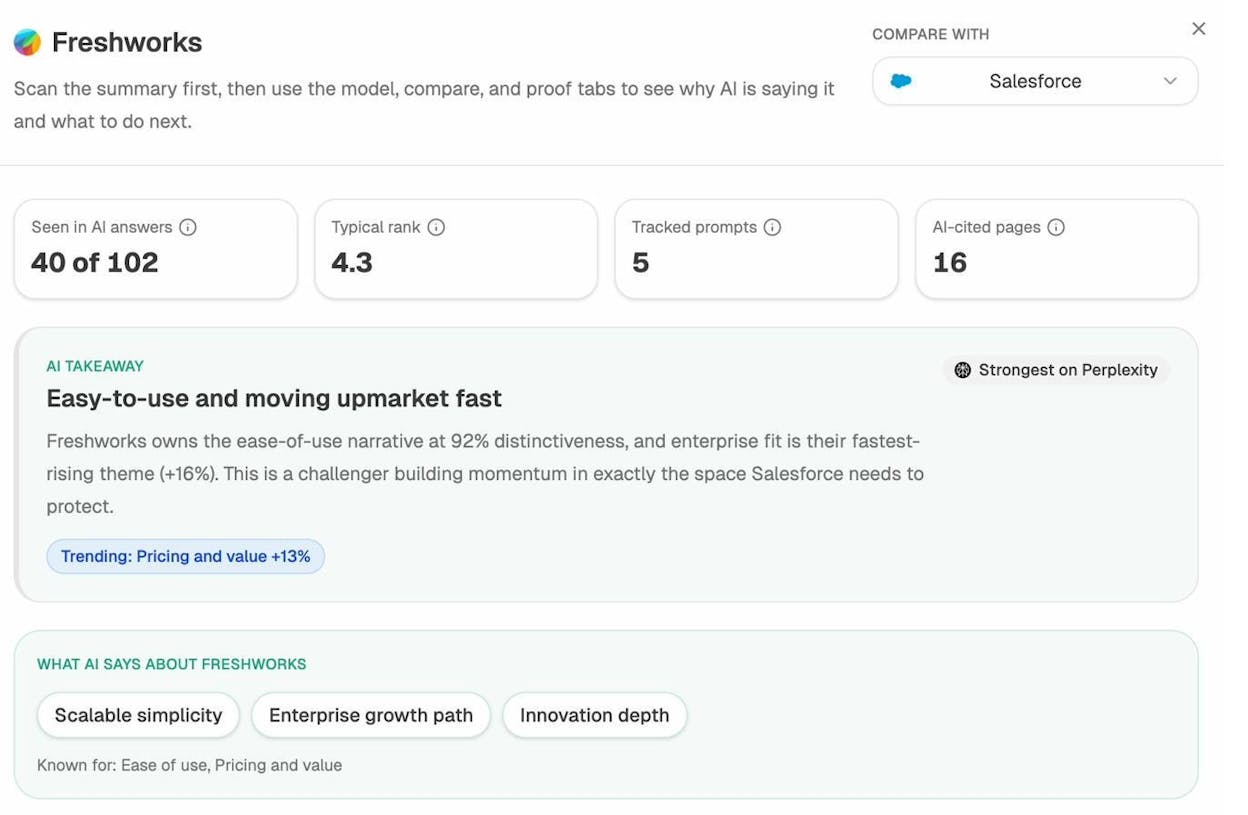
You can also drill into the specific themes AI associates with your brand and see which themes are trending up or down quarter over quarter. If your campaign was about, say, “design integrity,” you want to see that theme climb in the next reporting cycle.
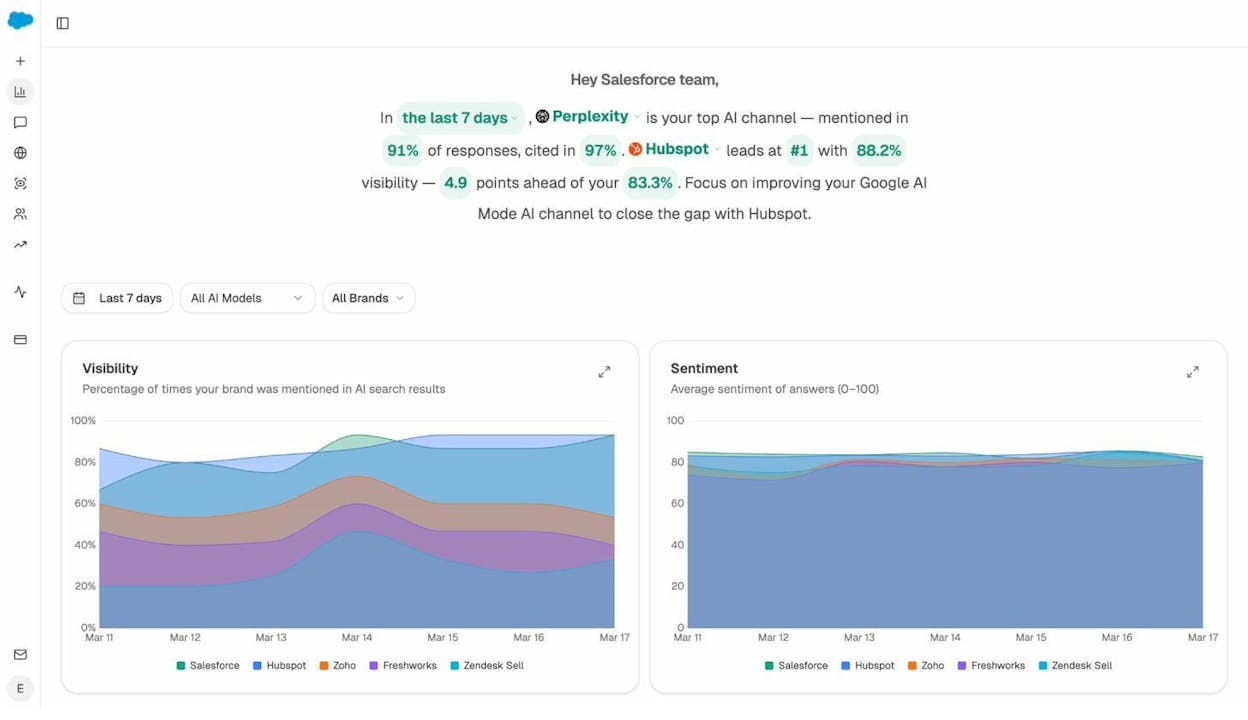
For broader sentiment context across all AI engines, the Overview dashboard shows visibility and sentiment trended over time so you can correlate dips and lifts to specific campaigns.
For a broader comparison of platforms in this space, see our list of AI sentiment analysis tools.
Track organic traffic uplift to campaign pages
If your branded content has a hub page (and it should), track its organic traffic over time. Look for spikes that align with launch dates, press coverage, or anniversary moments.
For a quick check, the free Website Traffic Checker gives you traffic estimates for any URL without a paid subscription. You can use it to benchmark your campaign page against competitor campaigns. For ranking specific campaign keywords, the free Keyword Rank Checker tells you where your campaign page sits in the SERP.
Track AI traffic to your campaign pages
Branded content that gets cited by AI engines drives a new kind of traffic, visitors who arrived from ChatGPT, Perplexity, Claude, or Gemini after seeing your brand mentioned.
This traffic doesn’t show up in standard analytics with a useful referrer, which is why you need a dedicated AI Traffic Analytics view to see it.
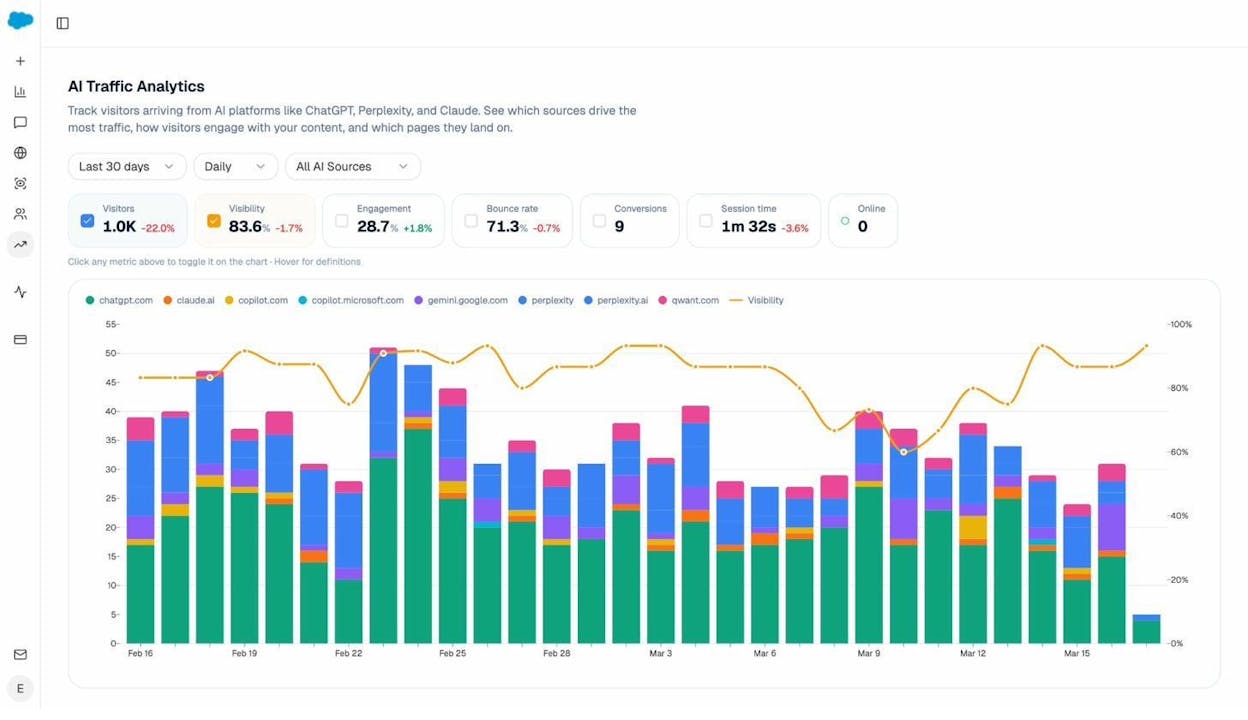
You can see total visitors from each AI engine, how those visitors engage with your content, and how visibility correlates with traffic over time. To see exactly which campaign pages are working, switch to the landing pages view.
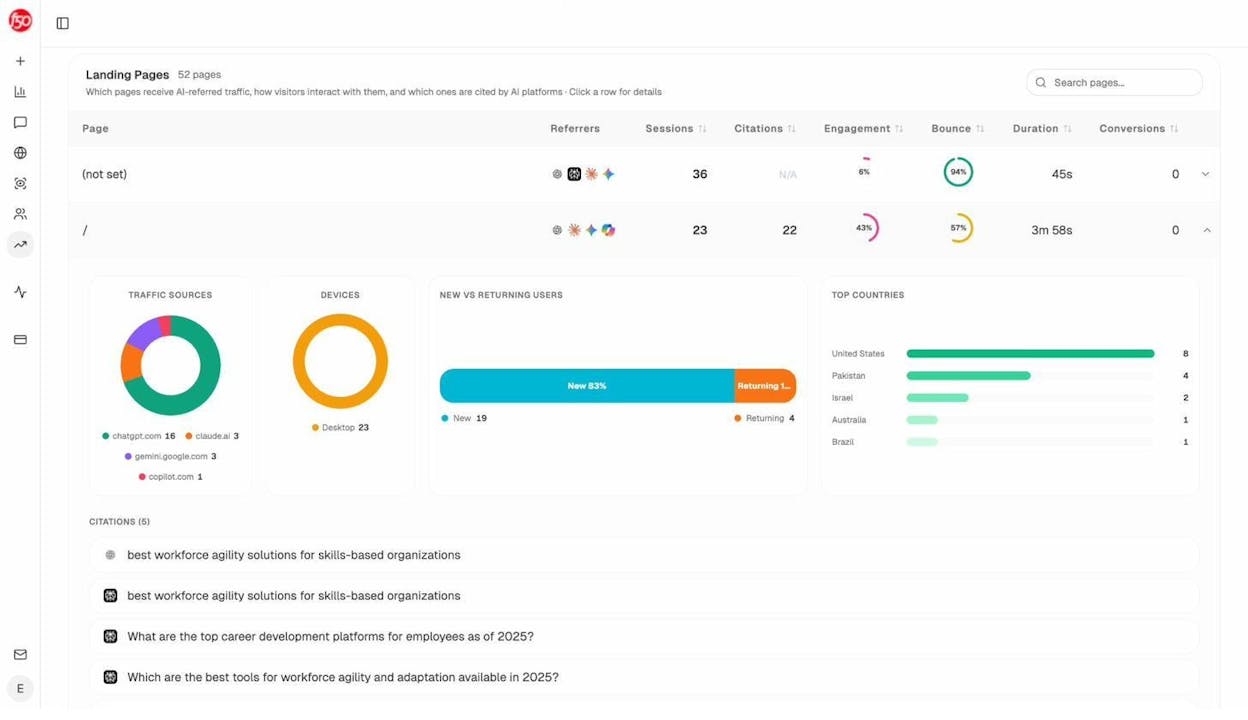
This is where measurement gets actionable. You can identify which campaign pages get cited most often, which AI engines send the most engaged visitors, and which prompts are surfacing your content. From there, you double down on what works.
Track keyword and prompt growth
Branded content drives net-new search interest. If your campaign coined a phrase, named a concept, or built a recognizable product line, people will start searching for it.
For Google search, you can use the free Keyword Generator to discover what variations and related terms your campaign is generating, then use the Keyword Difficulty Checker to figure out which terms are worth ranking for.
For AI search, you track prompts instead of keywords. A prompt is the actual question someone types into ChatGPT or Perplexity. The Prompt Tracking view shows the prompts your brand appears in, your visibility for each, your sentiment score, your average position in the answer, and which competitors also show up.
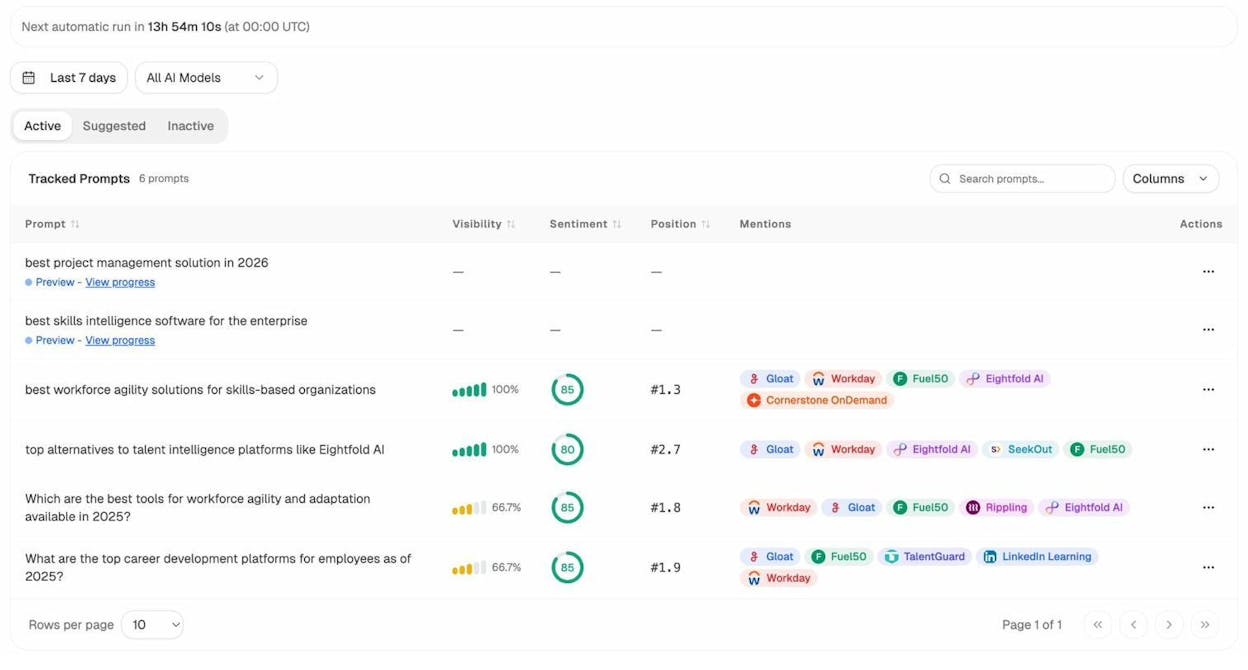
If you launch a campaign and a quarter later you’re appearing in five new prompts, that’s a measurable win.
For one-off checks (say, the moment your campaign launches), you can run ad hoc prompt searches on demand.
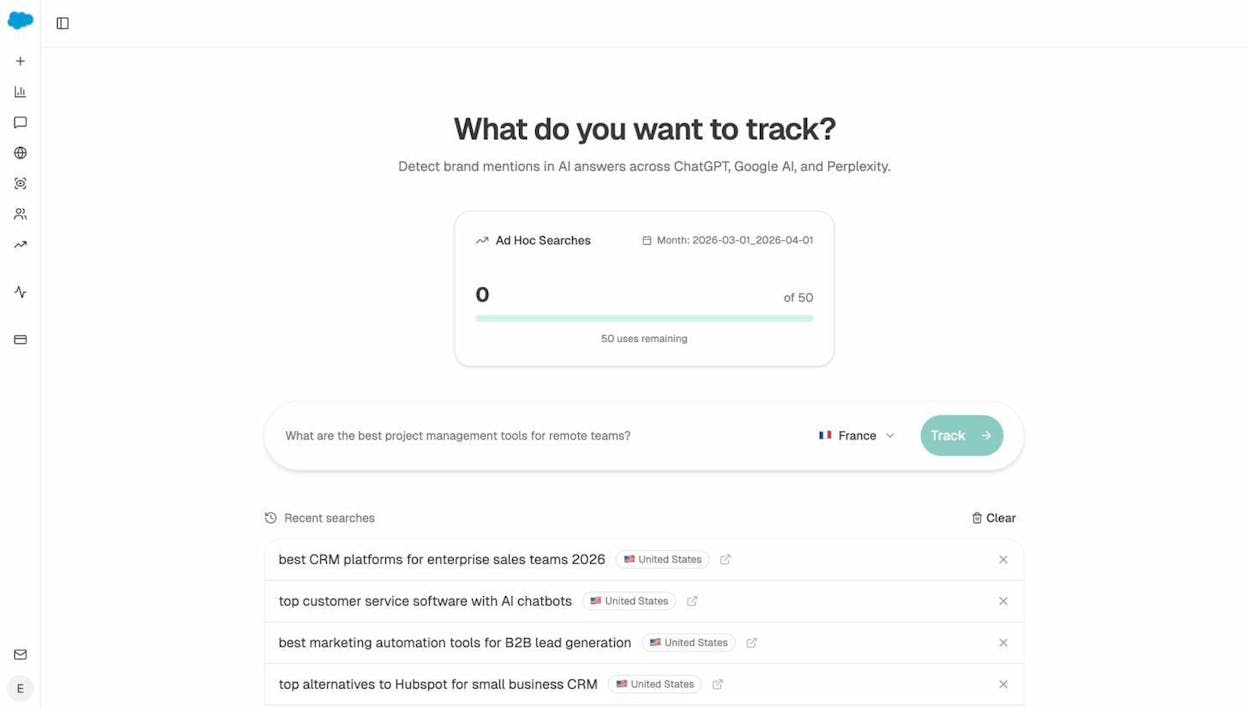
This is the AI-search equivalent of typing your brand into Google to check the SERP. Fast and useful for real-time campaign monitoring.
Track competitor share of voice
Branded content is a relative game. You want to be more visible, more positively described, and more cited than the brands you compete with.
The Competitor Intelligence view automatically surfaces brands getting mentioned alongside yours so you can track them too.
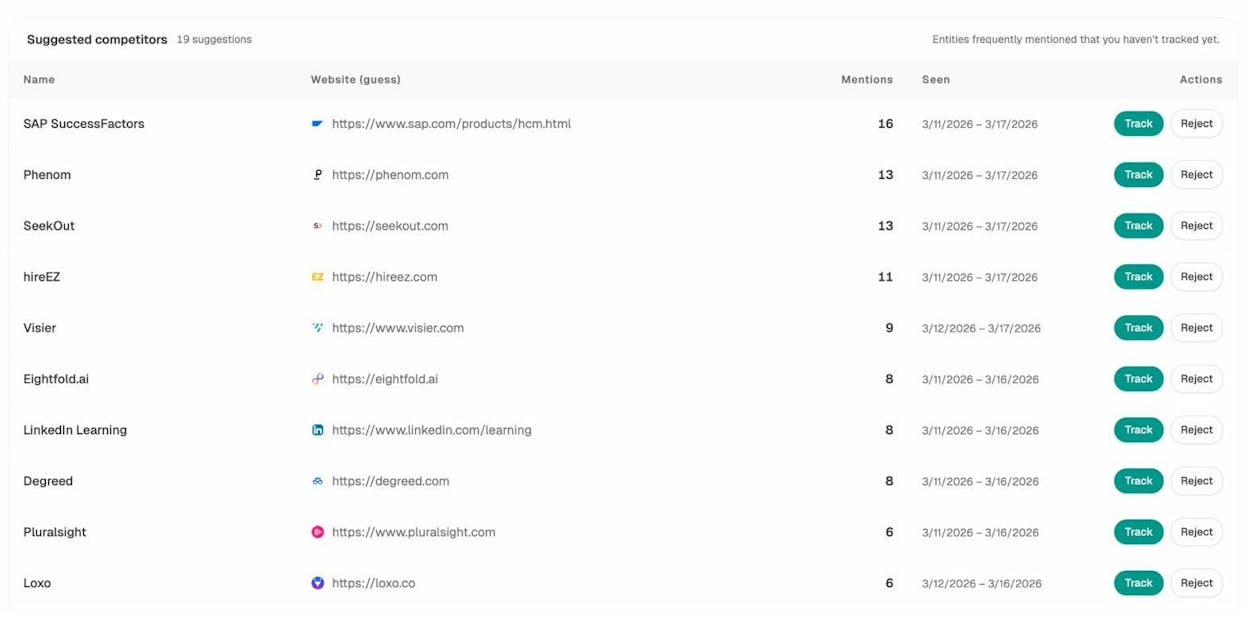
When a competitor launches a branded content campaign, you’ll see their mentions and citations climb. When yours starts working, you’ll see the inverse. For a structured tracking approach across both channels, see our guide to SEO competitor analysis.
7 examples of great branded content
These seven campaigns each made something the audience genuinely wanted to consume. None sold the product directly. All grew the brand.
1. Thoropass: Scam Hunters
![[Screenshot: The Scam Hunters podcast cover art featuring the show title and lead actors.]](https://www.datocms-assets.com/164164/1777769470-blobid11.jpg?auto=format,compress&w=1248&fit=max)
Thoropass is a compliance and infosec company. Their audience cares about scams, fraud, and information security, but the topic itself is dry.
So they made a scripted podcast drama starring Erin Moriarty (The Boys) and Greg Kinnear (Little Miss Sunshine). The plot follows a disgraced security officer and a journalist investigating scams targeting terminally ill patients.
Why it worked. Compliance is one of the hardest topics in B2B SaaS to make interesting. Scam Hunters wraps the topic in true-crime fiction, a genre the target audience already enjoys. The product never sells itself. The show just makes infosec feel important and dramatic, which is how Thoropass wants its category perceived.
2. Loewe: Decades of Confusion
![[Screenshot: A still from the Decades of Confusion short film showing Aubrey Plaza on a spelling bee stage in period costume.]](https://www.datocms-assets.com/164164/1777769476-blobid12.jpg?auto=format,compress&w=1248&fit=max)
Fashion brand Loewe released a two-and-a-half-minute short film starring Aubrey Plaza and Daniel Levy. Plaza plays spelling bee contestants across the decades, all failing to spell “Loewe,” each in a different era-appropriate Loewe outfit.
Why it worked. Loewe leaned into a real customer pain point, nobody knows how to pronounce the brand, and turned it into the joke. The casting signaled cultural identity. The decade-by-decade outfits showcased the brand’s design history without saying “look at our design history.” Fans of Plaza and Levy sought the content out, which means the brand reached audiences who’d never engage with a traditional ad.
3. Hallmark and the NFL: Holiday Touchdown
![[Screenshot: Promotional image for Holiday Touchdown: A Chiefs Love Story showing the lead characters in NFL-themed holiday setting.]](https://www.datocms-assets.com/164164/1777769476-blobid13.jpg?auto=format,compress&w=1248&fit=max)
Hallmark and the NFL co-produced a holiday movie called Holiday Touchdown: A Chiefs Love Story, riding the wave of new female NFL fans following the Taylor Swift and Travis Kelce romance.
Why it worked. Each brand reached the other’s audience without diluting its own identity. Hallmark stayed Hallmark. The NFL stayed the NFL. The crossover gave Hallmark access to football fans, gave the NFL access to family-oriented viewers, and built a cultural moment money usually can’t buy. This kind of partnership is replicable. Find a brand whose audience overlaps yours by 30 to 50% and propose a co-produced piece of content.
4. Paddle: Paddle Studios
![[Screenshot: The Paddle Studios homepage showing the Born Global series with documentary-style cover art.]](https://www.datocms-assets.com/164164/1777769482-blobid14.jpg?auto=format,compress&w=1248&fit=max)
Paddle is a global payments infrastructure provider for SaaS companies. Their marketing team built a Netflix-style content studio producing documentaries like We Sign Tomorrow (the inside story of a tech acquisition) and series like Born Global (entrepreneurs around the world).
Why it worked. B2B SaaS brands are notoriously hard to humanize. Paddle Studios solves the problem by becoming a publisher in its own right. The documentaries don’t pitch Paddle. They tell stories Paddle’s audience genuinely cares about. The brand benefits by being the studio that brought the audience the story they remember. ROI shows up in two years, not two weeks.
5. Tide: #TideTackles
![[Screenshot: A scene from a #TideTackles social video showing an NFL legend at a tailgate party.]](https://www.datocms-assets.com/164164/1777769482-blobid15.jpg?auto=format,compress&w=1248&fit=max)
Tide’s #TideTackles campaign sent NFL legends to tailgates across the United States, capturing the messiness of game-day food in unscripted, regionally-flavored short videos.
Why it worked. Tide aligned itself with the moment its product is most needed (game-day stains) without making the product the hero. The format suited the channel. Short fan-driven videos work on TikTok, Instagram, and YouTube Shorts in ways polished commercials don’t. Distribution was treated as a first-class part of the campaign.
6. Sky and Dogs Trust: Bonfire Night Pop-Up Channel
![[Screenshot: The Sky/Dogs Trust pop-up TV channel branding showing a calm dog with the Bonfire Night programming schedule.]](https://www.datocms-assets.com/164164/1777769488-blobid16.jpg?auto=format,compress&w=1248&fit=max)
UK broadcaster Sky partnered with Dogs Trust to create a pop-up TV channel airing feel-good movies and classical music to soothe anxious dogs (and their owners) during Bonfire Night, when fireworks distress millions of pets.
Why it worked. Sky and Dogs Trust both took an audience problem seriously enough to build infrastructure around it. The campaign earned press coverage, social shares, and emotional brand affinity from dog owners who’ll remember which broadcaster cared about their pet. Sometimes the strongest branded content is a service, not a story.
7. HubSpot: The Hustle and My First Million
![[Screenshot: The My First Million podcast cover art with hosts Sam Parr and Shaan Puri, alongside The Hustle newsletter branding.]](https://www.datocms-assets.com/164164/1777769488-blobid17.png?auto=format,compress&w=1248&fit=max)
HubSpot acquired the Hustle media company in 2021, which brought with it the My First Million podcast and a daily newsletter with millions of readers. The content remains independent of HubSpot’s product marketing. The hosts rarely mention HubSpot. The audience keeps showing up.
Why it worked. HubSpot bought attention from its exact target audience (entrepreneurs, founders, marketers) without forcing those audiences to engage with HubSpot’s brand. Over time, the implicit association builds, the content is owned by HubSpot, and HubSpot benefits from the halo. For SaaS marketers, this is the most replicable example on the list. Build the audience yourself like Paddle does, or buy it like HubSpot did.
Final thoughts
Branded content is having a moment because the alternative (more generic content) is becoming worthless.
When information is free and any team with a ChatGPT subscription can publish a “complete guide” overnight, the brands that win are the ones AI engines and search engines both find distinctive enough to remember. Distinctive enough to cite. Distinctive enough to repeat.
That is the through-line we believe at Analyze AI. SEO is not dead. AI search is not replacing it. They are two organic channels that reward the same underlying work, original audience-first content that humans want to share and AI engines want to summarize.
If you want to see how your brand is showing up across both channels, start with the Monitor pillar for visibility tracking, the Discover pillar to find the prompts and competitors you should be tracking, and the Improve pillar to optimize the content you already have.
Then go make something your audience actually wants to consume.

Ernest

Ibrahim


