



Summarize this blog post with:


In this article, you’ll learn how to localize your website without burning budget on translations that never rank, why search engines now translate your content for you (and quietly take the traffic when they do), how to pick markets using data instead of gut feel, and how to extend your localization work into AI search so ChatGPT, Perplexity, and Gemini cite you in every language your buyers ask in.
These 10 lessons come from teams running content programs across 14 markets and from our own data on how AI search engines surface localized content differently than Google does.
Table of Contents
Translation vs. localization vs. transcreation
Three words, three different jobs.
|
Approach |
What it does |
When to use it |
|---|---|---|
|
Translation |
Converts words from one language to another, preserving meaning and structure |
Legal pages, product UI strings, technical specs |
|
Localization |
Adapts examples, references, idioms, visuals, and strategy to feel native in the target market |
Blog posts, landing pages, case studies |
|
Transcreation |
Recreates the tone, emotion, and intent so a message lands the same way in a different culture |
Taglines, ad copy, brand campaigns |
Translation is the floor. Localization is what moves the needle for organic traffic. Transcreation is for brand-critical work where a tagline that falls flat costs more than the rewrite.
In SEO, the line that matters most is between translation and localization. A literal headline rarely matches how people in another market actually search. The same logic now applies to AI search, where the model needs to recognize your content as the relevant answer to a query phrased in local idiom, not the literal translation of an English question.
1. Beat Google to your own content
Localization stopped being optional in early 2025. Google now auto-translates English pages and serves them under its own subdomain inside AI Overviews and featured snippets. The user never sees your URL. Google gets the click and the link equity.
To check whether this is happening to you, open Google Search Console and go to Search Appearance, then Translated Pages.
![[Screenshot of Google Search Console showing the Translated Pages report under Search Appearance, with rows of pages being auto-translated]](https://www.datocms-assets.com/164164/1778089748-blobid1.png?auto=format,compress&w=1248&fit=max)
You can also check this in any backlink tool by looking up top pages on translate.google.com and filtering for URLs that contain your domain.
![[Screenshot of a backlink tool showing top pages report for translate.google.com filtered by domain]](https://www.datocms-assets.com/164164/1778089754-blobid2.png?auto=format,compress&w=1248&fit=max)
The fix is to publish a real localized version before Google does. You don’t need a perfect 3,000-word translation. A tight 300-word native-language version with locally relevant examples is usually enough to push Google’s auto-translation out of the SERP.
The same dynamic exists in AI search. When ChatGPT, Perplexity, or Gemini answer a question in French, they cite the sources they consider most relevant for a French audience. If you only have English content, you’re competing against locally written articles for citations in a query the user posed in French. The localized version usually wins.
2. Start with the markets that matter most
Most teams localize the wrong way. They pick a language because the founder studied abroad there or because a customer asked about it once. The traffic never shows up.
The teams that do this well make the decision based on five inputs.
First, billing data. Where are existing customers paying you in a non-home currency? Indonesia surprises a lot of B2B SaaS teams here.
Second, interface language settings. If a meaningful share of your product users have switched their UI to Portuguese or Japanese, that’s a strong demand signal.
Third, branded search volume in the target country. If people in Mexico are already Googling your brand, you have demand to capture and almost no awareness work to do.
Fourth, GDP and tech adoption. Markets with growing tech ecosystems often have search behavior shifting in your favor (South Korea’s gradual move from Naver to Google is a textbook example).
Fifth, AI search traffic. Most teams haven’t checked this yet. AI engines surface different sources in different countries, and your existing content may already be getting cited in markets you’ve never targeted.
To find this last input, open Analyze AI’s AI Traffic Analytics and look at the country breakdown of your AI-referred visitors.
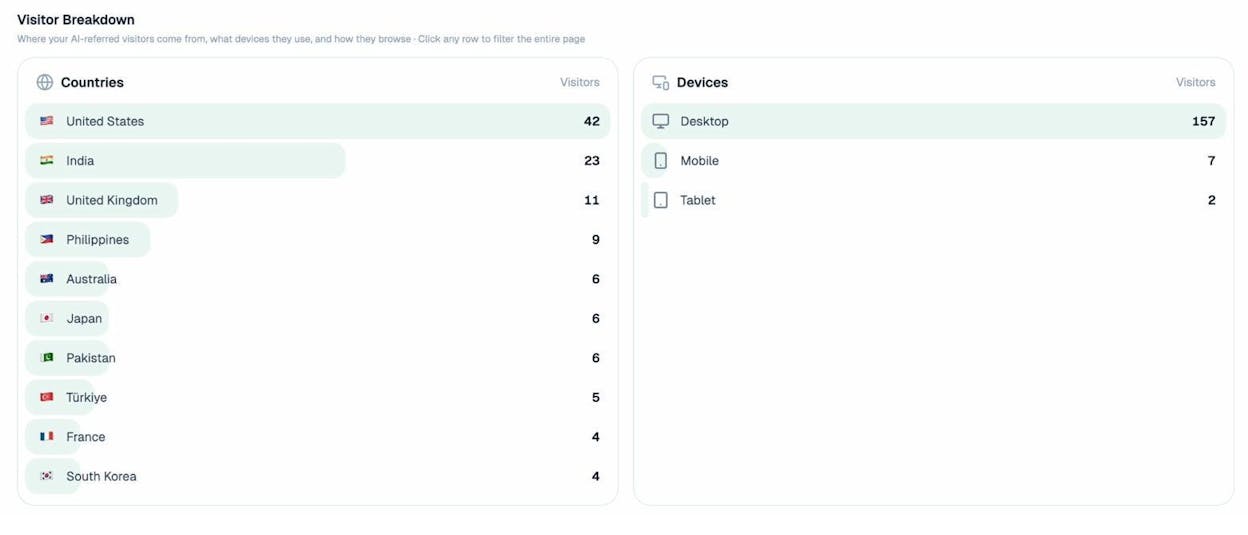
Visitor breakdown by country showing AI-referred traffic from United States, India, United Kingdom, Philippines, Australia, Japan, Pakistan, Türkiye, France, and South Korea
If you see countries you weren’t targeting (India, Philippines, and Türkiye are common surprises), that’s a market signal you can act on now. The AI is already sending you visitors. Localized content gives them a reason to stay.
You can drill into individual sessions to see which AI source sent a visitor from which country, and which page they landed on.
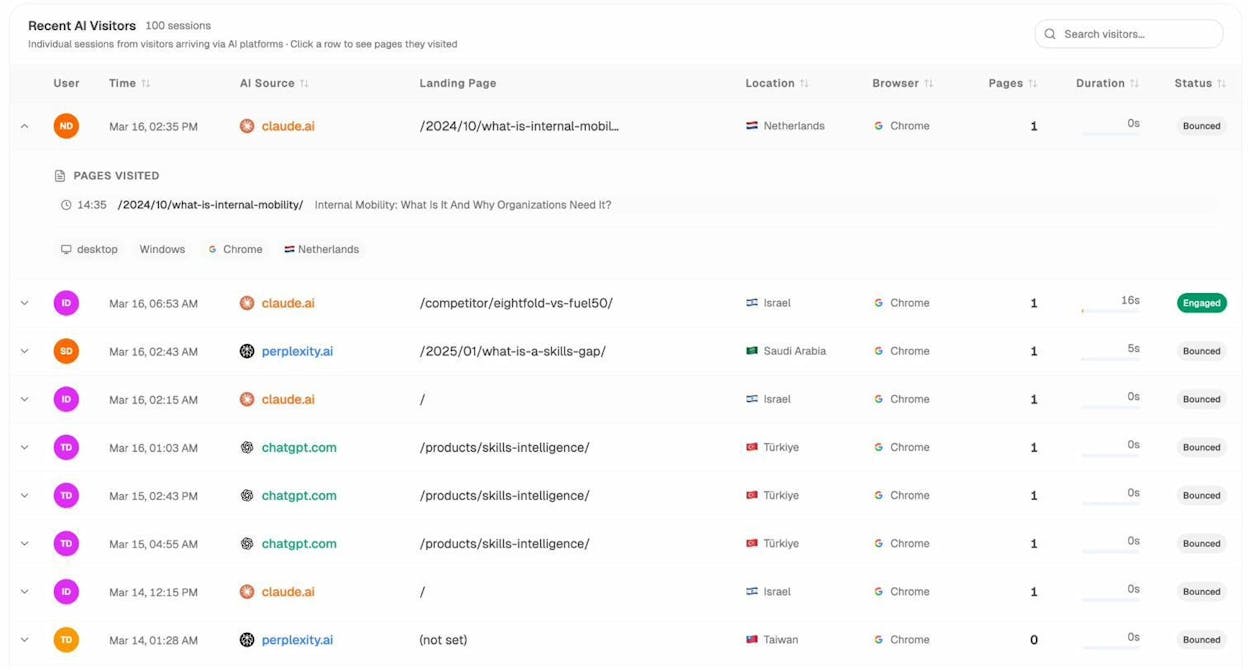
Score each candidate market on potential and confidence, then pick the top two or three. Don’t try to do five at once. Teams that do almost always end up with five mediocre programs instead of one great one.
3. Don’t assume, do local keyword research
What ranks in English rarely ranks the same way in another language. The literal translation of “best CRM for small business” might map to a phrase nobody types in German. Worse, the highest-volume version in German might mean something subtly different.
Local keyword research has to start in the target language, not in English with translation bolted on.
Start with your primary topic in your home language, run it through a keyword tool that supports country-level search volume, then translate the resulting cluster (not the seed).
For free options, our keyword generator, keyword difficulty checker, and keyword rank checker all support country-level data. For paid options, our keyword research tools roundup covers the full landscape.
Once you have a candidate list, validate that those terms still represent the same intent in the target market. A term that’s commercial in English might be informational in French. Check the SERP for each translated term using a SERP checker set to the target country. If the top results are guides, intent is informational. If they’re product pages, intent is commercial. Match your content to what’s actually winning.
Doing the same research for AI search
AI engines don’t have a keyword research tool yet, but they do have a prompt research equivalent. The questions people ask ChatGPT, Perplexity, and Gemini are longer, more conversational, and more local than what they type into Google.
To get a starting list of prompts in your category, open Prompt Discovery and review the suggestions. The tool generates them from real AI search behavior in your industry.
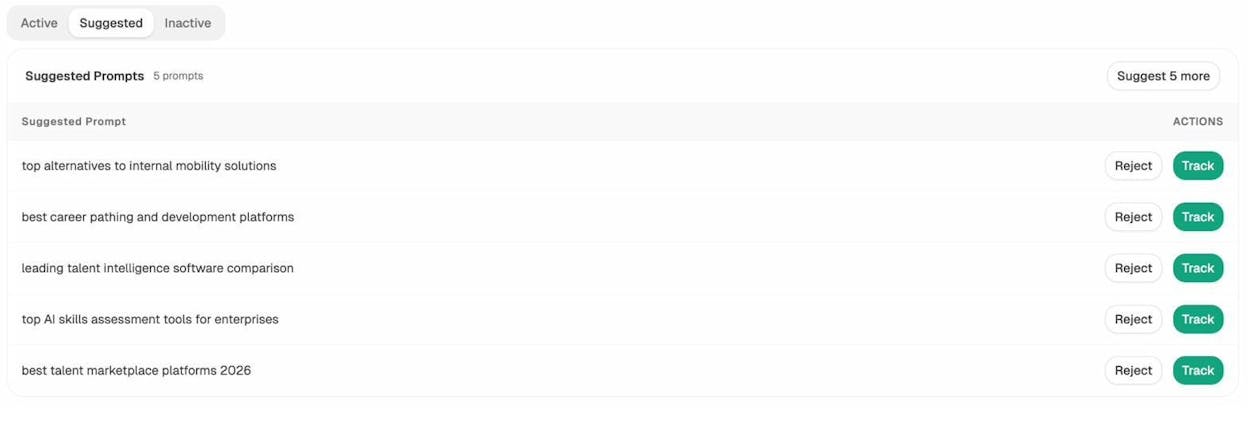
Then run each prompt in AI Search Explorer with the country set to the market you’re researching. The tool runs the prompt against ChatGPT, Google AI Mode, and Perplexity from that country’s perspective, so you see what an actual user in France or Brazil would see.
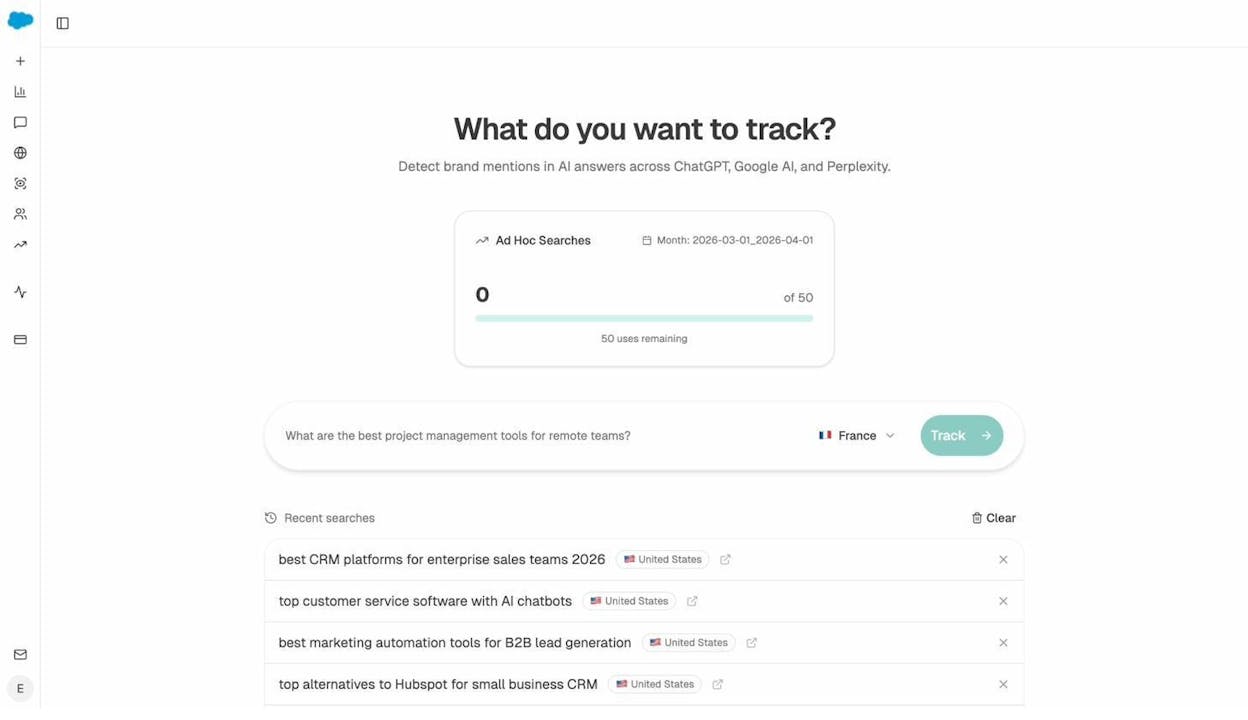
The brands cited in those local AI responses are your real competitors in that market, not the ones you’ve been benchmarking in English. You’ll often find a regional player punching above its weight in AI search even though it barely registers in your usual SEO competitor analysis.
4. Don’t translate everything, localize strategically
Translating every blog post on your site is the most common, most expensive mistake in localization. Most articles never recover the cost of being translated.
Map your existing content into three buckets and treat each one differently.
Data studies and original research translate well. The numbers stay the same. The findings are interesting in any language. Publish a near-direct translation, then add a short local micro-study to anchor it locally.
Evergreen guides need real localization. Examples, screenshots, and references all need to change. A guide that uses Mailchimp screenshots will feel foreign to a German audience that uses CleverReach. Identify two or three replacement examples per guide, not a full rewrite.
Country-specific topics should be written from scratch. Translating a US-focused tax filing article to French won’t help a French audience because the topic itself doesn’t apply.
To decide which existing articles deserve translation, pull the ones with the most organic traffic and the most backlinks. High-traffic, high-link articles are proven content and worth the translation investment.
![[Screenshot of a content audit spreadsheet showing top pages by traffic and backlinks, sorted by potential]](https://www.datocms-assets.com/164164/1778089770-blobid7.png?auto=format,compress&w=1248&fit=max)
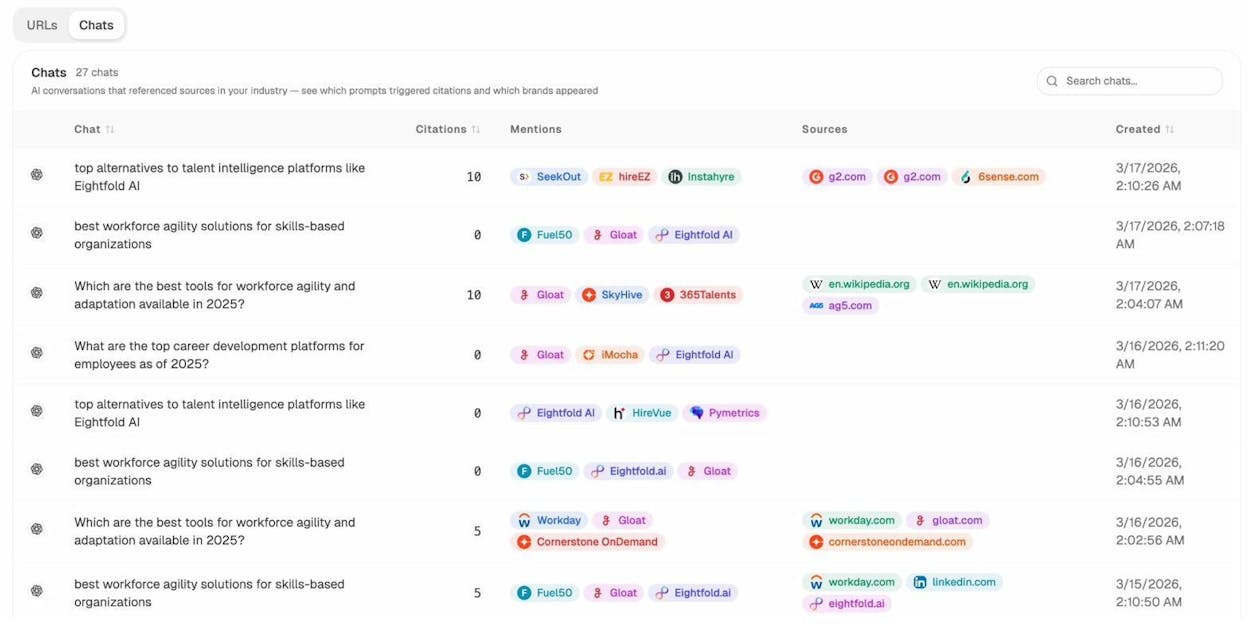
You can do the same audit for AI search. Pull the pages getting cited most often by ChatGPT, Perplexity, and Google AI Mode. Those pages have already been validated as authoritative. Localizing them gives the AI a native-language version to cite when the same query gets asked elsewhere.
To see which pages are winning AI citations, open Citation Analytics and sort by citation count.
5. Create culturally relevant content that earns trust
Localized content has to read like it was written in that market, not for it.
Teams that do this well replace examples, swap out reference brands, and bring in local authors who actually live in the target market. A Spanish blog post about content marketing should reference Spanish-language publishers, Spanish case studies, and platforms that Spanish marketers actually use. A direct translation that mentions only US brands reads as a tourist’s perspective even when the prose is grammatically perfect.
Local authors carry weight beyond the content itself. They share the article with their own networks. They get tagged in industry conversations. The links and mentions that follow are the trust signals both Google and AI engines look for when deciding which sources to surface in a given country.
The same dynamic governs AI search. LLMs cite the sources they consider authoritative, and authority is increasingly local. A French publication citing your French case study counts more in a French AI response than ten US publications citing your English case study.
6. Refresh localized content to boost traffic
Localized content decays faster than content in your home market. The reason is volume. You’re publishing fewer articles, so each one needs to keep working over a longer period.
A refresh cycle for localized content should run on a 6-to-9-month rhythm rather than the 12-to-18-month rhythm most US programs use. Watch for ranking decline, traffic decline, outdated stats, broken internal links, and US-centric examples that no longer fit.
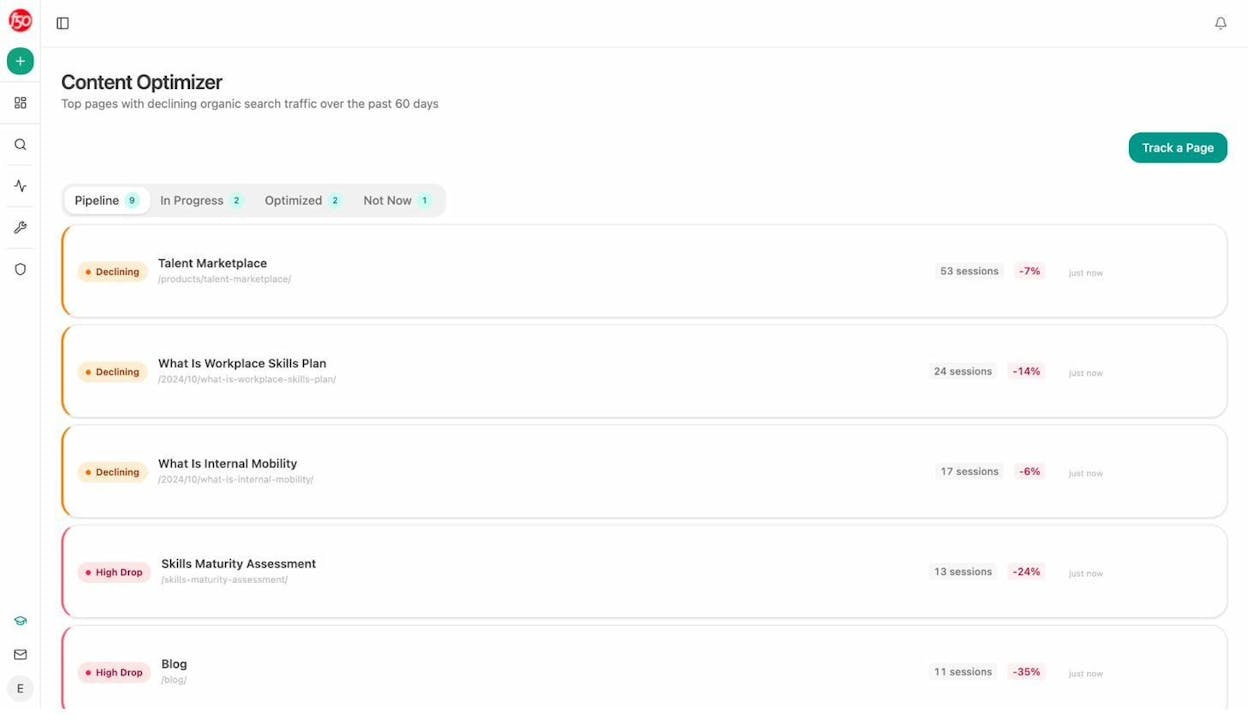
For pages losing AI search visibility specifically, the Content Optimizer flags URLs that have dropped citation counts or organic sessions over the same window.
When you refresh, focus on four things in order. Update outdated stats and examples. Add sections that address questions in the target market’s People Also Ask results. Improve internal linking from other localized pages on the same topic. Replace visuals that look stale or US-centric.
7. Automate, but don’t overtrust the AI
Translation has gotten dramatically better in the last two years. You can now run a draft through GPT-5 or Claude with a custom glossary, get back a translation that’s 90% publish-ready, and ship it the same day.
That last 10% is where every shortcut breaks down. The model will mistranslate a brand name. It will use a regional dialect that feels off. It will miss a cultural reference that needs replacing rather than translating. None of this shows up in a quality score, but all of it shows up to a native reader within the first three sentences.
The workflow that works is AI for the first pass, native human editor for the polish. The editor’s job is not to retranslate. It’s to catch the cultural and tonal misses the model can’t see. Build a feedback loop where editor corrections feed back into your glossary and translation memory so the model gets better on your specific content over time.
8. Keep voice and terminology consistent across languages
Style guides and glossaries are boring. They are also the single thing that prevents your localization program from drifting into inconsistency a year from now when you have three writers, two editors, and four languages working in parallel.
The minimum viable version is two documents per language.
The first is a glossary of 50 to 200 terms (product names, feature names, industry jargon, anything you’ve coined). For each one, the glossary specifies the preferred translation, the rejected alternatives, and a note on when to use which.
The second is a style guide covering tone, voice, formality level, and conventions specific to that market. Should you address the reader formally or informally? How do you handle gendered language? What’s the standard format for dates, currencies, and units?
![[Screenshot of a localization glossary spreadsheet showing source terms, target translations, context notes, and approval status]](https://www.datocms-assets.com/164164/1778089782-blobid10.png?auto=format,compress&w=1248&fit=max)
Both documents should be living. Update them monthly based on editor feedback.
9. Sync updates across languages and AI engines
When you update an English article, every localized version becomes slightly out of date. If the English version gains traffic from the update, the localized versions are now leaving traffic on the table.
The hack high-functioning teams use is to monitor content changes on the source articles, then propagate the same change to every translated version on a regular sync cycle.
![[Screenshot of a content changes report showing which sections of an article were updated and the resulting traffic impact]](https://www.datocms-assets.com/164164/1778089786-blobid11.png?auto=format,compress&w=1248&fit=max)
The same logic applies to AI citations. When a competitor’s page suddenly starts gaining citations in Google AI Mode or Perplexity, the underlying reason is usually a content update or a new piece of structured data. If you’re tracking this, you can see the change before your own pages start losing ground.
Analyze AI surfaces this in weekly email digests so you don’t have to check the dashboard daily. The digest tells you which competitor pages just gained citations, which of yours just lost them, and a short explanation of why.
10. Build on a good technical foundation
Most localization technical guides stop at “use hreflang correctly,” which is a bit like telling someone to “use SEO correctly.” The technical layer is where careful work compounds.
Six decisions to get right.
URL structure. Subfolders (example.com/fr/) consolidate domain authority and are the right default for most teams. Subdomains (fr.example.com) split authority. Country-code top-level domains (example.fr) feel maximally local but split your SEO efforts across multiple domains and are usually overkill unless you have a dedicated team in that country.
Hreflang tags. Every localized version needs to declare its language and region, and every version needs to point to every other version. A French page should have hreflang entries for the English version, the German version, the Spanish version, and itself. Most CMS plugins handle this automatically. Errors usually come from missing return links, conflicting language codes, or pages that hreflang to URLs that 404.
![[Screenshot of a site audit tool’s hreflang report showing the link graph between language versions and any broken or conflicting tags]](https://www.datocms-assets.com/164164/1778089790-blobid12.jpg?auto=format,compress&w=1248&fit=max)
No IP-based redirects. Don’t auto-redirect users based on IP. Googlebot crawls primarily from the US, so an IP-based redirect can prevent your localized pages from being indexed at all. Show a language picker and respect the user’s choice.
A CDN for global delivery. Page speed matters more for international users than for users near your origin. A CDN cuts load times by hundreds of milliseconds in distant markets. Both Google and Bing factor page experience into rankings, and the same speed signals matter for AI engines that need to crawl and re-crawl your content.
Localized structured data. Schema markup helps both search engines and AI engines understand the relationships in your content. Most teams add schema to the English version and forget to update language attributes when they translate. Make sure the inLanguage property reflects each localized version, and that any text inside the schema (FAQ answers, product names, organization descriptions) is also translated.
An llms.txt file. This is newer and most teams haven’t done it yet. An llms.txt file at the root of your domain tells AI crawlers which content is the canonical version for which language. As AI engines start respecting this file the way search engines respect robots.txt, having one in place gives you control over how your localized pages get cited. Our llms.txt generator tools roundup lists the current options.
For the broader foundation everything else sits on top of, see our 4 pillars of an effective SEO strategy.
Final thoughts
Localization SEO is a compounding asset. The first six months feel slow because you’re spending more on production than you’re seeing in traffic. The compounding starts in month nine or ten, when the early articles start ranking, the local backlinks start arriving, and AI engines start citing your localized pages instead of your English ones.
The teams that win pick their markets carefully, write content that locals actually want to read, and treat AI search as another organic channel rather than a separate strategy. Search isn’t being replaced by AI. It’s getting more channels, and each one still rewards the same fundamentals. Clear content. Real expertise. A setup that lets engines find and trust you.
If you want to see which markets are already sending you AI search visitors before you decide where to invest, start with Analyze AI. The country breakdown is the same one we use to make our own localization decisions.

Ernest

Ibrahim


