



Summarize this blog post with:


In this article, you’ll see how often PPC and SEO end up bidding on the same ground, why most teams don’t notice, and what to do once you find it on your own site. You’ll also see why ad spend can’t fix poor visibility in ChatGPT, Perplexity, or Google’s AI Mode, and how to audit all three channels in one pass.
Table of Contents
The PPC and SEO overlap problem in one chart
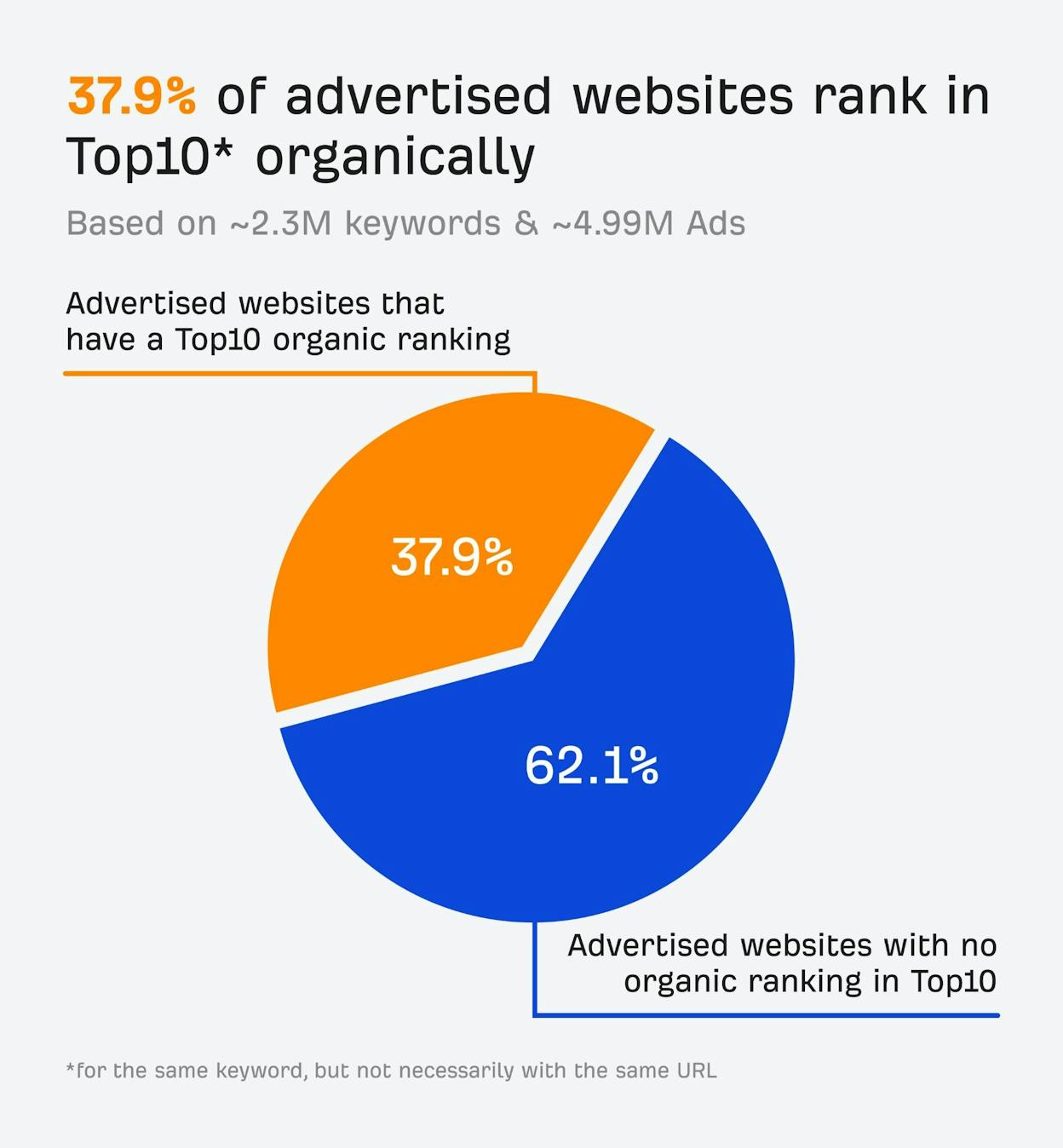
The clearest data on this came from Ahrefs in late 2024. Their team analyzed 2.3 million keywords and 4.99 million top ads to measure how often advertisers were paying for traffic they could have earned organically.
Three numbers stood out:
-
37.9% of advertised websites already ranked in the top 10 organically for the same keyword.
-
15.7% of advertised URLs (the exact landing page) ranked in the top 10 for the keyword the ad targeted.
-
40.66% of advertised pages ranked #1 organically. The advertiser was paying for the ad slot above their own free, top result.
A separate, much earlier experiment by Blake, Nosko, and Tadelis at eBay reached a similar conclusion. They ran controlled tests on branded and non-branded paid search and found that for an established brand, most clicks attributed to ads would have happened organically anyway. The measured ROI on those ads was negative.
This is the baseline problem. Most teams have never run the audit, so they don’t know how much of their paid spend is replacing organic traffic instead of adding to it.
Why teams pay for clicks they were already going to get
Before fixing the overlap, it helps to understand why it happens. There are four common causes, and they often stack on the same account.
Siloed teams. PPC and SEO usually report into different leads, run on different tools, and review performance on different cadences. Neither team has a daily reason to look at the other team’s keyword list, so duplicate coverage builds up quietly.
Brand defense theory. Many teams bid on their own branded terms because they’re afraid a competitor might. That fear is real in a few categories (more on when in a moment), but Ahrefs found that brands bid on their own brand keywords two-thirds of the time even when no competitor was running ads against them. That’s pure overlap with no opponent on the field.
Attribution that flatters paid. Most last-click setups give ads credit for clicks that organic would have captured for free. The PPC dashboard looks healthy, the SEO report looks fine in isolation, and the duplicated cost stays invisible. Animalz makes a similar argument about aligning teams around real conversions instead of channel-level vanity metrics.
Auto-bidding sprawl. Smart Bidding, broad match, and recommended keyword expansions push ads onto terms the advertiser never explicitly chose. Some of those new keywords are ones the brand already ranks for organically, and the bid is placed before anyone notices.
These causes all produce the same outcome. The ad budget keeps growing, the organic team can’t see why traffic feels flat, and the overlap compounds.
Branded keywords: the “always bid” assumption
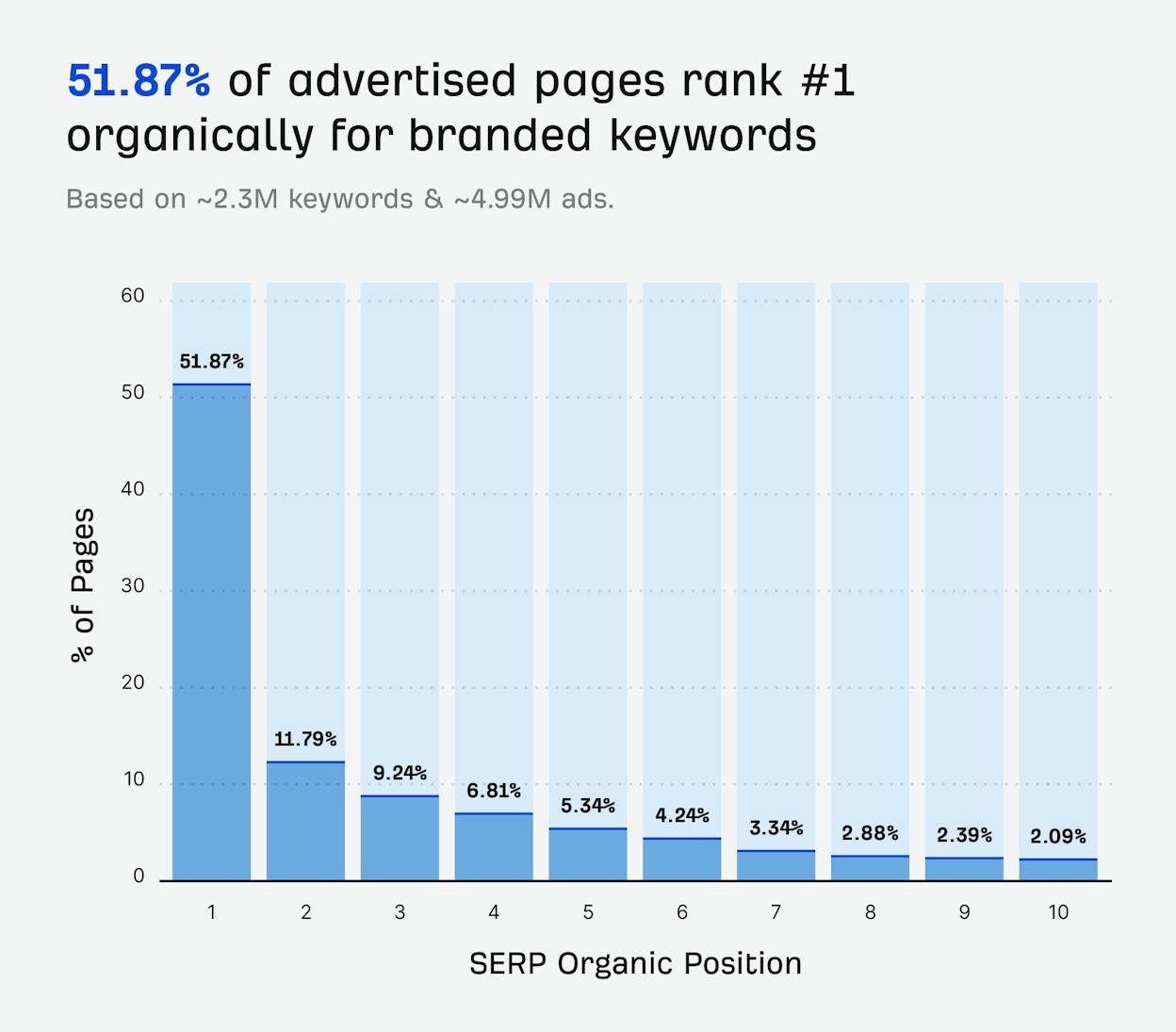
The Ahrefs study found that brands rank #1 for their own branded keywords more than half the time, and they still bid on those terms in two-thirds of cases. The eBay experiment found that pulling brand-term ads barely moved total clicks, because organic absorbed them.
Brand bidding is the easiest line item to defend in a meeting and the hardest to justify with data. Here’s a simple way to decide.
Brand bidding makes sense when:
-
A direct competitor is actively running ads on your brand name. You can confirm this in any SERP checker, including the free Analyze AI SERP Checker.
-
You’re running a campaign that promises something your homepage doesn’t say (a discount, a launch, a webinar) and you want the ad to land them on the campaign page.
-
Your organic listing is below the fold because of sitelinks, knowledge panels, or shopping units.
Brand bidding is probably waste when:
-
You hold the #1 organic spot, no competitor is bidding, and the ad sends users to the same page they would have clicked for free.
-
Your brand-term ads have CTR above 50% and your incremental conversion lift is in the low single digits.
-
You’re bidding on brand terms in markets where you’re the category-defining name and competitors don’t try to take your traffic.
The test most teams skip is a 30-day pause. Turn off brand-term ads in one geography, hold the SEO content fixed, and compare total branded conversions before and after. If the number barely moves, you have your answer.
Non-branded keywords: where the budget really leaks
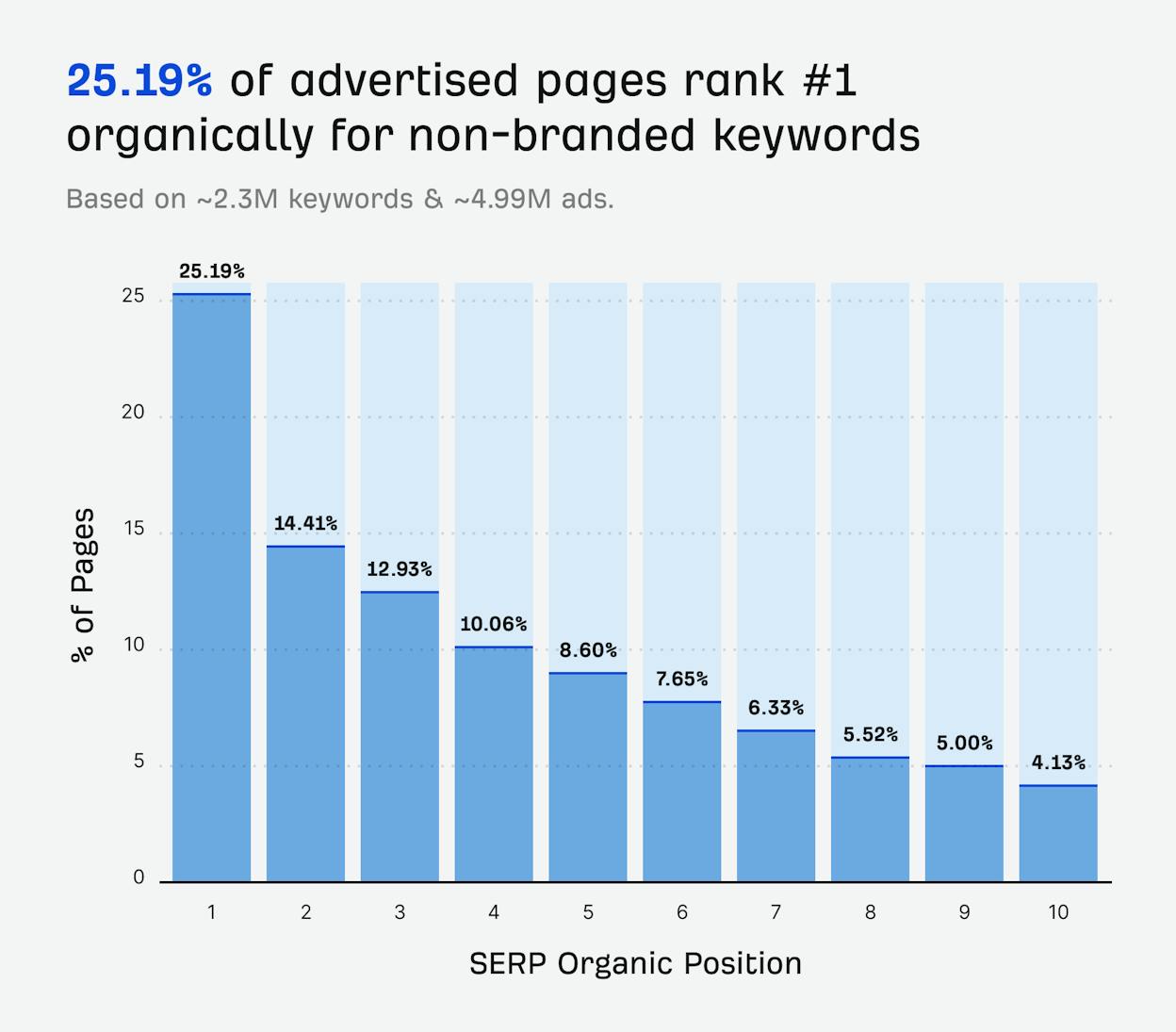
The brand keyword discussion gets more attention, but the bigger waste tends to live in non-branded terms. Ahrefs found that brands rank #1 organically for non-branded keywords about 25% of the time, and a meaningful share of those #1 pages still get an ad pushed above them by their own account.
The damage there is bigger because the cost-per-click is higher. A branded click might be $0.50. A non-branded commercial click in B2B SaaS or insurance can run $40 or more. Doubling up on a click you already own is expensive at that rate.
There’s also a second-order problem. When the same URL serves both the ad and the organic listing, the ad cannibalizes the organic CTR without adding incremental clicks. The page now looks like a top performer in PPC reports and a flat performer in SEO reports, which makes the SEO investment look weak and the PPC investment look strong. The team then doubles down on the channel that was just stealing from the other.
Auditing your own non-branded overlap is straightforward. Pull every paid keyword you’ve spent on in the last 90 days, join it against your top 10 organic positions, and look at any keyword where the same URL appears in both columns. The next section walks through how to do that and how to extend the same audit into AI search.
The AI search wrinkle: why ad budget can’t help you here
The PPC versus SEO discussion has been framed for two channels. There are now three, and the third one doesn’t take ads at all.
ChatGPT, Perplexity, Claude, and Google’s AI Mode answer the question directly inside the chat surface. There is no sponsored slot at the top of an AI answer. The brands that get mentioned are the brands the model decided to cite, based on what it pulled from the open web. If your content isn’t being cited, ad spend doesn’t fix it.
This is the part of the manifesto we keep coming back to. AI search isn’t replacing SEO, and SEO isn’t dead. AI search is a third organic channel sitting next to traditional search and social. Strong SEO content tends to earn citations in AI answers, weak content doesn’t, and the same content gaps that hurt your organic rankings also hurt your visibility in AI answers. We covered the underlying mechanics in how to rank on ChatGPT and how to rank on Perplexity, both based on a 65,000-citation dataset.
The practical implication for the PPC versus SEO question is this. If you find that you’re paying for clicks on keywords you already rank for, the right move isn’t always to keep the ad spend and accept the overlap. The right move is often to redirect that budget toward content that earns AI citations on the same buyer questions, because no amount of paid budget will buy you a placement inside a Perplexity answer.
You can see the gap clearly in the Sources view inside Analyze AI, which shows every URL and domain AI engines cite when they answer questions in your category.
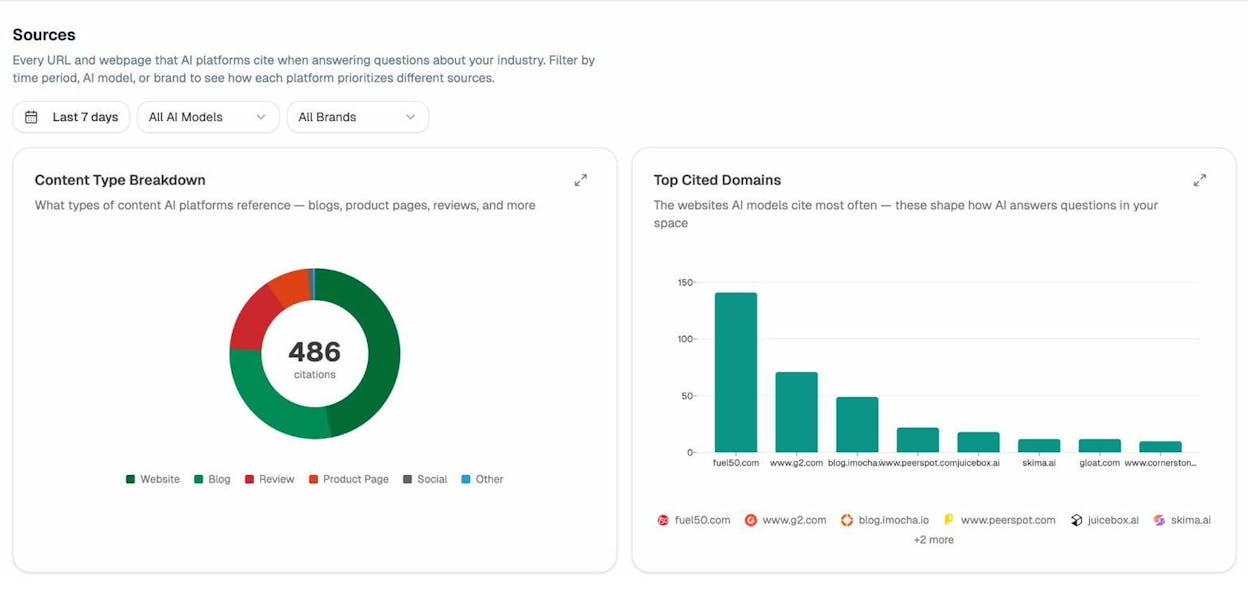
If your domain isn’t on that chart and a competitor’s is, that’s an organic gap. PPC budget won’t close it.
How to audit your PPC and SEO overlap (and your AI search overlap, in the same pass)
Here’s the audit, step by step. The first three steps work in any SEO tool. The last two extend the audit to AI search.
Step 1: Pull your paid keywords with organic positions
In any major SEO tool, open the paid keyword report for your domain and add the organic position column. In Ahrefs, you’d open Site Explorer, go to the Paid keywords report, and look at the Organic position column. In Semrush, the Advertising Research report has the same data.
![[Screenshot: Paid keywords report in any SEO tool with the Organic position column visible]](https://www.datocms-assets.com/164164/1777923784-blobid5.png?auto=format,compress&w=1248&fit=max)
Filter for keywords where your organic position is between 1 and 10. Those are the rows worth investigating.
Step 2: Filter by URL match
The next filter that matters is URL-level. A keyword can show up in your paid keyword list and your organic list while pointing to two different pages. That isn’t always overlap, sometimes the ad sends users to a campaign page and organic sends them to a guide.
The real waste is when the same URL appears as both the paid landing page and the organic ranking URL. Filter for that match and you’ll have your shortlist.
![[Screenshot: filtered paid keyword list showing rows where paid landing page URL equals top organic URL]](https://www.datocms-assets.com/164164/1777923788-blobid6.png?auto=format,compress&w=1248&fit=max)
Step 3: Pull the incremental conversion data
For every keyword on the shortlist, you want to know what would happen to total conversions if you paused the ad. The cleanest way is a 30-day geo-test. Pause the ad in one region, leave it running in another, and compare conversions for that keyword across both regions, normalized for traffic.
If conversions barely drop in the paused region, the ad wasn’t doing much. That keyword goes on the cut list.
If conversions drop sharply, the ad was incremental. Keep it.
![[Screenshot: simple before-and-after table showing paused-region conversions vs. control-region conversions for a tested keyword]](https://www.datocms-assets.com/164164/1777923789-blobid7.png?auto=format,compress&w=1248&fit=max)
Step 4: Check the same keywords in AI search
Once you have your shortlist of overlap keywords, push the same terms into prompt tracking inside Analyze AI to see whether the AI engines mention your brand for the buyer questions tied to those keywords.
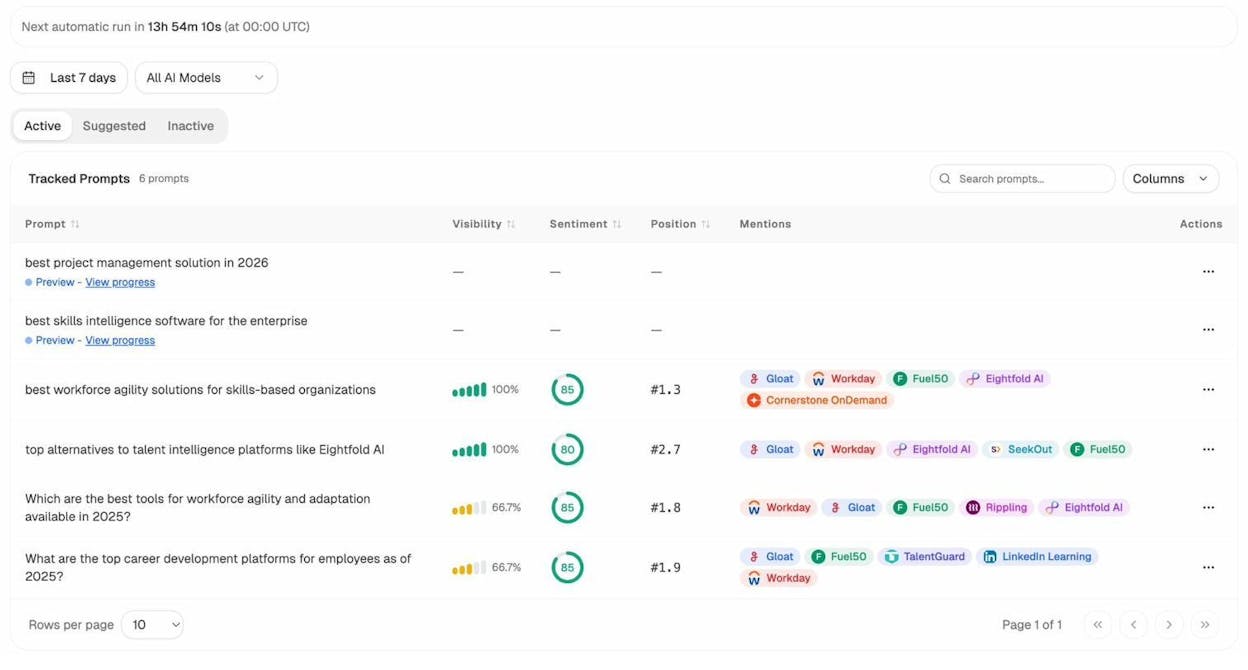
Two patterns are useful here. First, if you have strong AI visibility for a keyword you already rank #1 for organically, the PPC overlap is even harder to justify. You’re winning on two channels for free. Second, if you have weak AI visibility for that same keyword, the budget conversation gets sharper. You can either keep paying for an ad slot you don’t need, or redirect that budget into content that earns citations and starts winning the third channel.
You can also use prompt discovery to find adjacent buyer questions that your audience asks AI tools but that you’ve never targeted. Those are usually higher-leverage budget targets than doubling down on terms you already own.
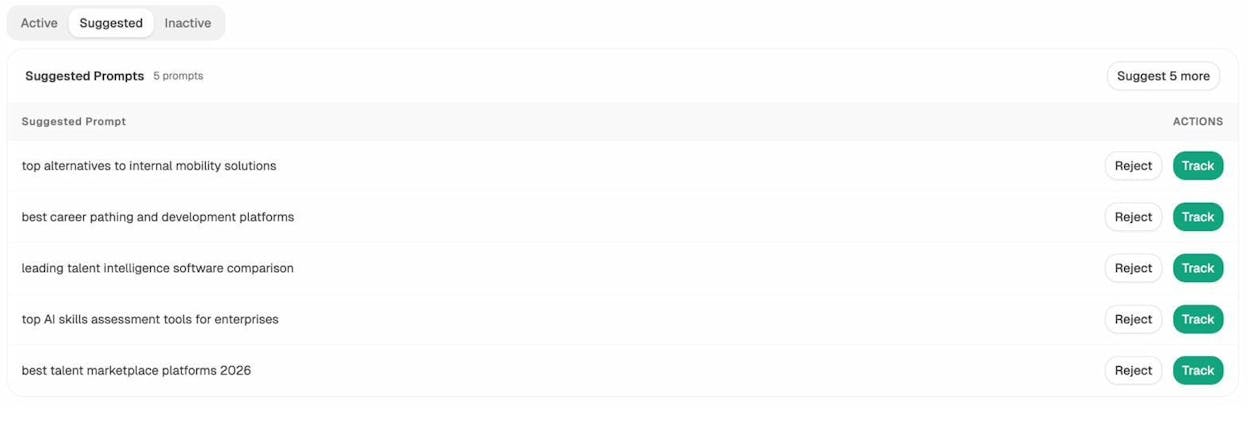
Step 5: Find which pages already work in AI search and double down
The last step is to find the pages on your site that already earn AI traffic, and use those patterns to inform the next round of content investment.
Open AI Traffic Analytics inside Analyze AI and sort the landing pages by sessions and citations. Pages with high session counts and high citation counts are pages the AI engines already trust on a topic. The format, depth, and angle of those pages are repeatable.
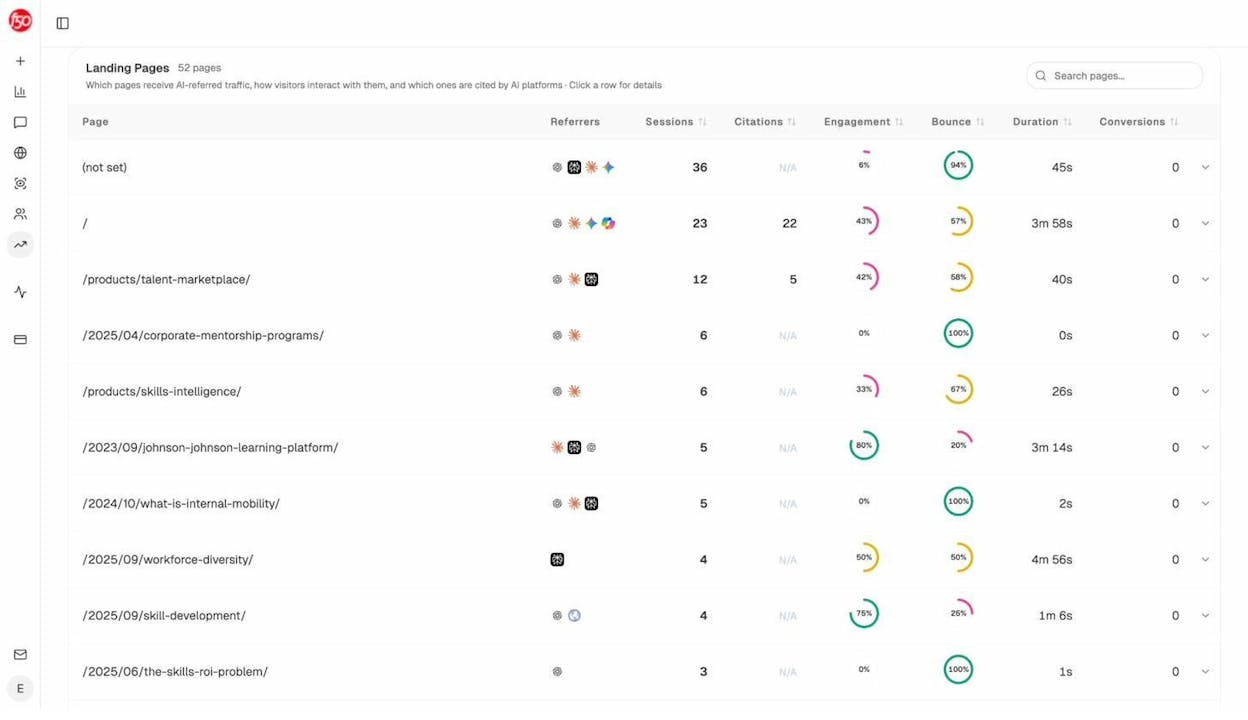
This is the part of the audit that turns a PPC budget review into a content roadmap. If you cut overlap spend and reinvest the same dollars into more pages that look like your AI-winning pages, you compound across all three channels at once.
How to fix PPC and SEO cannibalization (a five-move framework)
Once the audit is done, the fix is mechanical. Five moves, in this order.
1. Pause, don’t kill, in 30-day windows. For every overlap keyword on the cut list, run a 30-day geo-test. Don’t permanently delete a keyword based on a hunch. Test, measure incremental conversions, then decide.
2. Redirect the recovered budget to keywords where you don’t rank. The point of the audit isn’t to spend less. It’s to spend on terms you can’t capture organically yet. Pull a list of commercial keywords where you rank between positions 11 and 30 and push the recovered budget there.
3. Use PPC to test new content angles before investing in long-form content. This is one of the more useful applications of paid search for an SEO-led team. Run cheap ads on a query you want to rank for, pointing at three different landing page angles, and see which one converts. Then commission the long-form organic page based on the winner. PPC becomes content market research instead of organic replacement.
4. Defend branded terms only when a competitor is actively bidding. Use the Analyze AI Competitors view to monitor which brands are showing up in your category and which ones might be running campaigns on your name. Bid defensively only when the data says you need to.
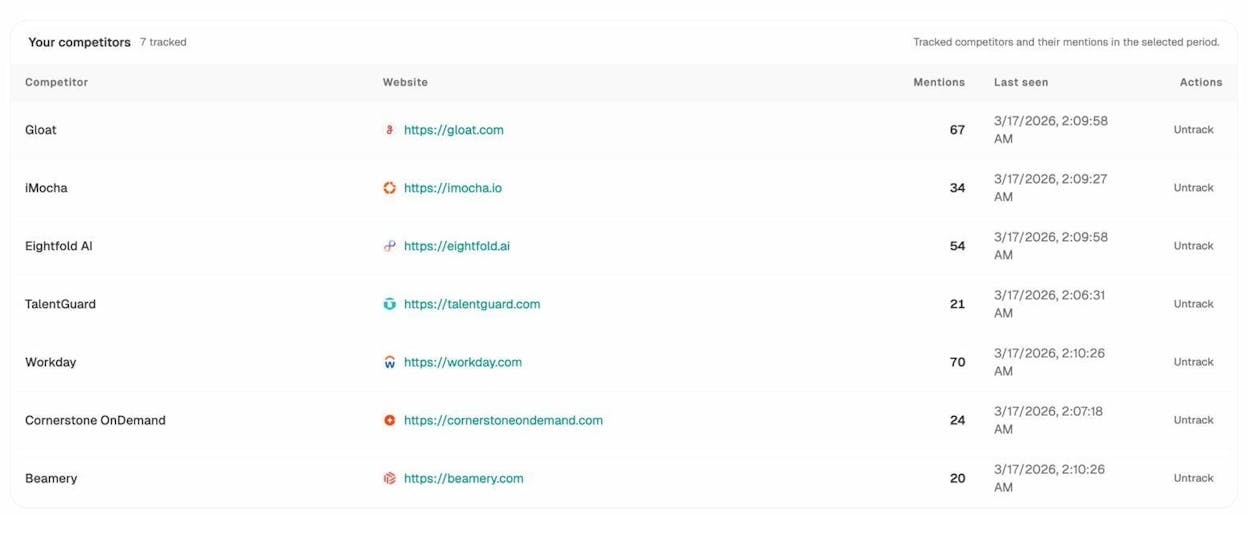
5. Reinvest in pages that already win in AI search. From the AI Traffic Analytics audit in step 5 above, take your top-cited pages and add adjacent topical depth, internal links, and refreshed examples. This compounds. The same page that ranks #1, drives an ad you can now turn off, and gets cited in three AI engines is the most efficient asset on your site.
A useful way to summarize all of this is the table below.
|
Scenario |
Keep the ad? |
What to do |
|---|---|---|
|
You rank #1 organically, no competitor is bidding |
No |
Pause for 30 days, measure, redirect budget |
|
You rank #1 organically, a competitor is bidding on your brand |
Often yes |
Keep the defensive bid, monitor weekly |
|
You rank in positions 4–10 and the SERP is heavily ad-loaded |
Often yes |
Ad pushes you above the fold |
|
You rank between 11 and 30 organically |
Yes |
This is the right place for paid budget |
|
You don’t rank at all and the keyword is volatile |
Yes, while you build organic |
Build the page, then pause |
|
You’re cited by AI engines and rank organically |
No |
The third channel is already working for free |
When PPC and SEO overlap is actually a smart strategy
The Ahrefs piece treats overlap as waste by default. That’s mostly fair, but not always. There are a few cases where running an ad on a keyword you already rank for is the right call.
Volatile rankings. If the keyword you rank for moves between positions 1 and 5 week to week (common in news, finance, and travel), the ad smooths out the variance.
SERP feature dominance. If the SERP for your target keyword is stacked with shopping units, AI Overviews, video carousels, and “people also ask” boxes, your #1 organic listing might sit below the fold on most screens. The ad earns visibility your organic ranking can’t.
Active competitive attack. If a competitor is bidding on your brand name in your highest-revenue market, defensive bidding is rational until they back off. You can confirm whether the attack is real (and not paranoia) by tracking it in competitor intelligence instead of guessing.
A new launch with no organic ranking yet. SEO compounds slowly. PPC delivers immediately. For the first 90 days of a new product page, paying for clicks while organic catches up is a fine bridge.
Underperforming organic CTR. If your organic listing is technically #1 but the title and description are weak and CTR is low, the ad recovers some of the missing clicks while you fix the snippet. This is a temporary fix, not a permanent budget line.
If your overlap keyword fits one of those five cases, keep the ad. If it doesn’t, the budget is probably better spent elsewhere.
Final thoughts
PPC and SEO aren’t opposing channels. They’re two ways of capturing the same buyer. The overlap problem isn’t that they exist together. It’s that most teams never measure where they double up, never test what would happen if they didn’t, and never look at the third channel where neither paid budget nor old-school SEO tactics work on their own.
The teams that win in the next few years are going to be the ones who treat paid search, organic search, and AI search as one coordinated surface. Audit the overlap, redirect the recovered budget, build content that earns citations, and watch all three channels start to compound at the same time.
That’s the whole job.

Ernest

Ibrahim


