



Summarize this blog post with:


In this article, you’ll learn what the great decoupling is, why it’s pulling clicks and impressions apart on almost every site at the same time, how to confirm the pattern is happening to your own domain, and how to convert the impressions you can see into the AI search traffic you cannot.
Table of Contents
What the great decoupling actually is
For two decades, clicks and impressions on a search result moved together. When more people saw your listing, more people clicked it. The relationship was so reliable that almost every SEO dashboard in the world treated impressions as a leading indicator for traffic.
That relationship has broken.
Across the industry, sites are reporting the same thing. Daily impressions are up. Daily clicks are flat or down. The two metrics that used to grow in lockstep now move in opposite directions. Darwin Santos coined the name for it in a viral X post. He called it the great decoupling.
The Ahrefs blog showed this in its own data. In late 2024, daily impressions and clicks for the Ahrefs blog had a positive correlation of 0.425. By the first half of 2025, that correlation had flipped to -0.352. Impressions kept climbing. Clicks stopped following.
![[Screenshot: GSC chart showing the classic “crocodile mouth” pattern with impressions rising and clicks falling, taken from a public GSC export or recreated for the article]](https://www.datocms-assets.com/164164/1777922262-blobid1.png?auto=format,compress&w=1248&fit=max)
The same shape now appears on SaaS blogs, ecommerce category pages, B2B publications, and personal sites. Industry reporting on SERoundtable confirmed the trend was widespread by mid-2025. The cause is not anything you did. The cause is structural, and it sits in two changes Google has made to the search results page.
The two causes of the great decoupling
Two things are happening on the same SERP at the same time, and together they produce the crocodile.
The first cause is mechanical. A single keyword now creates more total impressions than before, because AI Overviews appear above the traditional search results for an increasing share of queries. When your URL is cited inside an AI Overview, that citation registers as an impression in Google Search Console. If your URL also ranks in the regular blue-link results below the Overview for the same keyword, John Mueller has clarified that Google treats both placements as a single impression, similar to how an image-block plus blue-link placement counts as one impression. But the AI Overview itself can cite multiple URLs, which means more domains in total are being credited with impressions for any given query that triggers an Overview. Across millions of keywords, that pushes total impressions for ranking content upward.
The second cause is behavioral. Fewer of the people seeing the SERP click through to a website. This is the part most teams feel hardest. Searchers can read the AI Overview, get the answer, and close the tab without clicking anything. An Ahrefs study of 300,000 keywords found that the presence of an AI Overview correlates with a 34.5% reduction in clickthrough rate for the top organic result. Pew Research found a related pattern at the search level. More than half of Google searches end without any click on an external link.
The two effects compound. Impressions go up because more URLs are now visible per query. Clicks go down because a smaller share of viewers leave the SERP. Plot the two lines on the same chart and the gap between them widens every month.
The timing in the data is hard to argue with. Ahrefs found the share of SERPs with an AI Overview increased by 116% around the March 2025 Core Update. That is the same window in which most websites started seeing the crocodile open. Sites that rank for queries which rarely trigger AI Overviews, like very narrow product or pricing terms, do not see the same chart shape. The decoupling is concentrated on informational and commercial-investigation queries, which is exactly what AI Overviews were built to answer.
The trend is also unlikely to reverse. AI Mode, Google’s full conversational search experience, was announced as the default direction for search at I/O 2025. As more queries route through AI-first interfaces, the gap between impressions and clicks on traditional listings will probably keep widening.
How to spot the decoupling in your own GSC
Before you change strategy, confirm the pattern is real for your site. Three quick checks are enough.
Step one. Open the Performance report in Google Search Console and set the date range to the last 16 months. Make sure both the Clicks and Impressions toggles are turned on. Look at the chart from left to right. If the two lines tracked together until early 2025 and then began diverging, with impressions rising and clicks falling, you are looking at the decoupling.
![[Screenshot: Google Search Console Performance report with both Clicks and Impressions toggled on, 16-month view, showing the crocodile pattern]](https://www.datocms-assets.com/164164/1777922268-blobid2.png?auto=format,compress&w=1248&fit=max)
Step two. Filter to the queries where the pattern is concentrated. Click into Queries, sort by Impressions descending, and look at the queries where impressions grew but clicks did not. These are your decoupled queries. Most of them will be informational. Many will be questions. A growing share will trigger AI Overviews.
![[Screenshot: GSC Queries report sorted by impressions descending, with columns showing impression growth and flat or falling clicks]](https://www.datocms-assets.com/164164/1777922272-blobid3.png?auto=format,compress&w=1248&fit=max)
Step three. Check whether your top-impression queries trigger AI Overviews. You can do this manually by searching the query in an incognito window from the country where most of your traffic comes from. If an AI Overview appears and your URL is cited inside it, you have confirmed the source of the inflated impressions. If an AI Overview appears and your URL is not cited, you have a different problem worth solving, which we will come back to.
![[Screenshot: A live Google SERP showing an AI Overview at the top of the page, with citation links visible to the right]](https://www.datocms-assets.com/164164/1777922273-blobid4.jpg?auto=format,compress&w=1248&fit=max)
For larger sites with thousands of ranking keywords, doing this query by query is not realistic. The faster path is to run a SERP feature audit using a free tool. The SERP Checker lets you paste in any keyword and see whether an AI Overview is currently triggering for it, along with the citations included. Run it across your top 50 impression-gaining queries and you will have a clear picture of how much of your impression growth is coming from AI Overviews.
If you want to layer in keyword volume and difficulty for the same queries, the Keyword Rank Checker, Keyword Difficulty Checker, and Website Authority Checker will give you the context you need to prioritize which decoupled queries are worth fighting for.
How to see where your impressions are actually going
The diagnostic above tells you which queries are triggering AI Overviews on Google. It does not tell you what is happening on the other answer engines that are now redirecting demand. ChatGPT, Perplexity, Claude, Gemini, and Copilot are all answering the same questions buyers used to type into Google.
This matters because the impression growth in your GSC is only one slice of the visibility shift. The same searcher who used to type a query into Google might now ask the same question to ChatGPT instead. Your domain can be cited inside ChatGPT’s answer, drive a visit, and close a deal, without any of that activity showing up in GSC at all.
To see the full picture, you need to track how often your brand and your URLs appear inside the answers AI engines give. This is what AI Visibility Tracking was built for. Inside Analyze AI, you set up the prompts that matter to your business, the engines you want to monitor, and the competitors you want to benchmark against. The platform runs those prompts on a schedule across ChatGPT, Perplexity, Gemini, Claude, and Copilot, and shows you visibility, position, and sentiment per engine.
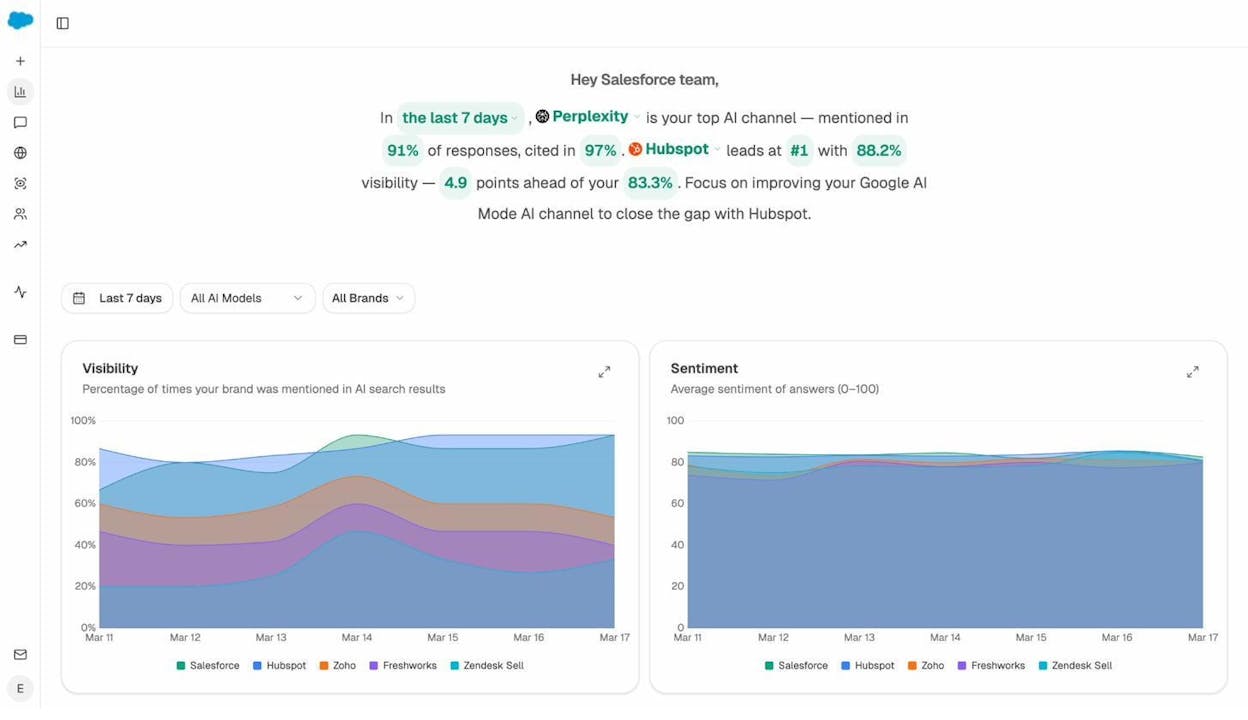
For most teams, the first surprise is how unevenly visibility is distributed. A brand might be cited 70% of the time on Perplexity and 12% on Gemini for the same prompt. Without engine-level data, you would guess that one strategy works for AI search. With it, you can see that each engine has its own preferred sources, and your work is to win the ones that drive traffic.
The second surprise is how many decoupled queries on Google are also live prompts inside AI engines. The questions that are now sending impressions but not clicks in GSC are often the same questions buyers are typing into ChatGPT. Tracking both sides at once is how you stop guessing.
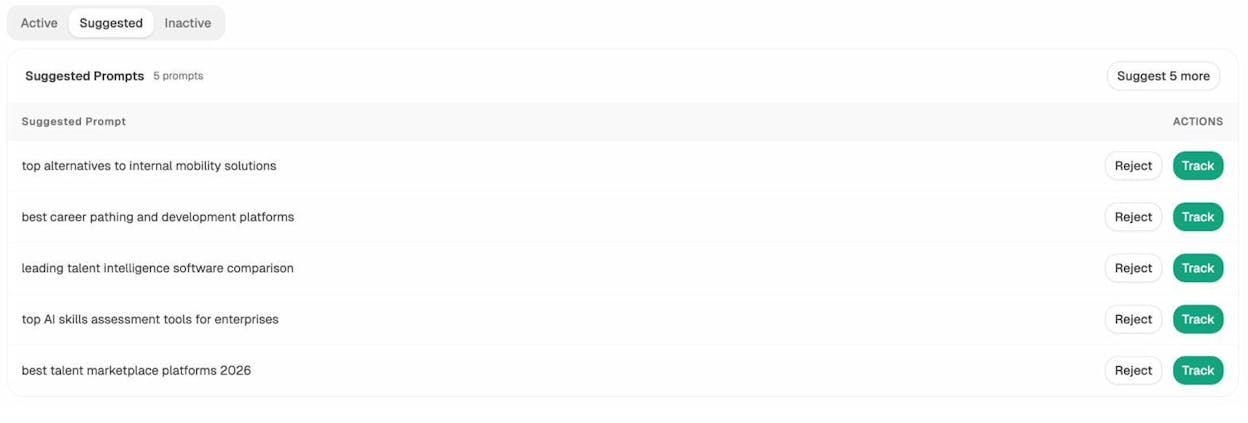
If you do not yet know which prompts are worth tracking, the Prompt Discovery feature surfaces the questions buyers in your space are asking AI engines, including the ones you have not thought of. Suggested prompts appear right inside the prompt-tracking interface and can be tracked with one click.
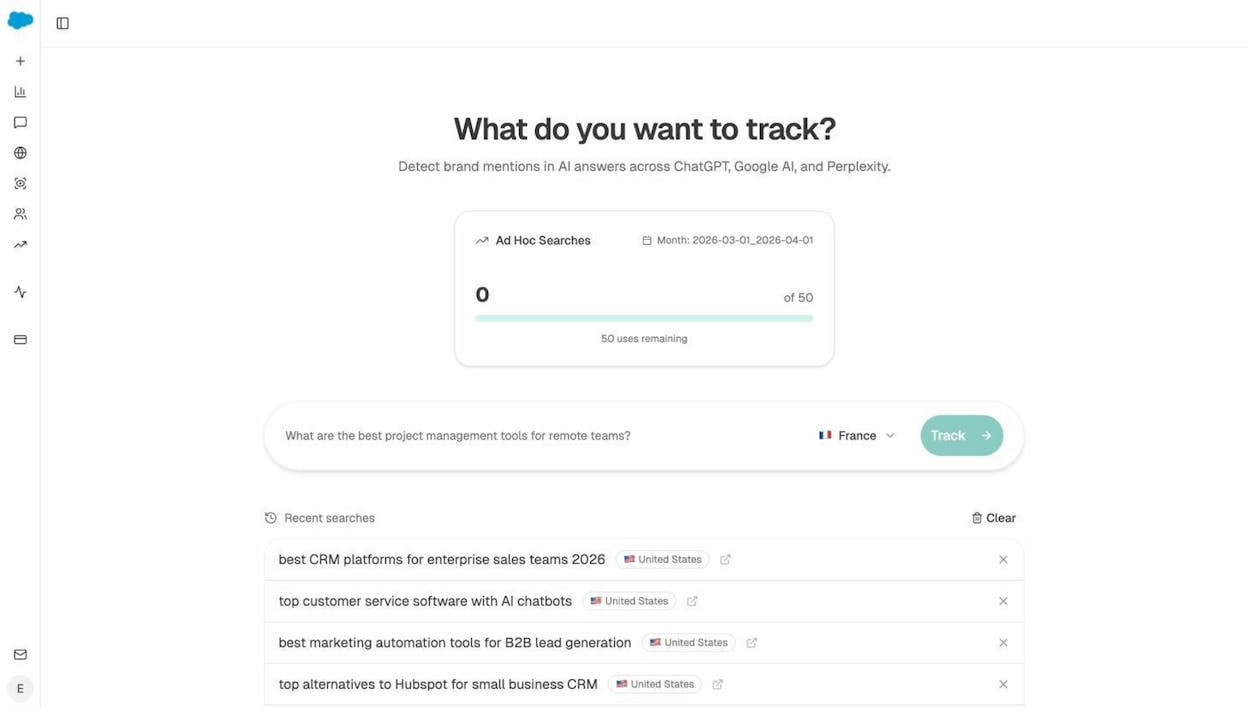
For a one-off check, the AI Search Explorer runs a single prompt across all major engines and shows you who appears, who is cited, and how your brand is positioned, in under a minute.
The point of doing this work is to answer one question. For the queries where my Google impressions are climbing without clicks, am I also visible in AI engines, or am I losing both sides at once?
How to capture the AI search traffic the decoupling created
Once you can see your AI visibility, the next job is converting that visibility into measurable traffic. Two features inside Analyze AI handle this directly.
The first is AI Traffic Analytics. Connect your GA4 and the platform isolates the sessions that arrived from AI engines, breaks them out by source, and shows you which pages they landed on. Recent data from Patrick Stox at Ahrefs showed that for the Ahrefs site, visitors from AI search converted 23 times better than visitors from traditional search. That number will vary by site, but the underlying pattern is consistent across the dashboards we see. AI search visitors arrive later in the buying cycle. They have already done research with the assistant. They are closer to a decision.
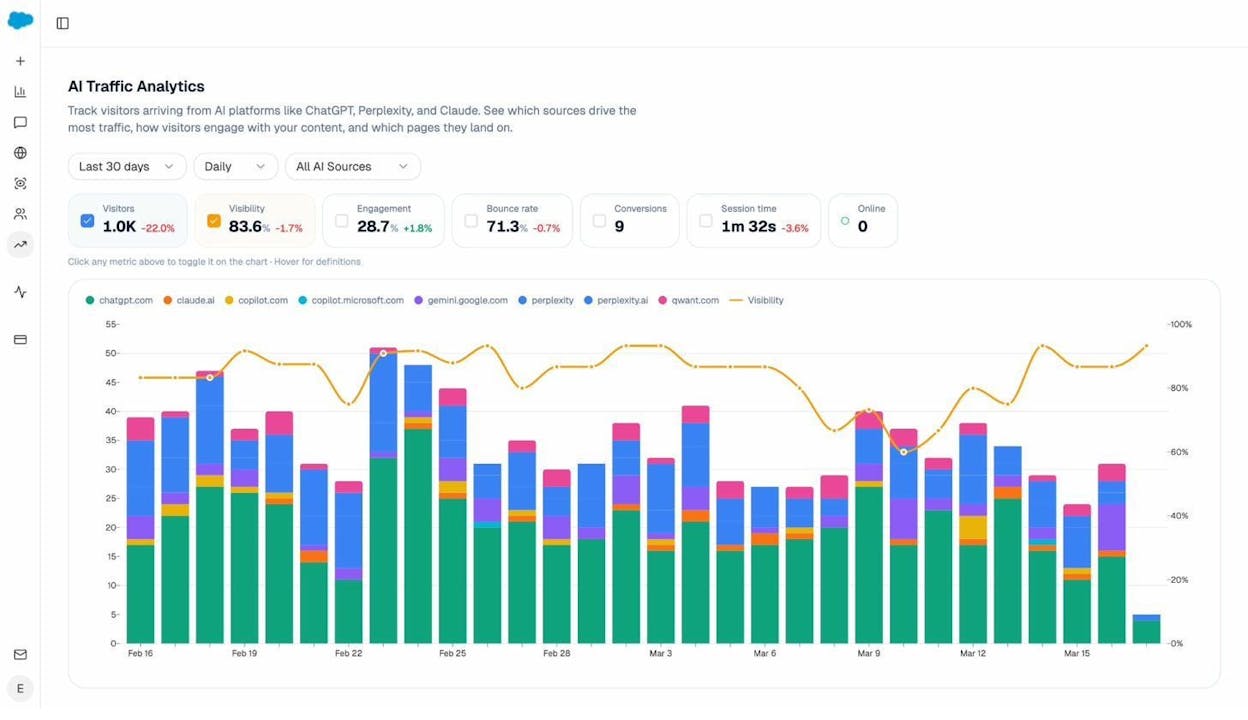
The chart above shows what the data looks like for one customer. Each colored bar segment is a different AI engine. The orange line is overall AI visibility. Plotting both at once shows whether visibility growth is converting into actual traffic, or whether the gap is widening for you, too.
The second is the landing-pages view. Once you know which pages are receiving AI traffic, the strategy becomes obvious. You double down on the page formats and topics that consistently win citations and visits, and you stop investing in formats AI engines do not pick up.
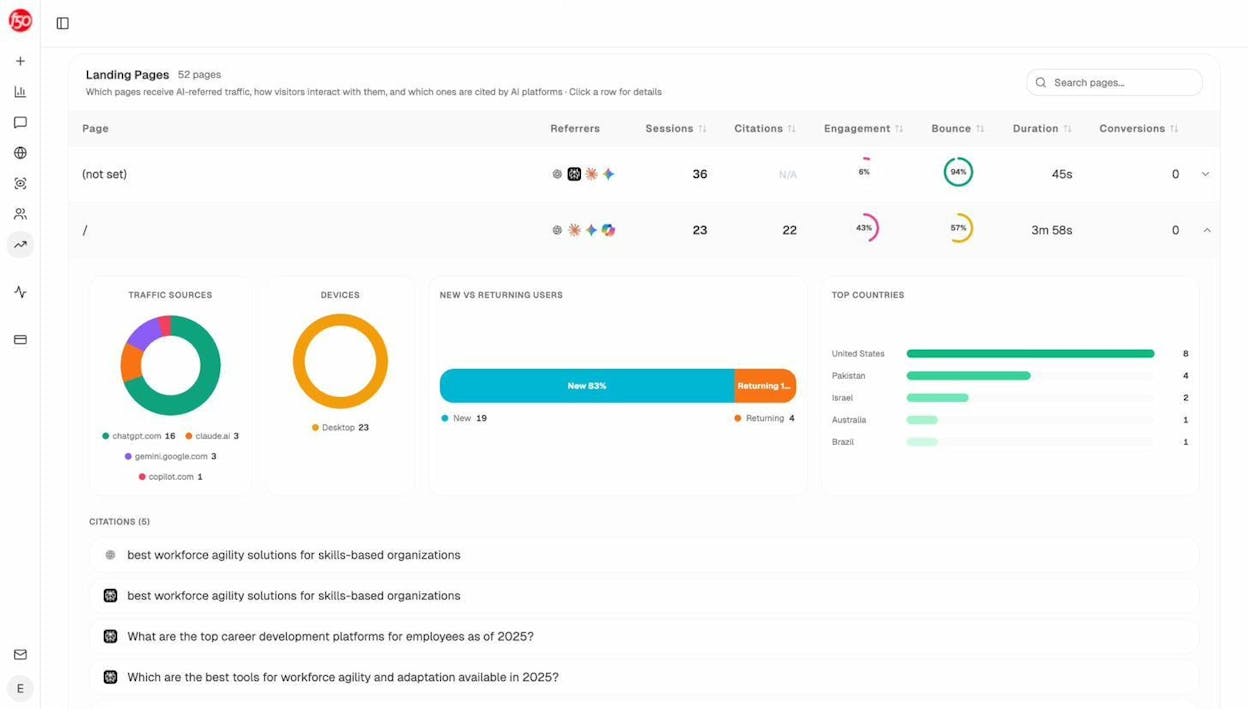
The patterns repeat. Comparison pages, alternatives pages, and well-structured listicles tend to earn the most citations. Generic top-of-funnel content often earns visibility but not traffic. Knowing which is which lets you reallocate your editorial calendar inside a single quarter.
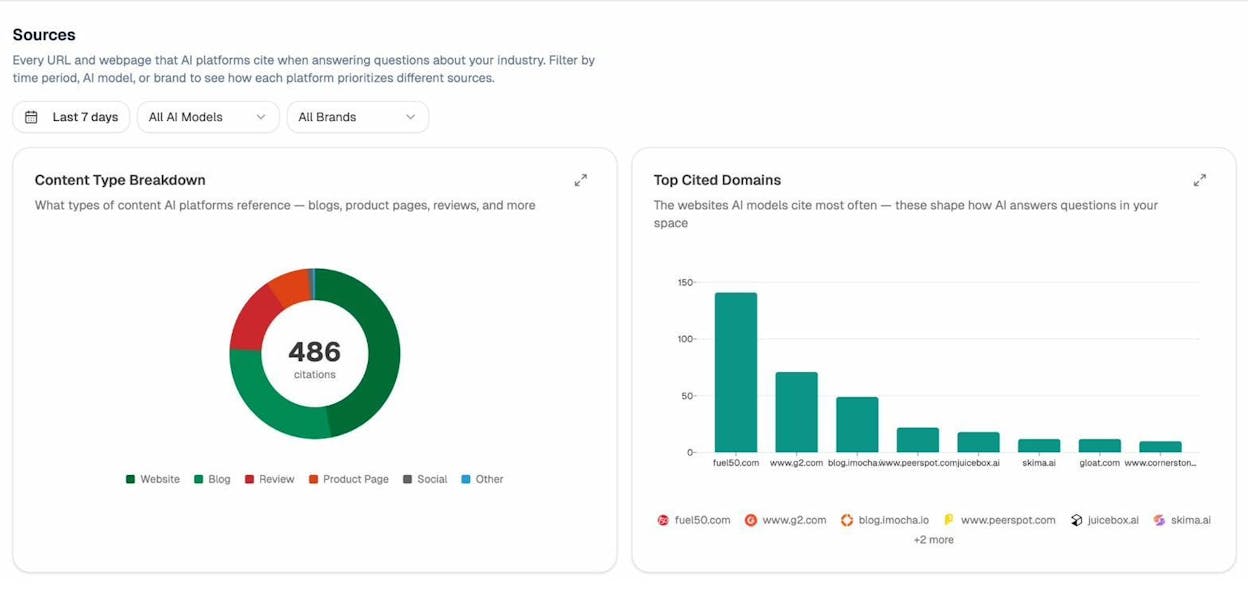
To complete the loop, Citation Analytics shows you which third-party domains AI engines cite when answering questions in your category. If review sites or Reddit threads are consistently cited above your blog, that is where your earned-coverage budget should go.
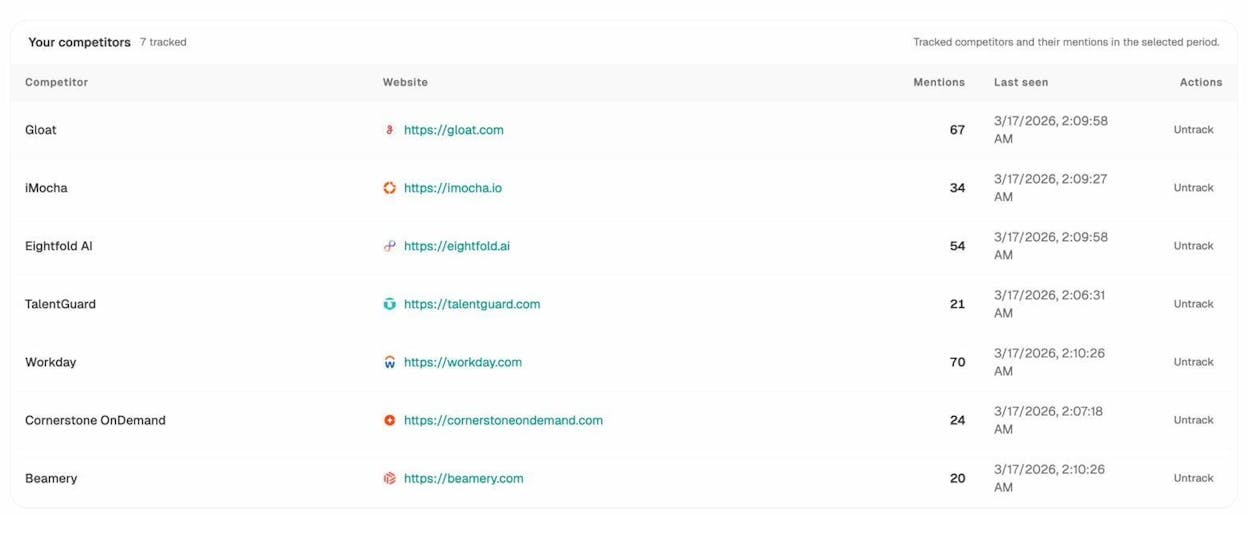
Competitor Intelligence shows you which competitors are winning the prompts you are losing, broken down by engine. The output is a ranked list of opportunities. The list shows prompts where a competitor is cited and you are not, sorted by how often the prompt is asked.
A simple way to organize the work is the table below. It maps each diagnostic question to the data source that answers it.
|
Question |
Where to find the answer |
|---|---|
|
Are my Google impressions climbing while clicks fall? |
Google Search Console Performance report, 16-month view |
|
Which queries are driving the gap? |
GSC Queries report, sorted by impressions |
|
Which of those queries trigger AI Overviews? |
|
|
How visible am I in AI engines for those queries? |
Analyze AI AI Visibility Tracking |
|
How much traffic am I actually getting from AI engines? |
Analyze AI AI Traffic Analytics |
|
Which pages are converting AI traffic best? |
Landing-pages view in AI Traffic Analytics |
|
Which sources are AI engines citing instead of me? |
Analyze AI Citation Analytics |
|
Which competitors are winning my prompts? |
Analyze AI Competitor Intelligence |
If the table feels like a lot of moving parts, that is the actual job. The decoupling is not one problem with one fix. It is a structural change in how organic visibility is distributed across two channels, and the only path through it is to measure both.
What the great decoupling means for your content strategy
The first instinct most teams have is to write more content to recover the lost clicks. That is the wrong move. The clicks did not disappear because your content was not good enough. They disappeared because the SERP changed shape. Writing more content for the same SERP will not reopen the crocodile.
The right move is closer to a portfolio rebalance.
Some content was earning impressions and clicks together because the query had no AI Overview yet. Keep that content updated and continue to invest in it as a traditional SEO play. Some content is now earning impressions but no clicks because the query is mostly answered by an AI Overview. The job for that content is to become the citation, which means writing in a way that AI engines can extract from. Strong factual claims, clear structure, original data, and explicit comparisons all help. The AI Content Optimizer inside Analyze AI scores existing pages on these dimensions and shows you exactly what to add. Some content is winning AI search traffic that will never appear in GSC at all. The job for that content is to convert. Treat it like a landing page, not a top-of-funnel post.
For new content, the AI Content Writer walks the same logic in reverse. It starts from the prompts you want to win, builds research and an outline around the gaps your competitors leave, and produces a draft you edit rather than rewrite. If you need a deeper read on how to think about content for both channels at once, the 4 Pillars of an Effective SEO Strategy for AI Search and the 2026 SEO Content Strategy lay out the full framework.
This is also where the framing matters. SEO is not dead and AI search is not replacing it. The Analyze AI manifesto says it directly. People are searching differently, but the reason they choose you has not changed. Quality content still wins. The teams who treat AI search as another organic channel to instrument and improve, rather than a threat to react to, are the ones who will compound visibility while everyone else writes panicked LinkedIn posts about the death of SEO.
The crocodile chart is real. The work to respond to it is also real. The opportunity, for the teams who do the work first, is real too.

Ernest

Ibrahim


