



Summarize this blog post with:


In this article, you’ll learn how to republish blog content the right way, so it earns back lost rankings on Google and starts showing up in answers from ChatGPT, Perplexity, Gemini, and Google AI Mode. You’ll get an 8-step playbook, a way to decide which posts to update first, the on-page checks that matter for both search and AI, and the exact tactics we use at Analyze AI to track whether a refresh actually worked.
Table of Contents
Why republishing content still works in 2026
Even with strong keyword research and a strong first draft, very few posts win on the first try. A piece of ours that originally pulled around 350 visits a month tripled in traffic after we rewrote it nine months later. That happened because Google has a ranking system called query deserves freshness (QDF) that re-promotes pages it sees as recently maintained, especially for timely or “best of” topics.
The freshness bias is even stronger inside AI assistants. A Waseda University study added artificial publication dates to web pages and watched results jump by as much as 95 positions in 7 different AI models, with around 1 in 4 ranking decisions reversing on the basis of the timestamp alone. ChatGPT engineers have also been spotted referencing an internal URL_freshness_score. Recent content gets pulled into answers more often, full stop.
But here is the part most refresh guides miss. A republish does three different jobs at once:
-
It reclaims search traffic. Google re-crawls, re-evaluates, and frequently re-ranks the page.
-
It earns AI citations. AI assistants pull from the freshest, clearest source they can find on a topic, and republishing increases the odds you’re that source.
-
It corrects how AI describes your brand. Outdated pricing, old feature names, or wrong USPs in your old posts get fed straight into AI answers. Updating the source corrects the narrative.
That third reason is underrated. As we wrote in the Analyze AI manifesto, AI search is not replacing SEO. It’s a new organic channel that compounds with it. Quality content still wins. The difference now is that your content has to work for AI models too, not just Google.
The two ways to republish content
At Analyze AI we split refreshes into two buckets, and the right choice depends on the goal.
|
Type |
What it is |
Time investment |
When to use |
|---|---|---|---|
|
Quick update |
A targeted refresh of headlines, examples, screenshots, data, and weak sections |
1–3 hours per post |
When the page is mostly correct but losing traffic or citations |
|
Full rewrite |
A near-complete rebuild of the angle, structure, and argument |
1–2 days per post |
When the topic now ties to a new product, the angle is outdated, or the page has stopped ranking entirely |
The rest of this guide focuses on quick updates. They give you the best return on time, they compound, and they’re what most teams should be doing every week. Save full rewrites for posts where the business goal has shifted (a new product launch, a repositioning, or a topic where your old take is now wrong).
How to update your content in 8 steps
1. Find pages worth reviving
Start with high-traffic pages that are slipping, not pages that never worked. A small percentage gain on a busy page beats a big gain on a dead one.
In Ahrefs, open the Top Pages report in Site Explorer and apply these filters:
-
Drop in your domain or a subfolder like /blog/
-
Set Traffic to Declined with a minimum number close to your top 10 percent of pages
-
Set Keyword Difficulty (KD) to Up to 40 so you only see fixable competition
-
Pick a date range of 6 to 12 months
-
Sort by negative traffic change
![[Screenshot: Ahrefs Site Explorer Top Pages report with Traffic filter set to “Declined,” KD filter set to “Up to 40,” and the Change column highlighted to show pages with negative traffic deltas]](https://www.datocms-assets.com/164164/1777675277-blobid1.png?auto=format,compress&w=1248&fit=max)
Before you queue anything, check the Content Changes column. Anything labeled “Major” or “Overhaul” has been recently rewritten by someone on your team and shouldn’t be touched again yet. Focus on pages with “Minor” or “Moderate” changes.
You can do a similar workflow for free with the Analyze AI Keyword Rank Checker plus Google Search Console, but the AI-side of this question needs its own tool.
In Analyze AI, open the Content Optimizer. It surfaces your top pages with declining organic traffic over the past 60 days, ranks them by drop severity, and gives each one a status (Declining or High Drop) so you know where to start.
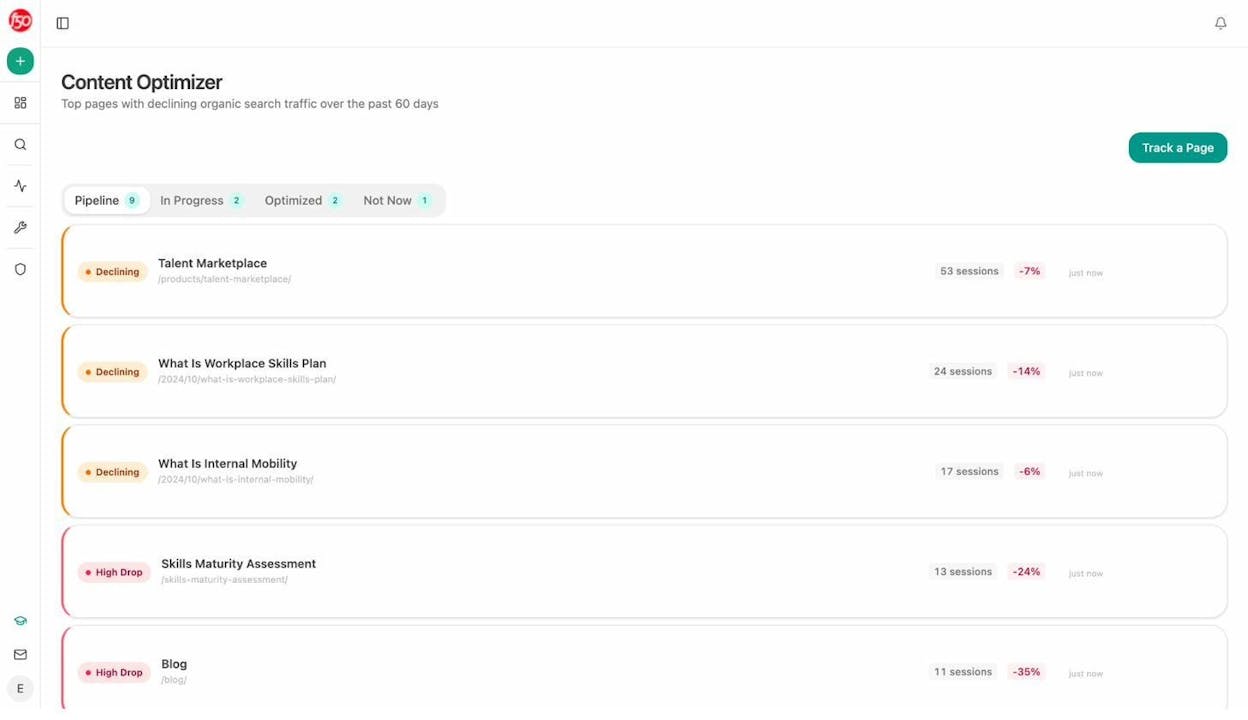
You can also manually track any page that matters to you, even one not on your domain, by adding its URL to the optimization pipeline.
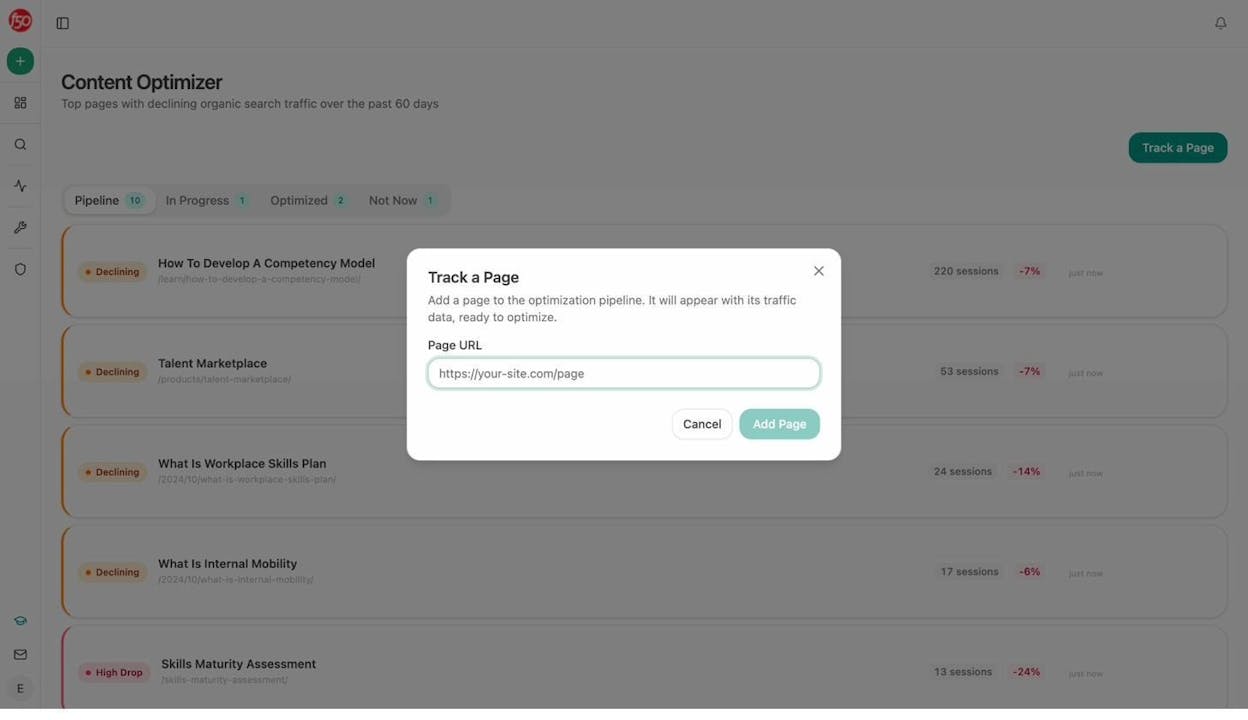
This is the AI search equivalent of Ahrefs’ Top Pages report, with the difference that the pipeline tracks AI-driven sessions and citation drops, not just blue-link traffic.
2. Steal update ideas from search competitors
You don’t need to invent the angle for your refresh. Find a competitor who already updated theirs, look at what they changed, and decide what’s worth borrowing.
In Ahrefs Content Explorer, run a search like site:hubspot.com inurl:blog and apply the Republished pages: This year filter. Each result shows a traffic trendline. Spikes after the republish date are the wins. Click in to see a side-by-side diff of the article before and after.
![[Screenshot: Ahrefs Content Explorer search results for site:competitor.com filtered by Republished pages: This year, with a clear traffic spike on one of the results]](https://www.datocms-assets.com/164164/1777675288-blobid4.png?auto=format,compress&w=1248&fit=max)
A few things to watch for:
-
A spike right after the republish date is a green light, an algorithm-update spike on the same week is not
-
An Overhaul badge means the entire piece was rewritten, a Moderate badge means you can borrow surgically
-
Pages that picked up new SERP features (FAQ, video, AI Overview) often did so because of a structural change you can copy
Run this analysis across 3 or 4 competitors. You’ll quickly see which topics in your space are getting the biggest lift from being refreshed, and you’ll know which of your own posts on those topics deserves attention first.
3. Steal update ideas from competitors in AI
The same logic applies to AI search, but the signal is different. Instead of traffic curves, you’re tracking citations.
Inside Analyze AI Citation Analytics, the Sources view lists every URL that AI models have cited in your industry over a chosen window, along with which brands those URLs mentioned and how often each one is reused.
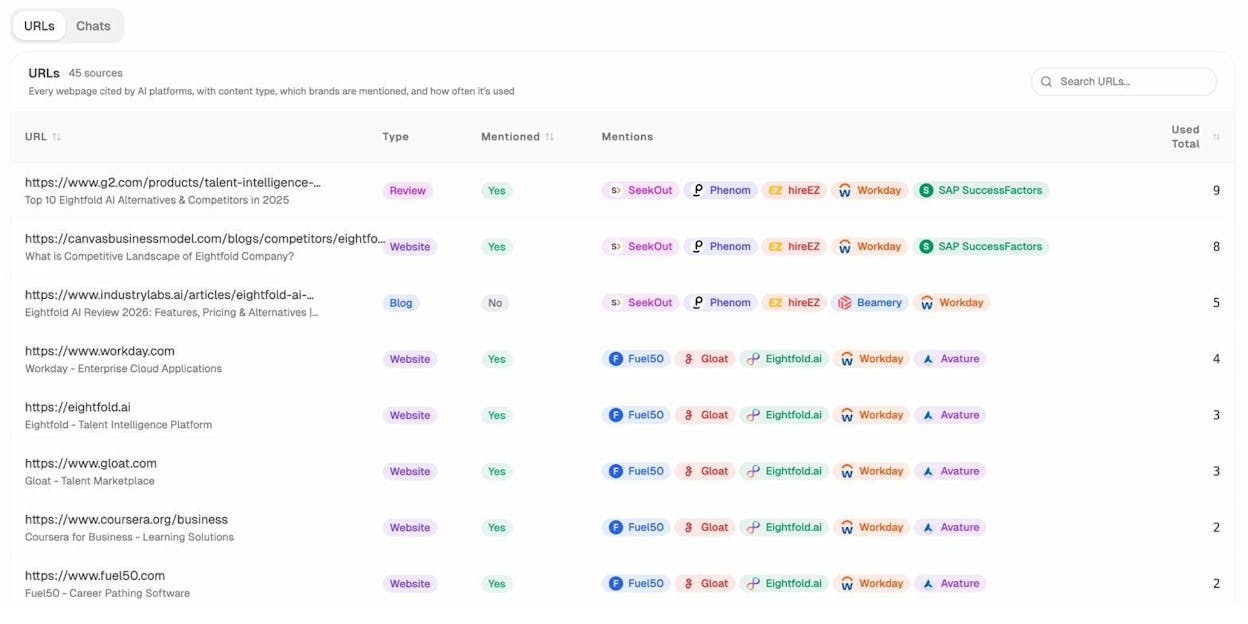
Sort by Used Total. Any URL near the top that belongs to a competitor is a page you should study. Open it, compare it to your equivalent post, and write down what they cover that you don’t.
The Competitor Intelligence view goes further. It tracks which of your tracked rivals are gaining ground in AI answers and which specific pages of theirs are doing the work.
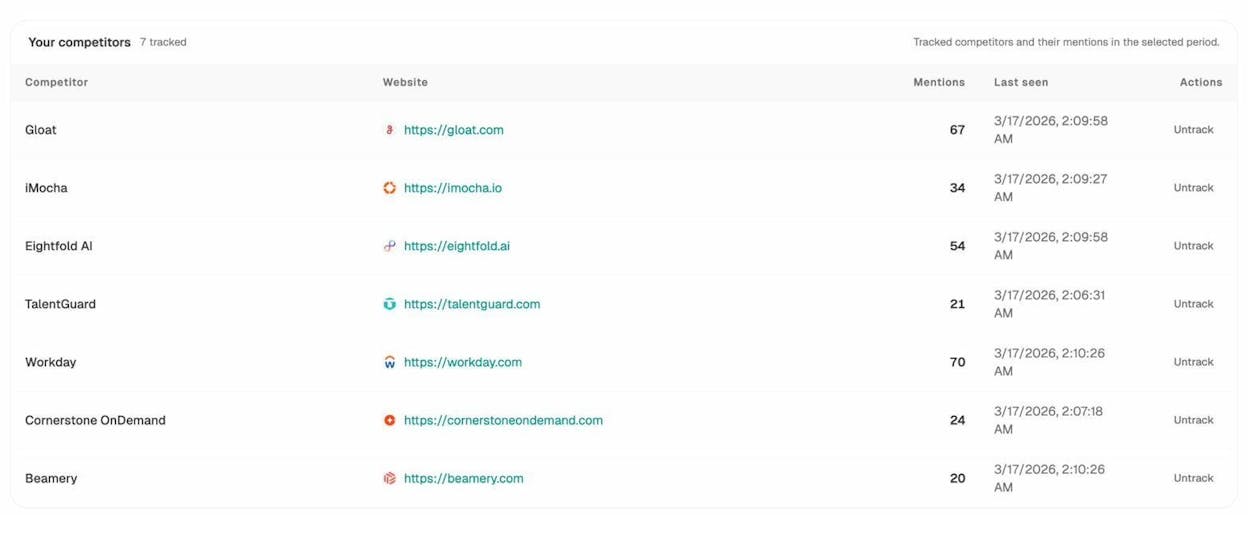
When a competitor’s mentions jump week over week, the dashboard tells you which of their pages picked up new citations and which AI engine started citing them. That’s your shortlist of update ideas, ranked by what AI assistants are already rewarding.
4. Validate whether the content is worth updating
Before you spend an afternoon rewriting, run four quick checks. Skip even one and you risk pouring effort into a page that will never recover.
Does the topic still tie to your business? Top-of-funnel posts you wrote three years ago might now be irrelevant to what you sell. If the keyword has zero path to a conversion, archive the page or merge it into a stronger one rather than refreshing it.
Is it a content problem or a backlink problem? Open the SERP for the target keyword. If the pages outranking you all have higher domain authority, you have a links problem and a refresh won’t fix it. Use a tool like the Analyze AI Website Authority Checker to compare you against the top 10. If their authority is similar to yours, content is the lever.
Did an AI Overview eat the SERP? Several studies put the AI Overview impact on click-through rate at 15 to 35 percent. Run the keyword through the Analyze AI SERP Checker. If an AI Overview now sits above the organic results, your traffic loss may not come back even with a perfect refresh. Update only if the keyword has high commercial intent or is one your brand has to be cited on.
Are people still engaging on the page? Time on page, scroll depth, and conversion rate tell you whether the content still works for the readers who do find it. Inside AI Traffic Analytics, the Landing Pages report gives you per-page sessions, citation count, engagement, bounce, duration, and conversions for visitors arriving from AI sources.
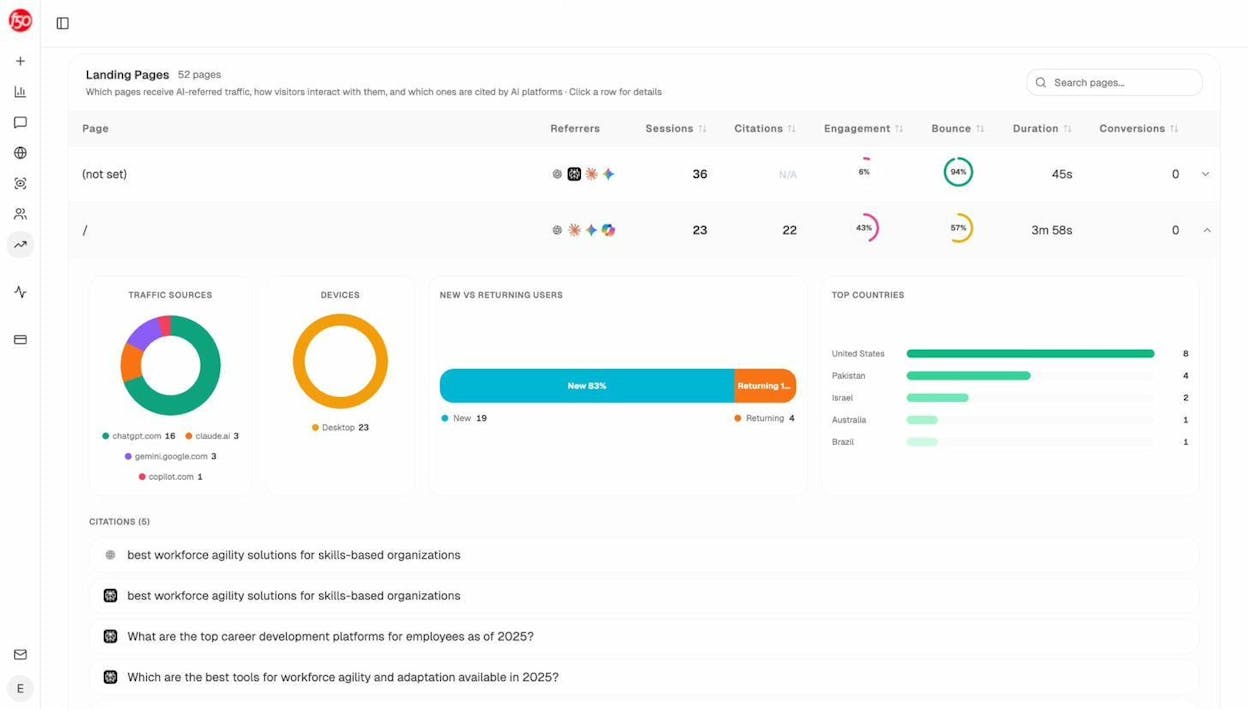
A page with low traffic but 3-minute sessions and active citations is one of the strongest update candidates you can find. The audience is still there. You just need to give the algorithms a reason to send more.
5. Fill the topic gaps (for both search and AI)
Once you know the page is worth updating, the fastest improvement comes from comparing it to the best-performing pages on the same keyword and filling in what they cover that you don’t.
In Ahrefs, the AI Content Helper grades your draft against top-ranking pages and surfaces missing topics. ![[Screenshot: Ahrefs AI Content Helper interface scoring a draft against top-ranking pages, with a Topics panel listing missing entities and a content score in the corner]](https://www.datocms-assets.com/164164/1777675300-blobid8.png?auto=format,compress&w=1248&fit=max)
For an AI-search-aware version of this exercise, the Analyze AI Content Optimizer fetches your existing page, scores it on Argument & Flow plus Clarity & Polish, and leaves editorial comments inline against specific paragraphs.
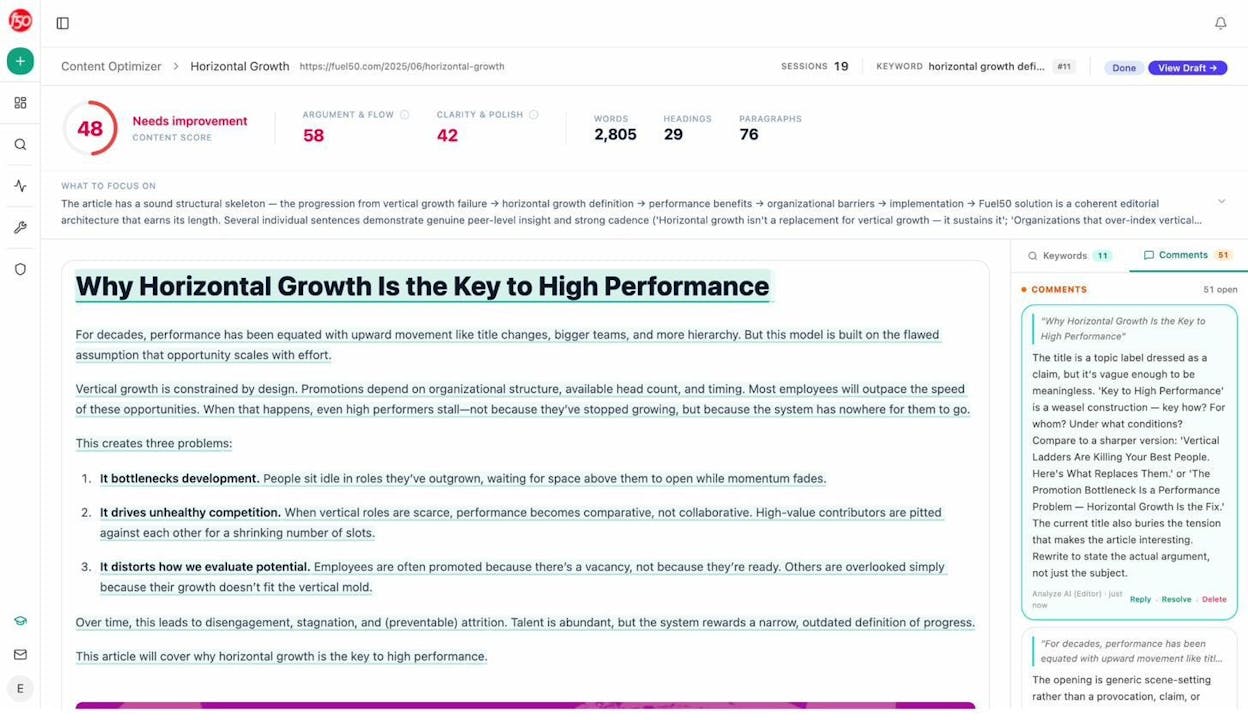
The comments tell you exactly what to rewrite: a topic label dressed as a claim, a generic opening, a weak transition, an unsupported stat. That cuts the “what should I change” step down to minutes.
To find the AI-side gaps your competitors are filling and you aren’t, switch to Prompt Discovery. It surfaces the prompts your audience is actually typing into ChatGPT, Perplexity, and Gemini around your category. Track the ones where competitors are mentioned and you aren’t, and rewrite the relevant page to answer that exact question.
If you want to test a specific prompt right now, the AI Search Explorer lets you run ad-hoc queries across AI models and see who gets cited.
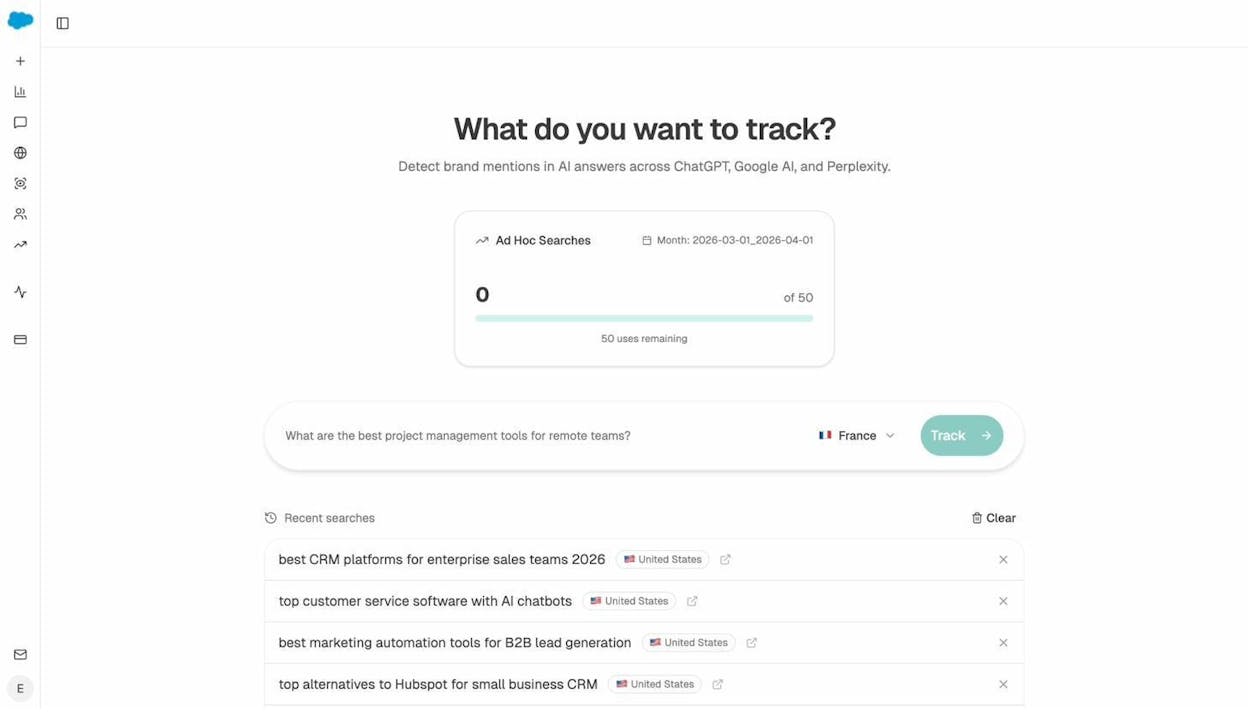
For each prompt where a competitor is named in the answer and you aren’t, ask one question: which of your existing pages should answer this? That page is your next refresh candidate, and the answer the AI gave you is your outline.
6. Apply on-page best practices that work for both Google and AI
Once you’ve filled the gaps, run the page through a short on-page checklist. These changes take minutes each and they affect both blue-link rankings and AI parsing.
-
Title tag and meta description. Rewrite both to match the angle of the updated piece. Even when Google rewrites the title, AI engines often pull the original tag verbatim into citations.
-
Headers. Make sure every H2 is a clear, complete claim, not a label. AI assistants chunk content by header. A vague H2 like “Going Further” gives them nothing to extract.
-
Alt text and schema. Add descriptive alt text to every image, and add (or fix) FAQ, HowTo, or Article schema. Both help AI engines understand the structure.
-
Internal links. Add fresh internal links from your other recent posts pointing back to the updated page. This is the single biggest signal that a refresh is real, not cosmetic.
-
External links. Add 2 to 3 citations to authoritative sources. AI models reward pages that participate in the wider web rather than linking only inwards.
-
Broken links. Run the page through the Broken Link Checker. Dead links destroy trust and stop AI crawlers from completing their pass.
The header point is the one most teams skip. Compare these two H2s on the same topic:
-
Weak: Why Horizontal Growth Is the Key to High Performance
-
Strong: Vertical promotion ladders are killing your best people. Horizontal growth is the fix.
The second header gives an AI engine a complete claim it can lift directly into an answer. The first one is a label.
7. Add real information gain
Filling topic gaps and tightening on-page elements gets you to parity. Information gain is what gets you cited.
Information gain is anything in your post that isn’t in the other 14 pages on page one. A new data point, a surprising counter-claim, a real customer story, a screenshot from your own product, or a piece of internal research. AI assistants are explicitly biased toward sources that introduce new information, because that’s how they avoid synthesizing the same five sentences from five identical pages.
Where to find ideas:
-
Communities your audience hangs out in. Subreddit threads, Slack groups, niche newsletters. Read what people complain about that nobody is writing about.
-
Your own data. Anonymized customer outcomes, product analytics, support ticket trends. This is original by definition.
-
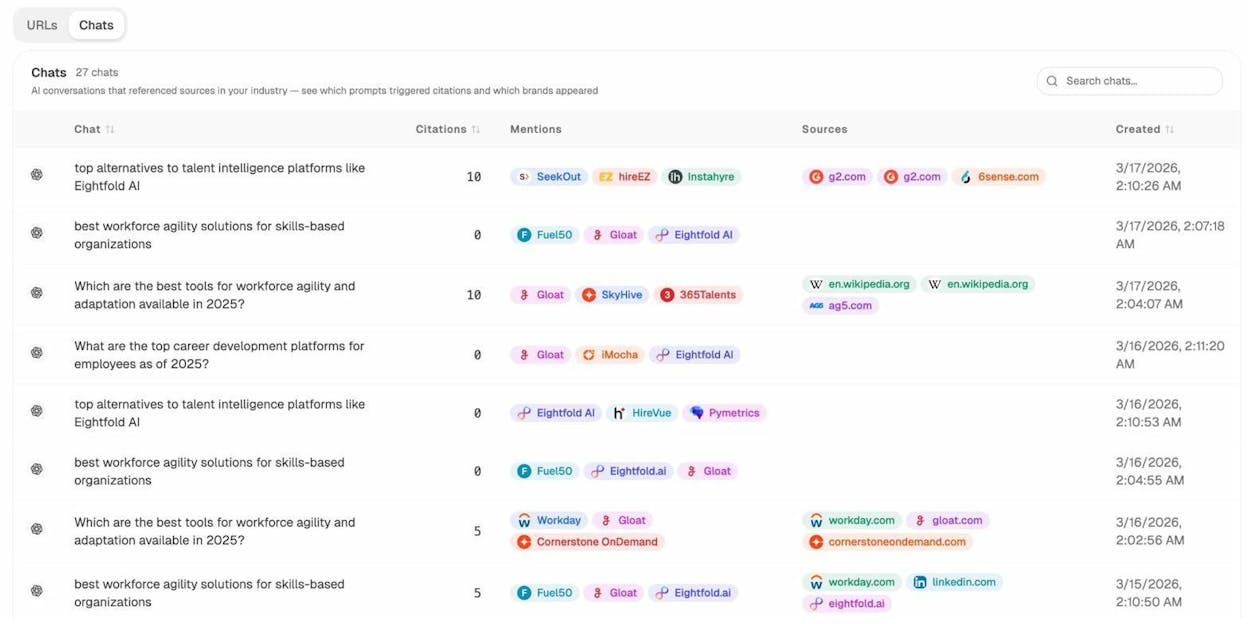
AI conversations themselves. Inside Analyze AI’s Sources view, the Chats tab shows the actual prompts that triggered citations in your industry, including which competitors were mentioned and which sources the AI used. Read the prompts. They’re often more specific than any keyword tool would suggest.
-
Customer interviews. Quote two or three customers in the refresh. AI engines reward content with named entities.
-
Original framing. Take a known idea and reframe it. Animalz calls this the thesis-antithesis-synthesis approach: present the status quo, articulate what’s wrong with it, then offer your better solution.
A useful self-check before you publish: pick the most interesting sentence in your refreshed post. If a competitor could have written it word for word, it’s not information gain.
8. Re-distribute, measure, and iterate
Republishing without redistribution is a wasted refresh. Once the new version is live, treat it like a brand-new piece.
-
Send it to your newsletter list with a “We just rebuilt this” framing
-
Post it on LinkedIn with a quote from the new section
-
Drop it in 2 to 3 relevant communities where the original took off
-
Update the canonical link from any old internal pages
-
Pitch the new data point or angle to one journalist who covers your space
Then measure both channels.
For search, watch the page in Google Search Console for impressions, average position, and CTR over the next 4 to 6 weeks. A real refresh moves the needle in that window. If nothing changes by week 6, the issue isn’t content (revisit the link authority and AI Overview checks from step 4).
For AI, watch AI Visibility Tracking for the prompts the page is meant to answer, and watch the page itself inside AI Traffic Analytics for citation count and AI-source sessions.
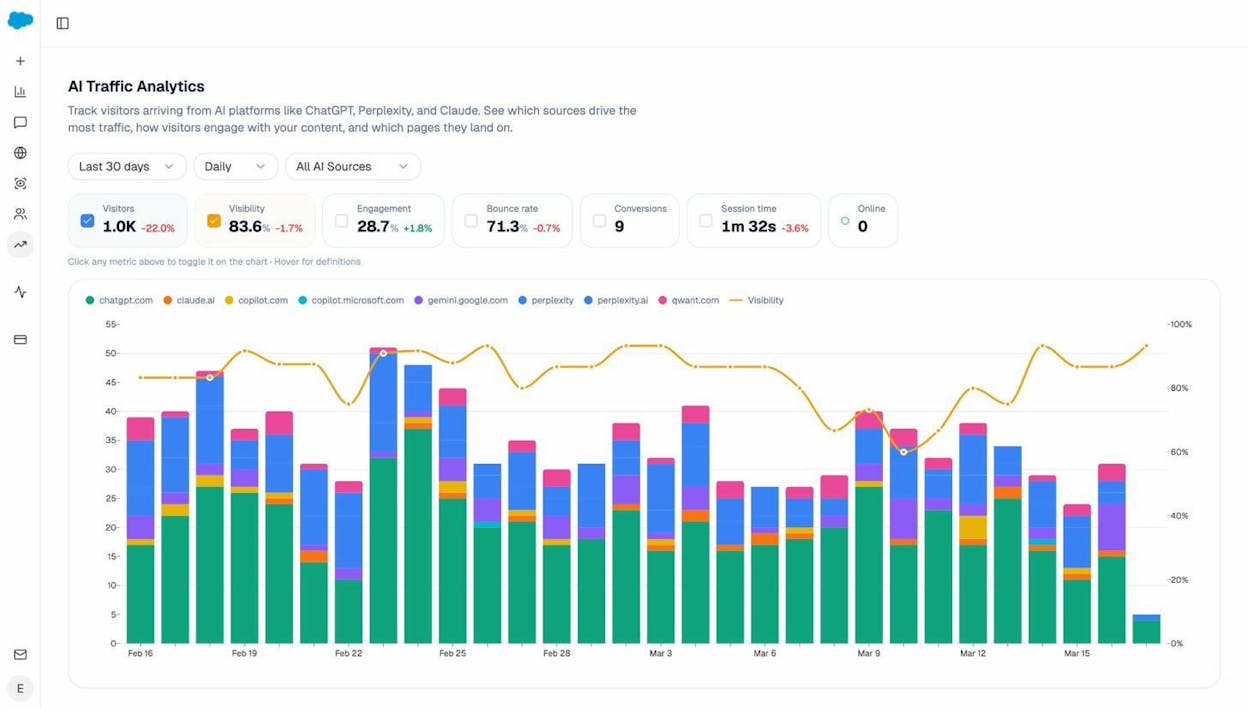
Citations from AI engines often move before traffic does. A page that picks up 3 to 5 new citations in the first two weeks after a refresh is on the right track even if blue-link traffic hasn’t budged yet.
Once an update is in market for 60 days, run the same Content Optimizer score on it again. The gaps will have shifted. Set a quarterly cadence for the top 20 pages on your site, and a yearly cadence for everything else. The small wins compound.
Final thoughts
Republishing content isn’t about timestamps. It’s about telling Google, AI engines, and your readers that you still stand behind the page and you’ve made it more useful since the last time anyone looked.
The brands winning AI citations right now aren’t the ones with the most content. They’re the ones with the freshest, clearest, most specific takes on the questions their buyers actually ask. A weekly 2-hour refresh on your top 20 pages will outperform 10 new posts a month for almost any team in 2026.
Pick the highest-traffic page on your site that has slipped in the last 90 days. Run it through the 8 steps above. You’ll see the difference in your Google Search Console data within 6 weeks and in your AI citations within 2.

Ernest

Ibrahim


