



Summarize this blog post with:


In this article, you’ll learn the five steps of a modern SEO process, how each step works in practice, and how to extend every step to cover AI search so your brand shows up in both Google and AI answer engines like ChatGPT, Perplexity, and Gemini.
Here are the five steps:
-
Get your technical foundation right — make sure search engines (and AI crawlers) can find, crawl, and index your site.
-
Find keywords worth targeting — pick topics with real search demand, clear intent, and business value.
-
Create content that deserves to rank — match search intent, go deeper than the competition, and make your page genuinely useful.
-
Build links to your pages — earn and build the backlinks and internal links that signal authority.
-
Monitor, measure, and iterate — track rankings, traffic, and AI visibility so you can improve what’s working and fix what isn’t.
Table of Contents
1. Get your technical foundation right
Technical SEO is the foundation everything else sits on. If search engines can’t find and index your pages, no amount of keyword research or link building will help.
To rank your content, Google needs to do two things. First, it needs to crawl your pages, which means its bot (Googlebot) has to be able to access and read your content. Second, it needs to index those pages, which means adding them to the master list of pages it can serve in search results.
In most cases, your pages will be crawled and indexed automatically. But there are common situations where things go wrong.
What breaks crawlability and indexability
Robots.txt blocking Googlebot. Your robots.txt file tells crawlers which parts of your site they can and can’t access. A misconfigured robots.txt can block Googlebot from crawling entire sections of your site. Check yours at yoursite.com/robots.txt and make sure you aren’t accidentally disallowing important pages.
![[Screenshot of a robots.txt file showing allow/disallow directives]](https://www.datocms-assets.com/164164/1777549980-blobid1.png?auto=format,compress&w=1248&fit=max)
Noindex tags on pages you want indexed. A noindex meta tag tells Google not to include a page in its index. This is useful for pages like internal search results or staging environments, but it becomes a problem when it’s added to pages you actually want to rank.
Canonical tag issues. If Google sees multiple versions of the same page (for example, with and without trailing slashes, or HTTP and HTTPS versions), it picks one as the “canonical” version and ignores the rest. If the wrong version gets chosen, the page you want to rank may not appear in search results.
Slow page speed. Google has confirmed that page speed is a ranking factor. Pages that load slowly are harder to crawl and provide a worse user experience. Use Google PageSpeed Insights to identify speed issues.
Broken internal links. If your pages link to URLs that return 404 errors, you’re wasting crawl budget and creating dead ends for both users and search bots. Run a crawl with a tool like Analyze AI’s Broken Link Checker to find and fix these.
How to audit your technical SEO
The easiest way to find technical issues is to use an SEO auditing tool. Two free options are Google Search Console and Bing Webmaster Tools.
Google Search Console will show you which pages are indexed, which have errors, and which are excluded from the index. The “Pages” report under the “Indexing” section is the best place to start.
![[Screenshot of Google Search Console’s Pages indexing report showing indexed and excluded pages]](https://www.datocms-assets.com/164164/1777549986-blobid2.png?auto=format,compress&w=1248&fit=max)
For a more detailed crawl-level audit, use a tool like Screaming Frog or Sitebulb. These tools crawl your site the way Googlebot does and flag issues like broken links, redirect chains, missing meta tags, duplicate content, and orphaned pages.
Here’s a practical checklist to run through:
|
Technical factor |
What to check |
Tool to use |
|---|---|---|
|
Crawlability |
Is Googlebot blocked by robots.txt? |
Google Search Console |
|
Indexability |
Are important pages indexed? Any noindex tags? |
Google Search Console |
|
Canonical tags |
Are the right pages set as canonical? |
Screaming Frog |
|
Page speed |
Core Web Vitals passing? |
PageSpeed Insights |
|
Mobile usability |
Is the site mobile-friendly? |
Google Search Console |
|
Broken links |
Any 404 errors on internal links? |
|
|
XML sitemap |
Is it submitted and error-free? |
Google Search Console |
|
HTTPS |
Is the site secured with SSL? |
Browser check |
Technical SEO for AI search
Most AI answer engines (ChatGPT, Perplexity, Gemini, Copilot) rely on their own crawlers to discover and process web content. These crawlers behave similarly to Googlebot, but they have different user agents and different priorities.
There are a few things you can do to make sure AI crawlers can access your site.
Check your robots.txt for AI bot access. Some sites have started blocking AI crawlers (like GPTBot or ClaudeBot) in their robots.txt. If you want AI engines to find and cite your content, make sure you’re not blocking them. You can see which bots are accessing your site in your server logs.
Create an llms.txt file. This is a relatively new standard that helps AI models understand the structure and purpose of your site. It acts as a guide for AI crawlers, similar to how a sitemap helps search engine bots. You can generate one using Analyze AI’s LLM.txt Generator.
Use structured data. Schema markup helps both Google and AI models understand the entities, relationships, and facts on your pages. The more clearly your content is structured, the easier it is for AI models to extract and cite it.
2. Find keywords worth targeting
You can’t get search traffic without creating content about things people actually search for. That sounds obvious, but it’s the step most businesses get wrong.
The mistake isn’t that they skip keyword research. It’s that they approach it backwards. They start with a keyword research tool, sort by search volume, and pick the highest-volume terms they think they can rank for. Then they write content for those terms and wonder why it doesn’t convert.
The more effective approach is to start with your customers’ problems and work backward to keywords. What questions do your customers ask before they buy? What comparisons do they make? What alternatives do they evaluate? Find the keywords that match those questions, and you’ll attract people who are already looking for a solution like yours.
How to find keyword ideas
Start with a seed keyword related to your business and plug it into a keyword research tool. You can use Analyze AI’s free Keyword Generator to get started.
![[Screenshot of Analyze AI’s Keyword Generator tool showing keyword suggestions for a seed term]](https://www.datocms-assets.com/164164/1777549986-blobid3.png?auto=format,compress&w=1248&fit=max)
From a single seed keyword, you’ll get hundreds or thousands of ideas. The challenge is narrowing them down to the ones worth targeting.
How to prioritize keywords
Not all keywords are created equal. Here are the four factors to evaluate:
Search traffic potential. This is different from raw search volume. A keyword with 500 monthly searches might send you 2,000 monthly visitors if the top-ranking page also ranks for dozens of related keywords. Look at how much traffic the current top-ranking pages actually get, not just the volume of the primary keyword. Use Analyze AI’s free SERP Checker to see what’s ranking and estimate traffic potential.
Business potential. How naturally can you mention your product or service in content about this keyword? A keyword like “SEO audit tools” has high business potential for an SEO software company because the content naturally leads to a product mention. A keyword like “what is HTML” has almost none.
Rate your keywords on a simple scale:
|
Score |
Business potential |
Example |
|---|---|---|
|
3 |
Your product is the solution |
“AI search monitoring tools” |
|
2 |
Your product helps, but isn’t the only solution |
“how to improve brand visibility” |
|
1 |
Tangentially related |
“what is digital marketing” |
|
0 |
No connection |
“how to learn Python” |
Prioritize keywords scoring 2 or 3. They’ll convert at much higher rates than top-of-funnel terms.
Ranking difficulty. Look at the pages that currently rank in the top 10. How many backlinks do they have? How strong are the domains? Are they big brands or smaller sites? Use Analyze AI’s Keyword Difficulty Checker to get a difficulty estimate, then manually review the top results to validate.
Search intent. What does the searcher actually want? There are four types of search intent:
-
Informational — they want to learn something (“what is technical SEO”)
-
Navigational — they want to find a specific site (“Ahrefs login”)
-
Commercial — they’re comparing options (“best SEO tools for small businesses”)
-
Transactional — they’re ready to buy (“Semrush pricing”)
Match your content format to the intent. If the top results for a keyword are all how-to guides, don’t try to rank a product page. If they’re all comparison lists, write a comparison list.
![[Screenshot of Google SERP for “best SEO tools” showing a mix of listicles and comparison articles]](https://www.datocms-assets.com/164164/1777549990-blobid4.png?auto=format,compress&w=1248&fit=max)
Keyword research for AI search
Here’s where the process expands. Traditional keyword research focuses on what people type into Google. But people are now asking the same questions, often in more conversational form, to ChatGPT, Perplexity, and Gemini.
The difference is that these AI engines don’t return a list of 10 blue links. They return a single answer, often with a handful of cited sources. That means visibility in AI search works differently. Instead of “ranking,” you’re trying to get “cited” or “mentioned.”
To find out which prompts matter in your space, use Analyze AI’s Prompt Discovery feature. It suggests prompts your audience is likely asking AI engines, based on your industry and competitors.
You can also run ad hoc searches to test specific prompts across multiple AI engines at once. Type a prompt, select a region, and see which brands AI recommends.
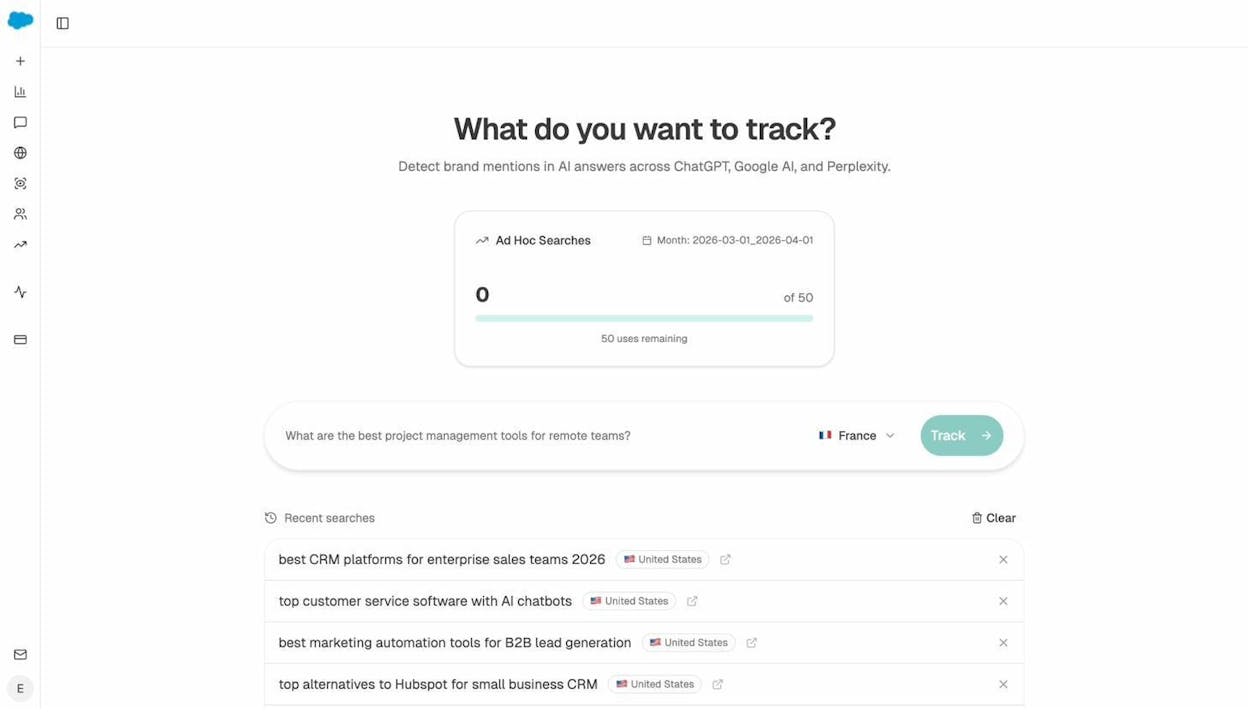
This gives you a real-time snapshot of who AI engines recommend for any given question. If your brand isn’t showing up, you now know where the gap is.
Once you’ve identified the prompts that matter, you can add them to your Prompt Tracking dashboard to monitor visibility, sentiment, and position over time.
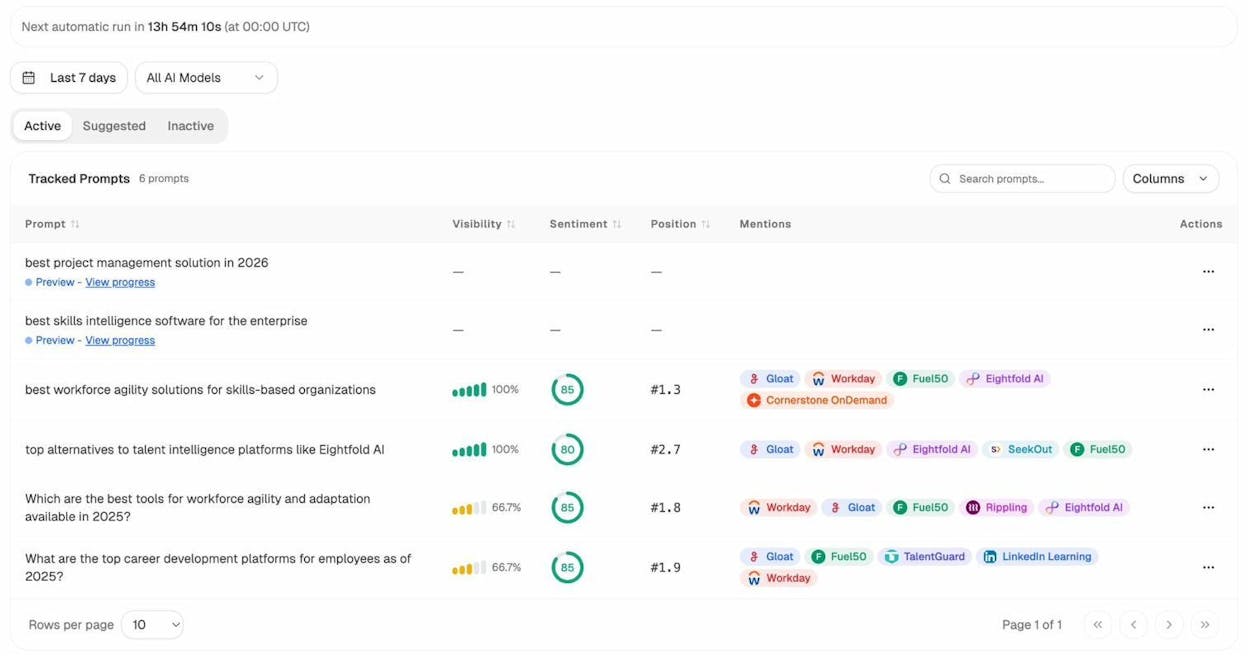
The key insight here is that keyword research and prompt research are complementary. Many of the same topics that have search volume on Google are also being asked in AI engines. By targeting them with strong content, you can rank in both channels.
3. Create content that deserves to rank
Finding the right keyword is only half the battle. The content you create for that keyword determines whether you rank and whether visitors find it useful.
Google’s own documentation says that the most important factor in ranking is whether a page provides useful, relevant content. Specifically, Google evaluates content on five dimensions: meaning (does it match what the searcher wants), relevance (does it contain relevant information), quality (is it helpful, well-structured, and backed by expertise), usability (is the page fast, mobile-friendly, and accessible), and context (location, search history, and settings).
That’s a lot of criteria, but it simplifies into one practical rule: create the most useful page for the searcher’s query. Not the longest page. Not the most keyword-stuffed page. The most useful one.
Match search intent first
Before you write a single word, search your target keyword in Google and study the top results. Pay attention to three things:
Content type. Are the top results blog posts, product pages, landing pages, or something else? If every result is a blog post, don’t try to rank with a product page.
Content format. Are they how-to guides, listicles, comparisons, or opinion pieces? Match the dominant format.
Content angle. What specific perspective do they take? Is it “for beginners,” “in 2026,” “for small businesses”? Your angle doesn’t need to copy theirs, but it should address the same core need.
For example, if you search “free SEO tools,” you’ll see that the top results are all listicle-style blog posts. A product landing page for your free SEO tool would have almost no chance of ranking here, even if your tool is excellent. The intent is informational. People want a curated list.
Write for depth, not word count
There’s a persistent myth that longer content ranks better. It doesn’t. What ranks better is content that covers a topic more completely, more clearly, and with more useful detail than the competition.
Here’s a practical framework for creating content that goes deeper:
Address the core question immediately. Don’t bury the answer in paragraph six. Put it in the first section. This follows the BLUF (Bottom Line Up Front) principle that the best content writers use. It also helps AI models extract your answer for featured snippets and AI citations.
Support claims with evidence. Every claim you make should be backed by data, examples, expert quotes, or your own experience. Generic advice like “create great content” is not helpful. Specific advice like “pages with 3+ original data points earn 4x more backlinks” is.
Use examples liberally. Abstract explanations are hard to follow. Show a real example of the concept in action. Screenshots, case studies, and before/after comparisons make content tangible.
Eliminate filler. Every sentence should either advance the argument or provide useful information. If a sentence could be deleted without changing the reader’s understanding, delete it.
On-page SEO essentials
Once your content is written, optimize the on-page elements that help Google understand what your page is about.
Title tag. Include your primary keyword. Keep it under 60 characters. Make it compelling enough to earn a click.
Meta description. This doesn’t directly affect rankings, but it affects click-through rate. Write a concise summary that makes searchers want to click. Keep it under 155 characters.
Heading structure. Use H1 for your title (one per page), H2 for main sections, and H3 for subsections. Include your primary keyword in the H1 and semantically related keywords in H2s where natural.
Internal links. Link to other relevant pages on your site. This helps Google discover and understand the relationship between your pages. It also keeps visitors on your site longer. More on this in the next section.
Image alt text. Describe what the image shows. This helps search engines understand your images and improves accessibility.
URL structure. Keep URLs short, descriptive, and include your primary keyword. Use hyphens between words.
Optimizing content for AI search
Traditional on-page SEO focuses on signals that help Google rank your page. But if you also want AI engines to cite your content, you need to think about a few additional things.
Structure your content for extraction. AI models pull specific facts, definitions, and recommendations from pages. Content that’s organized with clear headings, concise paragraphs, and structured data is easier for AI to parse and cite.
Include entity-rich content. AI models think in terms of entities (brands, products, people, concepts) and relationships between them. Mention relevant entities by name and explain how they relate to each other.
Be the primary source. AI engines prefer to cite original research, proprietary data, and first-hand experience over aggregated or secondhand information. If you have original data, publish it. If you have a unique methodology, explain it. Content that simply rewrites what others have said is less likely to get cited.
Provide clear, direct answers. When covering “what is” or “how to” topics, lead each section with a direct answer. AI models often pull the first clear statement they find under a heading.
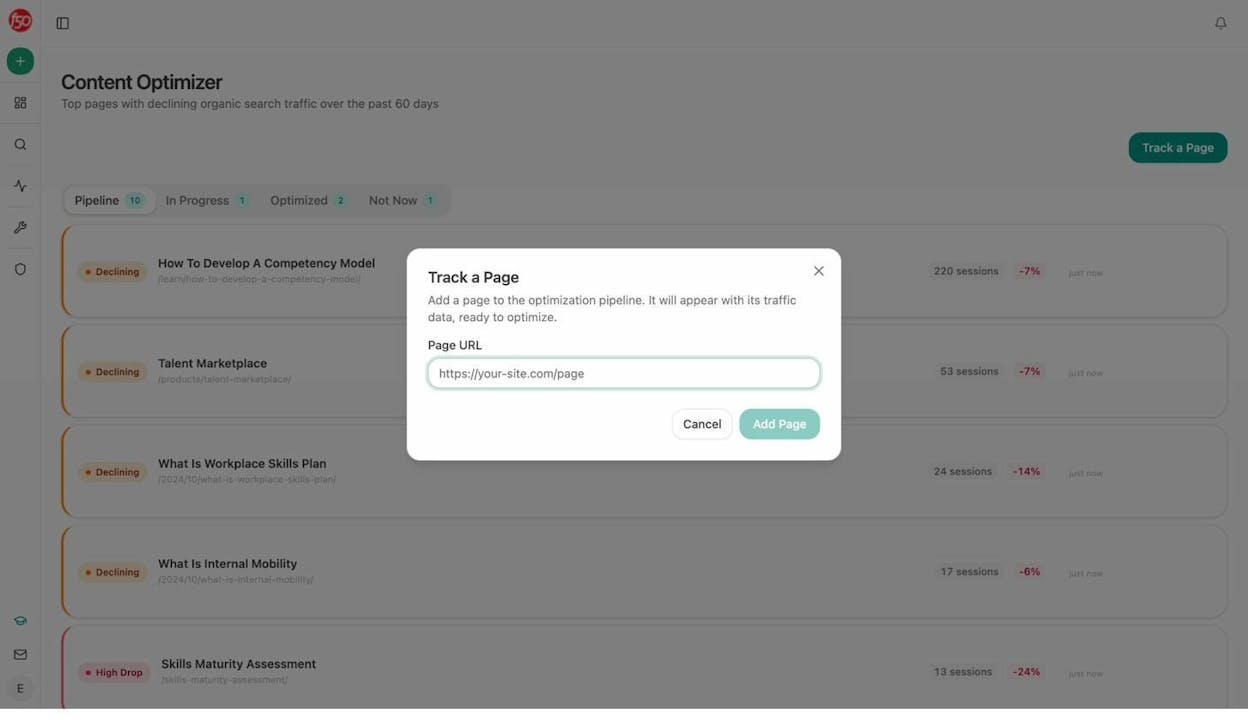
If you want to audit how well a specific page performs for both SEO and AI visibility, use the Content Optimizer in Analyze AI. It fetches your page, scores it on argument strength and clarity, and generates specific editorial suggestions for improvement.
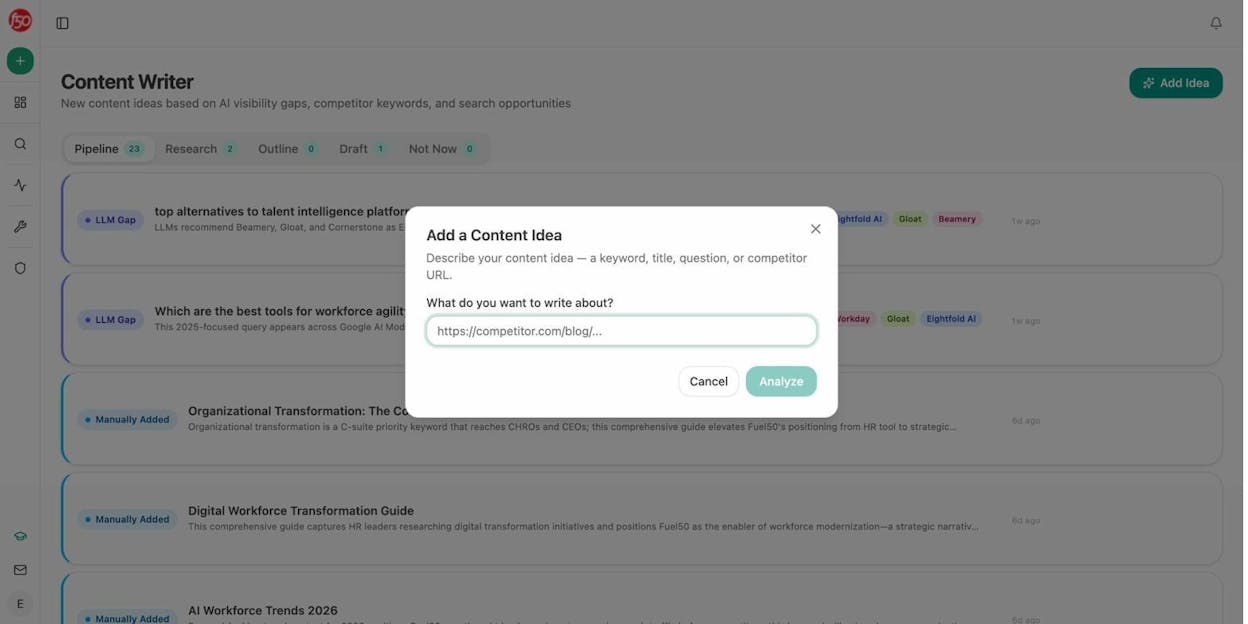
For net-new content, the Content Writer takes you from idea to research to outline to draft, with AI visibility gaps, competitor keywords, and editorial comments built into every step.
4. Build links to your pages
Links remain one of the strongest ranking signals in SEO. There are two types you need to care about: internal links and backlinks.
Internal links
Internal links are links from one page on your site to another. They serve two purposes.
First, they help search engine crawlers discover and navigate your pages. A page with no internal links pointing to it is an “orphaned” page. Search engines may struggle to find it, and when they do, they have no context about how it relates to the rest of your site.
Second, internal links pass link equity (ranking power) from one page to another. If your homepage has strong authority from backlinks, linking from it to a new blog post gives that post a boost.
Here are three practical internal linking tactics:
Link from high-authority pages to new content. Find the pages on your site with the most backlinks and add contextual links from them to newer pages you want to rank. This is sometimes called the “middleman method.”
Use descriptive anchor text. Instead of linking with “click here” or “this article,” use anchor text that describes what the linked page is about. “Learn more about internal linking for SEO” is far better than “learn more here.”
Add navigational links. Placing links in your site’s navigation, sidebar, or footer creates automatic internal links from every page on your site to the linked page. This is useful for your most important pages.
Backlinks
Backlinks are links from external websites to yours. They act as votes of confidence. The more high-quality votes you get, the stronger Google considers your authority on a topic.
But not all backlinks are equal. A link from a high-authority, relevant website in your niche is worth far more than a link from a random, low-quality directory. The best backlinks are “followed” links placed within the main content of a relevant, authoritative page.
How to earn backlinks organically:
Publish original research. Data studies, surveys, and industry benchmarks attract links naturally because other writers cite them as sources. This is one of the most reliable ways to earn links over time.
Create definitive guides. If you publish the most comprehensive, well-organized guide on a topic, other sites will reference it when they write about the same subject.
Build useful free tools. Free tools (like calculators, checkers, or generators) attract links because people share them with colleagues and link to them in blog posts. Analyze AI offers several free SEO tools that serve this exact purpose.
How to build backlinks through outreach:
Guest posting. Write high-quality articles for other websites in your niche. Include a contextual link back to your site within the content.
Broken link building. Find pages in your niche that link to broken (404) URLs. Reach out to the site owner, let them know about the broken link, and suggest your relevant content as a replacement.
Statistics-based outreach. Create an article that compiles up-to-date statistics on a topic. Then find articles that cite outdated versions of those statistics and ask them to link to your updated version instead.
For a deeper look at link building tools and strategies, see our dedicated guide.
How links affect AI search visibility
Links don’t just help with Google rankings. They also influence AI search visibility, indirectly.
AI engines like ChatGPT and Perplexity tend to cite authoritative sources. Authority, in this context, is shaped by many of the same signals Google uses, including backlinks, domain reputation, and content quality.
Additionally, the specific URLs that AI engines cite as sources are worth tracking. In Analyze AI, the Sources dashboard shows which domains and content types AI engines cite most often in your space.
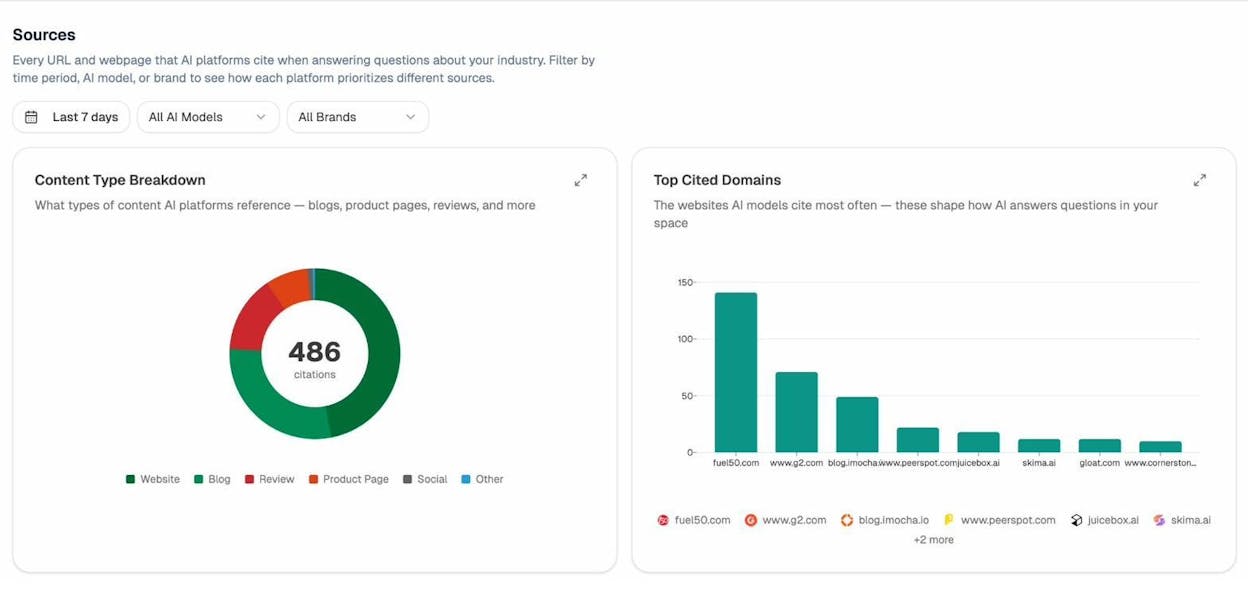
This is useful for two reasons. First, if a specific domain (like G2 or a major industry blog) is heavily cited by AI engines, getting your brand mentioned on that domain could improve your AI visibility. Second, you can see what content types AI engines prefer to cite (blogs, product pages, review sites) and create more of what works.
5. Monitor, measure, and iterate
SEO is not a one-time project. Rankings change. Competitors publish new content. Algorithms update. If you’re not monitoring your performance, you’re flying blind.
Tracking SEO performance
At a minimum, you should track three things on a regular basis:
Keyword rankings. Are the pages you optimized ranking where you want them? Are they moving up or down? A rank tracking tool shows you this over time so you can catch declines early.
Use Analyze AI’s Keyword Rank Checker to check where any page ranks for a given keyword right now.
Organic traffic. Rankings are a leading indicator, but traffic is what actually matters. Use Google Analytics (GA4) to monitor organic sessions over time. Look at traffic by page, not just site-wide, so you can see which pages are growing and which are declining.
Conversions. Traffic without conversions is a vanity metric. Make sure you’re tracking form submissions, signups, purchases, or whatever your conversion event is. Tie it back to specific pages and keywords so you know which content is actually driving business results.
Tracking AI search performance
Here’s where things get interesting. Traditional SEO tools track your performance in Google. But they don’t tell you anything about how your brand appears in ChatGPT, Perplexity, Gemini, or Copilot.
To close that gap, you need an AI search monitoring tool.
Analyze AI’s Overview dashboard gives you a single view of your brand’s visibility and sentiment across all major AI engines, compared against your competitors.
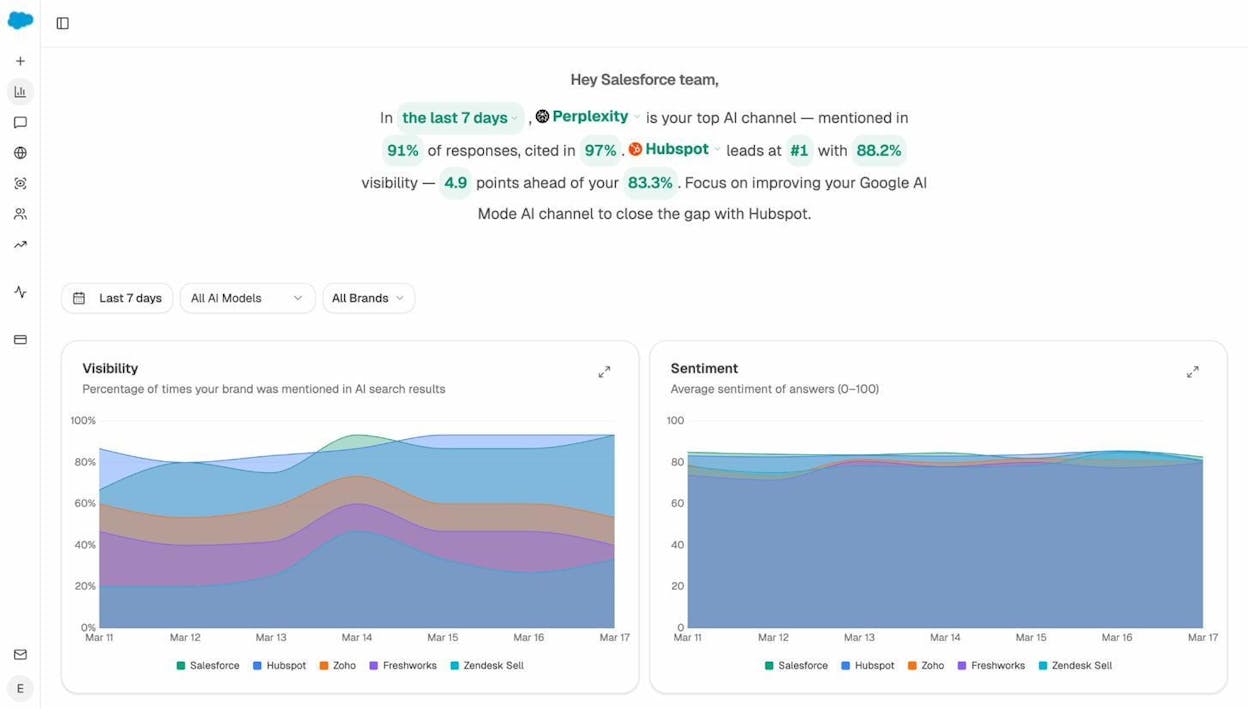
From here, you can drill into specifics.
AI Traffic Analytics shows exactly how many visitors are coming from AI platforms, which engines drive the most traffic, and which pages they land on.
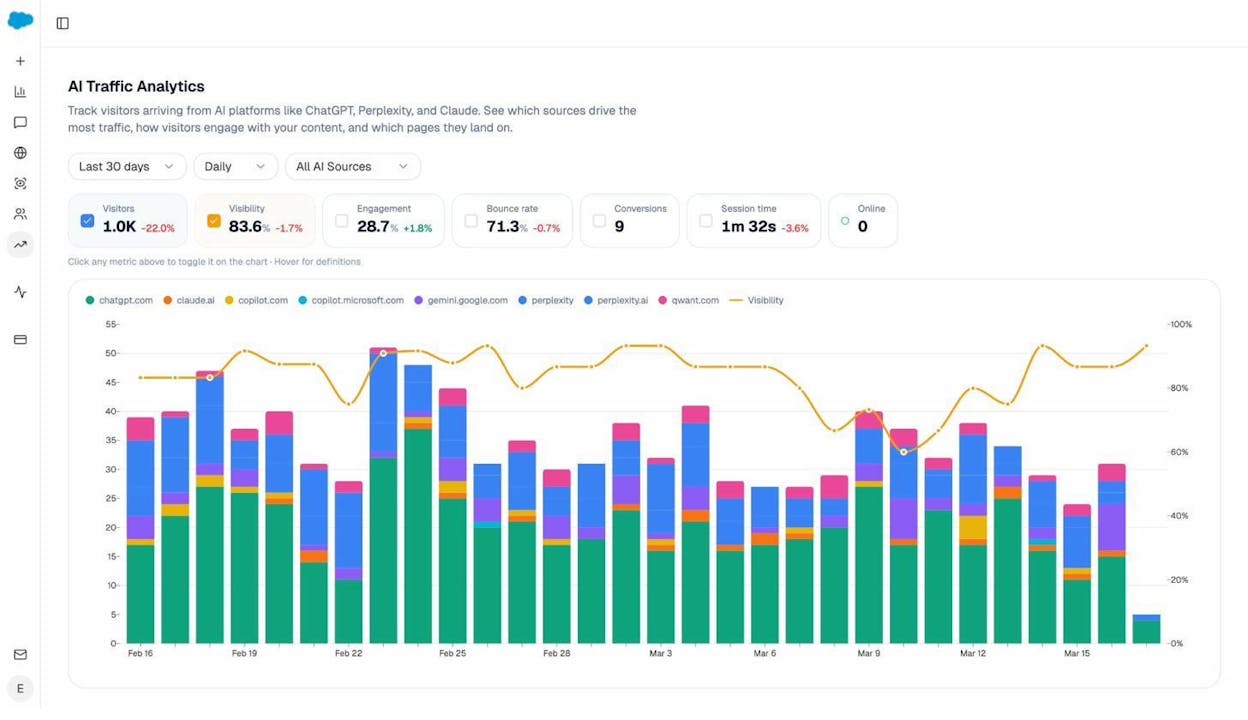
The Landing Pages view inside AI Traffic Analytics is particularly valuable. It shows which specific pages on your site receive AI-referred traffic, how visitors engage with them, and whether those visits convert.
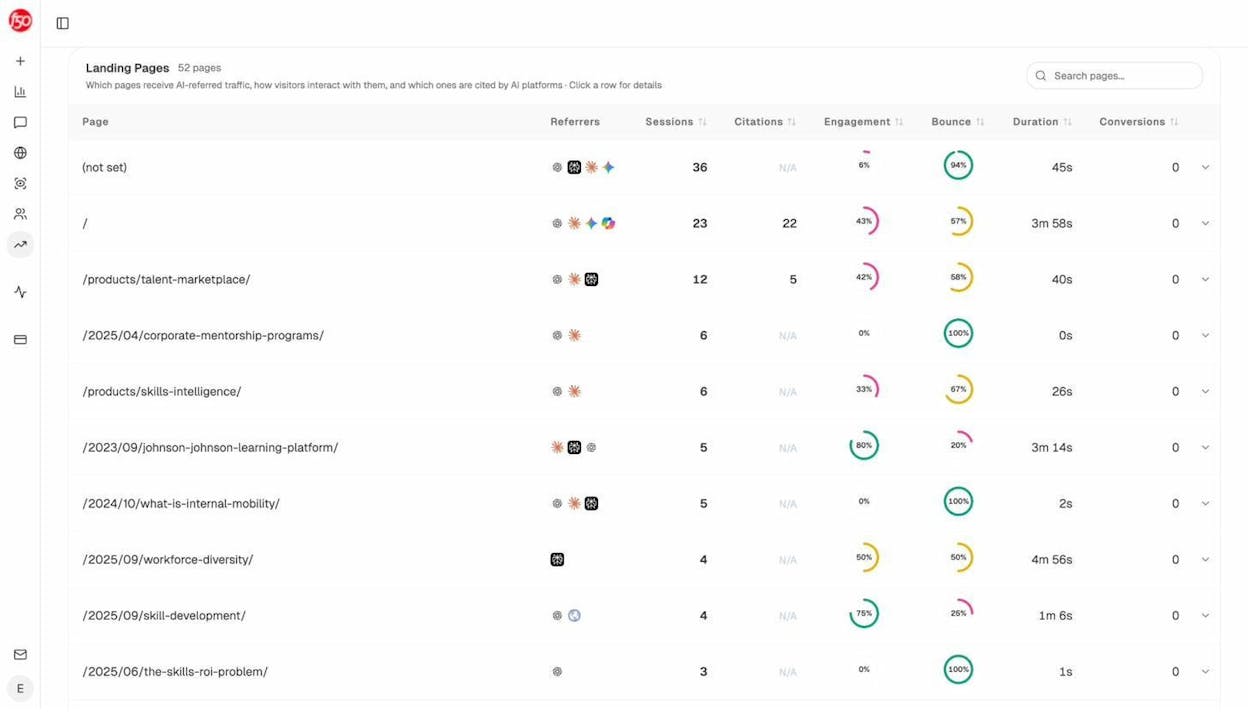
This data helps you identify patterns. If certain types of pages consistently attract AI traffic (say, comparison pages or product pages), you can double down on creating more of them.
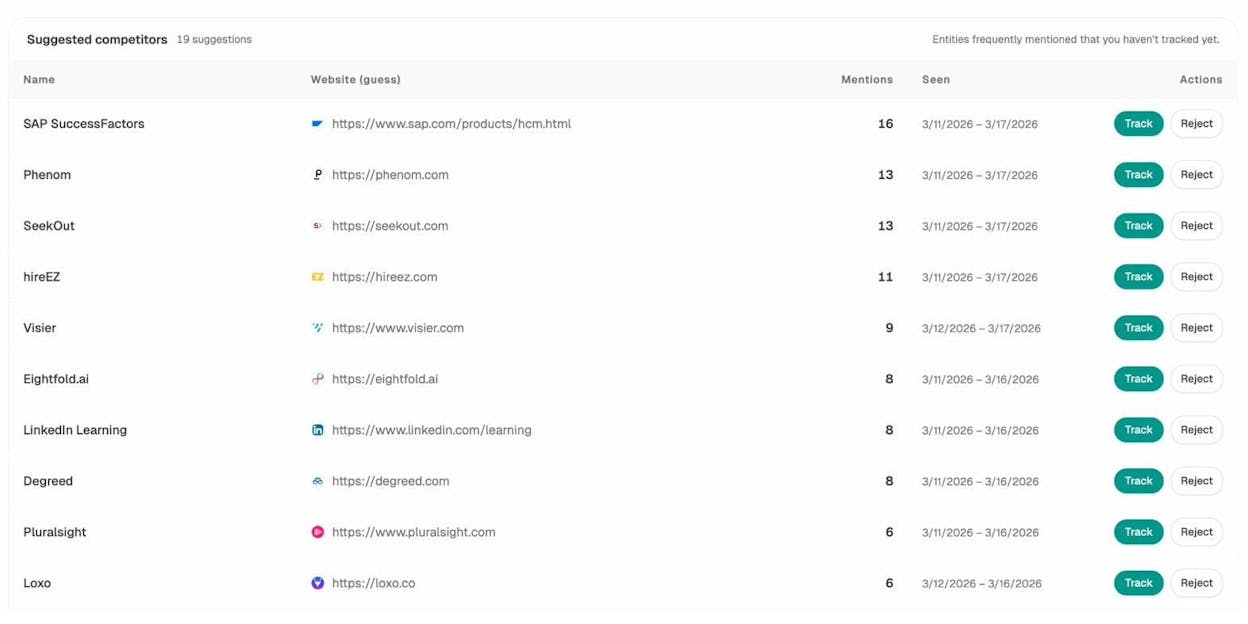
Competitor Intelligence shows which brands AI engines recommend alongside yours, how often, and on which prompts. If a competitor is showing up on prompts where you’re absent, that’s a gap to close.
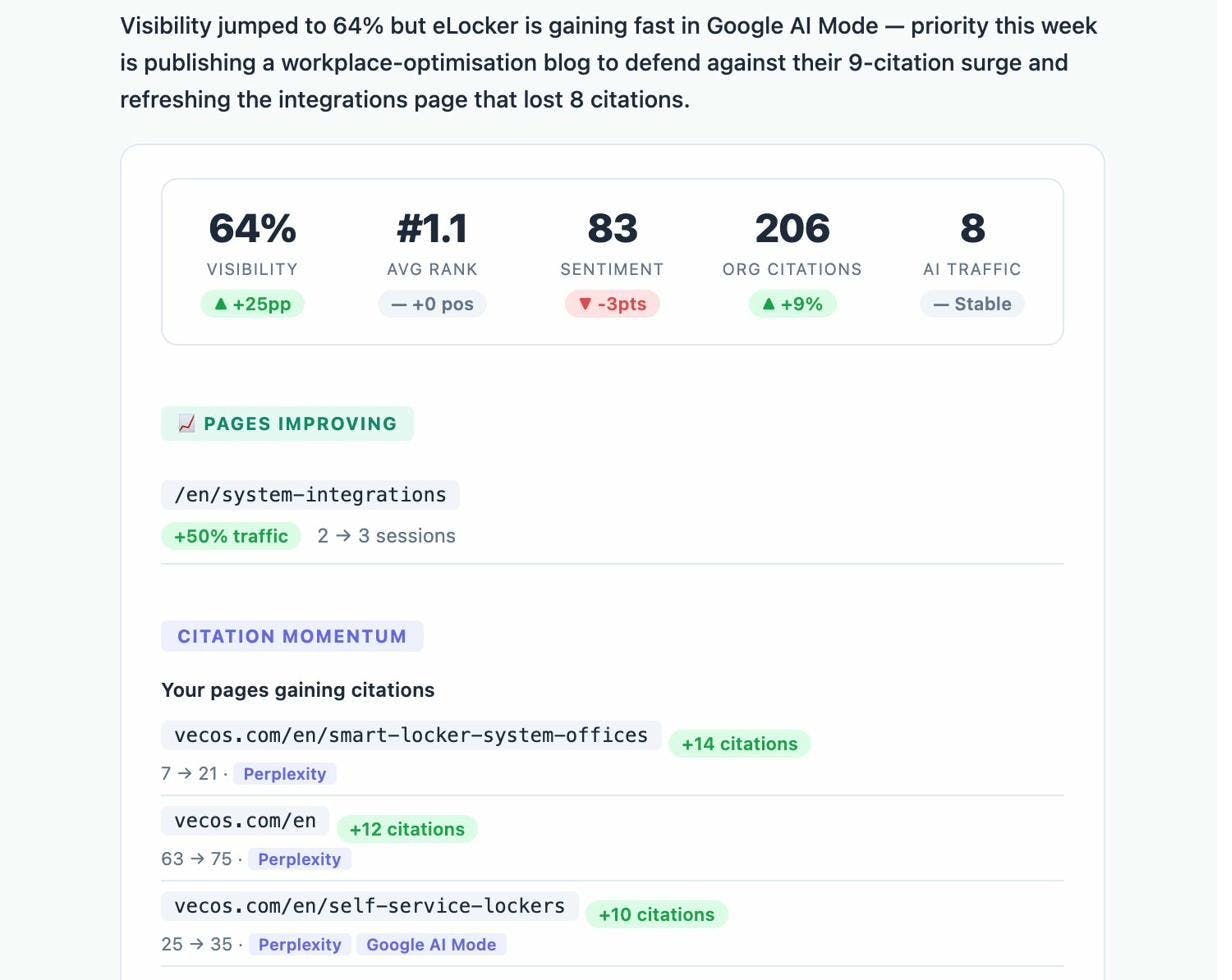
Weekly Email Digests deliver a prioritized summary of changes every Monday. Competitor shifts, citation changes, sentiment swings, and recommended actions, all without logging in.
The iterate part
Monitoring is only valuable if you act on what you find. Here’s how:
For SEO: Revisit step 3 (content) when rankings drop. Update content with new information, better examples, and stronger structure. Revisit step 4 (links) when you need to boost a page’s authority. See our guide on SEO content strategy for a deeper framework on content refreshes.
For AI search: Look at which prompts you’re invisible on and create or optimize content for those topics. Check which sources AI engines cite and work to get your brand mentioned on them. Use the Content Optimizer to score existing pages and generate improvement suggestions.
The teams that treat SEO and AI visibility as a continuous loop, rather than a one-time checklist, are the ones that compound their results over time.
What to expect before you start
It’s important to set realistic expectations.
SEO takes time. Most SEOs report that it takes 3 to 6 months to see meaningful results. According to an Ahrefs study, only 5.7% of pages rank in the top 10 within one year. Google itself says crawling a page can take days to weeks. There’s a natural delay built into the process.
AI search visibility moves faster, but is less predictable. Because AI engines re-generate answers in real time, your visibility can change more quickly than in traditional SEO. This is both an opportunity (you can gain visibility faster) and a risk (you can lose it faster too). Ongoing monitoring is critical.
You can do this yourself or hire help. The least expensive option is doing SEO yourself. You need time to learn, tools that fit your budget, and the patience to experiment. Alternatively, you can hire a freelancer, consultant, or agency. SEO hourly rates vary widely depending on provider type and location. Do your research and ask for case studies before committing.
AI search is additive, not a replacement. We’ve said this before, but it’s worth repeating. SEO is not dead. AI search is an additional organic channel that complements traditional SEO. The brands that invest in both are the ones building durable visibility.
If you want to understand how SEO and AI search optimization relate to each other, read our guide on GEO vs SEO.
Final thoughts
The SEO process hasn’t fundamentally changed. Get your technical foundation right. Find the right keywords. Create genuinely useful content. Build links. Monitor and iterate.
What has changed is the surface area. Your content now needs to work in two environments: the traditional search engine results page and the AI answer engine. The good news is that the same principles apply in both. Clear, original, well-structured content wins in Google and gets cited by AI.
If you want to see how your brand currently appears in AI search, how competitors stack up, and where the gaps are, start with Analyze AI. You’ll have your first visibility baseline in minutes.
For more tactical guides, check out:

Ernest

Ibrahim


