



Summarize this blog post with:


In this article, you’ll learn what entity SEO actually is, why it’s not a new discipline you need to master, and how to make sure your entity signals are strong for both Google and AI search engines like ChatGPT, Perplexity, and Gemini.
Table of Contents
What is an entity in SEO?
Before we get to entity SEO, we need to understand entities.
An entity is anything that can be distinctly identified. A person, a place, a company, a concept, a recipe, a color. Google’s own documentation defines entities as “things, not strings.” That distinction matters.
For decades, search engines matched the words in your query to the words on a page. If you searched for “apple,” Google had to figure out whether you meant the fruit, the company, or the record label based on keyword clues alone. That approach was fragile. It could be tricked by keyword stuffing, and it broke down whenever people used different words to describe the same thing.
In 2012, Google introduced the Knowledge Graph, a massive database of entities and the relationships between them. This changed how Google understood search queries. Instead of matching strings, Google could now match concepts.
![[Screenshot of a Google Knowledge Panel showing a well-known entity like Apple Inc., with structured data including founder, stock price, and related entities]](https://www.datocms-assets.com/164164/1777065204-blobid1.png?auto=format,compress&w=1248&fit=max)
Here’s a simple example. The footballer Federico Chiesa is an entity. The restaurant Dishoom is an entity. The concept of “machine learning” is an entity. Each one has a unique identifier in Google’s Knowledge Graph, along with connections to related entities.
These connections are called edges. Federico Chiesa is connected to the entity “Juventus” and to the entity “Italy national football team.” Those relationships help Google understand that when someone searches for “Chiesa transfer news,” they probably mean the footballer, not a church.
![[Screenshot of Google showing a Knowledge Panel for a footballer, displaying team, position, and related players]](https://www.datocms-assets.com/164164/1777065224-blobid2.png?auto=format,compress&w=1248&fit=max)
Why did Google build the Knowledge Graph?
Three reasons stood out.
Understanding intent, not just words. People describe the same thing in different ways. Someone might search “actor who played Han Solo” instead of “Harrison Ford.” Because Han Solo and Harrison Ford are closely connected entities, Google can resolve the query without relying on exact keyword matches.
![[Screenshot of Google search results for “actor who played Han Solo” showing Harrison Ford filmography]](https://www.datocms-assets.com/164164/1777065231-blobid3.png?auto=format,compress&w=1248&fit=max)
Reducing the power of keyword manipulation. When ranking depended purely on word frequency, SEOs could game the system by stuffing keywords into a page. Entity-based understanding makes relevance about meaning, not repetition.
Handling scale efficiently. The internet is vast. Google can’t parse the full meaning of every sentence on every page. Entities give it a structured framework to understand the web without processing every word.
So what does all of this mean for entity SEO?
What is entity SEO?
Entity SEO is optimizing your website so that search engines correctly identify and associate the entities on your pages and your brand itself as a recognized entity.
That’s the formal definition. Here’s the practical one: it’s just SEO.
If Google has moved from keyword-matching to entity-based understanding, then every SEO practice you follow is already operating within an entity-driven system. You’re doing entity SEO whether you call it that or not.
As Patrick Stox, a well-known technical SEO, has pointed out: the entity identification part is more on Google’s end than on ours. Google’s job is to recognize entities. Your job is to make your content clear, comprehensive, and well-structured enough that Google can do its job easily.
Why most “entity SEO tactics” are just SEO tactics
Look at any blog post listing entity SEO tactics, and you’ll find a familiar checklist:
|
“Entity SEO” tactic |
What it actually is |
|---|---|
|
Earn a Wikipedia page |
Brand building and digital PR |
|
Create a Google Business Profile |
Local SEO basics |
|
Add internal links |
On-page SEO fundamentals |
|
Create images and videos |
Content marketing 101 |
|
Build topical authority |
A sound content strategy |
|
Include semantically related words |
Writing naturally about your topic |
|
Add schema markup |
Technical SEO best practice |
If you’re serious about SEO and investing in it, you’re probably already doing most of the above.
Would you not want a Wikipedia page regardless of entity SEO? Brand recognition and a backlink from one of the world’s most authoritative domains are reason enough. If you’re a local business, you’ve already created a Google Business Profile because that’s how customers find you on Maps.
And creating relevant images and videos? That’s just marketing. If you run a Korean recipe site and want to rank for kimchi jjigae, you already know you need photos of the cooking process and a step-by-step video. You don’t need an entity SEO consultant to tell you that.
![[Screenshot of Google Knowledge Panel for a food entity like “kimchi jjigae” showing images and related recipes]](https://www.datocms-assets.com/164164/1777065246-blobid4.jpg?auto=format,compress&w=1248&fit=max)
Topical authority is just good blogging
Topical authority is the practice of becoming the go-to resource on a specific subject by creating comprehensive content around it. Some people treat it like a revolutionary entity SEO concept. It’s not.
Read any guide on starting a blog and you’ll find a section called “niche down.” Once you niche down, you naturally create content surrounding that one topic. If you start a site about breakdancing, the chances you’ll write about pottery or macroeconomics are close to zero.
This is similar to what Nat Eliason called the Wiki Strategy back in 2017. His advice was to cover a topic comprehensively, like a wiki would, so that search engines understand your site as the definitive resource. There wasn’t a single mention of entities. It was just the smart way to create content for the internet.
The real problem has never been a lack of entity SEO knowledge. It’s that many companies target whatever keywords have the highest search volume, regardless of relevance to their actual product or service.
Some of the pages sending HubSpot the most organic traffic have almost nothing to do with their core product. Pages on how to type the shrug emoji. Pages on famous quotes. These pages attract visitors, but those visitors are not HubSpot’s buyers.
![[Screenshot of a site’s top pages report in an SEO tool showing high-traffic pages unrelated to the brand’s core product]](https://www.datocms-assets.com/164164/1777065246-blobid5.png?auto=format,compress&w=1248&fit=max)
When Google eventually stops rewarding that kind of content, companies scramble to “build topical authority.” But topical authority was never a new strategy. It was always the right approach. These companies just hadn’t followed it.
Where entity SEO tactics do add value
Two practices from the typical entity SEO checklist deserve a closer look because they go beyond standard SEO fundamentals: checking for semantically related subtopics and implementing schema markup.
Checking for semantically related subtopics. Even if you know your topic well, it’s easy to miss important subtopics because of the curse of knowledge. You assume your reader already understands something, or you forget to cover an angle that competing pages address.
A content gap analysis helps here. Look at the top-ranking pages for your target keyword and identify subtopics they cover that you don’t.
For example, if you’re writing about “inbound marketing” and the top three pages all cover inbound marketing strategy, inbound marketing examples, and inbound marketing tools, you should probably cover those too. Not because of entity SEO, but because your page needs to be comprehensive to satisfy the searcher’s intent.
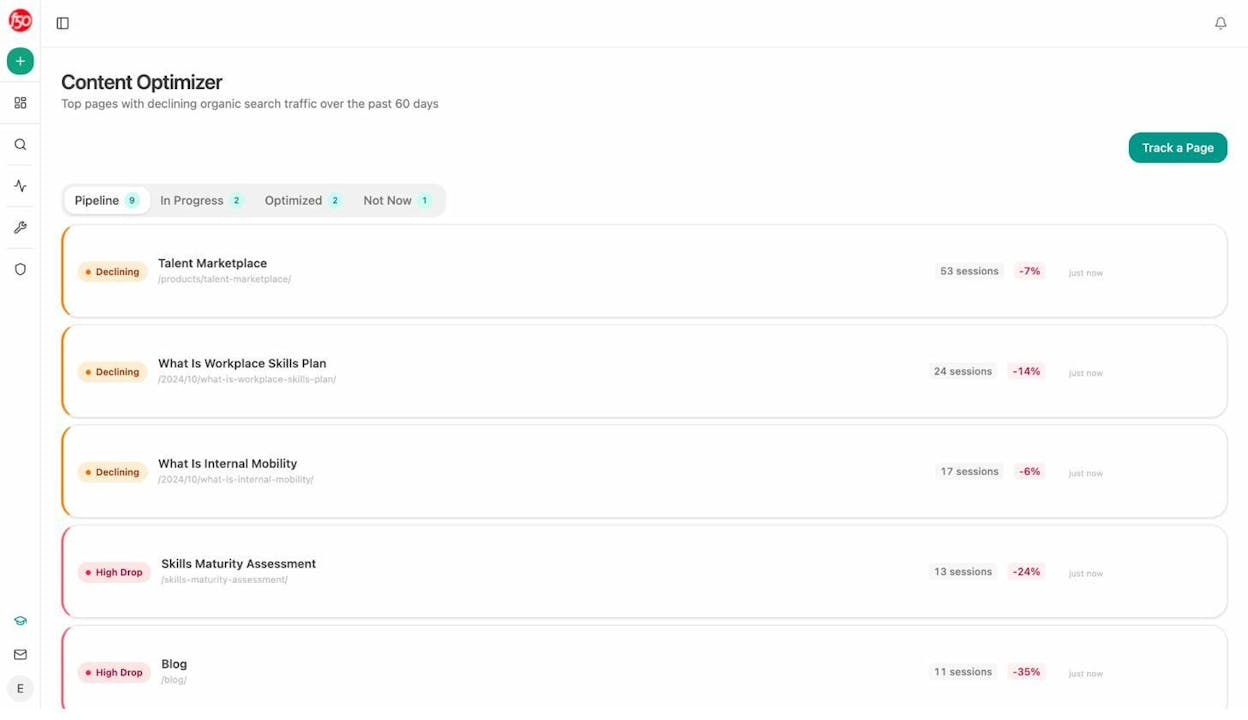
The Content Optimizer in Analyze AI does something similar. It fetches your existing page, scores it on argument strength and clarity, and generates editorial comments highlighting gaps in your coverage. If there are entities or subtopics your competitors address that you’re missing, the optimizer flags them.
Adding schema markup. Schema markup is how you directly tell Google which entities appear on your page and what relationships they have. It’s structured data, written in a vocabulary that search engines understand.
For example, if you have a recipe page, schema markup lets you specify the entity type (Recipe), its properties (cook time, calories, ingredients), and its relationships (author, cuisine type). Google uses this data to populate rich results like Knowledge Panels, recipe cards, and FAQ dropdowns.
Here’s a basic example of Organization schema:
{
"@context": "https://schema.org",
"@type": "Organization",
"name": "Your Company Name",
"url": "https://yourcompany.com",
"logo": "https://yourcompany.com/logo.png",
"sameAs": [
"https://twitter.com/yourcompany",
"https://linkedin.com/company/yourcompany",
"https://en.wikipedia.org/wiki/Your_Company"
]
}
The sameAs property is particularly important for entity SEO because it connects your brand entity to its representations on other platforms. This helps Google confirm that these different pages all refer to the same entity.
Other schema types that matter for entity recognition include Person, Product, LocalBusiness, Article, and FAQPage. If you’re not implementing schema markup yet, this is the single most concrete thing you can do to improve your entity signals.
You can test your schema using Google’s Rich Results Test or the Schema Markup Validator.
![[Screenshot of Google’s Rich Results Test showing validated schema markup for an Organization entity]](https://www.datocms-assets.com/164164/1777065263-blobid7.png?auto=format,compress&w=1248&fit=max)
How to check if Google recognizes your brand as an entity
Before you optimize for entity SEO, it helps to know whether Google already recognizes your brand as an entity.
Step 1: Search your brand name on Google
Type your brand name into Google. If you see a Knowledge Panel on the right side of the results page, Google recognizes you as an entity.
![[Screenshot of a Google search for a brand name showing a Knowledge Panel with company details, logo, and social profiles]](https://www.datocms-assets.com/164164/1777065264-blobid8.png?auto=format,compress&w=1248&fit=max)
If you don’t see a Knowledge Panel, it doesn’t mean you’re invisible. It means Google hasn’t yet built a strong enough entity profile for your brand. The steps below can help.
Step 2: Check the Google Knowledge Graph API
Google offers a Knowledge Graph Search API that lets you query the Knowledge Graph directly. Search for your brand name and see what comes back.
If your brand has an entry, you’ll see its entity type (Organization, Person, etc.), a description, and links to authoritative sources. If nothing comes back, you have work to do.
![[Screenshot of Google Knowledge Graph API results for a recognized entity, showing entity type, description, and detailed URL]](https://www.datocms-assets.com/164164/1777065276-blobid9.png?auto=format,compress&w=1248&fit=max)
Step 3: Search for your brand on Wikidata
Wikidata is one of the primary sources Google uses to populate the Knowledge Graph. Search for your brand or company. If you have a Wikidata entry, Google is much more likely to recognize you as an entity.
If you don’t have one, creating a Wikidata entry (assuming your brand meets their notability requirements) is one of the most direct ways to establish your entity in Google’s eyes.
![[Screenshot of a Wikidata search showing an entity result with properties, descriptions, and linked identifiers]](https://www.datocms-assets.com/164164/1777065282-blobid10.jpg?auto=format,compress&w=1248&fit=max)
Step 4: Audit your structured data
Use Google Search Console to check for structured data issues across your site. Navigate to the “Enhancements” section to see which schema types Google has detected and whether any have errors or warnings.
![[Screenshot of Google Search Console Enhancements section showing detected schema types and error counts]](https://www.datocms-assets.com/164164/1777065285-blobid11.png?auto=format,compress&w=1248&fit=max)
Fix any errors first. Then look for opportunities to add schema types you’re not yet using. If you have a blog, make sure your articles use Article schema. If you have a product, make sure you’re using Product schema with reviews.
Entities in AI search: why they matter even more now
Here’s where most entity SEO guides stop. They explain the Knowledge Graph, list some tactics, and leave you with the impression that entity SEO is a Google-only concern.
It’s not. Entities are even more important for AI search engines.
When someone asks ChatGPT, Perplexity, or Gemini a question like “what’s the best CRM for small businesses,” the AI model isn’t matching keywords. It’s reasoning about entities. It understands “CRM” as a category, “HubSpot” and “Salesforce” as specific products within that category, and “small businesses” as a qualifier that filters the recommendation.
The stronger your brand’s entity signals, the more likely AI models are to include you in their responses. That’s because AI models pull from multiple sources to construct their understanding of entities and relationships. If your brand consistently appears in authoritative contexts, linked to the right topics, with clear and consistent information, AI models build a stronger internal representation of your brand.
This is not theoretical. We’ve seen it play out across the brands we work with at Analyze AI.
How to see where your brand entity appears in AI search
Traditional SEO gives you Google Search Console to see how Google interprets your site. For AI search, you need something different.
In Analyze AI, the Overview dashboard shows you how often your brand is mentioned across AI engines, what position you hold, and what sentiment AI models associate with your brand.
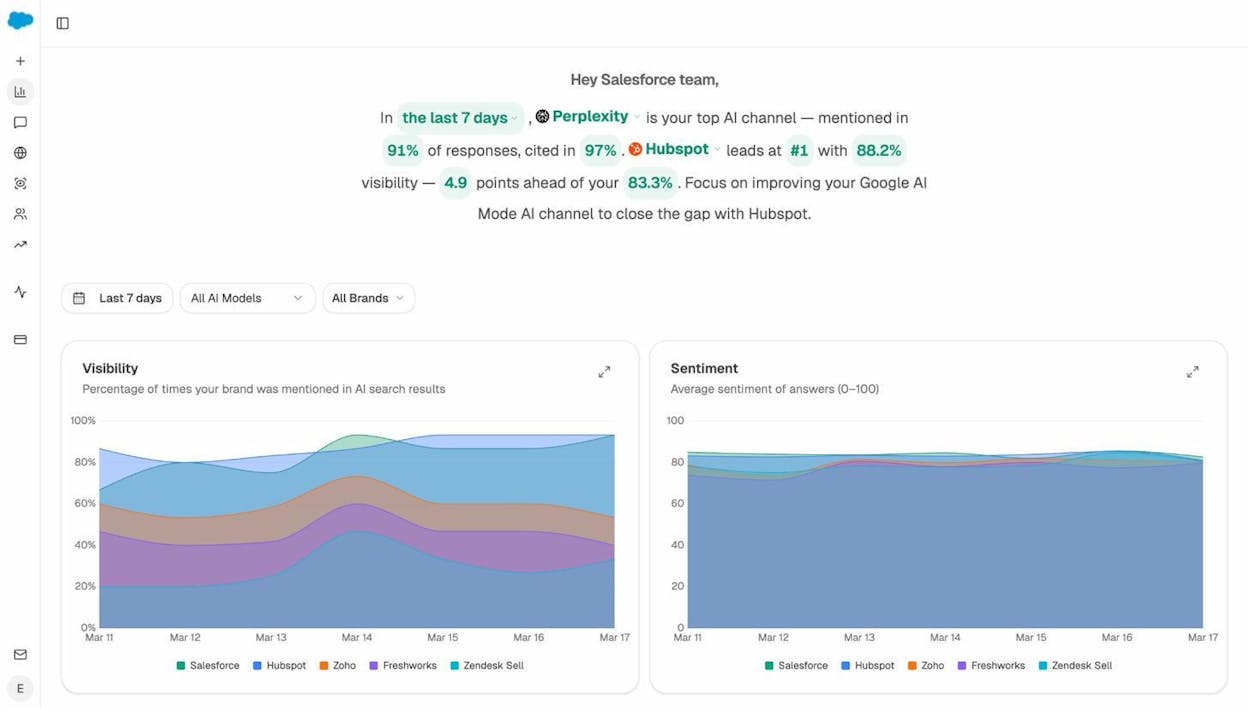
This is the AI equivalent of checking your Google search rankings. Except instead of tracking keyword positions, you’re tracking how often and how favorably AI models mention your brand entity when users ask relevant questions.
How to see which entities AI search associates with your competitors
One of the most powerful applications of entity thinking in AI search is competitive analysis. When a user asks ChatGPT “what are the best project management tools,” the AI doesn’t just list brands. It positions them relative to each other, often citing specific attributes and sources.
The Competitors dashboard in Analyze AI shows you which competitor entities appear most frequently across AI engines. It also surfaces “suggested competitors,” which are entities that AI models frequently mention alongside your tracked brands, even if you hadn’t thought of them as competitors.
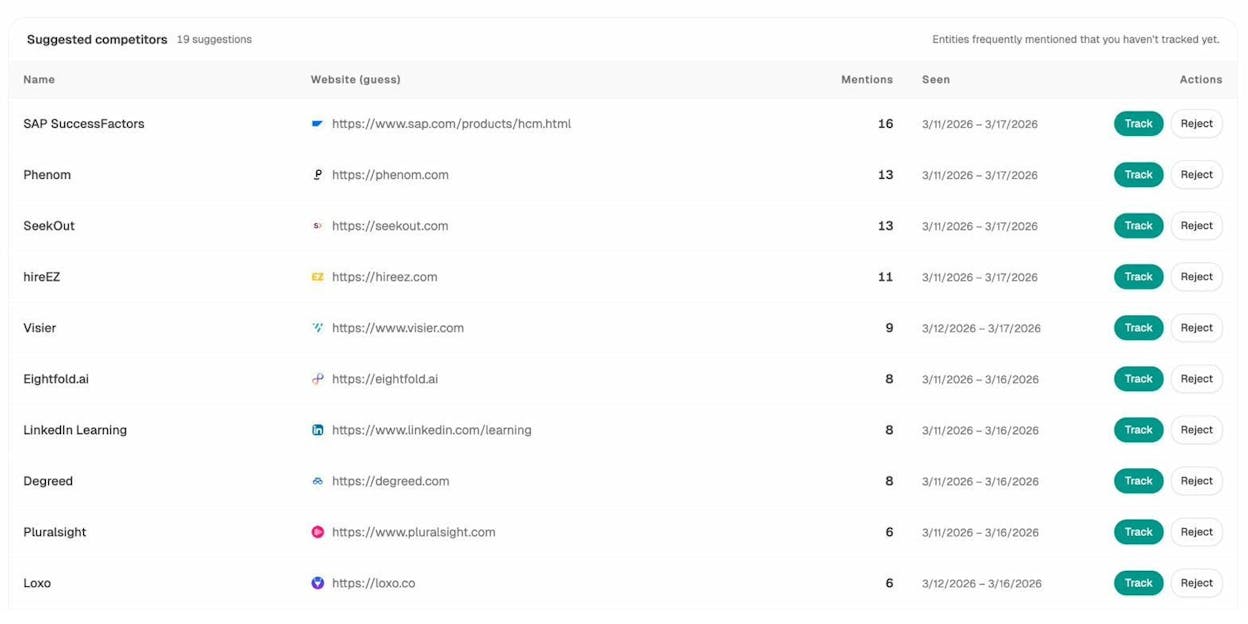
This is entity intelligence you can’t get from traditional SEO tools. If AI models are consistently associating your brand with certain competitors but not others, that tells you something about your entity positioning in the minds of these models.
How to test your entity presence in AI search with ad hoc prompts
Not sure whether AI models even know your brand exists? The AI Search Explorer in Analyze AI lets you run one-off searches across ChatGPT, Perplexity, and Google AI to see who shows up for any prompt.
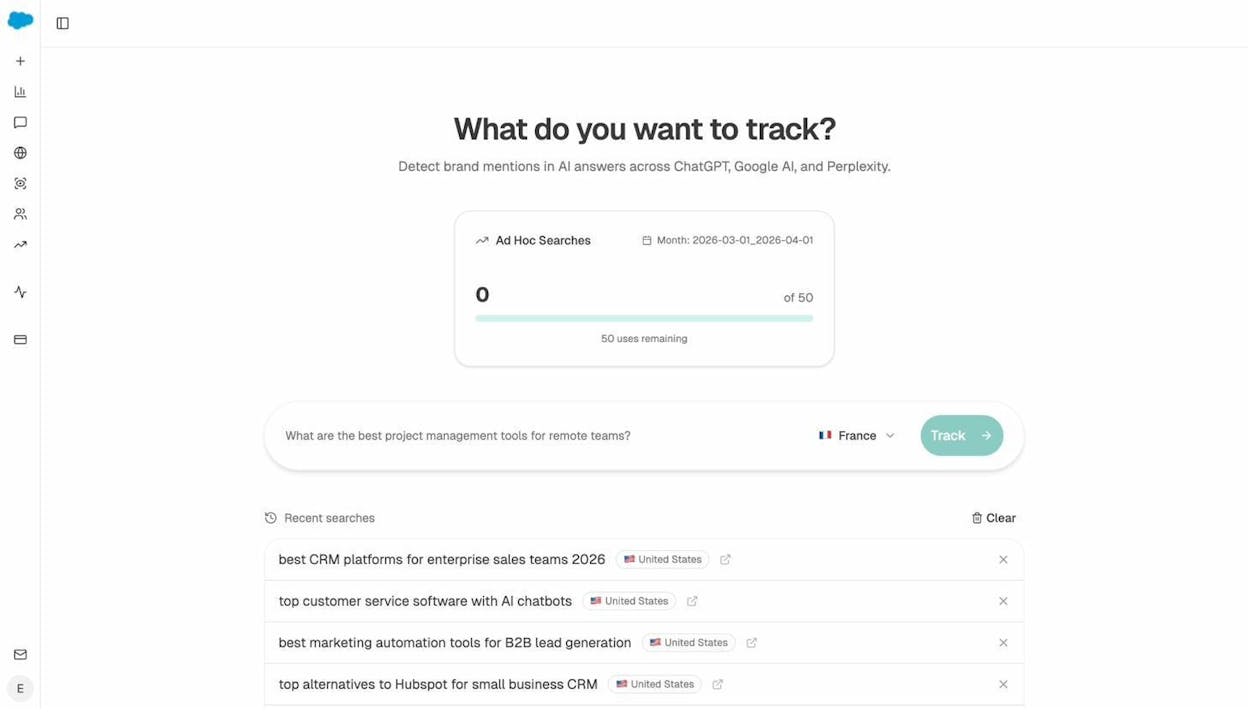
Type in a prompt your potential customer might use. Something like “best project management tools for remote teams” or “top alternatives to Hubspot for small business CRM.” See whether your brand appears, where it ranks, and who appears alongside you.
If you’re absent, that’s a signal that your entity signals are weak for that topic. The fix isn’t some mysterious entity SEO tactic. It’s the same work you’d do for traditional SEO: create better content, earn more citations, and build a stronger topical footprint.
How to see what sources AI models trust in your space
AI models don’t generate recommendations from thin air. They pull from sources: websites, blog posts, review platforms, product pages, and documentation that they’ve been trained on or can access through retrieval.
The Sources dashboard in Analyze AI shows you exactly which domains and content types AI engines cite most often in your space.
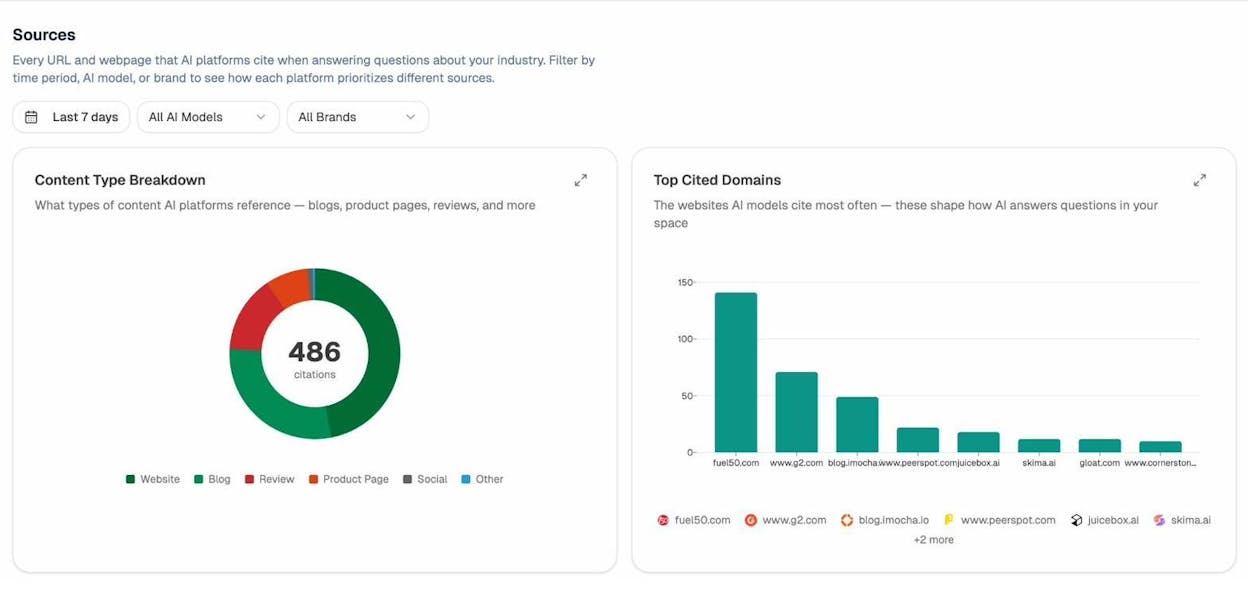
This data tells you where to focus your effort. If G2 and Capterra are the most-cited sources in your category, getting strong reviews on those platforms is a direct investment in your entity’s AI search presence. If blog content dominates the citations, your content strategy matters more than your product page for AI visibility.
How to understand your entity’s perception across AI models
Entities don’t just have visibility. They have perception. AI models build a narrative around every entity they know about, and that narrative shapes what they recommend and how.
The Perception Map in Analyze AI plots your brand and competitors on two axes: visibility (how often you’re mentioned) and narrative strength (how compelling the story AI tells about you is).
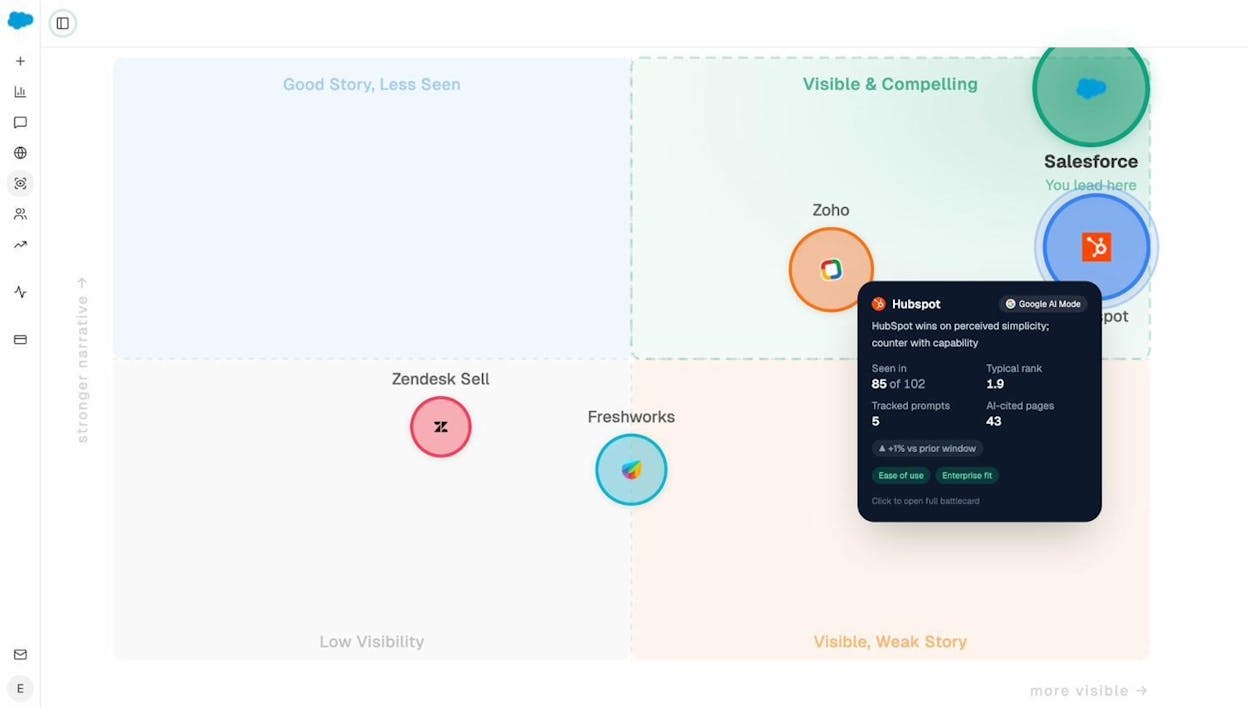
A brand in the “Visible and Compelling” quadrant has strong entity signals and a positive narrative. A brand in the “Visible, Weak Story” quadrant gets mentioned often but without a strong value proposition. And a brand that’s low-visibility could have a great story that AI models simply haven’t picked up yet.
This is where entity SEO meets brand strategy. The same principles that make you a strong entity in Google’s Knowledge Graph, clear information, consistent presence, authoritative sources, are the same principles that build a compelling AI search narrative.
How to strengthen your entity signals (for Google and AI search)
If entity SEO is just SEO, then the tactics that improve your entity signals are the same ones you should already be following. Here’s the practical checklist, ranked by impact.
1. Get your brand’s core information consistent everywhere
The most basic entity signal is consistency. Your brand name, address, website URL, social profiles, and descriptions should be identical across every platform: your website, LinkedIn, Twitter/X, Crunchbase, G2, Capterra, industry directories, and anywhere else your brand appears.
Inconsistencies confuse both Google’s Knowledge Graph and AI models. If your company is called “Acme Corp” on your website but “Acme Corporation” on LinkedIn and “Acme” on G2, you’re making it harder for search engines to connect these mentions into a single entity.
![[Screenshot of a brand’s consistent NAP (Name, Address, Phone) information across Google Business Profile, LinkedIn, and website footer]](https://www.datocms-assets.com/164164/1777065306-blobid17.png?auto=format,compress&w=1248&fit=max)
2. Create (or claim) your Wikidata and Wikipedia entries
Wikidata and Wikipedia are two of the most authoritative entity sources for both Google and AI models. A Wikidata entry formally establishes your brand in the structured knowledge base that Google draws from. A Wikipedia page adds narrative context and backlinks.
Creating a Wikipedia page requires meeting notability guidelines, which typically means having significant coverage in independent reliable sources. If your brand has been covered by publications, industry reports, or news outlets, you likely qualify.
If a Wikipedia page isn’t feasible yet, start with Wikidata. The notability requirements are lower, and having a Wikidata entry still sends a strong entity signal.
3. Build topical authority through comprehensive content coverage
Cover your core topic area thoroughly. Every piece of content you publish should reinforce what your brand is about and what entities it’s connected to.
This doesn’t mean targeting every keyword tangentially related to your industry. It means building a content footprint that makes your expertise unmistakable. If you’re a CRM company, your blog should cover CRM workflows, sales pipeline management, customer retention strategies, and CRM integrations. Not how to type the shrug emoji.
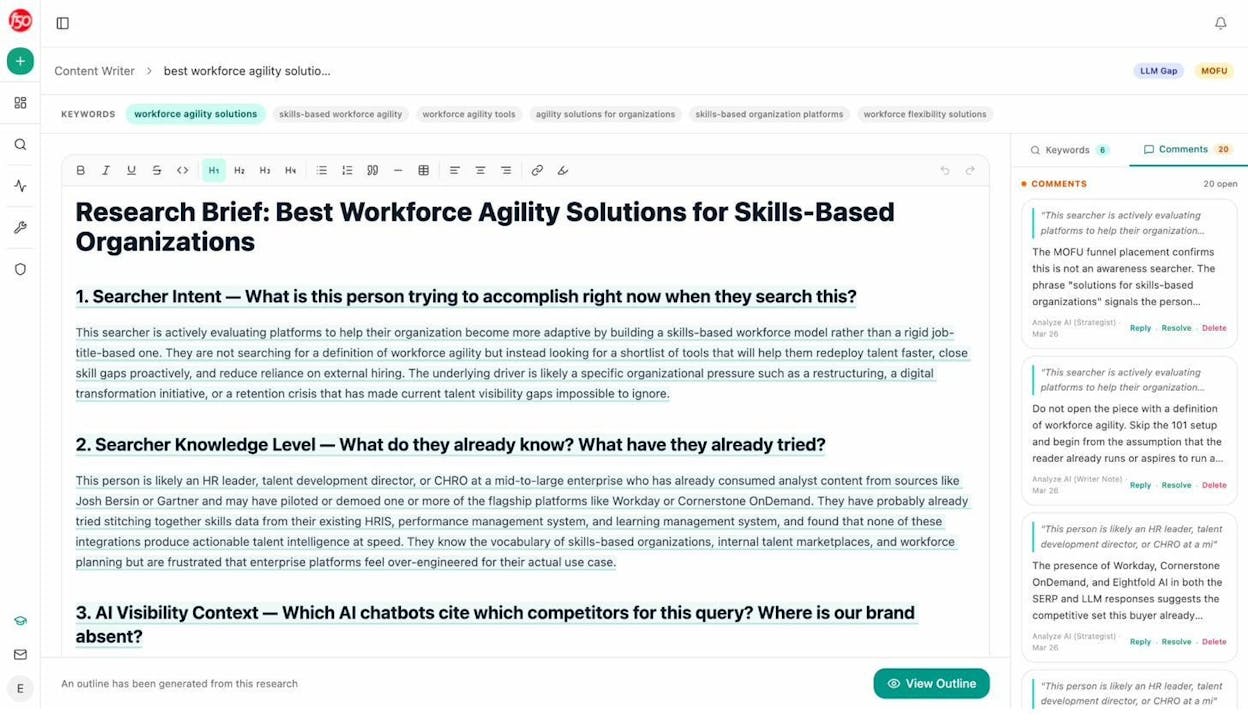
The Content Writer in Analyze AI helps here. It takes you from idea to research to outline to draft, and during the research phase, it generates editorial comments that flag missing entities, competitor keywords, and topical gaps so that your content is comprehensive from the start.
4. Implement schema markup across your site
This is the most technical tactic on the list, but also one of the most impactful. Schema markup explicitly tells Google what entities are on your page and how they relate to each other.
At minimum, implement:
-
Organization schema on your homepage (with sameAs links to your social profiles and Wikipedia/Wikidata)
-
Article schema on blog posts (with author, date published, and publisher)
-
Product schema on product pages (with reviews, pricing, and features)
-
FAQPage schema on pages with FAQ sections
-
BreadcrumbList schema for your site navigation
You can use Google’s Structured Data Markup Helper to generate the initial markup, then validate with the Rich Results Test.
5. Earn mentions and citations from authoritative sources
Entities gain strength through association. The more authoritative sites that mention your brand in the context of your core topics, the stronger your entity signals become.
For Google, this means earning backlinks and brand mentions from trusted publications in your industry. For AI search, this means getting cited as a source in AI model responses, which typically requires appearing on the platforms AI models trust most.
Use the Analyze AI Sources dashboard to see which domains are most cited in your category, then focus your PR and content distribution efforts on those platforms.
6. Use semantically related terms naturally in your content
This is where the “semantic” part of entity SEO lives. When you write about a topic, include the related entities and terms that naturally belong in the conversation.
If you’re writing about email marketing, terms like “open rate,” “click-through rate,” “automation workflows,” “list segmentation,” and “drip campaigns” should appear naturally. Not because you’re stuffing keywords, but because a comprehensive piece on email marketing would naturally cover those concepts.
The easiest way to check for blind spots is to run a content gap analysis. Look at what subtopics the top-ranking pages cover and make sure your content addresses them too.
7. Track your prompt-level presence across AI engines
For AI search specifically, tracking your visibility on specific prompts gives you the most actionable data. A prompt is the AI equivalent of a keyword. When someone asks ChatGPT “what are the best tools for keyword research,” that prompt generates a response where certain brands appear and others don’t.
The Prompt Tracking feature in Analyze AI lets you track exactly how your brand performs across specific prompts, broken down by AI engine.
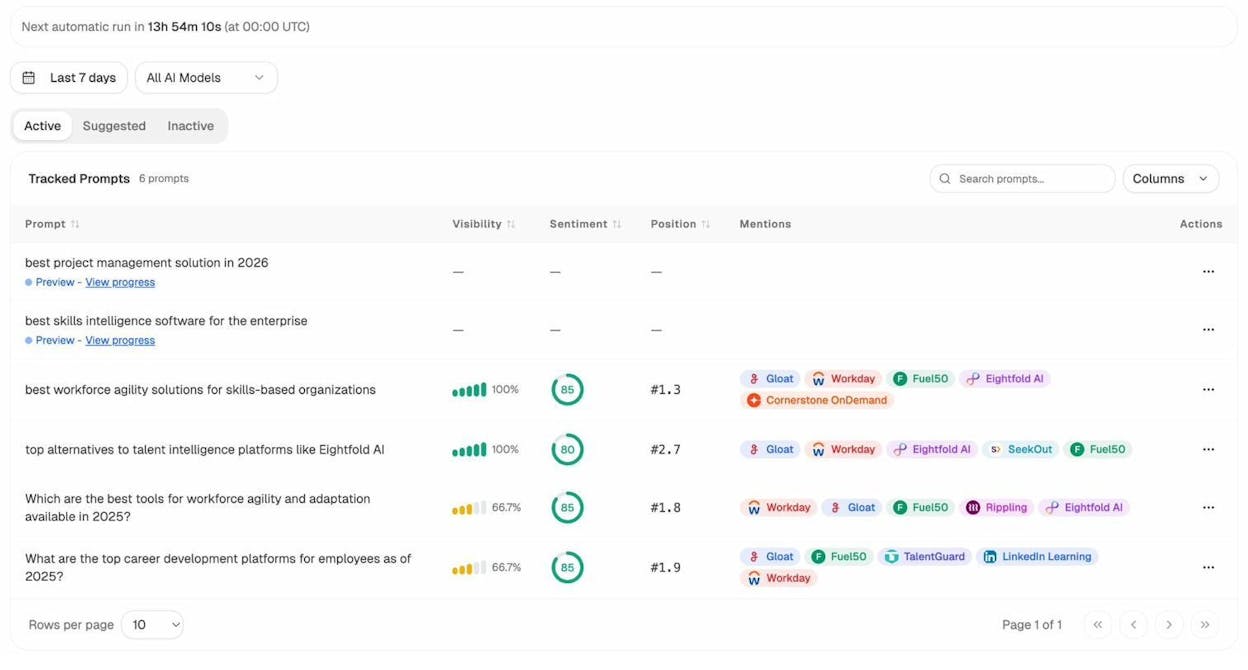
If your visibility is 100% on ChatGPT but 0% on Google AI Mode, that tells you exactly where to focus. If a competitor outranks you on a specific prompt, you can dig into why. Maybe they have better review coverage. Maybe their content is more comprehensive. Maybe their entity signals are stronger on a specific platform.
This is the AI search equivalent of rank tracking. And just like rank tracking in traditional SEO, it turns vague concerns into specific action items.
Common entity SEO mistakes to avoid
Now that you understand what entity SEO actually is (and isn’t), here are the mistakes that waste the most time.
Treating entity SEO as a separate discipline. It’s not. It’s a lens for understanding how Google and AI models interpret your content. Everything you do for entity SEO should already be part of your SEO strategy.
Obsessing over Knowledge Graph inclusion. Having a Knowledge Panel is nice. It’s not essential for ranking well. Plenty of brands rank on page one of Google without one. Focus on content quality and topical authority first.
Ignoring AI search entirely. This is the opposite mistake. Entity signals matter for both Google and AI models. If you optimize for one but not the other, you’re leaving visibility on the table. The good news is that the tactics overlap almost entirely. Quality content, authoritative mentions, and clear structured data help you in both channels.
Keyword stuffing in the name of “semantic SEO.” Including semantically related terms is useful. Cramming them into every paragraph is not. Write for the reader. If your content naturally covers the topic, the semantic signals will take care of themselves.
Chasing entity SEO tools and services. You don’t need a specialized entity SEO tool. You need a solid SEO toolkit for keyword research and competitive analysis, and an AI search analytics platform to track how AI models perceive and recommend your brand. That combination covers everything “entity SEO” promises and more.
Final thoughts
Two years ago, someone on Reddit asked for an SEO workflow that used advanced methodologies like entity SEO, topical authority mapping, and semantic NLP optimization.
The top answer from a senior SEO practitioner: none of the above.
The advice that actually worked? Find what your audience needs. Create the most helpful content you can. Make sure Google can access and understand it. Earn authority through genuine expertise and quality.
That advice hasn’t changed. And it applies just as much to AI search as it does to Google.
The brands that win in AI search are the same brands that win in traditional search: the ones with clear, useful, original content that earns trust from both users and algorithms. The difference is that now you also need to track your visibility across AI engines, understand which sources they cite, and make sure your entity signals are strong enough to get included in their responses.
Entity SEO isn’t a new strategy. It’s a new name for the strategy you should have been following all along.
The only truly new dimension is AI search. And if you want to see how your brand entity performs there, Analyze AI shows you exactly where you stand across ChatGPT, Perplexity, Gemini, Copilot, and more, all in one place.

Ernest

Ibrahim


