Top 8 AI Search Monitoring Tools That We’d Recommend Using in 2026
Written by
Ernest Bogore
CEO
Reviewed by
Ibrahim Litinine
Content Marketing Expert

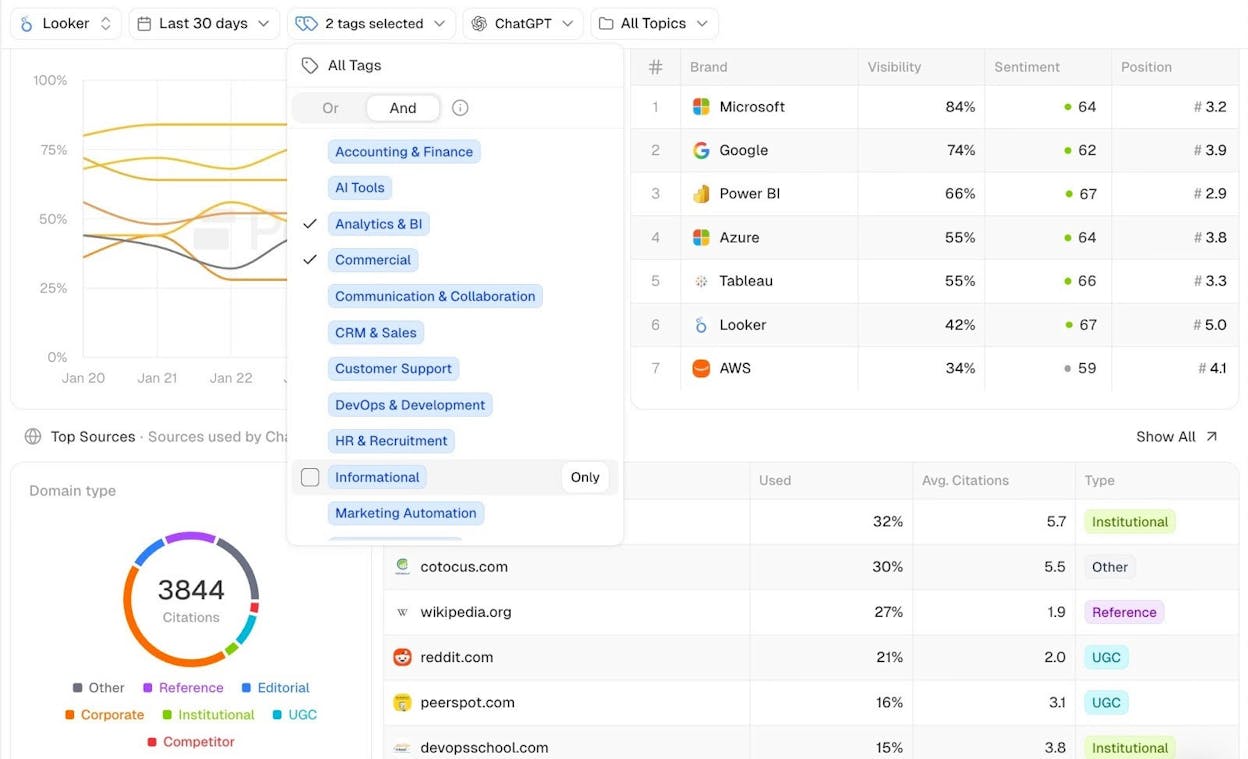
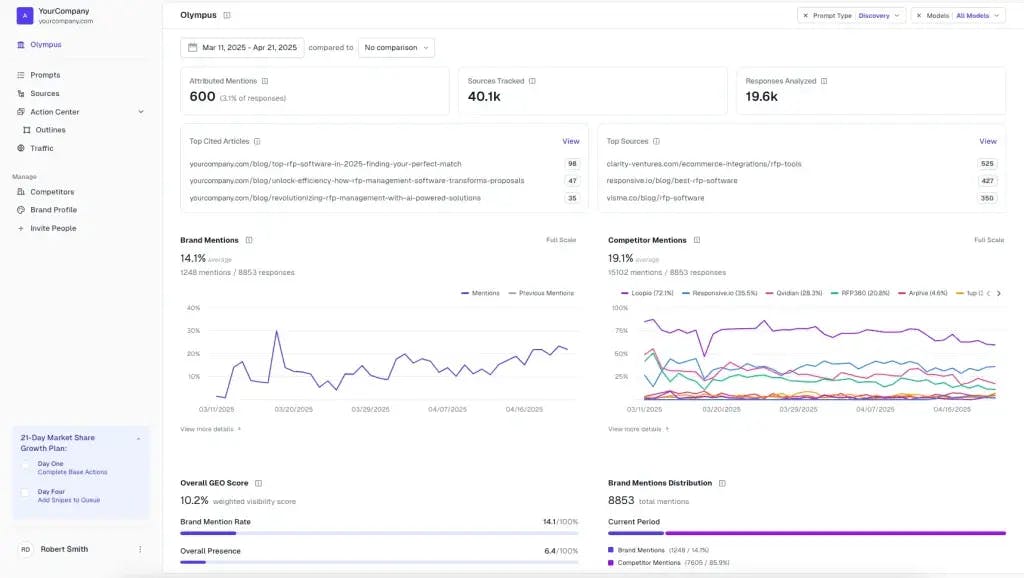
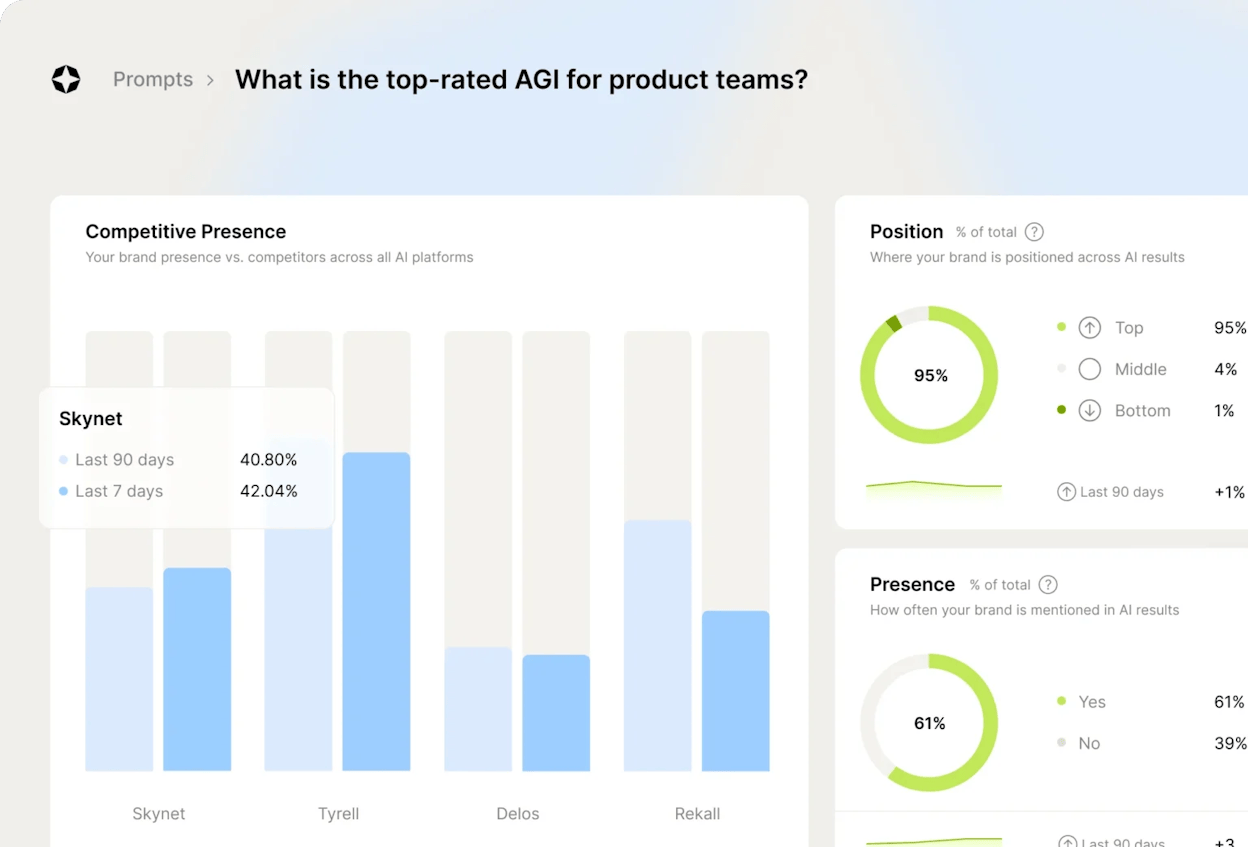
We evaluated the top 8 AI search monitoring tools. We tested how well they expose the moments your brand appears, disappears, or gets cited.
Table of Contents
TL;DR
|
Tool |
Best for |
Engine coverage (short) |
What makes it stand out |
Main limitations |
Starting price* |
|
Analyze AI |
Tying AI visibility to real traffic, conversions, and revenue |
ChatGPT, Perplexity, Claude, Copilot, Gemini |
Connects AI mentions to sessions, conversions, and ROI with prompt- and page-level attribution |
Needs proper analytics setup and baseline traffic; better for teams ready to work with data |
~$99/mo |
|
Peec AI |
Fast multi-engine brand visibility tracking |
ChatGPT, Perplexity, Claude, Gemini, AI Overviews |
Simple dashboards for brand + competitor tracking with prompt groups and multi-country views |
Monitoring-first (limited “how to fix” guidance); prompt-based pricing can scale up |
€89/mo (Starter) |
|
Semrush (AI Visibility Toolkit) |
Teams that want SEO + AI visibility in one platform |
ChatGPT, Google AI Mode, AI Overviews, others |
Deep integration with SEO data (keywords, ranks, backlinks) plus AI visibility and prompt research |
Steeper learning curve; premium pricing; data best read as trends, not exact counts |
$99/mo (AI toolkit add-on) |
|
Otterly.AI |
Simple prompt-level brand tracking for smaller teams |
ChatGPT, Google AIO/AI Mode, Perplexity, Gemini, Copilot |
Easy setup, clear views of prompts, brand mentions, sentiment, and citations |
Lighter analytics; fewer advanced features; coverage may miss some newer models |
$29/mo (Lite) |
|
RankPrompt |
Multi-engine prompt tracking with competitor insights and recommendations |
ChatGPT, Gemini, Grok, Perplexity |
Strong on competitive benchmarking and schema/citation guidance for key prompts |
Credit-based pricing can get expensive; less deep for complex global or persona use cases |
$49/mo (Starter) |
|
Profound |
Enterprise-grade topic clustering and citation-led AEO |
ChatGPT (Starter), more engines on higher plans |
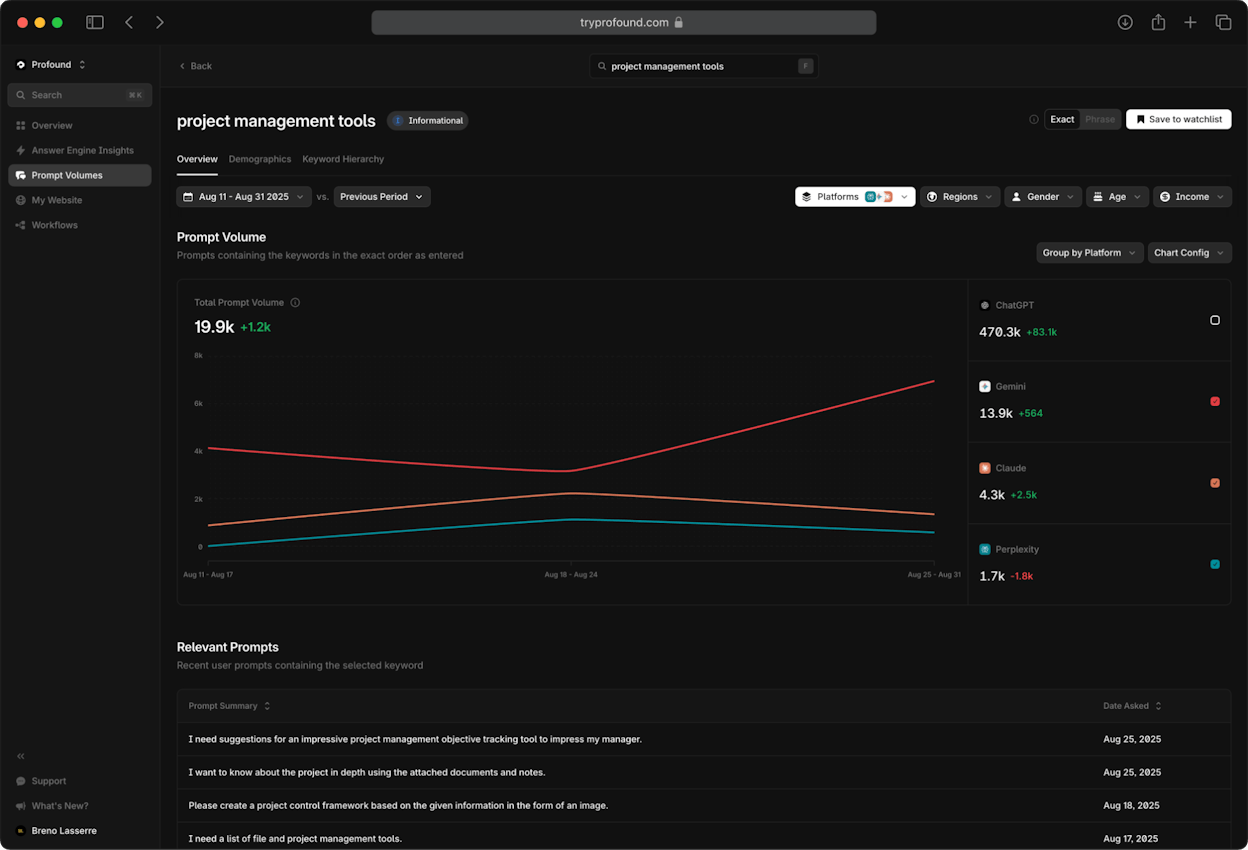
Clusters prompts into topics, maps cited domains, and supports big-data, multi-topic analysis |
Heavier onboarding; best when you already have mature SEO/content operations |
$99/mo (Starter) |
|
Gumshoe AI |
Persona-based prompt tracking and segmented AI visibility |
ChatGPT, Gemini, Perplexity |
Persona- and topic-level views that mirror real buyer journeys, with automated persona prompts |
Page-level optimization is basic; usage-based pricing can spike with heavy use |
Free, then $0.10/conversation (PAYG) |
|
LLMrefs |
Budget-friendly keyword-based multi-engine tracking |
ChatGPT, Gemini, Perplexity, Claude, Grok, others |
Keyword-first approach that feels familiar to SEO teams; 10+ engines, 20+ countries, simple UI |
Keyword-only view lacks conversational context; analytics and guidance are more basic |
$79/mo (Pro) |
Analyze AI: best AI search monitoring tool for tying visibility to real traffic and conversions
|
Area |
What Analyze AI does |
Why it matters for AI search monitoring |
|
Traffic attribution |
Ties AI referrals to sessions and conversions |
Helps teams answer, “Is AI search driving growth?” using real data |
|
Multi-engine tracking |
Monitors engines like ChatGPT, Perplexity, Claude, Copilot, Gemini |
Prioritizes engines based on actual revenue impact, not mentions |
|
Prompt & sentiment tracking |
Measures prompt performance by brand, position, and sentiment |
Helps teams understand which buying queries shape visibility and conversions |
|
Citation audit |
Identifies URLs and domains cited by AI systems |
Allows teams to focus effort on sources that boost AI trust and visibility |
|
Opportunity prioritization |
Highlights gaps and recommended actions by impact |
Helps avoid vanity metrics and focus on high-ROI improvements |
Key Analyze AI features
-
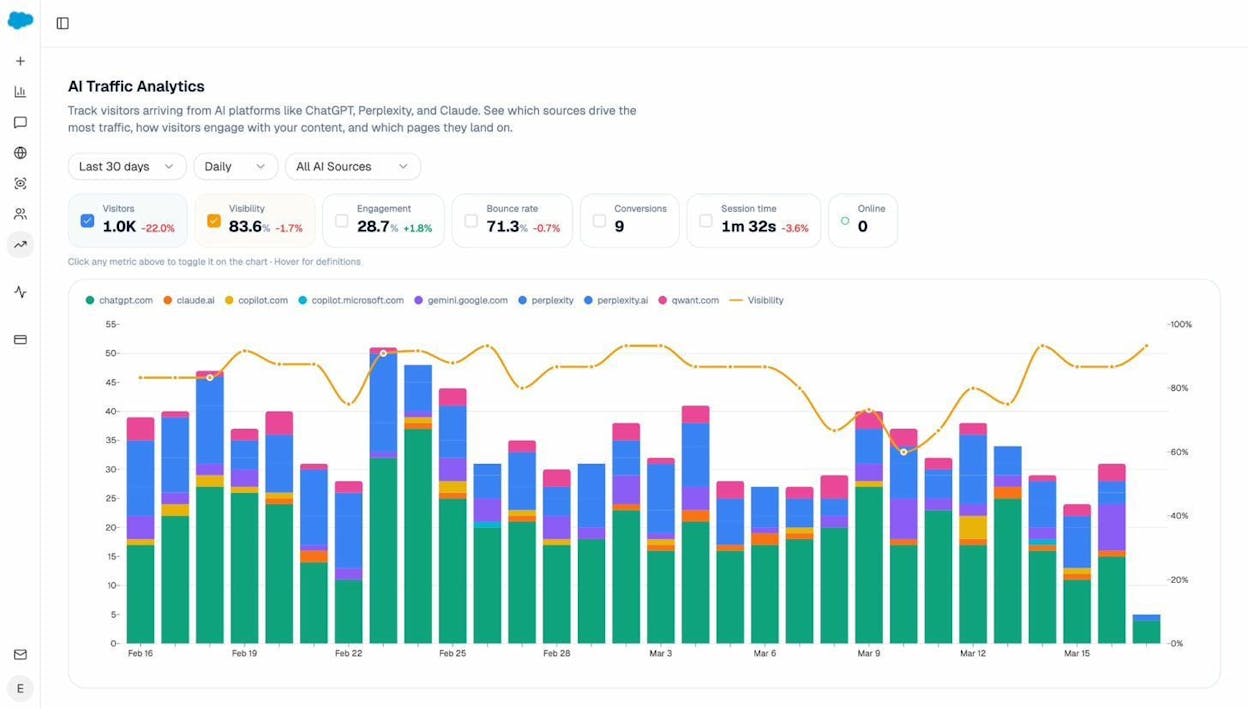
See actual AI referral traffic by engine and track trends that reveal where visibility grows and where it stalls.
-
See the pages that receive that traffic with the originating model, the landing path, and the conversions those visits drive.
-
Track prompt-level visibility and sentiment across major LLMs to understand how models talk about your brand and competitors.
-
Audit model citations and sources to identify which domains shape answers and where your own coverage must improve.
-
Surface opportunities and competitive gaps that prioritize actions by potential impact, not vanity metrics.
Here are in more details how Analyze AI works:
See actual traffic from AI engines, not just mentions

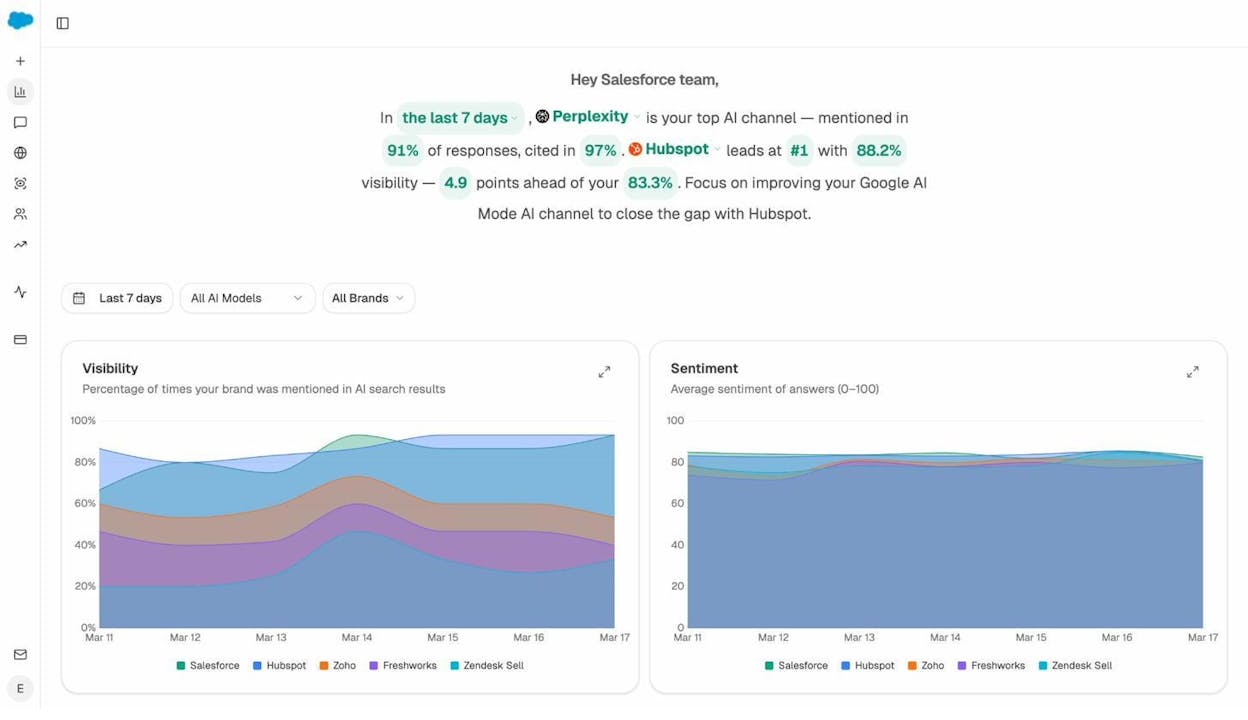
Analyze AI attributes every session from answer engines to its specific source—Perplexity, Claude, ChatGPT, Copilot, or Gemini. You see session volume by engine, trends over six months, and what percentage of your total traffic comes from AI referrers. When ChatGPT sends 248 sessions but Perplexity sends 142, you know exactly where to focus optimization work.

Know which pages convert AI traffic and optimize where revenue moves

Most tools stop at "your brand was mentioned." Analyze AI shows you the complete journey from AI answer to landing page to conversion, so you optimize pages that drive revenue instead of chasing visibility that goes nowhere.
The platform shows which landing pages receive AI referrals, which engine sent each session, and what conversion events those visits trigger.
For instance, when your product comparison page gets 50 sessions from Perplexity and converts 12% to trials, while an old blog post gets 40 sessions from ChatGPT with zero conversions, you know exactly what to strengthen and what to deprioritize.
Track the exact prompts buyers use and see where you're winning or losing

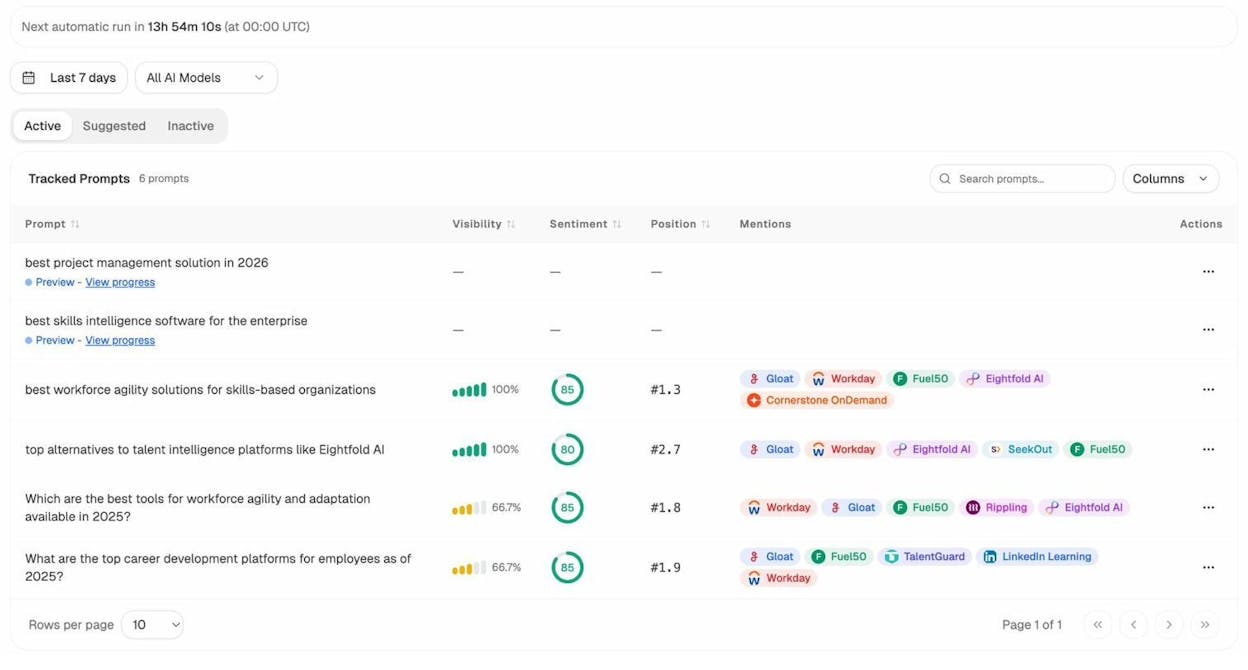
Analyze AI monitors specific prompts across all major LLMs—"best Salesforce alternatives for medium businesses," "top customer service software for mid-sized companies in 2026," "marketing automation tools for e-commerce sites."

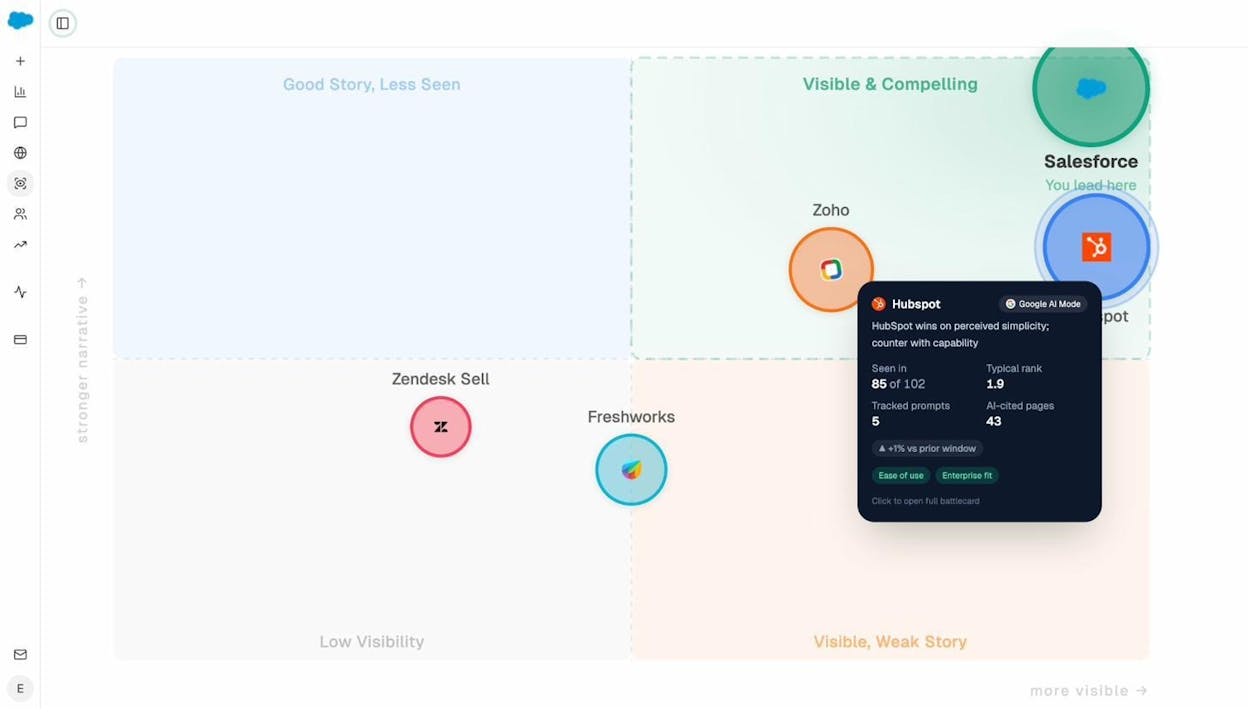
For each prompt, you see your brand's visibility percentage, position relative to competitors, and sentiment score.
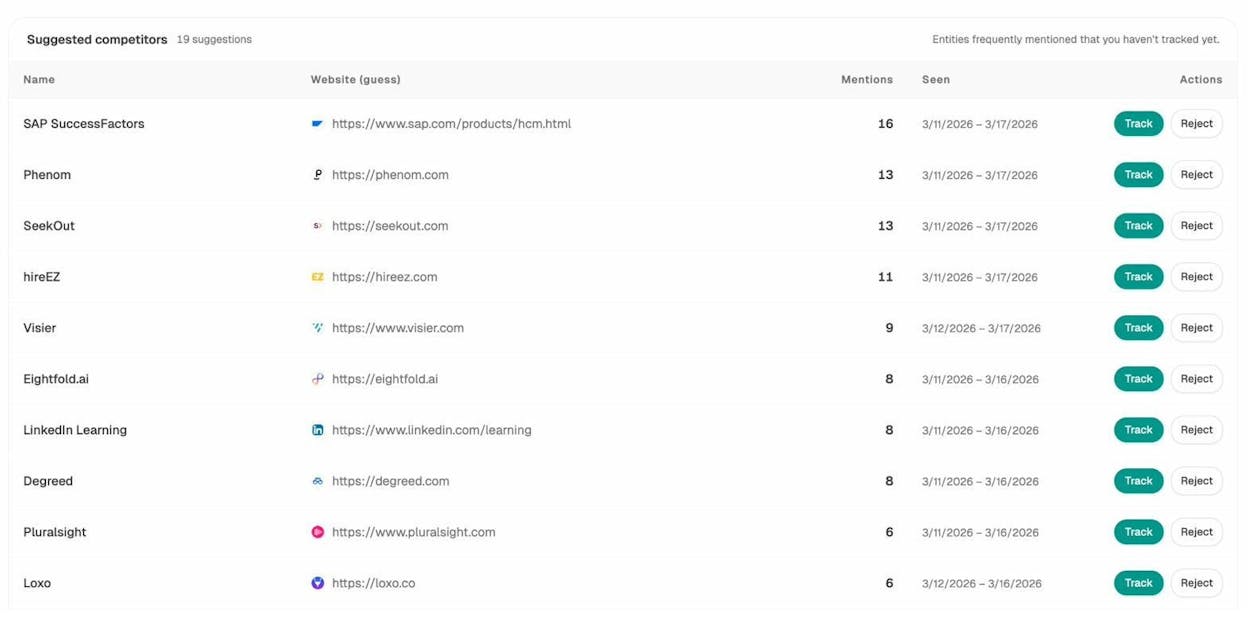
You can also see which competitors appear alongside you, how your position changes daily, and whether sentiment is improving or declining.

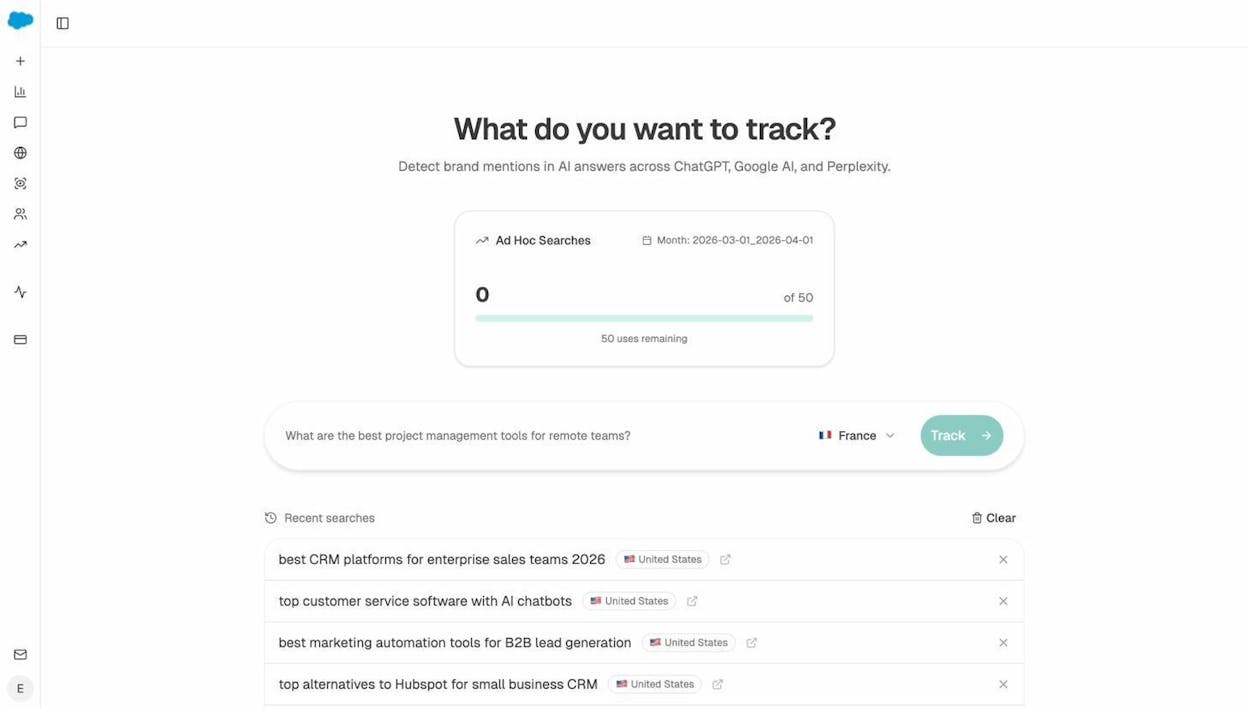
Don’t know which prompts to track? No worries. Analyze AI has a prompt suggestion feature that suggests the actual bottom of the funnel prompts you should keep your eyes on.
Audit which sources models trust and build authority where it matters

Analyze AI reveals exactly which domains and URLs models cite when answering questions in your category.
You can see, for instance, that Creatio gets mentioned because Salesforce.com's comparison pages rank consistently, or that IssueTrack appears because three specific review sites cite them repeatedly.

Analyze AI shows usage count per source, which models reference each domain, and when those citations first appeared.
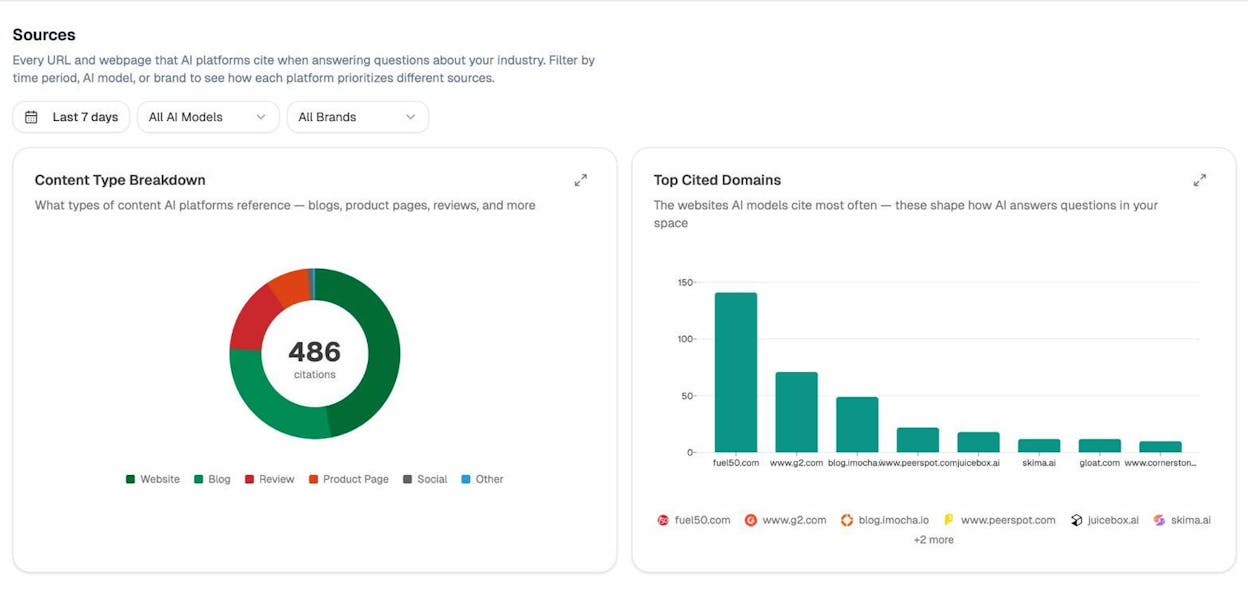
Citation visibility matters because it shows you where to invest. Instead of generic link building, you target the specific sources that shape AI answers in your category. You strengthen relationships with domains that models already trust, create content that fills gaps in their coverage, and track whether your citation frequency increases after each initiative.
Prioritize opportunities and close competitive gaps

Analyze AI surfaces opportunities based on omissions, weak coverage, rising prompts, and unfavorable sentiment, then pairs each with recommended actions that reflect likely impact and required effort.
For instance, you can run a weekly triage that selects a small set of moves—reinforce a page that nearly wins an important prompt, publish a focused explainer to address a negative narrative, or execute a targeted citation plan for a stubborn head term.
Best-fit use cases
-
In-house marketing teams that need to link AI visibility with conversions and pipeline.
-
SEO and content groups who want to prioritize improvements based on real traffic data.
-
Agencies tracking visibility across multiple clients and engines with ROI-linked reporting.
-
Product and growth teams aiming to understand which prompts and landing pages drive revenue.
Analyze AI goes beyond brand mentions by tying AI search visibility to actual traffic, conversions, and growth. It works best for teams willing to connect data and act strategically rather than chase vanity metrics.
Peec AI: best AI search monitoring tool for fast multi-engine brand tracking

Key Peec AI standout features
-
Tracks your brand across ChatGPT, Perplexity, Claude, Gemini, and AI Overviews.
-
Shows which prompts trigger your brand and how engines answer.
-
Measures share of voice, citations, and basic sentiment.
-
Benchmarks performance against chosen competitors.
-
Lets you group prompts by themes, products, or markets.
Peec AI gives teams a clear view of how AI engines talk about their brand across many models in one place. It helps you see which prompts lift your visibility, which engines favor your brand, and which competitors appear more often in key questions. The tool also makes it easy to set up focused prompt groups so your tracking follows real campaigns and not random tests.

It stands out because the setup is fast, the dashboards are simple, and the insights are easy for non-technical teams to use. You can see trends by market, compare gains with rivals, and spot when answers change tone or source. These views help teams act sooner, before shifts in AI search impact traffic or brand trust.
Peec AI has some limits because it focuses more on tracking than deep guidance. It shows gaps and sources but does not give step-by-step fixes or detailed playbooks. You must decide how to turn insights into real content or PR changes, which may be hard for teams with no analyst support.
Pricing can rise when you track many prompts or large regions, and brands with little AI visibility may see fewer early insights, which makes value harder to show. Peec AI works best when you already have some presence in AI answers and now want clean, repeated tracking across many models.
Peec AI pricing

Peec AI offers three plans that scale by prompt volume and support level, and each plan includes access to ChatGPT, Perplexity, and AIO, which makes the tool easy to test before committing because all plans allow unlimited countries and unlimited seats. The Starter plan (€89/month) suits growing startups since it tracks up to 25 prompts, runs them daily across models, and analyzes up to 2,250 answers with email support. The Pro plan (€199/month) is the most popular because it raises tracking to 100 prompts, expands analysis to 9,000 answers, and adds Slack support for faster team use. The Enterprise plan (€499+/month) fits large companies because it covers 300+ prompts, analyzes 27,000+ answers, and includes a dedicated account rep plus custom reporting, which helps teams with complex visibility needs.
Peec AI at a glance
|
Area |
What Peec AI does |
Why it matters for AI search monitoring |
|
Engine coverage |
Tracks brand and rival visibility across many AI engines |
Shows how often each model picks your brand over others |
|
Prompt tracking |
Lets you define and group key prompts |
Helps teams track the questions tied to real business goals |
|
Citations view |
Shows which sources engines trust |
Reveals where to focus content or PR to shift AI answers |
|
Competitor view |
Benchmarks share of voice and ranking trends |
Helps teams act when rivals gain ground inside AI results |
|
Market splits |
Supports multi-country tracking |
Surfaces gaps that normal SEO tools do not show |
Best-fit use cases
-
Brands with growing AI visibility that want clear tracking across models.
-
Teams that need simple dashboards for leadership updates.
-
Agencies managing a few high-value clients.
-
Global brands that want visibility by market or region.
Peec AI gives teams fast, clean insight into how AI engines present their brand. It works best for teams that want simple tracking and can turn visibility gaps into real action.
Semrush: best AI search monitoring tool for teams that want SEO and AI visibility in one place

Key Semrush standout features
-
Combines full SEO tools with AI visibility tracking in one platform.
-
Tracks prompts across ChatGPT, Google AI Mode, AI Overviews, and other LLMs.
-
Measures brand share of voice, sentiment, and frequency in AI answers.
-
Shows where competitors win prompts and where your visibility falls behind.
-
Offers a large prompt database to discover and track AI-driven questions.
Semrush brings AI visibility into the same workspace where teams already run keyword research, backlink audits, and site health checks. This connection makes it easier to compare how a brand performs in classic search results versus how AI engines present it in direct answers. You can follow prompt-level trends, study changes in answer tone, and see which engines highlight your brand most often, which helps teams understand where discovery shifts begin.
It also stands out because its AI insights sit beside a long history of SEO data, which gives strong context for trend analysis. You can see when visibility changes come from AI engines and when they come from shifts in rankings or competitor actions. Semrush One deepens this view by linking SEO and AI data together so teams can manage all discovery signals in one workflow.

That said, Semrush carries more complexity than lighter tools because its dashboards contain deep layers of data that take time to learn. The system highlights prompt wins, losses, and sentiment changes, but users still need to interpret those signals and turn them into clear actions. This makes the tool powerful for experienced teams but less friendly for newcomers who want immediate guidance.
Semrush also suits teams that already invest in SEO or competitive monitoring, since the platform’s scale and depth favor structured workflows rather than early-stage exploration. Because AI datasets shift often, visibility numbers should be viewed as directional trends, which means teams must rely on patterns rather than expecting perfect precision.
Semrush pricing

Semrush’s AI Visibility Toolkit costs $99 per month without a free trial, and this plan includes one folder, one domain for brand analysis, 300 daily AI queries, 25 tracked prompts, AI search checks for up to 100 pages, and shared access for added subusers at the same rate. You can expand limits by buying extra domains or locations for $99 each, or by using Semrush One, which raises prompt and website caps across its Starter, Pro+, and Advanced tiers. You can also purchase add-ons like 50 additional prompts for $60 per month, giving teams flexible ways to scale their AI tracking as campaigns grow.
Semrush at a glance
|
Area |
What Semrush does |
Why it matters for AI search monitoring |
|
SEO + AI in one place |
Combines SEO data with AI visibility tracking |
Lets teams see how AI answers shift visibility beyond rankings |
|
Multi-engine prompts |
Tracks prompts across ChatGPT, Google AI Mode, AIO, and more |
Reveals which AI engines surface your brand and where gaps appear |
|
Brand and sentiment |
Measures frequency, tone, and share of voice in AI answers |
Helps teams watch how AI systems shape brand trust and message framing |
|
Competitor view |
Shows which prompts competitors win and where you fall behind |
Supports faster action when rivals gain ground inside AI-driven answers |
|
Prompt research |
Offers a large database with volume and intent metrics |
Helps identify high-value AI questions worth tracking and improving |
Best-fit use cases
-
SEO teams that already use Semrush and want AI visibility inside the same system.
-
Content and competitive teams comparing prompt wins and brand share of voice.
-
Agencies supporting mid-market clients that need deeper AI reporting.
-
Enterprise teams tracking visibility across many markets and product lines.
Semrush gives teams one platform to track AI visibility and classic SEO together. It works best for teams that need depth, structure, and a complete view of modern discovery.
Otterly.AI: best AI search monitoring tool for simple, prompt-level brand tracking

Key Otterly.AI standout features
-
Turns keywords into conversational prompts and tracks them across major AI engines.
-
Measures brand mentions, sentiment, and context in AI-generated answers.
-
Shows which links and domains engines rely on when forming responses.
-
Covers ChatGPT, Google AI Overviews/AI Mode, Perplexity, Gemini, and Copilot.
-
Benchmarks your visibility and sentiment scores against chosen competitors.
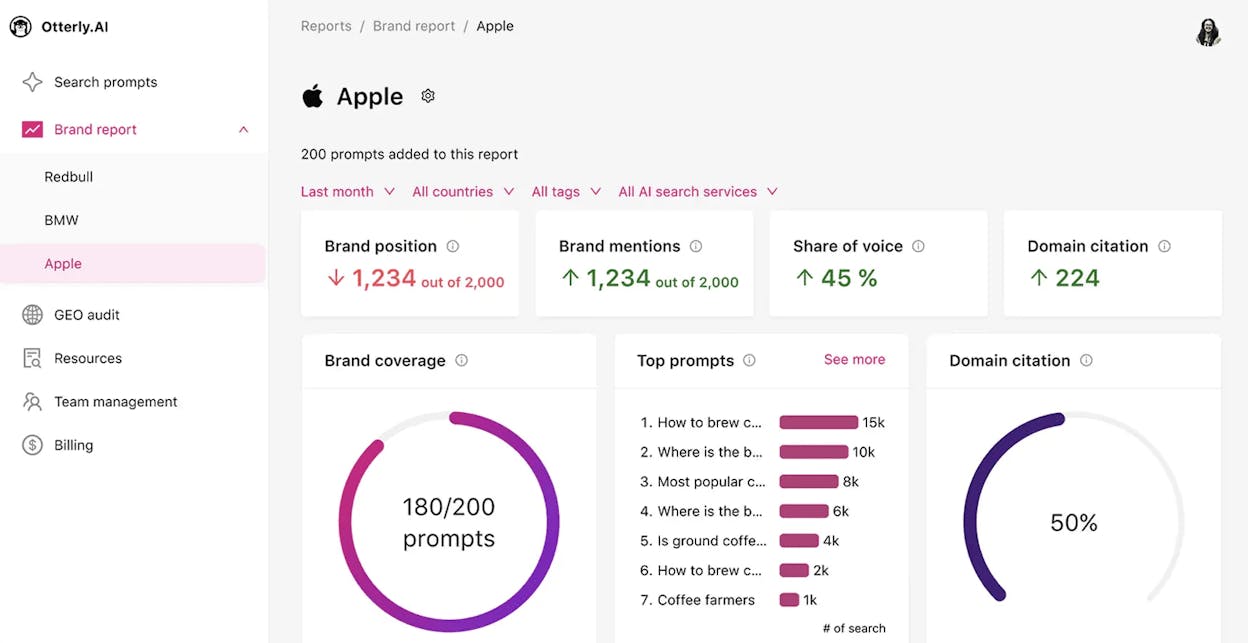
Otterly.AI focuses on helping teams understand how AI systems describe their brand inside real prompts, not just how pages rank on search engines. It takes the questions people would ask in daily conversations and checks those prompts across several AI platforms, giving teams a direct view of where they appear and what tone the engines use. This helps brands understand early signals about trust, authority, and relevance inside AI environments, which often shape perception before a user even reaches a website.

Another strength is the simplicity of setup, since teams only need to create a prompt library and let the system track results on a daily or weekly cycle. Dashboards fill with visibility, sentiment, and citation insights without manual testing, which makes the tool helpful for smaller teams or early-stage companies without analysts. This ease of use supports quick wins because teams can see where they rise or fall in AI answers and adjust messaging or content priorities with little friction.
However, Otterly.AI focuses more on visibility snapshots than deep analytics, and teams looking for highly detailed trend modeling or persona-level views may find its reporting less advanced than enterprise tools. The platform highlights prompt outcomes and citation sources but does not guide users through optimization steps, which means each team must interpret the data and build its own action plan.
Coverage can also vary across engines, since Otterly supports major models but may not track newer or smaller LLMs in full detail. Because AI systems change often, teams must treat Otterly’s insights as directional patterns rather than exact numbers. This works well for spotting gains or drops in visibility, but not for users who expect precise ranking-style measurement.
Otterly.AI pricing

Otterly.AI offers three plans that scale by prompt volume and engine support, and each tier includes daily tracking across ChatGPT, Google AI Overviews, Perplexity, and Microsoft Copilot. The Lite plan ($29/month) tracks 15 prompts and suits small teams testing AI visibility for the first time. The Standard plan ($189/month) raises the limit to 100 prompts and allows add-ons of 100 extra prompts for $99, which helps growing teams manage larger campaigns. The Premium plan ($489/month) supports 400 prompts with the same add-on structure, giving agencies and mid-size brands room to scale their prompt library while keeping access to the same core engines.
Otterly.AI at a glance
|
Area |
What Otterly does |
Why it matters for AI search monitoring |
|
Prompt tracking |
Converts keywords into prompts and tests them across engines |
Offers a clear view of how AI systems talk about your brand |
|
Brand mentions |
Measures visibility and sentiment inside answers |
Shows whether engines see your brand as credible or secondary |
|
Citation analysis |
Lists the links AI engines rely on |
Helps teams target the sources shaping AI-generated responses |
|
Multi-engine support |
Covers ChatGPT, Google AIO, Perplexity, Gemini, Copilot |
Centralizes tracking across major AI search systems |
|
Competitor view |
Compares visibility and tone with rivals |
Helps spot risks or wins inside prompt categories that matter |
Best-fit use cases
-
Small and mid-sized teams that want simple prompt tracking and brand visibility checks.
-
SEO teams converting keyword lists into conversational prompts to monitor AI shifts.
-
Agencies or consultants adding AI visibility reporting to client work.
-
Product and content teams tracking sentiment trends in AI-generated answers.
Otterly.AI gives teams an easy way to track prompts, measure brand mentions, and study citation sources across major AI engines. It works best for teams that want simplicity and clarity rather than deep enterprise analytics.
RankPrompt: best AI search monitoring tool for multi-engine prompt tracking and competitor insight

Key RankPrompt standout features
-
Tracks brand visibility across ChatGPT, Gemini, Grok, and Perplexity.
-
Highlights which prompts mention your brand and which favor competitors.
-
Compares mentions, citations, and positions across rival brands.
-
Suggests schema, citation, and content fixes to improve inclusion.
-
Monitors prompt trends over time to show progress and gaps.
RankPrompt focuses on how AI systems respond to real questions users might ask, turning those prompts into clear visibility signals across major engines. It shows where your brand appears, where it gets skipped, and why certain prompts lean toward competitors. This helps teams understand early shifts in AI-driven discovery that classic SEO tools cannot capture. The platform also digs into citation patterns so you can see which sources engines trust and which missing links might be holding back visibility.

Another strength lies in its ability to connect prompt outcomes to practical fixes. RankPrompt uses its trend data to highlight specific prompts where you lose ground, along with suggestions for schema updates, new content angles, or citation improvements. This blend of measurement and guidance supports teams that need insight and direction without building their own workflow from scratch. It also supports agencies or multi-brand teams that need side-by-side comparisons across many client prompts.
RankPrompt, however, can become expensive as your prompt library grows because the pricing is tied to credits. Each test consumes credits, so teams running large sets of prompts or tracking many brands may see usage rise quickly. This structure works well for focused prompt sets but may require close management for broad campaigns.
The tool also delivers less depth in persona segmentation or advanced analytics compared to higher-end enterprise platforms. While RankPrompt offers useful recommendations, teams operating across global markets or multilingual prompts may need extra tools to cover deeper insights. This makes RankPrompt strong for core visibility tracking but less suited for teams seeking heavy analytical layers.
RankPrompt pricing

RankPrompt uses a credit-based model with plans that scale by usage, starting with the Starter plan ($49/month) that includes 150 credits for about 5–6 reports and suits individuals testing key prompts. The Pro plan ($89/month) raises the limit to 500 credits for 17–20 reports and fits small teams running regular checks. The Agency plan ($149/month) offers 1,000 credits for 35–40 reports and supports multi-brand monitoring, expanded dashboards, and priority support, making it a better fit for agencies or power users.
RankPrompt at a glance
|
Area |
What RankPrompt does |
Why it matters for AI search monitoring |
|
Multi-engine tests |
Tracks prompts across ChatGPT, Gemini, Grok, Perplexity |
Offers a full view of how engines differ in brand visibility |
|
Prompt benchmarking |
Shows which prompts include or exclude your brand |
Helps teams find gaps that reflect real user questions |
|
Competitor insight |
Compares mentions, citations, and rankings |
Reveals areas where rivals dominate AI answers |
|
Citation guidance |
Suggests structured data and link fixes |
Helps influence the sources that shape AI responses |
|
Trend tracking |
Monitors visibility changes over time |
Shows whether optimization efforts improve AI presence |
Best-fit use cases
-
Brands and agencies needing structured prompt tracking across multiple AI engines.
-
Teams studying where rivals gain visibility in conversational searches.
-
SEO and content teams turning keyword lists into prompt clusters.
-
Organizations that want tactical guidance for improving AI inclusion.
RankPrompt gives teams a clear view of AI visibility across engines and helps them pinpoint prompt gaps that matter. It works best for teams that want structured tracking with practical optimization cues.
Profound: best AI search monitoring tool for deep topic clustering and citation-driven insight

Key Profound standout features
-
Groups related prompts into structured topic clusters to reduce manual work.
-
Maps the domains and sources AI engines rely on when forming answers.
-
Highlights where competitors gain visibility and where you fall behind.
-
Tracks long-term topic performance to measure AEO progress.
-
Offers high-volume analytics and big-data benchmarks for enterprise teams.
Profound focuses on understanding AI visibility at a deeper structural level, making it ideal for teams that want more than simple prompt checks. It combines prompt clustering, citation analysis, and competitor benchmarking so users can see how AI engines understand whole themes, not just single questions. This view helps teams understand how intent families shift, which topics expand or shrink in visibility, and where brand gaps start to emerge.

Another advantage is the way Profound connects clustered prompts with the sources that AI engines trust most. By showing which domains or URLs appear again and again inside AI answers, the platform helps teams identify which content formats, citations, or partnerships could lift long-term visibility. This structured approach supports content and SEO teams that want to align planning, optimization, and AEO strategy under one system. Profound is especially useful for organizations that already manage large content inventories and need deeper insight into how AI systems interpret them.
Profound’s depth also brings more onboarding and operational complexity than lighter tools. Teams that are early in their AI journey or have limited resources may find the platform’s taxonomies, dashboards, and clustering logic harder to adopt. Because the tool is built for scale, it assumes that brands already have enough content and visibility to analyze, which can make it feel heavy for early-stage teams.
It also fits best when a company has an established SEO or content program. Profound’s advanced analytics make the most sense when teams work with dozens of topics and want to tie AI visibility back to full-funnel content planning. For simple prompt checks or early-stage monitoring, it may be more tool than needed.
Profound pricing

Profound offers three tiers shaped around prompt volume and engine coverage. The Starter plan ($99/month) tracks 50 prompts and supports ChatGPT only, making it suitable for early monitoring. The Growth plan ($399/month) tracks 100 prompts across three AI engines and includes up to six optimized articles each month, which suits brands scaling their AEO efforts. The Enterprise tier is custom, expanding to ten engines, multiple companies, tailored prompt plans, and dedicated support, which fits large teams running full AEO campaigns.
Profound at a glance
|
Area |
What Profound does |
Why it matters for AI search monitoring |
|
Topic clustering |
Groups related prompts into themes |
Shows how AI engines understand entire topics, not single queries |
|
Citation analysis |
Maps domains AI engines rely on |
Helps teams focus on sources that influence AI-generated answers |
|
Competitor tracking |
Highlights rival visibility inside clusters |
Reveals where competitors dominate entire intent families |
|
Trend insights |
Tracks visibility shifts over time |
Helps teams measure the impact of AEO improvements |
|
Enterprise analytics |
Handles large datasets and deep queries |
Supports complex content programs with structured guidance |
Best-fit use cases
-
Enterprise or mid-market teams investing in structured AEO and deep content programs.
-
SEO teams needing scalable clustering and citation-led optimization.
-
Competitive teams analyzing visibility gaps across full topic families.
-
Organizations linking topic clusters to long-term AI visibility and ROI.
Profound gives teams a structured, high-depth view of AI visibility across clusters and citations. It works best for brands with mature SEO systems that need enterprise-level insight.
Gumshoe AI: best AI search monitoring tool for persona-based prompt tracking and segmentation

Key Gumshoe AI standout features
-
Generates prompts that reflect different buyer personas to show how AI engines shift brand visibility by audience.
-
Tracks presence across key AI systems like ChatGPT, Gemini, and Perplexity.
-
Segments insights by persona or topic to reveal where a brand resonates or underperforms.
-
Benchmarks competitors across the same personas and prompt sets.
-
Surfaces visibility gaps and recommended focus areas through automated reports.
Gumshoe AI centers its entire model on the idea that real users ask different questions depending on who they are, and AI engines adjust their answers accordingly. Instead of treating all prompts the same, the platform builds and tests persona-shaped queries so teams can see how a brand performs across various audience types. This makes the insights more grounded in behavior, not just keywords, allowing marketers to match visibility patterns to real buyer journeys.

It also reduces manual effort by generating persona prompts and running them through multiple AI engines automatically. This workflow helps teams compare results, study tone and framing, and identify where competitors capture attention inside each persona group. Because it clusters visibility by topic and persona, the platform gives a layered view of AI perception that many general tools overlook, which helps brands detect shifts in demand or misalignment in their messaging.
Gumshoe’s persona strength does come with some trade-offs, particularly at the content level. The platform’s optimization features are often described as basic, offering limited depth for teams that want detailed article or schema guidance. This means teams may still need separate tools or manual review to translate persona insights into granular updates. Pricing can also rise for teams running large numbers of report “conversations,” so usage must be monitored to avoid unexpected costs.
Because Gumshoe places heavy focus on personas and segmentation, it may feel less helpful for teams that only need simple prompt rankings. Early-stage brands or teams without a clear persona strategy might struggle to extract the full value, while more mature marketing groups will benefit most from its structured segmentation.
Gumshoe AI pricing

Gumshoe offers three tiers, starting with a Free plan that includes three report runs to establish baseline visibility and explore core persona insights. A Pay-as-You-Go tier charges $0.10 per conversation and adds scheduled reporting, trend tracking, optimization suggestions, and AI-assisted content generation. The Enterprise option is custom and includes all features, volume discounts, dedicated support, and integration options for teams with complex visibility requirements.
Gumshoe AI at a glance
|
Area |
What Gumshoe AI does |
Why it matters for AI search monitoring |
|
Persona prompts |
Builds queries shaped by real buyer types |
Reveals how AI engines shift brand visibility across audiences |
|
Multi-model visibility |
Tests prompts on ChatGPT, Gemini, Perplexity, and more |
Shows how different AI engines interpret and rank your brand |
|
Segmented reporting |
Groups insights by persona and topic |
Helps teams detect strengths and weaknesses by audience intent |
|
Competitor tracking |
Compares visibility across persona clusters |
Highlights where rivals win specific customer segments |
|
Automated insights |
Surfaces gaps and suggested focus areas |
Helps teams act on patterns without heavy manual analysis |
Best-fit use cases
-
Content and marketing teams studying how AI represents their brand across buyer personas.
-
SEO teams aligning AI visibility with persona-based search behavior.
-
Agencies running segmented AI visibility audits for multiple clients.
-
Strategy teams seeking deeper signals about how different user types perceive the brand.
Gumshoe AI delivers persona-driven insights that reveal how AI engines adjust brand visibility across audience types. It works best for teams that want segmentation and behavioral depth rather than broad prompt averages.
LLMrefs: best AI search monitoring tool for keyword-based, multi-engine tracking

Key LLMrefs standout features
-
Tracks keyword visibility across AI engines instead of prompts, making onboarding easier.
-
Supports ChatGPT, Gemini, Perplexity, Claude, Grok, and additional emerging engines.
-
Reports keyword rankings, citations, and referenced sources in AI-generated answers.
-
Benchmarks visibility against competitors for the same keyword sets.
-
Uses a simple dashboard suited for early-stage teams and SEO-style workflows.
LLMrefs focuses on the familiar structure of keyword tracking, which helps teams move from classic SEO to AI search without redesigning their entire workflow. Instead of building prompt libraries, teams track keyword lists and see how those keywords appear across major AI engines. This structure speeds up adoption because teams instantly recognize the data format and can evaluate visibility patterns with little friction. It is especially useful for spotting early visibility gaps across engines and adjusting strategy before competitors pull ahead.

Another advantage is its global reach and engine coverage. With support for over ten AI models, twenty countries, and multiple languages, LLMrefs offers international visibility tracking at a cost low enough for startups and small teams. The dashboards summarize keyword performance, cited URLs, and basic competitive comparisons, giving early-stage teams a clear understanding of where they stand in AI-driven discovery. Its low price point and straightforward interface make it one of the easiest entry paths into multi-engine AI monitoring.
However, the focus on keyword-level tracking limits the contextual depth teams can extract. Because it does not monitor conversational prompts, LLMrefs may miss subtle differences in tone, framing, and persona-specific answers that appear when queries are phrased naturally. Teams wanting deeper segmentation or prompt-driven insights may find themselves needing additional tools.
The simplicity that makes LLMrefs appealing also means its dashboards and optimization reports stay relatively lightweight. It offers helpful directional signals but lacks the heavier analytics, advanced insights, or strategic guidance found in more premium AEO platforms. As a result, it works best as a starter tool rather than a full enterprise solution.
LLMrefs pricing

LLMrefs offers a single primary plan at $79 per month, which includes tracking for 50 keywords, access to more than ten AI engines, weekly updates, geo-targeting across twenty countries and ten languages, and support for unlimited projects and team members. The plan also adds keyword search volume estimates, CSV/API export, and extra utilities like an AI crawlability checker and A/B content tester, making it a strong value for teams beginning to track AI visibility at scale.
LLMrefs at a glance
|
Area |
What LLMrefs does |
Why it matters for AI search monitoring |
|
Keyword tracking |
Monitors keywords instead of prompts |
Makes AI visibility easier for SEO-focused teams |
|
Multi-engine support |
Covers ChatGPT, Gemini, Perplexity, Claude & more |
Shows how visibility shifts across different AI ecosystems |
|
Citation insights |
Lists sources AI engines rely on |
Helps teams see which domains influence AI answers |
|
Competitive view |
Benchmarks keyword visibility vs rivals |
Identifies early gaps and opportunities in AI discovery |
|
Simple interface |
Offers a lightweight dashboard |
Fits the needs of early-stage teams without complex setup |
Best-fit use cases
-
Startups and small teams moving from SEO to AI visibility tracking.
-
Teams that prefer keyword-based monitoring instead of prompt workflows.
-
Brands needing a cost-effective, multi-engine starter tool.
-
Organizations tracking visibility across multiple countries and languages.
LLMrefs offers an affordable and simple way to monitor keyword visibility across many AI engines. It is ideal for early-stage teams that want quick insights without the complexity of prompt-level tools.
Tie AI visibility toqualified demand.
Measure the prompts and engines that drive real traffic, conversions, and revenue.
Similar Content You Might Want To Read
Discover more insights and perspectives on related topics

Check Website Accessibility: Manual Checks and Tools to Use in 2026

PEEC AI vs Otterly AI: A Comprehensive Comparison

9 Top Marketing Trends to Watch in 2026

7 Best LLM.txt Generator Tools (Tested Firsthand)

5 Best AI Sentiment Analysis Tools For AI Search Monitoring