



Summarize this blog post with:


A niche keyword is a search query that points to a small, specific slice of a larger market. In the jacket market, “jacket” is the head term. “Sustainable jacket” and “recycled wool jacket” are niche.
![[Screenshot of three rows showing “jacket” as a head term branching out into niche variations like “sustainable jacket” and “recycled wool jacket”, with rough volume numbers next to each]](https://www.datocms-assets.com/164164/1778513795-blobid1.png?auto=format,compress&w=1248&fit=max)
The reason to chase them is simple. They have less competition, the searcher knows exactly what they want, and the traffic converts. The trade-off is volume. You won’t replace a head term with a single niche keyword. You replace it with a portfolio of fifty.
In this article, you’ll learn how to find niche keywords that bring in highly targeted traffic without forcing you to compete against billion-dollar brands. You’ll also learn how to extend the same idea to AI search, so the work you do for Google compounds into mentions on ChatGPT, Perplexity, Gemini, and Copilot.
Table of Contents
What actually makes a keyword “niche”
Most articles treat niche and low-volume as the same thing. They aren’t.
A niche keyword has three traits at the same time. First, it has a specific intent that doesn’t fit cleanly under a head term. “Vegan leather jacket” is niche. “Best jacket 2025” is not, even if a long-tail variant of it has low volume. Second, the SERP is dominated by content that targets the exact phrase, not pages that rank for it accidentally. Third, the topic appeals to a defined audience, which usually means the click rate of the people who do search is high.
Without all three, you’re not looking at a niche keyword. You’re looking at a low-volume keyword, which is often a misspelling or a synonym of a more popular term. We’ll come back to this in Step 3, because failing this check is the single biggest reason new sites publish niche content that never ranks.
If you want a broader primer before continuing, our guide on SEO keywords covers the foundations, and our breakdown of 22 keyword types explains how niche fits into the wider keyword landscape.
Step 1. Build a raw seed keyword list
The seed keyword is the broad term that points to your market. “Mechanical keyboard” is a seed. So is “soap making” or “pour over coffee.”
The fastest way to expand a seed into hundreds of variants is to drop it into a keyword tool that returns matching terms. We use Ahrefs Keywords Explorer in the steps below because it’s the de facto standard, but the same approach works in any tool that returns search volume and difficulty for a parent keyword.
Type your seed term into Keywords Explorer and hit enter.
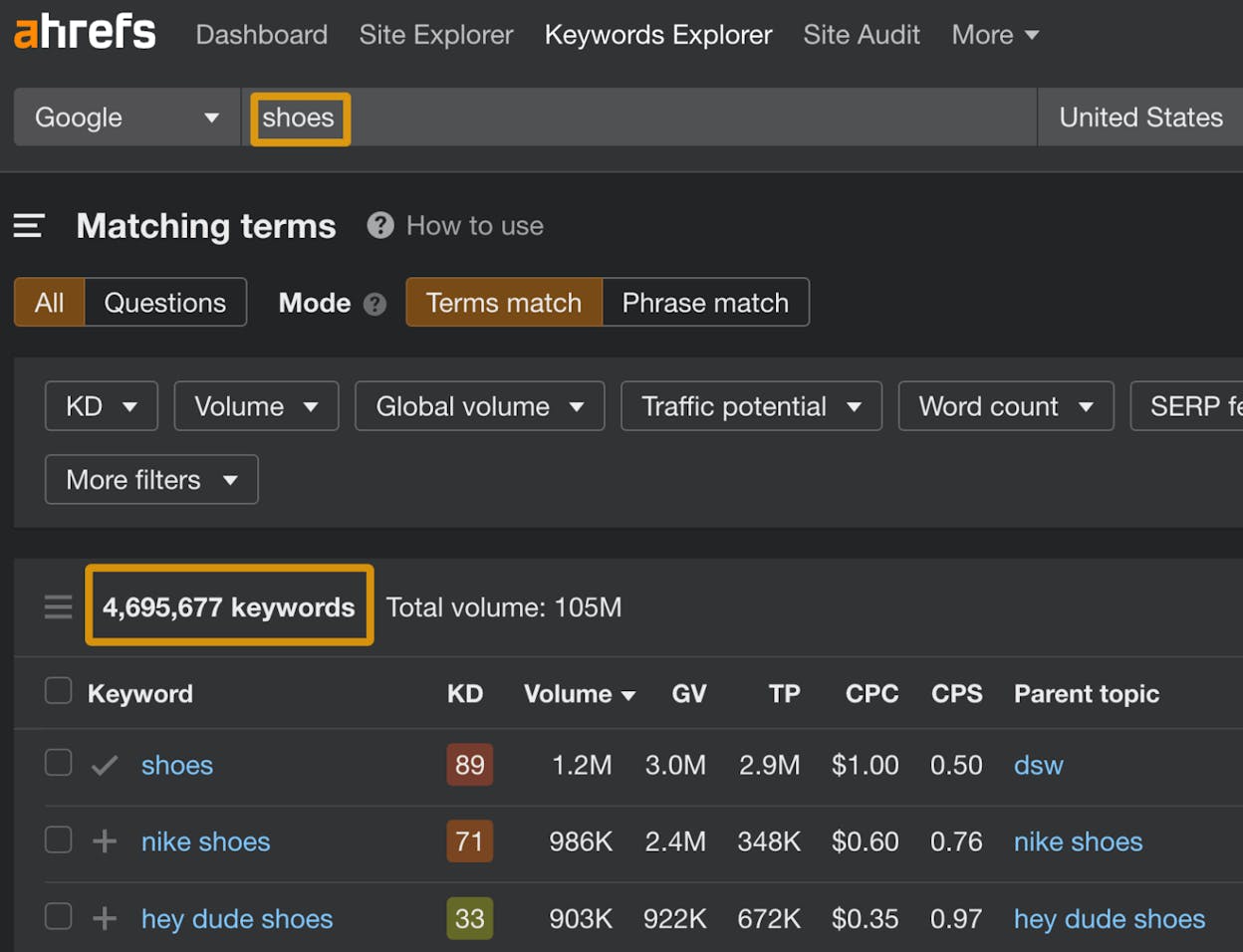
Open the Matching terms report. You’re now looking at every keyword that contains your seed, sorted by volume.
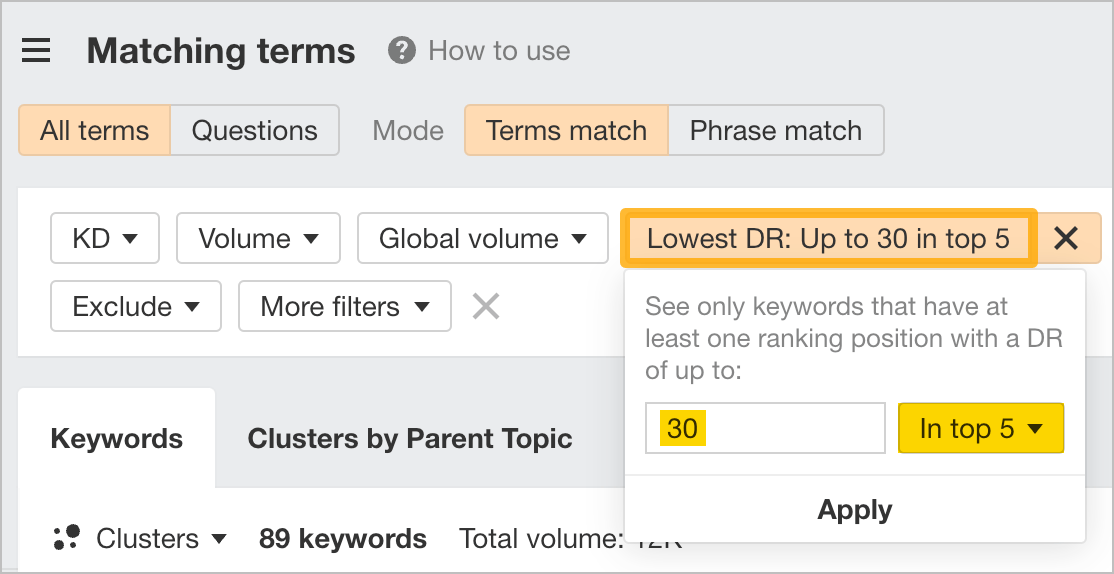
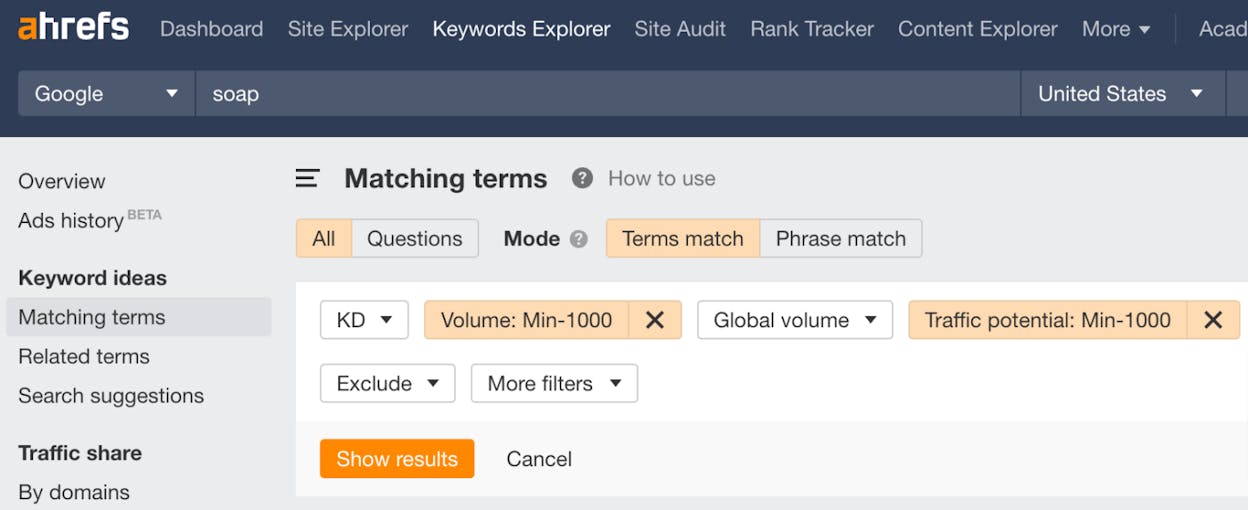
Set the maximum volume filter to something low. There’s no universal number. For a small market like artisan soap, 500 is reasonable. For a large market like running, 2,000 might still be niche. Set the maximum Traffic Potential (TP) filter to the same number. The volume filter alone isn’t enough, because some low-volume queries actually live under a parent topic with thousands of monthly searches. The TP filter strips those out.
If you don’t have access to a paid tool, you can build a respectable seed list with free options. Our keyword generator tool returns long-tail variations of any seed, and our Bing keyword tool surfaces the questions and phrases people search on Bing, which often correlate with niche terminology that hasn’t been overcrawled by SEO writers. For ecommerce niches, the Amazon keyword tool is particularly strong because product searches on Amazon are far more specific than on Google.
You can also pull seeds from Reddit threads, niche subreddit search, YouTube comment sections, Quora, and forum titles. The pattern is the same. You’re looking for the language a sub-segment of your audience uses when they’re not in front of a Google search box.
By the end of Step 1 you should have a raw list of a few hundred to a few thousand keywords. It will be messy. That’s expected.
Step 2. Refine the list with three filter combinations
Reading through 4,000 matching terms by hand is a waste of a day. Instead, layer filters until the list is short enough to skim.
Three filter combinations do most of the work.
Combination 1. Low difficulty plus a real volume floor
This is the obvious starting point and still the most useful.
-
Set Keyword Difficulty (KD) to a maximum of 10
-
Set Volume to a range of 100 to 1,000
-
Set Traffic Potential to a range of 100 to 1,000
-
Click Show results
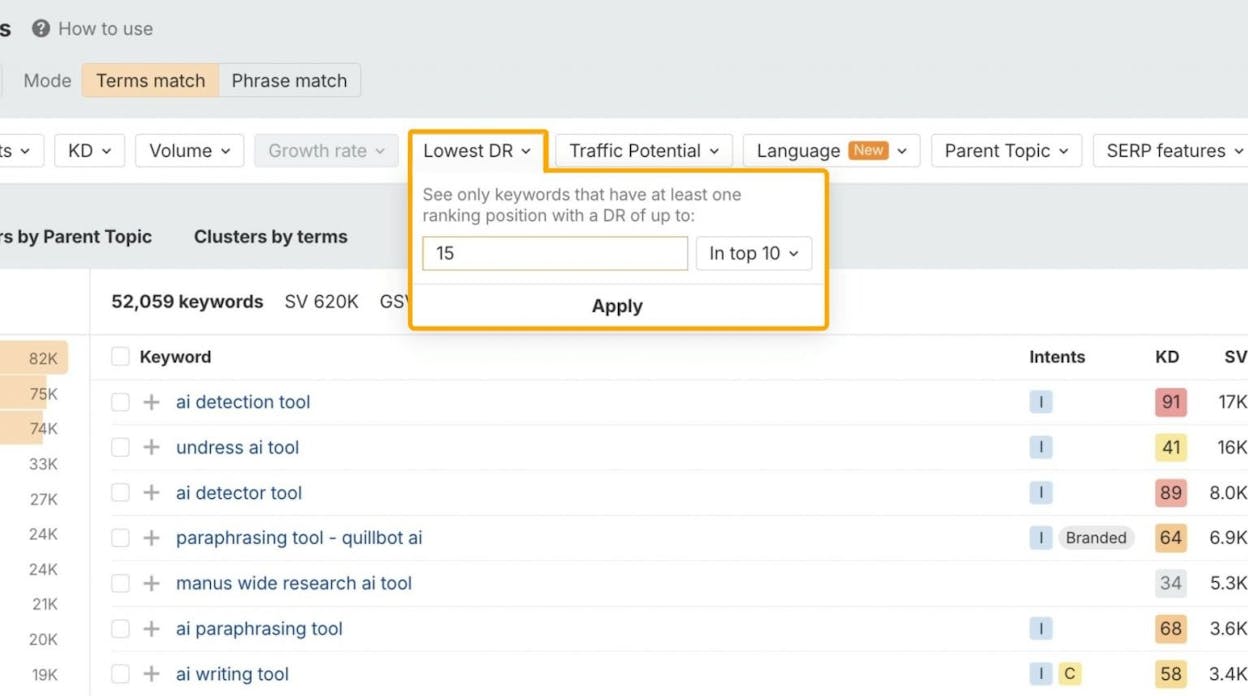
Browse the result. When a keyword fits your business, click the star icon and add it to a list inside the tool so you don’t lose it.
The KD threshold is a starting point, not a rule. New sites should be aggressive (KD 0–5). Sites with some authority can push to KD 20 and still rank. You can validate your real ceiling with our free keyword difficulty checker or our website authority checker, which estimates your domain’s competitive range.
Combination 2. Modifier filtering for use cases, segments, and features
Modifiers are the words that turn a generic search into a specific one. “For,” “alternative to,” “without,” “vs,” “with,” “for beginners,” “small,” “DIY,” “homemade.” When a searcher adds a modifier, they’re declaring an intent.
In Keywords Explorer, open the Terms tab. It shows the most frequent words in your matching list and lets you filter by them.
Switch the Include filter to “Any word,” type a comma-separated list of modifiers, and apply.
You’ll get a much shorter list of keywords that all carry intent. As you scan, you’ll spot more modifiers worth adding. “Without lye” might lead to “without palm oil,” which leads to “with coconut oil only.” Each iteration narrows you closer to the actual problems your customer is searching.
Combination 3. The Questions filter
Questions are gold for niche content because they map directly to informational intent and pull in featured snippets and AI Overviews.
In the Matching terms report, switch the dropdown from All to Questions.
![[Screenshot of the Matching terms report dropdown switched from “All” to “Questions”]](https://www.datocms-assets.com/164164/1778513814-blobid6.png?auto=format,compress&w=1248&fit=max)
Now you’re looking at every “how,” “what,” “why,” “is,” “does,” “can” variation of your seed. Combine the Questions filter with the KD and Volume filters from Combination 1, and you’ll have a list of niche question keywords with low competition.
When you spot a keyword that’s clearly outside your wheelhouse, drop it into the Exclude filter to clean up the view. After half an hour of refining, you should have a curated list of fifty to two hundred niche keywords worth validating.
For a deeper look at how to organize what you find, see our guide on keyword clustering, which shows how to group these niche terms into pages instead of treating each one as its own article.
Step 3. Validate each keyword against the SERP
A keyword that survives Step 2 might still be a bad bet. Three checks separate the keepers from the noise.
Check 1. Is there a more popular query that means the same thing?
This is the check most articles skip and the one that saves you from publishing a post that nobody will ever find.
Take “diy soap sheets.” It has search volume. It looks niche. But the dominant phrasing is actually “how to make soap paper,” which has more volume and the same intent. If you write the first one, you’ll rank a page that almost nobody searches for, while the bigger pool of searchers lands on someone else’s “soap paper” article.
Keywords Explorer flags this through the Parent Topic column. If your candidate keyword’s parent topic is a different phrase with higher volume, write the article around the parent topic and treat your original keyword as a secondary one.
![[Screenshot of an Ahrefs keyword row where “diy soap sheets” appears in the keyword column and “how to make soap paper” appears in the Parent Topic column, with the volume difference visible]](https://www.datocms-assets.com/164164/1778513815-blobid7.png?auto=format,compress&w=1248&fit=max)
The mirror image of this check is the misspelling trap. “Nivia soap” looks niche. It’s just a misspelling of “Nivea soap.” Targeting it would be wasted effort because Google rewrites the query and shows results for the correct spelling anyway.
Check 2. What does the SERP say about intent?
Open Google. Search the keyword. Look at the top ten results.
You’re trying to identify which of three intents Google has decided dominates the query.
|
If most top results are… |
The intent is… |
Your page should be… |
|---|---|---|
|
Guides, tutorials, comparisons, listicles |
Informational (“Learn”) |
A blog post or guide |
|
Product pages, category pages, ecommerce listings |
Transactional (“Buy”) |
A product or category page |
|
The brand’s own homepage or location page |
Navigational (“Go”) |
Probably not worth targeting unless it’s your brand |
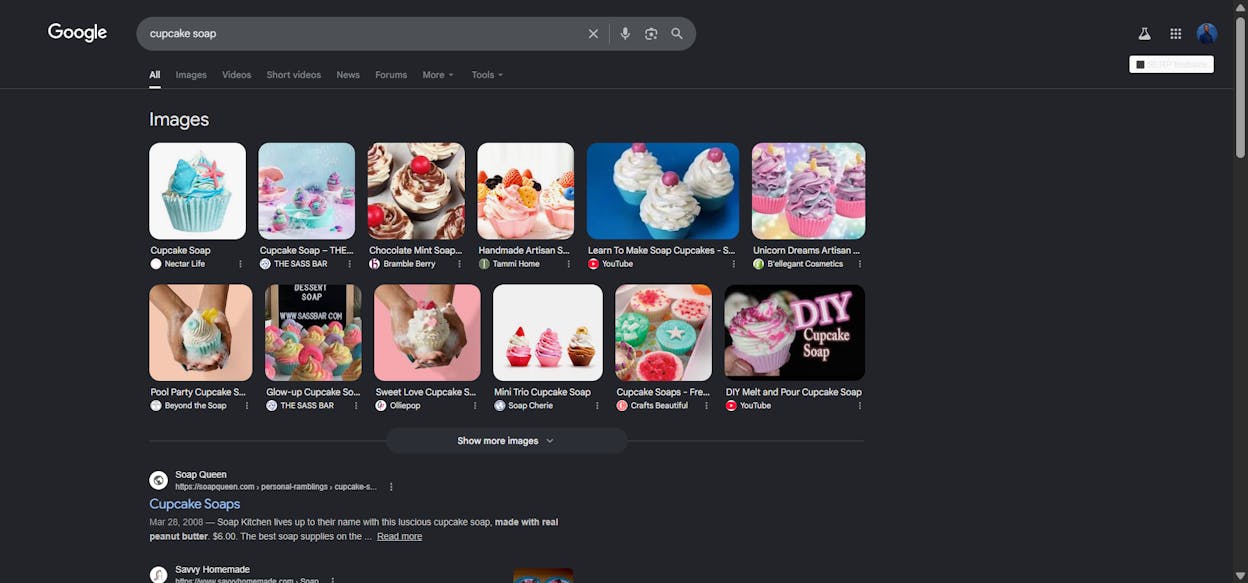
If you can match the dominant intent and the format makes sense for your business, the keyword is worth pursuing. If you can’t, drop it. A learn-intent keyword is not going to rank a product page no matter how many internal links you point at it.
You can also run a candidate through our free SERP checker to see the exact top results without leaving any browser fingerprints.
For a deeper take on intent matching, Google’s own guidance on creating helpful, reliable, people-first content is worth reading once and re-reading every time you draft a content brief.
Check 3. How hard is it really to rank?
KD is a starting point. The real difficulty depends on four other factors that the metric doesn’t capture.
The first is branded competition. If Etsy, Amazon, and Walmart hold the top three spots even at KD 0, you’re not competing against the page. You’re competing against the brand expectation. Users expect to see those brands for shopping queries, and Google knows it. Treat the SERP as a hint about how much room there is for an editorial result.
The second is YMYL territory. Health, finance, legal, and safety topics have a higher EEAT bar regardless of KD. A new site with no demonstrated expertise will struggle even on niche YMYL terms in these categories. The fix is slow but well understood. Build author profiles, cite primary sources, and earn topical authority before competing on commercial intent in regulated spaces.
The third is content quality. Read the top three results. If you can’t add new information, a clearer explanation, original data, or first-hand experience, ranking will be slower than KD suggests.
The fourth is whether anyone is actually targeting the keyword. If the SERP is full of pages that rank because they’re authoritative on the broader topic, but nobody has written a dedicated post on your specific phrase, you have leverage. A focused page often beats a tangentially relevant one from a stronger domain.
![[Screenshot of a Google SERP for a niche keyword showing Amazon, Etsy, and Reddit threads in the top five spots, illustrating that low KD doesn’t always mean low difficulty]](https://www.datocms-assets.com/164164/1778513820-blobid9.png?auto=format,compress&w=1248&fit=max)
If a keyword passes all three checks, it goes on your final shortlist. If it fails any of them, drop it without guilt. There are always more niche keywords.
Step 4. Find niche prompts for AI search
SEO is not dead. People still run trillions of Google searches every year. But a real share of buyer research now happens inside ChatGPT, Perplexity, Gemini, and Copilot. The brands that get cited in those answers earn share of voice that compounds with their organic rankings.
The same principle applies. AI search has its own niche queries (called prompts), and they’re easier to win than the generic ones. The difference is that you can’t pull them from a keyword tool, because Ahrefs and the rest don’t see ChatGPT logs.
This is the gap Analyze AI was built for. Here’s how to use it to extend your niche keyword work into AI search.
Use Suggested Prompts to surface niches you didn’t know existed
Once you connect your domain and competitors, Analyze AI continuously generates prompt suggestions based on what your buyer category actually gets asked across AI engines. These are the AI-search equivalent of long-tail keywords.
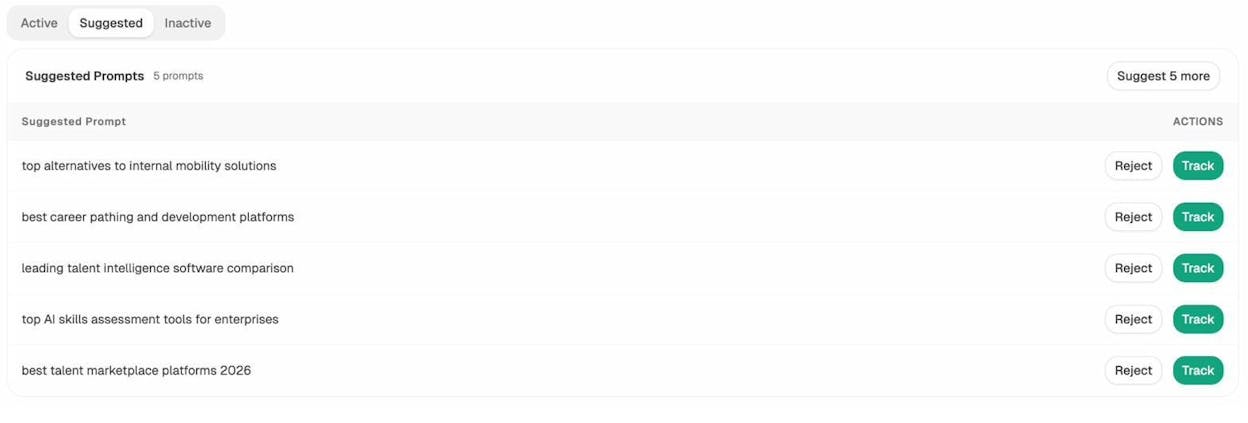
Skim the list. Track the prompts that match buyer intent in your category. Reject the ones that don’t. Each accepted prompt becomes part of your tracked set, and Analyze AI runs it across the major AI engines on a recurring basis to show how often you’re cited and how often your competitors are.
This is genuine information gain compared to traditional keyword research. The list is generated from real AI behavior, not from Google’s autosuggest, so it surfaces phrasing your customers use with chatbots that they would never type into a search box.
Use Ad Hoc Prompt Searches to validate niche AI queries on demand
When you have a hypothesis (for example, “people probably ask AI for alternatives to my main competitor”), you can test it without waiting for a tracked prompt to populate.
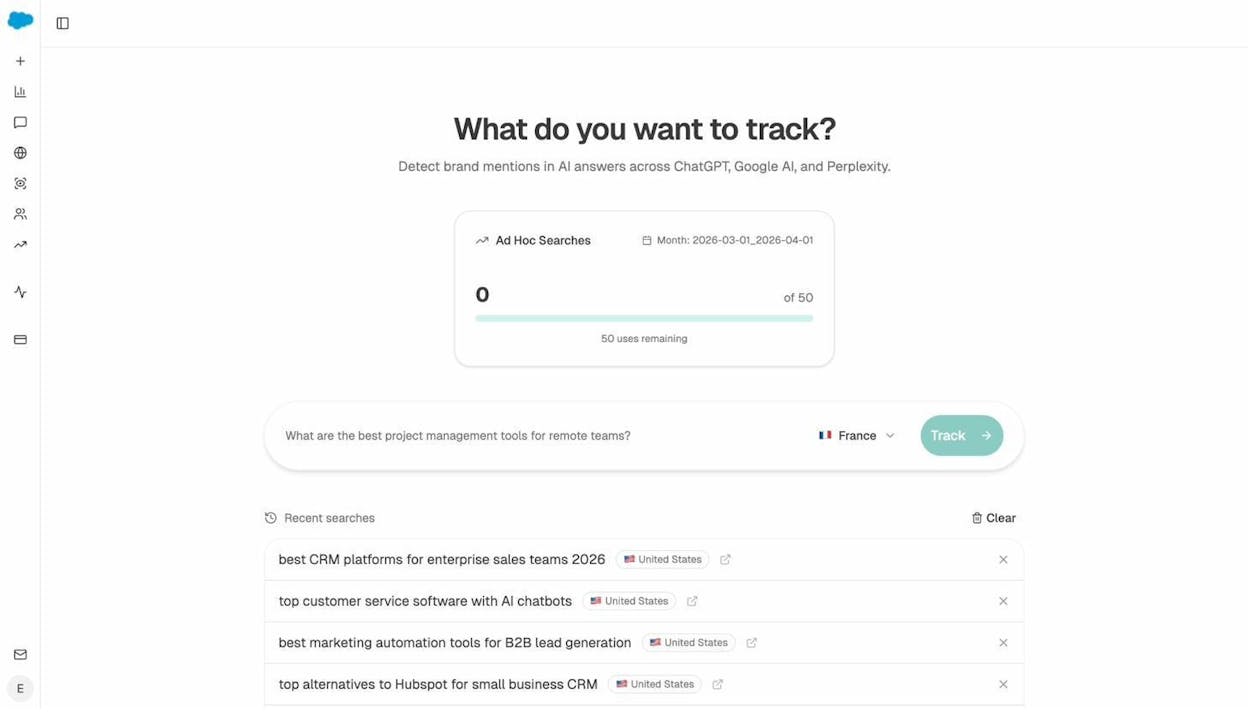
Type the prompt, pick a region, and run it. You see exactly how the major AI engines answer that query, who they cite, and where you stand. If you appear, you have a beachhead to defend. If you don’t, you have a content gap to close. We’ve written a full breakdown of how citation patterns work in our analysis of how to outrank competitors in AI search.
This is the AI-search equivalent of running a Google search to validate intent in Step 3. You’re closing the loop between hypothesis and reality.
Use the Competitors view to find prompts where rivals win and you don’t
Niche keyword research in SEO often works backwards from a competitor’s ranked keywords. The same approach works in AI search, except the data point is mentions, not rankings.
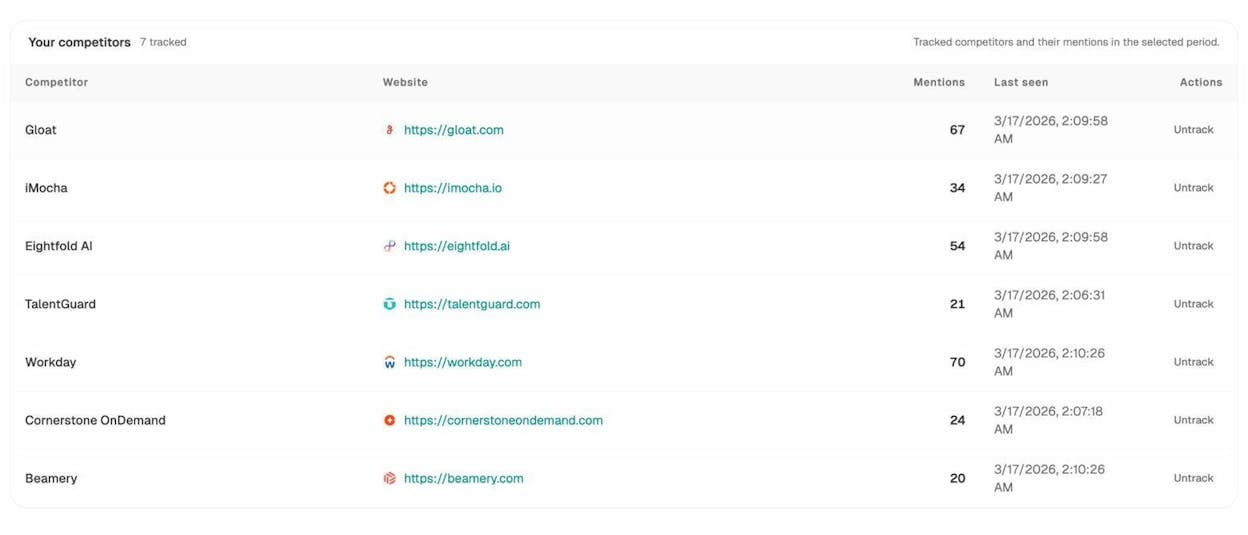
Track your real competitors. After a few weeks of data, you’ll see prompts where they’re cited and you aren’t. Those are the gaps. Each gap is a niche prompt waiting for an article that closes it. The work that follows is conventional content production, but the targeting is precise. Our SEO competitor analysis guide walks through how to do this systematically across both Google and AI search.
Use Landing Pages to double down on what already works
Once you have AI search analytics installed on your site, you can see exactly which pages of yours pull AI-referred traffic.
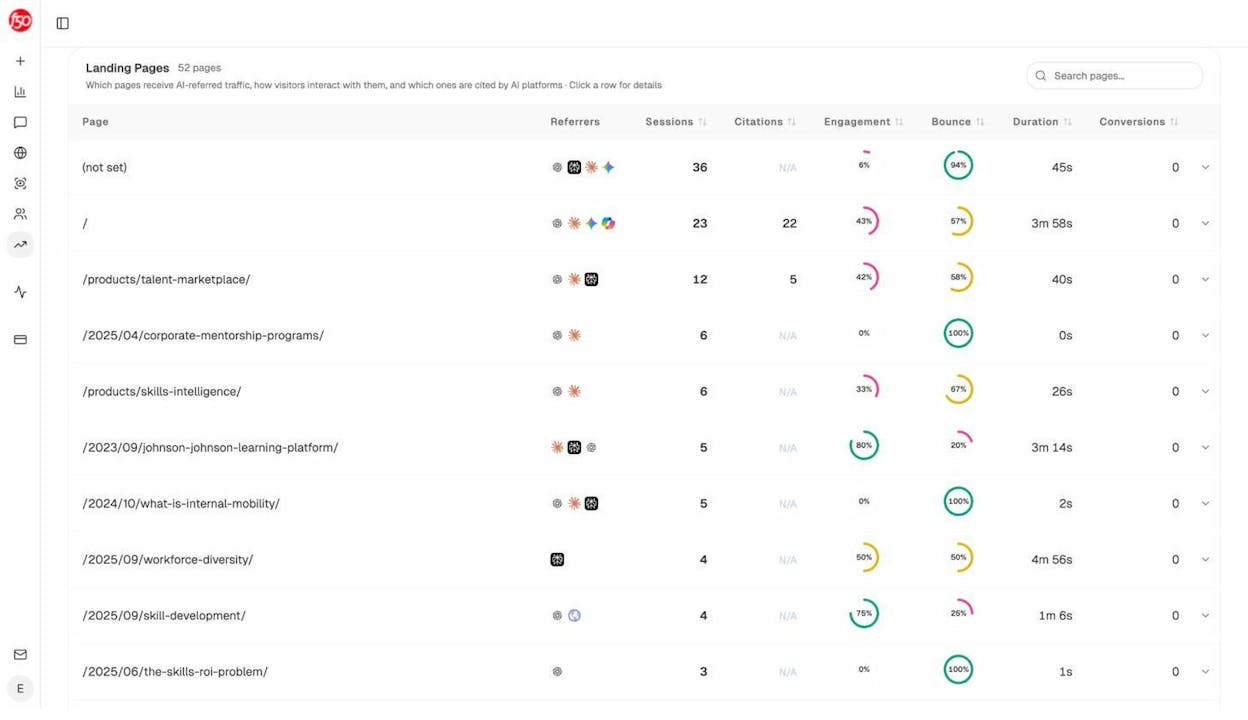
Sort by sessions. The pages at the top tell you which topics already have momentum in AI search. Mine those URLs for the niche they cover, then build adjacent pages that target related niche prompts. This is how you compound. You’re not guessing which topics work. You’re extending the ones that already do.
A practical workflow looks like this. Pick the top five AI-traffic pages. For each, identify three niche prompt variations. Validate each variation with an ad hoc search. Write the page. Track the prompt. Repeat in 90 days.
For more on the broader strategy, our guide to generative engine optimization explains how this fits into the larger picture of optimizing for AI search.
Bonus. Mine niche websites for keywords and prompts
If you know a website that targets the exact niche you’re after, you can extract its entire keyword footprint in a few clicks.
In Ahrefs Site Explorer, paste the competitor’s domain, open the Organic keywords report, and apply the same Volume and KD filters from Step 2. A site like mechanicalkeyboards.com will return thousands of keywords in the mechanical keyboard niche with low difficulty and meaningful volume.
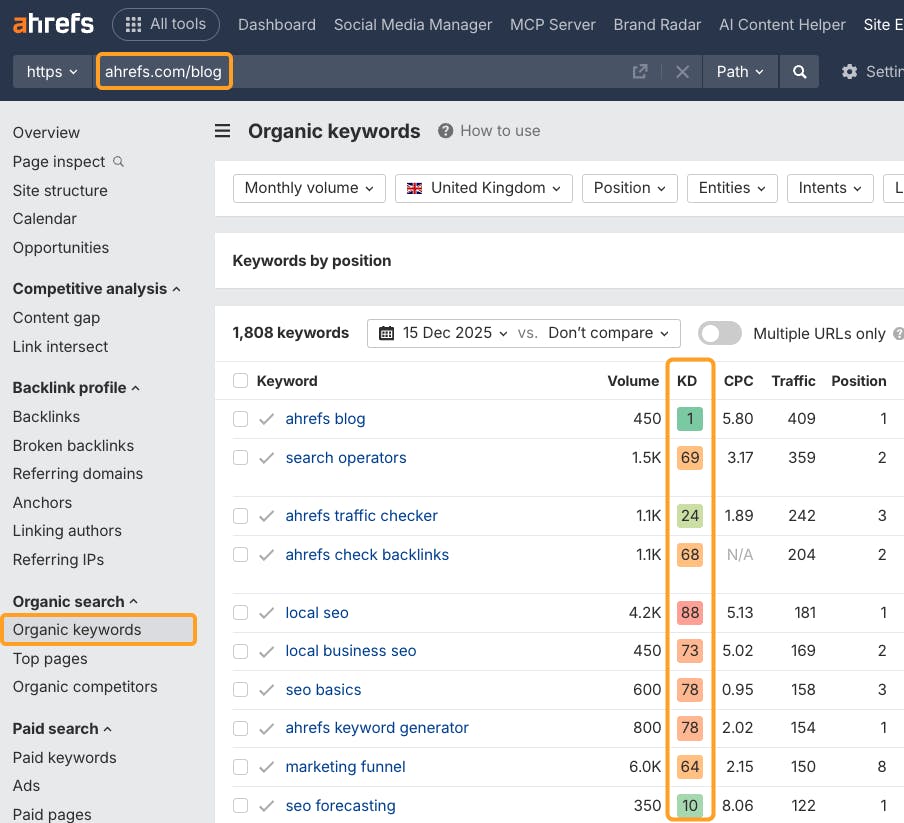
The AI search equivalent is to track a niche-focused competitor inside Analyze AI and let the prompt list grow. Niche sites tend to surface in answer engines for a tight cluster of prompts, and seeing those prompts side by side is the fastest way to map a category.
If you want to expand the seed-mining approach further, our guide on 6 tools to find new keywords covers the free and paid options that pair well with the workflow above.
Final thoughts
Niche keyword research isn’t a clever trick. It’s a portfolio strategy. You give up the dream of a single article that brings 50,000 monthly visits and accept that fifty articles bringing 1,000 visits each will get you to the same place with less competition and higher conversion.
The work itself is mechanical. Build a seed list. Filter it three ways. Validate against the SERP. Extend the same logic to AI search prompts so the same investment buys you visibility in two channels instead of one. SEO is evolving, not dying. AI search is a new organic channel sitting alongside it. Treat them as complementary and you’ll compound results in both.
The brands that win the next decade of search are the ones that show up in answers everywhere their buyers look. Niche keywords (and niche prompts) are the most efficient way to get there.

Ernest

Ibrahim


