



Summarize this blog post with:


In this article, you’ll get the current list of the 100 most expensive keywords on Google Ads, the real reason advertisers willingly pay four figures per click for some of them, the math you can use to decide if a keyword is worth bidding on, and a step-by-step walkthrough of how to find both the paid keywords and the AI prompts your competitors are winning. By the end, you’ll have a working playbook for high-CPC keyword research across Google Ads and AI search engines.
Table of Contents
The 100 most expensive keywords on Google Ads in the U.S.
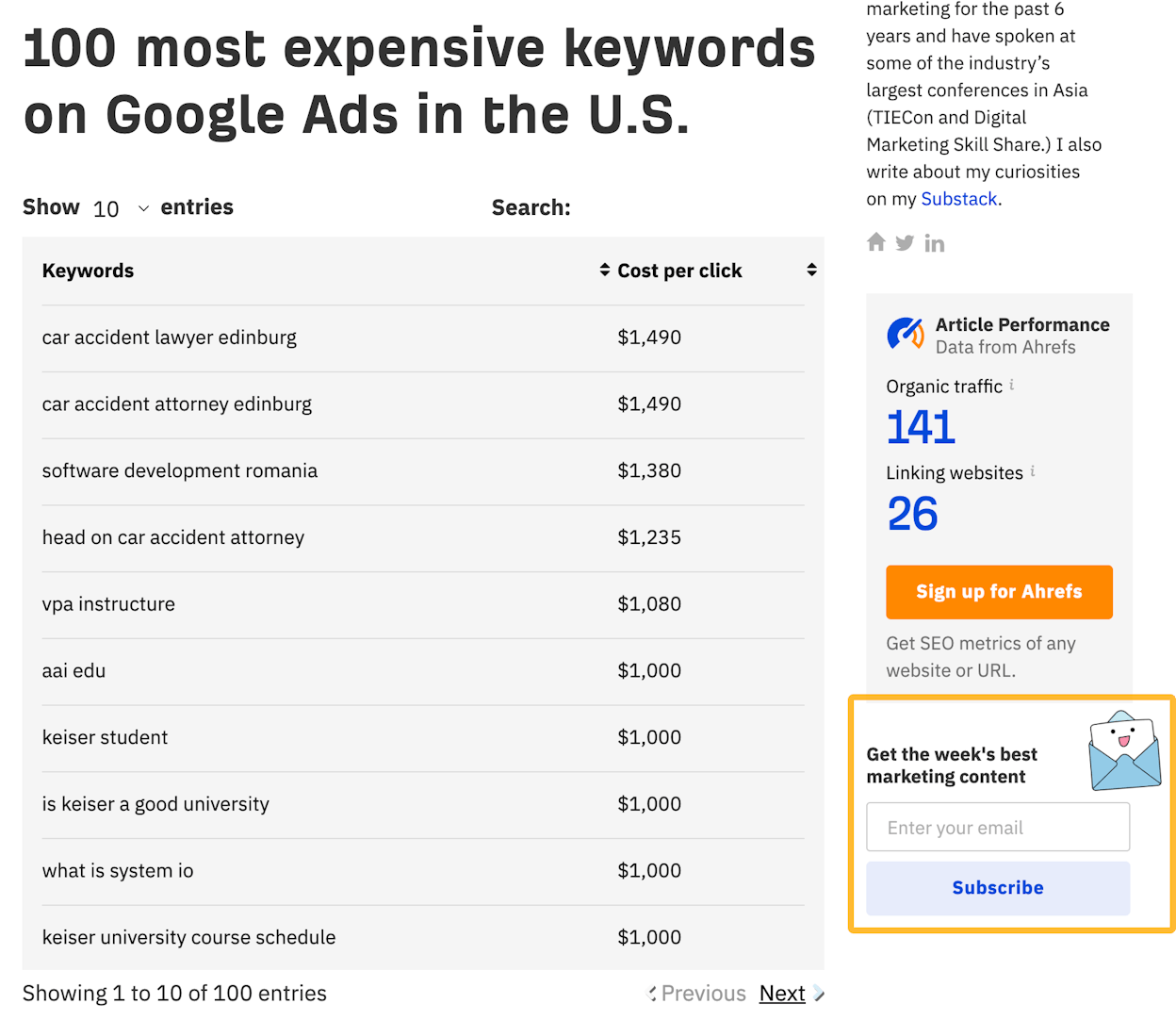
We pulled the live cost-per-click data for the highest-bid keywords in the U.S. as of May 2026. Costs are expressed in U.S. dollars and reflect what advertisers are paying at the top of the auction.
|
Keyword |
Cost per click |
|---|---|
|
drunk driving accident lawyer houston |
$1,540 |
|
car accident attorney edinburg |
$1,490 |
|
internet randomly drops for a few seconds |
$1,455 |
|
tractor trailer accident attorney near me |
$1,420 |
|
is dsl dial up |
$1,300 |
|
how fast is 128kbps |
$1,215 |
|
freight house paducah |
$1,155 |
|
vpa instructure |
$1,080 |
|
wrongful death lawyers los angeles |
$1,050 |
|
new iberia car accident lawyers |
$1,030 |
|
dram shop liability lawyers |
$1,020 |
|
dothan al personal injury lawyer |
$1,015 |
|
aai edu |
$1,000 |
|
keiser student |
$1,000 |
|
is keiser a good university |
$1,000 |
|
what is system io |
$1,000 |
|
keiser university course schedule |
$1,000 |
|
phemex in usa |
$1,000 |
|
t premarket |
$1,000 |
|
keiser university directions |
$1,000 |
|
banks power promo code |
$1,000 |
|
keiser university lawsuit |
$1,000 |
|
the athletic 1 dollar |
$1,000 |
|
is keiser university regionally accredited |
$1,000 |
|
keiser university deadlines |
$1,000 |
|
scentsit |
$1,000 |
|
tunercult coupon |
$1,000 |
|
keiser cost |
$1,000 |
|
collegecentral/keiser |
$1,000 |
|
vacation offer.com reviews |
$1,000 |
|
go high level marketing |
$1,000 |
|
vacation offers reviews |
$1,000 |
|
1-800-ask-gary reviews |
$1,000 |
|
acceptance rate for keiser university |
$1,000 |
|
chrome pkg download |
$1,000 |
|
aai.edu |
$1,000 |
|
keiser university commercial |
$1,000 |
|
verizon government sales |
$1,000 |
|
verizon msi |
$1,000 |
|
keiser university student population |
$1,000 |
|
is keiser university private or public |
$1,000 |
|
keiser university help desk |
$1,000 |
|
keiser university undergraduate catalog |
$1,000 |
|
olay brand in usa |
$1,000 |
|
chrome msi file |
$1,000 |
|
miller motte tulsa |
$1,000 |
|
is vacation offer legit reddit |
$1,000 |
|
dara bricks |
$1,000 |
|
apexfunded |
$1,000 |
|
apex prop trading |
$1,000 |
|
verizon public sector |
$1,000 |
|
keiser university withdrawal policy |
$1,000 |
|
dell.premier |
$1,000 |
|
keiser university gym |
$1,000 |
|
what is axiom company |
$1,000 |
|
where is keiser university main campus |
$1,000 |
|
where is keiser |
$1,000 |
|
keiser university scam |
$1,000 |
|
is keiser accredited |
$1,000 |
|
xpert rating |
$1,000 |
|
athlete discount |
$1,000 |
|
keiser university president |
$1,000 |
|
how much money does disney make in a day |
$1,000 |
|
how many students attend keiser university |
$1,000 |
|
what is systeme |
$1,000 |
|
banks power promo codes |
$1,000 |
|
keiser university class schedule |
$1,000 |
|
android store data |
$1,000 |
|
okta device trust certificate |
$1,000 |
|
keiser university students |
$1,000 |
|
keiser doral |
$1,000 |
|
keiser university lake underhill |
$1,000 |
|
keiser university bursar office |
$1,000 |
|
systeme.ii |
$1,000 |
|
what does go high level do |
$1,000 |
|
the athletic special offer |
$1,000 |
|
keiser university loan forgiveness program |
$1,000 |
|
backup in linux |
$1,000 |
|
system me |
$1,000 |
|
verizon wireless government support |
$1,000 |
|
smidge promo code |
$1,000 |
|
is keiser university good |
$1,000 |
|
uptodate mounjaro |
$1,000 |
|
google msi download |
$1,000 |
|
the athletic discount code |
$1,000 |
|
dell premeire |
$1,000 |
|
keiser university employee benefits |
$1,000 |
|
keiser university employee handbook |
$1,000 |
|
keiser calendar |
$1,000 |
|
verizon wireless government |
$1,000 |
|
sntsy |
$1,000 |
|
stephen matthews md colorado |
$1,000 |
|
keiser bb |
$1,000 |
|
axioms definition |
$1,000 |
|
databricks distributed computing |
$1,000 |
|
cit group stock |
$1,000 |
|
what is systeme io |
$1,000 |
|
dell priemer |
$1,000 |
|
sistem io |
$1,000 |
|
keiser university corporate office |
$1,000 |
|
hornblasters coupon |
$1,000 |
The numbers above are top-of-page bids. They represent what someone paid for a single click on a Google search result, before any conversion happened. A click is not a customer.
Why are these keywords this expensive?

Google Ads runs as a sealed-bid second-price auction. For any given query, only a handful of ad slots exist on the page. The advertisers willing to pay the most (adjusted for Quality Score) win those slots. When demand for a keyword goes up, the floor of the auction goes up with it.
Demand goes up in four predictable conditions:
The first is high customer lifetime value. A personal injury law firm that wins a single case can earn six or seven figures in fees. A spend of $1,540 to bid on “drunk driving accident lawyer houston” is rational if even one in 200 clicks turns into a settled case. A SaaS vendor selling a $50/month subscription cannot rationalize the same bid.
The second is commercial intent baked into the query. Searches like “tractor trailer accident attorney near me” or “wrongful death lawyers los angeles” are not research queries. The person typing them has a real, immediate need. That intent is rare and advertisers pay for it.
The third is geographic concentration. Local services compete in fixed-supply markets. There are only so many people searching “new iberia car accident lawyers” in a given month. The smaller the pool of qualified searches, the more aggressive each firm in that pool has to be to win.
The fourth, and the one most lists ignore, is brand defense. We will return to this in the section below, but it explains the long block of “keiser university” keywords on this list. None of those searches express commercial intent. They are research queries that a brand is willing to pay $1,000 per click to control.
For an external view of the auction mechanics and the role of Quality Score, the Google Ads Help documentation on ad rank is the cleanest reference.
Which industries dominate the most expensive keywords?
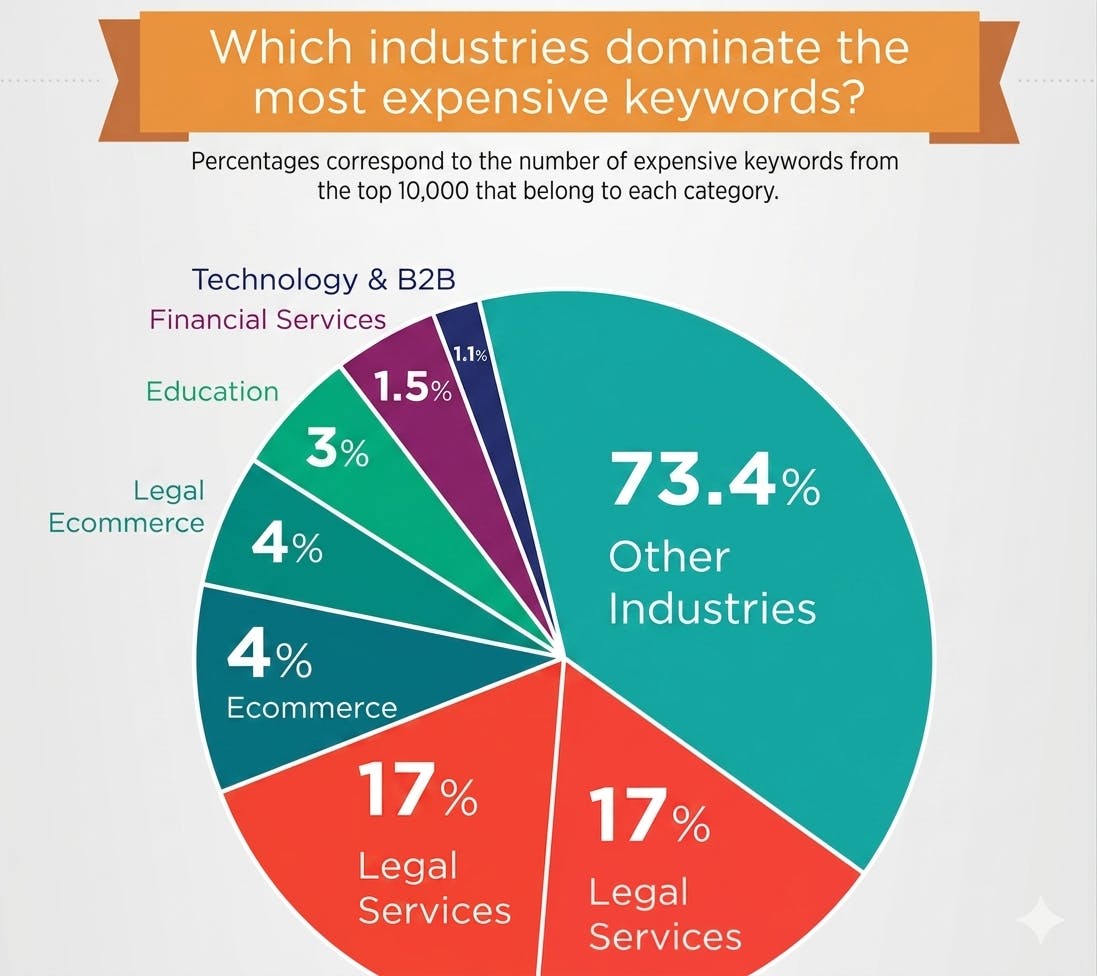
We segmented the top 10,000 most expensive keywords by industry. The breakdown looks like this.
Legal services (around 17% of the top 10,000). This is the dominant category and has been for over a decade. Almost every keyword in this group combines a high-stakes practice area (personal injury, drunk driving, wrongful death, mesothelioma, trucking accidents) with a city or region. Personal injury firms operate on contingency. A single converted lead can pay for hundreds of clicks.
Ecommerce (around 4%). Most of the ecommerce entries on this list are not generic product terms. They are brand-modified queries like “banks power promo code”, “tunercult coupon”, “the athletic discount code”, and “smidge promo code”. These are bottom-of-funnel searches by people already considering a purchase. Affiliate publishers and the brands themselves bid heavily to capture or recapture the conversion.
Education (around 3%). A single “keiser university” cluster accounts for over a third of this category on its own. We will explain why below.
Financial services (around 1.5%). Trading platforms (“apexfunded”, “apex prop trading”, “phemex in usa”), brokerage prop trading firms, and individual stock tickers (“t premarket”, “cit group stock”) show up consistently. The reason is straightforward. A funded prop trading account or a brokerage signup represents thousands of dollars in expected revenue.
Technology and B2B (around 1.1%). Enterprise software keywords (“verizon government sales”, “okta device trust certificate”, “databricks distributed computing”, “dell.premier”) appear because each new account in these categories represents a multi-year contract. The CPC math works.
You can see the full breakdown of 22 keyword types and how each behaves in SEO and AI search for context on how commercial intent translates into bid pressure.
The pattern most analyses miss: defensive bidding
If you look at the table again, one cluster will jump out. Over 30 of the 100 most expensive keywords are direct queries about Keiser University. None of them have commercial intent in the usual sense. “Keiser university gym”, “keiser calendar”, and “where is keiser university main campus” are research queries from existing students or applicants.
So why is Keiser University paying $1,000 per click on its own brand?
Because the alternative is letting a competitor (or a lawsuit-mining law firm, in the case of “keiser university lawsuit”) run an ad above their organic listing. For a school whose enrollment funnel runs through brand search, every lost click on a brand query is a lost lead. Defensive bidding is not about winning new customers. It is about not losing the ones you already have.
The same logic applies to “verizon msi”, “dell.premier”, “the athletic special offer”, and most of the ecommerce coupon keywords. These are existing-customer or near-customer queries that a third party could otherwise intercept.
The practical takeaway is simple. When you analyze a competitor’s paid keyword list, separate the offensive bids (acquiring new customers) from the defensive bids (protecting existing ones). The two require completely different strategies, and only one of them is worth copying.
Should you bid on a $500 keyword? The break-even math
The right question is never “is this keyword expensive?”. The right question is “does this keyword’s CPC math work for my business?”. Here is the framework.
You need three numbers:
-
Conversion rate from click to lead (call it CR-1)
-
Conversion rate from lead to paying customer (call it CR-2)
-
Average revenue per customer, or better, gross margin per customer
The math is:
Maximum profitable CPC = Gross margin per customer × CR-1 × CR-2
Worked example. A small personal injury firm in Texas converts 8% of paid clicks to consultation requests, signs 25% of consultations as clients, and earns an average $14,000 in fees per case.
Max CPC = $14,000 × 0.08 × 0.25 = $280
That firm cannot rationally bid on “drunk driving accident lawyer houston” at $1,540. They can bid on long-tail variations like “affordable dwi lawyer austin tx” where the CPC drops to $40 and the conversion rates often improve.
A B2B SaaS vendor selling a $20,000 ACV product, converting 3% of clicks to demos and 20% of demos to closed-won, has a max CPC of $120. Anything above that destroys margin.
The point is to do this calculation before you log into Google Ads, not after. You can pull baseline conversion data with the free keyword rank checker to first see whether you already rank organically (in which case the paid bid may be unnecessary), or use the keyword difficulty checker to weigh the relative cost of going organic versus paid for a given term.
How to find the paid keywords your competitors are bidding on
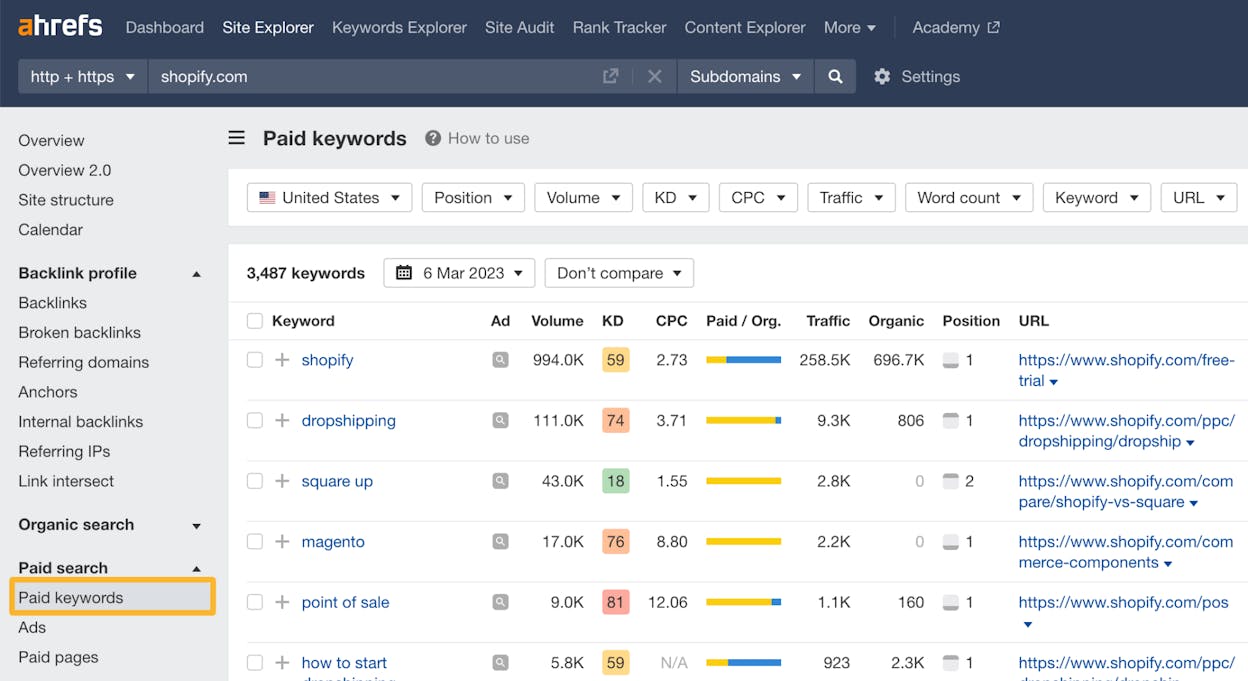
Competitor paid-keyword research is the fastest way to find profitable terms because someone else has already done the validation work. If a competitor has bid on a keyword consistently for more than 90 days, that keyword is paying for itself. Here is the step-by-step.
Step 1. Build a clean competitor list. Pick four to seven direct competitors. Direct means they sell to the same buyer for the same problem at a similar price point. Aspirational competitors (you sell to SMBs, they sell to enterprise) will mislead you.
[Description of screenshot to use: Google Ads Keyword Planner home screen showing the “Discover new keywords” and “Get search volume and forecasts” tabs.]
Step 2. Pull each competitor’s paid keyword list. Use Ahrefs Site Explorer, Semrush, or Spyfu. Enter the competitor’s domain, navigate to the Paid Keywords report, and export the full list to a CSV. Repeat for every competitor.
[Description of screenshot to use: Ahrefs Site Explorer Paid Keywords report for asana.com, showing the keyword column, CPC column, paid traffic column, and ad copy preview.]
Step 3. Filter aggressively. Most of what you export is noise. Apply these filters in order:
-
Minimum CPC of $5 (this removes brand-defense and incidental bids)
-
Minimum monthly search volume of 100
-
Exclude any keyword containing the competitor’s brand name
-
Exclude any keyword containing your own brand name (those are theirs to defend, not yours to attack)
-
Exclude any keyword with location modifiers outside your service area
You should be left with 50 to 200 keywords per competitor.
Step 4. Cluster the survivors by intent. Group the remaining keywords into three buckets. The first is comparison (“X vs Y”, “alternatives to Z”). The second is problem-aware (“how to fix [problem]”). The third is solution-aware (“best [category] software for [use case]”). Each bucket needs a different ad and landing page.
Step 5. Cross-reference against your existing organic rankings. If you already rank top 5 organically for a keyword, paid bidding is usually wasted spend. If you rank 6-20, paid bidding can lift you above your own organic listing while you build authority. If you do not rank at all, paid is your only short-term option. Use the SERP checker to verify your current organic position for each candidate.
Step 6. Stage your bids. Start at 50% of the median competitor bid for each keyword. Run for 14 days. Kill any keyword below your max CPC threshold. Double the bid on anything above it.
This same workflow is covered in detail in our step-by-step SEO competitor analysis guide, which extends the framework into organic and AI search channels.
The AI search version: which prompts are competitors winning?
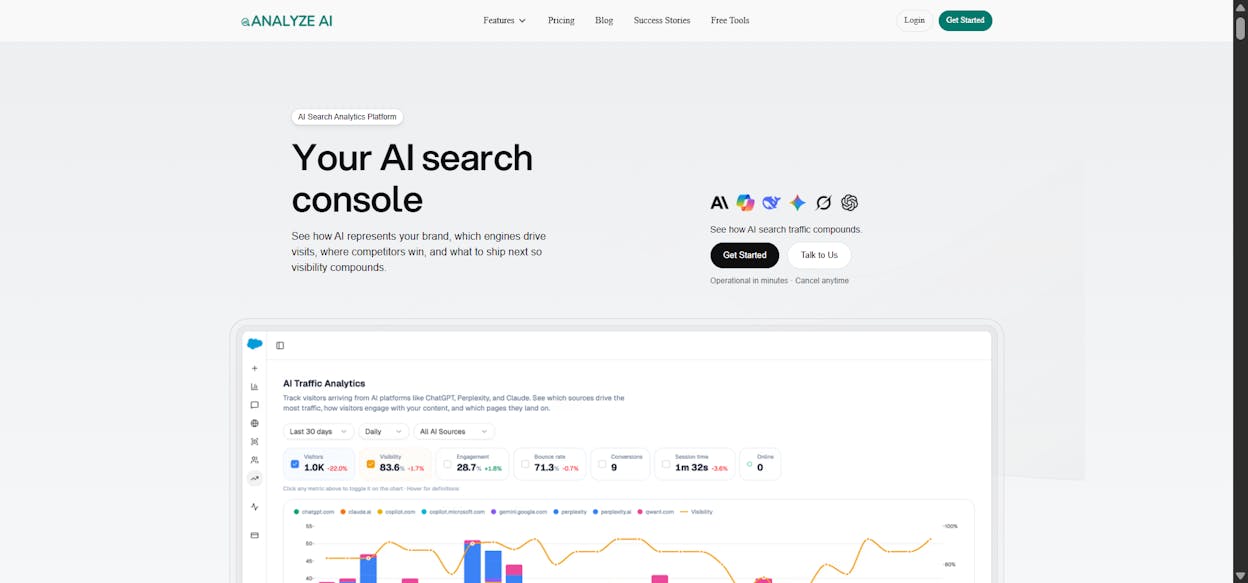
Here is the part most expensive-keyword posts ignore in 2026. Search behavior is shifting. A growing share of high-intent commercial queries are now being answered inside ChatGPT, Perplexity, Gemini, Claude, and Copilot before the user ever sees a Google ad. We do not believe this replaces Google search or Google Ads. Both are still significant channels, and our manifesto on AI search and SEO makes that position explicit. But AI search is a parallel channel where similar buyer intent is being expressed, and your competitors are already showing up there.
The same competitor research workflow translates to AI search. Instead of pulling paid keywords, you pull paid prompts.
In Analyze AI’s Prompt Tracking, you add the prompts that matter for your category and Analyze AI runs them against the major AI engines on a daily cadence. The output tells you which competitor each engine recommends, where you appear (or do not), and how that has shifted week over week.
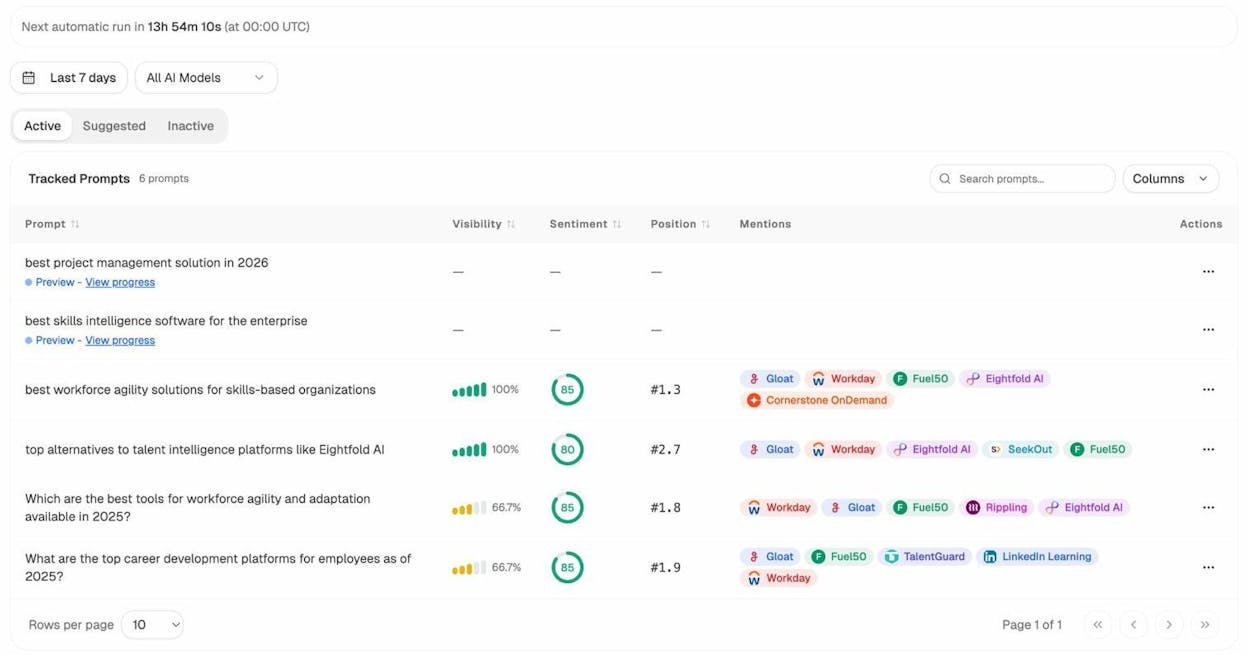
For example, in the screenshot above the prompt “best workforce agility solutions for skills-based organizations” returns Gloat, Workday, Fuel50, Eightfold AI, and Cornerstone OnDemand at 100% visibility, with the tracked brand sitting at position #1.3 on average. That is the AI-search analog of “competitors X, Y, and Z are bidding on this exact paid keyword”.
You can also run a one-off check before committing to ongoing tracking. Analyze AI has an Ad Hoc Prompt Search that lets you fire any prompt across ChatGPT, Google AI, and Perplexity and see who is being recommended right now.
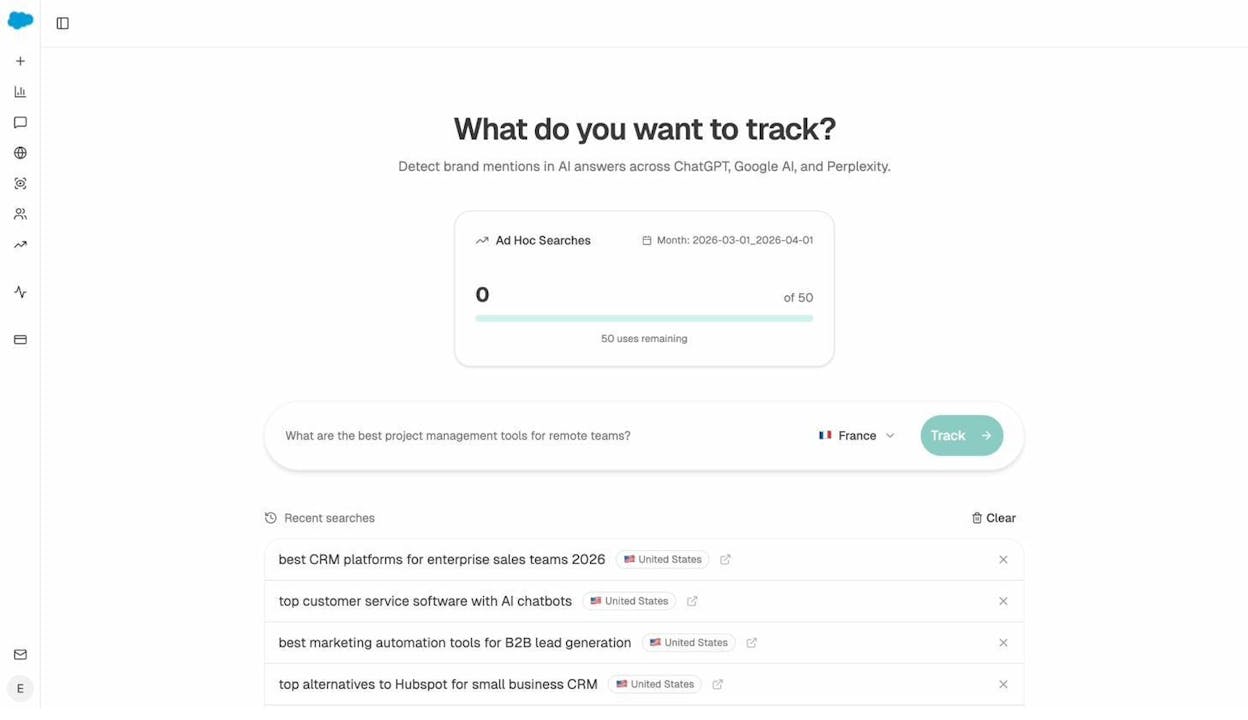
This is useful for the same reason competitor paid-keyword research is useful. You see which competitors the AI engines are recommending, in which order, and why. From there you can:
-
Find prompts where your competitors win and you are absent. These are your AI search “high-CPC keywords”, except instead of bidding for them you earn them by becoming citable. We covered the citation mechanics in how to outrank competitors in AI search.
-
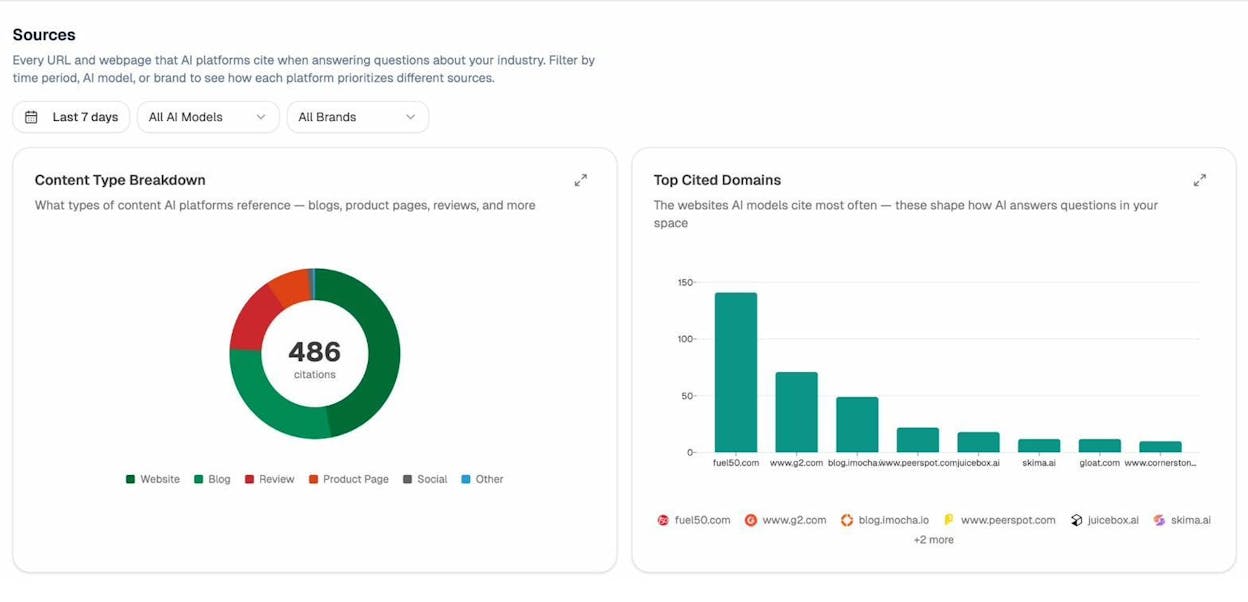
Identify which sources the engines cite when answering those prompts. If three engines all cite the same five domains, those domains are your link and citation targets.
-
Track which of your existing landing pages are already pulling AI traffic, then double down on the formats that work.
The third point matters more than people realize. Once you connect GA4 to Analyze AI, you can see which pages are receiving AI-referred sessions, from which engines, and how those visitors behave once they land.
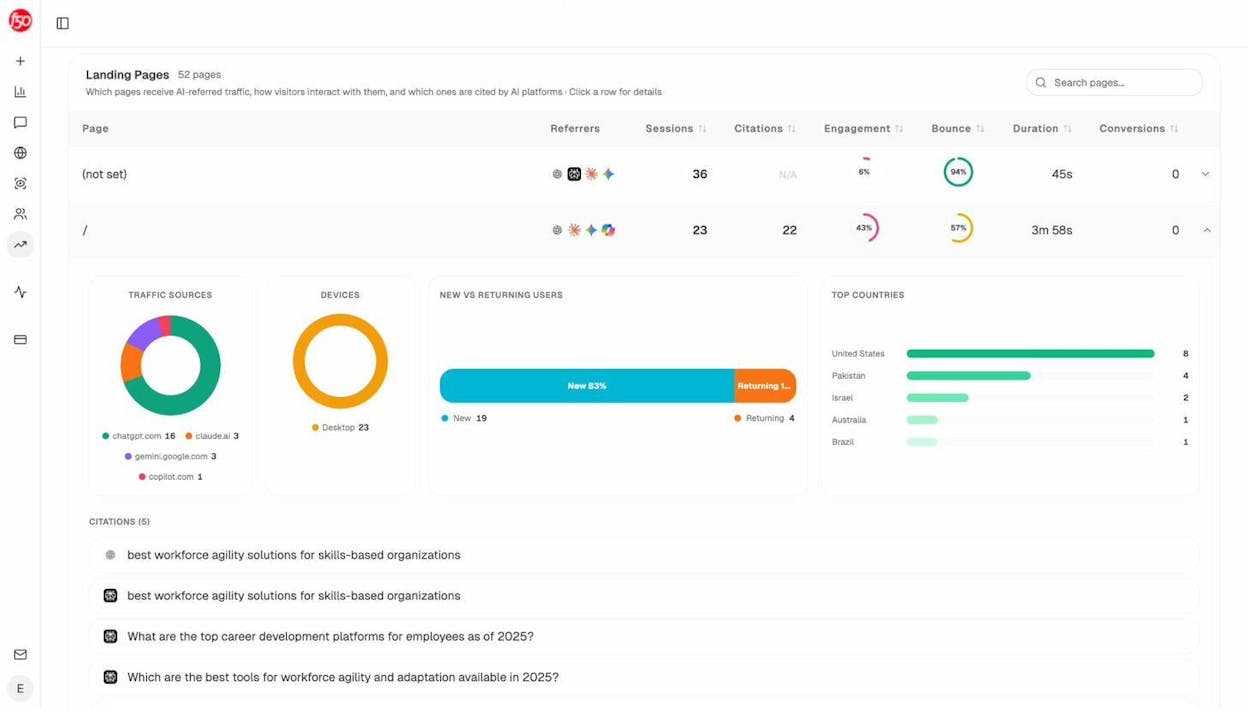
The patterns are usually clear within two weeks. Comparison pages and “best X for Y” pages tend to outperform generic blog content. Pages with structured pricing tables get cited more than pages without. Once you see what works, you can produce more of it deliberately. This is the same logic that drove the original “spy on your competitors’ paid keywords” strategy, applied to a channel where there is no auction to enter.
For the underlying citation question (which sources the engines actually trust in your category) you can review your Sources dashboard:
If you want a deeper view of the methodology behind ranking in AI engines, we wrote how to rank on ChatGPT based on 65,000 citations and how to rank on Perplexity AI.
Four ways to compete on expensive keywords without burning your budget
Even if a keyword passes your CPC math, you should still try to lower your effective cost per click. The four methods below compound. Stack them.
Improve your Quality Score. Quality Score is Google’s 1-to-10 rating of how relevant your ad and landing page are to a query. A keyword with a Quality Score of 9 will cost roughly half what the same keyword costs at a Quality Score of 5. The three inputs are expected click-through rate, ad relevance, and landing page experience. The single highest-leverage move is to write the searcher’s exact query into the H1 of your landing page and into the first line of your ad copy.
Run negative keyword lists from day one. Negative keywords prevent your ad from showing on irrelevant searches. For a personal injury firm bidding on “car accident lawyer”, typical negatives would include “salary”, “jobs”, “free”, “what is”, “law school”, “movie”, and “definition”. A clean negative list usually drops wasted spend by 20-40% in the first month.
|
Bid keyword |
Add as negative |
|---|---|
|
crm software |
“what is”, “definition”, “wikipedia”, “free open source” |
|
personal injury lawyer |
“salary”, “jobs”, “school”, “definition”, “movie” |
|
insurance quote |
“claim”, “calculator”, “definition” |
|
project management software |
“course”, “certification”, “salary”, “jobs” |
Bid on long-tail variants instead of head terms. Instead of “personal injury lawyer”, bid on “best personal injury lawyer for slip and fall in austin”. The CPC drops 70-90%, the conversion rate often doubles, and the searcher is closer to a decision. To find these systematically you can use the keyword generator tool, the Bing keyword tool, or the YouTube keyword tool for video-search variants.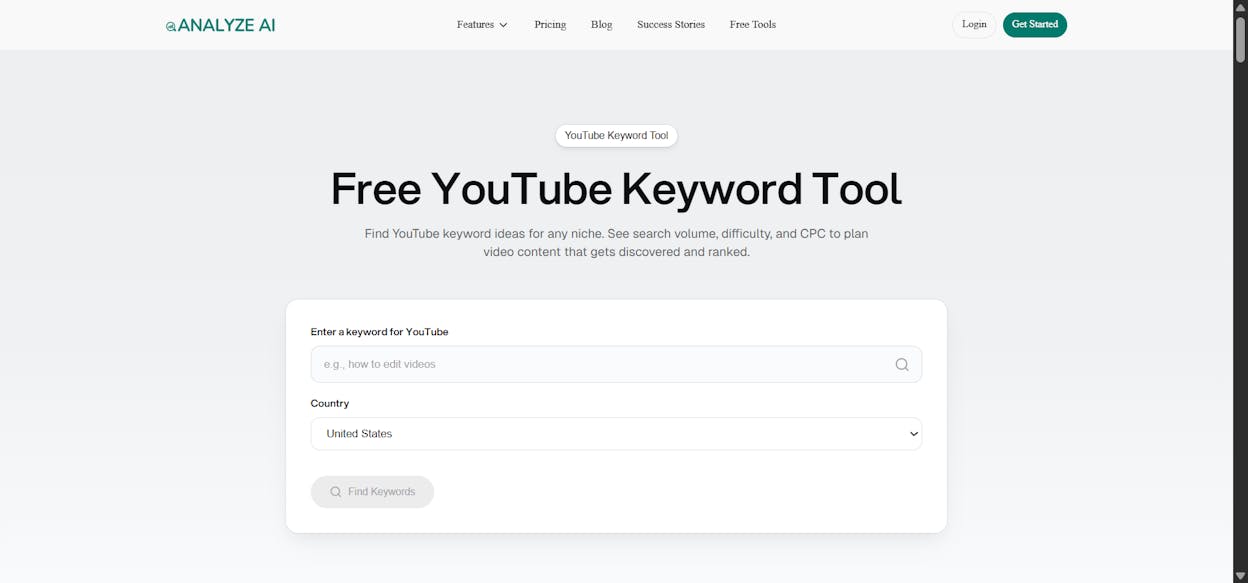
Retarget instead of paying full price for cold traffic. A retargeting click typically costs a third of a cold-search click and converts at 3-5x the rate. Build a remarketing list from anyone who hits your pricing page, your comparison pages, or your “alternatives” pages. Bid aggressively on this audience even on otherwise unprofitable keywords. They have already done the research.
For a fuller competitive intelligence stack that combines paid, organic, and AI search signals, our review of the best ad intelligence software covers the major platforms.
A final note on what “expensive” actually means
Expensive is not a price. It is a relationship between what something costs and what it returns.
A $1,540 click on “drunk driving accident lawyer houston” is cheap for a Houston firm whose average case fee is $40,000 and whose close rate from paid clicks is 0.5%. The same $1,540 click is a catastrophe for a marketing agency that wandered into the keyword by mistake. The keyword has not changed. The math behind it has.
The right move is not to avoid expensive keywords. It is to build the math, the negatives, the long-tail variants, the landing pages, the AI search visibility, and the competitor intelligence that lets you bid on the keywords your competitors cannot afford to lose. Those keywords are worth what they cost.
When you are ready to extend that same competitor playbook into AI search, Analyze AI is built to track which prompts your competitors are winning, where you are absent, and which content patterns are pulling AI traffic to your site.

Ernest

Ibrahim


