



Summarize this blog post with:


In this article, you’ll find seventeen free courses that teach digital marketing in 2026, what each one covers, who teaches it, how long it takes, and whether it ends with a certification. We’ve cut the picks that older roundups still recommend but no longer work (Twitter Flight School shut down with the rebrand to X, half the Skillshare lessons are out of date) and added the courses that matter now. The new picks include Meta Blueprint, AI for marketers, and prompt engineering, alongside the SEO and content classics that still hold up.
We picked these courses based on four things:
-
The instructor’s track record and credibility in their field.
-
Student ratings and reviews from a recent cohort.
-
Whether the material is current and reflects how marketing actually works today.
-
Whether you can apply what’s taught on Monday morning, not just nod along.
There’s also a section near the end of this article on the one channel none of these courses cover well, AI search, and how to put your new skills to work there.
Table of Contents
1. Fundamentals of Digital Marketing by Google Digital Garage
Topic: Digital marketing (broad) Level: Beginner Certification: Yes (accredited by IAB Europe and The Open University) Duration: ~40 hours Available at: Google Digital Garage
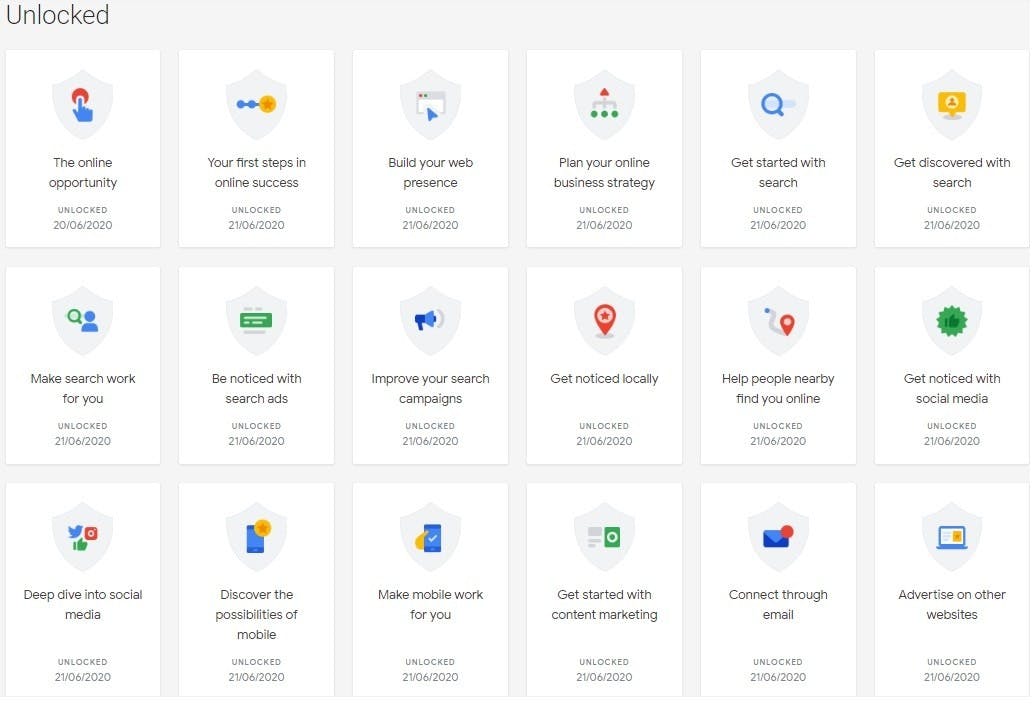
This is the course to take if you’re starting from zero. It covers twenty-six modules across SEO, SEM, content, social, email, mobile, and analytics, with a forty-question final exam and a certificate that holds up well on a CV.
Forty hours sounds heavy. In practice you can pace it across a few weeks of evenings, and the certification is one of the few free credentials that hiring managers actually recognize.
2. Inbound Marketing Certification by HubSpot Academy
Topic: Inbound marketing Level: Beginner Certification: Yes Duration: ~5 hours Available at: HubSpot Academy
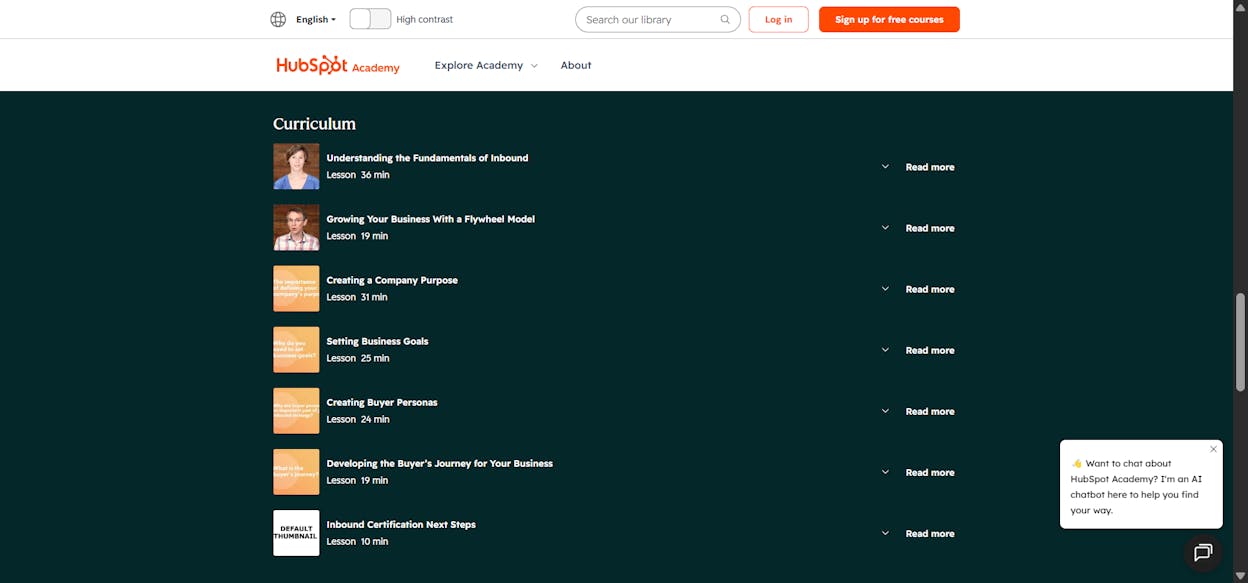
Inbound is the pull-don’t-push approach to marketing, and HubSpot wrote the book on it. This certification walks you through the inbound methodology of attract, engage, delight, then translates each stage into concrete activities you can run.
You leave the course with a framework you can use to plan content, structure your funnel, and brief a sales team. The exam has sixty questions, and a score of forty-five gets you certified.
3. Content Marketing Certification by HubSpot Academy
Topic: Content marketing Level: Beginner Certification: Yes Duration: ~6 hours Available at: HubSpot Academy
This is the certification that gets recommended often by working marketers. Twelve lessons cover storytelling, content frameworks, content creation, repurposing, and measurement, taught by HubSpot’s own content team alongside a few outside voices.
You set up an account by linking Google. The exam takes ninety minutes, multiple choice, with a 75% pass mark. If you already work in content, our breakdown of content marketing reporting tools is a useful follow-up read.
4. Blogging for Business by Ahrefs Academy
Topic: Content marketing and blogging Level: Beginner to intermediate Certification: No Duration: ~5 hours Available at: Ahrefs Academy (search for “Blogging for Business”)
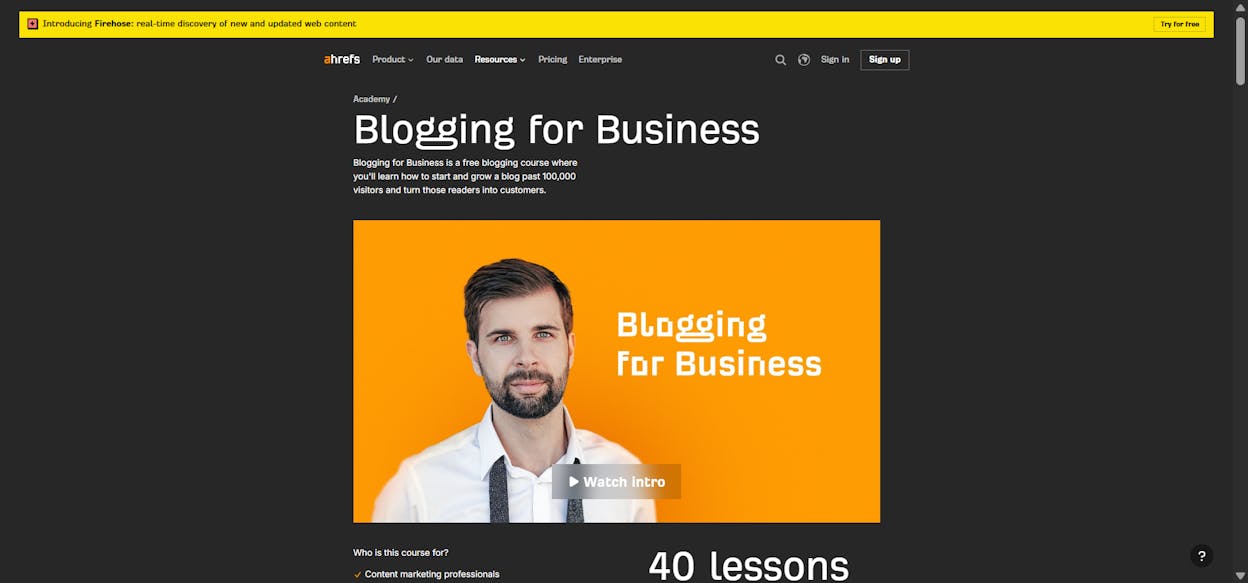
Tim Soulo, the CMO of Ahrefs, teaches the system they used to grow their blog to millions of monthly visits. Eleven modules and forty lessons cover idea generation, on-page basics, promotion, and link building. No sign-up required, which is rare for a free course of this depth.
This one pairs well with our 10-step SEO content strategy guide once you finish it. The Ahrefs course teaches the blogging mechanics. Our guide covers what to do before you ever open a content brief.
5. SEO Training Course by Ahrefs Academy
Topic: Search engine optimization Level: Beginner Certification: No Duration: ~2 hours Available at: Ahrefs Academy (search for “SEO Training Course”)
Sam Oh teaches this one. Fourteen lessons across four modules give you a working understanding of keyword research, on-page SEO, link building, and technical SEO. It’s a quick way to build a working mental model of how organic search functions.
The course shows you the principles. Applying them is where many people stall. If that sounds familiar, our guide on how to use keywords in SEO takes the theory and turns it into fourteen practical tips you can run today.
6. SEO Certification Course by HubSpot Academy
Topic: Search engine optimization Level: Beginner to intermediate Certification: Yes Duration: ~3 hours Available at: HubSpot Academy
Where the Ahrefs course is fast and tactical, this one is slower and more structured. It covers website optimization, on-page SEO, technical SEO, keyword research, and link building, with quizzes after each section and a sixty-question exam at the end.
Take this one if you want a certification on your LinkedIn profile after a SEO course. Take the Ahrefs course if you want to start ranking pages by next week.
7. Semrush Academy
Topic: SEO, PPC, and content marketing Level: Beginner to advanced Certification: Yes (free) Duration: Varies (1 to 4 hours per course) Available at: Semrush Academy
Semrush has built a library of forty-plus free courses that go deeper than plenty of paid options. The standouts are the SEO Toolkit course, the Keyword Research course, and the Technical SEO course taught by Brian Dean.
You don’t need a paid Semrush account to take any of them, and the certificates come at no cost. Treat the platform demos as optional. The teaching is what you’re there for.
8. Google Ads by Skillshop
Topic: Search engine marketing (PPC) Level: Beginner to intermediate Certification: Yes (Google Ads Certified) Duration: Self-paced Available at: Skillshop
Skillshop is Google’s official training platform. The Google Ads track has six certifications across Search, Display, Video, Shopping, Apps, and Measurement. Each one takes a few hours of reading and ends in a multiple-choice exam.
These certifications are widely recognized. Many agencies require their PPC managers to hold at least the Search certification, so it’s worth taking that one even if you don’t run paid search yourself.
9. Microsoft Advertising Certification
Topic: SEM (Bing and Microsoft Ads) Level: Intermediate Certification: Yes Duration: Self-paced Available at: Microsoft Advertising Learning Lab
Microsoft Ads has around eight percent of US search market share, and that audience tends to be older and higher-income. If you run paid search, this certification is a low-effort way to add a second engine to your toolkit.
There’s a 230-page study guide you can download for free. Many people skim it, take the practice test, and pass the exam in a single afternoon.
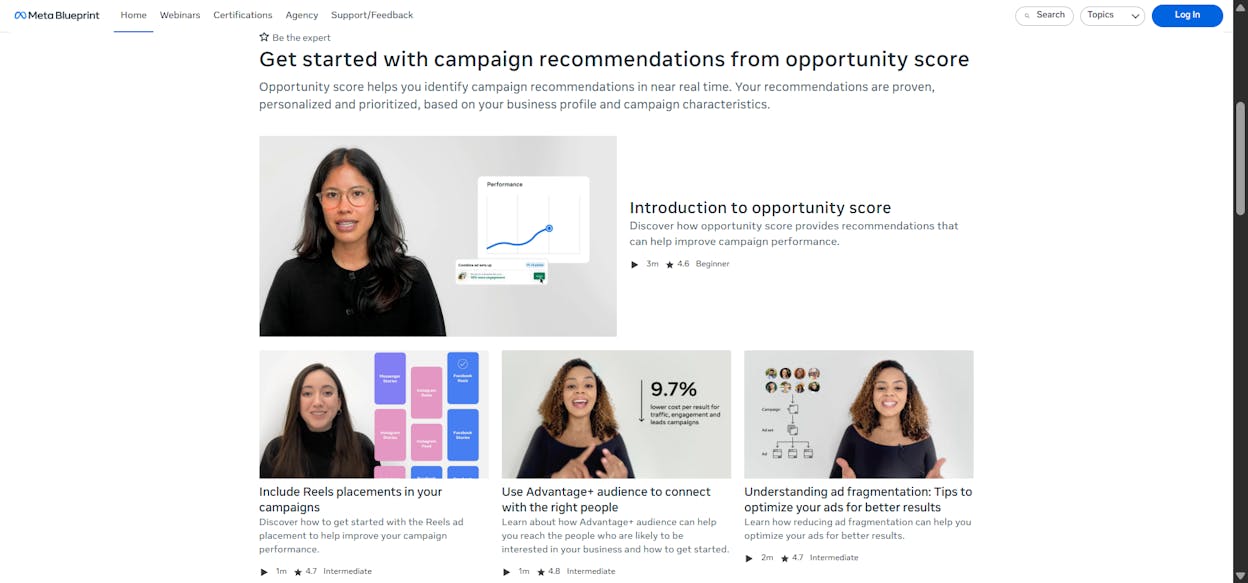
10. Meta Blueprint
Topic: Paid social (Facebook, Instagram, Messenger, WhatsApp) Level: Beginner to advanced Certification: Free courses, paid certifications ($99 to $150) Duration: Self-paced Available at: Meta Blueprint
Meta Blueprint is two things rolled into one. The free courses cover everything from Ads Manager basics to creative strategy, audience targeting, and Pixel implementation. There are over a hundred mini-courses, and Meta updates them as the platform changes.
The paid part is the credential. You only pay if you want the verified badge on your profile. For many marketers, the free courses on their own are enough to run profitable campaigns.
11. LinkedIn Marketing Labs
Topic: B2B paid social Level: Beginner to intermediate Certification: Yes (free) Duration: ~4 hours per certification Available at: LinkedIn Marketing Labs
LinkedIn ads are expensive and easy to waste money on. This is the official training, broken into four certifications, including Marketing Strategy, Marketing Analytics, Content & Creative, and Sales Insights. You watch the videos, take the test, and add the badge to your profile.
It’s a clean path to running a competent LinkedIn campaign without burning budget while you learn what the buttons do. The targeting modules alone are worth the four hours.
12. Email Marketing Certification by HubSpot Academy
Topic: Email marketing Level: Beginner to intermediate Certification: Yes Duration: ~3 hours Available at: HubSpot Academy
Twenty-eight short videos across nine topics, taught by Courtney Sembler. The course covers list segmentation, lead nurturing, copy, deliverability, and measurement. The exam is the standard sixty-question HubSpot format.
What sets this course apart is the focus on the harder side of email, deliverability, sender reputation, and list health. Plenty of free email courses skip these, and they’re usually what determines whether your campaigns actually land in the inbox.
13. Mailchimp Academy
Topic: Email marketing and small business automation Level: Beginner Certification: Yes (Mailchimp Foundations and Email Automation) Duration: ~6 hours total Available at: Mailchimp Academy
Mailchimp’s training is more practical than HubSpot’s. Less theory, more click-through-the-platform-and-build-something. If you want to ship a real campaign by the end of the week, start here.
You don’t need a paid Mailchimp plan to take the courses or earn the certifications. The free tier is plenty to follow along with the exercises.
14. Google Analytics Academy
Topic: Web analytics (GA4) Level: Beginner to advanced Certification: Yes (Google Analytics Individual Qualification) Duration: ~4 to 6 hours Available at: Google Analytics Academy
Three free courses sit on this platform. They’re GA4 for Beginners, Advanced GA4, and the GAIQ certification prep. You move from setting up basic event tracking to building custom reports and explorations.
GA4 is harder to learn than the old Universal Analytics, and that’s where this course earns its place. It’s the official, current explanation of how the tool works. For a deeper look at where GA4 falls short, our roundup of Google Analytics alternatives is worth a read after you finish.
15. TikTok for Business Learning Center
Topic: Short-form video and social Level: Beginner to intermediate Certification: No Duration: Self-paced Available at: TikTok Academy
Older roundups recommend Later.com’s TikTok course. We checked. TikTok now runs its own learning hub, and it’s better. Lessons cover the algorithm, ad formats, creative best practices, and how to use TikTok Pixel for conversion tracking.
The platform changes constantly, so any course older than six months is already out of date. The official source is the one to rely on, and it’s free.
16. AI for Marketing by HubSpot Academy
Topic: Applying AI to marketing workflows Level: Beginner Certification: Yes Duration: ~2 hours Available at: HubSpot Academy
This is a short course at roughly two hours, and the one that will translate into a noticeable change in your day-to-day work right away. It covers using AI for content creation, audience research, personalization, and analysis, plus the responsible-AI guardrails that any company-facing work needs.
Pair it with the next course on prompt engineering. Knowing what AI can do for you is one skill. Knowing how to ask it for that thing is another. You need both.
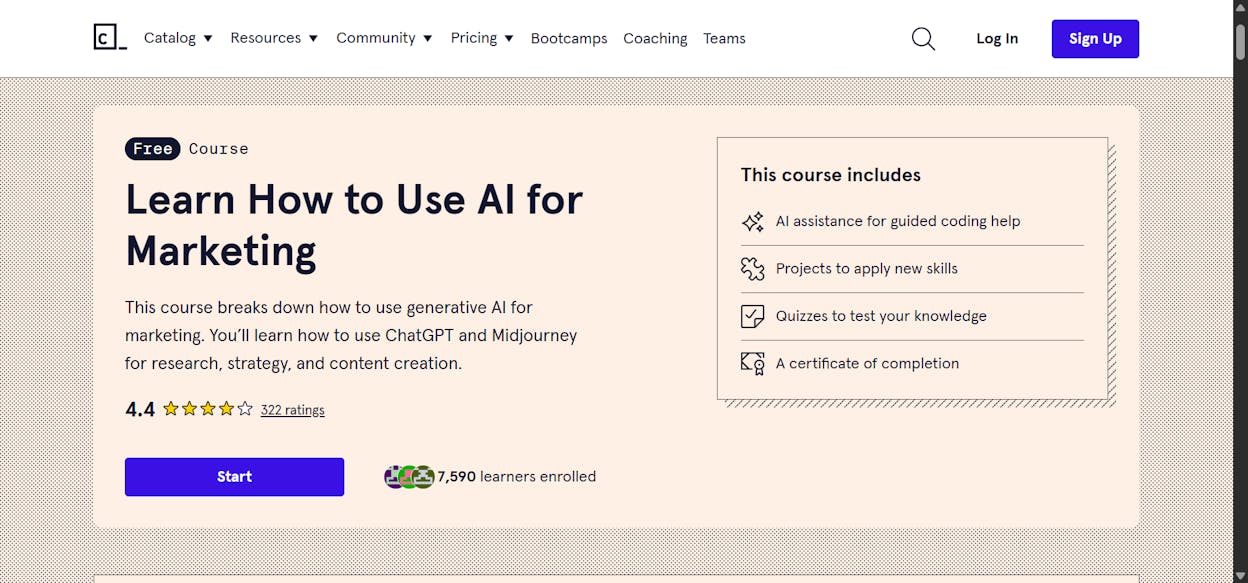
17. Prompt Engineering for Marketing by Codecademy
Topic: AI prompt engineering for marketers Level: Beginner Certification: Yes (included) Duration: ~3 hours Available at: Codecademy
Codecademy’s marketing prompt course is hands-on. You write prompts, run them, see the output, and refine them inside the course interface. The exercises cover product copy, ad campaigns, customer research, image generation, and content briefs.
If you’d rather go to the source, OpenAI Academy and Anthropic’s free prompt engineering documentation are both excellent alternatives. They’re broader and less marketing-specific, but the techniques transfer cleanly. For background on where this all fits in the new search landscape, see our explainer on generative engine optimization.
Don’t forget AI search literacy
Every course above teaches you how to win on a channel that already exists. That includes Google, Meta, LinkedIn, email, and YouTube. There’s a newer channel that none of them cover well, and it’s where a meaningful share of your future buyers will spend their research time.
People are now asking ChatGPT, Perplexity, Gemini, and Copilot the questions they used to type into Google. Your brand either shows up in those answers or it doesn’t.
This is not a replacement for SEO. We’ve written at length about why SEO is not dead and why AI search should be treated as another organic channel that sits alongside it. The skills overlap. The metrics and tools don’t.
Much of what you need to understand about AI search is short:
-
AI engines pull from a small set of trusted sources for any given prompt. If you’re not in that set, you’re invisible.
-
The “keywords” of AI search are prompts, and they look more like full questions than two-word queries.
-
Citations, brand mentions, and sentiment are the new rank.
-
The pages that get cited in AI answers are often different from the pages that rank #1 on Google.
This is the gap our product was built for. Once you’ve finished a few of the courses above, here’s the workflow we recommend for putting them to work on AI search.
Find the prompts your buyers are actually asking. You can’t guess what people are typing into ChatGPT. You have to look. Analyze AI’s prompt discovery surfaces the questions buyers in your category are asking AI engines, mapped to where they sit in the funnel.
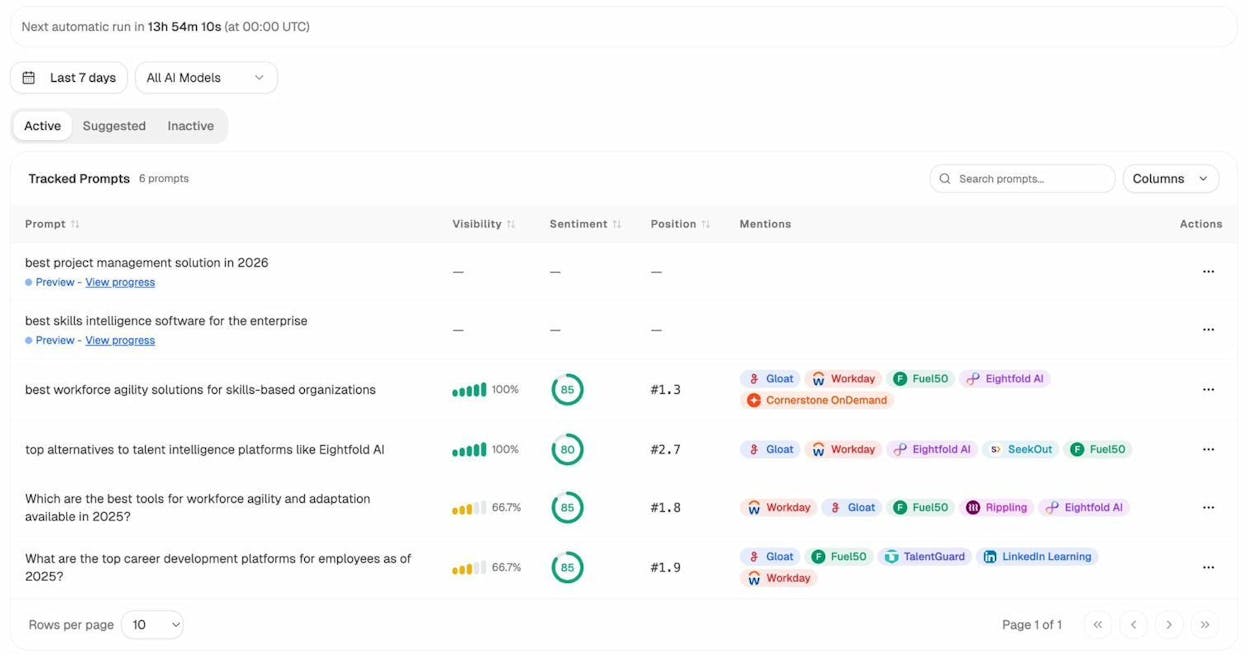
Track who shows up in those answers and who doesn’t. For each prompt you care about, you need to know which brands are getting cited and how often. The AI visibility tracking view breaks this down across ChatGPT, Perplexity, Gemini, and Copilot in one place.
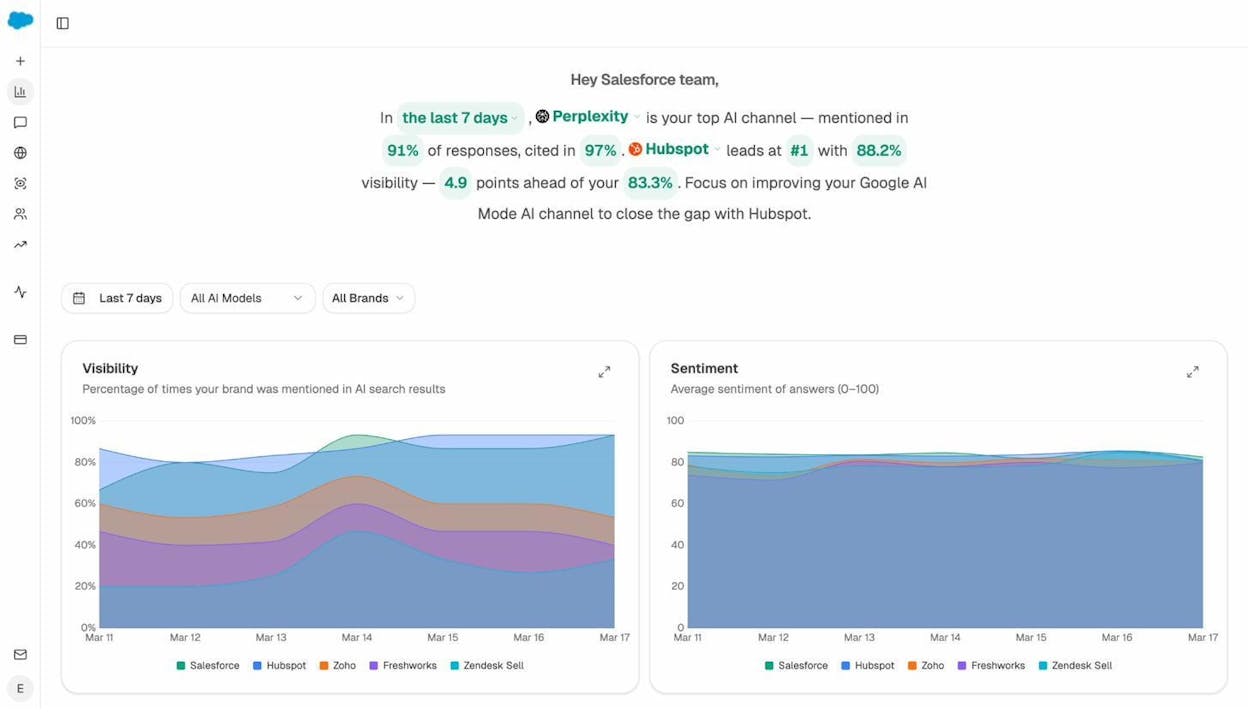
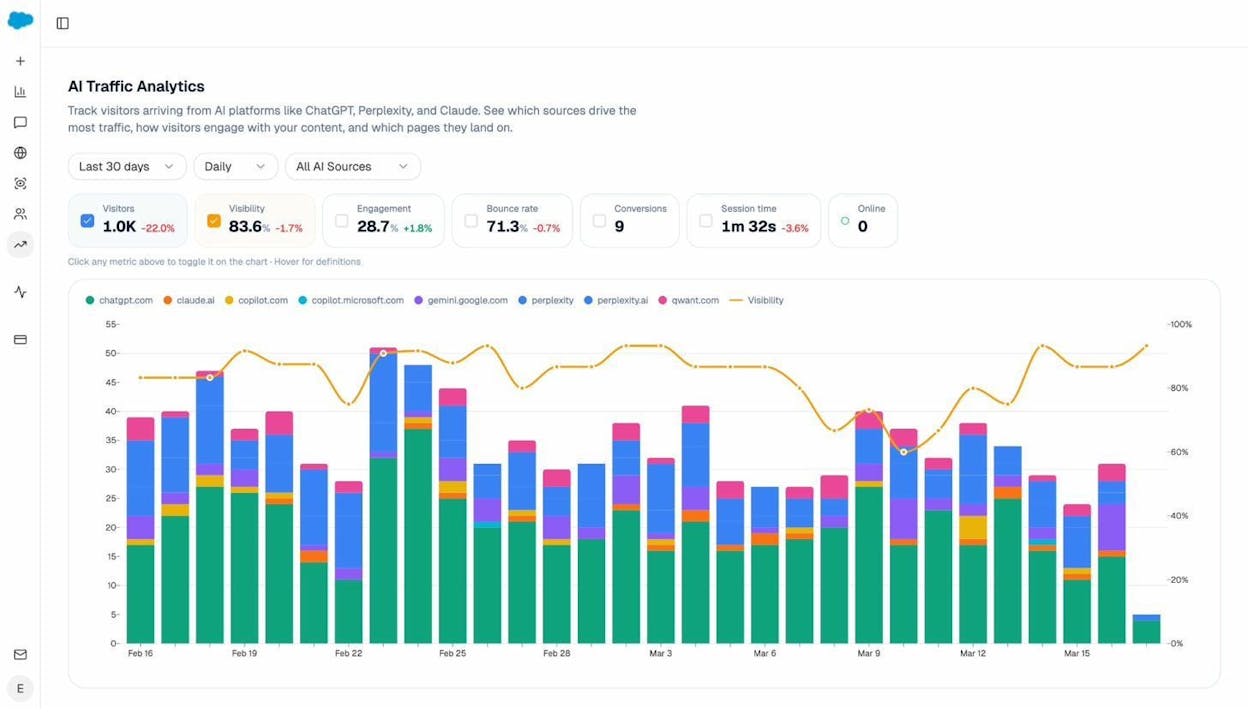
Find the pages that drive AI traffic and double down on what works. AI search traffic doesn’t always show up in Google Analytics the way you’d expect. The AI traffic analytics view shows you which of your landing pages are getting cited, which are converting, and which ones are silently doing the work.
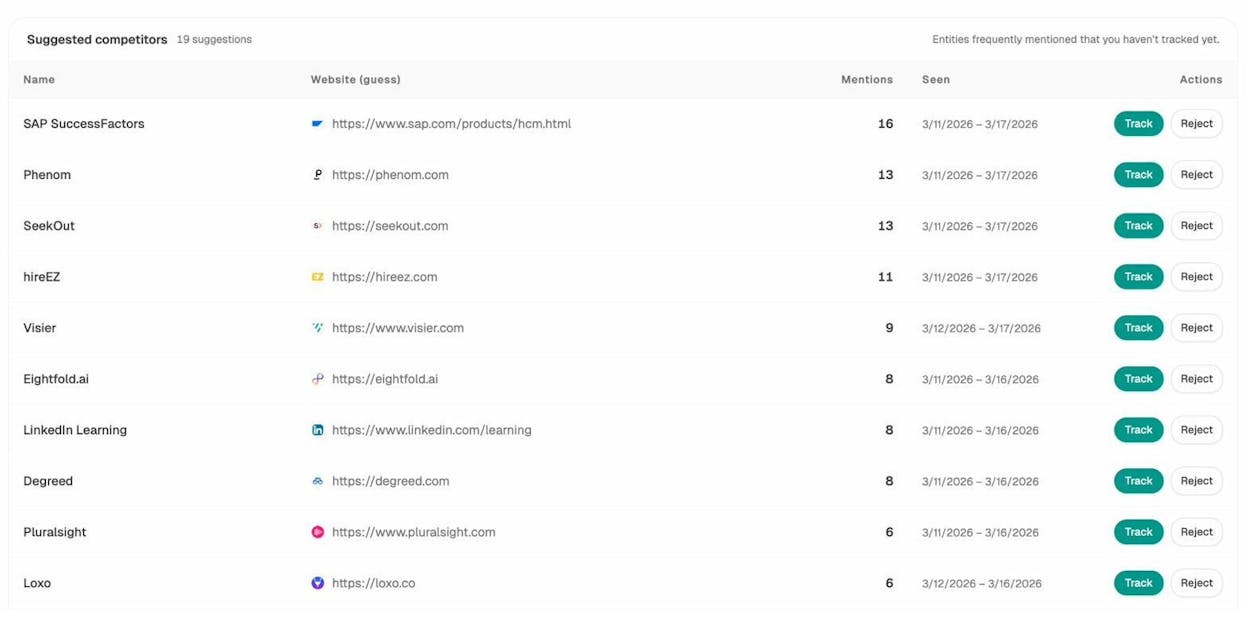
Watch where competitors win and you don’t. Our competitor intelligence shows the prompts where rivals are mentioned and you aren’t. Each one is a content gap you can act on next sprint.
If you’d rather start free, our keyword rank checker and SERP checker are a fast way to see where you stand on a single prompt before committing to a full setup. For the deeper picture, our guides on how to rank on ChatGPT and how to rank on Perplexity draw on 65,000 citations of real data.
Bonus: LearningSEO.io
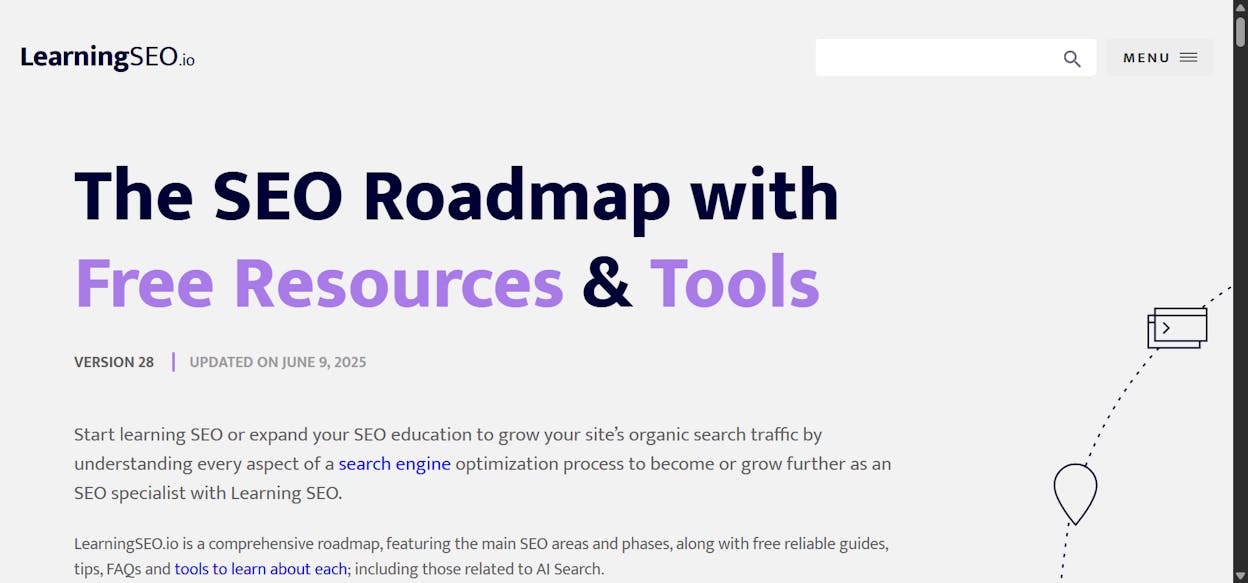
LearningSEO isn’t a course on its own. It’s a thorough, regularly updated free library of external SEO guides, courses, and videos, maintained by Aleyda Solis. Resources are categorized by skill level, from SEO basics through to crawl budget optimization and SEO contracts.
There’s a copyable color-coded spreadsheet you can use to track your own progress through it. Treat it less like a course and more like a curriculum you build for yourself, picking and choosing what’s relevant to the role you actually have.
Where to start
You don’t need to take all seventeen courses. You probably shouldn’t.
If you’re brand new to marketing, start with the Google Digital Garage Fundamentals course. Then pick one specialty (content, SEO, paid, or email) and go deep on a single course in that area. From there, add the AI for Marketing course and one prompt engineering resource. That’s a complete starter curriculum in roughly twenty hours of total study time.
If you already have a marketing role, skip the foundations and pick the courses that match the channel you’re being asked to grow. Pair every course with a small live project. Reading about Google Ads doesn’t teach you how to run a Google Ads campaign. Spending fifty dollars of your own money on a real one does.
Here’s a quick pick-your-path table to make that easier.
|
Your situation |
Start with |
|---|---|
|
Brand new to marketing |
Google Digital Garage + HubSpot Inbound Certification |
|
Need to grow a blog |
Blogging for Business by Ahrefs + HubSpot Content Marketing |
|
Want to run search ads |
Google Ads by Skillshop + Microsoft Advertising Certification |
|
Want to run paid social |
Meta Blueprint free courses + LinkedIn Marketing Labs |
|
Need to learn SEO from scratch |
SEO Training by Ahrefs + HubSpot SEO Certification + Semrush Academy SEO Toolkit |
|
Run email or lifecycle programs |
HubSpot Email Marketing Certification + Mailchimp Academy |
|
Need to make sense of GA4 |
Google Analytics Academy GA4 for Beginners + Advanced GA4 |
|
Want to use AI well in your role |
HubSpot AI for Marketing + Codecademy Prompt Engineering for Marketing |
|
Need to understand AI search |
Read our AEO guide + try Analyze AI |
Once you’ve covered the channels you can already see, spend an afternoon on AI search. It’s a cheap place to get ahead in 2026 because many of your competitors haven’t started looking yet, and the courses above give you everything you need to take action on the data once you have it.

Ernest

Ibrahim


