



Summarize this blog post with:


In this article, you’ll learn the nine on-page factors that move the needle in search today, how to actually do each one (not just define it), and how to make those same pages work harder in AI search engines like ChatGPT, Perplexity, and Google AI Mode.
Table of Contents
1. Content relevance
Content relevance means your page actually answers the question behind the keyword. Not the literal keyword. The question.
Take the keyword “air fryer salmon.” Type it into Google and every top result is a recipe. If you publish a 1,500-word essay on the pros and cons of air-frying salmon, you can hit every other on-page checkbox in this article and you will still not rank.
Here is the four-step check we use before we write a single word.
Step 1: Look at the top 10 results and classify the dominant format. Is it a listicle, a tutorial, a tool, a definition, a comparison? Whatever appears five or more times is the format Google has decided satisfies that query.
![[Screenshot description: Google SERP for a sample keyword, with red boxes highlighting the format pattern across the top 10 results.]](https://www.datocms-assets.com/164164/1777924966-blobid1.png?auto=format,compress&w=1248&fit=max)
Step 2: Read the first three results in full. Note what every article covers, what only one article covers, and what is missing entirely. The shared coverage is the floor. The unique coverage is the ceiling. The missing coverage is your information gain.
Step 3: Match angle, not just topic. A query like “best CRM for startups” has a buyer asking for a recommendation. Replying with “what is a CRM” misses the angle even though the topic is right.
Step 4: Verify with the SERP Checker. Paste the keyword in and confirm the format pattern across regions before you commit.
The AI search layer. AI engines pull from the same pool of pages but answer users directly instead of returning a list. Your page now has to deliver the answer in the first 100 to 150 words, in clear, declarative language. The Bottom Line Up Front (BLUF) format that helps human readers also helps AI extract the answer cleanly.
To see what AI engines actually pull when people search your space, run a few queries through the Ad Hoc Prompt Searches tool inside Analyze AI.
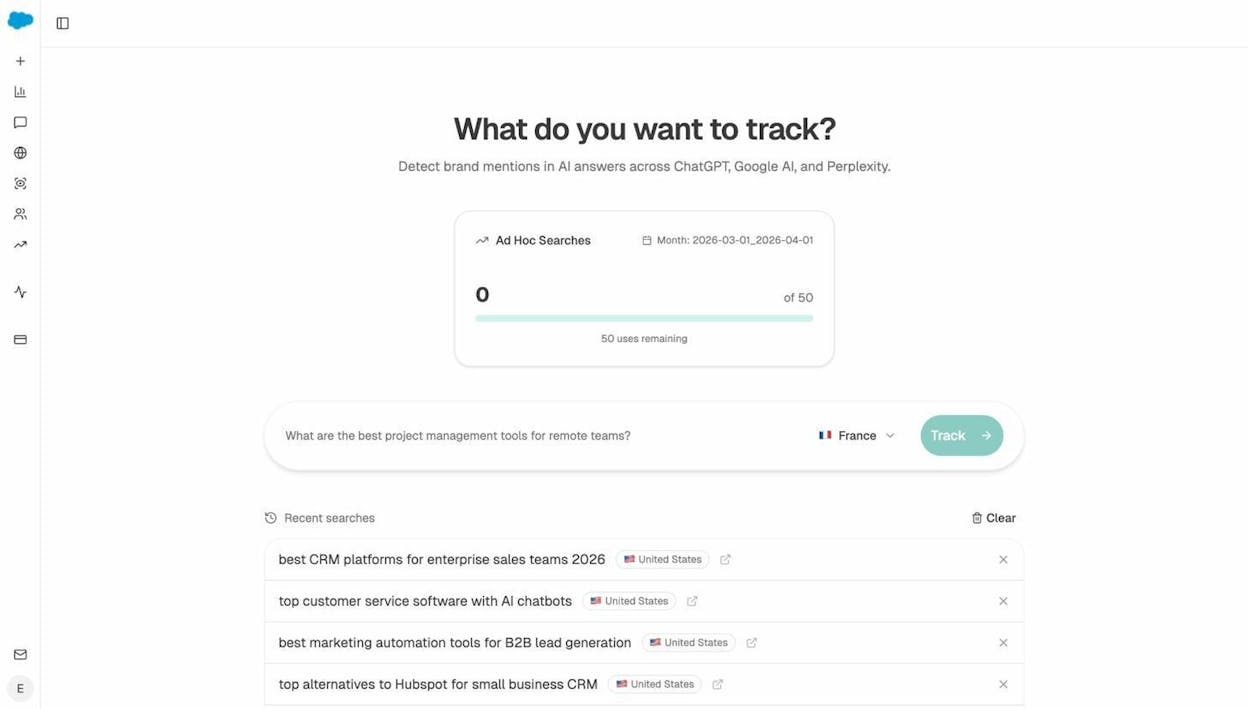
This tells you which pages are getting cited and which are not, so you can reverse-engineer the angle that wins.
For more on matching content to actual buyer intent, see our guide on keyword types for SEO and AI search.
2. Content freshness
Freshness is not a date stamp. It is whether the information on the page reflects the current state of the world.
A 2018 article that says “Google now uses BERT” is not fresh. A 2026 article on perennial topics like the basics of HTML title tags can be twelve months old and still be perfectly fresh.
Before you refresh a page, run this two-step diagnostic.
Diagnostic 1: Is the traffic actually declining? Pull the last 90 days of impressions and clicks for the URL in Google Search Console. If clicks are stable and impressions are dropping, you may be losing share to AI Overviews rather than to a competitor page. The fix is different in each case.
Diagnostic 2: Is the content factually wrong, or just stale-looking? Stale-looking content gets a quick refresh. Factually wrong content gets a rewrite.
When you do refresh, do this in order:
-
Update any time-bound claims and statistics.
-
Replace screenshots that show old product UIs.
-
Add one new section that did not exist before. This is your information gain.
-
Tighten the introduction so the answer appears in the first paragraph.
-
Update the publish date only after the content actually changed.
The AI search layer. Research from Ahrefs analyzing 17 million citations found that ChatGPT, Copilot, Gemini, and Perplexity all prefer to cite content newer than what typically appears in traditional search. ChatGPT even has an internal URL freshness score. So fresh content does double duty in 2026: it ranks better and it gets cited more.
![[Screenshot description: GSC graph showing impressions and clicks for a single URL over 90 days, with annotations marking the period when an AI Overview started appearing.]](https://www.datocms-assets.com/164164/1777924973-blobid3.png?auto=format,compress&w=1248&fit=max)
For the full process we use, read our breakdown of how to refresh content for SEO and AI search.
3. Title tags
The title tag is the HTML element that controls what shows up as the clickable headline in search results. It is also the strongest on-page signal of what the page is about.
A good title tag does three jobs in this order: tells Google the topic, tells the reader the value, and earns the click.
Here is the formula we use.
[Primary keyword] : [specific value or angle] | [brand]
Examples:
|
Bad |
Better |
Best |
|---|---|---|
|
Welcome to Our Blog | Acme |
SEO Tips and Tricks for 2026 | Acme |
9 On-Page SEO Factors You Can’t Ignore | Acme |
|
Best CRMs |
Top 10 CRM Software |
10 Best CRMs for B2B Sales Teams (Tested in 2026) |
|
About Us |
About Acme, Our Mission |
Acme: The CRM Built for Outbound Sales Teams |
Three quick rules. Keep it under 60 characters so it does not get truncated in the SERP. Put the primary keyword as close to the front as you can without making it sound robotic. Match the search intent classified in factor #1. If the SERP wants a listicle and your title says “guide,” you have already lost.
Common mistake. Stuffing the brand name and a tagline in front of the keyword. “Acme | The Leading CRM for Modern Teams | Best CRMs in 2026” is a title tag wearing a costume. Lead with what the user searched for.
The AI search layer. Title tags double as the visible label AI engines display when they cite a page. A clear, declarative title increases the chance the engine will surface your page as a named source rather than burying it inside a paragraph. Vague titles like “What You Need to Know” do not give AI engines anything to anchor to.
For the deeper formula and 50+ examples, see our guide on SEO keywords.
4. URLs
A URL is the address of your page. From an SEO perspective, the only things that matter are readability, structure, and stability.
Readability. A user should be able to read your URL out loud and have it make sense. Compare:
-
❌ acme.com/p?id=4827&cat=12
-
❌ acme.com/blog/2026/03/14/the-best-crm-software-for-small-business-teams-in-2026-final-version-v2
-
✅ acme.com/blog/best-crm-software
Structure. Group related content into logical folders. A recipe site might use /recipes/dinner/, /recipes/breakfast/, and so on. This helps both crawlers and humans understand site hierarchy. Avoid deep nesting beyond three levels.
Stability. Once a URL ranks, do not change it without setting up a 301 redirect. Changing a URL without redirecting it deletes the page from Google’s eyes and resets your link equity to zero.
A few practical rules:
-
Use hyphens, not underscores or spaces.
-
Lowercase only.
-
Cut stop words you do not need (“the,” “a,” “and,” “of”).
-
Avoid dates unless the page is genuinely time-bound.
-
Keep it under 75 characters when possible.
The AI search layer. Clean URLs help here too. AI engines often cite the URL string as part of their answer or include it in the source list. A descriptive URL like acme.com/blog/best-crm-software doubles as a trust signal in the citation. A cryptic one like acme.com/?p=8472 does not.
![[Screenshot description: side-by-side comparison of two AI search results, one citing a clean URL and one citing a query-string URL, with the cleaner one circled.]](https://www.datocms-assets.com/164164/1777924979-blobid4.jpg?auto=format,compress&w=1248&fit=max)
5. Meta descriptions
A meta description is the snippet of text Google sometimes shows under your title in search results. We say “sometimes” because Google rewrites them in roughly 70% of cases.
So why bother? Two reasons.
First, when Google does use yours, a sharp meta description can lift click-through rate by several percentage points. Second, your meta description doubles as the preview text on social platforms when someone shares the link.
Here is the formula:
[Promise of value] + [proof or specificity] + [call to action]
A worked example for an article on B2B email outreach:
Most cold email templates get ignored. We tested 12 across 4,000 sends and found three patterns that lift reply rates by 38%. See the data.
Notice three things. The promise is concrete (lift reply rates). The proof is specific (12 templates, 4,000 sends, 38% lift). The CTA is direct (see the data).
Common mistake. Repeating the title tag almost word for word. The meta description is your second sales pitch, not a reprise of the first. If your title says “9 On-Page SEO Factors,” your meta description should expand on what the reader gets out of those nine factors.
Keep meta descriptions between 150 and 160 characters so they do not get truncated.
6. Internal links
Internal links do four things at once. They distribute authority from strong pages to weak ones. They tell Google which pages on your site you consider important. They help users navigate. They help crawlers find pages they would otherwise miss.
Here is the workflow we use to add internal links systematically.
Step 1: Identify your money pages. These are the pages that drive sign-ups, demos, or sales. List them.
Step 2: Find every existing page on your site that mentions the topic of a money page. A simple Google site search works: site:yourdomain.com "topic phrase".
![[Screenshot description: Google search results page showing a site: search returning 12 results across blog posts, all candidates for internal linking.]](https://www.datocms-assets.com/164164/1777924980-blobid5.png?auto=format,compress&w=1248&fit=max)
Step 3: Add a contextual link from each of those pages to the money page. Use anchor text that includes the target keyword naturally. Not “click here.” Not “this article.” The anchor text is itself a ranking signal.
Step 4: Audit broken internal links quarterly. A 404 inside your own site wastes link equity. Use the Broken Link Checker to catch them.
A note on link depth. Pages that require more than three clicks from the homepage to reach are crawled less frequently and tend to rank worse. Flatten your architecture wherever you can.
The AI search layer. AI engines follow the same link graph crawlers use. A page that no other page on your site links to is essentially invisible to them. Internal linking is how you signal which pages should be findable, both to traditional crawlers and to AI bots scraping your site for context.
For the full breakdown, see our guide on 10 internal linking tips for SEO.
7. Schema markup
Schema markup is structured data you add to a page (usually as JSON-LD in the page head) that tells search engines exactly what the content is. A recipe. An article. A product. An FAQ. A how-to.
You do not need schema for every page. You need it where it changes how your result is displayed. The four schemas with the highest payoff for most sites:
|
Schema type |
When to use it |
What it gets you |
|---|---|---|
|
Article |
Blog posts, news |
Headline display, author byline in SERP |
|
Product |
Ecommerce product pages |
Price, rating, stock status in SERP |
|
Recipe |
Cooking content |
Image carousel, cook time, calories |
|
FAQPage |
Pages with Q&A blocks |
Expandable Q&A directly in SERP |
The fastest implementation path:
-
Pick the schema type from schema.org.
-
Generate the JSON-LD using a tool like Google’s Structured Data Markup Helper.
-
Paste it into the <head> of the page (or use a plugin if you are on WordPress).
-
Validate with Google’s Rich Results Test.
-
Submit the URL for re-indexing in Search Console.
Common mistake. Adding schema for content the page does not actually contain. Marking a page as a Recipe when it is a listicle of ten recipes is a manual penalty waiting to happen.
The AI search layer. Schema is one of the cleanest ways to communicate entities to AI engines. When your page declares itself a Product with a brand, a price, and a rating, AI engines do not need to guess. They have the entity ready to cite. This is one of the highest-leverage technical changes you can make for AI visibility, and almost nobody does it well.
8. Images
Image SEO covers four jobs: alt text for accessibility and crawlers, file size for page speed, file naming for context, and image search visibility.
Run through this checklist for every image you publish:
-
Alt text: Describe what is in the image in one sentence. Include the keyword only if it is genuinely relevant.
-
Filename: crm-pipeline-dashboard.png, not Screen-Shot-2026-03-14-at-2.47.png.
-
Format: Use WebP for photos, SVG for logos and icons. PNG only when transparency is required and SVG will not work.
-
Compression: Aim for under 200 KB per image on content pages. Tools like Squoosh or TinyPNG handle this in seconds.
-
Dimensions: Serve images at the size they will display. A 4000-pixel-wide hero image on a 1200-pixel container is wasted bandwidth.
-
Lazy loading: Add loading="lazy" on images below the fold.
Common mistake. Skipping alt text on decorative images. If an image is purely decorative, give it alt="" (empty alt, not missing alt). Missing alt attributes are accessibility failures.
The AI search layer. When an AI engine generates a visual answer (Google AI Mode, Perplexity in some queries), it pulls from indexed images. Clean filenames, structured alt text, and proper schema (ImageObject) make your images eligible. Most teams skip this entirely, which means whoever does it well gets the citation by default.
9. E-E-A-T
E-E-A-T stands for Experience, Expertise, Authoritativeness, and Trustworthiness. It is not a direct ranking factor. It is the framework Google’s human quality raters use to evaluate whether the algorithm is doing its job.
In practice, E-E-A-T translates into specific things you can put on a page.
Experience. Show first-hand use. If you are writing about a product, include screenshots of you using it. If you are writing about a city, include photos you took.
Expertise. Add author bios with credentials relevant to the topic. A medical article needs a doctor’s name. An SEO article needs a marketer’s name. Link the bio to a full author page. Link the author page to LinkedIn.
Authoritativeness. Get cited by other sites in your space. The most reliable way is to publish original research, original data, or original frameworks. Restating what other people have said does not earn citations.
Trustworthiness. Make basic facts about your business easy to find. Contact info. Physical address. Return policy if you sell anything. SSL certificate. Author transparency. The absence of these is a trust signal too, just a negative one.
The AI search layer. AI engines lean on the same trust signals, often more heavily than Google does. They are trained to cite sources that look credible to a reader. A page with a named expert author, original data, and transparent sourcing gets cited at a much higher rate than an anonymous regurgitation, even if the regurgitation ranks higher in Google.
How to measure on-page SEO performance (in both channels)
The Ahrefs original article ends with the nine factors. We are going one step further, because doing the work without measuring it is just hope. Here is what to track.
For Google search:
-
Impressions and clicks per URL in Google Search Console.
-
Average position for the primary keyword (use the Keyword Rank Checker).
-
Click-through rate from impression to click.
-
Bounce rate and time on page in GA4.
For AI search:
This is where most teams stop because they do not have visibility. Inside Analyze AI, the AI Traffic Analytics dashboard shows which pages on your site receive AI-referred traffic, broken down by engine.
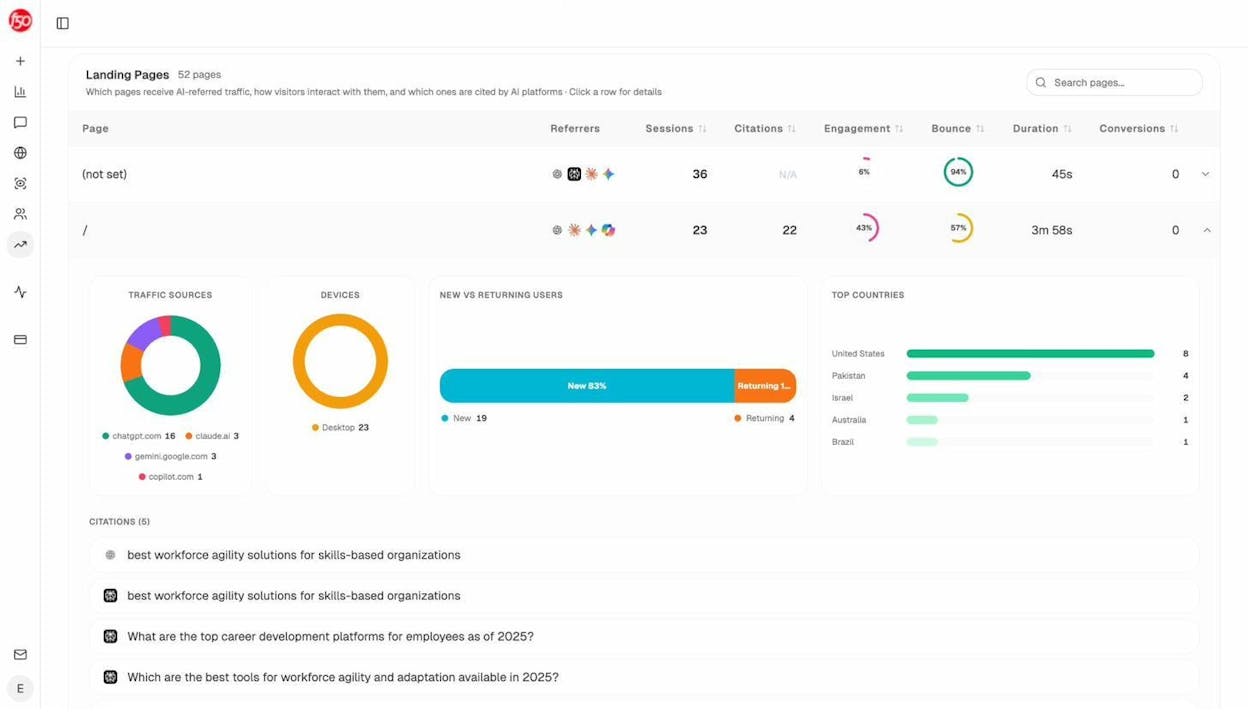
You can see exactly which pages ChatGPT, Claude, Perplexity, and Gemini are sending visitors to. That tells you which on-page changes are working in AI search, the same way GSC tells you what is working in Google.
For the citation side, the Sources dashboard shows the content types AI engines cite most often in your space.
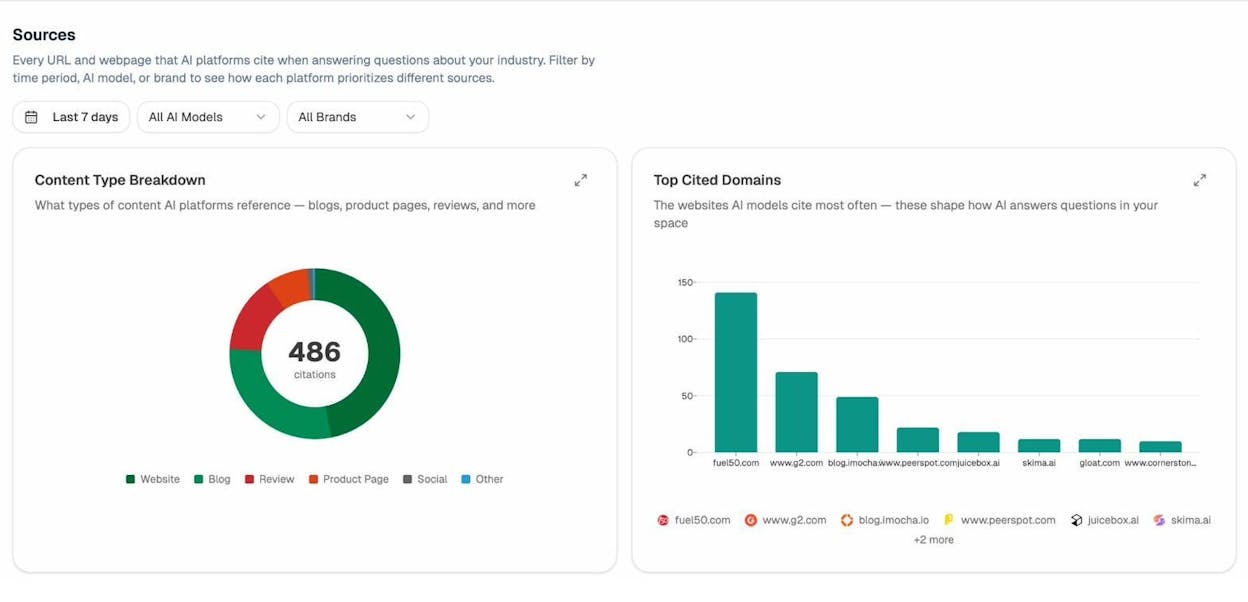
If blogs make up 65% of citations in your category and you are putting all your effort into product pages, the data is telling you to rebalance.
When a page is underperforming, the Content Optimizer inside Analyze AI grades the page on argument, flow, clarity, and polish, and produces line-by-line editorial comments on what to fix.
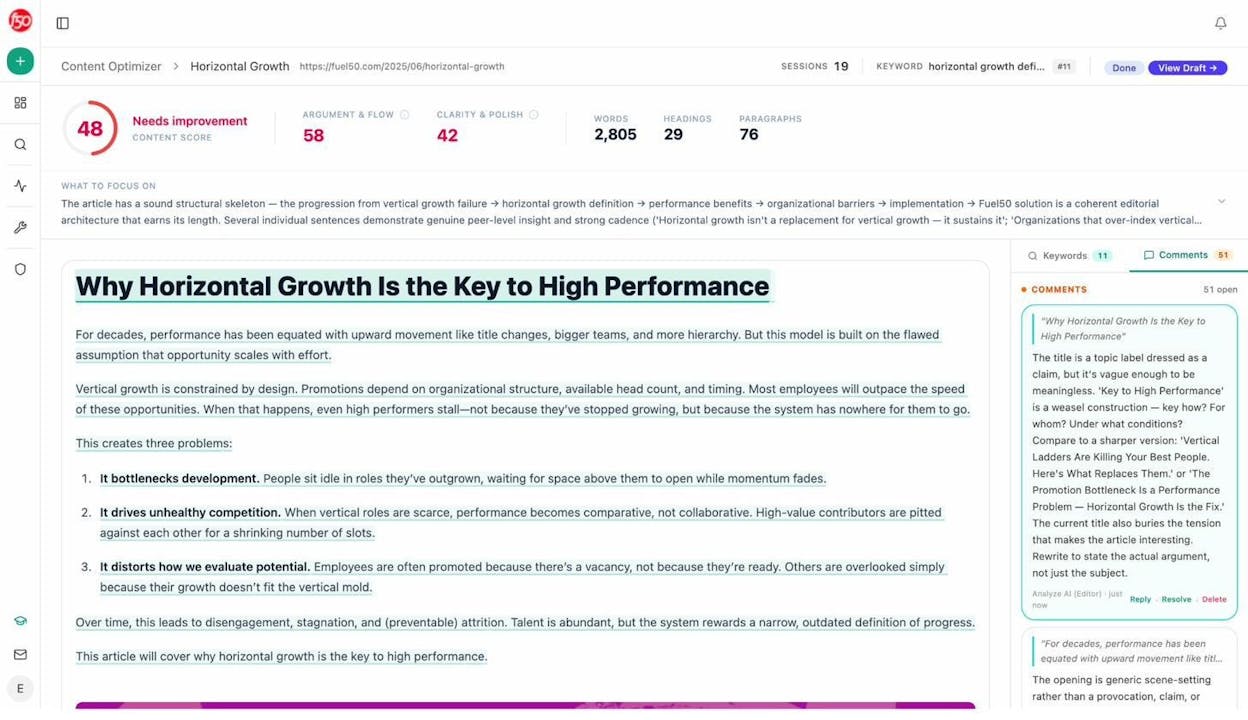
That turns a fuzzy “this page needs work” into a specific edit list you can hand to a writer.
What to do this week
If you read all the way down to here and want to leave with a single action, do this:
-
Pick your three highest-traffic pages.
-
Run them through the nine factors above.
-
Score each page out of 9.
-
Fix the lowest-scoring factor on each page first.
That is the smallest version of an on-page audit that produces results. Once the loop is working, scale it to the next 20 pages, then the next 100. The brands that win in both Google and AI search are not the ones with secret tactics. They are the ones who execute the basics consistently across every page.

Ernest

Ibrahim


