



Summarize this blog post with:


In this piece, you’ll see a straightforward breakdown of the nine tools practitioners rely on most — what they do well, where they struggle, and when each one makes sense depending on your bottleneck. The goal is simple: give you a clear, practical guide that removes guesswork and helps you choose the tool that actually moves your metrics in the right direction.
Table of Contents
TL;DR
|
Tool |
Primary focus |
Best for |
Key strengths |
Key watch-outs |
|
Analyze AI |
Full-funnel AI-search + attribution |
Growth / SEO teams that want to prove AI-search impact on pipeline |
Ties AI visibility to sessions, conversions, and revenue; prompt-level + source-level insights across major LLMs |
GEO-only (no full SEO stack); needs clean analytics setup and enough traffic to get full value |
|
SEMrush AI SEO Toolkit |
Full-stack SEO + AI visibility |
Teams wanting one platform for keywords, links, audits, and early AI-search tracking |
Mature SEO suite (keywords, backlinks, audits) with added AI visibility and prompt tracking |
Expensive for small teams; AI layer still maturing and can feel heavy if you only need content optimisation |
|
Surfer AI Tracker |
Prompt-level AI visibility |
Teams already using Surfer who want to see how LLMs talk about their brand |
Easy fit into Surfer workflows; prompt + source transparency across ChatGPT, Perplexity, etc. |
Young dataset; no traffic or revenue attribution; not a full SEO/analytics platform |
|
Pricefx |
Pricing & margin optimisation |
Commercial teams focused on pricing, product mix, and deal guidance |
Transparent, modular “science bricks”, BYOS, strong enterprise pricing use cases |
Out-of-scope for SEO/content; complex setup and better suited to data-mature, larger organisations |
|
NEURONwriter |
Semantic SEO content optimisation |
Bloggers, SMBs, small content teams that want affordable optimisation |
Strong value for money; semantic/NLP-focused suggestions; outlines, scoring, internal links |
No deep technical SEO or backlink tools; AI drafts still need solid human editing |
|
Rankscale AI |
Multi-engine GEO monitoring |
Teams wanting deep, cross-engine AI visibility and competitive insight |
Prompt-level and citation analysis across engines/regions; strong competitor benchmarking |
Monitoring-only (no content workflows); can feel technical; still need other tools for SEO execution |
|
Rankability |
Semantic content scoring + workflows |
Content teams and agencies producing lots of pages monthly |
Research → outline → draft → optimise in one tool; real-time scoring and relevance monitoring |
Limited technical SEO; AI writing needs human review; not as deep on GEO as dedicated tools |
|
AirOps |
Content operations & automation |
High-volume teams that need repeatable content + refresh workflows |
No-code workflows, “Power Agents”, strong support for refresh programs and brand consistency |
Built for mature teams; heavier setup; light on pure GEO/AI-visibility compared to specialist tools |
|
LLMrefs |
Citation-level GEO tracking |
Teams that care specifically about how often LLMs cite their pages |
Clear view of citations, domains, and multi-engine coverage; accessible entry pricing |
Narrow focus (no SEO/technical features, no attribution); data is directional due to LLM variability |
Analyze AI: best AI optimization tool for full-funnel AI-search visibility, traffic, and revenue attribution
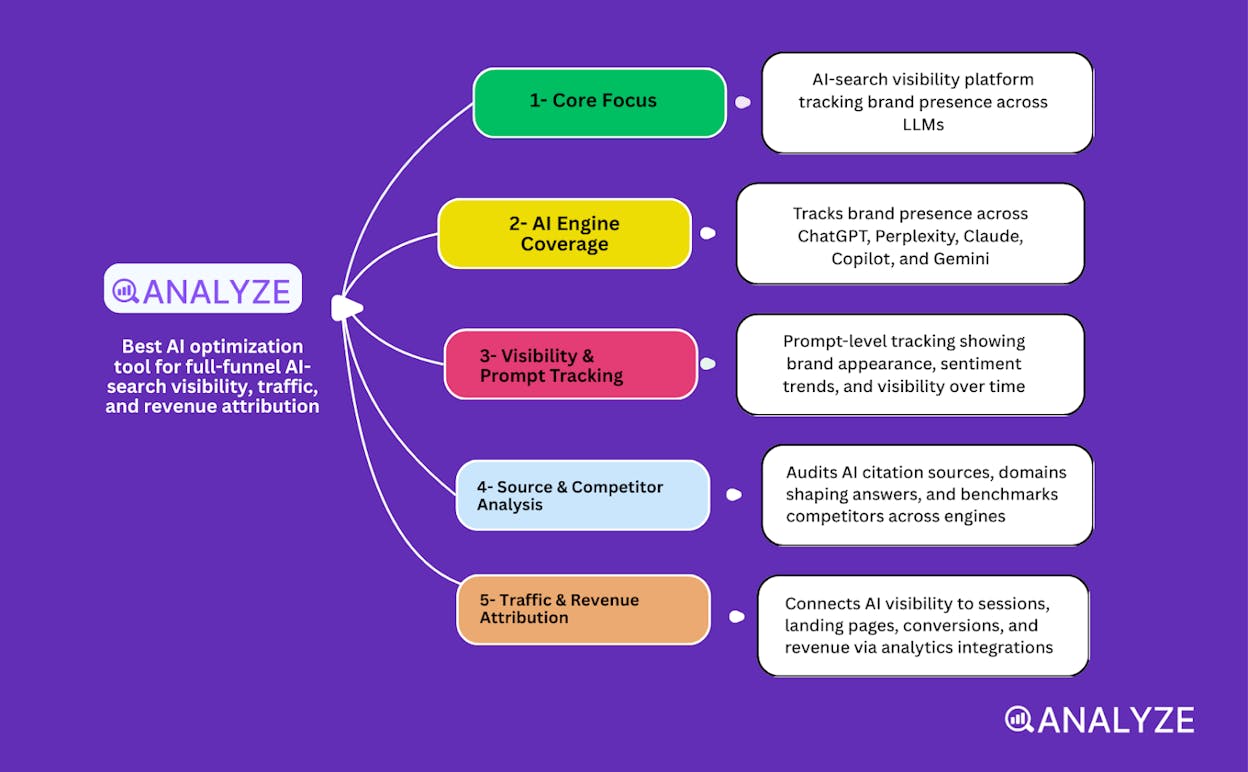
Key Analyze AI standout features
-
AI-search visibility platform that tracks how your brand appears across major LLM answer engines such as ChatGPT, Perplexity, Claude, Copilot, and Gemini.
-
Connects AI visibility to real business outcomes by showing which engines send sessions, which landing pages receive that traffic, and how many of those visits convert.
-
Prompt-level tracking that reveals which prompts surface your brand, how you compare to competitors, and how sentiment trends shift over time.
-
Audits which sources and domains AI models rely on when generating answers, showing which pages shape the narrative in your category.
-
Multi-engine coverage, competitor benchmarking, trend visualisation, and direct analytics integrations that link visibility → traffic → conversions.
Analyze AI works well when your main goal is to understand how AI visibility translates into real business impact. Most visibility tools stop at showing whether an LLM mentioned your brand, but Analyze AI goes deeper by connecting mentions to sessions, landing paths, and conversions.
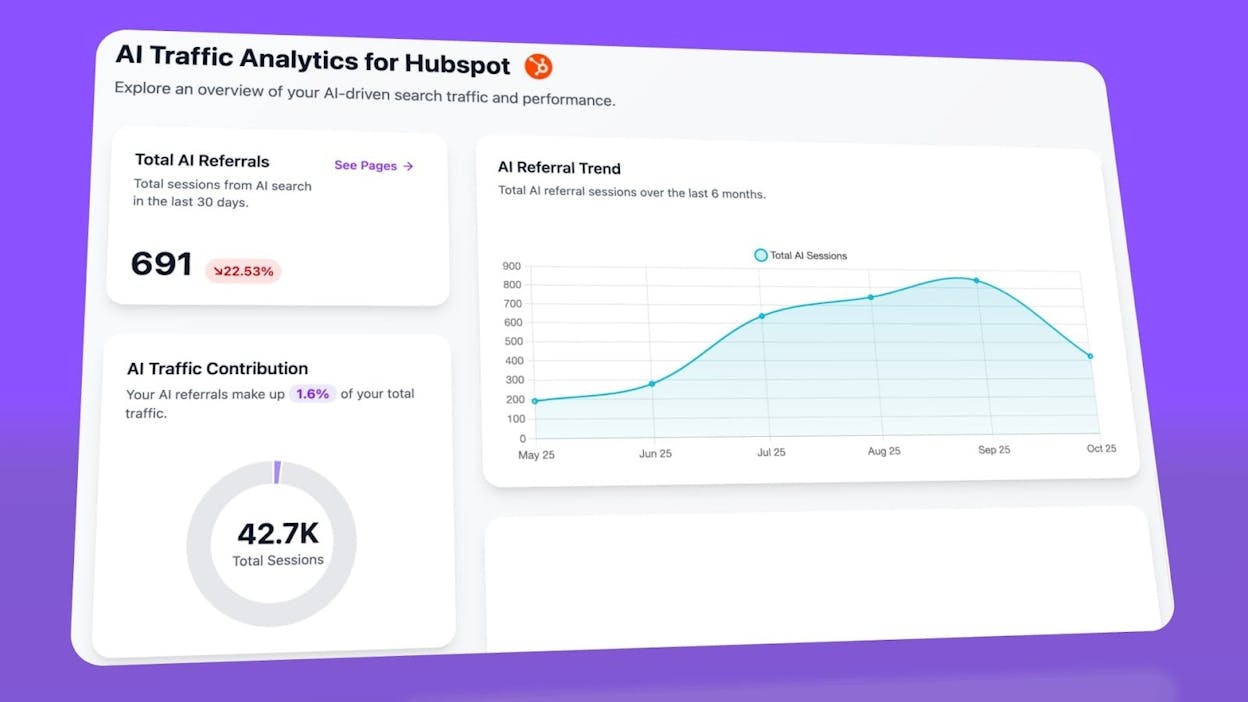
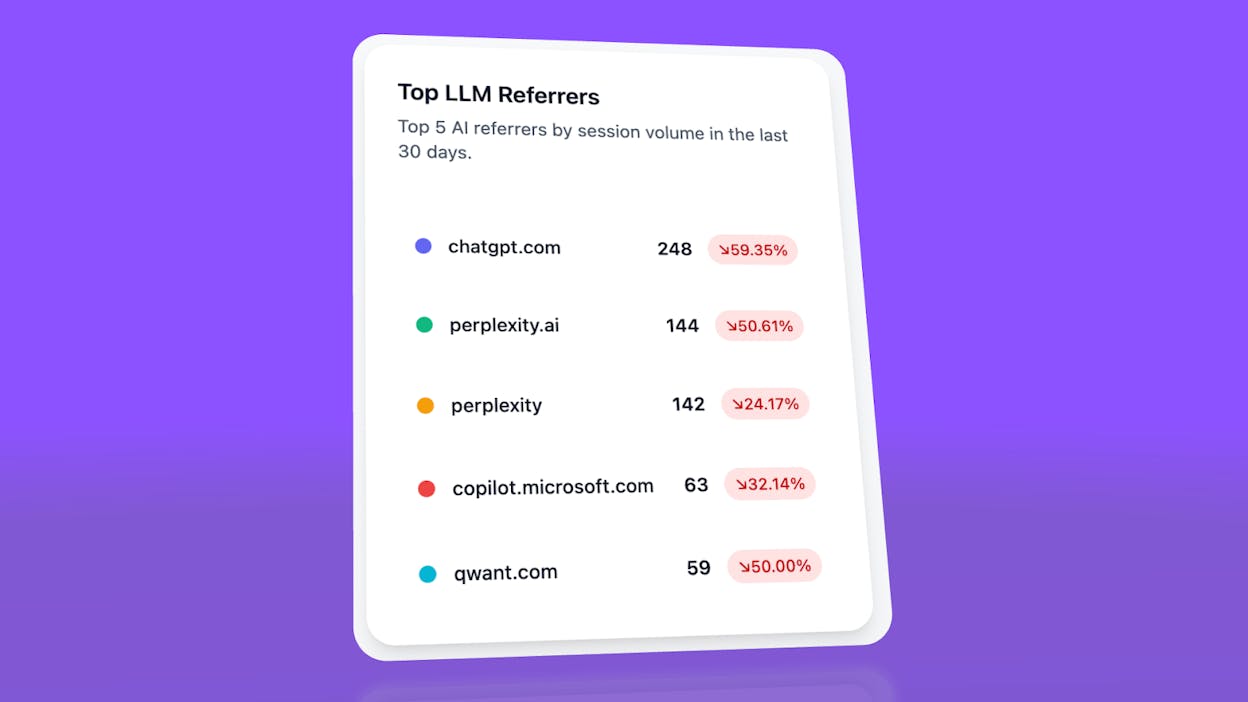
This gives teams clarity on which engines deserve attention, which pages drive revenue from AI referrals, and which prompts act like bottom-of-funnel search terms. The platform also provides clear insight into the buyer journey, so you can strengthen pages that convert and deprioritize visibility that never produces results.
The platform stands out because it shows how AI models form their answers through source and citation audits. Teams can see which domains influence AI responses and where their own content coverage falls short. This turns authority building into a targeted process rather than guesswork.
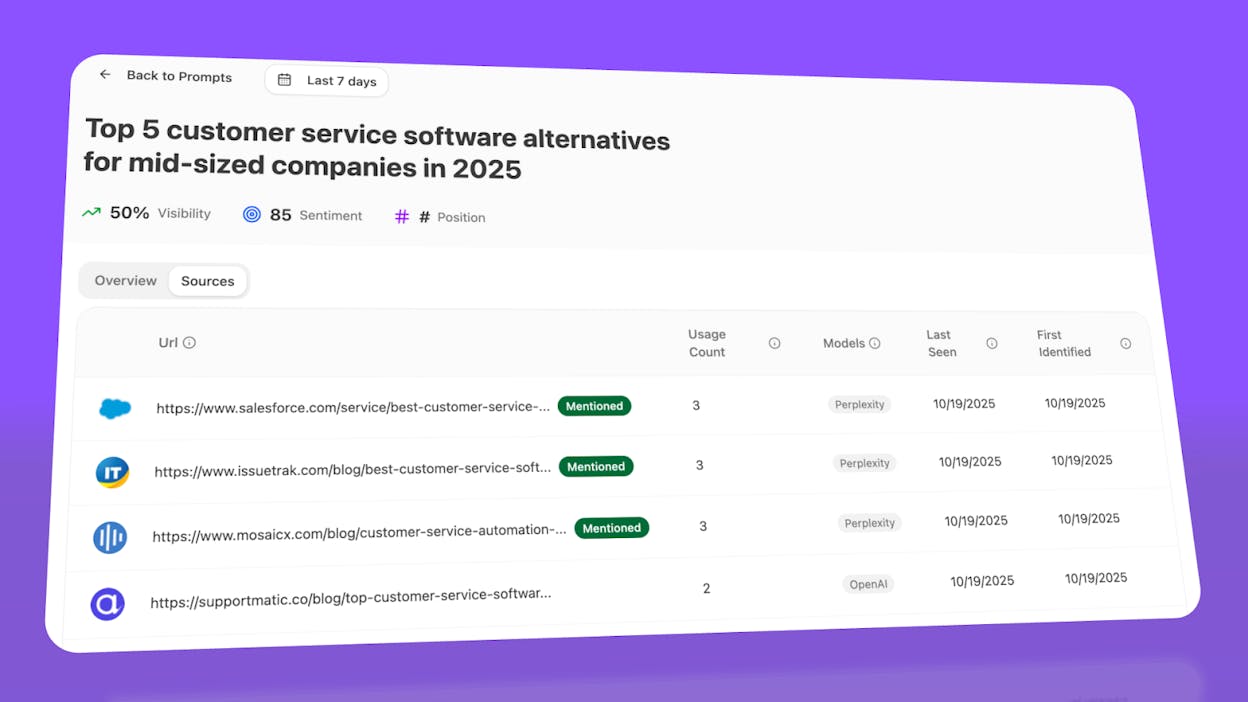
With prompt-level visibility, competitive share-of-voice, and engine-specific insights, Analyze AI allows teams to prioritize actions that have the highest impact. For growth teams treating AI search as a serious acquisition channel, this data transforms GEO from an experiment into a measurable growth lever.
Even with those strengths, Analyze AI comes with limits that depend on team maturity. Visibility across LLMs can fluctuate because engine updates, regions, or prompt variations change results. This means the dataset should be used to track patterns over time rather than expecting perfect stability.
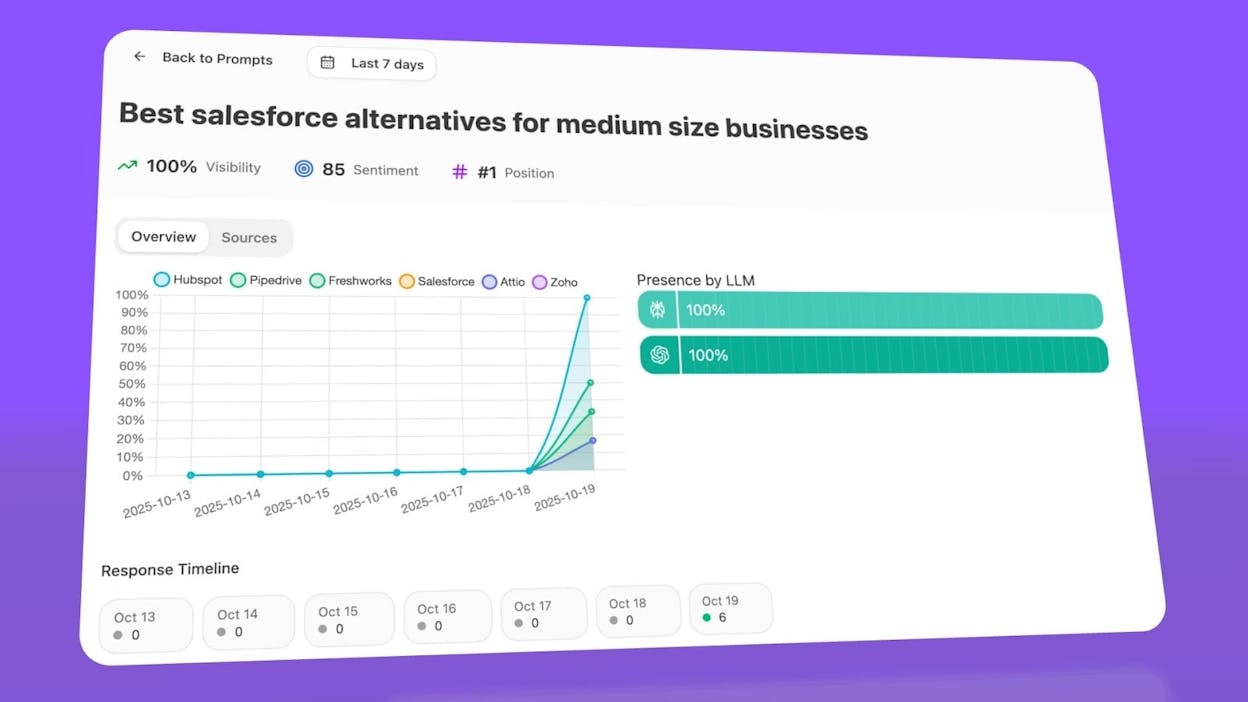
Teams also need some analytics workflow in place to get the most value out of attribution features, because the platform relies on clean tracking to link sessions and conversions to specific engines and prompts.
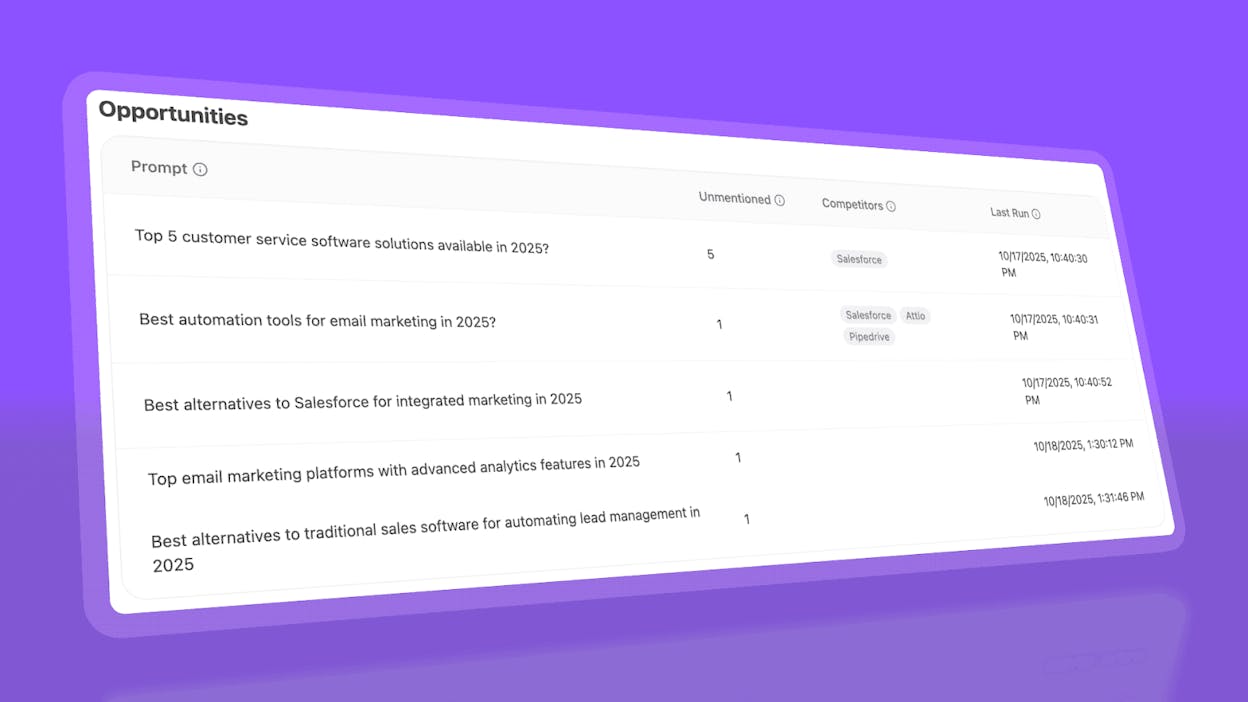
Analyze AI also focuses exclusively on AI-search visibility, which means it does not replace tools that handle full SEO stacks such as crawling, technical diagnostics, or backlink analysis. It excels in GEO and attribution but should be paired with traditional SEO tools for full coverage. Finally, the platform’s depth makes it more suitable for teams with ongoing publishing velocity or meaningful organic traffic. Smaller teams with little content may find it harder to justify without a clear strategy for scaling AI-search visibility.
|
Tool |
Best for |
Where it feels strongest |
Where it falls short compared with others |
|
Analyze AI |
Full-funnel AI-search visibility and attribution |
Traffic attribution, prompt insights, conversion analytics |
It’s tailored to SMBs |
|
LLMrefs |
Citation-level GEO tracking |
Source mapping, citation frequency |
No traffic or conversion analytics |
|
Rankscale AI |
Multi-engine GEO benchmarking |
Multi-region trends, competitor visibility |
Less revenue attribution and page-level journey mapping |
|
Surfer AI Tracker |
Lightweight AI visibility inside content workflows |
Simple prompt monitoring, source transparency |
Not built for business impact or conversion tracking |
Analyze AI shows how AI-search visibility drives traffic, conversions, and revenue by tracking every engine, every prompt, and every visit. It’s best for teams that want to treat AI search as a measurable growth channel. Its main weaknesses are its focus on AI visibility (not full SEO) and the need for mature analytics, but it becomes the strongest choice when you want full-funnel insight from AI answer → session → conversion.
SEMrush AI SEO Toolkit: best AI optimization tool for full-stack SEO and AI-search visibility
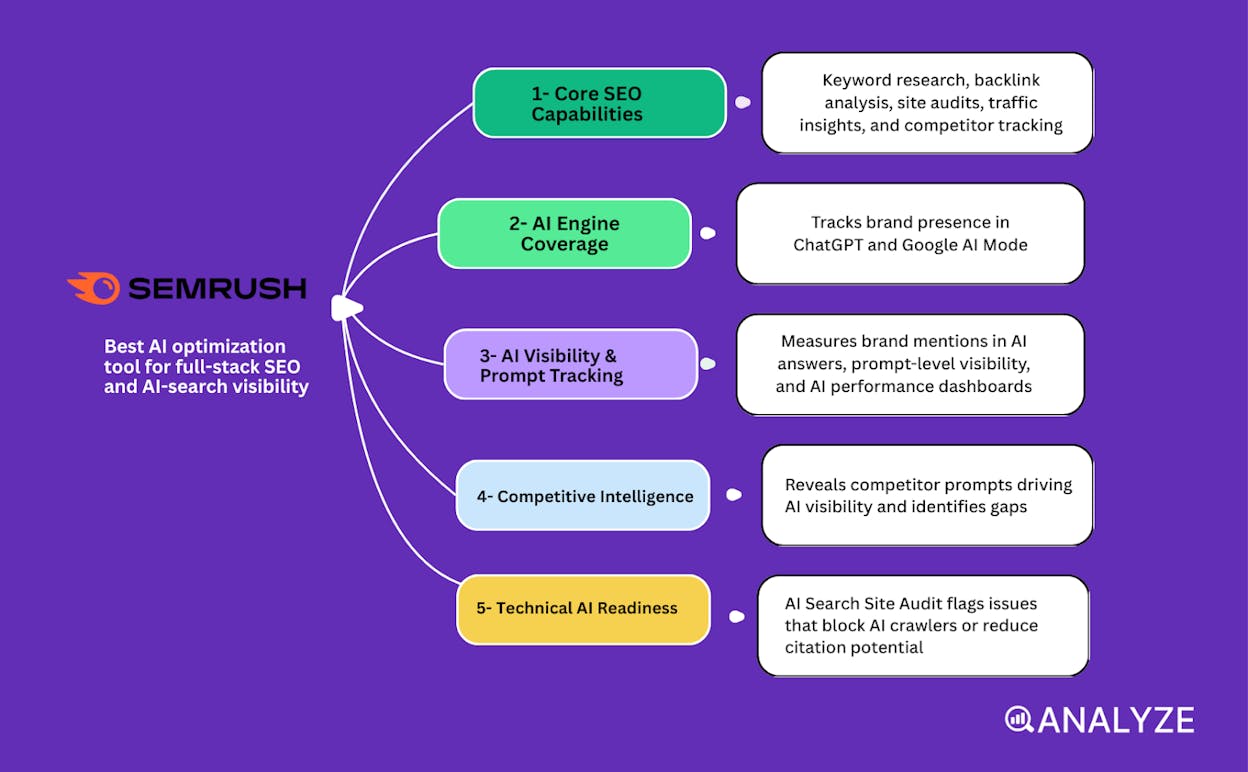
Key SEMrush AI SEO Toolkit standout features
-
Full SEO suite with keyword research, backlink analysis, site audits, competitor tracking, and traffic insights.
-
Prompt tracking that shows how your brand appears inside AI search engines like ChatGPT and Google AI Mode.
-
AI visibility and brand performance dashboards that measure how often AI answers mention your brand and how you compare with competitors.
-
Competitor and prompt research tools that reveal which prompts help rivals gain AI visibility and where your gaps sit.
-
AI Search Site Audit that checks for issues that might block AI crawlers or reduce your chances of being cited in AI-generated results.
SEMrush works well when you want one platform to handle almost every part of your SEO workflow because it blends old SEO needs with new AI-search demands. The core suite still gives you deep keyword data, full backlink profiles, site-wide audits, and strong competitor tracking, which form the base of most SEO programs. The AI SEO Toolkit then adds a new layer on top, giving you visibility into how AI models read, interpret, and surface your content, so you can respond to changes in the search landscape faster. That mix turns SEMrush into a single place where teams can see both classic SEO signals and emerging AI-search signals without jumping across many tools.
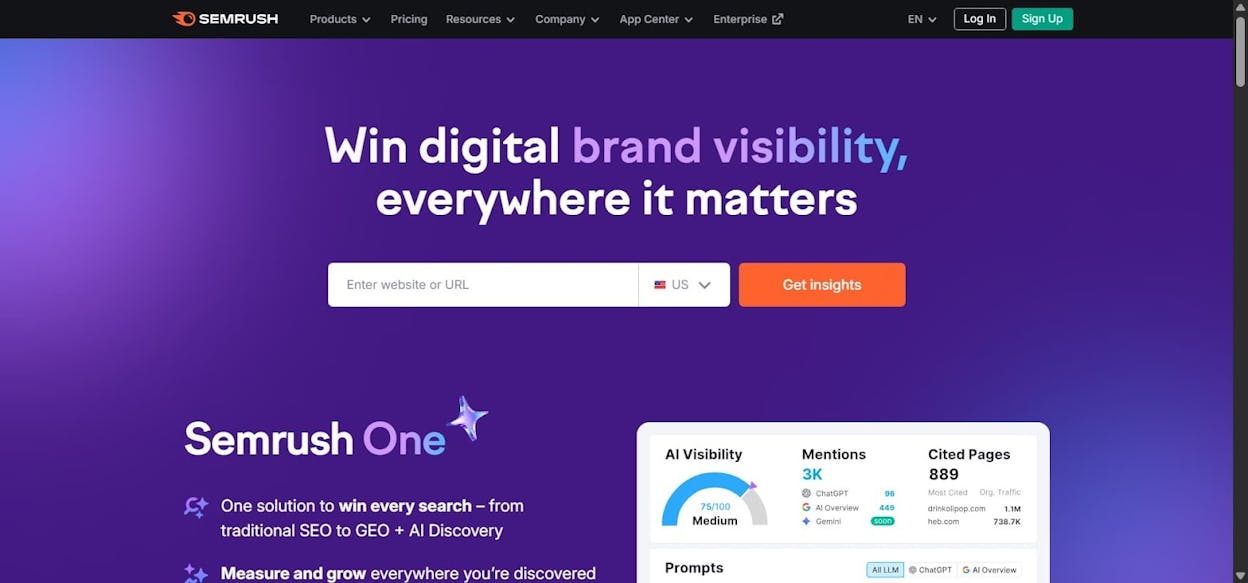
The biggest strength of SEMrush is the way every feature connects to another, which makes the platform useful for teams that want a clear view of how traffic, links, prompts, and brand visibility work together. You can study how your site performs, identify gaps in both Google search and AI-generated answers, and use the same interface to fix weak pages through audits and research tools. This gives marketers and SEOs a more complete picture of why a page ranks, why it loses ground, or why a competitor suddenly gains more attention inside AI models.
Even with those strengths, SEMrush has some drawbacks that matter when you compare it with lighter tools. The AI-visibility features remain new, so users sometimes report that the data feels early, with dashboards that change often or feel less polished than long-standing SEO tools. If you expect the AI layer to be as deep as the keyword or backlink tools, you may find it less mature because the space itself is moving fast. Cost can also rise quickly, especially when you manage many sites or need access for several team members, because the add-ons stack on top of the main plan. This makes SEMrush harder to justify if you only need a narrow part of the suite.
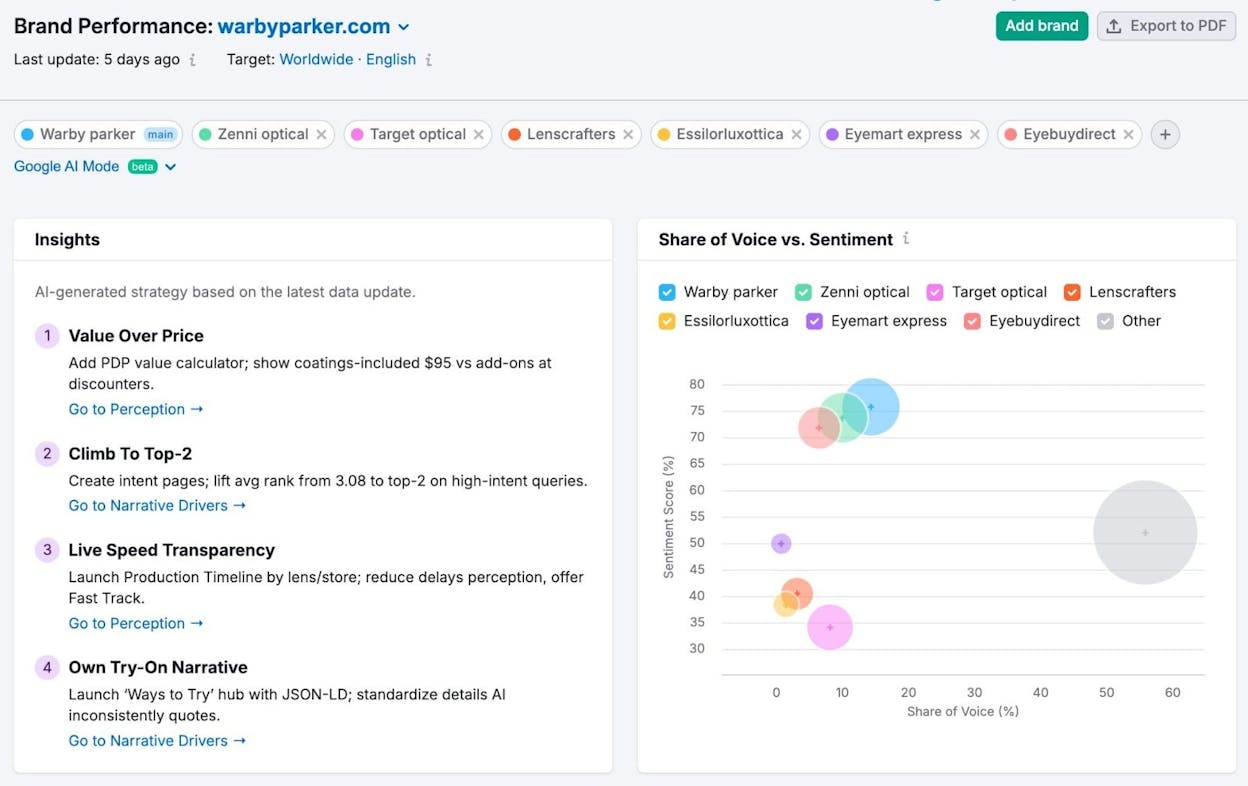
Another limitation appears when your main goal is simple on-page content optimization, because SEMrush gives far more features than most teams need for that use case. If you only want writing guidance or content scoring, you might feel the platform is too heavy or too expensive for a narrow workflow. SEMrush shines when you want a wide view of your organic and AI performance, but it becomes less practical when your needs sit in one small corner of SEO.
|
Tool |
Best for |
Where it feels strongest |
Where it falls short compared with others |
|
SEMrush AI SEO Toolkit |
Teams that need full SEO and AI visibility |
Keyword data, backlinks, audits, prompt tracking |
High cost, AI layer still maturing |
|
Surfer AI Tracker |
Teams tracking prompt-level AI visibility |
Prompt insights, source transparency, simple integration |
Not a full SEO suite; no deep technical or backlink analysis |
|
Rankability |
Semantic content optimization |
Topic scoring, outlines, real-time content optimisation |
Limited technical SEO; no deep GEO tracking |
|
AirOps |
High-volume content operations & workflows |
Workflow automation, content refresh at scale, brand consistency |
Limited GEO depth; requires mature processes and larger team setups |
SEMrush AI SEO Toolkit gives you a wide view of both classic SEO and new AI-search signals in one place. It works best for teams that want full-stack visibility across keywords, links, audits, and AI prompts. Its main weakness is the early stage of its AI features and its higher cost, especially for agencies. Choose SEMrush when you need a complete platform that connects your SEO work with your AI-search presence.
Surfer AI Tracker: best AI optimization tool for prompt-level brand visibility across ChatGPT and Perplexity
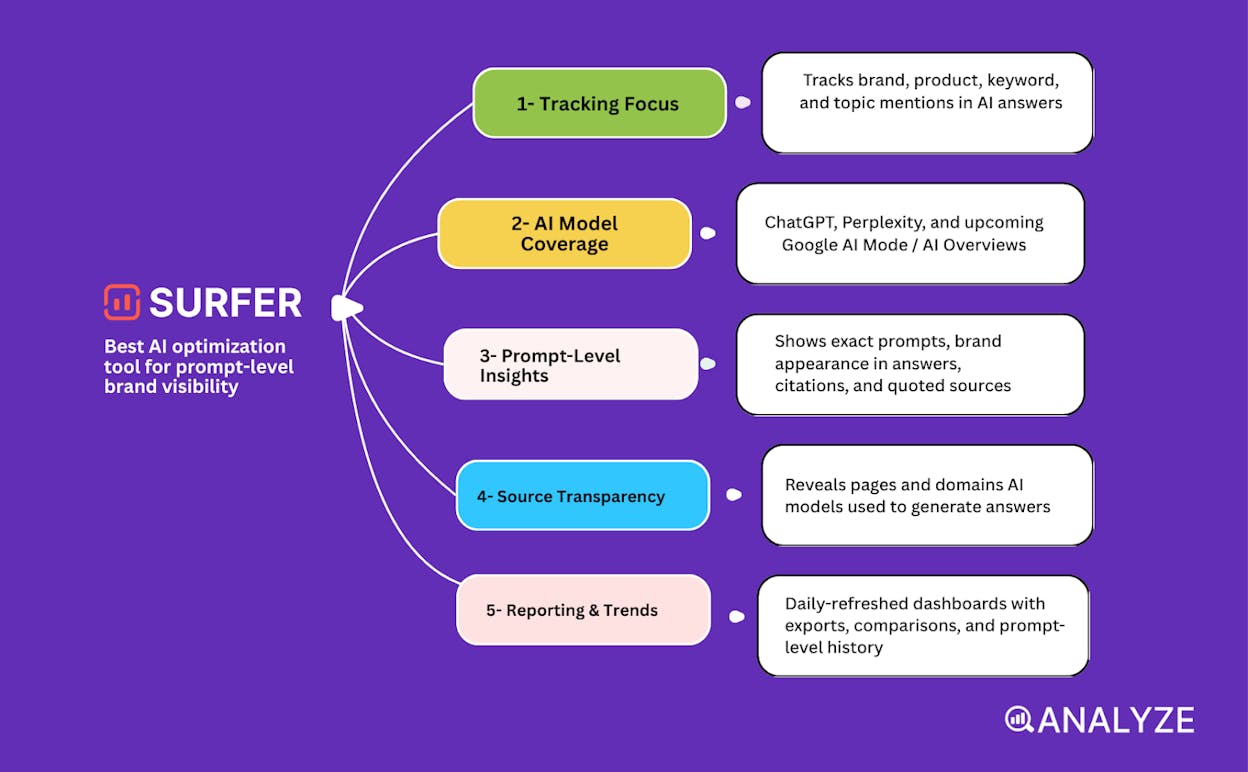
Key Surfer AI Tracker standout features
-
Brand and keyword tracking that shows where, when, and how often AI systems mention your brand, products, or topics.
-
Multi-model visibility across ChatGPT, Perplexity, and soon Google AI Mode or AI Overviews.
-
Prompt-level insights that display the exact prompt used and how your brand appeared inside the answer, including citations and quoted sources.
-
Source transparency that reveals which pages the AI models pulled from when forming an answer.
-
Trend dashboards and rolling updates that refresh daily and include exports, comparisons, and prompt-level history.
Surfer AI Tracker works well when your main goal is to understand how AI models talk about your brand, because it shows the exact prompts that triggered mentions and the sources behind those mentions. It does more than count visibility because it helps you see how AI systems form answers and which content they choose to trust. This helps content teams adjust pages that AI models use often and fix pages they ignore. The tool also follows the same workflow as Surfer SEO, so teams already using Surfer for content work can plug the tracker into their existing process without adding another complex platform.
The tool stands out because it treats AI visibility as a real channel, not a side metric. It shows brand share across prompts, surfaces which competitors win certain topics, and highlights which prompts create the best opportunities. The daily refresh and multi-model coverage help teams track changes in real time, which matters because AI models update often, and answers can shift without notice. This makes Surfer AI Tracker useful for teams that want an early look at how LLM-powered search works before the space becomes more crowded.
For all those strengths, Surfer AI Tracker also comes with limits that are worth knowing before you add it to your stack. The product is still early, which means long-term history and deeper trendlines may feel thin until more data builds. Users note that the dataset feels young, which is normal for a new category but still something to keep in mind when making decisions. It focuses heavily on prompt-level tracking, so it does not replace a full analytics or SEO suite, and it cannot guarantee complete visibility when AI answers vary based on geography, model version, or prompt phrasing.
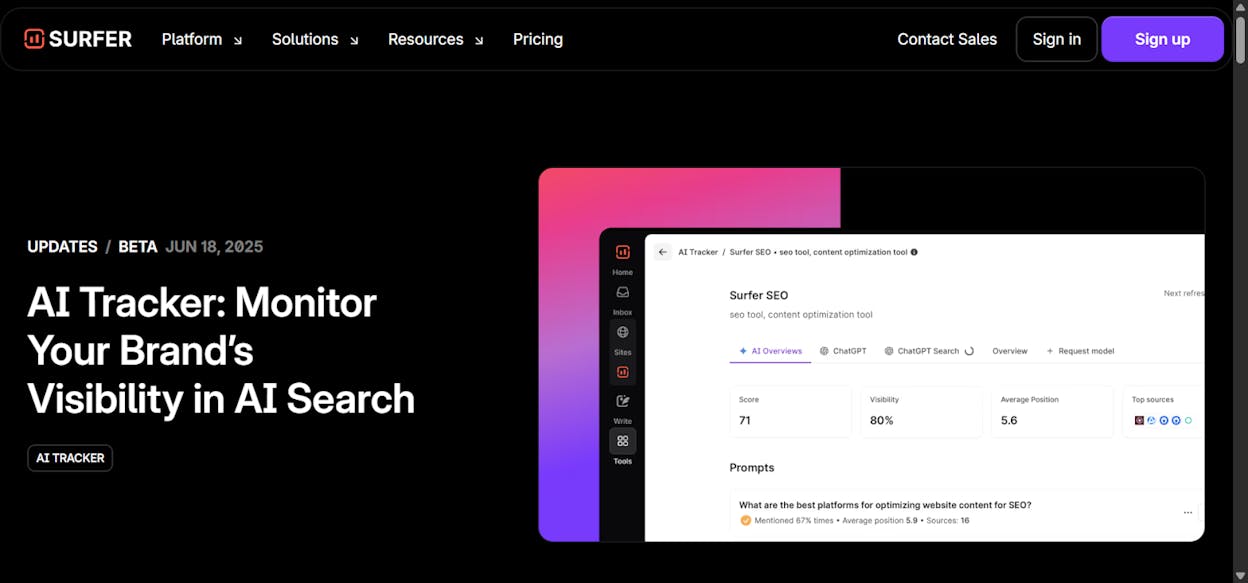
Cost can also grow fast when you track many prompts across several models because pricing scales by prompt count. Small teams may find lower tiers enough, but larger brands often need higher tiers to see meaningful coverage. Finally, if your content foundation is weak or your site has limited authority, prompt-level tracking might not give you high-value insights until your content becomes strong enough for AI systems to reference more often.
|
Tool |
Best for |
Where it feels strongest |
Where it falls short compared with others |
|
Surfer AI Tracker |
Teams tracking prompt-level AI visibility |
Prompt insights, source analysis, multi-model tracking |
Young dataset, not a full SEO or analytics platform |
|
Rankability AI Analyzer |
Teams wanting deeper AI-citation audits |
Source mapping, citation scoring, competitor visibility |
Less integrated with content optimization workflows |
|
LLMrefs |
Teams needing citation-level GEO tracking |
Citation frequency, domain-level source mapping, SOV |
No content workflows, no traffic or conversion attribution |
|
SEMrush AI Toolkit |
Teams needing SEO + AI visibility in one tool |
Full SEO suite plus AI search tracking |
Higher cost, less detailed prompt-level transparency |
Surfer AI Tracker shows how AI models mention your brand by giving prompt-level and source-level insights across ChatGPT and Perplexity. It’s best for teams that want real visibility into AI answers, not just traditional search results. Its main weaknesses are its early stage and prompt-based pricing, but it becomes a strong choice when you already use Surfer and want to understand how AI models shape your brand’s presence.
Pricefx: best AI optimization tool for pricing, margin, and product-mix decisions
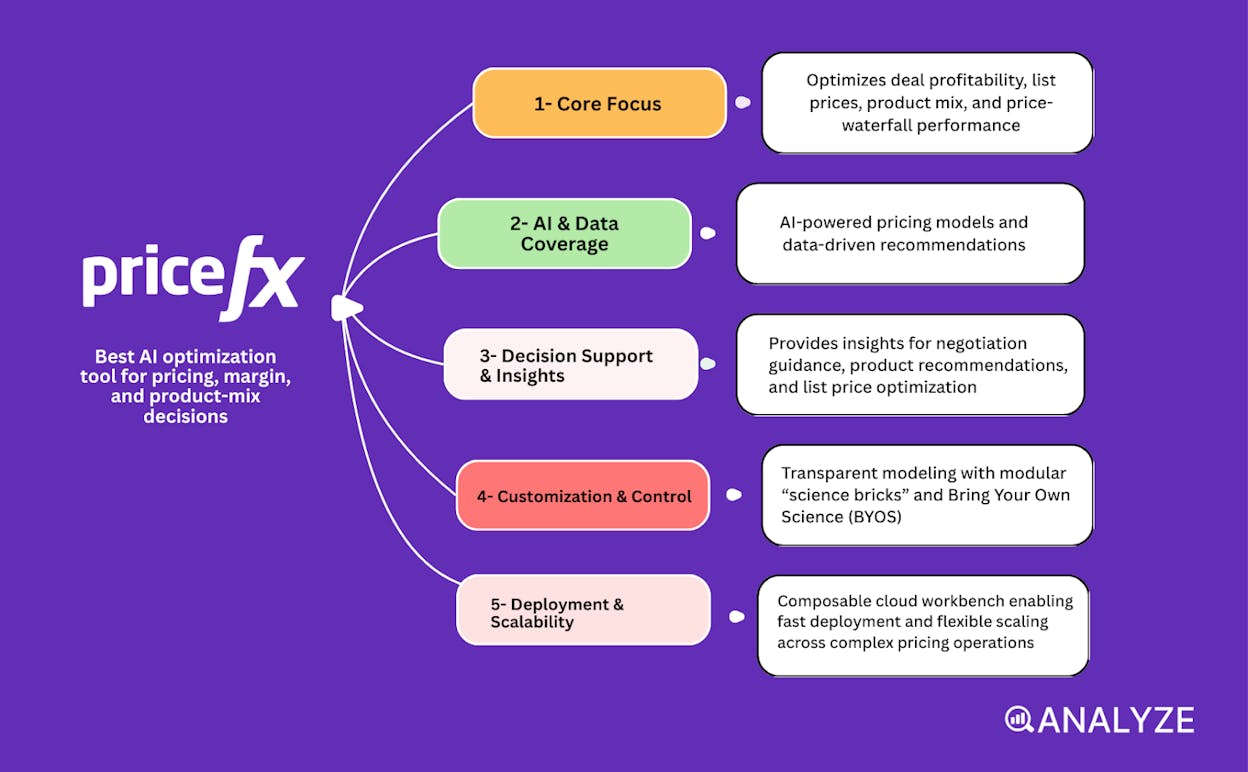
Key Pricefx standout features
-
AI-powered pricing tools that optimise deal profitability, list prices, product mix, and full price-waterfall performance.
-
Transparent modelling with clear control over automation levels, giving teams insight into how recommendations are generated.
-
Modular “science bricks” that let companies swap algorithms or plug in their own models through Bring Your Own Science (BYOS).
-
Prebuilt use cases such as Negotiation Guidance, Product Recommendations, List Price Optimisation, and Price-Waterfall Optimisation.
-
A composable cloud workbench built for fast deployment and flexible scaling across complex pricing operations.
Pricefx works well when your business depends on strong pricing decisions because the tool gives you clear guidance on how to improve margins, discounts, and product mix. It uses modular building blocks that let you mix AI models with your own pricing rules, so you never feel locked into a black box. The system turns messy pricing processes into structured workflows, and teams can tune the automation level to keep control while still gaining speed. This makes it useful for companies that run many deals, manage dynamic price lists, or need to align pricing decisions across sales and finance teams.
The platform stands out because it treats pricing as a science that should adapt to your business rather than force your business to adapt to a preset model. Most pricing tools are rigid, but Pricefx gives companies full visibility into how each recommendation is formed and lets them bring their own models. The use-case library also covers many commercial needs, so teams can launch Negotiation Guidance or Product Recommendations without building everything from scratch. This helps companies move faster and get value sooner, which matters when small margin changes have large financial impact.

Even with those strengths, Pricefx comes with limits that matter in an article focused on content or SEO. It sits in a very different category, so you may need to give readers more context if they expect content-focused AI tools. It also demands business and data maturity, because the platform works best when you have clean data, clear pricing rules, and teams ready to manage more complex workflows. Smaller teams may find the setup intimidating because custom science models and pricing logic require planning and coordination.
Cost and implementation time can also grow quickly, especially for enterprise deployments where many use cases run across regions or product lines. Pricefx’s power sits in its flexibility and depth, but that same flexibility means companies must invest effort to get the full value. Teams that only want light optimisation or simple pricing rules may find the tool more than they need, while companies that want full pricing transformation will see the platform shine.
|
Tool |
Best for |
Where it feels strongest |
Where it falls short compared with others |
|
Pricefx |
Pricing teams driving margin and product decisions |
Deal guidance, price optimisation, flexible science |
Not suited for SEO or simple optimisation workflows |
|
NEURONwriter |
Small–mid teams needing affordable semantic SEO |
Entity-focused optimisation, SERP alignment, strong value |
Lacks deep technical SEO and full-suite GEO tracking |
|
Rankscale |
Teams needing multi-engine GEO and prompt visibility |
Prompt-level insights, competitor benchmarking, multi-region data |
No full content workflows; less suited for non-GEO SEO needs |
|
LLMrefs |
Teams wanting citation-level visibility tracking |
Source mapping, citation frequency, multi-engine support |
No traffic attribution, no content optimisation tools |
Pricefx helps companies improve pricing and margin by giving transparent, flexible AI models that fit real commercial workflows. It works best for teams that need strong pricing science rather than content or SEO optimisation. Its main weaknesses are complexity and higher implementation effort, but it becomes a strong option when pricing decisions drive major business results.
NEURONwriter: best AI optimization tool for semantic SEO and affordable content workflows
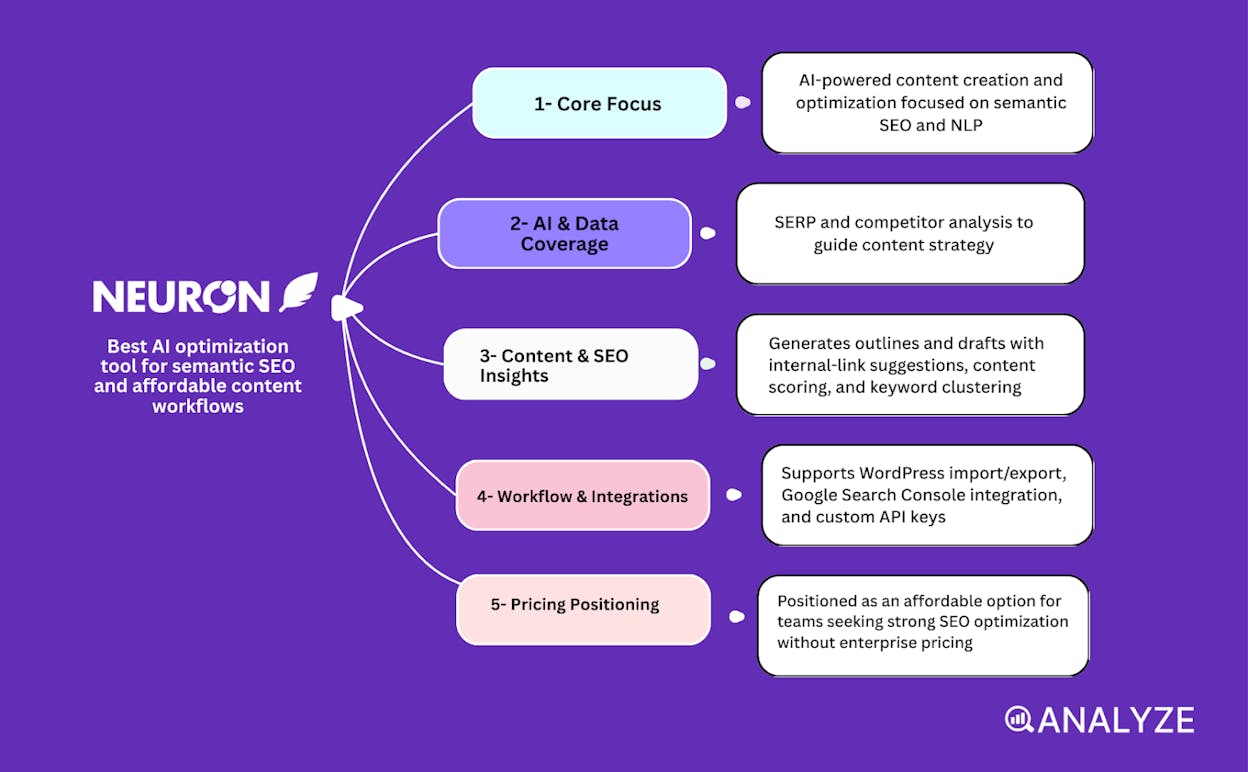
Key NEURONwriter standout features
-
AI-powered content creation and optimisation built around semantic SEO and NLP rather than simple keyword lists.
-
SERP and competitor analysis that studies top-ranking pages and shows what your content should cover to stay competitive.
-
Outline and draft generation with internal-link suggestions, content scoring, and keyword clustering to guide structure and depth.
-
Workflow support through WordPress export/import, Google Search Console integration, and the option to use your own API keys.
-
Positioned as an affordable option for teams that want strong optimisation tools without enterprise-level pricing.
NEURONwriter works well when you want a simple tool that helps you plan, write, and optimise content with clear guidance from real search data. It uses semantic SEO and NLP to help you understand which topics matter most and which entities appear across top pages, so your content stays relevant and complete. The tool makes the writing process easier by turning SERP insights into practical steps like content scores, outline ideas, and internal link suggestions. This helps smaller teams publish stronger content without needing deep SEO knowledge.
The platform also shines because it keeps features accessible and easy to use, which makes semantic SEO less intimidating. Many teams choose it because it offers solid optimisation tools without charging the high prices of bigger platforms. It fits well into workflows for bloggers, small content teams, and SMBs who want to scale publishing while staying aligned with search intent. By focusing on entity coverage, page structure, and topic depth, NEURONwriter supports the way search engines evaluate meaning and context rather than simple keyword repetition.
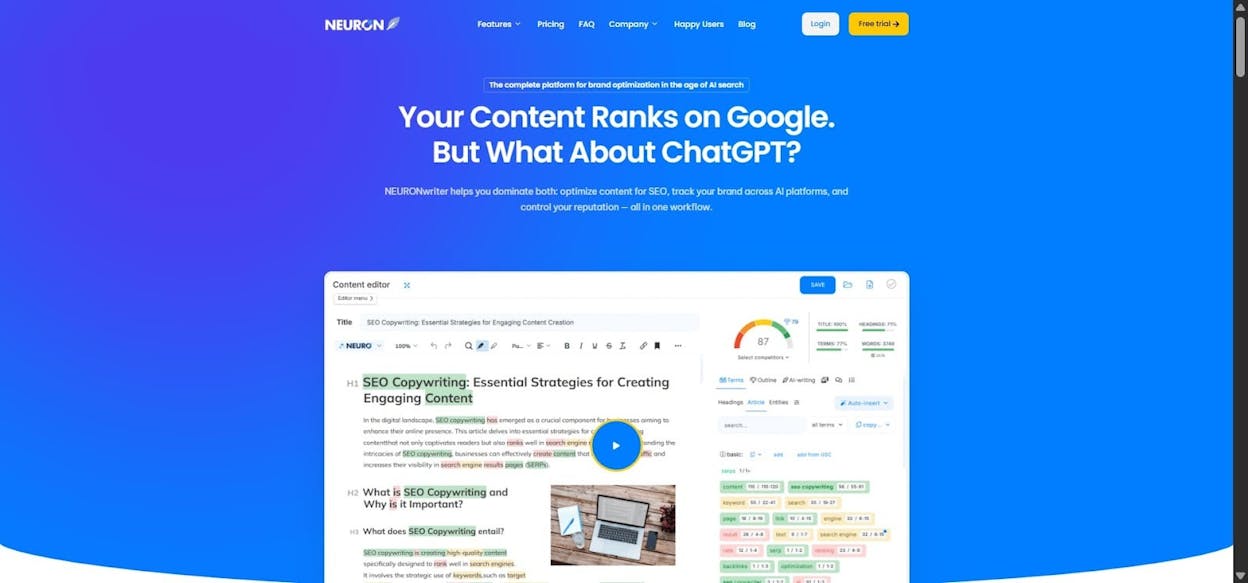
Even with those strengths, NEURONwriter has limits that matter when you compare it with full SEO suites. It cannot replace human creativity or expert judgement because the tool does not understand your brand voice or strategic point of view, so you still need strong editing to make content stand out. The platform also lacks deeper SEO capabilities like backlink analysis, site-wide crawl audits, or detailed competitor link profiles. This means teams with broader SEO needs will likely need additional tools to fill those gaps.
As with many AI-driven writing and optimisation tools, the content it generates often requires firm human review to avoid generic writing or missed context. AI output may not always reflect nuanced industry insight or subject expertise, so writers must refine drafts to ensure originality and quality. NEURONwriter works best as a guide and assistant, not a tool that replaces thoughtful content creation, so teams should expect to pair it with a clear editorial process.
|
Tool |
Best for |
Where it feels strongest |
Where it falls short compared with others |
|
NEURONwriter |
Semantic SEO and affordable content optimisation |
Topic coverage, SERP insights, entity-focused suggestions |
No backlink analysis or deep technical SEO |
|
Surfer AI Tracker |
Teams tracking AI visibility across models |
Prompt insights, source mapping, multi-model visibility |
Not designed for content writing or semantic optimisation |
|
Rankability |
Modern semantic optimisation + content workflows |
NLP-driven scoring, outlines, content monitoring |
Limited technical SEO; not a full GEO or AI-visibility tracker |
|
SEMrush |
Teams needing full SEO + AI visibility |
Keyword data, backlink index, audits + AI search tracking |
Higher pricing; AI visibility less granular than GEO-focused tools |
NEURONwriter helps teams plan and optimise content using semantic SEO and NLP at a lower cost than most premium tools. It is best for smaller teams that want clear guidance without complex SEO software. Its main weaknesses include limited technical SEO features and the need for strong human editing, but it remains a great fit when you want affordable, structured content optimisation.
Rankscale AI: best AI optimization tool for multi-engine prompt-level GEO visibility
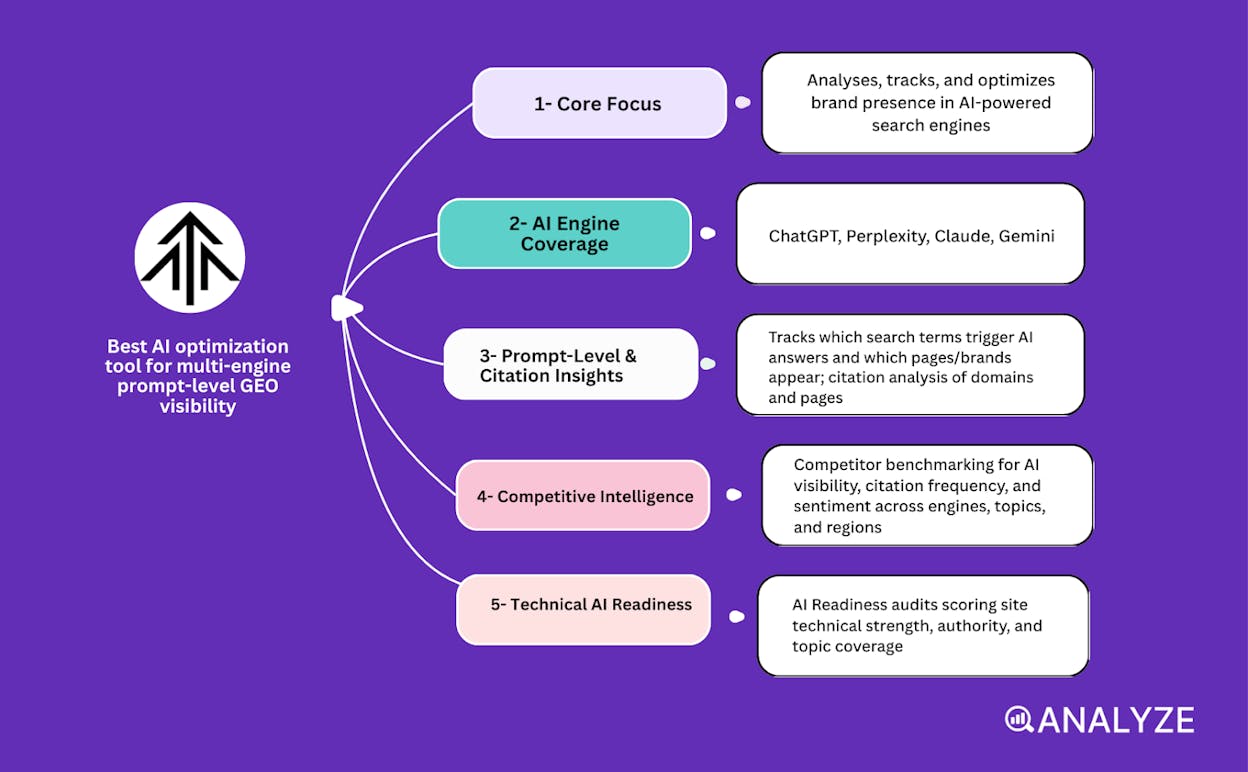
Key Rankscale AI standout features
-
GEO platform built to analyse, track, and optimise brand presence inside AI-powered search engines like ChatGPT, Perplexity, Claude and Gemini.
-
Prompt-level visibility tracking that shows which search terms trigger AI answers and whether your brand or site appears in them.
-
Citation analysis that reveals which domains and pages AI models use when forming their answers, so you see where your content is trusted or ignored.
-
Competitor benchmarking for AI visibility, citation frequency, and sentiment across engines, topics, and regions.
-
AI Readiness audits that score your site for technical strength, authority, and topic coverage so you know how well you’re positioned for AI search.
Rankscale AI works well when your goal is to understand how AI models talk about your brand across many engines because it shows the exact prompts, citations, and sources behind each answer. It goes deeper than a simple visibility score because it highlights the mechanics behind AI-generated responses. The tool breaks down where AI models pick information, which domains they trust most, and how often your competitors show up for the same prompts. This level of detail helps teams focus on high-impact areas rather than guessing why certain brands appear and others do not.
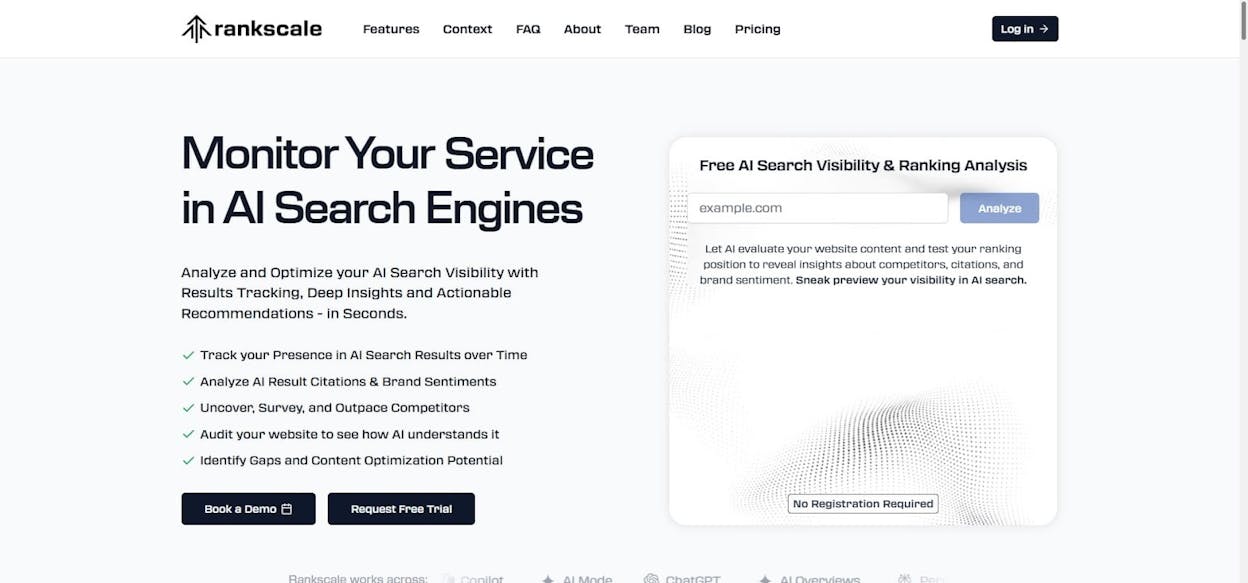
The platform stands out because it treats AI search as a multi-engine world and helps you track patterns that shift across regions or model versions. Most tools only cover one engine, but Rankscale builds a wide map of how different LLMs behave and how often they surface your content. This is useful for brands operating internationally or across many categories because AI behaviour changes fast, and the tool keeps pace with those changes. By pairing prompt-level insights with citation analysis, Rankscale provides a clear picture of both visibility and authority inside AI answers.
Even with those strengths, Rankscale comes with limits that matter for teams expecting more than monitoring. The tool can feel technical because prompt-level and model-level insights require a learning curve, and some users say it takes time to understand how to act on the data. Rankscale focuses heavily on visibility, so it does not replace a full content optimisation platform; you may need separate tools to adjust content or fill gaps that the audits reveal. If you want a single tool that handles writing, optimisation, audits, and technical SEO, Rankscale will not cover every workflow.
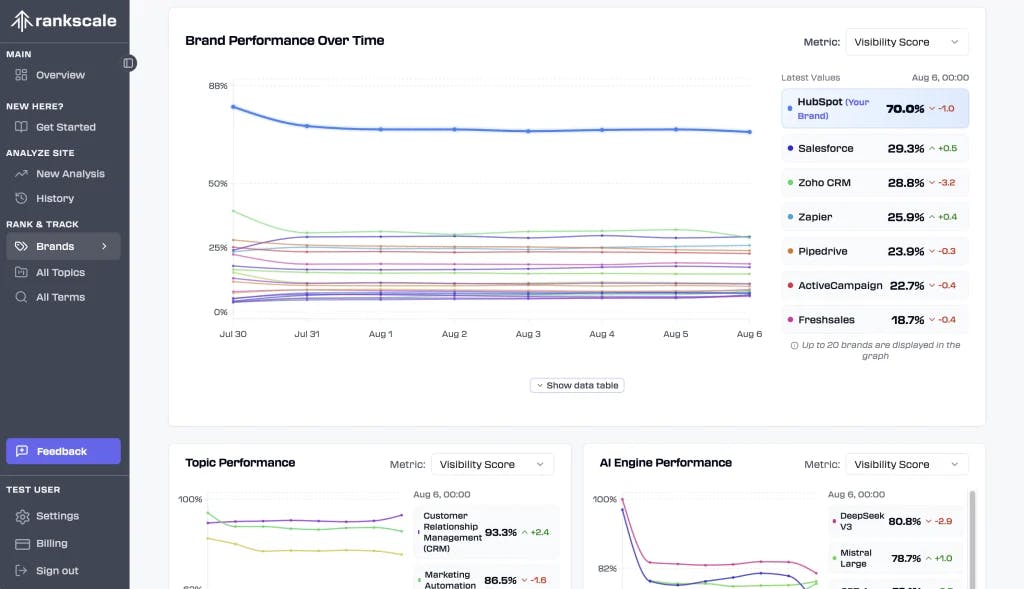
The results in Rankscale can also fluctuate because AI engines change responses based on prompt phrasing, region, and model updates. This makes the data directional rather than absolute, so teams must monitor patterns rather than fixate on single outputs. Finally, Rankscale operates purely in the GEO/AI search space, so teams who need traditional SEO coverage—like backlinks, crawl issues, or page speed—will still need separate tools to manage the rest of their organic program.
|
Tool |
Best for |
Where it feels strongest |
Where it falls short compared with others |
|
Rankscale AI |
Multi-engine GEO visibility and AI-prompt analysis |
Prompt tracking, citation insights, multi-region coverage |
No content optimisation or traditional SEO depth |
|
Surfer AI Tracker |
Teams tracking prompt-level visibility in fewer engines |
Prompt insights, source mapping, simple workflow integration |
Fewer engines tracked compared with Rankscale |
|
LLMRefs |
Teams wanting citation-first GEO analysis |
Strong mapping of what pages AI models cite |
Less focus on competitor visibility or trend benchmarking |
|
SEMrush AI Toolkit |
Teams needing blended SEO + AI insights |
Full SEO suite plus AI visibility tools |
Less detailed prompt-level or citation-level data |
Rankscale AI helps teams understand how AI models mention and cite their brand across many engines by giving prompt-level and source-level visibility. It works best for teams that want detailed GEO insights and multi-region tracking. Its main weaknesses are complexity and limited optimisation workflows, but it becomes a strong choice when AI visibility is your main bottleneck and you need a wide multi-engine view.
Rankability: best AI optimization tool for semantic content scoring and modern SEO workflows
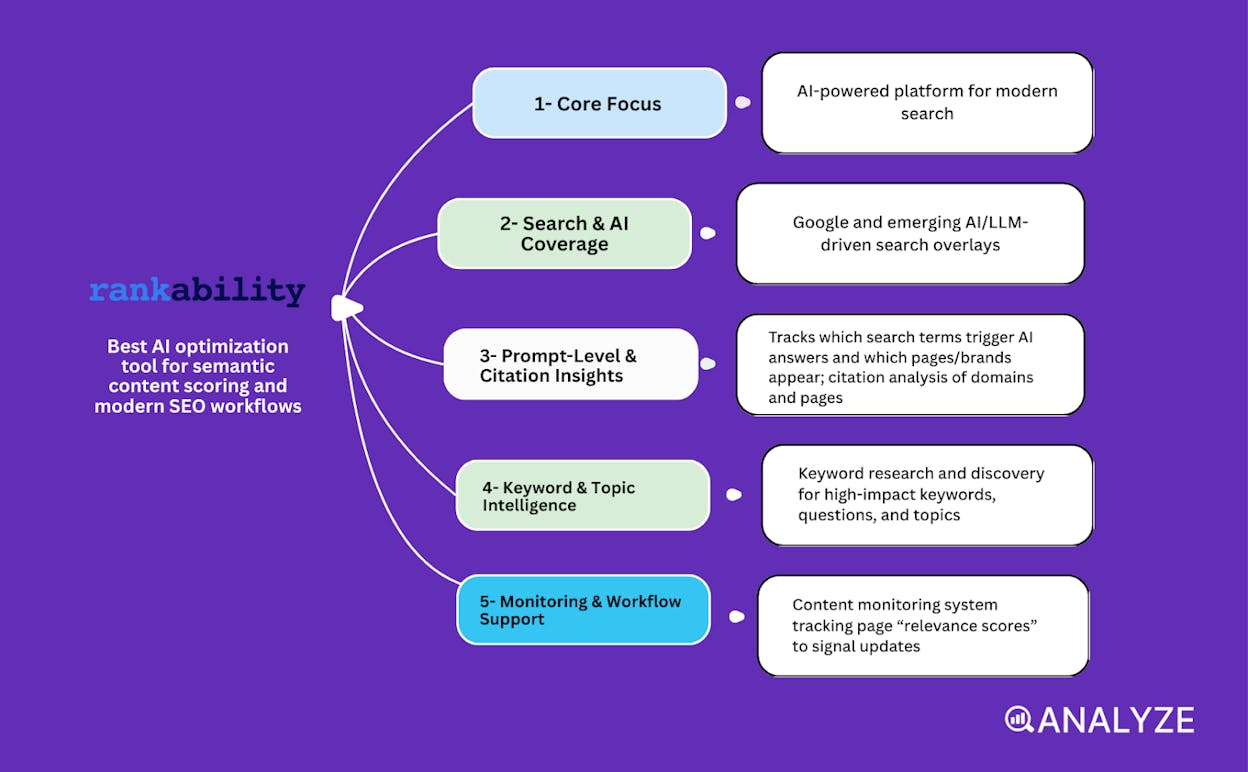
Key Rankability standout features
-
AI-powered platform built for modern search, covering both Google and emerging AI/LLM-driven search overlays.
-
Content Optimizer with real-time topic coverage scoring, AI-driven outlines, and editor support based on competitive content.
-
AI SEO Writer for generating drafts, meta titles, descriptions, and scalable content for SaaS, ecommerce, and local search.
-
Keyword research and discovery tools that surface high-impact keywords, questions, and topics.
-
Content monitoring system that tracks page “relevance scores” to signal when updates are needed.
Rankability works well when you want a simple tool that helps you create, optimise, and maintain content without juggling many apps. The platform gives clear guidance on what to include, which topics matter, and where your draft falls short compared to top competitors. Its real-time scoring helps writers stay on track while drafting, and the built-in AI writer speeds up the early stages of content creation. Because the tool focuses on semantic SEO and NLP, it helps teams build pages that match search intent and entity coverage rather than relying on keyword stuffing.
The platform also stands out because it rolls research, outlining, writing, and optimisation into a single workflow. This makes it useful for content teams, agencies, or SMBs that need to produce many pages each month and want predictable, repeatable processes. The price point, while not cheap for freelancers, is still more accessible than many enterprise tools offering similar semantic and NLP features. Rankability makes modern SEO more manageable by keeping the interface simple and reducing the number of steps needed to take a page from idea to publish-ready.
Even with those strengths, Rankability comes with limits that matter when you want full-stack SEO coverage. The tool focuses on content and semantic optimisation, so you still need a separate platform for deep technical SEO, crawling, backlink analysis, or log-file insights. Teams needing a full view of technical health and link authority may find Rankability only solves half the workflow. It also does not yet handle AI-search visibility with the depth of GEO-specific tools, even though its messaging nods to AI/LLM search preparation.
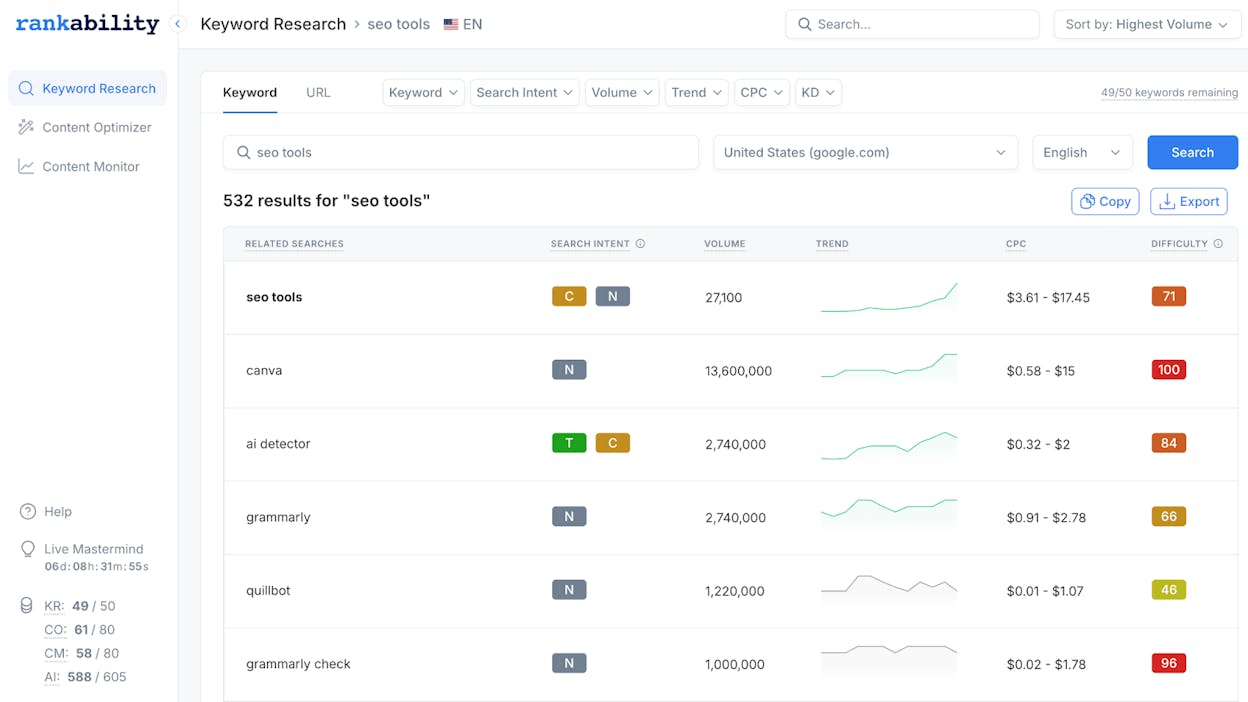
The pricing, although fair for the feature set, may still be out of reach for solo writers or very small teams who only publish a few pages per month. The AI-generated content also needs careful human review to maintain brand voice, accuracy, and originality—something reviewers highlight often. Rankability supports optimisation, but it cannot replace thoughtful editing or niche expertise, so teams must plan for a strong editorial layer on top of the tool’s suggestions.
|
Tool |
Best for |
Where it feels strongest |
Where it falls short compared with others |
|
Rankability |
Semantic content optimisation and workflow automation |
Topic coverage scoring, outlines, content scoring |
Limited technical SEO, not a full GEO or AI visibility tool |
|
Rankscale AI |
Multi-engine GEO visibility tracking |
Prompt-level insights, multi-region views |
No content creation or optimisation tools |
|
NEURONwriter |
Affordable semantic SEO for small teams |
Entity suggestions, SERP reviews, NLP-driven outlines |
Less workflow depth, fewer monitoring tools |
|
Surfer AI Tracker |
Prompt-level AI visibility tracking |
Source mapping, simple daily monitoring |
Not built for on-page content workflows |
Rankability helps teams plan, write, and optimise content using semantic SEO and real-time scoring in one simple workflow. It’s best for teams producing content at scale who want guidance and structure without enterprise pricing. Its main weaknesses are limited technical SEO and the need for strong human editing, but it fits well when content optimisation—not full-suite SEO—is your main bottleneck.
AirOps: best AI optimization tool for end-to-end content operations at scale
Key AirOps standout features
-
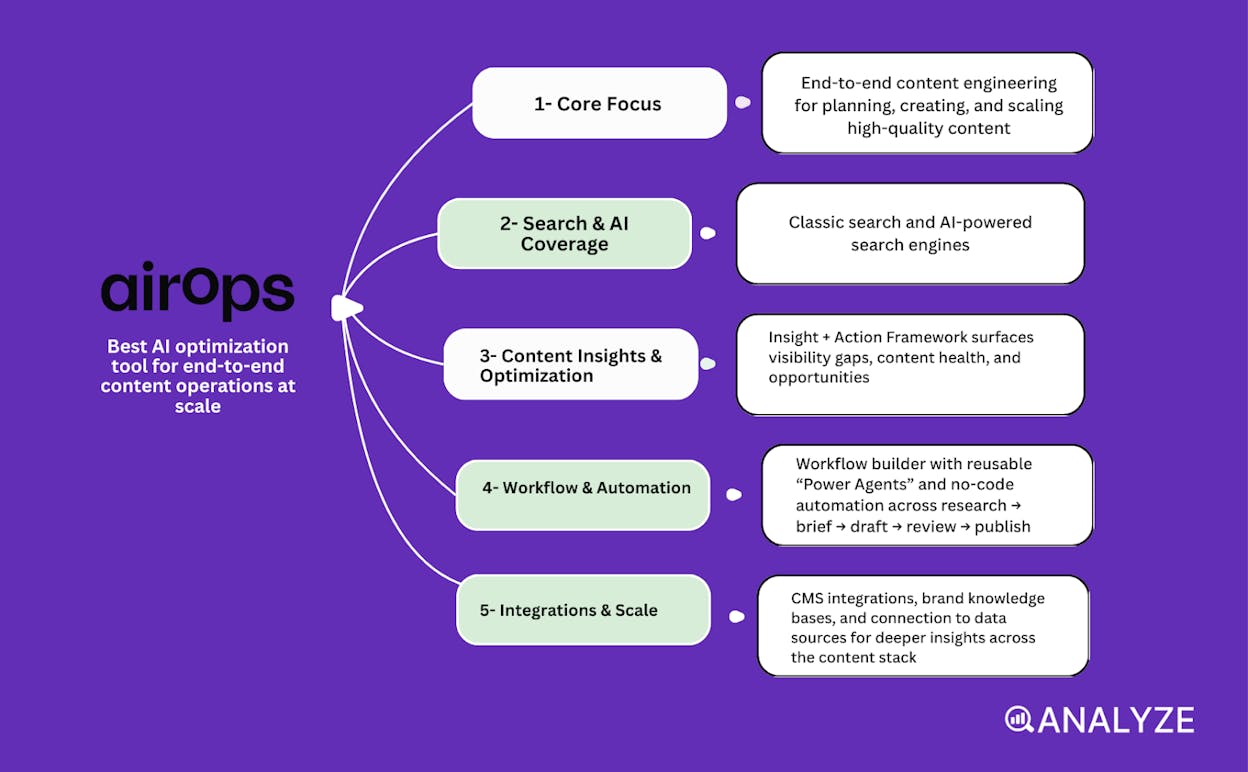
End-to-end content engineering platform designed to help brands plan, create, and scale high-quality content for both classic search and AI-powered search engines.
-
Insight + Action Framework that surfaces visibility gaps, content health, and opportunities, and then links them to workflows you can execute.
-
Workflow builder with reusable “Power Agents” and no-code automation that supports full content lifecycles from research → brief → draft → review → publish.
-
Supports large-scale content refresh and new-content creation to help reclaim rankings or expand into new topics.
-
Integrates with CMSs, uses brand knowledge bases to maintain voice, and connects to data sources for deeper insights across your stack.
AirOps works well when your main bottleneck is scale because it gives teams a structured system for producing and refreshing content without losing quality. The platform moves beyond simple writing tools by combining insights, workflows, and automation into one environment. It helps teams build repeatable processes so they can turn research into briefs, drafts, and final pages faster. The content refresh workflows also help large sites recover visibility by making updates easier and more predictable instead of manual and chaotic.
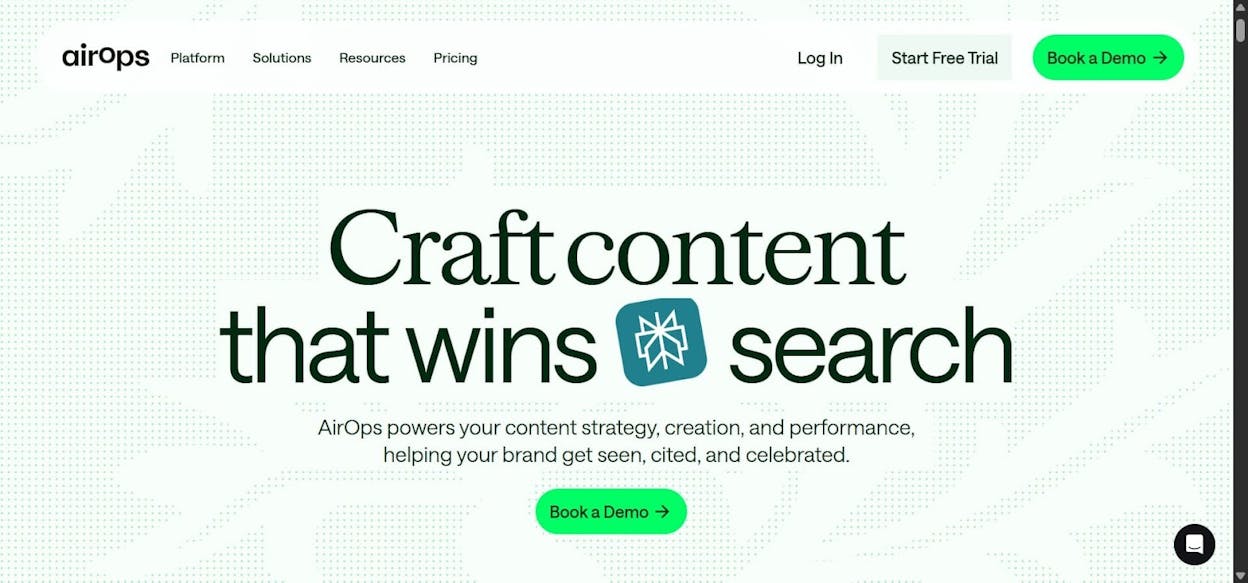
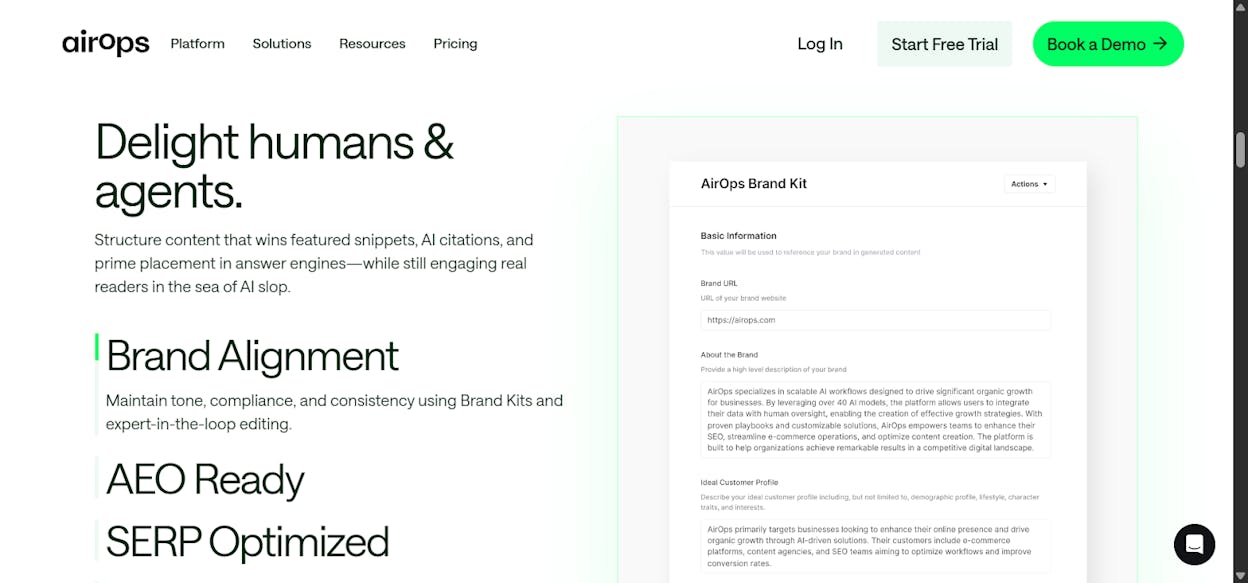
The platform stands out because it blends automation with strong human review. Many AI writing tools push speed but lose control of voice or structure, while AirOps uses brand kits and review steps to keep output consistent. It helps agencies and high-volume teams hit production targets without sacrificing the brand feel. AirOps also supports both new content and existing content, which matters because large sites often win more traffic from refreshes than from publishing new pages. For teams with an established process, AirOps can multiply output and quality at the same time.
Even with those strengths, AirOps comes with limits that matter depending on your needs. The learning curve can be steep because the platform works best when you already have a clear SEO and content process. Without a defined strategy or workflow discipline, teams may find it hard to set up the right automations or use its full power. The focus is more on production and operations than on deep analytics or pure AI-search visibility, so teams that mainly want GEO tracking will likely need a dedicated visibility tool.
Pricing and complexity also make AirOps better suited for mid-sized or large teams rather than freelancers or very small companies. Some features require custom plans, and the system can feel heavy if you only need light optimisation or a few pages per month. Finally, AirOps cannot replace strategy; it amplifies the processes you already have. If your strategy is weak, the platform will not magically fix traffic problems, and you still need strong editorial review to keep content high quality.
|
Tool |
Best for |
Where it feels strongest |
Where it falls short compared with others |
|
AirOps |
High-volume teams needing content workflows |
Workflow automation, refresh operations, brand consistency |
Limited GEO depth, requires mature processes |
|
Rankability |
Semantic content optimisation |
Topic scoring, outlines, real-time optimisation |
Less automation, fewer workflow controls |
|
NEURONwriter |
Affordable semantic SEO |
Entity suggestions, SERP alignment |
No deep workflow or content-ops automation |
|
Rankscale AI |
Multi-engine AI-visibility monitoring |
Prompt-level insights, citation mapping |
No content creation or workflow features |
AirOps helps teams scale content creation and refreshes by giving them structured workflows, automation, and insight-driven processes. It’s best for teams that already publish a lot and want more speed without losing quality. Its main weaknesses are setup complexity and limited GEO depth, but it excels when content operations—not visibility tracking—are your main challenge.
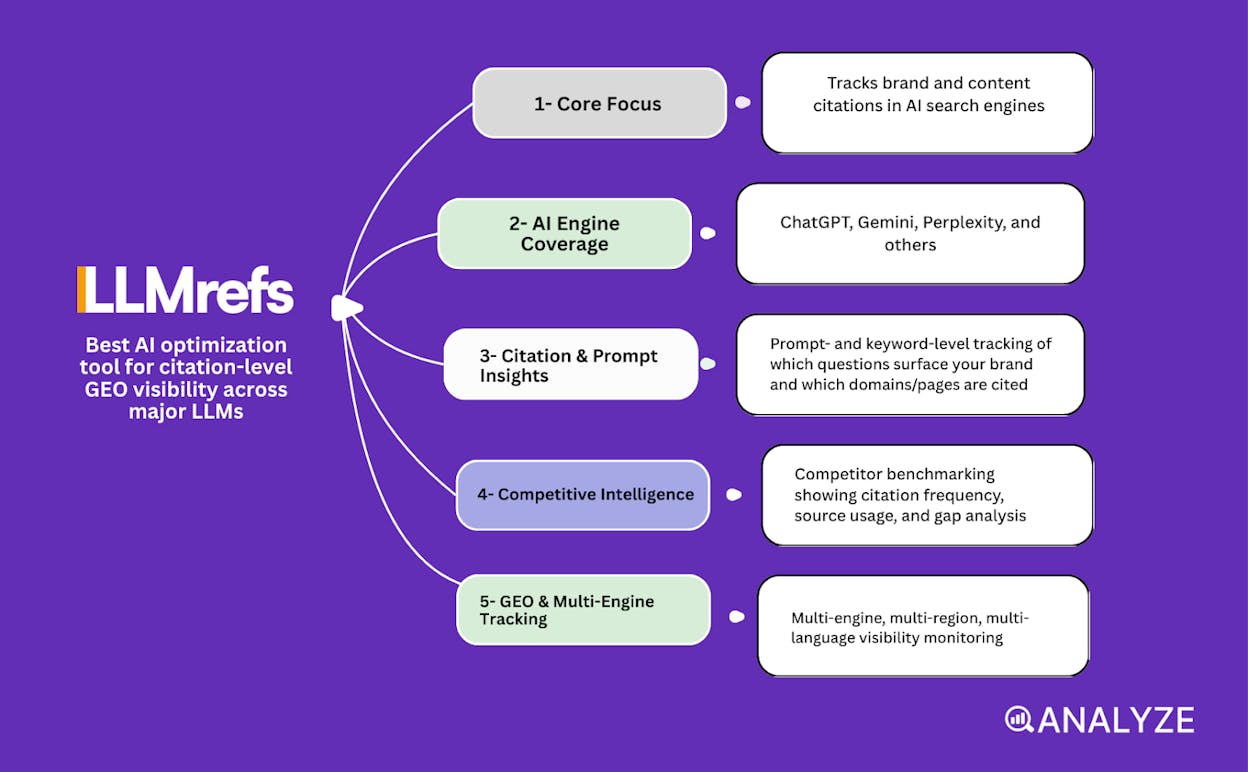
LLMrefs: best AI optimization tool for citation-level GEO visibility across major LLMs
Key LLMrefs standout features
-
AI-powered visibility platform that tracks how often your brand or content is cited inside AI search engines like ChatGPT, Gemini, Perplexity, and others.
-
Prompt- and keyword-level tracking that shows which questions surface your brand and how often specific domains or pages are cited.
-
Proprietary “LLMrefs Score” that benchmarks visibility so you can measure trend changes across engines.
-
Competitor benchmarking that reveals how often rivals are cited, which sources they use, and where your gaps sit.
-
Multi-engine and multi-region tracking to monitor visibility across languages, markets, and model variations.
LLMrefs works well when your main bottleneck is understanding how AI models cite and surface your brand inside their answers. It goes deeper than simple mention tracking because it highlights which pages AI engines trust, how often they appear, and how that compares to your competitors. This helps teams see whether their content earns recognition inside AI systems or if models lean on competing domains. The platform becomes especially useful when you want early signals on which topics your brand “owns” in AI answers and where you need better authority.
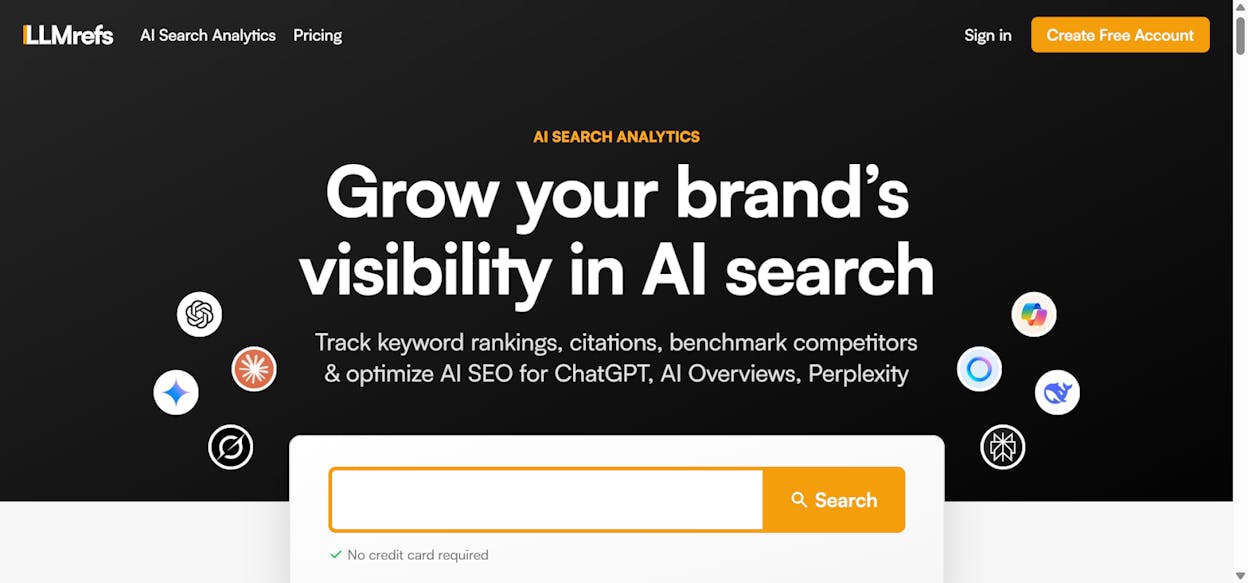
The platform also stands out because it brings clarity to a space that traditionally has no transparency. Without tools, teams guess why AI answers choose certain sources. LLMrefs reveals the patterns behind these choices, allowing more strategic optimisation. Multi-region and multi-engine tracking help brands see variations across markets, models, and languages. The relatively low entry pricing makes LLMrefs more accessible compared to larger platforms, giving smaller teams a way to start tracking AI visibility without committing to enterprise software.
Even with those strengths, LLMrefs has limits that matter depending on your needs. It is not a full SEO suite because it does not include backlink analysis, technical audits, crawling, or broader keyword databases. Tools that handle traditional SEO will still be required if you want a complete view of organic performance. LLMrefs operates narrowly within GEO visibility, and its value depends on how much your team cares about AI-search behaviour.
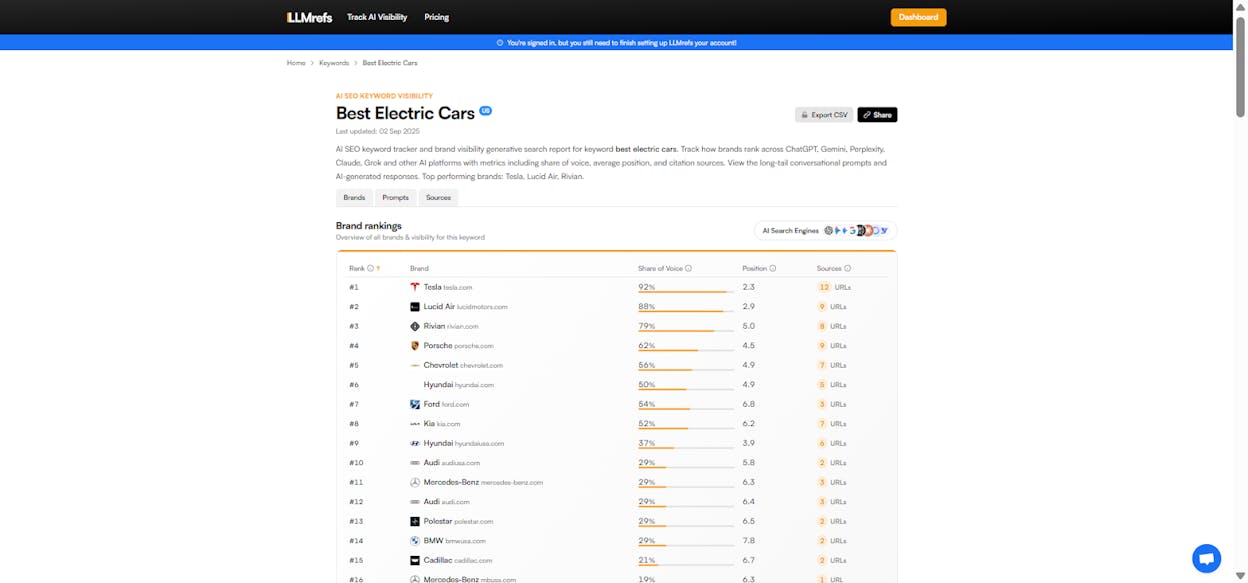
Another limitation is the fluctuating nature of AI models. Prompts, regions, and model versions can produce inconsistent results, so dashboards show directional patterns rather than precise measurements. For very small teams or those who update content rarely, the effort may not justify the insight, especially if their focus remains on traditional search. LLMrefs becomes most valuable when a brand actively competes for AI-search visibility and needs a tool dedicated to measuring how LLMs reference their content.
|
Tool |
Best for |
Where it feels strongest |
Where it falls short compared with others |
|
LLMrefs |
Citation-level AI-search visibility tracking |
Source mapping, citation frequency, multi-engine coverage |
No content creation, no technical SEO features |
|
Rankscale AI |
Multi-engine GEO visibility and competitive tracking |
Prompt insights, multi-region benchmarking |
Less emphasis on citation-first scoring |
|
Surfer AI Tracker |
Lightweight GEO monitoring within content workflows |
Simple daily tracking, source transparency |
Fewer engines and regions compared to LLMrefs |
|
Rankability |
Semantic content optimisation |
Topic scoring and content workflows |
No GEO depth, no citation-level insights |
LLMrefs helps teams understand how often AI models cite their pages and how they compare with competitors. It’s best for organisations that care about GEO performance and want citation-level clarity across major LLMs. Its main weaknesses are its narrow focus and the need for other SEO tools, but it becomes a strong choice when AI-search visibility—not traditional SEO—is your top priority.

Ernest

Ibrahim


