



Summarize this blog post with:


In this article, you’ll get a working comparison of Profound and Otterly that goes past the marketing pages. You’ll see what each tool actually does well, where each one runs out of room, what the real prices are, and which one fits your team. You’ll also see the third option most teams skip past. By the end, you’ll know how to pick without booking three demos.
Table of Contents
The short version
Profound is the enterprise pick. Deeper data, multi-region tracking, real prompt panel research, and a price tag that starts at $499/month and climbs into custom-quote territory.
Otterly is the marketer pick. Cleaner UX, $29/month entry, fast time to value, and an honest set of features for teams who just want to know whether they show up in AI answers.
Both stop at monitoring. Neither writes content. Neither builds workflows. Neither pulls your GSC, GA4, HubSpot, or Semrush data into a single agent that runs every Monday at 7am. That’s the gap Analyze AI is built to fill, which is why the back third of this article walks through it.
What each tool was built for
Profound and Otterly solve the same surface problem (showing you where your brand appears in AI answers) but they were built by different teams for different buyers.
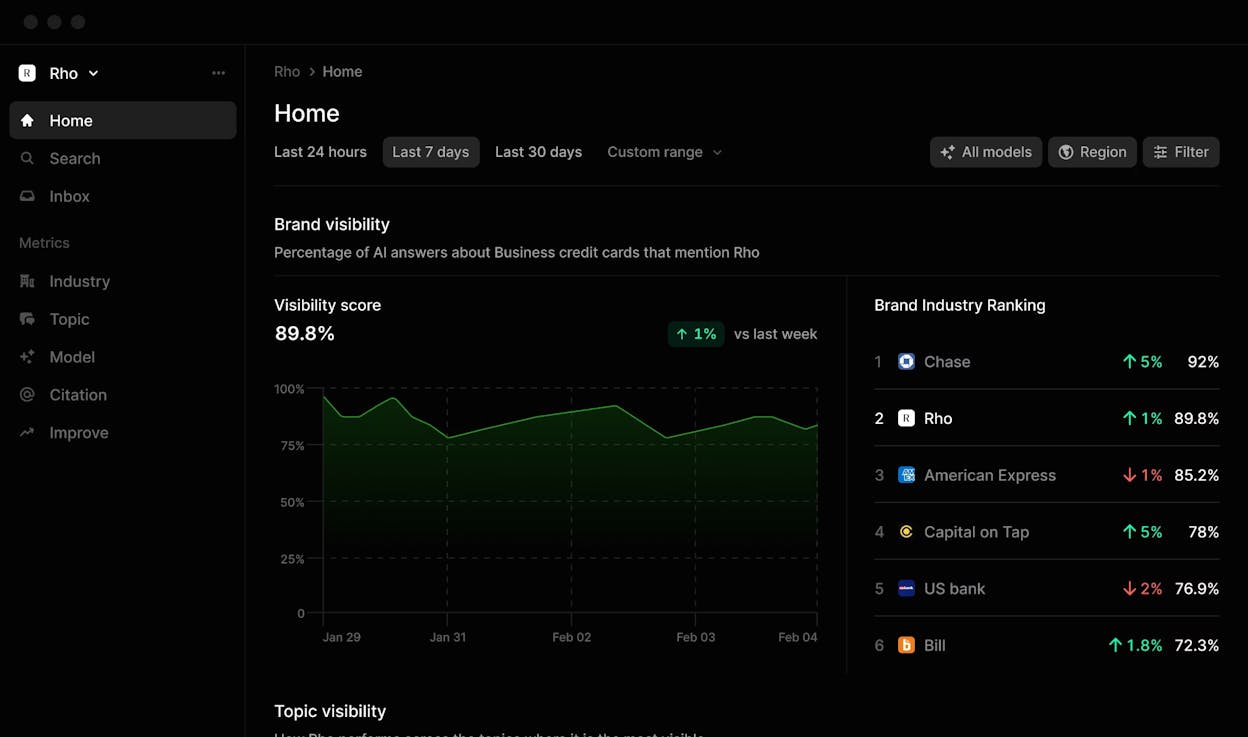
Profound raised a $96M Series C at a $1B valuation in late 2025, backed by Sequoia, Lightspeed, and Kleiner Perkins. Customers include Ramp, MongoDB, Figma, and DocuSign. The product centers on a proprietary panel dataset called Prompt Volumes, which estimates how often specific queries get asked across ChatGPT, Gemini, Perplexity, Copilot, and Claude. Think of it as keyword research for the AI era, bundled with a visibility platform.
Otterly was co-founded in Vienna in 2024 by the team that previously built and sold Usersnap. They’ve grown past 15,000 marketing users and earned a 2025 Gartner Cool Vendor for AI in Marketing nod. The product is what you’d expect from marketers building for marketers. Clean dashboards, fast onboarding, fair pricing, and a GEO Audit feature that goes deeper than most competitors at the price point.
The philosophy split matters. Profound is a reporting and intelligence layer for enterprise GEO programs. Otterly is a lightweight monitoring tool you can hand to a junior marketer on Monday and get value from by Friday.
Feature-by-feature breakdown
The sections below walk through seven areas that actually matter when you’re picking. For each one, you’ll get what Profound does, what Otterly does, and where Analyze AI fits the same job differently.
Prompt visibility and tracking
This is the table-stakes feature. You give the tool prompts, it runs them against AI engines, you watch your brand show up (or not) over time.
Profound runs deep. Multi-region, multi-language, historical modeling, and engine coverage that goes wide on Enterprise tiers. The trade-off is that you usually need a person owning the platform to extract value. Profound is a power tool. Junior marketers tend to bounce off it.
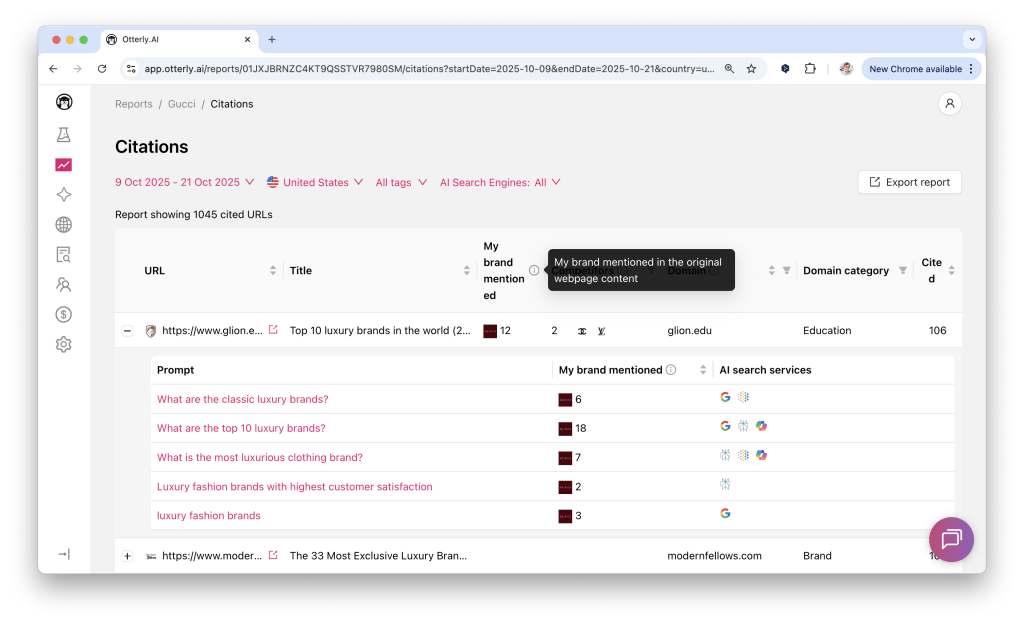
Otterly tracks ChatGPT, Perplexity, Google AI Overviews, and Microsoft Copilot on the base plans. Gemini and Google AI Mode are paid add-ons that range from $9 to $149/month depending on your tier. Data refreshes weekly on most plans. The interface is built so a single marketer can use it without a training session.
The Analyze AI version of this job. Prompt Tracking runs daily across ChatGPT, Claude, Gemini, and Perplexity. Each tracked prompt shows visibility, sentiment, position, and which brands you’re competing with.
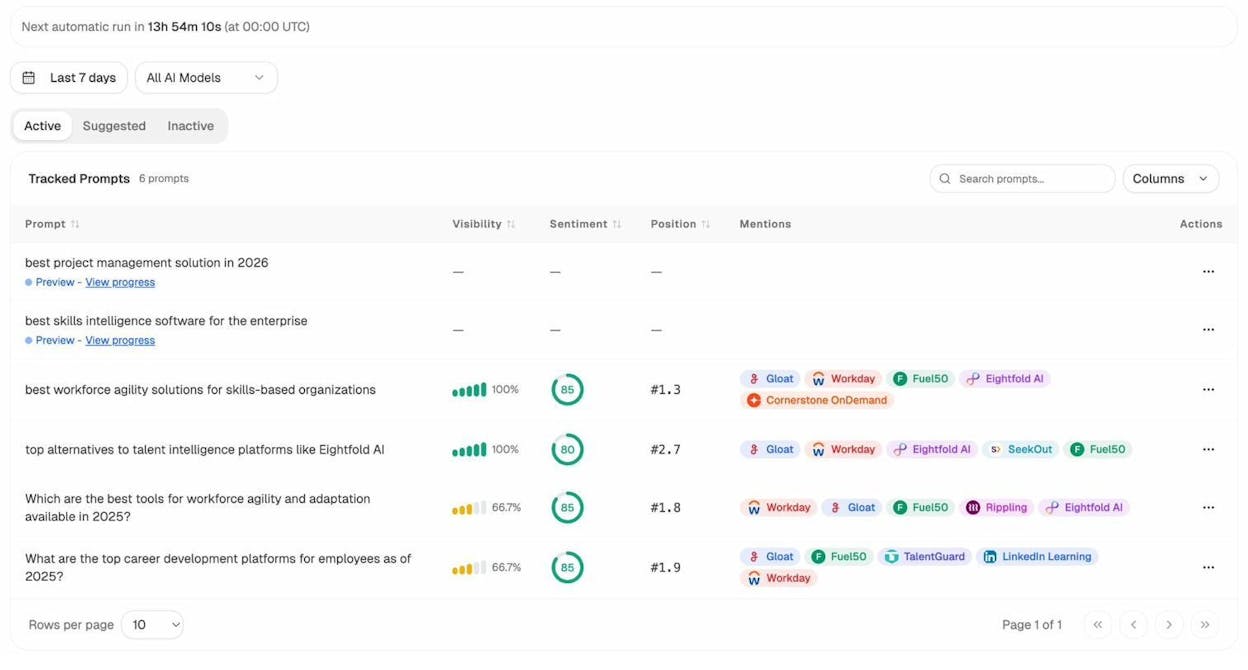
Analyze AI Prompts dashboard showing tracked prompts with visibility, sentiment, position, and competitor mentions
The difference isn’t tracking itself. It’s that every prompt result feeds the rest of the platform. The Content Optimizer sees which pages need fixing. The Agent Builder can fire a Slack alert when visibility drops. The Weekly Email Digest summarizes everything in plain English. Tracking on its own is a feature. Tracking wired to action is a workflow.
Prompt discovery and research
Knowing what to track is harder than tracking. Most teams monitor 10 to 30 prompts when their real conversational landscape sits at 200 to 2,000.
Profound’s edge is Prompt Volumes. Real panel data showing what queries people actually send to AI platforms, with demographic breakdowns. If you’ve researched prompts manually, you know how good that is.
Otterly converts keywords into prompts your audience would phrase. You can also pull existing Semrush keyword lists in through their App Center integration, a thoughtful touch for teams already on Semrush.
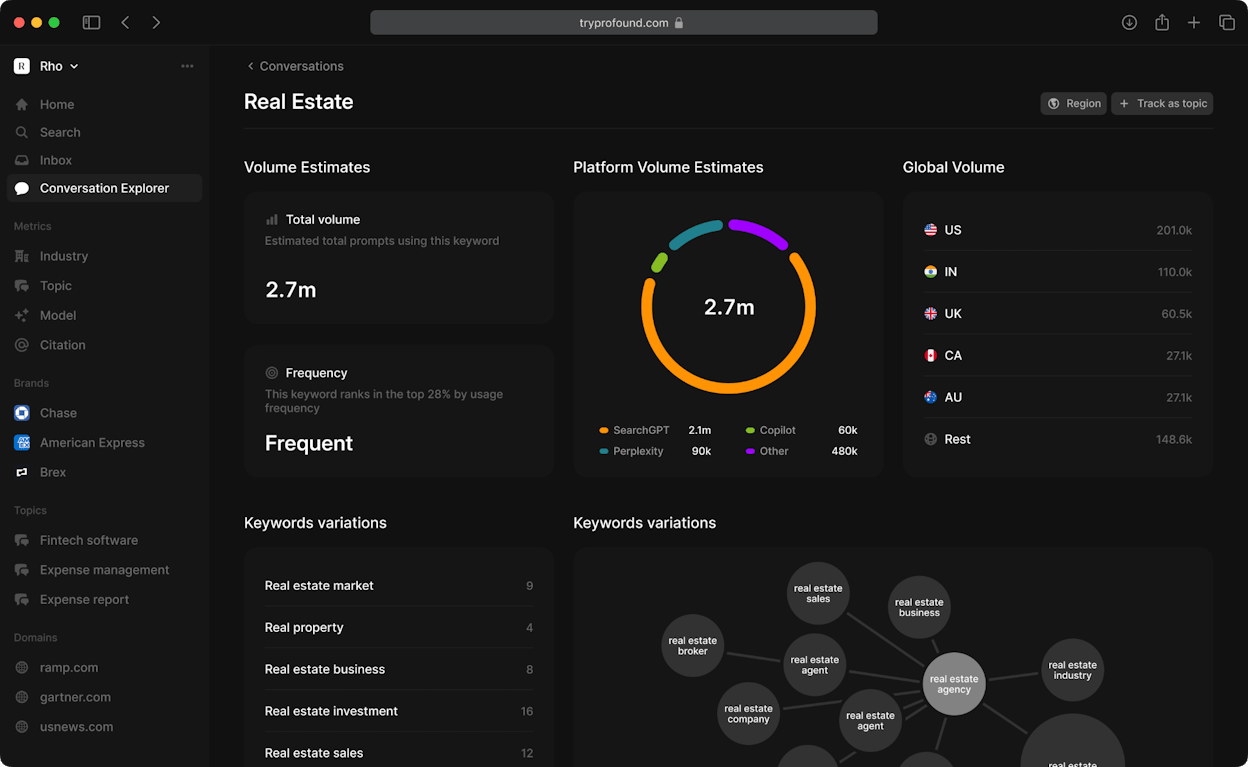
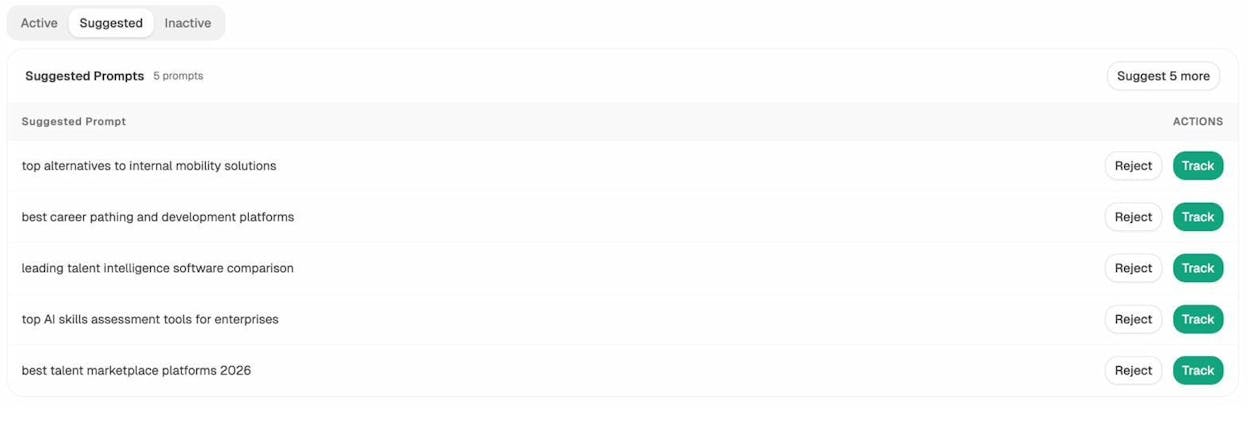
The Analyze AI version of this job. Prompt Discovery suggests prompts based on your brand, competitors, and how AI models are framing your category right now. Suggestions get ranked by visibility opportunity.
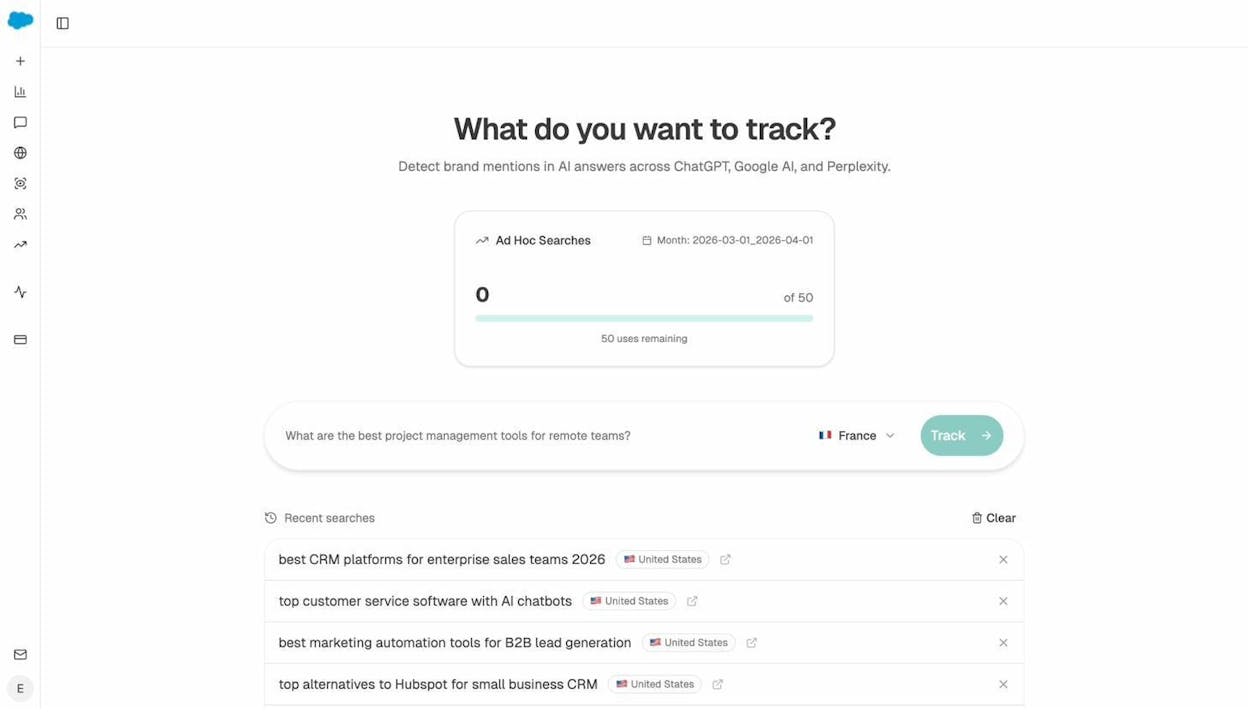
For ad-hoc research, AI Search Explorer works like a search bar. Type any prompt, see how every major AI engine responds, see who gets cited.
Citation and hallucination analysis
In AI answers, getting mentioned isn’t the whole game. Are AI engines linking back to your pages? Are they getting your claims right? Are competitors earning the citation share you should be earning?
Profound runs deep on citations. Full citation logs per prompt, top-cited domains, and hallucination detection that flags when an AI engine attributes a wrong claim to your brand. For compliance-heavy categories, this is the most important feature Profound ships.
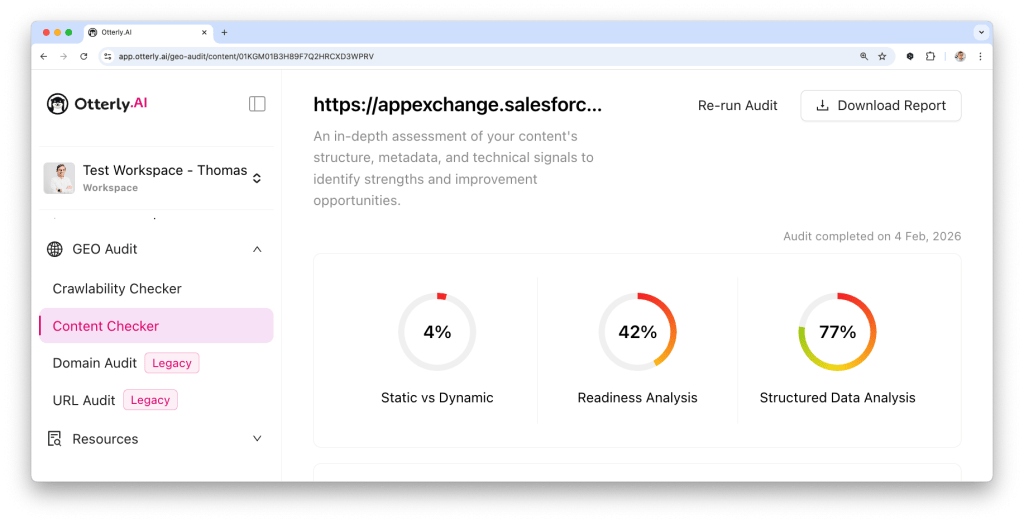
Otterly tracks citations and shows which URLs each AI engine references. The GEO Audit feature runs your pages against 25+ on-page factors that influence whether AI engines pull from your site. You get 5,000 URL audits per month on Standard and 10,000 on Premium. A real differentiator at Otterly’s price point.
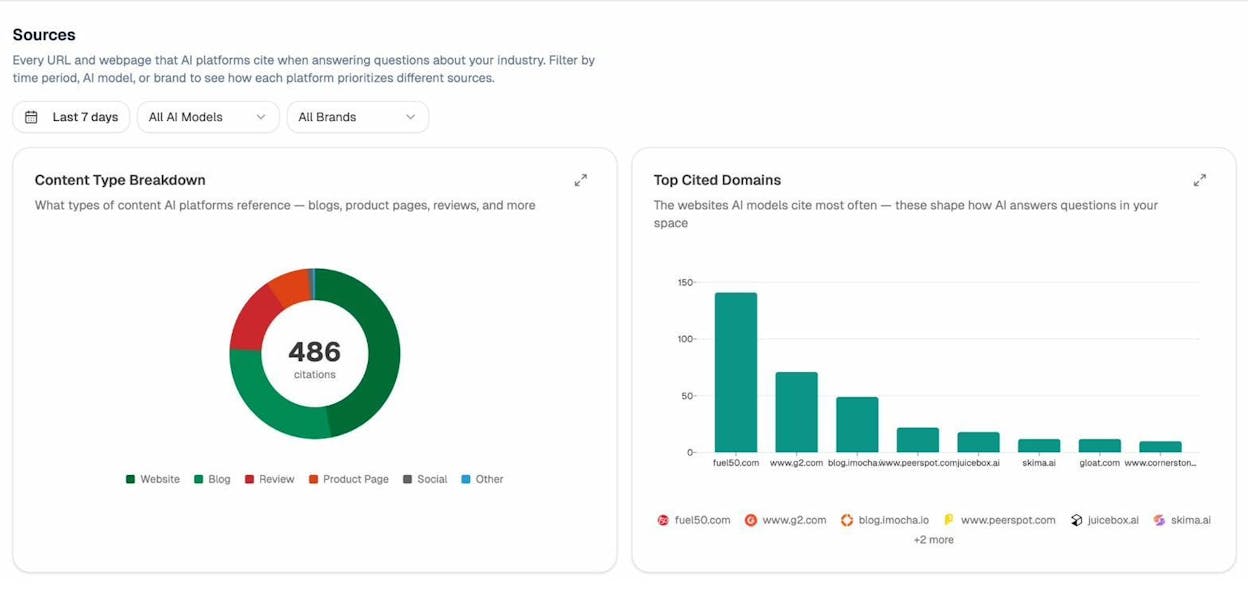
The Analyze AI version of this job. Citation Analytics shows every URL each AI engine cites, how often, on which prompts, and which competitors are getting the citation share you’re missing.
You can wire citation drops into the Agent Builder. Set up an agent that runs daily, calls the citation-decay-alert data recipe, and Slacks your content team the second a previously-cited page stops getting cited. Profound shows you the data. Analyze AI lets you build the response loop around it.
Competitive benchmarking
AI visibility in isolation tells you very little. The interesting question is who’s beating you and where.
Profound’s enterprise benchmarking is the deepest here. Share of voice modeling, sentiment per competitor, multi-product tracking. You can build executive dashboards that compare your brand against five or ten rivals at once. The cost is configuration time.
Otterly keeps it lighter. You can build a Brand Report for any competitor and watch citation counts shift over time. Useful for PR-style monitoring. Not enough for a team building a six-month competitive narrative strategy.
The Analyze AI version of this job. Competitor Intelligence handles share of voice and rank comparisons, with two extras that stand out.
The Perception Map plots every tracked brand on a 2D quadrant by visibility and narrative strength. You can see in one glance whether you’re winning attention, winning narrative, both, or neither.
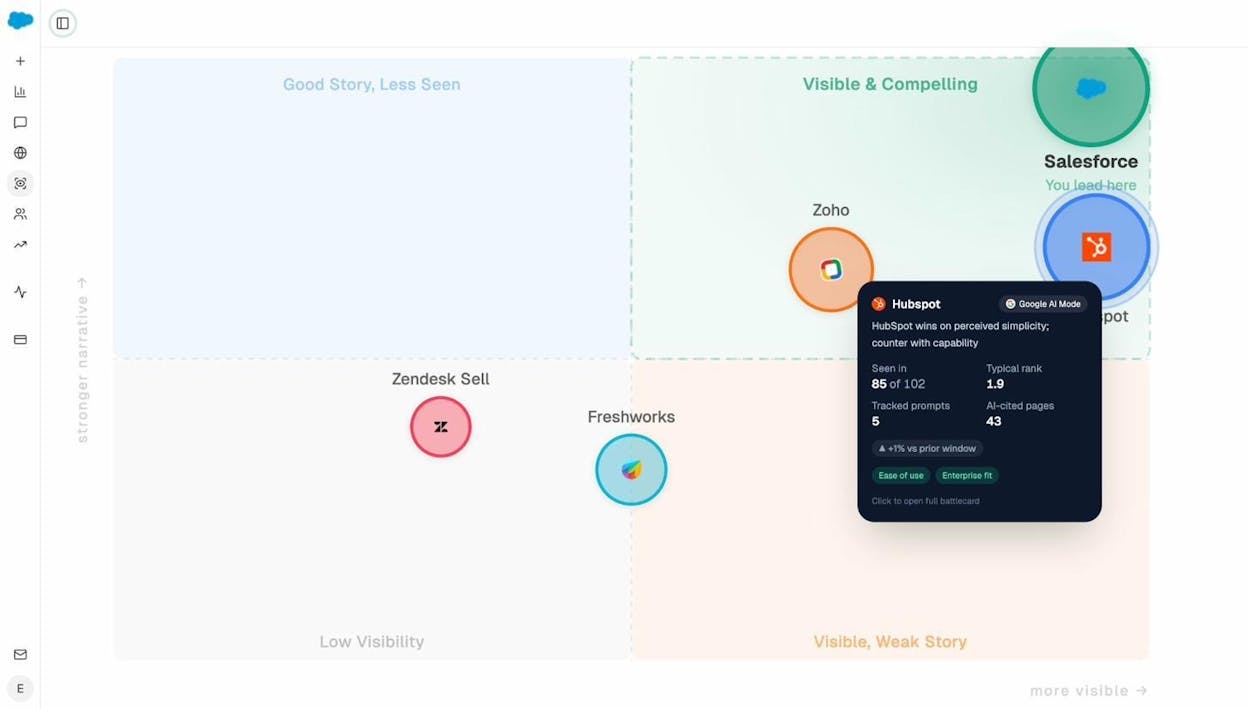
AI Battlecards auto-generate the side-by-side narrative comparison your sales team would otherwise build in a Google Doc. What AI says about you, what it says about a chosen competitor, where you win, where you lose. Refreshed automatically.
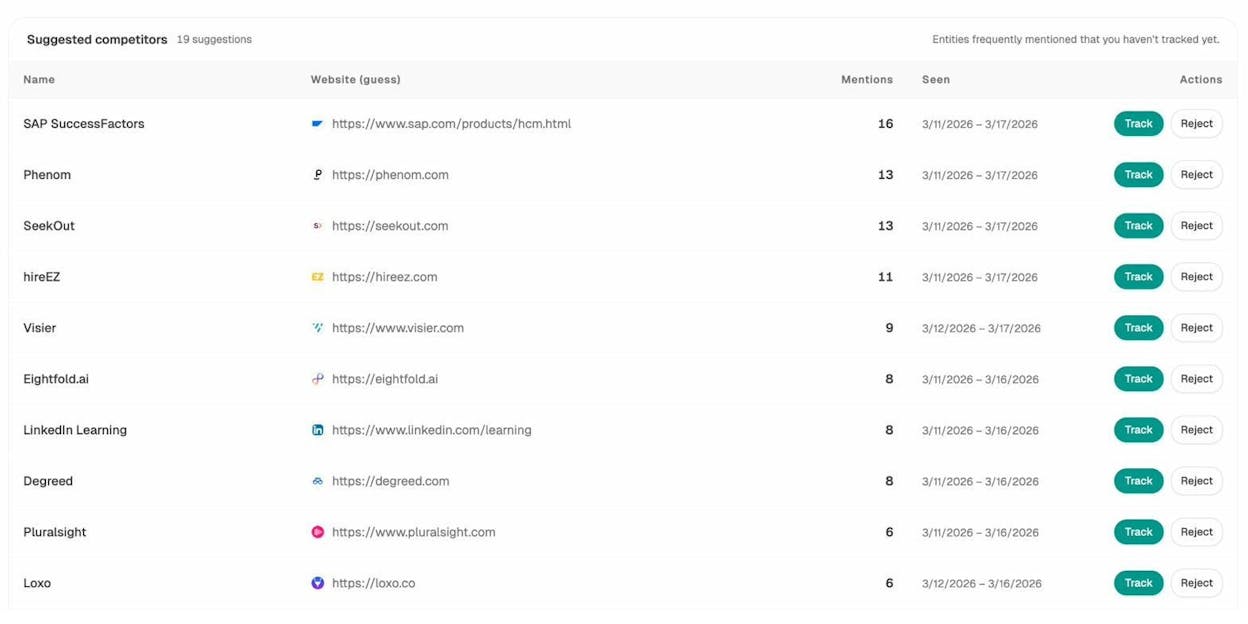
The system also surfaces competitors you’re not yet tracking but who keep appearing in your prompt set.
AI traffic analytics
Visibility is upstream. The question every CMO eventually asks is whether any of it drives sessions.
Profound experiments with directional AI traffic analytics that model how prompt visibility influences buying behavior. The models are still early.
Otterly doesn’t ship AI traffic analytics. Visibility stops at the prompt response.
The Analyze AI version of this job. AI Traffic Analytics connects to GA4 and shows which AI engines are sending real visitors, which pages they land on, and where they convert.
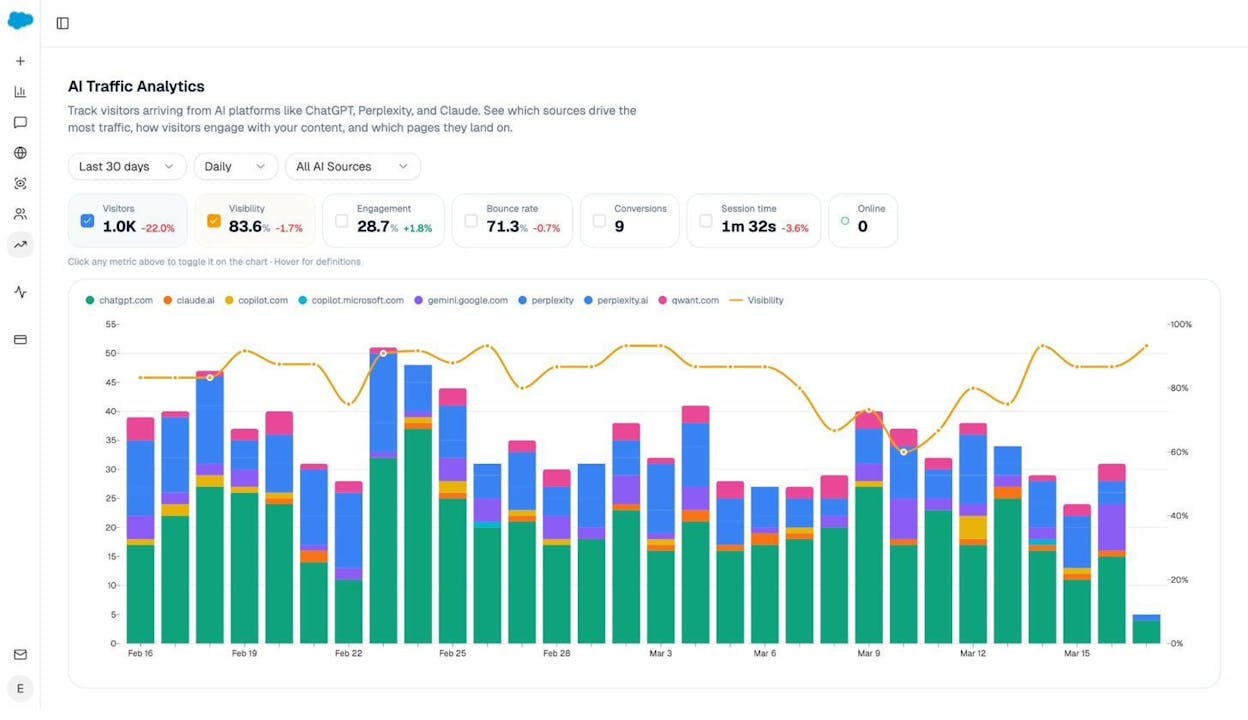
That’s the closest thing to ROI proof you’ll get in this category right now.
Content optimization and writing
Here’s where the comparison gets uncomfortable for both tools. Most teams reading this article aren’t trying to add another monitoring vendor. They want to fix the problem. Monitoring is step one. Writing better pages and optimizing the ones you have is steps two through twelve.
Profound ships “Content Agents,” an AI-optimized writing layer on certain plans. Reviews are still light. It’s a young feature.
Otterly is honest about its lane. The GEO Audit tells you what’s wrong with a page. It doesn’t write the fix.
If you need a real content optimization workflow today, you’ll likely pair either tool with a separate writer or optimizer. That’s a second contract, a second login, and a second source of truth.
The Analyze AI version of this job. The AI Content Writer runs a four-step pipeline (research, outline, draft, QA) with your brand voice rules injected at every step.
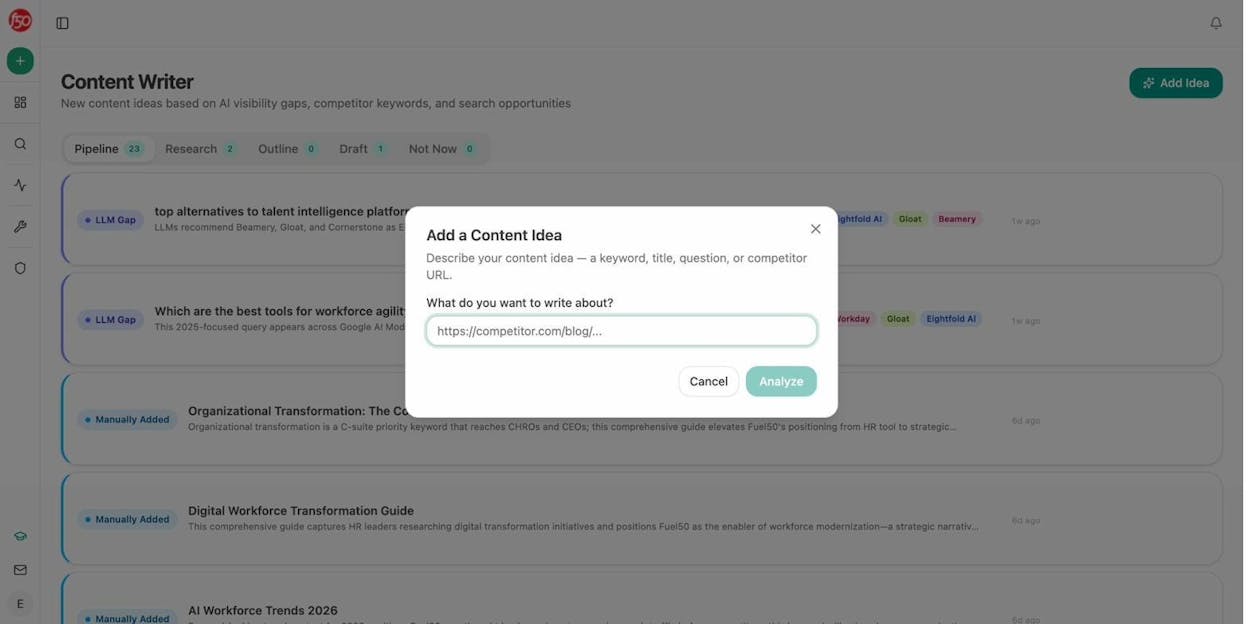
Research pulls live data from DataForSEO, Semrush, GSC, and your own knowledge base. The outline gets refined with editor comments. The draft uses your tone and required phrases.
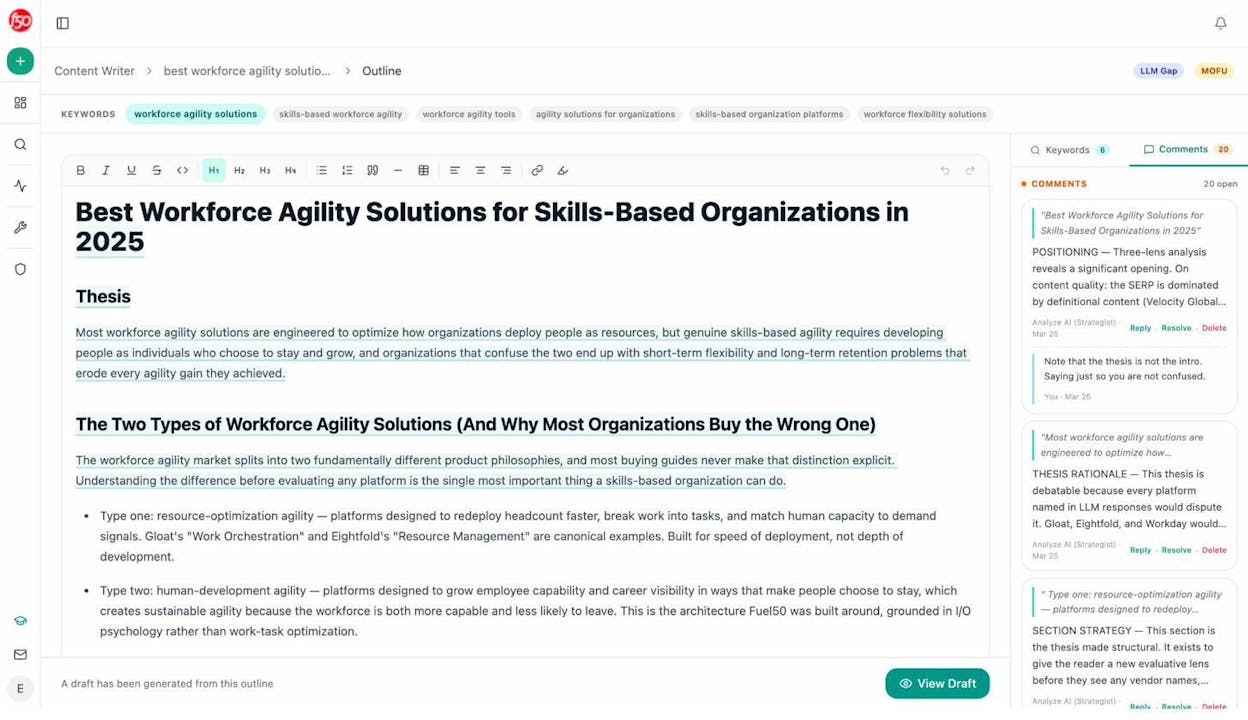
The Content Optimizer takes any published URL, runs an audit, then rewrites it section by section. The editor leaves comments. You accept or reject changes the way you would in a Google Doc with a senior editor.
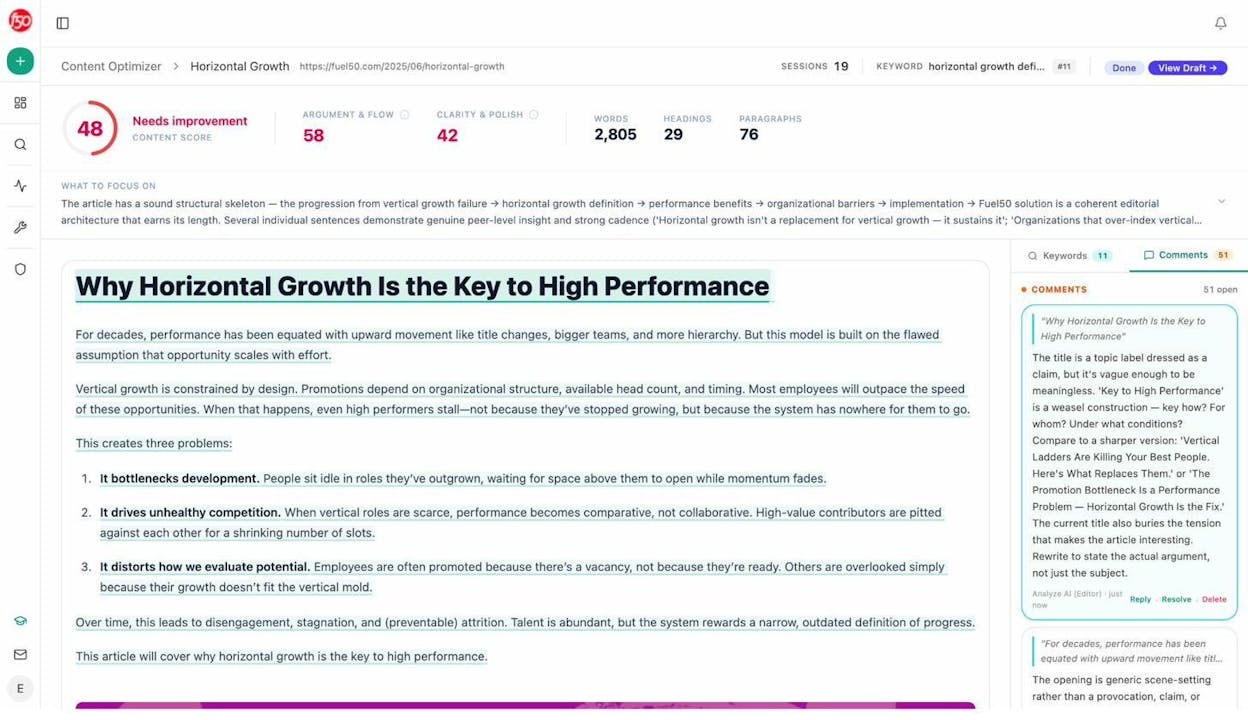
A final QA gate scores the page before it ships. This is the part Profound and Otterly hand back to your team. Analyze AI keeps it in-platform.
Pricing
Here’s where the conversation gets practical.
|
Tier |
Profound |
Otterly |
Analyze AI |
|---|---|---|---|
|
Entry |
$499/mo (Lite, ChatGPT-only) |
$29/mo, 15 prompts |
Self-serve, see pricing |
|
Mid |
$99 to $399/mo |
$189/mo, 100 prompts |
Self-serve mid-tier |
|
Pro / Premium |
Custom enterprise |
$489/mo or $989/mo |
Self-serve |
|
Enterprise |
Custom quote |
Custom (SSO, GEO health check) |
Custom |
|
Add-ons |
Included in tiers |
Gemini, AI Mode are paid add-ons ($9 to $149/mo) |
Most engines included |
A few honest notes on the pricing landscape.
Profound’s Lite tier covers ChatGPT only at around $499/month, which works out to roughly $10 per tracked prompt. That’s the worst cost-per-prompt in the category. Their value shows up at Plus and Enterprise tiers where the Prompt Volumes data and 10+ engine coverage justify the spend.
Otterly’s $29 starter is the lowest entry in the category. The jump from $29 to $189 (the Standard tier with 100 prompts) is the friction point. You’ll feel that jump if you’re a small agency or a mid-market in-house team.
Analyze AI prices simpler. Most engines are included on every tier. Content Writer, Content Optimizer, and Agent Builder access scale with the plan rather than being feature-gated.
Where both tools hit a ceiling
This is the conversation the comparison pages on both sites don’t have.
Profound and Otterly are monitoring tools. They show you the picture. They don’t move the chess pieces.
If your role is to write a board-ready monthly report, Profound is built for that. If your role is to run a $29/month sanity check on whether your brand is in the answers, Otterly is built for that. If your role is to run a content team, a competitive intelligence program, a PR function, or an agency, neither tool finishes the job.
You’ll still need to pull GA4 traffic into the same view as AI visibility, match competitor citation gaps to actual content briefs, run Monday-morning briefing packs without rebuilding them weekly, refresh stale pages losing AI citations, generate per-client retainer reports if you’re an agency, and rewrite underperforming pages with your tone respected. That’s the work. Monitoring is the input.
This is the gap Analyze AI is built to close.
The third option: Analyze AI as an agentic platform for SEO, AEO, content, and GTM
Most teams come to Analyze AI for AI search visibility. That part of the platform sits on the Monitor tab and looks similar in shape to what Profound and Otterly do. Brand visibility tracking, citation analytics, engine breakdowns, AI traffic.
The real difference shows up underneath. The same nodes that power the monitoring product are exposed in an Agent Builder with 180+ nodes, 34 pre-built data recipes, 13 input primitives, and three trigger modes (manual, scheduled, webhook).
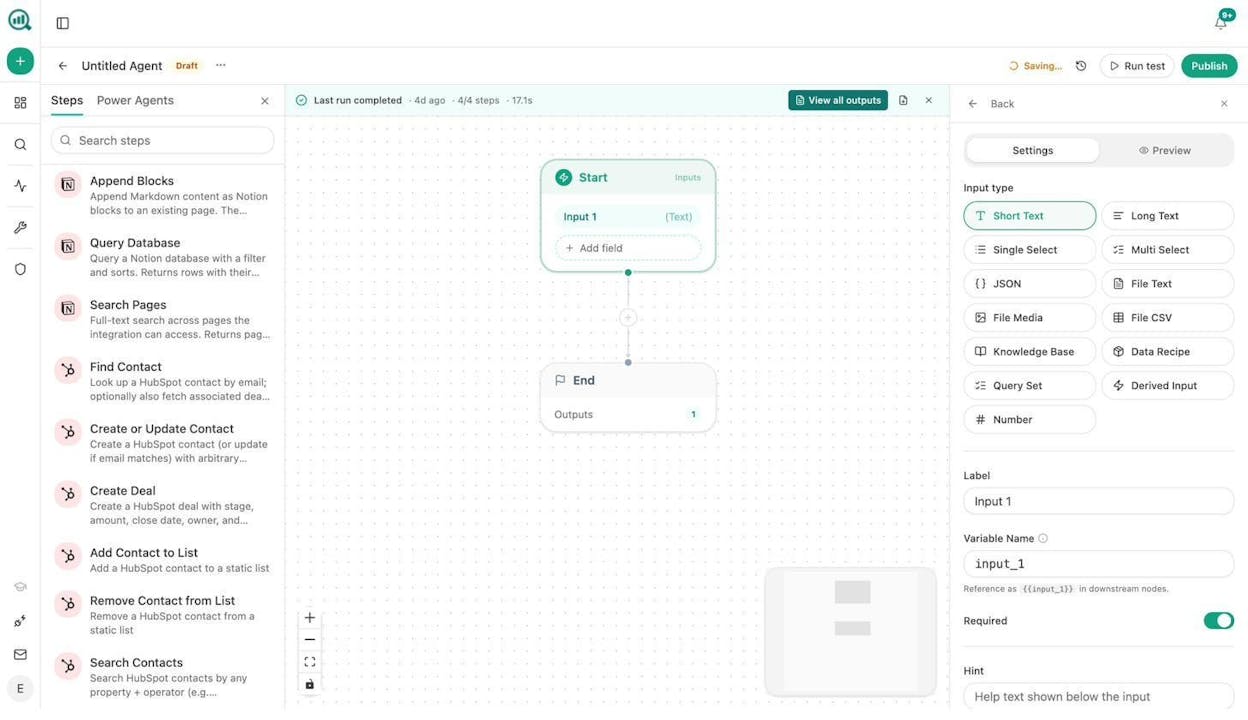
What this means in practice is that the data you’d normally pull into Looker Studio (Analyze AI visibility, GA4, GSC, DataForSEO, Semrush, HubSpot, Notion, WordPress, your brand vault, the major LLMs) sits in one workflow editor. You compose the workflow once. It runs on schedule, on demand, or fires from a webhook when reality changes.
A few examples of what teams actually build.
A CMO runs a Monday board prep agent. It fires at 7am, pulls share of voice across AI engines, GA4 traffic, the new HubSpot deals from last week, a competitor narrative shift summary, and a sentiment alert digest. An LLM composes the executive summary using your tone rules. The whole thing gets exported as DOCX and emailed to leadership. Four hours of analyst work, gone.
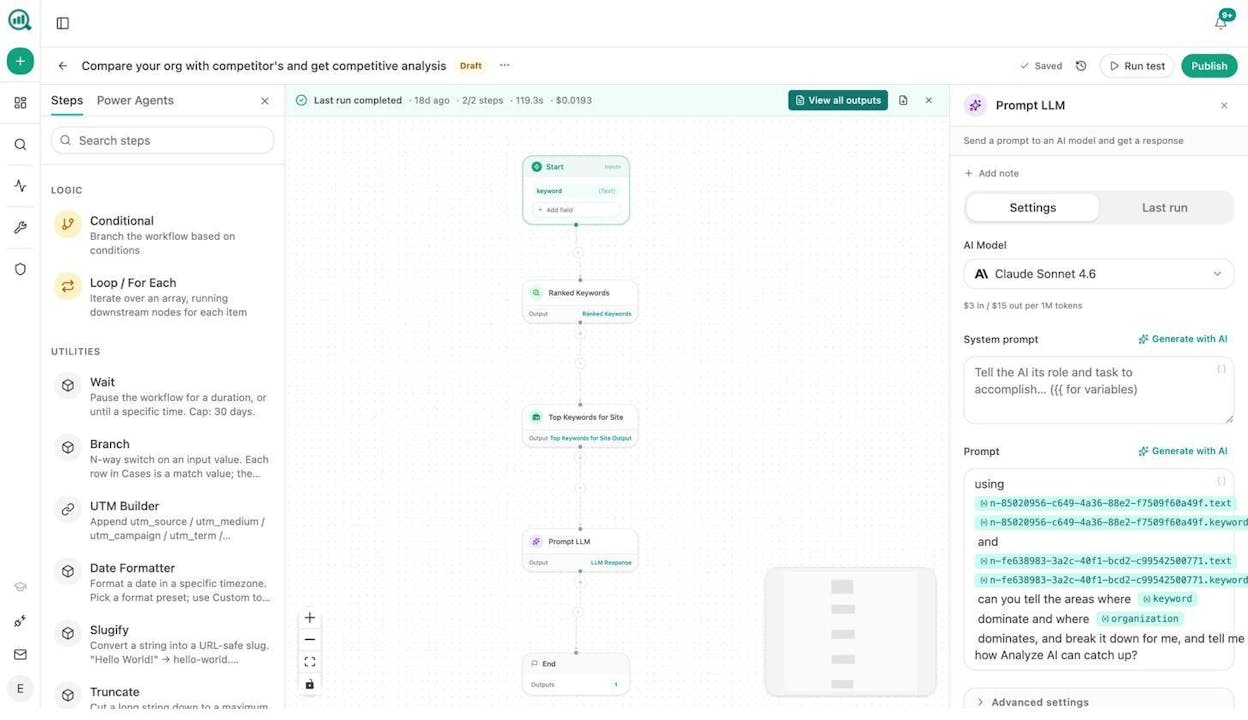
A content team sets up a brief-to-publish pipeline. A new brief moves to “approved” in Notion. The webhook fires. The agent runs research, drafts an outline, writes the draft with brand voice injected, runs an AEO scorecard, and either publishes to WordPress or Slacks the writer with gaps to fix.
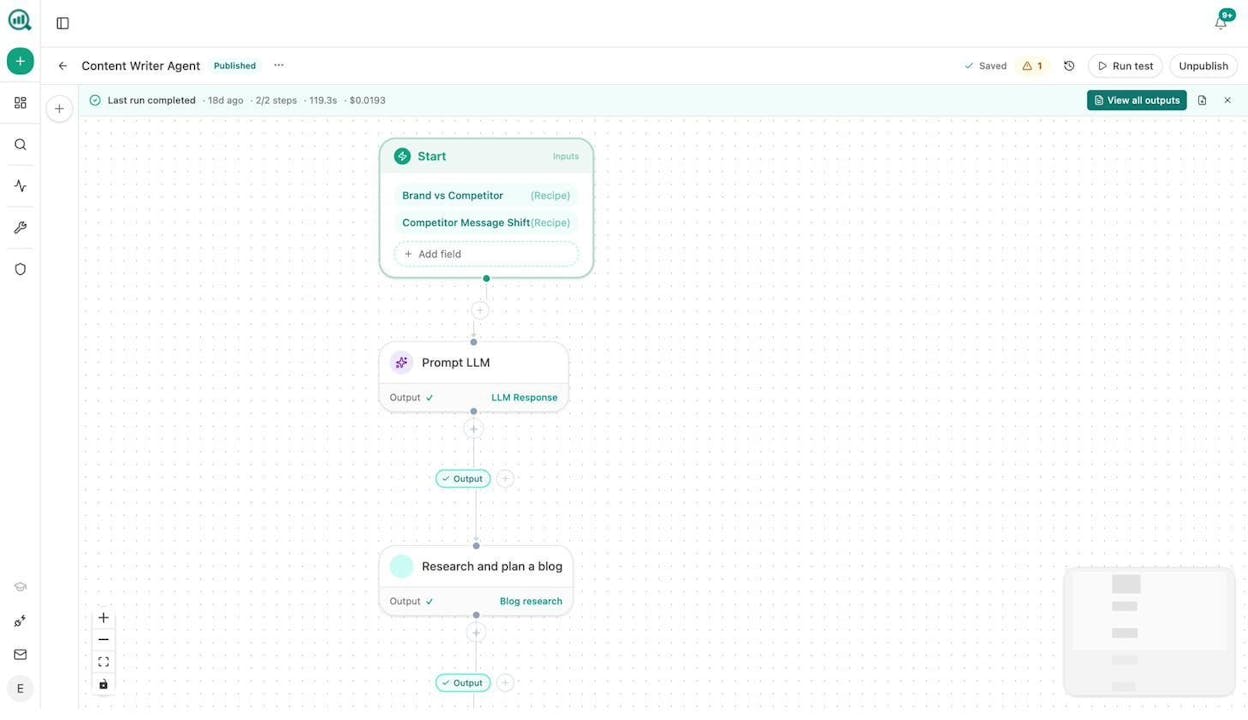
An agency runs a per-client Monday briefing pack. One agent loops over the client list, builds the report for each, generates DOCX with the agency’s letterhead, and emails each client’s account team automatically. Reporting day stops existing.
None of this is theoretical. The 34 data recipes (things like share-of-voice, competitor-gaps, citation-decay-alert, stale-content, keyword-opportunities, narrative-themes) are pre-baked queries against the data you already pay for. You drop them into a workflow and they hydrate at runtime.
Profound and Otterly don’t ship anything like this. They were built as visibility products. Analyze AI was built as a platform that includes visibility.
How the three compare on the full stack
|
Capability |
Profound |
Otterly |
Analyze AI |
|---|---|---|---|
|
AI search visibility tracking |
Deep, multi-region |
Solid, weekly refresh |
Daily across major engines |
|
Prompt volume data |
Yes (Prompt Volumes panel) |
No, but Semrush integration |
Suggested prompts engine |
|
Citation analytics |
Deep + hallucination detection |
Citation + GEO audit |
Full citation graph + Agent triggers |
|
Competitive benchmarking |
Enterprise share of voice |
Brand reports per competitor |
Perception Map + Battlecards |
|
AI traffic analytics |
Directional, early |
Not offered |
GA4-connected, daily |
|
Content writer |
Content Agents (limited) |
Not in product |
Full research-to-draft pipeline |
|
Content optimizer |
Not offered |
GEO Audit (diagnostic only) |
Audit + rewrite + QA |
|
Workflow automation |
Not offered |
Not offered |
Agent Builder (180+ nodes) |
|
GA4 / GSC / HubSpot data |
External |
External |
Native nodes |
|
Brand voice injection |
Not offered |
Not offered |
12-block Brand Vault |
|
Weekly digest emails |
Custom reporting |
CSV export |
Auto-generated, plain English |
|
Starting price |
$499/mo |
$29/mo |
See pricing |
The picture isn’t that Analyze AI wins on every row. The picture is that the rows you care about depend on what you do all day.
Which one should you actually pick
Choose Profound if you’re an enterprise team with budget and a dedicated GEO analyst. Their Prompt Volumes data is the best in the category. SOC 2 Type II and multi-region tracking clear procurement. You’ll get the deepest visibility intelligence in the market, and you’ll pay accordingly.
Choose Otterly if you’re a small or mid-market team who needs visibility without a six-figure contract. The $29 starter is the cleanest way to see whether AI visibility is moving for your brand. The GEO Audit is genuinely useful. Just budget for the jump to $189/month when you outgrow 15 prompts, and plan for Gemini and AI Mode add-ons.
Choose Analyze AI if you want one platform for AI search, content, competitive intelligence, and the workflows that connect them. The visibility product alone is competitive with both. The Agent Builder, Content Writer, Content Optimizer, Perception Map, Battlecards, Weekly Digest, and AI Traffic Analytics turn it from a monitoring tool into the operations layer of your marketing org.
The deeper bet underneath that pick is the one we wrote in the Analyze AI manifesto. SEO is not dead. AI search is the next organic channel, not a replacement for the old one. Tools that treat AI visibility as a separate universe push you into a separate workflow. Tools that treat it as part of the same content engine you already run reduce the surface area you have to manage.
FAQ
Is Profound worth the price? For enterprise teams with a real GEO program and a person who lives in the platform, yes. For everyone else, the entry tier at $499/month is the most expensive prompt tracking in the category and is hard to justify.
Does Otterly track Gemini and Google AI Mode? Not on the base plans. Both are paid add-ons that cost anywhere from $9 to $149/month depending on your tier. Factor that into your real monthly cost.
Can either tool write or optimize content for me? Profound ships a Content Agents feature on some tiers. Otterly diagnoses content issues but doesn’t fix them. If content optimization is a real part of your workflow, you’ll likely need a third tool, or a platform like Analyze AI that bundles it.
Do any of these tools tell me whether AI visibility actually drives traffic? Profound experiments here with directional AI traffic models. Otterly doesn’t. Analyze AI ties AI visibility to GA4 traffic directly, which is the closest proof of ROI you’ll get today.
If the next step is seeing how your brand shows up across ChatGPT, Claude, Gemini, and Perplexity, start with a free AI Visibility Audit or open a free side-by-side comparison against Profound.

Ernest

Ibrahim


