



Summarize this blog post with:


In this article, you’ll learn what SEO OKRs are, why they matter for aligning your SEO work with business goals, and how to write them so they actually drive results. You’ll get ready-to-use OKR examples across content, technical SEO, link building, and AI search visibility. And you’ll walk away with a clear process for tracking progress and avoiding the mistakes that make most SEO OKRs useless.
Table of Contents
What Are SEO OKRs?
OKR stands for Objectives and Key Results. It is a goal-setting framework that pairs a clearly defined objective with measurable key results that track progress toward that objective.
The objective is what you want to achieve. It should be specific, ambitious, and tied to a real business outcome. “Improve SEO” is not an objective. “Increase organic revenue from product pages by 15% in Q3” is.
The key results are how you know you’re making progress. They are the measurable milestones that tell you whether the objective is on track. Each objective should have two to five key results.
Here is a simple example to make it concrete:
Objective: Increase organic revenue from product pages by 15% in Q3
-
Key result 1: Publish 20 new product-supporting blog posts by end of Q3.
-
Key result 2: Improve average position of top 50 product keywords from 8.2 to 5.0.
-
Key result 3: Increase organic click-through rate on product pages from 2.1% to 3.5%.
Many teams use the SMART framework to pressure-test their goals. SMART stands for Specific, Measurable, Achievable, Relevant, and Time-bound. It is a useful gut check, but OKRs already bake most of this in if you write them well.
Why SEO Teams Need OKRs
Most SEO teams have no shortage of work. They have a shortage of alignment. There are always more audits to run, more content to publish, and more technical tickets to file. The question is never “what can we do?” The question is “what should we do first, and why?”
OKRs force that conversation. They connect the SEO roadmap to what the company actually cares about, whether that is revenue, pipeline, market share, or brand awareness.
Without OKRs, SEO teams end up in one of two traps. The first is the activity trap, where the team measures success by how much they shipped instead of what that shipping accomplished. The second is the vanity metric trap, where the team reports on traffic and rankings without connecting those numbers to revenue or leads.
OKRs are typically set at three levels. Company-level OKRs define the big bets. Team-level OKRs translate those bets into department goals. Individual OKRs turn department goals into personal deliverables. The most effective SEO OKRs align upward to company goals and downward to SEO tactics that the team knows will have an impact.
How to Write Effective SEO OKRs
Bad OKRs are worse than no OKRs. They create busywork, misalign teams, and give leadership a false sense of progress. Here is how to write ones that actually work.
Start with the business goal, not the SEO tactic
The most common mistake is writing OKRs that start with what the SEO team wants to do instead of what the business needs to accomplish. “Improve Core Web Vitals” is an SEO tactic. “Reduce bounce rate on product pages to increase conversion rate” is a business goal that Core Web Vitals might help with.
Always ask: what does this OKR do for the company? If you cannot answer that in one sentence, rewrite it.
Make key results measurable and time-bound
“Improve rankings” is not a key result. “Move 15 target keywords from page 2 to page 1 within 90 days” is. Every key result should have a number and a deadline.
The number does not have to be exact. It has to be directional. If you say “increase organic traffic by 20%,” you can adjust the target later. The point is that everyone agrees on what progress looks like before the work starts.
Limit the number of OKRs
Three to five objectives per quarter is the sweet spot. Each objective should have two to five key results. More than that and the team loses focus. Fewer than that and the OKRs are probably too vague to be useful.
Separate input metrics from output metrics
Input metrics are things the team controls directly, like publishing 30 articles or fixing 500 crawl errors. Output metrics are things the team influences but does not control directly, like organic traffic or revenue.
Good OKRs include both. Input metrics keep the team accountable for doing the work. Output metrics keep the team accountable for doing the right work.
Revisit OKRs mid-quarter
OKRs are not set-and-forget documents. Review them every two to four weeks. If a key result is already hit, raise the bar. If a key result is clearly unreachable, figure out why and adjust the approach.
General SEO OKRs
General SEO OKRs often focus on organizational alignment, reporting, and proving the value of SEO to the broader business. These are especially important for in-house SEO teams that need executive buy-in to get resources.
Objective: Increase organizational awareness and buy-in of SEO
-
Key result 1: Conduct SEO training sessions for eight core teams (product, content, engineering, marketing) in the next quarter.
-
Key result 2: Build and distribute an internal SEO playbook with best practices, templates, and approval workflows within six months.
-
Key result 3: Deliver a monthly SEO impact report to leadership that connects organic performance to revenue.
-
Key result 4: Get three non-SEO teams to independently adopt SEO recommendations in their workflows by end of quarter.
The hardest part of enterprise SEO is not the technical work. It is getting other teams to care. Training sessions and playbooks help, but the real unlock is showing concrete revenue impact. When the sales team sees that organic search generated $2M in pipeline last quarter, they start paying attention.
![[Screenshot: Google Looker Studio or GA4 dashboard showing organic revenue attribution by channel]](https://www.datocms-assets.com/164164/1777586188-blobid1.png?auto=format,compress&w=1248&fit=max)
Objective: Unify brand experience across web properties
-
Key result 1: Define and document SEO standards for a unified design system within two months.
-
Key result 2: Consolidate content from three separate CMSs into one primary CMS within one year.
-
Key result 3: Migrate two acquired domains per quarter onto the main website while maintaining within 5% of pre-migration traffic levels.
Domain migrations are high-risk, high-reward. The key result here is specific about traffic preservation because that is where most migrations fail. If you are consolidating acquisitions, plan for a 10-20% traffic dip in the first 60 days and set your OKR accordingly.
Objective: Improve SEO reporting to support data-driven decisions
-
Key result 1: Create competitor scorecards that track share of voice, keyword overlap, and content gaps for the top five competitors.
-
Key result 2: Build business unit scorecards that show organic performance by product line, region, and funnel stage.
-
Key result 3: Connect SEO results to CRM revenue data within six months to prove pipeline attribution.
Reporting is only useful if it changes behavior. The best SEO reports do not just show what happened. They show what to do next. If your report says “organic traffic increased 12%,” add a line that says “driven by 8 new posts in the [topic cluster], suggesting we should double down on that cluster next quarter.”
For a deeper look at SEO reporting tools, we have a full breakdown of free and paid options.
Measuring SEO awareness in AI search
These general OKRs cover traditional search well. But there is a growing gap in how organizations think about organic visibility. AI search engines like ChatGPT, Perplexity, Google AI Mode, and Claude now answer questions directly, and your brand either shows up in those answers or it does not.
A simple addition to any general SEO OKR is to include AI visibility as a key result. For example, under the reporting objective above, you could add:
-
Key result 4: Set up AI visibility tracking for the brand and top five competitors, and include AI search share of voice in monthly reports.
In Analyze AI, the Overview dashboard gives you a single view of your brand’s visibility, sentiment, and citation trends across all major AI platforms. You can filter by time period, AI model, and competitor to see exactly where you stand.
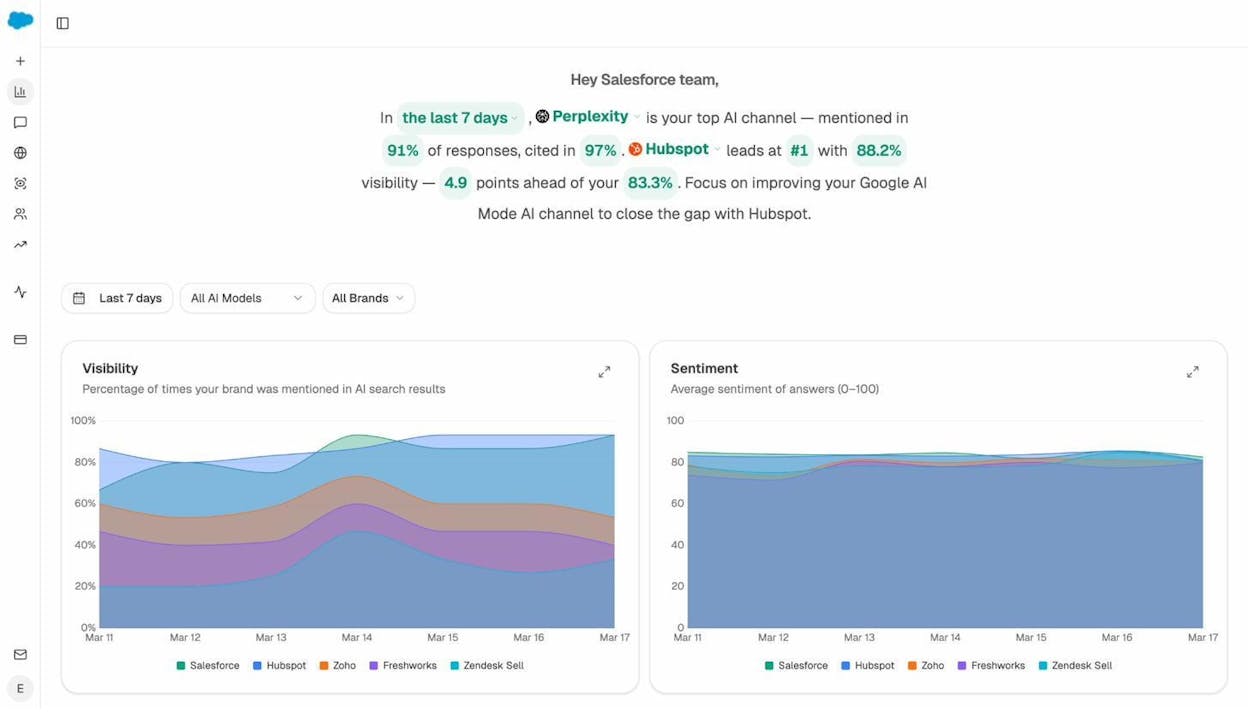
This is not about replacing your SEO reporting. It is about adding a new layer that captures a channel most teams are ignoring.
Content OKRs
Content OKRs focus on creating, updating, and optimizing content to drive organic traffic, rankings, and revenue. These tend to be the most common OKRs for SEO teams because content is where most of the day-to-day work happens.
Objective: Increase organic revenue from top 20 products by 10% this quarter
-
Key result 1: Build a content plan with keyword-mapped topics supporting each of the top 20 products.
-
Key result 2: Use SEO forecasting to estimate the traffic and revenue opportunity for each topic.
-
Key result 3: Publish 50 new pieces of content aligned to those topics.
-
Key result 4: Update 30 existing posts with refreshed data, improved structure, and expanded coverage.
The revenue target here forces the team to prioritize. Instead of publishing content on any topic with search volume, the team focuses on topics that support the 20 products that generate the most revenue. This is pain point SEO in practice.
![[Screenshot: Keyword research tool showing keyword difficulty, volume, and CPC for product-related terms]](https://www.datocms-assets.com/164164/1777586215-blobid3.png?auto=format,compress&w=1248&fit=max)
![[Screenshot: Content calendar or spreadsheet mapping target keywords to product pages and publish dates]](https://www.datocms-assets.com/164164/1777586221-blobid4.png?auto=format,compress&w=1248&fit=max)
Objective: Drive brand awareness beyond the blog
-
Key result 1: Create and publish 15 videos around core topics to YouTube.
-
Key result 2: Build comparison pages for the top five competitors (e.g., “Brand X vs. Brand Y”).
-
Key result 3: Launch 2,000 programmatic pages in the next six months that showcase unique data or use cases.
-
Key result 4: Ship free versions of 10 core tools so users can try them and rank those pages for feature-related keywords.
Free tools are one of the most underrated content strategies. They attract links naturally, they rank for high-intent keywords, and they give users a reason to come back. At Analyze AI, our free tools suite includes a keyword generator, keyword difficulty checker, SERP checker, keyword rank checker, website authority checker, website traffic checker, and broken link checker. Each one ranks for its target keyword and feeds users into the product.
Objective: Update 30 pieces of content to recapture declining rankings
-
Key result 1: Identify all posts with a traffic decline of 20% or more over the last six months.
-
Key result 2: Find low-hanging-fruit keywords where the page ranks on positions 5-15 and could move up with minor improvements.
-
Key result 3: Optimize five pages for featured snippets by restructuring content to match snippet formats (tables, lists, definitions).
Content decay is real. A post that ranked #3 a year ago might sit at #8 today because competitors published better content or because the topic shifted. Regular content audits are not optional.
![[Screenshot: Google Search Console performance report filtered to show pages with declining clicks over 6 months]](https://www.datocms-assets.com/164164/1777586234-blobid5.png?auto=format,compress&w=1248&fit=max)
![[Screenshot: SEO tool showing keyword positions 5-15 for a specific domain, highlighting quick-win opportunities]](https://www.datocms-assets.com/164164/1777586241-blobid6.png?auto=format,compress&w=1248&fit=max)
Objective: Expand into international markets
-
Key result 1: Translate the top 50 performing pages into Spanish, French, and German within six months.
-
Key result 2: Implement hreflang tags correctly across all translated content.
-
Key result 3: Achieve 80% of original-language traffic levels for translated pages within nine months.
International SEO is a multiplier. If your English content already performs well, translating it into languages where competition is lower can generate outsized returns with relatively low effort.
Content OKRs for AI search visibility
AI search engines do not just pull from the SERP. They pull from content that is well-structured, clearly written, and frequently cited by other sources. That means your content OKRs should also consider how content performs in AI answers.
Here are content-specific key results you can add to any content objective:
-
Track which of your pages get cited by AI platforms using citation analytics, and identify patterns in the content that gets cited most.
-
Use the AI Traffic Analytics dashboard to see which landing pages receive the most visits from ChatGPT, Perplexity, Claude, and other AI sources.
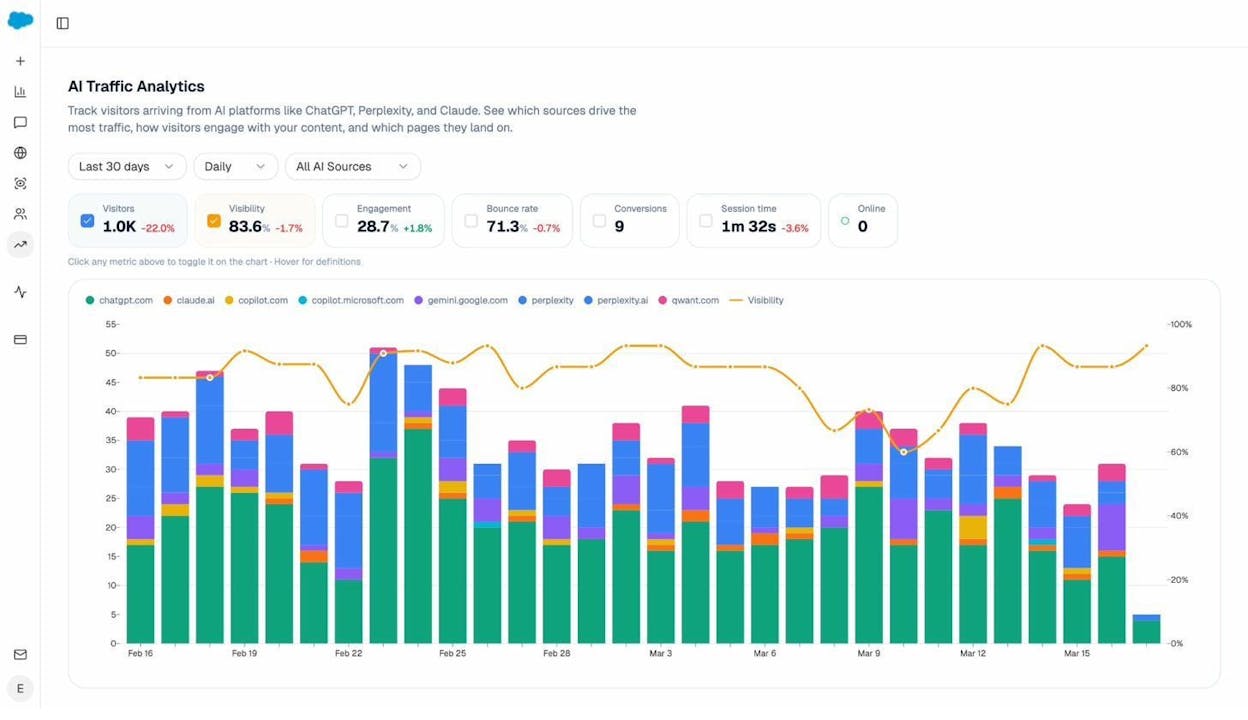
The Landing Pages view inside AI Traffic Analytics shows exactly which URLs receive AI-referred traffic, how visitors interact with them, and which AI platforms send the most sessions. This data helps you identify patterns. If your product pages get cited but your blog posts do not, that tells you something about what AI models value in your content.
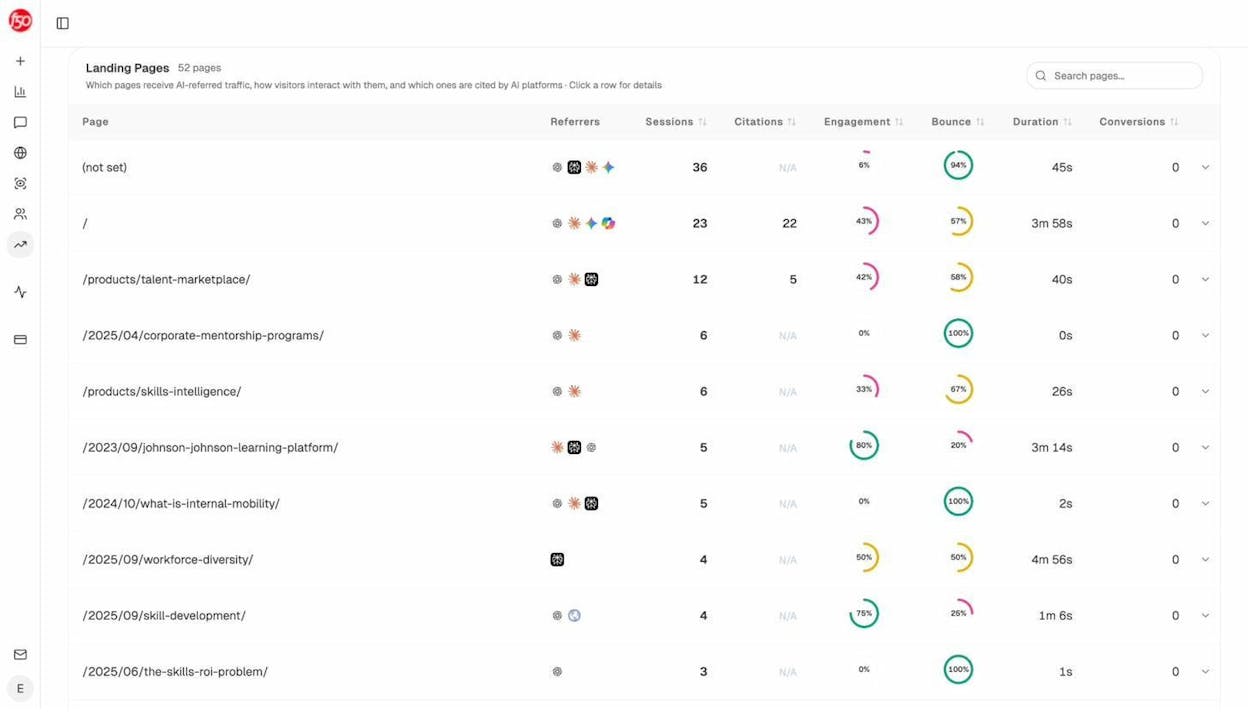
Use these insights to set content OKRs like:
Objective: Increase AI-referred traffic by 25% in Q3
-
Key result 1: Identify the top 10 landing pages by AI traffic and create supporting content that links to each one.
-
Key result 2: Restructure 20 blog posts to lead with clear, direct answers in the first paragraph (BLUF format) to increase citation likelihood.
-
Key result 3: Increase total AI citations from 150 to 200 by publishing content on topics where AI platforms currently cite competitors but not you.
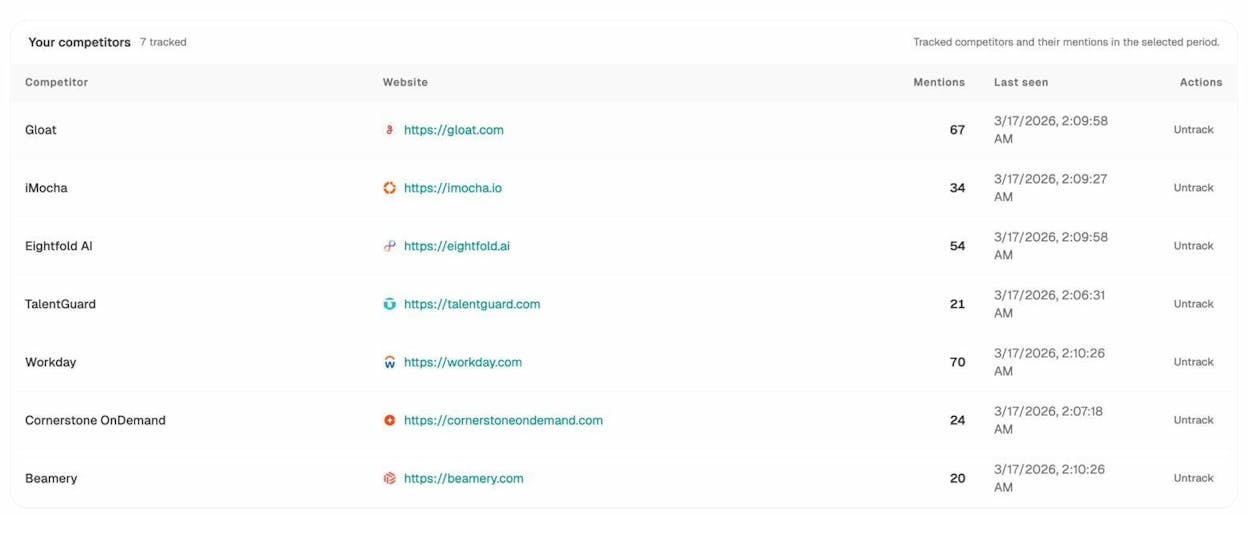
That last key result uses competitive gap analysis. In Analyze AI, the Competitor Intelligence feature shows you which competitors get mentioned in AI answers and how often. If a competitor shows up in 70% of relevant AI responses and you show up in 30%, that is a clear gap to close.
Link Building OKRs
Link building remains one of the most impactful levers in SEO. It is also one of the hardest to scale, especially in enterprise environments where brand guidelines and legal approvals slow everything down.
Objective: Reclaim lost link value
-
Key result 1: Recover lost link equity from 500+ broken backlinks through redirects using a link reclamation process.
-
Key result 2: Convert 30 unlinked brand mentions into live backlinks through targeted outreach.
-
Key result 3: Fix all internal broken links identified in a site-wide audit using a broken link checker.
Link reclamation is the lowest-effort, highest-ROI link building tactic available. These are links you already earned. You are just making sure they still work. Start by crawling your site to find 404 pages with existing backlinks, then redirect those URLs to the most relevant live page.
![[Screenshot: Backlink analysis tool showing broken backlinks with referring domains, anchor text, and target URL]](https://www.datocms-assets.com/164164/1777586267-blobid10.png?auto=format,compress&w=1248&fit=max)
![[Screenshot: A spreadsheet tracking broken backlinks with columns for original URL, redirect target, referring domain, and status]](https://www.datocms-assets.com/164164/1777586270-blobid11.png?auto=format,compress&w=1248&fit=max)
For unlinked mentions, search Google for your brand name in quotes and filter out results that already link to you. What remains is a list of pages that mention your brand but do not link. A short outreach email with the specific URL and a suggested link often converts at 5-15%.
Objective: Increase average order value through internal linking
-
Key result 1: Add “related products” widgets to the top 100 product pages to cross-sell and upsell.
-
Key result 2: Audit and add internal links from the top 50 informational blog posts to relevant product pages.
-
Key result 3: Build a topic cluster model that connects hub pages to supporting content for three primary product categories.
Internal links are the most undervalued ranking factor. They pass authority, they help search engines understand site structure, and they guide users toward conversion. The ROI on internal linking projects is almost always positive because there is no outreach, no negotiation, and no external dependency.
Objective: Earn 50 new referring domains through content-led link building
-
Key result 1: Publish three data-driven studies using proprietary data in the next quarter.
-
Key result 2: Create five original infographics or interactive tools designed to attract links.
-
Key result 3: Secure guest posts or contributed articles on 10 industry publications.
The best link building happens when you create something worth linking to. Original research, unique data sets, and free tools attract links naturally because they provide value that cannot be found elsewhere.
Technical SEO OKRs
Technical SEO is where one fix can be worth millions of dollars. And one mistake can cost millions. That asymmetry makes it critical to set clear objectives so the team focuses on the fixes that matter most.
Objective: Improve user experience on pages related to the top 30 offerings
-
Key result 1: Get 80% of main pages to pass Core Web Vitals within six months.
-
Key result 2: Ensure 95% of pages are mobile-friendly within six months.
-
Key result 3: Reduce average page load time from 4.2 seconds to under 2.5 seconds for the top 30 product pages.
Core Web Vitals are not just a ranking factor. They directly affect conversion rates. Google’s own data shows that as page load time goes from 1 second to 3 seconds, the probability of bounce increases by 32%. Fixing performance is an SEO project that also benefits every other marketing channel.
![[Screenshot: Google PageSpeed Insights report showing Core Web Vitals metrics for a product page]](https://www.datocms-assets.com/164164/1777586283-blobid12.png?auto=format,compress&w=1248&fit=max)
Objective: Be proactive about identifying issues instead of reactive
-
Key result 1: Work with developers to set up staging-site crawls and pre-deployment checks so issues are caught before they go live.
-
Key result 2: Build a sampled page list from each CMS and template type, and crawl it daily to flag new issues within 24 hours.
-
Key result 3: Establish a post-release crawl process for every deployment.
-
Key result 4: Move from weekly crawls to always-on crawling with automated alerts.
-
Key result 5: Set up a dashboard with daily visibility updates for the top 100 pages and keywords.
Most technical SEO problems are discovered weeks or months after they happen. By then, the damage is done. The goal of proactive monitoring is to catch issues the same day they occur, ideally before they hit production.
![[Screenshot: A site audit tool showing a list of crawl errors categorized by severity, with trends over time]](https://www.datocms-assets.com/164164/1777586286-blobid13.png?auto=format,compress&w=1248&fit=max)
Objective: Increase visual real estate in the SERP
-
Key result 1: Implement product schema on all e-commerce pages and set up a Google Merchant Center feed.
-
Key result 2: Optimize images on the top 200 pages for image pack visibility (file names, alt text, compression).
-
Key result 3: Add event schema to all event pages and FAQ schema to the top 50 informational pages.
-
Key result 4: Add job posting schema and submit new jobs via the Google Indexing API.
Schema markup does not directly improve rankings, but it increases the size and visibility of your search result. A product listing with star ratings, price, and availability takes up more space on the SERP and gets a higher click-through rate than a plain blue link.
![[Screenshot: Google SERP showing a rich result with product schema including star ratings, price, and availability]](https://www.datocms-assets.com/164164/1777586290-blobid14.jpg?auto=format,compress&w=1248&fit=max)
Objective: Clean up indexing and crawl budget waste
-
Key result 1: Identify and noindex or remove 10,000+ thin or duplicate pages within three months.
-
Key result 2: Fix all orphaned pages by adding internal links or removing them from the index.
-
Key result 3: Submit updated XML sitemaps that only include indexable, canonical URLs.
Crawl budget matters more than most people think, especially for large sites. If Google is spending its crawl budget on 50,000 parameter-based URLs that return duplicate content, it has less budget to crawl and index your important pages.
![[Screenshot: Google Search Console coverage report showing indexed vs. excluded pages, with reasons for exclusion]](https://www.datocms-assets.com/164164/1777586298-blobid15.png?auto=format,compress&w=1248&fit=max)
AI Search Visibility OKRs
This is the section most SEO teams are missing entirely. AI search is not replacing traditional SEO. It is an additional organic channel that runs parallel to it. The brands that set OKRs for AI search visibility today will have a compounding advantage over those that wait.
AI search engines like ChatGPT, Perplexity, Google AI Mode, Gemini, and Claude now handle a growing share of information-seeking queries. When someone asks “what is the best CRM for small businesses?” in ChatGPT, the answer includes specific brand names, product recommendations, and source citations. If your brand is not in that answer, you are invisible in that channel.
Here is the good news. The fundamentals that make you visible in AI search are the same fundamentals that make you rank well in traditional search. Clear content, strong brand authority, and a well-structured website. The difference is that AI search also rewards being cited by third-party sources, having a consistent brand narrative, and producing content that directly answers specific questions.
For a deeper understanding of how traditional SEO and AI search overlap, read our piece on GEO vs SEO.
Objective: Establish baseline AI search visibility and close gaps with top competitors
-
Key result 1: Set up prompt tracking for 20 high-value prompts related to your core products and services.
-
Key result 2: Achieve 50% visibility (brand mentioned in at least half of tracked AI responses) within six months.
-
Key result 3: Identify the top three competitors in AI search and reduce the visibility gap by 15 percentage points.
The first step is knowing where you stand. In Analyze AI, the Prompt Tracking feature lets you track specific prompts across multiple AI models over time. You can see your visibility percentage, average position, sentiment score, and which competitors appear alongside you.
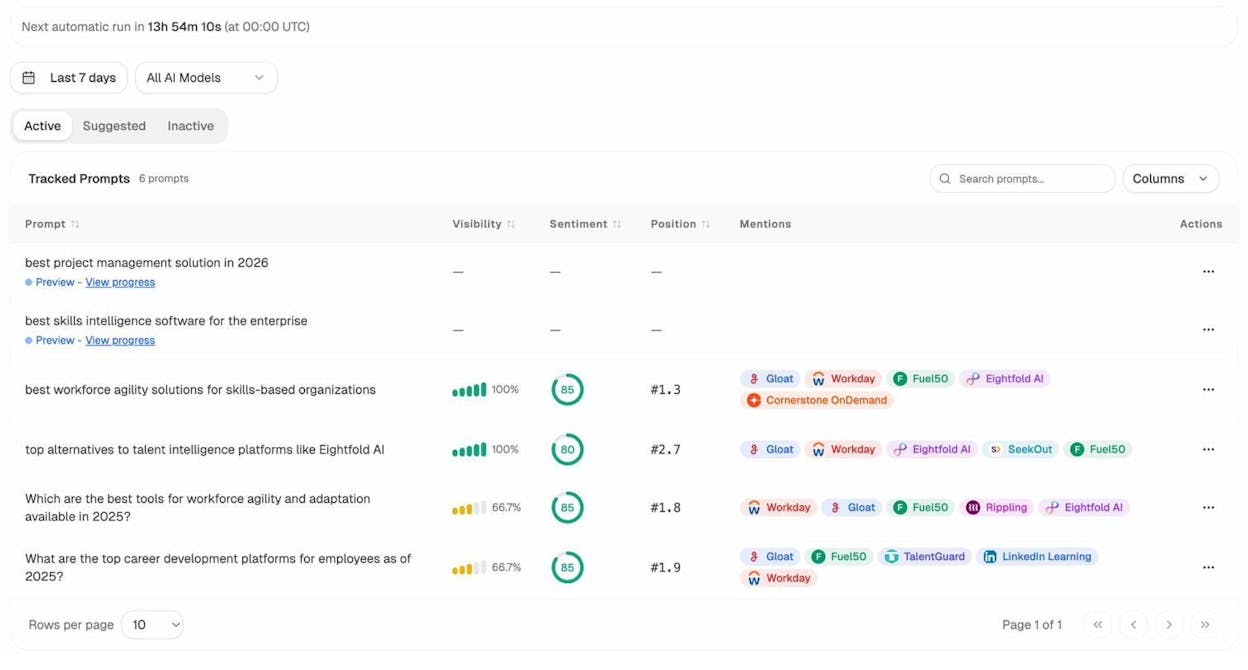
This is the AI search equivalent of rank tracking. Instead of tracking keyword positions on Google, you are tracking brand mentions in AI responses to specific questions.
Objective: Understand and improve brand perception in AI search
-
Key result 1: Map current brand perception across all major AI models using the Perception Map.
-
Key result 2: Identify the top three negative or neutral themes in AI responses and create content that addresses each one.
-
Key result 3: Improve average sentiment score from 70 to 80 across tracked prompts within one quarter.
AI models form opinions about brands based on the content they have ingested. If your brand is frequently associated with “expensive” or “hard to use” in third-party reviews, that perception will show up in AI answers. The Perception Map in Analyze AI plots your brand and competitors on a quadrant based on visibility and narrative strength.
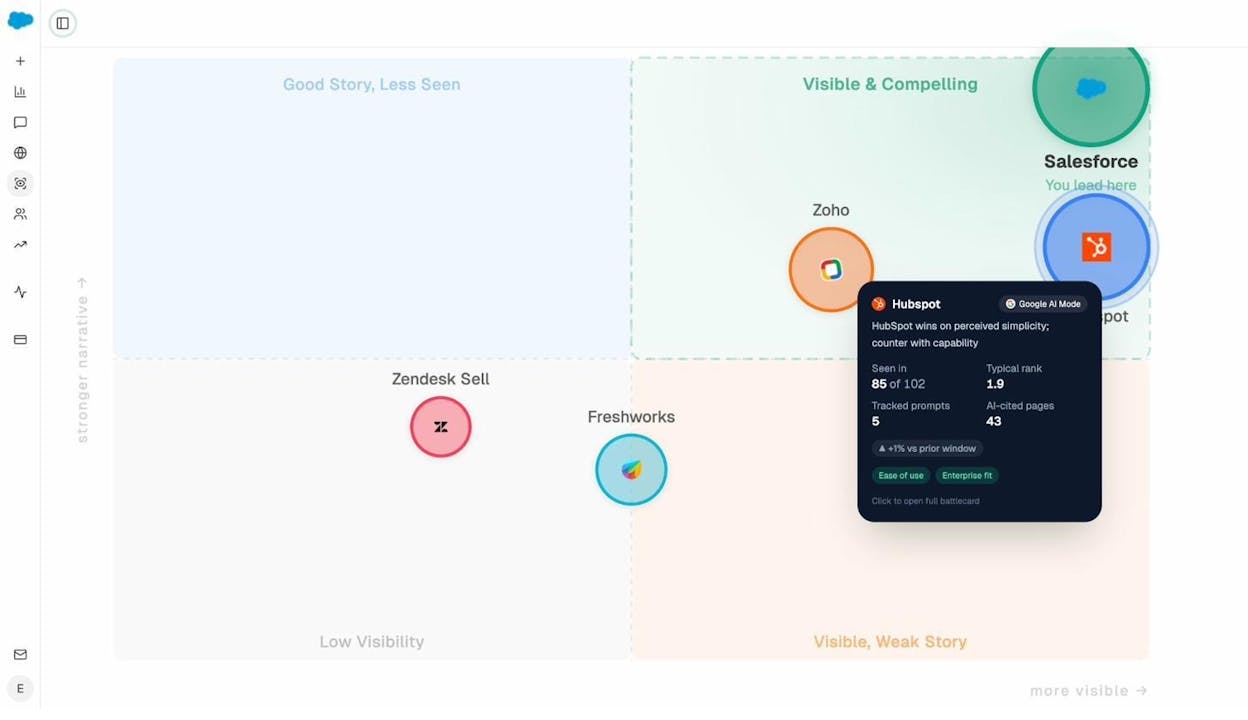
The goal is to move from “Visible, Weak Story” or “Low Visibility” into the “Visible & Compelling” quadrant. The key results above give you a concrete path to get there.
Objective: Increase AI-referred traffic and conversions
-
Key result 1: Increase monthly sessions from AI referral sources by 30% within six months.
-
Key result 2: Achieve a conversion rate of 2%+ on AI-referred traffic (matching or exceeding organic search conversion rate).
-
Key result 3: Identify the top five AI traffic landing pages and optimize each for conversion.
AI-referred traffic is real traffic from real users. These visitors arrive at your site because an AI model cited your page in its response. In Analyze AI, the AI Traffic Analytics dashboard breaks down this traffic by source (ChatGPT, Perplexity, Claude, Gemini, Copilot), and shows engagement metrics like bounce rate, session time, and conversions.
Objective: Discover and act on AI search opportunities your competitors are missing
-
Key result 1: Use AI Search Explorer to run ad hoc prompt searches and identify 20 high-value queries where your brand is absent but competitors appear.
-
Key result 2: Create or optimize content targeting each of those 20 queries within the quarter.
-
Key result 3: Achieve brand mention in at least 10 of those 20 queries by end of quarter.
The Ad Hoc Searches feature in Analyze AI lets you type any prompt and instantly see which brands appear in AI responses across ChatGPT, Google AI Mode, and Perplexity. This is a fast way to spot opportunities.
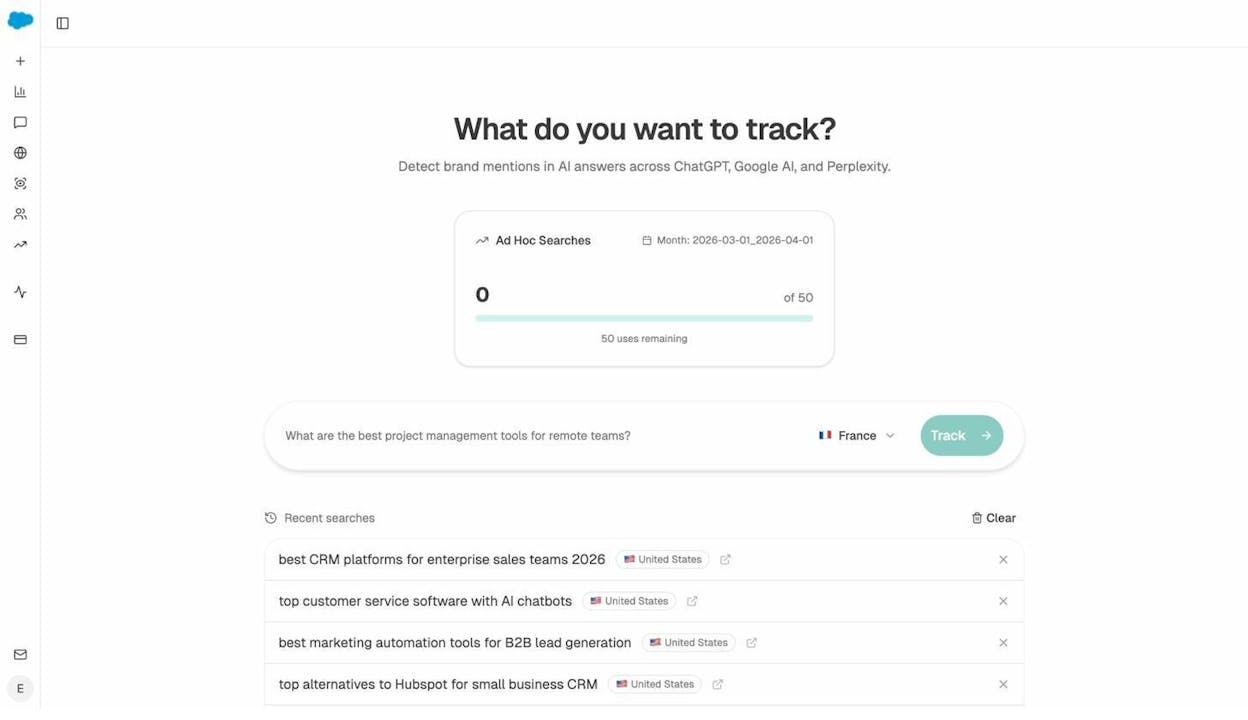
Think of it as the AI search version of a SERP checker. Instead of checking who ranks for a keyword on Google, you are checking who gets mentioned when a user asks an AI model a question.
Objective: Build an AI search reporting cadence
-
Key result 1: Set up weekly email digests that summarize visibility changes, citation momentum, and competitive shifts.
-
Key result 2: Include AI search metrics in the monthly SEO report to leadership.
-
Key result 3: Establish a quarterly AI search review that aligns AI visibility goals with content and SEO strategy.
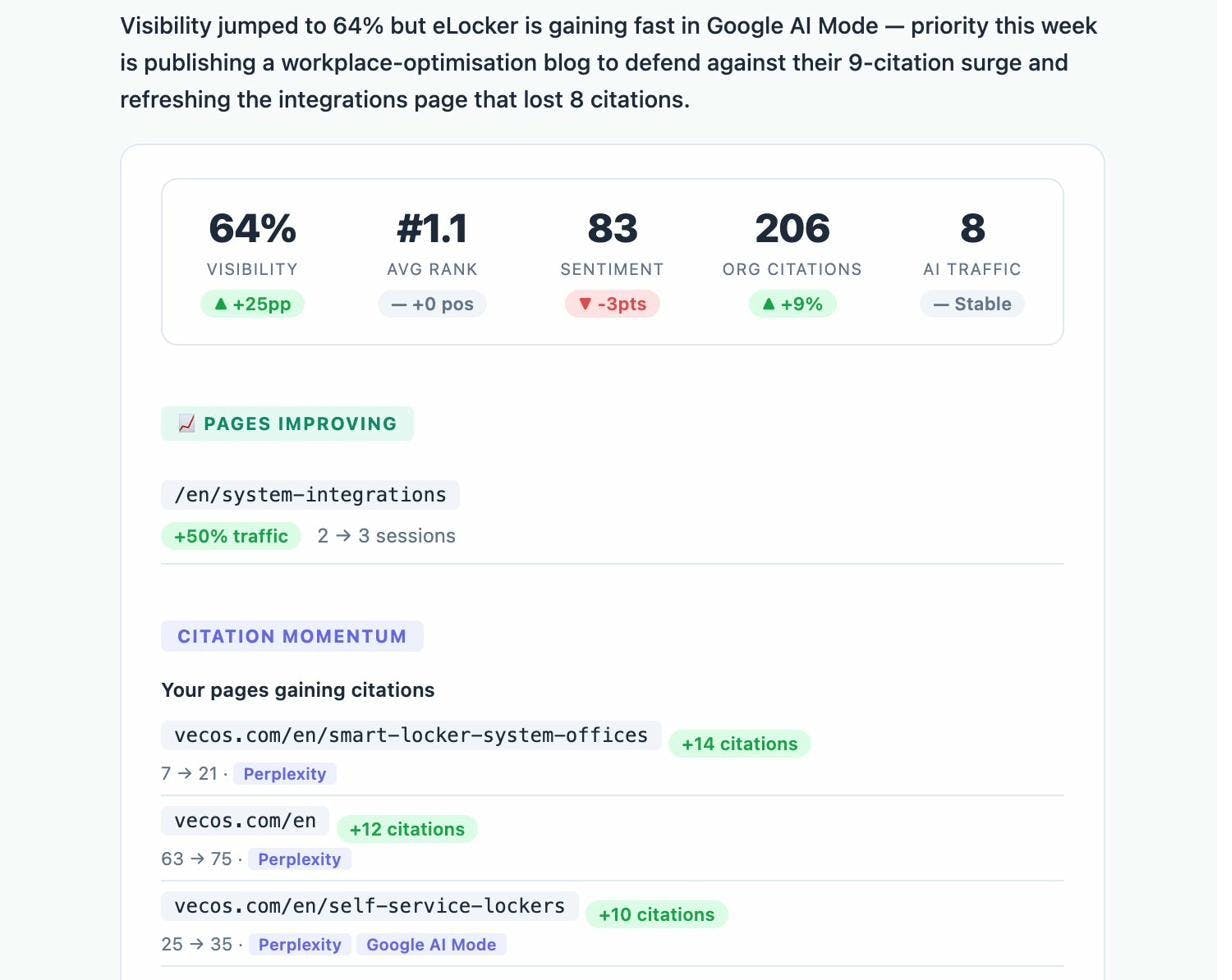
Reporting on AI search does not need to be a separate workflow. Analyze AI sends automated weekly digests that summarize your visibility score, rank changes, sentiment shifts, citation gains and losses, and pages that are improving or declining. Forward these to stakeholders and you have instant AI search reporting with zero manual effort.
How to Track and Report on SEO OKRs
Setting OKRs is the easy part. Tracking them consistently and reporting on them in a way that influences decisions is where most teams fall short.
Build a single source of truth
Create one document or dashboard where all OKRs live. This could be a Google Sheet, a Notion database, or a project management tool like Asana. Every OKR should show the objective, its key results, the current status of each key result, and who owns it.
Update this document every two weeks. If a key result is not moving, that is a signal to investigate why and adjust the approach.
![[Screenshot: A Google Sheet or Notion board showing OKRs with columns for objective, key results, owner, status, and progress percentage]](https://www.datocms-assets.com/164164/1777586313-blobid20.png?auto=format,compress&w=1248&fit=max)
Use a traffic and rankings dashboard for traditional SEO
Google Search Console and Google Analytics are the foundation. Search Console shows impressions, clicks, average position, and click-through rate. Analytics shows sessions, conversions, and revenue. Together, they tell you whether your SEO work is reaching people and whether those people are taking action.
For keyword tracking, use a rank tracking tool that updates daily and lets you segment by keyword group, page, or product line.
Add AI search metrics to your reporting stack
Traditional SEO dashboards do not capture AI search performance. You need a separate layer for that. Analyze AI provides this through a unified dashboard that tracks visibility, sentiment, citations, AI-referred traffic, and competitive positioning across all major AI platforms.
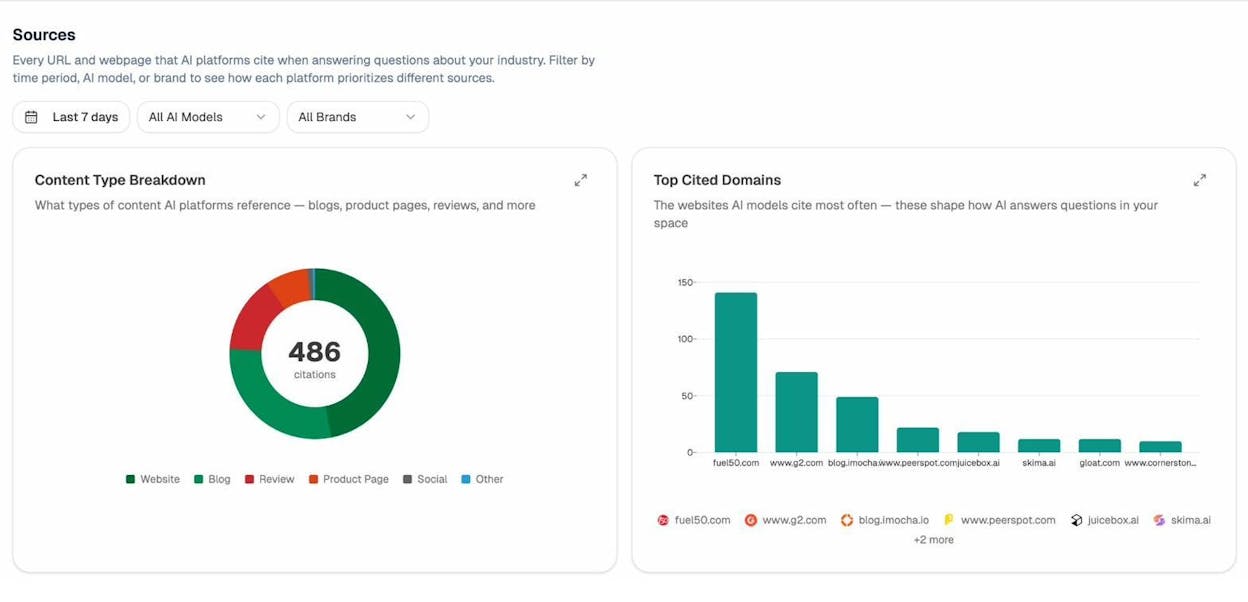
The Sources view shows which of your URLs are being cited by AI models, broken down by content type (blog, product page, review, etc.) and by domain. This helps you understand what type of content AI models prefer to cite in your industry.
Report outcomes, not activities
When you present OKR progress to leadership, lead with outcomes. “We published 30 articles” is an activity. “We published 30 articles, which generated 12,000 new organic sessions and $45,000 in attributed pipeline” is an outcome.
The same principle applies to AI search. “We set up prompt tracking” is an activity. “We tracked 20 prompts and discovered that our brand appears in only 35% of AI responses while our top competitor appears in 72%, so we are creating content to close that gap” is an outcome that drives the next action.
Common Mistakes When Setting SEO OKRs
Setting OKRs that are too vague
“Improve SEO performance” is not an OKR. It is a wish. Every objective needs a specific outcome, and every key result needs a number and a deadline. If you cannot tell whether the OKR was achieved at the end of the quarter, it was too vague.
Confusing KPIs with OKRs
KPIs are ongoing metrics you monitor continuously, like organic traffic, bounce rate, or domain authority. OKRs are time-bound goals that drive a specific change. “Maintain organic traffic above 100K sessions per month” is a KPI. “Increase organic traffic from 100K to 130K sessions per month by end of Q3” is an OKR.
Both are useful. They serve different purposes. Do not mix them up.
Ignoring AI search entirely
Most SEO OKR frameworks published today focus exclusively on traditional search. That was fine in 2023. It is not fine in 2026. AI search engines now handle a meaningful share of discovery queries, and that share is growing. If your OKRs do not include AI visibility, you are planning for half the battlefield.
You do not need to overhaul your entire OKR framework to account for AI search. Start with one objective and two to three key results. Track your brand’s visibility in AI responses, measure the traffic those responses send to your site, and compare your performance to competitors. That is enough to get started.
Setting OKRs in isolation
SEO does not happen in a vacuum. Content OKRs depend on writers and editors. Technical OKRs depend on developers. Link building OKRs depend on PR and partnerships. If you set OKRs without involving those teams, you will miss your targets because you do not control all the inputs.
The fix is simple. Share your OKRs with every team that touches SEO. Get their input on whether the key results are realistic given their capacity. And make sure they understand how their work contributes to the objective.
Chasing vanity metrics
A 200% increase in organic traffic sounds impressive until you find out it was all branded traffic from a PR campaign that would have happened anyway. Or it was all informational traffic with no commercial intent.
The best SEO OKRs connect to revenue, pipeline, or qualified demand. Traffic and rankings are means to an end, not the end itself.
Final Thoughts
SEO OKRs work when they are specific, measurable, and aligned with what the business actually cares about. They fail when they are vague, disconnected from revenue, or set in isolation from the teams that do the work.
The biggest opportunity most teams are missing is AI search. It is not a replacement for traditional SEO. It is an additional channel that rewards the same fundamentals: clear content, strong authority, and a brand worth mentioning. The teams that include AI search visibility in their OKRs today will compound their advantage over the next two to three years.
If you want to start tracking your brand’s AI search performance, Analyze AI makes it straightforward. Set up prompt tracking, monitor your visibility and sentiment across AI platforms, measure AI-referred traffic, and turn those insights into OKRs that drive real results.

Ernest

Ibrahim


