



Summarize this blog post with:


In this article, you’ll get the real answer to “how long should a blog post be,” what 8 different studies actually found, why “longer is better” is mostly wrong, how AI search has changed the math, and a 4-step framework for deciding the right length for any post you sit down to write.
Table of Contents
The short answer (in one table)
Across the studies that get cited in every “how long should a blog post be” article, three patterns hold up.
|
Study |
Sample |
Finding |
|---|---|---|
|
Backlinko |
11.8M Google results |
First-page average is 1,447 words |
|
Orbit Media |
Annual blogger survey |
Average post length is 1,427 words and rising |
|
Semrush |
Content Trends Report |
Top-performing posts average 1,152 words. Low-performing posts average 668 |
|
Backlinko + BuzzSumo |
912M posts |
Posts above 3,000 words earn 77% more backlinks than posts under 1,000 |
|
HubSpot |
Internal data |
2,100 to 2,400 words is the sweet spot for SEO traffic |
|
Ahrefs (AI Overviews) |
174,048 cited pages |
Average is 1,282 words. 53.4% of citations went to pages under 1,000 words |
|
Dan Petrovic (Google grounding) |
7,000+ queries |
Grounding plateaus at ~540 words. Pages over 2,000 words show diminishing returns |
|
Sumo |
Reading behavior data |
Only 20% of readers finish an article. Average reader gets through 25% |
Two things jump out.
First, every study about traditional Google SEO points to a band of 1,400 to 2,400 words for high-ranking pages. That is the number most marketers anchor on.
Second, the moment you study AI search, the data shifts. AI Overview citations average 1,282 words. More than half of all citations go to pages under 1,000 words. The correlation between word count and citation position is 0.04, which is mathematically zero.
The conclusion you should walk away with is simple. Write for the topic, not the number. And if AI search matters to your business (and at this point, it does), do not assume the SEO playbook still applies on length.
Why people think long blog posts are better for SEO
Three arguments come up over and over. Each has data behind it. Each falls apart under scrutiny.
Myth 1: Longer content gets more backlinks
This one is partly true. The Backlinko and BuzzSumo joint analysis of 912 million posts showed that content over 3,000 words earns 77% more backlinks than content under 1,000.
But the correlation has a ceiling. Ahrefs ran the same analysis on its Content Explorer dataset and found that average backlinks per post climb until around 1,000 words, then start to drop again.
Why?
Longer posts tend to include more “link-worthy” hooks. Original research, bold claims, useful frameworks. They also bury those hooks under so much filler that fewer readers ever reach them. A 3-hour read does not get linked to. A reader who never finishes your post never quotes you.
What to do instead. Find what made past content link-worthy and reverse-engineer it. Look at the top-ranking page for your target keyword. Pull its backlinks. Read the anchor text and the surrounding sentences.
If half the backlinks point to one specific stat, framework, or quote on the page, you know what made it linkable. Replicate that part. Skip the filler around it.
![[Screenshot: backlink anchor text analysis showing patterns in what gets linked from a top-ranking post]](https://www.datocms-assets.com/164164/1777799991-blobid1.png?auto=format,compress&w=1248&fit=max)
This same approach works one level higher. Use a backlink audit to spot patterns in what gets linked across an entire competitor site. We cover the wider technique in the link building tools breakdown.
Myth 2: Longer content gets more organic traffic
The Backlinko study of 11.8 million results put the average first-page Google result at 1,447 words. Semrush followed with a different cut and reported that top-performing posts average 1,152 words while low-performing posts average 668.
The instinct is to read this as “Google rewards length.” It does not.
Google’s John Mueller has stated outright that word count is not a ranking factor. The reason long posts correlate with more traffic is that long posts tend to cover more subtopics. That coverage helps a single page rank for hundreds of related long-tail keywords instead of one.
A page that covers Google search operators in detail will rank for “google inurl operator” and “google filetype operator” and “google cache search” all at once. A 600-word version of the same page covers fewer operators and ranks for fewer terms.
The lesson is not “write longer.” The lesson is “cover the subtopics that matter.”
What to do instead. Before you write, run two checks.
The first is a competitor pass. Pull the top 5 to 10 ranking pages for your keyword and skim their headings. Anything that shows up in 4 of 5 pages is table stakes. You have to cover it. Use our free SERP Checker and Keyword Difficulty Checker to see the SERP layout without leaving the browser.
![[Screenshot: SERP Checker showing the top 10 results for a sample target keyword, with titles and URLs visible]](https://www.datocms-assets.com/164164/1777800003-blobid2.png?auto=format,compress&w=1248&fit=max)
The second is a subtopic pass. Use a keyword research tool to surface every related question and term. Cluster them. Anything with meaningful search volume that none of the top pages covers becomes your differentiator. We wrote a full breakdown of the technique in the keyword clustering guide.
![[Screenshot: Keyword cluster output showing primary keyword grouped with secondary keywords and related questions]](https://www.datocms-assets.com/164164/1777800009-blobid3.png?auto=format,compress&w=1248&fit=max)
Myth 3: Longer content gets more social shares
Backlinko’s older social shares analysis showed posts of 3,000+ words earning 11.07 average shares versus 3.47 for posts under 1,000.
But a separate study found that 59% of people share articles without clicking on them first. That means social share counts are partly a measure of how impressive your headline and hero image look in a feed, not how thorough your content is.
This one is mostly a wash. Treat shares as a soft signal and move on.
The new wrinkle: AI search rewards different lengths than Google
Here is where the conversation has moved over the last 18 months.
Ahrefs analyzed 174,048 pages cited in Google’s AI Overviews. The average word count was 1,282 words. More than half of all citations went to pages under 1,000 words. The correlation between word count and citation position was 0.04, which is mathematically the same as no correlation at all.
A separate study by Dan Petrovic on Google’s grounding behavior reached the same conclusion from a different angle. Grounding effectiveness plateaus at around 540 words. Pages over 2,000 words show diminishing returns. His exact phrasing was direct. Density beats length.
What this means in practice is that if you write a 3,000-word ultimate guide for a topic AI search has already started answering for users, you are over-investing on length and under-investing on density. The model wants the answer near the top, in clear language, with structure it can parse. Not your full keyword research notes from week one of the project.
This does not mean SEO is dead, and it does not mean every post should be 800 words. The Analyze AI manifesto is clear on this point. AI search is an additional organic channel, not a replacement for Google. Quality content still wins. The brands that show up in AI answers are the ones with clear, original, and useful content. The shift is that your content now has to work for AI models too.
What that looks like at the keyboard:
-
Lead with the answer. Bury the lede and the model will skip you.
-
Use clean H2s that mirror how a person would phrase a sub-question.
-
Cut the long preamble. The first 500 to 1,000 words carry most of the weight.
-
Keep the rest only if it adds genuine information gain.
The fastest way to know whether your length is working in AI search is to look at your own data. Pull every page on your site that already gets cited or linked by ChatGPT, Perplexity, Gemini, or Copilot. Note the word count. Find the median. That is your floor for that topic.
Analyze AI’s AI Traffic Analytics shows you exactly which of your pages are pulling AI referrals and which prompts drive them.
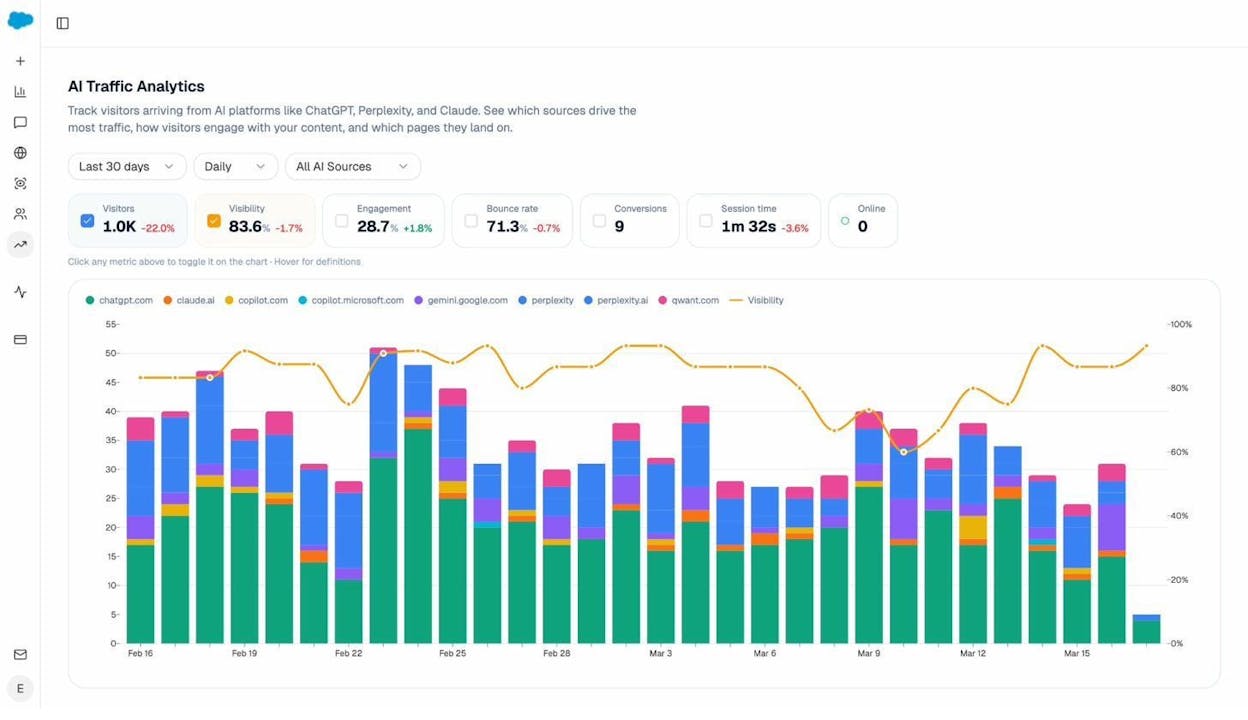
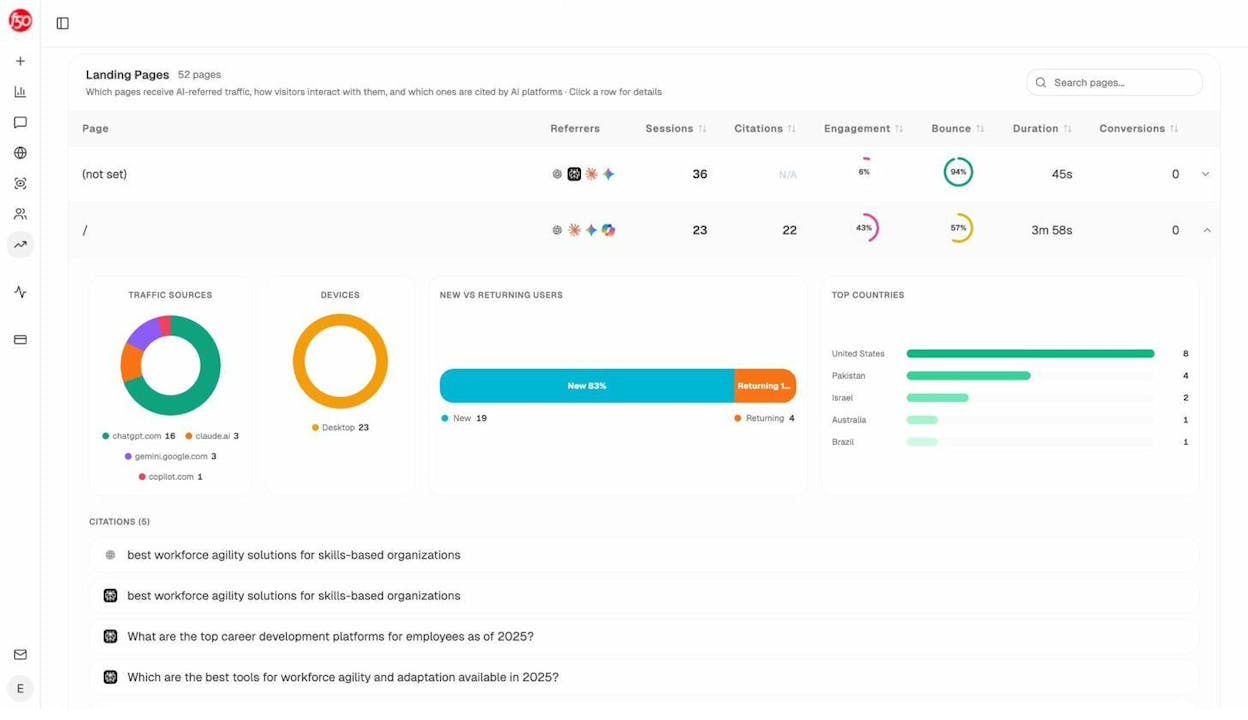
When you click into a page, you see the prompts that cite it, which engines link to it, and how visitors behave once they land. The pages that earn AI traffic at high volume are your living evidence of what length and structure work for your space.
Citation analytics adds another layer. The Citation Analytics feature shows the URLs and domains AI engines cite in your space. You can see which page lengths your competitors are getting picked up at and pattern-match to that.
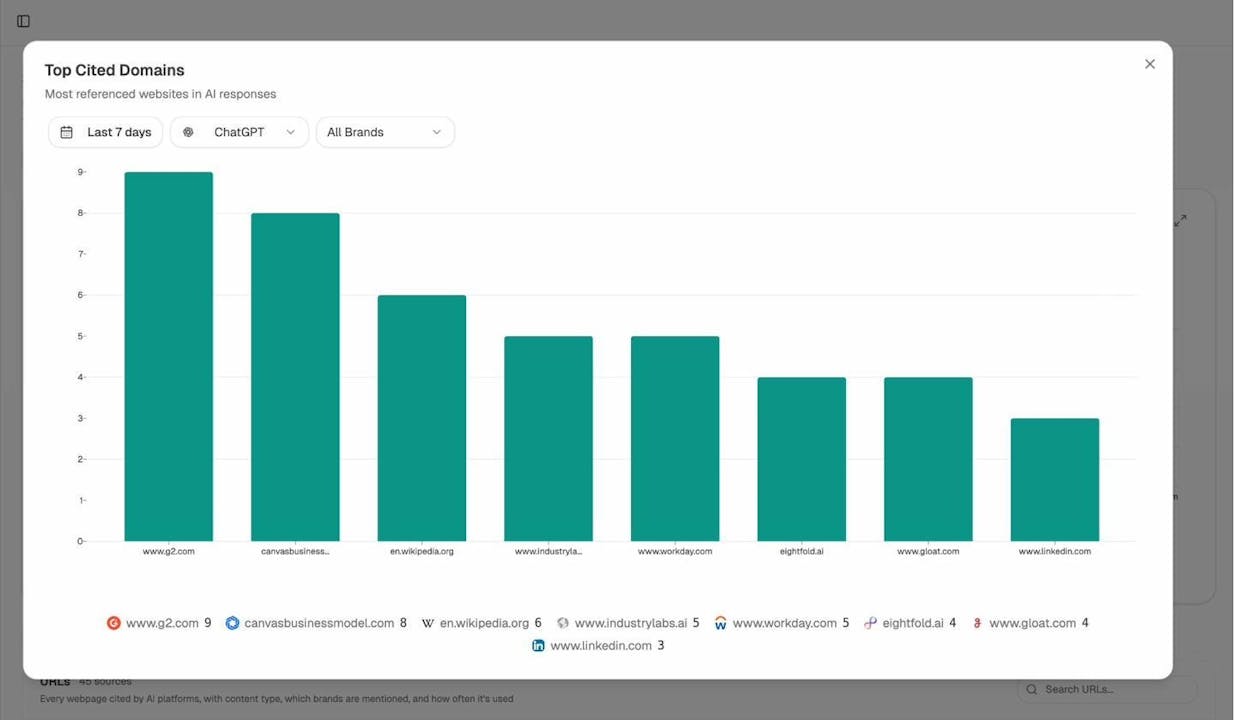
If your competitors get cited at 800 words and you keep publishing 3,500-word guides, the data is telling you something specific. Density wins.
How to actually decide blog post length
The four steps below give you a defensible answer for any post you write.
Step 1: Match length to search intent
Different intents earn different lengths. The table below covers the formats you will write most often.
|
Content type |
Recommended length |
Why |
|---|---|---|
|
Quick definition or “what is X” |
400–800 words |
Reader wants a short answer. Filler hurts |
|
News update |
400–800 words |
Currency matters more than depth |
|
Listicle |
1,000–2,000 words |
Each item needs context. Too many items dilutes value |
|
How-to guide |
1,500–2,500 words |
Step-by-step needs space, but every step earns its place |
|
Comparison or “X vs Y” |
1,500–2,500 words |
Side-by-side analysis benefits from a table plus prose |
|
Ultimate guide / pillar page |
3,000–5,000+ words |
Only when the topic genuinely spans many subtopics |
|
Original research / case study |
2,000–4,000 words |
Data, methodology, and takeaways earn the length |
These are starting ranges. The deciding factor is intent, which you can read directly from the SERP.
Step 2: Study the SERP and the AI answer side by side
Open a private browser window. Search your target keyword. Read the top 10 results.
Ask three questions.
-
What is the dominant format? If 7 of 10 results are listicles, the searcher wants a list. Do not write a 4,000-word essay.
-
What is the median word count? Aim for ±20% of that. If the top 10 average 1,200 words, you are looking at a target of 960 to 1,440. Going much higher rarely helps.
-
Does the SERP show an AI Overview or AI summary? If yes, look at which sources it cites and how it phrases the answer. The AI Overview is showing you, in real time, what Google’s model thinks the top 2 to 3 sentences on this topic look like.
For the second question, the free SERP Checker and Keyword Rank Checker handle this without forcing you to install anything.
![[Screenshot: SERP Checker showing the top 10 SERP results for a sample keyword with title, URL, and meta description visible for each]](https://www.datocms-assets.com/164164/1777800026-blobid7.png?auto=format,compress&w=1248&fit=max)
Step 3: Pressure-test against AI search behavior
This step is new. It did not exist in the SEO playbook five years ago, and it is the most useful addition to a length decision today.
Run the question your post will answer through ChatGPT, Perplexity, and Gemini. Read the response. Note three things.
-
Does the AI answer the question fully in 200 words? If yes, anyone searching has likely already gotten their answer from the AI. The reader who still clicks through to your post wants something deeper than that 200-word summary. A step-by-step. A personal angle. Original data. A tool. Length should serve that depth, not pad it.
-
Which sources does the AI cite? Open them. Read them. What is their average word count? That number is more predictive than the SERP average for AI visibility on your topic.
-
Are the cited pages structured the same way? If every cited source uses an H2 followed by a bullet list in the first 500 words, that is the pattern AI prefers for that topic.
You can do this manually. You can also do it inside Analyze AI’s Ad Hoc Prompt Searches, which runs a single prompt across multiple engines at once and shows you the cited URLs in one view.
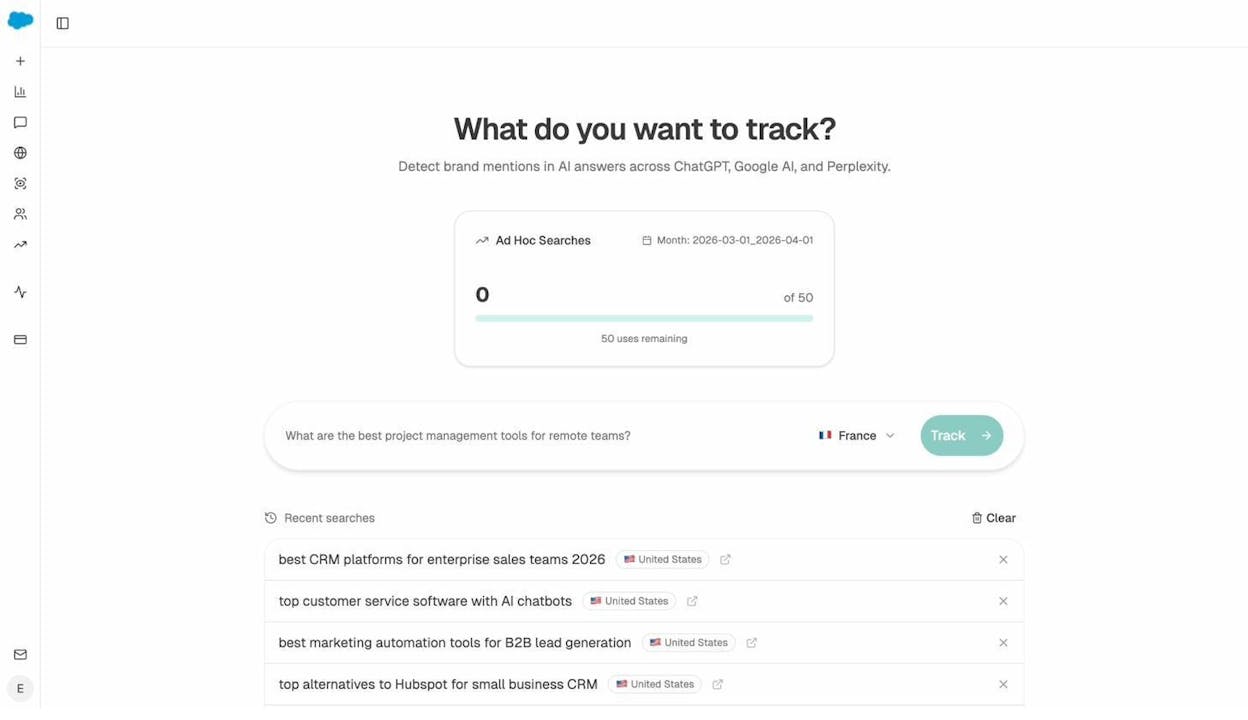
The Prompt Discovery feature goes further. It surfaces the prompts your buyers are actually running in AI search around your topic, so the queries you pressure-test are the ones that matter for your pipeline rather than the ones you guessed at.
This is also where Competitor Intelligence earns its keep. If three of your competitors get cited for a prompt and you do not, you can see the cited pages, their word count, and their structure. Then you decide whether you need a 1,200-word post or a 3,000-word one to compete.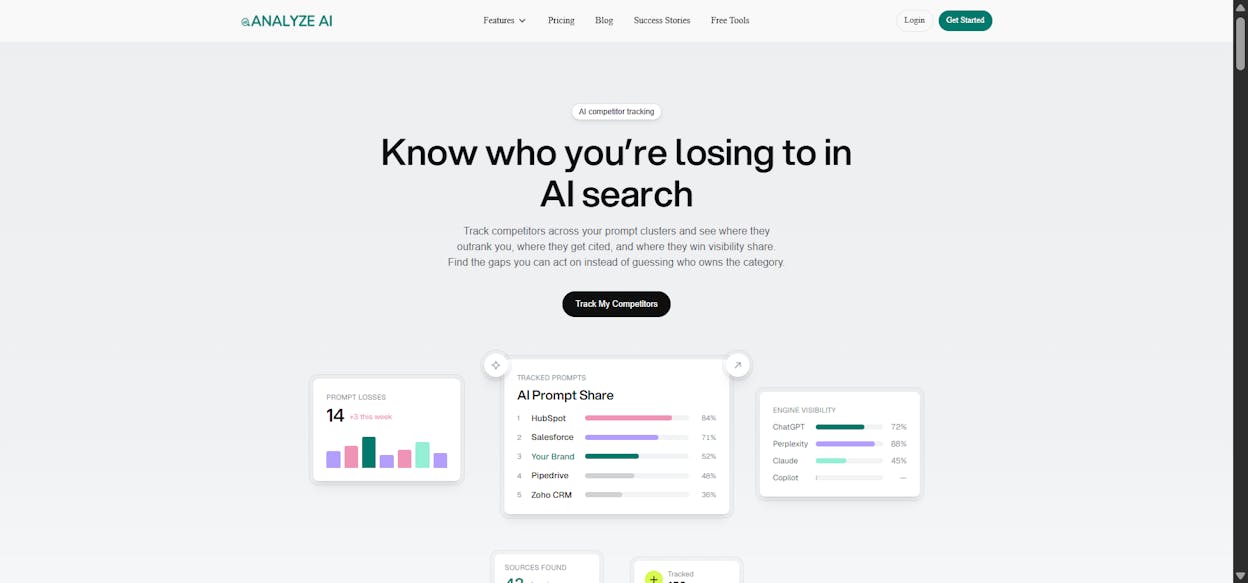
Step 4: Audit what you have already published
Before you write the next post, audit the last 20 you published. Three numbers tell you most of what you need.
-
The current word count
-
The current ranking and AI citation status
-
The content score
If a post is 4,500 words and ranks #14, length is not the problem. Probably it is intent match, structure, or topical depth. If a post is 600 words and ranks #2 but never gets cited in AI Overviews, length might be working for SEO but failing for AI visibility.
Analyze AI’s Content Optimizer handles this audit. Paste a URL and it pulls the page, scores it on Argument & Flow plus Clarity & Polish, and surfaces the gaps.
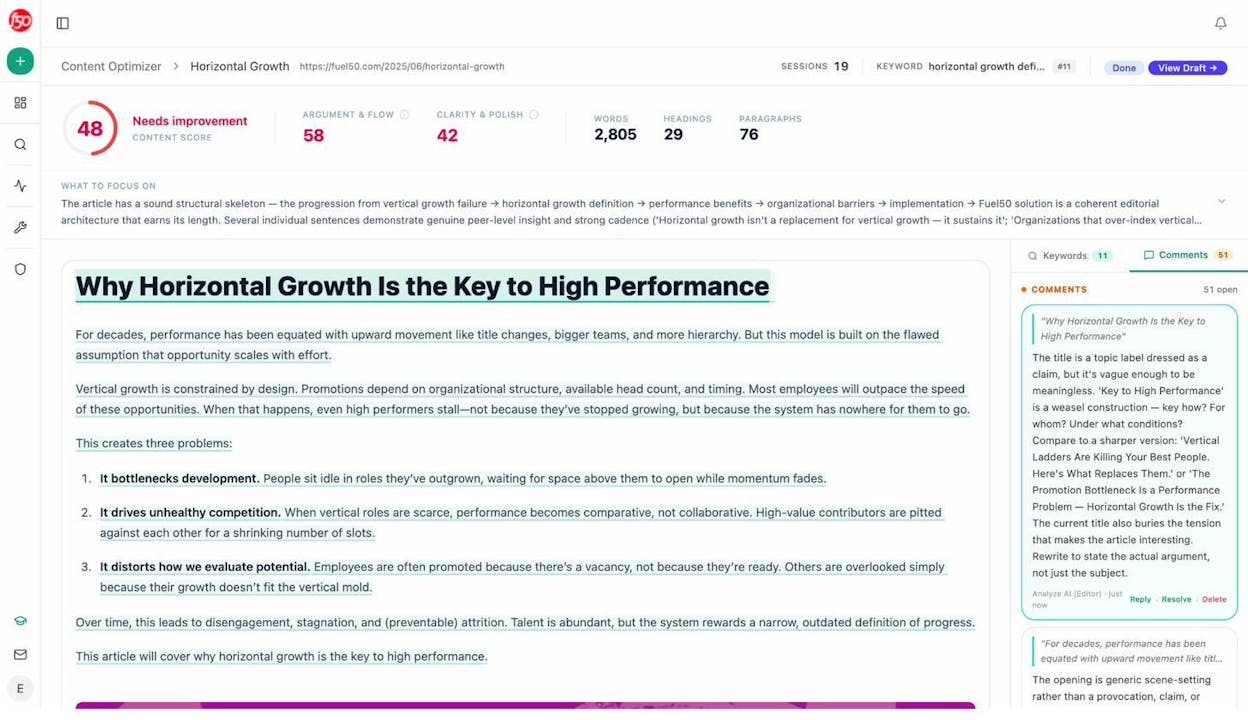
You see word count, heading count, and paragraph count next to a content score. The editorial comments call out specific places where the post is too dense, too thin, or too off-topic. The output is a prioritized list of edits, not a generic “write more” recommendation.
For a wider view of the audit process across an entire blog, the SEO content strategy guide walks through how to combine length, intent, and gap analysis into a single quarterly plan.
How to cut fluff from your posts
Decisions on length are upstream. Cutting fluff is downstream. Both matter.
A few practices we use on every post that goes live.
Read it aloud. If you cannot get through a paragraph without losing the thread, the reader will not either. Cut whatever paragraph made you stumble.
Run it through Hemingway. Hemingway Editor flags long sentences, passive voice, and dense words. In our experience, you can cut 10 to 15% of any first draft without losing meaning.
Get a second pair of eyes. Other people are better at spotting filler than the person who wrote it. We do this for every post, including this one.
Score the draft. Run the draft through the Content Optimizer before publishing. The Argument & Flow and Clarity & Polish scores catch what your editor might miss, particularly around structure, transitions, and density.
Check the per-section word count. If any section runs past 400 words, ask whether it deserves its own post. Often the answer is yes, and you have just discovered a second piece of content for free.
Beyond fluff, longer posts also have a discoverability problem. Sumo’s reading data found that only 20% of readers finish an article. The average reader gets through 25%. Medium’s analysis of post length and engagement showed that engagement starts dropping for posts longer than a 7-minute read, which is roughly 1,750 words.
Reading behavior tells you that whatever sits after the 1,750-word mark needs to earn its keep harder than the first 1,750.
Final thoughts
The honest answer to “how long should blog posts be” is this. Long enough to fully cover the topic. Short enough that no sentence is filler.
Length follows intent. Intent comes from the SERP, from the AI answer, and from your reader’s job-to-be-done. Word count is a result, not a target.
If you take three things from this post:
-
The SEO sweet spot for most posts is 1,400 to 2,400 words, but that range is a starting point, not a rule.
-
AI search rewards density over length. Pages under 1,000 words win more than half of all AI Overview citations. Lead with the answer.
-
Audit before you write. Look at what is already ranking, what is already getting cited, and what your existing content looks like before deciding the length of the next post.
For a deeper read on how length connects to topical depth and pillar structure, the 4 pillars of SEO strategy for AI search guide is a good next step. If you are starting from scratch with keyword and topic research, the SEO keywords guide is the right place to land.

Ernest

Ibrahim


