



Summarize this blog post with:


A blog title is a one-line argument for why your post deserves attention. Get it right and traffic compounds. Get it wrong and the rest of your work goes unread.
In this article, you’ll learn the seven blog title formulas that consistently earn clicks on Google and citations in AI answers. You’ll also get a simple framework for choosing the right formula, the SEO checks that keep your titles out of the truncation pile, and a workflow for validating a title in AI search before you hit publish.
Table of Contents
What makes a great blog title
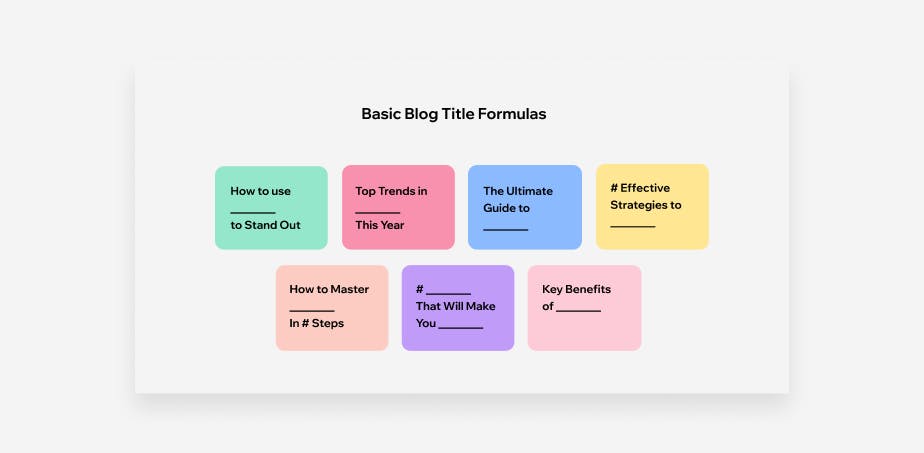
Every strong blog title satisfies four criteria.
1. It contains the target keyword. This signals relevance to Google and to the language models that crawl your page. Drop the exact phrase you want to rank for into the title in a way that reads naturally. If the keyword is awkward, use a close variation. For “best CRM software for small business,” a title like “The Best CRM Software for Small Businesses (2026 Picks)” works.
2. It promises a specific outcome. A reader scans a SERP for the title that answers their question most directly. “How to Reduce Bounce Rate” is fine. “How to Cut Your Bounce Rate in Half (Without Touching Your Site Speed)” tells the reader exactly what they get and why this version is different.
3. It has a unique angle. If the top ten results all use the same framing, yours has to break the pattern. The point is not to be clever. The point is to give a searcher one good reason to click your result over the nine others that look identical.
4. It names the entity clearly. This is the criterion most title guides skip, and it matters more every quarter. Large language models cite sources whose titles unambiguously match the question being asked. A title like “Our Take on the New Marketing Playbook” is meaningless to an LLM. “B2B SaaS Content Marketing Strategy: A 2026 Framework” tells both Google and ChatGPT what entity, topic, and time frame the page covers. Clear entity naming is the cheapest way to earn citations in AI answers.
The formula is Keyword + Outcome + Angle + Entity Clarity = Title that earns clicks and citations.
The 7 blog title formulas that get clicks
These seven formulas account for the majority of blog titles ranking on the first page of Google and appearing as cited sources in ChatGPT, Perplexity, Claude, and Gemini answers.
1. The list post
Numbers anchor a promise. A reader sees “11 Tactics” and knows the scope, the format, and the time investment before clicking. Numbered lists also map well to the way LLMs structure answers, which makes them frequent citation candidates when a model needs to enumerate options.
Examples
-
9 Cold Email Templates That Booked 200+ Meetings
-
14 Free Tools Every Solo Marketer Should Use
-
7 SaaS Onboarding Flows We Studied (And What We Learned)
Use odd numbers when you can. They feel more specific and tend to outperform round numbers in click-through testing.
2. The how-to title
The how-to is the workhorse of search. It works because it matches the structure of a question. Your job is to make the promise specific enough to stand out.
Examples
-
How to Run a Customer Interview That Actually Tells You Something
-
How to Migrate from HubSpot to Salesforce Without Losing Data
-
How to Write a Cold DM That Gets Replies (From Someone Who Sent 5,000)
Add proof or a constraint in parentheses when the topic is competitive. Proof signals you have done the work. A constraint signals you respect the reader’s situation.
3. The “what / why / how” question title

When a searcher types a question into Google, they often click the result that mirrors their phrasing. Same with AI search. If a user asks ChatGPT “what is server-side tracking,” the model is more likely to cite a page titled “What Is Server-Side Tracking?” than one titled “Modern Tag Management.”
Examples
-
What Is Programmatic SEO? (And When to Use It)
-
Why Does My Email Land in Promotions? 6 Causes and Fixes
-
How Does Stripe Verify Card Information?
This formula is your default for any informational query.
4. The versus title
Comparison searches are decision-stage searches. Someone typing “Notion vs Coda” is not curious. They are about to buy. The versus title meets that intent head on.
Examples
-
Notion vs Coda: Which Wins for a Small Product Team?
-
ConvertKit vs Beehiiv vs Substack: Which Should a New Newsletter Pick?
-
Webflow vs Framer for Marketing Sites in 2026
If your post compares more than two options, name them all in the title. Searchers add tools to comparison queries when they recognize the names.
5. The ultimate guide
The ultimate guide promises completeness. It tells the reader they will not need to open a second tab. The risk is that “ultimate” has been overused to the point of cliche, so the title needs a hook that earns the claim.
Examples
-
The Ultimate Guide to Lifecycle Email (With 22 Examples)
-
The Complete Guide to Schema Markup for Local Businesses
-
The Founder’s Guide to Hiring Your First Marketer
Replace “ultimate” with “complete,” “definitive,” or “founder’s” depending on the audience. The reader is buying the promise of comprehensiveness, not the specific adjective.
6. The contrarian title
A contrarian title pushes back on a belief the reader holds. It works because curiosity beats agreement. The reader has to click to find out if you are right.
Examples
-
Why Most A/B Tests Are a Waste of Time
-
The Case Against Personalized Outreach (And What to Do Instead)
-
Stop Building Personas. Start Building Switch Triggers.
The contrarian formula has one rule. The post has to deliver. If the body of the article walks back the title, you lose trust on first read and the reader does not come back.
7. The direct-answer title
A direct-answer title puts the answer in the title itself. It looks counterintuitive. Why would a reader click if you already gave them the answer? Because most direct answers prompt a follow-up question. “It Takes 4-7 Months to Rank a New Page in Google” is the answer. The reader still wants to know why, and what to do about it.
Examples
-
A Cold Email Open Rate Above 40% Is Possible (Here is How)
-
The Average SaaS Free Trial Converts at 8-12%
-
LinkedIn Posts Get 3x More Reach With Native Video
Direct-answer titles also do well in AI search, because LLMs frequently cite pages whose titles state a finding the model is summarizing.
How to choose which formula to use
The Ahrefs version of this advice is “look at the SERPs.” That is correct but incomplete. The SERP only tells you what works for Google. AI search has its own patterns, and a title that ranks in Google can be invisible in ChatGPT.
Use this three-step check before committing to a formula.
Step 1. Look at the top ten Google results for your keyword.
Run your keyword through the SERP Checker and note the dominant format. If eight of ten results are listicles, that is the format searchers are clicking on. Match it. If results are mixed, check which format the highest-traffic page uses, since traffic is a stronger signal than ranking position alone.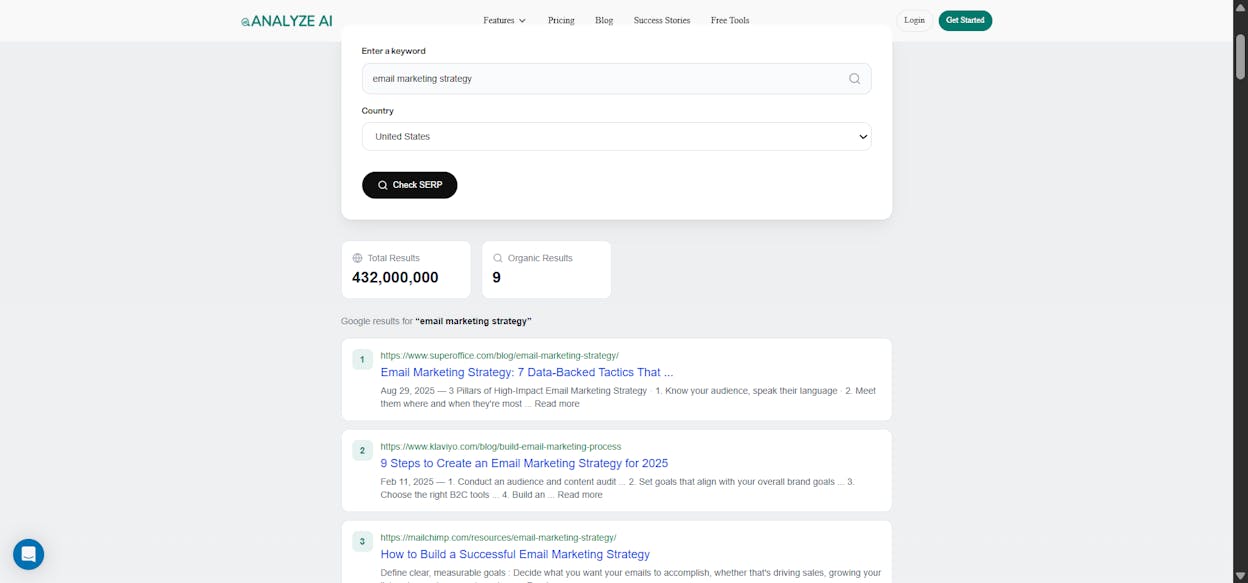
![[Screenshot: SERP Checker results page showing the top ten results for a sample keyword with their formats highlighted.]](https://www.datocms-assets.com/164164/1777769004-blobid4.png?auto=format,compress&w=1248&fit=max)
Step 2. Run the topic as a prompt against AI engines.
Open the Ad Hoc Prompt Searches feature in Analyze AI and run the buyer-intent version of your keyword. For “best CRM software,” try “What is the best CRM software for a 20-person sales team?” The tool returns the answer ChatGPT, Gemini, Perplexity, and Copilot give, plus the URLs each one cited.
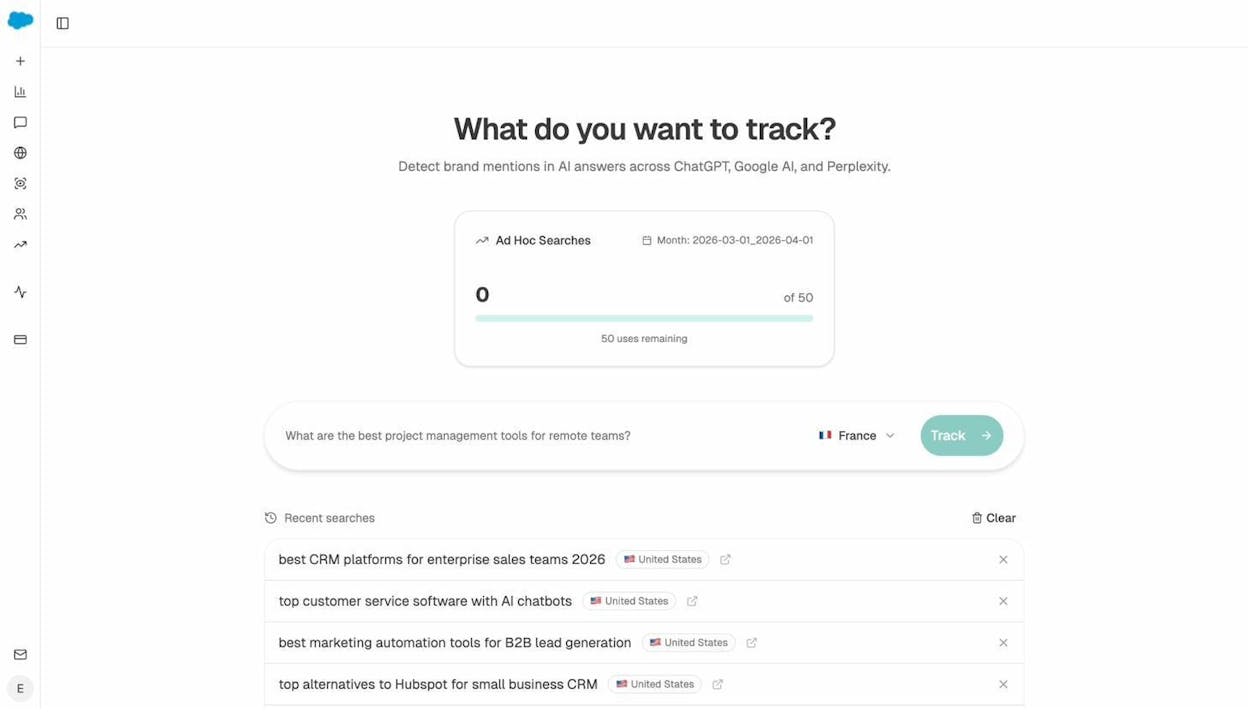
The cited URLs are your real competition in AI search. Open them and note the title formula each uses. If most cited pages use the listicle format, your title should too. If cited pages use direct-answer titles, that signals the model is rewarding pages that state findings up front.
Step 3. Cross-check against the prompts your audience actually asks.
Suggested Prompts in Analyze AI surfaces the prompts being asked in your category that you are not yet tracking. These prompts are uncovered demand. If three of the suggested prompts are framed as “best X for Y,” that is your signal that the buyer-intent versus listicle format will pull in real traffic, not just rankings.
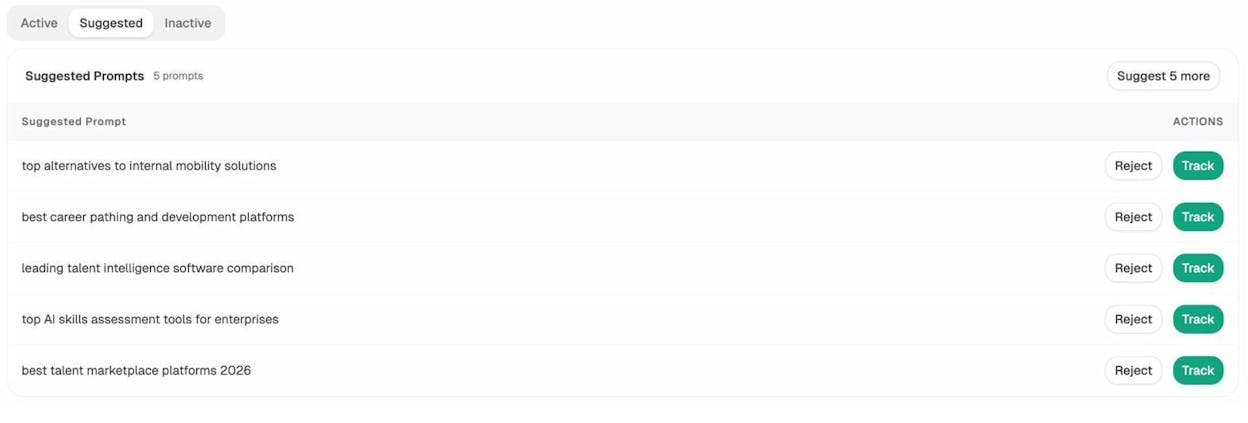
This three-step process replaces guesswork with two data sources. You see what works on Google and what gets cited in AI answers, then you pick the formula that satisfies both.
How to SEO your blog titles
A clickable title that no one finds is wasted effort. These four optimizations make sure your title can rank.
Match search intent
Search intent is the why behind the query. The format you chose in the previous section already aligns with intent. The remaining work is angle. Look at how top-ranking titles frame the value, and align yours with the same outcome.
If results for “SEO tips” emphasize traffic growth, your angle should be traffic. If results for “email marketing” emphasize conversion, your angle should be revenue. The dominant angle on the SERP is the proxy for what searchers actually want.
Watch for three angle signals on the SERP:
-
Freshness. Current year in the title means searchers want updated information.
-
Speed. Words like “fast,” “quick,” and “in minutes” mean searchers are looking for shortcuts.
-
Simplicity. Beginner-friendly framing means the audience is new to the topic.
Pick the angle that matches the dominant signal. For more on aligning intent with format, see our breakdown of how to find and use SEO keywords.
Optimize for long-tail variations
Long-tail keywords are less popular variations of your main term. They have lower volume individually, but a title that captures one or two of them can pull in five to ten times the traffic of a title that targets the head term alone.
Here is the workflow:
-
Run your main keyword through the Keyword Generator to surface variations.
-
Sort by volume, then filter for keywords with the same search intent as your main term.
-
Pick the long-tail that adds context without adding length.
For a target of “is SEO worth it,” a useful long-tail is “is SEO worth it for small business.” A title like Is SEO Worth It? The Real Value for Small Business Owners now competes for both queries with one page.
For a deeper walkthrough of finding and clustering long-tails, see our guide on keyword clustering.
Add power words sparingly
Power words trigger emotion. Used well, they raise click-through rate. Used badly, they read as clickbait and hurt trust.
A short list of power words that still feel honest:
-
Proven, tested, real, hidden, overlooked, simple, free, fast, complete
Pick one per title. Two reads as desperate. None reads as flat. The mid point is where titles convert.
For 700+ examples, see OptinMonster’s power word list.
Stay between 50 and 60 characters
Google truncates titles past roughly 60 characters. A truncated title loses the part you spent the most time on, which is usually the angle.
Run your title through any free SERP snippet preview before publishing. If your CMS does not show a live character count, write the title in a plain text editor and check the length there. The cleanest titles fit the limit without abbreviation.
|
Title length |
What happens on the SERP |
|---|---|
|
Under 50 characters |
Sits well in the slot, looks underused |
|
50-60 characters |
Optimal, uses the full slot without truncation |
|
60-70 characters |
Truncated on most queries |
|
Over 70 characters |
Truncated on every query |
If you have older posts, run them through the Free AI Website Audit Tool to find every title past 60 characters at once.
How to make your blog titles work in AI search
Google is one channel. AI search is another. The rules overlap but are not identical, and the titles that win citations in ChatGPT or Perplexity have three properties beyond standard SEO.
They name the entity precisely. “How We Doubled Our Traffic” is not citable. The model has no way to know what “we” or “our” refers to. “How Buffer Doubled Its Blog Traffic in 90 Days” is. Lead with the entity, the action, and the time frame. This is the single biggest lever for AI citations.
They match the structure of common prompts. People ask AI tools things like “what is the best project management tool for remote teams” or “how do I migrate from MailChimp to Klaviyo.” Titles that mirror that phrasing get cited. Titles written in marketing voice get skipped. If your title does not sound like something a human would type into ChatGPT, rewrite it.
They state a finding. AI engines summarize. When the model needs a number, a comparison, or a recommendation, it cites pages that already provide one. A title like “B2B SaaS Email Open Rates Average 22%” is more citable than “Insights From Our Email Benchmark Study.”
To check whether your titles are working in AI search, open AI Traffic Analytics inside Analyze AI and look at the Landing Pages report. It shows every page on your site that has received traffic from ChatGPT, Perplexity, Claude, Gemini, or Copilot, plus the prompts that triggered each visit.
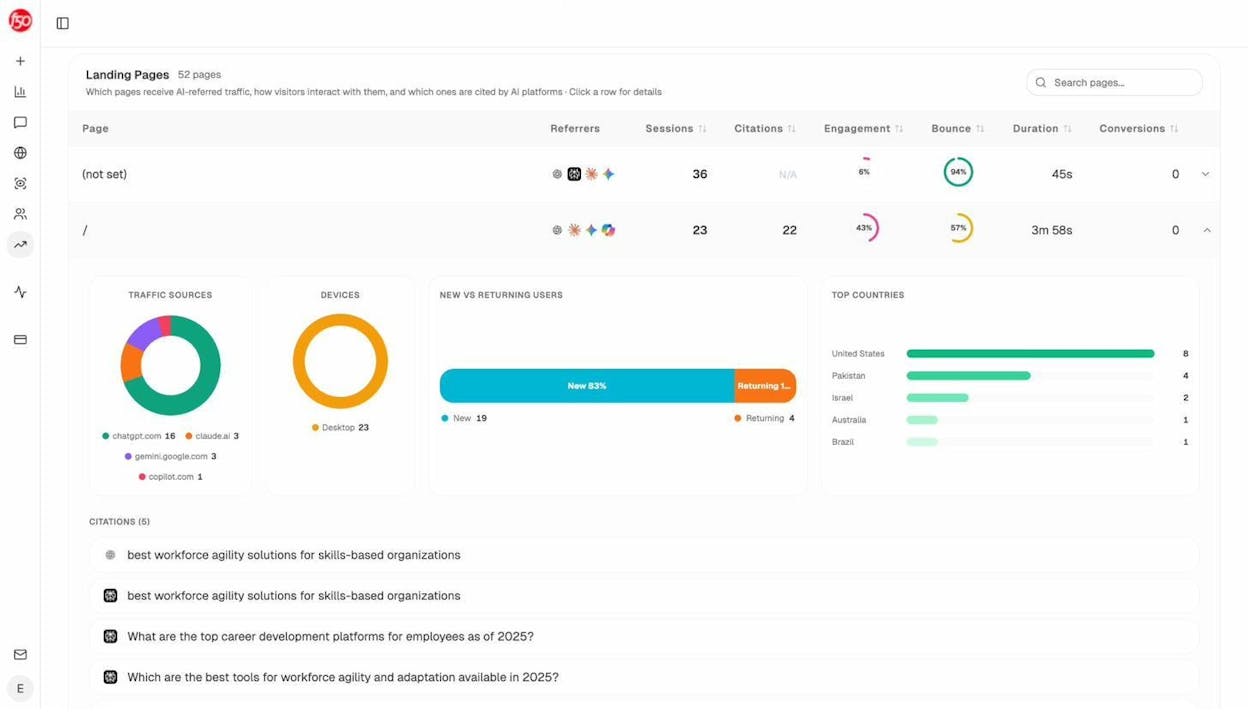
Sort by sessions. The top ten pages tell you which of your titles are already pulling AI traffic. Look for the pattern. If your highest-traffic AI page has a direct-answer title, lean into that format for new posts. If it is a listicle with a year in the title, freshness is doing the heavy lifting.
You can also pull the Sources view to see what types of pages AI engines cite most often in your category. If review-format pages dominate, your next title should signal a review.
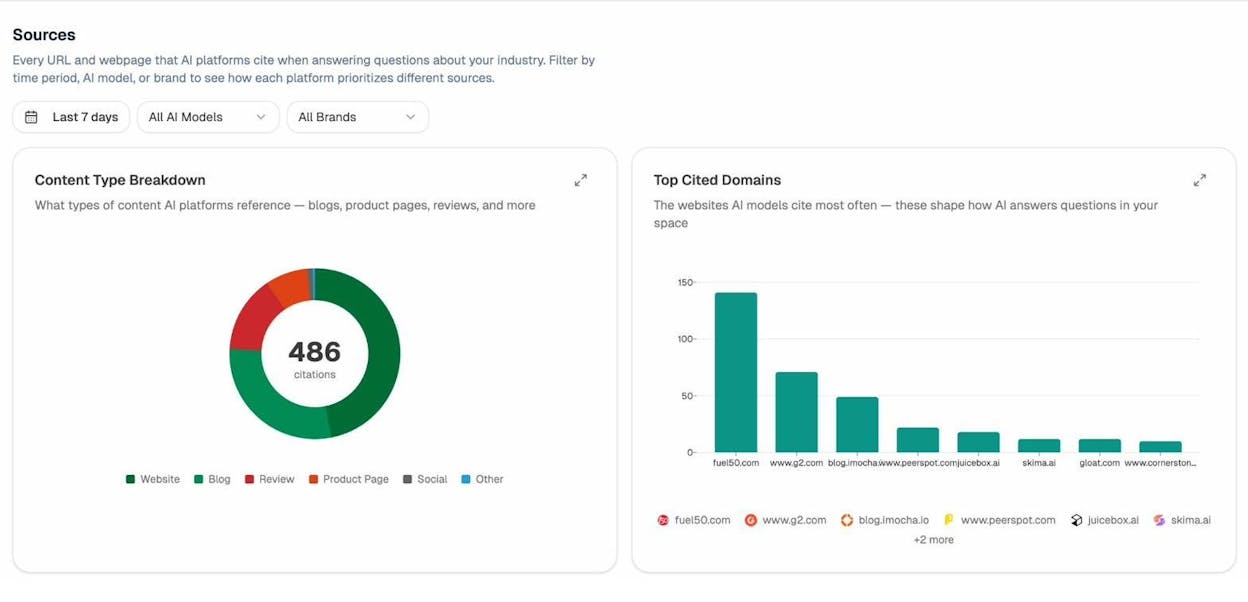
For more on the title patterns that earn citations, see our analysis of how to rank on ChatGPT and how to rank on Perplexity, both based on more than 65,000 citations.
How to validate a title before you publish
Most teams write a title, publish, and hope. The 15 minutes it takes to validate first is the highest-leverage edit you can make.
1. Search the keyword in Google and read the top three titles out loud. If yours sounds like one of them, you do not have an angle yet. Rewrite.
2. Search the buyer-intent prompt in ChatGPT, Perplexity, and Gemini. If your competitors get cited and you do not, your title is not yet working in AI search. Use the citation patterns to adjust.
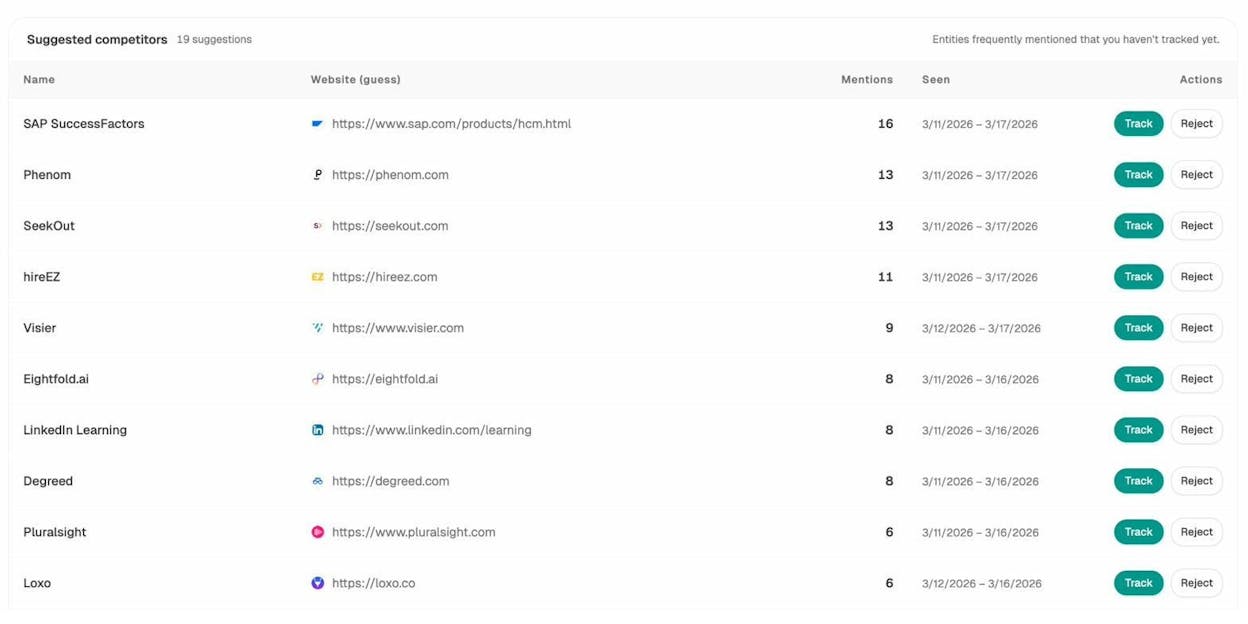
3. Pull your top three competitors into the Competitor Intelligence view. Look at which of their pages get the most AI mentions. Reverse-engineer the title patterns and apply the same structure with a sharper angle.
4. Generate alternates with the Free AI Blog Title Generator. Drop in your keyword and target audience, then pick from the variations. Use this for inspiration, not as the final answer. The best title is usually a hybrid of the version you wrote and one the generator surfaced.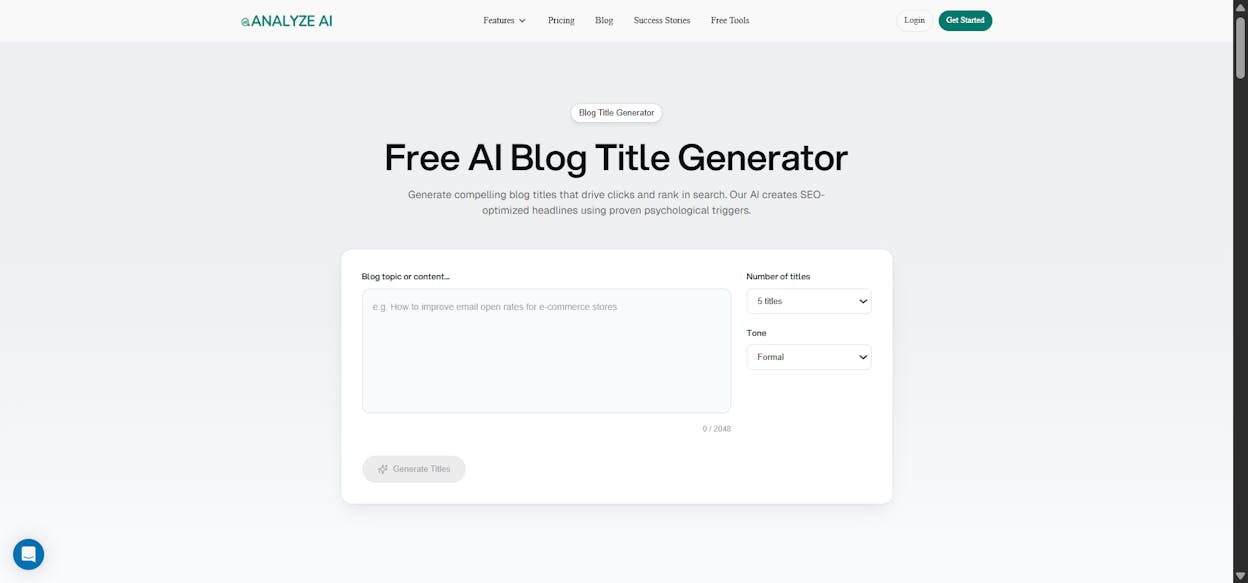
5. Test the strongest two for character count. If one truncates and the other does not, the one that fits wins, even if you prefer the wording of the longer version.
This loop takes 10 to 15 minutes. It cuts the chance of publishing a title that misses both Google and AI search by an order of magnitude.
Final thoughts
A blog title is the only sentence you write that every reader will read. It deserves more thought than the headline you wrote in 30 seconds before sending the post to your editor.
Pick a formula that matches what the SERP and AI engines reward. Make sure the title contains the keyword, names the entity clearly, promises a specific outcome, and offers a unique angle. Validate against Google and AI search before publishing. Do that for every post and your traffic compounds across both channels, not just one.
Ready to keep going? A few related guides worth your time:

Ernest

Ibrahim


