



Summarize this blog post with:


In this article, you’ll see three content strategies that look nothing alike but all work, learn the framework that makes each one defensible, and get a step-by-step process for building your own across both traditional search and AI search.
The companies inside, Zapier, Animalz, and Freshpaint, share almost nothing on the surface. One floods the SERPs with thousands of programmatic pages. One almost ignores SEO and writes essays instead. One serves a niche so narrow most marketers would call it a death sentence. Yet all three are growing.
The reason is that a real content strategy is a set of choices, not a checklist. Once you understand the choices each company is making, you can copy the thinking without copying the playbook.
Table of Contents
A simple framework for content strategy
Most content strategies fall apart because they try to do everything. Three questions, drawn from Richard Rumelt’s Good Strategy, Bad Strategy, force you to pick a lane.
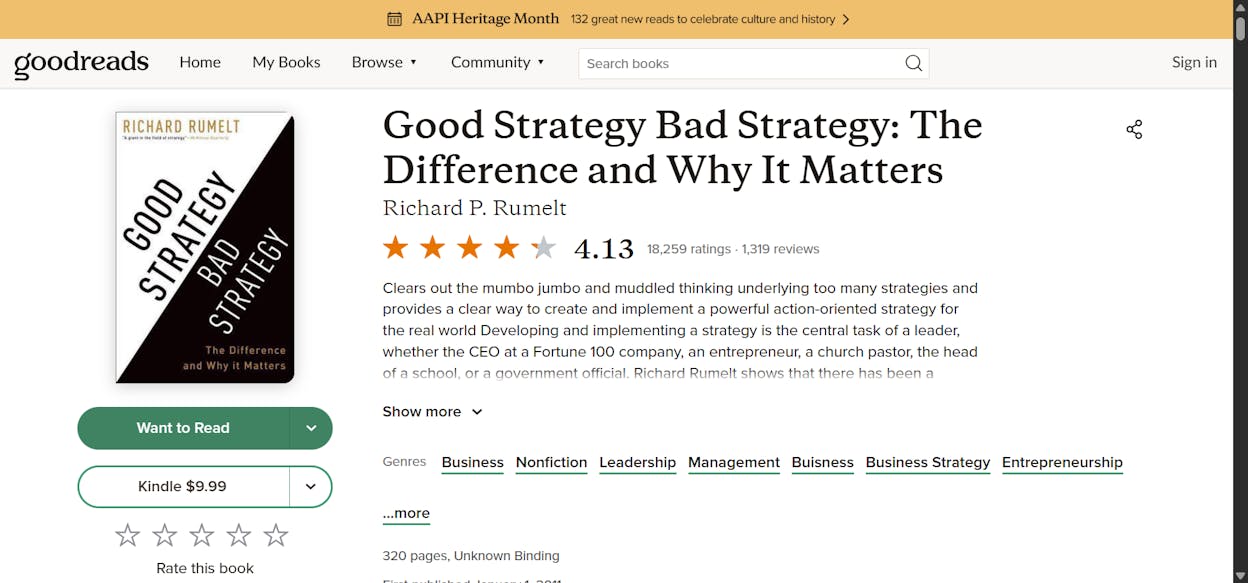
1. What problem are you solving?
Every company says it needs more customers. That is a goal, not a problem. The problem is the bottleneck in the way of the goal. A few real ones.
-
A new SaaS product has no demand because nobody knows the category exists.
-
An agency has plenty of leads but cannot get them past the first sales call.
-
An ecommerce brand has traffic but conversions are flat.
-
A B2B tool has signups but churn after thirty days.
Each of these is a different problem, and each one needs a different kind of content.
2. What advantage do you have?
Strong content strategies are built on something competitors cannot copy. This is your leverage. It can come from anywhere.
-
Proprietary data from your product or your customers.
-
A founder or team member with a real audience.
-
Deep domain expertise that took years to earn.
-
A network of experts willing to contribute.
-
An existing customer base that produces stories worth telling.
Without leverage you are publishing the same content as everyone else. With leverage your content is hard to imitate, which is what makes it durable.
3. What kind of content fits the problem?
Content types are not interchangeable. Each one solves a different kind of problem.
|
Content type |
What it is good at |
Where it falls short |
|---|---|---|
|
Search-optimized articles |
Compounding traffic, predictable demand capture |
Slow start, hard to differentiate |
|
Programmatic pages |
Scaling coverage, capturing long-tail intent |
Easy to look generic, vulnerable to deindexing |
|
Thought leadership |
Backlinks, brand awareness, executive trust |
Spiky traffic, hard to measure |
|
Sales enablement |
Closing deals, objection handling |
Low new-traffic generation |
|
Use-case content |
Educating users, growing accounts |
Mostly bottom-funnel, not for awareness |
Your job is to match the right content type to the problem you picked in question one, then power it with the leverage you found in question two. That is the whole strategy.
Now let’s see what that looks like in practice.
Example 1: Zapier’s organic search and integration play
Zapier is an automation tool that connects apps to each other. Its content strategy is the textbook case of programmatic SEO at scale. The company built tens of thousands of pages targeting two patterns.
The first is “best app” lists, like The best free CRM software or The best AI chatbots. These rank for high-volume comparison queries where the buyer is shortlisting options.
The second is integration pages, one for every pairing of two apps. A user looking for “Notion to Slack integration” lands on a page that explains the workflow and offers Zapier as the connector. With thousands of apps in their ecosystem, Zapier multiplies one template into thousands of indexed URLs.
What problem is Zapier solving?
Zapier is freemium. Most users never pay. To grow, the product needs a constant flood of new users at the top of the funnel so a small percentage convert. Search content gives them that flood, predictably, every month.
The second problem is reach. Zapier serves marketers, sales teams, recruiters, finance, ops, and developers. A single homepage cannot speak to all of them. Programmatic pages can.
What advantage does Zapier have?
Their leverage is the integration list itself. Every new app Zapier supports is a free seed for hundreds of new pages, because each integration creates demand for content explaining how to use it. Competitors cannot copy this without copying the integration roadmap, which would take years.
How does Zapier’s strategy hold up in AI search?
Programmatic SEO is the strategy AI Overviews and ChatGPT have hit hard. Listicles like “best CRM software” are exactly what AI engines summarize. The clicks shrink, but the brand mentions can grow if your content is the source the model pulls from.
Zapier benefits because its integration pages answer extremely specific user intents that LLMs are good at matching. When someone asks ChatGPT “how do I send a Slack message when a Notion page changes,” Zapier’s page reads as a focused, on-topic source for that exact question. The mention is the win, even when there is no click.
If you are running a similar play, you need to track which of your pages are getting cited in AI answers and which prompts trigger them. That is exactly what AI traffic analytics inside Analyze AI surfaces.
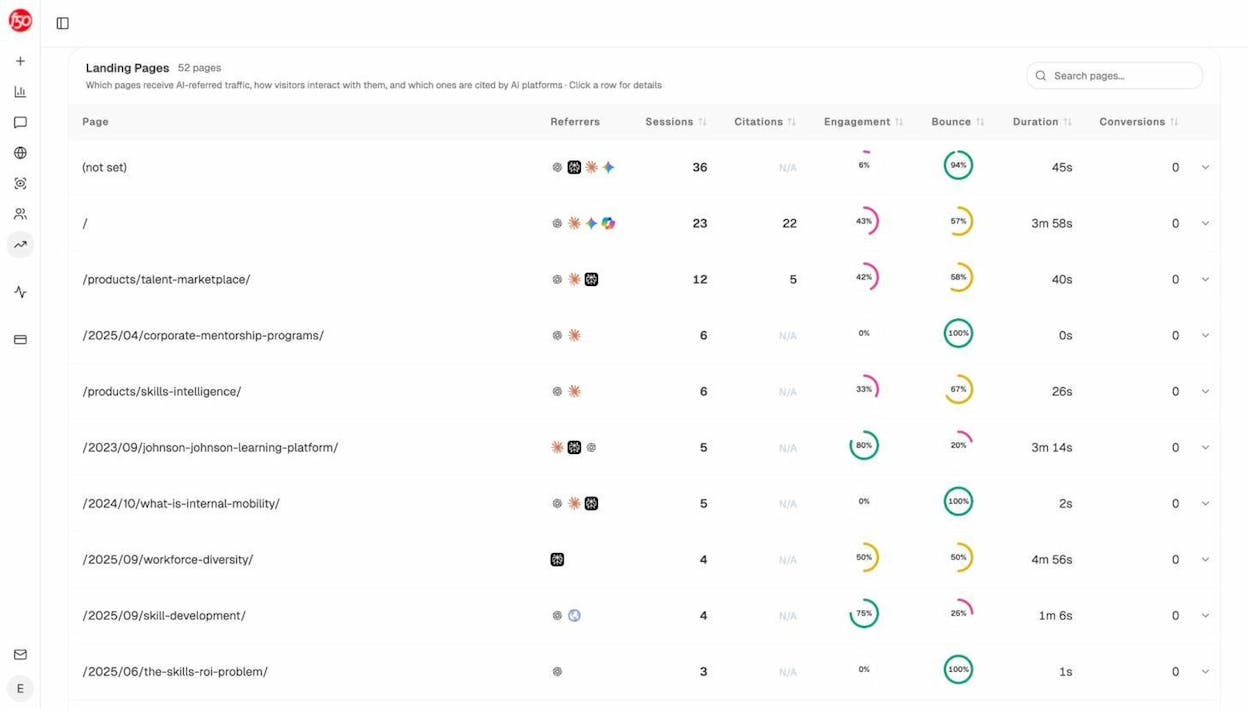
The pages that show up here are your AI search winners. Double down on the templates and topics that are already getting cited, and rewrite the ones that are not.
Example 2: Animalz’s thought leadership play
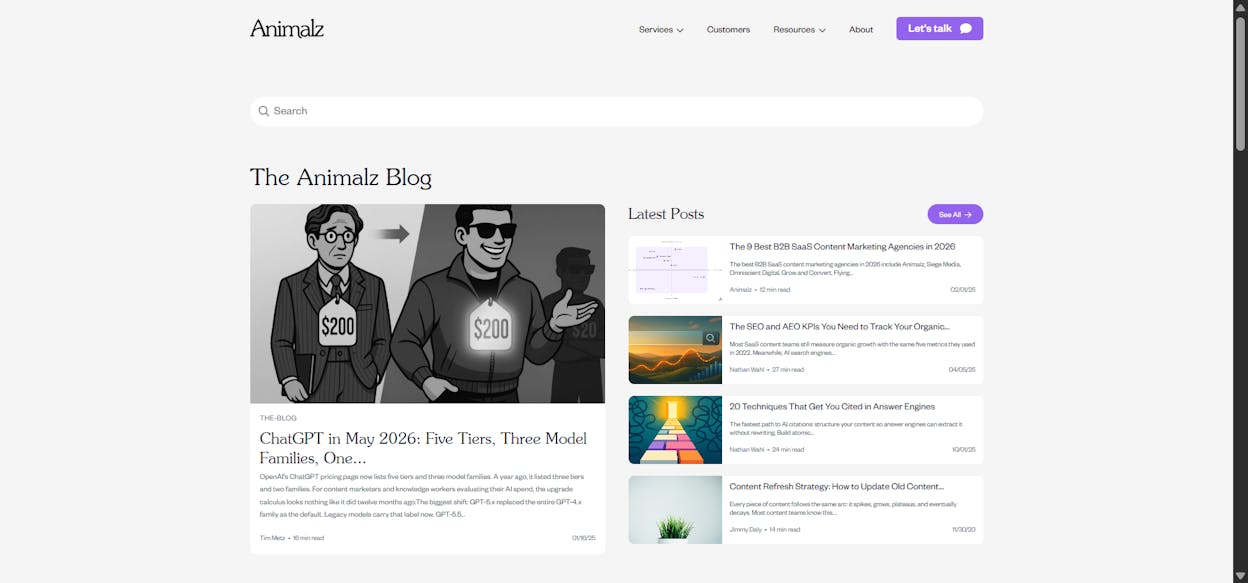
Animalz is a content marketing agency. Most agencies in the space publish SEO content because that is what they sell. Animalz does the opposite. Their blog is built around opinion, original frameworks, and original research.
You will find articles like The Pageview Paradox, pieces on the quality cliff for CMOs, and benchmark reports on content performance. They argue, sometimes uncomfortably, with prevailing industry wisdom.
What problem is Animalz solving?
An agency does not need millions of visitors. It needs maybe twenty new clients a year, each worth six figures. The reader Animalz wants to reach is a marketing director or VP at a B2B SaaS company who is already bored of generic content advice.
That reader does not Google “what is content marketing.” They subscribe to newsletters, follow people on LinkedIn, and read essays their peers send them. Search content cannot reach this person reliably. Opinion content can.
What advantage does Animalz have?
Their leverage is operational data from running content programs for hundreds of companies. They see what works across industries, formats, and budgets, which lets them write things no individual marketer could write. That is leverage no competitor can fake.
The other piece of leverage is the team itself. Senior writers with strong personal brands turn each post into a distribution event on LinkedIn and X.
Why this strategy is naturally strong in AI search
LLMs reward opinion, original data, and named frameworks more than they reward generic listicles. We analyzed 83,670 AI citations across ChatGPT, Claude, and Perplexity and found that Claude pulls 43.8% of its citations from blog content, almost four times more than ChatGPT. Original research and opinion pieces are exactly what fills that share.
If your strategy is built on thought leadership, the question is no longer just “did this get backlinks?” It is also “did this get cited by ChatGPT, Claude, or Perplexity, and for which prompts?”
The Sources view in Analyze AI shows you which domains are getting cited for prompts in your category, including yours.
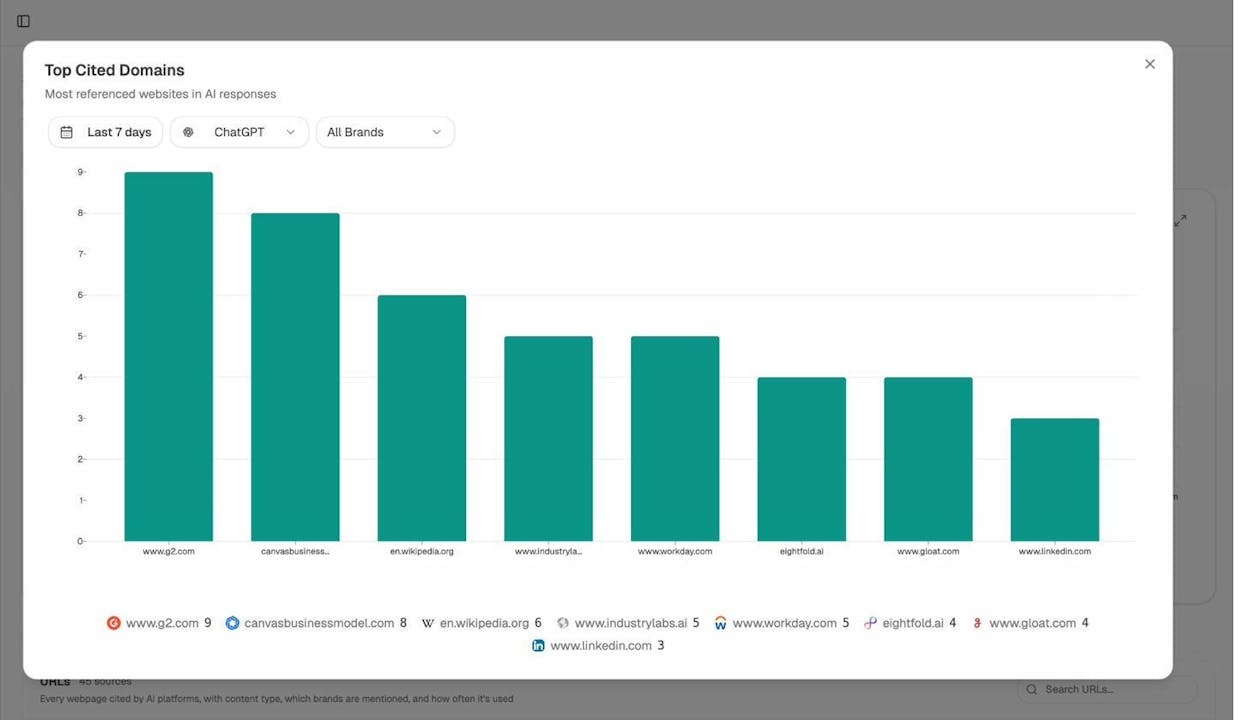
If your domain is missing from this chart for prompts where you should be the source, that gap is your editorial calendar. Every prompt where a competitor is cited and you are not is a piece of content waiting to be written.
Example 3: Freshpaint’s hyper-niche sales enablement play
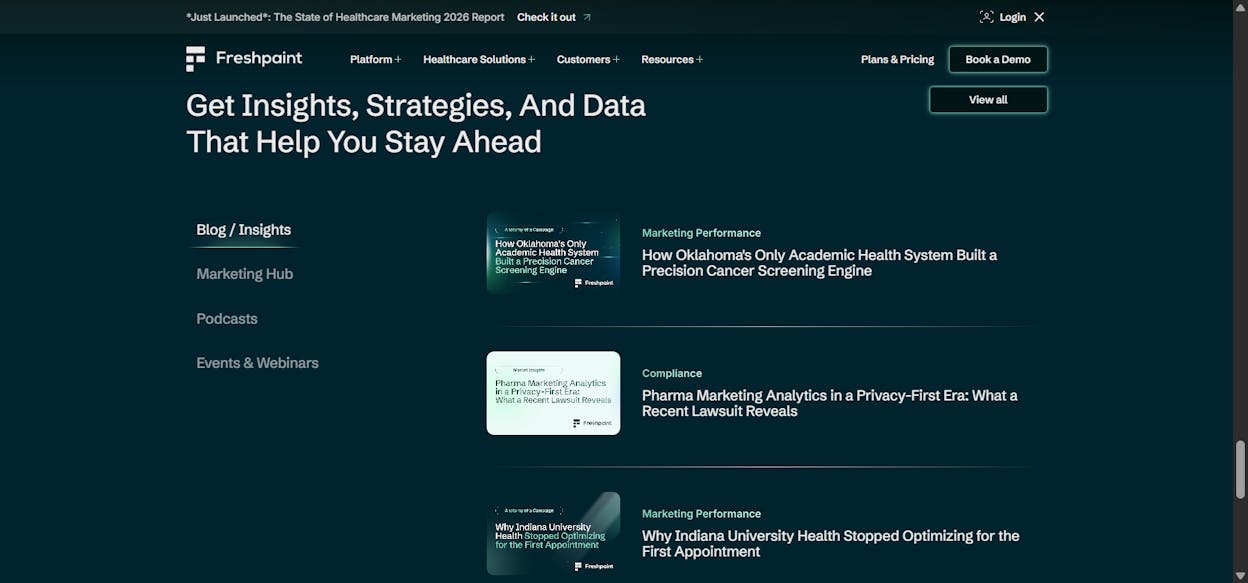
Freshpaint is a customer data platform built specifically for healthcare. That is the entire positioning. Their content strategy reflects this. Almost everything they publish is about HIPAA compliance for marketers.
Their blog covers questions like Can you use Google Analytics in a HIPAA-compliant way? and How do you embed YouTube videos without violating HIPAA? They publish long, technical, narrowly-scoped articles that would bore a generalist marketing audience but read like gold to a compliance officer at a hospital.
What problem is Freshpaint solving?
Freshpaint’s customers are not hard to find. The healthcare martech space is small and tight-knit. The hard part is closing the deal. Compliance teams, legal, and IT all have veto power, and they all need different reassurances.
Sales enablement content gives the sales team a library to point to. When a prospect raises an objection, a Freshpaint AE replies with a link to a 3,000-word article that addresses the exact concern.
What advantage does Freshpaint have?
The leverage is focus. Every other martech company has to write for ten audiences. Freshpaint writes for one. That means every article compounds topical authority on a single subject, which is exactly what Google rewards and exactly what LLMs latch onto.
Why narrow niches win in AI search
When someone asks ChatGPT about HIPAA-compliant analytics, the model needs to pull from a source that has written about that specific topic many times. Freshpaint has. That is why their pages get cited.
The play is the same for any vertical SaaS. Pick a defensible niche topic, write everything that exists to write about it, and you become the source LLMs default to.
If you want to see what AI engines currently cite for prompts in your niche, the Competitors view shows you which brands LLMs are mentioning that you may not even know are competitors.
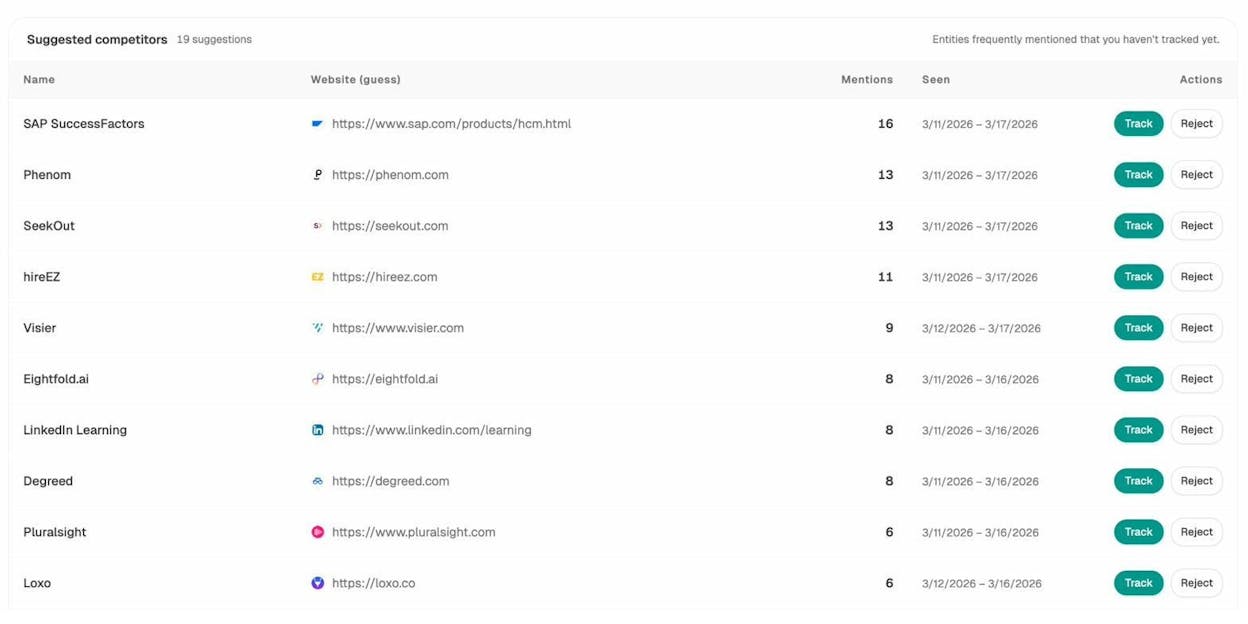
For Freshpaint, that list would be the small handful of healthcare martech tools competing for the same prompts. For your business, it might surface competitors you didn’t know were eating your share of the conversation.
How to build your own content strategy
The three strategies above are different on the surface but built the same way. Use the questions to make your own choices.
Step 1: Diagnose your real problem
Spend an hour writing down the metric that, if it doubled, would change your business. Is it MQLs, demos booked, free signups, or average contract value?
Then write down the bottleneck. If demos are flat, is it because traffic is low, or because traffic is the wrong kind? If signups are growing but revenue is not, is it activation, conversion, or expansion?
A clear problem, in one sentence, is the foundation of everything that follows.
Step 2: Find your leverage
This part is uncomfortable because most teams cannot name their leverage. Run through this checklist.
-
Do you have product data nobody else has?
-
Do you have employees with strong personal brands or domain expertise?
-
Do you have access to a customer base willing to share results?
-
Do you have a partner network or integration ecosystem?
-
Do you have deep expertise in a topic where competitors are shallow?
If you answered yes to two or more, those are your assets. Pick one and build the strategy around it.
Step 3: Map content types to your problem
Use the table earlier in this article. If you need predictable demand, search content. If you need brand awareness with executives, thought leadership. If you need to close stuck deals, sales enablement. If you need to grow an existing user base, use-case content.
Most teams pick two and let one lead. Zapier leads with search and uses thought leadership occasionally. Animalz leads with thought leadership and uses search rarely. Pick a lead, then a support.
Step 4: Find the topics that matter for SEO
Once you have your content type, you need a topic backbone.
For SEO, that means keyword research. Pull a list of relevant queries, prioritize by search volume and intent, and group them into clusters. Our guide on keyword clustering walks through the full process. You can also use the free keyword generator and keyword difficulty checker to size opportunities.
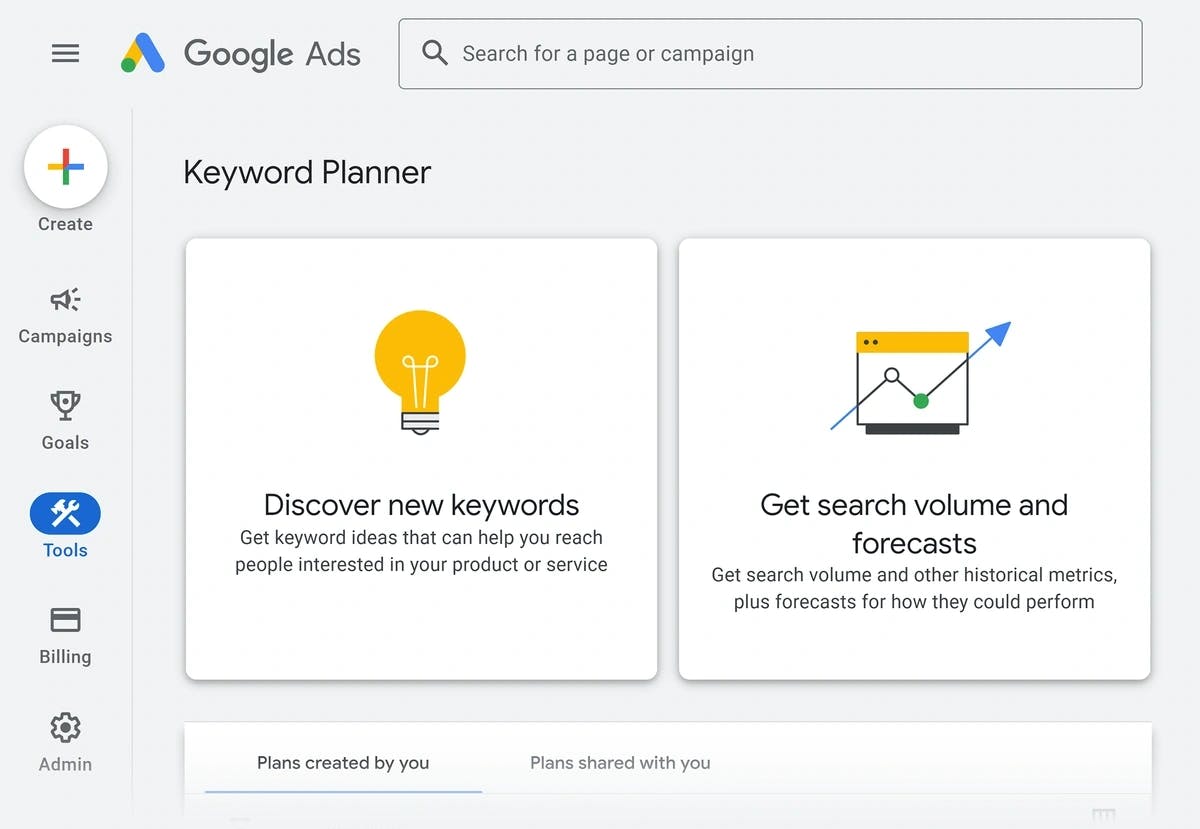
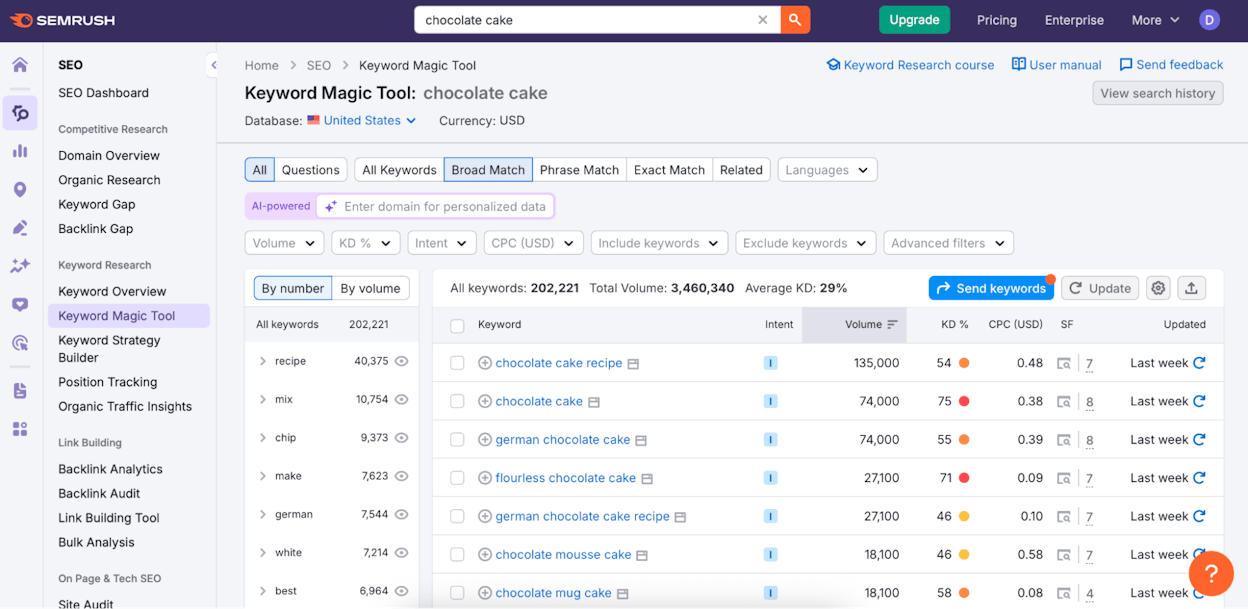
Score each cluster on three dimensions before you commit. Search volume tells you the size of the opportunity. Difficulty tells you whether you can realistically rank. Buyer intent tells you whether the click will turn into anything. Most teams over-index on volume and under-index on intent, which is how you end up with traffic that does nothing.
Step 5: Find the topics that matter for AI search
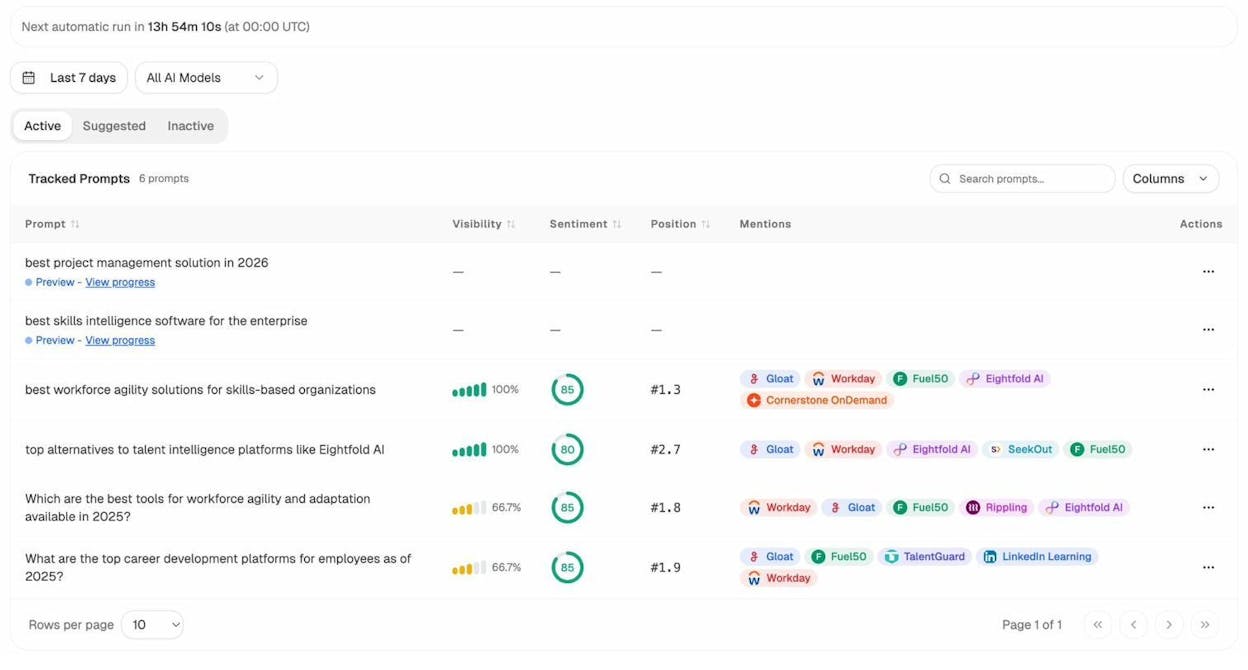
For AI search, the unit is not a keyword. It is a prompt. The questions buyers actually type into ChatGPT or Perplexity rarely match the queries they would have typed into Google. They are longer, more conversational, and often comparison-driven.
Inside Analyze AI, the Prompts view lets you track the prompts that matter in your category and see which brands get mentioned in the answers.
The Suggested tab inside the same view will surface prompts you should be tracking based on your industry, so you can pick the ones with the highest strategic value.
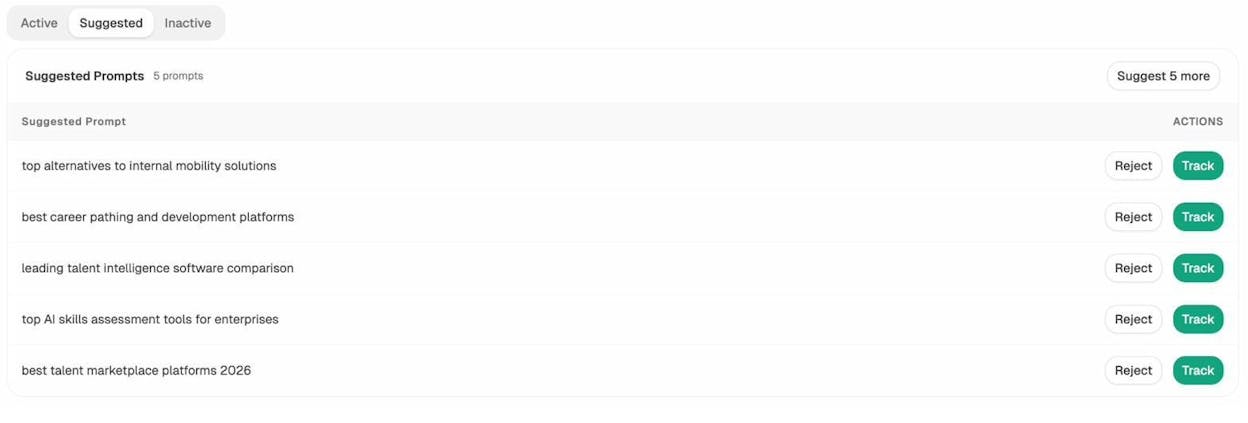
That gives you a working list of high-intent prompts to optimize for, the same way an SEO list gives you keywords. For more on this, see our breakdown of AI keyword research and our guide on how to rank on ChatGPT.
Step 6: Look at what is already working
Whatever strategy you choose, you have signals already. Pages getting traffic, prompts getting answered, articles getting linked.
The fastest path forward is to find what is working and double down. The Landing Pages view inside AI Traffic Analytics shows which of your pages are getting AI-referred traffic, how visitors engage with them, and which ones are being cited.
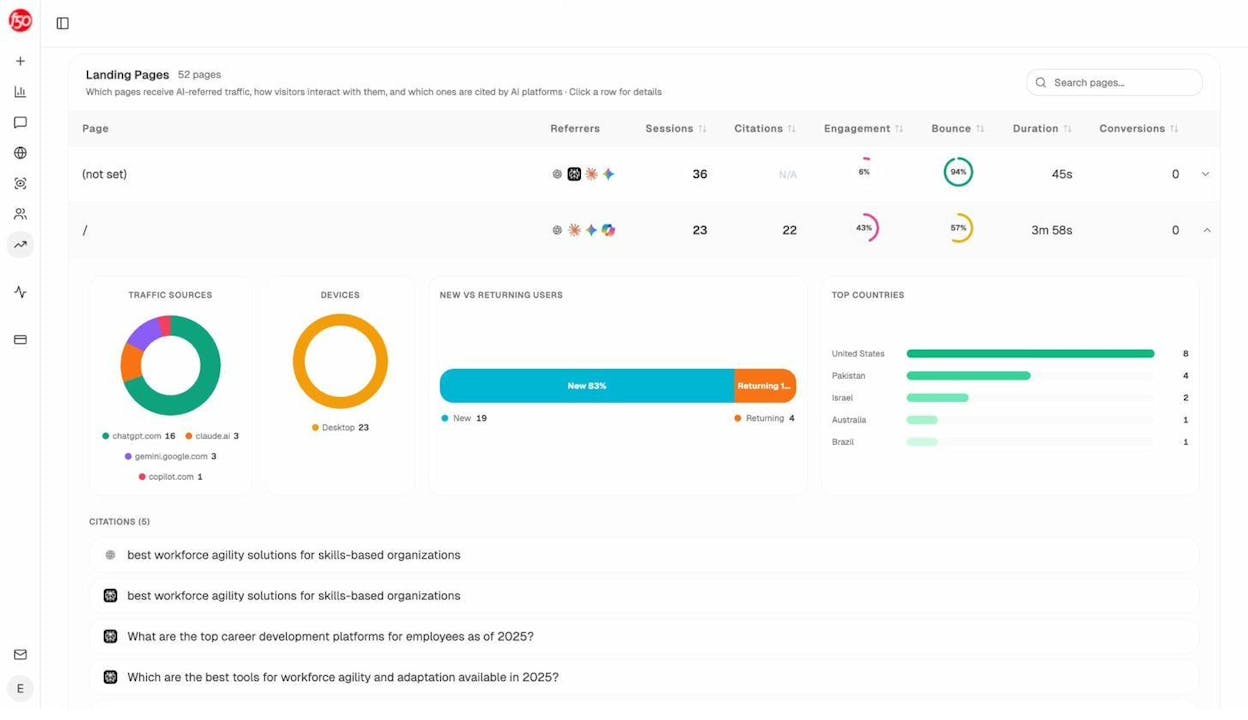
Pages already getting cited in AI answers are templates worth copying. Pages getting AI traffic with high bounce rates are content waiting to be improved. Pages with no AI presence at all give you a clear decision. Rewrite, redirect, or retire.
Step 7: Track both channels and adjust
Treat AI search as another organic channel sitting next to SEO, not a replacement. Both compound. Both are influenced by content quality, brand mentions, and authority. Both deserve a budget line.
For more on the relationship between the two, our deep dive on GEO vs SEO covers the differences and the overlap, and our 10-step SEO content strategy lays out the full execution plan.
The strategy is the choices you do not make
Every effective content strategy in this article rejected something. Zapier rejected thought leadership. Animalz rejected SEO. Freshpaint rejected breadth. Their growth came from what they refused to do as much as what they chose to do.
If you cannot describe your strategy in one sentence, with at least one thing you are explicitly choosing not to do, you do not have a strategy. You have a list of tactics.
Pick the problem. Find the leverage. Choose the content type. Then run it for long enough that the choices compound, in Google and in ChatGPT. The shape of search has changed. The discipline behind a real strategy has not.

Ernest

Ibrahim


