



Summarize this blog post with:


In this article, you’ll learn why demand generation without a capture strategy is wasted spend, how to make your product discoverable the moment people search for it, and how to use both traditional SEO and AI search data to measure whether your demand gen efforts are actually working. You’ll also get practical steps for monitoring competitors, tracking branded searches, and using AI traffic analytics to find patterns in what content converts demand into revenue.
Table of Contents
How is demand typically generated?
Demand generation is any marketing activity that makes people want something they had no desire to buy before they saw your message. It shifts an audience from “never heard of it” to “I need to look this up.”
Some common examples include paid ads, word of mouth, social media, video marketing, email newsletters, content marketing, community marketing, podcasts, and event sponsorships.
Sometimes demand gen is a short-term play. An ecommerce brand creates buzz before a product launch. Other times, especially in B2B, it is a long-term play to educate out-of-market audiences and slowly pull them toward a buying decision.
Either way, the spend adds up fast.
Here is a real-world example. Pryshan is a small Australian brand that makes exfoliating stones from clay. They have been selling offline since at least 2018. The product is not a breakthrough innovation, but it is genuinely new to the market. Nobody was searching for clay exfoliating stones before Pryshan started advertising.
To launch online, they ran Facebook ads.
![[Screenshot of Pryshan’s Meta Ads library showing multiple ad creatives for their clay exfoliating stone product]](https://www.datocms-assets.com/164164/1777769871-blobid1.png?auto=format,compress&w=1248&fit=max)
Because of those ads, search demand started to appear. In Australia, there are now roughly 40 searches per month for “clay stone exfoliator” and a handful of related variations.
![[Screenshot of keyword research tool showing Australian search volume for “clay stone exfoliator” and related terms totaling over 100 monthly searches]](https://www.datocms-assets.com/164164/1777769879-blobid2.png?auto=format,compress&w=1248&fit=max)
But here is the interesting part. Those same keywords get almost zero search volume in the US.
![[Screenshot of keyword research tool showing US search volume for “clay stone exfoliator” keywords at 0-10 searches]](https://www.datocms-assets.com/164164/1777769880-blobid3.png?auto=format,compress&w=1248&fit=max)
That never happens. Australia has a much smaller population than the US. For non-localized searches, Australian search volume is typically 6-10% of US volume. Look at the most popular searches as proof.
![[Screenshot showing side-by-side comparison of US vs. Australian search volumes for YouTube, Facebook, Wordle, Gmail, and Google]](https://www.datocms-assets.com/164164/1777769887-blobid4.png?auto=format,compress&w=1248&fit=max)
Pryshan’s Facebook advertising directly created this search demand. The ads educated Australians about a product they did not know existed. Those people then went to Google to learn more.
This is the pattern that repeats across industries. It does not matter where or how you educate people about your product. What matters is shifting their perception from cognitive awareness to emotional desire. Emotions trigger actions, and the first action most people take after discovering something interesting is to search for it.
If you are spending money on demand generation but not including SEO (and increasingly, AI search optimization) as part of your strategy, you are likely losing the conversions you worked so hard to create.
Below are four things you can do to minimize budget waste, capture interest when people search, and convert the audiences you are already reaching.
1. Make your product, service, or innovation searchable
If you are working hard to create demand for your product, make sure it is easy for people to discover when they search Google.
There are three principles to follow.
Give it a simple name that is easy to remember. Your audience will not always remember your brand name. But they will remember what they saw and how the product works. If someone watches a video of an exfoliating stone made from clay, they will remember “clay stone exfoliator” even if they forget Pryshan entirely.
Label it according to how people naturally search. Think about the words your audience would type into a search bar. Not your internal product name, not your marketing team’s clever tagline. The actual words a person would use when describing the product to a friend.
Avoid terms that create ambiguity with existing things. If Pryshan had chosen to call its product “clay stones,” it would have competed with gardening products in search results.
![[Screenshot of Google SERP for “clay stones” showing gardening products like landscaping stones, with Pryshan’s shop listing appearing out of context among them]](https://www.datocms-assets.com/164164/1777769888-blobid5.png?auto=format,compress&w=1248&fit=max)
Pryshan’s listing looks out of place because the rest of the results are about garden supplies.
When you go through branding exercises to name your product, search your ideas on Google first. This way, you will see what phrases to avoid so your product is not grouped with unrelated things.
How to test searchability before you launch
Here is a practical process to validate your product naming.
Step 1. Write down 5-10 name variations your audience might search. Think nouns and descriptors, not slogans.
Step 2. Search each one on Google. Check whether the results match your product category or something completely different.
![[Screenshot of Google search results for your product name variation, showing whether the SERP matches your category or returns unrelated content]](https://www.datocms-assets.com/164164/1777769892-blobid6.png?auto=format,compress&w=1248&fit=max)
Step 3. Use a keyword generator tool to see what related searches exist. If your chosen name already has significant search volume for an unrelated category, pick a different phrase.
![[Screenshot of a keyword generator tool showing related keywords and their search volumes for your product name]](https://www.datocms-assets.com/164164/1777769892-blobid7.png?auto=format,compress&w=1248&fit=max)
Step 4. Check Google Trends to confirm whether any search interest is emerging for your term. If you have already started running ads, you should see a small uptick.
![[Screenshot of Google Trends showing search interest over time for your product term, with a visible uptick after campaign launch]](https://www.datocms-assets.com/164164/1777769897-blobid8.png?auto=format,compress&w=1248&fit=max)
Step 5. Ask ChatGPT, Perplexity, or Google AI Mode about your product name. If the AI response describes something unrelated to your product, your naming creates the same disambiguation problem in AI search that it does in traditional search.
This last step matters more than most marketers realize. A growing share of product discovery is happening through AI search engines, and the naming conventions that work on Google also influence how AI models categorize your brand.
2. Own as much real estate on search results as you can
Imagine being part of a company that invested heavily in a rebrand. New logo, new slogan, new marketing materials.
On the back of their new business cards, the design team thought it would be clever to invite people to Google the new slogan.
The only problem was the company did not rank for the slogan. They were not showing up at all.
This is a true story. It happens more often than you would expect. And it is an expensive mistake.
Many businesses use this tactic intentionally. They leverage the fact that people will Google things they see offline. Billboards, radio ads, and TV spots often include a prompt to search for a specific phrase.
![[Screenshot of a billboard that includes a search prompt like “Google: cheesesteaks nearby”]](https://www.datocms-assets.com/164164/1777769897-blobid9.png?auto=format,compress&w=1248&fit=max)
But if you do not already own the search results page for that phrase, you are handing your demand gen investment directly to competitors.
How to dominate your branded SERPs
Here is what a strong branded SERP looks like. You want to own every organic position, appear in paid placements if competitors are bidding, and control the narrative through sitelinks, knowledge panels, and People Also Ask boxes.
![[Screenshot of a branded SERP where one company dominates all organic positions, knowledge panel, and sitelinks]](https://www.datocms-assets.com/164164/1777769901-blobid10.png?auto=format,compress&w=1248&fit=max)
Let us use Pryshan again. They were the first brand to create exfoliating clay stones. Their advertising created the keyword “clay stone exfoliator.” Yet competitors and retailers are already showing up for that term.
![[Screenshot of Google SERP for “clay stone exfoliator” showing competitor products ranking alongside Pryshan’s listings]](https://www.datocms-assets.com/164164/1777769905-blobid11.png?auto=format,compress&w=1248&fit=max)
Sure, Pryshan holds a few organic spots. But paid product carousels from competitors appear before their website.
![[Screenshot of Google sponsored product carousel showing competitor clay stone exfoliator products appearing above organic results]](https://www.datocms-assets.com/164164/1777769906-blobid12.jpg?auto=format,compress&w=1248&fit=max)
This is the pattern that repeats everywhere. You do the hard work of creating demand. Then competitors, retailers, and affiliate marketers capitalize on the search traffic you generated.
Here is a practical checklist for protecting your branded search presence.
Audit your branded keywords. Search your brand name, product names, slogans, and any taglines you use in advertising. Document who else appears and where.
![[Screenshot of a SERP analysis tool showing all the domains ranking for your branded keyword]](https://www.datocms-assets.com/164164/1777769911-blobid13.png?auto=format,compress&w=1248&fit=max)
Optimize your homepage and key landing pages for your brand terms. This sounds obvious, but many companies have homepages that do not even mention their product by its searchable name.
Build out supporting pages. Create dedicated product pages, comparison pages, and FAQ pages that target branded long-tail variations. Every page you own is one less SERP position for competitors.
Claim your Google Business Profile. Even if you are not a local business, a verified profile gives you more SERP real estate through the knowledge panel.
Consider branded paid search. If competitors are bidding on your brand terms, you may need to run branded search ads as a defensive measure. It is cheaper than losing conversions to a competitor.
Set up Google Alerts and keyword monitoring for your brand name. Track when new competitors start ranking for your terms.
![[Screenshot of a keyword tracking tool showing branded keyword positions over time, with alerts for ranking changes]](https://www.datocms-assets.com/164164/1777769913-blobid14.png?auto=format,compress&w=1248&fit=max)
Why AI search SERP ownership matters too
Here is the part most marketers are missing. When someone asks ChatGPT, Perplexity, or Google AI Mode about your product category, the AI model pulls information from a handful of sources. If your brand is not among those sources, you lose the recommendation.
Unlike Google’s ten blue links, AI search results are zero-sum. The AI cites 3-5 sources at most. There is no “page two.” You are either mentioned or you are not.
This means owning AI search real estate requires a different set of tactics alongside your traditional SEO. You need to ensure your brand appears in AI-generated answers for the prompts your audience is asking.
With Analyze AI’s Prompt Tracking, you can monitor exactly which brands AI models mention for specific prompts. For example, you can track a prompt like “best [your category] for [your use case]” and see whether your brand shows up, what position it holds, and which competitors are mentioned alongside you.
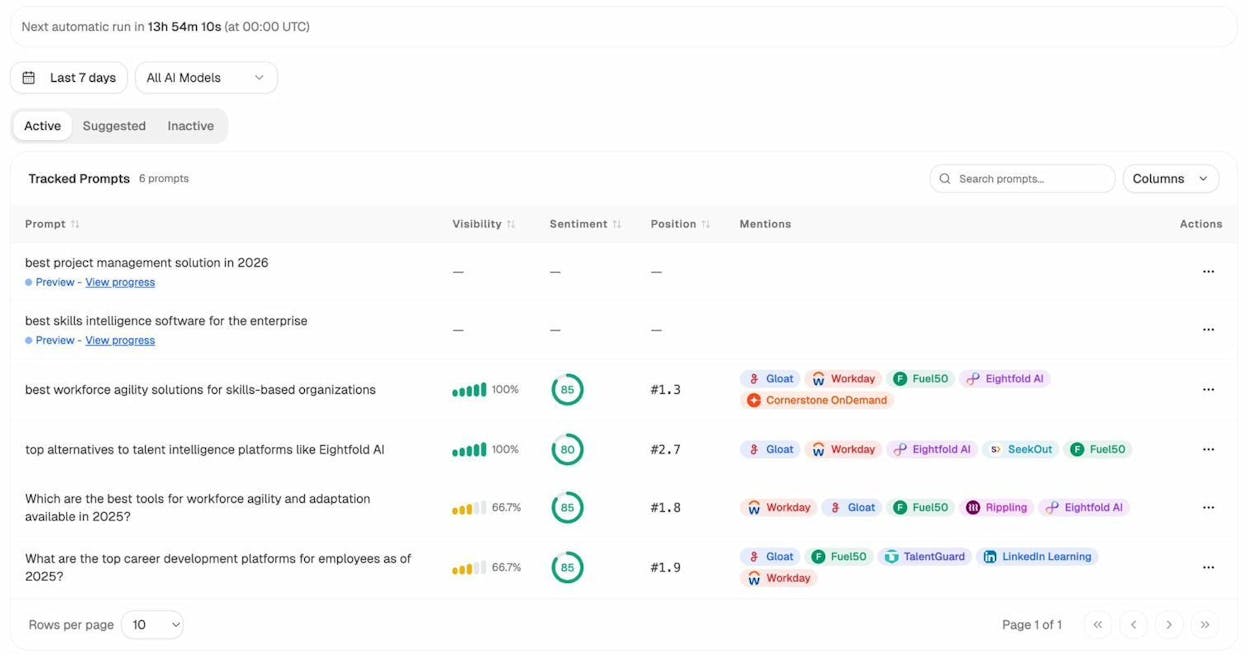
The “Suggested” tab even surfaces new prompts that AI models are generating about your category, so you can stay ahead of emerging demand signals before competitors react.
This is the AI search equivalent of monitoring your branded SERPs. If you are generating demand through podcasts, events, or social media, people are not just Googling you anymore. They are asking ChatGPT and Perplexity about you. And if the AI answer recommends your competitor instead, your demand gen budget just funded their pipeline.
3. Use search data to measure demand gen success
If you are working hard to generate demand for something new, it can be hard to know if it is working.
You can measure sales. But demand generation rarely turns into immediate sales, especially in B2B. Educating out-of-market audiences and converting them into in-market prospects takes months, sometimes years.
Search data can close this gap and give you evidence to justify continued investment to leadership.
Measure increases in branded searches
A natural byproduct of demand generation is that people search more for your brand. If your branded keyword volume is not growing, your demand gen might not be reaching the right people, or the message is not resonating.
Here is how to track this.
Step 1. Set up a list of your core branded keywords. This includes your brand name, product names, taglines, and any branded terms you use in advertising.
Step 2. Track these keywords weekly or monthly in a rank tracking tool. Look at both ranking position and estimated search volume over time.
![[Screenshot of a rank tracking dashboard showing branded keyword positions and estimated traffic trending upward over several months]](https://www.datocms-assets.com/164164/1777769917-blobid16.png?auto=format,compress&w=1248&fit=max)
Step 3. Compare branded search volume trends against your demand gen campaign schedule. You should see upticks after major campaigns, product launches, or press coverage.
Step 4. If your brand gets enough searches, use tools that forecast search potential to project future demand.
![[Screenshot of a keyword research tool showing search volume trends and forecasted growth for a branded keyword]](https://www.datocms-assets.com/164164/1777769922-blobid17.png?auto=format,compress&w=1248&fit=max)
The key metric is the trendline, not the absolute number. A small brand that goes from 50 to 200 branded searches per month has a stronger demand gen signal than a large brand holding steady at 10,000.
Discover and track new keywords about your products
When you generate demand, your audience invents their own ways to search for what you offer. They might not use your official product name. They might describe your product by its function, its look, or the problem it solves.
You need to discover these keywords and make sure you rank for them.
Step 1. Set up keyword alerts for your brand name and product names. Use tools that notify you when new keywords appear in search data.
![[Screenshot of a keyword alert setup interface where you can enter your brand name, set volume thresholds, and choose notification frequency]](https://www.datocms-assets.com/164164/1777769923-blobid18.png?auto=format,compress&w=1248&fit=max)
Step 2. Use a keyword generator to explore variations of your product description. Type in what your product does rather than what it is called. For example, Pryshan might search for “exfoliating stone” or “clay skin tool” to discover how people naturally describe their product.
![[Screenshot of a keyword generator showing unexpected keyword variations for a product description, revealing how users actually search]](https://www.datocms-assets.com/164164/1777769927-blobid19.png?auto=format,compress&w=1248&fit=max)
Step 3. Monitor your Google Search Console query report. Filter for queries you did not expect. These are the organic language patterns your audience is using.
![[Screenshot of Google Search Console query report filtered to show new, unexpected search queries related to your product]](https://www.datocms-assets.com/164164/1777769928-blobid20.png?auto=format,compress&w=1248&fit=max)
Step 4. Create content targeting these newly discovered keywords before competitors find them. This is how you build a moat around the demand you created.
Monitor visibility against competitors
If you are worried other brands will steal your spotlight in Google’s search results, you need competitive monitoring.
Here is a step-by-step setup.
Step 1. Identify your top 3-5 competitors. These are the brands most likely to target the same keywords your demand gen creates.
Step 2. Use a competitive analysis tool to compare your organic share of voice against theirs for your target keywords.
![[Screenshot of a share of voice comparison chart showing your website’s organic traffic share vs. competitor sites over time]](https://www.datocms-assets.com/164164/1777769932-blobid21.png?auto=format,compress&w=1248&fit=max)
Step 3. Look specifically at keywords where competitors are gaining and you are losing. These are the terms where your demand gen is creating opportunity for others.
Step 4. Set up alerts for competitor ranking changes on your most important terms. You want to know immediately when a competitor starts ranking for a keyword your campaign created.
![[Screenshot of a competitor alert showing a new domain ranking for one of your branded or product keywords]](https://www.datocms-assets.com/164164/1777769935-blobid22.png?auto=format,compress&w=1248&fit=max)
Step 5. Do a SERP check on your most valuable keywords monthly. Document who appears in each position and how the landscape changes over time.
Track demand signals in AI search
This is where most marketers have a blind spot. Your demand generation does not just create Google searches. It creates questions people ask AI chatbots.
Someone who sees your podcast appearance might ask ChatGPT “What is [your product] and is it worth trying?” Someone who reads about your category in a newsletter might ask Perplexity “best [category] tools in 2026.”
If you are not tracking these AI search signals, you are missing a significant portion of your demand gen impact.
Here is how to set up AI search demand tracking.
Step 1. Identify the prompts your audience is likely asking AI models. Think about the questions that come after someone encounters your demand gen content. These are prompts like “best [category] for [use case],” “is [brand] worth it,” and “[brand] vs [competitor].”
Step 2. Set up prompt tracking to monitor your visibility across ChatGPT, Perplexity, Claude, Gemini, and Copilot. This lets you see whether AI models mention your brand when users ask relevant questions.
Step 3. Use ad hoc prompt searches to test new prompts in real time. Type in a question your audience might ask and see which brands the AI recommends.
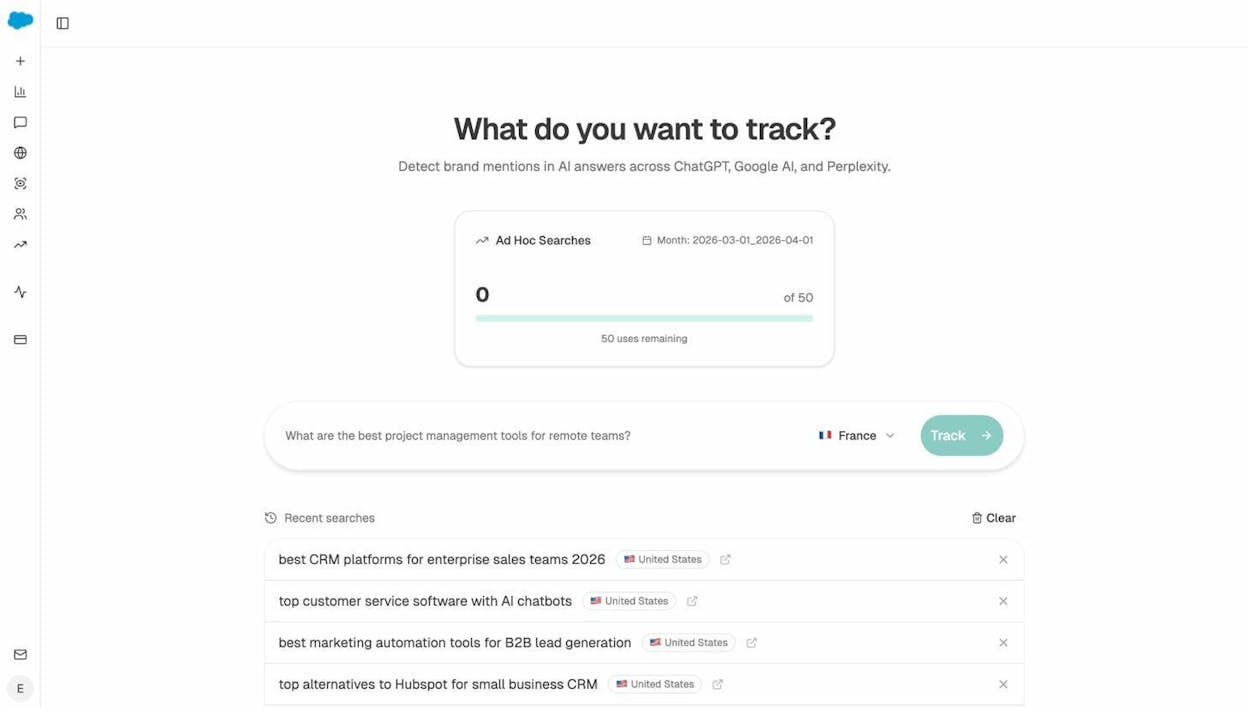
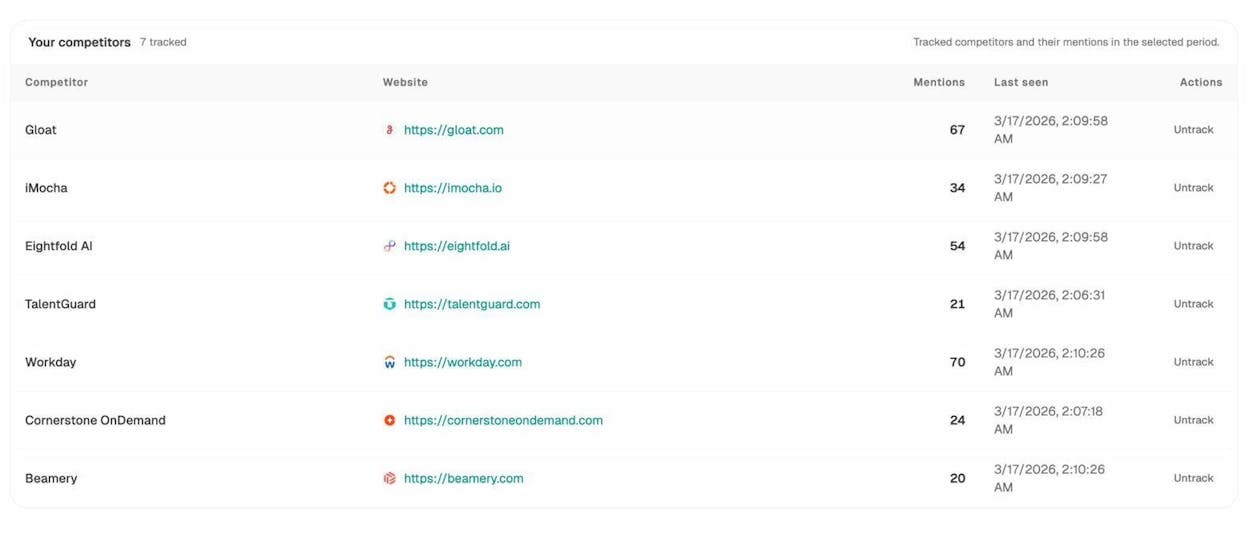
Step 4. Compare your AI visibility against competitors. In Analyze AI’s Competitor Intelligence dashboard, you can see exactly how many times each competitor is mentioned across AI models and which ones are gaining traction.
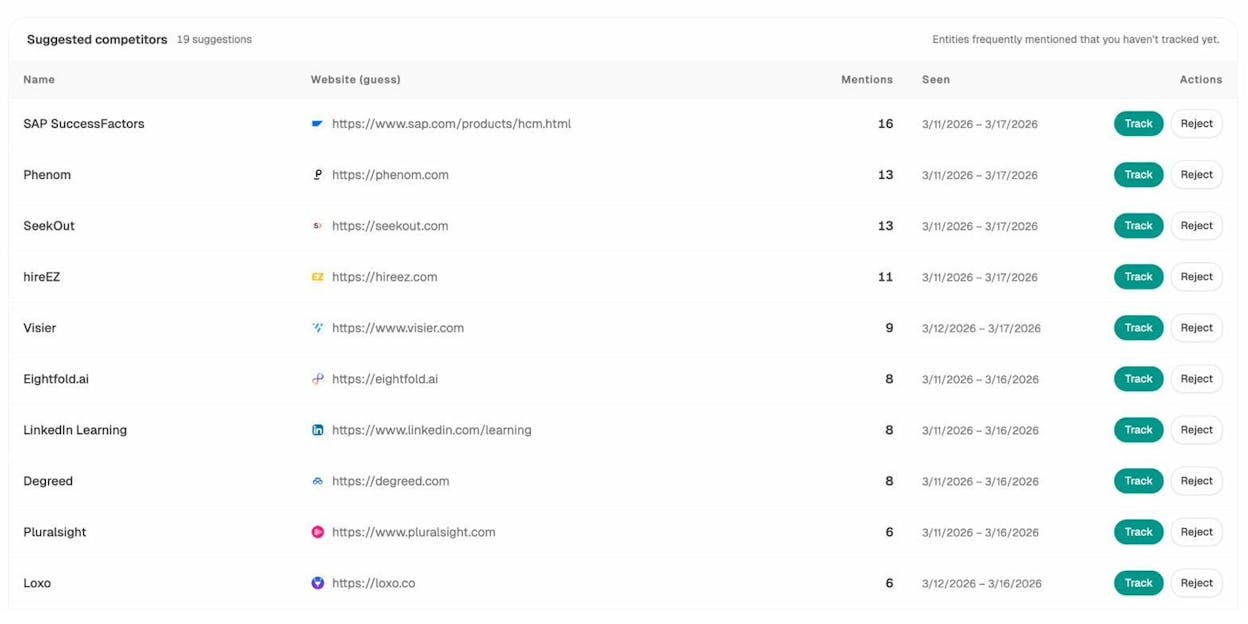
The platform also surfaces suggested competitors you may not have thought to track. These are brands that AI models frequently mention alongside yours.
Step 5. Set up weekly email digests to get automated AI visibility reports. These emails show your overall visibility score, sentiment trends, pages gaining or losing citations, and competitor movements, all without logging into the platform.
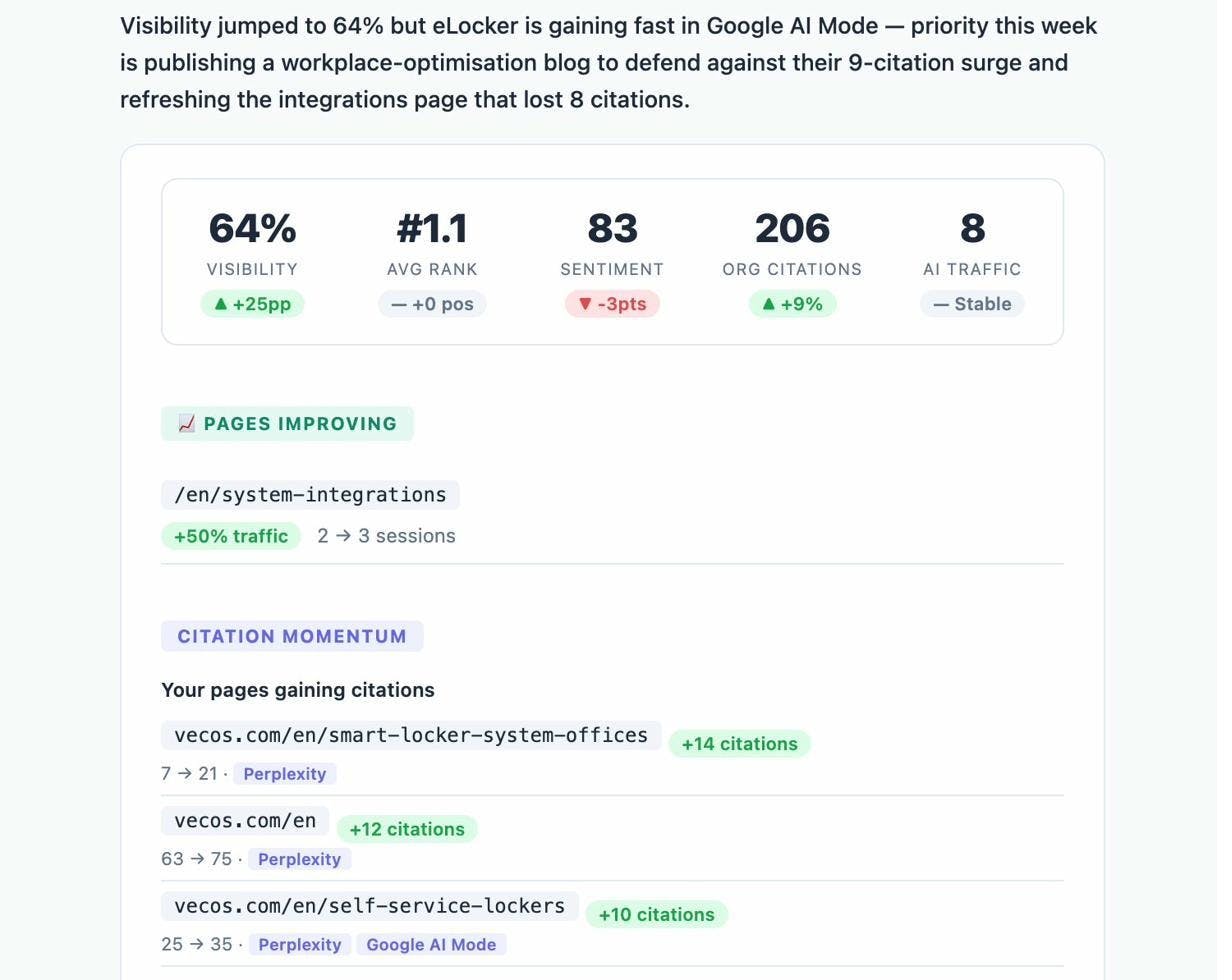
This gives you and your leadership team a recurring, data-backed view of how your demand gen efforts are translating into AI search presence.
4. Use AI traffic data to find what content captures demand
Here is a tactic most marketers are not using yet, and it is one of the highest-leverage things you can do after running demand gen campaigns.
When your demand generation works, people search for you. Some find you on Google. But an increasing number find you through AI search engines like ChatGPT, Perplexity, and Google AI Mode. These AI platforms cite your pages as sources, and visitors click through to your website.
The question is: which pages are capturing this demand? And can you find patterns to double down on what works?
How to analyze your AI-referred traffic
Step 1. Set up AI Traffic Analytics to track visitors arriving from AI platforms. This shows you which AI sources (ChatGPT, Claude, Perplexity, Gemini, Copilot) drive the most traffic, how those visitors engage with your site, and which pages they land on.
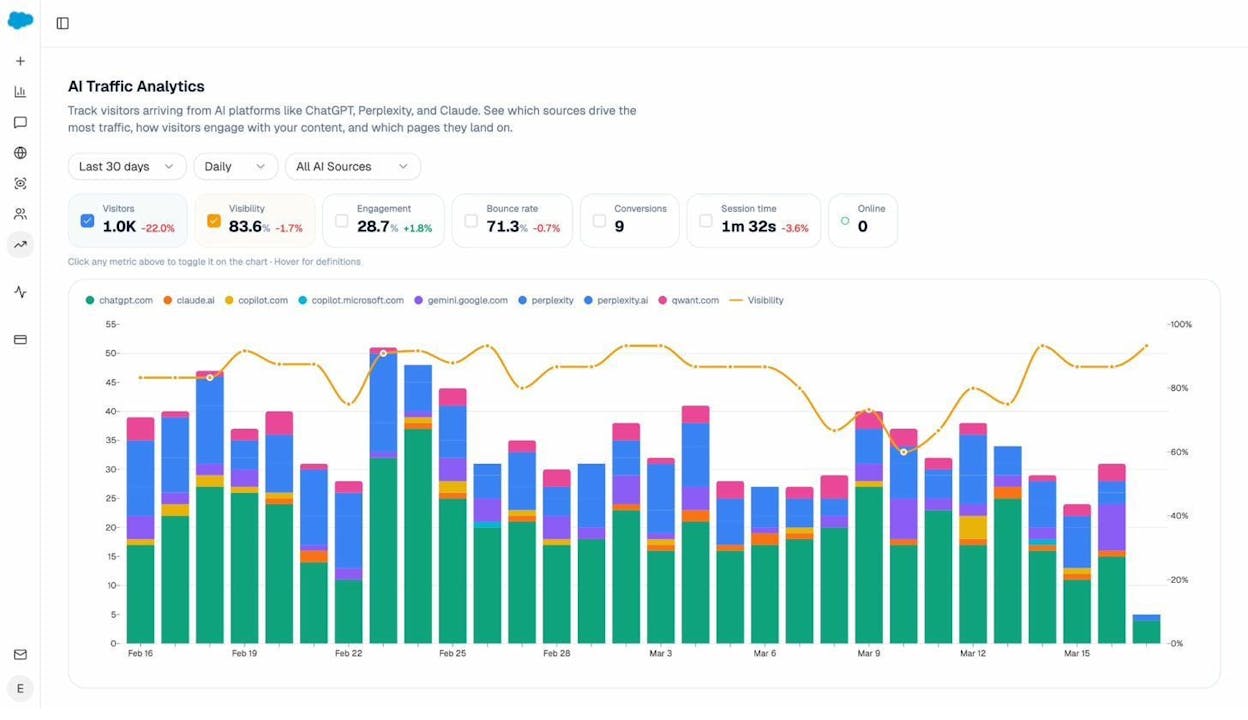
This dashboard gives you a bird’s eye view of your AI-referred traffic. You can filter by date range and AI source to spot trends.
Step 2. Drill into the Landing Pages report. This shows you exactly which pages receive AI-referred traffic, how many sessions each gets, how many citations it earns, and the engagement metrics for each page.
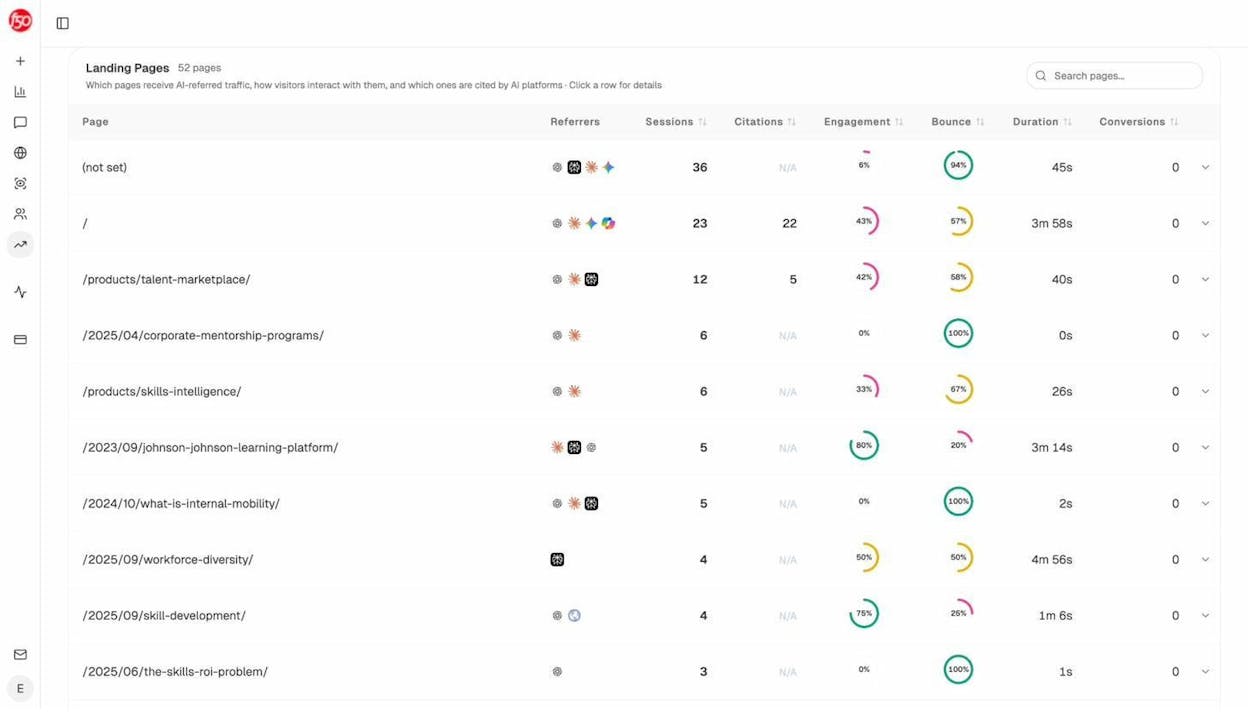
Look for patterns. Are product pages or blog posts performing better? Are certain topics getting cited more than others? This is your playbook for creating more demand-capturing content.
Step 3. Cross-reference your top AI landing pages with the Sources dashboard. This shows you which content types AI models prefer to cite (blogs, product pages, reviews) and which domains dominate citations in your space.
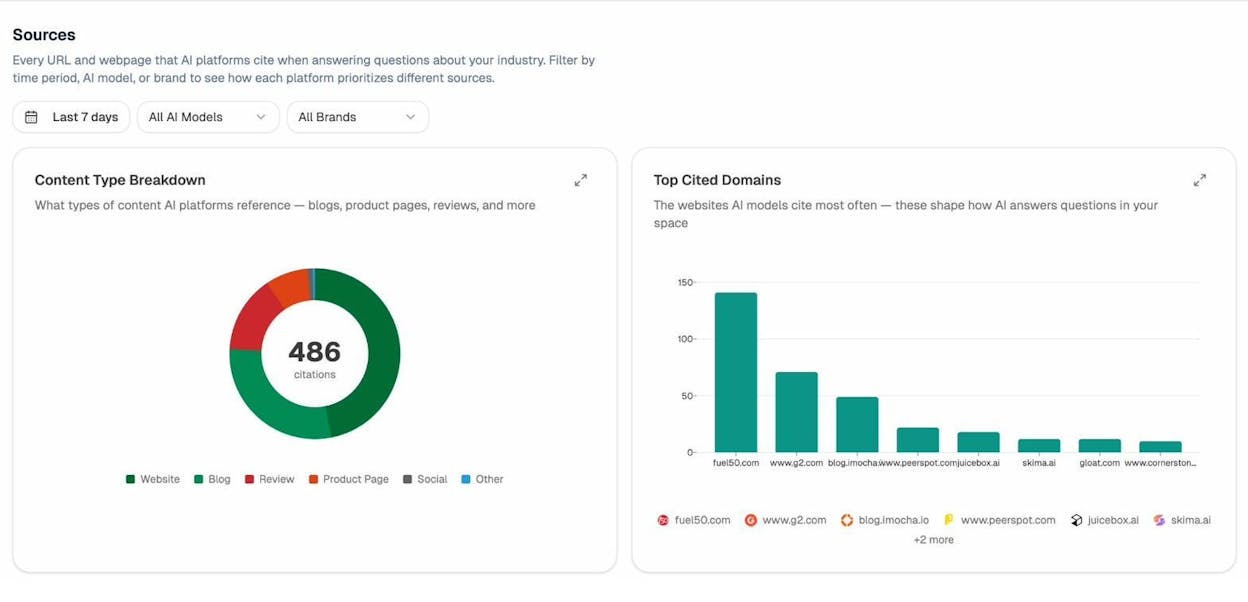
If you see that blog content accounts for most citations in your industry but your competitor’s product pages get more citations than yours, that is an actionable insight. You know where to focus your content creation.
Step 4. Look at the Perception Map to understand how AI models position your brand relative to competitors. This visual shows you which brands are “Visible and Compelling” versus “Visible, Weak Story” versus “Good Story, Less Seen.”
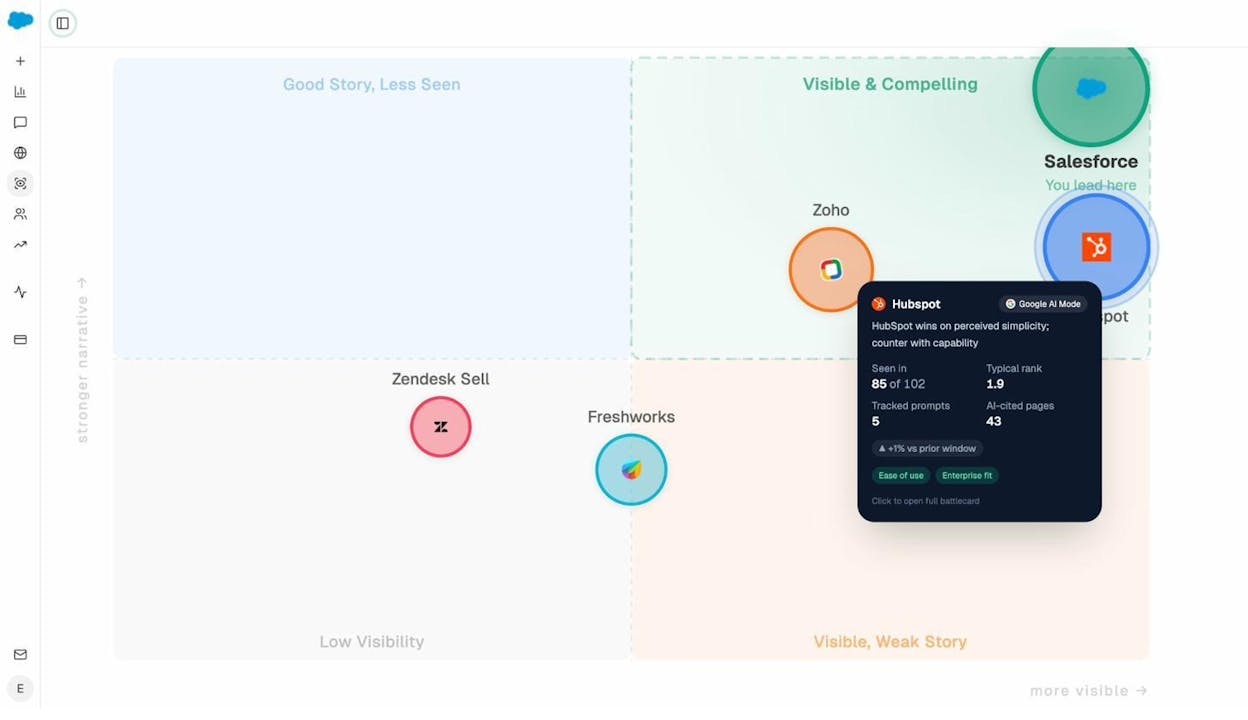
This matters for demand capture because it tells you whether your brand narrative is strong enough to convert the awareness your demand gen creates. If you are in the “Visible, Weak Story” quadrant, people are finding you in AI search but the AI model’s description of your brand is not compelling enough to drive clicks.
Turn AI traffic patterns into a content strategy
Once you have a few weeks of AI traffic data, here is how to turn it into a content plan.
Identify your top 5 AI-cited pages. These are the pages that AI models trust enough to reference. Study what makes them work. Is it depth? Is it structure? Is it original data?
Find pages with high citations but low traffic. These are pages AI models reference but users do not click through to. The problem might be that the AI summary is complete enough on its own, or that your page title does not compel a click. Consider adding exclusive data, tools, or templates that AI cannot summarize.
Find pages with high traffic but low engagement. These are pages where people arrive from AI but bounce quickly. The page might not match the intent of the AI prompt that sent them there. Align the content more closely with the specific questions people are asking.
Create more content in the pattern of your winners. If your “How to” guides get cited 3x more than your product pages, produce more guides. If your comparison posts get the highest engagement from AI traffic, build out your comparison library.
This is the same approach experienced content strategists use for organic SEO. You analyze what works, find the pattern, and do more of it. The only difference is that now you have a second organic channel, AI search, to analyze and optimize.
How demand capture works across SEO and AI search together
The smartest marketers do not treat SEO and AI search as separate channels. They treat them as two sides of the same demand capture strategy.
Here is a practical example of how this works end to end.
Your demand gen campaign: You sponsor a popular industry podcast. The host mentions your product, explains the problem it solves, and shares your website.
Google search capture: Listeners search your brand name on Google. Because you have optimized your branded SERP (homepage, product pages, comparison pages, knowledge panel), you own the entire first page. You capture the click and the conversion.
AI search capture: Other listeners ask ChatGPT “What is [your product] and how does it compare to [competitor]?” Because your website has clear, well-structured content that AI models can reference, your brand appears in the answer with a citation. The listener clicks through and lands on your comparison page.
Measurement: Your AI Traffic Analytics shows an uptick in AI-referred visitors the week after the podcast airs. Your branded keyword volume in Google also spikes. Your weekly digest email confirms that both visibility and citations are trending up.
Optimization: You notice that the comparison page got the most AI traffic. You create two more comparison pages targeting similar “vs” queries. You also update your prompt tracking to monitor new prompts that emerged from the podcast audience.
This is what a complete demand capture loop looks like. And the brands that build this system now will compound their advantage as AI search grows.
Final thoughts
Demand always comes first. SEO and AI search exist to capture it.
If you are spending money to generate demand through ads, events, social media, content marketing, or any other channel, you need a system to capture that demand when people search for you. Without one, your competitors, retailers, and affiliate marketers will happily take the conversions you paid for.
The good news is that the same content that works for Google also tends to work for AI search. Clear, original, well-structured content that genuinely answers questions gets cited by AI models and ranked by Google. You do not have to choose between the two channels. You just need to measure both.
Start with the basics. Make your product searchable. Own your branded SERPs. Track your branded keyword trends. Then layer in AI visibility tracking and AI traffic analytics to capture the growing share of demand that flows through AI search.
The savviest marketers are already building this system. They are creating their own SEO and AI search opportunities long before competitors figure out what they are doing.

Ernest

Ibrahim


