



Summarize this blog post with:


We pulled findings from studies by Semrush, Keywords Everywhere, Moz, BrightEdge, Seer Interactive, and multiple independent researchers. Combined, these datasets span over 150 million keywords and hundreds of thousands of SERPs tracked between 2024 and 2026.
In this article, you’ll learn what data from multiple large-scale studies reveals about featured snippets in 2026. You’ll see how often they appear, what kinds of queries trigger them, how they affect click-through rates, which websites dominate them, and why the rise of AI Overviews is reshaping everything marketers thought they knew about “position zero.” You’ll also get actionable steps for winning featured snippets and adapting your strategy to include AI search as an additional organic channel.
Table of Contents
What Is a Featured Snippet?
A featured snippet is a highlighted block of text that Google displays at the very top of the search results page, above the first organic listing. It pulls content directly from one of the top-ranking pages and shows the page’s title, URL, and a brief answer to the searcher’s question.
You may also hear it called “position zero” or “the answer box.”
![[Screenshot description: Google SERP showing a featured snippet for an informational query, with the snippet box highlighted above organic results]](https://www.datocms-assets.com/164164/1777577004-blobid1.png?auto=format,compress&w=1248&fit=max)
Featured snippets come in four main formats:
-
Paragraph snippets display a short block of text. These are the most common.
-
List snippets show ordered or unordered lists. They appear frequently for how-to and step-by-step queries.
-
Table snippets pull structured data into a formatted table. These are underused and underoptimized by most publishers.
-
Video snippets embed a YouTube video. These appear for about 33.8% of all how-to queries as of 2026.
Now, why should you care about them?
Why Featured Snippets Still Matter in 2026
If your page ranks anywhere in the top 10 Google results, it can be pulled into a featured snippet. That means a page sitting at position 7 can jump to position zero without earning a single new backlink or rewriting its entire content.
That shortcut is powerful. It is also under pressure.
Google’s AI Overviews now appear on roughly 20% to 30% of all search queries, depending on the study and market you look at. In many cases, AI Overviews are replacing featured snippets entirely. Keywords Everywhere documented a 64% drop in featured snippet visibility between January and June 2025 alone.
But here’s the part most people miss. Research from multiple sources shows a strong overlap between pages that previously earned featured snippets and pages that now get cited inside AI Overviews. The same content patterns that win snippets also win AI citations.
Featured snippets are not dying. They are evolving into a different form of visibility. Optimizing for them still pays off, because the skills transfer directly to earning mentions in AI-generated answers across Google, ChatGPT, Perplexity, and Claude.
Let’s look at what the data tells us.
1. Featured Snippets Appear on 8% to 24% of Search Queries (Depending on When You Measure)
In 2017, featured snippets appeared on roughly 12.29% of all US search queries based on a sample of 112 million keywords.
That number climbed. By 2025, Semrush and BrightEdge reported that featured snippets appeared on approximately 19% to 24% of all Google SERPs. That is a significant expansion over 8 years.
But then the decline started.
As Google accelerated the rollout of AI Overviews in 2025, featured snippet prevalence dropped. Keywords Everywhere tracked SERP visibility falling from 15.41% in January 2025 to just 5.53% by June 2025. Glenn Gabe documented a similar trend, finding a 35% to 57% drop in featured snippet queries between September 2024 and March 2025 across multiple sites.
|
Time Period |
Featured Snippet Prevalence |
Source |
|---|---|---|
|
2017 |
~12.29% of queries |
Ahrefs (112M keywords) |
|
Early 2025 |
~19-24% of queries |
Semrush, BrightEdge |
|
June 2025 |
~5.53% SERP visibility |
Keywords Everywhere |
|
Early 2026 |
~8% of queries |
Multiple studies |
The takeaway is clear. Featured snippets are contracting. But they have not disappeared. They still appear for roughly 8% of queries, and for certain query types (definitions, lists, how-to instructions) they remain the dominant SERP feature.
The queries losing featured snippets are primarily complex informational ones. Those are the same queries now absorbed by AI Overviews. Simple, factual, definition-style queries still trigger traditional snippets at high rates.
2. Featured Snippets Reduce Overall Click-Through Rates
This is the counterintuitive finding that surprises most marketers.
When a featured snippet sits at position one, it gets roughly 8.6% of clicks on average. The page ranking directly below it gets about 19.6%. For comparison, a regular position-one result with no featured snippet above it captures about 26% of clicks.
In other words, the featured snippet steals clicks from the rest of page one. And it captures fewer clicks than a normal top-ranking result would.
This makes sense when you think about the purpose of featured snippets. They are designed to answer the question directly on the SERP. Many searchers read the answer and never click through.
The data backs this up. Searches with featured snippets have a lower clicks-to-searches ratio than searches without them. Featured snippets increase zero-click behavior.
But the story changes when you consider AI Overviews.
When featured snippets and AI Overviews co-occur on the same SERP, CTR drops even further. Amsive Digital found a 37.04% CTR decline when both appear together. That is significantly worse than the impact of either feature alone.
|
SERP Scenario |
Avg CTR for Top Result |
|---|---|
|
No featured snippet, no AI Overview |
~26% |
|
Featured snippet (no AI Overview) |
~8.6% (snippet) / ~19.6% (#2) |
|
AI Overview only |
~8% overall clicks |
|
Featured snippet + AI Overview |
~37% CTR decline vs. baseline |
This is where AI search monitoring becomes critical. If you are tracking only your traditional keyword rankings, you are missing the real picture. You need to know which of your pages are losing featured snippets to AI Overviews and how that impacts your actual traffic.
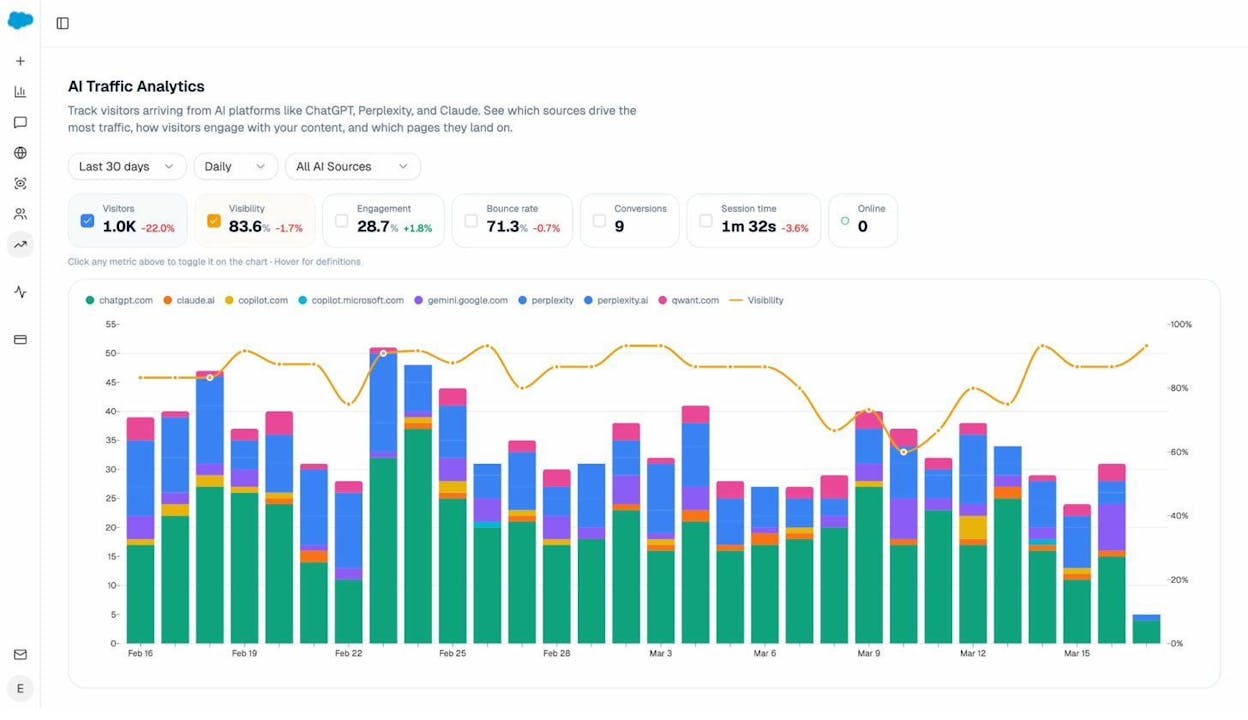
Analyze AI’s AI Traffic Analytics shows you exactly how much traffic arrives from each AI platform. You can see visitors from ChatGPT, Claude, Perplexity, Gemini, and Copilot broken down by day, engagement rate, bounce rate, and conversions. This gives you a complete view of whether the clicks you lose from featured snippet changes are being partially recovered through AI search referrals.
3. Most Featured Snippets Rank in the Top 5 Positions
In the original 2017 study of 2 million keywords, only 30.9% of featured snippets appeared at the very top of the search results. The rest ranked within the top 5 positions fairly consistently.
This finding has held up in more recent analyses. The vast majority of featured snippets are pulled from pages ranking in positions 1 through 5. Pages in positions 6 through 10 get featured far less often.
This matters for strategy. If your page ranks at position 8 or 9, your odds of winning the snippet are low. But if you can push into the top 5, the featured snippet opportunity opens up dramatically.
4. You Must Rank in the Top 10 to Get Featured (99.58% of the Time)
Data shows a 99.58% probability that Google only features pages already ranking in the top 10 organic results for that query.
The remaining 0.42% are pulled from other SERP features like knowledge panels or answer boxes. They are anomalies.
The practical implication is straightforward. You cannot shortcut your way to a featured snippet. You need strong enough content, backlinks, and topical authority to earn a first-page ranking first. The snippet opportunity comes after.
This is also why content strategy and keyword research matter so much. You need to identify queries where you already rank on page one, or can realistically reach page one, and then optimize your content format to match the snippet type Google displays for that query.
5. Backlink Strength Does Not Determine Which Page Gets Featured
When researchers compared the backlink profiles of featured pages against the median backlink profile of other top-10 pages on the same SERP, the results were surprising.
In most cases, the featured page’s backlink metrics were on par with the rest of the top 10. Google was not consistently picking the page with the strongest backlink profile.
This means that winning a featured snippet is less about raw authority and more about content formatting and relevance. Google’s criteria for selecting a snippet focus on how well the content directly answers the specific query, how it is structured (paragraph, list, table), and whether the answer is concise enough to fit the snippet box.
That said, backlinks still matter for getting onto page one in the first place. You cannot earn a snippet from position 30. But once you are on page one, the snippet competition is more about on-page structure than off-page authority.
6. A Single Page Can Rank for Thousands of Featured Snippets
The top-performing page in one study ranked for 4,658 featured snippets simultaneously.
This is not a typo. A single comprehensive page can get pulled into thousands of featured snippets across thousands of different long-tail keyword variations.
The pattern is consistent with broader SEO research showing that a single well-structured page can rank for hundreds or thousands of related keywords. When that page also matches the snippet format for those keywords, it can capture snippet after snippet.
This has an important strategic implication. Rather than creating a separate page for every keyword variation, you are often better off writing deep, comprehensive content that covers a topic thoroughly. That approach naturally hits many long-tail queries that trigger featured snippets.
The same principle applies to AI search. When we analyzed 83,670 AI citations across ChatGPT, Claude, and Perplexity in our own study, we found that comprehensive content with clear structure gets cited across many different prompts. Claude in particular favors blog content at a rate of 43.8%, nearly four times ChatGPT’s rate of 16.7%. The more depth your page has, the more variations of related questions it can answer, both for Google and for AI engines.
7. Most Featured Snippets Are Triggered by Long-Tail Keywords
Here is a finding that often surprises people. The majority of featured snippets are triggered by long-tail keywords, not high-volume head terms.
The search volume distribution of keywords with featured snippets skews heavily toward lower-volume queries. This means that featured snippet optimization is not about chasing the biggest keywords. It is about writing thorough content that answers many specific questions within a topic.
This data supports the “write great, in-depth content” approach. You cannot manually target millions of long-tail featured snippets one by one. But you can write detailed, comprehensive articles that naturally answer dozens of related questions. When those pages rank, they pick up featured snippets for many of those long-tail variations organically.
The same long-tail dynamic appears in AI search. When someone asks ChatGPT or Perplexity a highly specific question, the LLM needs to find content that addresses that exact nuance. The pages that go deep on a topic are the ones that get cited.
Use Analyze AI’s Prompt Discovery to see the actual prompts people are asking AI engines about your brand and your competitors. Many of these prompts are the AI-search equivalent of long-tail keywords. The exact phrasing people use often reveals content gaps you can fill.
8. Question-Based Queries Are Not the Top Trigger for Featured Snippets
The original study grouped featured snippet queries into three categories: questions (who, what, how, why), prepositions (for, with, without), and comparisons (vs, versus, or).
The result was surprising. The vast majority of keywords that triggered featured snippets did not belong to any of these three categories. They were “other” queries like “primary taste sensations,” “cocktail weiner recipe,” and “gmat scores range.”
The top 30 most common words in featured snippet queries include basic terms like “best,” “make,” “vs,” “recipe,” “does,” and “cost.” These are everyday search terms, not formal question phrases.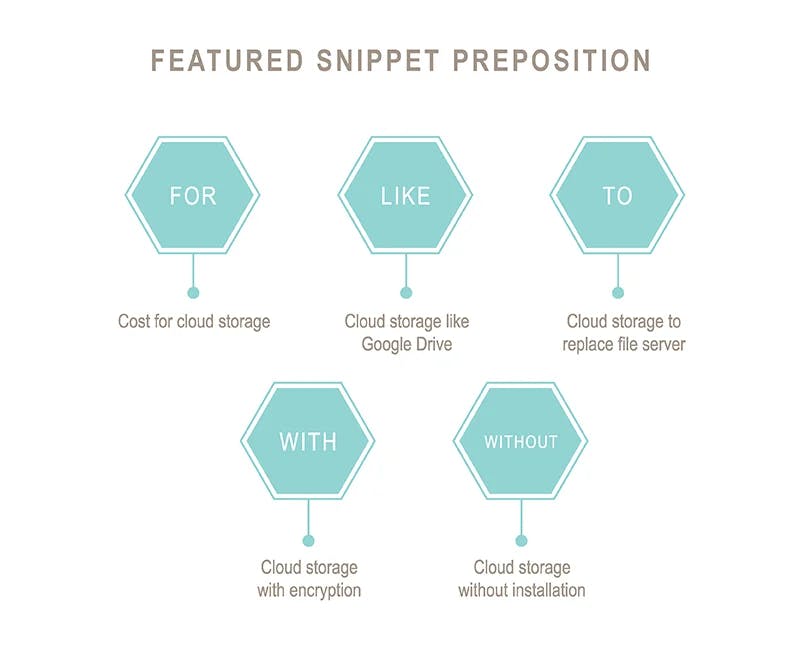
This means featured snippet optimization is not limited to question-and-answer content. Any query where Google wants to provide a direct, concise answer is a snippet opportunity. Product comparisons, definitions, recipes, how-to procedures, and even simple factual lookups can all trigger snippets.
For on-page SEO, the lesson is to structure your content so that clear, concise answers are easy for Google to extract, regardless of whether the searcher phrased their query as a question.
9. Wikipedia, YouTube, and Health Sites Dominate Featured Snippets
Wikipedia is the clear leader in total featured snippet ownership. That is no surprise. Its content is structured, factual, and covers virtually every topic.
But the rest of the top 20 is more interesting:
-
Health sites like WebMD, Healthline, and Mayo Clinic own a disproportionate share of featured snippets. Health queries are heavily informational and frequently trigger snippets.
-
YouTube ranks surprisingly high. Google pulls short video descriptions into featured snippets for search queries like “how to clean a dishwasher filter” or “how to connect HDMI to DVI.” Even a few-sentence video description can earn a snippet if it matches the query.
-
Recipe sites own a large share thanks to highly structured list and table content.
-
Educational and reference sites round out the top tiers.
The YouTube finding is especially notable. It means that video creators should pay attention to their video descriptions. A well-written description that concisely answers the query in the video title can earn a featured snippet, driving additional clicks from Google’s SERP.
10. Featured Snippets Are Volatile. Google Swaps Them Frequently.
Tracking 10,000 frequently updated keywords, researchers found that featured snippets change fairly often. Google does not lock in a single page for a snippet permanently. It swaps the source URL regularly.
This means two things. First, you can steal a competitor’s featured snippet. Snippet ownership is not permanent. Second, you can also lose your own snippets if a competitor produces better-formatted content or if Google changes its interpretation of the query.
For competitor monitoring, this makes regular tracking essential. If you are not monitoring your featured snippets, you will not know when a competitor steals one from you until you notice the traffic drop.
The Big Shift: Featured Snippets Are Becoming AI Overview Citations
This is the most important finding for anyone planning their SEO and content strategy in 2026.
Featured snippets are being absorbed into AI Overviews. The same pages that earned featured snippets are now being cited inside AI-generated summaries. Multiple studies confirm this correlation.
Here is what is happening:
AI Overviews are replacing featured snippets for complex queries. When Google determines that a query needs a synthesized answer from multiple sources (not just a single excerpt), it shows an AI Overview instead of a featured snippet. This is why featured snippet visibility dropped 64% in the first half of 2025.
But the same content patterns win in both formats. Research shows that pages optimized for featured snippets have a higher likelihood of being cited in AI Overviews. The skills are transferable. Clear headings, concise answers, structured data, and comprehensive coverage all matter for both.
AI Overviews cite more sources than featured snippets. A featured snippet pulls from one page. An AI Overview typically cites five to six pages. This means the total opportunity for citation is actually larger, even though any single page gets fewer clicks per appearance.
Featured snippets still dominate for simple factual queries. Definitions, short answer questions, and basic how-to lists still show traditional featured snippets. AI Overviews are concentrated on complex, multi-faceted informational queries.
|
Feature |
Featured Snippet |
AI Overview |
|---|---|---|
|
Sources cited |
1 page |
5-6 pages on average |
|
Query types |
Simple, factual, definitional |
Complex, multi-faceted |
|
Format |
Paragraph, list, table, video |
AI-generated summary |
|
Prevalence (2026) |
~8% of queries |
~20-30% of queries |
|
CTR to source |
~8.6% |
~1% (but more sources cited) |
|
Content needed |
Single concise answer |
Comprehensive, citable depth |
This shift is why tracking visibility across multiple channels matters more than ever. Featured snippets alone no longer capture the full picture of your search visibility.
How AI Search Engines Handle the Same Queries Differently
Here is something that most featured snippet studies miss entirely.
Google is not the only search engine anymore. When a user asks ChatGPT, Perplexity, or Claude the same question that would trigger a featured snippet on Google, they get a very different experience.
AI search engines do not show featured snippets. They generate full answers. And the sources they cite differ dramatically from what Google selects.
In our analysis of 83,670 AI citations, we found major differences in how each AI engine cites sources:
-
ChatGPT cites Wikipedia 12.1% of the time and LinkedIn 4.1% of the time. It strongly favors product pages (60.1%).
-
Claude barely cites Wikipedia (0.1%) and never cited LinkedIn in our dataset. It favors blog content (43.8%).
-
Perplexity never cited Wikipedia. It provides the most citations per mention (1.26) and splits between blog and product content.
This means that the page Google selects for a featured snippet may not be the page that ChatGPT, Claude, or Perplexity cites for the same question. Each engine has its own content preferences, its own source biases, and its own way of evaluating authority.
Use Analyze AI’s Sources dashboard to see exactly which URLs each AI engine cites in your industry. This shows you the content type breakdown (blog, website, review, product page, social) and the top cited domains. You can filter by AI model to see how each engine differs.
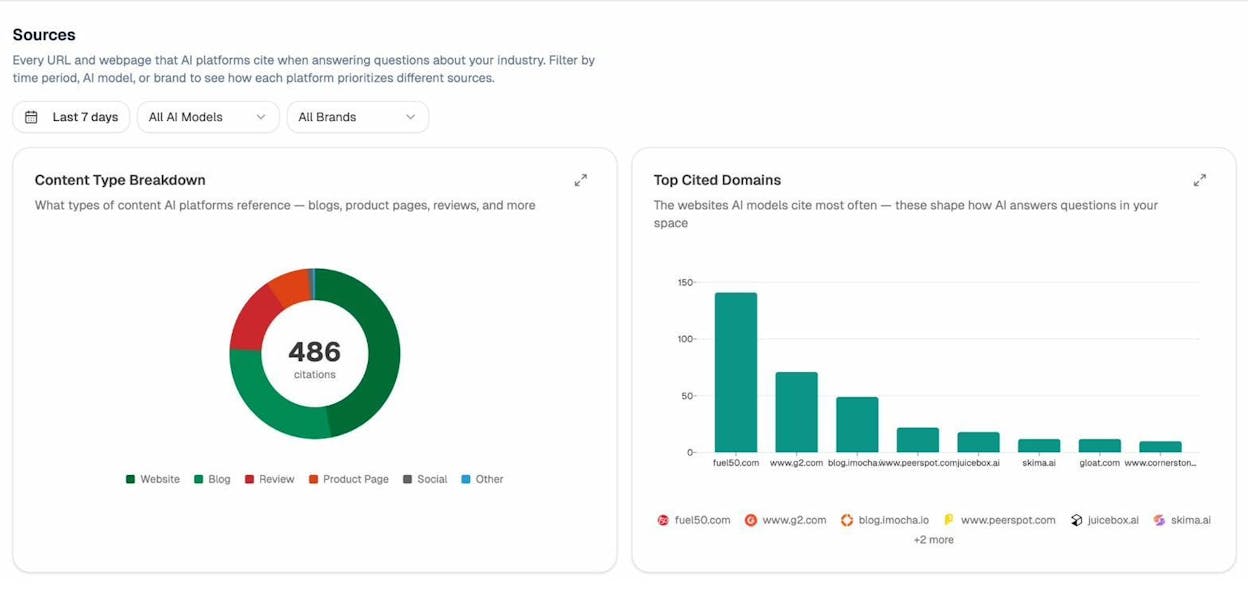
The takeaway: optimizing for Google’s featured snippet is one piece of the puzzle. But if you want visibility across all the places people search today, you need to understand how each AI engine selects sources and adjust your content strategy accordingly.
How to Rank in a Featured Snippet
Now let’s get practical. Here are the steps to win and keep featured snippets.
Step 1: Find Your Existing Featured Snippet Opportunities
Start with what you already have. If your site ranks in the top 10 for any keyword with a featured snippet, you already have an opportunity.
Open an SEO tool and filter your organic keywords by the “featured snippet” SERP feature. Then filter for keywords where you rank in positions 2 through 10 but do not own the snippet.
![[Screenshot description: SEO tool showing organic keywords filtered by “featured snippet” SERP feature, with position column visible]](https://www.datocms-assets.com/164164/1777577029-blobid5.png?auto=format,compress&w=1248&fit=max)
These are your lowest-effort opportunities. You already rank for the query. You just need to format your content to match what Google expects for the snippet.
Step 2: Match the Snippet Format
Look at the existing featured snippet for each target keyword. What format is it in?
If it is a paragraph snippet: Write a concise 40-to-50-word answer directly under a heading that matches the query. Place the heading as an H2 or H3 and put the answer immediately below it. Do not bury the answer several paragraphs into a section. Google wants it front and center.
If it is a list snippet: Use proper HTML list markup (ordered or unordered lists). Do not fake lists with bullet characters in paragraph text. Make sure your list items are concise and clearly represent individual steps or items.
If it is a table snippet: Use a proper HTML table. Most comparison posts use visual styling that does not translate to proper table markup. A well-structured HTML table with clear headers has a meaningful advantage.
![[Screenshot description: Side-by-side example of a paragraph snippet, list snippet, and table snippet on Google SERPs]](https://www.datocms-assets.com/164164/1777577034-blobid6.png?auto=format,compress&w=1248&fit=max)
Step 3: Include Both the Question and the Answer on Your Page
Google needs to identify the question and extract the answer. The easiest way to help is to use the exact query (or a close variant) as your heading, then answer it directly in the first one to two sentences below that heading.
For example, if the target query is “what is a featured snippet,” your page should have an H2 that says “What Is a Featured Snippet?” followed immediately by a one-to-two-sentence definition.
Keep the answer concise. Paragraph snippets are typically 40 to 60 words. If your answer runs much longer than that, Google may skip it for a more concise competitor.
Step 4: Protect the Snippets You Already Own
Featured snippets are volatile. Someone else can steal yours at any time.
Audit your existing snippets regularly. Make sure the content is current, accurate, and well-formatted. Outdated information is one of the fastest ways to lose a snippet.
Also watch for format changes. Google sometimes switches a query’s snippet from paragraph to list format (or vice versa). If the format changes and your content does not match the new format, you may lose the snippet.
Step 5: Write In-Depth Content That Captures Long-Tail Snippets
We know from the data that most featured snippets are triggered by long-tail keywords. You cannot target these one by one. Instead, write detailed, comprehensive content that naturally covers many sub-questions within a topic.
Use clear headings for each sub-topic. Answer each question concisely in the opening of each section. Use proper list and table markup where appropriate.
This approach creates a page that can capture dozens or even hundreds of featured snippets across related long-tail variations.
How to Track Your Visibility in AI Search
Featured snippet tracking is one half of the equation. The other half is knowing whether AI engines mention your brand, cite your content, and how they perceive you relative to competitors.
Track Which Prompts Mention Your Brand
Use Analyze AI’s Prompt Tracking to monitor specific prompts across ChatGPT, Claude, Perplexity, Gemini, and Copilot. You can see your visibility percentage, sentiment score, ranking position, and which competitors appear alongside you for each prompt.
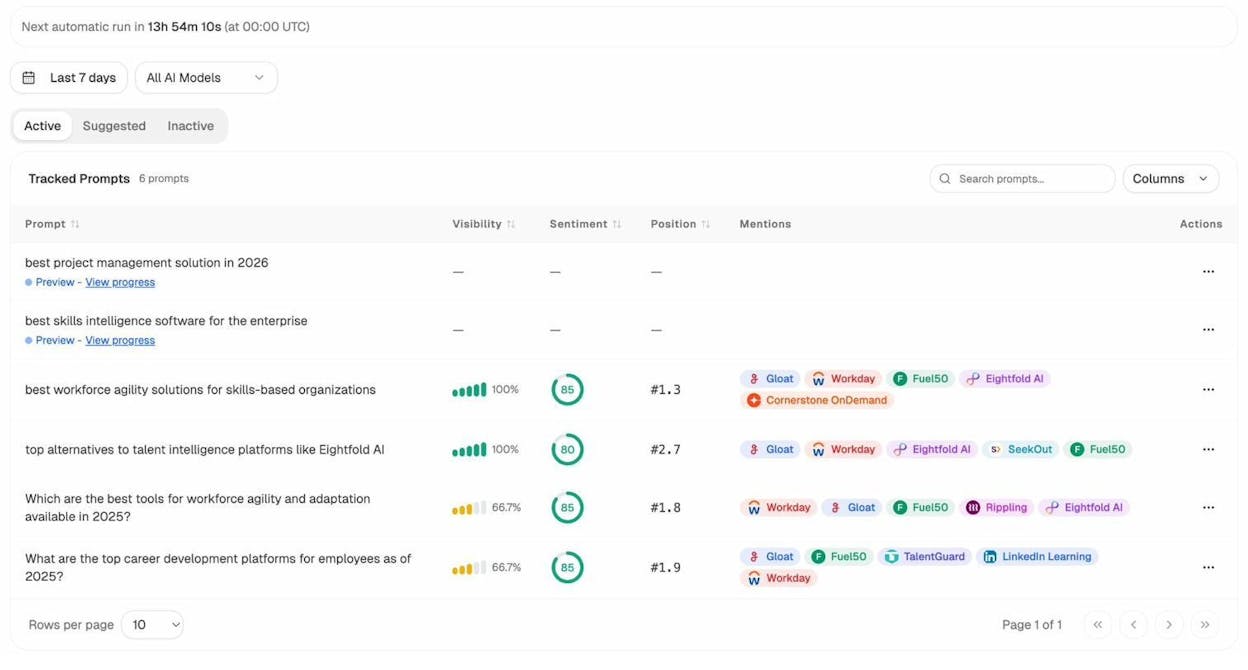
This is the AI search equivalent of tracking your keyword rankings in Google. Except instead of tracking positions 1 through 10, you are tracking whether your brand appears at all in AI-generated answers and in what context.
Find Competitor Gaps in AI Search
Analyze AI’s Competitor Intelligence shows you which competitors AI engines mention frequently and which ones you might be missing. If a competitor appears in AI answers that your brand does not, that is a content gap you can fill.
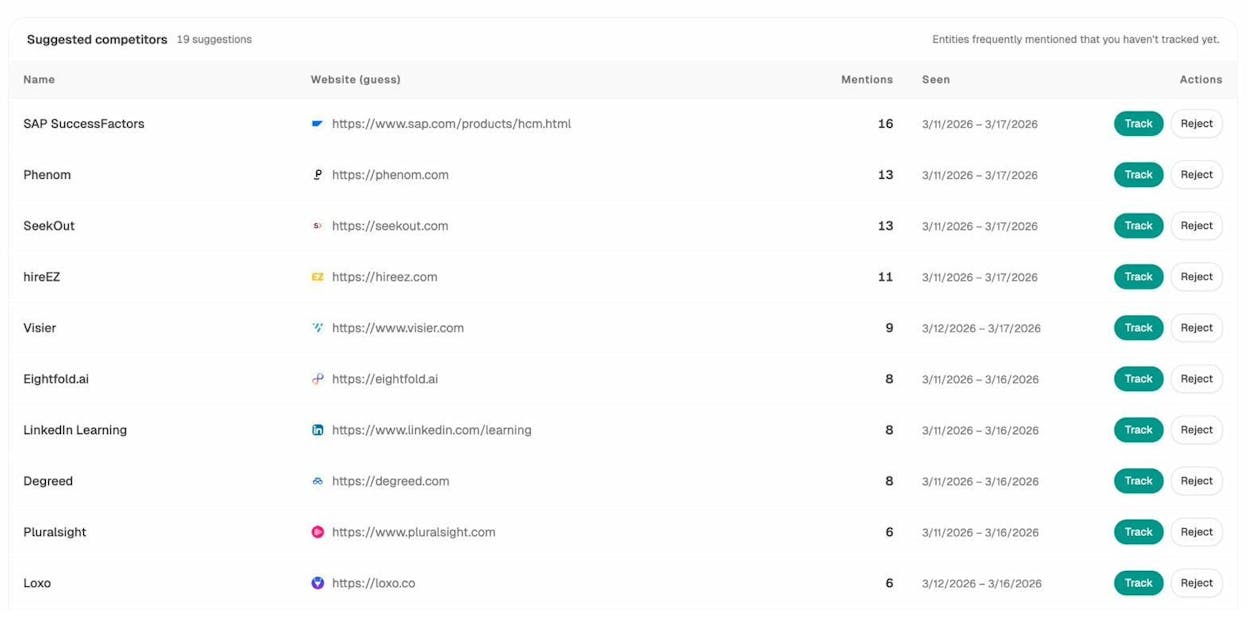
These gaps are direct opportunities. If an AI engine consistently mentions a competitor for a certain topic but not your brand, you need content that covers that topic with enough depth and clarity to earn an AI citation.
Monitor Brand Sentiment Across AI Engines
Different AI engines perceive the same brand differently. In our study, the same brand was scored up to 79 points apart across ChatGPT, Claude, and Perplexity.
Analyze AI’s Perception Map shows you how AI engines describe your brand across key themes. You can see which attributes each engine associates with your brand (positive and negative) and the exact language they repeat.
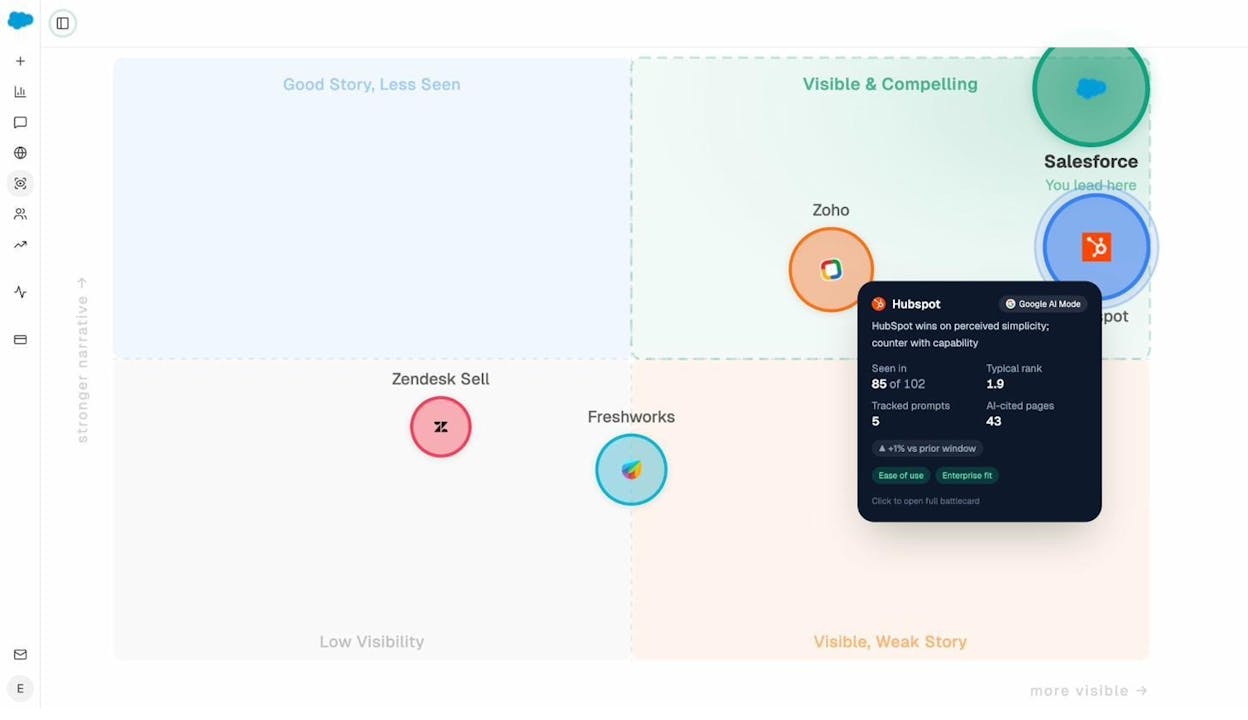
This data tells you whether your messaging is getting through to AI models. If you want AI engines to describe your brand as “easy to use” or “enterprise-grade,” the Perception Map shows you whether that is happening or not.
Measure AI Traffic to Your Website
Once you understand your AI visibility, you need to measure the actual traffic it drives. Analyze AI’s AI Traffic Analytics connects to your website analytics and shows visitors arriving from AI platforms, broken down by source, engagement, bounce rate, conversions, and session time.
This closes the loop between visibility and revenue. You can see not just whether AI engines mention you, but whether those mentions drive qualified traffic and conversions.
Featured Snippet Optimization and AI Search Optimization Are Complementary
One of the biggest misconceptions we see is the idea that featured snippets are “dead” and you should abandon them for AI search optimization. This framing is wrong.
The Analyze AI manifesto is clear on this point. SEO is not dead. AI search is an additional organic channel alongside traditional SEO, not a replacement for it. The teams that treat these as complementary strategies will outperform the ones that chase trends and panic.
Here is why the two strategies reinforce each other:
The content structure that wins featured snippets also earns AI citations. Clear headings, concise answers, structured data, and thorough topic coverage are the exact signals that LLMs use to select and cite sources.
Pages that rank on Google’s first page are more likely to be crawled and indexed by AI engines. High-ranking pages have more backlinks, more authority signals, and more external references. These are the same signals that LLMs use to evaluate source credibility.
Featured snippet optimization forces clarity. When you structure content to win a snippet, you are forced to answer questions directly and format information cleanly. That clarity translates into better performance everywhere, including AI search, voice search, and regular organic rankings.
The winners in 2026 are the brands that optimize for both channels simultaneously. They write comprehensive content that answers questions clearly. They structure it with proper headings, lists, and tables. They earn backlinks and build topical authority. And they track their performance across Google, ChatGPT, Claude, Perplexity, and Gemini to understand the full picture.
Key Takeaways
Featured snippets appeared on roughly 12% to 24% of queries during their peak, but have contracted to approximately 8% as AI Overviews absorb complex informational queries. They still matter for definitions, lists, how-to content, and simple factual queries.
Featured snippets reduce overall CTR, but they put your brand at the top of the SERP. The visibility and brand awareness benefits are real even when click-through is lower.
You must rank in the top 10 to be featured. Backlink strength gets you onto page one, but content structure determines which page wins the snippet.
Long-tail keywords drive the majority of featured snippets. Write comprehensive, in-depth content to capture them organically. Do not try to target them one by one.
Featured snippets are volatile. Monitor them regularly and protect the ones you own by keeping content current and well-formatted.
The same content patterns that win featured snippets also earn AI search citations. Treat SEO and AI search as complementary channels, not competing priorities.
Track your visibility across all AI platforms with tools like Analyze AI to get the complete picture of where your brand appears in search, who your competitors are in AI answers, and how much qualified traffic these channels drive to your site.
Featured snippets are not the finish line anymore. They are one part of a broader visibility strategy that now spans Google, ChatGPT, Claude, Perplexity, Gemini, and every AI engine your buyers use. The brands that understand this and act on it will compound their advantage. The ones that wait will spend the next two years wondering where their traffic went.

Ernest

Ibrahim


