



Summarize this blog post with:


In this article, you’ll learn how Google’s search results page has changed dramatically since early 2025, which SERP features are growing, which are dying, what the data from multiple large-scale studies reveals about the shift, and how to adapt your strategy for both traditional search and the growing AI search channel.
Table of Contents
What Are SERP Features?
SERP features are any result on a Google search page that goes beyond the standard ten blue links. They include AI Overviews, Featured Snippets, People Also Ask boxes, Knowledge Panels, Local Packs, Shopping results, Sitelinks, Video carousels, Discussion forums, and News boxes.
Each feature serves a specific intent. Some answer questions directly (Featured Snippets, AI Overviews). Some help users navigate to the right part of a site (Sitelinks). Some point to local businesses (Local Packs). And some showcase products (Shopping results).
The important thing to understand is that SERP features compete with organic results for attention. A page that ranks number one organically can still be invisible if an AI Overview, a People Also Ask box, three ads, and a video carousel sit above it.
This is why tracking your rank position alone is no longer enough. You need to understand which SERP features appear for your target keywords, whether those features are growing or shrinking, and whether your content is showing up inside them.
How We Gathered This Data
The findings in this article draw on multiple large-scale studies published between late 2025 and mid-2026:
|
Study |
Sample Size |
Period |
Key Focus |
|---|---|---|---|
|
Ahrefs SERP Study |
1,000,000 US desktop SERPs |
Jan–Jun 2025 |
SERP feature presence changes |
|
Serpstat Year in Search |
1 billion keywords, 35 million AI Overviews |
Feb–Dec 2025 |
AI Overview growth and source overlap |
|
Semrush AI Overviews Study |
10 million keywords |
Throughout 2025 |
AI Overview expansion by industry |
|
Seer Interactive CTR Study |
3,119 queries, 25.1 million impressions |
Jun 2024–Sep 2025 |
Click-through rate impact |
|
ALM Corp SERP Remonetization |
16,000+ queries across 4 verticals |
Jan 2025–Jan 2026 |
Organic vs. paid click share shifts |
By combining these datasets, we can paint a much more complete picture than any single study provides.
The SERP Features That Are Declining
Nine of the fifteen major SERP features tracked by Ahrefs declined in appearance between January and June 2025. Four of them declined significantly.
Featured Snippets: Down 64%
Featured Snippets appeared on 15.41% of SERPs in January 2025. By June, that number dropped to 5.53%. That is a 64% relative decline in six months.
This is the single most important shift for content marketers to understand. Featured Snippets were the gold standard of “position zero” SEO for nearly a decade. Entire content strategies were built around winning them. Now they are being replaced.
The decline correlates very strongly with the growth of AI Overviews. Ahrefs found a -0.90 correlation between the two features. Serpstat’s data corroborates this, showing a clear “switchover” in March 2025 when AI Overviews jumped from roughly 3% to over 8% of SERPs in a single month. Featured Snippets dropped sharply at exactly the same time.
This makes intuitive sense. Both features serve the same purpose: answering the searcher’s question directly on the results page without requiring a click. Google appears to have decided that AI Overviews do this job better, and is gradually phasing Featured Snippets out in favor of them.
![[Screenshot: Google search showing an AI Overview replacing what would have been a Featured Snippet for an informational query]](https://www.datocms-assets.com/164164/1777319061-blobid1.jpg?auto=format,compress&w=1248&fit=max)
Shopping Results: Down 68%
Shopping SERP features dropped from 3.14% to 0.99% of SERPs, a 68% relative decline. This likely reflects Google consolidating its commerce features into other formats, including AI-powered shopping experiences it has been testing since late 2024.
Paid Results and Paid Sitelinks: Down 53% and 55%
Paid SERP features also declined in raw appearance rate. But this number is misleading. While paid ads appeared on fewer SERPs overall, the data from ALM Corp’s study of 16,000+ queries tells a different story: text ads actually captured 7 to 13 percentage points of previously organic click share between January 2025 and January 2026.
In other words, paid ads are appearing on fewer keywords but taking a larger share of clicks on the keywords where they do appear. This is Google’s remonetization strategy in action, and it is worth watching closely.
Other Declining Features
|
SERP Feature |
Jan 2025 |
Jun 2025 |
Change |
|---|---|---|---|
|
Shopping |
3.14% |
0.99% |
-68% |
|
Featured Snippet |
15.41% |
5.53% |
-64% |
|
Paid Sitelink |
1.48% |
0.66% |
-55% |
|
Paid |
1.95% |
0.91% |
-53% |
|
Local Teaser |
2.55% |
1.96% |
-23% |
|
Local Pack |
3.48% |
2.96% |
-15% |
|
Knowledge Panel |
14.09% |
12.95% |
-8% |
|
Organic Shopping |
11.24% |
10.40% |
-7% |
|
News |
14.94% |
14.20% |
-5% |
Local Packs, Knowledge Panels, and News results saw smaller declines. These features serve intents that AI Overviews are not yet well-suited to replace. When someone searches for “pizza near me,” an AI Overview is less useful than a map with ratings and directions. When someone searches for a breaking news event, a curated News box still outperforms a generated summary.
But the trend line points in one direction. AI Overviews are flexible enough to accommodate many different intents, and Google is clearly expanding their scope.
The SERP Features That Are Growing
Six SERP features grew in appearance between January and June 2025. Three of them grew dramatically.
Sitelinks: Up 906%
Sitelinks were the biggest winner, jumping from 8.44% to 84.95% of SERPs. This 906% increase is staggering, and it happened almost entirely during Google’s March 2025 Core Update.
Before March, most Sitelinks were “Internal Sitelinks” that appeared only for branded searches. After March, Google rolled out “Scroll-to Sitelinks” that can appear for both branded and non-branded queries. These link to specific sections within a page, making it easier for users to jump directly to the information they need.
For SEO teams, this means your on-page structure matters more than ever. Clear headings, logical section organization, and proper use of anchor links all increase the likelihood that Google will generate Scroll-to Sitelinks for your content.
![[Screenshot: Google SERP showing Scroll-to Sitelinks for a non-branded informational query]](https://www.datocms-assets.com/164164/1777319074-blobid2.png?auto=format,compress&w=1248&fit=max)
AI Overviews: Up 598%
AI Overviews grew from 3.93% to 27.43% of SERPs between January and June 2025. By November 2025, Serpstat’s data showed them on 27.5% of tracked SERPs across their full keyword database. By some estimates, they now appear on 40% or more of informational queries.
Here is what multiple studies tell us about where AI Overviews show up most:
|
Query Type |
AI Overview Prevalence |
|---|---|
|
Informational queries |
40–60% |
|
Commercial/comparison queries |
20–30% |
|
Technology and general knowledge |
50–60% |
|
Healthcare and finance (YMYL) |
15–20% |
|
Real estate and shopping |
Minimal |
|
Local/navigational |
Minimal |
The pattern is clear. AI Overviews dominate informational search. They are expanding into commercial search. And they are being kept away from categories where Google already has strong monetization features (shopping, local) or where accuracy concerns limit AI-generated answers (YMYL).
Semrush’s 10 million keyword study also found a notable trend in what appears alongside AI Overviews. Featured Snippets co-occurring with AI Overviews dropped from 34% in March to 18% by November 2025. Meanwhile, Google Ads appearing alongside AI Overviews jumped from less than 1% to 25% in the same period.
This tells you exactly what Google’s strategy is: use AI Overviews to answer informational queries (replacing Featured Snippets) while simultaneously creating new ad inventory around those answers.
AI Overview Sitelinks: Up 541%
AI Overview Sitelinks, the source links that appear within AI Overviews, grew from 3.90% to 25.00%. This feature is functionally how Google gives credit to the sources it used to generate the AI Overview. Being cited as an AI Overview source is the new equivalent of winning a Featured Snippet.
Knowledge Cards: Up 54%
Knowledge Cards grew from 1.50% to 2.30%, a 54% increase. These are the factual information boxes that appear for entity-based queries (people, places, organizations). Google continues to invest in its Knowledge Graph, and these cards are becoming richer and more interactive.
Discussion and Question Features: Steady Growth
Discussion forums (mainly Reddit) grew 4% to 20.26%, and People Also Ask boxes grew 7% to 79.13%. People Also Ask now appears on nearly 8 out of 10 searches, making it one of the most dominant SERP features. For content teams, optimizing for People Also Ask remains a high-value tactic.
|
SERP Feature |
Jan 2025 |
Jun 2025 |
Change |
|---|---|---|---|
|
Sitelinks |
8.44% |
84.95% |
+906% |
|
AI Overview |
3.93% |
27.43% |
+598% |
|
AI Overview Sitelink |
3.90% |
25.00% |
+541% |
|
Knowledge Card |
1.50% |
2.30% |
+54% |
|
People Also Ask |
73.73% |
79.13% |
+7% |
|
Discussion |
19.49% |
20.26% |
+4% |
The Featured Snippet to AI Overview Switchover
The most important story in these numbers is the inverse relationship between Featured Snippets and AI Overviews. When you plot both features on the same timeline, you see a clear crossover point in March 2025.
Before March, Featured Snippets appeared on roughly 15% of SERPs and AI Overviews on roughly 4%. After March, those numbers inverted. AI Overviews climbed rapidly while Featured Snippets fell at almost the same rate.
This is not a coincidence. Both features answer the same user need. The key difference is that AI Overviews can synthesize information from multiple sources, handle more complex queries, and adapt their format to different types of questions. A Featured Snippet could only extract a paragraph, list, or table from a single page. An AI Overview can combine information from ten pages and present it as a coherent answer.
For SEO practitioners, this shift has practical implications. The tactics that won Featured Snippets (clear question-and-answer formatting, concise paragraphs, structured data) still matter. But now you are optimizing to be cited as a source within AI Overviews rather than to have your content extracted as the Featured Snippet itself.
Serpstat’s data adds an important nuance here. Their analysis of AI Overview sources found that over 90% of the domains cited in AI Overviews do not come from the organic top 20 for that query. Only 4-8% of AI Overview sources overlap with the top organic results.
This means ranking well organically does not guarantee visibility in AI Overviews. And appearing in AI Overviews does not require ranking on page one. The source selection process is different, and Google appears to be using a broader set of signals than traditional ranking factors.
What the CTR Data Says
The shift in SERP features is not just an academic exercise. It has real consequences for traffic.
Seer Interactive’s study of 3,119 informational queries across 42 organizations found that organic click-through rates dropped 61% for queries where AI Overviews appeared. Organic CTR fell from 1.76% to 0.61%. Paid CTR dropped even more sharply, falling 68% from 19.7% to 6.34%.
But here is the part most people miss: brands that were cited inside AI Overviews actually saw increased clicks. Seer found that brands cited in AI Overviews earned 35% more organic clicks and 91% more paid clicks compared to brands that were not cited.
This creates a clear two-tier system. If your content is a source for AI Overviews, you benefit from the feature. If your content is pushed below it, you lose traffic. The strategy is obvious: figure out how to become a cited source.
BrightEdge’s data corroborates this at a macro level. Overall search impressions are up nearly 50% year over year, but clicks are not growing at the same rate. People are seeing more results but clicking on fewer of them. The clicks that do happen are increasingly concentrated among cited sources and high-intent queries.
Why Zero-Click Does Not Mean Zero Value
A common reaction to the SERP feature evolution is panic. If AI Overviews answer the question without a click, what is the point of creating content?
This is the wrong framing. Here is why.
First, brand visibility in a zero-click result still has value. When someone asks ChatGPT or Google’s AI Overview for the best CRM tools and your brand appears in the answer, that person now knows you exist. They may not click today, but when they are ready to buy, your brand is in their consideration set. This is how brand awareness has always worked. It just happens on a search results page now instead of a billboard.
Second, the data shows that being cited in AI results actually increases clicks for your other content. The Seer Interactive study proved this. Citations drive trust, and trust drives clicks.
Third, AI search engines are sending real traffic. ChatGPT has over 800 million weekly active users. Perplexity processed 780 million queries in May 2025 alone. These platforms include citations that link directly to source content. And the traffic they send converts well because it arrives with high intent.
At Analyze AI, we have seen this firsthand with our customers. Kylian AI, for example, scaled from 200 to over 1,000 AI-sourced sessions per month. Their AI search traffic converts at 5 to 8%, far above their typical blog conversion rate of 1 to 2%. That is not a rounding error. That is a meaningful growth channel.
The brands that treat zero-click as a death sentence are missing the bigger picture. The brands that adapt, by becoming cited sources in both Google’s AI Overviews and standalone AI search engines, are building a compounding advantage.
How to Analyze SERP Features for Your Keywords
Understanding the macro trends is useful. But what matters most is knowing which SERP features appear for your specific target keywords and how those features are changing over time. Here is how to do that.
Step 1: Build Your Keyword List
Start with the keywords that drive your business. Pull them from Google Search Console, your keyword research tools, and your content strategy. Focus on 100 to 500 keywords that represent your core topics and funnel stages.
Do not limit yourself to head terms. Include long-tail queries, question-based keywords, and comparison keywords. Different keyword types trigger different SERP features, and you need to understand the full landscape.
![[Screenshot: Google Search Console Performance report filtered by queries, showing CTR changes over time]](https://www.datocms-assets.com/164164/1777319084-blobid3.png?auto=format,compress&w=1248&fit=max)
Step 2: Check Which SERP Features Appear
For each keyword, search it manually on Google (in an incognito window) and note which SERP features appear. Pay attention to whether an AI Overview shows up, whether People Also Ask boxes appear, and where your organic listing sits relative to all the other features.
You can speed this up using the Analyze AI SERP Checker, which lets you see the full SERP layout for any keyword without manual searching.
![[Screenshot: Analyze AI SERP Checker showing SERP features for a target keyword]](https://www.datocms-assets.com/164164/1777319092-blobid4.png?auto=format,compress&w=1248&fit=max)
Step 3: Categorize by Feature Type
Group your keywords based on the dominant SERP features they trigger:
AI Overview keywords. These are queries where Google shows an AI-generated summary at the top. Typically informational or comparison queries. Your strategy here is to become a cited source within the AI Overview.
PAA-dominant keywords. Queries where People Also Ask boxes dominate the above-the-fold real estate. Your strategy is to create content that answers these questions directly, with clear headings and concise answers.
Local Pack keywords. Queries with local intent where the map and business listings appear. Your strategy is local SEO: Google Business Profile optimization, reviews, and local content.
Clean organic keywords. Queries where traditional organic results still dominate without heavy SERP feature interference. These are your highest-opportunity keywords for traditional SEO, and they are becoming rarer.
Step 4: Track Changes Over Time
SERP features are not static. The keywords that trigger AI Overviews today may not trigger them next month, and vice versa. Set up a monthly check of your top keywords to track which features appear and how your visibility within them changes.
Google Search Console now includes some AI Overview data in its performance reports, though the attribution is limited. For a more complete view, you will need to combine GSC data with a dedicated SERP monitoring tool.
How to Optimize for the New SERP Landscape
Knowing what is changing is the first step. Adapting your content strategy is the second. Here are the specific actions to take.
Optimize for AI Overview Citations
The most valuable SERP feature to target in 2026 is AI Overview citations. Here is what the data says about what gets cited:
Authoritative, in-depth content wins. Google’s AI cites sources that demonstrate expertise and provide comprehensive coverage of a topic. Thin content does not get cited.
Structure matters. Content with clear headings, logical flow, direct answers to questions, and supporting evidence is more likely to be pulled into AI Overviews. Use BLUF (Bottom Line Up Front) in every section. Lead with the answer, then provide context.
Entity coverage is critical. AI Overviews rely on Google’s understanding of entities (people, organizations, concepts, products). Make sure your content mentions relevant entities and explains the relationships between them.
Freshness counts. AI Overviews favor recent, updated content. If your cornerstone pages have not been refreshed in over a year, they are less likely to be cited.
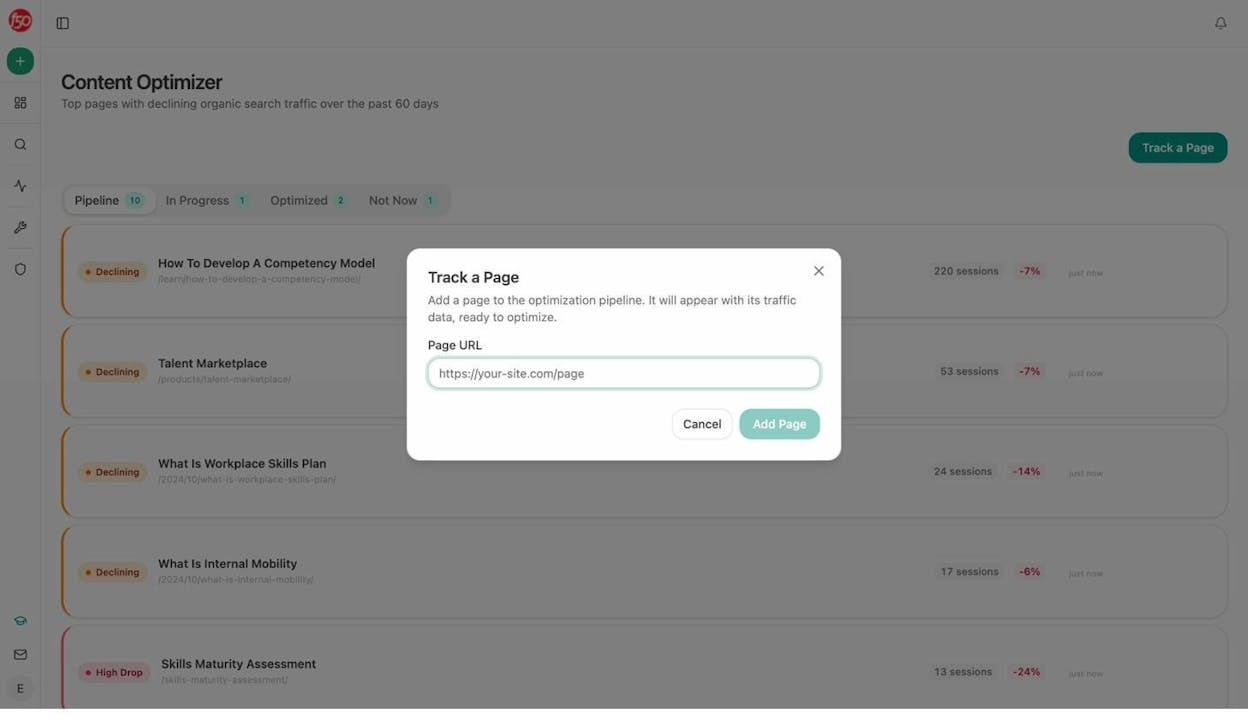
The Analyze AI Content Optimizer can help here. It fetches your existing pages, scores them on argument quality and structural clarity, and generates specific editorial suggestions to improve their chances of being cited by both Google’s AI Overviews and standalone AI search engines.
Win the People Also Ask Box
PAA appears on nearly 80% of searches. It is the most common SERP feature, and it is still growing. Here is how to win it:
Answer the exact question. Write a clear, concise answer (40 to 60 words) directly below a heading that matches the PAA question. This gives Google a clean extract to use.
Cover related questions. PAA boxes are generated from clusters of related queries. If you answer one question well, Google is more likely to pull your content for related questions too. Use your keyword research to find the full cluster of questions around each topic.
Use FAQ schema markup. Structured data helps Google understand that your content contains question-and-answer pairs. This increases your chances of appearing in PAA and in voice search results.
For more on this, see our guide on optimizing for People Also Ask.
Structure Content for Scroll-to Sitelinks
With Sitelinks appearing on 85% of SERPs, your on-page structure directly affects how much real estate you occupy on the results page. Use clear, descriptive H2 headings that match common search variations. Use jump links (anchor links) within your page. And keep your heading hierarchy clean (H1 > H2 > H3) so Google can easily identify the structure.
Do Not Abandon Traditional SEO
The panic narrative says SEO is dead. The data says otherwise.
People are still using traditional search engines. According to SparkToro, 95% of Americans continue to use them each month, and 86% are heavy users. Organic search still drives the majority of website traffic for most businesses.
What is changing is that SEO alone is not enough anymore. You need to be visible in Google’s organic results, in Google’s AI Overviews, and in standalone AI search engines. These are three overlapping but distinct visibility layers, and the brands that show up across all three are the ones building durable competitive advantages.
As the Analyze AI manifesto puts it: quality content still wins. The brands that show up in AI answers are the ones with clear, original, and useful content. The difference now is that your content has to work for AI models too, not just Google.
Beyond Google: The AI Search Visibility Layer
Everything discussed so far has been about Google’s results page. But there is a second, parallel evolution happening that most SERP feature analyses ignore entirely: the rise of AI search engines as a standalone discovery channel.
ChatGPT, Perplexity, Gemini, and Copilot do not have traditional SERP features. They do not show ten blue links, People Also Ask boxes, or Knowledge Panels. Instead, they generate a single, synthesized answer and cite the sources they used.
Those citations are the AI search equivalent of SERP features. They function the same way: they determine who gets visibility, who gets traffic, and who gets ignored.
And unlike Google’s SERP features, which you can analyze using traditional SEO tools, AI search citations require a different set of tools to track.
How AI Search Engines Decide What to Cite
Each AI search engine has its own approach to selecting sources, but the patterns are consistent:
Content quality is the primary signal. AI models favor content that is comprehensive, well-structured, factually accurate, and clearly written. This is similar to what wins Featured Snippets and AI Overviews on Google.
Domain authority matters, but differently. AI search engines do not rely on PageRank the way Google does. They tend to favor well-known, authoritative sites, but they also cite niche sources that provide uniquely detailed coverage of specific topics. A small SaaS blog that writes the definitive guide to a narrow topic can outperform a major publication.
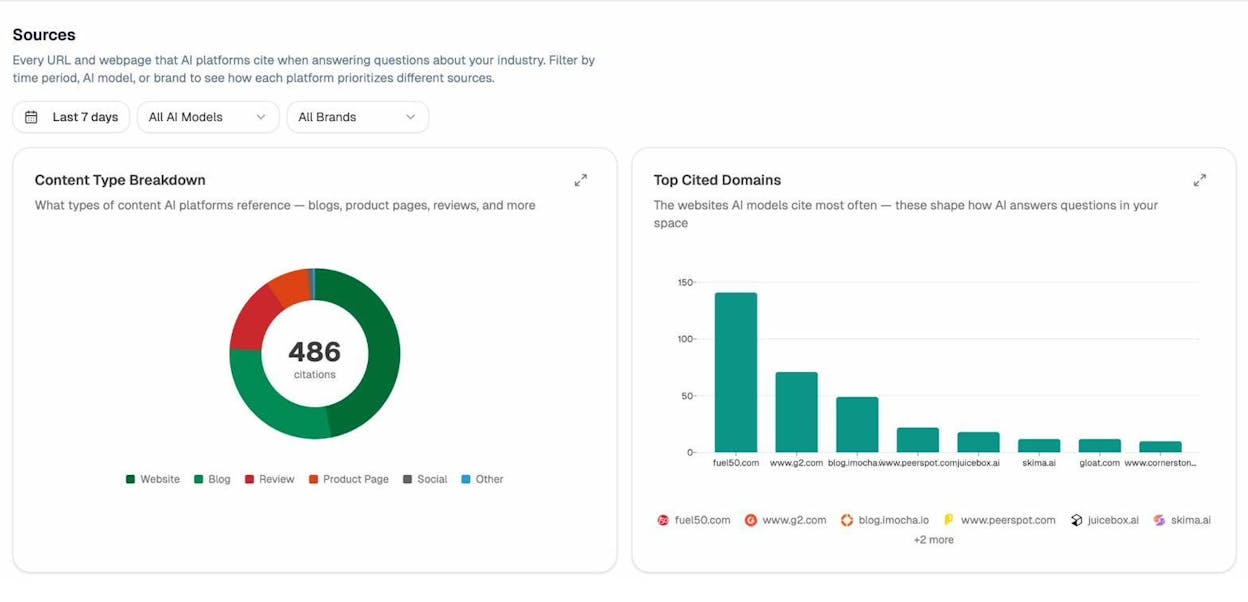
Content format influences citation. Analyze AI’s Sources dashboard shows which content types AI engines cite most in any given industry. In many spaces, blog posts and documentation pages are cited far more often than product pages or landing pages.
Freshness and update frequency. AI models trained on more recent data tend to favor more recent content. Perplexity, which searches the web in real-time, is particularly sensitive to content freshness.
How to Track Your AI Search Visibility
Google Search Console tells you how you perform on Google. But there is no “Search Console” for ChatGPT or Perplexity. This is why we built Analyze AI.
Here is how to set up AI search tracking:
Step 1: Identify the prompts that matter to your business. Think about the questions your target audience asks AI search engines. These are not the same as Google keywords. They tend to be longer, more conversational, and more specific. For example, instead of “best CRM software,” someone might ask ChatGPT “What is the best CRM for a 50-person B2B SaaS company that needs HubSpot migration support?”
Analyze AI’s Prompt Discovery feature helps you find the prompts that are relevant to your brand and industry. It suggests prompts based on your competitors and your tracked topics, so you do not have to guess.
Step 2: Track your visibility across engines. Once you have identified the right prompts, track how AI search engines respond. For each prompt, you want to know: Does the AI mention your brand? What position are you in? What sentiment does the AI express about you? And who are the competitors that appear instead of you?
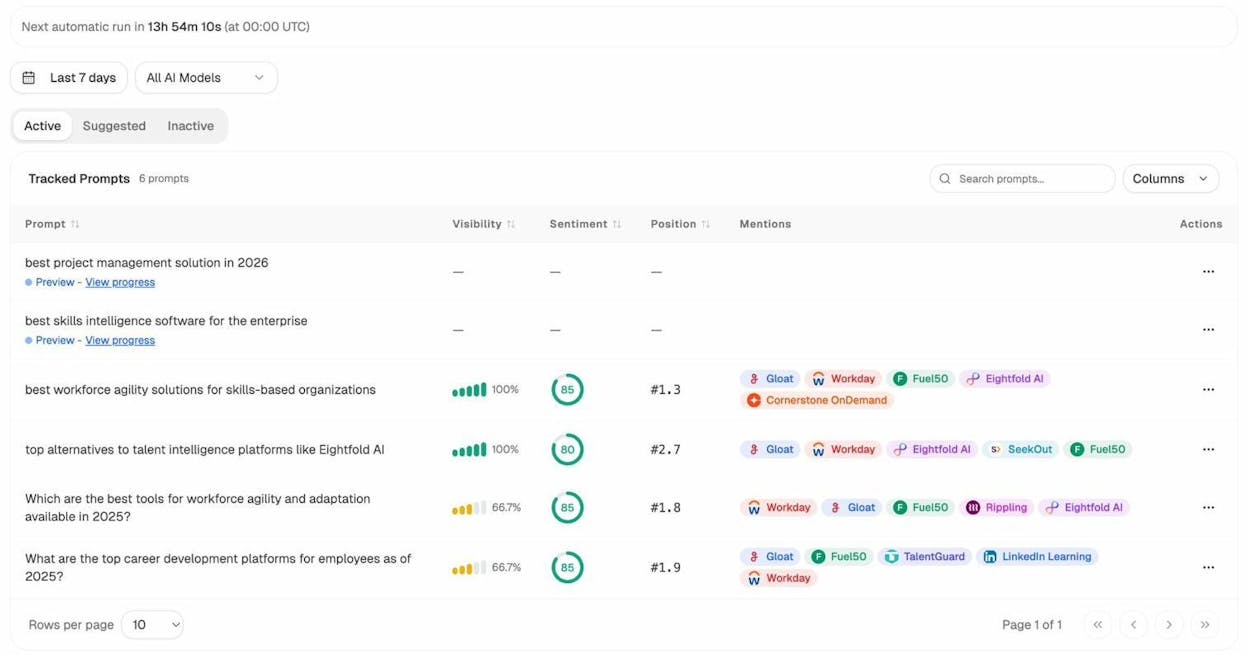
This is the AI search equivalent of tracking your keyword rankings on Google. Except instead of position 1 through 10, you are tracking whether you appear at all, and in what context.
Step 3: Identify your blind spots. The most valuable insight is not where you appear. It is where you do not appear but your competitors do. Analyze AI’s Competitor Intelligence dashboard shows you exactly which prompts your competitors win and you lose. These are your highest-priority opportunities.
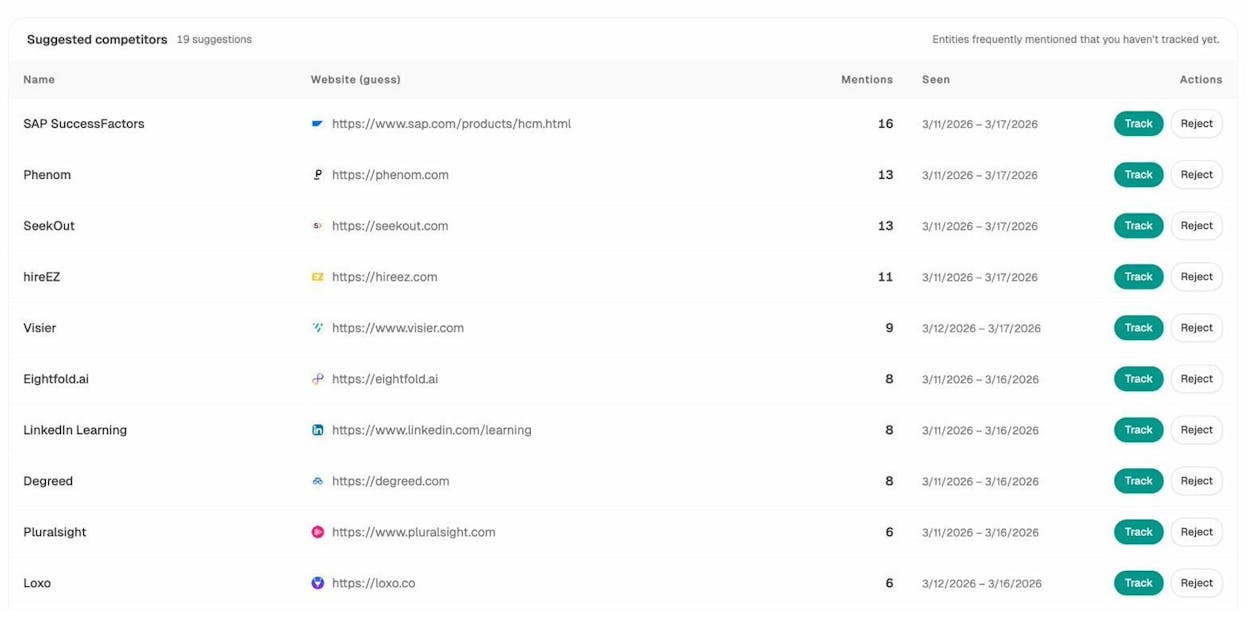
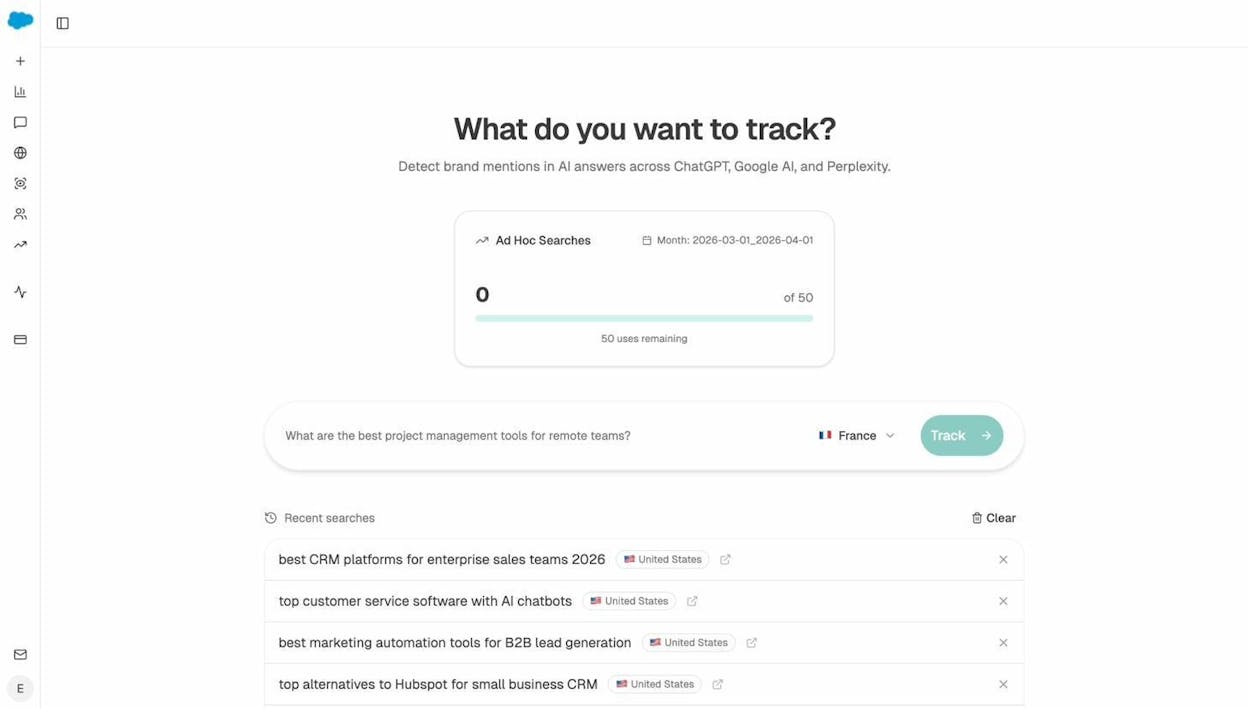
Step 4: Test new prompts before committing. Before you build a full tracking campaign around a new topic, run a quick ad hoc search to see who currently shows up. Analyze AI’s AI Search Explorer lets you run a one-off search across ChatGPT, Perplexity, and Google AI to see the competitive landscape for any prompt.
Step 5: Measure the traffic AI search sends you. AI search engines are already sending traffic to websites. ChatGPT, Perplexity, Claude, Gemini, and Copilot all include clickable citations in their responses. You can see this traffic in your analytics, but only if you know where to look.
Analyze AI’s AI Traffic Analytics dashboard connects to your GA4 data and shows you exactly how many visitors arrive from each AI search engine, which pages they land on, how they engage, and whether they convert.
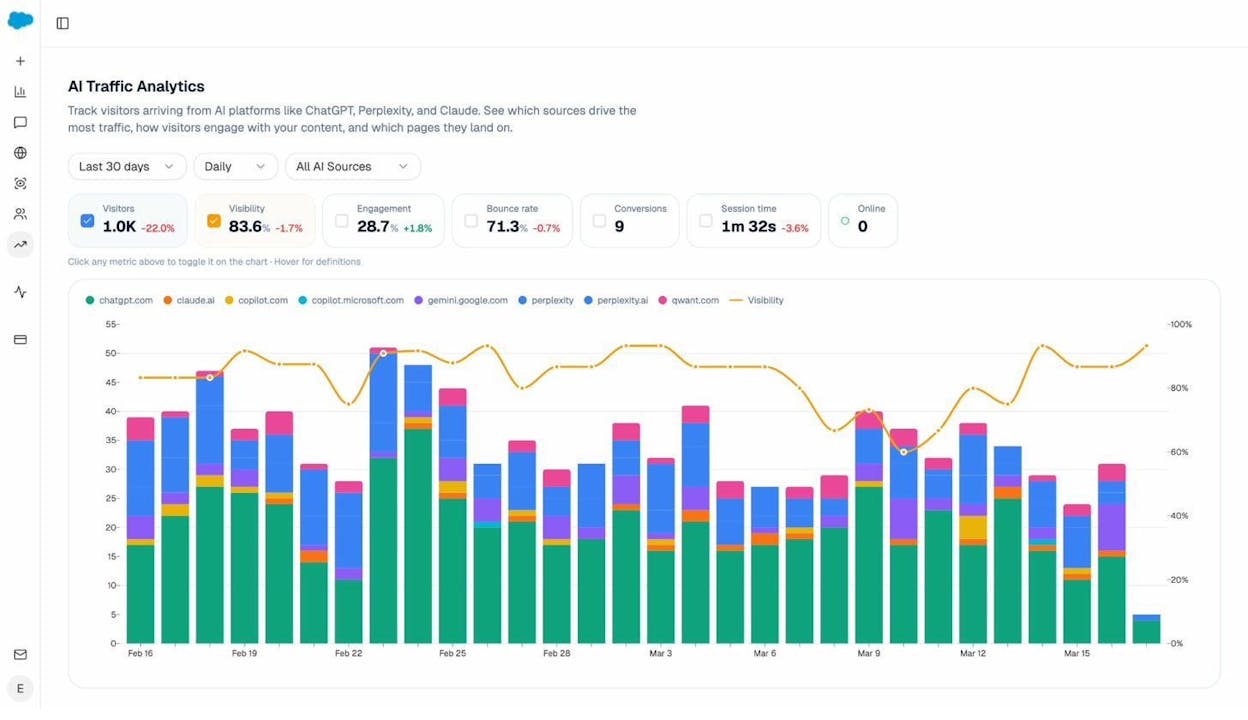
This closes the loop. You can see which AI engines mention your brand, which ones send traffic, which landing pages receive that traffic, and whether those visitors become customers. That is the full picture, from visibility to revenue.
For a deeper dive into ranking on specific AI platforms, see our guides on how to rank on ChatGPT and how to rank on Perplexity.
How SERP Feature Changes Affect Different Content Types
Not all content is affected equally by the SERP feature evolution. Here is how different content types are experiencing the shift.
Informational Blog Content
This is the category most affected by AI Overviews. Queries like “what is X,” “how does Y work,” and “X vs. Y” are exactly the types of questions AI Overviews are designed to answer. If your traffic strategy relies heavily on informational blog posts, you will see declining CTR for these keywords unless your content is being cited within AI Overviews.
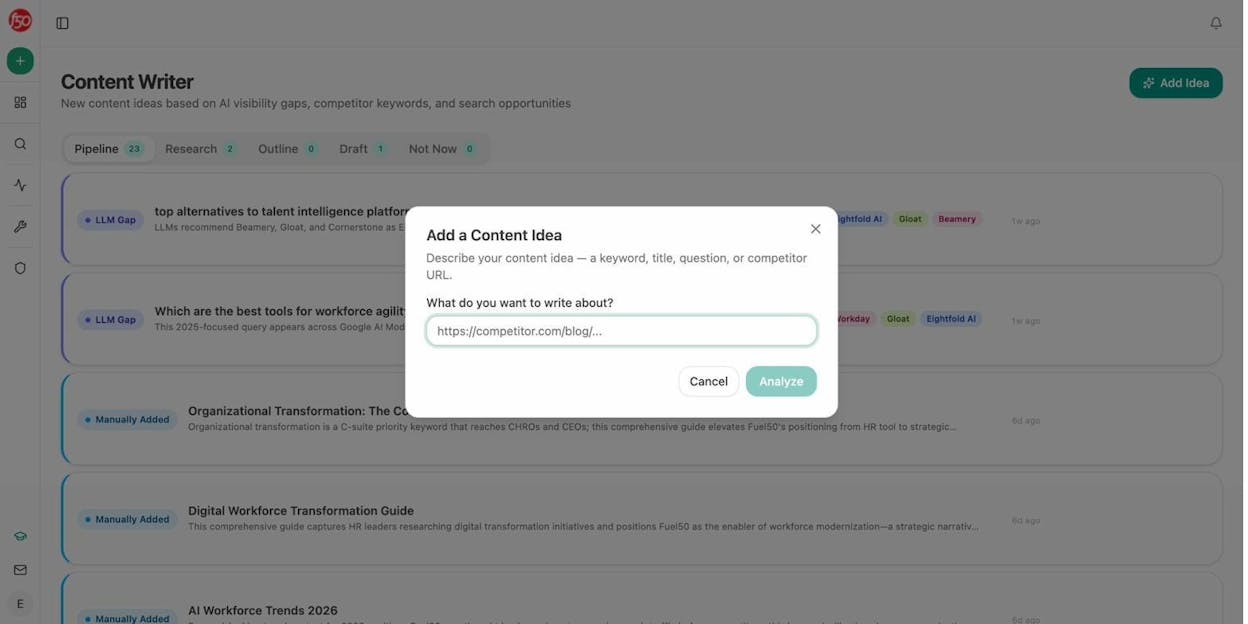
What to do: Shift your informational content toward deeper, more original analysis that AI cannot easily replicate. Add proprietary data, expert quotes, unique frameworks, and practical templates. The goal is to create content that AI Overviews want to cite as a source, not content that they can fully replace. Analyze AI’s Content Writer helps here by building AI visibility gaps, competitor analysis, and editorial comments into every step of the content creation process, from idea to draft.
Product and Comparison Pages
Comparison queries (“best X for Y,” “X alternatives,” “X vs. Y”) are increasingly triggering AI Overviews, but these tend to include brand mentions and source citations more liberally. If your comparison page is well-structured and provides clear, specific evaluations, it has a good chance of being cited.
What to do: Make your comparison content as specific and evidence-based as possible. Include pricing, feature breakdowns, use case recommendations, and clear verdict statements. Generic listicles will not get cited. Detailed, opinionated comparisons will.
E-commerce Product Pages
Shopping-related SERP features have declined, but Google is experimenting with AI-powered shopping experiences that could reshape e-commerce search visibility. For now, product pages are relatively insulated from AI Overview disruption because Google protects its shopping monetization.
What to do: Continue optimizing product pages with structured data (Product schema, Review schema) and strong visual assets. Also ensure your products are mentioned in relevant comparison and review content, because AI search engines often cite these when users ask for product recommendations.
For a complete guide, see our article on ecommerce SEO in the AI search era.
Local Content
Local Pack and Local Teaser features have declined modestly (-15% and -23% respectively), but they are still the dominant SERP feature for location-based queries. AI Overviews are not well-suited for local search yet.
What to do: Continue investing in Google Business Profile, local reviews, and location-specific content. Local SEO remains one of the most stable areas in the current SERP landscape.
The Bigger Picture: SEO Is Evolving, Not Dying
Every time Google makes a major change to its search results, a wave of “SEO is dead” takes floods the internet. The rise of AI Overviews has produced the loudest version of this narrative yet.
But the data tells a more nuanced story. SEO is not dead. It is evolving. And the evolution has two dimensions.
Dimension one: Whole-SERP SEO. On Google, success is no longer about ranking number one for a blue link. It is about appearing across multiple SERP features for each keyword: in the organic results, in the AI Overview, in the People Also Ask box, in the Sitelinks. Teams that adopt a “whole-SERP” strategy will outperform those that optimize for rank alone.
Dimension two: Multi-channel organic visibility. Beyond Google, AI search engines represent a growing organic channel. Just as social media became an organic discovery channel alongside Google, AI search is becoming another layer of organic visibility. The teams that recognize this early and build their presence across Google and AI search engines will compound their advantage over time.
This is the perspective we take at Analyze AI. AI search is an additional organic channel that complements traditional SEO. It is not a replacement. The content that works for Google (clear, useful, authoritative, well-structured) also works for AI search engines. The difference is that AI search requires its own tracking and optimization, just as social media required its own analytics and strategy when it first emerged as a marketing channel.
For a detailed comparison of how GEO and SEO relate, see our guide on GEO vs. SEO. And for a full breakdown of answer engine optimization strategies, check out What Is Answer Engine Optimization.
An Action Plan for Adapting to the New SERP Landscape
Here is a practical checklist you can work through this week.
Audit your keyword portfolio for SERP features. Take your top 100 keywords and manually check which SERP features appear for each one. Categorize them by feature type. This gives you a baseline.
Identify keywords where AI Overviews have appeared. These are your highest-risk keywords for traffic decline. Check whether your content is being cited in the AI Overview. If it is, great. If it is not, your content needs to be updated.
Refresh your highest-traffic informational pages. Update them with more depth, better structure, fresher data, and clearer answers. This improves your chances of being cited in AI Overviews and keeps your content competitive.
Set up AI search monitoring. Sign up for Analyze AI and start tracking the prompts that matter to your business across ChatGPT, Perplexity, Gemini, and other AI search engines. This gives you visibility into the channel that most of your competitors are not tracking yet.
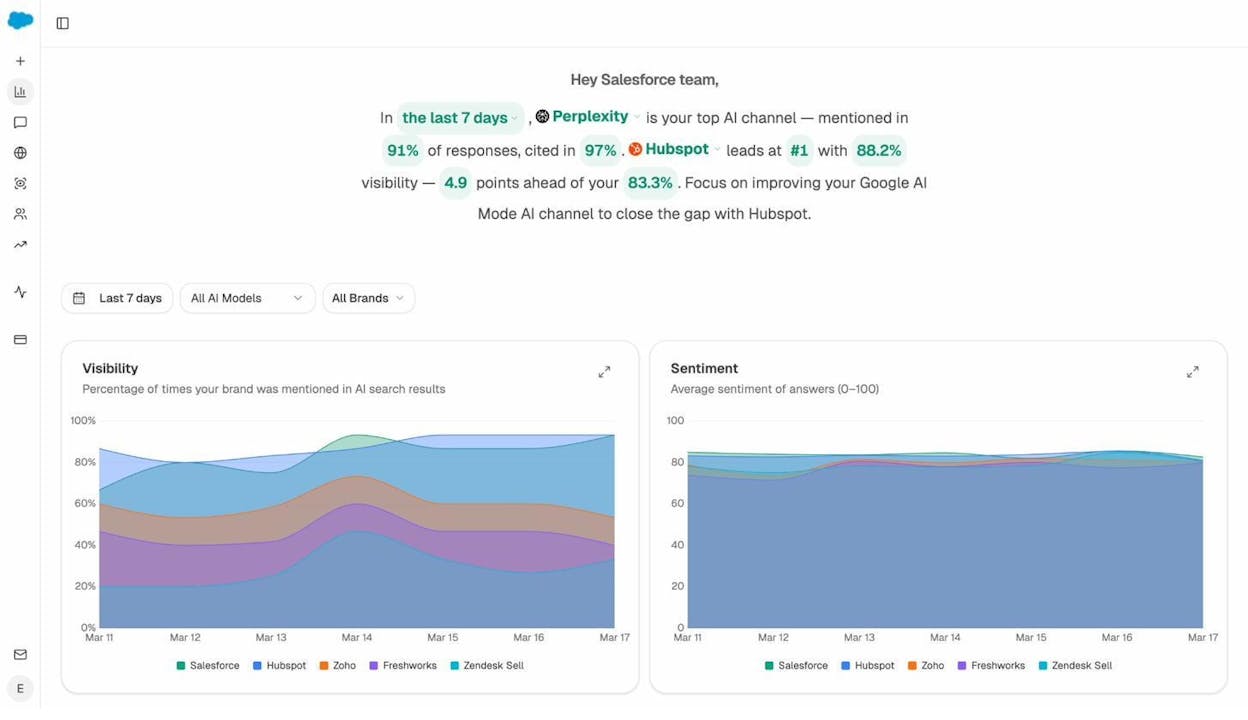
Connect your GA4 to track AI traffic. Use Analyze AI’s AI Traffic Analytics to see how much traffic AI search engines are already sending you. You might be surprised. Many brands discover they are already receiving meaningful AI search traffic that they were not aware of.
Create content built for citation. Use the Analyze AI Content Writer to identify content gaps in AI search responses and create pages designed to fill them. Focus on original research, detailed comparisons, and authoritative guides that AI models want to cite.
Monitor competitor movements. Track which competitors are gaining or losing visibility in both Google SERP features and AI search. Use this intelligence to prioritize where you invest your content and SEO resources.
Report on the full picture. When you report to leadership or clients on search performance, include both traditional SEO metrics (rankings, traffic, CTR) and AI search metrics (visibility, citations, sentiment, AI-referred traffic). This positions you as someone who understands the full landscape, not just one slice of it. For reporting tools, see our roundup of SEO reporting tools.
What Comes Next
The SERP landscape will continue to evolve. Google has signaled that AI Mode, an even more AI-forward search interface, will eventually become the default experience. When that happens, the SERP as we know it could change even more dramatically.
AI search engines outside of Google are also growing fast. ChatGPT, Perplexity, and others are processing hundreds of millions of queries per month, and that number is climbing. The share of total search volume they capture is still small compared to Google, but it is growing fast enough to matter.
The smart play is not to bet on one channel. It is to build a content foundation that performs across all of them. Original, well-structured, authoritative content that answers real questions will always find an audience, regardless of which platform serves it.
Start by understanding how the SERP features are changing for your keywords. Then expand your view to include AI search engines. Track both. Optimize for both. And measure the results across the full picture.
That is how you build durable visibility in the AI era.

Ernest

Ibrahim


