



Summarize this blog post with:


In this article, you’ll learn the exact number of keywords a single page should target, the difference between primary and secondary keywords, how to find both types efficiently, and how to use them inside your content. You’ll also learn why AI search engines like ChatGPT and Perplexity change the way you should think about keyword targeting—and how to adapt without abandoning what already works.
Table of Contents
Primary vs. Secondary Keywords
Before anything else, you need to understand the two categories of keywords you’ll work with.
A primary keyword is the main topic of your page. It’s the single phrase you build the entire piece around. Think of it as the title of a book.
A secondary keyword is any closely related phrase that supports or expands on that primary topic. Synonyms, subtopics, long-tail variations, and related questions all qualify as secondary keywords. The most useful secondary keywords are subtopics—they help you cover a topic in depth, which is exactly what search engines reward.
Here’s the simplest way to think about it: if the primary keyword is the book, secondary keywords are the chapters.
![[Screenshot: Google SERP showing a focused result ranking for a specific keyword, not a generic homepage]](https://www.datocms-assets.com/164164/1777122463-blobid1.png?auto=format,compress&w=1248&fit=max)
For example, if your primary keyword is “dog toys,” your secondary keywords might include “best chew toys for puppies,” “indestructible dog toys,” and “how to choose safe dog toys.” Each one becomes a section or talking point inside your article—not a separate page.
Why One Primary Keyword Is Enough
The short answer: focus beats breadth. Here’s the longer explanation, broken into three reasons.
Reason 1. Every Page Needs One Clearly Defined Topic
People search for specific things. When someone types “best running shoes for flat feet” into Google, they want a page that answers that exact question—not a general shoe guide that mentions flat feet once in passing.
Google understands this. Its ranking system rewards relevance, which means a tightly focused page will almost always outperform a broad one for any given query. The Wikipedia model works because each page covers one subject thoroughly—not because the homepage tries to cover everything.
![[Screenshot: Google SERP showing a highly specific query returning a focused article as the #1 result, not a generic page]](https://www.datocms-assets.com/164164/1777122469-blobid2.png?auto=format,compress&w=1248&fit=max)
Reason 2. Google Catches Close Variations Automatically
You don’t need to manually target every possible way someone might phrase a query. Google handles misspellings, synonyms, and close variations on its own.
Try searching for “submitt website to search engines” (with a typo). Google corrects it and shows results for the right phrase. The same logic applies to synonyms. “Submit website to search engines” and “website submission to search engines” return nearly identical results.
![[Screenshot: Google autocorrecting a misspelled search query and showing the intended results]](https://www.datocms-assets.com/164164/1777122470-blobid3.png?auto=format,compress&w=1248&fit=max)
This means you can write naturally. If your page thoroughly covers “keyword research tools,” Google will also rank it for “tools for keyword research,” “keyword research software,” and other variations—without you having to wedge each one in.
Reason 3. One Keyword Can Rank You for Hundreds More
This is where the data gets interesting. Research from Ahrefs shows that the average page ranking #1 in Google also ranks in the top 10 for nearly 1,000 other keywords.
That’s not a typo. And it’s not limited to high-volume terms. A page targeting a keyword with 1,400 monthly searches can easily rank for 400+ related keywords and generate 5x–6x the estimated traffic of the original keyword alone.
![[Screenshot: An SEO tool showing a single page ranking for hundreds of keywords with combined traffic far exceeding the primary keyword’s volume]](https://www.datocms-assets.com/164164/1777122475-blobid4.png?auto=format,compress&w=1248&fit=max)
Some of these ranking keywords won’t even look like close variations at first glance. “SEO basics,” “how to use SEO,” “beginner’s guide to SEO,” and “SEO fundamentals” are all different queries—but Google recognizes they share the same intent and serves similar pages for all of them.
The takeaway: targeting one primary keyword well—and covering the topic thoroughly—is the fastest path to ranking for many keywords.
Why You Need Secondary Keywords
If one primary keyword is enough, why bother with secondary keywords at all?
Because coverage matters. A page that only addresses the surface of a topic will lose to a page that covers it in depth. And the best way to ensure you cover a topic thoroughly is to include relevant subtopics—which is exactly what secondary keywords represent.
Think about it from the searcher’s perspective. If you’re looking for a beginner’s guide to gardening, you’d expect sections on soil, watering, sunlight, tools, and common mistakes. A guide that skips most of those subtopics isn’t really a complete guide. Google knows this, and it rewards content that meets the searcher’s full set of expectations.
Secondary keywords are the roadmap to those expectations. They tell you what subtopics to include so your content answers the question more thoroughly than competing pages.
How to Find Primary Keywords
Let’s get practical. Here are three reliable methods to find a strong primary keyword for any piece of content.
Method 1. Use a Keyword Research Tool
A dedicated keyword research tool is the most efficient way to find primary keywords at scale. You want a tool that surfaces keyword ideas alongside actionable metrics like search volume, keyword difficulty, and traffic potential.
Here’s a simple workflow:
-
Start with a seed keyword related to your niche. If you sell pet supplies, that seed might be “dog toys” or “cat food.”
-
Expand the seed using the tool’s keyword suggestions or matching terms report.
-
Browse the results by parent topic. Most keyword tools group related keywords under parent topics, which makes it easy to spot the best primary keyword for a given subject.
-
Pick a keyword by weighing keyword difficulty, traffic potential, and business relevance. A keyword with high volume but extreme difficulty might not be the right target if your site is new.
![[Screenshot: A keyword research tool showing keyword suggestions for “dog toys” with volume, difficulty, and traffic potential columns visible]](https://www.datocms-assets.com/164164/1777122476-blobid5.png?auto=format,compress&w=1248&fit=max)
Analyze AI’s free Keyword Generator is a good starting point if you don’t have a paid tool. Enter a seed keyword, and it returns related keyword ideas with volume and difficulty estimates.
![[Screenshot: Analyze AI’s free Keyword Generator tool showing results for a seed keyword]](https://www.datocms-assets.com/164164/1777122481-blobid6.png?auto=format,compress&w=1248&fit=max)
Method 2. Find Common Topics in Any Niche
Content gap analysis is one of the most underused keyword research methods. It works by comparing multiple competing sites and finding the topics that all of them cover—revealing the “must-have” keywords in a niche.
Here’s how to do it:
-
Identify 3–5 competitors in your space.
-
Enter their URLs into a content gap tool.
-
Look at the keywords that multiple competitors rank for. These are the topics your audience clearly cares about.
-
Filter for keywords with reasonable difficulty and a minimum search volume (say, 100+).
![[Screenshot: A content gap tool showing overlapping keywords between three competitor websites, with filters applied]](https://www.datocms-assets.com/164164/1777122482-blobid7.png?auto=format,compress&w=1248&fit=max)
This method is especially useful when you’re entering a niche you’re unfamiliar with. Instead of guessing what topics matter, you let the data tell you.
Method 3. Analyze Competitor Keywords
A more targeted approach: pick a single competitor and reverse-engineer their keyword strategy.
-
Enter a competitor’s domain into a site explorer or organic keywords tool.
-
Browse their ranking keywords.
-
Filter by position (top 10 or top 20), volume, and difficulty to find keywords where they’re getting traffic.
-
Identify keywords that also make sense for your site.
![[Screenshot: An organic keywords report for a competitor’s website, filtered by position and volume]](https://www.datocms-assets.com/164164/1777122487-blobid8.jpg?auto=format,compress&w=1248&fit=max)
You can use Analyze AI’s free Keyword Rank Checker to quickly see what keywords any site ranks for, without needing a paid subscription.
How AI Search Changes Primary Keyword Selection
Here’s where the game is shifting. In traditional SEO, keyword research is purely about what people type into Google. But today, a growing number of searches happen inside AI platforms like ChatGPT, Perplexity, Claude, and Gemini—and the phrasing is different.
People don’t type short keywords into AI search. They type full questions and natural language prompts: “What’s the best CRM for a 10-person sales team?” instead of “best CRM small business.”
This creates a new dimension for keyword research. You still need to find and target the traditional SEO keyword. But you also need to understand the AI prompts that relate to your topic—because those prompts drive AI-referred traffic to your site.
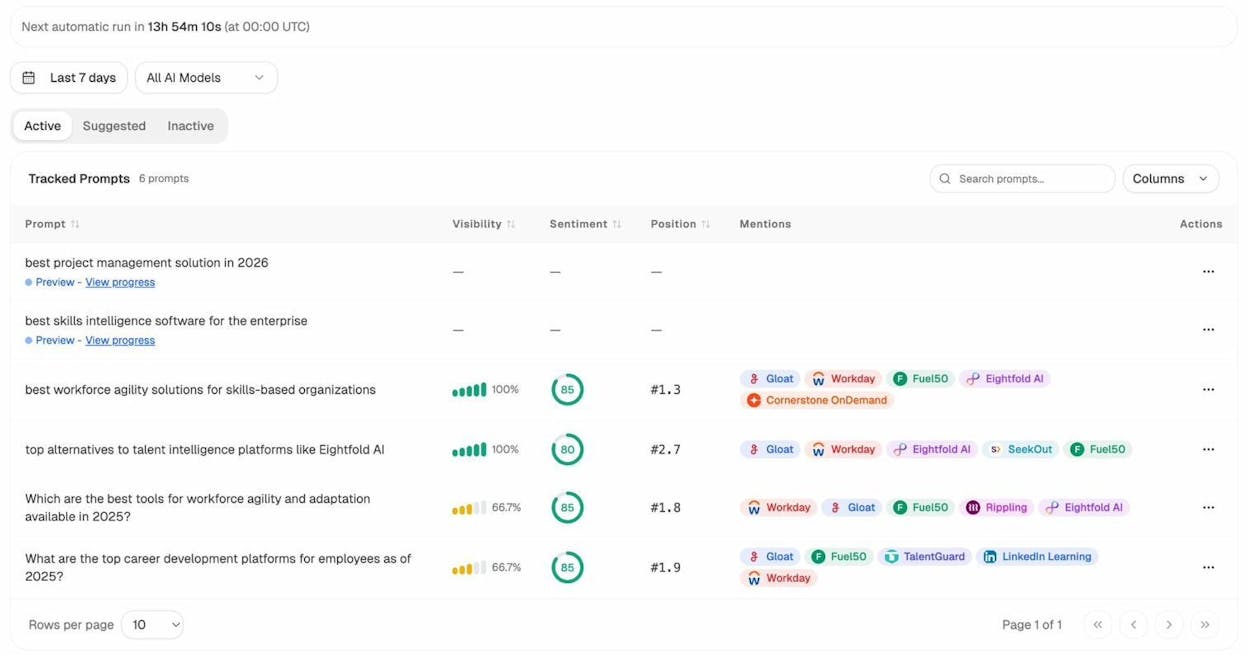
Analyze AI gives you visibility into this. The Prompts dashboard shows the actual prompts people are using across AI engines in your space—plus which brands are being mentioned, how they rank, and what sentiment the AI assigns to them.
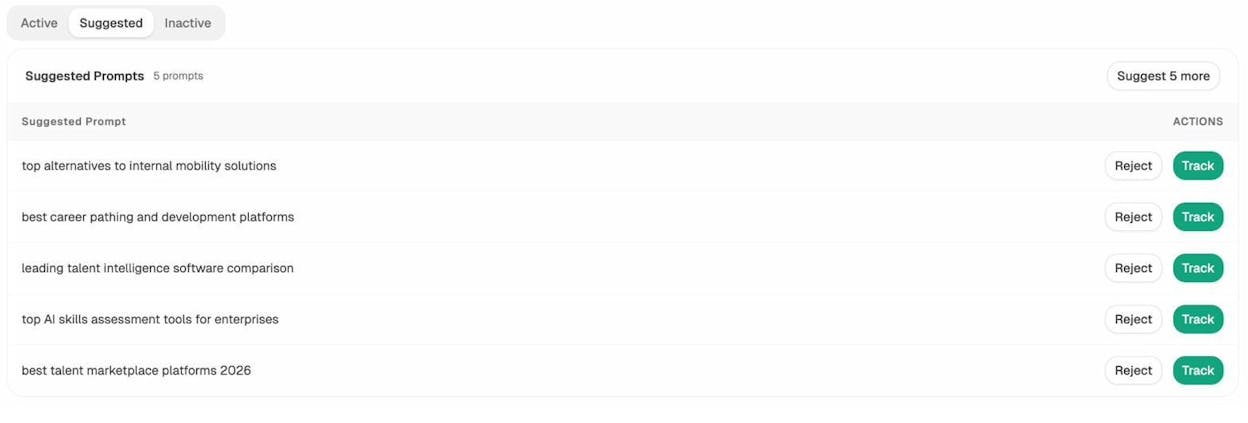
The Suggested Prompts tab takes this further. It automatically recommends new prompts to track based on your industry, so you can discover AI search terms you didn’t even know existed.
This doesn’t replace keyword research. It adds a layer on top. The primary keyword you target for SEO remains the same. But now you also know the AI prompts related to that keyword—and you can create content that answers both.
How to Find Secondary Keywords
Once you have a primary keyword locked in, secondary keywords help you build out the structure of your content. Here are two methods.
Method 1. Find What Top-Ranking Pages Also Rank For
The logic here is simple: if the pages ranking #1–3 for your primary keyword also rank for other related terms, those terms are subtopics you should consider covering.
Here’s the workflow:
-
Enter your primary keyword into a keyword research tool.
-
Look for a “Related terms” or “Also rank for” report.
-
Set it to show only terms where top-10 results also rank.
-
Scan the results for keywords that look like natural subtopics.
![[Screenshot: A “Related terms” report showing secondary keywords that top-ranking pages also rank for, filtered to top 10]](https://www.datocms-assets.com/164164/1777122494-blobid11.png?auto=format,compress&w=1248&fit=max)
For example, if your primary keyword is “how to train a puppy,” secondary keywords might include “crate training,” “leash training,” and “potty training schedule.” Each of these becomes a section in your article.
A critical point: don’t just copy what competitors cover. Google’s helpful content guidelines explicitly reward content that adds something new. Use competitor research to understand baseline expectations, then add your own experience, data, or perspective on top.
Method 2. Find Missing Keywords with a Content Gap Analysis
This method is best for improving existing content. It works by comparing your published page to the pages outranking you and finding the secondary keywords you’re missing.
-
Take the URL of your published page.
-
Enter it alongside 2–3 competing URLs into a content gap tool.
-
Look at the keywords your competitors rank for that you don’t.
-
Identify which of those keywords represent subtopics you should add to your page.
![[Screenshot: Content gap tool comparing one page against three competitors, highlighting missing keyword opportunities]](https://www.datocms-assets.com/164164/1777122499-blobid12.png?auto=format,compress&w=1248&fit=max)
For example, if your guide on “playing with dogs” ranks well but competing guides also rank for “games to play with puppies,” you’ve found a subtopic worth adding.
Find the Prompts Your Competitors Win (and You Don’t)
Secondary keywords tell you what subtopics to cover for Google. But there’s a parallel question for AI search: which prompts mention your competitors but not you?
Analyze AI’s Competitors dashboard answers this directly. It shows which brands appear in AI responses for your tracked prompts—and highlights the gaps where competitors get mentioned but your brand doesn’t.
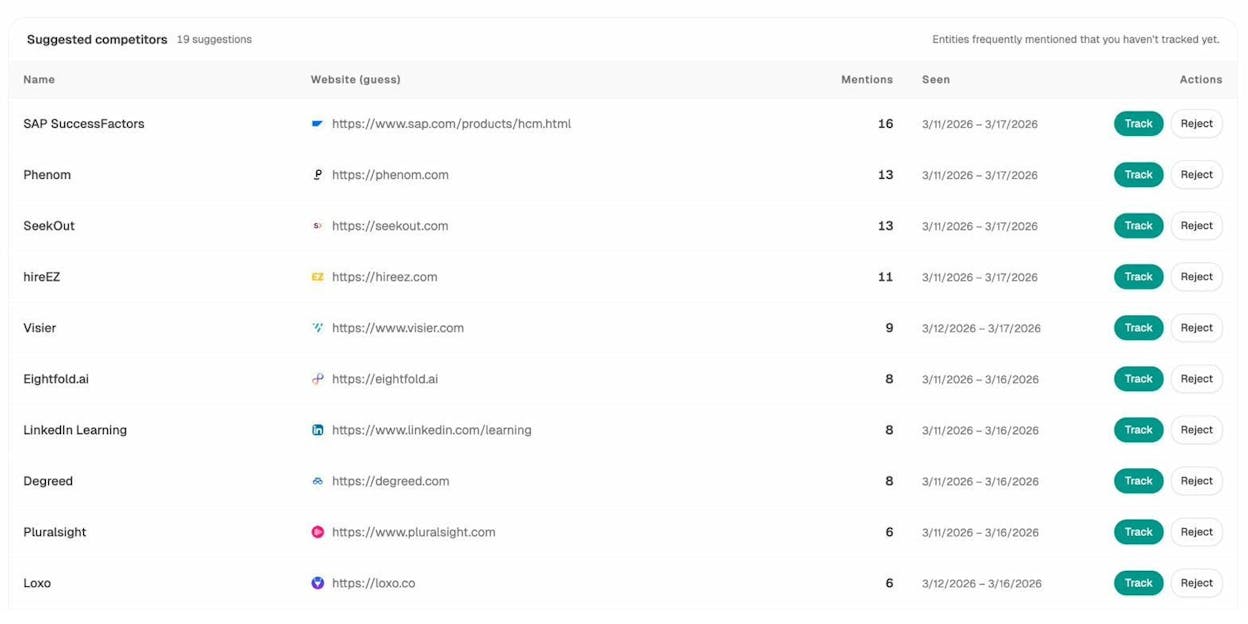
These competitor-only prompts are content opportunities. If ChatGPT recommends three competitors for “best project management tool for remote teams” but doesn’t mention your product, that’s a signal. You likely need content—a blog post, a landing page, a comparison guide—that gives AI models the information they need to include you.
The Prompts dashboard also shows a detailed breakdown per prompt, so you can see exactly which competitors are mentioned, their position, and their sentiment score.
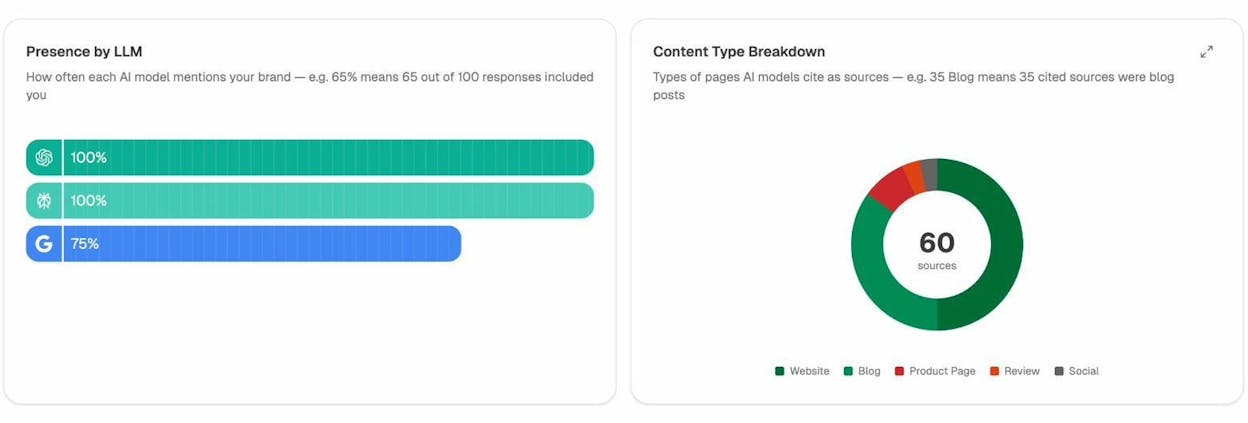
Use this data alongside your secondary keyword research. The secondary keywords tell you what subtopics Google expects. The AI prompt gaps tell you what subtopics AI engines expect. Covering both gives your content the best chance of performing in every channel.
How to Optimize Content for Keywords
Finding keywords is half the job. Placing them correctly inside your content is the other half.
Start with Search Intent
Your primary keyword determines the search intent—the type of content the searcher expects to find. Before writing a single word, search your primary keyword on Google and study the top results. Look for three things:
-
Content type. Are the top results blog posts, product pages, videos, or landing pages?
-
Content format. Are they listicles, how-to guides, reviews, or comparison articles?
-
Content angle. What’s the hook? “Best,” “free,” “for beginners,” “in 2026”—these angles tell you what the searcher values.
![[Screenshot: Google SERP for a keyword showing the dominant content type, format, and angle of the top-ranking results]](https://www.datocms-assets.com/164164/1777122506-blobid15.png?auto=format,compress&w=1248&fit=max)
If every top result for “learn piano” is a beginner’s guide in article format, don’t publish a product page or a video playlist. Match the intent first, then differentiate with better depth and structure.
Cover the Topic in Full
Your primary keyword is the topic. Your secondary keywords are the subtopics. Together, they form the skeleton of your content.
But keyword research alone won’t surface every subtopic worth covering. Always check the structure of competing pages to see what they include. Look at their headings, subheadings, and the flow of their arguments.
![[Screenshot: A browser extension or SEO toolbar showing the heading structure (H1, H2, H3) of a top-ranking page]](https://www.datocms-assets.com/164164/1777122512-blobid16.png?auto=format,compress&w=1248&fit=max)
Use this as a starting point—not a template. Your goal isn’t to copy the structure of existing content. It’s to cover everything the searcher needs, plus something they can’t find elsewhere. That might be original data, a unique perspective, a more actionable framework, or a step-by-step walkthrough that competing guides skip.
Place Keywords Naturally
Once you’ve outlined your content, place your keywords in these locations:
|
Location |
What to use |
Why it matters |
|---|---|---|
|
Title tag |
Primary keyword |
Helps Google understand the page topic at a glance |
|
H1 tag |
Primary keyword (match or align with title) |
Confirms the topic for both users and crawlers |
|
URL slug |
Primary keyword |
Adds context for Google and makes links readable |
|
H2–H6 headings |
Secondary keywords |
Signals subtopic coverage and improves scannability |
|
Body text |
Both, naturally |
Demonstrates depth and relevance |
|
Meta description |
Primary keyword |
Improves click-through rate from the SERP |
Two things to avoid:
Don’t stuff keywords. There’s no ideal keyword density. Write naturally, and your keywords will appear at a frequency that works. Forcing a keyword into every other sentence hurts readability and sends a spam signal to Google.
Don’t force in synonyms for SEO purposes. Google doesn’t rank your page higher because you used five different ways to say the same thing. If “keyword research tools” is your primary keyword, you don’t need to also say “tools for researching keywords,” “keyword research software,” and “keyword discovery platforms” in the same paragraph. Google already understands these are related. Write the version that reads best and move on.
Optimize for AI Search Too
Traditional keyword placement is about signals to Google’s crawler. But AI search engines like ChatGPT, Perplexity, and Gemini work differently. They don’t crawl your page and match keywords—they read your content, synthesize it, and decide whether to cite you in a response.
This means the way you structure information matters as much as the keywords you use. Here’s what helps:
Use clear, direct answers. AI engines pull from content that states things plainly. If someone asks “how many keywords should a page target,” a page that opens with a clear answer (“One primary keyword, supplemented by relevant secondary keywords”) is more likely to be cited than one that buries the answer in paragraph six.
Structure content with descriptive headings. AI models parse headings to understand what each section covers. Headings like “How to Find Primary Keywords” are more useful than “Step 1” or “Getting Started.”
Include data and specific claims. AI engines are more likely to cite content that makes verifiable, specific claims backed by data. “The average #1 page ranks for nearly 1,000 keywords” is citeable. “Pages can rank for lots of keywords” is not.
You can track whether your content actually gets cited by AI engines using Analyze AI’s Sources dashboard. It shows every URL and domain that AI platforms cite when answering questions in your space—broken down by content type, AI model, and brand.
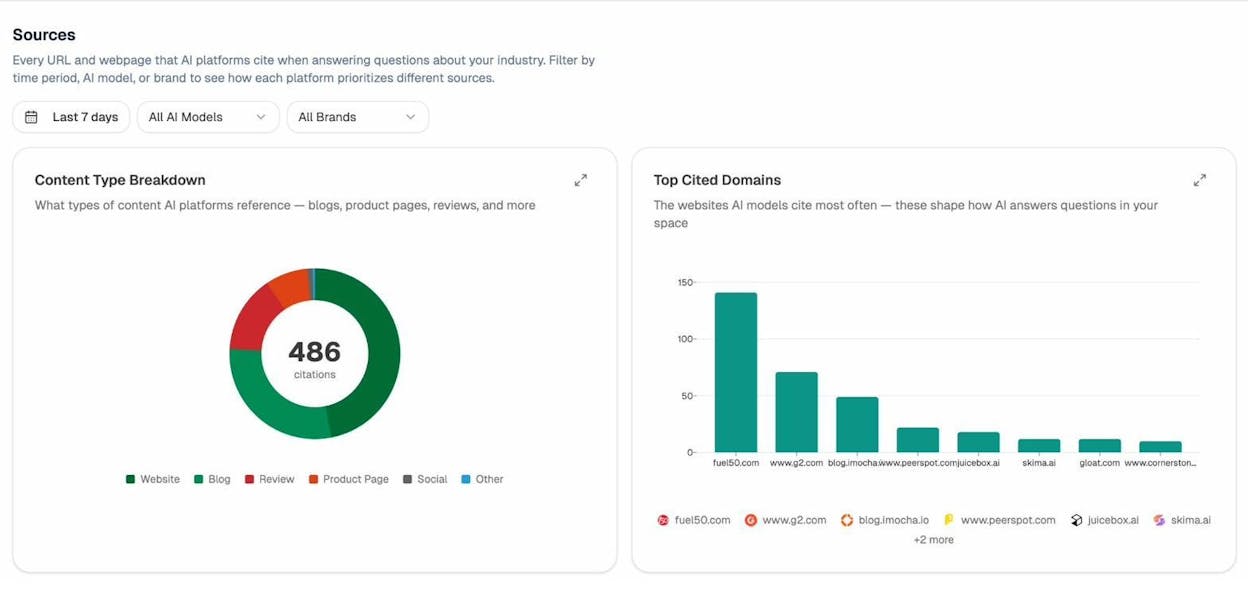
If your pages aren’t showing up in the citations, it’s a signal that your content structure, authority, or depth needs work—regardless of how well your keywords are placed.
Use AI Traffic Data to Validate What Works
There’s one more step most guides skip: using real AI traffic data to validate your keyword strategy.
Analyze AI’s AI Traffic Analytics dashboard connects to your website analytics and shows exactly which pages receive traffic from AI platforms like ChatGPT, Claude, Perplexity, and Copilot.
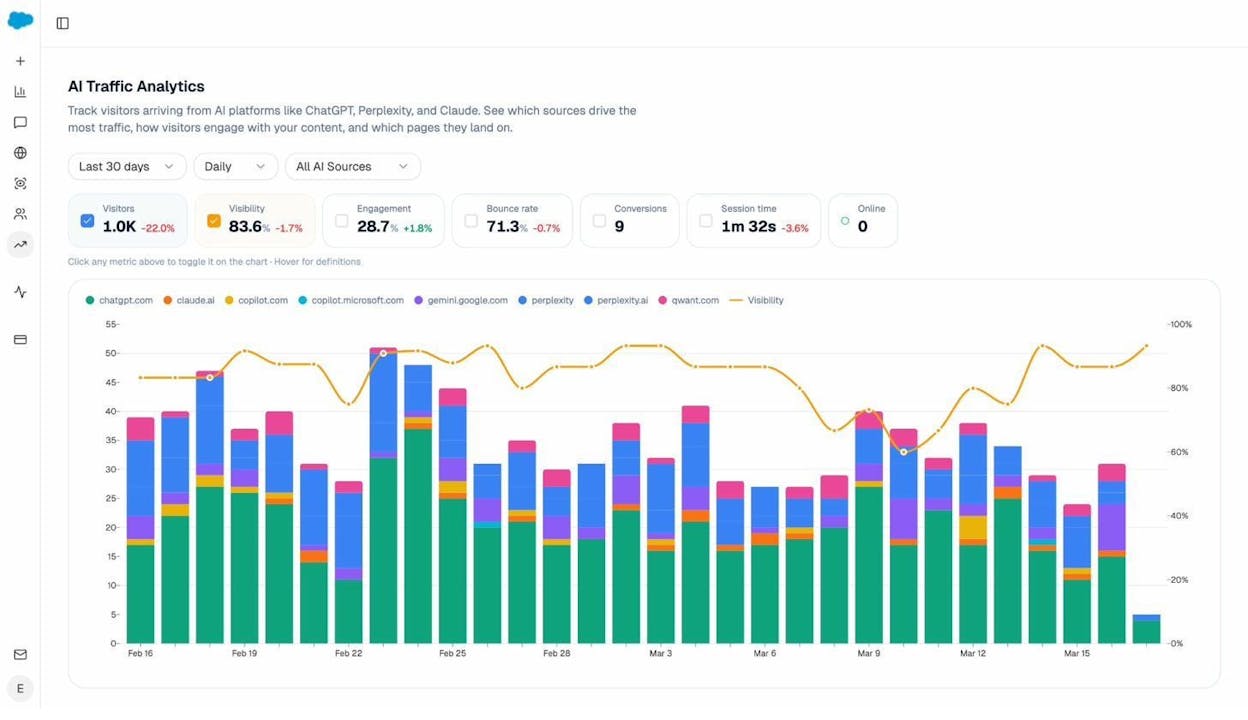
The Landing Pages report inside AI Traffic Analytics goes deeper. It shows which specific pages on your site receive AI-referred traffic, how many sessions each page gets, which AI platform sent the visitors, and what prompts triggered the citation.
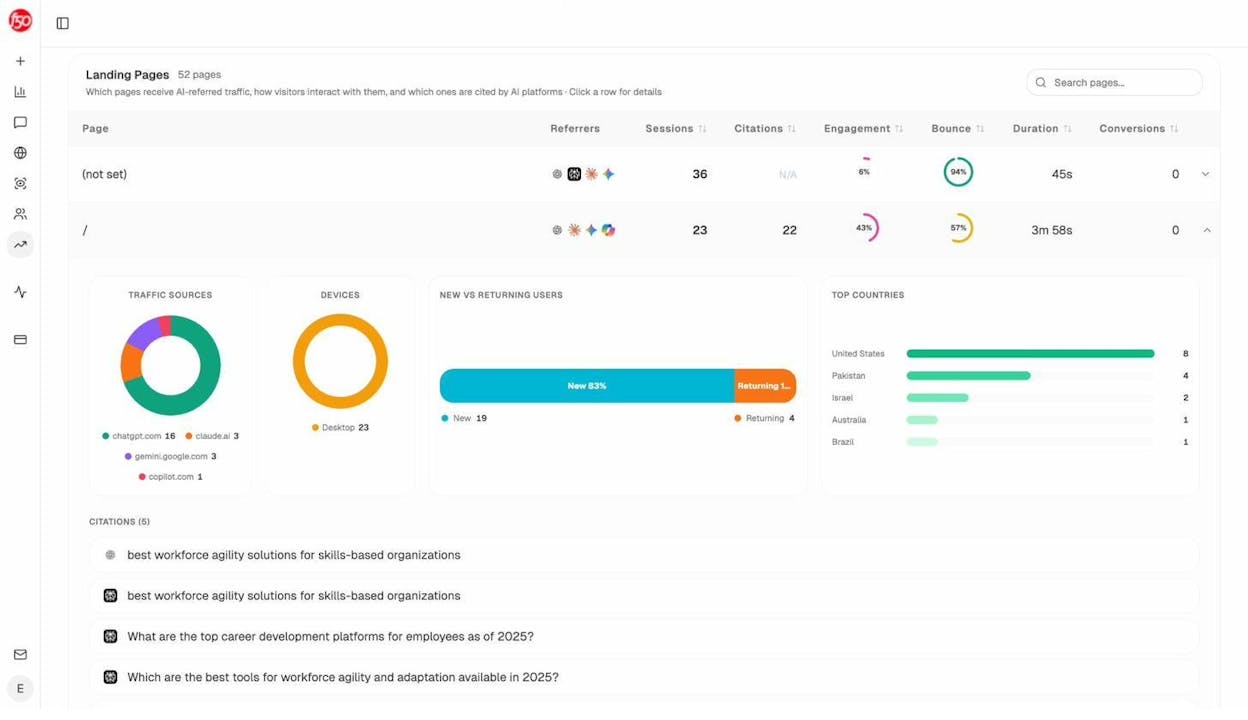
This data closes the loop on your keyword strategy. You can see which keyword-targeted pages perform well in AI search—and double down on the content patterns that work. If your how-to guides get cited by ChatGPT far more than your listicles, that tells you something about how to structure future content.
How to Think About Keywords Across SEO and AI Search
The biggest mistake marketers make right now is treating SEO and AI search as separate strategies that require separate content. They don’t.
SEO is not dead. Google still sends the vast majority of organic traffic. But AI search is growing fast, and the brands that show up in AI responses are building a compounding advantage. The correct approach is to treat AI search as an additional organic channel—not a replacement for SEO.
Here’s what that looks like in practice for keyword targeting:
-
Pick your primary keyword based on SEO data. Search volume, keyword difficulty, traffic potential—the traditional metrics still matter and still drive the most traffic.
-
Find secondary keywords using both SEO tools and AI prompt data. Your secondary keywords should include the subtopics Google expects (from competitor analysis) and the prompts AI engines associate with your topic (from tools like Analyze AI).
-
Write content that serves both channels. Use clear structures, direct answers, specific data, and descriptive headings. These practices help you rank in Google and get cited by AI.
-
Track performance in both channels. Use Google Search Console for SEO rankings and Analyze AI for AI visibility, citations, and AI-referred traffic.
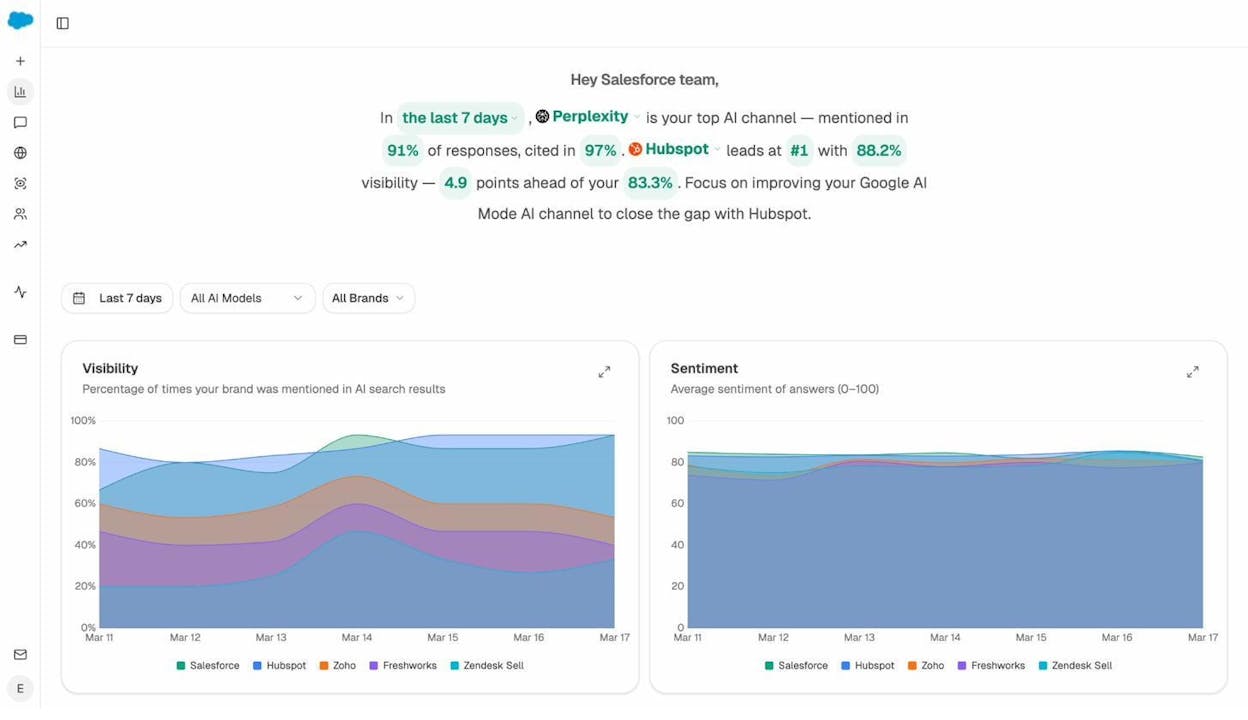
The Perception Map in Analyze AI gives you a visual snapshot of where your brand stands relative to competitors across AI engines. It plots visibility against narrative strength, showing whether your brand is seen, how strong its story is, and where the gaps lie.
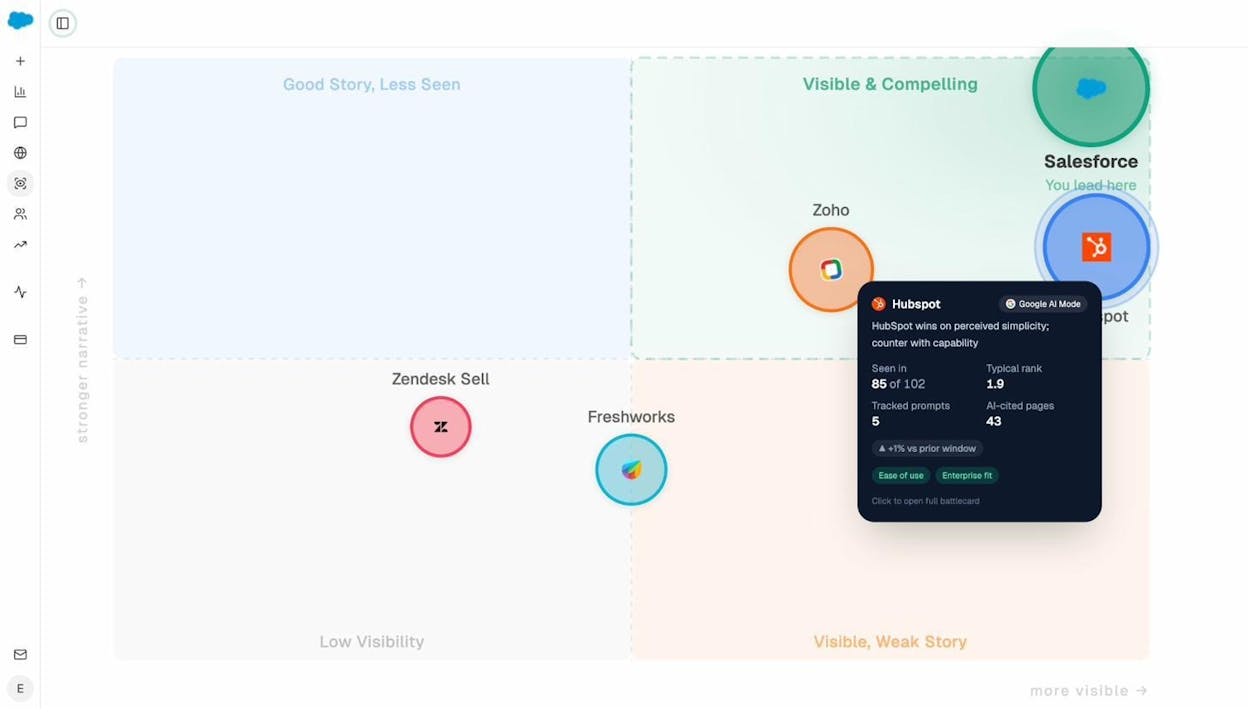
If you’re “Visible, Weak Story,” your keyword strategy is surfacing your brand but your content isn’t compelling enough to influence the narrative. If you’re “Good Story, Less Seen,” your content quality is strong but your visibility footprint needs work—which often means you need more content targeting more keywords and prompts.
Dos and Don’ts for Keyword Targeting
|
Do |
Don’t |
|---|---|
|
Pick one primary keyword per page |
Target multiple unrelated topics on one page |
|
Use secondary keywords as subtopics |
Stuff keywords or aim for a density percentage |
|
Cover the topic thoroughly |
Copy competitor structure without adding value |
|
Put the primary keyword in the title, H1, and URL |
Force synonyms or LSI keywords into every paragraph |
|
Use descriptive headings with secondary keywords |
Use vague headings like “Step 1” or “More Info” |
|
Write naturally and let keywords appear organically |
Sacrifice readability for keyword placement |
|
Track AI prompt visibility alongside SEO rankings |
Ignore AI search as a traffic channel |
|
Use data to validate which pages work in AI search |
Assume SEO performance equals AI search performance |
Final Thoughts
The answer to “how many SEO keywords should a page target?” is simple: one primary keyword, supported by as many secondary keywords as you need to cover the topic thoroughly.
But the world those keywords live in is no longer just Google. AI search engines now answer the same questions your content targets—and they decide whether to cite your brand or your competitor’s. The keyword strategy that wins in 2026 is one that optimizes for both channels simultaneously: traditional SEO for the bulk of traffic, and AI search visibility for the fastest-growing channel in organic discovery.
The good news? The fundamentals haven’t changed. Clear topics, thorough coverage, natural language, and strong structure still win. You just need to track one more channel now—and Analyze AI makes that easy.

Ernest

Ibrahim


