



Summarize this blog post with:


Most website-promotion guides act like AI search killed SEO. We disagree. People still run billions of Google searches every month, and the same content principles that win in Google now win in ChatGPT, Perplexity, and Gemini too. Treat AI search as another organic channel, not a replacement for the playbook. That belief shapes our SEO content strategy and runs through this list.
In this article, you’ll learn 18 practical ways to bring more visitors to your website. Some are free, some are paid. Some compound over months, others move the needle this week. The list covers SEO, AI search, content, social, partnerships, and ads.
Pick one tactic, get good at it, then add the next.
Table of Contents
1. Fix the pages you already have before chasing new ones
The fastest way to grow traffic is not publishing more. It is fixing pages already ranking in positions 4 to 15 on Google.
Open Search Console, sort your queries by impressions, and look for pages stuck on page two. For each one, ask five questions:
-
Does it match the search intent of the top three results today?
-
Is the content out of date?
-
Does the title tag earn the click?
-
Are there content gaps the top results cover and you don’t?
-
Are you linking to it from your highest-authority pages?
A single update can move a page from position 8 to position 3 without writing a new word. Our guide on internal linking for SEO covers the full process.
The same logic applies to AI search. Pages already cited by ChatGPT or Perplexity for one prompt are usually one rewrite away from being cited for five more. Open Analyze AI’s Sources view, see which of your pages get cited and for which prompts, then look at adjacent prompts where competitors win and you don’t.
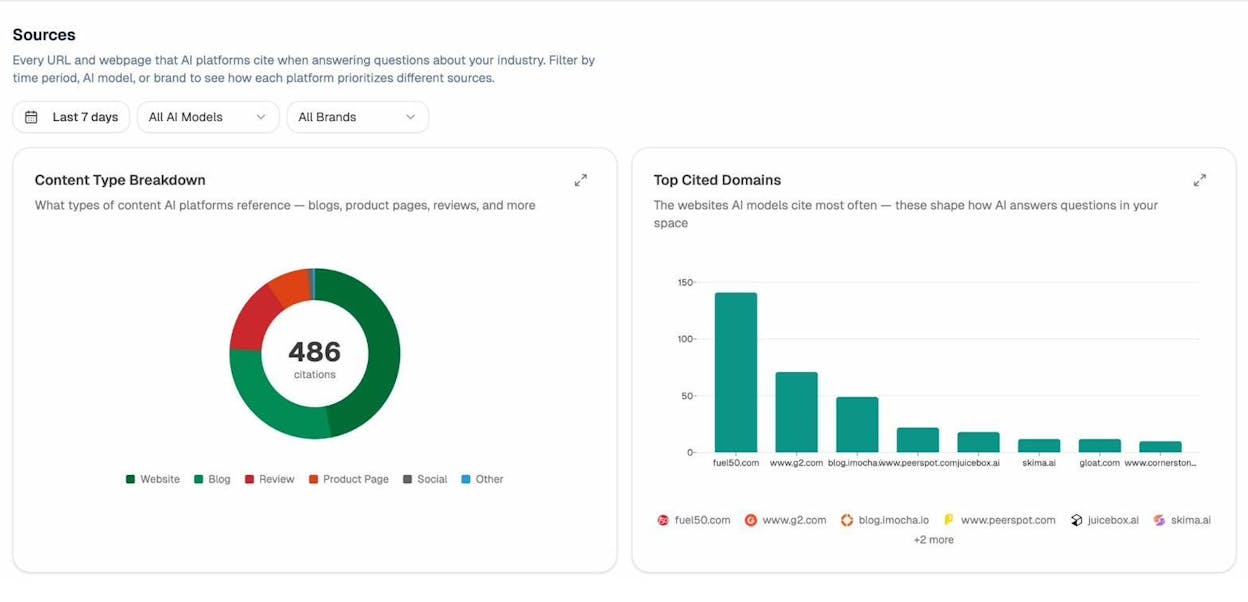
When you spot a competitor cited for a prompt you should own, open the cited URL, read it, and add the missing angle to your own page. Our guide on how to outrank competitors in AI search walks through this in detail.
2. Start with keywords you can actually rank for
If you target the same head terms as Wikipedia and Forbes, you will lose. Target the keywords they ignored.
Open our free Keyword Generator, drop in a broad seed term related to your business, and pull a list of related queries with search volume and difficulty.
![[Screenshot of the Analyze AI Keyword Generator with a seed keyword like “matcha” entered, showing the resulting list of related keywords with search volume and KD scores.]](https://www.datocms-assets.com/164164/1778176727-blobid2.png?auto=format,compress&w=1248&fit=max)
Two filters do most of the heavy lifting. First, filter for keyword difficulty under 30, the band where small sites can realistically break in. Our Keyword Difficulty Checker gives you that score for any keyword. Second, sort by cost per click. A keyword with a $5 or higher CPC means someone is paying real money to be there, which usually signals it converts.
![[Screenshot of a keyword list sorted by CPC descending, with a few high-CPC keywords highlighted to show they are buyer-intent terms.]](https://www.datocms-assets.com/164164/1778176727-blobid3.png?auto=format,compress&w=1248&fit=max)
Then run the top three results for each shortlisted keyword through our SERP Checker. If even one ranking page looks weak (forum thread, thin blog, generic listicle), the keyword is yours to take. Our deeper guide on how to find SEO keywords lays out the full filter stack.
In AI search, keywords become prompts. Real users don’t type “best CRM for startups” into ChatGPT. They type something like “I run a 12-person sales team using HubSpot and we are outgrowing it. What should we move to?” That difference matters because long, specific prompts pull from long, specific content.
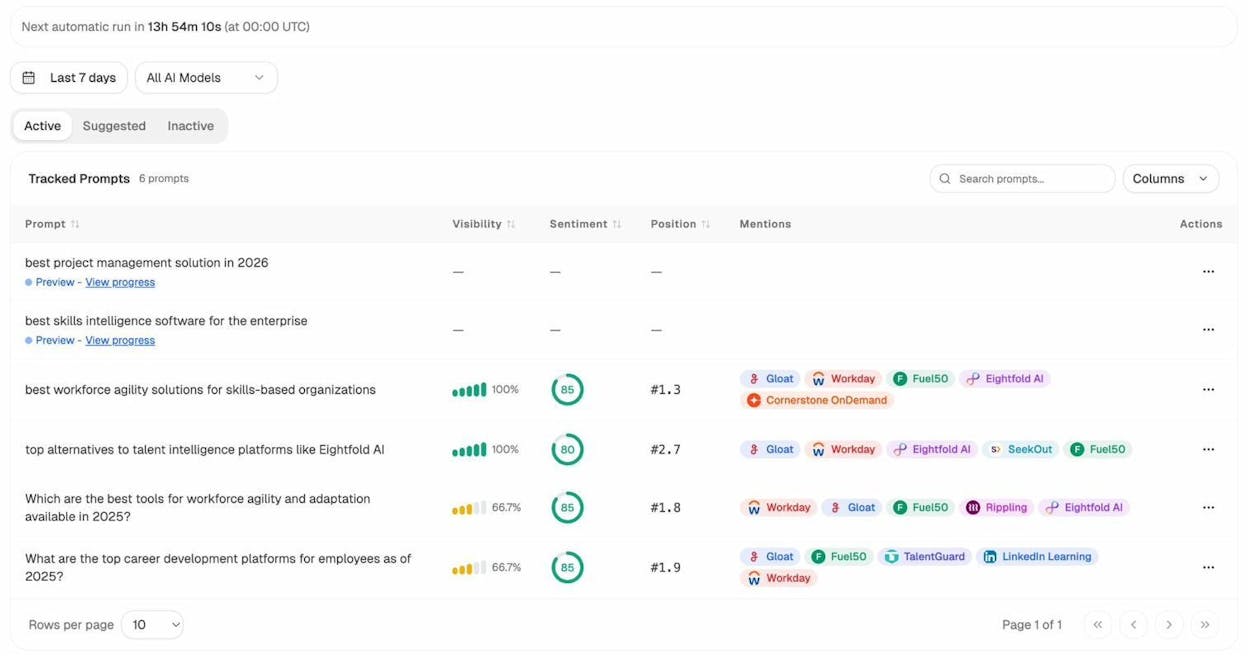
To find prompts worth targeting, open Analyze AI and look at the suggested prompts in your category, then add the ones that mention your competitors but not you. Track them and you will see exactly which pages on your site need to exist.
3. Get found in your neighborhood with free local listings
If you serve a local market, getting listed in directories is non-negotiable. People search for “lawyer near me” or “plumber Brooklyn” every minute, and Google sends most of those users to its Map Pack and to local directories before any organic result appears.
Start by claiming and fully completing your Google Business Profile. Add categories, photos, hours, services, and ask happy customers for reviews. Then add your business to the relevant local directories in your category. Keep your name, address, and phone number identical across every listing.
These same listings now do double duty for AI search. ChatGPT and Perplexity pull local recommendations from directories, review aggregators, and Wikipedia entries. Inconsistent NAP data confuses both Google and AI engines, and confused engines do not recommend you.
4. Give away something genuinely useful
A free template, calculator, mini-course, or PDF guide pulls in word-of-mouth traffic and earns links at the same time.
The trick is to solve a sharp, specific problem your audience is already paying for. A “social media calendar template” is generic. A “30-day content calendar for SaaS founders launching their first podcast” is specific and the kind of asset journalists link to.
Free tools earn the most. Our Bing Keyword Tool, Amazon Keyword Tool, and YouTube Keyword Tool all came from this thinking.
5. Make simple videos that bring visitors from YouTube
YouTube is the second-largest search engine, and AI engines are starting to cite YouTube transcripts directly inside answers. A single well-targeted video can keep delivering traffic for years.
You already have what you need. A phone, decent light, basic earbuds.
Step 1: Find topics people are already searching for
Type a question related to your niche into YouTube. Watch the autocomplete suggestions. Those are real searches.
![[Screenshot of YouTube autocomplete with a niche query typed in, showing suggested searches.]](https://www.datocms-assets.com/164164/1778176735-blobid5.png?auto=format,compress&w=1248&fit=max)
Then run those queries through our free YouTube Keyword Tool to see which ones have real search volume.
Step 2: Use the pillar-and-atom approach
Make one comprehensive video, 8 to 15 minutes long, that fully answers the search query. That is your pillar. Use the exact search phrase in your title.
Then cut three to five 30 to 60 second clips from the pillar and post them as Shorts, Reels, and TikToks. Each clip ends with a caption pointing back to the full video. The shorts pull in new audiences, and the pillar deepens trust and drives clicks to your site.
When you upload, paste the transcript into the description. AI engines crawl those transcripts.
6. Start collecting emails
Email is the only marketing channel you actually own. Search algorithms change, social platforms throttle reach, AI engines decide what to cite. Your email list goes wherever you go.
Put a sign-up form next to your best content, not in the footer. Offer a clear, specific reason to subscribe (a weekly digest, a one-time guide, an early-access waitlist).
Keep the newsletter itself differentiated. Generic “industry roundup” emails get unsubscribed. Specific newsletters with a point of view get forwarded. We do this with our own weekly digest, which surfaces shifts in AI search visibility for the brands we track.
7. Show up where your audience already hangs out
Your audience is already in three or four communities. Reddit, Quora, a niche Slack, an industry subreddit. Find them, spend a month answering questions without promoting yourself, and only then start linking back.
The reason this still works in 2026 is that ChatGPT, Perplexity, and Google’s AI Overviews all cite Reddit, Quora, and other community platforms heavily. According to a recent analysis we ran across 83,670 AI citations, third-party sources account for roughly 83 percent of all citations across ChatGPT, Claude, and Perplexity. A thoughtful answer on Reddit is now both a marketing channel and an AI training signal.
To find which communities matter most for your category, open Analyze AI’s Sources view and sort by domain. The top-cited domains in your space are exactly where you should be active.
Two rules. Read the rules of every community before you post. And never paste a link in your first comment, ever.
8. Build a community of your own
Once you have spent time inside other people’s communities, you’ll know what is missing. That gap is your community.
A Slack group, a Circle community, a private newsletter, a Discord. The format matters less than the focus. Communities work when there is a sharp shared identity (“indie SaaS founders in EU,” “physical therapists who treat runners”) and steady value the host actually delivers.
Communities reinforce your entity in AI search too. The more your brand shows up alongside the right topics, the more LLMs associate you with them. Our guide on off-page SEO covers how brand mentions, even unlinked ones, now feed both Google and AI.
9. Turn one piece of content into ten
Every long-form article you publish should become at least five other things. A LinkedIn carousel. A Twitter thread. A YouTube video. A podcast segment. A short Reel. A Reddit post. An email.
|
Original format |
Repurpose into |
|---|---|
|
Long-form blog post |
Twitter thread, LinkedIn post, YouTube video, podcast episode |
|
Webinar |
Blog post recap, three Reels, an email series |
|
Original research study |
Press pitch, infographic, conference talk, three blog posts |
|
Customer case study |
Sales deck, LinkedIn post, video testimonial, email proof |
Each format also lives in a different AI training pool. Your blog post might get cited by Perplexity, your YouTube transcript by Gemini, your LinkedIn post by ChatGPT.
10. Republish on platforms with built-in audiences
Content syndication means reposting your existing articles on platforms that already have an audience. Medium, LinkedIn, dev.to, Substack, Reddit (in long-form subreddits).
Two ways to do this. Self-syndicate by posting your own work, with a “this originally appeared on” link back to your site. Or pitch your work to industry sites that publish syndicated posts (“originally appeared on” + your topic on Google reveals dozens).
Set the canonical tag on syndicated copies to point to your original. That preserves SEO equity. Medium, LinkedIn, and Substack are also in the training data of major LLMs, so syndicating there plants your name where AI engines already trust the source.
11. Write for other websites to reach new readers
Guest blogging gives you four things at once. Referral traffic, brand exposure, a backlink, and an industry relationship.
Use Google search operators to find sites that accept guest posts.
[your topic] "write for us"
[your topic] "guest post guidelines"
[your topic] "contribute"
![[Screenshot of Google search results for a query like “marketing ‘write for us’” showing a list of guest posting opportunities.]](https://www.datocms-assets.com/164164/1778176744-blobid7.png?auto=format,compress&w=1248&fit=max)
Then vet each candidate with our free Website Authority Checker. Skip anything with thin content, low traffic, or a “guest posts only” feel. Aim for sites where the founder still writes some posts themselves.
When you pitch, lead with one specific headline tailored to a content gap on their site. Generic pitches get deleted. Our link building tools guide covers the full outreach stack.
12. Get listed in “best of” roundups
This is the highest-leverage tactic on the list, and almost nobody runs it well.
Roundup posts (the “12 best [tool] for [use case]” articles) drive three things. Direct referral traffic. Backlinks. And, increasingly, AI mentions. Remember that 83 percent figure from earlier. The single best way to get into AI answers is to get into the third-party content AI engines already trust, and roundup posts are the densest version of that content.
Here is the workflow:
-
Open Analyze AI’s Sources view and sort by frequency. The domains cited most often for prompts in your category are your highest-priority outreach targets.
-
For each domain, find their existing roundup articles (“best [your category]”). Read them.
-
Identify the gap your product fills that none of the listed tools fill.
-
Pitch the editor a single, specific addition (not a generic “please add us”). Offer them a unique data point, a free trial code for readers, or an exclusive insight only you can provide.
![[Screenshot of Analyze AI Sources view filtered to show top-cited third-party domains for a sample category, with a few highlighted as outreach targets.]](https://www.datocms-assets.com/164164/1778176750-blobid8.png?auto=format,compress&w=1248&fit=max)
A single placement in a high-frequency cited roundup can multiply your AI mentions overnight. We’ve seen brands jump from 10 percent visibility to 60 percent visibility on category-defining prompts after landing two well-targeted roundup placements.
13. Land mentions in newsletters and podcasts
Every niche has at least one curator who collects the best content of the week and ships it to thousands of inboxes. Get into that newsletter.
Use the Google operators trick to find them. Search “weekly newsletter” + your topic, “best [topic] newsletter,” or specific names like SEOFOMO and Marketing Brew. Pitch your single best article, not five.
Podcasts work the same way. Find the three to five your audience listens to, look up the host on LinkedIn, and pitch a specific episode angle. Hosts get the generic pitch a hundred times a week.
The traffic from a podcast appearance often underwhelms in the short run. The compounding effect (citations on the show notes page, the YouTube version showing up in YouTube search, the transcript getting cited by AI) is where the real value sits.
14. Team up for webinars and joint content
Find a non-competing business that targets the same audience as you, and run a joint webinar, a co-authored report, or a shared course. Each of you brings half the audience.
Pick a topic where both companies bring distinct expertise. Promote it with two emails each, two LinkedIn posts each, and one shared landing page. The recording itself becomes a permanent asset you both link to.
If their audience trusts them and you show up alongside them, that trust transfers, and LLMs treat the partner’s authority as a signal of yours.
15. Ask the right people to link to your best content
Outreach for backlinks is a numbers game with a craft layer on top. The numbers part is finding 200 relevant prospects. The craft part is writing 200 emails so personalized that each feels like the only one.
Our link building tools guide breaks down the workflow. The short version:
-
Pick one of your best assets (an original study, a calculator, a definitive guide).
-
Find sites that already link to similar content from competitors.
-
Run them through our Website Authority Checker.
-
Send a one-paragraph email that names a specific page on their site, points out a specific gap, and offers your asset as the fix.
Ten well-researched pitches beat a hundred generic ones every week.
16. Get featured in news and trade press
Digital PR is the practice of getting your brand into the kind of articles journalists already write.
Three workflows that work in 2026:
-
Reactive sourcing. Sign up to Help a B2B Writer, Featured.com, and Qwoted. Reply fast with a quote a journalist can paste in.
-
Newsjacking. When something breaks in your industry, publish a sharp take and email it to journalists who cover that beat. Speed beats polish here.
-
Original data. Run a small study using data only you have access to. A single original data point can earn 30 backlinks if you pitch it well.
PR mentions on high-authority publications also drive AI citations. ChatGPT, Perplexity, and Gemini weight news domains heavily when answering questions about brands. A single Forbes mention can keep paying you in AI mentions for years.
17. Partner with influencers who already have your audience
Influencer marketing is not just for consumer brands. B2B founders, niche experts, and category-defining creators all have engaged audiences you can borrow.
Skip vanity metrics. A creator with 5,000 highly engaged followers in your niche is more valuable than one with 500,000 generic followers. Look for creators who already mention your category and have a real comment section, not just emoji reactions.
Four steps:
-
Define the outcome (sign-ups, demo requests, podcast subscribers).
-
Find creators by searching your category hashtags on LinkedIn and X, then sorting by engagement.
-
Offer something specific (free product, paid sponsorship, affiliate split, co-created content). Smaller creators often accept product or co-marketing in lieu of cash.
-
Track results with UTM links and a unique discount code per creator.
18. Start small with targeted Google Ads
Paid ads work when you go narrow. Compete with big brands on broad keywords and you will burn cash. Compete on specific long-tail keywords and you will drive qualified clicks for under a dollar.
The workflow:
-
Open our free Keyword Generator and pull keywords with three or more words.
-
Filter for keywords with commercial or transactional intent (buy, hire, software, near me, alternatives).
-
Set a max CPC that fits your budget. If a keyword’s typical CPC is $8 and you can afford $3, skip it.
-
Add negative keywords aggressively. Words like “free,” “DIY,” and “jobs” tell Google not to show your ad to people who’ll never buy.
![[Screenshot of a Google Ads keyword planner or campaign setup showing negative keywords being added to a campaign.]](https://www.datocms-assets.com/164164/1778176751-blobid9.png?auto=format,compress&w=1248&fit=max)
Send every ad click to a dedicated landing page that exactly matches the ad’s promise. If the ad says “emergency plumber in Brooklyn,” the page should show 24/7 service, a Brooklyn phone number, and a clear booking flow. Sending paid traffic to your homepage is the most expensive mistake new advertisers make.
ChatGPT, Perplexity, and Google’s AI Overviews are also rolling out paid placements. Treat them the way you’d have treated Google Ads in 2003. Early movers compound their returns.
Final thoughts
You don’t need 18 tactics. You need three you can run consistently for a year.
Pick the ones that match your strengths. If you write well, lean into content, guest posts, and newsletters. If you build well, ship a free tool. If you talk well, start the podcast. The best tactic is the one you’ll actually keep doing in month nine.
SEO is not dead, AI search is an additional organic channel, and the brands that win in both are the ones with sharp, original content. That is the bet behind our manifesto and the 4 pillars of an effective SEO strategy for AI search.
If you want to see what AI engines say about your brand right now, sign up for Analyze AI and run a free audit. You’ll see which prompts cite you, which cite competitors, and which roundup placements would move the needle fastest.

Ernest

Ibrahim


