



Summarize this blog post with:


In this article, you’ll learn the eleven challenges that quietly hold back enterprise SEO programs, the mistakes most teams make when trying to fix them, and a practical way to attack each one. We’ll also show how AI search fits into the same playbook, because the pages that rank in Google now feed answers in ChatGPT, Perplexity, and Google’s AI Mode. Treating AI search as a separate problem is itself an enterprise mistake. The teams winning at scale build one organic motion that compounds across both channels.
Table of Contents
Fragmented teams and tangled infrastructure
Enterprise companies are harder to work in than smaller ones, and most of the friction shows up before any keyword research starts.
Teams that don’t know each other exist
A typical enterprise has SEO work happening inside content, product marketing, growth, regional teams, and sometimes a dedicated technical SEO group. None of them report to the same leader. Finding the right person to fix a canonical tag can take a week of Slack messages.
The mistake here is trying to centralize everything before you have credibility. Start by mapping who already touches SEO across the org, then build a working group with the people closest to the code and the content. Lean on institutional knowledge from longer-tenured colleagues so you don’t reinvent processes that already exist.
Multiple sites, CMSs, and CDNs
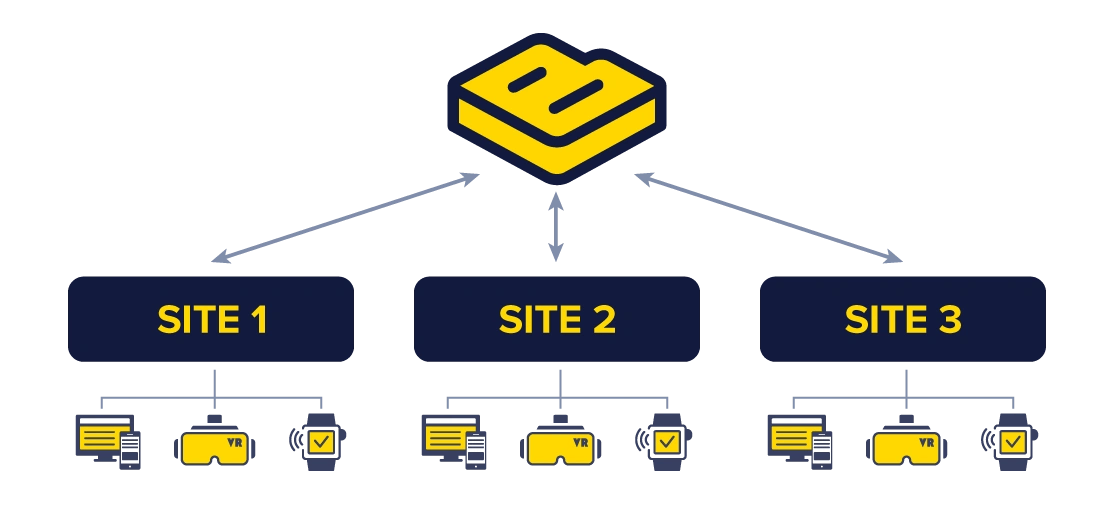
Most enterprises run anywhere from 5 to 50+ properties across Adobe Experience Manager, Sitecore, WordPress, Drupal, custom builds, and headless setups. Each has its own deploy pipeline and its own owner. Issues that take 30 minutes on a startup site take three weeks to ship at the enterprise level.
Segment by system. List every property, every CMS, every CDN, and the team that owns each one. When you find an issue, you can route the fix to the right team instead of opening a ticket in the void. For migrations and consolidations, document the redirect strategy and entity mapping before any URL changes ship.
For AI search, the same fragmentation applies, with an added layer. AI engines crawl your marketing site, your developer docs, your help center, your YouTube channel, and even your social posts. If your knowledge base lives on a different domain than your blog, you might be invisible in ChatGPT for a topic where your blog ranks #1 in Google. Track citations across every domain you own, not just the marketing site.
Getting buy-in for SEO and AI search projects
If leadership doesn’t see the value of organic, you’ll lose every prioritization meeting. You’re always selling.
Align objectives to company goals
Enterprise SEO objectives that survive budget cycles tie directly to a goal someone’s bonus depends on. If the company is pushing a new product line, your top-line OKR should be visibility and traffic to that line. If the goal is enterprise expansion, focus your work on the topics enterprise buyers research.
The same logic applies to AI search. Don’t pitch “increase brand mentions in ChatGPT” as a standalone goal. Pitch “we will be the brand AI engines recommend when buyers in our ICP ask about our category.” That maps to revenue. Vague visibility goals get cut first when budgets tighten.
Make a business case in dollars
A common mistake is to pitch projects because Google says they’re industry convention. At enterprise scale, that argument loses every time.
Tie every project to revenue, or to a reasonable proxy. A useful trick is to assign a per-unit value to the asset you’re recovering. For redirect projects, a common framing is to assign $400 per recovered referring domain (adjust for your industry and link valuations). If you’re recovering 250 URLs that average 10 referring domains each, the project gets pitched as $400 × 250 × 10 = $1,000,000 in recovered link equity. That number gets attention. “Implement 301 redirects” does not.
For AI search, run the same math. If 1 in 4 AI mentions of your category translates to a branded search, and your branded search converts at 8%, you can model the revenue from each additional mention. We’ve broken down the underlying math in our piece on tracking visibility in AI search.
Promote your wins, including the AI ones
Most enterprise SEOs underreport their results. If a content cluster doubled lead volume, that should be in the next exec deck with the team’s name on it. The same goes for AI wins. When a page starts getting cited by Perplexity or appearing in Google AI Overviews, screenshot it and share it. Visibility in AI engines is novel enough that exec teams pay attention.
Show off expertise outside the company
Internal credibility builds faster when external credibility is visible. Speaking engagements, published research, and quoted commentary in industry pieces all signal that the SEO function is led by a subject matter expert, not a generalist. Add it to your email signature. The mistake is to assume the org notices your work without you pointing to it.
Reporting that proves business impact
Reporting at the enterprise level is a tax you pay for trust. Skip it and you lose the next budget conversation.
The mistake teams make is reporting on the same five SEO metrics every month and ignoring whether anyone outside the team uses them. Different audiences need different reports. The CFO wants pipeline contribution. The CMO wants share of voice. The product team wants page-level conversion. Build one source of truth, then cut views for each audience.
For AI search reporting, a few metrics are worth standardizing on:
|
Metric |
What it tells you |
Who cares |
|---|---|---|
|
Visibility (% of tracked prompts where you appear) |
How often you show up in AI answers |
CMO, brand |
|
Sentiment score |
How AI engines describe you |
PR, brand |
|
Average rank in AI answers |
Where you sit versus competitors |
SEO lead, GTM |
|
Citation count by domain and page |
Which of your pages AI engines trust |
Content team |
|
AI-referred sessions and conversions |
Bottom-line traffic from AI engines |
CFO, RevOps |
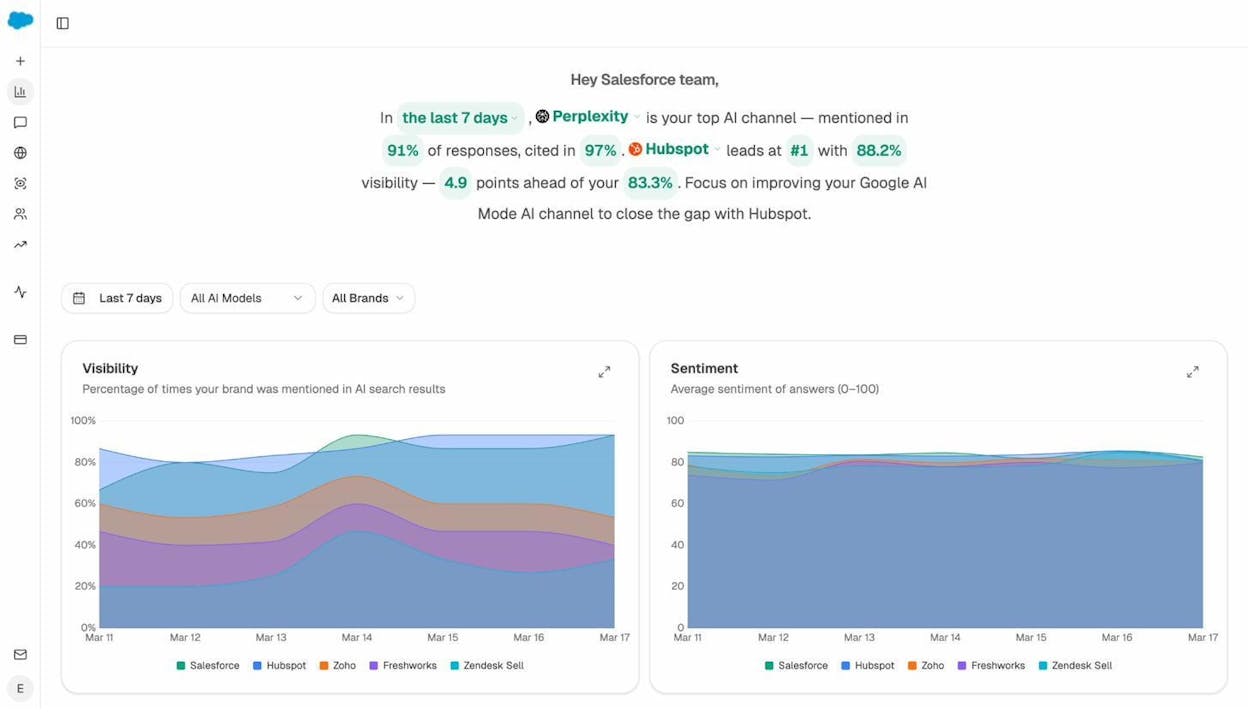
The Analyze AI overview surfaces the exec-ready summary, share of voice across LLMs, and sentiment trend in one place. That single view is usually enough to anchor a monthly stakeholder update.
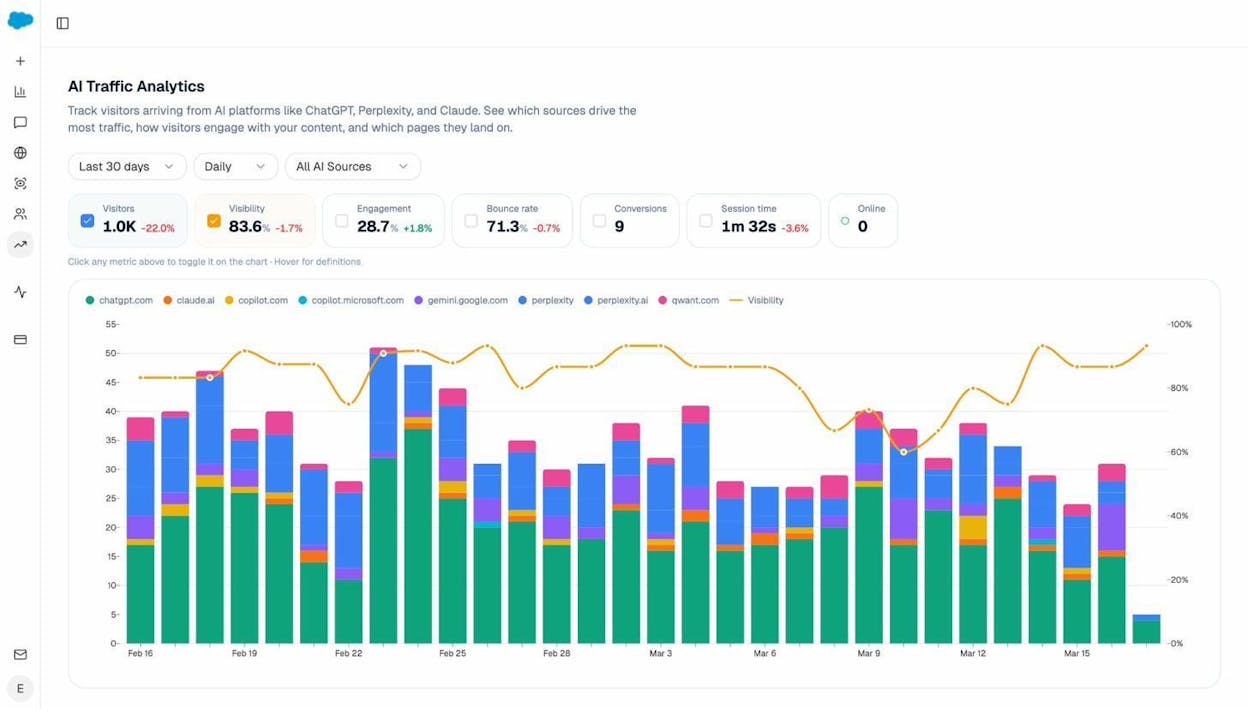
AI Traffic Analytics ties AI engine sources to actual sessions, bounce rate, conversions, and engagement. This is the metric set most CFOs actually want when they ask “is AI search real revenue or a vanity channel.”
If you’re piecing together a reporting stack from scratch, our roundup of free SEO reporting tools covers the supporting cast for traditional search.
Implementation friction
Even when you’ve sold the project, getting it shipped at an enterprise is its own discipline.
Legacy systems
Some of your most important pages live on platforms the company stopped funding three years ago. Pure code fixes are off the table. The escape hatch is edge logic. If your site is fronted by a CDN like Cloudflare, Akamai, or Fastly, you can ship redirects, header changes, and even DOM rewrites at the edge without touching the legacy CMS. This is sometimes called Edge SEO, and it has rescued many enterprise migrations that would have otherwise stalled.
Legal and compliance
Legal can kill your link-building outreach, your testimonial pages, your data studies, and sometimes your internal linking on regulated content. The mistake is asking legal to approve an entire program in one go. Bring them a single, clear deliverable, the exact language, the exact recipients, and the exact channels. A yes/no on a tight scope is far easier to get than approval on a strategy doc.
Cross-team collaboration
Engineering won’t ship your meta tag changes if you sent them as a wall of Jira tickets. Package the work. A redirect project becomes “recover $1M in link equity in 6 weeks.” A schema rollout becomes “improve AI engine eligibility across 4,000 product pages.” Engineers and PMs respond to packaged outcomes far more than to a backlog.
Prioritization across millions of pages and prompts
Enterprise sites have anywhere from 50,000 to 50 million URLs. You cannot fix them all. Picking what to work on is the actual job.
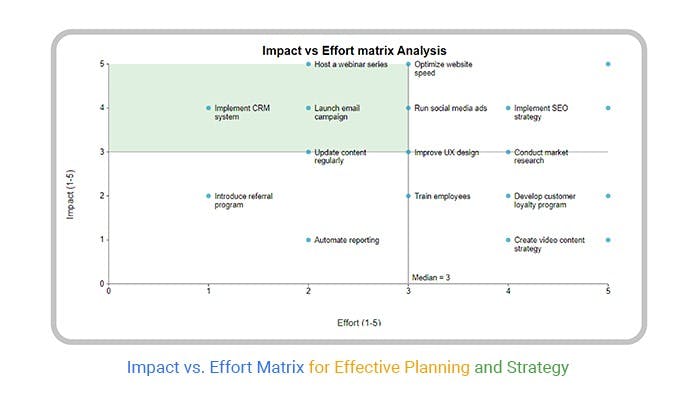
A practical tool for this is an impact-effort matrix. List candidate projects, score each on revenue impact and on engineering effort, plot them, and start with the high-impact, low-effort quadrant. Work down to high-impact, high-effort once you have wins on the board.
For AI search, the analog is prompt prioritization. You can’t track every prompt your buyers might ask. You can track the 20 to 100 prompts that actually drive consideration in your category. Analyze AI surfaces the high-value prompts your competitors get cited on but you don’t, so prioritization is data-driven instead of guesswork.
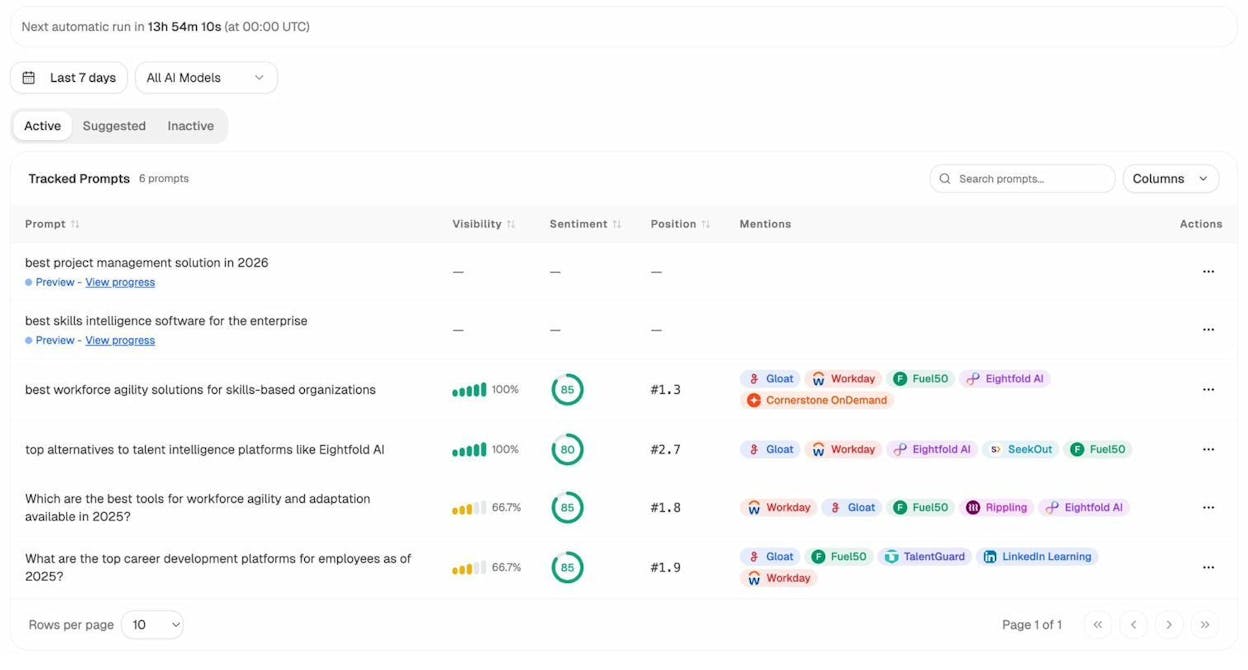
Each tracked prompt shows visibility percentage, sentiment, average position, and which competitors get cited alongside or instead of you. Sort by visibility ascending, and the prompts at the top are the ones to attack first.
For deeper context on the matrix logic applied to keyword gaps, our writeup on SEO competitor analysis covers the workflow.
Resources are still finite
Even at enterprises with eight-figure marketing budgets, SEO teams compete with paid, brand, and product for headcount and tooling.
Hiring versus agencies
Adding headcount in an enterprise can take 9 to 18 months. Agencies can start in 4 weeks and come from a different budget line. The mistake is to hire an agency to “do SEO” without a brief. The agencies that move the needle fill specific gaps your team named, like a technical audit during a migration, content production for a new vertical, or AI search readiness across your top 100 pages.
Tooling
Enterprise SEO tools are expensive, and bad ones are nearly impossible to remove once integrated. A short comparison of the main categories:
|
Tool category |
What it does |
When you need it |
|---|---|---|
|
Crawlers and audit tools |
Find technical issues at scale |
Always, especially during migrations |
|
Rank trackers |
Track keyword positions and SERP features |
When organic is a primary channel |
|
Backlink tools |
Monitor referring domains and lost links |
When PR or link building is active |
|
AI search visibility platforms |
Track citations, prompts, and AI-referred traffic |
Now, before competitors anchor first |
If you’re evaluating the AI search side, our breakdown of enterprise SEO tools and our LLM monitoring tools roundup cover the field. For free entry-level checks, Analyze AI’s website authority checker, SERP checker, and keyword rank checker cover the basics without a contract.
Wrong incentives
The cost-recovery model, where one team has to charge another to do work, is one of the costliest enterprise traps. Putting in a redirect should not require a billable code from the requester. Things done for the company’s benefit should be centrally funded. If yours isn’t, raise it as a structural blocker, not a personal complaint.
Reactive monitoring when you should be proactive
The default crawl cadence at most enterprises is monthly. That means a broken canonical can sit live for 30 days before anyone notices.
Critical page and prompt monitoring
Every enterprise team should have a list of 50 to 200 pages that account for the bulk of revenue, and a separate list of 20 to 100 AI search prompts that drive their category. Monitor both daily, not monthly. When a critical page drops in rank, or starts losing citations in AI engines, the alert should land in your inbox the same day.
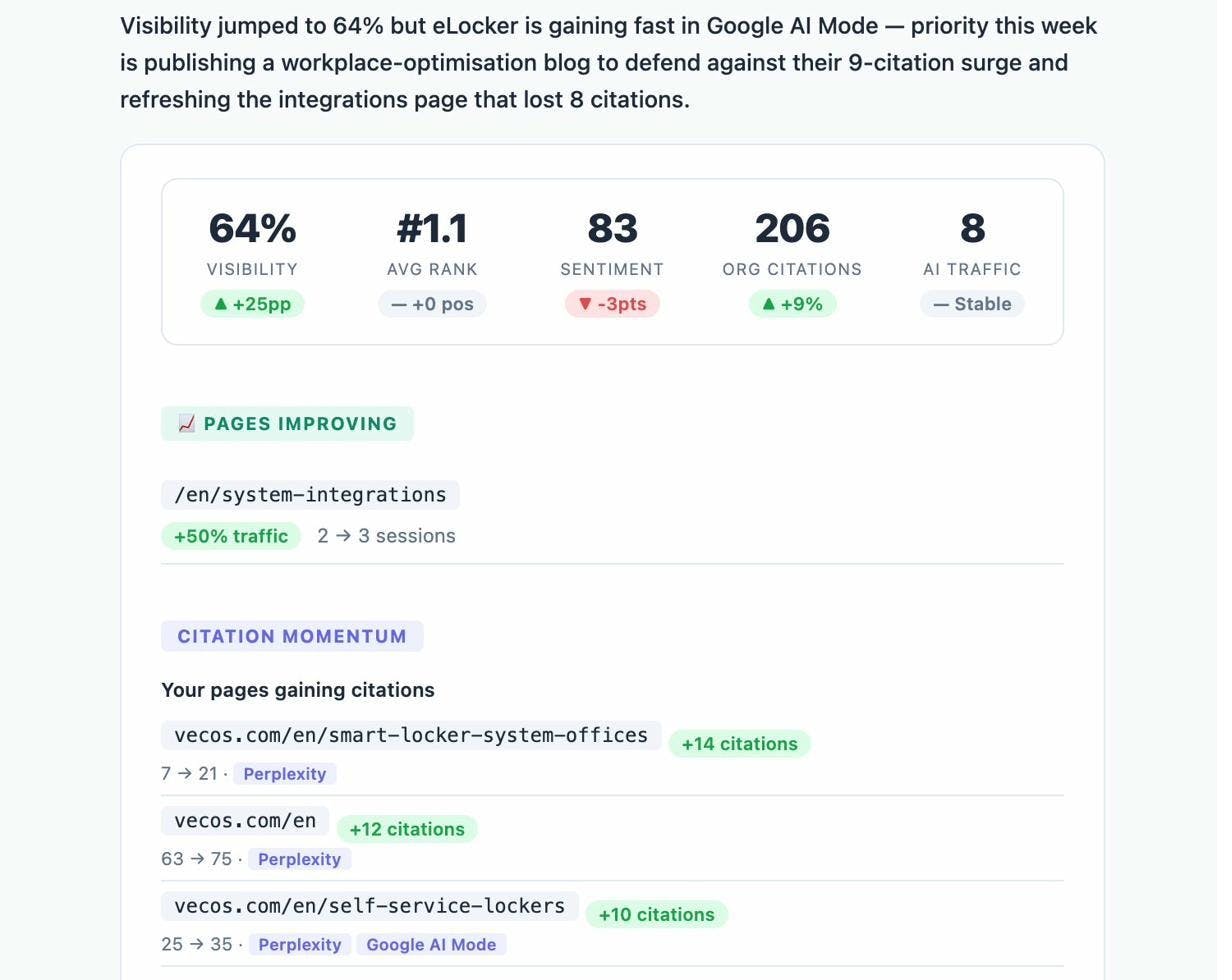
The Analyze AI weekly digest flags pages gaining or losing AI citations, the prompts that shifted in your favor or against you, and a recommended action for the week. It compresses what would otherwise be 90 minutes of dashboard scrubbing into a 30-second read.
Catch issues before they launch
A common mistake is to wait for the next scheduled crawl. Better practice involves four moves:
-
Run unit tests in your CI/CD pipeline that flag missing canonical tags, broken redirects, and structured data errors.
-
Crawl your staging environment before any large release.
-
Set up sample crawls of your top 100 templates and your top 100 pages, and run them daily.
-
Use IndexNow on supported CDNs to push real-time signals to search engines and AI crawlers.
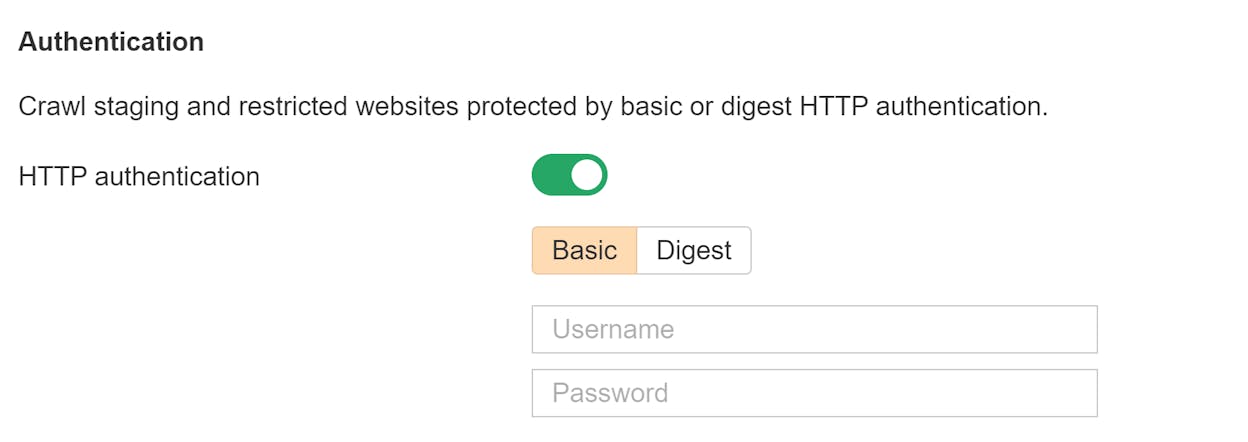
For broken-link monitoring across an enterprise estate, Analyze AI’s broken link checker is a fast way to scan a site without spinning up a full audit.
Working in the weeds versus strategic work
A common enterprise SEO mistake is staying busy with small tasks. Optimizing one page at a time feels productive, and 18 months later the team is exhausted while the company hasn’t moved.
You need both views. Macro work is portfolio strategy, content cluster planning, and the architectural decisions that touch thousands of pages at once. Micro work is the individual page fixes. If your week is 90% micro, your impact is capped.
A practical fix is to block half a day every week for portfolio review. Look at the trend lines, not the page-level details. Where is share of voice growing? Where is it slipping? Which clusters are losing AI citations even though their Google rankings are stable? Those signals show you the macro problems before they hit the next monthly report.
Over-investing in bottom-of-funnel content
Most enterprise teams over-index on transactional content. The category landing pages, the comparison pages, the pricing pages. They convert, so they get the budget.
The mistake is that AI engines, especially ChatGPT and Perplexity, lean heavily on informational content when they answer buyer questions. If you have no presence in the awareness and consideration tier, you become invisible in AI answers exactly when buyers are deciding which brands to shortlist.
The fix is to build out the top of the funnel deliberately. Definitions, comparisons of approaches (not just products), how-to guides, and explainers all earn citations in AI engines, and they often earn featured snippets and People Also Ask placements in Google too. We’ve gone deeper on the structural side in our piece on the 4 pillars of an effective SEO strategy for AI search.
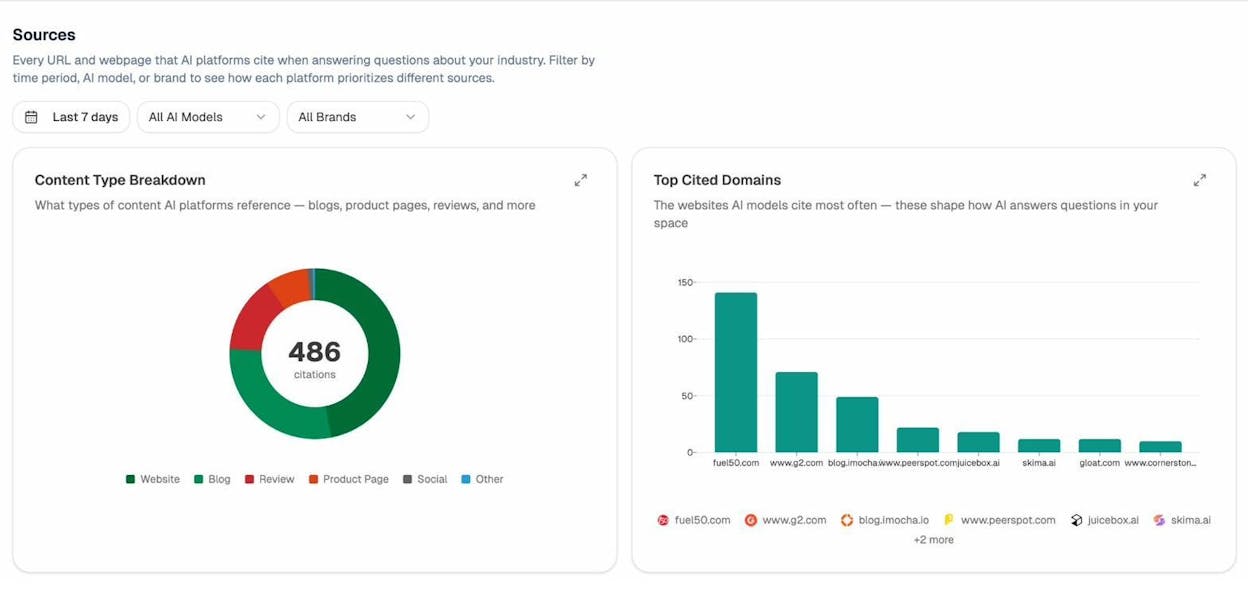
The Analyze AI Sources view shows which content types and which domains AI engines cite the most in your category. Notice that blog content dominates the breakdown. That’s not a coincidence. Informational content is what AI engines were trained on, and it’s still what they pull from when they generate answers.
You can also reverse-engineer top-of-funnel opportunities by mining People Also Ask and AI follow-up queries. Our writeup on optimizing for People Also Ask covers the workflow for SEO and AI search together.
Outpacing competitors who are racing in AI too
There is a lot of money in your category, and your competitors are investing too. Sitting still loses.
The work splits in two.
For traditional search, track competitor publishing cadence, new pages, and lost pages. When a competitor pulls ahead in a cluster, the fix is rarely a single page. It’s a content sprint, or a refresh on your top 20 pages in that cluster.
For AI search, track which competitors get cited for which prompts, which sources AI engines trust in your category, and which prompts you don’t show up on at all. Every uncited prompt where a competitor wins is an opportunity worth costing out.
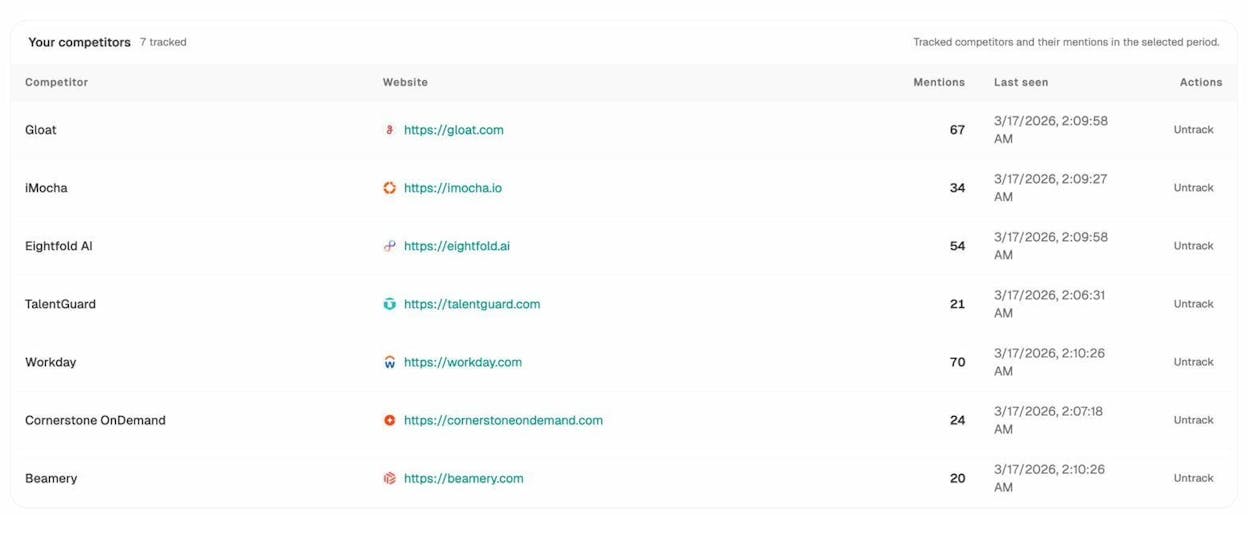
The Suggested Competitors view in Analyze AI surfaces entities AI engines mention that you haven’t started tracking. This is how you find the upstart competitor who’s quietly winning citations in your category before they show up in your sales pipeline.
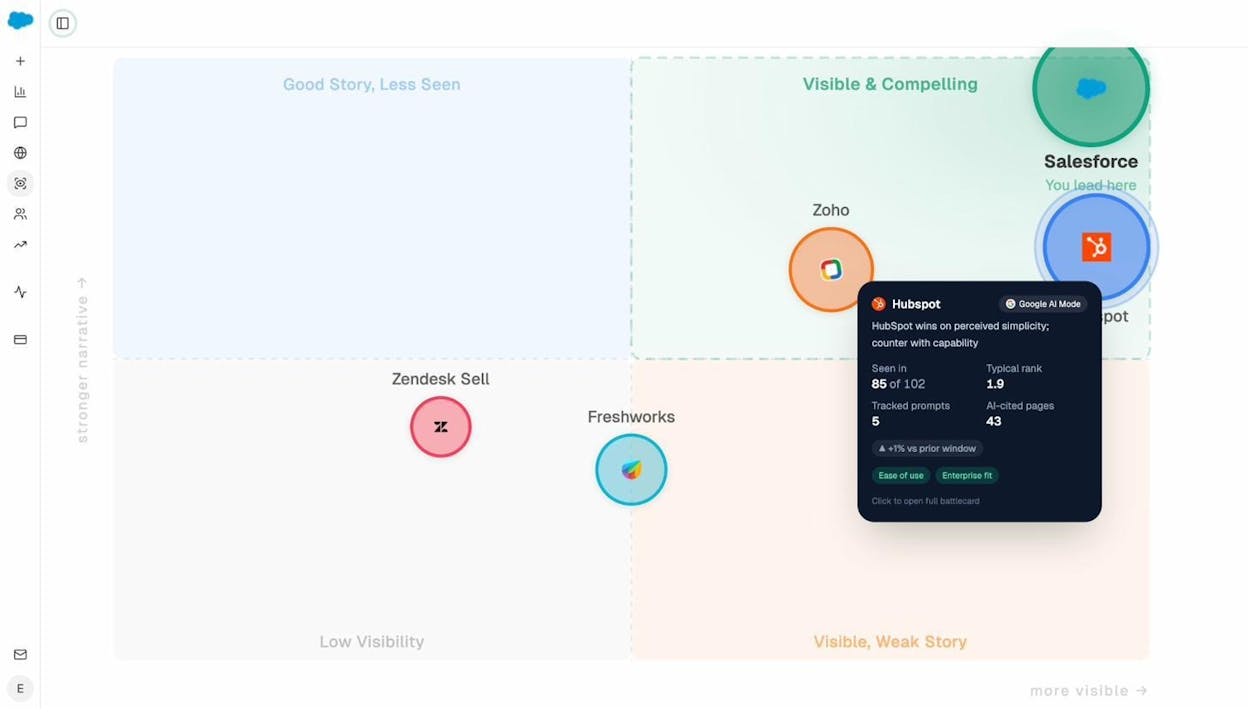
The perception map plots competitors on visibility versus narrative strength, so you can see where to defend a leadership position and where to attack a weaker incumbent. Treat it the way an analyst relations team treats the Gartner quadrant. Move yourself toward the upper right, deliberately.
To go deeper on the workflow, our piece on outranking competitors in AI search breaks down the citation data behind these decisions.
Final thoughts
Enterprise SEO is hard because the work is mostly organizational. The technical fixes are usually well understood. Getting them shipped, getting them funded, and getting credit for them is where most teams stall.
The same is true for AI search. The brands winning in ChatGPT, Perplexity, and Google AI Mode right now aren’t the ones with the cleverest GEO tactics. They’re the brands that already had strong organic foundations, and they extended those foundations into AI engines deliberately. SEO is not dead. It’s compounding into a second channel that pulls from the same content investments.
If you want to see how Analyze AI helps enterprise teams report on both channels in one place, our AI visibility tracking and AI traffic analytics features are the ones to start with.

Ernest

Ibrahim


