



Summarize this blog post with:


In this article, you’ll learn a seven-step process for selling SEO services that closes more deals at higher prices. You’ll see how to build proof that gets you in the door, qualify prospects before wasting time on calls, pitch outcomes instead of deliverables, write a one-page proposal that does the selling for you, and forecast results so clients feel confident signing. You’ll also learn how to add AI search visibility to your offering, giving you a competitive edge over every other SEO provider pitching the same services.
Table of Contents
Step 1. Build proof that gets you in the door
Nobody hires an SEO provider based on a promise. They hire based on evidence. If you do not have proof of results yet, your first job is to create some.
Show traffic and ranking growth with screenshots
The fastest way to establish credibility is to show what you have done for someone else. Pull an organic traffic chart from Google Search Console, Google Analytics, or a tool like Analyze AI’s Website Traffic Checker and add it to your website or pitch deck.
![[Screenshot: Google Search Console performance chart showing organic traffic growth over 6 months for a client site]](https://www.datocms-assets.com/164164/1777315418-blobid1.png?auto=format,compress&w=1248&fit=max)
If you ran a link building campaign, show the referring domains chart. If you improved rankings for specific keywords, show the before-and-after positions using a tool like Analyze AI’s Keyword Rank Checker.
![[Screenshot: Keyword rank tracking dashboard showing position improvements for target keywords]](https://www.datocms-assets.com/164164/1777315433-blobid2.png?auto=format,compress&w=1248&fit=max)
The key is specificity. Do not say “we grew traffic.” Say “we grew organic traffic from 1,200 to 8,400 monthly visits in nine months by targeting 34 keywords in the commercial investigation stage.” Numbers create trust. Vague claims create suspicion.
Show before-and-after results
A before-and-after comparison is more persuasive than a single metric because it shows movement. Here is what to include in a good before-and-after case study:
The starting point. Where was the client’s traffic, rankings, or revenue when you started? Be specific. “The site ranked on page 3 for its primary keyword and received 340 organic visits per month.”
What you did. Describe the work without jargon. “We restructured the site architecture, rewrote 12 service pages to target buyer-intent keywords, and earned 28 backlinks from industry publications over six months.”
The result. Show the outcome in numbers. “Organic traffic grew to 4,100 monthly visits. The site now ranks in the top 3 for 8 of its 12 target keywords. The client attributes 22 new qualified leads per month to organic search.”
![[Screenshot: Side-by-side comparison of Google Analytics traffic before and after an SEO campaign, with annotations showing the start date of the campaign]](https://www.datocms-assets.com/164164/1777315448-blobid3.png?auto=format,compress&w=1248&fit=max)
Get client testimonials
Testimonials from real clients carry more weight than any chart. But most SEO providers ask for testimonials the wrong way. They say “can you write a testimonial?” and get something generic like “Great to work with, highly recommend.”
Instead, ask a specific question. Try: “What was your biggest concern before hiring us, and what happened after we started working together?” This produces a testimonial that addresses objections and shows a transformation.
Put these testimonials on your website, in your proposals, and in your email signatures. A single line from a real client is worth more than a page of self-promotion.
Show AI search visibility results too
Here is where most SEO providers miss an opportunity. Buyers are increasingly aware that AI search engines like ChatGPT, Perplexity, Gemini, and Copilot are influencing their customers’ decisions. If you can show that your SEO work also improved a client’s visibility in AI search results, you immediately differentiate yourself from every other provider who only talks about Google rankings.
You can use Analyze AI to pull a visibility chart showing how often a client’s brand gets mentioned across AI engines, how that has changed over time, and which AI engines recommend them most.
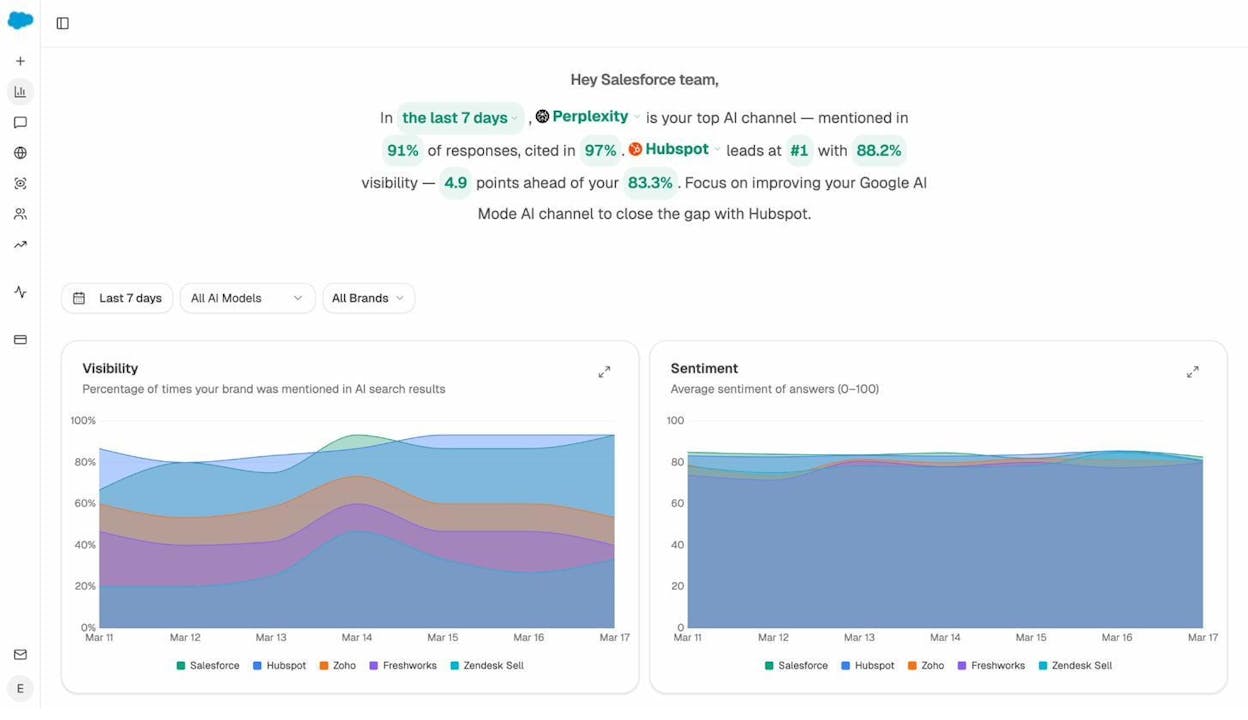
This is not about replacing your SEO pitch with an AI pitch. It is about adding a layer of proof that no other provider is showing. When a prospect sees that you track and improve visibility across both traditional and AI search, you look like the provider who understands where search is heading.
Step 2. Find and qualify prospects
Finding prospects is the easy part. The hard part is qualifying them before you invest time in calls, proposals, and follow-ups that go nowhere.
Where to find SEO prospects
There are two categories of prospect sources: inbound and outbound.
Inbound sources bring prospects to you. These include your website, blog content optimized for keywords your prospects search (like “SEO services for dentists” or “ecommerce SEO agency”), Google Business Profile for local visibility, referrals from existing clients, and social media content where you share case studies and insights.
Outbound sources require you to initiate contact. These include cold email, LinkedIn outreach, phone calls, attending conferences and meetups, and freelance platforms like Upwork, People Per Hour, and Fiverr.
Inbound leads close at a higher rate because the prospect has already identified a problem and found you as a potential solution. But outbound lets you choose who you want to work with and can produce results faster when you are starting out.
Most successful SEO providers use both. They build inbound over time while using outbound to fill gaps.
How to qualify prospects before the call
The biggest time-waster in selling SEO is spending 45 minutes on a discovery call only to learn the prospect has no budget, no decision-making authority, or no actual need for SEO.
Qualify before the call. Use a short intake form on your website, an email sequence, or a chatbot that asks the right questions. Here is a qualification framework you can adapt:
|
Question |
Why it matters |
|---|---|
|
What is your primary goal? (More leads, more sales, improved site performance) |
Tells you what outcome to pitch |
|
How many new leads or customers do you want per month? |
Lets you reverse-engineer the traffic needed |
|
What is a new customer worth to you? (Revenue per client or average order value) |
Lets you frame ROI and justify your pricing |
|
What keywords does your target audience search? |
Tests whether they understand their market |
|
Do you have a budget allocated for SEO? |
Eliminates tire-kickers early |
|
Who makes the final decision on hiring an SEO provider? |
Identifies whether you are talking to the decision-maker |
If a prospect cannot answer these questions or has no budget, they are not ready to buy. Add them to your newsletter and follow up later.
![[Screenshot: Example of a lead qualification form on an SEO provider’s website with fields for goal, target customer count, budget range, and website URL]](https://www.datocms-assets.com/164164/1777315466-blobid5.png?auto=format,compress&w=1248&fit=max)
Qualify using AI search as a conversation starter
One powerful way to open a conversation with a prospect is to show them something they have never seen before. Run a quick ad hoc prompt search in Analyze AI using a query their customers would type into ChatGPT or Perplexity, and screenshot the result.
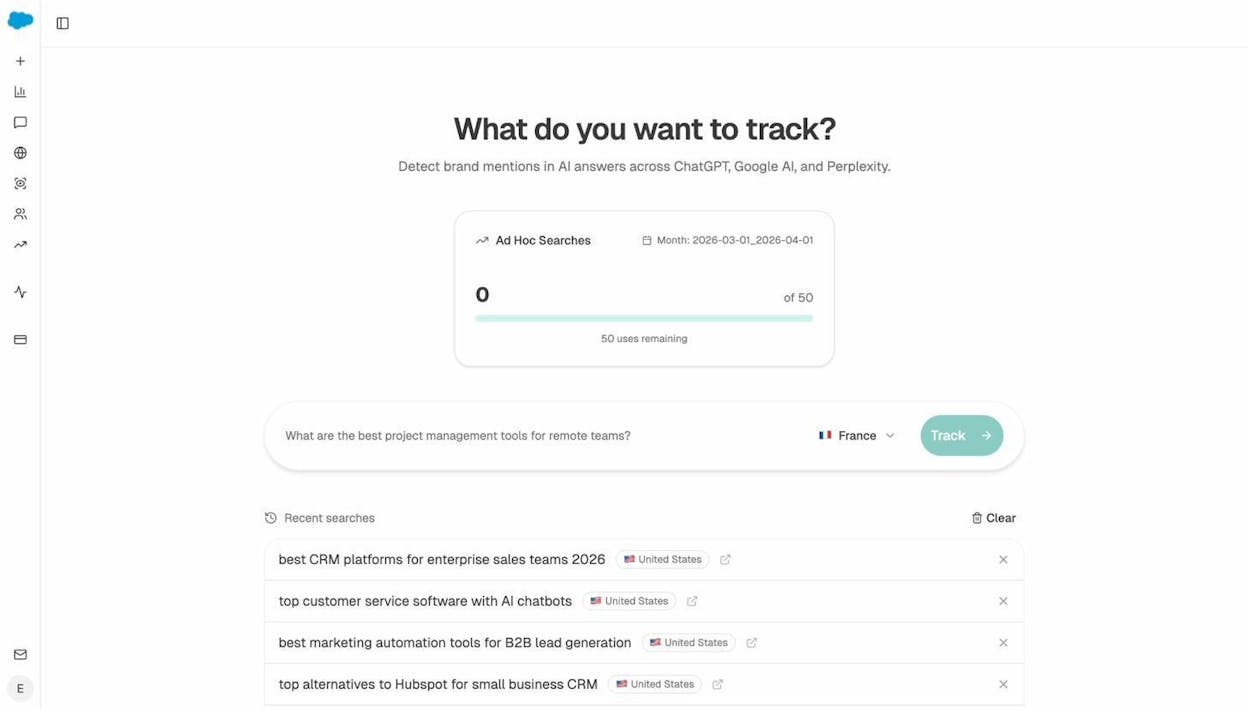
If the prospect’s brand does not appear in the AI response but their competitors do, you have an instant conversation starter. Send them the screenshot with a note: “I searched for [their service] in ChatGPT. Your three main competitors show up. You don’t. Want to talk about fixing that?”
This is a modern version of the classic “I audited your site and found problems” approach, but it hits harder because most business owners have never thought about whether AI search engines recommend them.
Step 3. Pitch outcomes in discovery sessions
Most SEO providers pitch their process. They talk about keyword research, on-page optimization, link building, and technical audits. The prospect’s eyes glaze over because they do not care about the process. They care about the result.
Pitch the outcome first. Then explain the process only when they ask how you will get there.
How to frame the conversation around outcomes
Start with what the prospect told you during qualification. If they said they want 20 new customers per month, start there.
Here is an example conversation with a prospect named Sarah, who runs a commercial cleaning company.
You: Sarah, you mentioned you want 20 new commercial cleaning contracts per month. Let me walk through what that looks like from a search perspective.
Sarah: Sure.
You: Your website currently gets about 400 organic visits per month. If we assume your site converts about 5% of visitors into inquiry form submissions, that is 20 inquiries. And if your team closes about 25% of inquiries into contracts, that is 5 new contracts from organic search right now.
Sarah: That sounds about right, actually.
You: So to hit 20 new contracts, we need 80 inquiries per month. At a 5% conversion rate, that means 1,600 organic visits. Your two biggest competitors in the area get 3,200 and 2,100 organic visits per month, so 1,600 is realistic for your market.
Sarah: How do you know what my competitors get?
You: I checked using a traffic analysis tool. I can show you the data. But here is the interesting part. I also looked at what happens when someone asks ChatGPT or Perplexity “best commercial cleaning companies in [your city].” Three of your competitors show up. You don’t appear at all. So there is a whole channel of potential customers who are not finding you.
Sarah: I had no idea AI search was even a factor.
You: It is becoming one. And the good news is that the same content and SEO work that will improve your Google rankings will also improve your visibility in AI search results. Let me show you what I mean.
The CPC anchor technique
Notice what happened in that conversation. The SEO provider did not talk about pricing first. They framed the value by showing what the prospect would have to spend on Google Ads to get the same traffic.
Here is how to calculate it. Go to a keyword research tool and look up the CPC (cost per click) for your prospect’s target keywords.
![[Screenshot: Keyword research tool showing CPC data for commercial cleaning keywords, with CPCs ranging from $8 to $22 per click]](https://www.datocms-assets.com/164164/1777315477-blobid7.png?auto=format,compress&w=1248&fit=max)
If the average CPC is $12 and the prospect needs 1,600 monthly visits, that is $19,200 per month in Google Ads to achieve the same result. Now your $2,500 per month SEO retainer looks like a bargain.
You do not need to use this as a hard-sell tactic. Just present the numbers and let the prospect do the math. The contrast between $19,200 in ad spend and $2,500 in SEO investment sells itself.
You can find CPC data for your prospect’s keywords using Analyze AI’s Keyword Generator or Keyword Difficulty Checker to assess the competitive landscape.
Ending the discovery call
When the conversation wraps up naturally, ask one question: “Where do you think we should go from here?”
There are only three answers you will hear:
“I need to think about it.” This usually means they want to talk to someone else. Ask who else is involved in the decision and whether it would help to send a summary they can share.
“Can you send me something?” This is your cue to send a one-page proposal (Step 4).
“Let’s do it.” Great. Move to closing (Step 6).
Do not push. If they need time, give it. Desperation kills deals.
Step 4. Follow up with a one-page proposal
Long proposals do not get read. A one-page proposal gets read, shared with stakeholders, and acted on.
What to include in your one-page proposal
Your proposal should cover six things on a single page:
The objective. State what the client wants to achieve in their words. “Generate 80 qualified inquiries per month from organic search, resulting in approximately 20 new commercial cleaning contracts.”
The approach. Three to four sentences describing what you will do. “We will conduct keyword research to identify the 40 highest-value keywords in your market. We will create and optimize content targeting those keywords. We will build authoritative backlinks to increase your domain authority. We will also monitor and improve your visibility across AI search engines.”
The timeline. How long before they see results. Be honest. “Initial improvements in months 2-3. Significant traffic growth in months 4-6. Full traffic potential in months 9-12.”
Pricing options. Give two or three options. This is important because it shifts the conversation from “should we hire them?” to “which option should we choose?”
|
Option A: Foundation |
Option B: Growth |
Option C: Acceleration |
|
|---|---|---|---|
|
Keyword research and strategy |
Included |
Included |
Included |
|
Content creation |
2 pages/month |
4 pages/month |
8 pages/month |
|
Link building |
5 links/month |
10 links/month |
20 links/month |
|
Technical SEO audit |
Quarterly |
Monthly |
Monthly |
|
AI search visibility tracking |
- |
Included |
Included |
|
AI search visibility optimization |
- |
- |
Included |
|
Monthly investment |
$1,500/mo |
$3,000/mo |
$5,500/mo |
Competitor traffic analysis. Show the organic traffic of two or three competitors. This reinforces that the opportunity is real and achievable.
Next step. A clear call to action. “Reply to this email to schedule a 15-minute follow-up, or call me at [number].”
![[Screenshot: Example one-page SEO proposal with sections for objective, approach, pricing tiers, and competitor analysis]](https://www.datocms-assets.com/164164/1777315480-blobid8.png?auto=format,compress&w=1248&fit=max)
Why AI search visibility belongs in your proposal
Notice that Option B and C in the table above include AI search visibility tracking and optimization. This is intentional.
Adding AI search visibility to your proposal does three things. First, it differentiates you from the 50 other SEO providers the prospect is evaluating. Second, it shows you understand where search is heading. Third, it gives you a deliverable that your competitors cannot match.
You do not need to be an AI search expert to offer this. Tools like Analyze AI let you track a client’s brand visibility across ChatGPT, Perplexity, Gemini, and Copilot, and include that data in your monthly reports alongside traditional SEO metrics.
Step 5. Create an SEO forecast to reassure the client
Some clients get cold feet between the proposal and the contract. They like the idea but they worry about the risk. An SEO forecast helps bridge that gap.
A forecast is not a guarantee. It is a reasonable projection based on data. It shows that you have done the math and that your plan is grounded in reality, not hope.
How to forecast traffic at the keyword level
For each target keyword, look at the Traffic Potential (TP) metric. TP shows the total organic traffic the top-ranking page receives from all the keywords it ranks for. It is a better predictor than search volume alone because a single page typically ranks for dozens or hundreds of related keywords.
![[Screenshot: Keyword research tool showing Traffic Potential metric for a list of target keywords]](https://www.datocms-assets.com/164164/1777315495-blobid9.png?auto=format,compress&w=1248&fit=max)
Add up the TP for your top 15-20 target keywords. Then apply a realistic capture rate based on where you expect the client to rank. If they reach the top 3 for most keywords, they might capture 30-40% of that traffic potential. If they reach positions 4-10, expect 10-20%.
Here is a simple spreadsheet framework:
|
Keyword |
Traffic Potential |
Expected Position |
Estimated Traffic |
|---|---|---|---|
|
commercial cleaning services [city] |
2,400 |
3 |
720 |
|
office cleaning company near me |
1,800 |
5 |
270 |
|
janitorial services [city] |
1,200 |
2 |
480 |
|
… |
… |
… |
… |
|
Total estimated monthly traffic |
1,470 |
How to forecast revenue
If your client sells products or services with a known conversion rate and average order value, you can extend the traffic forecast into a revenue projection.
The formula is: Estimated Traffic x Conversion Rate x Average Order Value = Projected Revenue
For a service business with a 5% form submission rate, a 25% close rate, and $2,000 average contract value:
1,470 visits x 5% = 73.5 inquiries x 25% = 18.4 new clients x $2,000 = $36,800/month in new revenue
This makes a $3,000 monthly SEO retainer look like an obvious investment.
How to forecast AI search visibility
Here is where you can go further than any competing SEO provider. In addition to a traditional traffic forecast, include an AI search visibility forecast.
The concept is simple. Measure the client’s current visibility across AI search engines. Then project what happens when you improve their content, build their authority, and earn citations from the sources AI models trust.
You can use Analyze AI’s Prompt Tracking to establish a baseline. Track 10-20 prompts that their customers would type into ChatGPT or Perplexity, and record how often the client’s brand appears in the responses.
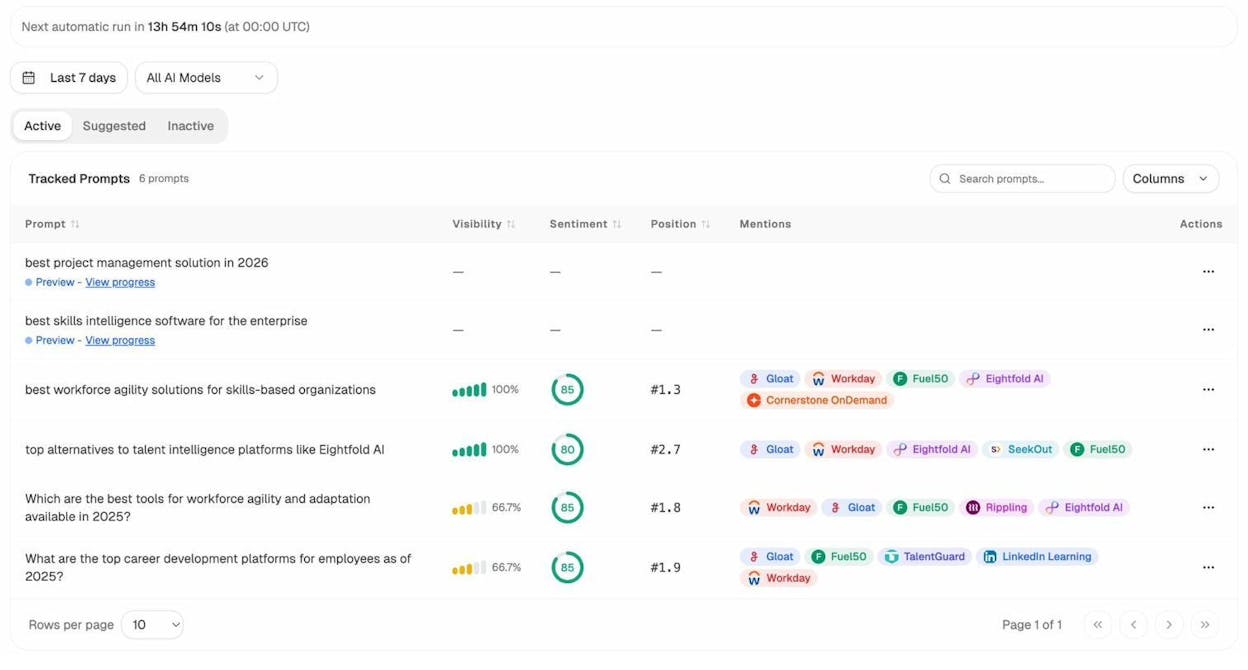
Then include a section in your forecast that says: “Currently, [brand] appears in AI search results for 2 of 15 tracked prompts (13% visibility). Based on our content strategy and authority-building plan, we project increasing this to 8 of 15 prompts (53% visibility) within 6 months.”
This gives the client a metric no other SEO provider is offering. And because AI search visibility is strongly correlated with traditional SEO performance (brands that rank well on Google tend to get cited in AI answers too), your SEO work naturally drives improvements in both channels.
Present the forecast with appropriate caveats
Always include caveats. SEO results depend on many factors outside your control, including algorithm updates, competitor activity, and the client’s willingness to implement your recommendations.
Frame it as a projection, not a promise. Say: “Based on the competitive landscape and our experience with similar campaigns, here is what we project. Actual results may vary depending on algorithm changes, competitor activity, and implementation timeline.”
Confidence with humility is more persuasive than guarantees. Smart clients know that anyone who guarantees SEO results is either lying or inexperienced.
Step 6. Close with a clear contract
Once the client is ready to move forward, make it easy for them to say yes. A clean, straightforward contract removes the last barrier.
What to include in your SEO contract
Your contract should cover these areas:
Scope of work. List exactly what you will deliver each month. Be specific. “4 SEO-optimized blog posts per month (1,500-2,500 words each), targeting keywords approved during the strategy phase” is better than “content creation services.”
Responsibilities. Who does what. If the client needs to provide access to their CMS, Google Analytics, and Google Search Console, state it here. If they need to review and approve content before publishing, state the turnaround time you expect.
Duration and payment terms. Most SEO retainers run for a minimum of 6-12 months because SEO takes time to produce results. State the monthly fee, when it is due, and what happens if payment is late.
Reporting. How often you will report and what the reports will include. Monthly is standard. Include organic traffic, keyword rankings, backlinks earned, and conversions. If you are tracking AI search visibility, include that too.
Termination clause. How either party can end the agreement. A 30-day written notice is standard. Avoid contracts that lock clients in with no exit, as it creates resentment and bad reviews.
NDA (if needed). Some clients will ask you to sign a non-disclosure agreement before sharing access to their analytics, customer data, or competitive intelligence. This is normal. Read it, sign it, and move on.
![[Screenshot: First page of a sample SEO contract showing scope of work, responsibilities, and payment terms sections]](https://www.datocms-assets.com/164164/1777315510-blobid11.png?auto=format,compress&w=1248&fit=max)
Do not overcomplicate the close
Some SEO providers lose deals at this stage by overcomplicating things. They send a 15-page contract filled with legal jargon that scares the client into “I need to have my lawyer review this.”
Keep it simple. Two to four pages. Plain language. Send it as a PDF with clear signature fields, or use a proposal tool like PandaDoc or Proposify that lets clients sign electronically.
Step 7. Differentiate your reporting with AI search data
Most SEO providers send the same monthly report: traffic went up, rankings moved, here are the backlinks we built. These reports start to feel repetitive after a few months, and clients begin to question whether they are still getting value.
Adding AI search visibility data to your reports solves this problem. It gives you a new set of metrics to discuss, new opportunities to recommend, and a clear way to show the client something their previous SEO provider never could.
What to include in AI search reports
Using Analyze AI, you can add these sections to your monthly client reports:
AI visibility score. How often the client’s brand appears when AI engines answer questions in their industry. Track this month over month to show progress.
Engine-level breakdown. Which AI engines mention the client (ChatGPT, Perplexity, Gemini, Copilot) and which do not. This lets you prioritize which gaps to close first.
Competitor comparison. Who AI engines recommend instead of the client and on which prompts. This turns vague competitive concerns into specific, actionable data.
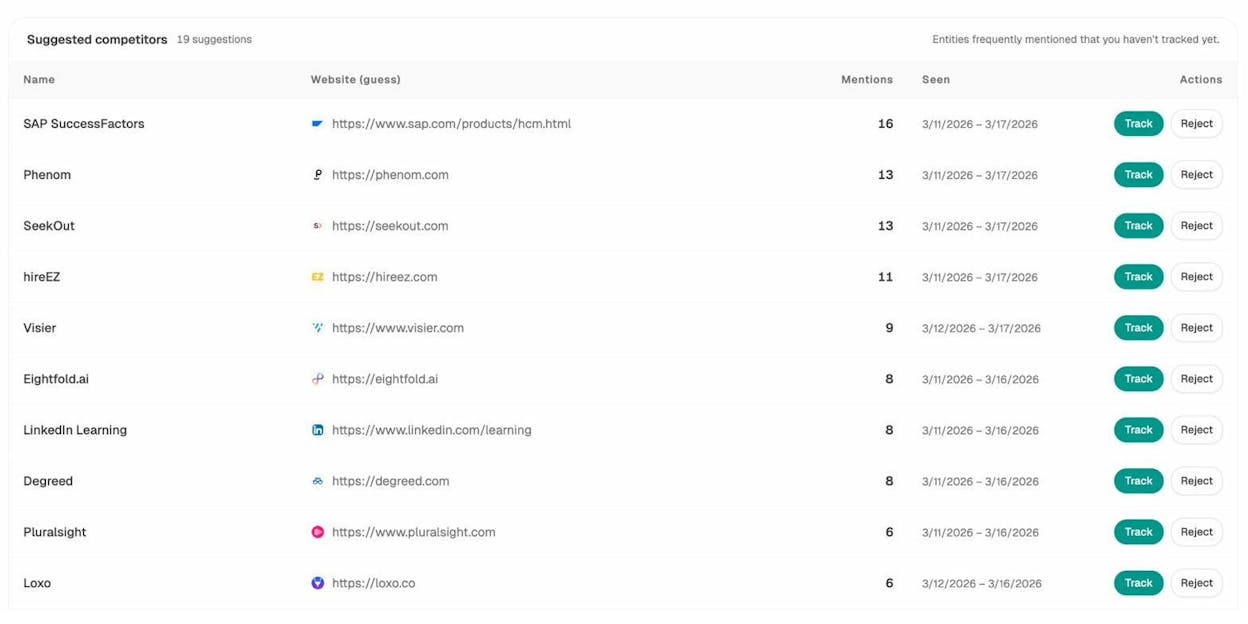
Citation sources. Which websites AI engines cite when answering questions in the client’s space. If the client is not among those sources, you know which content to create or improve.
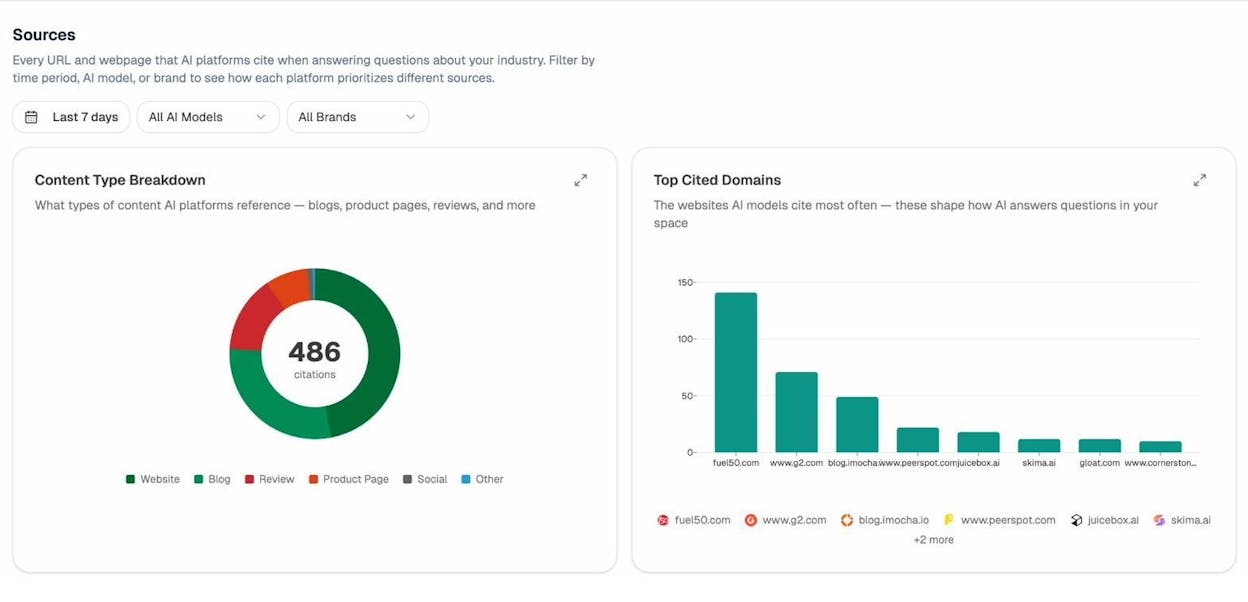
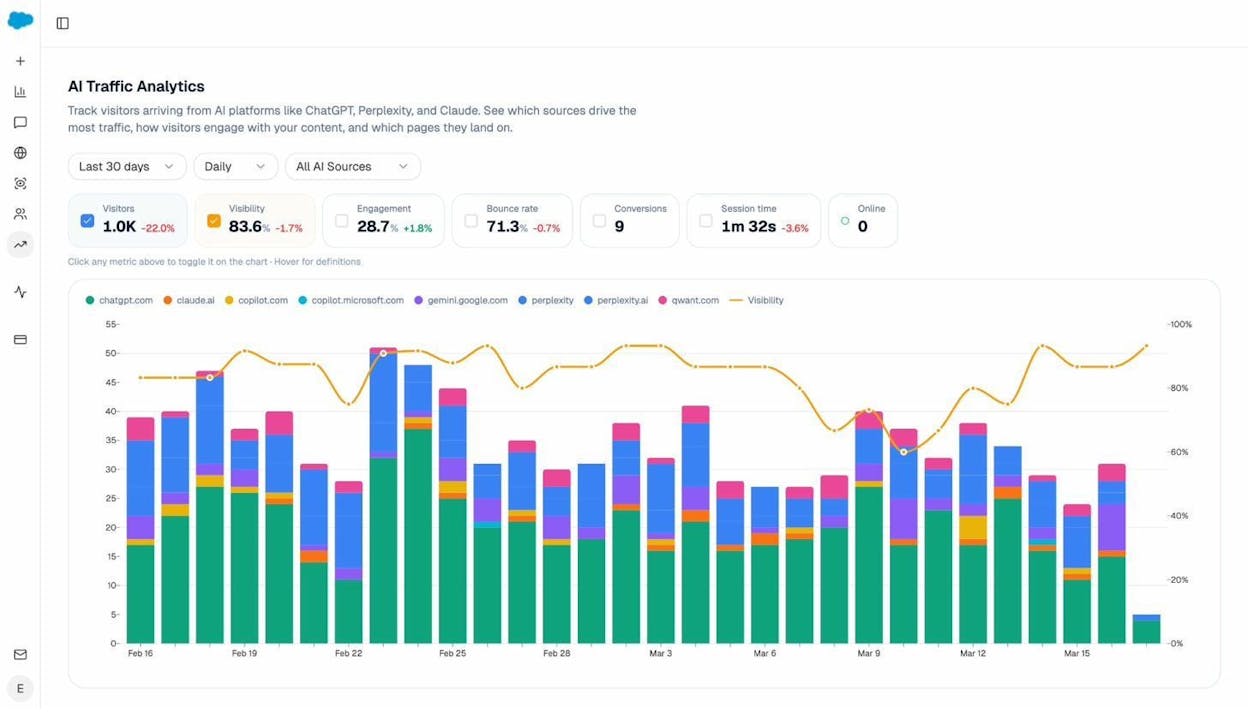
AI-referred traffic. If the client has Google Analytics connected, you can show how many visitors came from AI search engines, which pages they landed on, and whether they converted.
Sentiment tracking. How AI engines describe the client’s brand. Is the sentiment positive, neutral, or negative? Are there specific narratives that need to be addressed?
This level of reporting is nearly impossible to replicate manually. And it gives your clients a reason to keep paying you long after the initial SEO improvements have been made, because AI search visibility is an ongoing, evolving landscape.
Set up a weekly digest for your clients
One feature that works well for agency-client relationships is Analyze AI’s Weekly Email Digest. It sends a summary of visibility changes, citation momentum, and priority actions every Monday, so your clients see progress without logging into a dashboard.
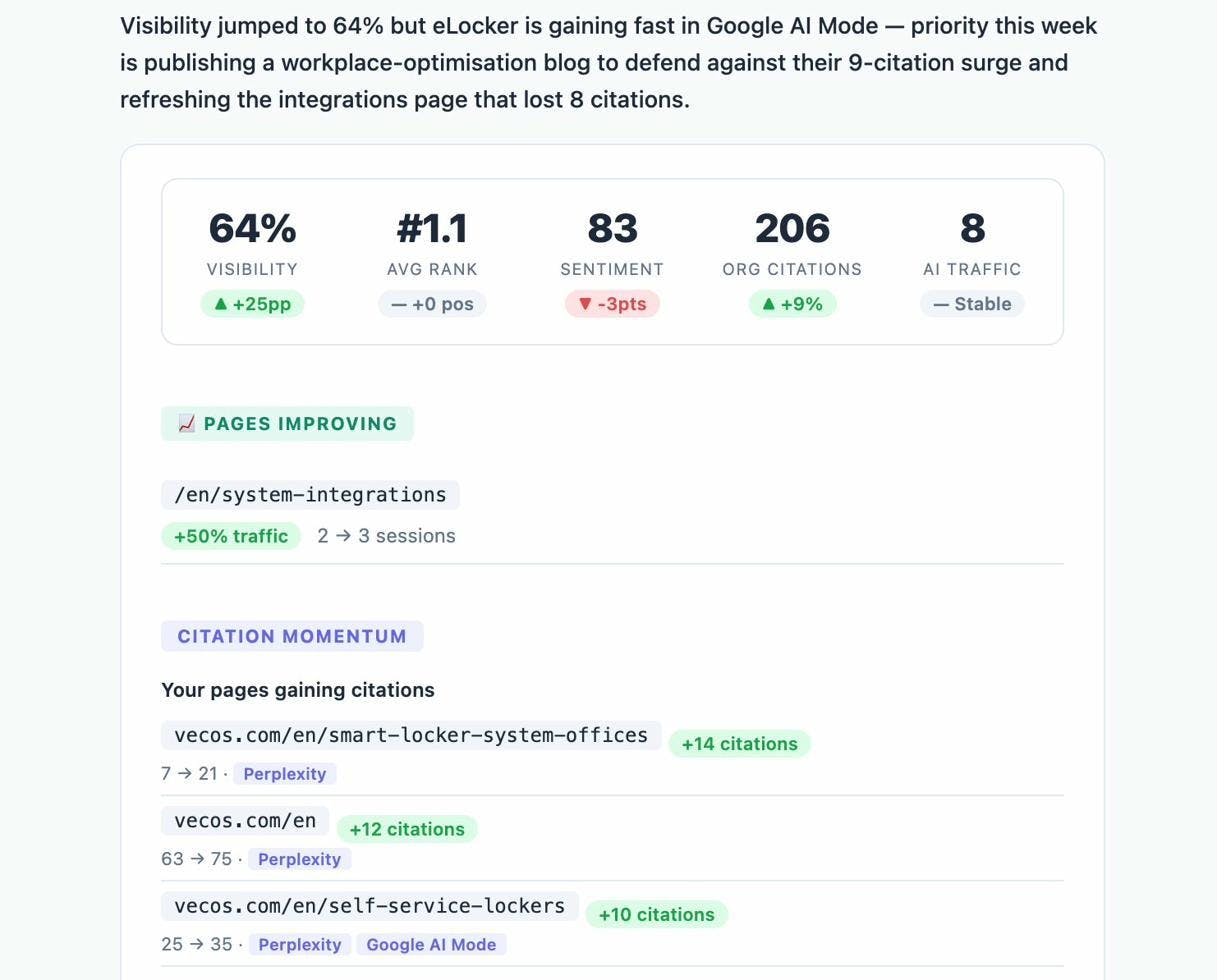
This keeps the client engaged between monthly reports and reduces the “what are we paying for?” conversations that kill retainers.
8 proven ways to get your first SEO clients
If you are just starting out and do not have a portfolio of results yet, here are eight ways to land your first clients.
1. Share your skills publicly
Before you have clients, you have knowledge. Share it. Write detailed posts on LinkedIn explaining how you would approach a specific SEO challenge. Record short videos walking through a site audit. Offer to analyze someone’s website for free and share the results publicly (with their permission).
This builds your reputation and attracts people who see your expertise before they ever talk to you.
2. Network at industry events
Conferences, meetups, and workshops are where business owners gather to learn. Attend events in industries you want to serve, not just SEO conferences. If you want to work with law firms, go to legal industry events. If you want to work with ecommerce brands, attend retail conferences.
The person you sit next to at lunch might become your first client.
3. Share case studies on social media
Even if you have only worked on one project, turn it into a case study and post it on LinkedIn, X, and in relevant Facebook groups. Case studies are the highest-performing content type for generating inbound leads because they combine proof, story, and results in one package.
Focus on the transformation. Before and after. Problem and solution. Make the results specific and verifiable.
4. Use cold email strategically
Cold email still works if you do it right. The mistake most people make is sending generic templates to hundreds of prospects. Instead, send personalized emails to 10-20 prospects per week.
Here is an approach that works: search for businesses that rank on pages 2-5 of Google for their most important keywords. These businesses are close to seeing results but are not there yet. Send them an email that says: “I noticed your site ranks on page 3 for [keyword]. That keyword gets [search volume] searches per month. I have ideas on how to get you to page 1. Want to see them?”
This works because it is specific, relevant, and shows you did actual research.
The typical response rate for well-targeted cold SEO emails is around 3-5%. So for every 50 emails, expect 2-3 responses and 1-2 meetings.
5. Get work on freelance platforms
Platforms like Upwork, Fiverr, and People Per Hour have a low barrier to entry. The competition is fierce and the initial rates are low, but they can be a proving ground for building your portfolio and getting testimonials.
Start with productized services. A fixed-price keyword research package, an SEO audit, or a content optimization report are all easy to scope and deliver. Once you have five-star reviews, raise your rates.
6. Talk to business owners you already know
Look through your contacts. Do you know anyone who owns a business with a website? Call them. Not to pitch, but to offer help. Say: “I am building my SEO practice and I would love to analyze your website and show you some opportunities. No charge, no obligation.”
Most people say yes to free help. And when they see the opportunities you uncover, many of them will ask what it costs to fix them.
7. Offer a free AI search visibility audit
This is a unique approach that very few SEO providers are using yet. Offer prospects a free audit of their AI search visibility. Use Analyze AI’s AI Search Explorer to run a few prompts related to their industry and show them where they appear (or do not appear) in ChatGPT, Perplexity, and Gemini.
Most business owners have never seen this data. Showing them that their competitors appear in AI search results and they do not creates immediate urgency and positions you as a forward-thinking provider.
8. Partner with complementary service providers
Web designers, PPC agencies, social media managers, and PR firms all serve the same clients you want. Build relationships with these providers and refer clients to each other.
A web designer who builds a beautiful site for a client will eventually get asked “how do we get traffic to this site?” If you have a referral relationship, they send that client to you. In return, you send your clients to them when they need design work.
This is how many successful SEO practices build a steady pipeline without any marketing spend at all.
What to charge for SEO services
Pricing SEO services is one of the most common questions new providers face. There is no universal answer, but here are benchmarks to guide you.
Hourly rates for SEO professionals typically range from $75 to $200 per hour, depending on experience and specialization. Specialists in competitive niches like legal, finance, or enterprise SaaS can charge $200-$300+ per hour.
Monthly retainers are the most common pricing model. Small business SEO retainers typically range from $1,000 to $3,000 per month. Mid-market retainers run $3,000 to $7,500. Enterprise SEO retainers start at $10,000 and go much higher.
Project-based pricing works for defined deliverables like SEO audits ($1,000-$5,000), keyword research packages ($500-$2,000), and content strategy development ($2,000-$10,000).
The key to charging higher rates is to tie your pricing to the value you create, not the hours you spend. If your work will generate $30,000 per month in new revenue for a client, a $3,000 monthly retainer represents a 10x return. Frame it that way.
Pricing AI search visibility as an add-on
If you offer AI search visibility tracking and optimization as a separate service, you can charge an additional $500-$1,500 per month on top of your standard SEO retainer. This covers the cost of tools like Analyze AI, your time analyzing the data, and the strategic recommendations you provide.
Alternatively, bundle it into your mid-tier and top-tier packages (as shown in the proposal template in Step 4). Bundling makes it easier to sell and harder for clients to compare your pricing with providers who do not offer it.
Common objections and how to handle them
Every SEO provider encounters the same objections. Here is how to address the most common ones.
“SEO takes too long”
Acknowledge it, then reframe. “You are right that SEO is a long-term investment. But that is exactly why it is valuable. Unlike ads where traffic stops the moment you stop paying, SEO builds an asset that compounds over time. Most of our clients see initial improvements in 2-3 months and significant growth in 6-9 months. And the traffic keeps coming.”
“We got burned by our last SEO provider”
This is actually a buying signal. They still want SEO to work. They just need to trust a new provider. Say: “I hear this a lot. Can I ask what went wrong? I want to make sure we do not repeat whatever happened.” Then listen. Address their specific concern with how your process is different.
“Can you guarantee results?”
Never guarantee specific rankings or traffic numbers. Anyone who does is either dishonest or inexperienced. Instead, say: “I cannot guarantee a specific ranking because Google’s algorithm considers hundreds of factors. But I can show you the data behind our forecast, share case studies from clients in similar situations, and commit to transparent reporting so you always know exactly what we are doing and what results it is producing.”
“What about AI replacing search?”
This one comes up more and more. And it is a great opportunity to differentiate yourself. Say: “AI is not replacing search. It is adding a new channel alongside it. People still use Google for billions of searches every day. But now they also ask ChatGPT and Perplexity for recommendations. The smart move is to be visible in both places. Our SEO work improves your visibility in traditional search and in AI search simultaneously, because the same fundamentals that make content rank well on Google also make it get cited by AI models.”
This response positions you as knowledgeable and forward-thinking without creating fear. It aligns with the reality that SEO and AI search are complementary channels, not competing ones.
Tools that make selling SEO easier
Having the right tools makes your pitch more credible and your delivery more efficient. Here are the categories that matter most, along with the tools that help in each area.
Keyword research and SERP analysis. Use tools like Analyze AI’s Keyword Generator, SERP Checker, and Keyword Difficulty Checker to find keyword opportunities and assess competition. These are free and give you the data you need to build a credible pitch.
Site auditing. Use Analyze AI’s Broken Link Checker and Website Authority Checker to quickly assess a prospect’s site health and authority. These tools give you talking points for your discovery call.
AI search visibility. Use Analyze AI to track brand visibility across AI engines, monitor competitor mentions, and analyze which sources AI models cite. This is the differentiator that sets you apart from other providers.
Content creation and optimization. Use Analyze AI’s Content Writer to go from idea to research to outline to draft with AI visibility gaps and competitor analysis built into every step. Use the Content Optimizer to audit existing pages and generate specific improvement recommendations.
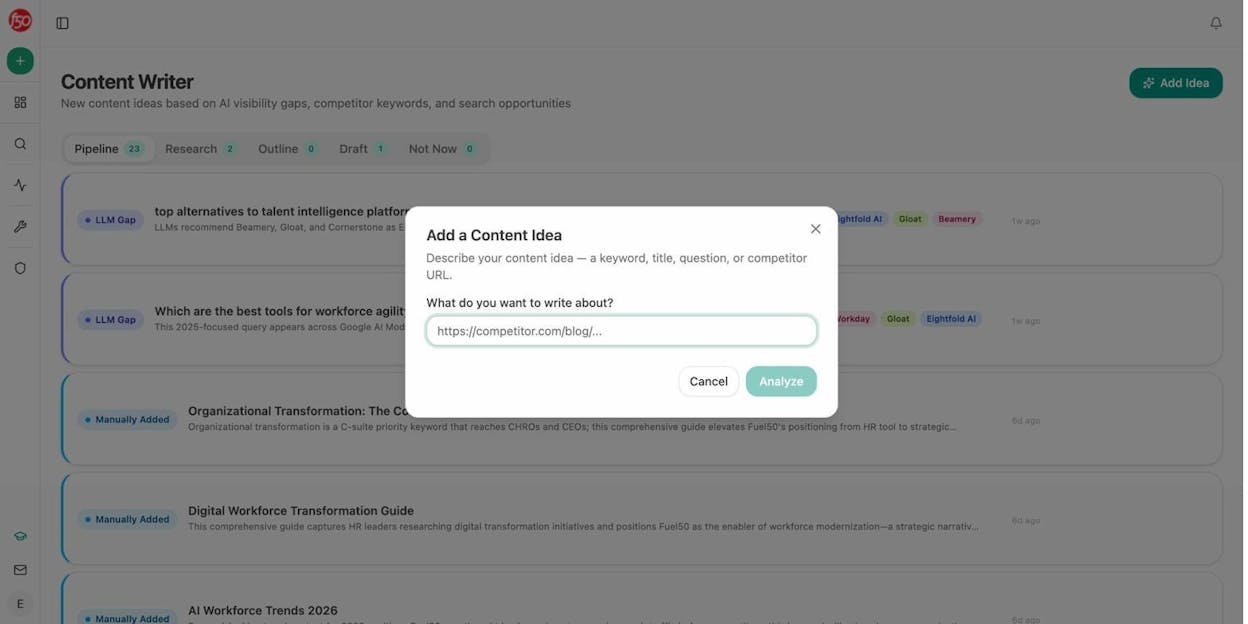
Reporting. Use SEO reporting tools that pull data from multiple sources into clean, client-facing reports. If you use Analyze AI, the Weekly Email Digest feature automatically sends clients a summary of their AI search performance every week.
Final thoughts
Selling SEO comes down to three things.
First, sell the outcome your client wants, not the process you will follow. Nobody buys keyword research. They buy more customers, more revenue, and more growth. Frame everything in terms of what they get, not what you do.
Second, use data to anchor your pricing. The CPC comparison technique works because it shows what the client would spend on ads to achieve the same result. It makes your retainer look like a smart investment, not a cost.
Third, differentiate yourself by including AI search visibility in your pitch, your proposal, and your reporting. Most SEO providers are still ignoring AI search entirely. By showing prospects their AI search visibility data, tracking it monthly, and optimizing for it alongside traditional SEO, you position yourself as the provider who sees the full picture.
SEO is not dead. It is evolving. The providers who adapt their sales process to reflect that evolution will close more deals, retain clients longer, and build practices that grow alongside the market.

Ernest

Ibrahim


