



Summarize this blog post with:


In this article, you’ll get a complete, actionable checklist that covers every meaningful step for improving your visibility in both traditional search and AI search engines. Each item includes enough context for you to act on it right away, and where relevant, you’ll see exactly how to track and measure your progress using Analyze AI alongside your existing SEO tools.
Table of Contents
Branding
Your brand is the foundation of everything that follows. In traditional SEO, a strong brand earns higher click-through rates and branded search volume. In AI search, brand recognition determines whether AI models mention you by name or default to a competitor. Start here.
1. Set up your brand’s online foundation. Create a brand style guide that documents your logo, colors, tagline, and core messaging. Then audit every place your brand appears online to make sure these elements are consistent. This matters for AI because language models learn entity associations from the web. If your brand name, description, and product categories are inconsistent across platforms, AI models form a weaker association between your brand and the topics you want to own.
2. Create branded profiles on every platform where people search. This goes beyond Google. Set up profiles on LinkedIn, YouTube, Reddit, TikTok, Product Hunt, G2, Capterra, and any niche directories in your industry. AI models pull data from all of these sources when generating answers. Our analysis of 83,670 AI citations found that only 17% of citations come from a brand’s own website. The remaining 83% come from third-party sources like review sites, forums, and media outlets. Your presence on these platforms directly influences whether AI mentions you.
3. Create or update your Wikipedia page. For established brands, Wikipedia is one of the most trusted references for both search engines and AI models. If your brand qualifies for a Wikipedia page, make sure it exists and that the information is accurate, current, and properly cited. Do not try to create one if your brand does not meet Wikipedia’s notability criteria. That will backfire.
4. Protect your branded search results. Search your brand name on Google and review the first two pages. Every result should ideally be a property you own or control. If competitor ads, negative press, or irrelevant results appear, you need to push those down by strengthening your owned properties. This means optimizing your homepage, about page, social profiles, and any directory listings for your brand name.
5. Apply for industry awards and certifications. Awards serve two purposes. First, they create additional web pages and backlinks that mention your brand alongside positive language. Second, they give AI models concrete credibility signals. When a model encounters “winner of X award” or “certified by Y organization” repeatedly across sources, it strengthens the association between your brand and trustworthiness.
6. Encourage happy customers to leave reviews. Reviews on Google Business Profile, G2, Capterra, Trustpilot, and Reddit influence both traditional search rankings and AI recommendations. Our citation data shows that AI engines frequently cite review platforms when recommending products. A brand with 500 positive G2 reviews is far more likely to be mentioned than one with 12.
7. Build E-E-A-T signals across your brand, website, and individual pages. E-E-A-T stands for Experience, Expertise, Authoritativeness, and Trustworthiness. Google’s quality raters use these criteria to evaluate content, and the same signals influence what AI models treat as credible. Start with author bios on every piece of content, expert credentials displayed prominently, and trust badges on key pages. Do not treat E-E-A-T as a one-time task. It compounds over time.
8. Audit your homepage and about page for brand clarity. These pages carry outsized weight in how search engines and AI models understand your brand. Your homepage should clearly state what you do, who you serve, and what makes you different. Your about page should include your founding story, team credentials, and any press mentions or partnerships. Both pages should include reviews, testimonials, or trust signals.
9. Use paid ads to reinforce branded search. Bid on your own brand name and key competitive terms to ensure your brand appears at the top of Google results. This prevents competitors from stealing your branded traffic and creates additional brand impressions. More importantly, paid ads drive branded searches on Google, and branded search volume is a signal that both Google and AI models use to assess brand authority.
10. Run awareness campaigns that drive branded searches. Launch social ads, email campaigns, or partnerships that prompt people to search for your brand by name. Growing branded search volume is one of the strongest long-term SEO strategies because it signals to Google and AI models that real people are actively seeking you out.
Auditing
Before you build anything new, understand where you stand. An audit tells you what is working, what is broken, and where the biggest opportunities are, both in traditional search and in AI answers.
11. Audit your brand visibility across the web. Search your brand name on Google, Bing, and three or four AI engines (ChatGPT, Perplexity, Gemini, Copilot). Document how your brand appears in each. Look for inconsistencies like old logos, outdated product descriptions, wrong addresses, or different brand names (e.g., “Acme” vs. “Acme Inc.” vs. “The Acme Group”). These inconsistencies confuse both search engines and AI models about your entity.
12. Benchmark your current AI search visibility. Before you optimize for AI search, you need a baseline. Use Analyze AI to track how often your brand appears in AI-generated answers, your average position, and which engines mention you most. Without this baseline, you will have no way to measure whether your efforts are working.
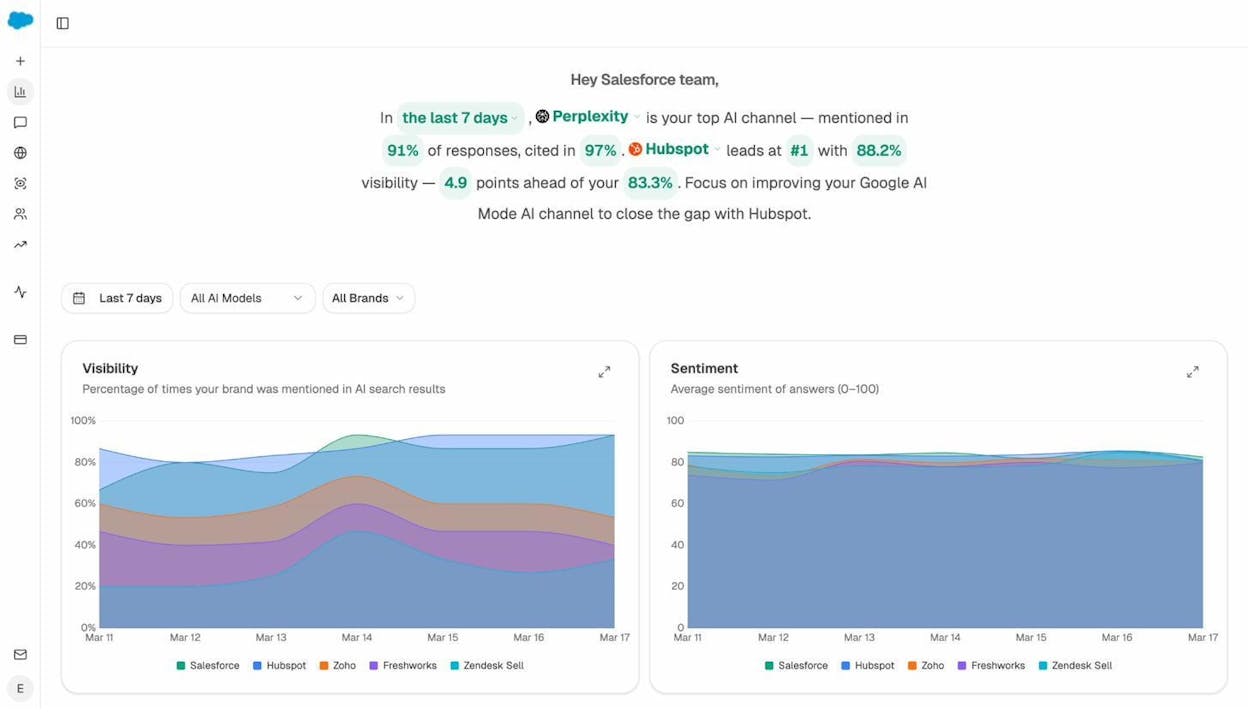
The Overview dashboard in Analyze AI shows your visibility percentage and sentiment score across all tracked AI engines, compared against your competitors. Set this up before making any changes so you have a clear before-and-after.
13. Audit your backlinks and brand mentions. Use an SEO tool to find all backlinks pointing to your site. Look for broken links, lost links, and unlinked brand mentions. These are quick wins. If someone mentioned your brand but did not link to you, reach out and ask for the link. If a link broke because of a URL change, set up a redirect or contact the site owner. You can also use Analyze AI’s Citation Analytics to see which domains AI models cite most in your space.
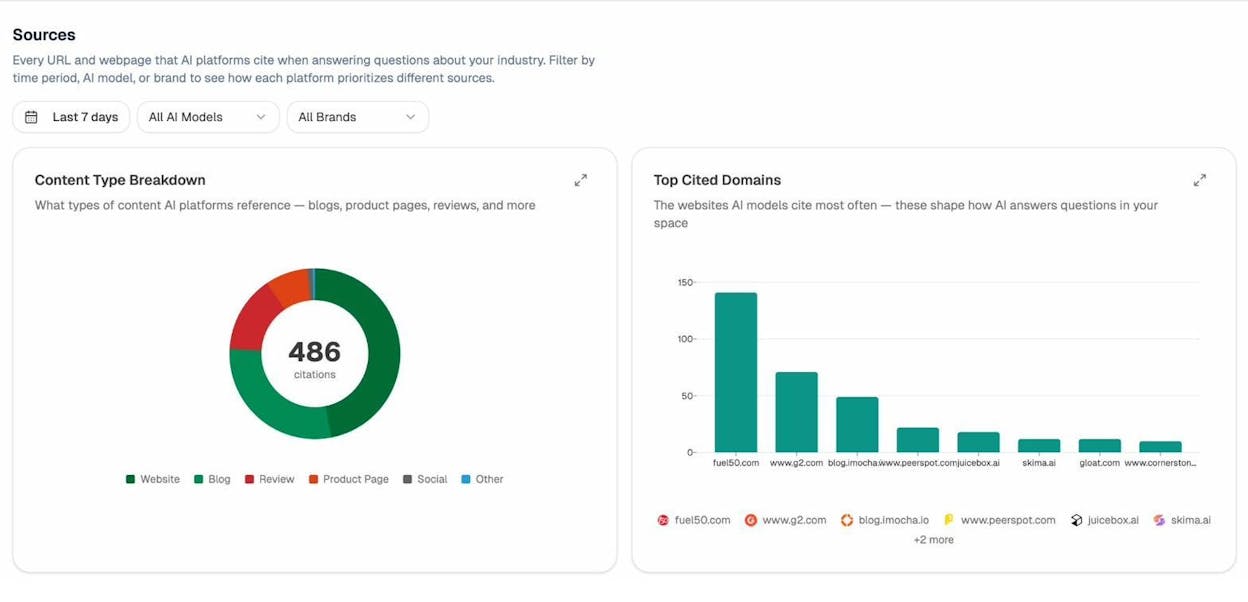
The Sources dashboard reveals which websites and content types AI engines reference most when answering questions about your industry. This tells you where to focus your third-party content and link-building efforts.
14. Audit your top pages that appear in AI responses. Some of your pages already show up in AI answers. Identify them and ask two questions. First, is the information accurate and current? Second, does the page create business value by leading visitors toward your product or service? If a page gets heavy AI citations but has no call to action, you are leaving pipeline on the table.
15. Audit your content for topical completeness. Review your content library against the topics your audience cares about. Map every piece of content to a topic or subtopic and look for gaps. A topical map does not need to be complicated. A spreadsheet with columns for topic, subtopic, existing URL, and status (missing, outdated, strong) works well. For AI search, use Analyze AI’s Prompt Discovery to see what prompts people actually ask that relate to your space. You will likely discover entire topic clusters you have never addressed.
16. Find and refresh decaying content. Content decay is when a page that used to perform well starts losing traffic and rankings. Look for pages where organic traffic has dropped 20% or more over the past six months. Check whether the content is outdated, whether competitors have published better versions, or whether search intent has shifted. Refreshing one high-potential page often delivers more ROI than publishing three new ones.
Use Analyze AI’s Content Optimizer to identify pages with declining organic traffic and get AI-generated editorial suggestions for improvement.
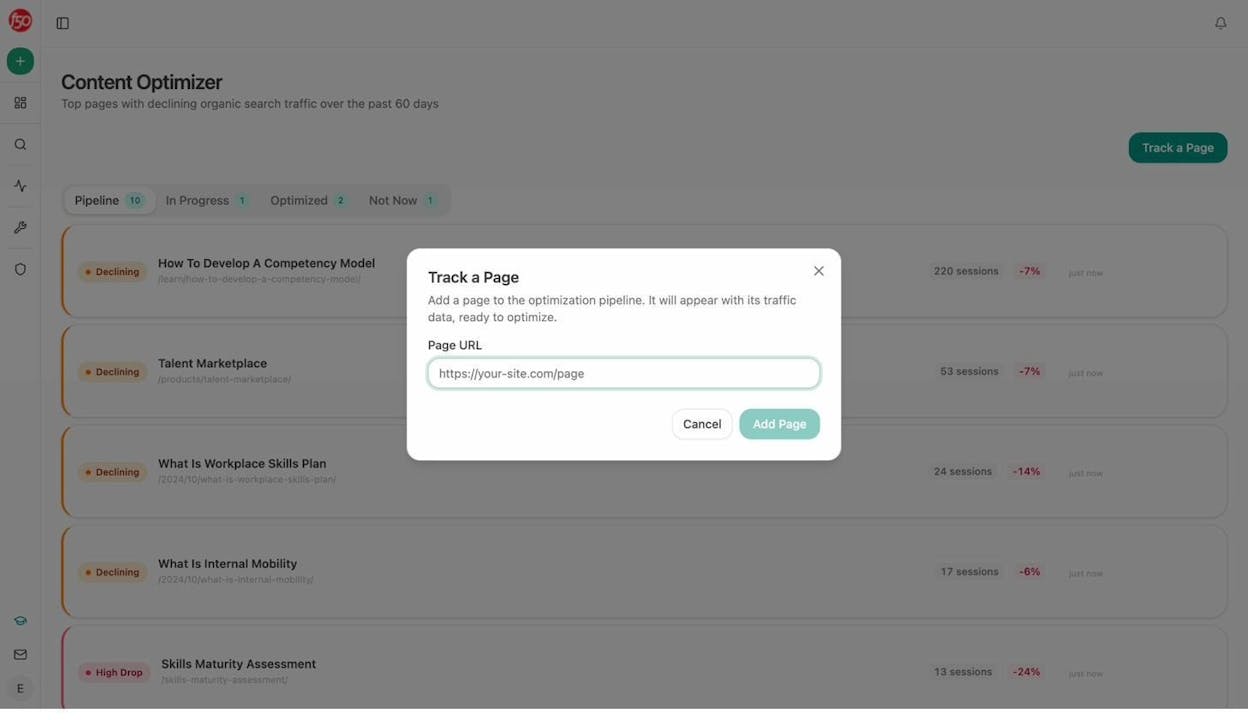
The Content Optimizer surfaces your top pages with declining traffic over the past 60 days. Click into any page to get a full content score, argument gaps, and line-by-line optimization suggestions.
17. Run a competitor analysis for SEO and AI search. Identify your top five competitors and analyze their content, keywords, backlinks, and AI visibility. For traditional SEO, focus on content gaps (keywords they rank for that you do not) and link gaps (sites linking to them but not you). For AI search, use Analyze AI’s Competitor Intelligence to see which competitors appear in AI answers alongside your brand, and on which prompts they beat you.
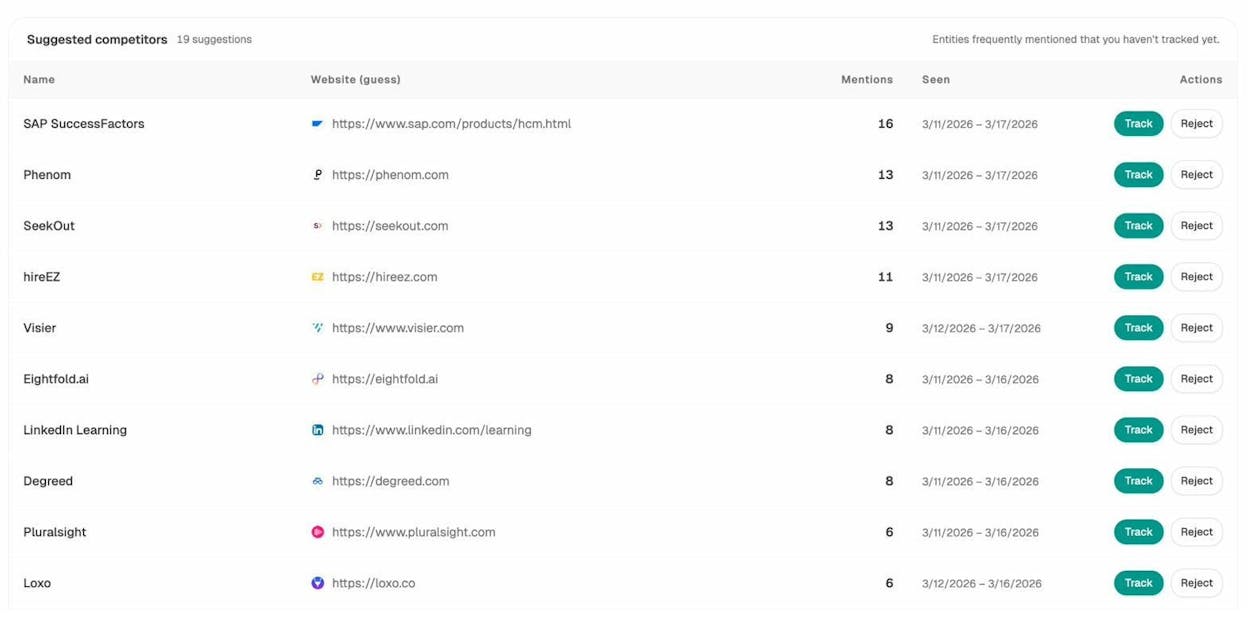
Analyze AI automatically suggests competitors based on entities that appear alongside your brand in AI responses. You can track them, compare visibility, and spot the exact prompts where they outrank you.
18. Check what AI says about your brand and whether it is accurate. Ask ChatGPT, Perplexity, Gemini, and Copilot direct questions about your brand. Things like “What does [Brand] do?”, “Is [Brand] good for [use case]?”, and “What are alternatives to [Brand]?”. Document the answers. Look for factual errors, outdated information, or negative framing. If AI is saying something wrong about your brand, you need to correct the source material it is pulling from.
You can automate this with Analyze AI’s Prompt Tracking. Set up the prompts that matter to your business and the platform will run them daily across all major AI engines, tracking changes over time.
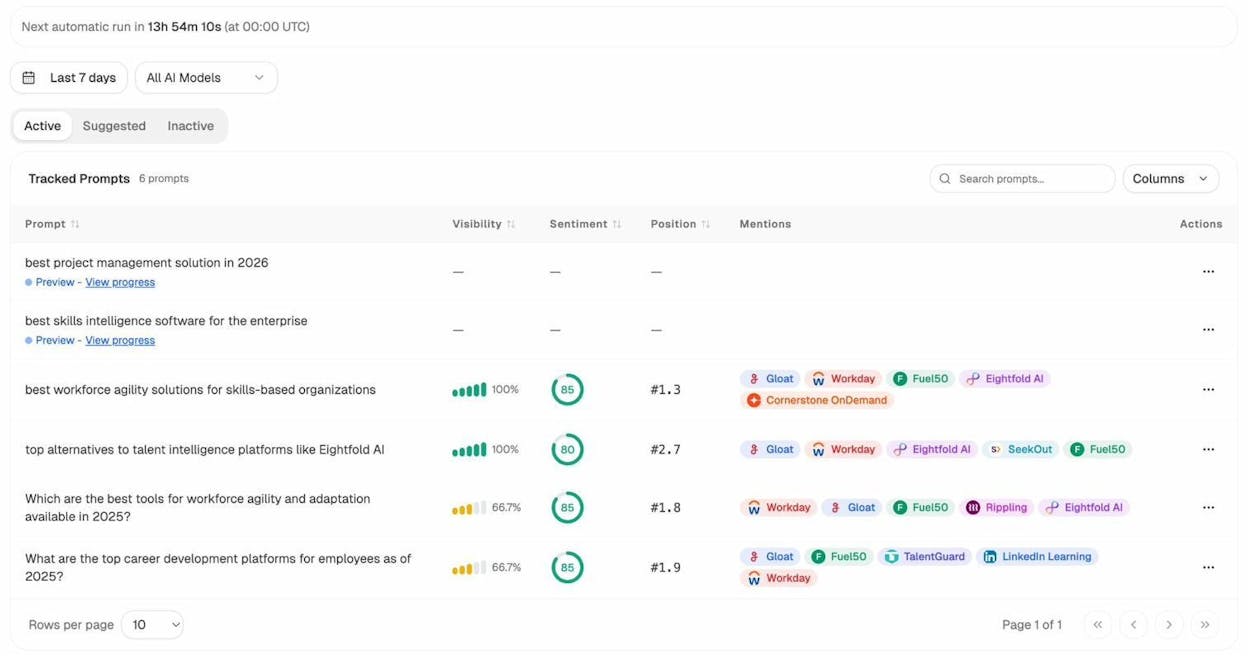
Each tracked prompt shows your visibility percentage, sentiment score, average position, and which competitors appear alongside you. The platform runs these automatically so you do not have to manually query each engine every week.
19. Do a competitive gap analysis for AI search. Compare your AI visibility with your top competitors across all tracked prompts. Identify the prompts where competitors appear and you do not. These are your AI content gaps. Prioritize them based on business value and create content that addresses them directly.
Content
Content is where SEO and AI search overlap the most. The pages you create and how you structure them determine whether search engines rank you and whether AI models cite you. This section covers everything from building topical authority to formatting your content for maximum visibility.
Build topical authority
20. Publish original research and data. Original data is the single most effective type of content for earning backlinks and AI citations. Publish surveys, benchmark studies, industry reports, or analyses of your own product data. AI models prioritize sources with unique, verifiable information. Generic content that rephrases what everyone else already says provides no reason for an AI model to cite you specifically.
21. Keep your most-cited pages fresh and commercially valuable. Identify the pages that AI engines cite most often. Update them quarterly with new data, examples, and insights. Also make sure these pages include clear calls to action. If AI is sending visitors to a page with no next step, you are wasting the traffic.
22. Close topic gaps to win visibility for new queries. Every topic cluster has subtopics you have not covered yet. Use keyword research tools to find related terms, People Also Ask questions, and emerging subtopics. For AI search, check which prompts mention your competitors but not you. These are the gaps that matter most. Close them by creating content that directly answers those prompts with original, detailed information.
23. Build content hubs around your core topics. A content hub is a pillar page surrounded by related cluster pages, all linked together. For example, if your pillar topic is “email marketing,” your cluster pages might cover subject lines, A/B testing, deliverability, automation workflows, and list building. This structure helps search engines understand your topical depth. It also helps AI models because the interconnected content creates stronger entity relationships. Read more about SEO content strategy for a step-by-step approach.
24. Find and answer the questions your audience is actively asking. Questions are the bridge between SEO and AI search. In traditional search, question-based queries trigger featured snippets and People Also Ask boxes. In AI search, question-based prompts are the default way people interact with chatbots. Here is where to find them:
-
Google’s People Also Ask boxes for your target keywords
-
Analyze AI’s Keyword Generator for related question keywords
-
Google Search Console’s query report filtered by questions (who, what, how, why, when, where)
-
Customer support tickets and sales call transcripts for real questions buyers ask
-
Reddit threads and forum discussions in your niche
-
Analyze AI’s Prompt Discovery for the exact prompts people use in AI engines about your topic
The last source is unique to AI search. Traditional keyword research tools cannot tell you what prompts people type into ChatGPT or Perplexity. Analyze AI’s Prompt Discovery can.
25. Create a topical map that goes beyond keywords. A topical map organizes your entire content library around themes, not just individual keywords. Start by listing your core topics. Under each, list related subtopics. Then map each subtopic to an existing page or flag it as a gap. The goal is to cover every angle of your core topics so thoroughly that both search engines and AI models recognize you as the authority on those subjects. For a deeper guide, see how to use keywords for SEO.
26. Update your content strategy to include AI search opportunities. Most content teams plan around search volume and keyword difficulty. Add a third dimension: AI citation potential. Some topics are heavily cited in AI answers but have low search volume. Others have high volume but AI models barely mention them. Use Analyze AI’s AI Search Explorer to run ad hoc queries across multiple AI engines and see which topics generate brand mentions.
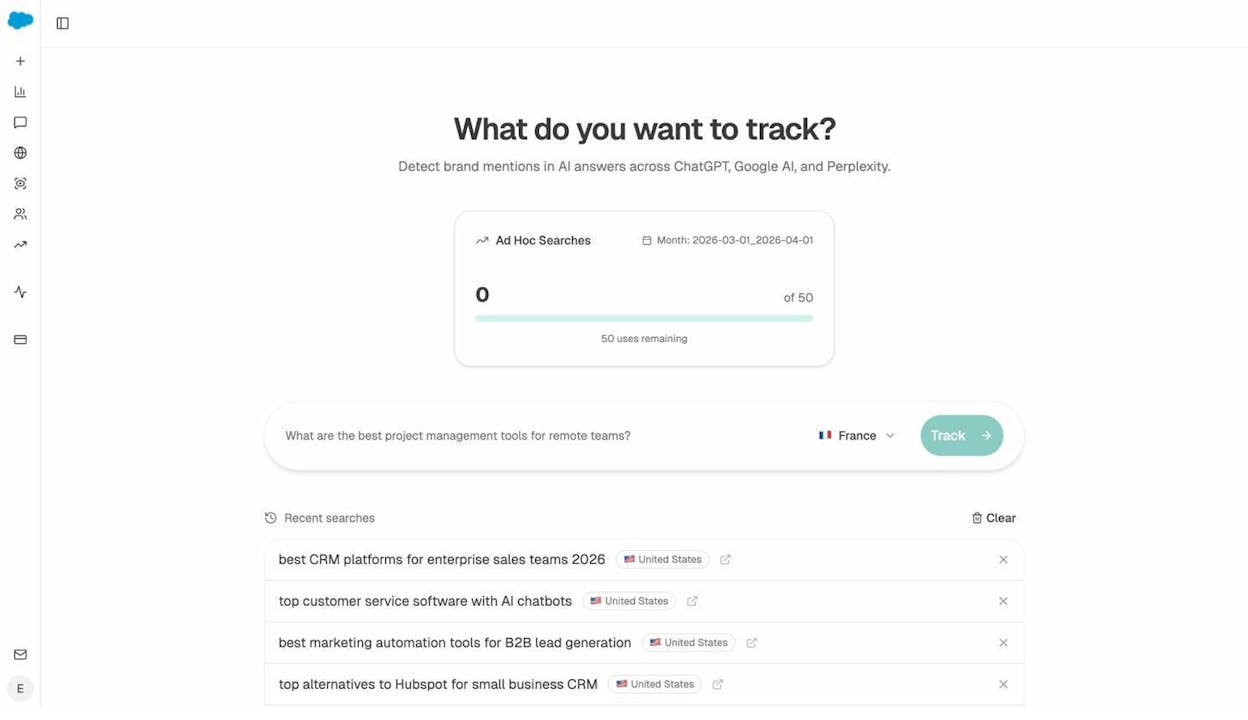
The AI Search Explorer lets you test any prompt across ChatGPT, Perplexity, Gemini, and Copilot in real time. Use it to validate content ideas before committing resources to a full article.
Content quality and credibility
27. Add detailed author bios to every piece of content. Author bios do more than satisfy E-E-A-T guidelines. They give AI models a named entity to associate with your content. Include the author’s title, years of experience, notable achievements, and links to their professional profiles. Create a dedicated author page that lists all their published content.
28. Include expert quotes and cite authoritative sources. When you reference a claim, link to the original source. When you explain a concept, include a quote from a recognized expert. This serves two purposes. It makes your content more trustworthy to readers, and it creates entity co-occurrence signals that AI models use to assess content quality. The brands that show up most in AI answers are the ones consistently associated with authoritative sources.
29. Match your writing tone to the content format. A tutorial should be direct and instructional. A thought leadership piece can be more conversational. A product comparison should be factual and balanced. Tone affects both engagement and how AI models categorize your content. If your tone mismatches the intent (e.g., overly casual in a technical guide), readers bounce and AI models learn to prefer competitors who match tone to intent.
30. Optimize content for jobs-to-be-done, not just questions. Answering a question is the minimum. The best content helps the reader complete a task. If someone searches “how to create a content calendar,” do not just explain what a content calendar is. Give them a template they can download and fill in. If someone asks about “SEO audit tools,” do not just list tools. Walk them through how to run an audit step by step. Analyze AI’s Content Writer does this automatically. It takes a content idea, runs competitive research, and generates an outline complete with AI visibility gaps and editorial comments.
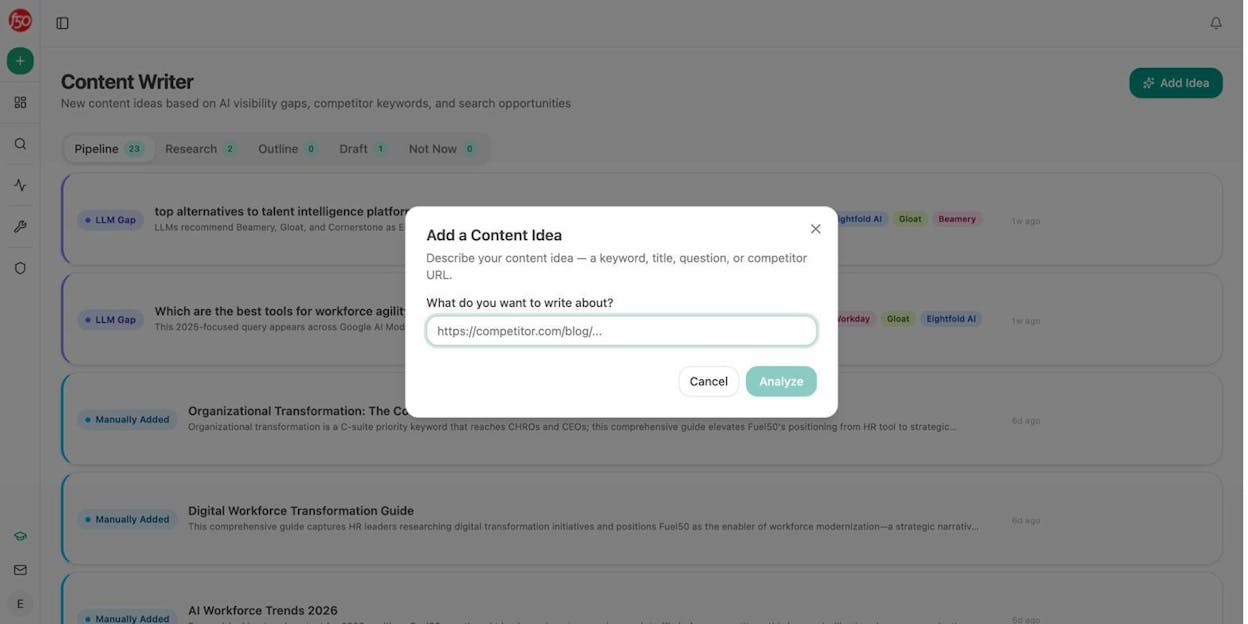
The Content Writer moves content ideas through a pipeline: from initial idea to research, outline, and draft. Each stage includes AI editorial comments and competitive analysis so you produce content that is both SEO-optimized and built for AI citations.
31. Define technical terms the first time you use them. Jargon without context alienates readers and confuses AI models. The first time you use a term like “content hub” or “topical authority,” define it in one sentence. This is especially important for AI search because AI models extract definitions and use them to categorize your content. Clear definitions increase the chance that your page gets cited as a definitional source.
32. Add original multimedia to your content. Create custom images, charts, diagrams, and videos for your content. Stock photos add no value. Original visuals that explain concepts, show data, or demonstrate processes make your content more engaging and harder to replicate. They also create additional surfaces for discovery. A well-made YouTube video embedded in your article can rank on YouTube search, appear in Google video results, and get referenced in AI answers that favor multimedia-rich sources.
Structure and readability
33. Study the content formats AI engines prefer for your topic. Before writing, search your target topic across multiple AI engines and look at what they cite. Do they cite listicles? Step-by-step guides? Comparison tables? Data studies? The format that gets cited most is the format you should use. Use Analyze AI’s Sources dashboard to see the content type breakdown for your industry.
This chart tells you whether AI engines in your space prefer citing blogs, product pages, review sites, or documentation. Create content in the formats that get picked up.
34. Start your content with a TL;DR or key takeaways section. A short summary at the top of your article helps readers decide if the content is worth their time. It also gives AI models a clean, extractable summary they can use in their answers. Keep it to three to five bullet points that capture the core value of your article.
35. Structure your content with clear, logical sections. Use short paragraphs (three lines maximum). Make each section follow logically from the previous one. Avoid abrupt jumps between topics. Readers and AI models both follow the flow of ideas, and a jarring structure causes both to disengage.
36. Write with one idea per section and lead with the bottom line. Each H2 or H3 section should address one specific point. Start the section with the most important takeaway, then support it with evidence, examples, and context. This bottom-line-up-front approach makes your content scannable for readers and extractable for AI models.
37. Use headings to create a logical hierarchy. Your page should have a single H1 containing your primary keyword. H2s should represent the major sections. H3s should break those sections into subtopics. Never use heading tags for visual styling. Headings tell search engines and AI models what your content is about and how ideas relate to each other.
38. Use bullet points, numbered lists, and tables where they add clarity. Structured content formats improve readability and increase your chances of appearing in featured snippets and AI answers. Use numbered lists for sequential steps, bullet points for non-ordered items, and tables for comparisons. Important: never upload tables as images. Use HTML or Markdown tables so search engines and AI models can read the data.
|
Format |
Best Used For |
SEO Benefit |
AI Benefit |
|---|---|---|---|
|
Numbered list |
Step-by-step instructions |
Featured snippet eligibility |
AI extracts steps directly |
|
Bullet points |
Feature lists, key points |
Scannability |
AI uses for summaries |
|
Tables |
Comparisons, data |
Rich snippet eligibility |
AI reads structured data |
|
FAQs |
Common questions |
FAQ rich results |
Direct answer extraction |
39. Add relevant FAQs with original, valuable answers. FAQ sections are powerful for both SEO (they can trigger FAQ rich results) and AI search (AI models love pulling from FAQ-formatted content). The key is to write original answers that add information gain. Do not just rephrase what every other article says. Add a data point, a specific example, or a contrarian perspective that makes your answer worth citing.
On-page SEO fundamentals
40. Include your target keyword in the URL slug. Keep slugs short, descriptive, and lowercase. Use hyphens to separate words. Avoid dates, numbers, and filler words. A clean URL like /seo-ai-search-checklist/ is better than /2026/04/the-ultimate-checklist-for-seo-and-ai-search-visibility-guide/.
41. Write a compelling title tag with your primary keyword. Your title tag appears in search results and browser tabs. Include your primary keyword naturally, keep it under 60 characters, and make it specific enough to differentiate from competitors. Add a number, a year, or a unique angle when possible.
42. Write a conversion-optimized meta description. Your meta description does not directly affect rankings, but it affects click-through rate. Write it like a mini sales pitch. State the benefit, hint at the format (checklist, guide, framework), and include a call to action. Keep it under 155 characters.
43. Internally link related pages to each other. Internal links help search engines discover and understand the relationships between your pages. They also distribute link equity across your site. Link from high-authority pages to newer pages you want to rank. Link between topically related articles. Use descriptive anchor text that tells both readers and AI models what the linked page is about. For more tactics, see our guide on internal linking for SEO.
44. Optimize your images for speed, accessibility, and discovery. Compress images to reduce file size without losing quality. Add descriptive alt text to every image. Name image files with relevant keywords (e.g., ai-visibility-dashboard.png instead of IMG_3847.png). Images with proper alt text and descriptive filenames can rank in image search and help AI models understand the visual content on your page.
Content distribution and repurposing
45. Repurpose your top content into multiple formats and distribute everywhere. Take your best-performing article and turn it into a LinkedIn post, a YouTube video, a podcast episode, a Twitter thread, and an infographic. Each format reaches a different audience on a different platform. More importantly, each version creates another source that AI models can reference when generating answers about your topic. Platforms like Reddit, LinkedIn, and YouTube are increasingly cited in AI responses.
46. Distribute content on platforms that AI models frequently cite. Our citation data shows that certain platforms are cited far more than others. Reddit, Wikipedia, G2, and major publications appear frequently in AI answers. Create content specifically for these platforms. Write detailed Reddit answers. Contribute to relevant Wikipedia articles. Publish guest posts on high-citation publications.
Link building
Links remain one of the strongest ranking signals in traditional SEO. In AI search, links and mentions serve as trust signals that influence whether AI models consider your brand authoritative enough to recommend.
47. Build links and brand mentions on high-authority sites. Focus on earning mentions and links from publications that AI models already trust. These are typically sites with high domain authority, strong editorial standards, and frequent AI citations. One mention on a trusted industry publication is worth more than 50 links from low-quality directories.
48. Get links and mentions near topics relevant to your business. Not all links are equal. A link from an article about “project management best practices” is far more valuable for a PM tool than a link from an unrelated tech roundup. When the anchor text and surrounding context match your core topics, search engines and AI models form stronger associations between your brand and those topics.
49. Partner with writers who are already cited in AI responses. This is a tactic specific to AI search. Identify the authors and publications that AI models cite most frequently for your topics. Reach out to collaborate. Guest post on their sites. Co-author research with them. When your brand appears on pages that AI already trusts, you inherit some of that trust. Use Analyze AI’s Citation Analytics to find the most-cited domains and pages in your space.
50. Publish guest posts on publications with strong AI visibility. Not all guest posting is equal. Prioritize outlets that appear frequently in AI responses. A guest post on a site that ChatGPT cites regularly is far more valuable for AI visibility than one on a site that only ranks on Google.
51. Create shareable assets that naturally attract links. Design free tools, calculators, templates, checklists, and original data studies. These are the types of content people naturally reference and link to. For example, Analyze AI offers a set of free SEO tools including a Keyword Generator, SERP Checker, Website Authority Checker, and Broken Link Checker. Each tool creates a reason for other sites to link back and for AI models to cite the source.
52. Clean up incorrect brand information on third-party sites. Search for your brand across directories, review sites, and aggregators. Fix any outdated information like old addresses, discontinued products, incorrect pricing, or broken links. Inconsistent information across sources confuses AI models and weakens your entity signals. Use Analyze AI’s AI Sentiment Monitoring to track what AI says about your brand and catch inaccuracies early.
53. Reclaim lost backlinks and mentions. Links break over time. Pages get deleted, URLs change, and sites go down. Use your SEO tool to find backlinks you have lost and reach out to the site owners to request reinstatement. Also look for brand mentions that do not include a link and ask for one. These are among the easiest link-building wins available.
54. Contribute to relevant conversations on forums and communities. Reddit, Quora, LinkedIn groups, and niche forums are increasingly cited by AI models. Participate authentically in these communities. Answer questions where your expertise is genuinely useful. Do not spam links. A helpful, detailed answer that mentions your brand naturally will earn more visibility than a dozen link drops.
55. Get mentions on the most-cited pages for your topic. Use Analyze AI’s Sources dashboard to find the specific pages that AI engines cite most for your core topics. Reach out to those page owners for a mention, a link, or a contributor opportunity. When your brand appears on a page that AI already trusts and cites, you benefit from that citation momentum.
Technical SEO
Technical SEO ensures that search engines and AI crawlers can access, understand, and index your content. Many of these items are one-time setups that pay dividends indefinitely.
56. Run a comprehensive site audit and schedule recurring crawls. Use an SEO audit tool to scan your entire site for issues. Look for broken pages, missing meta tags, duplicate content, crawl errors, and slow-loading pages. Schedule weekly or monthly audits to catch new issues before they affect your rankings.
57. Secure your site with HTTPS. Every page on your site should load over HTTPS. This is a baseline requirement for both search engines and user trust. If any pages still load over HTTP, set up 301 redirects to the HTTPS versions.
58. Check that your robots.txt allows AI bots to access your content. This is a new and critical step. Many robots.txt files now block AI crawlers by default, especially sites using Cloudflare. If your robots.txt blocks GPTBot, ClaudeBot, PerplexityBot, or other AI crawlers, your content will not appear in AI-generated answers. Review your robots.txt file and make sure you are not accidentally blocking the AI crawlers you want to be cited by.
Here is a list of the major AI crawler user agents you should allow:
|
AI Engine |
User Agent |
|---|---|
|
ChatGPT (OpenAI) |
GPTBot |
|
Google Gemini |
Google-Extended |
|
Perplexity |
PerplexityBot |
|
Claude (Anthropic) |
ClaudeBot |
|
Microsoft Copilot |
Bingbot (shared) |
|
Apple Intelligence |
Applebot-Extended |
59. Update your XML sitemap and submit it to Google and Bing. Your sitemap should include every important page on your site and exclude thin, duplicate, or no-index pages. Submit it through Google Search Console and Bing Webmaster Tools. Resubmit whenever you add significant new content.
60. Build a clean, crawlable site architecture. Every important page should be reachable within three clicks from your homepage. Use a flat hierarchy with clear navigation categories. Avoid orphan pages that have no internal links pointing to them. A clean architecture helps search engines crawl efficiently and helps AI models understand the relationship between your pages.
61. Optimize your page speed. Fast-loading pages rank better and convert better. Compress images, minify CSS and JavaScript, use browser caching, and implement a CDN. Run Google’s PageSpeed Insights on your key pages and aim for a score above 80 on mobile.
62. If you use Cloudflare, verify it is not blocking AI crawlers. Cloudflare has added new bot management features that block AI crawlers by default. Log in to your Cloudflare dashboard and check the AI bot settings. If these defaults are applied, your site likely will not appear in AI responses. Navigate to Security > Bots and review the settings for verified bots and AI crawlers.
63. Measure and improve Core Web Vitals. Track your Largest Contentful Paint (LCP), Interaction to Next Paint (INP), and Cumulative Layout Shift (CLS) metrics. Google uses these as ranking signals. Fix issues by optimizing your largest images, reducing JavaScript execution time, and setting dimensions on all media elements.
64. Add structured data (schema markup) to your pages. Structured data helps search engines understand your content and display rich results. Use JSON-LD format to add schema for articles, FAQs, how-to guides, products, reviews, organizations, and breadcrumbs. Structured data also helps AI models interpret your content more accurately. Use Google’s Rich Results Test to validate your markup.
65. Implement hreflang tags for multilingual content. If your site serves content in multiple languages or targets multiple regions, use hreflang tags to tell search engines which version to show in each locale. Incorrect or missing hreflang tags lead to the wrong language version ranking in local search results.
66. Use server-side rendering for JavaScript-heavy sites. Most AI crawlers do not render JavaScript. If important content on your site is loaded dynamically via JavaScript, AI crawlers will see an empty page. Use server-side rendering (SSR) or pre-rendering to ensure all content is available in the initial HTML. This is especially important for single-page applications built with React, Vue, or Angular.
67. Prioritize mobile-first, responsive design. Google uses mobile-first indexing, meaning it primarily uses the mobile version of your site for ranking decisions. Make sure your site works flawlessly on mobile devices with responsive design, readable text, tappable buttons, and no horizontal scrolling.
68. Redirect broken pages and URLs hallucinated by AI. AI models sometimes generate links to pages that do not exist on your site. These are hallucinated URLs. Monitor your server logs for 404 errors coming from AI referrers and set up 301 redirects from those hallucinated URLs to the most relevant real page on your site. This captures traffic you would otherwise lose.
Local SEO
If your business serves specific geographic areas, local SEO determines whether you appear in map results, local packs, and location-based AI answers.
69. Create and optimize business profiles on Google, Bing, and Apple Maps. Claim your listings on all three platforms. Fill in every field completely. Add photos, business hours, services, and a detailed description. An incomplete profile is worse than no profile because it signals neglect to search engines and AI models.
70. Create location pages for each area you serve. If you have multiple locations or serve multiple cities, create a dedicated page for each. Include the city name, local address, phone number, directions, and location-specific content. Do not just copy-paste the same text and swap the city name. Each location page should have unique, locally relevant information.
71. Keep your NAP (name, address, phone) consistent everywhere. Audit every directory, social profile, and listing where your business appears. Make sure the name, address, and phone number are identical everywhere. Even small differences (like “St.” vs. “Street” or “Suite 100” vs. “#100”) can confuse search engines about whether these are the same business.
72. Build localized citations in trusted directories. Submit your business information to industry-specific directories, local chambers of commerce, and trusted aggregators like Yelp and Yellow Pages. Each consistent citation reinforces your business entity in search engines and AI models.
73. Keep business profiles active with regular posts and updates. Google Business Profile and similar platforms reward active profiles with better visibility. Post updates, offers, events, and new photos regularly. Respond to reviews promptly. An active profile signals to search engines and AI that your business is current and engaged.
Reporting and analysis
You cannot improve what you do not measure. Set up tracking and reporting for both traditional SEO and AI search so you can identify what is working, catch problems early, and prove ROI to stakeholders.
74. Set up Google Search Console and Bing Webmaster Tools. These free tools provide critical data about how search engines see your site. Track impressions, clicks, average position, and crawl errors. Use the performance report to find keywords you rank for and identify opportunities to improve.
75. Set up web analytics to track traffic from all sources. Install Google Analytics or another analytics platform and set up proper tracking for organic, paid, social, referral, and AI traffic. Make sure you can segment traffic by source so you know exactly how much comes from traditional search versus AI engines.
76. Track AI search traffic separately. This is where most teams fall behind. AI referral traffic comes from chatgpt.com, perplexity.ai, claude.ai, gemini.google.com, and copilot.microsoft.com. Use Analyze AI’s AI Traffic Analytics to see visitors, engagement, bounce rate, conversions, and session time broken down by AI engine.
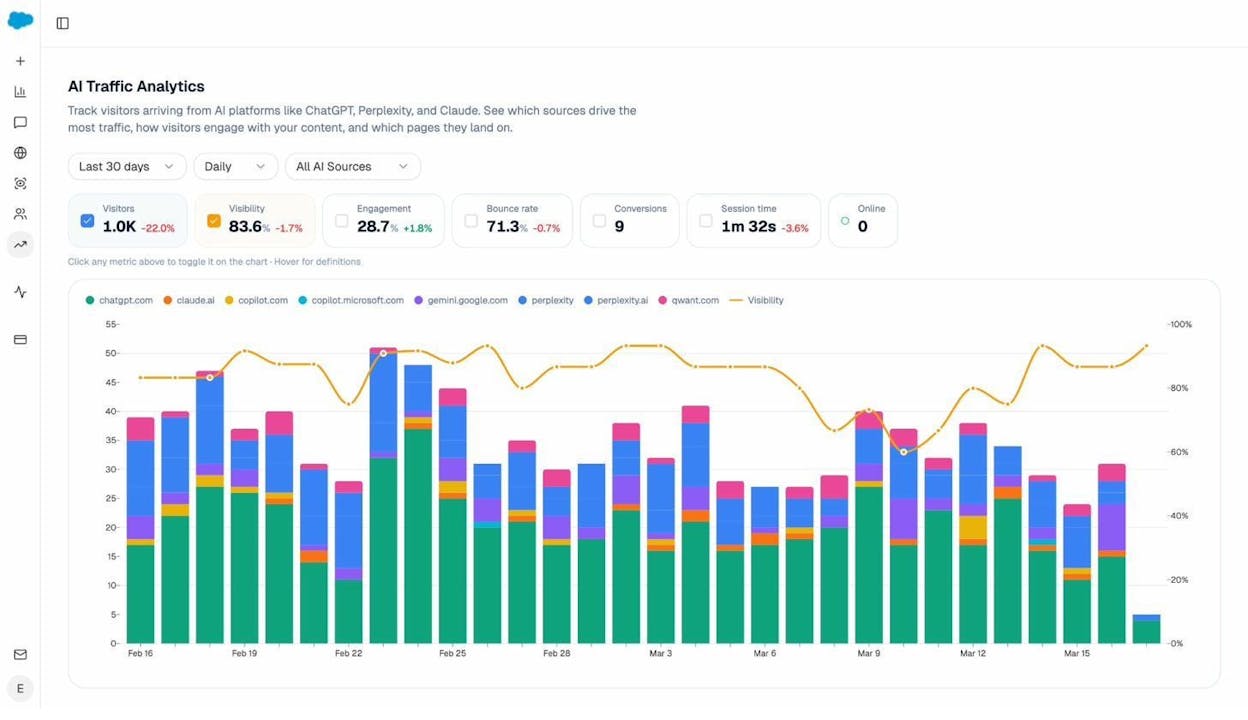
The AI Traffic Analytics dashboard shows daily visitor counts from each AI engine, overlaid with your overall visibility score. You can filter by time period, view daily or weekly trends, and see exactly which AI engines drive the most traffic to your site.
77. Track which landing pages receive AI traffic. Not all pages attract AI referrals equally. Use Analyze AI’s Landing Pages report to see which specific pages on your site receive the most AI-sourced traffic, how visitors engage with those pages, and whether they convert.
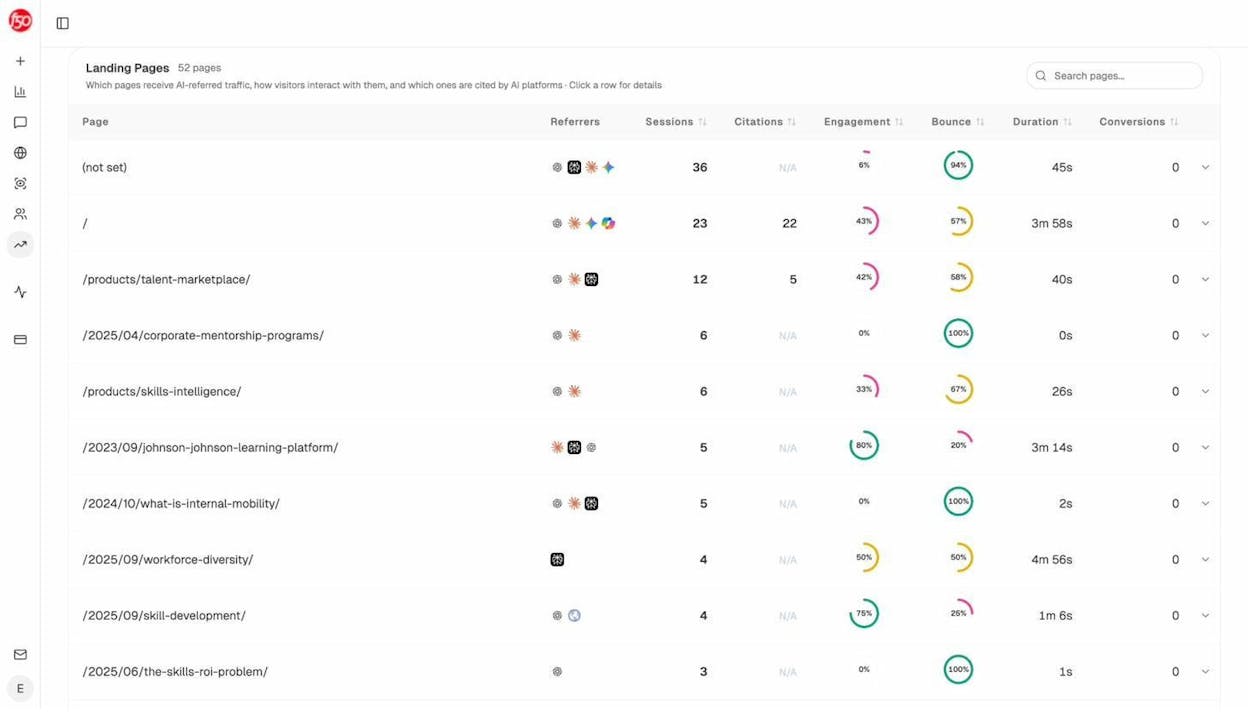
The Landing Pages view shows each page receiving AI traffic alongside its sessions, citations, engagement rate, bounce rate, and conversions. Use this data to double down on pages that convert and fix pages that bounce.
78. Track keyword rankings in the top 20 organic positions. Monitor your target keywords and their position changes over time. Focus on keywords in positions 4-20 where small improvements can yield significant traffic gains. Use a keyword tracking tool to automate this and catch drops early.
79. Monitor your brand’s growth in links and mentions. Track the total number of referring domains, brand mentions, and new backlinks your site earns each month. A healthy link profile grows steadily over time. Sudden drops or plateaus signal problems that need attention.
80. Measure your AI Share of Voice compared to competitors. Share of Voice in AI search is the percentage of relevant prompts where your brand appears in AI answers. Use Analyze AI to compare your Share of Voice against your top competitors. This is the AI equivalent of tracking market share in organic search.
81. Track your brand sentiment across AI engines. Different AI engines portray your brand differently. ChatGPT might describe you positively while Gemini highlights a weakness. Use Analyze AI’s Perception Map to see how each engine frames your brand relative to competitors.
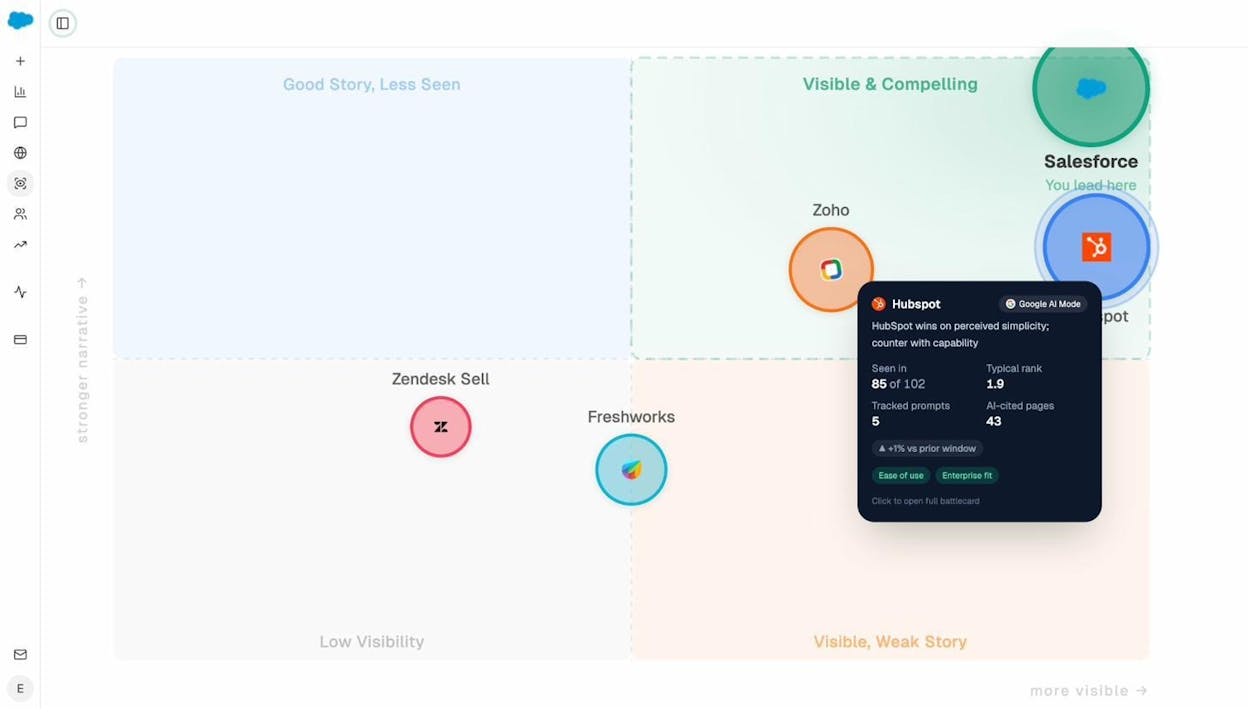
The Perception Map plots your brand and competitors on two axes: visibility (how often you appear) and narrative strength (how positively AI describes you). Brands in the “Visible and Compelling” quadrant have both high visibility and strong narratives. This tells you whether you need more visibility, a better narrative, or both.
82. Track how closely AI connects your brand to key topics. AI models associate brands with topics based on the content they have been trained on. If your brand is not associated with the right topics, you will not appear in relevant AI answers. Use Analyze AI’s prompt tracking to see which topics your brand appears for and identify missing associations you need to build through content and outreach.
83. Track hallucinations and inaccurate brand information in AI responses. AI models sometimes state incorrect facts about your brand. They might cite a discontinued product, show an old pricing model, or attribute a competitor’s feature to you. Set up monitoring to catch these inaccuracies and create content that corrects them. If an AI engine says your product costs $99/month when it actually costs $49/month, that is costing you revenue every time someone reads that answer.
84. Set up automated weekly reports so you never miss a shift. Checking dashboards daily is not sustainable. Use Analyze AI’s Weekly Email Digests to receive a summary of your visibility changes, citation shifts, sentiment movements, and competitor actions every Monday morning.
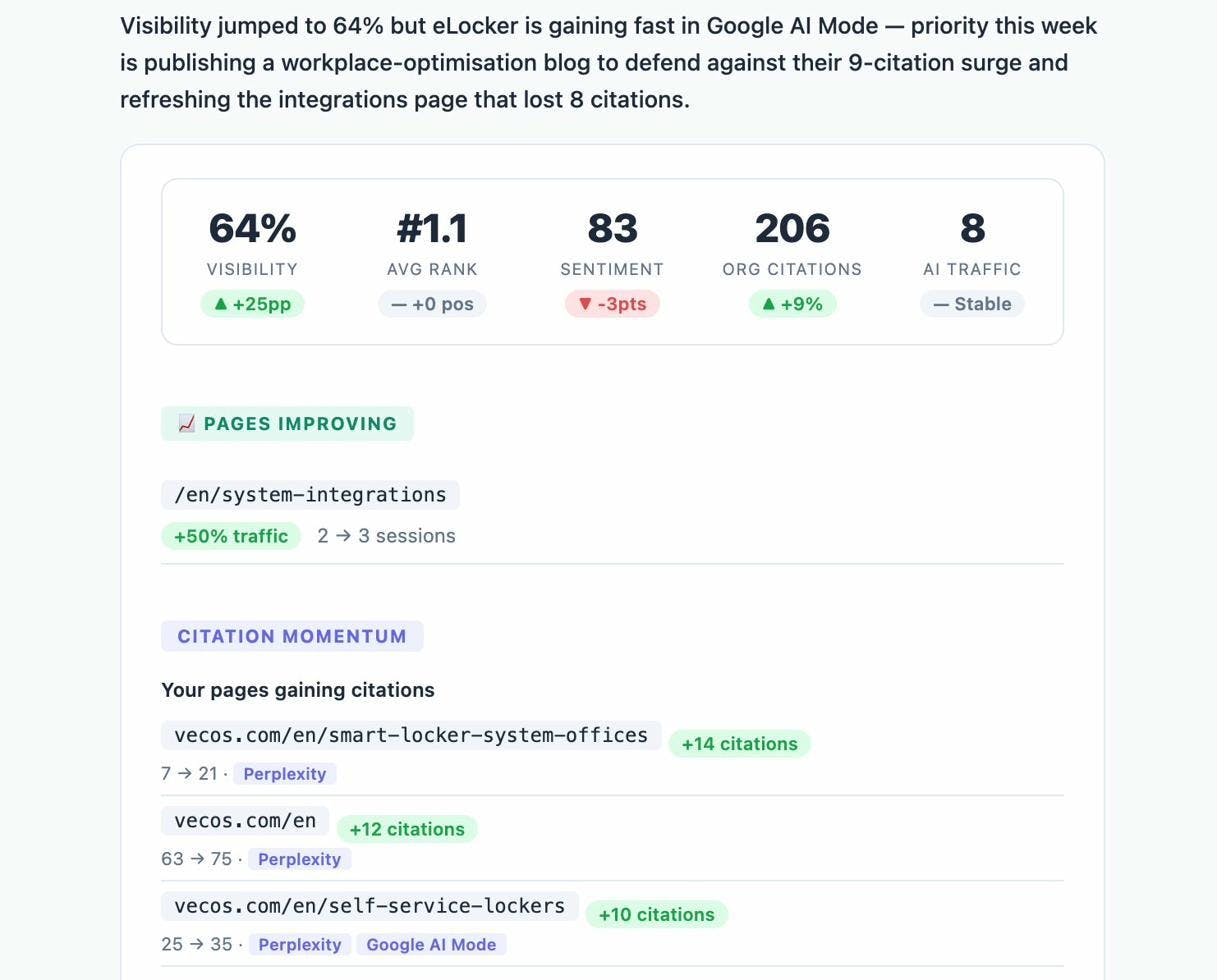
The weekly digest includes your visibility score, average rank, sentiment, citation count, and AI traffic. It highlights pages that are improving, pages losing citations, and competitor movements. Open this on Monday morning and you will know exactly what to prioritize for the week.
85. Build an internal reporting dashboard for leadership. Create a single dashboard that pulls together your SEO metrics (organic traffic, rankings, conversions) and your AI search metrics (visibility, citations, AI traffic, sentiment). Present these together so leadership sees the full picture. Analyze AI exports data that can feed into your existing reporting stack.
AI search-specific actions
The items above cover the overlap between SEO and AI search. The following items are specific to AI search optimization and do not have a direct SEO equivalent.
86. Create an llms.txt file for your website. An llms.txt file is the AI equivalent of a robots.txt file. It tells AI crawlers what your site is about, what pages are most important, and how to interpret your content. Place it in your root directory. Analyze AI offers a free LLM.txt Generator that builds this file for you automatically.
87. Monitor which AI engines mention your brand most and least. Each AI engine has different training data and different content preferences. ChatGPT might cite you frequently while Claude rarely mentions you. Analyze AI’s Engine Breakdown shows your performance across each engine individually so you can identify where to focus improvement efforts.
88. Track which third-party sources AI engines cite in your space. AI engines do not generate information from nothing. They cite specific sources. If you know which domains, pages, and content types AI cites most in your industry, you can create similar content or earn mentions on those exact sources. Use Analyze AI’s Sources dashboard to see the top cited domains and content types.
89. Test prompts before committing to a content strategy. Before investing in a new content topic, test it across AI engines. Use Analyze AI’s AI Search Explorer to run a query across ChatGPT, Perplexity, Gemini, and Copilot. See who currently shows up, what content formats get cited, and whether there is room for your brand. This is the AI equivalent of doing keyword research before writing an article.
90. Use AI battlecards to counter competitive narratives. When AI engines consistently recommend a competitor over you for certain prompts, you need a counter-strategy. Analyze AI’s AI Battlecards show you exactly what AI says about each competitor, which prompts they win, and what content you need to create to shift the narrative.
91. Optimize your content for AI content preferences. Our analysis shows that different AI engines prefer different content types. ChatGPT cites blogs most frequently. Perplexity leans toward documentation and product pages. Claude cites a mix of blogs and first-party content. Tailor your content format to the engines where you want the most visibility. Read more in our guide on how to rank on ChatGPT and how to rank on Perplexity.
92. Track the prompts your competitors win and you do not. In traditional SEO, you track keyword gaps. In AI search, you track prompt gaps. These are the prompts where competitors appear and you do not. Analyze AI surfaces these gaps automatically in the Competitors dashboard, showing you exactly which prompts to target.
Final thoughts
Search is no longer a single channel. People find brands through Google, ChatGPT, Perplexity, Gemini, YouTube, Reddit, and a growing number of AI-powered tools. The good news is that the fundamentals still hold. High-quality content, strong brand signals, clean technical foundations, and genuine expertise continue to win in traditional search and perform even better in AI search.
The key shift is this: your content now has to work for both human readers and AI models. That means writing clearly, structuring logically, citing sources, and building authority across the web. None of this replaces SEO. It extends it into a new channel where the same principles apply in slightly different ways.
Use this checklist as your operating system. Work through it section by section. Assign items to teammates. Track progress weekly. The brands that execute consistently across both channels will compound their visibility over time while everyone else debates whether SEO is dead.
It is not. It is evolving. And the teams that treat AI search as an additional organic channel alongside traditional SEO will be the ones that win.
Start tracking your AI visibility with Analyze AI and see exactly where you stand today.

Ernest

Ibrahim


![The Ultimate SEO Contract Template [100% Free]](/_next/image?url=https%3A%2F%2Fwww.datocms-assets.com%2F164164%2F1777123455-blobid0.png&w=3840&q=75)


