



Summarize this blog post with:


In this article, you’ll learn how long SEO realistically takes to show results, the factors that speed it up or slow it down, what a month-by-month SEO timeline actually looks like, and the quick wins you can use to accelerate rankings. You’ll also learn how long it takes to see results in AI search engines like ChatGPT and Perplexity, and how to track progress across both channels.
Table of Contents
The Short Answer: 3 to 6 Months (But It Depends)
Most SEO professionals agree that it takes three to six months to see meaningful results from SEO. That number comes from industry polls, practitioner surveys, and years of collective experience.
But “results” is a slippery word. If you mean small ranking improvements and early indexing signals, you could see those within weeks. If you mean consistent organic traffic growth that moves business metrics, you’re looking at six to twelve months. And if you’re in a brutally competitive space going after high-difficulty keywords, it could take a year or more.
Google’s own former Developer Programs Tech Lead, Maile Ohye, put it plainly. In most cases, SEOs need four months to a year to first implement improvements and then see potential benefit.
The honest answer is that SEO timelines vary wildly depending on where you’re starting, what you’re targeting, how much you invest, and who you’re competing against. Let’s break down why.
Why Does SEO Take So Long?
SEO is not advertising. You cannot pay for a top position in Google’s organic results. To rank number one for any keyword, you have to earn it by proving to Google that your page is the most relevant, most helpful, and most trustworthy result available.
![[Screenshot: Google SERP showing organic results vs paid ads, annotated to show the difference]](https://www.datocms-assets.com/164164/1777312996-blobid1.png?auto=format,compress&w=1248&fit=max)
That proof takes many forms. Your page has to align with what the searcher actually wants (search intent). It needs to be well-structured, easy to read, and fast to load. The content has to be genuinely useful, backed by expertise, and ideally contain something original that no other page offers. And your website as a whole needs enough authority (backlinks, brand reputation, topical depth) for Google to trust it.
None of this happens overnight. Google’s crawlers need to discover your page, index it, and then test it against the pages already ranking. That testing phase alone can take weeks or months. Google will sometimes push a page up in rankings, observe user behavior, and then drop it back down. This “ranking volatility” is normal, especially for newer content.
The other reason SEO takes time is that your competitors are not standing still. If you’re targeting a keyword, chances are five or ten other companies are also investing in content, building links, and optimizing for that same term. You’re not just building something good. You’re building something better than what already exists.
7 Factors That Affect How Long SEO Takes
Not every website starts from the same place. These seven factors determine whether you’ll see results in three months or twelve.
1. Website Age and Authority
Older, established websites have a compounding advantage. They’ve accumulated backlinks over years, built topical depth across dozens or hundreds of pages, and earned trust with Google through a long track record.
A brand-new domain starts from zero. Google’s John Mueller has said it can take up to a year for Google to figure out where a new site should rank. Some SEOs call this the “Google sandbox” effect, where new sites seem to be held back regardless of content quality.
If your website authority is low (under DR 20), expect a longer runway. You’ll need to build credibility through consistent publishing and link acquisition before you can compete for anything moderately competitive.
2. Competition Level
The difficulty of your target keywords is one of the biggest predictors of timeline.
Going after a keyword like “CRM software” means competing with HubSpot, Salesforce, and dozens of other well-funded companies that have been publishing content and building links for years. That could take a very long time. But targeting “CRM software for nonprofits with under 50 employees” is a different story. Less competition means faster results.
You can gauge competition using a keyword difficulty checker. Keywords with a difficulty score under 20 are generally achievable for newer sites within a few months. Keywords scoring above 50 will take significantly more time, resources, and authority.
![[Screenshot: Analyze AI Keyword Difficulty Checker showing a keyword with difficulty score and SERP analysis]](https://www.datocms-assets.com/164164/1777313029-blobid2.png?auto=format,compress&w=1248&fit=max)
3. Resources and Budget
SEO is an investment, and the return correlates directly with what you put in.
A solo marketer writing one blog post per month will see results far more slowly than a team producing four well-researched articles per week, supported by a technical SEO specialist and a link building strategy. More content, more internal links, more promotion, more updates. All of these compound over time.
This doesn’t mean you need a massive budget. But it does mean you need to be realistic. If you can only invest modestly, focus your resources on low-competition keywords and build from there.
4. Content Quality and Relevance
Google’s ranking systems are increasingly sophisticated at evaluating content quality. The helpful content system, E-E-A-T signals, and natural language processing all work together to surface pages that genuinely serve the searcher.
Publishing thin, generic content that restates what every other page already says won’t move the needle, no matter how many pages you publish. What works is content with real information gain. Original data, expert perspectives, detailed how-to instructions, unique frameworks. The things that make a reader bookmark your page instead of hitting the back button.
If your content strategy is built around depth and originality, results will come faster than if you’re churning out surface-level articles.
5. Technical Health
Technical issues act as brakes on your SEO progress. If Google can’t crawl your site efficiently, can’t index your important pages, or encounters slow load times and broken links, everything else you do gets undermined.
Common technical blockers include accidental noindex tags on important pages, broken internal links, duplicate content issues, poor mobile usability, and slow page speed. Fixing these issues won’t magically rank you number one, but leaving them unfixed will keep you from ranking at all.
Run a technical audit early. The sooner you fix foundational issues, the sooner your content efforts will actually compound.
6. Your Goals
This sounds obvious, but your definition of “results” matters.
If your goal is to rank on page one for a long-tail, low-difficulty keyword, that might happen in two or three months. If your goal is to rank in the top three for a high-volume head term with a keyword difficulty of 80+, that’s a twelve-to-eighteen-month project at minimum.
Set specific, measurable goals tied to business outcomes. “Increase organic traffic by 30% in six months” is actionable. “Rank number one for everything” is not. The more specific your goals, the better you can prioritize and the faster you’ll see the results that actually matter.
7. Your Strategy and Execution
The best SEO strategy in the world means nothing if it doesn’t get executed consistently. And a poor strategy executed perfectly will just get you to the wrong destination faster.
What separates teams that see results in three months from teams that are still waiting at month twelve is usually a combination of two things. First, a smart strategy that targets the right keywords in the right order, prioritizing quick wins while building toward harder targets. Second, consistent execution where content gets published on schedule, technical fixes get implemented promptly, and nothing sits in a backlog for months.
A Realistic Month-by-Month SEO Timeline
Every website is different, but here’s what a realistic SEO journey looks like for a site with moderate authority (DR 20-40) investing consistently.
|
Month |
What You Should Be Doing |
What to Expect |
|---|---|---|
|
Month 1 |
Run a full technical audit. Fix crawl errors, broken links, and indexing issues. Set up Google Search Console and analytics. Conduct keyword research to build your initial target list. |
Slight increases in impressions. Rankings mostly unchanged. This is the foundation-building phase. |
|
Month 2 |
Start publishing content targeting low-difficulty keywords (KD under 20). Optimize existing pages for search intent. Set up internal linking between related pages. |
A few new keywords start appearing in Search Console. You may see positions 30-80 for some terms. Traffic is still minimal. |
|
Month 3 |
Continue publishing. Begin building backlinks through outreach, digital PR, or creating linkable assets. Refresh any existing content that’s underperforming. |
Low-competition keywords begin reaching page 2-3. Impressions are growing. You might see your first trickle of organic traffic from long-tail terms. |
|
Month 4 |
Ramp up content production. Start targeting medium-difficulty keywords (KD 20-40). Analyze what’s working and double down on those topics. |
Rankings start moving more visibly. Some pages break into the top 10 for low-competition terms. Traffic shows early upward momentum. |
|
Month 5-6 |
Optimize pages that are ranking on page 2 (positions 11-20). Add internal links, improve content depth, and build supporting content around your key topics. |
Consistent organic traffic growth begins. Your top-performing pages are driving real sessions. You should see your first measurable business outcomes (leads, sign-ups, sales). |
|
Month 7-12 |
Expand to more competitive keywords. Build topical authority with comprehensive content clusters. Continue link building and content refreshes. |
Organic traffic compounds. You’re ranking for dozens or hundreds of keywords. Domain authority is climbing. New content ranks faster because Google trusts your site more. |
The key insight here is that SEO compounds. Months 1-3 feel slow because you’re building foundations. But every page you publish, every link you earn, and every technical fix you make increases the velocity of everything that follows. By month 6-12, each new piece of content benefits from all the authority you’ve already built.
How to Get SEO Results Faster
You don’t have to simply wait and hope. These are proven tactics that can accelerate your timeline.
1. Target Low-Competition Keywords First
Not all keywords are equally hard to rank for. By starting with low-difficulty terms, you can generate traffic and build authority while your site is still gaining traction.
Here’s how to find them.
Step 1: Use a keyword generator or keyword research tool. Enter a broad seed keyword related to your business.
![[Screenshot: Analyze AI Keyword Generator showing keyword suggestions with difficulty scores]](https://www.datocms-assets.com/164164/1777313031-blobid3.png?auto=format,compress&w=1248&fit=max)
Step 2: Filter results to keywords with a difficulty score under 20. These are terms where newer or lower-authority sites have a realistic chance of ranking within a few months.
Step 3: Look for keywords with decent search volume (at least 100-500 monthly searches) that are directly relevant to your business. Ideally, pick keywords where a searcher could become a customer.
Step 4: Check the SERP for your target keywords. If you see forums, thin content, or low-authority sites ranking in the top 5, that’s a strong signal you can compete.
![[Screenshot: Analyze AI SERP Checker showing SERP results for a low-competition keyword]](https://www.datocms-assets.com/164164/1777313045-blobid4.png?auto=format,compress&w=1248&fit=max)
The goal is to build a base of content that ranks relatively quickly, generates traffic, and earns your site credibility with Google. Once that foundation is solid, you can work your way up to harder keywords.
2. Optimize for Featured Snippets
Featured snippets are the answer boxes that appear at the top of some Google search results. Winning a featured snippet can jump your page from position 5 or 6 all the way to position zero, above all other organic results.
To find featured snippet opportunities, look for keywords where you already rank in positions 2-10 and where Google currently shows a featured snippet. Then optimize your content to directly answer the query in a clear, concise format.
For definition-type queries, add a short paragraph (40-60 words) that directly answers the question right below your subheading. For list-type queries, structure your content with clear H2 or H3 headings that form a logical sequence. For table-type queries, add a well-formatted HTML table.
3. Build Internal Links Strategically
Internal links pass authority between pages on your site. When you link from a high-authority page to a newer page, you’re giving that newer page a ranking boost.
Here’s a practical approach.
Step 1: Identify your highest-authority pages. These are usually your most-linked, most-trafficked pages. Check which pages have the most backlinks using a website authority checker or your SEO tool of choice.
Step 2: Find relevant internal linking opportunities. Look for places in your existing content where you naturally mention topics you’ve written about elsewhere. Add contextual links to those pages.
Step 3: For important pages you want to boost (product pages, key blog posts), aim for at least 5-10 internal links pointing to them from related content. Make sure the anchor text is descriptive and relevant.
This is one of the fastest and cheapest ways to improve rankings because you control it entirely. No outreach needed.
4. Fix Indexing and Technical Issues
If Google can’t index your pages, they can’t rank. And you’d be surprised how often important pages get blocked from indexing by mistake.
Check for noindex tags on important pages using Google Search Console or a crawling tool. Look for pages that are returning 404 errors or redirecting incorrectly. Run a broken link check to find and fix dead links.
Also check your page speed. Google has confirmed that page experience is a ranking factor. If your site takes more than three seconds to load, you’re likely losing both rankings and visitors.
5. Refresh Declining Content
If you have existing content that used to rank well but has been losing traffic, a content refresh can bring it back. This is often the single fastest way to recover lost organic traffic because you’re working with a page that already has authority and backlinks.
Look for pages with declining traffic over the past 3-6 months. Update outdated information, add new sections that address related queries, improve the introduction, and add fresh data or examples.
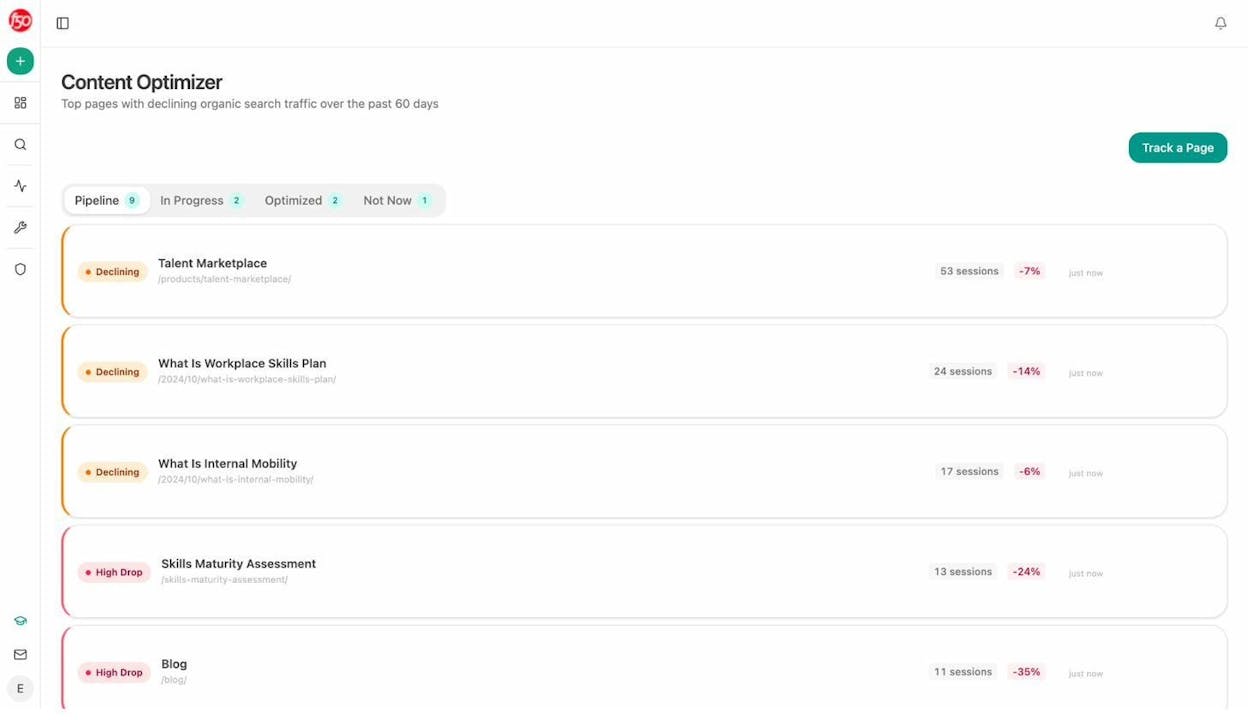
The Content Optimizer in Analyze AI can help here. Paste any URL and it will flag pages with declining traffic, score them on content quality, and generate specific suggestions for improvement.
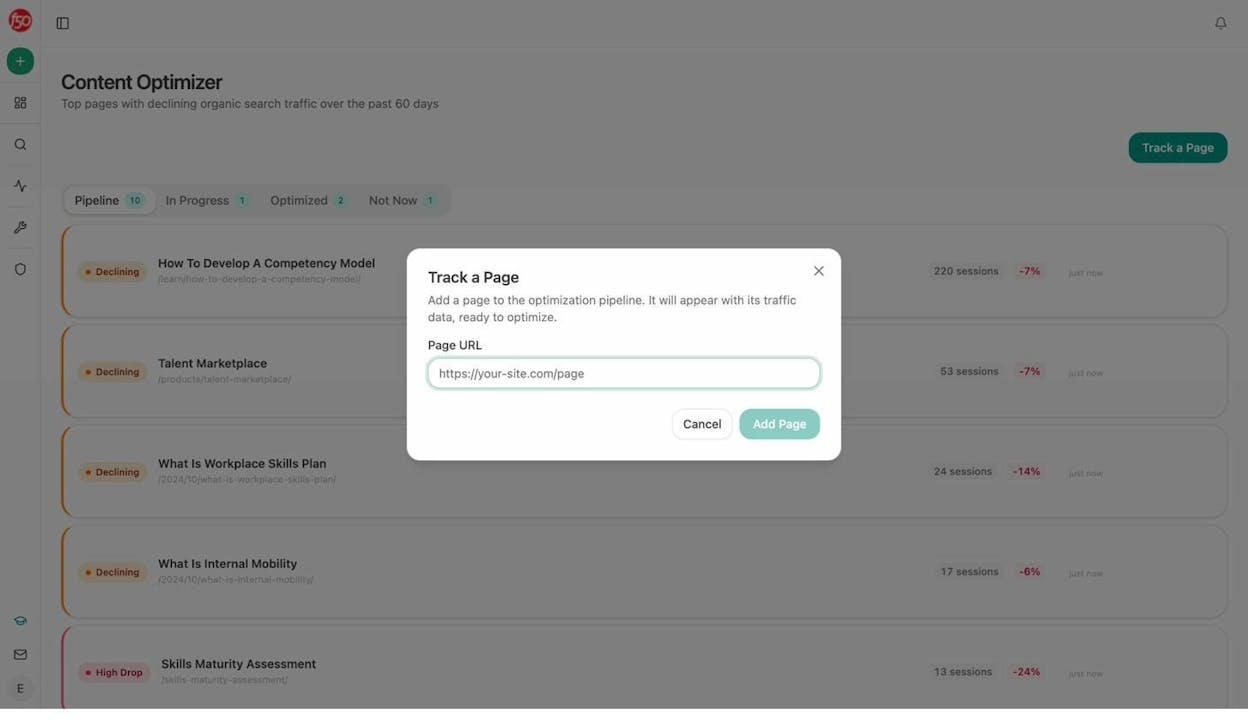
The tool surfaces your top pages with declining sessions and lets you add any URL to an optimization pipeline. From there, it fetches the original content, provides editorial comments on gaps, and produces an optimized draft.
6. Build Topical Authority
Google increasingly rewards websites that demonstrate deep expertise in a topic area. Instead of publishing scattered posts across unrelated subjects, build clusters of content around your core topics.
For example, if your business sells project management software, don’t just write one post about “project management.” Build a hub with supporting content on subtopics like project management methodologies, Gantt charts, resource allocation, sprint planning, and stakeholder communication. Each piece links to the others, creating a web of topical relevance.
This approach does two things. First, it signals to Google that you’re an authority on the topic. Second, it creates more opportunities for internal linking, which distributes authority across your cluster.
How Long Does It Take to See Results in AI Search?
Here’s something most SEO guides won’t tell you. While you’re focused on Google rankings, a growing share of your potential customers are finding answers through AI search engines like ChatGPT, Perplexity, Gemini, and Copilot. And the timeline for visibility in AI search is different from traditional SEO.
SEO is not dead. But the landscape is evolving. AI search is an additional organic channel that complements traditional SEO. The brands that understand this are the ones gaining a compounding advantage.
AI Search Visibility Works Differently
In traditional SEO, you optimize a page, Google crawls it, and you gradually climb the rankings. In AI search, large language models pull information from their training data and from real-time sources to generate answers. Your brand either gets mentioned in those answers or it doesn’t.
The factors that influence AI search visibility overlap significantly with what makes good SEO. Clear, well-structured content. Original data and expert perspectives. Brand authority and reputation. Getting cited by authoritative third-party sources. But the mechanics are different. There’s no “position 1” in an AI answer. Instead, AI models recommend brands, cite sources, and frame narratives. Your visibility depends on how often and how favorably you appear in those responses.
The AI Search Timeline
The good news is that AI search visibility can compound faster than traditional SEO for brands that already have strong content fundamentals. If your content is already well-structured, authoritative, and cited by other reputable sources, AI models are more likely to surface it.
Here’s what a realistic AI search timeline looks like.
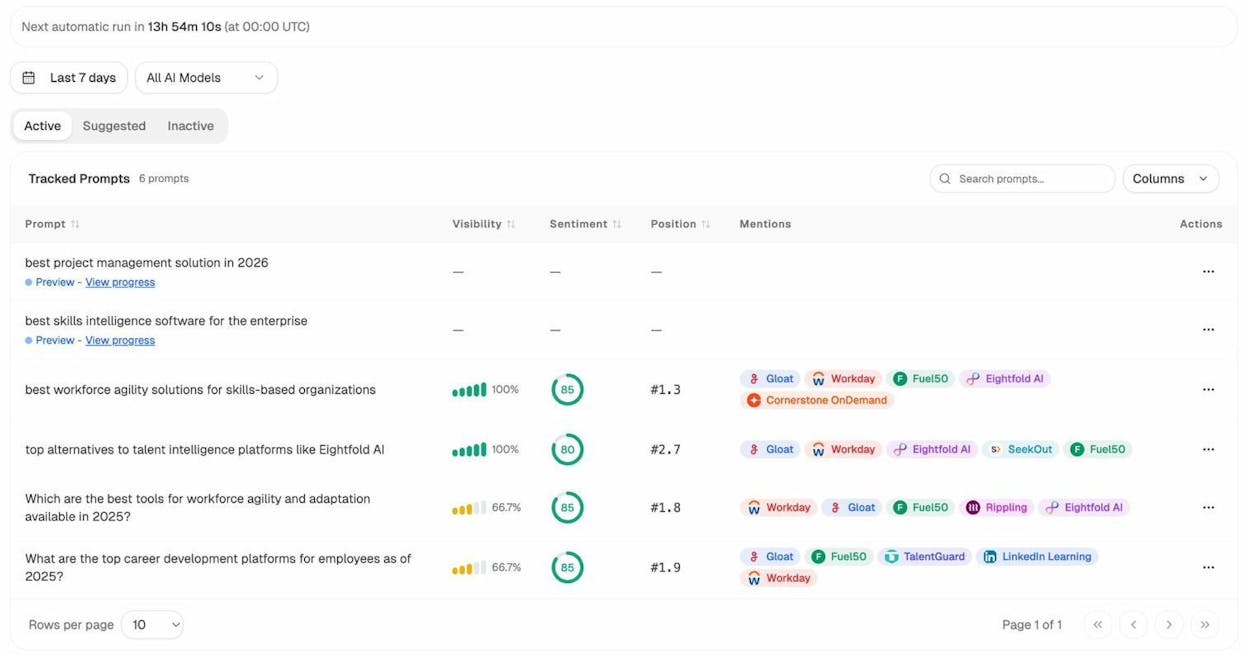
Weeks 1-2: Set up monitoring. You can’t improve what you don’t measure. Use Analyze AI to track how often your brand appears in AI search results, which engines mention you, and what sentiment they assign to your brand.
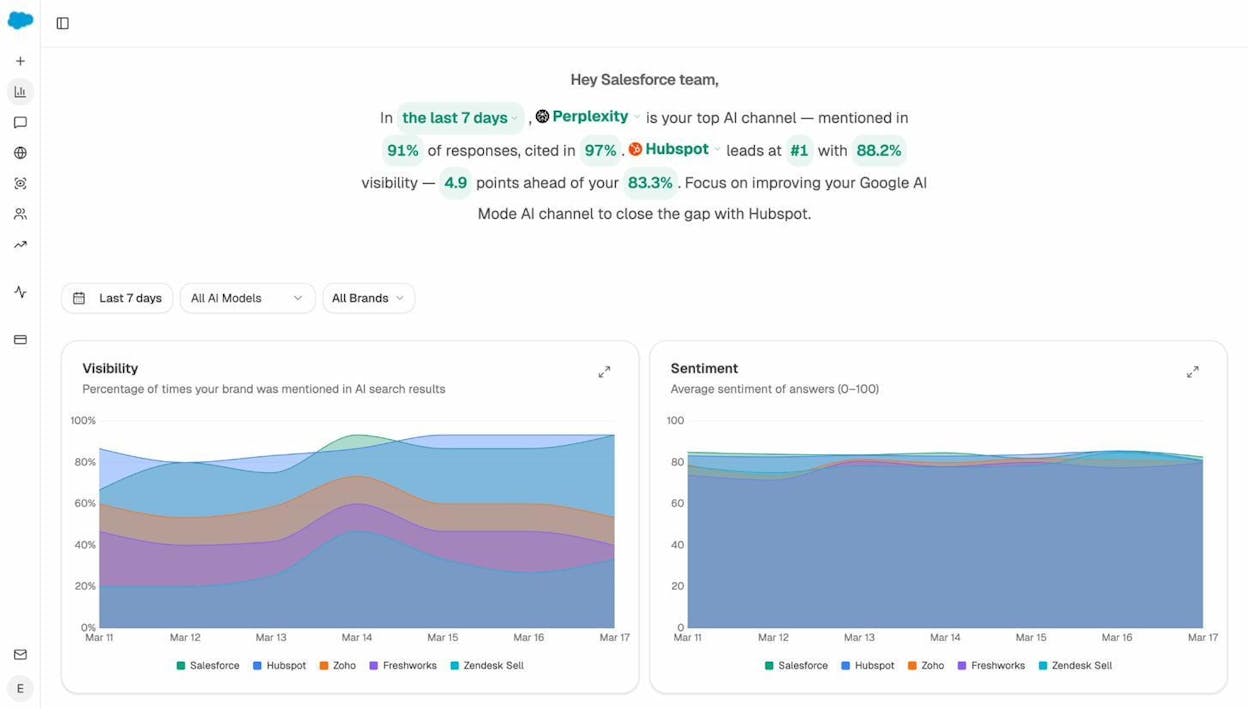
Weeks 3-4: Identify gaps. Look at which prompts and topics your competitors appear in but you don’t. Analyze AI’s competitor intelligence feature surfaces exactly which brands AI engines recommend instead of yours, and on which prompts.
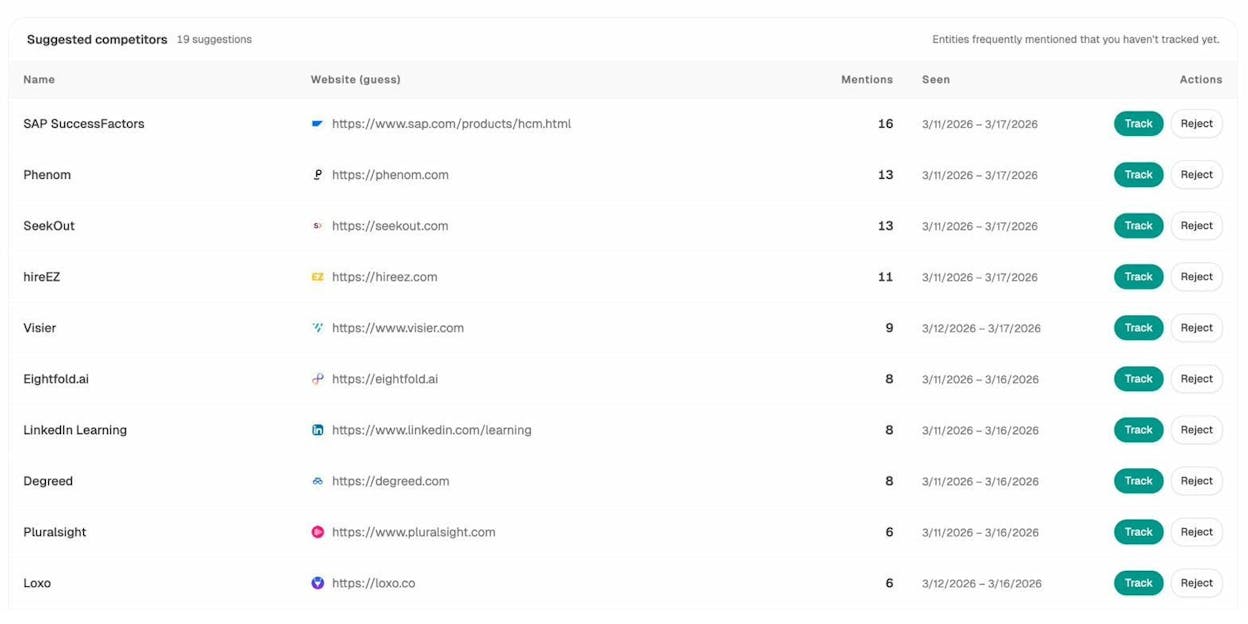
Month 2-3: Create and optimize content for the gaps you’ve found. Use the AI Content Writer to research topics, identify the sources AI models cite, and create content that fills the information gaps.
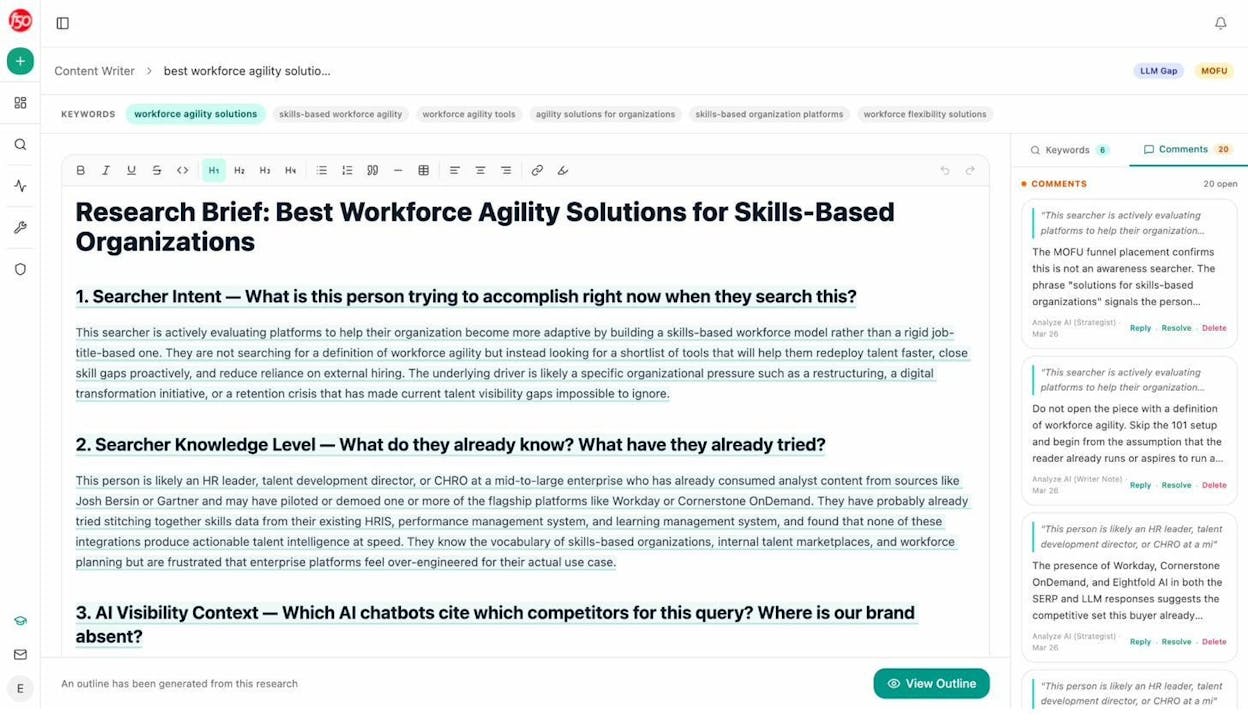
Month 3-6: Track progress. AI visibility doesn’t move in a straight line. Models update their knowledge, new sources get indexed, and competitor content shifts. Use prompt tracking to monitor your visibility across specific queries over time.
Measuring AI Search ROI
The question every executive asks is: does AI search actually drive business results? The answer is yes, and you can prove it.
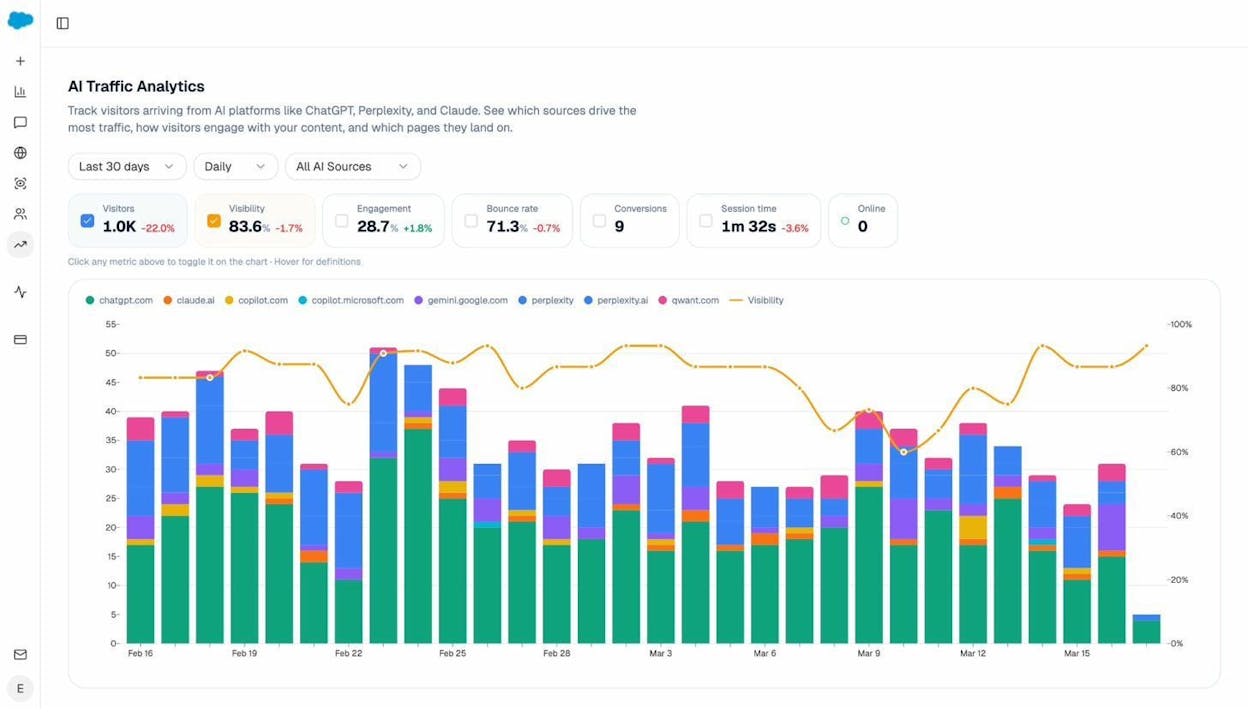
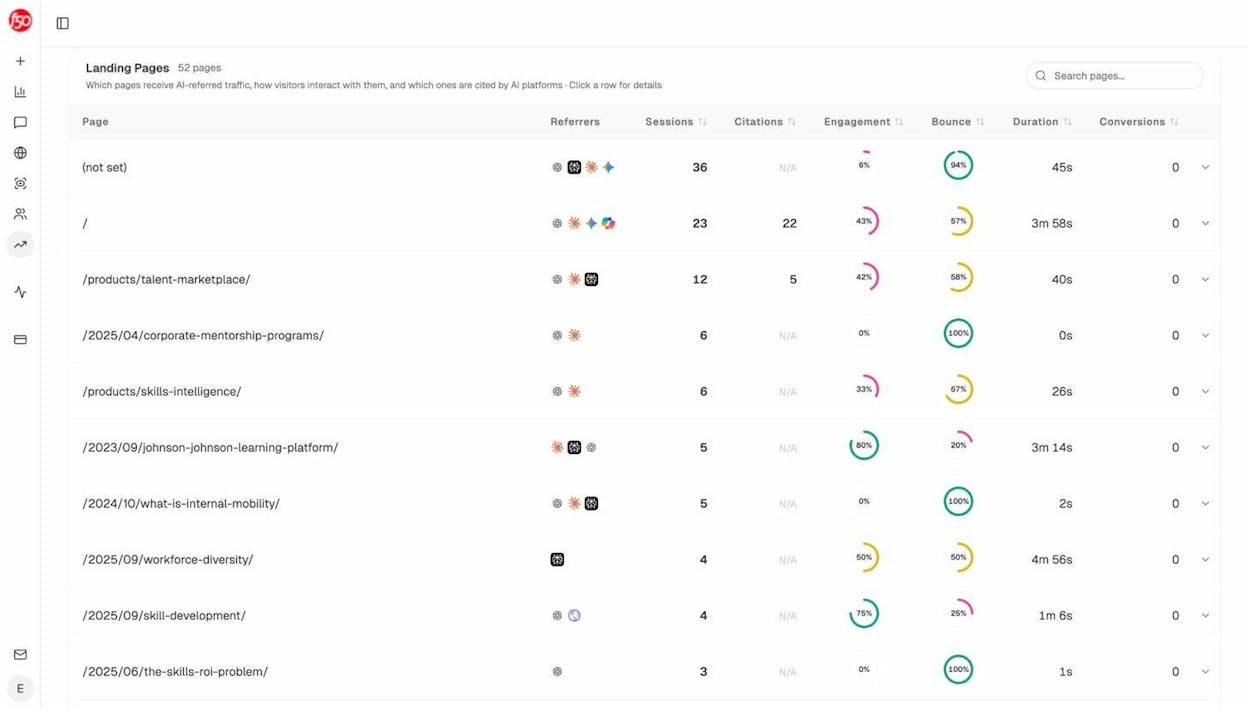
By connecting Google Analytics 4 to Analyze AI’s traffic analytics, you can see exactly how many visitors arrive from ChatGPT, Perplexity, Gemini, Claude, and other AI engines. You can see which landing pages they visit, how long they stay, and whether they convert.
The landing pages report is particularly useful. It shows which of your pages actually receive AI-referred traffic, which engines send it, and how visitors engage. This lets you identify patterns in what works and double down on the content types and formats that AI engines prefer to cite.
One of Analyze AI’s customers, Kylian AI, scaled from 200 to 1,000+ AI-referred sessions per month within six months by using these insights to optimize their content. Their AI search traffic now converts at 5%, significantly above the typical blog conversion rate of 1-2%.
How to Track Your SEO Progress
You can’t manage what you don’t measure. Here are the metrics that actually matter at each stage of your SEO journey.
Early Stage (Months 1-3)
In the early months, traffic won’t tell you much. Instead, focus on leading indicators.
Impressions in Google Search Console tell you whether Google is even showing your pages to searchers. If impressions are growing, your pages are getting in front of people. Rankings will follow.
Indexed pages confirm that Google has discovered and indexed your content. Check the “Pages” report in Search Console to make sure your important pages are indexed.
Keyword rankings for your target terms. Even if you’re at position 40, that’s progress compared to not ranking at all. Track these weekly or biweekly to spot trends.
Growth Stage (Months 3-6)
Now you can start looking at business-relevant metrics.
Organic traffic is the headline number. Track month-over-month growth in Google Analytics. Look at both total sessions and landing page performance to identify which content is driving results.
Click-through rate (CTR) from Search Console shows whether your title tags and meta descriptions are compelling enough to earn clicks. Low CTR on a high-impression keyword is a quick-win opportunity.
Conversions from organic traffic tie your SEO work to business outcomes. Set up goal tracking or e-commerce tracking so you can measure leads, sign-ups, or revenue from organic visitors.
Maturity Stage (Months 6-12+)
At this stage, think about compounding and efficiency.
Revenue or pipeline from organic search is the metric that gets buy-in from leadership. Track how much revenue your organic channel generates and how it’s trending.
Content efficiency measures how much traffic (and revenue) each piece of content generates relative to the cost of producing it. Double down on formats and topics that perform well.
Share of voice in your target keyword set tells you how visible you are compared to competitors. This is where tools like Analyze AI become especially valuable. Not only can you track your SEO keyword rankings, but you can also monitor your visibility in AI search across every major engine.
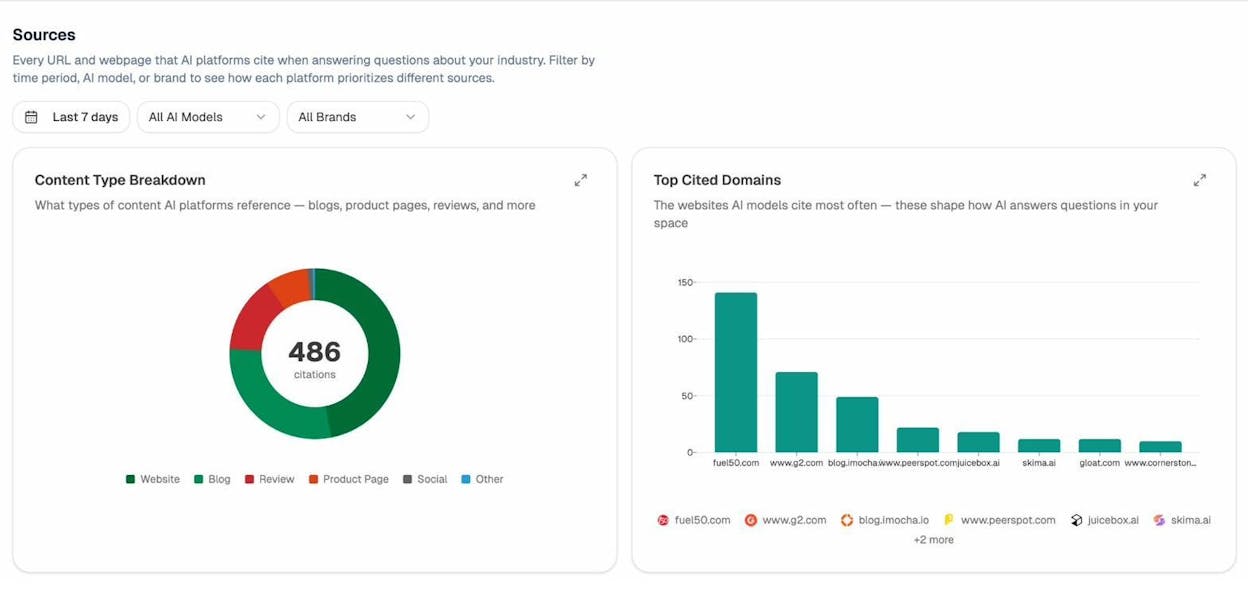
The Sources dashboard in Analyze AI shows you which domains and content types AI engines cite most in your space. If you know that AI models in your industry cite G2 reviews and blog posts more than product pages, you can prioritize the formats that actually earn citations.
The Bottom Line
SEO takes three to six months to show meaningful results, and six to twelve months to drive significant business impact. That timeline depends on your starting authority, competition, resources, content quality, and technical health.
But there are concrete things you can do to accelerate results. Target low-competition keywords first. Fix technical issues early. Build internal links strategically. Refresh declining content. And build topical authority through content clusters.
The biggest shift in organic search right now is that it’s no longer just Google. AI search engines are becoming a significant traffic source, and the brands that track and optimize for both channels will compound their advantage faster than those focused on only one.
Start by measuring where you stand today. Run a keyword analysis to find your best opportunities, audit your site for technical issues, and set up AI search monitoring to understand how AI engines currently represent your brand.
Then execute consistently, measure progress weekly, and adjust your strategy based on what the data tells you. SEO is a long game, but it’s one that pays off.
Learn More
Want to go deeper? These resources will help.

Ernest

Ibrahim


![The Ultimate SEO Contract Template [100% Free]](/_next/image?url=https%3A%2F%2Fwww.datocms-assets.com%2F164164%2F1777123455-blobid0.png&w=3840&q=75)