



Summarize this blog post with:


Search intent is the reason behind a search query. It is what the searcher actually wants when they type something into Google or ask a question to an AI engine like ChatGPT or Perplexity.
In this article, you’ll learn what search intent is, why it matters more than any other SEO factor, how to identify and analyze it step by step, how to optimize your content to align with it, and how to extend your search intent strategy to AI search engines that are quickly becoming a second organic channel.
Table of Contents
What Is Search Intent?
Search intent (also called user intent or keyword intent) is the goal a person is trying to accomplish when they enter a query into a search engine.
Every search has a reason behind it. Someone typing “how to fix a leaky faucet” wants instructions. Someone typing “plumber near me” wants to hire someone. Someone typing “Delta Airlines” wants to reach a specific website. And someone typing “best plumber in Austin” wants to compare options before picking one.
The concept traces back to Andrei Broder’s 2002 taxonomy, which classified web queries into informational, navigational, and transactional. Google adopted and expanded this framework, and today most SEOs and content marketers work with four core search intent categories.
Understanding search intent is not about filling in a column on your keyword spreadsheet. It is about figuring out what you actually need to create in order to rank for a given term and deliver real value to the person searching.
The Four Types of Search Intent
SEOs typically classify search intent into four buckets. Each one signals a different stage of the buyer’s journey and calls for a different type of content.
1. Informational Intent
The searcher wants to learn something. They are looking for an answer, an explanation, or guidance on a topic. These queries often start with “how to,” “what is,” “why does,” or “guide to.”
Examples: “what is search intent,” “how to change a tire,” “why is the sky blue,” “content marketing strategy”
What to create: Blog posts, guides, how-to articles, videos, infographics, or educational landing pages.
2. Navigational Intent
The searcher already knows where they want to go. They are using Google as a shortcut to reach a specific website, page, or brand.
Examples: “Facebook login,” “Ahrefs pricing,” “Analyze AI blog,” “YouTube”
What to create: Ensure your branded pages are well-optimized and rank for your own brand terms. There is typically little opportunity to rank for another company’s navigational queries.
3. Commercial Intent
The searcher is comparing products, services, or solutions before making a decision. They have purchase intent but are not ready to buy yet. They want to evaluate options.
Examples: “best CRM software,” “Ahrefs vs Semrush,” “top project management tools 2026,” “Salesforce alternatives”
What to create: Comparison posts, “best of” listicles, reviews, versus pages, and buyer’s guides.
4. Transactional Intent
The searcher is ready to take action, usually a purchase. They have already done their research and want to buy, sign up, or download something.
Examples: “buy running shoes online,” “Mailchimp pricing plans,” “download Notion,” “coupon code for Grammarly”
What to create: Product pages, pricing pages, landing pages with clear CTAs, and checkout flows.
Here is a quick reference table:
|
Intent Type |
The Searcher Wants To… |
Common Modifiers |
Content to Create |
|---|---|---|---|
|
Informational |
Learn or understand something |
how to, what is, guide, tips, examples, why |
Blog posts, guides, tutorials, videos |
|
Navigational |
Reach a specific website or page |
[brand name], login, official site, app |
Brand pages, homepages, login pages |
|
Commercial |
Compare options before buying |
best, vs, review, top, comparison, alternative |
Listicles, comparison posts, reviews |
|
Transactional |
Complete an action (buy, sign up) |
buy, price, coupon, discount, download, sign up |
Product pages, pricing pages, landing pages |
These four categories are a useful starting point, but they are not the whole story. Many queries have multiple intents at once, and the real work of search intent analysis happens when you go beyond labels and study what actually ranks.
Why Search Intent Matters for SEO
Google explicitly states that relevance is one of the primary ranking signals. If your content does not match what the searcher is looking for, it will not rank. Period.
This is not theoretical. Consider the keyword “backlink checker.” If you create a detailed blog post explaining what backlinks are and why they matter, you will not rank for that term. Google’s SERPs clearly show that searchers expect a free tool. The top results are all interactive backlink checkers, not informational articles.
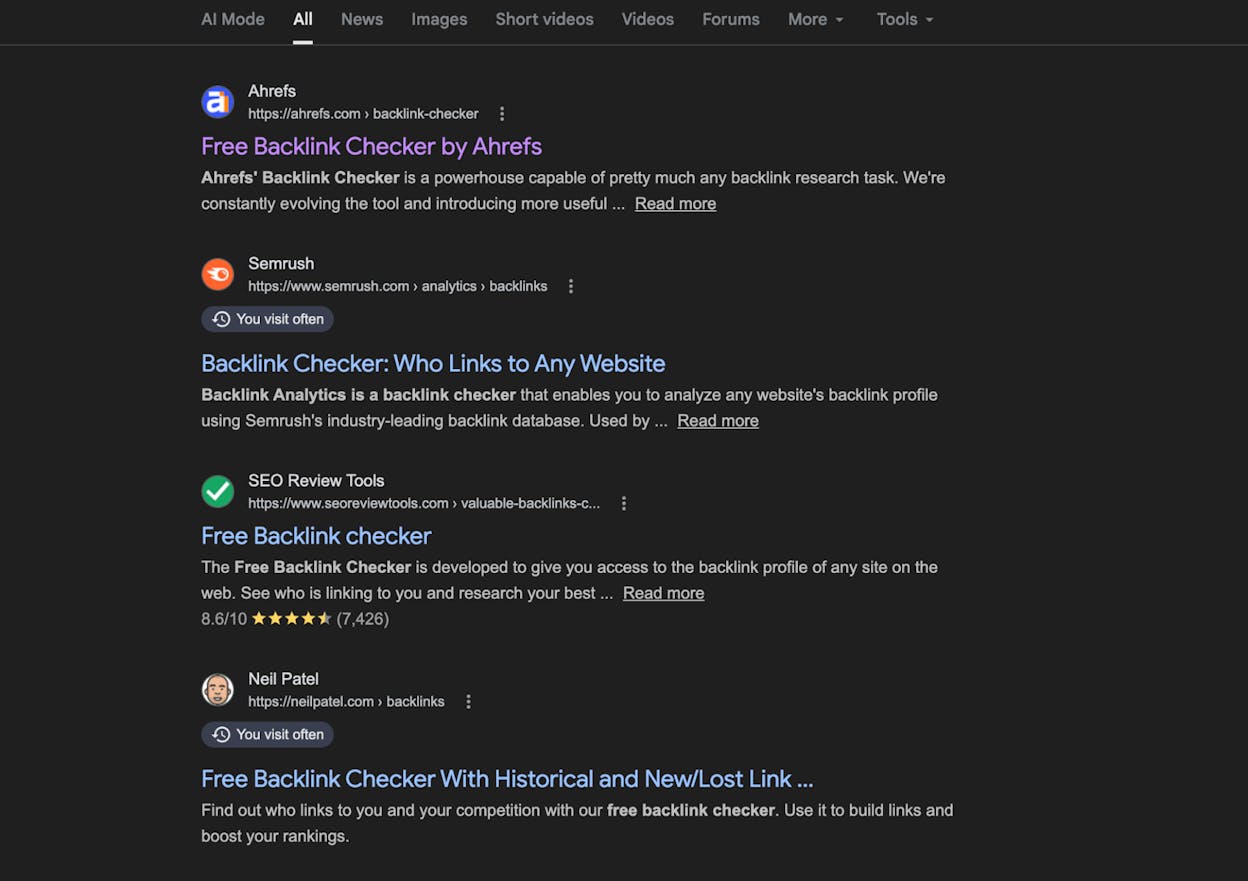
Aligning content with search intent can produce dramatic results. Teams that audit their existing content and realign it with what searchers actually want consistently report significant traffic gains — sometimes in the range of 500% or more — within a few months.
Here is why search intent is the most important factor in your content strategy:
It determines whether you can rank at all. If the SERPs for your target keyword are dominated by product pages and you publish a blog post, Google will not surface your content. The format mismatch alone disqualifies you.
It shapes what your content needs to include. Even if you get the right content type, you still need to cover the right subtopics, answer the right questions, and take the right angle. Search intent analysis tells you exactly what those are.
It prevents wasted effort. Every misaligned piece of content is time and money spent on something that will never generate organic traffic. Understanding intent before you write saves you from building the wrong thing.
It improves user engagement signals. When your content matches what people are looking for, they stay longer, bounce less, and engage more. These behavioral signals reinforce your rankings over time.
How to Determine Search Intent (Step by Step)
The four-label classification (informational, commercial, transactional, navigational) is a starting point. But relying on labels alone will often lead you astray. The real method for determining search intent is analyzing the SERPs themselves.
Here is the step-by-step process.
Step 1. Analyze the “Three Cs of Search Intent”
For any keyword you want to target, start by Googling it and studying what currently ranks. You are looking for three things:
Content Type
What is the dominant type of content on page one? This is usually one of the following: blog post, video, product page, category page, or landing page.
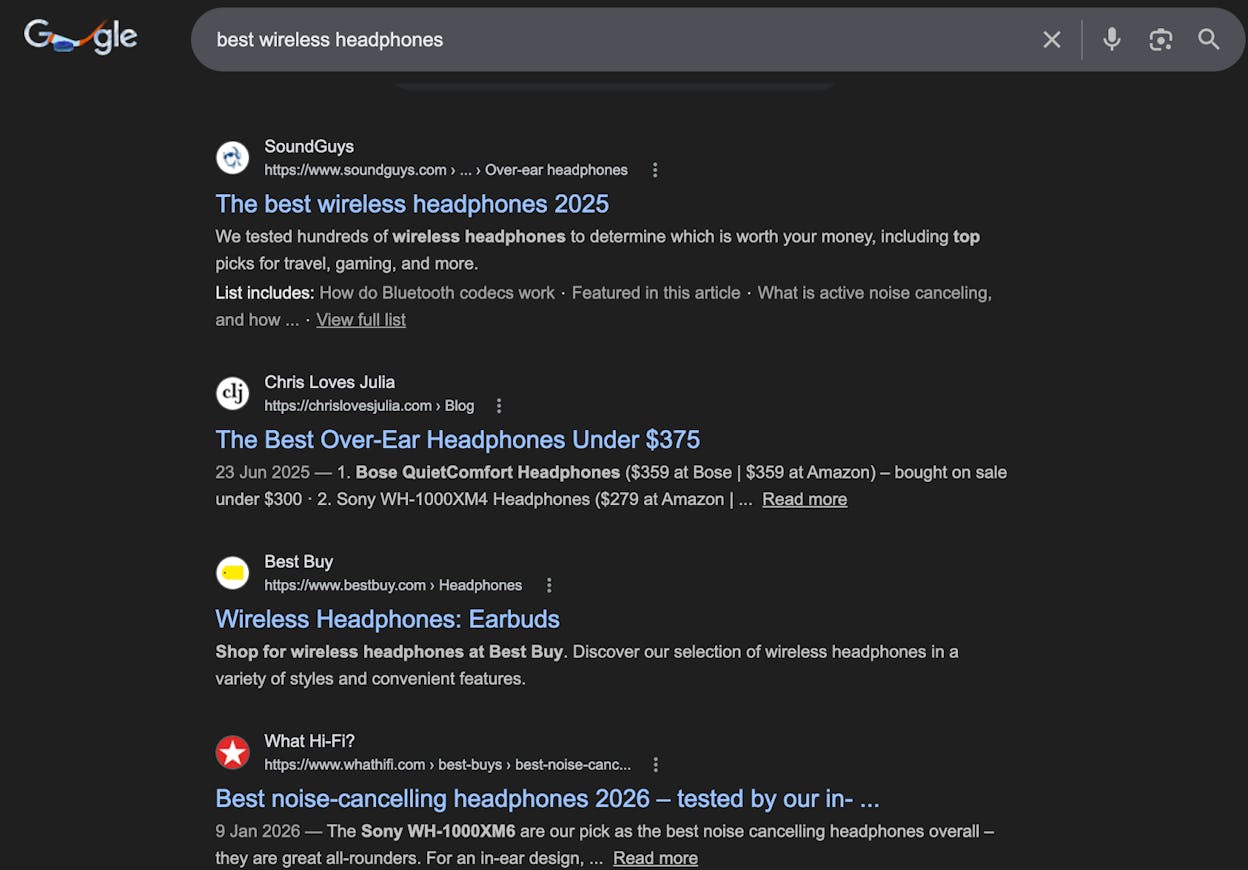
For example, search for “best wireless headphones.” The top results are all blog posts from review sites, not product pages from Sony or Bose. This tells you that searchers want third-party opinions, not manufacturer marketing.
Now search for “buy AirPods Pro.” The top results are product pages and retailer listings from Apple, Amazon, and Best Buy. This tells you the searcher is ready to purchase and expects a place to buy.
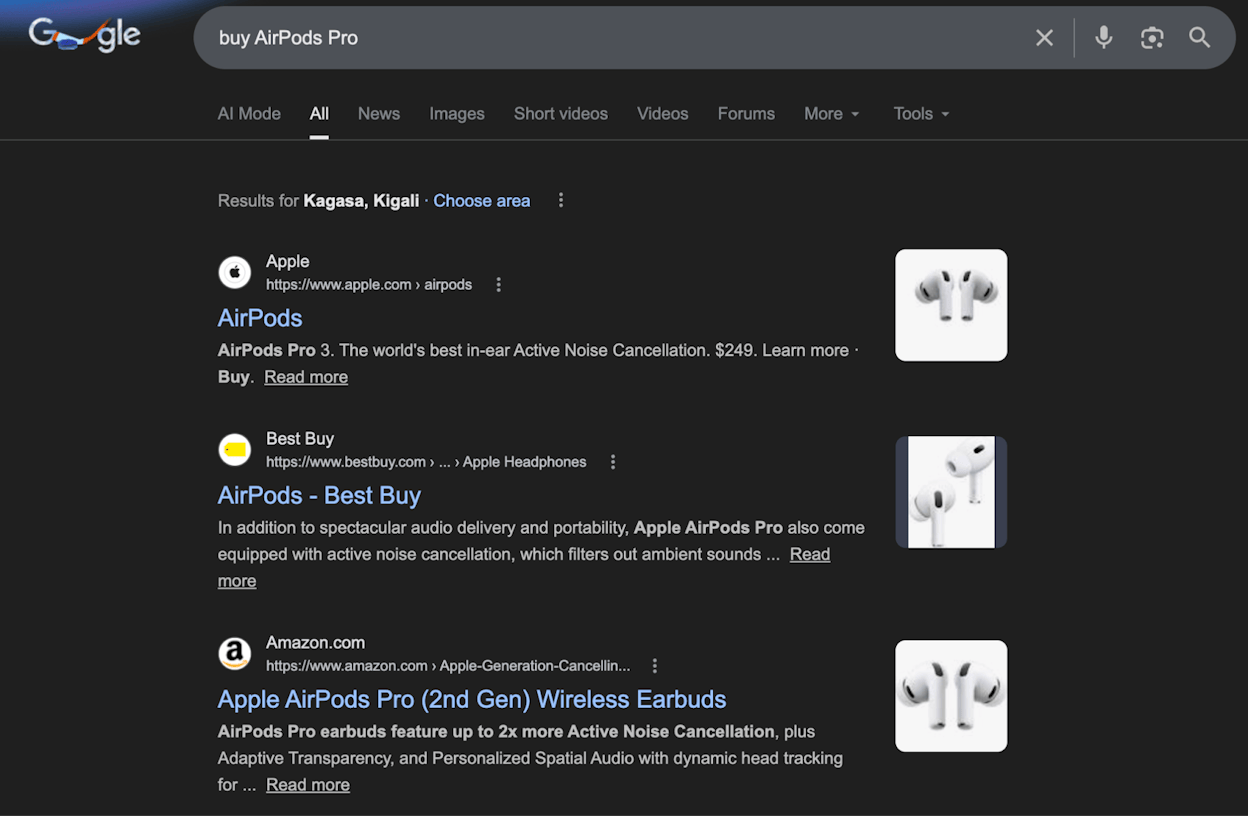
If you try to rank a blog post for a transactional keyword where product pages dominate, you will fail. The content type must match.
Content Format
Within the dominant content type, what format do the top-ranking pages use? For blog posts, common formats include:
-
How-to guides
-
Step-by-step tutorials
-
Listicles (list posts)
-
Comparisons and versus posts
-
Opinion pieces and editorials
-
Reviews
-
Definitions and glossary entries
Search for “email marketing tips” and you will see that listicles dominate. Search for “how to set up Google Analytics” and you will see step-by-step tutorials. Search for “what is a VPN” and you will find definition-style guides.
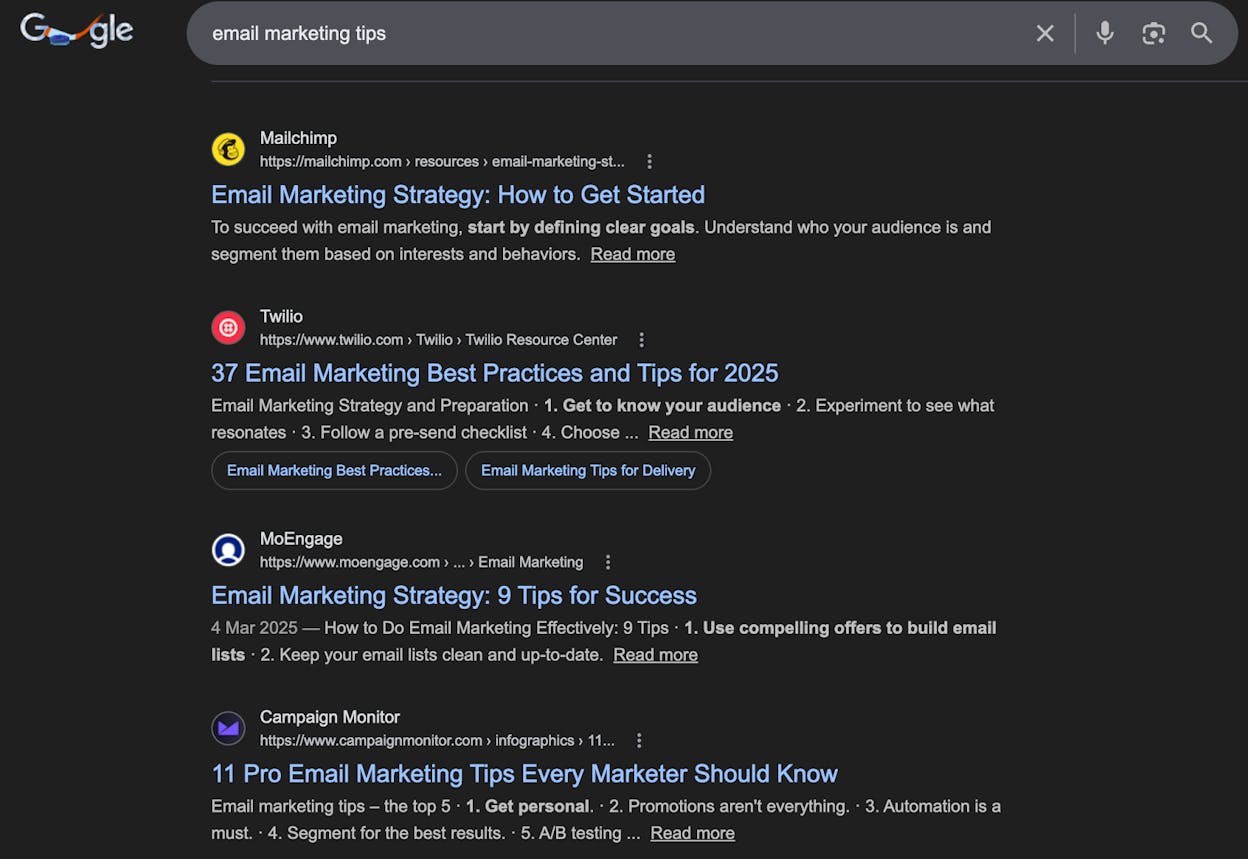
The format tells you how to structure your content. If the top five results are all listicles, publishing a narrative essay will not work.
Content Angle
The content angle is the specific focus, hook, or unique selling point that makes certain pages resonate with searchers. Look at the titles and descriptions of top-ranking results for clues.
For “best air fryer,” many top results include the current year in the title (e.g., “Best Air Fryers of 2026”). This signals that recency matters — searchers want up-to-date recommendations.
For “beginner yoga,” the dominant angle is “for beginners” or “easy.” This tells you that searchers are looking for something approachable, not advanced.
For “CRM software for small business,” the angle is about size and simplicity. Searchers do not want enterprise-grade solutions — they want something built for small teams.
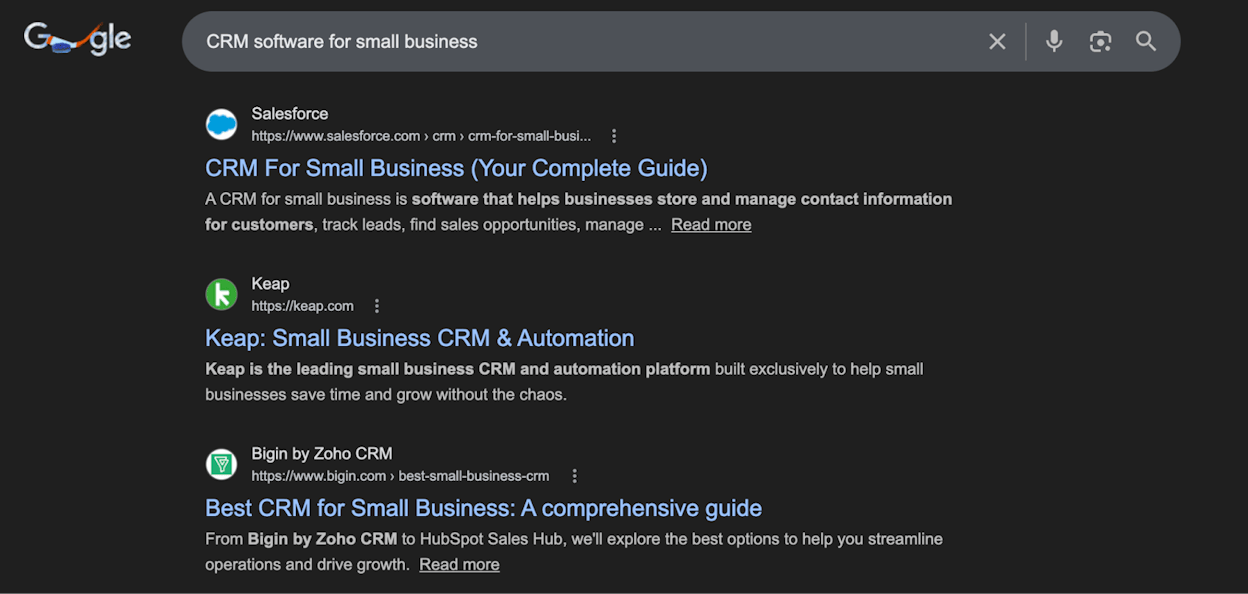
The three Cs together give you a blueprint. Match the content type, format, and angle, and you are off to a strong start.
Step 2. Use Keyword Modifiers to Identify Intent at Scale
When you are doing keyword research across hundreds or thousands of terms, you cannot manually Google every single one. Keyword modifiers give you a fast way to sort keywords by intent.
Here are the most common modifiers by intent type:
|
Intent |
Common Modifiers |
|---|---|
|
Informational |
how, what, why, guide, tutorial, tips, examples, learn, ideas, ways to |
|
Navigational |
[brand name], login, official, website, app, portal |
|
Commercial |
best, top, review, comparison, vs, alternative, pros and cons |
|
Transactional |
buy, price, cheap, deal, discount, coupon, order, purchase, sign up, download |
In any keyword research tool — Ahrefs, Semrush, or even Google’s free Keyword Planner — you can use these modifiers as filters to quickly segment your keyword list by intent.
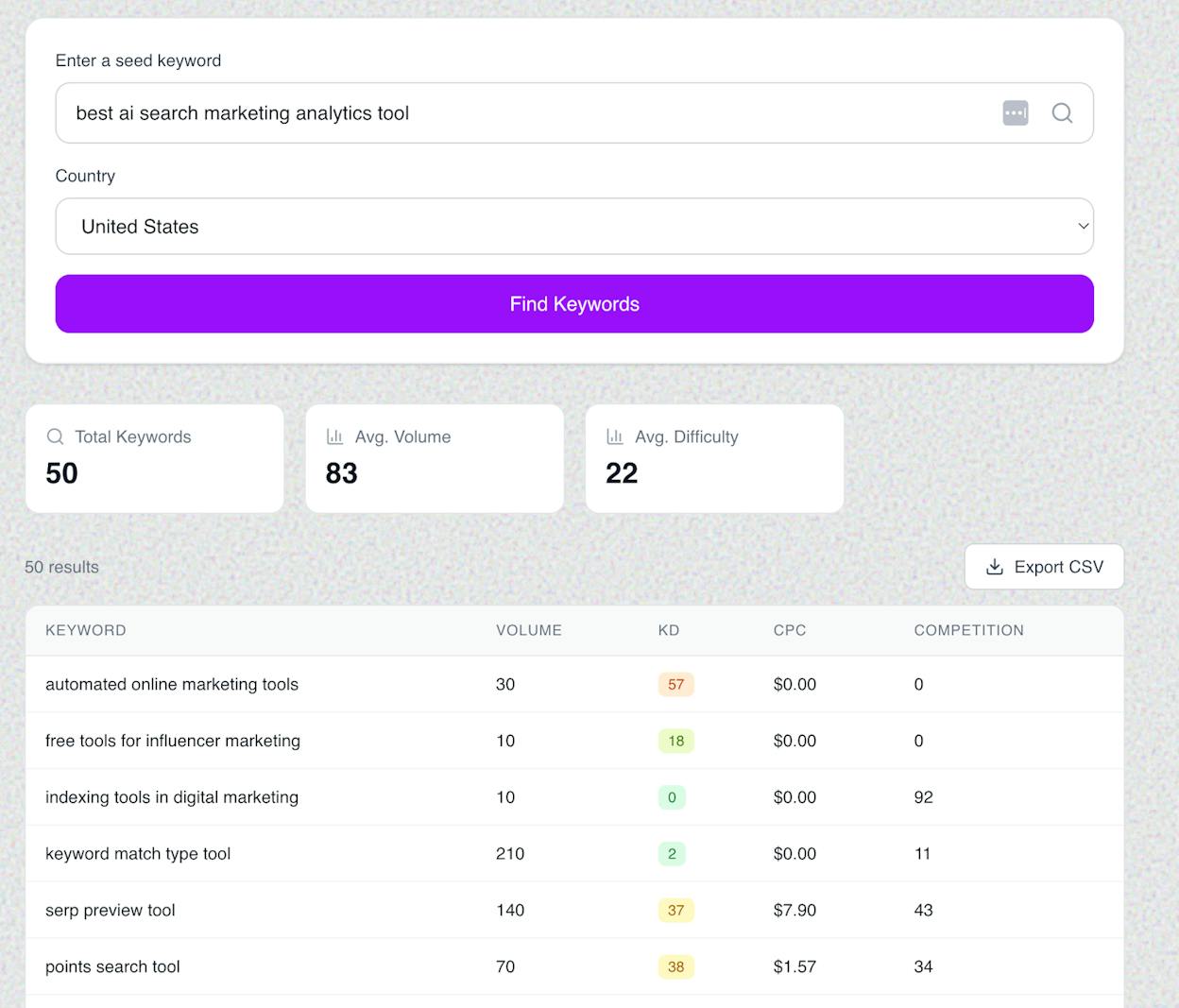
For example, if you are building a content calendar for an SEO tool company, you might filter for “how to” modifiers to surface informational blog post topics, then filter for “best” and “vs” to find commercial comparison opportunities.
A warning about automated intent labels. Tools like Ahrefs and Semrush assign intent labels automatically (informational, commercial, etc.). These labels are generated by pattern-matching algorithms, not SERP analysis. They get it wrong often, especially for keywords with mixed intent, low search volume, or ambiguous phrasing. Use them as a starting point, not gospel. Always verify with a manual SERP check for your highest-priority keywords.
Step 3. Recognize Mixed and Ambiguous Intent
Many keywords do not fit neatly into a single intent category, and this is where most content teams make mistakes.
Take the keyword “best CRM software.” An SEO tool might label it “commercial.” And it is — partially. But when you look at the SERPs, you will find that the top results also include informational elements (what is a CRM, how to choose one), transactional elements (pricing links, free trial CTAs), and even navigational elements (links to specific CRM websites).
This is what mixed intent looks like. The searcher wants to compare, but they also want to learn and potentially buy.
How to handle mixed intent:
-
Lead with the dominant intent. If 8 out of 10 results are comparison listicles, create a comparison listicle. Do not try to reinvent the wheel.
-
Layer in secondary intents. Within your comparison post, include a brief section on what to look for in a CRM (informational) and clear CTAs or links to sign up for the tools you recommend (transactional). This satisfies the full range of what the searcher needs.
-
Look at SERP features. If Google shows a featured snippet with a definition, a People Also Ask box with how-to questions, AND shopping ads, the intent is clearly mixed. Your content should address all of these signals.
Another common scenario is when a keyword’s intent is genuinely ambiguous. The query “mercury” could mean the planet, the element, the car brand, or the musician Freddie Mercury or even the online bank. Google handles this by showing a diverse set of results. For ambiguous keywords like these, you need to pick the intent that matches your content and accept that you are competing for a slice of the SERP, not all of it.
Step 4. Check SERP Volatility to Gauge Intent Stability
Google’s rankings are not static. For some keywords, the top results stay consistent for months or years. For others, the results churn constantly.
Stable SERPs indicate clear, settled search intent. The keyword “how to write a resume” has had the same types of pages ranking at the top for years. The intent is clear: searchers want a step-by-step guide.
Volatile SERPs indicate shifting or unclear intent. The keyword “mercury” has high ranking fluctuations because Google is constantly testing different interpretations of the query.
You can assess SERP volatility using the SERP position history graph in tools like Ahrefs’ Keywords Explorer. Set the filter to “Top 50” and “last 6 months,” then look at how much the lines move.
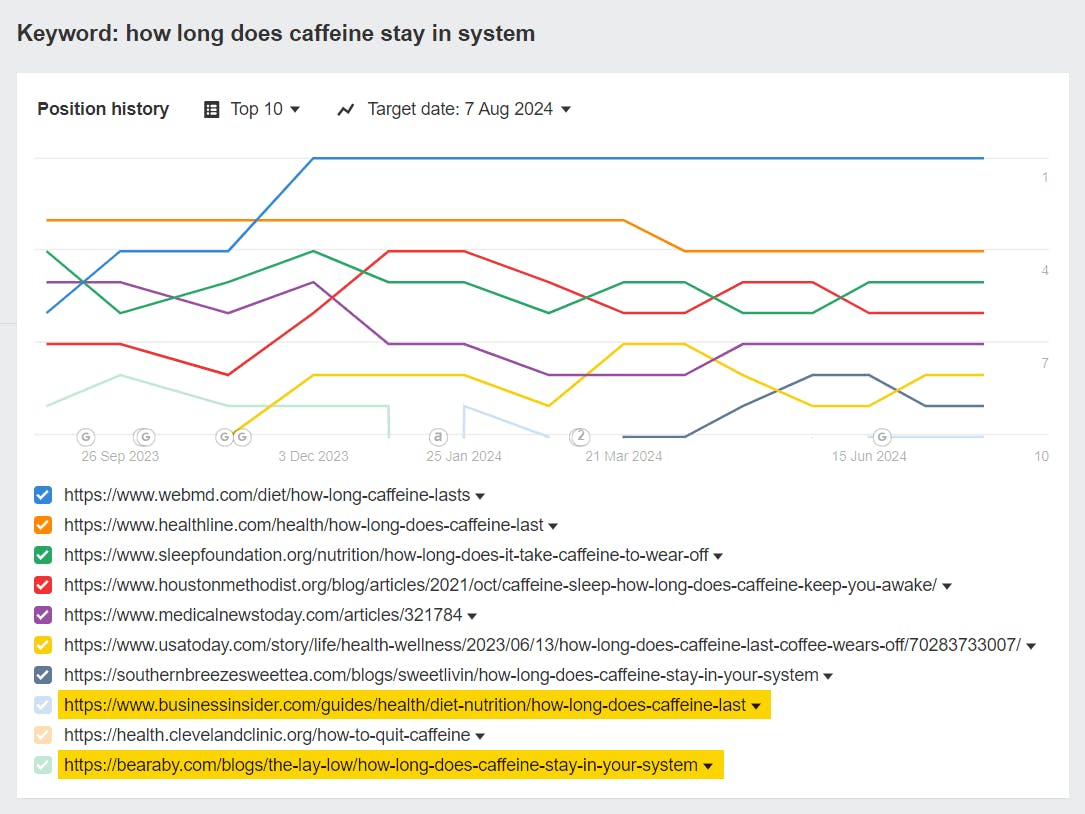
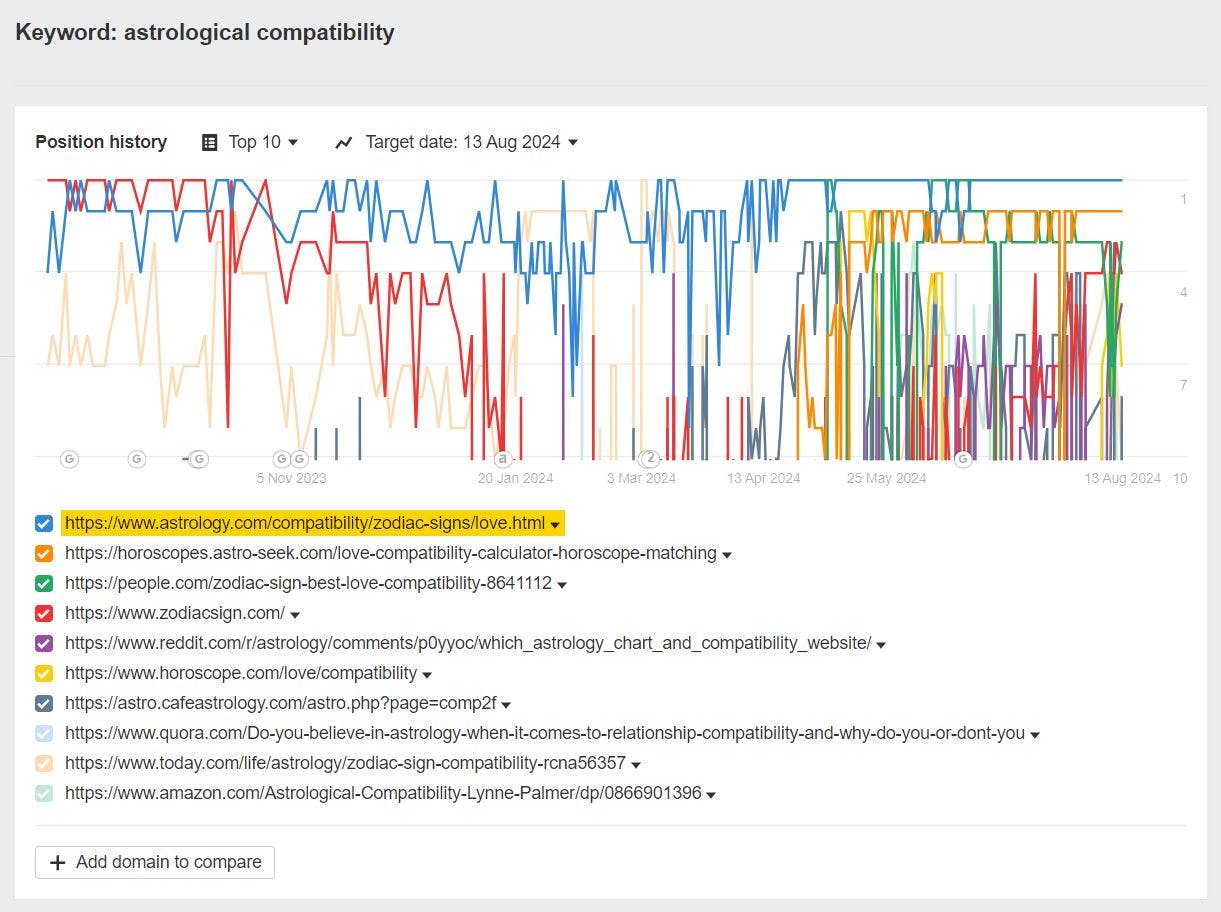
Why this matters for your strategy: Keywords with stable SERPs are safer bets. You can study the top results, match their intent, and have confidence that the landscape will not shift dramatically. Keywords with volatile SERPs carry more risk — the intent may change, and your content could lose rankings as Google re-evaluates what searchers want.
Step 5. Study People Also Ask and Related Searches
Google’s People Also Ask (PAA) box and related searches are direct windows into what else is on the searcher’s mind. They reveal the questions and subtopics that cluster around your target keyword.
For “search intent,” the PAA box might include questions like:
-
What are the 4 types of search intent?
-
How do you determine search intent?
-
Why is search intent important for SEO?
-
What is an example of search intent?
Each of these is a potential subtopic for your content. If you cover them, you are more likely to satisfy the full intent behind the query. If you ignore them, you leave gaps that competitors will fill.
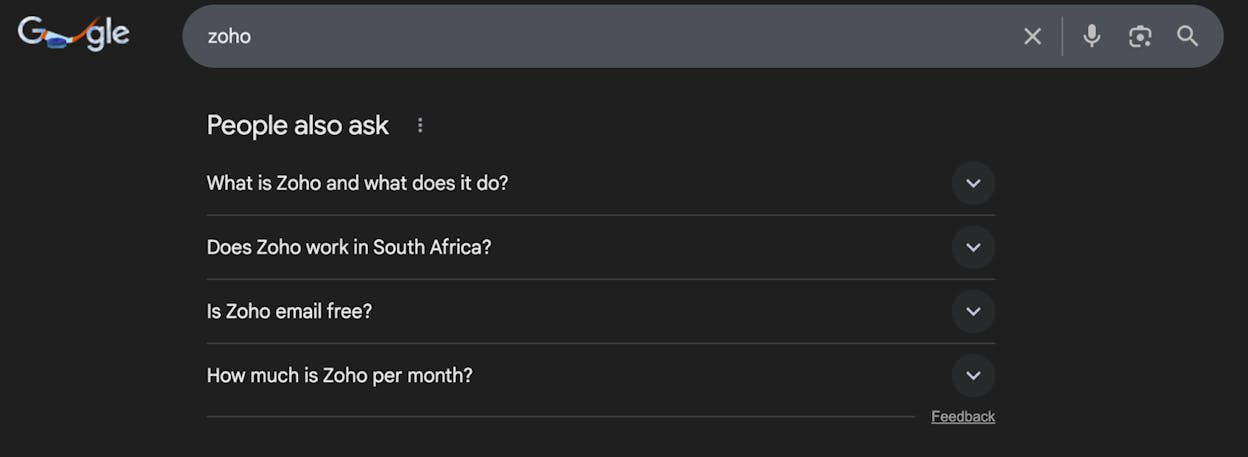
Related searches at the bottom of the SERP work the same way. They show you the queries people commonly type before or after your target keyword, which helps you understand the broader context of what the searcher is trying to accomplish.
For a deeper guide on optimizing for PAA, see our post on People Also Ask: 5 Ways to Optimize & Track PAA in AI Search.
How to Optimize Content for Search Intent
Once you have identified the search intent behind your target keyword, here is how to create content that aligns with it.
Match the Content Type, Format, and Angle
This is the foundation. Based on your three Cs analysis:
-
Create the right type of content. If the SERPs show blog posts, create a blog post. If they show tools, build a tool. If they show product pages, optimize your product page.
-
Use the right format. If listicles dominate, write a listicle. If how-to guides dominate, write a how-to guide. Do not force a format that the SERPs do not support.
-
Adopt the right angle. If recency matters, include the current year. If beginners dominate, write for beginners. If “free” is the dominant angle, offer a free option or emphasize free elements.
This sounds simple, but it is where the majority of ranking failures happen. Many teams create great content that is simply the wrong type, format, or angle for the keyword they are targeting.
Find and Cover Key Subtopics
Matching the three Cs gets you in the game. Covering the right subtopics is what makes your content the best result.
Here are three ways to identify the subtopics your content needs to cover:
1. Manually Review Top-Ranking Pages
Open the top five results for your keyword and read them. Look for common sections, headings, questions answered, and points covered. If four out of five pages include a section on “how to choose the right option,” that is a subtopic you need to address.
Pay special attention to what these pages include that goes beyond the obvious. For example, if you are targeting “best air fryer,” top-ranking pages do not just list products. They organize recommendations by category: best overall, best budget, best for families, best compact. These subcategories are subtopics you need to cover.
2. Run a Content Gap Analysis
A content gap analysis shows you the keywords that your competitors rank for but you do not. At the page level, it reveals the subtopics that top-ranking pages cover.
In Ahrefs, you can do this by opening Keywords Explorer, entering your target keyword, selecting two or three top-ranking pages, and opening them in the Content Gap report. The resulting list of shared keywords reveals the subtopics you should include.
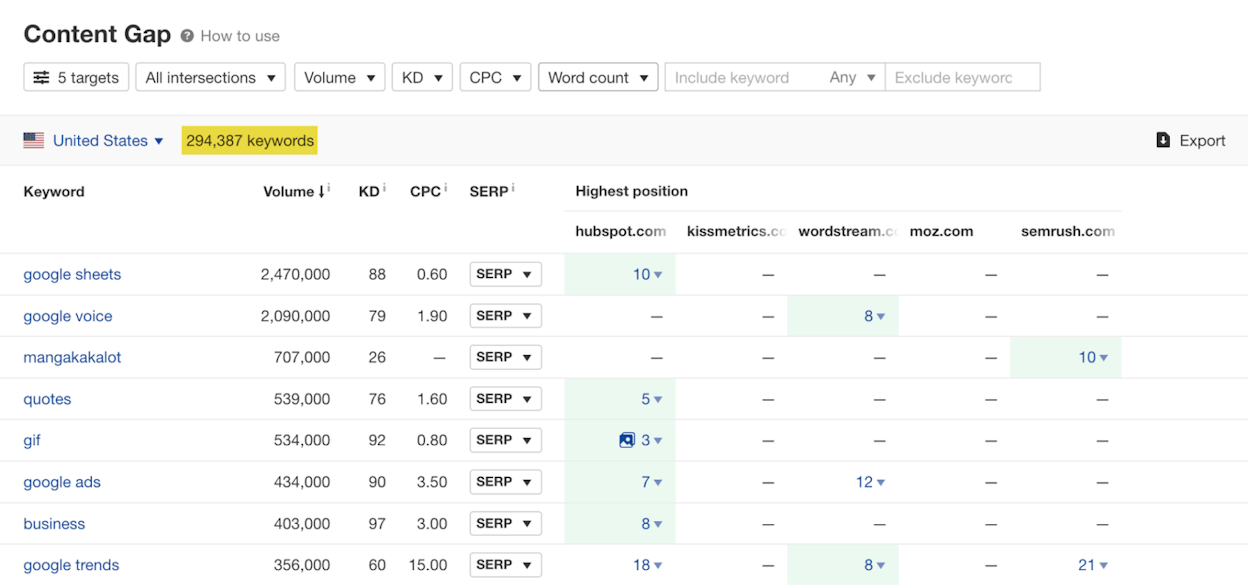
For example, a content gap analysis for “best air fryer” might reveal that top pages also rank for “best budget air fryer,” “best small air fryer,” and “best smart air fryer.” Each of these is a subtopic worth including in your article.
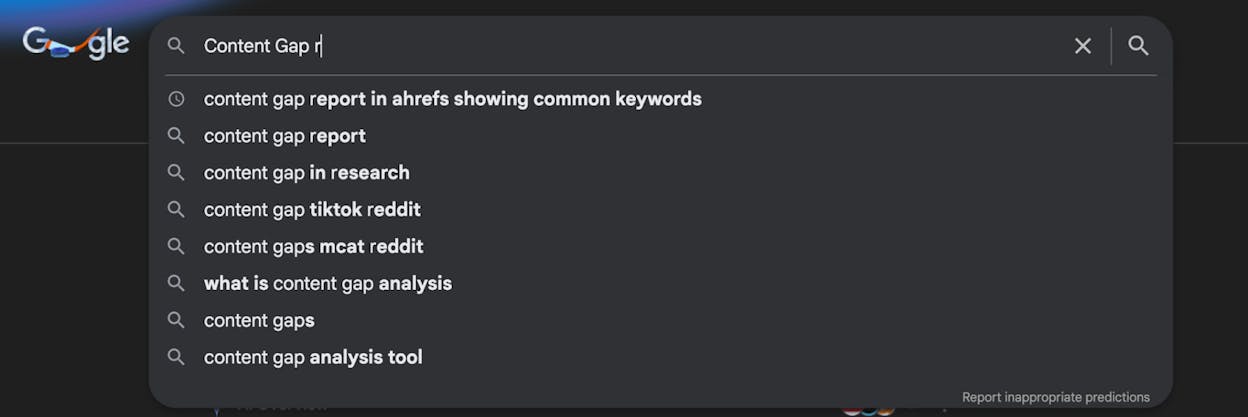
3. Use Google’s People Also Ask and Autocomplete
As mentioned in Step 5 above, the PAA box and autocomplete suggestions are free subtopic research tools.
Type your keyword into Google and note the autocomplete suggestions that appear. Then check the PAA box on the results page. Each suggestion and question is a potential section for your content.
Write for the Intent Behind the Intent
Here is where good content becomes great content.
Most SEO advice stops at “match the search intent.” But the best-performing content goes a step further — it anticipates what the searcher will need next and provides it proactively.
For example, someone searching “best project management tool” is not just looking for a list of names. They want to know which tool fits their specific situation. They might be a freelancer, a startup, or an enterprise team. They might prioritize price, integrations, or ease of use.
The best-ranking pages for this keyword do not just list tools. They include:
-
A quick-pick table at the top so busy readers can jump to the answer
-
Category-specific recommendations (best for small teams, best for Agile, best free option)
-
Brief pros and cons for each tool
-
Pricing information so the reader does not have to visit five different websites
-
A “how to choose” section addressing common decision criteria
This is what “writing for the intent behind the intent” means. You are not just answering the literal query — you are solving the problem that triggered the search in the first place.
Optimize On-Page Elements for Intent Alignment
Once your content is written, make sure your on-page elements reinforce the intent match:
Title tag: Include the keyword and mirror the dominant angle. If the SERPs show “Best [Product] in 2026,” your title should follow the same pattern.
Meta description: Describe what the searcher will find and why it is useful. If the intent is commercial, mention that you compare options. If informational, mention that you explain the topic step by step.
H1 and subheadings: Structure your headings to match the questions and subtopics searchers expect. Use natural phrasing that echoes how people actually search.
Internal links: Link to related content that supports the searcher’s next step. If someone reading your “what is search intent” guide wants to learn keyword research next, link them to your keyword research guide. For more on internal linking, see 10 Internal Linking Tips for SEO Explained.
How Search Intent Works in AI Search (And How to Optimize for It)
Everything we have covered so far applies to traditional search engines like Google. But search is evolving. AI-powered engines like ChatGPT, Perplexity, Claude, Gemini, and Copilot are now a growing source of organic traffic for many brands.
And here is the important part: AI search engines also follow intent logic. When someone asks ChatGPT “what is the best CRM for small businesses,” the model generates an answer with the same goal Google has — to satisfy the intent behind the question. The difference is that AI engines synthesize answers from multiple sources and present them directly, rather than showing a list of links.
This means search intent is now relevant across two organic channels: traditional SEO and AI search.
At Analyze AI, we believe that AI search is not replacing SEO — it is the next evolution of it. Quality content, deep expertise, and clear structure still drive visibility. What is changing is where that visibility needs to be legible — not just to Google’s crawlers, but to language models that synthesize and cite information.
Here is how to extend your search intent strategy to AI search.
Track How AI Engines Respond to Intent-Driven Prompts
In traditional SEO, you analyze SERPs to understand intent. In AI search, you need to analyze how models respond to prompts that match your target keywords.
With Analyze AI, you can track specific prompts across ChatGPT, Perplexity, Claude, Copilot, and Gemini. For each prompt, you can see whether your brand is mentioned, what position you hold, and what competitors appear alongside you.
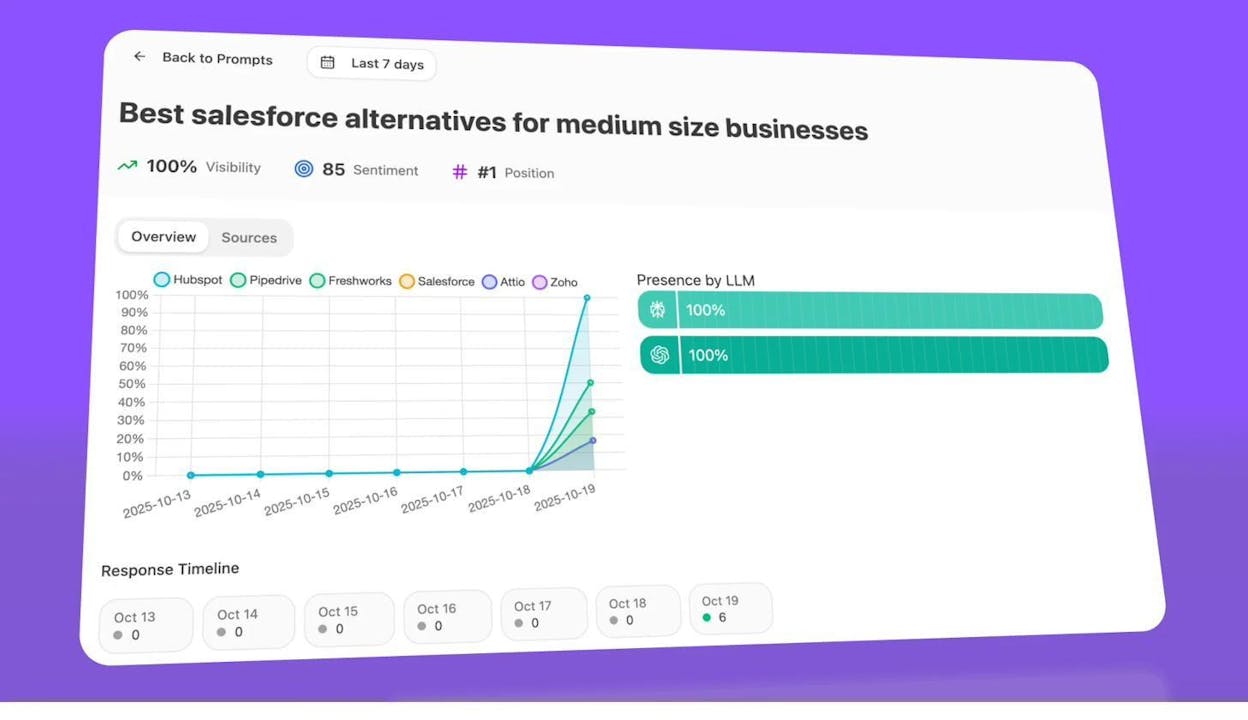
For example, if your target keyword is “best CRM for small businesses,” you would track the equivalent prompt across AI engines. The Prompt Level Analytics dashboard shows your visibility percentage, sentiment score, and position — giving you a clear picture of how well your content aligns with the intent behind that prompt.
Find Opportunities Where Competitors Win and You Do Not
In traditional SEO, a content gap analysis reveals keywords your competitors rank for but you do not. In AI search, the equivalent is finding prompts where competitors get mentioned and your brand is absent.
Analyze AI’s Opportunities dashboard surfaces exactly this. It shows prompts where your competitors appear but you are unmentioned — and the number of times this has occurred.
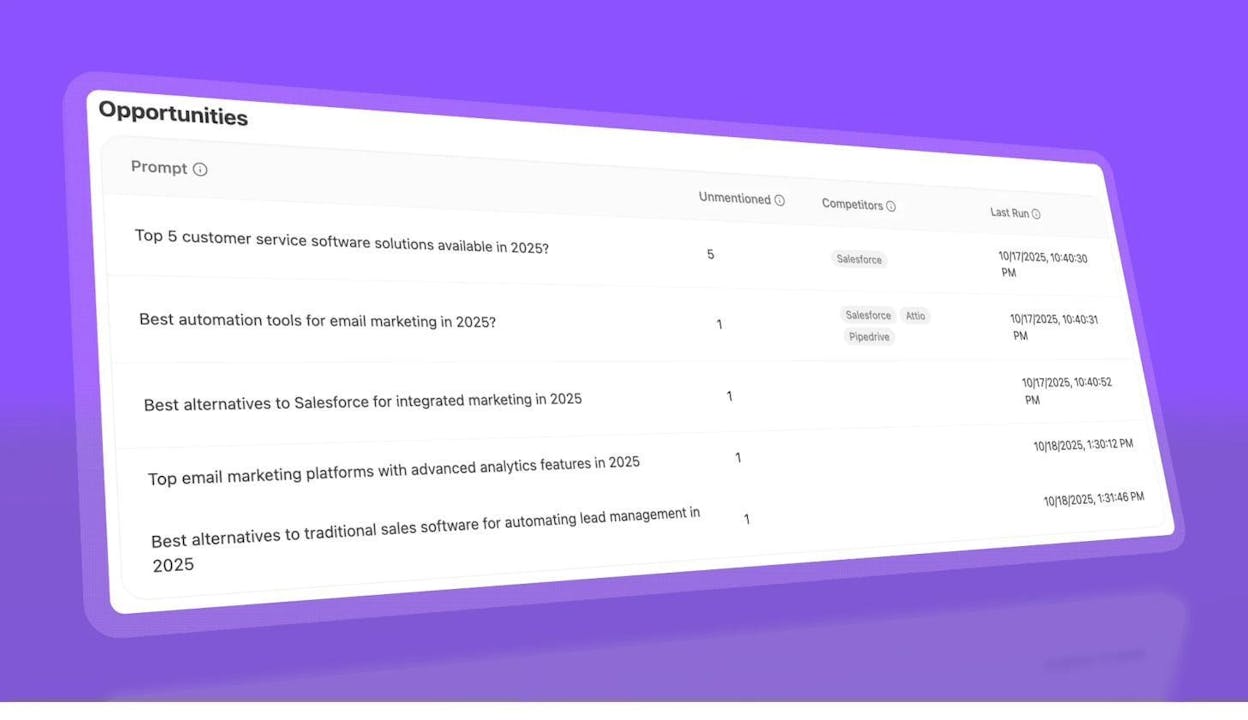
These are your AI search intent gaps. Each one represents a prompt where someone with clear intent (often commercial or informational) is getting answers that include your competitors but not you. Addressing these gaps requires creating or improving content that AI engines can cite when they generate responses to those prompts.
Analyze Which Content Formats Win in AI Search
In Google, you study the SERPs to see what content types and formats rank. In AI search, you can study which of your pages actually receive traffic from AI engines and look for patterns.
Analyze AI’s Landing Pages from AI Search report shows exactly which pages on your site receive traffic from AI-powered engines, broken down by source (ChatGPT, Perplexity, etc.) and sessions.
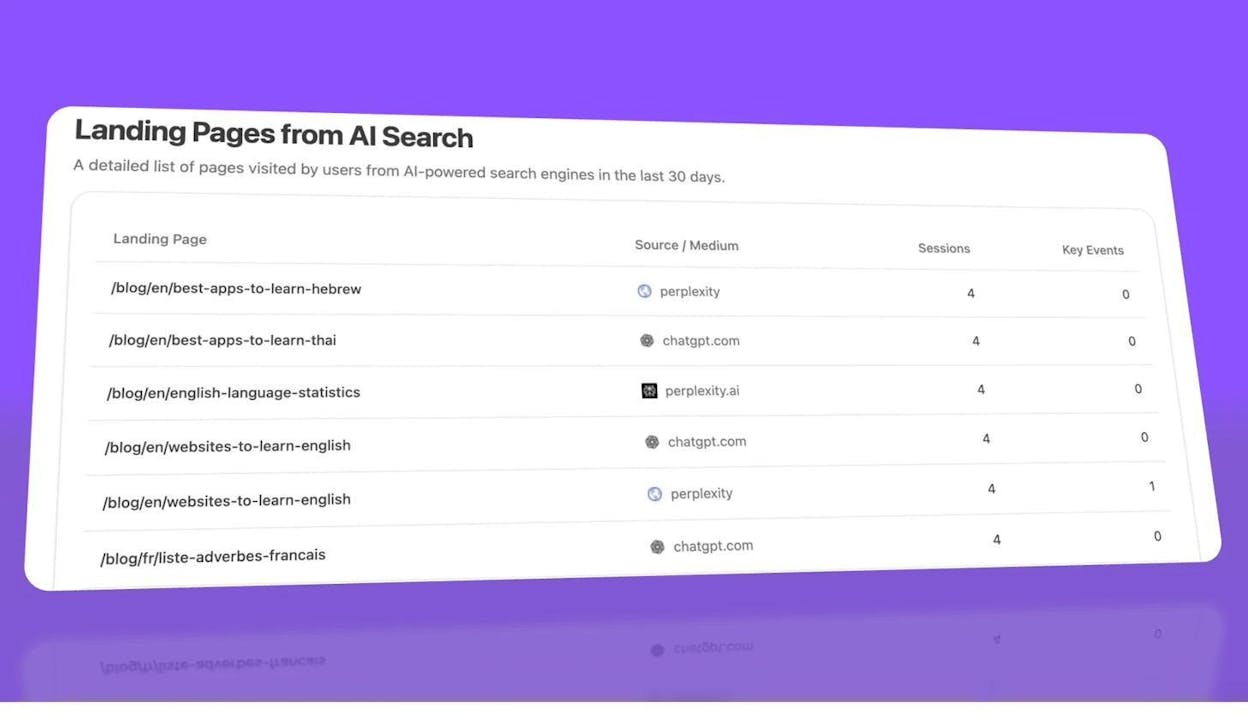
By examining the pages that consistently attract AI traffic, you can identify the content formats, structures, and topics that AI engines prefer to cite. These patterns become your playbook for creating more content that performs well in AI search.
For example, if your “best of” comparison posts receive significantly more AI traffic than your generic informational posts, that is a signal to prioritize the comparison format for commercial intent keywords — not just in Google, but across AI engines as well.
Monitor Competitor Visibility Across AI Engines
In traditional SEO, you track competitor rankings on Google. In AI search, you need to track which competitors show up in AI-generated answers for the prompts that matter to your business.
Analyze AI’s Competitor Overview lets you add competitors and monitor their mentions, frequency, and trends across all tracked prompts.
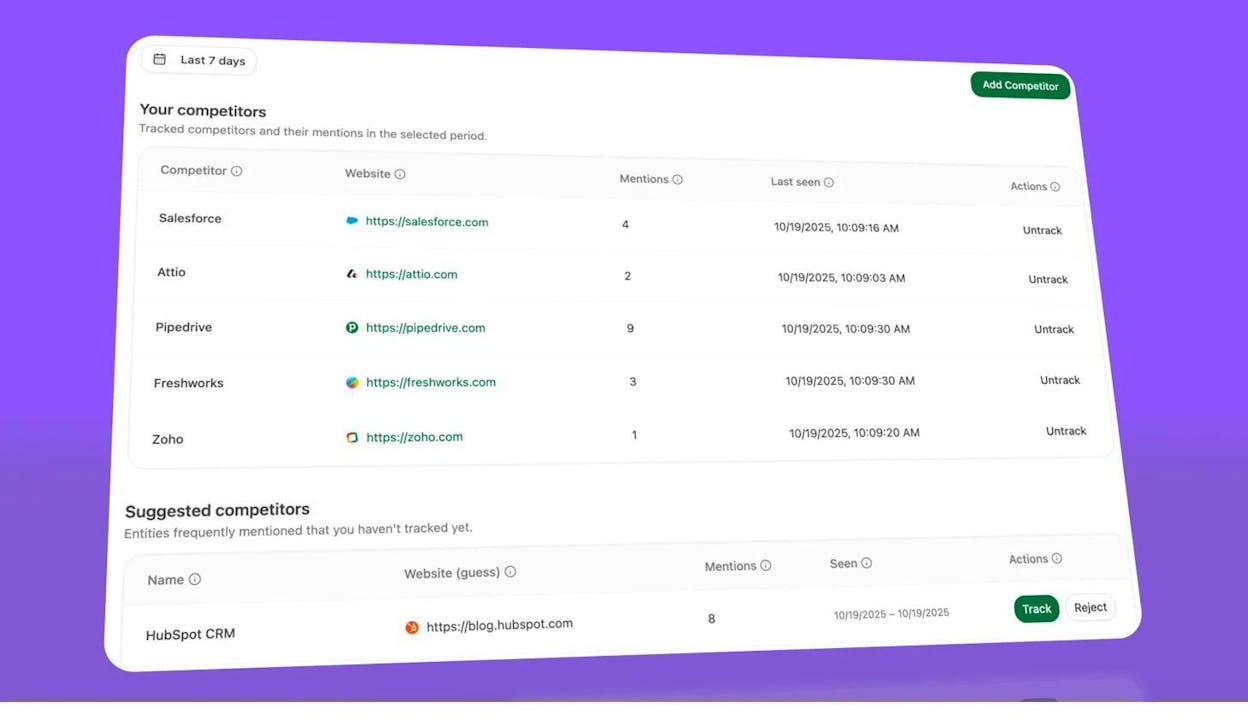
This is the AI equivalent of a SERP competitor analysis. If a competitor is consistently mentioned in AI answers for your key prompts and you are not, that is a signal that they have content, citations, or authority that the models trust more. Use this data to inform your content strategy — study what they are doing differently and build content that is more comprehensive, more cited, and more authoritative.
For a full walkthrough of how to analyze competitors in AI search, check our dedicated guide.
Audit the Sources AI Engines Cite
One of the most powerful ways to optimize for AI search intent is to understand which sources models actually cite in their answers. If you know what content AI engines trust and reference, you can create similar (or better) content.
Analyze AI’s Citation Analytics report shows which URLs and domains get cited across your tracked prompts, along with the total citation count and average citations per prompt.
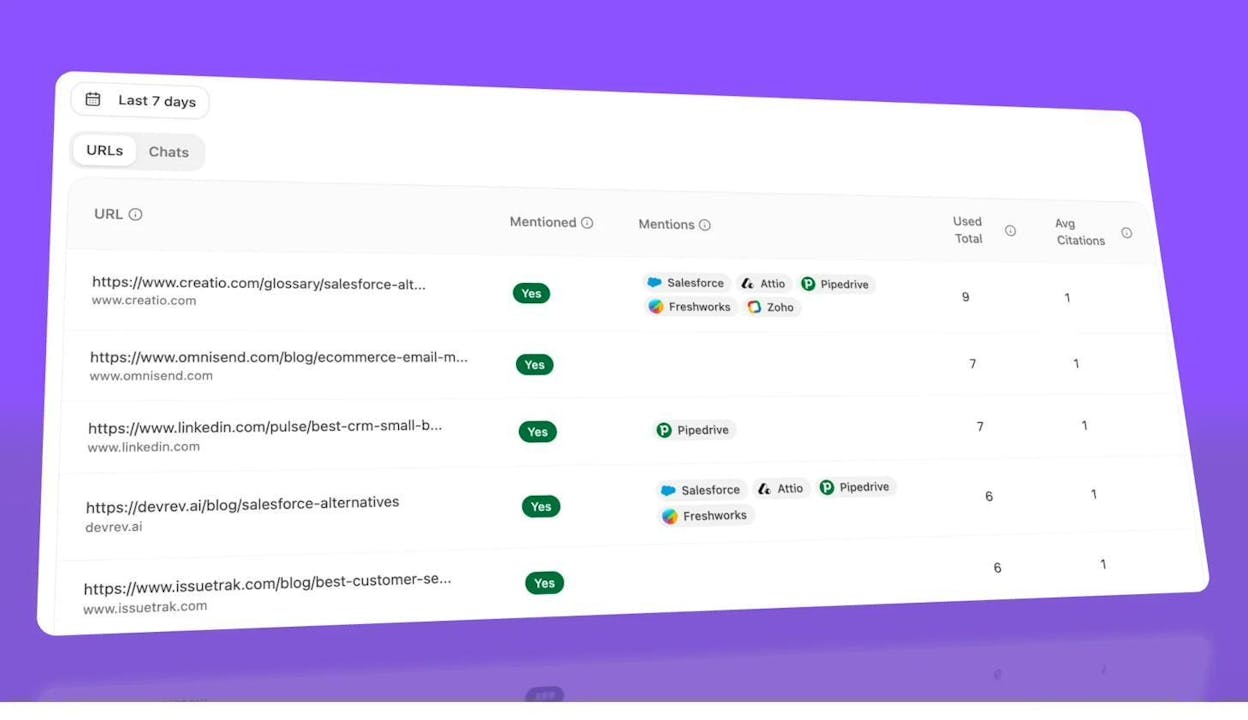
This is actionable intelligence. If a particular blog post on a competitor’s site gets cited repeatedly for prompts related to your business, you know exactly what content to create or improve. The goal is to become the source that AI engines reference when answering intent-driven prompts.
For more on how AI engines choose their sources, see our research on How LLMs Cite Sources: What 83,670 AI Citations Tell Us.
Prove AI Search Intent Strategy With Real Traffic Data
Unlike traditional SERP tracking, AI search optimization needs to be tied back to real traffic and conversions. Otherwise, you are chasing vanity metrics.
Analyze AI connects to your GA4 account and shows total AI referral sessions, trended over time, with breakdowns by engine.
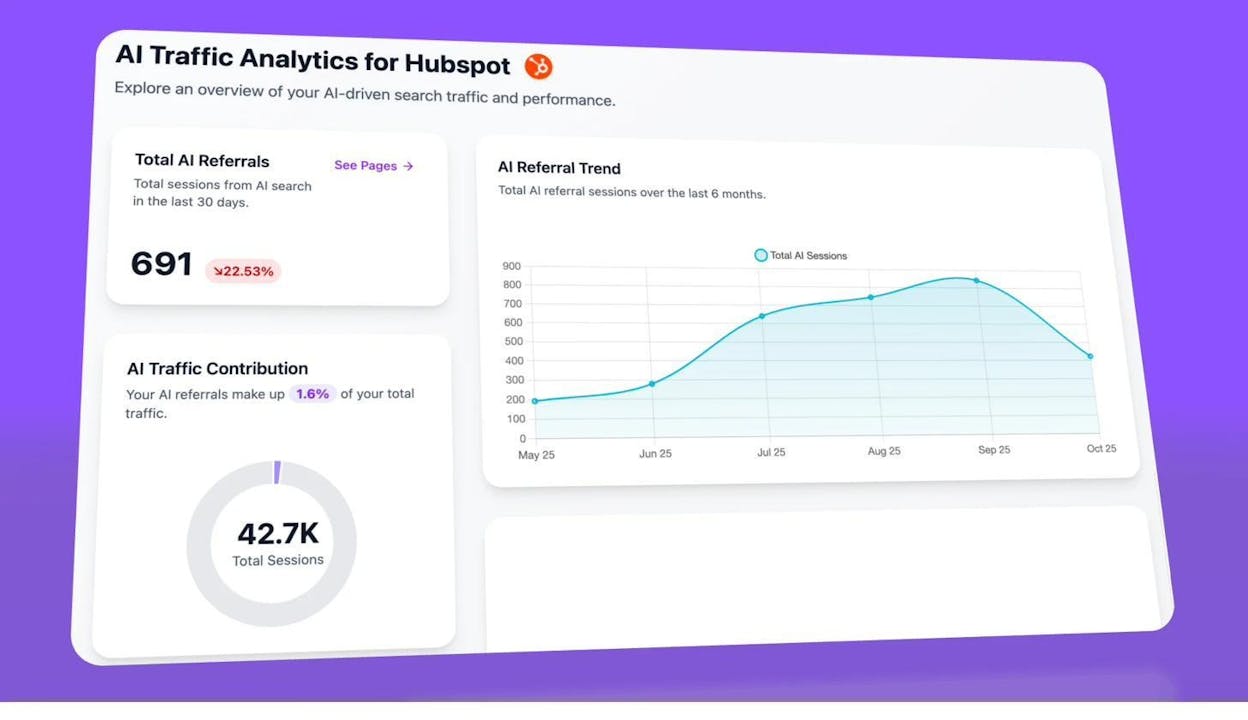
You can also drill down by engine to see which AI platforms are actually sending traffic. This helps you prioritize your optimization efforts — if 70% of your AI traffic comes from Perplexity and ChatGPT, focus your content strategy on the formats and topics those engines prefer.
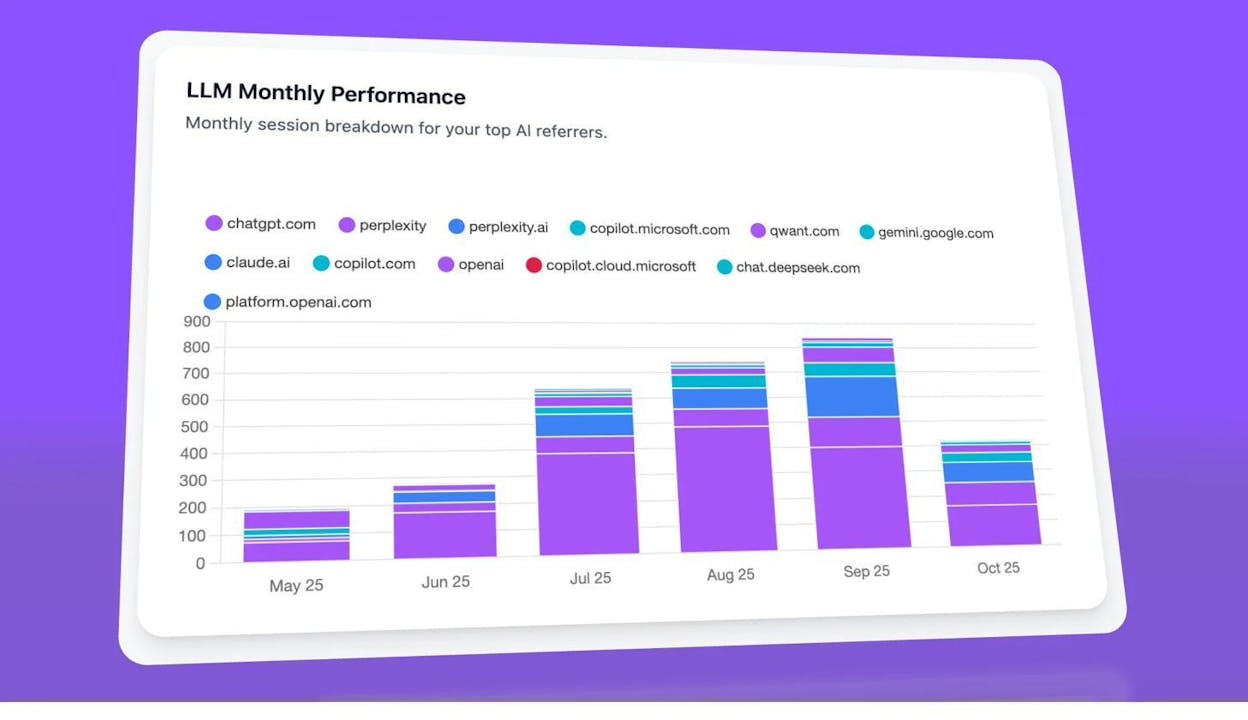
This is the measurement layer that closes the loop. You identify search intent, create content that aligns with it across both Google and AI engines, and then measure the real traffic and conversion impact of your efforts.
Common Search Intent Mistakes (and How to Avoid Them)
After working with hundreds of content teams, here are the most common search intent mistakes we see — and how to fix them.
1. Trusting Automated Intent Labels Without Verification
SEO tools assign intent labels using pattern-matching algorithms. These labels are often wrong, especially for keywords with mixed intent, low search volume, or ambiguous phrasing.
The fix: Use tool labels as a starting point, but always verify high-priority keywords with a manual SERP check. Open Google, look at the top 10 results, and apply the three Cs analysis. It takes two minutes and saves you from building the wrong content.
2. Ignoring Mixed Intent
Many content teams pick one intent label and build content exclusively for that intent. But many valuable keywords have mixed intent. If you only address one dimension, you leave gaps that competitors fill.
The fix: Lead with the dominant intent but layer in secondary intents. If the query is primarily commercial (comparison listicle) but also informational (people want to learn what to look for), include a “how to choose” section. If the query has transactional elements, include CTAs and pricing information.
3. Forcing a Content Type Against SERP Evidence
This happens when companies insist on promoting a product page for a keyword where blog posts dominate, or vice versa. It does not matter how good your product page is — if Google’s SERPs show that searchers want a blog post, your product page will not rank.
The fix: Let the SERPs guide your content type. If blog posts dominate, create a blog post. You can still include product mentions and CTAs within the blog post. If product pages dominate, optimize your product page.
4. Never Revisiting Intent Over Time
Search intent can shift. As markets evolve, new products launch, and user behavior changes, the intent behind a keyword can change too. What worked a year ago may not match current searcher expectations.
The fix: Audit your top-performing content quarterly. Re-check the SERPs for your target keywords and compare them to what you published. If the dominant format has shifted (e.g., from how-to guides to video results), update your content or create new content that matches the current intent.
For guidance on how to systematically refresh your content, see our SEO Content Strategy breakdown.
5. Ignoring Intent in AI Search
Many teams optimize search intent for Google but completely ignore how AI engines handle the same queries. This leaves an entire organic channel unaddressed.
The fix: Extend your search intent analysis to AI search. Track the prompts that mirror your target keywords across ChatGPT, Perplexity, Claude, and other engines. Use tools like Analyze AI to monitor your visibility, find gaps, and measure real AI referral traffic. AI search is not a separate strategy — it is a natural extension of the search intent work you are already doing.
6. Creating Content That Matches Intent But Lacks Depth
Matching the three Cs is necessary but not sufficient. If your content matches the intent but is thinner or less useful than competing pages, you still will not rank. Google rewards the most helpful, comprehensive result — not just the most technically aligned one.
The fix: Once you have matched the type, format, and angle, go further. Add more examples, cover more subtopics, include original data or screenshots, and make your content the most actionable resource on the topic. This is where information gain — the unique value your content adds beyond what already exists — becomes your competitive advantage.
Search Intent and Keyword Research: How They Work Together
Search intent analysis is not a standalone exercise. It is woven directly into the keyword research process.
When you evaluate a keyword, you are always asking two questions: “How many people search for this?” and “What do they expect to find?” The second question is search intent, and it determines whether a keyword is worth targeting.
Here is a practical workflow:
Step 1. Generate a list of keyword ideas using a keyword research tool, Google Autocomplete, People Also Ask, or Analyze AI’s free keyword generator.
Step 2. Filter by intent using keyword modifiers. Separate informational keywords (for blog content) from commercial keywords (for comparison pages) and transactional keywords (for product or landing pages).
Step 3. For your top-priority keywords, run the three Cs analysis to confirm what content type, format, and angle you need.
Step 4. Group related keywords by intent and subtopic using keyword clustering. This helps you plan content that targets multiple related terms with a single page.
Step 5. Check AI search as a parallel channel. Use Analyze AI’s Prompt Suggestion feature to identify the prompts people are asking AI engines about your topic. Track these alongside your Google keywords.
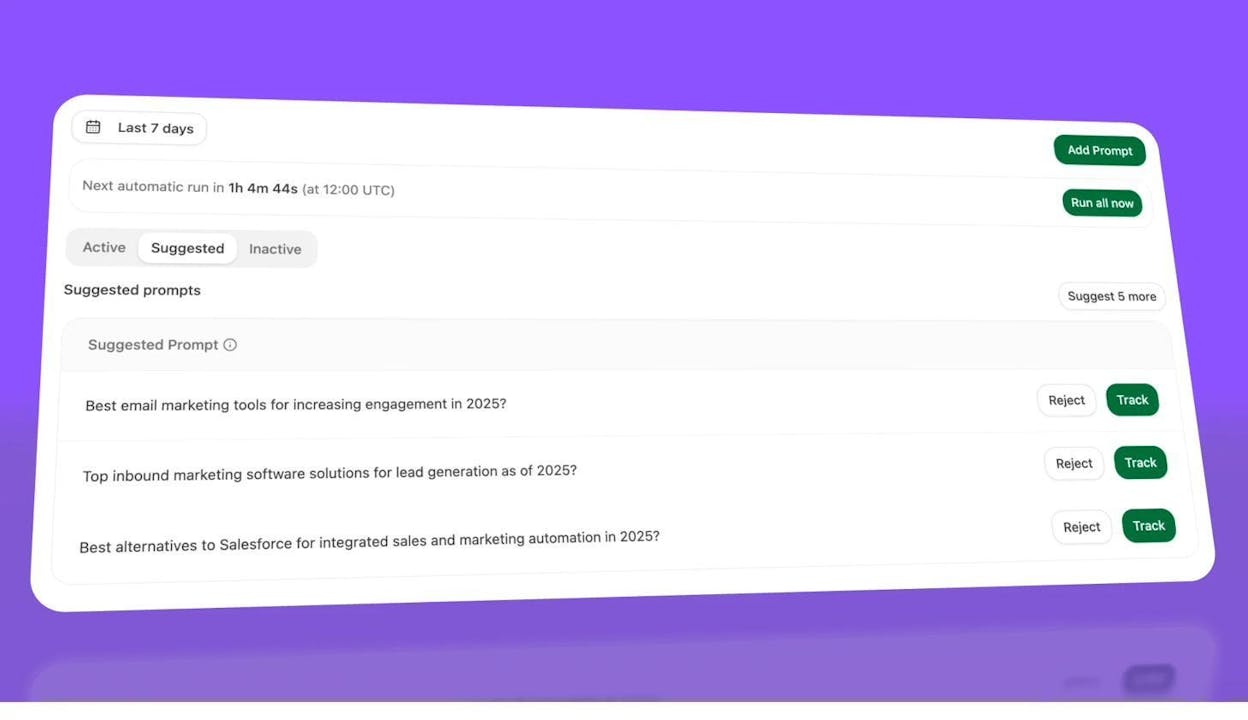
This integrated workflow ensures that every piece of content you create is aligned with search intent from the beginning — across both traditional and AI search.
How to Use Free Tools to Analyze Search Intent
You do not need expensive tools to start analyzing search intent. Here is how to do it with free resources:
-
Google Search. The simplest and most reliable method. Google your keyword, study the top 10 results, and apply the three Cs framework. This is free and gives you the most accurate intent data.
-
Google Autocomplete. Start typing your keyword in Google’s search bar and note the suggestions. These reveal what people commonly search for around your topic.
-
People Also Ask. Check the PAA box on Google’s results page. Each question is a subtopic or related intent.
-
Google Trends. Compare keyword variations to see which version has more search demand. This can help you choose the best phrasing for your target keyword.
-
Analyze AI’s free tools. Use the free keyword generator to find related keywords, the keyword difficulty checker to assess competition, the SERP checker to preview search results, and the keyword rank checker to see where you currently stand.
-
Google Search Console. If you already have a website, GSC shows you which queries bring people to your site and which pages they land on. This data reveals whether your current content aligns with the intent behind the queries it ranks for.
Final Thoughts
Search intent is the foundation of every successful SEO strategy. Get it wrong, and no amount of link building, technical optimization, or content volume will save you. Get it right, and you build a sustainable traffic engine that compounds over time.
The process is straightforward: analyze the SERPs, apply the three Cs framework, cover the right subtopics, and write content that solves the problem behind the search. Do this consistently, and your content will earn the rankings it deserves.
But the landscape is shifting. Traditional search is no longer the only organic channel. AI search engines are growing rapidly, and they follow the same intent logic that Google does. The brands that win in 2026 and beyond will be the ones that optimize search intent across both channels — using the SERPs to guide their Google strategy and tools like Analyze AI to extend that strategy to ChatGPT, Perplexity, Claude, and beyond.
Search intent is not a one-time exercise. It is an ongoing discipline — one that sits at the intersection of keyword research, content strategy, and user empathy. Make it central to everything you publish, and the results will follow.

Ernest

Ibrahim


