



Summarize this blog post with:


In this article, you’ll learn what Domain Rating (DR) is, how it’s calculated, what it’s actually good for, and where it falls short. You’ll also learn how to check any website’s Domain Rating for free, how to use it in real SEO workflows like link prospecting and competitive analysis, and why a high DR alone won’t guarantee rankings—in traditional search or AI-generated answers.
Table of Contents
What Is Domain Rating?
Domain Rating (DR) is a metric developed by Ahrefs that measures the relative strength of a website’s backlink profile on a scale from 0 to 100.
The higher the number, the stronger the backlink profile. A DR of 90 (think Wikipedia or The New York Times) signals a site with an enormous, high-quality link profile. A DR of 10 typically means a newer or smaller site with very few backlinks.
DR is measured on a logarithmic scale. That distinction matters. Moving from DR 20 to DR 30 is far easier than moving from DR 70 to DR 80. Each incremental point at the higher end represents an exponentially larger gap in backlink strength. Think of it like the Richter scale for earthquakes—a magnitude 7 isn’t just a little stronger than a magnitude 6; it’s roughly ten times stronger.
This logarithmic nature is why you’ll see many websites clustered in the 20–40 range, and relatively few above 80.
Domain Rating vs. Domain Authority vs. Authority Score
DR isn’t the only website-level authority metric. Several SEO tools have their own versions:
|
Metric |
Tool |
Scale |
What It Measures |
|---|---|---|---|
|
Domain Rating (DR) |
Ahrefs |
0–100 |
Strength of a site’s backlink profile (link quantity and quality between domains) |
|
Domain Authority (DA) |
Moz |
1–100 |
Likelihood of ranking in search, based on link profile and other factors |
|
Authority Score (AS) |
Semrush |
0–100 |
Composite of link power, organic traffic, and spam signals |
|
Trust Flow (TF) |
Majestic |
0–100 |
Quality of backlinks based on distance from trusted seed sites |
These metrics are all third-party estimates. Google does not use any of them in its ranking algorithm. Google confirmed years ago that it does not use a single “domain authority” score internally, even though its original PageRank patent—which evaluated pages, not domains—is the conceptual ancestor of all these metrics.
Still, they each capture something real. A site with DR 85 almost certainly has a massive, high-quality link profile. The metric doesn’t cause rankings, but it correlates with them because links remain a fundamental ranking signal.
The key difference between these tools is methodology. Ahrefs’ DR focuses exclusively on backlink data. Moz’s DA incorporates machine learning predictions. Semrush blends links with traffic data. You’ll sometimes see the same website score 75 in one tool and 55 in another, which is why comparing DR to DA directly is meaningless. Pick one metric and use it consistently.
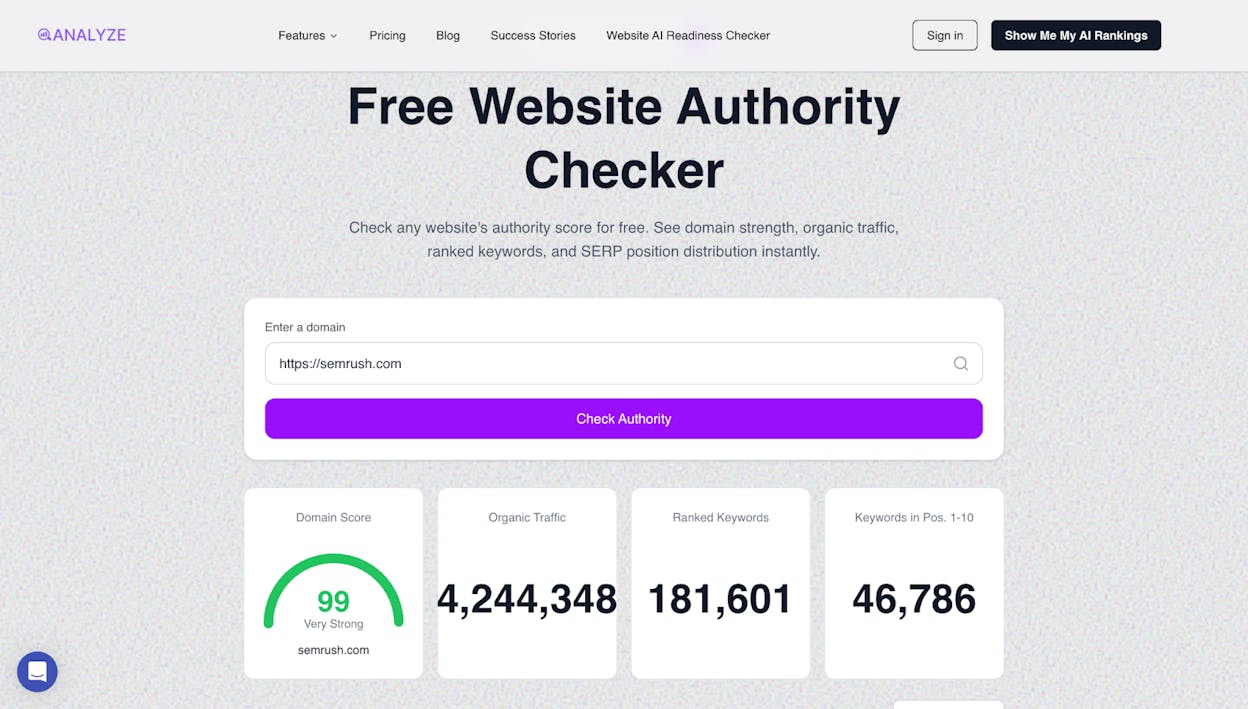
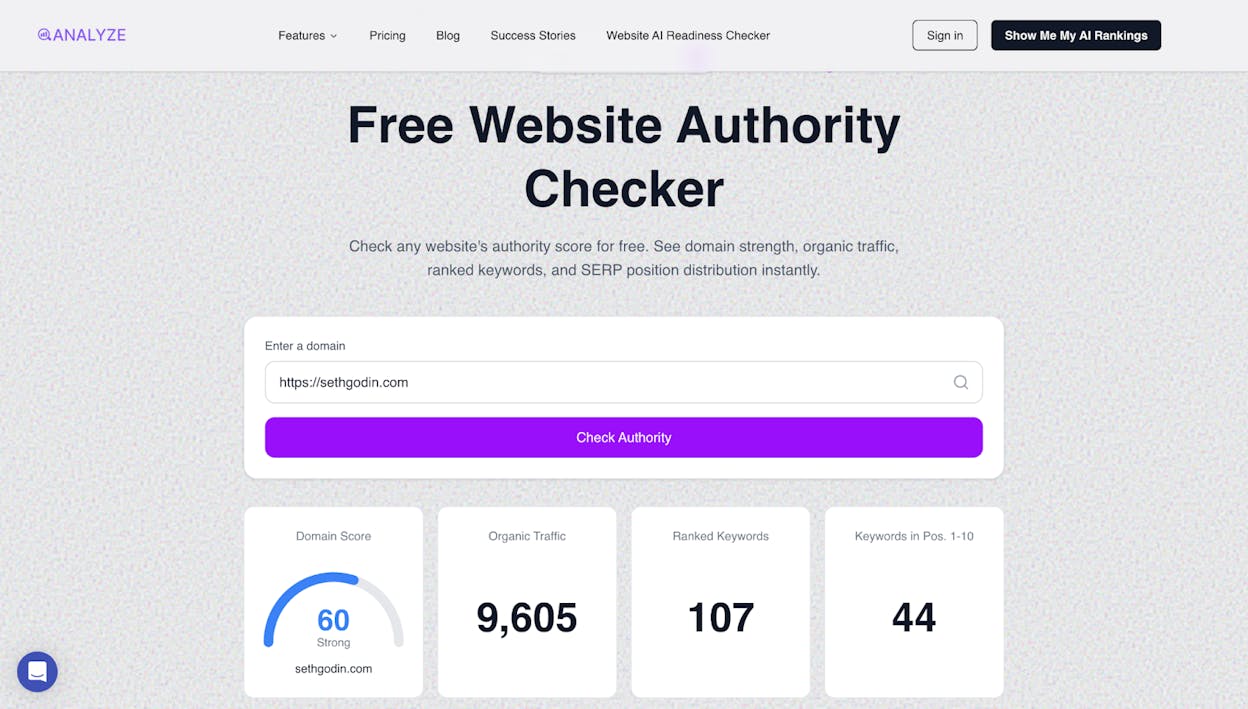
You can check any site’s authority score for free using Analyze AI’s Website Authority Checker.
How Is Domain Rating Calculated?
Ahrefs calculates DR in a way that loosely mirrors how Google’s original PageRank algorithm worked—but at the domain level rather than the page level.
Here is the simplified version of what happens:
Step 1: Ahrefs identifies every domain that has at least one dofollow link pointing to the target website.
Step 2: For each linking domain, Ahrefs checks how many other unique domains that linking site also points to.
Step 3: Each linking domain passes a share of its own DR to the target site. The amount is roughly proportional to the linking domain’s DR divided by how many other domains it links to.
Think of it like a recommendation. If a respected professor writes you a personal reference letter, it carries weight. But if that same professor writes identical letters for 10,000 other people, each letter carries far less weight.
This explains a few practical quirks:
-
Nofollow links don’t count. If a website links to you only with rel="nofollow" tags, it won’t boost your DR.
-
Only the first link matters. If TechCrunch links to you from 50 different articles, your DR only benefits from the first one. The other 49 are redundant for DR purposes (though they may still pass PageRank value at the page level).
-
DR dilutes as sites link out more. If your linking domain starts linking to hundreds of new sites, the “DR juice” it passes to each one—including you—shrinks over time.
-
DR can drop even if you don’t lose links. Because DR is relative, other websites gaining links can push yours down. If the entire web gets stronger, your relative position shifts.
-
DR can rise without you doing anything. If a domain that links to you acquires more backlinks and grows its own DR, it passes more value to you.
What DR Does Not Factor In
This is just as important as what it measures:
-
Search traffic. A website could get millions of visitors and still have a low DR if it doesn’t have many backlinks.
-
Domain age. An old domain with few links will have low DR. A new domain with many high-quality links can have high DR.
-
Content quality. DR doesn’t evaluate what’s on the page. It only looks at link signals.
-
Brand reputation. A widely recognized brand with poor link-building practices might have a surprisingly low DR.
-
Spam detection (partially). While Ahrefs has improved its filtering of artificial link manipulation, large amounts of low-quality links can still temporarily inflate DR.
This is why DR should never be treated as a single measure of a website’s “quality” or “trustworthiness.” It measures one dimension—link popularity—and nothing else.
How to Check Domain Rating
Checking DR is straightforward. Here are the most common methods:
Method 1: Ahrefs Site Explorer (Most Accurate)
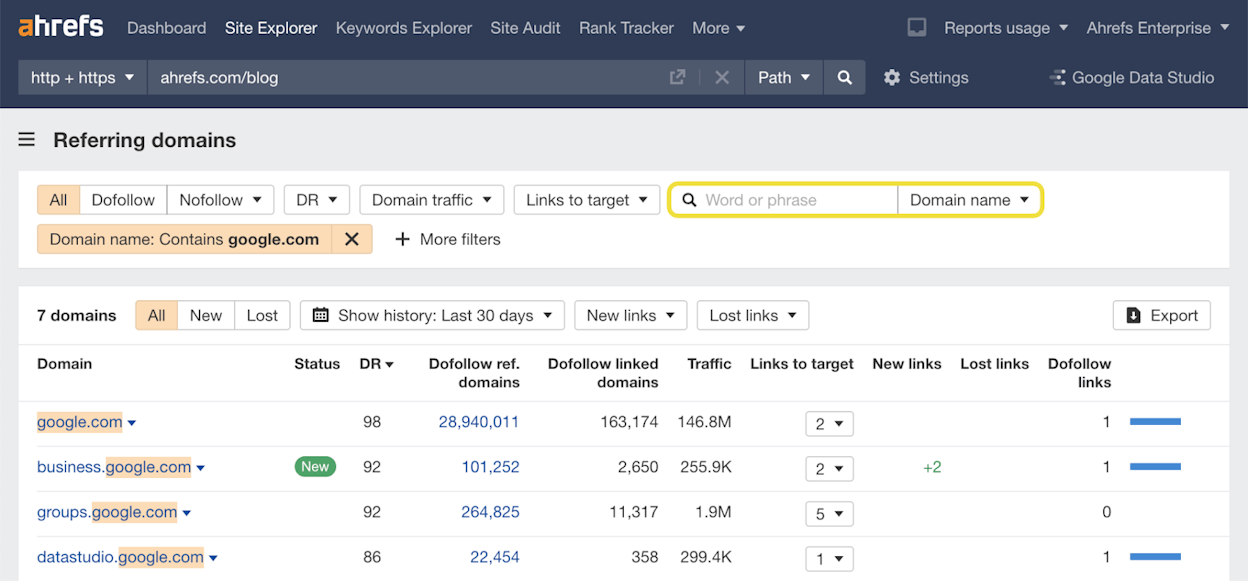
Enter any domain into Ahrefs’ Site Explorer, and you’ll see the DR score at the top of the overview report alongside other metrics like referring domains, organic traffic, and backlinks.
This is the most reliable method because DR is Ahrefs’ own metric, calculated from their own link index.
Method 2: Free Website Authority Checkers
If you don’t have an Ahrefs subscription, several tools provide authority scores for free:
-
Analyze AI Website Authority Checker – Check domain authority scores instantly
-
Ahrefs’ free Website Authority Checker – Provides DR alongside basic backlink data
-
Moz’s free Domain Analysis tool – Shows DA (their equivalent metric)
Method 3: Bulk Checking with SEO Tools
When you need to check DR for hundreds of domains at once—during link prospecting, for example—you can export a list and run it through Ahrefs’ batch analysis tool. Most enterprise SEO tools offer similar batch-check features.
Method 4: Browser Extensions
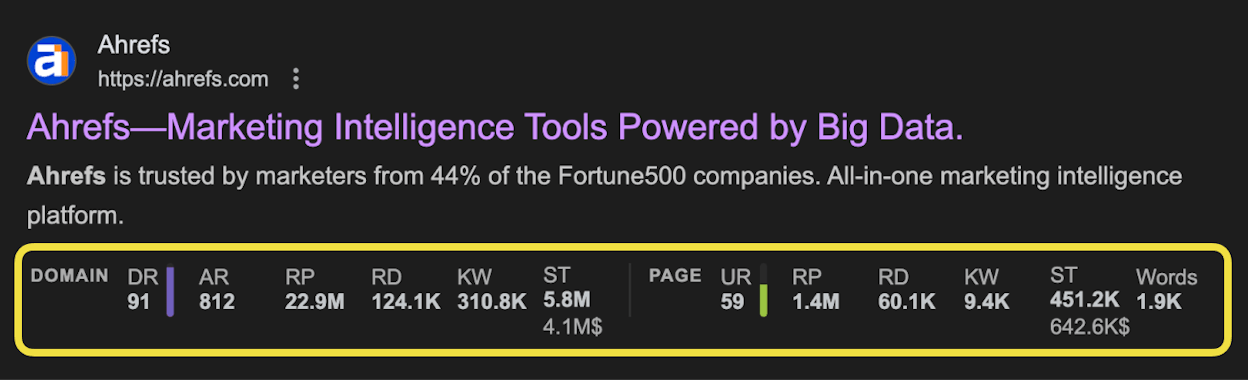
Ahrefs’ SEO Toolbar and Moz’s MozBar both display authority metrics directly in your browser as you visit websites or scan search results. This makes quick-glance comparisons easy during manual research.
Is Domain Rating Important for SEO?
Yes and no. It depends entirely on how you use it.
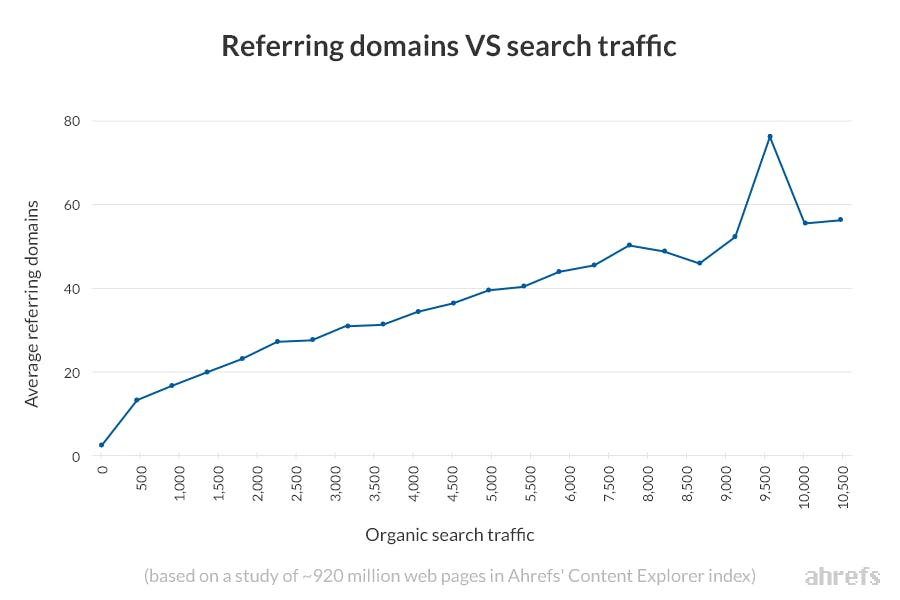
DR correlates strongly with search visibility. A study by Ahrefs found a clear positive relationship between Domain Rating and organic search traffic. Sites with higher DR tend to rank for more keywords and attract more traffic.
But correlation is not causation. Google doesn’t look at Ahrefs’ DR score (or Moz’s DA, or Semrush’s AS) when deciding what to rank. What Google does look at—among hundreds of other signals—is the backlink profile that DR attempts to measure.
Here’s the practical takeaway: You should not try to “increase your DR” as a goal. Instead, focus on producing genuinely useful content and earning high-quality backlinks to that content. Your DR will grow naturally as a byproduct.
Chasing DR directly leads to bad decisions. Teams that obsess over the number often waste money on low-quality link schemes, PBN links, or irrelevant guest posts that inflate the score without improving actual rankings. Some black-hat SEOs have historically exploited Ahrefs’ DR calculation to artificially inflate scores and sell overpriced links from high-DR domains that provide zero real value.
5 Practical Use Cases for Domain Rating
The metric becomes useful when you treat it as a filtering and comparison tool, not an end goal. More on its specific use cases below.
1. Gauging Competitive Ranking Potential
DR gives you a rough sense of whether you’re in the same “weight class” as a competitor.
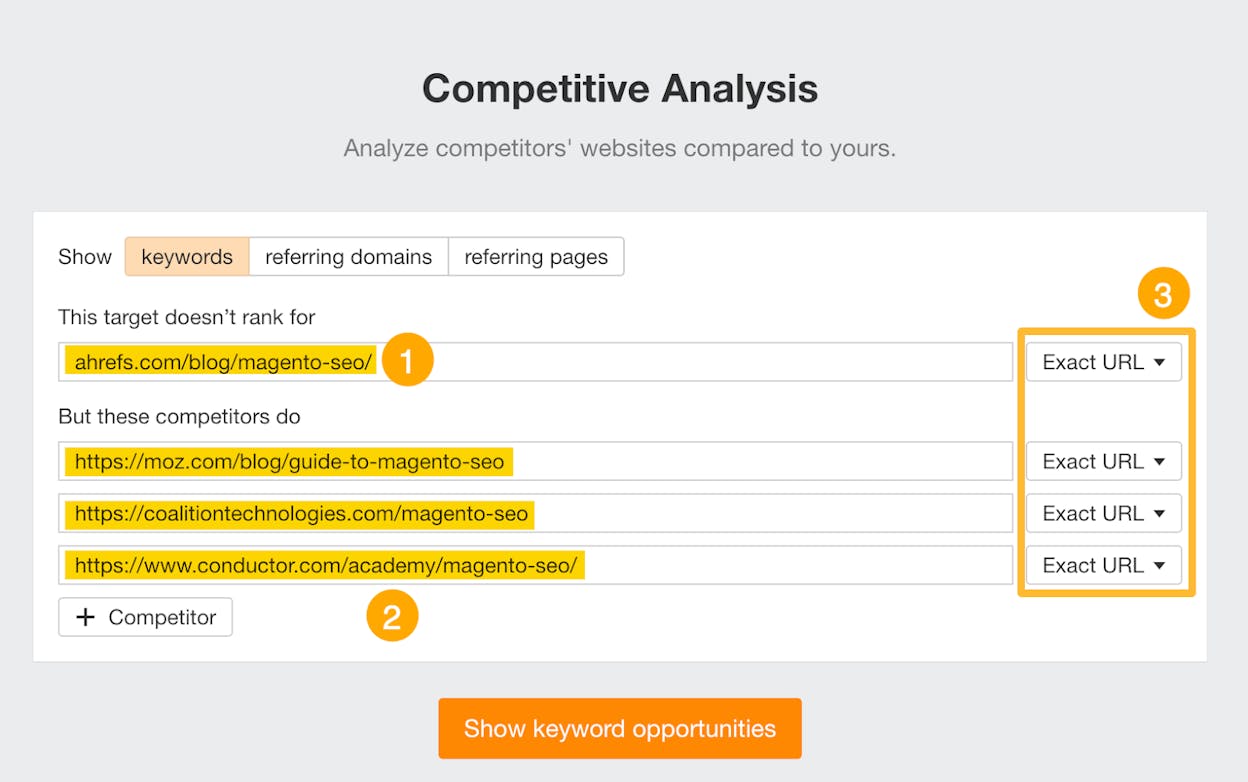
If your site has a DR of 35 and a competitor has a DR of 38, you’re in a similar league. You can study their top-performing content, identify keywords they rank for, and realistically pursue the same topics. Tools like Ahrefs’ Content Gap or Semrush’s Keyword Gap let you find exactly which keywords a competitor ranks for that you don’t.
But if your DR is 25 and a competitor’s DR is 80, targeting the same high-difficulty keywords would likely be a poor use of resources. You’d be better off finding lower-competition keyword opportunities that match your current authority level.
This doesn’t mean lower-DR sites can never outrank higher-DR sites. They can and frequently do—especially when the lower-DR site has stronger page-level signals (better content, more relevant backlinks to that specific page, stronger topical authority). But at scale, the site with the stronger domain-level link profile has a systematic advantage.
2. Prioritizing Link Prospects
When you’re running a link-building campaign and you have a list of 200 potential prospects, DR helps you triage that list.
A link from a DR 75 publication in your niche will almost always pass more value than a link from a DR 12 personal blog. That doesn’t mean you should ignore the DR 12 site—relevance matters too—but when you’re allocating limited outreach time, DR helps you prioritize.
The sweet spot is usually relevance first, DR second. A DR 30 site that’s deeply relevant to your niche is often more valuable than a DR 70 site that has nothing to do with your topic. But among equally relevant prospects, the higher-DR site usually offers more link equity.
3. Evaluating Potential Partners and Collaboration Opportunities
If someone pitches you on a guest post exchange, a co-marketing webinar, or a link swap, DR gives you a quick signal of that site’s link strength.
A few red flags to watch for:
-
Unusually high DR with very low traffic. This can indicate an artificially inflated DR through link spam or PBN manipulation.
-
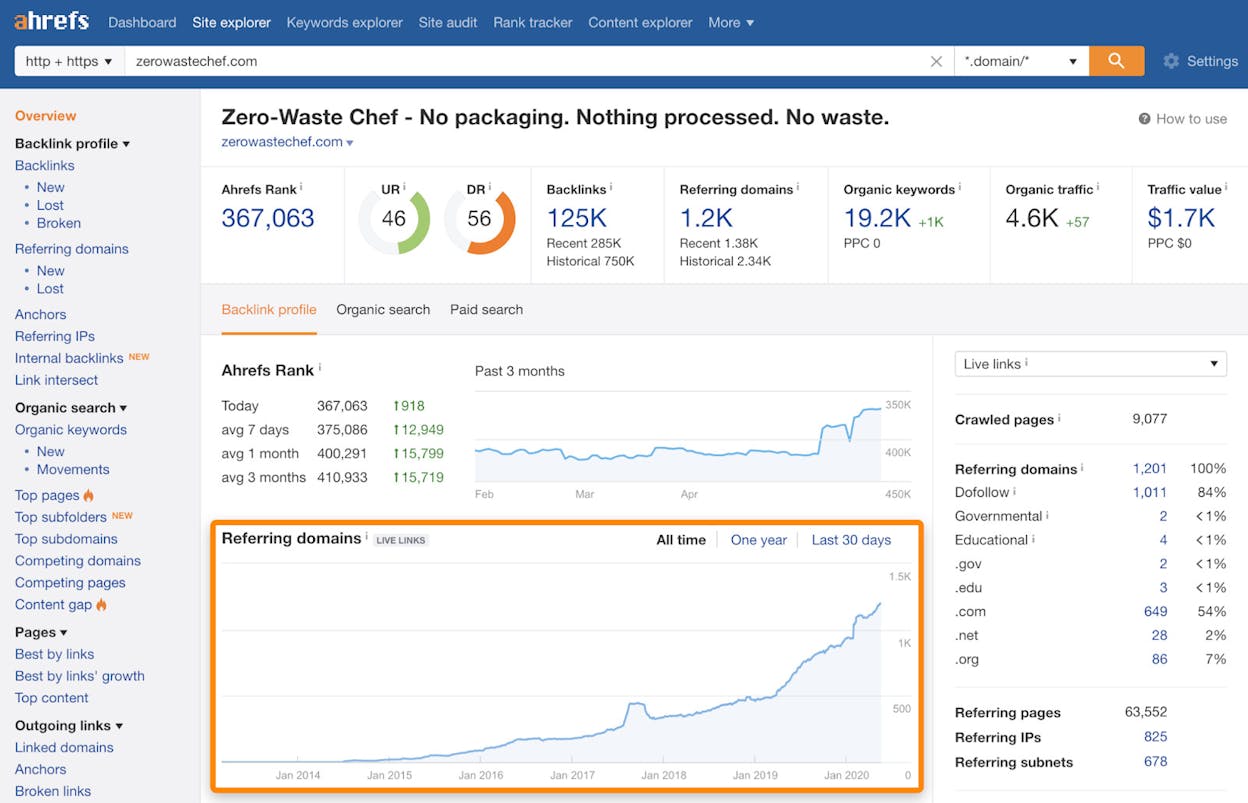
DR that has spiked sharply. A sudden jump often signals a link scheme rather than organic growth. Check the “Referring domains” graph over time to see if growth looks natural or suspicious.
-
High DR with a very thin backlink profile. If a site claims DR 60 but only has links from 50 referring domains, something doesn’t add up.
4. Benchmarking Your Own Progress
Tracking your DR over time gives you a broad-stroke picture of whether your off-page SEO efforts are working. If you’ve been consistently earning links for six months and your DR hasn’t budged, something may be off with your strategy—either the links aren’t high enough quality, or you’re losing links at the same rate you’re gaining them.
You can set up monthly benchmarks alongside other metrics like referring domains, organic keywords, and traffic to get a fuller picture.
5. Qualifying Websites for Content Syndication or Advertising
If you’re paying for sponsored content, choosing syndication partners, or evaluating display ad placements, DR serves as a quick quality filter. A website with DR 55 and decent traffic is likely a real publication with a real audience, whereas a DR 3 site with 100 monthly visitors is probably not worth your advertising budget.
How Domain Rating Applies to AI Search Visibility
Domain Rating was designed for traditional SEO—measuring how link equity flows between websites. But as search increasingly includes AI-generated answers from ChatGPT, Perplexity, Claude, Google AI Mode, and Gemini, the question becomes: does DR matter in AI search too?
The short answer: indirectly, yes. But the relationship is different.
Why High-DR Sites Appear More Often in AI Answers
When Analyze AI studied 83,670 citations across major AI engines, a pattern emerged: AI models disproportionately cite sources from high-authority domains. This makes intuitive sense. LLMs are trained on web data, and the training process inherently gives more weight to frequently referenced, well-linked content. When models retrieve sources during inference (as Perplexity and ChatGPT with browsing do), they tend to pull from the same authoritative sources that rank well in traditional search.
So while there’s no direct “DR check” happening inside an AI model, the underlying signals that produce a high DR—widespread linking, frequent citation by other authoritative sites—are the same signals that make content more likely to appear in AI-generated responses.
Where DR Falls Short in AI Search
But DR alone tells you nothing about whether AI models actually recommend your brand, cite your content, or represent you accurately. A site with DR 80 might never appear in AI answers for its core topics if the content isn’t structured in a way that LLMs can parse and cite.
This is where AI search analytics becomes essential. Instead of guessing whether your authority translates into AI visibility, you can measure it directly.
With Analyze AI, you can:
-
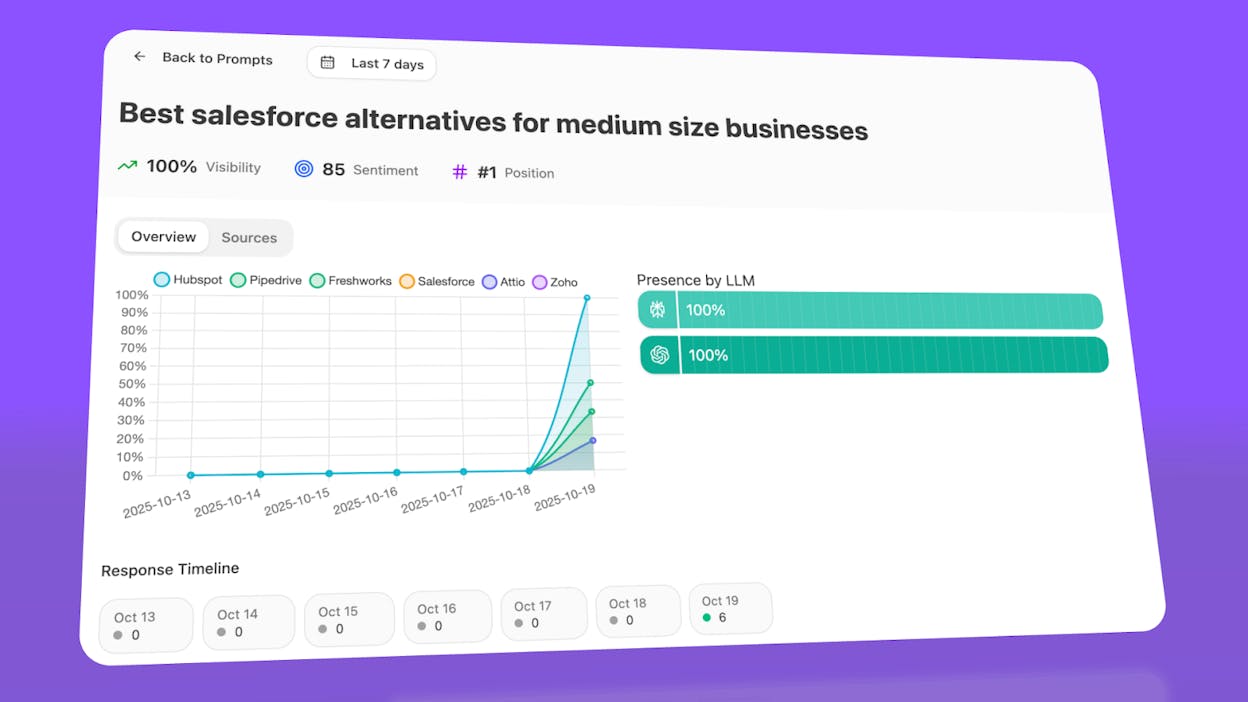
Track which prompts mention your brand across ChatGPT, Perplexity, Claude, Copilot, and Gemini—and see your position, visibility, and sentiment for each.
-
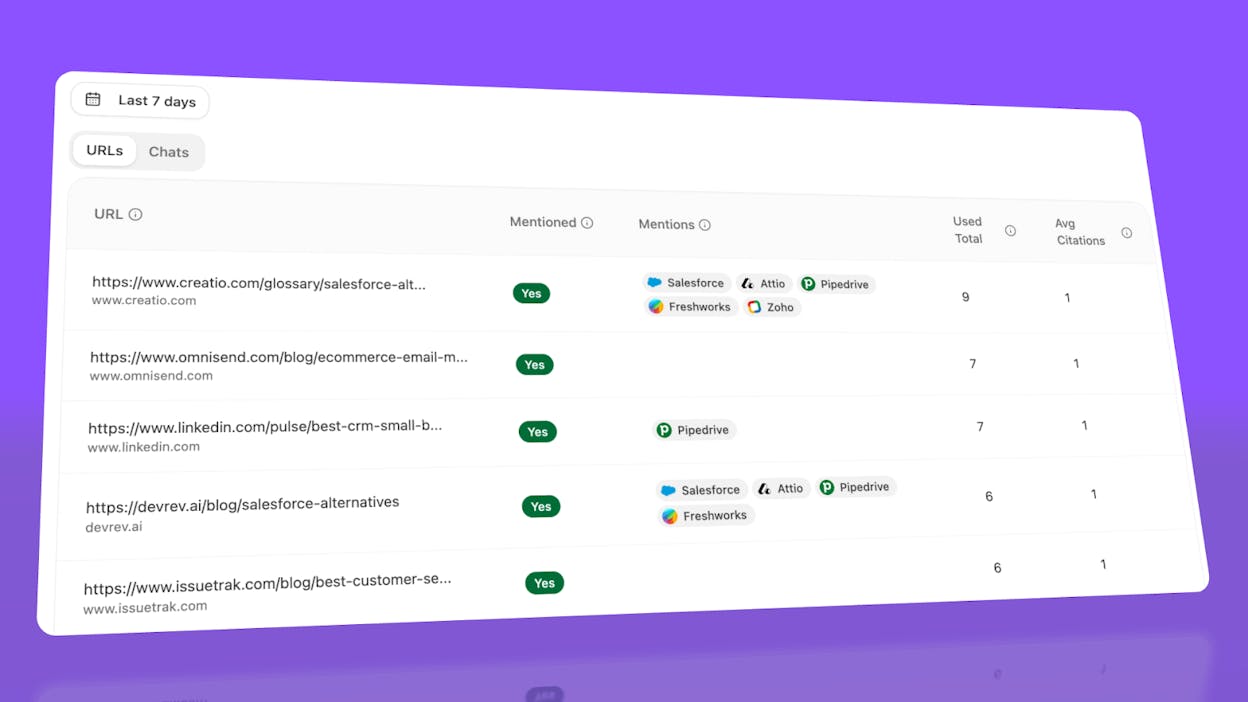
See which of your URLs get cited by AI models, how often, and in which engines. This is the AI equivalent of tracking which pages earn backlinks.
-
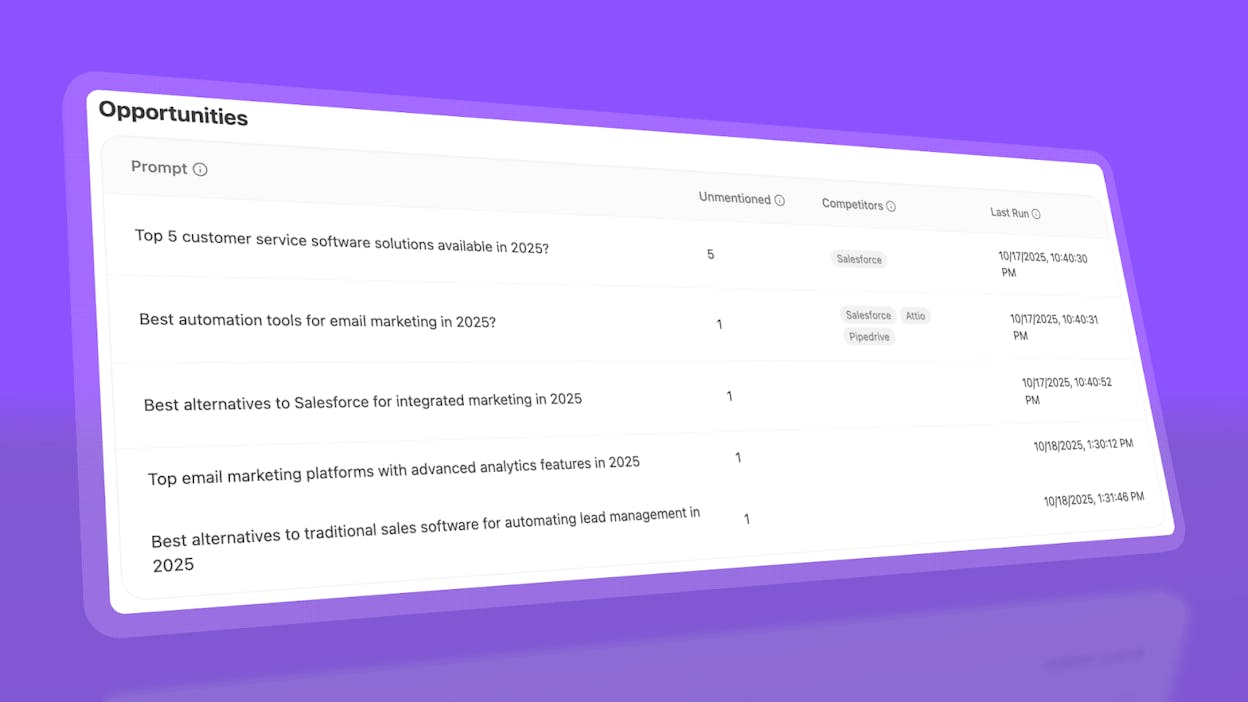
Identify competitor gaps where rivals appear in AI answers and you don’t. This is similar to running a Content Gap analysis in Ahrefs, but for AI-generated responses instead of Google SERPs.
-
Measure actual AI referral traffic by connecting your GA4 data. Instead of relying on proxy metrics like DR, you can see how many sessions, conversions, and revenue come from AI search engines directly.
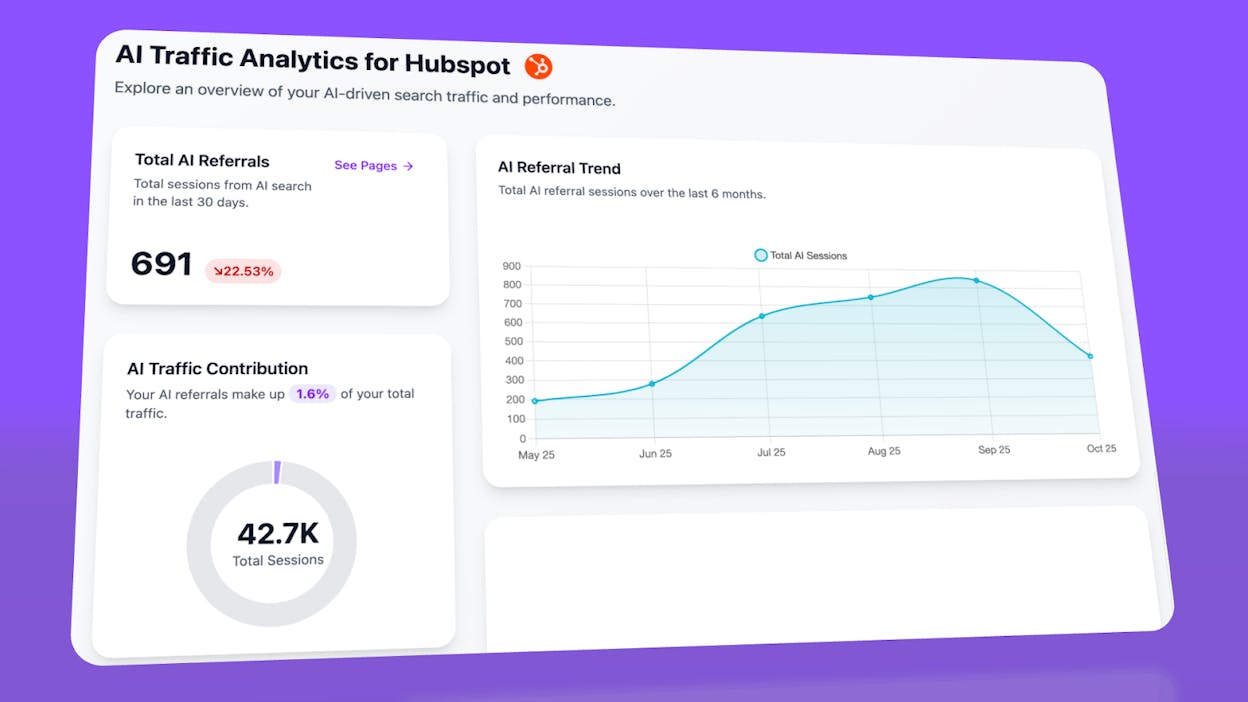
The takeaway isn’t that DR doesn’t matter for AI search. It’s that DR is a proxy for authority, and what you really need is direct measurement. In traditional SEO, you check rankings. In AI search, you should check citations, mentions, and actual traffic.
Do Subdomains Share Their Root Domain’s DR?
Not always. Ahrefs treats this on a case-by-case basis.
When a subdomain is controlled by the same organization as the root domain—like blog.hubspot.com or developer.mozilla.org—the subdomain inherits the root domain’s DR. Ahrefs recognizes these as extensions of the same website.
But when a subdomain is essentially a separate website operated by a different person or entity—like yourname.wordpress.com or yoursite.blogspot.com—Ahrefs separates it from the parent domain’s DR. This is because these are “service root domains” that let anyone create their own subdomain, and it wouldn’t be accurate for a random WordPress.com blog to display DR 93 just because wordpress.com has that score.
Domains that Ahrefs treats as service root domains (where subdomains get their own DR) include:
-
wordpress.com
-
blogspot.com
-
tumblr.com
-
squarespace.com
-
typepad.com
-
webs.com
-
hubpages.com
-
medium.com
If you’re building content on a subdomain, verify whether your root domain’s DR carries over. If it doesn’t, your subdomain’s authority starts from scratch, which has significant implications for your SEO strategy.
Domain Rating vs. URL Rating: What’s the Difference?
DR measures the strength of an entire domain’s backlink profile. URL Rating (UR), also an Ahrefs metric, measures the strength of a specific page’s backlink profile.
This distinction matters because Google ranks pages, not domains. A page on a DR 30 site with a UR of 65 (meaning that specific page has earned a lot of strong backlinks) can absolutely outrank a page on a DR 80 site with a UR of 12.
Here’s when to use each:
|
Scenario |
Use DR |
Use UR |
|---|---|---|
|
Comparing overall site authority |
✓ |
|
|
Evaluating a specific page’s link strength |
✓ |
|
|
Prioritizing link-building targets (domains) |
✓ |
|
|
Assessing whether a specific page can rank |
✓ |
|
|
Benchmarking against competitors at the site level |
✓ |
|
|
Diagnosing why a specific page isn’t ranking |
✓ |
In practice, you often want both. A high DR tells you the site has a strong foundation. A high UR tells you the specific page you’re evaluating has strong page-level link support. The pages that rank best tend to have both a solid domain behind them and strong page-level backlinks.
Domain Rating and Ahrefs Rank: How They Relate
DR assigns a score from 0 to 100. Ahrefs Rank (AR) assigns every website in their index a unique numerical ranking based on how strong its backlink profile is relative to every other website.
The difference is granularity.
Multiple websites can share the same DR. For instance, huffingtonpost.com, techcrunch.com, and salesforce.com might all show DR 92. But their backlink profiles aren’t identical.
AR resolves this ambiguity. HuffPost might be AR 316, TechCrunch AR 317, and Salesforce AR 346. This tells you that HuffPost’s backlink profile is marginally stronger than TechCrunch’s, and that 29 other websites sit between TechCrunch and Salesforce in terms of backlink strength.
AR is most useful when you need to compare two websites that share the same DR score and want to determine which one has the objectively stronger link profile.
How to Improve Domain Rating
Improving your DR comes down to earning more high-quality backlinks from unique referring domains. But the approach matters.
What Actually Moves DR
-
Earn links from high-DR domains. A single link from a DR 80 site that links to relatively few other domains will move your DR more than dozens of links from DR 10 sites. Prioritize publications, news outlets, and respected industry sites in your link building efforts.
-
Increase your total number of referring domains. Beyond quality, breadth matters. Having 500 unique domains linking to you provides a stronger DR signal than having 100 links from a single domain. Pursue diverse link sources through guest posting, digital PR, original research, and creating linkable assets.
-
Create content that naturally attracts links. Original research, proprietary data studies, free tools, and comprehensive resource pages are the content types most likely to earn backlinks organically. If you’re in the SEO space, publishing unique data (like this analysis of 83,670 AI citations) generates natural linking interest because other writers cite your data.
-
Reclaim lost links. Use Ahrefs’ “Lost backlinks” report to find referring domains that previously linked to you but stopped. Reach out to see if the link was removed intentionally or if it’s a broken link you can help them fix. You can also use Analyze AI’s Broken Link Checker to find broken links on your own site that may be hurting your link equity flow.
What Won’t Help Your DR
-
Internal links. These have zero effect on DR. It’s entirely based on external backlinks between domains.
-
Nofollow links. Links tagged rel="nofollow" don’t contribute to DR calculations.
-
Multiple links from the same domain. Only the first followed link from a unique domain counts. Getting 10 more links from a domain that already links to you won’t change your DR.
-
Buying cheap link packages. Low-quality link networks may temporarily inflate DR, but Ahrefs continues to improve their spam detection, and the links provide no real ranking value regardless.
Frequently Asked Questions
My DR dropped but I didn’t lose any backlinks. Why?
DR is a relative metric. If other websites in Ahrefs’ index gained lots of backlinks, the entire scale shifts. Since DR can’t go above 100, when the top gets more crowded, everyone below gets pushed down slightly. It’s like class rankings—even if your grades stayed the same, new students joining and scoring higher changes your percentile.
Another possibility: one or more of the domains linking to you lost their own backlinks, reducing their DR and therefore reducing the “DR juice” they pass to your site. Or those linking domains started linking out to many more sites, diluting the value they pass to each one.
A competitor has a higher DR but worse backlinks than me. How?
You don’t need links from high-DR sites to grow your DR. Having a very large number of links from lower-DR sites can produce a high DR score through sheer volume. The calculation weighs both quality and quantity of referring domains.
Also, remember that DR doesn’t factor in relevance, anchor text, or link placement. A competitor might have thousands of links from irrelevant directories and still show a higher DR than you, even though your niche-relevant links are far more valuable for rankings.
I got a link from a huge website but my DR didn’t change. Why?
Large websites like TechCrunch, Forbes, or Wikipedia link out to tens of thousands of other domains. The “DR juice” each linking domain passes gets divided among all the domains it links to. When a site links to 100,000+ other domains, the share your site receives from that single link is extremely small—often not enough to visibly move your DR.
This doesn’t mean the link is worthless. It may still help your specific page rank better (improving UR). But the domain-level impact is diluted by the sheer number of outbound links.
Does my DR affect my visibility in AI search?
Not directly. AI language models don’t query Ahrefs’ database to check your DR before deciding whether to mention your brand. However, the underlying authority signals that DR measures—being widely linked to and referenced across the web—do influence what content AI models learn from and what sources they cite. Studies show that high-authority domains are cited more frequently in AI-generated answers.
To measure your actual AI visibility, rather than relying on proxy metrics, use an AI search monitoring tool that tracks your brand mentions, citations, and referral traffic from AI engines directly.
Do homepage links pass more DR than links from inner pages?
No. For DR purposes, it doesn’t matter whether the link pointing to your site comes from the homepage or a deep inner page. Both contribute to your DR equally. The relevant factors are the linking domain’s own DR and how many other domains that linking site points to.
However, at the page level, homepage links do tend to carry more weight because homepages usually have the highest UR on any given site (since most internal and external links point to the homepage).
What is a “good” Domain Rating?
There’s no universal benchmark because DR is relative to your competitive landscape. In some niches, a DR of 40 is enough to compete effectively for most keywords. In highly competitive industries like finance, insurance, or technology, you may need a DR above 70 to compete for head terms.
Here’s a rough reference framework:
|
DR Range |
Typical Profile |
|---|---|
|
0–20 |
New or very small websites with minimal link profiles |
|
21–40 |
Small to mid-size businesses, newer blogs with some link building |
|
41–60 |
Established businesses, mid-authority publications, active content marketers |
|
61–80 |
Well-known brands, large publications, major industry players |
|
81–100 |
Global media outlets, major tech platforms, government/education institutions |
Can I lose DR by disavowing links?
If you use Google’s Disavow Tool, that action exists only in Google’s systems. It has no effect on your Ahrefs DR. Ahrefs calculates DR based on their own crawled link data, and they don’t reference Google’s disavow file.
However, if spammy sites linking to you are deindexed or taken down (which sometimes coincides with disavow campaigns), and those sites drop out of Ahrefs’ index, you could see a DR change as a side effect.
Final Thoughts
Domain Rating is a useful shorthand for the strength of a website’s backlink profile. It helps you compare sites, prioritize link prospects, and benchmark your own progress. But it’s one data point among many.
The websites that win—in both traditional search and AI search—don’t focus on inflating a single metric. They earn authority the hard way: by creating content worth linking to, building genuine relationships with their industry, and showing up consistently where their audience is looking.
As search evolves to include AI-generated answers, the fundamentals haven’t changed. Quality, authority, and usefulness still determine visibility. What’s changed is where you need to measure it. Traditional tools like Ahrefs give you backlink data and keyword rankings. AI search analytics tools like Analyze AI show you how AI models represent your brand, which engines drive real traffic, and where your competitors are winning in this new channel.
The smartest approach is to use both. Track your DR and backlinks for SEO. Track your AI citations, mentions, and referral traffic for the growing share of queries that never touch a traditional SERP.

Ernest

Ibrahim


