



Summarize this blog post with:


In this article, you’ll learn what an SEO manager actually does day to day, the skills the role really demands, what they earn across in-house and agency settings, and the path most people take to land the job. You’ll also see how the position is evolving as buyers move between Google and AI search engines like ChatGPT, Perplexity, and Gemini, and what that means if you want to stay competitive.
Table of Contents
What does an SEO manager do?
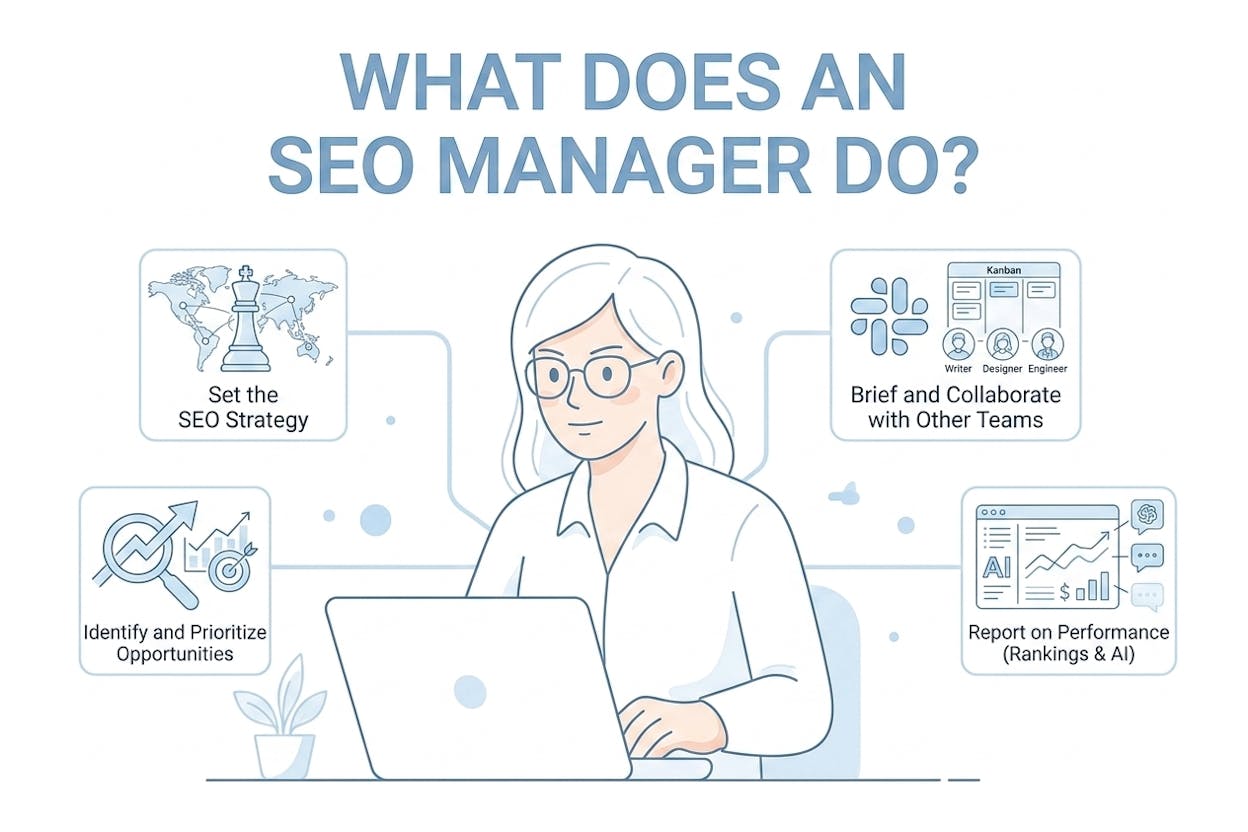
An SEO manager owns the strategy that grows a website’s organic traffic and search visibility. They do not write every blog post, build every backlink, or fix every broken redirect. They decide what gets done, why, and in what order, then make sure the right people execute on it.
In practice, the role splits across seven recurring responsibilities. The weight of each one shifts depending on whether the company is in-house or agency-side, B2B or ecommerce, and the size of the manager’s team.
1. Set the SEO strategy. This is the core of the job. The SEO manager looks at the company’s revenue goals, the search landscape, and the current state of the site, then decides where to invest. That investment usually splits across three buckets, namely technical fixes, content production, and link earning. A good strategy ties each bucket back to a business outcome, not just a ranking.
2. Identify and prioritize opportunities. Modern SEO managers run keyword research, competitor analysis, and content gap audits to find where the website can win. The bar for what counts as an “opportunity” has gone up. Pages that rank but don’t convert are no longer interesting. Pages that show up in both Google and AI answer engines are. You can read more about how to run this exercise in our guide to SEO competitor analysis.
3. Brief and collaborate with other teams. SEO managers spend a lot of time writing briefs, jumping into Slack threads, and reviewing dev tickets. Most of the work that moves the needle is done by writers, designers, and engineers, so the SEO manager’s job is to make sure those people have what they need.
4. Report on performance. Every month, the SEO manager has to walk leadership through what changed, why it changed, and what comes next. That report used to focus on Google rankings and organic traffic. Today it also includes AI search visibility, citations across answer engines, and AI-referred sessions. A modern report shows where the brand appears in ChatGPT, Perplexity, and Gemini, and how that maps to pipeline.
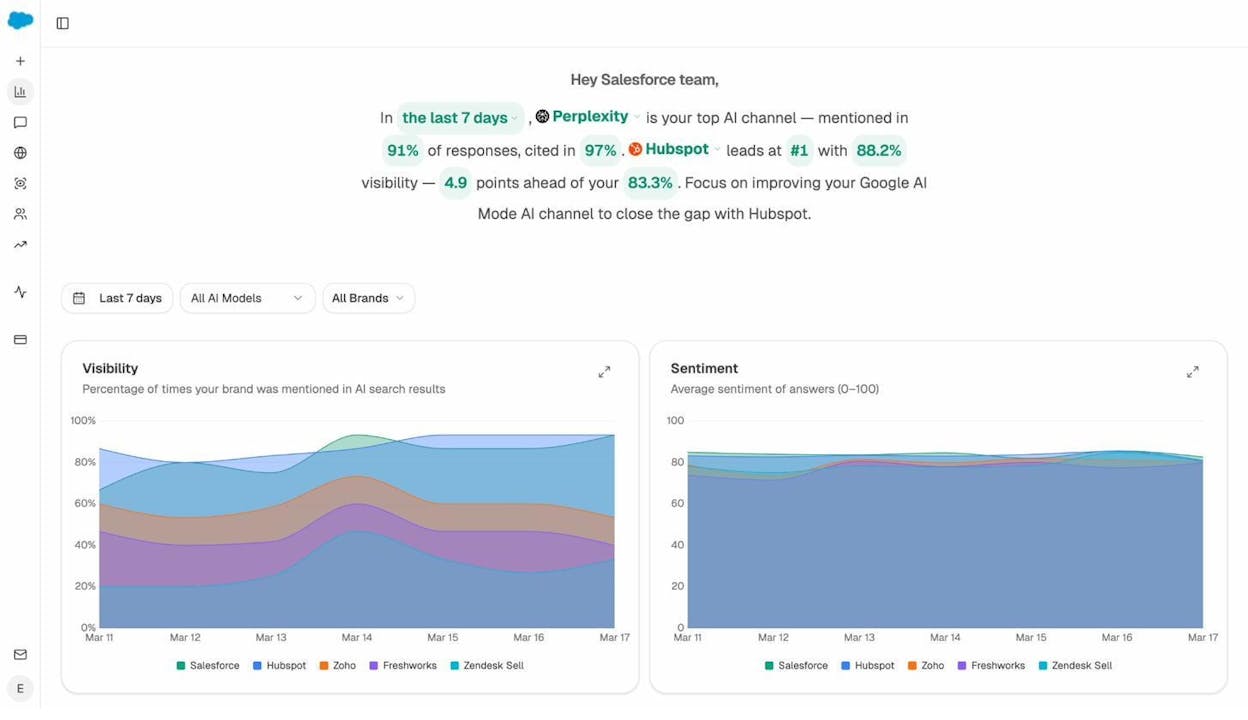
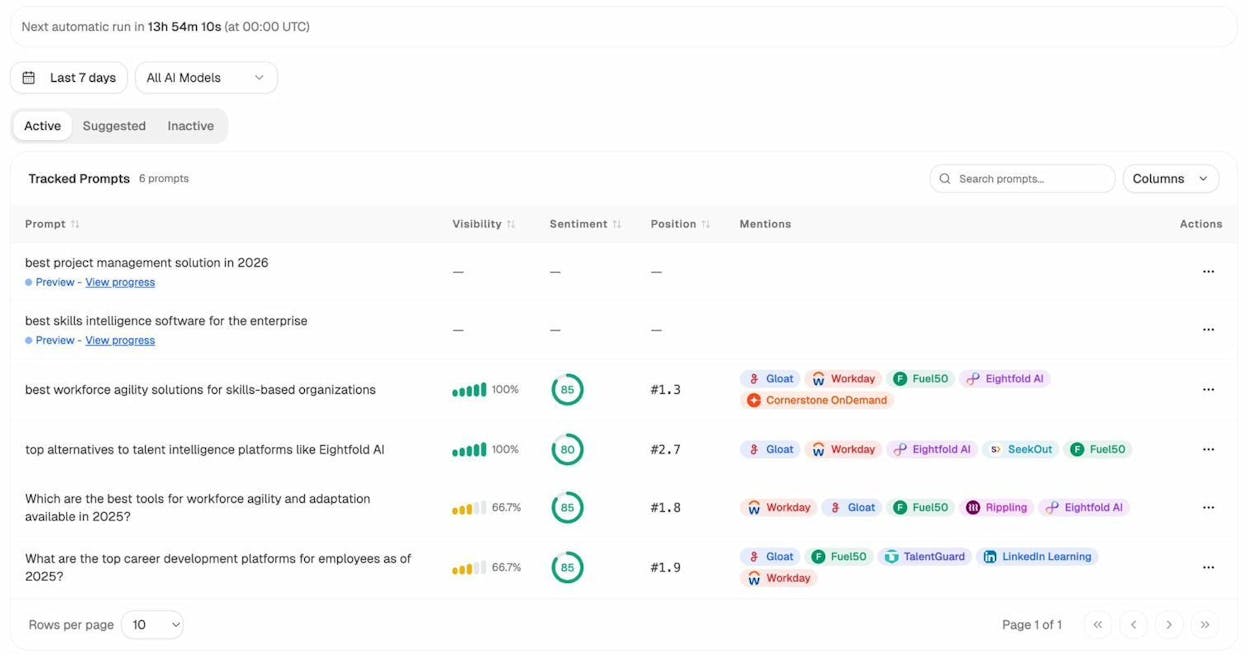
5. Track AI search visibility. This is the new responsibility that almost no job description fully captures yet, but every SEO manager I have spoken to in the last twelve months is now expected to handle it. The work involves choosing the prompts that matter to the business, tracking how often the brand appears in AI answers, and noting which competitors get cited instead. Inside Analyze AI, this looks like the prompt tracking view below, where each tracked prompt shows visibility, sentiment, average position, and the brands cited alongside yours.
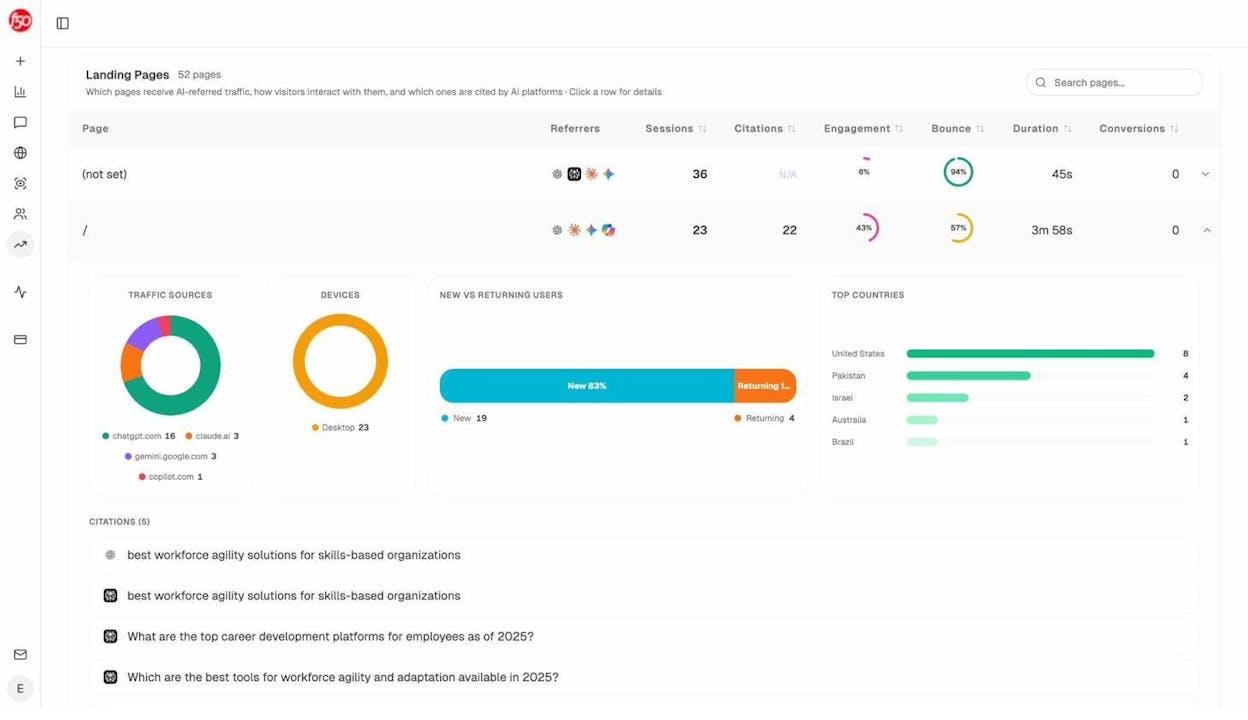
6. Manage the AI traffic channel. AI search now drives real, measurable visits. SEO managers are increasingly the ones who connect those visits to landing pages and conversions. Analyze AI’s AI Traffic Analytics shows which pages get cited by which engines and how those visitors behave once they land.
7. Stay on top of platform changes. Google still ships core updates that can erase a quarter of a website’s traffic overnight. AI search engines change their citation patterns even more often. The SEO manager has to read the announcements, run the tests, and translate the noise into a calm decision for the rest of the team.
What skills does an SEO manager need?
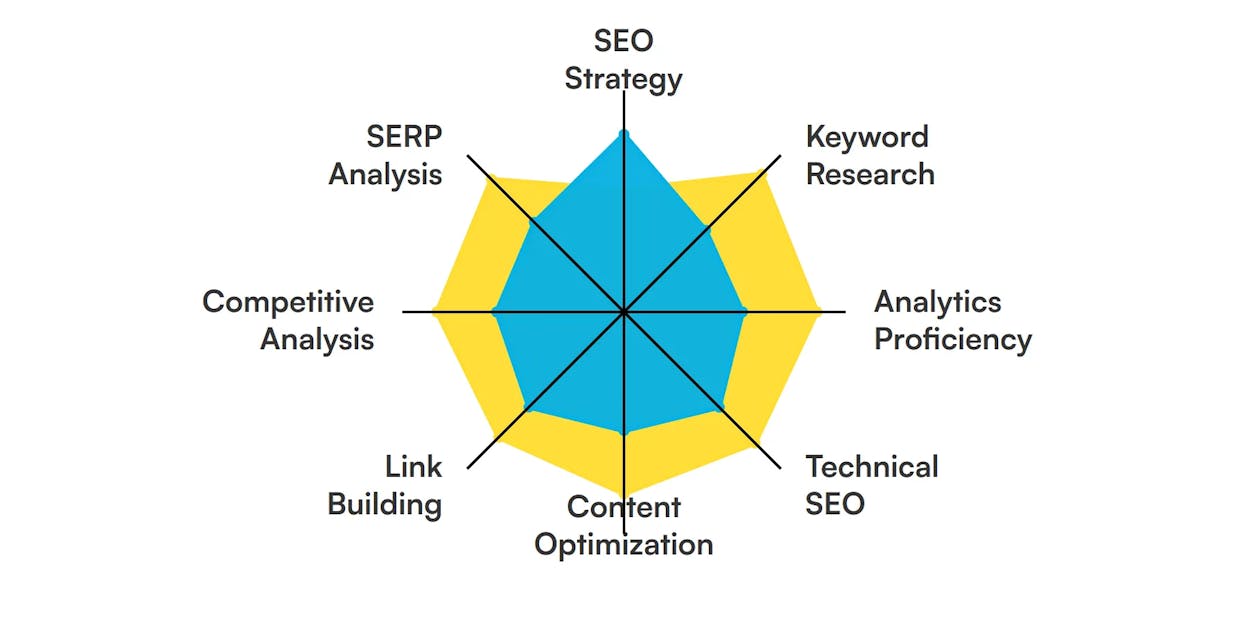
The skills that show up most often in SEO manager job listings cluster into five buckets. The list itself has not changed much in the last five years. What has changed is the depth expected in each one.
1. Data analysis
This is the single most cited skill across job descriptions, and the gap between someone who can analyze SEO data and someone who can only look at a dashboard is huge. The role expects you to pull data from Google Search Console, Google Analytics 4, your rank tracker, and now your AI visibility tool, then form a hypothesis and design the next test.
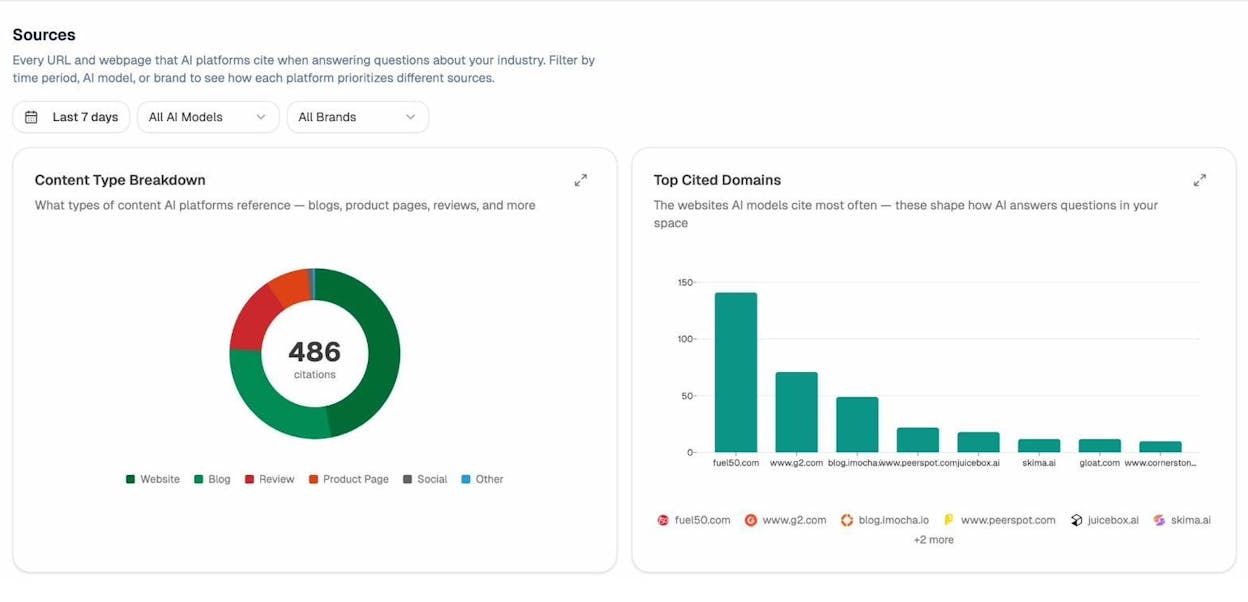
The shift with AI search is that the data set has grown. You used to need to know how to read a SERP. Now you also need to know how to read a citation map, which means tracking which domains AI engines cite, which formats they prefer, and which prompts your brand actually shows up for.
2. Strategic thinking
SEO managers get paid more than SEO specialists because they do less hands-on work and more decision-making. The strategic skill is being able to pick the three things that will move the business this quarter and to say no to the other thirty.
Strategic thinking is also what separates SEO managers who survive AI search from those who get caught flat-footed. The ones who keep growing organic traffic are the ones who treat AI search as another organic channel to invest in alongside Google, not a replacement for SEO. We laid out our perspective on this in GEO vs SEO.
3. Communication
Most of the SEO manager’s day is spent explaining things. Why a redirect needs to ship before launch. Why this competitor is taking citations from us. Why the CMO should not panic about the latest core update. The job rewards people who can simplify complex ideas without dumbing them down.
A specific version of this skill is reporting. Strong SEO managers can stand up in front of a CEO or board and explain organic performance in two slides. The new version of that skill is doing the same thing for AI search visibility, which most leadership teams are still trying to make sense of.
4. Light technical knowledge
You do not need to be a developer, but you do need to read HTML, understand JavaScript rendering, debug a hreflang error, and know what a status code means. About half of job listings ask for “experience with HTML, CSS, and JavaScript.” None of them ask for a CS degree.
The new technical skill on the rise is understanding how AI engines crawl, parse, and cite content. Things like clean schema markup, content structure that LLMs can extract from, and the use of llms.txt files are starting to appear in job specs.
5. Project management
SEO is a multi-month effort run across content, dev, and design teams. Without project management discipline, briefs get stuck, releases ship without redirects, and reports get filed late. The role expects you to keep things moving without micromanaging anyone.
What tools do SEO managers use?
Job listings ask for experience with a fairly predictable set of tools. About 80% of the listings I checked named at least one paid platform by name. The most common were Ahrefs, Semrush, Google Search Console, Google Analytics 4, and Screaming Frog. Newer listings, especially at companies that already invest in content, also ask for experience with an AI search visibility platform.
A practical SEO manager’s stack today looks like this.
|
Category |
Common tools |
What it’s for |
|---|---|---|
|
Keyword research |
Ahrefs, Semrush, Analyze AI Keyword Generator, Keyword Difficulty Checker |
Finding the queries worth ranking for |
|
Rank tracking |
Watching positions over time |
|
|
Site audits |
Screaming Frog, Sitebulb, Broken Link Checker |
Catching technical issues before they hurt rankings |
|
Analytics |
Google Analytics 4, Looker Studio |
Tying organic traffic to revenue |
|
Authority and traffic |
Benchmarking competitors |
|
|
AI search visibility |
Analyze AI |
Tracking brand mentions and citations across ChatGPT, Perplexity, Gemini, Copilot, and Claude |
|
Content optimization |
Analyze AI Content Optimizer, Clearscope |
Improving existing pages for both Google and AI search |
The shift in the toolbox is real. Three years ago, an SEO manager could get hired with Ahrefs and Search Console alone. Today, hiring managers expect candidates to know at least one platform that tracks visibility across AI search engines. We covered this category in detail in our roundup of AI search monitoring tools.
Do you need a degree to be an SEO manager?
Roughly half of the SEO manager job listings on LinkedIn and Indeed ask for a bachelor’s degree in marketing, business, communications, or computer science. The other half do not.
In the listings that do require a degree, almost none ask for anything beyond a bachelor’s. Of those that specify a field, the most common are marketing, business, advertising, and computer science. None of the listings I reviewed asked for a graduate degree.
In practice, very few hiring managers I have spoken with treat the degree as decisive. What they actually screen for is two to four years of demonstrable SEO experience, ideally with case studies or numbers attached. If you have a degree in something unrelated and a portfolio of websites you have grown, you will get further than someone with a marketing degree and no proof of work.
Who hires SEO managers, in-house vs agency?

The SEO manager title is more common in-house than at agencies. Around 85 to 90% of the job listings tagged “SEO manager” on LinkedIn are for in-house roles. Agencies do hire for the title, but they often use other titles like SEO consultant, account director, or strategist for similar work.
The difference matters because the day-to-day looks different.
In-house SEO managers tend to focus on one website, one product line, and one buyer persona. They work closely with internal product, engineering, and content teams and they own a single P&L. The wins are bigger because the surface area is smaller and the iteration loop is faster.
Agency-side SEO managers run multiple client accounts at once, often three to ten. The work is more about managing relationships and translating recommendations than implementing them. The variety is higher and the technical exposure is broader, but the depth of any single project is usually shallower.
How much do SEO managers make?
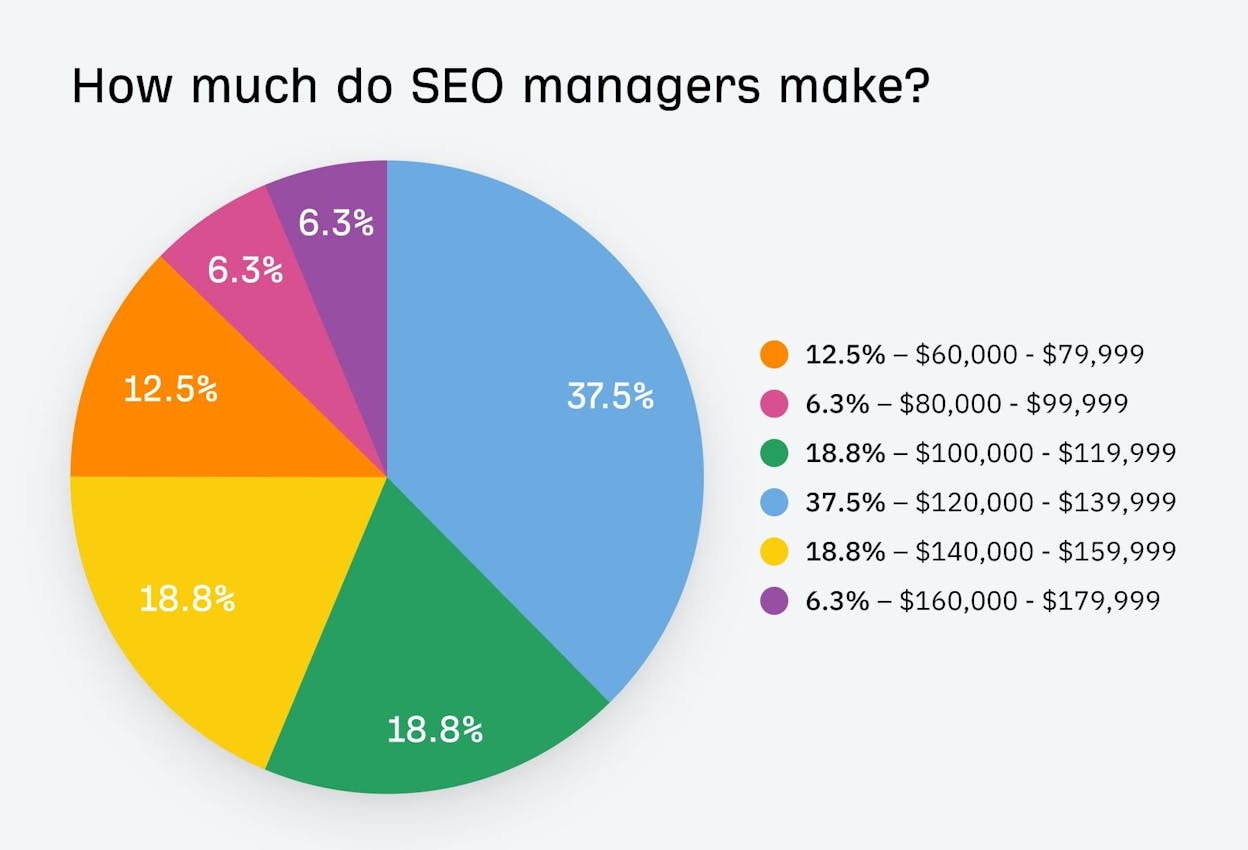
The honest answer is that SEO manager salaries vary so much that any single number is misleading. Sites that pull from job postings tend to come in lower because they capture the base salary listed in the ad. Sites that pull from self-reported total compensation tend to come in higher because they include bonus and stock.
Here is what the major sources reported for US-based SEO managers in 2026.
|
Source |
Average salary |
|---|---|
|
$81,910 base |
|
|
$86,633 base |
|
|
$86,206 base |
|
|
$89,385 total comp |
|
|
$143,456 total comp |
Two patterns hold across all the data sets.
First, location matters. SEO managers in Los Angeles, San Francisco, New York, Boston, and Washington DC earn 20 to 40% more than the national average. Remote roles at venture-backed software companies tend to pay closer to those metro rates regardless of where you live.
Second, experience pays much more than education. Senior SEO managers, typically those with five or more years of experience, average around $118,000 to $123,000 according to Salary.com, with top earners crossing $155,000. Adding a master’s degree barely moves the needle. Adding two more years of provable experience moves it a lot.
How to become an SEO manager
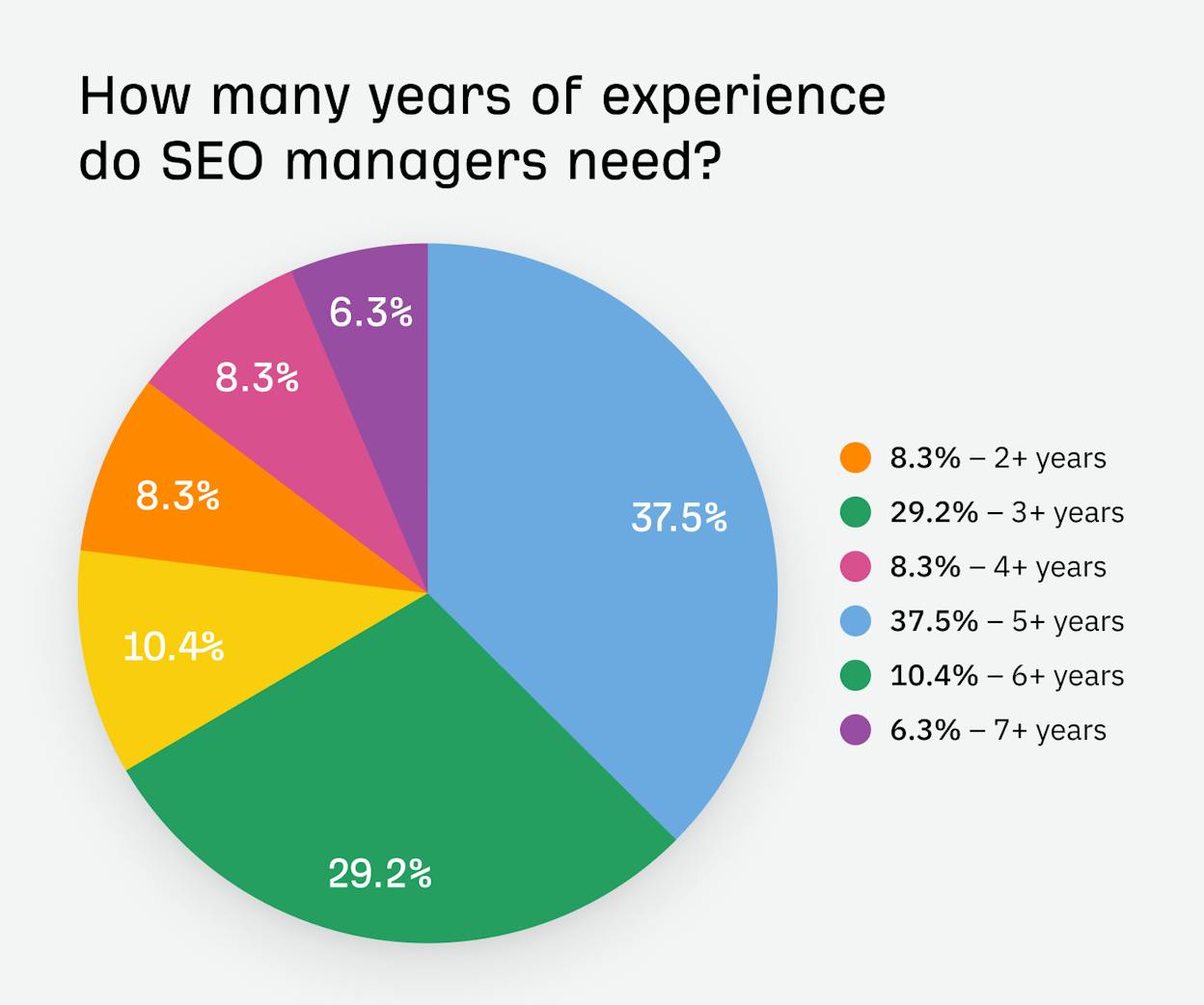
SEO manager is not an entry-level role. Almost every listing I have seen asks for at least two years of experience, and the majority ask for four or more. The good news is that the path to get there is well worn. Here is what most people actually do.
Step 1: Pick a starter role
The two cleanest entry points are an SEO internship or an SEO specialist position. If you can land either of those, take it.
If you cannot, take the closest adjacent role you can find. Content writer, marketing coordinator, junior digital marketer, and even technical writer are all roles where you can ask to take on SEO work and quickly move into a specialist title.
Step 2: Build a portfolio while you learn
The single fastest way to get hired is to have a portfolio. That can be:
-
A site of your own that ranks for real keywords with real traffic
-
A freelance client whose traffic you doubled
-
An internal project at your current job where you can show before-and-after numbers
Two case studies with screenshots of GA4 and Search Console will get you further than any certification. The same applies to AI search. If you can show a screenshot of a brand you grew from zero citations to consistent placement in ChatGPT or Perplexity answers, you stand out from every applicant who is still pitching themselves on Google rankings alone.
Step 3: Learn the modern stack
Pick one paid SEO platform and learn it deeply, because most listings will name one. Ahrefs and Semrush are the safest bets. Then learn Search Console, GA4, and at least one AI search visibility tool so you can speak credibly about both organic channels.
Free tools matter here too. Most candidates can run a keyword difficulty check, a rank check, or a site authority check without paying for anything. Doing the work and screenshotting the result is the cheapest way to prove you actually know how to use the inputs.
Step 4: Get to specialist, then move
Most SEO managers I checked on LinkedIn followed the same trajectory. Intern or coordinator, then SEO specialist or executive, then SEO manager.
The hidden detail is that most of them switched companies on the way. If your current company has no clear path to manager, do not stay in the specialist seat for four years waiting. Apply for SEO manager roles at smaller companies where you can take more ownership and build the case study you need for the next move.
Step 5: Run AI search visibility from day one
This is the new addition that gives you a real edge in 2026. Almost every SEO manager job spec is starting to add language about “GEO,” “AEO,” “answer engines,” or “LLM visibility.” Most candidates either ignore it or use it as a buzzword.
If you can walk into the interview with a clear point of view on which AI engines drive your industry, what your brand’s current visibility looks like, and which prompts you would target first, you are competing against a much shorter list. The Analyze AI AI Search Explorer and Prompt Discovery tools both give you a way to do this preparation in an afternoon.
Where the role goes from here
SEO manager is not a terminal title. Most people in the role move in one of three directions within three to five years.
Up the SEO ladder. The next steps are senior SEO manager, head of SEO, or director of SEO. These roles trade hands-on work for team leadership. The pay jumps by $25,000 to $50,000, and the work gets closer to the executive table.
Into broader marketing leadership. A meaningful share of SEO managers move into roles like head of organic, head of growth, head of content, or VP of marketing. The skills overlap more than the titles suggest. A good SEO manager already runs a multi-channel funnel through one channel. Running it through five is an extension, not a leap.
Into freelancing or consulting. A smaller group goes independent. The economics work because senior SEO managers can charge $150 to $400 an hour, and the demand is consistent. The trade-off is no team and a lot of business development.
The newer track that did not exist three years ago is the AI search lead role. Some companies are starting to hire dedicated heads of GEO or heads of AI search to sit alongside the SEO function. The candidates being hired into those roles overwhelmingly come from senior SEO manager backgrounds, because the discipline that drives AI search visibility, structured content, citation earning, and entity coverage, sits on top of the discipline that drives traditional SEO. We covered the foundations in What is generative engine optimization.
What to do next
If you want to land an SEO manager role, the fastest version of the plan is this. Get to specialist, build two real case studies, learn one paid SEO platform, learn one AI search visibility platform, and apply broadly. Switch companies if you have to. Add an AI search angle to every conversation, because most of your competition still cannot.
If you already have the role, the work that will define your next two years is the same work that hiring managers are starting to ask about. Build your AI search visibility tracking the same way you built your Google rank tracking five years ago. The brands that show up in answer engines today are the brands that will compound traffic across both channels.

Ernest

Ibrahim


