



Summarize this blog post with:


In this article, you’ll learn the four ways backlinks are acquired, which ones are worth your time, and how to start building links to your website today. You’ll get step-by-step instructions for researching competitor backlinks, identifying link opportunities, writing outreach emails that actually get responses, and creating content that earns links without outreach. You’ll also learn how to evaluate whether a backlink is worth pursuing, the mistakes that lead to Google penalties, and why the same content that earns backlinks is increasingly the content that AI search engines choose to cite.
Table of Contents
What Are Backlinks and Why Do They Matter?
A backlink is a link from another website to yours. When a blog post on someone else’s domain links to a page on your site, that’s a backlink.
Backlinks matter because Google treats them as votes of confidence. When a trusted website links to your page, it signals to Google that your content is valuable and worth showing to searchers. Pages with more high-quality backlinks tend to rank higher in search results.
This is not a theory. Google has confirmed that backlinks are one of their core ranking factors. And study after study has shown a strong correlation between the number of referring domains (unique websites linking to a page) and higher organic rankings.
![[Screenshot of an Ahrefs or similar study showing the correlation between referring domains and organic rankings]](https://www.datocms-assets.com/164164/1777924071-blobid1.png?auto=format,compress&w=1248&fit=max)
But not all backlinks are equal. A link from The New York Times carries far more weight than a link from a brand-new blog with no readers. A link from a website in your industry is more valuable than a link from a completely unrelated site. Quality matters more than quantity, and understanding this distinction is what separates effective link building from wasted effort.
There Are Only 4 Ways to Get Backlinks
Every link building tactic, strategy, or hack you have ever heard of falls into one of four buckets.
-
Add links yourself on websites that allow user-generated content.
-
Earn links naturally by creating content so good that people link to it without being asked.
-
Ask for links by reaching out to website owners and giving them a reason to link to you.
-
Buy links directly from site owners or pay someone to build them for you.
That’s the entire universe of link acquisition. Guest posting is a form of “asking.” Creating a free tool that goes viral is “earning.” Dropping your URL in a forum signature is “adding.” Paying a blogger $200 to insert your link in an existing article is “buying.”
Understanding which bucket a tactic belongs to tells you two things: the likely quality of the links you’ll get, and the risk involved. Let’s walk through each bucket in detail.
1. Adding links yourself
Some websites let you publish content with little or no moderation. Forum profiles, blog comments, business directory listings, social bookmarking sites, Q&A platforms, and wiki pages are all places where you can manually add a link to your website.
The process is simple. Register an account, create a post or profile, include your URL. It takes five minutes and requires no relationship with the website owner.
The problem is that these links carry almost no SEO weight. Google knows that if anyone can place a link somewhere without editorial review, that link is not a genuine endorsement of quality. Most user-generated content platforms also add a nofollow attribute to outbound links, which tells search engines not to count them as ranking signals.
Does that mean all self-placed links are useless? Not entirely. There is a legitimate subset.
When adding links is worth your time:
-
Business directory listings. Claiming your profile on Google Business Profile, Yelp, Bing Places, and industry-specific directories like Capterra (for SaaS) or Avvo (for lawyers) is basic hygiene. These links may not individually move your rankings, but they help search engines verify that your business is real and confirm your NAP (name, address, phone) data. They also generate referral traffic from people browsing those directories.
![[Screenshot of a Google Business Profile listing showing the website URL field]](https://www.datocms-assets.com/164164/1777924076-blobid2.png?auto=format,compress&w=1248&fit=max)
-
Q&A sites with genuine participation. Answering questions on platforms like Quora, Reddit, or Stack Exchange can send referral traffic if you genuinely help people. The key word is “genuinely.” Writing thoughtful, helpful answers and including a link when it’s relevant is fine. Carpet-bombing every thread with your URL is spam, and moderators will ban you.
-
Industry-specific resource submissions. Some niche websites maintain curated resource directories. If they review submissions before listing them, a link from these sites has some value. The key distinction is whether the listing involves editorial judgment. If anyone can list themselves automatically, the link is worth very little.
When adding links is a waste of time:
Automated link building tools or plugins that create backlinks on random websites whenever you publish a post. This is spam. Comment spam on blogs where most links are nofollow anyway. Mass directory submissions to hundreds of low-quality directories. These tactics worked in 2008. Today, they’re more likely to trigger a spam penalty than help your rankings.
The rule of thumb: if the link requires no editorial judgment from another person, it is unlikely to move the needle for SEO.
2. Earning links naturally
Earned links are the gold standard. Someone discovers your content, decides it’s valuable, and links to it from their own website. No outreach email. No payment. No deal. Just a genuine editorial endorsement that you created something worth referencing.
This is also the hardest type of link to get, because it requires you to create something genuinely exceptional. Not “good.” Not “comprehensive.” Exceptional. Something that makes another person think: “I need to reference this in my own work.”
The types of content that attract links naturally share common traits. They contain information that cannot be found anywhere else. They solve a real problem in unusual depth. They provide a tool or resource that people want to use and share. They present data that other writers need to cite.
Types of linkable assets that consistently earn backlinks:
Original research and data studies. If you can run a survey, analyze a proprietary dataset, or conduct an experiment and publish the findings, you create something that journalists, bloggers, and other content creators want to cite. Numbers are powerful link magnets because writers need sources for their statistics.
For example, a company that surveyed 500 SEO professionals about their link building habits and published the results could earn hundreds of backlinks. Every article written about link building in the following year would reference those numbers, and each citation is a backlink.
You don’t need a massive research budget to do this. Even analyzing data you already have access to (your own product data, customer survey responses, or publicly available datasets) can produce findings worth linking to.
![[Screenshot of an example data study page showing key findings with a referring domains count]](https://www.datocms-assets.com/164164/1777924080-blobid3.png?auto=format,compress&w=1248&fit=max)
Free tools and calculators. People love linking to free tools. A keyword generator, a website authority checker, a broken link checker, or a SERP checker each serve specific needs that users want to share with their audience. The investment is higher than writing a blog post, but the payoff compounds over time because tools keep earning links as long as they remain useful.
Many of the most linked-to pages on SaaS websites are free tools, not blog posts. If your competitors have free tools and you don’t, you’re at a structural disadvantage. They earn links on autopilot while you hustle for each one through outreach.
Comprehensive guides and frameworks. A 5,000-word guide that covers every angle of a topic can become the default reference in an industry. The key is genuine depth and originality, not just length. A “complete guide to link building” that rehashes the same advice as every other guide won’t earn links. A guide that includes original frameworks, real campaign data, and step-by-step walkthroughs that you can’t find elsewhere will.
Infographics and visual assets. A well-designed chart, diagram, or data visualization that makes complex information easy to understand gets embedded and linked to across blogs, newsletters, and presentations. The visual needs to be genuinely informative, not decorative.
![[Screenshot of an example infographic or data visualization that has earned backlinks]](https://www.datocms-assets.com/164164/1777924081-blobid4.png?auto=format,compress&w=1248&fit=max)
News and original reporting. If your company launches a product, publishes a report, makes an acquisition, or does something genuinely newsworthy, journalists and industry bloggers will link to the source. This is why digital PR is an effective link building channel for companies that have news to share.
The common thread across all linkable assets: earned links come from creating genuine information gain. If someone could find the same information in five other places, they have no reason to link to you specifically. Your content needs to offer something that doesn’t exist elsewhere.
3. Asking for links through outreach
Outreach-based link building is the most common form of active link acquisition. You identify websites that might link to you, send them an email, and try to persuade them. It’s also where most people fail, because they confuse asking with begging.
Here is a typical outreach email that lands in the inbox of a blog editor:
![[Screenshot of a generic backlink outreach email that offers no value exchange, with subject line like “Quick question about your article”]](https://www.datocms-assets.com/164164/1777924086-blobid5.png?auto=format,compress&w=1248&fit=max)
It says something like: “I came across your article on [topic] and really enjoyed it. I recently published a similar piece that I think your readers would find valuable. Would you consider adding a link to it?”
This email fails for three predictable reasons.
First, there is no value exchange. The sender is asking for a favor without offering anything in return. The recipient gains nothing from adding the link. They’d need to log into their CMS, find the right article, add the link, and re-publish. All of this for a stranger who sent a templated email.
Second, “my content is great, you should link to it” is a weak argument. Every person who sends outreach emails believes their content is great. The recipient has no reason to agree and no incentive to spend 15 minutes reviewing someone else’s work.
Third, these emails arrive by the dozen. Anyone managing a website with decent authority receives multiple link requests per day. Most are obviously templated. Most get deleted without a response.
So what does work?
Tactic 1: Guest posting (done right)
You write a high-quality article for another website, and in return, you get a link back to your site within the content or author bio. This works because it’s a genuine value exchange. You provide content they’d otherwise need to produce themselves. They get a free, well-written article. Both sides benefit.
The catch is that the content needs to be genuinely good. If you outsource it to a cheap writer or use an AI tool to generate a generic piece, you’ll struggle to find publishers. The best guest posts come from people with real expertise who can write something the host blog couldn’t have produced on their own.
How to find guest post opportunities step by step:
-
Search Google for "your industry" + "write for us" or "your topic" + "guest post" or "your niche" + "contribute". This surfaces websites that actively accept guest contributions.
![[Screenshot of Google search results for “marketing” + “write for us” showing multiple guest post opportunity pages]](https://www.datocms-assets.com/164164/1777924087-blobid6.png?auto=format,compress&w=1248&fit=max)
-
Check each website for quality. Does it have real traffic? Is the content well-written? Would you actually want to be associated with this site? Use the Analyze AI Website Authority Checker to check the site’s domain authority.
![[Screenshot of the Analyze AI website authority checker showing domain authority score for a potential guest post target]](https://www.datocms-assets.com/164164/1777924092-blobid7.png?auto=format,compress&w=1248&fit=max)
-
Read their existing content. Understand what topics they cover, what level of depth they expect, and what gaps you could fill. Don’t pitch a topic they’ve already covered extensively.
-
Send a pitch email. Keep it short. Include 2-3 specific topic ideas with one-sentence descriptions. Mention a relevant credential or previous publication. Don’t attach a draft to the first email.
Example guest post pitch that works:
Subject: Guest post idea for [their site name]
“Hi [name],
I’m [your name], [one-line credential]. I’ve been reading [their site] for a while and noticed you haven’t covered [specific topic gap].
I’d love to write a piece on [topic] that covers [specific angle]. I recently [did something relevant that gives you credibility on this topic].
Here are two other ideas if that one doesn’t fit:
-
[Topic 2: one sentence description]
-
[Topic 3: one sentence description]
I’ve previously written for [one or two publications]. Happy to send samples if helpful.
Thanks, [your name]”
This works because it’s specific, it shows you’ve done your homework, and it offers clear value.
Tactic 2: Broken link building
You find broken outbound links on relevant websites (links that point to pages that no longer exist), then reach out to the site owner and suggest your content as a replacement. This works because you’re solving a problem. Their page has a broken link that hurts user experience, and you’re offering a working replacement.
Step-by-step process for broken link building:
-
Find relevant websites in your niche that have resource pages, link roundups, or comprehensive guides with lots of outbound links. These pages are the most likely to contain broken links.
-
Scan those pages for broken outbound links. You can use the Analyze AI Broken Link Checker to check any URL for broken links.
![[Screenshot of the Analyze AI broken link checker showing results with broken outbound links highlighted]](https://www.datocms-assets.com/164164/1777924093-blobid8.png?auto=format,compress&w=1248&fit=max)
-
For each broken link, check what content used to be at that URL. Use the Wayback Machine (web.archive.org) to see what the dead page contained. This tells you whether you already have a suitable replacement, or whether you need to create one.
![[Screenshot of the Wayback Machine showing an archived version of a dead page]](https://www.datocms-assets.com/164164/1777924098-blobid9.png?auto=format,compress&w=1248&fit=max)
-
If you have content that covers the same topic as the dead page, send a short email:
Subject: Broken link on your [page topic] page
“Hi [name],
I was reading your page about [topic] and noticed that the link to [dead site/resource name] in the [section name] section is broken. Looks like the page was taken down.
I have a similar resource that covers [topic]: [your URL]
Happy to help if you’d like to update it. Either way, just wanted to flag the broken link.
[your name]”
This works because you’re leading with a helpful observation, not a selfish request.
Tactic 3: Resource page link building
Many websites maintain curated lists of tools, articles, or resources on a specific topic. If your content or tool belongs on one of these lists, a polite email can get you added.
How to find resource pages:
-
Search Google for "your topic" + "resources" or "your industry" + "useful links" or "your niche" + "recommended tools".
-
Evaluate each resource page. Is it well-maintained? Does it have real traffic? Are the existing resources high quality? If the page is a dumping ground, a link from it won’t help.
-
Send a short email explaining why your resource belongs on the list. Be specific about what it offers that the existing resources don’t.
Tactic 4: The Skyscraper technique
This is where you find content that has already earned many backlinks, create something significantly better, and then reach out to the people who linked to the original.
The idea is sound, but the execution requires more than most people expect. “Better” needs to be dramatic, not marginal. Adding three more items to a list post that already has 20 is not enough. You need to offer something the original doesn’t: original data, better visual design, a more useful format, a deeper level of expertise, or a genuinely different angle.
If you use this technique, focus on content where you can offer a clear, specific improvement. Then reach out to people who linked to the original and explain what’s different about your version. “I created a more comprehensive guide” is vague. “I added original data from a survey of 200 marketers, plus a downloadable template” is specific and compelling.
Tactic 5: HARO and journalist queries
Services like Help a Reporter Out (HARO), Qwoted, and Source of Sources connect journalists with expert sources. Journalists post queries (“Looking for a cybersecurity expert to comment on the recent data breach”), and you respond with your expertise.
If a journalist uses your quote, you typically get a backlink from the publication. These can be extremely high-quality links from major news outlets, industry publications, and high-authority blogs.
Tips for getting links through journalist queries:
-
Respond quickly. Journalists work on deadlines. The first good response often wins.
-
Be concise. Give them a usable quote in 2-3 sentences, not a 500-word essay.
-
Include your credentials. Why should they trust your expertise on this topic?
-
Only respond to queries where you have genuine expertise. Journalists can tell when you’re faking it.
![[Screenshot of a HARO query page showing journalist requests for expert sources]](https://www.datocms-assets.com/164164/1777924099-blobid10.png?auto=format,compress&w=1248&fit=max)
Tactic 6: Unlinked brand mentions
Sometimes websites mention your brand by name but don’t include a link. These are easy wins. The site owner already knows about you and thinks you’re worth mentioning, but they just forgot (or didn’t bother) to link.
How to find unlinked mentions:
-
Set up a Google Alert for your brand name, product names, and key executives’ names.
-
When you find a mention without a link, send a quick email: “Thanks for mentioning us in your article about [topic]. Would you mind adding a link to our website? Here’s the URL: [URL].”
-
These emails have a much higher success rate than cold outreach because the relationship already exists. The site owner chose to mention you. Asking for a link is a small extra step.
Outreach email principles that separate success from deletion:
|
What works |
What doesn’t |
|---|---|
|
Mentioning something specific that shows you read their content |
Opening with “I noticed your great article about…” (they know you didn’t read it) |
|
Offering a clear value exchange (guest post, data, quote, broken link fix) |
Asking for a link because your content is “comprehensive” or “updated” |
|
Keeping the email under 150 words |
Writing a 500-word essay justifying why they should link to you |
|
Being honest about what you want |
Hiding the link request behind fake compliments |
|
Following up once, politely, after 5-7 days |
Following up five times with increasingly desperate subject lines |
|
Sending from a real person’s email address |
Sending from info@ or marketing@ addresses |
|
Personalizing beyond the name (reference a specific article or point) |
Using obvious mail merge templates where only the name changes |
Even with a perfect email, expect a low response rate. A 5-10% conversion rate from cold outreach is normal. A 15%+ rate is excellent and usually means you have strong brand recognition, exceptional content, or both.
4. Buying backlinks
Buying backlinks is risky. Google’s spam policies explicitly prohibit exchanging money for links that pass PageRank. If Google detects purchased links, your site can receive a manual penalty that tanks your rankings overnight.
Some companies buy links and get away with it. Many don’t. Here’s what to know before deciding.
Red flags that a link is not worth buying:
-
The seller contacts you via a cold email. If you receive an email offering backlinks with a price list, delete it. Legitimate websites don’t sell links as a service.
-
The price is under $50 per link. Research has shown that the average cost of a decent, editorially placed backlink is between $200 and $400. At $3-$10 per link, you’re buying from a link farm.
-
The seller guarantees a specific number of links per month. Real editorial links cannot be manufactured on a predictable schedule.
-
The website has no real audience. Check the site’s traffic using a website traffic checker. If the site gets no traffic and exists only to sell links, Google already knows.
The safer alternative: hire professionals to build links for you.
Instead of buying links directly, you can hire an agency or freelancer to handle outreach, guest posting, and relationship building on your behalf. The links themselves are earned through legitimate tactics. You’re paying for the labor, not the link.
When evaluating a link building service, ask:
-
Can they show examples of links they’ve built for other clients?
-
Will they let you talk to a previous client?
-
Are they transparent about their methods?
-
Do they promise specific quantities? If they guarantee 30 links per month, they’re cutting corners.
-
Do they focus on relevance and quality, or do they mainly talk about domain authority numbers?
The best agencies create linkable assets and promote them through genuine outreach. This is slower and more expensive, but it produces durable links that Google values for years.
How to Build Backlinks: A Step-by-Step Process
Here’s a three-step process for finding and pursuing link opportunities that you can start today.
Step 1. Study your competitors’ backlink profiles
The fastest way to find link opportunities is to see where your competitors get their links. If a website linked to your competitor, there’s a good chance they’d link to you too, provided you give them a reason.
How to do this:
-
Make a list of 3-5 direct competitors. These should be companies that compete for the same keywords and customers.
-
Enter your first competitor’s homepage URL into a backlink analysis tool. Free options include the Analyze AI Website Authority Checker for quick checks. For full backlink reports, tools like Ahrefs Site Explorer or Moz Link Explorer work well. Set the tool to “Exact URL” mode and look at the referring domains report.
-
Go through the referring domains and categorize them:
-
Easy to replicate: Directory listings, tool integration pages, sponsorship pages. If your competitor is listed on a niche directory, submit your site there too. If they got a link from a tool they integrate with, build the same integration.
-
Possible with effort: Guest posts, resource page mentions, roundup features. These require outreach, but the website has already linked to a competitor in your space, which means they’re open to it.
-
Hard to replicate: Earned links from major publications, data study citations, unique partnerships. You can’t replicate these directly, but you can create your own version of the content that earned them.
-
Not worth replicating: Spammy links, PBN links, links from irrelevant sites. Every competitor has some junk links. Ignore them.
-
Build a spreadsheet of actionable opportunities. For each one, note the linking website, the page the link is on, the link type, and your plan for getting a similar link.
-
Repeat for each competitor. You’ll start to see the same domains appearing across multiple competitors’ profiles. These are your highest-priority targets, because they’ve already demonstrated a pattern of linking to companies in your space.
Step 2. Find your competitors’ most linked pages
Every website has a handful of pages that account for most of its backlinks. These are the linkable assets. Finding them shows you what types of content earn links in your industry.
How to do this:
-
Enter your competitor’s domain into a backlink tool and navigate to the “Best by Links” or “Top Pages” report. Sort by referring domains.
![[Screenshot of a “Best by Links” report showing a competitor’s top 10 most linked pages with referring domain counts]](https://www.datocms-assets.com/164164/1777924104-blobid11.png?auto=format,compress&w=1248&fit=max)
-
Look at the top 10 most linked pages and identify the pattern:
-
Free tools dominate. This is extremely common for tech companies. If your competitors’ most linked pages are free tools and you don’t have any, that’s a gap you need to fill.
-
Data studies and reports earn the most links. Original research is a proven format. Consider running a survey or analyzing data you already have.
-
Comprehensive guides are heavily linked. Depth and thoroughness are what linkers in your industry value.
-
For each highly linked competitor page, ask:
-
Do I have anything similar? If not, that’s a content gap worth filling.
-
Can I create something genuinely better? Not longer. Better.
-
What is the “linkability trigger”? Is it the data, the format, the topic, the fact that it’s free?
Step 3. Reverse engineer the top-ranking pages for your target keywords
This step is about building links to specific pages you need to rank for specific keywords.
How to do this:
-
Pick a target keyword. Let’s say you want to rank for “best project management tools.”
-
Check the current SERP. Use a SERP checker or keyword tool to see the top 10 results. Note how many referring domains each top page has.
![[Screenshot of a SERP checker showing top results for a target keyword with referring domain counts]](https://www.datocms-assets.com/164164/1777924105-blobid12.png?auto=format,compress&w=1248&fit=max)
-
This gives you the “link threshold” for this keyword. If the top 3 results have 150+ referring domains and your page has 10, you know the gap.
-
Click into the backlink profiles of the top 3-5 ranking pages. Categorize the links:
-
Guest posts suggest outreach is how links are built in this niche.
-
Resource page links suggest resource page outreach could work.
-
Earned links from industry blogs suggest you need genuinely newsworthy content.
-
Look for specific patterns you can act on. If a top-ranking page earned 20 links from blogs that wrote “best productivity tools” roundups, you know exactly who to pitch.
-
Build your outreach list from these insights. Everyone who linked to a competing page is a warm lead.
Why Backlinks Also Matter for AI Search
Most guides about backlinks focus entirely on Google rankings. But the landscape is shifting. The pages that earn the most backlinks are increasingly the same pages that AI search engines like ChatGPT, Perplexity, Gemini, and Copilot choose to cite and recommend.
This is not a coincidence. AI models are trained on the open web, and they learn which sources are trustworthy partly by looking at the same signals Google uses: how many reputable sites link to a page, how comprehensive the content is, and how frequently it’s cited.
SEO is not dead. AI search is an additional organic channel that works alongside traditional search, not a replacement. The good news is that the content strategies that earn backlinks also earn AI citations. You don’t need to choose between the two.
What gets cited by AI search engines
AI search engines generate direct answers and cite sources within those answers. The content that gets cited shares traits with content that earns backlinks:
Original data and statistics. AI models need sources when presenting numbers. If your page contains a unique stat backed by your own research, AI models will cite you when users ask about that topic.
Clear definitions and frameworks. AI models look for well-structured explanations. If you create the clearest explanation of a concept in your industry, LLMs will surface it.
Comparison tables and structured data. AI engines favor organized, scannable content. A well-structured comparison table is more likely to be cited than the same information buried in paragraphs.
Free tools. When users ask AI for tool recommendations, models pull from pages that review or host those tools. If your tool has backlinks from authoritative sites, it’s even more likely to appear.
How to track your AI search visibility alongside link building
If you’re investing in content and backlinks, you should measure results across both Google and AI search. Analyze AI tracks how AI search engines represent your brand, which of your pages they cite, and where competitors are winning visibility you’re missing.
See which sources AI engines trust in your space.
The Citation Analytics dashboard shows every domain and URL that AI models reference when answering questions about your industry. This reveals which sources AI considers authoritative and whether you’re among them.
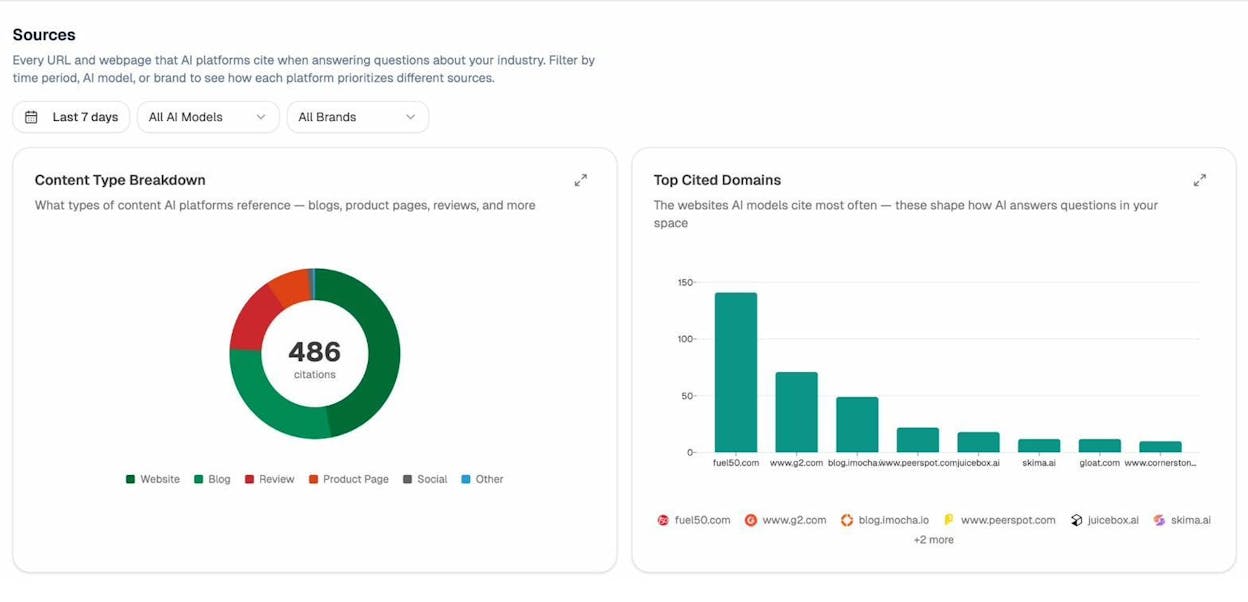
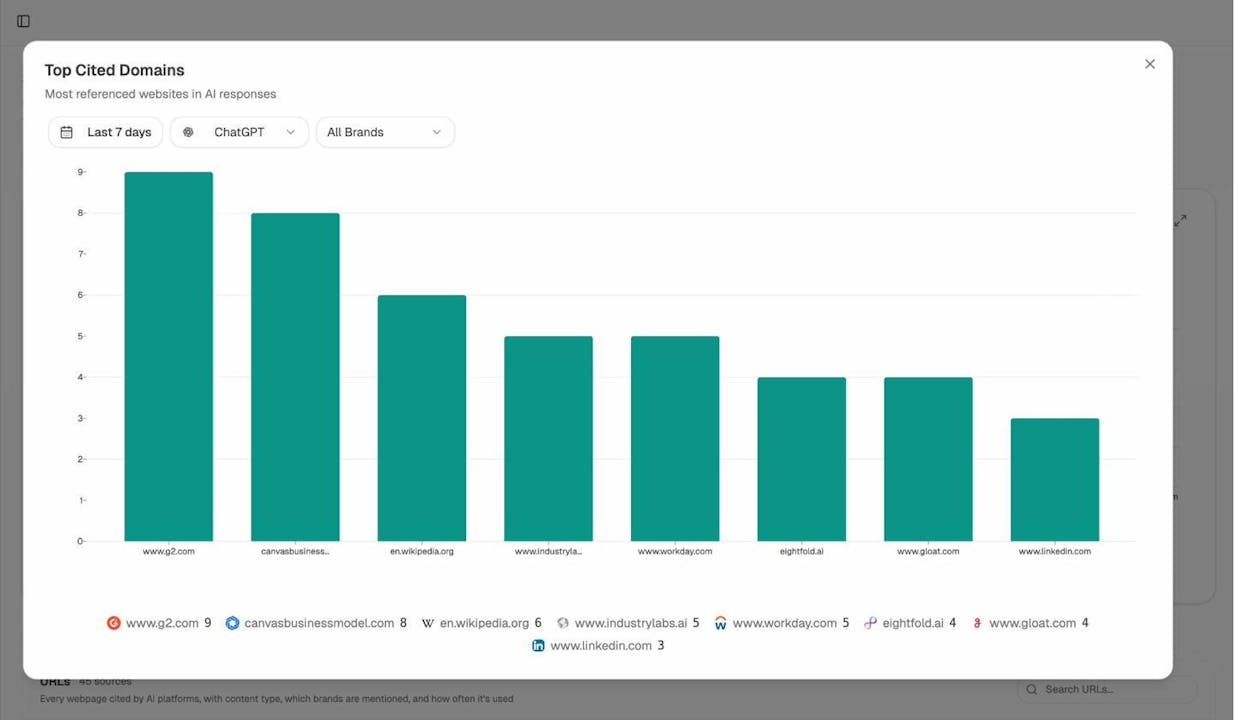
You can drill into specific engines to see differences. ChatGPT might heavily cite G2 and Wikipedia, while Perplexity cites industry blogs and product pages.
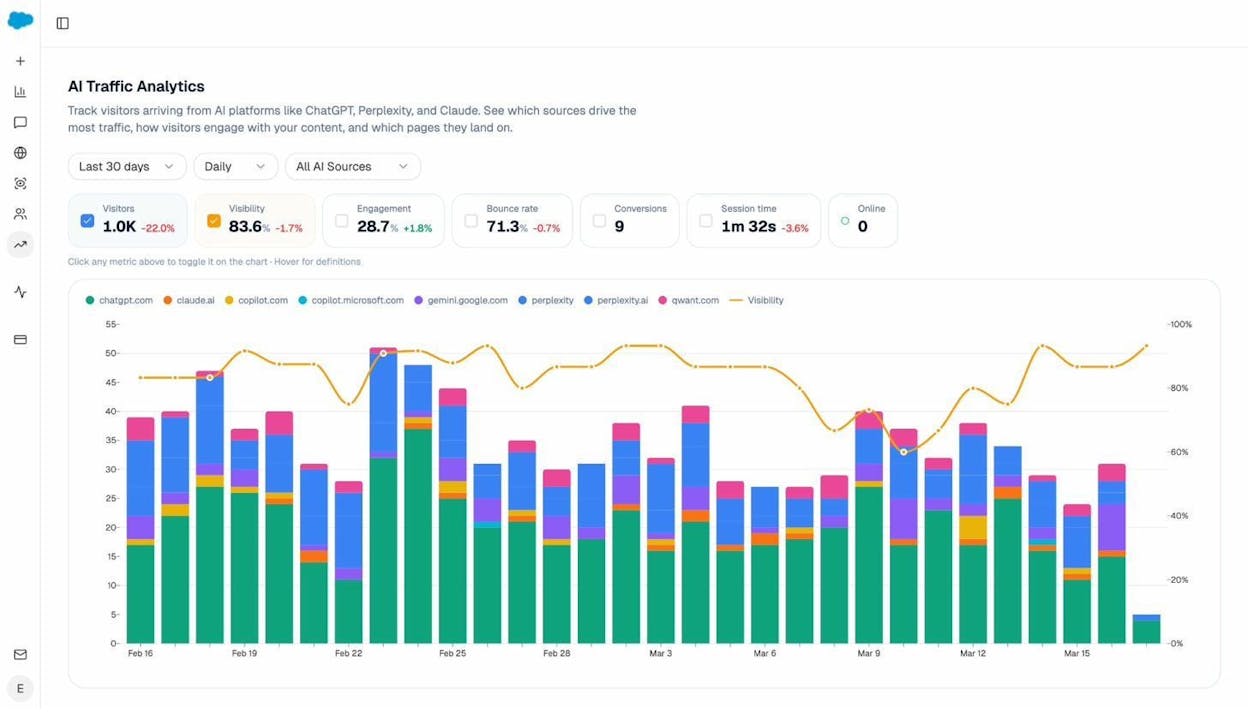
Track which of your pages get AI traffic.
The AI Traffic Analytics feature shows visitors arriving from AI search engines, broken down by source. You can see total visitors from ChatGPT, Claude, Perplexity, Gemini, and Copilot, and track the trend over time.
The Landing Pages view shows exactly which pages receive AI-referred traffic, with engagement metrics and the specific AI citations driving that traffic.
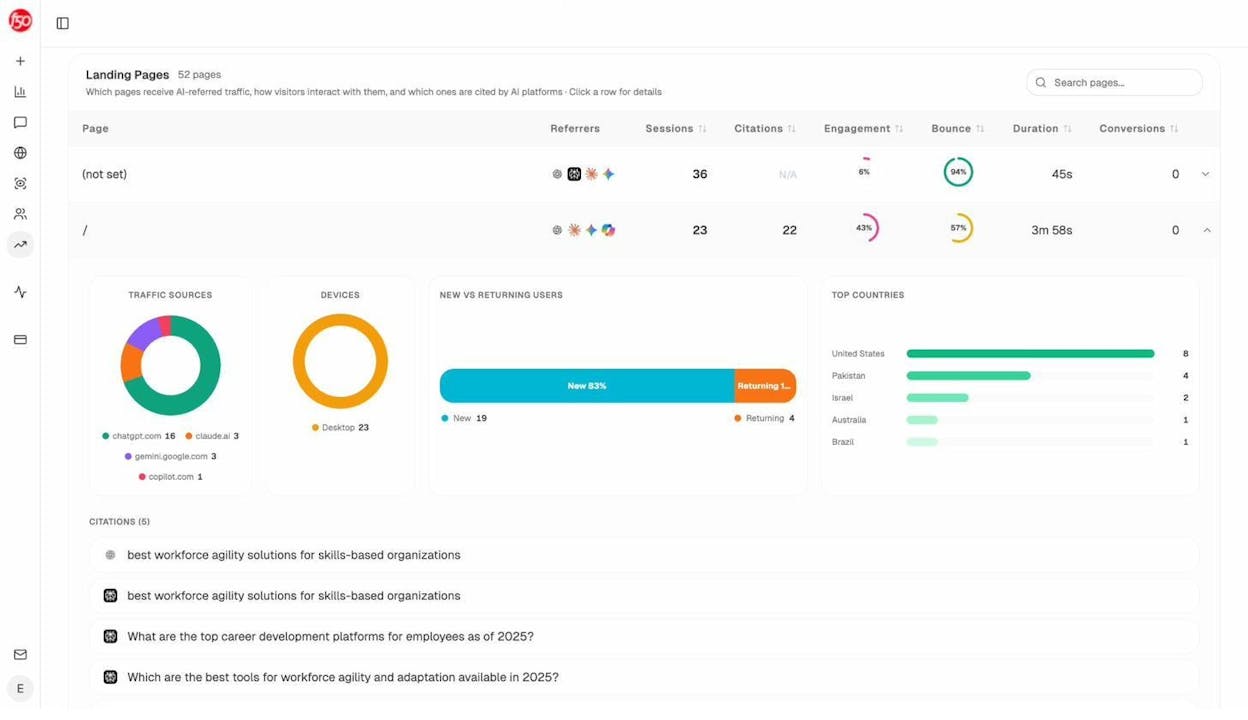
If a page is already receiving AI traffic, double down on it. Build more backlinks. Update it with fresh data. The compounding effect of backlinks plus AI citations reinforces itself.
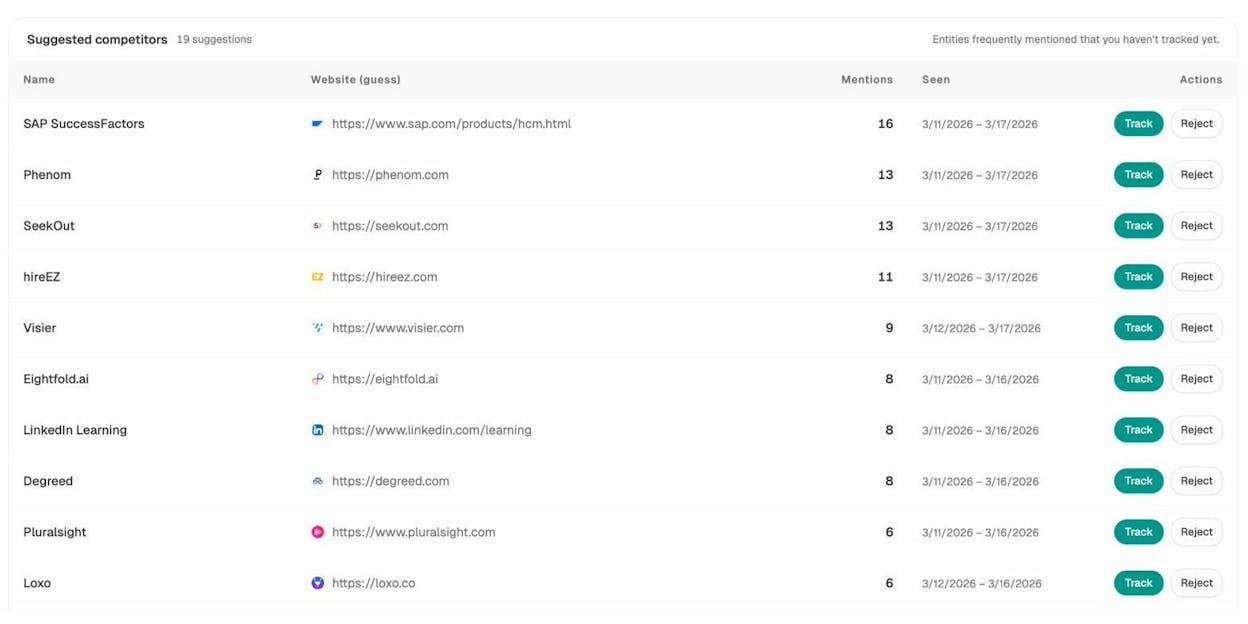
Find where competitors get cited instead of you.
The Competitor Intelligence feature shows which competitors AI engines mention most. If a competitor is getting cited on prompts where you’re absent, that’s both a content gap and a link building opportunity.
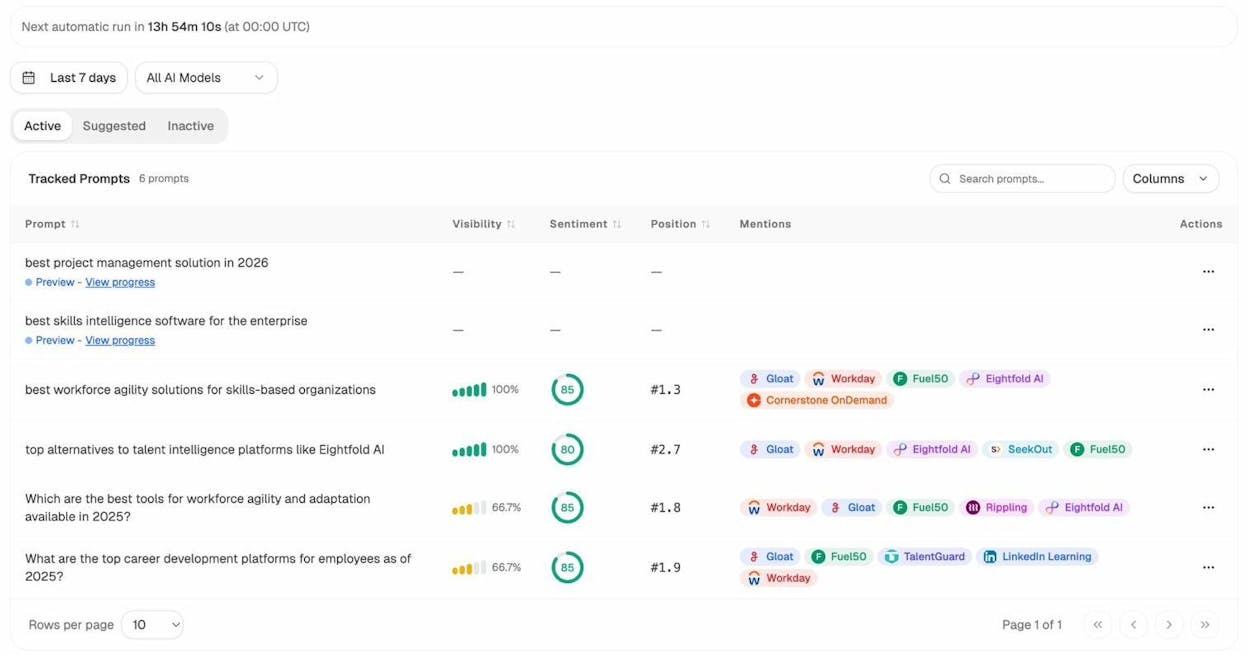
Track the questions AI answers about your topic.
The Prompt Tracking feature shows which prompts trigger AI responses that mention (or miss) your brand. This is a prioritized list of content and link building opportunities.
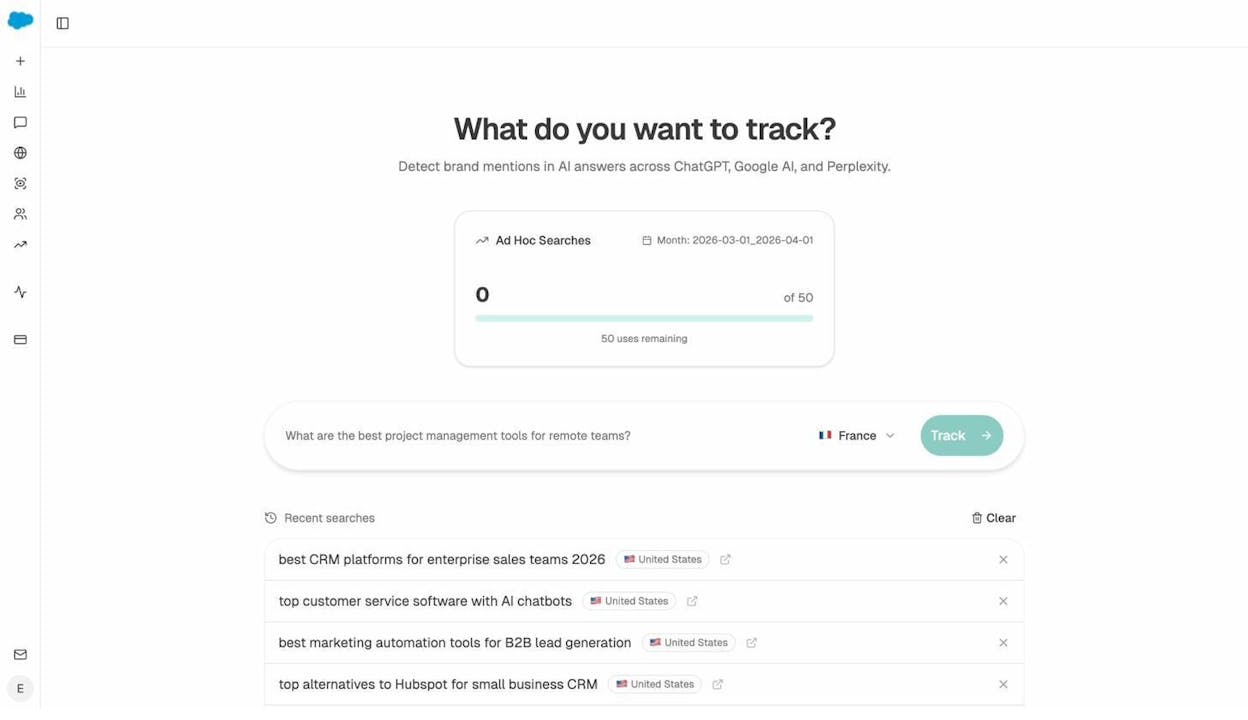
You can also use the AI Search Explorer to run ad hoc searches and see how AI engines respond to specific questions.
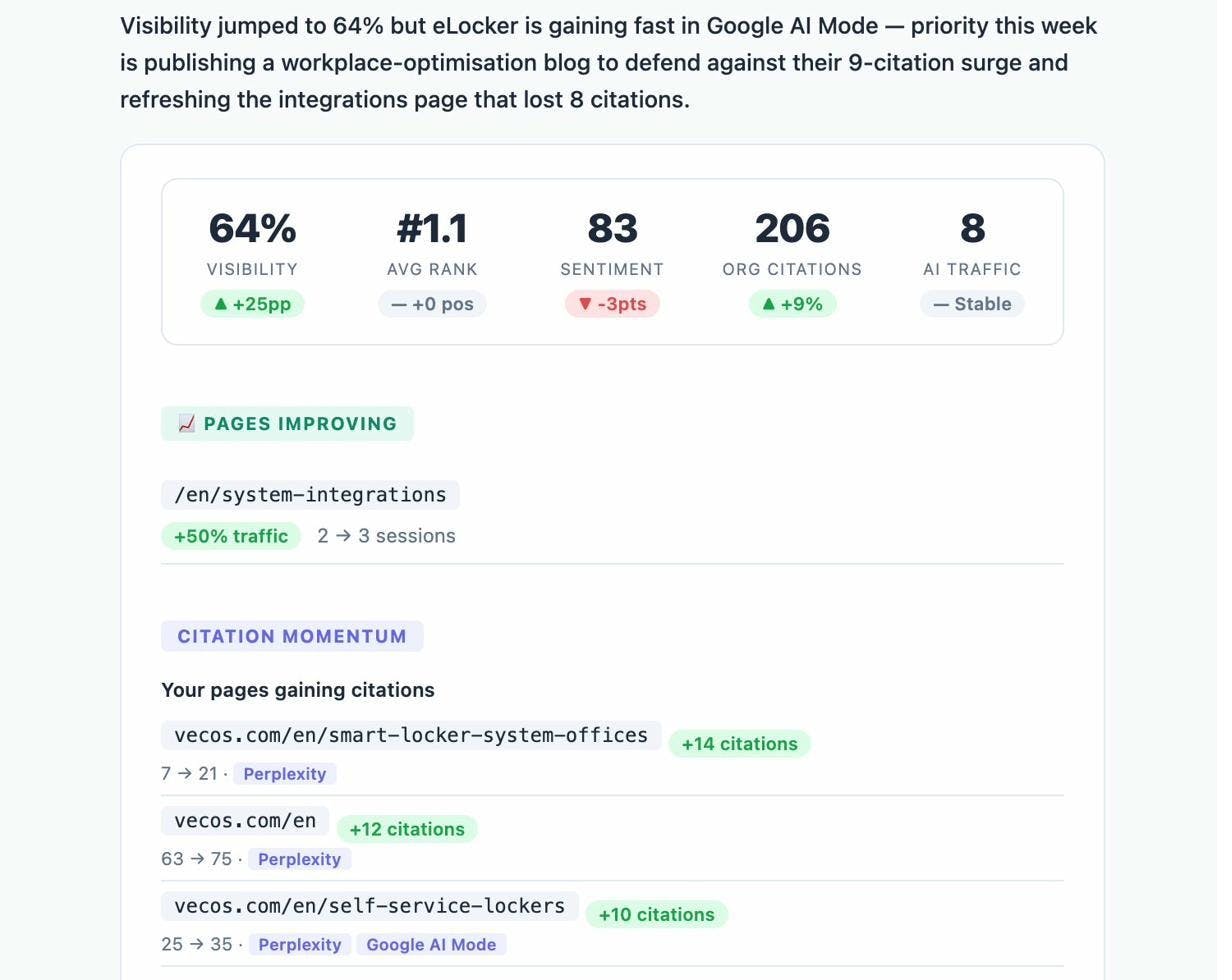
Get weekly AI visibility updates.
The Weekly Email Digests deliver a summary of visibility changes, citation momentum, and competitor shifts every Monday. You can see whether your link building and content work is translating into AI visibility without logging into the dashboard.
How to Evaluate Whether a Backlink Is Worth Pursuing
Before spending time on any link opportunity, evaluate it against these criteria.
Relevance
A link from a website in your industry carries more weight than a link from an unrelated site. Google understands topical relationships. When building your outreach list, prioritize relevance above all other factors. A moderately authoritative site in your niche is usually more valuable than a highly authoritative site in an unrelated vertical.
Authority
A website’s authority is determined by its own backlink profile. Use the Analyze AI Website Authority Checker to check any site’s domain authority. Sites with a Domain Rating (DR) above 40 are generally worth pursuing. But a DR 30 site with real traffic in your exact niche is often more valuable than a DR 80 general site.
Traffic
Does the linking site have real visitors? Use a website traffic checker to verify readership. A site with no traffic may exist only to sell links. Links from sites with real traffic also generate referral visitors, which is a bonus.
Editorial standards
Is the content well-written, original, and regularly updated? Links from sites with high editorial standards are more durable and less likely to be devalued by algorithm updates.
Link placement
A link embedded within body content of a relevant article is worth more than a link in a sidebar, footer, or author bio. Google evaluates where on the page the link appears and what text surrounds it.
Quick reference table for evaluating backlink quality:
|
Factor |
Strong signal |
Weak signal |
|---|---|---|
|
Relevance |
Same industry, related topic |
Completely unrelated |
|
Authority |
DR 40+, established site |
New or spammy site |
|
Traffic |
Real organic visitors |
Zero traffic |
|
Editorial quality |
Human-edited, original |
Thin, auto-generated |
|
Placement |
In-content, contextual |
Sidebar, footer, bio |
|
Link type |
Dofollow |
Nofollow (still some value) |
How to Create Content That Earns Backlinks on Autopilot
If you want to stop hustling for every link and start attracting them, invest in content that people link to without being asked.
Start with competitive gap analysis
Before creating anything, find out what earns links in your industry. Use the competitor analysis from Step 2 above to identify the content formats that attract links in your space.
The Analyze AI Content Writer can help identify content ideas based on AI visibility gaps, competitor keywords, and search opportunities. You can input a keyword or competitor URL, and it researches the landscape, identifies gaps, and builds an outline.
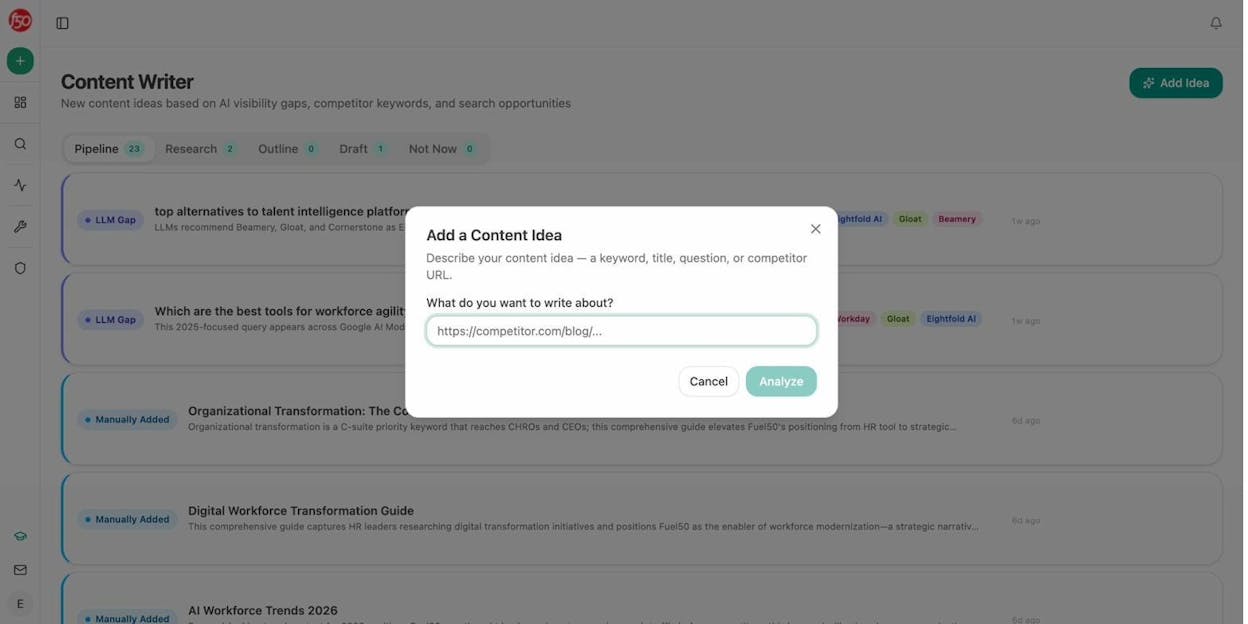
But the tool handles the research and structure. The linkability comes from what you add: your data, your examples, your expertise, your original perspective.
Five principles for linkable content
1. Include data nobody else has. Run a survey. Analyze your product data. The more original and specific your numbers, the more citable they are. Writers need sources for statistics, and if your page is the source, they link.
2. Be the most comprehensive resource. If someone needs a reference to link to on your topic, your content should be the obvious choice. Cover every subtopic, answer every common question, and organize the information for easy scanning.
3. Create something visual. Original diagrams, charts, and infographics get embedded across the web. A good visual that simplifies a complex concept travels far beyond your site.
4. Build free tools. A keyword difficulty checker, a keyword rank checker, or a YouTube keyword tool each solve a specific problem that users share. The upfront investment is higher, but the link-earning potential compounds.
5. Make content easy to reference. Clear headers, a table of contents, a summary stat near the top. Make it easy for other writers to find and link to the specific point they want to cite.
Refresh and re-promote existing content
Sometimes the fastest path to more backlinks is improving what you already have. The Analyze AI Content Optimizer surfaces pages with declining traffic and gives specific recommendations for improvement, including content scoring and line-by-line editor comments.
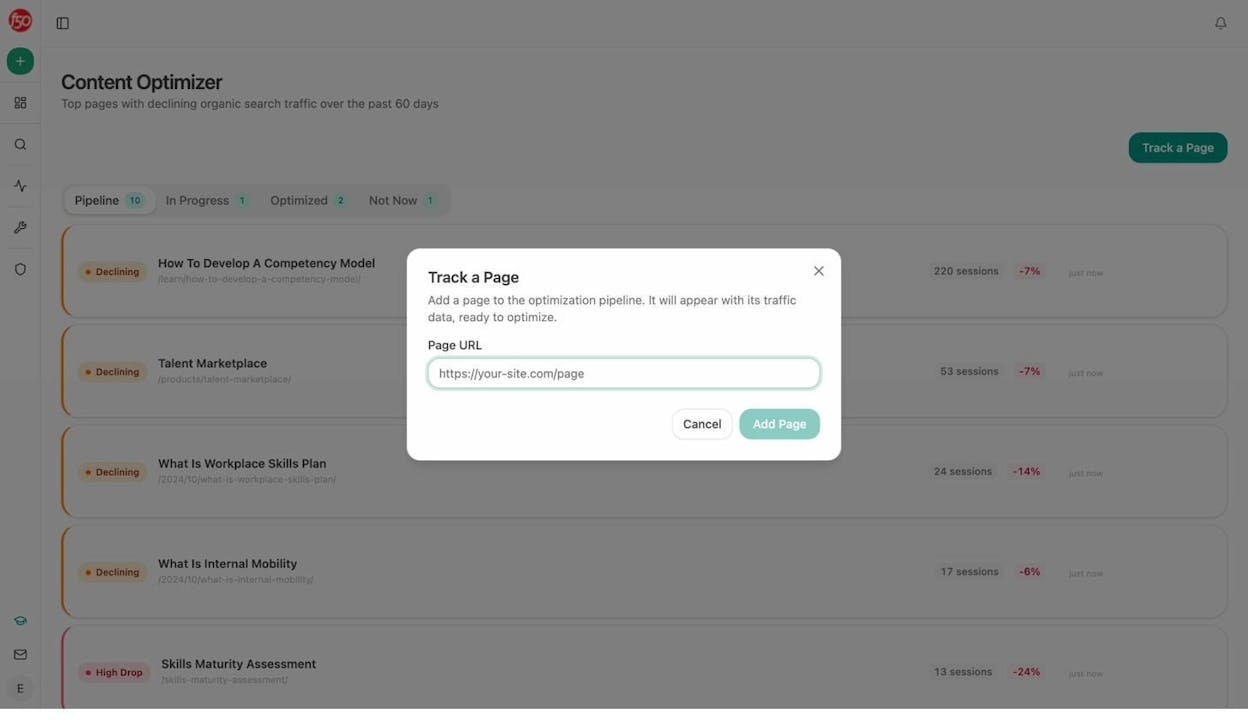
When you add a URL, it fetches the page and provides editorial comments with specific improvement suggestions.
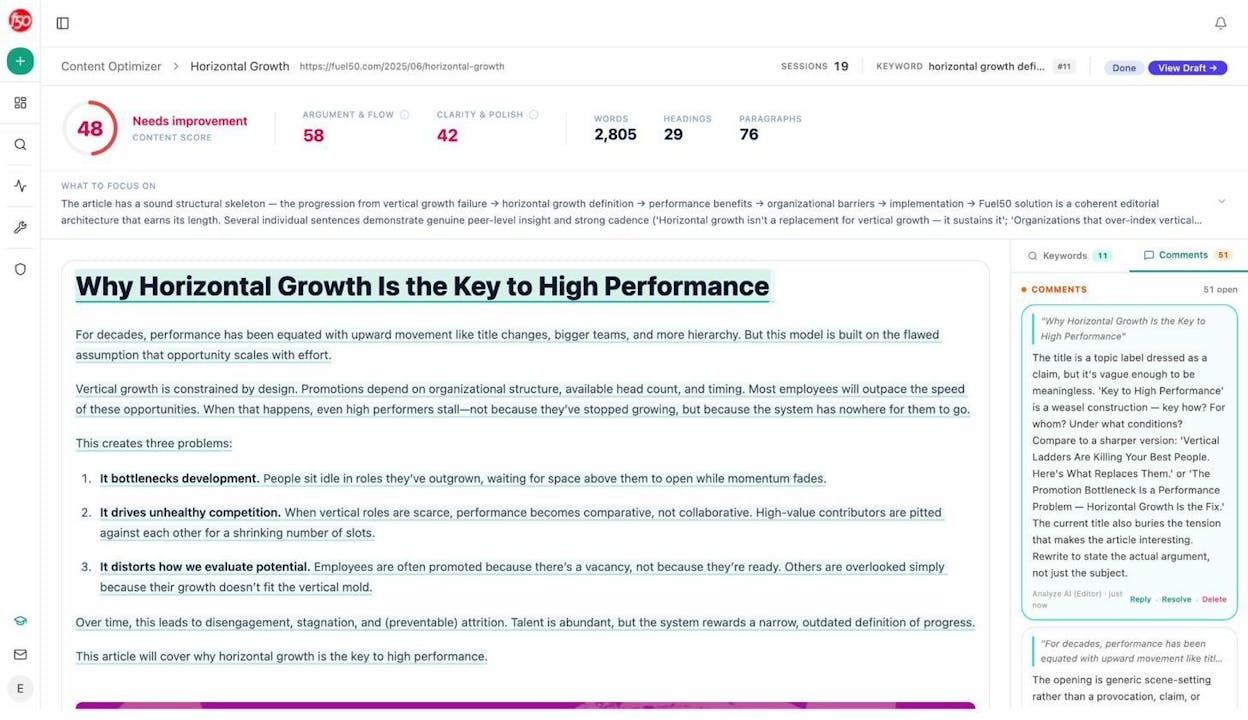
Refreshing an outdated guide with current data and better examples can renew its link-earning potential. You can re-promote it to the same outreach targets and earn a fresh wave of backlinks.
Link Building Mistakes That Lead to Penalties
Buying cheap links in bulk. At $3-$10 per link, you’re buying from a link farm. The resulting manual penalty can remove your site from search results.
Using the same anchor text for every link. If 80% of your backlinks use the exact keyword phrase as anchor text, it looks unnatural. Natural profiles have a mix of branded, generic, partial-match, and naked URL anchors.
Ignoring relevance. A link from a high-authority cooking blog doesn’t help your B2B SaaS company. Always prioritize topical fit.
Scaling link exchanges beyond natural relationships. Swapping links with 5-10 genuine partners is normal. Joining an exchange group with 200 strangers is a spam policy violation.
Neglecting internal links. External backlinks get the attention, but internal links distribute authority across your site. When you earn a powerful backlink to one page, make sure it links internally to other important pages.
Stopping after one campaign. Link building is ongoing. It’s part of SEO content strategy. Your competitors build links every month. If you stop, you fall behind.
Tracking Your Link Building Progress
New referring domains per month. Your most important metric. Compare your growth rate against competitors using the Analyze AI Website Authority Checker.
Rankings for target keywords. Track whether target pages climb in search results as you build links. If rankings don’t move after 30 new links, the links may not be high enough quality or the page needs content improvements.
Referral traffic from backlinks. Good links send visitors. Check analytics for referral traffic from linking sites. If a backlink sends zero traffic, the linking site may not have real readers.
AI search visibility. Track whether your pages get cited more frequently by AI engines as your backlink profile grows. Use Analyze AI to monitor visibility, citations, and sentiment. The weekly digests give you a snapshot without logging in.
Outreach response rate. Below 5% means your emails need work. Above 10% means you’re doing something right.
Start Building Backlinks Today
Building quality backlinks takes effort, patience, and a willingness to create content that deserves to be linked to. There are no sustainable shortcuts.
Here’s your action plan:
-
Run a competitive backlink audit. Find 3-5 competitors, review their backlink profiles, and identify replicable opportunities.
-
Study their most linked pages. Identify what types of linkable assets work in your industry.
-
Create or improve one piece of content designed to earn links. Make it the most comprehensive, most data-rich, or most useful resource on its topic.
-
Build an outreach list of 50-100 relevant prospects. Use guest posting, broken link building, and resource page outreach to earn links.
-
Track progress across both channels. Monitor new referring domains, keyword rankings, and AI search visibility to measure impact.
Every quality backlink strengthens your presence in both traditional search and AI-powered search. The pages that earn links are the same pages that AI search engines cite and recommend. Build for both, and the compound effect multiplies your results.
Link building is a marathon. Start today.

Ernest

Ibrahim


