



Summarize this blog post with:


In this article, you’ll learn how to decide if you need an in-house SEO team, see seven team structures that work at different company stages, and follow a five-step plan to hire, organize, and equip your team. You’ll also see how to build an SEO team that owns AI search visibility from day one, since that channel now compounds the same way Google traffic does.
Table of Contents
Should you build your own SEO team?
Building an in-house SEO team is the right move when three conditions are true.
First, organic search drives meaningful pipeline or revenue, or it could if you invested in it. Second, your domain is competitive enough that you cannot win with a generalist marketing hire. Third, you can commit to the function for at least 18 months, which is roughly how long it takes a new SEO hire to ship the strategy, content, and links that move rankings.
If those three are true, an in-house team usually outperforms an agency on cost per outcome over a multi-year horizon. You also get faster iteration loops, deeper product knowledge, and a single owner for both Google and AI search. If they are not true, hire an agency or a fractional SEO until they are.
Here is the real cost of building a small in-house team in 2026.
|
Role |
Salary range (US) |
Tools per seat |
|---|---|---|
|
SEO manager (mid-level) |
$80,000 to $110,000 |
$200 to $400 / month |
|
Content strategist |
$70,000 to $95,000 |
$100 to $200 / month |
|
SEO writer |
$55,000 to $80,000 |
$50 to $150 / month |
|
Outreach or link builder |
$55,000 to $75,000 |
$100 to $200 / month |
|
Technical SEO specialist |
$90,000 to $130,000 |
$200 to $400 / month |
A three-person team costs roughly $230,000 to $300,000 per year fully loaded. A five-person team lands closer to $400,000 to $550,000.
Compare that to a mid-tier SEO agency at $5,000 to $15,000 per month. The math favors in-house once you cross roughly $80,000 per month in retainers, or once you decide that organic search is a permanent strategic channel rather than a project.
One thing has changed about this calculation in 2026. AI search now sends qualified traffic to your site, and the brands that rank for a Google query are not always the brands that get cited by ChatGPT or Perplexity. Whoever owns SEO needs to also own AI search visibility, or the two strategies will drift apart.
7 SEO team structures that actually work
There is no single right way to structure an SEO team. The right structure depends on your company stage, competitive landscape, and whether your business depends on technical, transactional, or local content.
The seven structures below cover the majority of in-house and agency setups. For each, I have included where the responsibility for AI search visibility usually sits, since that is the part most existing org charts get wrong.
1. Solo SEO plus freelancers (pre-product-market-fit stage)
![[Screenshot: Simple org chart showing one SEO manager at the top with three freelance contractors below, a writer, a link builder, and a developer]](https://www.datocms-assets.com/164164/1777809538-blobid1.png?auto=format,compress&w=1248&fit=max)
Best for. Startups under 30 people, or any company where SEO is one of three or four marketing channels.
Where AI search lives. The SEO manager runs everything, including weekly checks on AI visibility. They route findings to the freelance writers.
Common failure mode. The SEO manager edits freelance work instead of doing strategy. Fix this by hiring one strong senior writer instead of three average ones.
2. Small in-house team (3 to 5 people)
![[Screenshot: Org chart showing SEO manager at top with three direct reports, a content lead, an outreach lead, and a technical SEO specialist]](https://www.datocms-assets.com/164164/1777809553-blobid2.png?auto=format,compress&w=1248&fit=max)
Best for. Companies between 30 and 150 people where SEO contributes at least 20 percent of pipeline.
Where AI search lives. Split across roles. The content lead audits which pages get cited by AI engines and decides what to update. The technical SEO specialist owns entity work, schema, and the llms.txt file. The SEO manager reviews weekly visibility data and reprioritizes the roadmap.
Common failure mode. The team builds a single workflow for Google and treats AI search as an afterthought. By the time leadership asks about ChatGPT visibility, there is no data and no plan.
3. Mid-sized in-house team (6 to 10 people)
![[Screenshot: Org chart showing director of SEO with two managers (content and growth), each with two to three direct reports]](https://www.datocms-assets.com/164164/1777809553-blobid3.png?auto=format,compress&w=1248&fit=max)
Best for. Companies where SEO is the primary acquisition channel, or where there are multiple product lines that each need dedicated coverage.
Where AI search lives. A dedicated AI search specialist or a senior content strategist with AI search as a named responsibility. They own prompt tracking, citation monitoring, and the playbooks that turn visibility data into briefs.
Common failure mode. The director hires for what they used to do (more writers) instead of what the team needs (a data analyst, brand strategist, or technical SEO).
4. Enterprise in-house team
![[Screenshot: Org chart showing VP of search with three managers, technical SEO, content SEO, and AI search and brand visibility, each managing a team of 3 to 6]](https://www.datocms-assets.com/164164/1777809564-blobid4.png?auto=format,compress&w=1248&fit=max)
Best for. Public companies and large private companies where organic search drives nine figures of pipeline.
Where AI search lives. A separate function, often led by a senior IC with one or two reports. This team owns brand visibility, sentiment monitoring, and the relationship with PR and comms.
Common failure mode. Politics. Technical SEO, content SEO, and AI search compete for budget and headcount instead of working from a shared roadmap.
5. International or multi-region SEO team
![[Screenshot: Org chart showing global SEO director with regional leads (US, EU, APAC, LATAM), each leading a content and link team for their market]](https://www.datocms-assets.com/164164/1777809568-blobid5.png?auto=format,compress&w=1248&fit=max)
Best for. Companies selling into more than three major markets.
Where AI search lives. Each regional lead owns AI visibility for their market because answer quality and citation patterns vary heavily by language. ChatGPT in French and ChatGPT in English cite different sources, so a US playbook will not work in Germany.
Common failure mode. The HQ team builds central tooling that doesn’t account for regional differences, then wonders why the regions ignore it.
6. Agency pod structure
![[Screenshot: Org chart showing three pods, each with an account manager, an SEO strategist, an SEO writer, and a link builder, all reporting to an agency director]](https://www.datocms-assets.com/164164/1777809575-blobid6.png?auto=format,compress&w=1248&fit=max)
Best for. Agencies serving 6 to 30 clients.
Where AI search lives. Each pod has one person trained on AI search workflows. Pods serving B2B SaaS clients tend to have stronger AI search coverage than pods serving local businesses.
Common failure mode. Pods do not share learnings. The same playbook gets rebuilt three times because no one owns horizontal knowledge.
7. Flat or embedded SEO team
![[Screenshot: Org chart showing four SEO individual contributors all reporting directly to the head of marketing, with no SEO manager layer]](https://www.datocms-assets.com/164164/1777809579-blobid7.png?auto=format,compress&w=1248&fit=max)
Best for. Series A to B startups where the head of marketing wants direct visibility into search work.
Where AI search lives. Distributed. Whoever picks up the work does it. Works in small teams, breaks down past five people.
Common failure mode. Without a senior SEO owner, the team chases tactics. Six months in, you have 40 published posts and no rank improvements.
How to build an SEO team in 5 steps
Building an SEO team is not just hiring. It is sequencing your hires against the work that matters most, then giving them the tools and the cadence to ship.
Step 1: Audit your starting position
You cannot hire correctly until you know what is broken. Run a baseline audit across four areas before you write a single job description.
Technical SEO. Use Screaming Frog, Ahrefs Site Audit, or Sitebulb to crawl your site. Look at crawl errors, indexability, and Core Web Vitals. More than 200 critical errors means your first hire should probably include technical work.
Content gaps. Pull your top 50 pages from Google Search Console. If most of them are old, thin, or irrelevant to your current ICP, your first hire should be a content lead, not a technical SEO. For a deeper read on this audit, our SEO content strategy guide walks through the prioritization framework.
Link profile. Run your domain through our free website authority checker and compare it to the top three competitors in your space. If your authority is more than 15 points behind, you need outreach capacity early.
AI search visibility. This is the part most teams skip and then regret. Pull the 20 to 30 prompts your buyers actually ask AI assistants when evaluating tools like yours. Run them on ChatGPT, Perplexity, Gemini, and Claude. Note where you appear, where competitors appear instead, and which sources the AI is citing.
You can do this manually for a week or two. Past that, you need a tool that runs the same prompts on a schedule.
If you are doing this for the first time, the Analyze AI overview dashboard gives you visibility and sentiment side by side, plus a one-line summary of what to focus on this week.
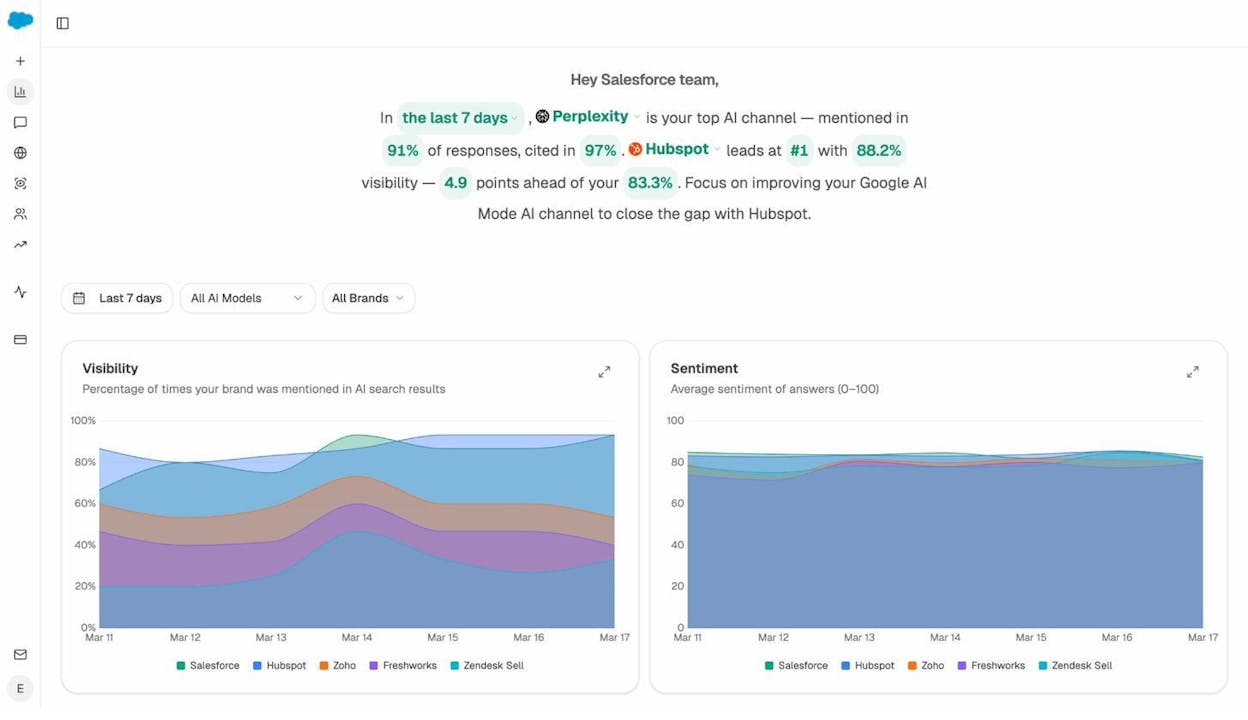
The first audit usually surfaces three things. Prompts where you should appear and don’t. Competitors who outrank you in AI answers but not on Google. Pages on your site that AI engines already cite that you can double down on.
The output of step 1 is a one-page summary of what is broken, what is working, and what you cannot fix without more people. That summary becomes the brief for step 2.
Step 2: Define your hiring sequence
Most teams hire the wrong role first. The right first hire is rarely an SEO manager. It is the role that matches your biggest gap from step 1.
Use this matrix to decide.
|
Biggest gap |
First hire |
Second hire |
Third hire |
|---|---|---|---|
|
Almost no content published |
Content lead |
SEO writer |
SEO manager |
|
Lots of content, no rankings |
Technical SEO |
Link builder |
Content strategist |
|
Strong content, weak authority |
Outreach lead |
Digital PR |
Content strategist |
|
Strong on Google, invisible in AI |
AI search specialist (or senior content with AI mandate) |
Content engineer |
Content strategist |
|
Multiple regions, generic content |
Regional content leads |
Localization PM |
Senior strategist |
The order matters. Hiring an SEO manager when there is no team to manage wastes 70 percent of their time. Hiring a writer when there is no strategy to execute wastes their first six months.
If you scored high on the AI search row, your first hire needs to come in understanding how prompt tracking, citation analysis, and entity work translate into briefs for writers. Our guide on outranking competitors in AI search covers what that workflow looks like.
Step 3: Write job descriptions that attract real talent
The quality of your candidates is set by the quality of your listing. A weak listing will not attract a strong candidate, no matter how much you pay.
Three rules for SEO job descriptions in 2026.
List outcomes, not tasks. Replace “writes 4 blog posts per month” with “owns the cluster strategy that grew non-branded traffic by X percent at last role.” Outcomes filter for senior thinkers. Tasks filter for junior executors.
Name AI search explicitly. If the role touches content or visibility, the description should mention “AI search visibility” or “answer engines” or “citation share.” This single change filters out candidates whose mental model of SEO stopped updating in 2022.
Ask for a portfolio of decisions, not a portfolio of pages. The strongest SEO hires can walk you through three calls they made and explain why. The mediocre ones send you a list of articles they wrote.
Skip the years-of-experience line. Replace it with two paragraphs describing what success looks like in the first 90 days. People who can do the work will self-select in. People who can’t will self-select out.
Step 4: Find candidates beyond job boards
Job boards are the worst place to find senior SEO talent because the people you want are usually not actively looking. Better sources, ranked by quality.
Your team’s network. The single highest-yield channel. Ask every current marketing hire to send their three best former colleagues your job description. Pay a $3,000 to $5,000 referral bonus. Referrals close at three to five times the rate of cold applicants.
SEO and AI search communities. Online SEO Slack, Aleyda Solis’ newsletter, the SEO subreddit, and the LinkedIn SEO commentariat. Find someone whose thinking you respect and reach out directly.
Adjacent roles. Some of the strongest AI search specialists come from PR, brand strategy, or competitive intelligence backgrounds, not SEO. The work rewards people who think about narrative and source authority.
Job boards. Indeed, We Work Remotely, and ProBlogger fill seats but rarely surface stars. Use them last, not first.
For freelancers, Upwork and Contra are fine for short-term work. For ongoing freelance writing, the highest-quality freelancers are usually found through introductions in private content marketing Slack groups.
If you want a deeper read on hiring frameworks, the book Who by Geoff Smart and Randy Street holds up. It is opinionated and prescriptive, which is what you want in a hiring book.
Step 5: Set up your stack and meeting cadence
Once your team is in place, the question shifts from “who do we need” to “how do we keep them aligned.” Your minimum viable stack has six pieces. A keyword and rank tracker (Ahrefs, Semrush, or our free keyword rank checker). A site audit tool. A CMS the team can publish to without engineering tickets. An AI visibility tool that tracks prompts, citations, and AI traffic. A project management tool (Asana, Linear, or Notion). A weekly digest that surfaces what changed without forcing anyone to log in.
The last piece matters more than people think. Most SEO teams report monthly because logging into a dashboard is a chore. A weekly digest reverses that. Your team gets the priorities pushed to their inbox every Monday.
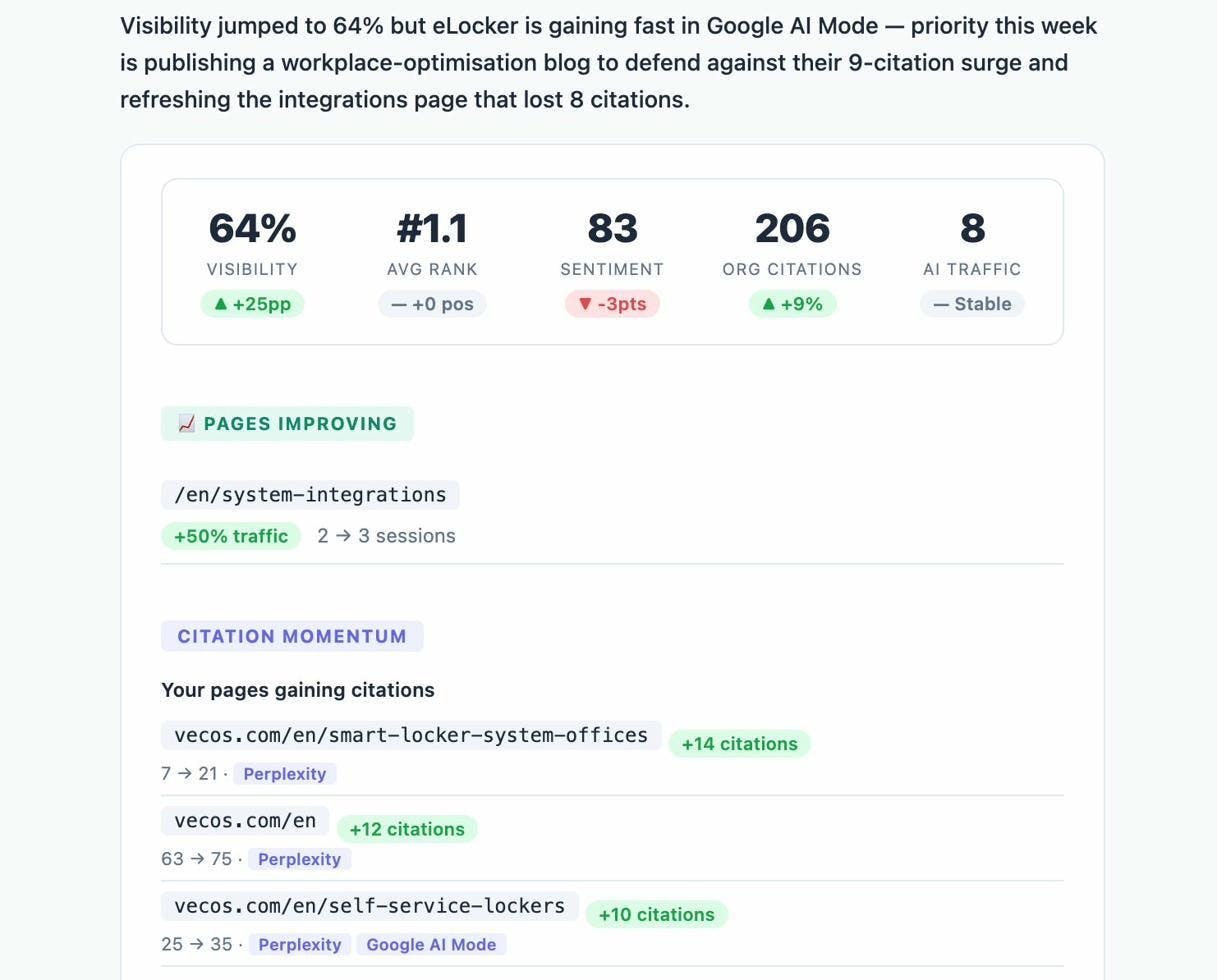
A workable meeting cadence has four layers. Daily 15-minute standup focused on blockers, not status. Weekly 60-minute team meeting to review the digest, reprioritize work, and unblock cross-functional dependencies. Monthly 90-minute strategy review with leadership covering rankings, AI visibility, traffic, and pipeline. Quarterly team offsite to plan the next 90 days against company priorities.
Skip status meetings. They are the single biggest waste of an SEO team’s week.
How to assign responsibilities so nothing falls through the cracks
Here is the responsibility matrix for a small in-house team. Use it as a starting point and adjust based on your hires’ strengths.
|
Role |
Owns |
Daily work |
Weekly KPI |
Quarterly KPI |
|---|---|---|---|---|
|
SEO manager |
Strategy and roadmap |
Reviews data, unblocks team, edits briefs |
Team velocity |
Non-branded traffic growth |
|
Content strategist |
Brief quality and topic selection |
Researches topics, writes briefs, reviews drafts |
Brief approval rate |
Pages ranking in top 10 |
|
SEO writer |
Draft quality and content velocity |
Writes drafts, edits, publishes |
Pages shipped |
Pages ranking in top 3 |
|
Technical SEO |
Site health and crawl efficiency |
Audits, fixes, monitors Core Web Vitals |
Critical errors fixed |
Site health score |
|
Outreach or link builder |
Authority and brand mentions |
Prospecting, outreach, follow-ups |
Reply rate, links won |
Domain rating change |
|
AI search owner |
AI visibility and citation share |
Prompt tracking, citation analysis, briefs for writers |
Prompt visibility, citation share |
AI traffic growth |
The AI search owner role is new for most teams. In smaller teams it is a hat worn by the SEO manager or content strategist. In larger teams it is a dedicated role.
Whoever owns it should run the same loop every week. Pull the prompt tracking report. Identify the prompts where competitors gained ground. Identify the pages where you gained citations. Brief writers on what to update or write next. The Analyze AI Discover module and the perception map are built around this loop.
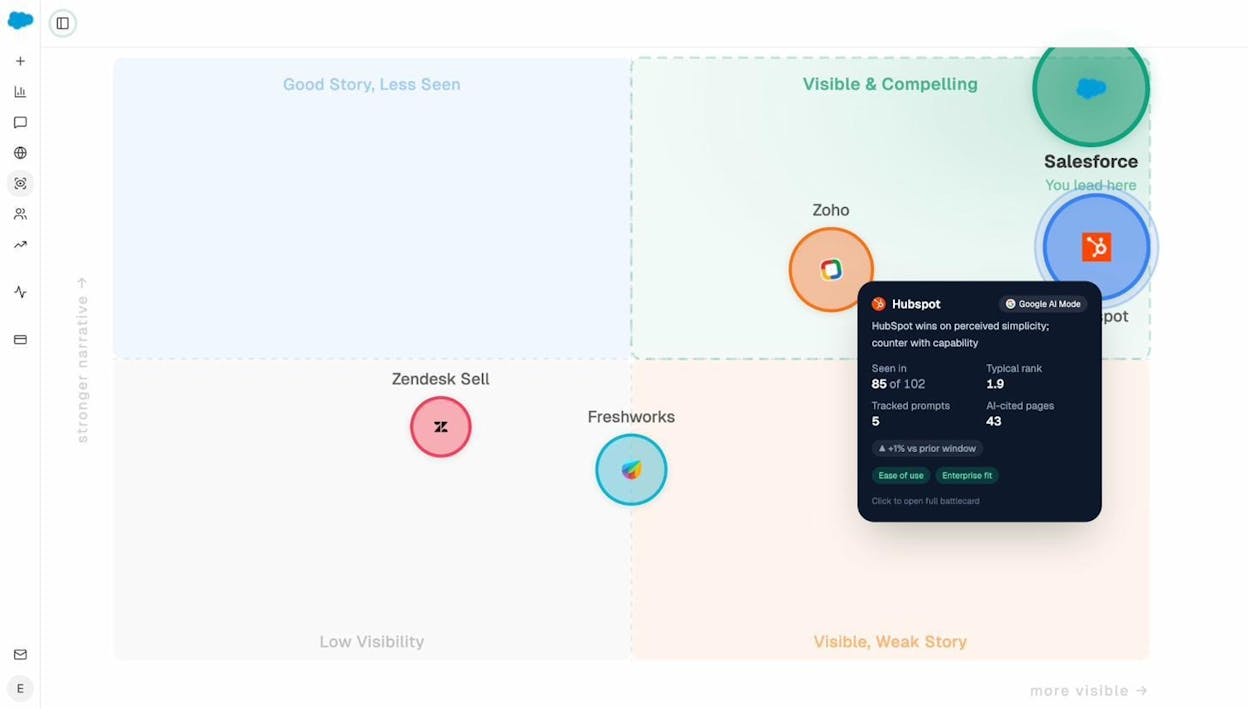
The point of the matrix is that every metric has one owner. When non-branded traffic dips, you know whose problem it is. When AI citations drop on a key prompt, you know who is briefing the fix. Without that ownership, dashboards become wallpaper.
The 5 mistakes that kill new SEO teams
The teams that fail usually fail in the same ways.
1. Hiring a senior SEO before you have data on what’s broken. A senior hire walks in expecting strategy and a team. If you can give them neither, they leave within a year.
2. Treating AI search as a side project. AI search now drives 1 to 5 percent of qualified traffic for many B2B sites and is growing fast. Ignore it for 12 months and you rebuild your content strategy from scratch. Our SEO pillars guide covers how to fold AI search into the core strategy from the start.
3. Hiring writers who can’t write for both humans and answer engines. Modern SEO writers need to understand entity coverage, citation patterns, and how to make claims that AI can attribute back to your brand. Writers who only know “1,500 words around a keyword” produce content that ranks neither on Google nor in AI answers.
4. Underinvesting in tooling. A $200,000 hire using $50 of tools is a $200,000 hire doing $80,000 of work. Budget at least 5 percent of total team cost for tools.
5. No clear escalation path with engineering. Technical SEO requires development time. If your SEO team has to fight for engineering tickets every quarter, the work never ships. Lock in 10 to 15 percent of your engineering team’s capacity for SEO work as part of annual planning.
Avoid those five and follow the five-step plan above, and you will have a functioning SEO team within 90 days and a high-output one within six months. From there, the work becomes about compounding the wins on both Google and AI search.

Ernest

Ibrahim


