



Summarize this blog post with:


In this article, you’ll learn what affiliate marketing is, how it works, and how to build an affiliate business from scratch—step by step. You’ll also learn how to drive traffic using both SEO and AI search (a growing channel most beginners ignore), how to pick the right affiliate programs, and how to avoid common mistakes that keep new affiliates stuck at $0.
Business spending on affiliate marketing in the U.S. surpassed $8.2 billion in 2022, and the industry is projected to grow to $15.7 billion by 2024, according to Influencer Marketing Hub. That growth isn’t slowing down. If anything, AI-powered search engines like ChatGPT, Perplexity, and Google’s AI Mode are creating entirely new surfaces for affiliate content to appear in front of buyers.
The opportunity is real. But so is the competition. This guide will show you how to approach affiliate marketing the right way—with a strategy that compounds over time instead of fizzling after a few blog posts.
Table of Contents
What Is Affiliate Marketing?
Affiliate marketing is a business model where you promote another company’s product or service. When someone clicks your unique affiliate link and makes a purchase, you earn a commission. That commission is usually a percentage of the sale price (anywhere from 1% to 50%+) or a fixed dollar amount.
Here’s how the basic flow works:
-
You join an affiliate program and receive a unique tracking link.
-
You share that link in your content (blog posts, videos, emails, social media).
-
A reader clicks the link and is taken to the merchant’s website.
-
If they buy something, the merchant tracks the sale back to you.
-
You get paid.
For example, if you write a blog post reviewing the best project management tools and include an affiliate link to one of them, every reader who clicks through and purchases earns you a commission—without you ever building, shipping, or supporting the product.
The key distinction: you are not the seller. You are the recommender. Your job is to help people make informed decisions and point them to the right products. The merchant handles everything else—inventory, shipping, customer service, and refunds.
Is Affiliate Marketing Legit?
Yes. Affiliate marketing is a legitimate and well-established business model used by major companies like Amazon, Shopify, HubSpot, and thousands of others.
It is legal, as long as you comply with advertising disclosure laws in your country. In the U.S., the Federal Trade Commission (FTC) requires you to clearly disclose your affiliate relationships. In the EU, similar rules exist under consumer protection regulations.
It is ethical, as long as you promote products you genuinely believe in and disclose the fact that you earn commissions. The moment you start recommending products solely because they pay the highest commission—regardless of quality—you lose your audience’s trust. And without trust, affiliate marketing doesn’t work.
The brands that have built lasting affiliate businesses—like Wirecutter (acquired by the New York Times for $30 million), RTINGS.com, and NerdWallet—all share one thing: they put the reader first. Their recommendations are thorough, honest, and backed by real testing.
Why Should You Do Affiliate Marketing?
There are several reasons why affiliate marketing is one of the best business models for beginners.
Low startup costs. Starting a traditional business means renting space, buying inventory, and hiring staff. An affiliate business requires a domain name ($3–10/year), web hosting ($3–10/month), and your time. If it doesn’t work out, you haven’t lost your life savings.
No product creation required. You don’t need to develop, manufacture, or ship anything. You don’t need to handle customer service or deal with returns. Your job is to create content and drive traffic—the merchant handles the rest.
Passive income potential. Once you publish a piece of content that ranks in search engines or gets picked up by AI answer engines, it can generate affiliate clicks and commissions for months or years. You write the review once. It earns for you repeatedly.
Location independence. You can run an affiliate business from anywhere with an internet connection. There’s no office, no commute, and no fixed hours.
Easy to diversify and scale. A traditional salesperson sells products from one company. As an affiliate, you can promote products from dozens of companies across multiple niches—all on the same website. If one affiliate program cuts its commission rates, you’re not out of business.
How Does Affiliate Marketing Work?
When you join an affiliate program, you receive a unique link that contains a tracking ID. This ID tells the merchant that you referred the customer.
When someone clicks your link, a small file called a cookie is stored on their device. This cookie has an expiration date—usually 24 hours to 90 days, depending on the program. If the person makes a purchase within that window, you get credit for the sale.
Here’s a real-world scenario:
-
Someone reads your blog post comparing the best email marketing tools.
-
They click your affiliate link for one of the tools.
-
They don’t buy right away—they close the tab and go back to work.
-
Two days later, they come back to the same tool’s website and sign up for a paid plan.
-
Because the cookie is still active on their device, you earn the commission.
This is why cookie duration matters. A 24-hour cookie (like Amazon’s) means you only earn if the person buys within a day. A 90-day cookie gives you a much bigger window.
Key Terms You’ll See in Affiliate Marketing
|
Term |
What It Means |
|
Commission rate |
The percentage or flat fee you earn per sale |
|
Cookie duration |
How long after a click you can still earn a commission |
|
EPC (Earnings Per Click) |
Average revenue earned per click on your affiliate links |
|
Conversion rate |
Percentage of link clicks that result in a sale |
|
Recurring commission |
Ongoing payments for subscription products (e.g., monthly SaaS fees) |
|
Two-tier program |
You earn commissions on sales made by affiliates you recruit |
|
Attribution model |
How the program decides which affiliate gets credit (first click, last click, etc.) |
How Much Money Do Affiliate Marketers Make?
The honest answer: it varies wildly.
According to a survey by Authority Hacker, the average affiliate marketer earns around $8,038 per month. But that average is heavily skewed by top earners. The median is much lower.
Here’s a more realistic breakdown by experience:
|
Experience Level |
Average Monthly Income |
|
Less than 1 year |
$636 |
|
1–2 years |
$2,434 |
|
3–5 years |
$6,760 |
|
6+ years |
$11,500+ |
The takeaway: affiliate marketing is not a get-rich-quick scheme. Most beginners earn very little in their first year. The people making serious money have been at it for years, and they treat it like a real business—not a side hustle.
Your first goal should be simple: make your first affiliate sale. Not your first $10,000 month. Just one sale. That proves the model works. Everything after that is optimization.
How to Get Started with Affiliate Marketing (7 Steps)
Here’s the step-by-step process for building an affiliate marketing business from scratch. Each step builds on the one before it—don’t skip ahead.
Step 1: Choose Your Niche
Your niche is the specific topic area you’ll focus on. It determines what products you promote, what content you create, and who your audience is.
The biggest mistake beginners make is choosing a niche that’s too broad. “Technology” is not a niche. “Fitness” is not a niche. These categories are so wide that you’ll compete with massive sites like CNET, Healthline, and Men’s Health—sites with decades of content and thousands of backlinks.
Instead, go narrow. Here are some examples of how to refine a broad topic into a real niche:
|
Too Broad |
Better |
Even Better |
|
Technology |
Laptops |
Laptops for college students |
|
Fitness |
Home gym equipment |
Home gym equipment for small apartments |
|
Finance |
Credit cards |
Travel rewards credit cards for beginners |
|
Food |
Cooking |
Meal prep for busy professionals |
|
Pets |
Dog products |
Products for senior dogs |
To find the right niche, ask yourself four questions:
-
What am I genuinely interested in? You’ll need to create a lot of content. If you pick a topic you don’t care about, you’ll burn out within a few months.
-
What do I have experience or knowledge in? First-hand experience makes your content more credible and detailed. Google’s E-E-A-T guidelines (Experience, Expertise, Authoritativeness, Trustworthiness) reward content from people who actually know what they’re talking about.
-
Can I monetize this niche? Some topics are interesting but have no affiliate programs worth joining. Before committing, search “[your niche] + affiliate program” to see what’s available.
-
Is the competition manageable? Use a tool like Analyze AI’s free keyword difficulty checker to gauge how hard it will be to rank for your target keywords.
One more thing: don’t confuse “niche” with “product category.” The best affiliate sites are built around a specific audience and their problems—not just a list of products. A site about “meal prep for busy professionals” has a clear audience with clear pain points. A site about “kitchen products” does not.
![[Screenshot: Google search results showing “[niche] + affiliate program” search to find programs]](https://www.datocms-assets.com/164164/1774858750-blobid0.png?auto=format,compress&w=1248&fit=max)
Step 2: Decide on a Content Platform
You can do affiliate marketing on virtually any platform: a blog, YouTube, Instagram, TikTok, a podcast, or a newsletter. But not all platforms are created equal for affiliate marketing.
Here’s a comparison of the most common options:
|
Platform |
Pros |
Cons |
Best For |
|
Blog/Website |
SEO-driven passive traffic, full content control, you own the platform |
Slower to build, requires writing skills |
Long-term, scalable affiliate income |
|
YouTube |
Huge reach, video builds trust fast, good for product demos |
Camera/editing skills needed, algorithm-dependent |
Product reviews, tutorials, unboxings |
|
Instagram/TikTok |
Fast audience growth, high engagement |
Hard to add links, short content lifespan, you don’t own the platform |
Lifestyle and visual niches |
|
Newsletter/Email |
Direct access to subscribers, high conversion rates |
Need traffic source to build the list first |
Any niche (as complement to blog/YouTube) |
|
Podcast |
Deep audience loyalty, low competition in most niches |
Hard to track clicks, slower growth |
Expert interviews, in-depth reviews |
Our recommendation for beginners: start with a blog. Here’s why.
A blog gives you full ownership of your content and your audience. Unlike social media, where algorithm changes can tank your reach overnight, a blog with strong SEO generates consistent organic traffic from Google. And as you’ll see later in this guide, your blog content can also be picked up by AI search engines—giving you a second traffic channel from the same content.
That said, the best platform is one you’ll actually stick with. If you hate writing but love being on camera, YouTube may be the better choice.
Whichever platform you choose, you’ll need to disclose your affiliate relationships. The FTC requires transparency when you earn income from endorsements. On a blog, add a disclosure notice at the top of affiliate posts and on a dedicated disclosure page. On YouTube, mention it in the video and include it in the description.
![[Screenshot: Example of an FTC affiliate disclosure at the top of a blog post]](https://www.datocms-assets.com/164164/1774858750-blobid1.png?auto=format,compress&w=1248&fit=max)
Step 3: Find Affiliate Programs to Join
Once you know your niche and platform, you need to find companies with affiliate programs you can join.
There are three main categories of affiliate programs, each with different tradeoffs:
|
Type |
Commission |
Volume |
Example |
Best For |
|
High commission, low volume |
$50–$500+ per sale |
Fewer potential buyers |
HubSpot (100% of first month), Kinsta ($50–$500) |
B2B, SaaS, enterprise tools |
|
Low commission, high volume |
1–10% per sale |
Mass-market products |
Amazon Associates (1–10%), Target, Walmart |
Consumer products, gadgets |
|
Recurring commission |
15–40% monthly |
Depends on product |
ConvertKit (30% recurring), Teachable (30% recurring) |
Subscription-based services |
The recurring commission model is often the most lucrative for affiliate marketers who play the long game. If you refer someone to a $100/month SaaS tool with a 30% recurring commission, that’s $30/month for as long as they remain a customer. Refer 100 customers and you’re earning $3,000/month passively.
How to find affiliate programs:
1. Search Google. The simplest approach. Search for “[product name] + affiliate program” or “[niche] + affiliate programs.” Most companies that offer affiliate programs have a dedicated page for it.
![[Screenshot: Google search for “email marketing affiliate program” showing results]](https://www.datocms-assets.com/164164/1774858757-blobid2.png?auto=format,compress&w=1248&fit=max)
2. Check affiliate networks. These are platforms that aggregate thousands of affiliate programs in one place. The biggest ones include:
-
ShareASale — Large marketplace with programs across many niches
-
CJ Affiliate (Commission Junction) — Strong in retail, travel, and finance
-
Impact — Popular with SaaS and tech companies
-
PartnerStack — Focused on B2B software
-
Amazon Associates — The easiest to join, works for almost any physical product
3. Look at what competitors are promoting. Visit successful affiliate sites in your niche and check what products they link to. Most affiliate links are easy to spot—they often contain parameters like ref=, aff=, or go through a redirect domain.
4. Reach out directly. If there’s a product you love but they don’t have a public affiliate program, email them and ask. Many companies are happy to set up affiliate relationships with creators who can drive sales.
Things to check before joining a program:
-
Cookie duration — Longer is better. Amazon’s 24-hour cookie is notoriously short. Many SaaS companies offer 30–90 day cookies.
-
Commission structure — Is it a one-time payment or recurring? What percentage?
-
Payment threshold and schedule — How much do you need to earn before they pay? Monthly or quarterly payouts?
-
Program reputation — Search for reviews from other affiliates. Some programs are known for denying commissions or shutting down accounts without cause.
Step 4: Create Great Content
Content is the engine of affiliate marketing. Without useful, trustworthy content, you have no way to attract visitors and no reason for them to click your affiliate links.
But “great content” doesn’t mean “long content.” It means content that actually helps the reader make a better decision. Here’s what that looks like in practice:
Product reviews. Write detailed reviews based on your actual experience with the product. Don’t just summarize the feature list from the company’s website—anyone can do that. Instead, explain what it’s like to actually use the product. What’s good? What’s frustrating? Who is it best for? Who should avoid it?
Wirecutter, one of the most successful affiliate sites ever, built its entire business on this approach. For their guide to the best air purifiers, they tested over 50 models in a controlled environment. You don’t need to go that far, but you do need to go beyond surface-level descriptions.
![[Screenshot: Example of a detailed product review with pros/cons and personal testing notes]](https://www.datocms-assets.com/164164/1774858757-blobid3.png?auto=format,compress&w=1248&fit=max)
Comparison posts. “Product A vs. Product B” posts are some of the highest-converting affiliate content. Readers searching these terms are actively weighing their options. A well-structured comparison—with clear criteria, honest assessments, and a definitive recommendation—can drive significant affiliate revenue.
![[Screenshot: Example of a comparison table showing two products side-by-side]](https://www.datocms-assets.com/164164/1774858763-blobid4.jpg?auto=format,compress&w=1248&fit=max)
“Best of” roundups. Posts like “The 7 Best Email Marketing Tools for Small Businesses” target buyers who haven’t narrowed down their shortlist yet. These posts tend to attract high search volume and can rank for multiple keywords simultaneously.
Tutorials and how-to content. Content that teaches readers how to accomplish something while naturally incorporating affiliate products. For example, “How to Start a WordPress Blog in 2026” can include affiliate links to hosting providers, themes, and plugins.
What makes affiliate content stand out:
-
First-hand experience. Google’s E-E-A-T guidelines prioritize content from people who have actually used the product. Mention specific features you tested, include your own screenshots, and share what surprised you.
-
Specificity. Don’t say “this tool is great for email marketing.” Say “this tool’s automation builder lets you create a 5-email welcome sequence in under 20 minutes, which is faster than any other tool I tested.”
-
Transparency. Be upfront about a product’s weaknesses. Readers trust reviewers who acknowledge downsides—it makes your positive claims more credible.
-
Visual proof. Include screenshots, photos, and even video clips of you using the product. This proves you’ve actually tried it and gives readers a preview of the user experience.
Step 5: Drive Traffic to Your Affiliate Content
You’ve created useful content. Now you need people to find it. Without traffic, even the best affiliate content earns nothing.
There are three main traffic strategies for affiliate marketers—and the smartest affiliates use more than one.
A. SEO (Search Engine Optimization)
SEO is the most reliable long-term traffic strategy for affiliate marketing. When your content ranks on the first page of Google for relevant keywords, you get a steady stream of visitors who are actively searching for information related to your niche—without paying for ads.
Here’s how to approach SEO for an affiliate site:
1. Do keyword research. Find the search terms your target audience uses when they’re looking for products in your niche. Focus on keywords with buying intent—terms like “best [product type],” “[product A] vs [product B],” and “[product name] review.” Use Analyze AI’s free keyword generator to find seed keyword ideas, then use the keyword difficulty checker to identify terms you can realistically rank for.
![[Screenshot: Analyze AI keyword generator showing keyword ideas for an affiliate niche]](https://www.datocms-assets.com/164164/1774858764-blobid5.png?auto=format,compress&w=1248&fit=max)
2. Study the search results. Before creating content for any keyword, look at what already ranks. What format do the top results use? How long are they? What topics do they cover? Your job is to create something genuinely better—not just longer, but more useful and more specific. Use Analyze AI’s free SERP checker to analyze the search results for any keyword without needing a paid SEO tool.
![[Screenshot: Analyze AI SERP checker showing top results for a keyword]](https://www.datocms-assets.com/164164/1774858770-blobid6.png?auto=format,compress&w=1248&fit=max)
3. Create content optimized for search. This means including your target keyword in the title, URL, and naturally throughout the content. But don’t stuff keywords—write for humans first. Use semantic keywords that are related to your main topic to signal relevance to search engines.
4. Build backlinks. Links from other websites signal to Google that your content is credible and worth ranking. Focus on creating content so useful that other sites want to link to it. Use Analyze AI’s free website authority checker to benchmark your site’s authority against competitors.
5. Fix technical issues. Make sure your site loads fast, works on mobile, and is free of broken links. Use Analyze AI’s free broken link checker to scan your site and fix any dead links that could be hurting your rankings or user experience.
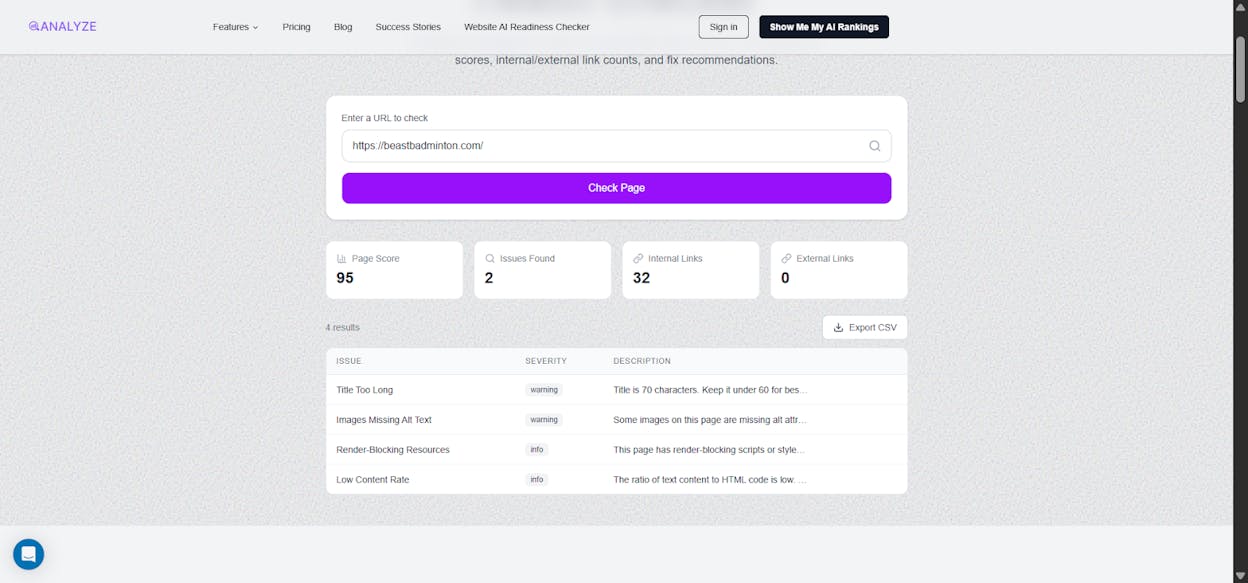
B. AI Search (The Channel Most Affiliates Ignore)
Here’s what most beginner guides won’t tell you: AI search is becoming a real traffic source for affiliate sites. Tools like ChatGPT, Perplexity, Google’s AI Mode, Claude, and Copilot are generating answers that cite and link to web content—including affiliate reviews and comparison posts.
This isn’t theoretical. Real affiliate sites are already getting measurable traffic from AI search engines. And because most affiliates haven’t caught on yet, there’s less competition in this channel than in traditional SEO.
SEO is not dead—it’s evolving. The same content that ranks well in Google can also appear in AI-generated answers. But there are specific things you can do to increase your chances of being cited:
1. Structure your content for AI readability. AI models parse well-structured content more effectively. Use clear headings, short paragraphs, tables, and structured data (schema markup). When a user asks ChatGPT “what’s the best email marketing tool for small businesses,” the model pulls from web content that answers that question clearly and directly.
2. Provide original data and unique perspectives. AI models prioritize content that adds something new to the conversation. If your review includes test results, benchmarks, or first-hand experience that no other review has, you’re more likely to be cited.
3. Earn citations from authoritative sources. Just as backlinks matter for Google, citations matter for AI search. When trusted domains reference your content, AI models learn to treat your site as a credible source.
4. Monitor your AI search visibility. This is where most affiliates fly blind. You might be appearing in AI answers without even knowing it—or you might be missing from prompts where your competitors show up. Analyze AI lets you track exactly where your brand or affiliate site appears across ChatGPT, Perplexity, Claude, Gemini, Copilot, and other AI engines.
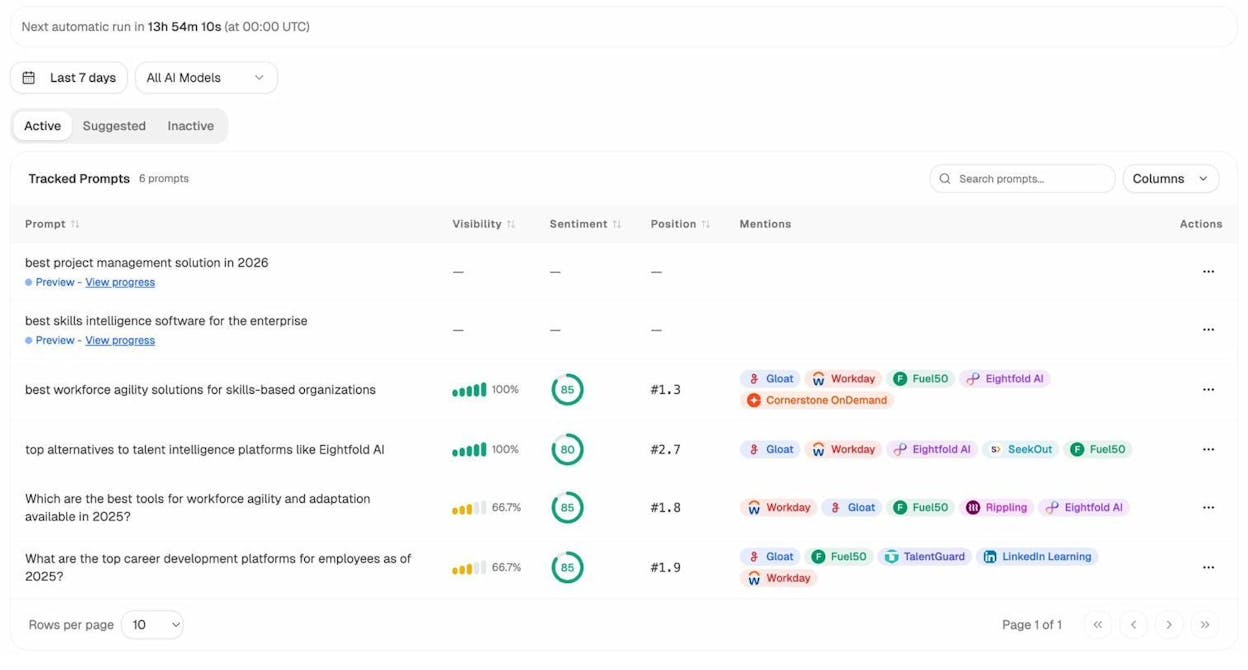
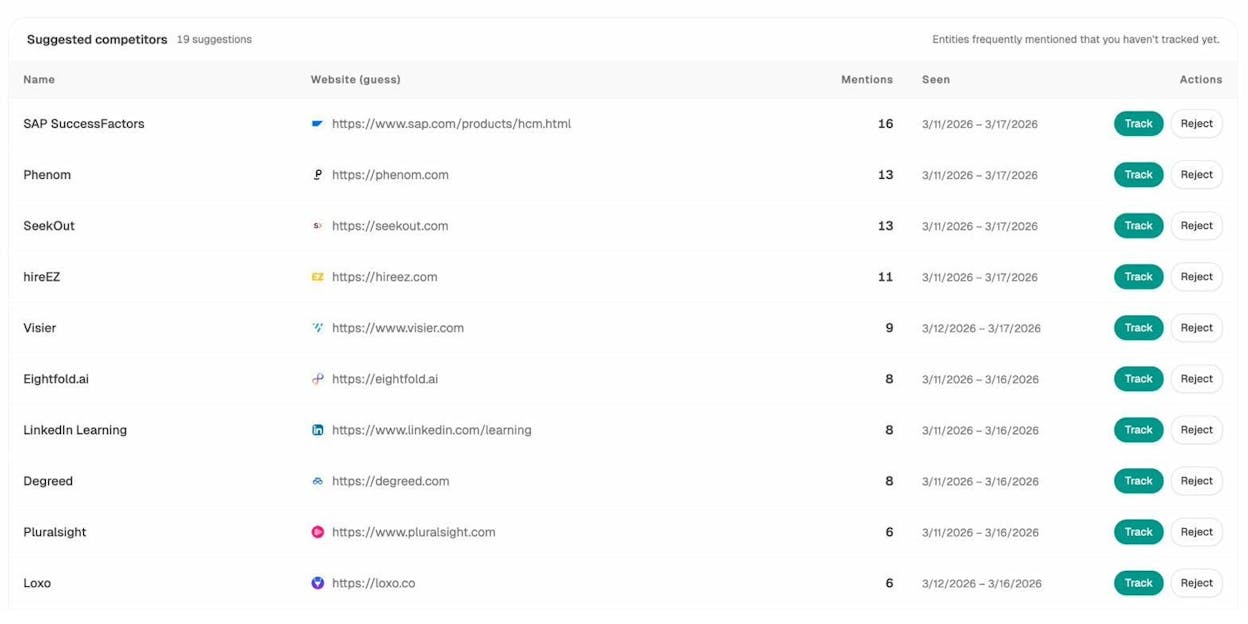
5. Identify content opportunities in AI search. Analyze AI’s competitor tracking shows you where rival affiliate sites are winning in AI answers and where you’re absent. This gives you a concrete list of content to create or improve.
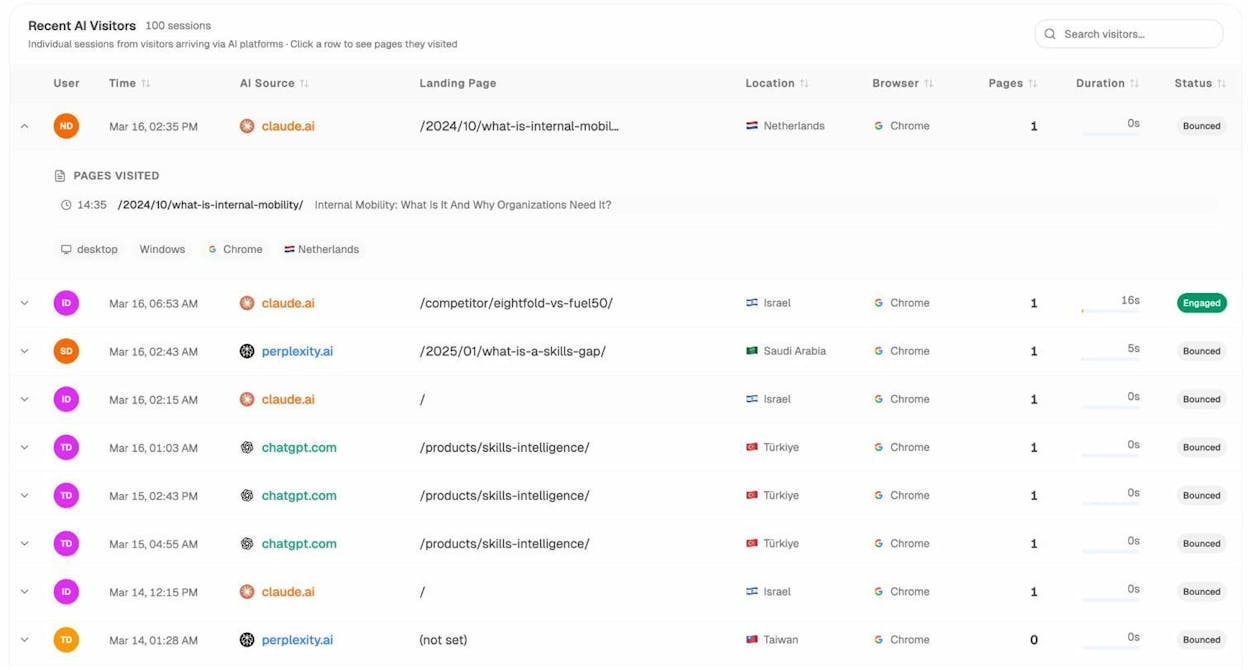
6. Track which pages receive AI traffic. Analyze AI connects to your Google Analytics and shows exactly which pages on your site are receiving visitors from AI search engines—broken down by source (ChatGPT, Perplexity, Claude, etc.).
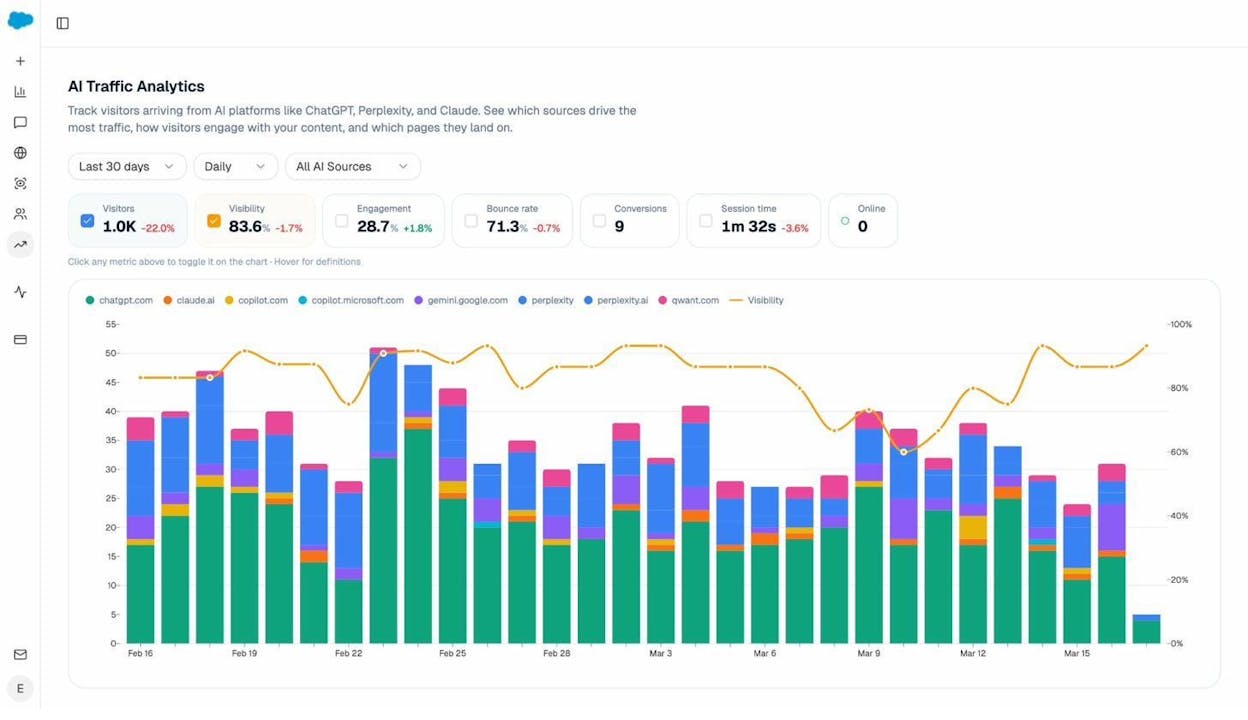
This data tells you what’s already working. If your “Best CRM Software” review is getting 50 visits/month from Perplexity, that’s a signal to double down on that page—update it, add more depth, and make sure your affiliate links are optimized.
C. Build an Email List
SEO and AI search bring visitors to your content. An email list lets you bring them back.
Email subscribers are your most valuable audience. They’ve explicitly said “I want to hear from you.” That means higher engagement, more repeat visits, and more affiliate clicks over time.
Here’s how to build and use an email list for affiliate marketing:
1. Create a compelling lead magnet. Offer something valuable in exchange for an email address. A free checklist, a comparison spreadsheet, a mini-course, or a resource guide works well. The key is making it directly relevant to your niche.
2. Add opt-in forms to your highest-traffic pages. Use your analytics to identify which pages get the most visitors, then add contextually relevant opt-in forms to those pages.
3. Send value-first emails. Don’t turn every email into a sales pitch. Share useful tips, new content, and genuine recommendations. When you do include affiliate links, make sure they’re relevant and helpful—not forced.
4. Segment your list. Different subscribers care about different things. Segment your list so you send relevant recommendations to the right people.
D. Paid Traffic
Paid advertising—Google Ads, Facebook Ads, YouTube Ads—can drive immediate traffic to your affiliate content. But it’s risky for beginners.
The math needs to work: if you spend $1 per click and your affiliate commission is $10, you need at least a 10% conversion rate just to break even. Most beginners don’t have the optimization skills to make paid traffic profitable from day one.
If you’re just starting out with a small budget, focus on SEO and AI search first. These channels take longer to build but deliver compounding returns without ongoing ad spend.
Step 6: Get Clicks on Your Affiliate Links
Traffic alone doesn’t pay the bills. You need visitors to actually click your affiliate links. Here’s how to increase your click-through rate without being spammy.
Link placement matters. If all your affiliate links are buried at the bottom of a 3,000-word article, most readers will never see them. Place your most important links where readers are most likely to take action—near the beginning of the content (after you’ve established credibility) and throughout the body wherever it’s contextually relevant.
Context is everything. An affiliate link should feel like a natural next step, not an interruption. Compare these two approaches:
Bad: “Today, I’m reviewing the best chef knives. Click here to see them.”
Good: “After testing 12 chef knives over three months, these are the three I’d actually buy. Here’s why the Victorinox Fibrox Pro came out on top.”
The second version gives the reader a reason to click. It establishes credibility (I tested 12 knives) and makes a specific recommendation.
Use visual callouts. Tables, comparison boxes, and buttons draw the reader’s eye and make it easy to take action. Product comparison tables are especially effective because they let readers quickly scan key features and click through to the option that fits their needs.
![[Screenshot: Example of a product comparison table with clear CTA buttons]](https://www.datocms-assets.com/164164/1774858788-blobid12.png?auto=format,compress&w=1248&fit=max)
Don’t overdo it. If every other sentence is a link, your content looks like spam. A good rule of thumb: only link where the reader would naturally want to learn more about or purchase the product. Quality of placement beats quantity of links.
Step 7: Convert Clicks to Sales
Getting clicks is only half the equation. The other half—converting those clicks into actual purchases—is largely out of your control. The merchant’s website, pricing, checkout experience, and product quality all affect conversion rates.
But you can stack the odds in your favor by choosing the right affiliate partners.
Look for programs with proven conversion rates. Some merchants convert better than others. If a program shares its average conversion rate or EPC (earnings per click), use those numbers to estimate your potential earnings before investing time in promoting them.
Check public income reports. Some affiliate marketers publish income reports that show how much they earn from specific programs. Search “[affiliate program name] + income report” to find these. If multiple successful affiliates are earning from a program, it’s likely a good one.
Promote products you’d recommend anyway. This is the simplest filter. Would you recommend this product to a friend or family member? If not, don’t promote it. Short-term commissions aren’t worth the long-term damage to your credibility.
Ask the affiliate manager. Most programs assign an affiliate manager who can share conversion data, top-performing landing pages, and promotional assets. Use them—it’s literally their job to help you sell more.
Test different merchants for the same product category. If you’re in the web hosting niche, there are dozens of hosting companies with affiliate programs. Test two or three, see which converts best for your audience, and focus your efforts there.
How to Track Your Affiliate Site’s Visibility in AI Search
This is a step most guides skip entirely, but it’s becoming essential.
AI search engines now drive real, measurable traffic to websites—including affiliate sites. When someone asks ChatGPT “what’s the best VPN for privacy?” or searches Perplexity for “top budget laptops 2026,” the AI model generates an answer that often cites and links to specific web pages.
If your affiliate content is being cited, you’re getting free traffic from a channel that didn’t exist a few years ago. If your competitors are being cited and you’re not, you’re leaving money on the table.
Here’s how to track and improve your AI search visibility:
1. Set up AI traffic tracking. Connect your Google Analytics to Analyze AI to see exactly how much traffic you’re getting from AI engines. The platform breaks down visits by source—ChatGPT, Perplexity, Claude, Gemini, Copilot—so you know which engines are sending you the most traffic.
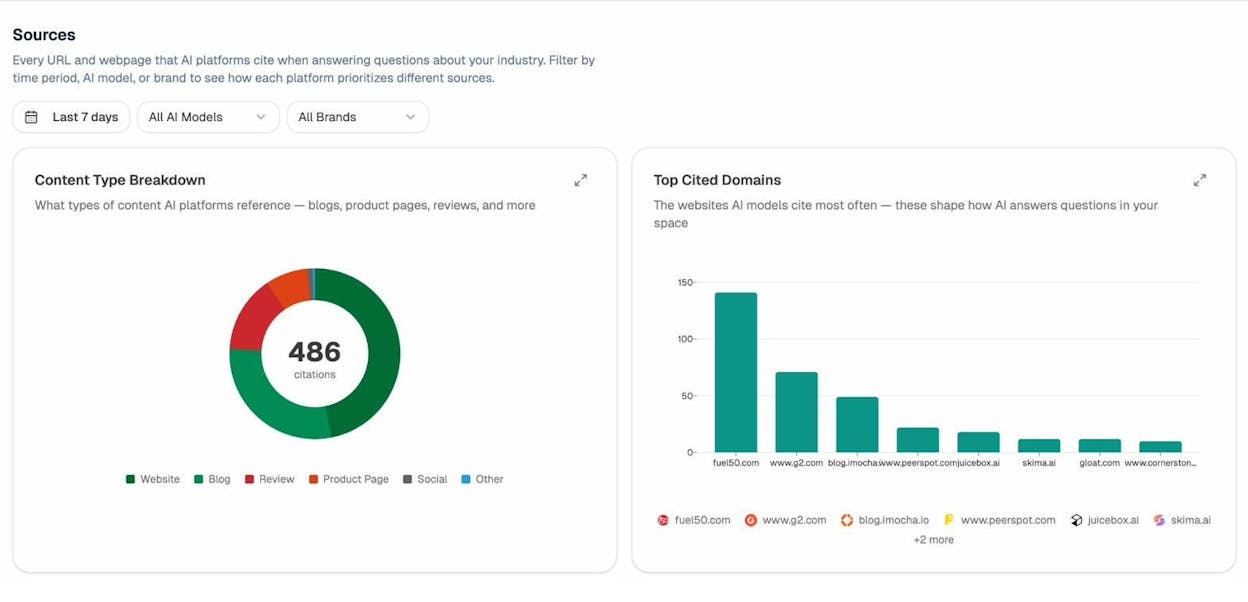
The Sources dashboard shows you which domains AI models cite most often in your space. If you’re not one of the top-cited domains, you know exactly where you need to improve.
2. Track the prompts that matter to your niche. Set up prompt tracking for the search queries your target audience uses in AI tools. Prompts like “best [product] for [use case]” and “[product A] vs [product B]” are the AI equivalents of your target keywords.
3. Monitor competitor visibility. See which affiliate sites appear alongside yours (or instead of yours) in AI-generated answers. This gives you a competitive intelligence advantage that most affiliates don’t have.
4. Double down on what works. When you identify pages that already receive AI traffic, invest in making them even better. Update them with fresh data, add more depth, and optimize their structure for AI readability.
The key insight is that SEO and AI search optimization aren’t separate strategies—they’re complementary. The same fundamentals that make content rank in Google (depth, clarity, authority, structure) also make it more likely to be cited by AI models. The difference is that AI search is a newer channel with less competition, which means early movers have an advantage.
Affiliate Marketing Examples That Actually Work
Studying successful affiliate sites teaches you patterns you can replicate. Here are three that do it right—and why.
1. Wirecutter (wirecutter.com)
Wirecutter is the gold standard of affiliate marketing. The site publishes deeply researched product reviews across dozens of categories—electronics, kitchen gear, outdoor equipment, and more. Every recommendation is backed by hands-on testing, expert interviews, and transparent methodology. The New York Times acquired Wirecutter for $30 million in 2016, and the site generates millions in affiliate revenue annually. Wirecutter currently ranks for over 4.5 million keywords on Google and gets an estimated 8.9 million monthly search visits.
What you can learn: Invest in genuine product testing. Readers (and search engines) reward content that demonstrates real experience.
2. RTINGS.com
RTINGS takes a data-driven approach to product reviews. Their TV, headphone, and monitor reviews include standardized test results, comparison tools, and scientific measurements. This level of rigor makes them one of the most trusted review sites online. The site ranks for over 680,000 keywords and receives approximately 3.9 million monthly visits from search.
What you can learn: Systematic testing and original data create a competitive moat that’s nearly impossible for AI or competitors to replicate.
3. NerdWallet (nerdwallet.com)
NerdWallet dominates the personal finance affiliate space—credit cards, banking, insurance, and investing. Their content is actionable, well-organized, and regularly updated. The company went public in 2021, validating the scale that affiliate marketing can reach.
What you can learn: Choose a niche with high-value affiliate programs (financial products pay well), and commit to regularly updating your content to maintain rankings.
Common Affiliate Marketing Mistakes to Avoid
Most affiliate marketers who quit do so because they made one of these avoidable mistakes.
Choosing a niche purely for money. High-commission niches like finance and SaaS are tempting, but they’re also the most competitive. If you have no interest or expertise in a topic, your content will be generic—and generic content doesn’t rank, doesn’t convert, and doesn’t last.
Spreading across too many platforms. Beginners often try to run a blog, YouTube channel, Instagram, TikTok, and Pinterest simultaneously. Each platform takes months to learn and build an audience on. Pick one or two and go deep.
Ignoring SEO and AI search. Social media followers come and go. Algorithm changes can kill your reach overnight. But organic traffic from search engines and AI platforms compounds over time. If you’re not investing in search, you’re building on a fragile foundation.
Promoting too many products. When you recommend everything, you recommend nothing. Readers trust affiliates who are selective—who clearly explain why they recommend Product A over Products B, C, and D.
Not disclosing affiliate relationships. Beyond the legal requirement, failing to disclose makes you look dishonest when readers inevitably figure it out. Be transparent from the start.
Giving up too soon. Most affiliate sites take 6–12 months to gain traction. The first few months often feel like you’re writing into a void. That’s normal. Keep publishing, keep improving, and keep learning.
Affiliate Marketing Tools
These tools will help you run your affiliate business more effectively:
|
Tool |
What It Does |
Cost |
|
Track your brand’s visibility in AI search, monitor competitor mentions, measure AI referral traffic, and identify content opportunities across ChatGPT, Perplexity, Claude, and more |
Paid plans available |
|
|
Suite of free tools including keyword generator, keyword difficulty checker, SERP checker, broken link checker, website authority checker, keyword rank checker, and website traffic checker |
Free |
|
|
Google Search Console |
Monitor your site’s performance in Google Search, find technical issues, and see which keywords drive organic traffic |
Free |
|
Google Analytics |
Track website traffic, user behavior, conversions, and traffic sources—including AI referrals when paired with Analyze AI |
Free |
|
WordPress + Rank Math |
WordPress is the most popular CMS for affiliate sites. Rank Math helps optimize your on-page SEO |
Free (with premium options) |
|
ThirstyAffiliates |
Manage, cloak, and track your affiliate links. See which links get the most clicks and protect against commission theft |
Free (with premium options) |
|
Canva |
Create custom images, social media graphics, and Pinterest pins for your affiliate content without design skills |
Free (with premium options) |
Frequently Asked Questions
How long does it take to make money with affiliate marketing?
Most affiliate marketers don’t earn significant income until 6–12 months in. Some take even longer. The timeline depends on your niche competition, content quality, and how consistently you publish. Focus on building a solid foundation rather than chasing quick wins.
Can you do affiliate marketing without a website?
Yes, but it’s harder. You can promote affiliate links through YouTube, social media, email, or even direct messaging. However, a website gives you the most control and the best long-term results—especially when combined with SEO and AI search strategies.
What is EPC in affiliate marketing?
EPC stands for “earnings per click.” It’s calculated by dividing your total commissions by the number of clicks on your affiliate links. For example, if you earned $500 from 1,000 clicks, your EPC is $0.50. This metric helps you compare the profitability of different programs.
What is cookie duration in affiliate marketing?
Cookie duration is the window of time after someone clicks your affiliate link during which you’ll earn a commission if they make a purchase. A 30-day cookie means you get credit for any purchase the person makes within 30 days of clicking your link. Longer cookie durations are generally better for affiliates.
How do I start affiliate marketing on Amazon?
Amazon’s affiliate program (Amazon Associates) is one of the easiest to join. Sign up at Amazon’s affiliate page, get your links, and start creating content that recommends products available on Amazon. The commission rates are low (1–10% depending on the category) and the cookie duration is only 24 hours, but the massive product selection and high brand trust make it a good starting point.
How much does it cost to start affiliate marketing?
At minimum, you need a domain name ($3–10/year) and web hosting ($3–10/month). So roughly $40–130 for your first year. Everything else—content creation, SEO, social media—can be done with free tools and your own time. Paid tools and ad spend are optional and can come later as your revenue grows.
Is affiliate marketing still worth it in 2026?
Absolutely. The industry continues to grow, and new traffic channels like AI search are creating opportunities that didn’t exist a few years ago. The key is to approach it as a real business—with a clear niche, quality content, and a long-term strategy—rather than expecting overnight results.
Can AI search engines drive affiliate traffic?
Yes. AI engines like ChatGPT, Perplexity, and Google AI Mode regularly cite and link to product reviews, comparison posts, and buying guides. If your content is high-quality and well-structured, it can appear in AI-generated answers and drive visitors to your site. Tools like Analyze AI can help you track and optimize for this growing channel. Learn more about answer engine optimization and how LLMs cite sources.

Ernest

Ibrahim


